

The Dinner Party That Made Me Rethink Everything,
I’ll never forget the look on my friend’s face when she tried to squeeze past the dining table to reach the kitchen. Six people. One table that was two sizes too big. A room that felt like a walk-in closet with chairs. Nobody said anything out loud, but the constant shuffling and bumping said everything.
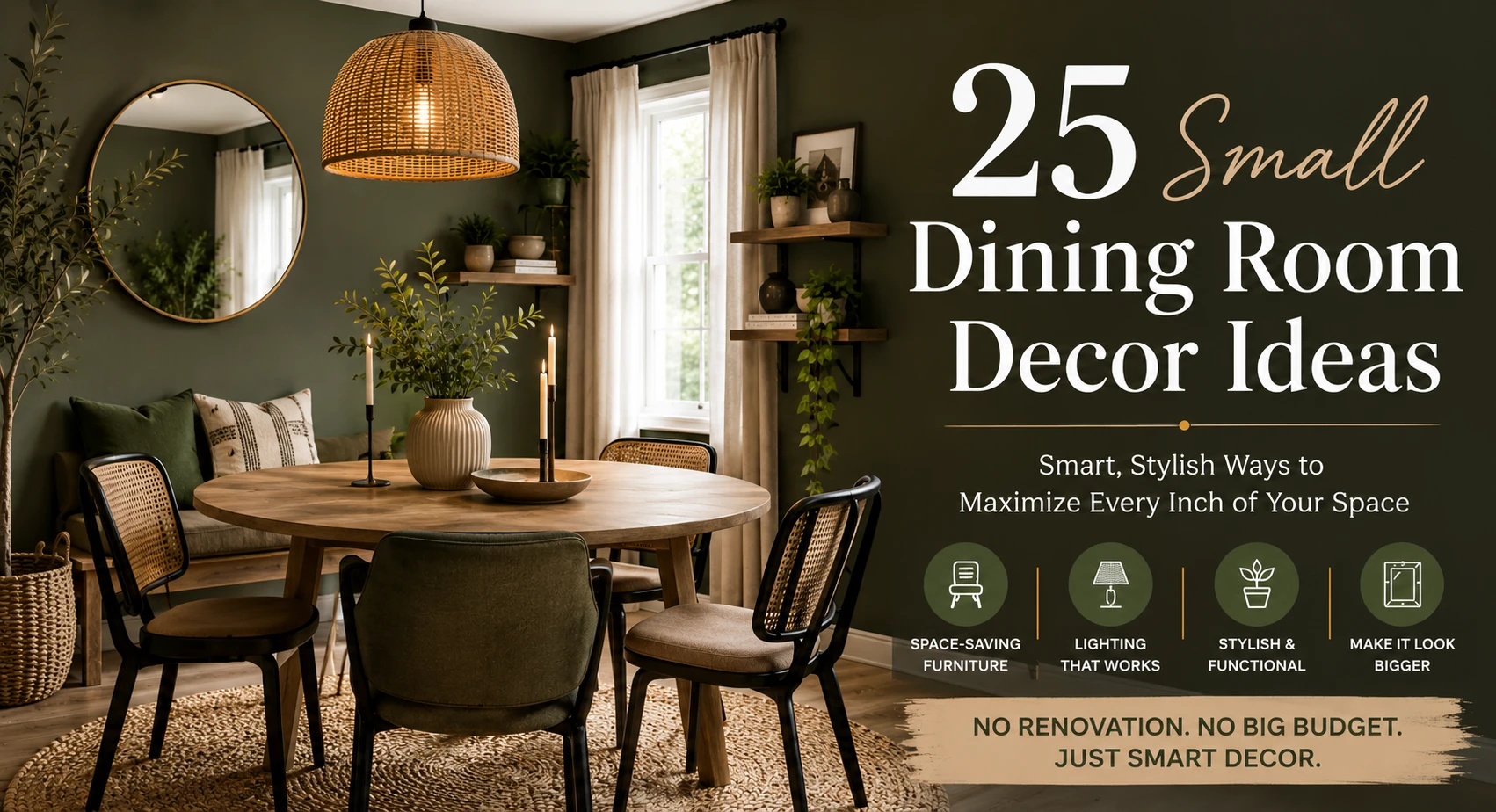
25 Small Dining Room Decor Ideas That Actually WorkIf your dining space feels like an afterthought, you’re not alone. According to the National Association of Home Builders, small dining rooms in apartments and townhouses can be as compact as 90–120 square feet, yet most decor advice online is written for rooms twice that size. I spent weeks testing real strategies, and these 25 small dining room decor ideas are the ones that genuinely work. No renovation. No massive budget. Just practical moves that make a tight space feel intentional and stylish.
This guide covers small apartments, rentals, and townhouses under 1,200 sq ft. It does not address open-plan great rooms or structural changes; those are a different conversation entirely.
What Are Small Dining Room Decor Ideas?
Small dining room decor ideas refer to design strategies, furniture picks, and layout techniques built specifically for compact dining spaces, typically under 150 square feet. They prioritize visual openness, multi-functional pieces, and intentional styling to make tight areas feel purposeful, polished, and larger than they actually are.
1. Pick a Round Table, The Shape That Saves Every Small Dining Room
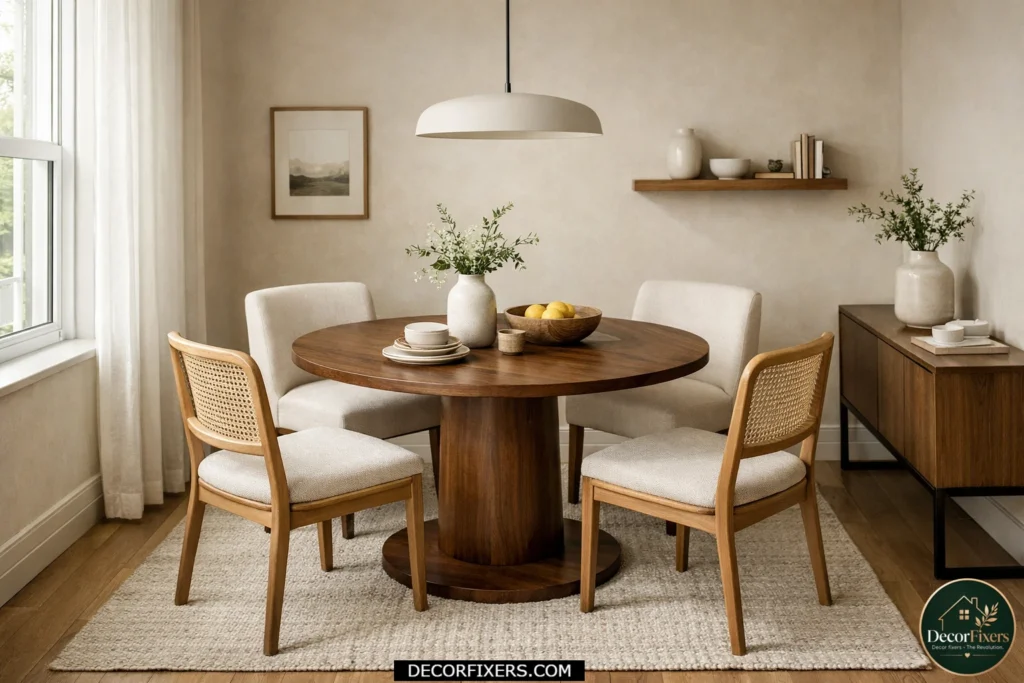
Here’s the thing: the shape of your table matters more than its size. Round tables eliminate corners, which immediately improves traffic flow in a 9×10 room. There’s no sharp edge catching your hip on the way to the kitchen, and no awkward dead-corner seat where someone sits sideways. I always recommend starting with the shape before anything else; it’s the decision that everything else builds on.
The West Elm Mid-Century Round Dining Table (around $599–$799) is a consistently solid pick; its compact 42-inch diameter seats four comfortably, while tapered walnut legs keep the visual footprint light. Pair it with two upholstered chairs and two open-back rattan chairs for that layered look designers charge a lot to suggest. According to Bel Furniture’s layout guide, you need a minimum of 36 inches of clearance around any dining table. Measure that before you buy anything else.
2. Go Extendable: The IKEA EKEDALEN Strategy for Tiny Spaces
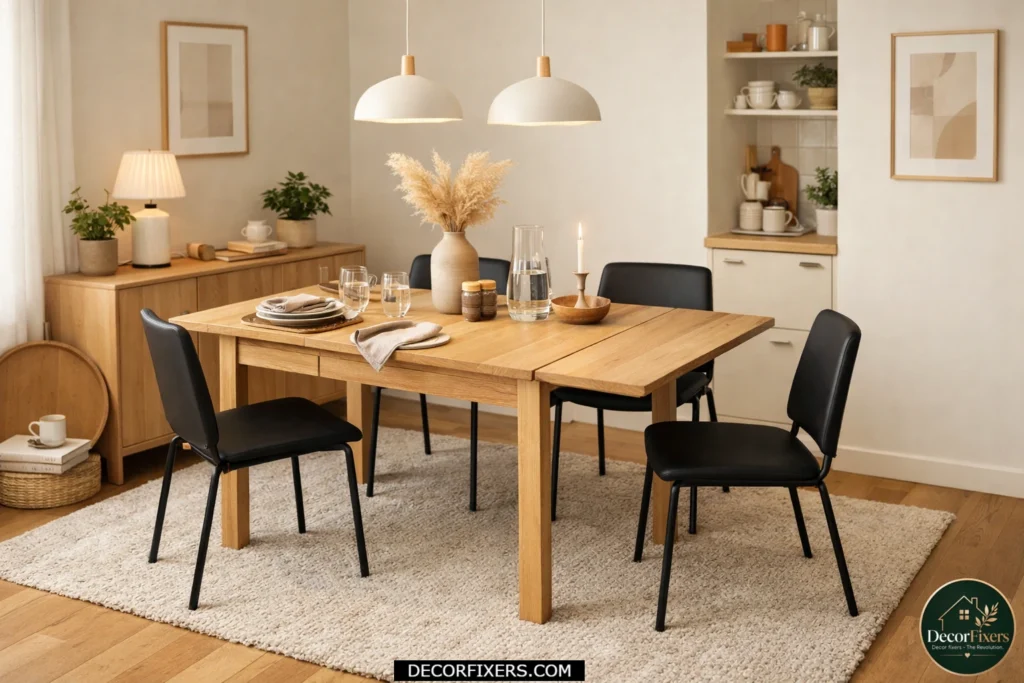
An extendable dining table is one of those small dining room furniture ideas that sounds obvious but transforms the space completely once you try it. The IKEA EKEDALEN starts at $349 and expands from four seats to six, perfect for a room that needs to work on a Tuesday night and a guest-filled Saturday without giving anything up. Day-to-day, it sits compact. Company comes? Expand it in under sixty seconds.
The two most common extension types are drop-leaf and butterfly. Drop-leaf sides fold down when not needed. Butterfly extensions hide the extra leaf inside the table itself, no awkward storage in a cramped apartment closet. For truly small spaces, the butterfly design wins: cleaner look, zero storage hassle, and it reads as a standard table when fully collapsed. If budget allows, CB2 and West Elm carry butterfly-extension options in the $499–$900 range that look distinctly more elevated than the IKEA option.
3. Hang a Statement Pendant to Instantly Anchor the Dining Zone
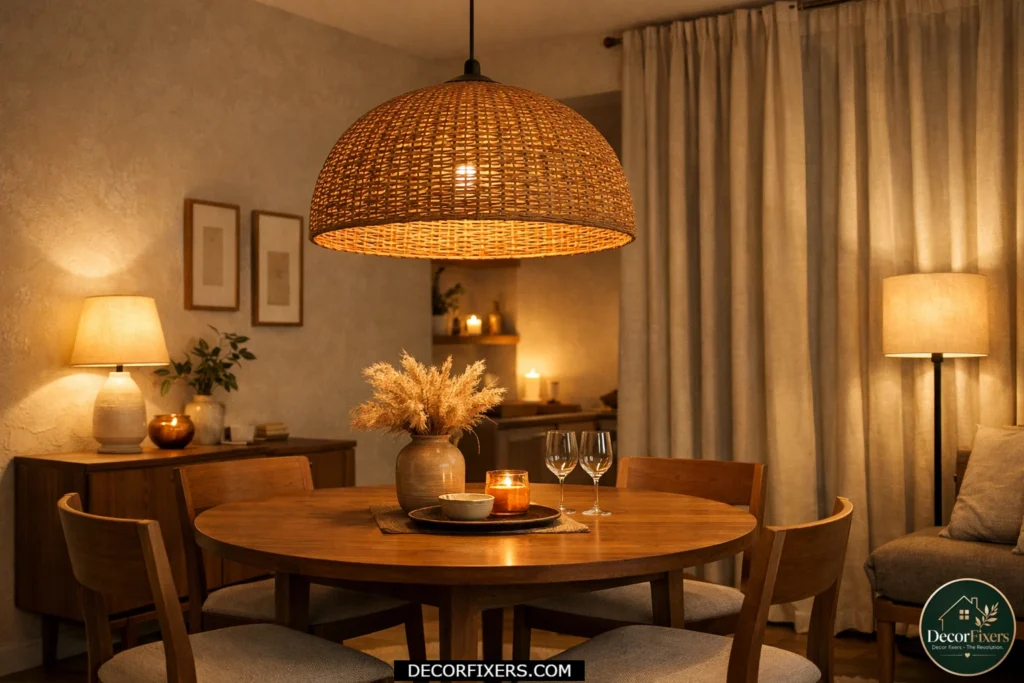
Lighting is the fastest way to make a dining space feel designed rather than just furnished. A single statement pendant hung 28–34 inches above the tabletop creates an immediate focal point, draws the eye upward, and makes the whole room feel deliberate. I’ve seen it change the entire atmosphere of a room in under an afternoon, no paint, no new furniture, just one light fixture.
Open cage and rattan pendant designs add texture without visual weight. Budget picks start at $120–$250 at World Market or on Amazon. For something more elevated, Anthropologie’s woven pendants run $300–$450 and look genuinely expensive over a round table. The sizing rule most people skip: the pendant’s diameter should be roughly half the table’s width. A 42-inch table pairs beautifully with a 20–22-inch pendant. Get that ratio wrong and the whole thing looks off.
4. Use a Large Mirror to Make the Room Look Twice Its Size
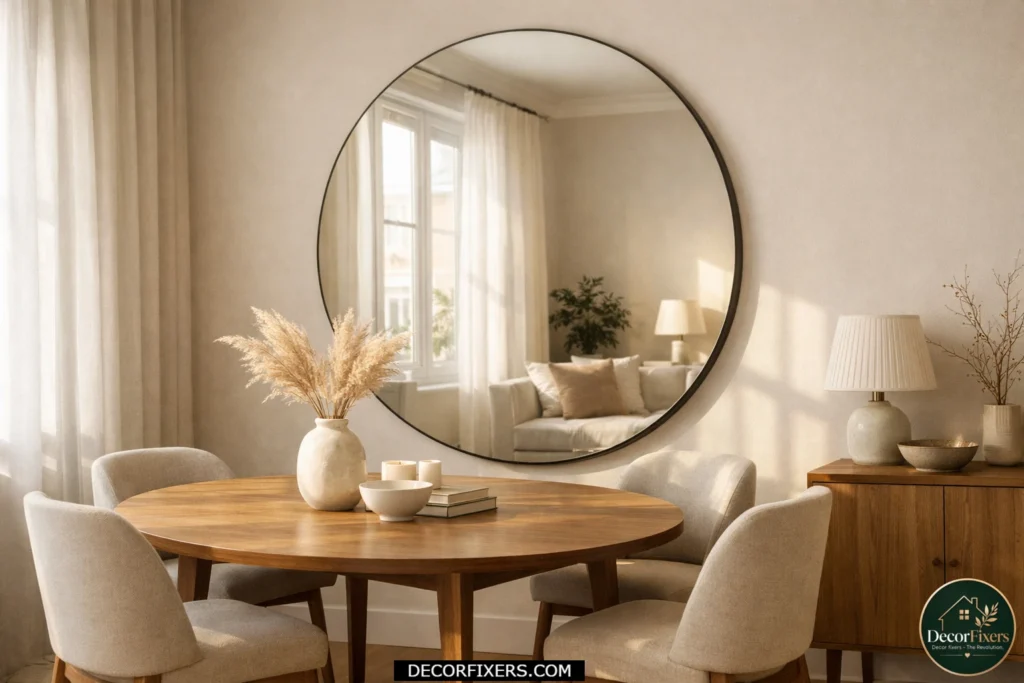
Mirrors are free square footage. A well-placed mirror on the wall opposite a window bounces natural light around and creates genuine visual depth; rooms look and feel bigger immediately. The CB2 Facet Round Mirror (around $299) is a go-to recommendation for small dining rooms because its faceted surface scatters light beautifully without looking fussy or overdone.
The placement details most people miss: hang the mirror so it reflects something beautiful, a window, a plant, a good light source, not a blank wall. A 24×36-inch mirror is the minimum for meaningful impact. Going larger is almost always better in a small dining room. Leaning a large mirror against the wall works just as well as mounting it and skips the hardware headache entirely, a trick I see used constantly in styled spaces.
5. Swap One Side of Chairs for a Bench, It’s a Game Changer
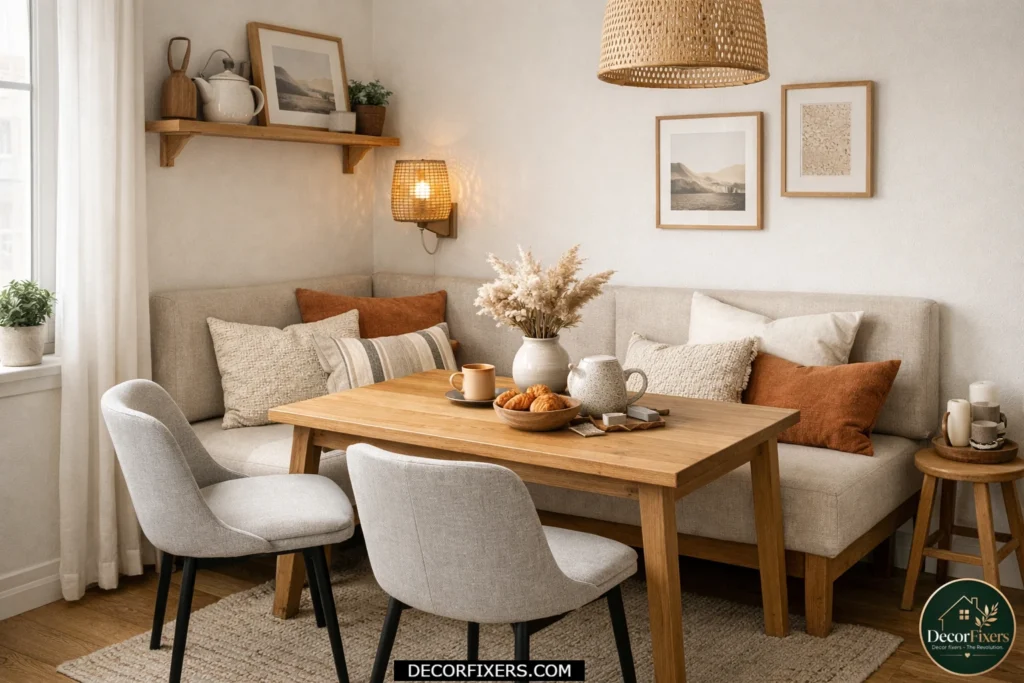
Replacing chairs on one side of the dining table with a bench is one of those tiny dining room decorating tips that outperforms its price. A bench tucks flush under the table when not in use, visually clearing significant floor space. It also seats more people per linear inch than individual chairs, which matters hugely when you’re hosting six people in a room meant for four.
A solid wood or upholstered dining bench in the $150–$350 range delivers a high-end look at a fraction of the cost. Push the bench against the wall; this is the power move. It frees the main walkway completely and creates that built-in banquette feeling that costs $3,000+ when hired. Pair the bench with two statement chairs on the opposite side for a mix-and-match look that’s all over Pinterest right now and genuinely works in real rooms.
6. Paint the Walls Dark, yes, even in a Small Space
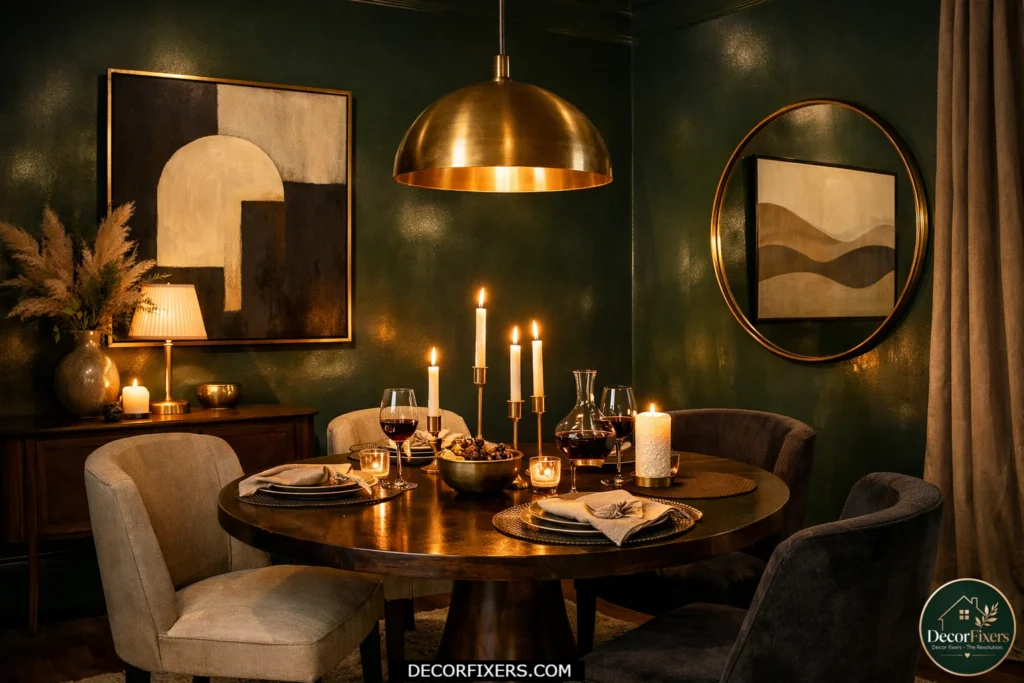
Most people assume small rooms need white or light walls. The data disagrees. Deep tones, forest green, navy, warm terracotta, and rich burgundy actually make compact dining rooms feel more intimate, cozy, and intentional. The room stops reading as a hallway and starts feeling like a destination. Or maybe I should say it this way: a poorly decorated bright-white room always feels worse than a thoughtfully styled dark one.
Paint is also one of the cheapest high-impact moves available, typically $40–$80 in paint cost for a small room. Farrow & Ball’s Hague Blue or Railings are two designer favorites; near-identical shades exist at Sherwin-Williams for a fraction of the price. Use a satin or eggshell finish in a dining room; it reflects just enough light to keep the room from going cave-like, while still delivering that rich, moody quality that flat paint can’t.
7. Float Open Shelves Instead of a Bulky Sideboard
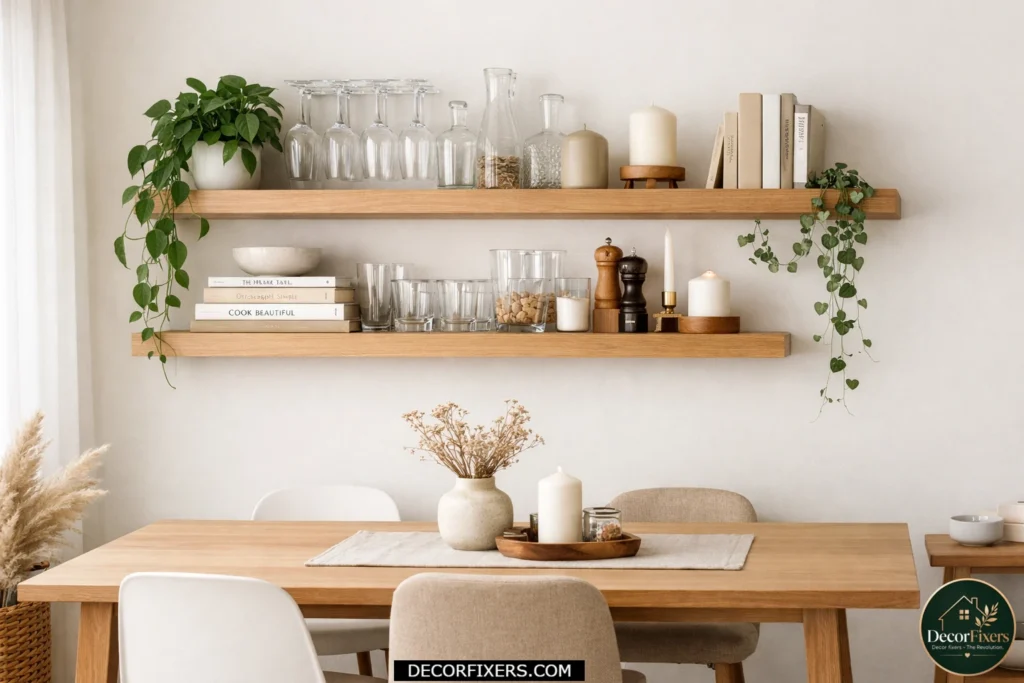
A traditional sideboard in a small dining room eats up floor space aggressively. Open wall shelves give you storage and display surface without occupying any floor space at all, and that distinction changes how the room feels to move through. Float two or three shelves on the main wall, and you instantly have a place for glassware, a plant, a small piece of art, and a candle without crowding the floor.
IKEA’s BERGSHULT shelf system runs $35–$75, depending on size, clean and minimal. For a more luxurious look, solid walnut or oak floating shelves from independent Etsy makers run $80–$200 and add warmth that flat-pack options simply can’t replicate. Style the top shelf decoratively, the middle for everyday glassware, and the bottom for cookbooks or a trailing plant. Three shelves, three purposes. One wall that looks completely intentional.
8. Size Your Rug Correctly, Bigger Than You Think
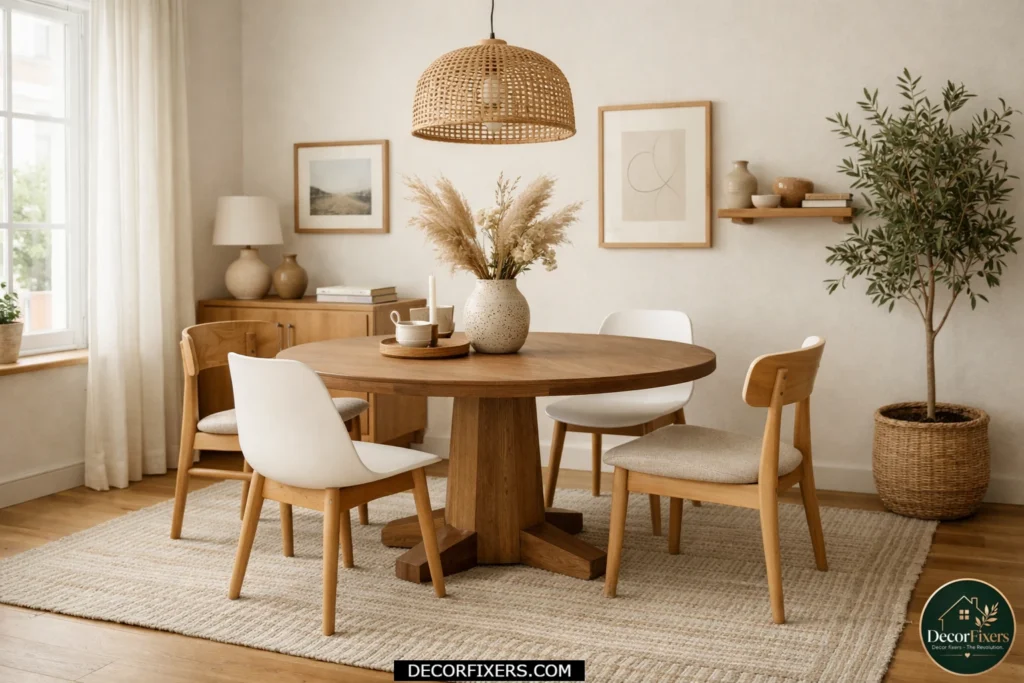
The single most common rug mistake in small dining rooms: buying one that’s too small. A rug that fits only under the table legs, not the chairs, makes the space look disconnected and actually smaller. The correct approach: choose a rug large enough that all chair legs stay on the rug even when pulled out. For a table seating four, that means a 5×8-foot rug minimum. A 6×9 is ideal and still leaves breathing room along the walls.
For material, a flat-weave or low-pile rug is far more practical under dining chairs than a thick shag; chair legs roll more easily, crumbs don’t disappear into the pile, and the room stays looking clean. A quality flat-weave rug runs $120–$400 at Rugs USA, Loloi, or IKEA. Quick note: round rugs under round tables create a cohesive, enclosed look that interior designers specifically recommend for small square dining rooms.
9. Hang Curtains High and Wide, The Free Room-Stretching Trick
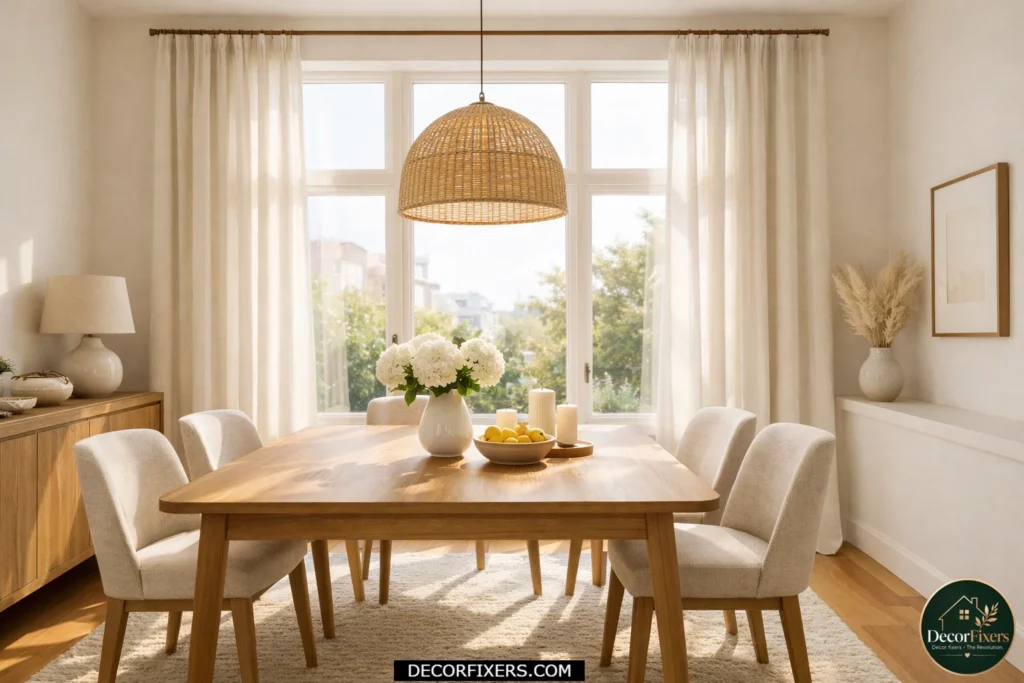
Window treatments are silent room-shapers. Hanging curtains 4–6 inches above the window frame and extending the rod 8–12 inches beyond the window on each side creates the illusion of taller ceilings and wider windows without touching a single structural element. In a modern small dining room, this single move can make the space look like it’s had a serious renovation. I’ve recommended this to people who thought they needed to knock down a wall.
Choose sheer or linen curtains in a tone slightly lighter than your wall color; this creates depth without visual noise. IKEA’s RITVA series runs around $25–$50 per panel, and photographs are far more expensive than it is. Full-length curtains that skim or lightly puddle the floor add an editorial, luxurious quality that short curtains simply cannot achieve, no matter how expensive those short panels are.
10. Build a Gallery Wall With One Clear Visual Thread
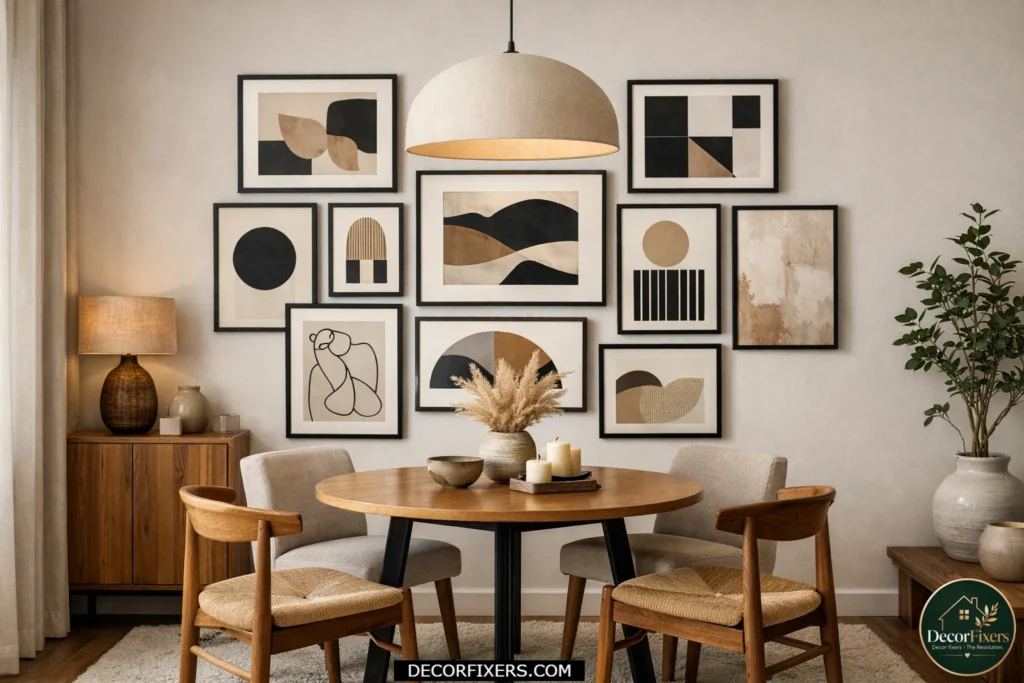
A gallery wall in a small dining room works beautifully, but only when it’s built around a clear visual anchor. The common mistake: grabbing random frames in mixed finishes and calling it curated. What actually works is choosing one consistent frame color, black is the most forgiving, varying the sizes, and centering everything around one large anchor piece at least 16×20 inches.
Look, if you’re in a small apartment with plain white walls and zero art budget, here’s what actually works: three to five prints from Desenio or Society6 at $15–$40 per print, framed in matching black IKEA RIBBA frames at $10–$20 each. Lay everything out on the floor before touching a single wall. Total investment: under $180. Total visual impact: something that genuinely looks like a designed room, not a student apartment.
11. Try Transparent Acrylic Chairs, Invisible Seating That Expands the Room
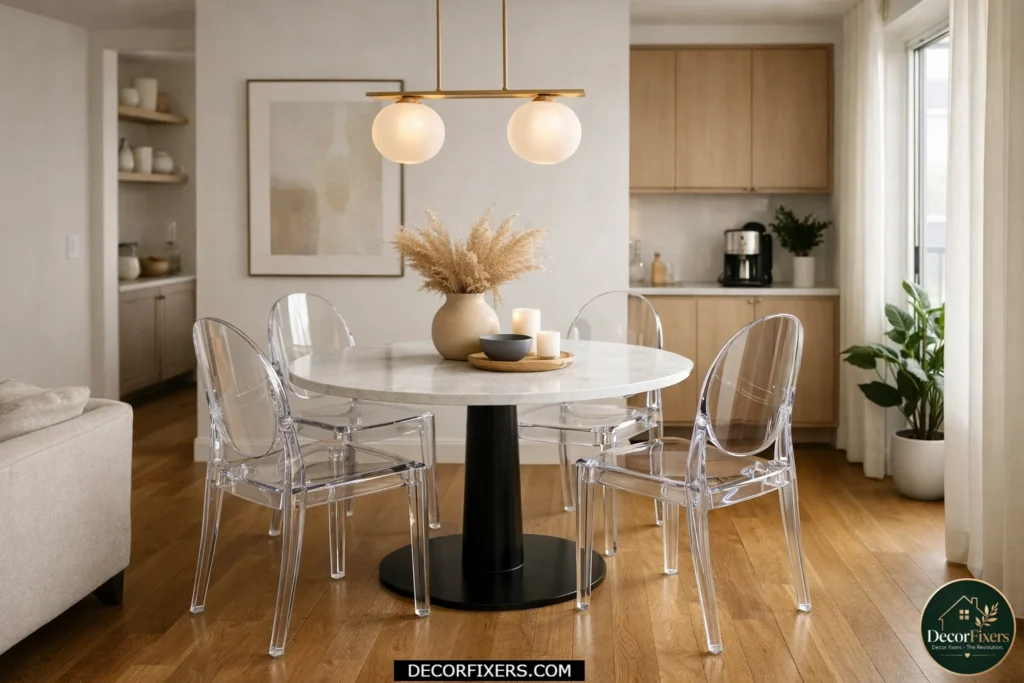
Clear acrylic or ‘ghost’ chairs are the interior designer’s quiet weapon in small dining rooms. They seat people without consuming visual space, your eye reads through them to the floor and walls beyond, making the room look less crowded even when it’s full. You can seat six people, and the room still reads as open.
The original Kartell Louis Ghost Chair runs $550–$650 per chair. Excellent dupes are available on Amazon and Wayfair for $80–$180 per chair; a set of four comes in at $320–$720. That’s less than most single upholstered dining chairs and delivers far more impact in a tight space. Mix two acrylic chairs with two upholstered ones for a layered, designer-coded look that costs less than buying a full matching set.
12. Add a Slim Console Table as a Smart Serving Surface
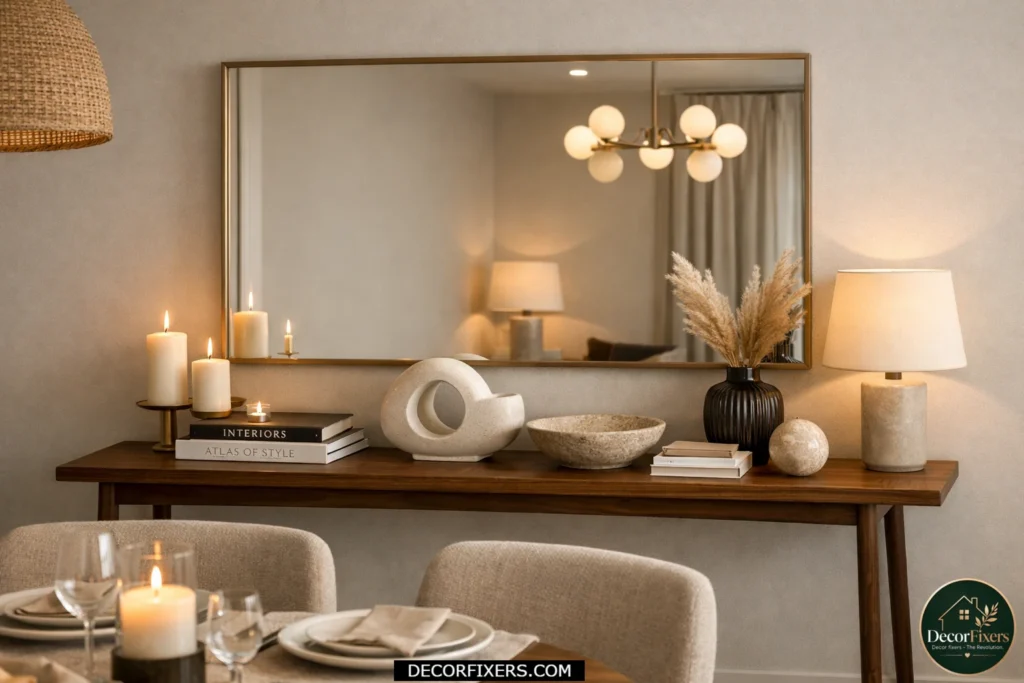
A console table against the dining room wall gives you a secondary surface for serving, staging, and storage without the floor footprint of a full sideboard. The key is depth: choose one no deeper than 14–16 inches. That’s enough to hold a plant, a few candles, and a serving dish while keeping the walkway fully clear. Most small apartments have a wall just begging for this treatment, and almost nobody uses it.
West Elm, IKEA, and Threshold at Target carry slim consoles in the $150–$400 range. Style the top with a trio of objects: a tall plant, a stack of design books, and a sculptural piece, and it reads as a deliberate design moment rather than overflow furniture. Add a mirror above it (see idea #4), and you’ve built a full feature wall in a single weekend for well under $700 combined.
13. Bring in Plants, Life, and Texture Without Losing Floor Space
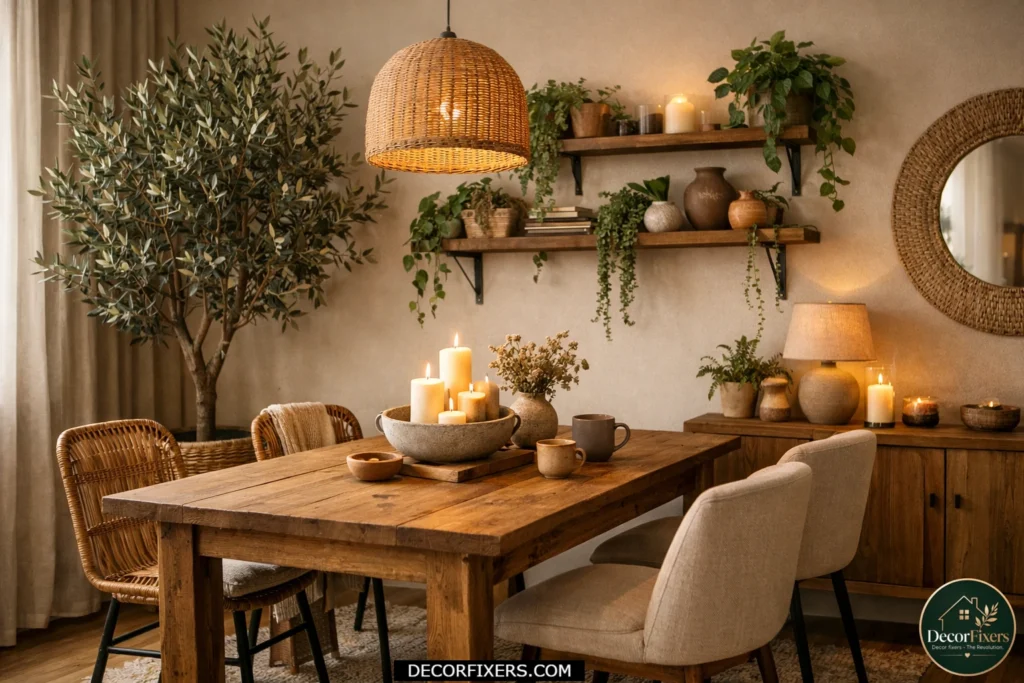
Plants are massively underrated in dining rooms. A single large fiddle leaf fig or olive tree in a corner costs $60–$150 and adds more warmth than most decorative objects at twice the price. They draw the eye upward naturally, add organic texture, and make a space feel genuinely alive, without taking up any functional floor area, as long as you keep them in corners or tight against walls.
For smaller spaces, a trailing pathos on an open shelf or a single hanging planter near a window is easier to maintain and equally effective. Wall-mounted planters run $20–$60 and add a gallery-quality touch to an otherwise plain wall. Green against a deep wall color, especially in the evening with warm lighting, creates the kind of moody, intimate atmosphere you’d pay a premium restaurant cover charge to sit inside.
14. Layer Your Lighting, Three Sources, Completely Different Room
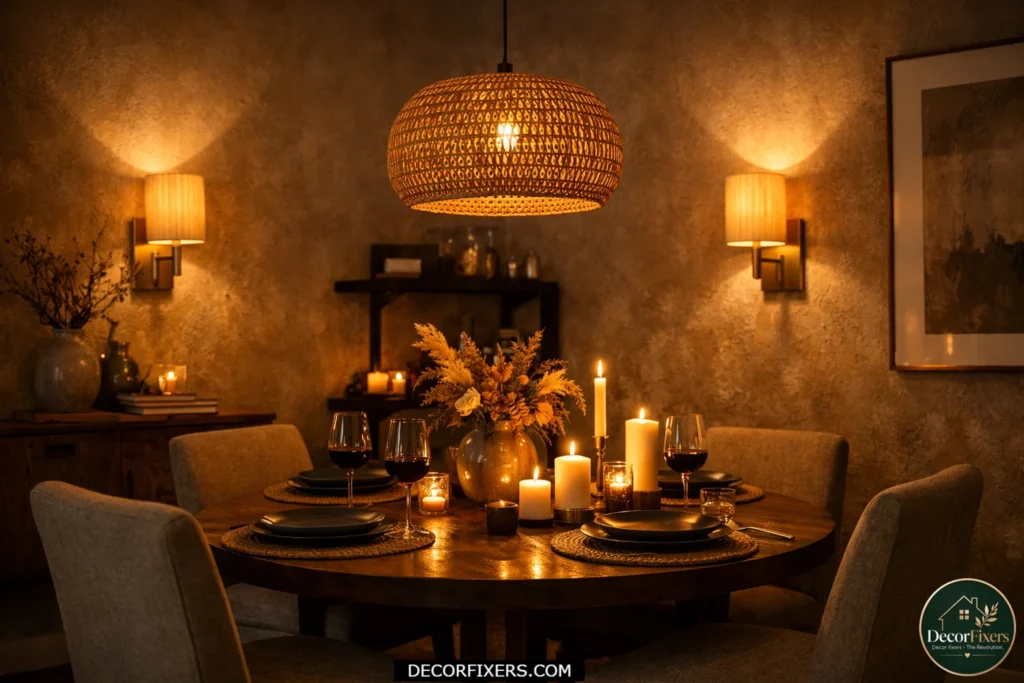
A single overhead light, particularly a flat or harsh one, kills a dining room’s atmosphere instantly. Layered lighting changes everything. The formula that works for small dining rooms: one pendant above the table as the anchor, one or two wall sconces for ambient fill, and a candle or two on the table for intimacy. Three light sources. Dramatically different mood.
Wall sconces don’t require an electrician. Battery-operated and plug-in sconces from IKEA, Rejuvenation, and Amazon look identical to hardwired ones and run $40–$180 each. The full three-layer lighting setup for a small dining room typically costs $200–$500, depending on your pendant choice. That’s one of the best return-on-investment moves in all of home decor, and one of the most consistently underused ones.
15. Choose a Pedestal Base Table, More Legroom, Cleaner Look
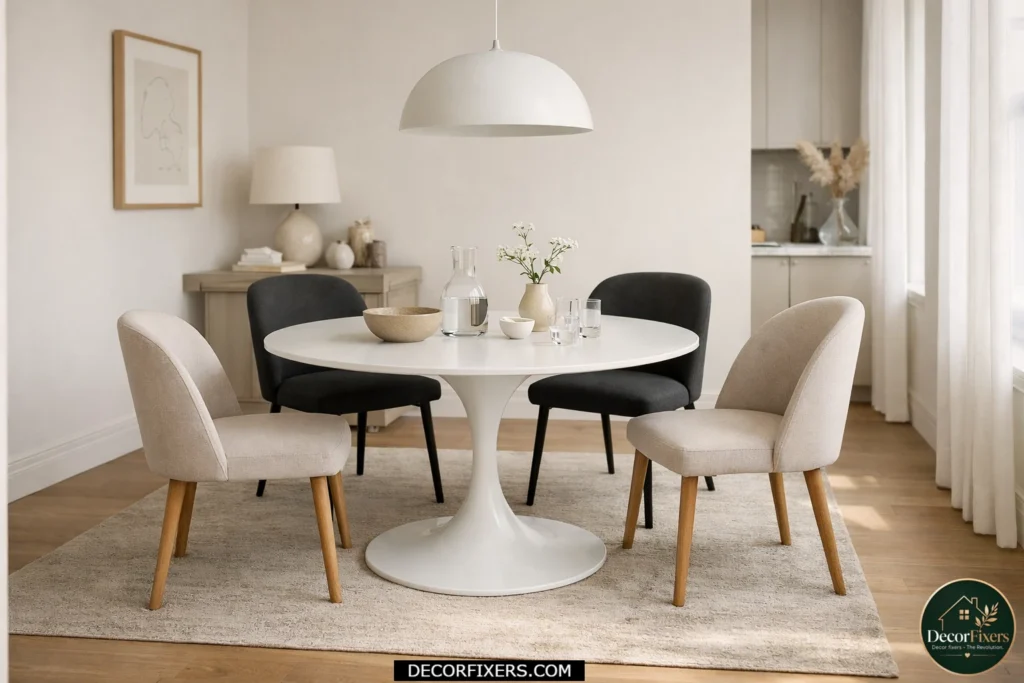
Table legs matter more than most people realize. A four-legged dining table in a small room creates a literal forest of legs that guests, chairs, and feet constantly compete with, especially painful in that dreaded corner seat. A pedestal base eliminates this. One central column means more flexible chair placement, better legroom, and no awkward end-of-table squeeze.
Pedestal tables in round and oval designs start around $350–$700 for solid-looking options at World Market, Target’s Studio McGee line, and IKEA. At the higher end, Pottery Barn’s Bench wright Pedestal Table runs $999–$1,299 and is genuinely beautiful. The pedestal base also anchors the room visually; one strong central column looks more intentional than four scattered legs in a space where every visual detail counts.
16. Paint Just the Ceiling to Zone the Dining Area in an Open Plan
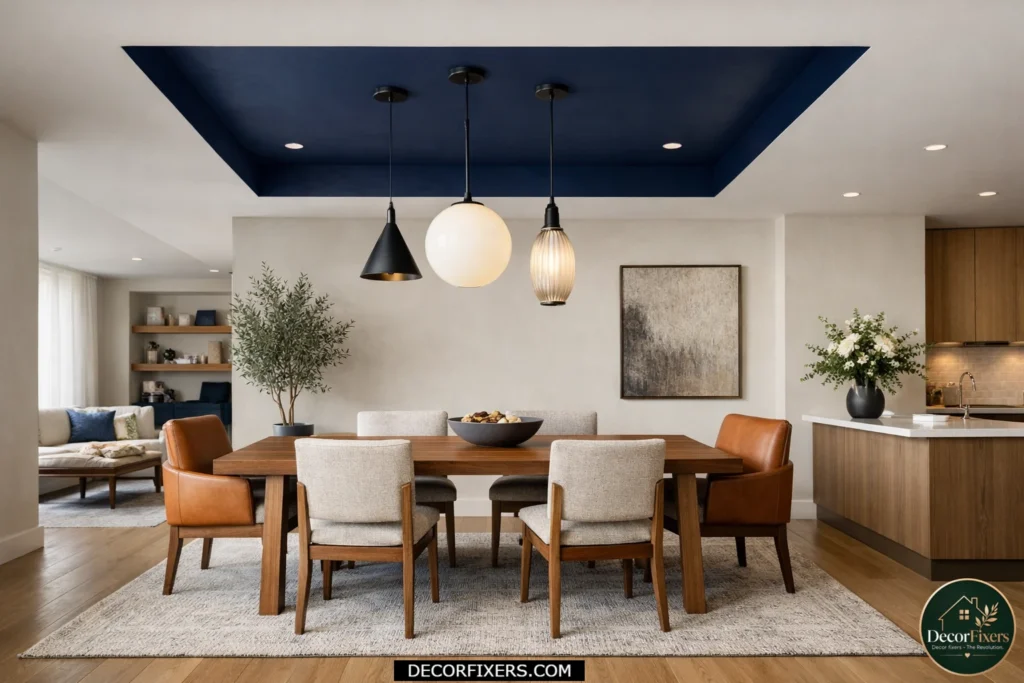
Painting only the dining area’s ceiling a different color is one of the most underused tricks in small apartment dining area decor. It creates a visual boundary, a ‘room within a room’, that defines the dining zone without any walls. Deep navy, terracotta, warm blush, or even a glossy black ceiling creates immediate drama at zero structural cost. Designers call it ‘ceiling zoning’ and charge a lot to recommend it.
The technique shines in open-plan apartments where the dining area bleeds into the kitchen or living room. Cost: the same as a can of paint, $40–$80. Pair a deep ceiling color with lighter walls to keep the room feeling open below eye level. The result reads like something from a boutique hotel, the kind of detail guests notice but can never quite name, which is exactly the point.
17. Style the Dining Table Between Meals, It’s Free Decor
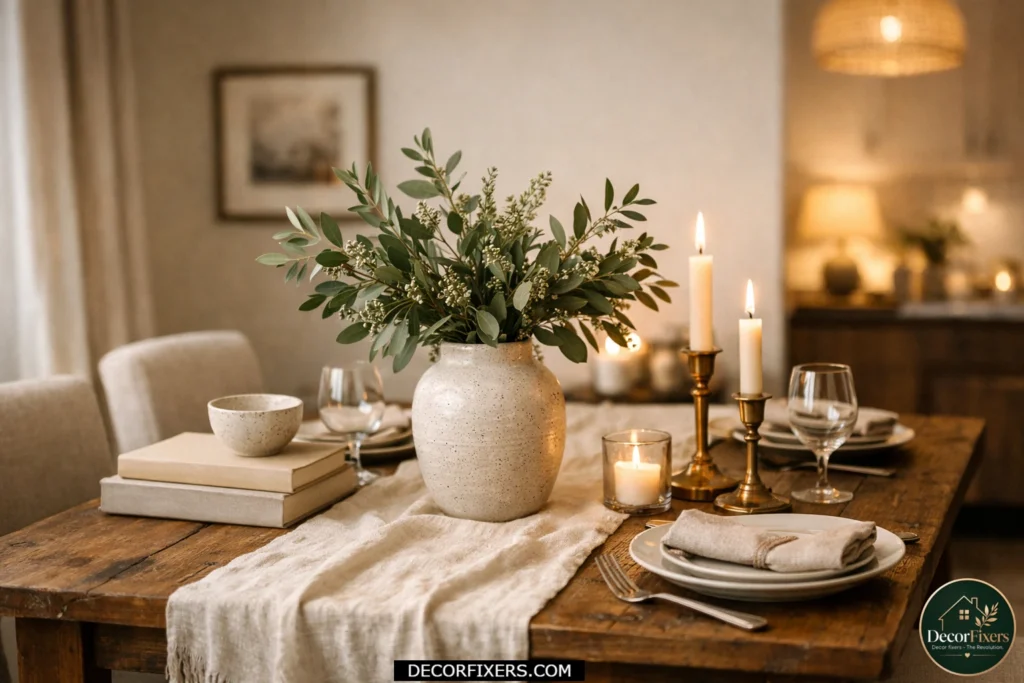
The dining table is the largest horizontal surface in the room, and leaving it bare between meals is a wasted decorating opportunity. A well-styled table center makes the whole room look finished and intentional, even at 7 pm on a Tuesday. The three-element formula: one tall object (a candle, a vase with greenery), one medium object (a bowl of fruit, a stack of books), one low object (a tray, a linen runner, a small ceramic).
Keep it completely functional; everything should move in under thirty seconds when it’s mealtime. A linen table runner costs $20–$60 and is the single easiest styling upgrade available. Taper candles in brass holders ($15–$40 for the pair) add that warm, elevated quality that no amount of larger furniture can replicate. Styled tables in dining rooms consistently perform better in real estate photography; that’s not an accident.
18. Fake a Built-In Banquette, For Under $350 in a Small Rental
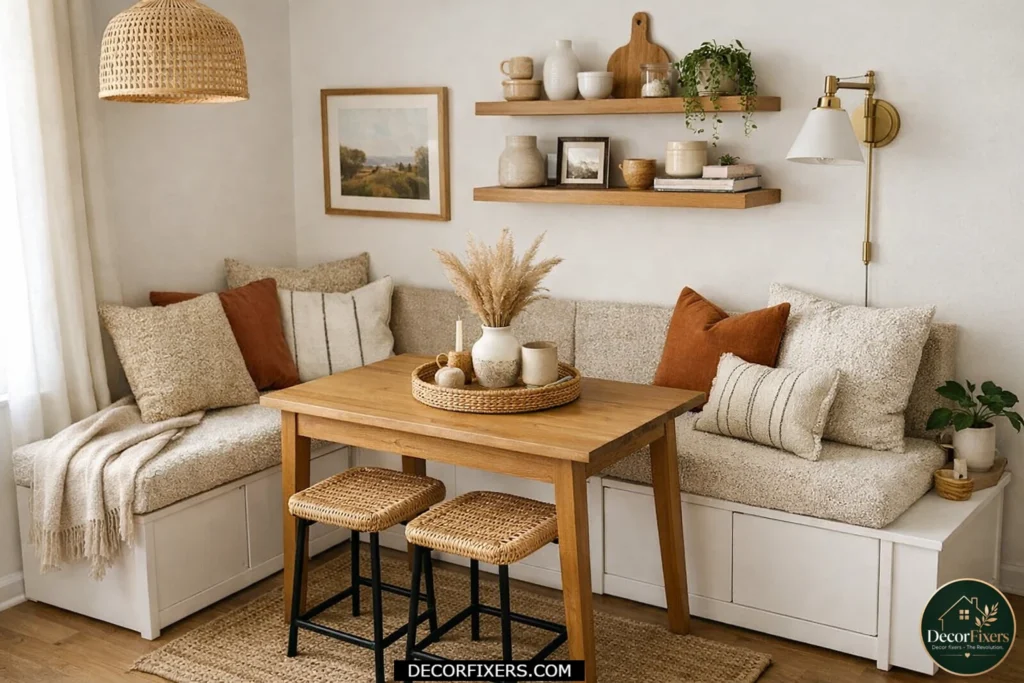
You don’t need to build a real banquette, and you definitely shouldn’t in a rental. The look is achievable for a fraction of the cost. Push a bench or firm two-seater sofa against the wall, bring the dining table up to it, and add a few linen or boucle throw pillows. From across the room, it reads as a designed, built-in banquette. Up close, it’s an IKEA bench and some cushions.
An IKEA KALLAX shelf unit ($129–$199) placed horizontally with a custom cushion on top creates a storage banquette for well under $350 all-in, including cushion and pillows. This is one of the most searched small dining room layout ideas for rentals, and for good reason: it solves storage, seating, and style in one piece. Two KALLAX units’ side by side give you a full-width banquette in a dining nook without a single nail in the wall.
19. Bring in Rattan or Woven Chairs, Warmth Without Visual Weight
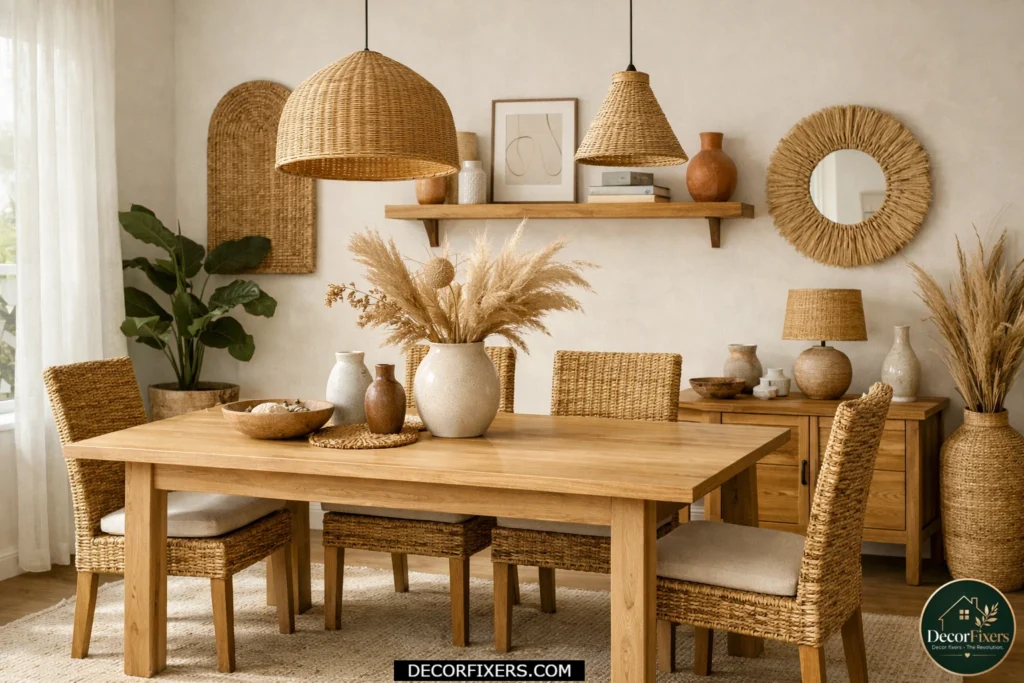
Rattan and woven dining chairs are everywhere right now, and they work especially well in small dining rooms because they’re visually lighter than upholstered chairs while delivering far more warmth than acrylic ones. The open weave ‘reads through’ similarly to a ghost chair, but without the cold, clinical feeling that acrylic sometimes carries in a cozy space.
IKEA’s NILSOVE rattan chair is one of the most underrated small dining room furniture ideas on the market, at around $99 per chair. A set of four: $396, exceptional value for a look that photographs beautifully and ages well. Pair them with a white or oak table against deep-toned walls, and you have a dining room that looks like it belongs on a design blog, at a price point that doesn’t require months of saving.
20. Hang Artwork at Eye Level, 57 Inches, Not Wall Center
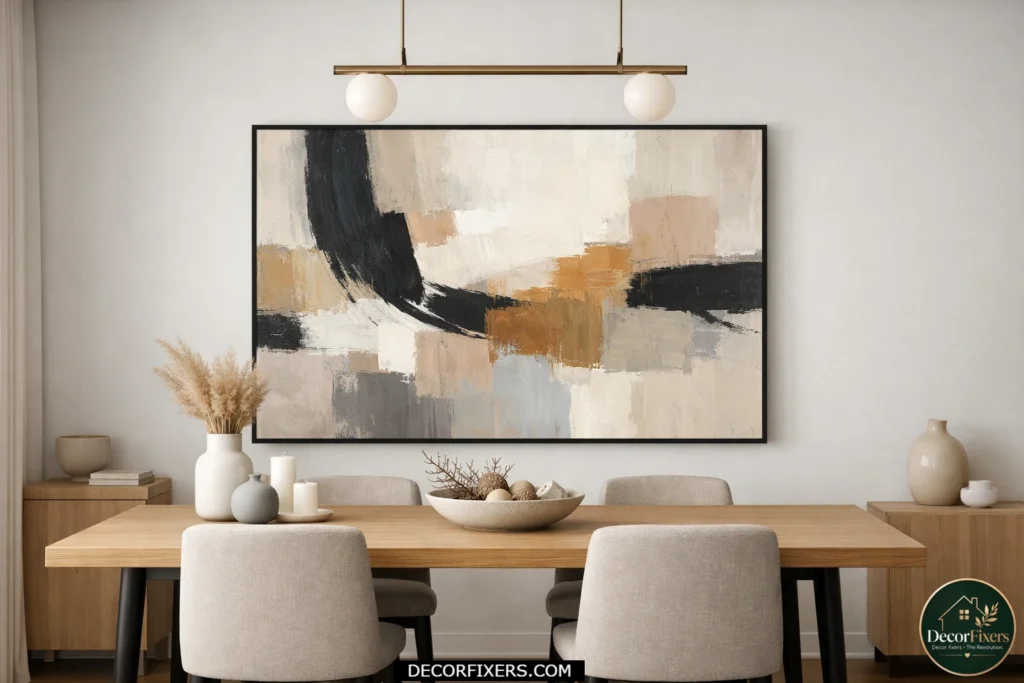
Artwork hung too high is one of the most punishing mistakes in small dining rooms, where every visual decision compounds. The rule: hang art so its center sits at 57–60 inches from the floor, average human eye level. This creates a natural, gallery-quality feeling. Art hung above that point makes the ceilings feel lower and visually disconnects the piece from the rest of the room.
In a small dining room, one large piece, at least 24×30 inches, almost always outperforms a cluster of small frames. Bolder statement, no wall fragmentation, harder to get wrong. Art prints from Desenio, Minted, or Artifact Uprising run $30–$150 in sizes that make a real visual impact. Commission a local artist on Etsy, and you’ll get something genuinely one-of-a-kind for $100–$300, and a story to tell every time someone asks about it.
21. Add Textile Layers, The Cheapest Full-Room Refresh Available
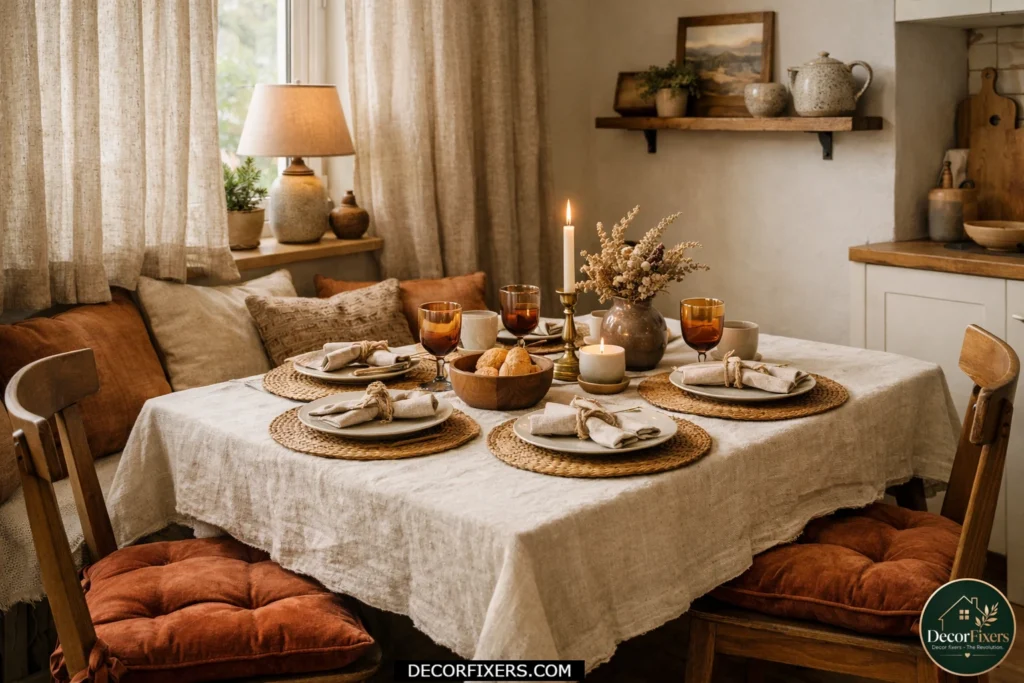
Texture is what separates a room that looks styled from one that looks bought. In a small dining room were loading up on furniture isn’t an option, textile choices carry serious visual weight. A linen tablecloth in an earthy tone, woven placemats, a velvet seat cushion tied onto a wooden chair, these layers make a room feel lived-in and luxurious at the same time.
A full textile refresh, two placemats, a table runner, four seat cushion covers, typically costs $80–$200 shopping at H&M Home, Target’s Threshold line, or IKEA. I’ve watched dining rooms transform completely from swapping plain chair cushions for something in mustard linen or deep sage. It costs under $100 and photographs at four times the price. That’s the kind of return that makes you question why anyone buys new furniture before trying textiles first.
22. Mount Plug-In Wall Sconces, Restaurant Mood, No Electrician Needed
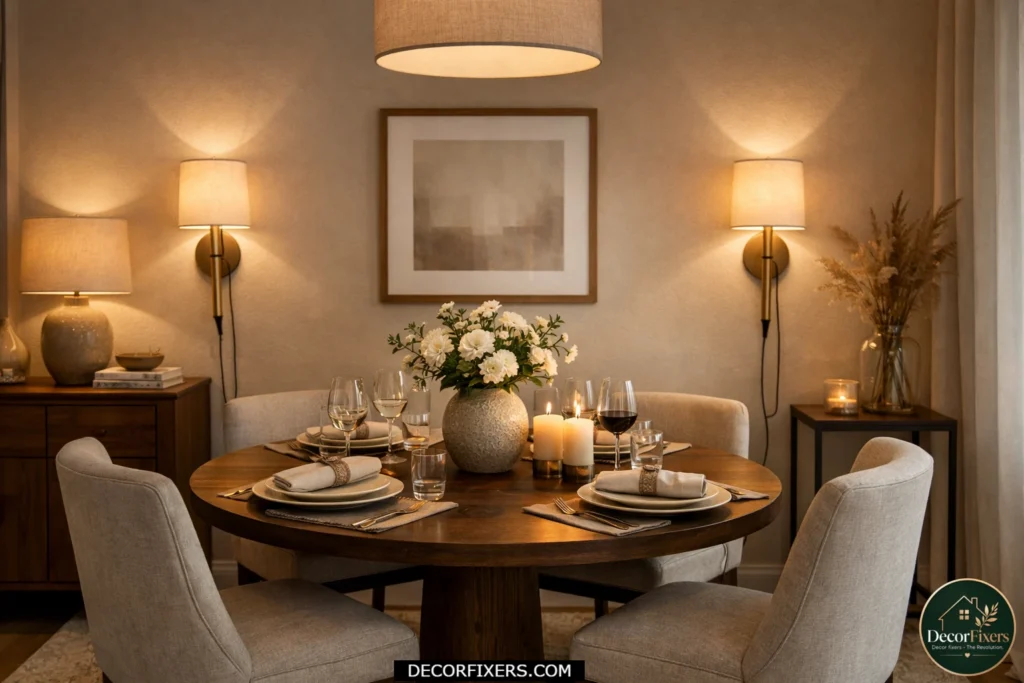
Sconces feel inherently luxurious; they’re the detail you notice in upscale restaurants but rarely replicate at home because wiring feels intimidating. The good news: plug-in sconces exist, look identical to hardwired ones, and require only a nail and a cord managed with a slim cable cover that blends into the wall.
Hang two sconces at 60–66 inches from the floor on the wall adjacent to, not directly above, your dining table. This creates a soft, layered ambient light that makes every meal feel like an event. Budget: plug-in sconces from Amazon, IKEA, or West Elm in the $40–$120 per sconce range. Two sconces plus a cable cover: $100–$280 total. The mood upgrade is completely disproportionate to the cost, which is exactly what makes it worth doing.
23. Choose Leggy, Light-Colored Furniture, Make the Floor Visible
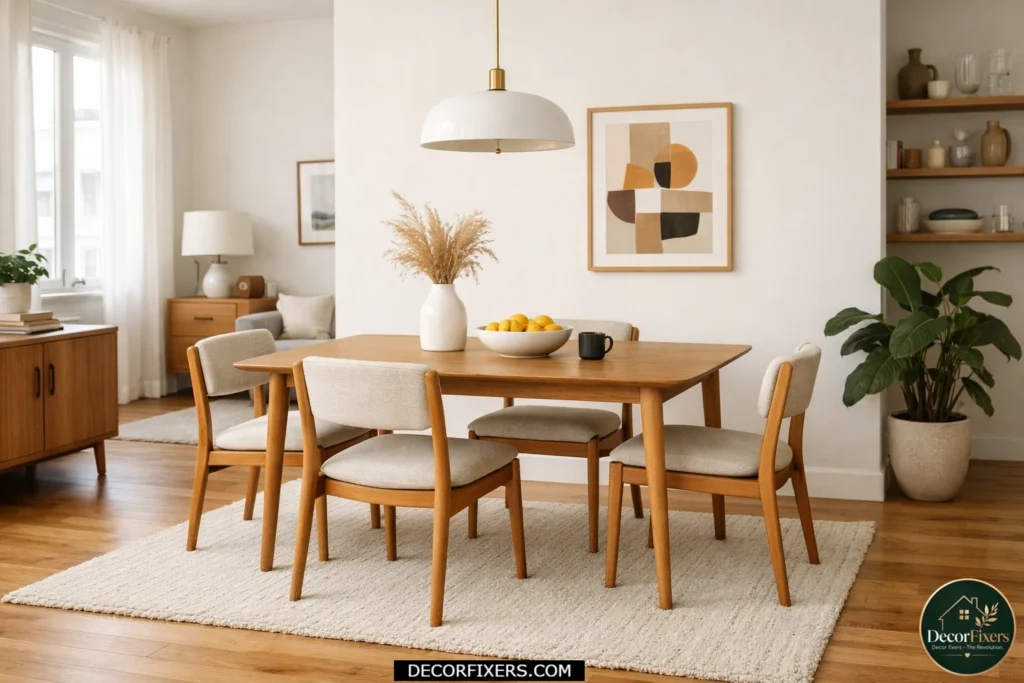
In small dining rooms, furniture that appears to float creates far more visual space than furniture that sits heavy on the floor. Chairs and tables with exposed slim legs, in natural wood or black metal, let your eye travel under and through the pieces, making the room feel larger. This is the core reason mid-century modern furniture works so well in compact spaces: the silhouette was built around exactly this principle.
The Studio McGee line at Target, West Elm’s mid-century dining range, and Article’s furniture all hit this aesthetic between $200–$800 for tables. The rule: darker and chunkier furniture adds visual mass that small rooms can’t afford. Keep at least two of your four chairs in a lighter material, such as cane, acrylic, or light-toned wood, and the room feels intentionally layered rather than accidentally crowded.
24. Go Vertical with a Tall Ladder Shelf, Use the Height You Already Have
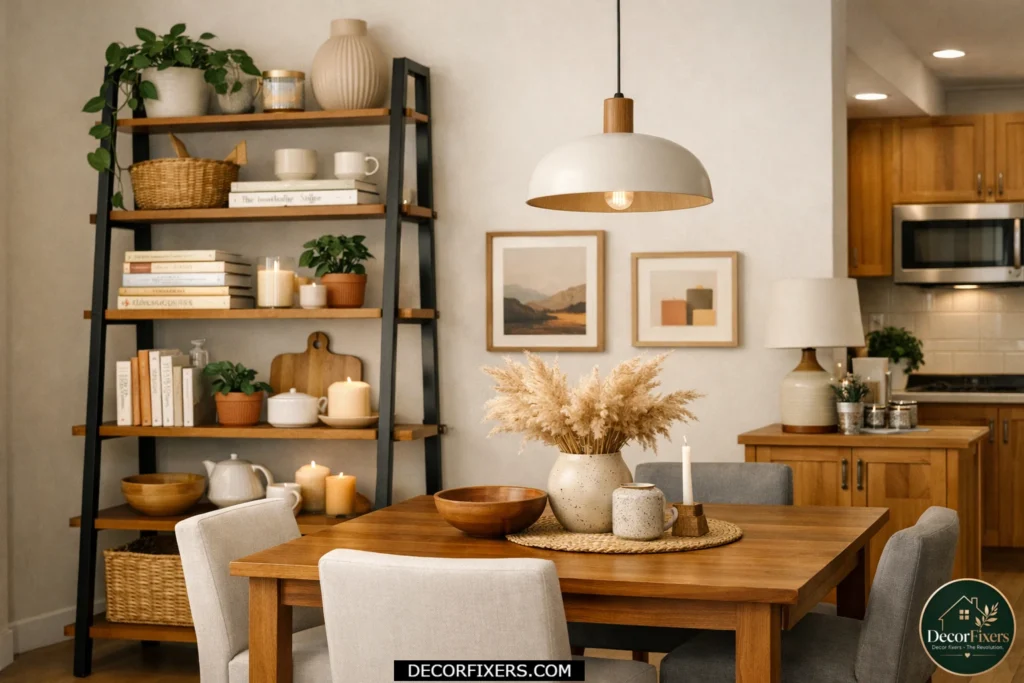
When floor space is gone, the only direction left is up. A tall, slim ladder shelf or floor-to-ceiling unit in a small dining room serves as storage, display space, and visual height simultaneously. It draws the eye upward, one of the most reliable tricks for making any room feel taller, while adding character that flat-packed furniture rarely achieves on its own.
Ladder shelves in natural wood or matte black run $80–$250 at IKEA, Target, or Amazon. Style with a mix of functional and decorative objects: one plant, one candle, actual used cookbooks, a ceramic bowl, and a small print. The styling rule that always works: odd numbers of objects, three or five, look more natural than even groupings. Leave the top shelves sparser; visual breathing room at the top makes the whole piece feel expensive and considered.
25. Commit to a Three-Color Palette, The Rule That Makes Everything Click
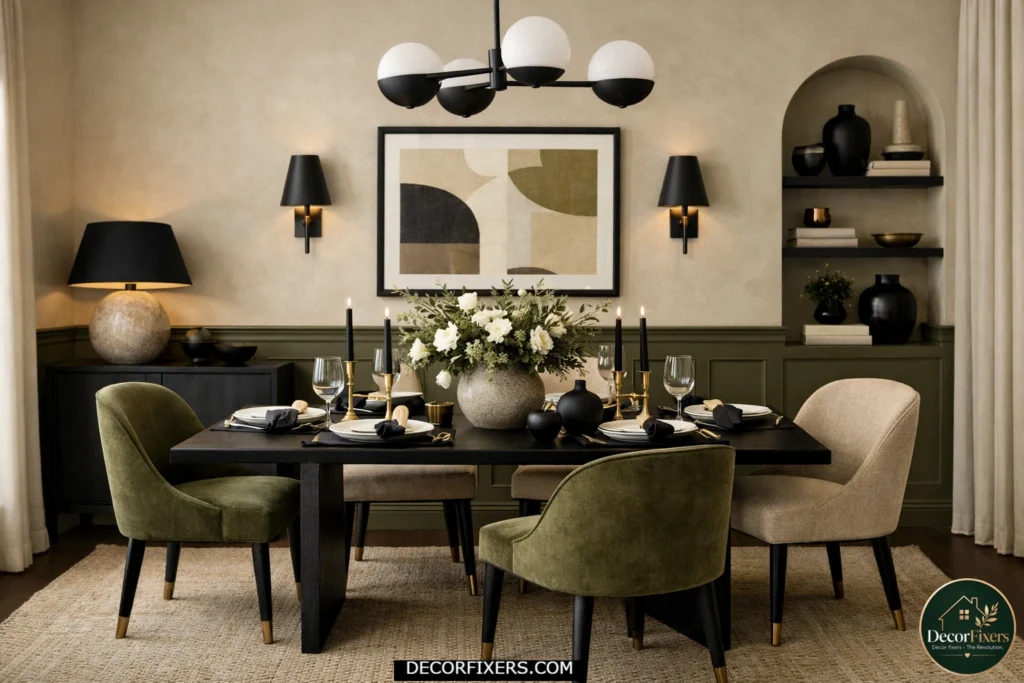
The fastest way to make a small dining room look expensive: commit to a three-color palette and don’t break from it. One dominant color (walls and large furniture), one secondary color (chairs, rug, or textiles), one accent color (art, candles, a single vase). Small rooms that look chaotic almost always suffer from too many competing colors, and that’s not a size problem; it’s a palette problem.
I’ve seen conflicting advice on this; some sources say two colors for clean minimalism, others argue five can work if they’re harmonious enough. My read: three is the sweet spot for a small dining room. Two can tip into sterile. Five is nearly impossible to execute without professional help. Three colors, consistently applied to every object in the room, creates that cohesive, put-together quality that makes guests ask who designed your space, and the palette itself costs nothing to choose.
How to Decorate a Small Dining Room: Quick-Start Steps
To transform a small dining room, follow these steps:
- Measure the room and mark 36-inch clearance zones around where the table will sit.
- Choose your table shape based on room dimensions: round for square rooms, rectangular for narrow ones.
- Select a rug large enough that chair legs stay on it when pulled out, minimum 5×8 feet.
- Hang a statement pendant 28–34 inches above the table surface.
- Layer with a wall mirror, two sconces, and a styled table center to complete the look.
Quick Comparison: Table Shapes for Small Dining Rooms
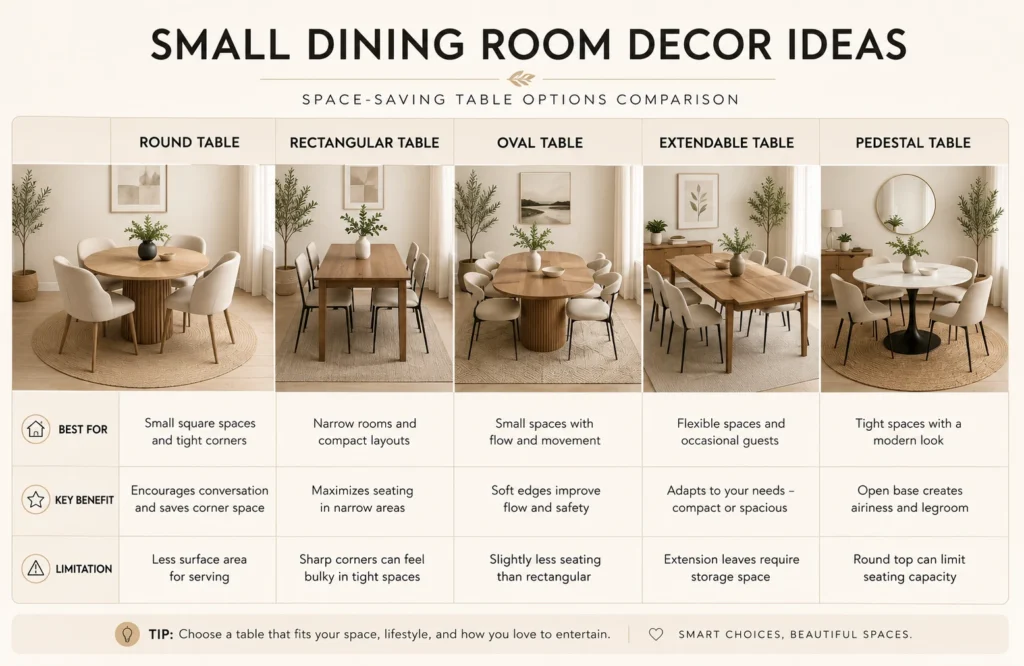
| Option | Best For | Key Benefit | Limitation |
| Round | Square/compact rooms | Eliminates corners, best flow | Seats fewer than a rectangle |
| Rectangular | Long/narrow rooms | Max seating, pairs with benches | Sharp corners cut clearance |
| Oval | Narrow rooms needing 6 seats | Soft edges + rectangle capacity | Harder to source, costs more |
| Extendable | Rental apartments | Compact daily, expands for guests | Mechanism adds cost and weight |
Round vs Rectangular Dining Table: Which Is Better for Small Rooms?
Round vs rectangular dining table: A round table is better suited for small, square rooms because it eliminates corners, improves traffic flow, and creates a more conversational layout. A rectangular table works better when the room is long and narrow or when seating more than six people regularly. The key difference is how each shape interacts with wall clearance and walkways.
CONCLUSION:
I’ve been in that dining room, the one that makes you want to apologize to guests before they even sit down. The table too big. The lighting too flat. Nothing quite connects. It feels personal, even when it’s really just a furniture sizing problem and a rug that’s four inches too small.
What I’ve learned from researching and applying these small dining room decor ideas: you don’t need more square footage. You need better decisions within the square footage you have. A round table instead of a rectangular one. Curtains hung six inches higher. One large mirror instead of three small ones. These aren’t compromises, they’re upgrades, and they cost far less than another furniture haul that doesn’t solve the actual problem.
Start with ideas 1, 3, 4, and 8, table shape, pendant lighting, mirror, and rug sizing. Those four moves alone will transform any small dining room. Everything else on this list is a layer on top of a foundation that actually works. You’ve got this.
This guide is best for renters and small-home owners working within fixed layouts. It does not cover structural changes, extensions, or open-plan redesigns; those are a separate project with a different budget entirely.
FAQs:
Q: What’s the best table shape for a small dining room?
A round table almost always works best for compact spaces because it eliminates sharp corners and improves traffic flow. For rooms that are longer than wide, a slim rectangular table with a bench on one side can work equally well.
Q: How do I make a small dining room look bigger?
Use a large mirror opposite a window, hang curtains high and wide, choose furniture with exposed legs, and keep your color palette to three tones maximum. Layered lighting and a correctly sized rug also significantly expand the room’s perceived size.
Q: Should I use a round or rectangular rug under a round dining table?
A round rug under a round table creates a cohesive, enclosed look that designers specifically recommend for small square dining rooms. Make sure the rug is large enough that chair legs stay on it when pulled out; a 6-foot diameter is typically the minimum.
Q: Why does my small dining room still look cluttered after decorating?
The most common cause is too many competing colors or a rug that’s undersized. Commit to a three-color palette, right-size your rug so chairs stay on it when pulled out, and remove all objects that don’t earn their place visually or functionally.
Q: When should I use a bench instead of dining chairs?
Use a bench on one side of the table whenever you need to seat more people or free up walkway space. A bench pushed against the wall saves more visual and physical floor space than individual chairs on the same side, and costs significantly less than a matching chair set.

Creator of DecorFixers, sharing practical home and interior ideas focused on real-life usability, simple design improvements, and budget-friendly solutions.
5 thoughts on “25 Small Dining Room Decor Ideas That Actually Works”