


I’ve been staring at the same beige walls for two years. Every time I’d sit down for dinner, I’d tell myself: this weekend I’m finally painting this room. Then the weekend would come, I’d pull up a search, get buried in generic ‘warm neutrals’ lists, and close the tab without touching a single brush.
Sound familiar? That cycle ends here.
This guide covers 15 specific color directions, with real product recommendations, pairing notes, and honest limitations, so you leave knowing exactly what to do with your walls. It won’t help if your dining area is a fully tiled, windowless basement; that’s a lighting problem first. But for everything else? Let’s go.
What are modern dining room color ideas?
Modern dining room color ideas refer to intentional wall, trim, or accent color strategies that make a dining space feel current, cohesive, and tailored to its occupants. They go beyond simply picking a trendy shade; they account for light direction, room size, furniture finish, and how the dining area connects to adjacent spaces.
1. Deep Navy Blue, The Color That Makes Dinner Feel Like an Event
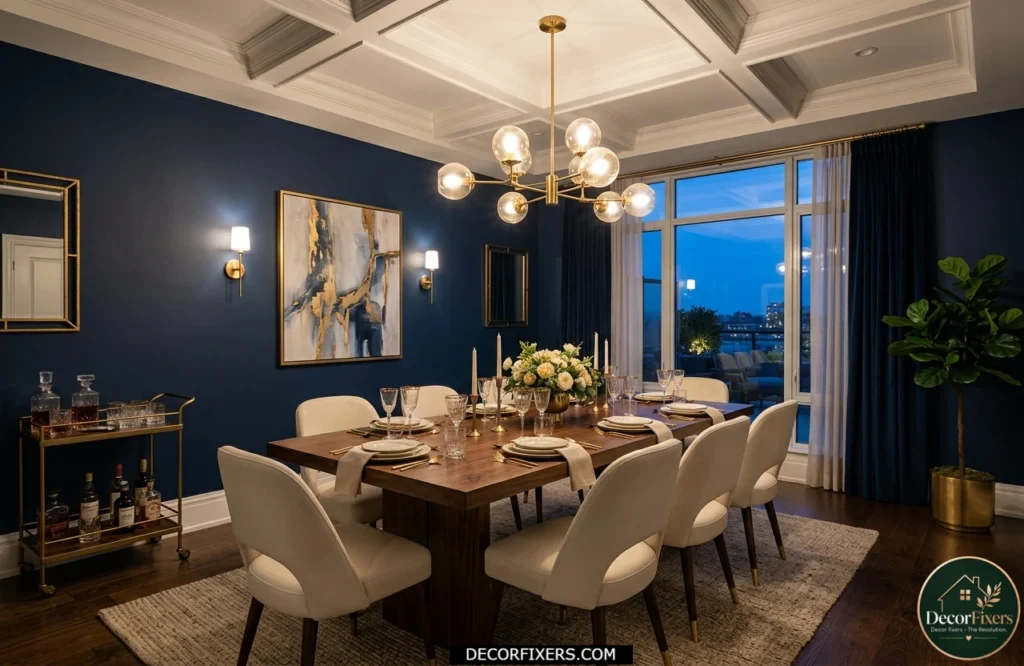
There’s a reason the navy keeps showing up in every designer’s portfolio. It’s not trendy, it’s timeless. A deep navy wall in the dining room creates that pulled-together, intimate atmosphere that makes even a Tuesday pasta night feel like you planned it.
Keep the ceiling light, warm white or cream, or the room will start to feel like a cave. Navy with a dark ceiling is a bold move, not a beginner’s move.
The shift is real, and it’s driven by a desire for rooms that feel lived-in, not staged.
Another question that comes up constantly: Do dark colors work in a small dining room?
Most people assume lighter always means larger. The data says otherwise. Deep shades like charcoal or forest green can visually pull the walls inward in a way that reads as intimate and intentional, especially under warm pendant lighting. This works particularly well in Tiny dining room decor ideas, where the goal is to create atmosphere, not the illusion of more square footage.
2. Forest Green, The Biophilic Shade That Never Goes Out of Style
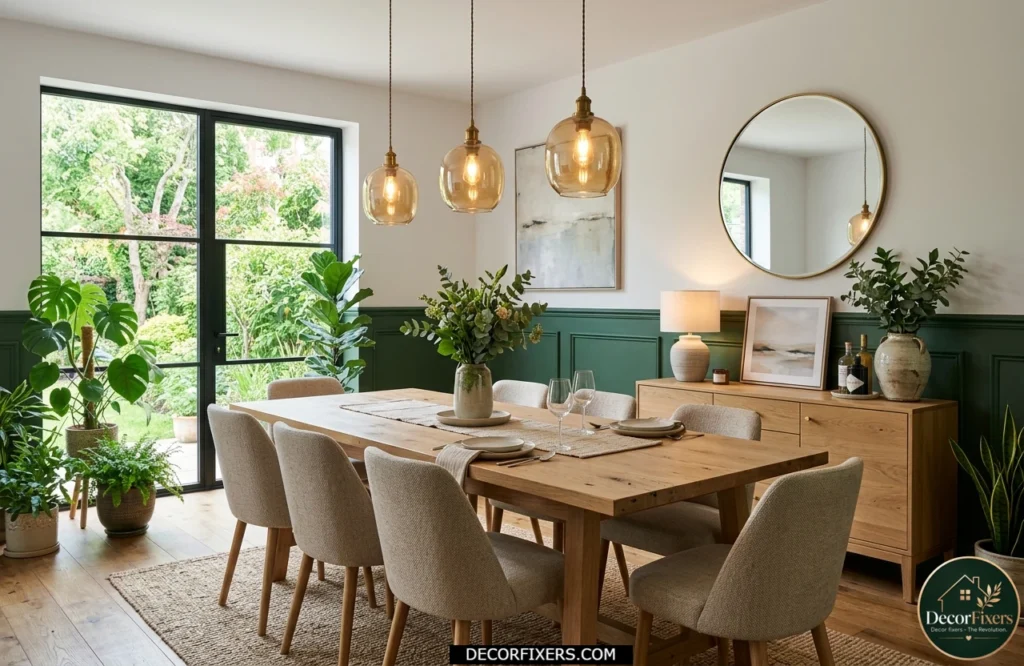
Forest green is having a moment, or more accurately, it’s been having a moment for four straight years, which means it’s not really a moment anymore. It’s a staple.
Benjamin Moore’s Forest Green 2047-10 on the lower wainscoting paired with White Heron OC-57 on the upper walls creates a two-tone treatment that looks expensive without an expensive room.
This technique also solves a problem competitors seldom address: what to do when your ceiling height feels low. The color break at chair-rail height draws the eye horizontally and vertically, making the room feel wider.
Renters: a deep green peel-and-stick wallpaper panel behind the buffet sideboard achieves a similar effect with zero commitment.
3. Warm Terracotta, Earthy, Flattering, and Easier to Pull Off Than You Think
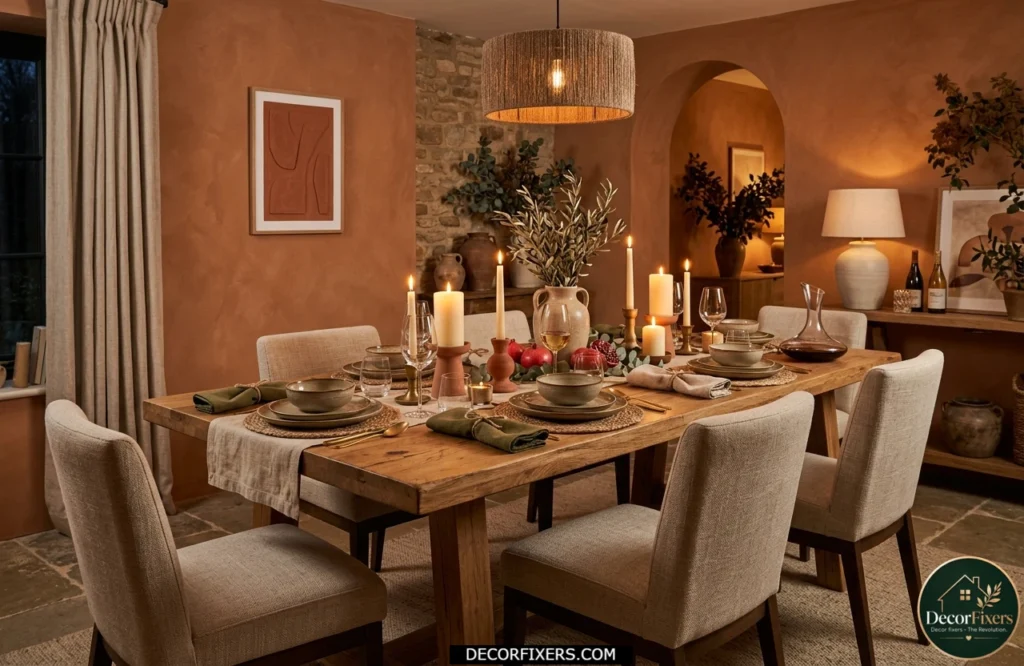
Terracotta is the color that photographs well and looks good in person, which is rarer than it sounds. The warm, clay-based tone flatters skin, flatters food, and flatters candlelight. For dinner parties, there’s frankly nothing better.
One caveat worth stating clearly: terracotta fights with cool-toned furniture. If your dining table is grey or has blue-grey undertones, this pairing will feel off. The fix is a warm-toned table runner or earthy placemats, not repainting.
4. Warm White and Cream, The Renter-Friendly Base That Works Harder Than You Expect
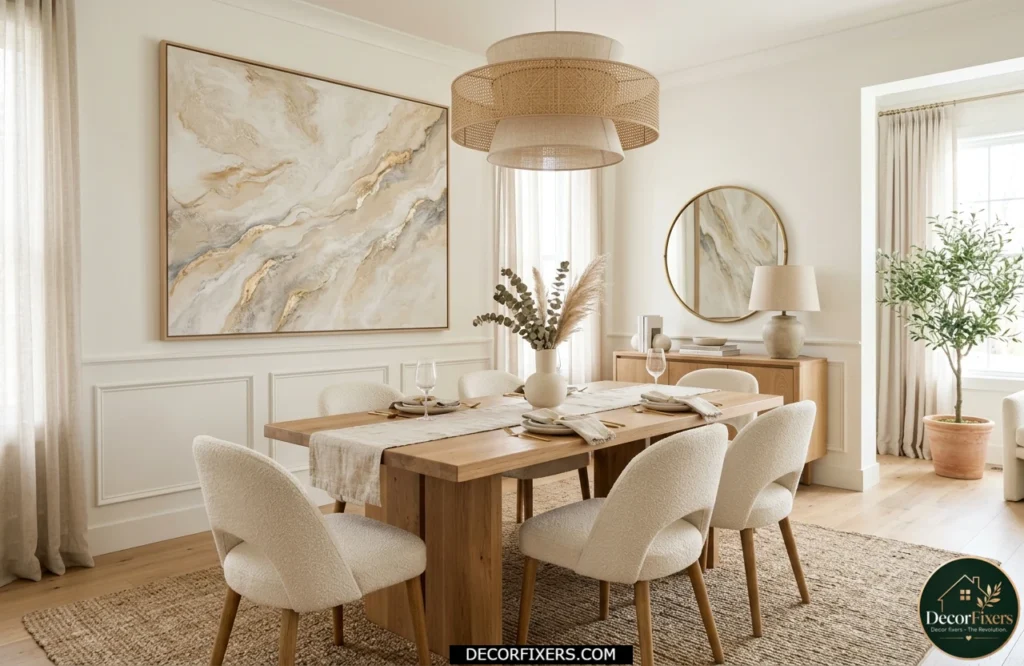
Here’s the thing: warm whites get dismissed as ‘playing it safe,’ and that framing is wrong. A well-chosen cream isn’t a failure of imagination; it’s a canvas strategy.
The difference between a boring white dining room and a beautiful one comes down to texture and contrast. Hang one oversized piece of art in a deep tone, and you have a room that feels curated, not cautious.
For renters who cannot paint at all, this is the go-to foundation. Build color through furnishings, and your walls stay landlord-approved.
5. Moody Charcoal, The Color That Makes Everything Else Look Better
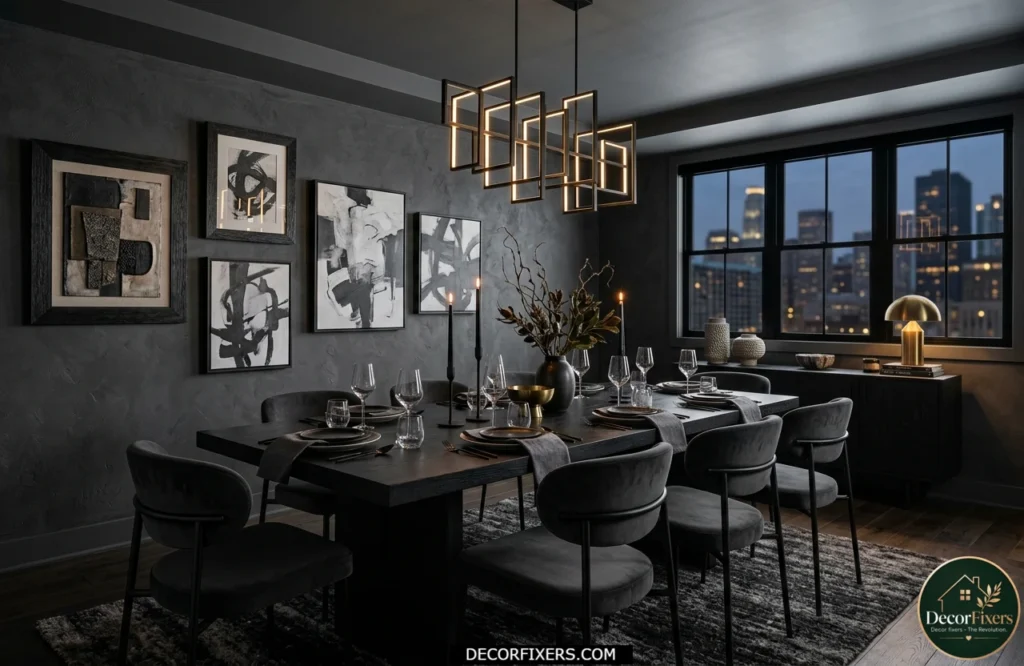
Charcoal is a commitment. Not because it’s irreversible, paint is always reversible, but because it requires you to trust the process through the awkward middle stages of painting, when half the wall is grey, and the other half is still beige.
Sherwin-Williams’ Urbane Bronze SW-7048 sits right at the intersection of charcoal and brown and reads differently across the day: almost mushroom in bright daylight, deeply sophisticated at night. Art pops against it. Glassware catches the light against it. Even a simple table setting looks intentional against it.
What most guides skip is the ceiling play. Paint the ceiling one shade lighter than the walls, and the room gains a quiet drama that’s hard to define but immediately felt by anyone who walks in.
6. Dusty Rose and Blush, The Underrated Modern Dining Room Color Idea
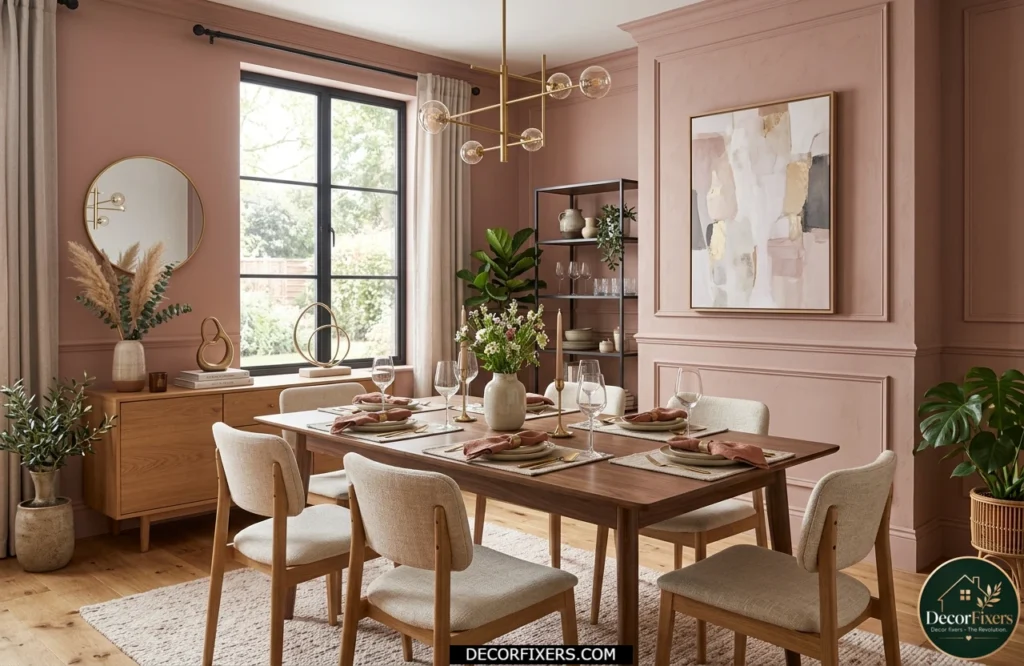
Blush gets a bad reputation because of overexposure in the millennial pink era. That’s over. The 2025 version of this palette is dusty, muted, and warm, closer to a weathered terracotta-rose than a baby shower aesthetic.
Little Greene’s Pink Drab 275 is precisely this: a historically influenced, complex pink with grey undertones that reads as a sophisticated neutral in the right light. Pair it with dark wood furniture, aged brass accessories, and deep burgundy table linens for a dining room that feels distinctly modern but totally unpredictable.
Or maybe I should say it this way: this is the color for people who want something unexpected but can’t commit to jewel tones. It’s the gateway palette.
7. Sage and Muted Olive, The Calm Modern Dining Room Wall Color
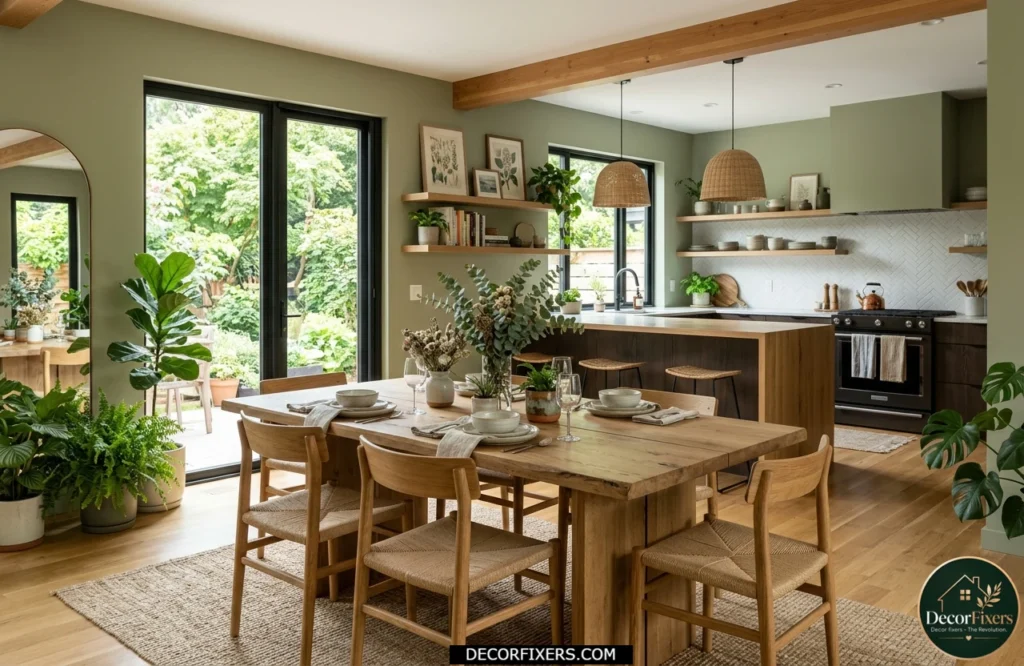
Sage is the color that everyone’s mother started choosing when she saw it online, and then designers quietly confirmed it was actually correct. There’s a reason: it’s one of the few colors that flatter both warm and cool furniture tones.
Sherwin-Williams’ Privilege Green SW-6193 and Benjamin Moore’s Saybrook Sage HC-114 are the two workhorses here. Both have enough grey in them to avoid reading ‘nursery,’ and both sit beautifully against natural oak, walnut, and even painted white furniture.
In open-plan homes, sage is the safest crossover color because it bridges dining and kitchen zones without feeling like a hard visual stop. This comes up repeatedly in modern dining room ideas for homes where the two spaces share sight lines.
8. Burgundy and Deep Wine, The Jewel Tone That Commands the Room
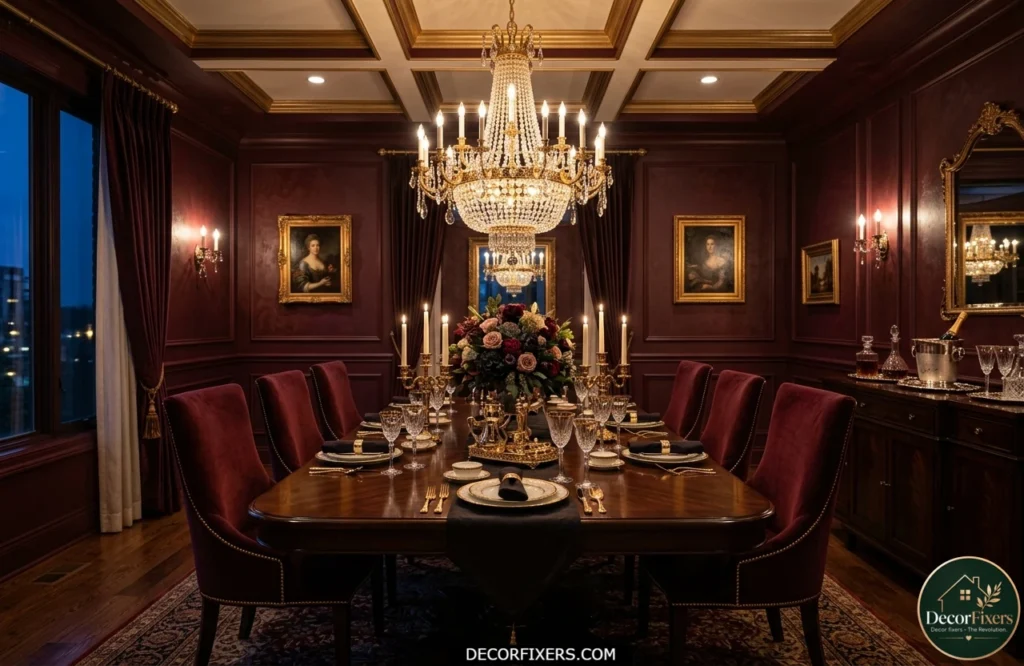
Burgundy in a dining room is a statement. Not the kind that needs explanation, the kind that people notice instantly and remember long after dinner ends.
The risk with deep reds and wines is going too warm, which can tip into a dated, colonial-era look. The fix is to choose a shade with cool or purple undertones. Little Greene’s Porphyry Pink 250 and Sherwin-Williams’ Cimmerian Sea SW-9209 (a berry-burgundy) both stay on the right side of that line.
Pair either with matte black chairs, a marble-topped buffet, and low candlelight for a room that feels intentionally dramatic — not accidentally 1994.
The risk with deep reds and wines is going too warm, which can tip into a dated, colonial-era look. The fix is to choose a shade with cool or purple undertones.
Quick Comparison:
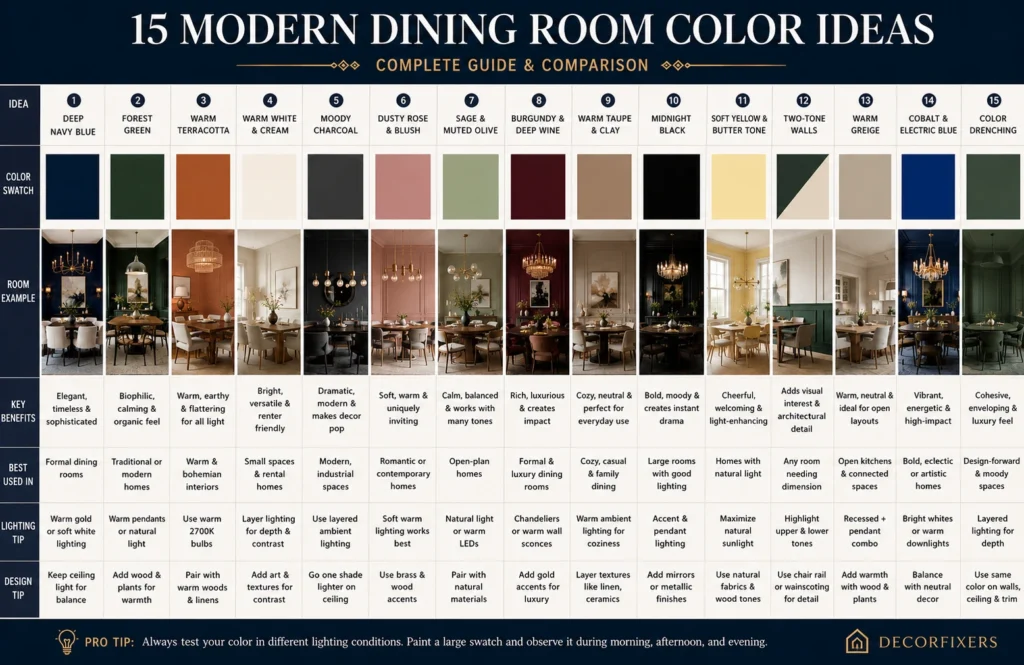
| Color Direction | Best For | Key Benefit | Limitation |
| Deep Navy Blue | Formal dining rooms | Creates drama; pairs with gold hardware | Can make small rooms feel closed in |
| Forest Green | Open-plan or natural light spaces | Biophilic feel; timeless year-round | Needs warm lighting to avoid going cold |
| Warm Terracotta | Casual or rustic dining spaces | Earthy and inviting; flatters skin tones | Can clash with cool-toned furniture |
| Warm White / Cream | Renters: small or low-ceiling rooms | Safe, light-boosting, endlessly versatile | Feels generic without textured contrast |
| Charcoal / Soft Black | Urban, minimalist, or industrial spaces | Sophisticated; makes art and decor pop | Requires a confident lighting plan |
9. Warm Taupe and Clay, When Neutral Doesn’t Have to Mean Boring
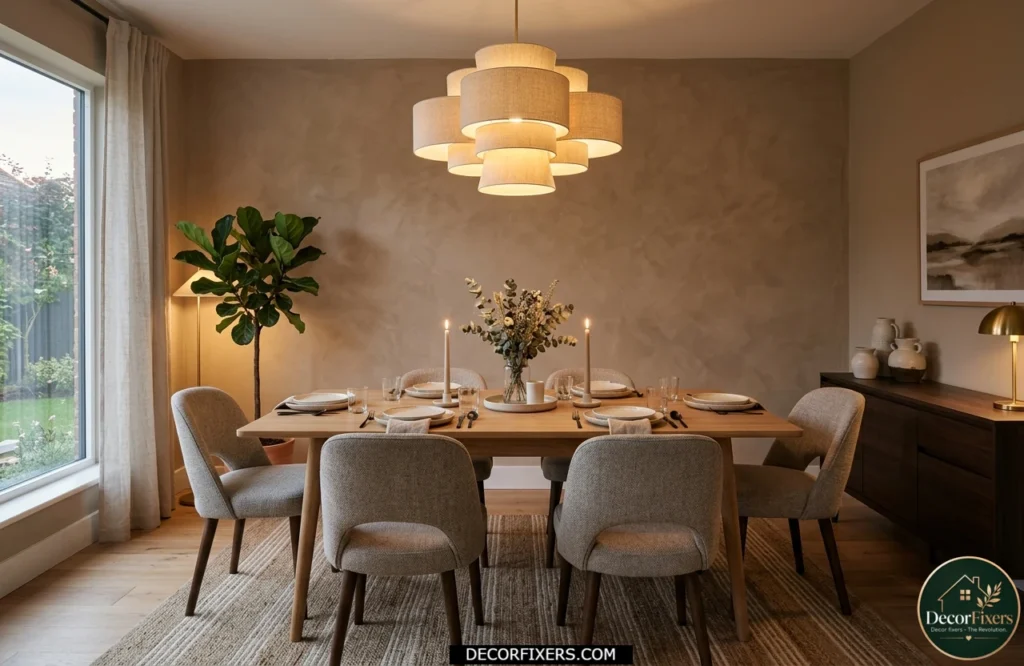
The most honest thing I can say about taupe is this: for years, I thought it was a cop-out. I was wrong. Warm taupe, the clay-inflected, slightly pinkish kind, not the cold grey-beige kind, is one of the most livable dining room colors available.
The distinction matters. Cold taupe with blue or grey undertones will drain the warmth out of your food, your candles, and your guests. Warm taupe like Sherwin-Williams’ Accessible Beige SW-7036 or Benjamin Moore’s Pale Oak OC-20 holds its warmth across lighting conditions and becomes genuinely beautiful at dinner time when everything softens.
Look, if you’re in a rented apartment with white walls you can’t change, warm taupe peel-and-stick panels on the back wall behind your seating area achieve most of this effect without a conversation.
10. Midnight Black, The Boldest Modern Dining Room Color That Actually Sells Homes
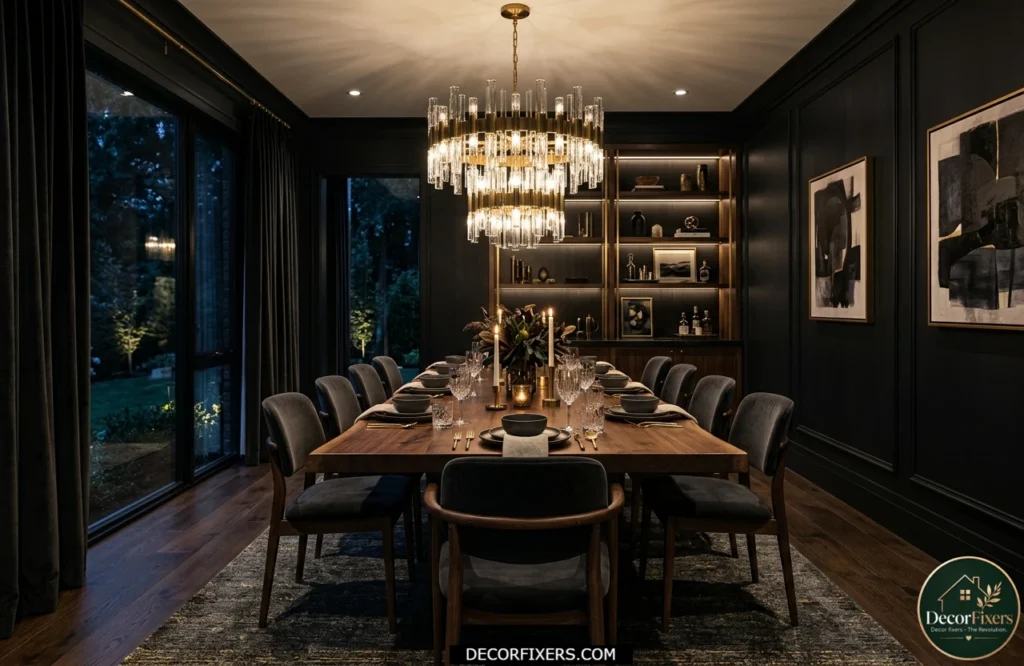
Black walls in a dining room stop being polarizing the moment you see them done well. And they are being done well, constantly, in 2025, because designers have figured out the formula.Benjamin Moore’s Onyx 2133-10 and Sherwin-Williams’ Tricorn Black SW-6258 are the two most reliable choices. The secret: never pair black walls with black furniture. You need contrast — a light wood table, white or cream upholstered chairs, and at least one reflective surface like a mirror or glass cabinet — to keep the room from collapsing into itself.
Some experts argue that black dining rooms only work in large, light-filled homes. That’s valid for open, airy spaces. But if you’re dealing with a deliberately cozy, enclosed dining room, black works precisely because it leans into the intimacy rather than fighting it.
11. Soft Yellow and Butter Tones, Morning-to-Evening Dining Room Color Energy
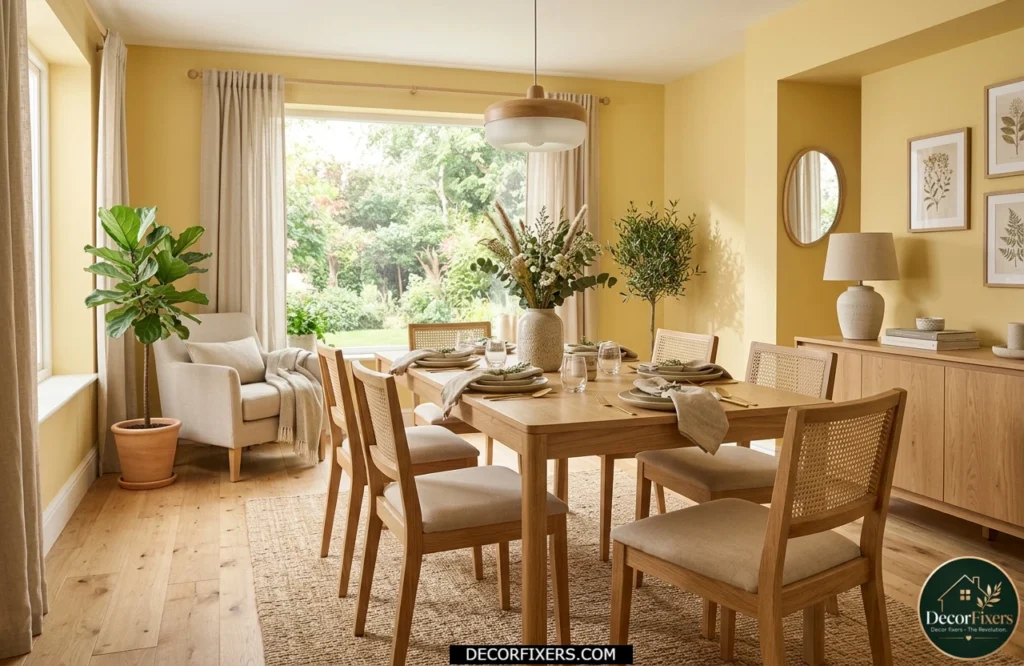
Yellow has a reputation problem in interior design. It conjures visions of 2004 kitchens, fast food outlets, and nurseries gone wrong. The modern version is nothing like that.
Buttermilk yellows and warm butter tones — like Sherwin-Williams’ Napery SW-9503 or Benjamin Moore’s Pale Moon OC-108 — function as warm neutrals that catch morning light beautifully and glow under incandescent lighting at night. They’re the color that makes your dining room feel like breakfast in Provence at 8 am and a dinner party at 8 pm.
The limitation is the saturation. Push too far toward saturated yellow, and you’re back in 2004. Stay muted, and you have something genuinely lovely.
12. Two-Tone Wall Treatment, The Modern Dining Room Color Idea Competitors Miss Completely
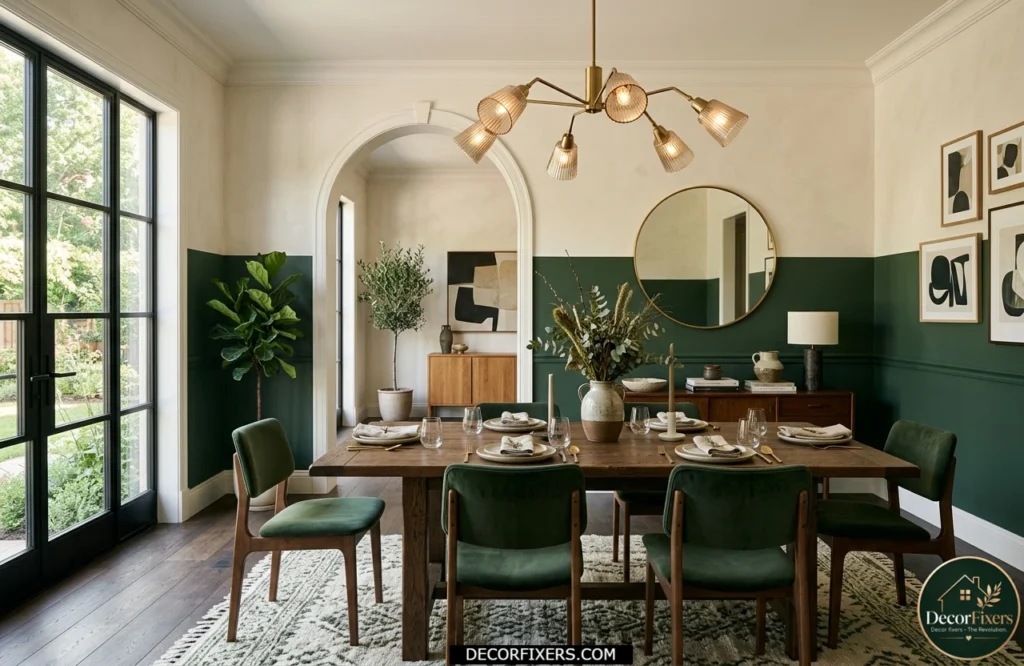
This is the technique that solves more problems than any single-color choice: split your wall horizontally at chair-rail height, roughly 32 to 36 inches from the floor, and paint the lower half in a bolder color and the upper half in a lighter shade.
It works in small rooms. It works in low-ceilinged spaces. It introduces color without overwhelming the room, and creates architectural interest in spaces that have none. In a small dining room context, this technique is arguably the single most impactful move you can make without buying new furniture.
Ideal pairing: Forest Green or Navy Blue, Warm White above. Or try Terracotta below, Cream above. The key is keeping the upper color at least two shades lighter than the lower.
How to apply a two-tone wall treatment in your dining room:
1. Measure and mark a horizontal line at 32–36 inches from the floor.
2. Apply painter’s tape along the line on both sides.
3. Paint the lower section in your chosen bold shade; allow to dry fully.
4. Remove tape carefully; re-tape the dried edge.
5. Paint the upper section in your lighter shade.
6. Remove tape while paint is still slightly wet for the cleanest line.
13. Warm Greige, The Modern Dining Room Color for Open-Plan Homes
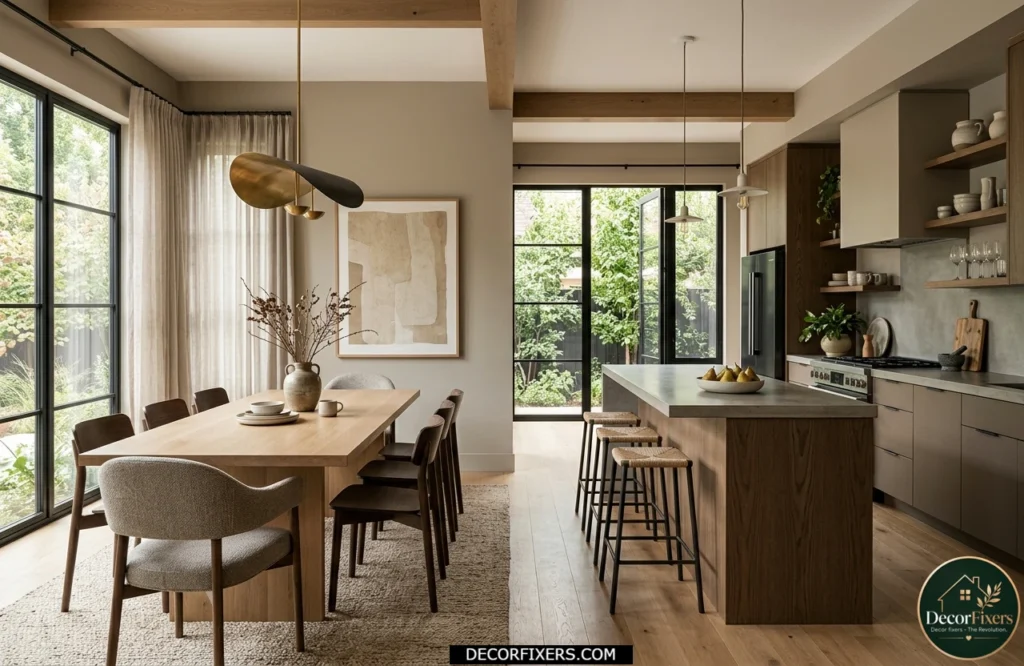
Greige, a blend of grey and beige, gets mocked as the ultimate safe choice. But warm greige, specifically, solves the hardest problem in modern home design: the open-plan dining room that needs to flow into the kitchen without either space looking disconnected or identical.
They read as warm against wood and upholstery, remain neutral against stainless appliances and white cabinetry, and shift subtly throughout the day as light changes. They’re the ultimate crossover color for connected spaces.
14. Cobalt and Electric Blue, For When You Actually Want People to Talk About Your Dining Room
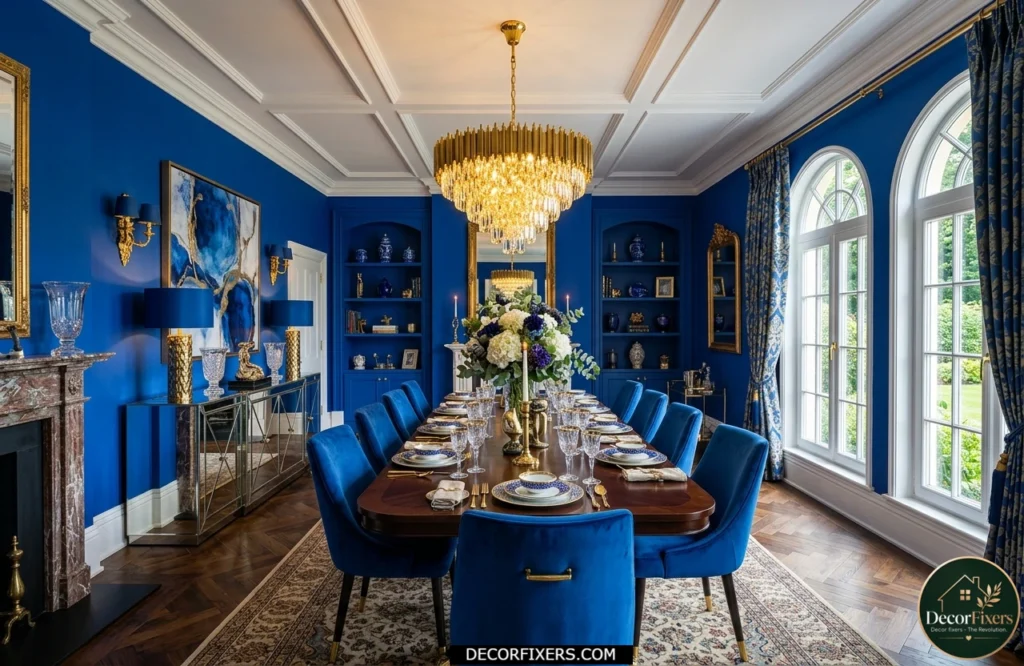
Cobalt is not for everyone. It knows that. It doesn’t care.
If you have a formal dining room, the kind that’s enclosed, only used for gatherings, and exists specifically to impress, cobalt is one of the most effective colors available. Pair it with warm gold fixtures, a mirrored console, and a white ceiling, and you have a room that people genuinely talk about.
I’ve seen conflicting data on this one; some sources treat electric blue as a 2020s trend with limited longevity, others argue it belongs in the classic category alongside navy. My read: it leans toward a trend. Use it in a room you’re comfortable repainting in five years.
15. Color Drenching, The Technique That’s Replacing the Accent Wall
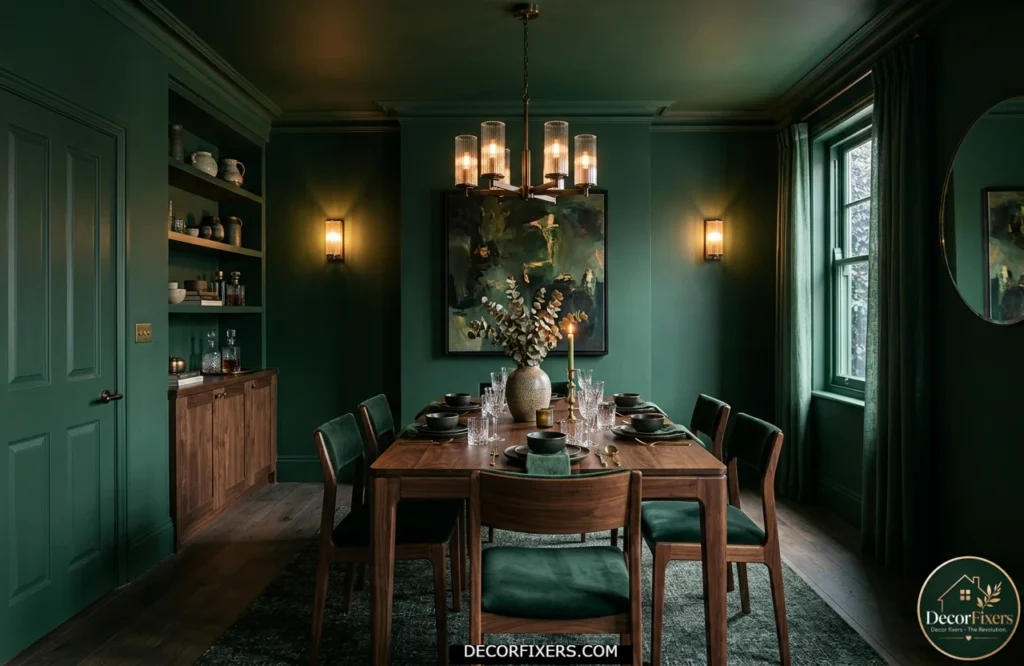
Color drenching means painting the walls, ceiling, trim, and even the doors in the same color or closely related tones. It’s the design world’s answer to a space that feels unsettled and visually cluttered.
In a dining room, color drenching in a single deep shade, deep plum, bottle green, or warm navy, creates an effect that reads as deliberate and enveloping rather than overwhelming. The logic is counterintuitive but consistent: when everything is one color, the room stops fighting itself, and the furniture becomes the focal point.
This technique also works particularly well for Small dining room ideas where you want to make a visual statement without the room feeling chopped up by contrast.
Color drenching vs. accent wall: Color drenching is better suited for small, enclosed dining rooms where you want depth and a cocoon-like atmosphere. An accent wall works better in open-plan spaces where a single bold wall anchors the dining zone without clashing with adjacent room colors. The key difference: drenching removes visual interruptions; an accent wall creates one intentional focal point.
CONCLUSION:
I want to be honest with you for a second. I spent longer than I’d like to admit staring at paint swatches on my phone before I finally just bought a sample pot and put it on the wall. And the one I liked on the screen, that soft, earthy green, looked completely different at 7 pm under warm light than it did in the browser tab at noon.
That’s not a failure of the color. That’s just how color works in real spaces.
The single most useful thing this guide can give you isn’t a specific shade; it’s the framework to evaluate any shade in your actual room. Test two samples side by side. Live with them for 48 hours across different lighting conditions. Look at them during the meal time that matters most to you.
Every color direction in this list has worked beautifully in real homes and looked wrong in others. The variable is never the color. It’s the room, the light, and the moment.
Go get a sample pot. The walls won’t paint themselves.
FAQs:
Q: What’s the best modern color for a dining room with no natural light?
A: Warm, mid-tone shades like terracotta, warm taupe, or sage work best. Avoid cool greys and stark whites; they amplify the flatness of artificial light. Add warm-toned bulbs at 2700K to support whichever color you choose.
Q: How do I pick a dining room color that works with my open kitchen?
A: Choose a color from the same temperature family as your kitchen’s dominant tone. Warm greige, sage, and cream are the most reliable crossover shades because they read neutrally against both cabinetry and dining furniture.
Q: Should I paint all four walls or just one accent wall?
A: For deep, bold colors, navy, forest green, and charcoal, paint all four walls for the best effect. For very bright or saturated shades, an accent wall behind the main seating or buffet gives impact without the risk.
Q: What paint colors make a small dining room feel bigger?
A: Warm whites and light creams reflect the most light. But don’t rule out dark colors, in a small enclosed dining room, deep shades can read as intimate rather than cramped, especially with strong pendant lighting. See more in our guide on small dining room decor ideas.
Q: When should I choose earthy tones over jewel tones for a dining room?
A: Choose earthy tones, terracotta, clay, and sage, for casual, everyday dining rooms where comfort is the goal. Jewel tones like burgundy, cobalt, and deep navy work best in formal dining rooms used primarily for gatherings and dinner parties.

Creator of DecorFixers, sharing practical home and interior ideas focused on real-life usability, simple design improvements, and budget-friendly solutions.
1 thought on “15 Modern Dining Room Color Ideas That Actually Work in Real Homes”