You’re standing in your kitchen, with white walls, beige cabinets, and plastic handles, and it looks like it belongs in a hotel that gave up. You’ve pinned 200 bohemian kitchens on Pinterest. You know exactly what you want. But you don’t know where to start, you don’t have $15,000, and your lease says you can’t drill holes in the wrong places.
I’ve been there. That exact mix of inspiration overload and practical paralysis is what keeps most people stuck with a kitchen that doesn’t feel like them, not for years, but sometimes forever. So let me show you what actually works.
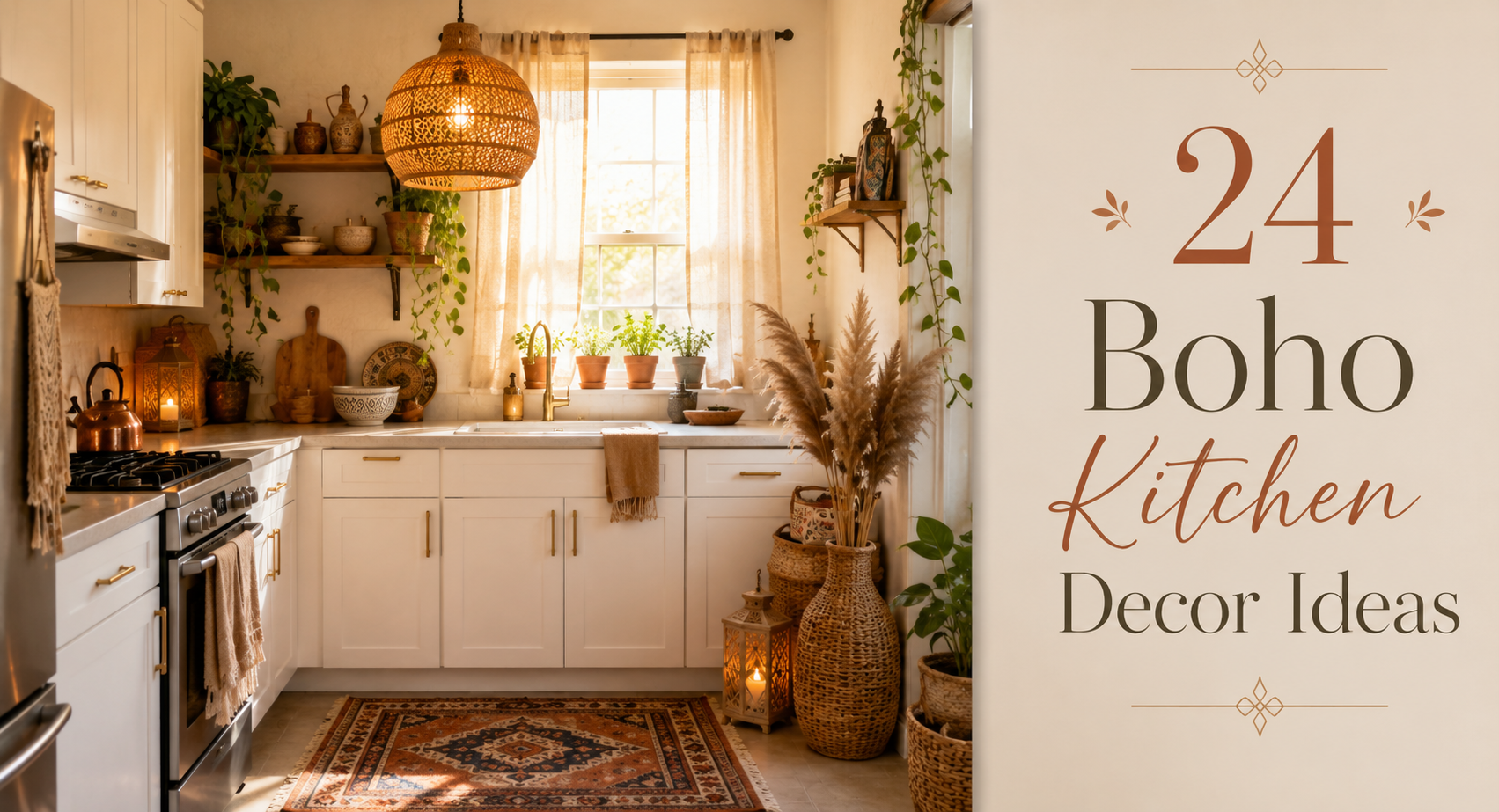
These 24 boho kitchen decor ideas are built for real people: renters, first-time homeowners, and anyone who wants that warm, layered, eclectic look without gutting their kitchen or calling a contractor. We’re talking about changes you can make this weekend, most of them under $50.
What Are Boho Kitchen Decor Ideas?
Boho kitchen decor ideas are budget-friendly, renter-safe styling approaches that layer natural textures, earthy tones, handmade objects, and eclectic vintage pieces to create a warm, free-spirited kitchen aesthetic. Unlike full renovations, these changes require no contractors, just intention and the right pieces placed in the right order.
1. Swap Your Light Fixture for a Rattan or Woven Pendant
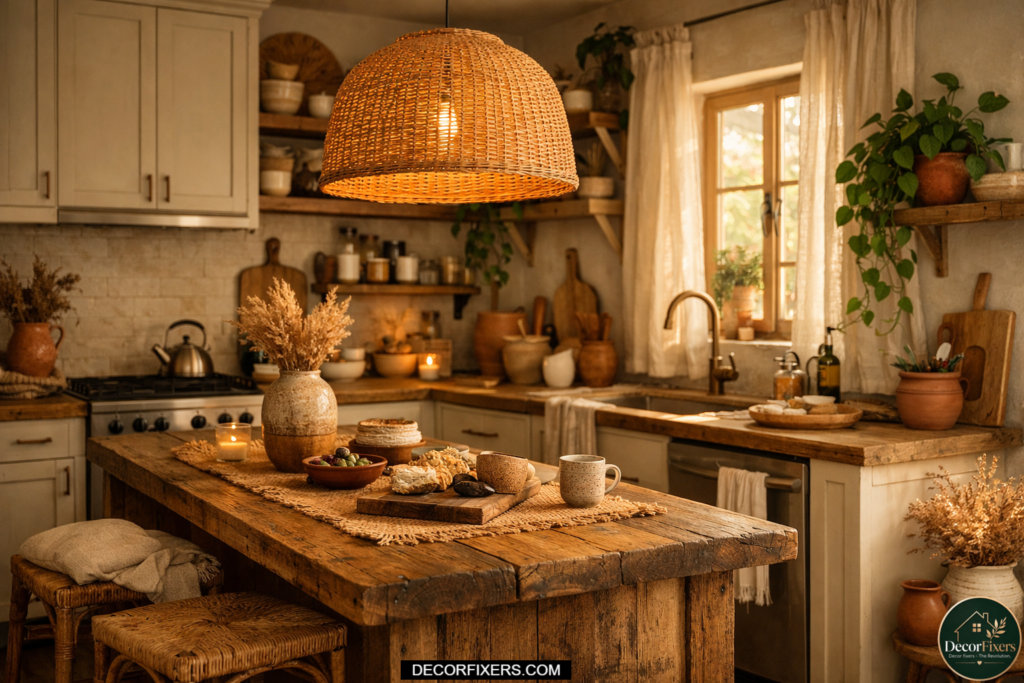
The single fastest way to change how your kitchen feels is overhead lighting. A rattan or woven pendant does something a bare bulb or flat ceiling light never can: it creates a warm, diffused glow that makes the whole room feel intentional.
Look for basket-style pendants or bamboo shades at stores like Anthropologie or on Etsy. Prices range from $35 to $120, and most swap in under 10 minutes if your existing fixture uses a standard bulb socket. If you’re renting, store your original fixture and reinstall it when you leave. Easy.
What to Look For in a Boho Pendant Light
Natural materials, rattan, bamboo, jute, or seagrass, are the non-negotiables. Avoid anything plastic that mimics these materials; it reads as cheap immediately. A warm Edison bulb (2200–2700K color temperature) inside the shade completes the effect and costs $8 at any hardware store.
2. Lay a Kilim or Jute Rug in Front of the Sink
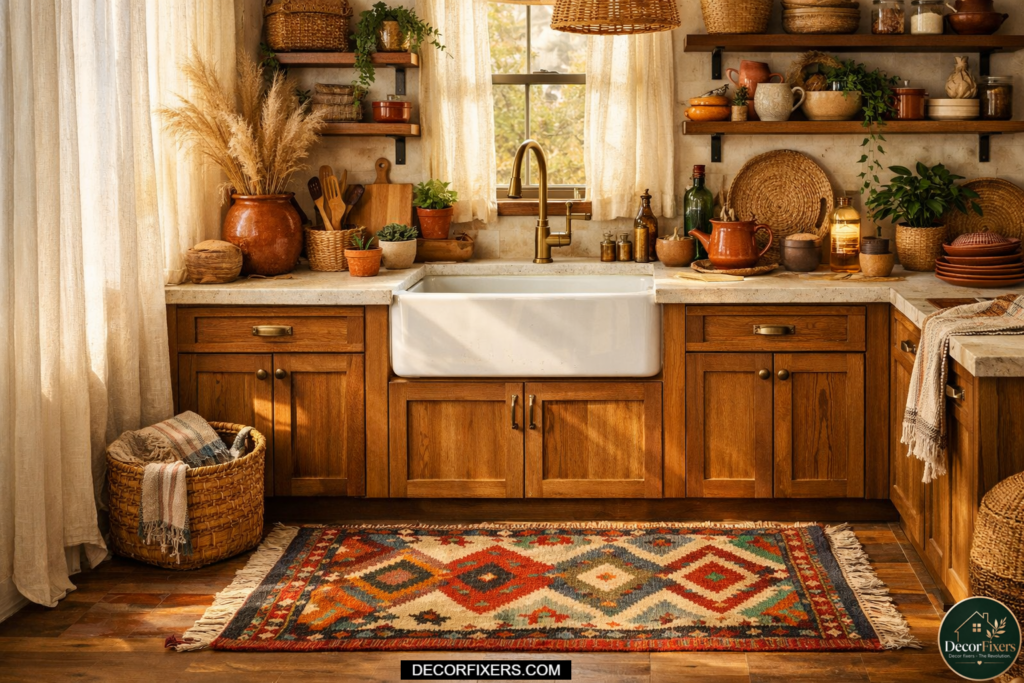
This one change does more visual work per dollar than almost anything else on this list. A kilim rug, those flat-woven geometric rugs that originated in Central Asia and Turkey, brings pattern, color, and warmth to a floor that’s otherwise nothing.
Jute is the budget option: $25–$60 on Amazon or at HomeGoods. Kilim is the statement option: $80–$200 on Etsy or at vintage markets. Both work. The key is size; you want it to extend at least 6 inches beyond each side of the sink. A rug that’s too small looks like an afterthought. A rug that fills the space looks designed.
3. Hang a Macramé Wall Piece Where Your Cabinets End
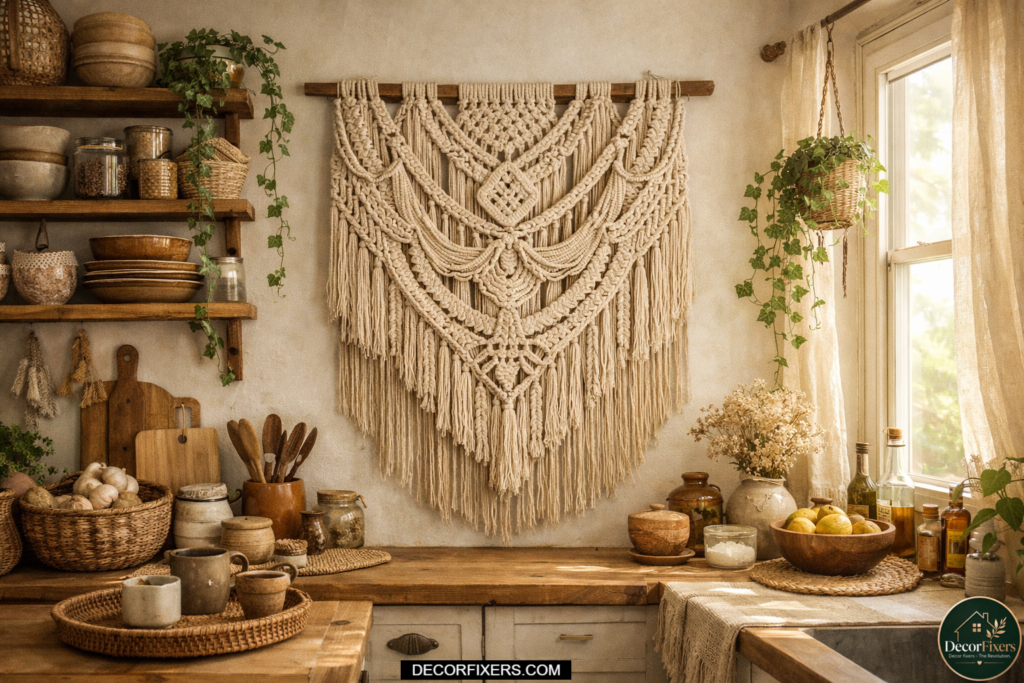
Macramé has been the heartbeat of boho decor since the 1970s, and it works in kitchens for one specific reason: it fills vertical space without making the room feel heavier. That’s a rare quality.
A medium-sized piece, roughly 12 to 18 inches wide, works well in the gap between your upper cabinets and the ceiling, or on any bare wall near a window.
Etsy has hundreds of handmade options from independent makers, usually $30–$80. If you want something completely unique, a beginner macramé kit from a craft store runs about $20, and you can make your own in a weekend afternoon.
4. Replace Cabinet Hardware With Brass, Ceramic, or Vintage Pulls
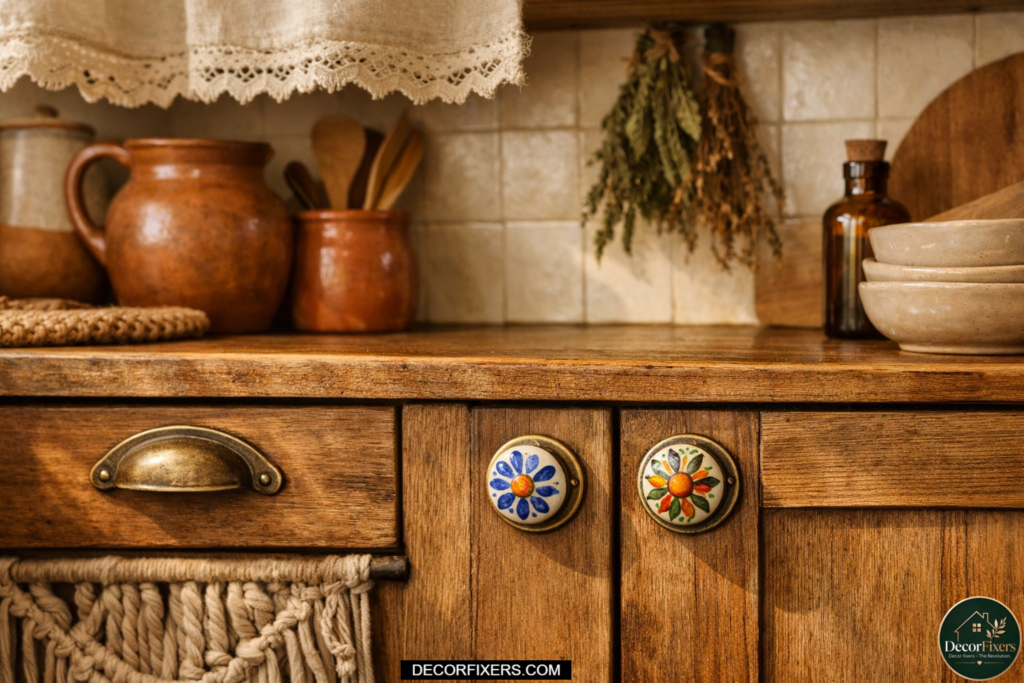
Your cabinet handles are probably the most ignored part of your kitchen. They’re also the easiest thing to change and one of the highest-impact updates you can make for under $30.
Antique brass pulls, hand-painted ceramic knobs, or hammered copper handles all read as boho-adjacent. Search ‘vintage ceramic cabinet pulls’ on Etsy or check the hardware section at HomeGoods. The swap takes about 15 minutes with a screwdriver. When you move out, swap the originals back in. Done.
5. Style Open Shelving With Earthy Ceramics and Trailing Plants
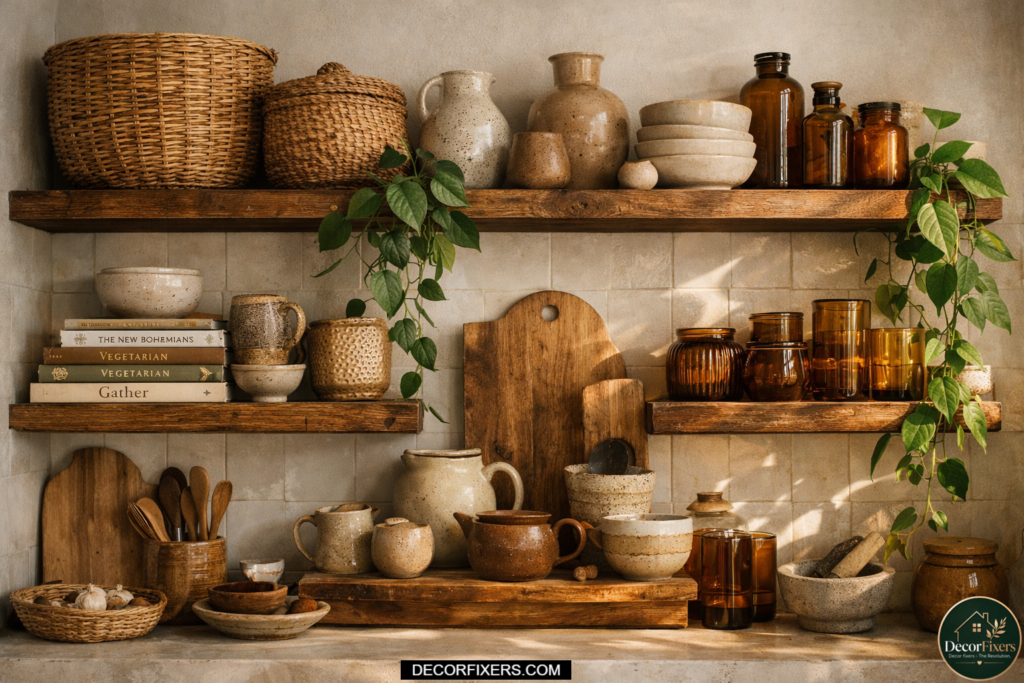
Open shelving is the cornerstone of the boho kitchen aesthetic, but only when it’s styled with intention. The mistake most people make is treating open shelves like regular cabinet storage and just stacking whatever fits. That’s where kitchens start looking chaotic instead of curated.
The formula: one-third functional items (mugs, bowls, jars), one-third decorative objects (a vintage vase, a stack of cookbooks, a small sculpture), one-third negative space. Leave breathing room. That gap between objects is what makes a shelf look styled rather than stuffed. Trailing photos or ivy cascading off a shelf edge adds the final organic layer that ties everything together.
How to Style Boho Open Shelves in 5 Steps
- Clear everything off the shelf, start from zero.
- Place your largest anchor piece first: a ceramic jug, a tall plant, or a stack of books.
- Add mid-sized items, mugs, small bowls, and a candle in groups of odd numbers.
- Trail a plant (photos or ivy) over the edge for organic movement.
- Step back. Remove one item. The shelf is better with a little empty space.
6. Add Peel-and-Stick Tile Decals to Your Backsplash
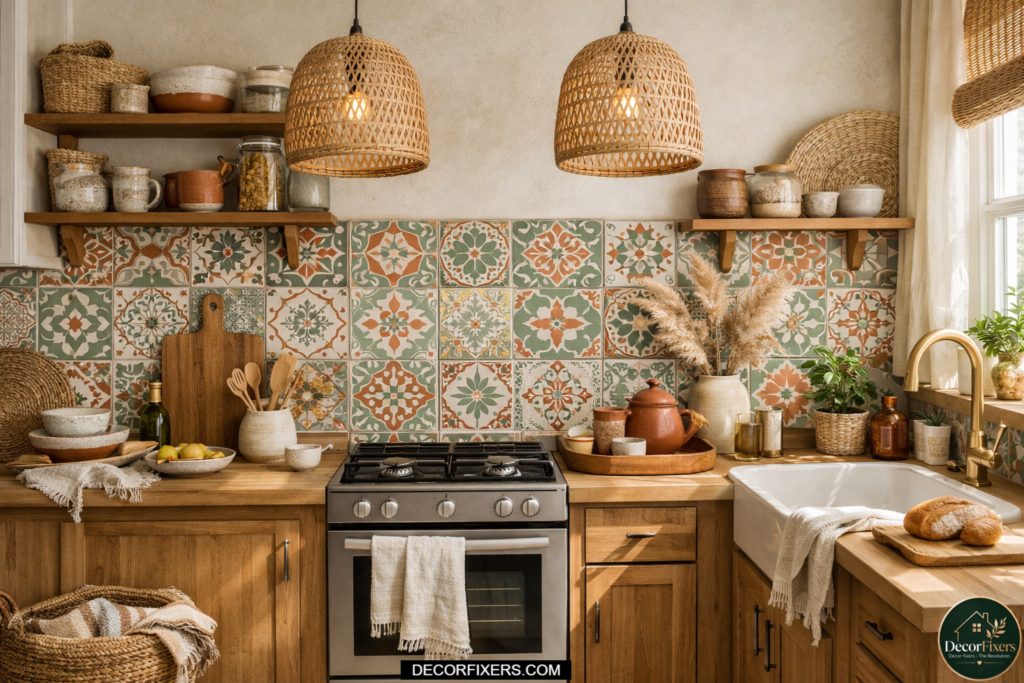
Here’s the thing: you don’t need real Moroccan tile to get the Moroccan tile effect. Peel-and-stick tile decals have come a long way; quality brands like Tile Club or Stickgoo offer patterns that are genuinely convincing and completely removable.
A geometric Zellige-inspired or encaustic-style pattern in terracotta, navy, or sage immediately makes a standard white backsplash look like something out of a Jungalow inspiration board. Cost: $40–$90 for a standard kitchen backsplash. Application time: two to three hours. And when you move? You peel them off, and there’s no residue. It’s almost unfairly easy.
7. Display Handmade Ceramics and Artisan Pottery on Your Counter
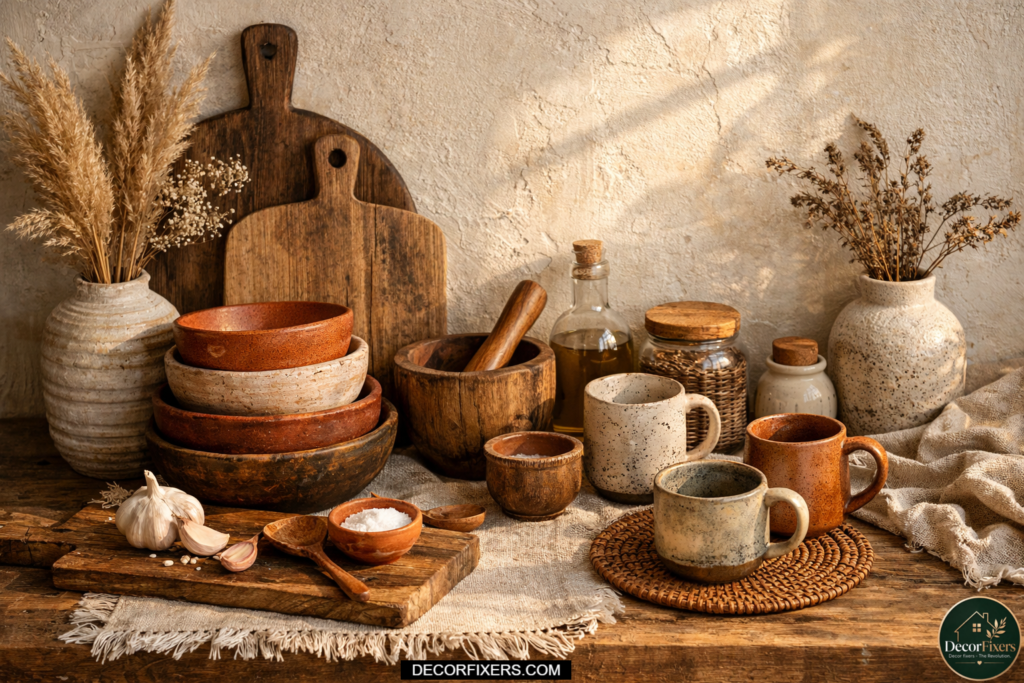
Mass-produced kitchenware is the enemy of the boho aesthetic. One handmade ceramic bowl does more for the vibe of your kitchen than six matching pieces from a big-box store. Genuine handmade pieces have visible imperfections, an uneven glaze, a thumb print in the clay, and those imperfections are the point.
Etsy is the best hunting ground here. Search ‘handmade terracotta bowl’ or ‘stoneware mug set’ and filter by ‘handmade.’ Budget $20–$60 for a statement piece. The Jungalow by Justina Blakeney also stocks beautifully patterned ceramics if you want something more curated. Display them intentionally on your counter, not shoved in a corner, but placed like objects worth looking at.
8. Bring In Dried Botanicals, Pampas Grass, Eucalyptus, and Dried Citrus
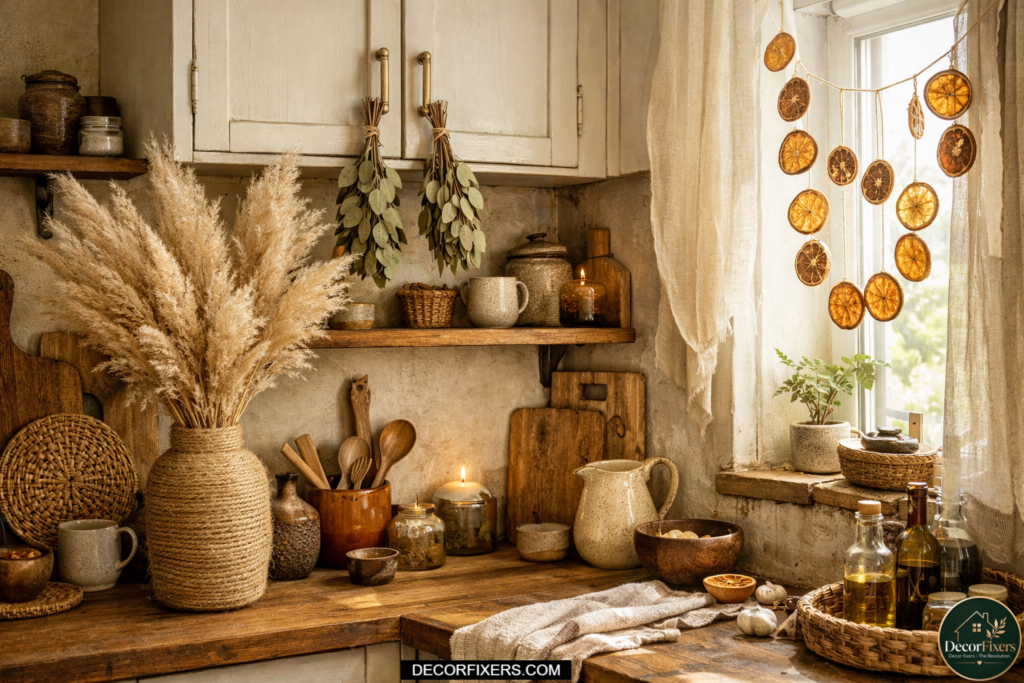
Live plants are great. But dried botanicals are the secret weapon of boho styling because they require zero maintenance, and they look incredible for months.
A tall vase of pampas grass in a corner, a bundle of dried eucalyptus hung from a cabinet handle, a wreath of dried orange slices near the window, these are effortless, affordable, and completely on-theme. You can find pampas grass at most craft stores or on Amazon for $15–$30. Hang a bundle of twine from a cabinet knob for a free styling hack that looks intentional every time.
9. Use Woven Baskets for Countertop and Under-Shelf Storage
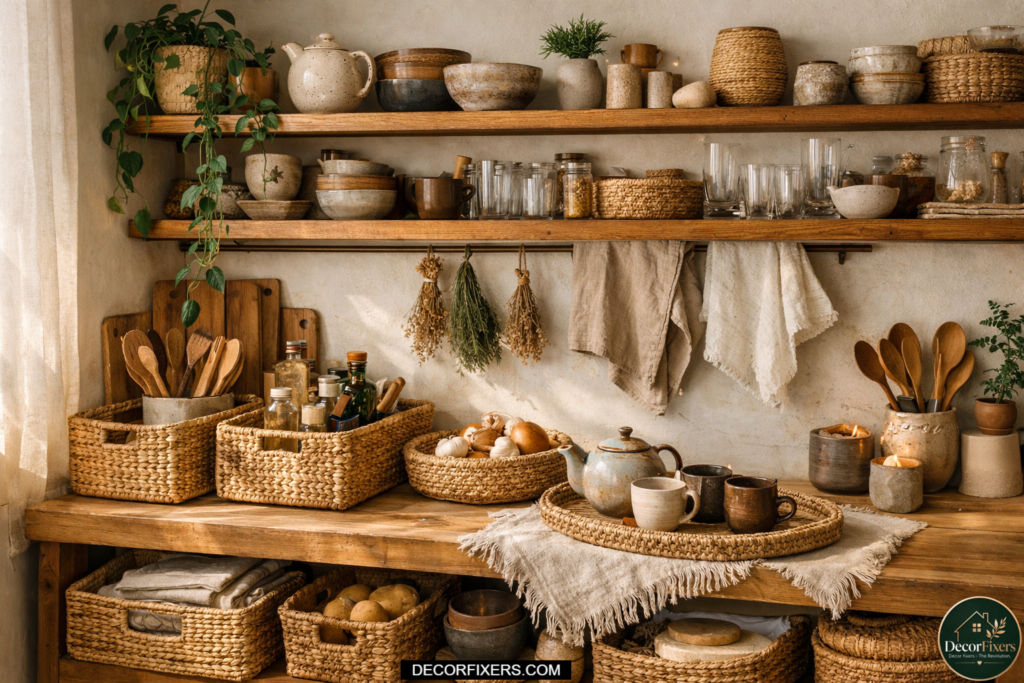
Storage and decor don’t have to fight each other. In a boho kitchen, they’re the same thing.
Woven seagrass baskets, rattan containers, and jute-wrapped bins handle all the functional storage you need, onions, potatoes, dish towels, and cleaning supplies, while adding that layered, organic texture that makes the space feel warm.
Stack two or three different-sized baskets on a counter or tuck them under open shelves. The variety in size and weave pattern gives the shelf-styled look without buying a single decorative object.
10. Hang Vintage Plates or Wicker Wall Baskets as Gallery Wall Art
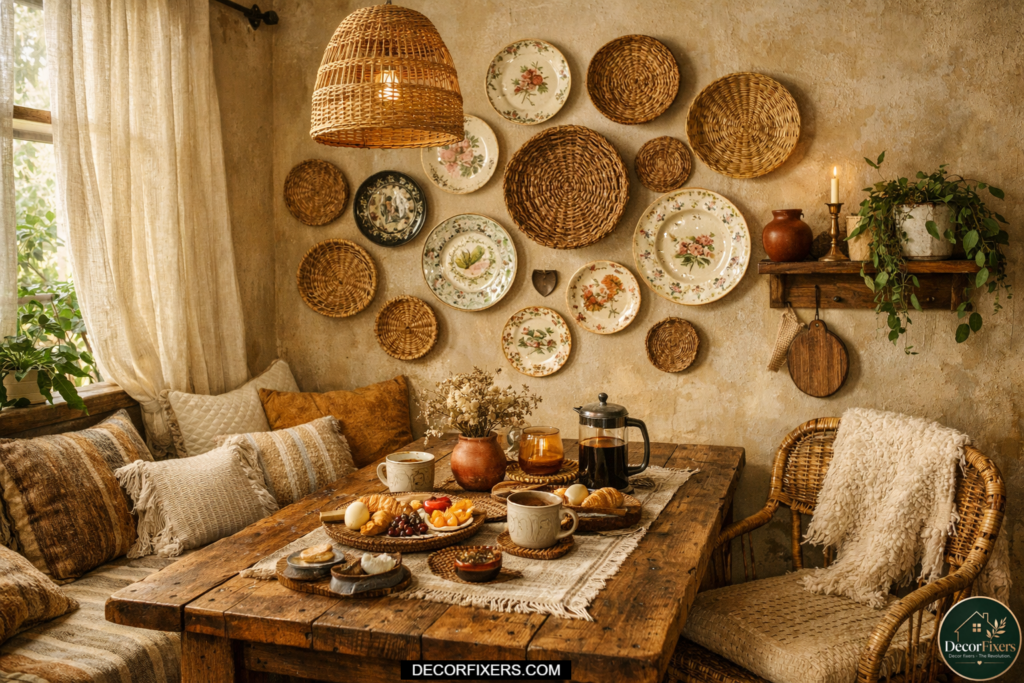
A gallery wall in a kitchen sounds impractical, with grease splatters and steam, but placed on the wall opposite your stove or on a breakfast nook wall, it’s one of the most effective ways to add personality to the space.
Vintage plates from a thrift store (usually $2–$5 each) arranged in a cluster of five or six create an eclectic, collected-over-time look that money honestly can’t buy. Wicker wall baskets in different sizes and weave patterns achieve the same effect with more texture. Command strips handle both without leaving a mark, making this fully renter-friendly. Or maybe I should say it this way: you can do an entire gallery wall and leave zero trace when you move out.
11. Place a Trailing Pothos or String of Pearls on Top of Your Cabinets
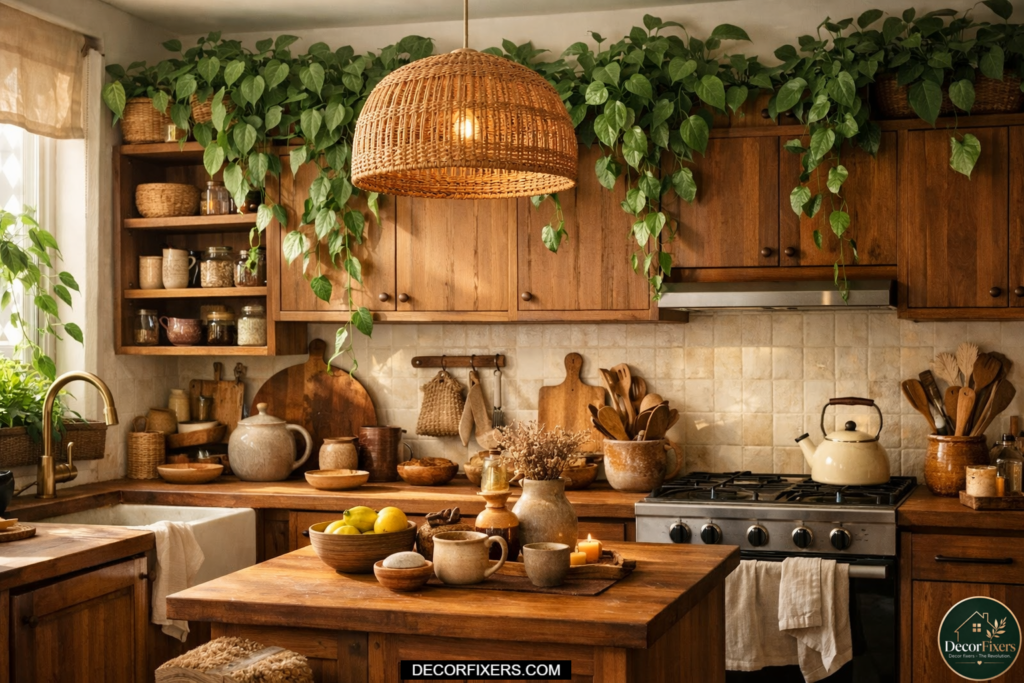
The space on top of your upper cabinets is one of the most consistently wasted zones in a kitchen. A trailing plant up there does something nothing else can: it draws the eye upward, makes the room feel taller, and adds life to a zone that normally collects dust.
Pothos is the go-to, nearly impossible to kill, grows fast, and tolerates low light. String of pearls is more dramatic and sculptural if your cabinets get decent indirect light. Either one cascading down the side of your cabinet face creates that effortlessly layered look you’re chasing. Water once a week. Done.
12. Display Your Herbs in Terracotta Pots on the Windowsill
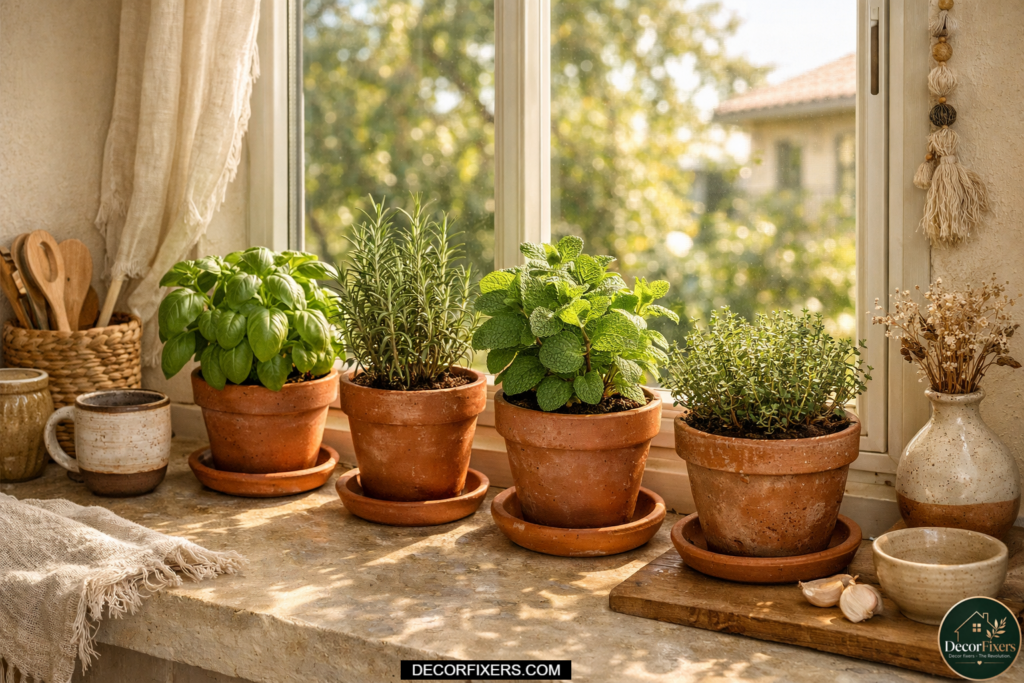
Herb gardens on windowsills are as practical as they are beautiful, and in a boho kitchen, terracotta is the only pot you should be considering. The warm, earthy orange of terracotta against a white wall with morning light coming through is one of those combinations that’s genuinely hard to photograph badly.
Grow basil, rosemary, mint, and thyme in a row of varying-sized terracotta pots. The different heights create visual interest. The herbs are used in cooking. The whole thing costs $15–$25 total and smells amazing. It’s one of those rare ideas where the budget version is actually better than the expensive version.
13. Use Linen or Cotton Curtains Instead of Blinds
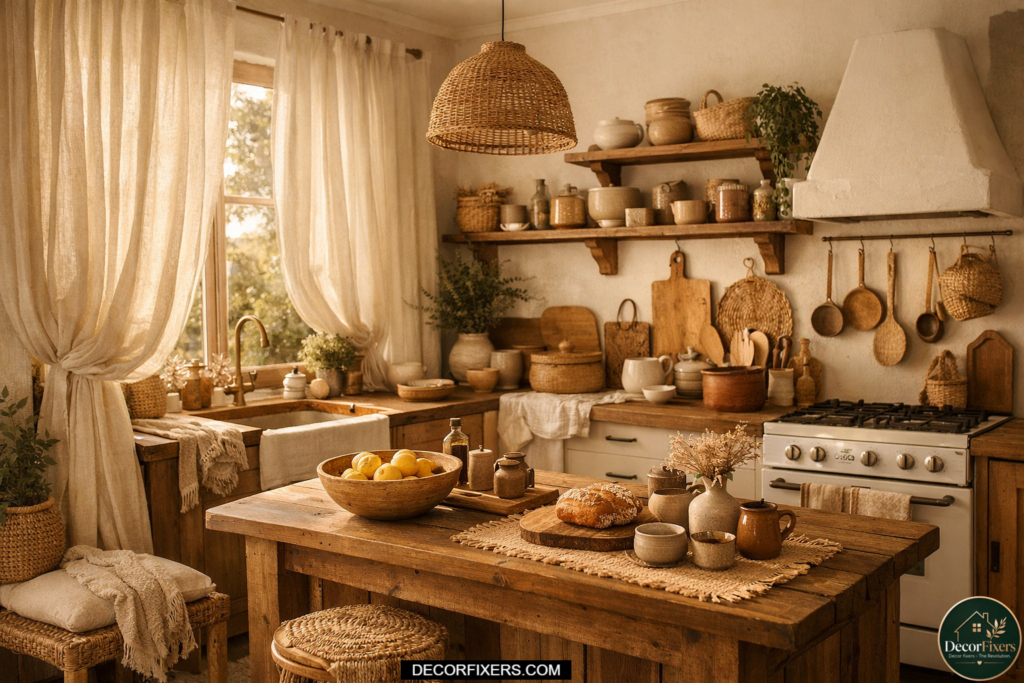
Window treatments are the most overlooked surface in a kitchen. Most people leave whatever came with the rental, usually a plastic blind that blocks light without adding anything, and that’s a mistake.
A pair of sheer linen curtains in cream, oatmeal, or sage transforms the light quality of the entire room. Linen diffuses sunlight into that warm, golden glow you associate with European kitchens and sun-drenched boho interiors. Tension rod installation means no drilling, making this completely renter-safe. Cost: $20–$60 for a pair from IKEA or Amazon. The upgrade from blinds to linen curtains is, genuinely, one of the highest-return moves on this entire list.
Linen Curtains vs. Bamboo Blinds: Which Is More Boho?
Linen curtains are better suited for kitchens with good natural light because they diffuse that light beautifully and add softness. Bamboo blinds work better in kitchens that need light control; they filter without blocking. The key difference: linen reads romantic and airy; bamboo reads earthy and structured. Both are boho-compatible. Use linen if you want warmth; use bamboo if you want texture and control.
14. Wrap a Plain Vase in Jute Rope for an Instant Boho Update
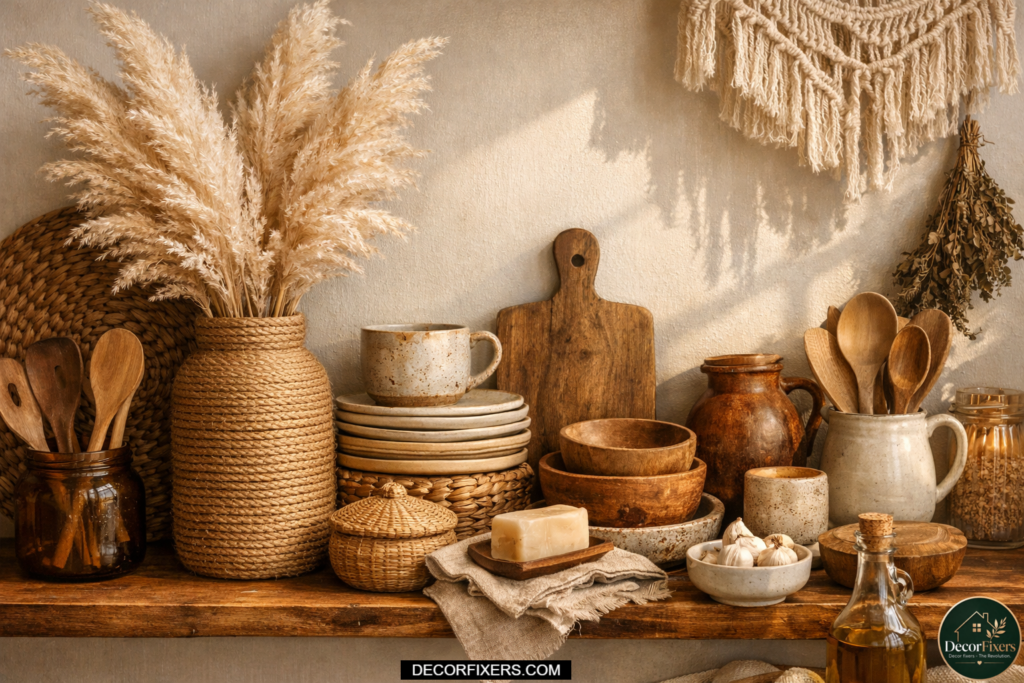
This one costs $3 and takes 20 minutes. Grab any plain glass or ceramic vase, even a $1 thrift store find, and a roll of jute twine from a craft store. Wrap it tightly from the base, securing with a dot of hot glue every few inches. By the time you reach the top, you have a textured, organic-looking vessel that looks like it came from an artisan market.
Fill it with dried pampas grass, eucalyptus, or even a single dried palm leaf. Place it on a counter or shelf. That’s a piece that, genuinely, people will ask about. Sometimes the budget move is the better move, not just the cheaper one.
15. Hang a Woven Tapestry or Textile Art on Your Largest Wall
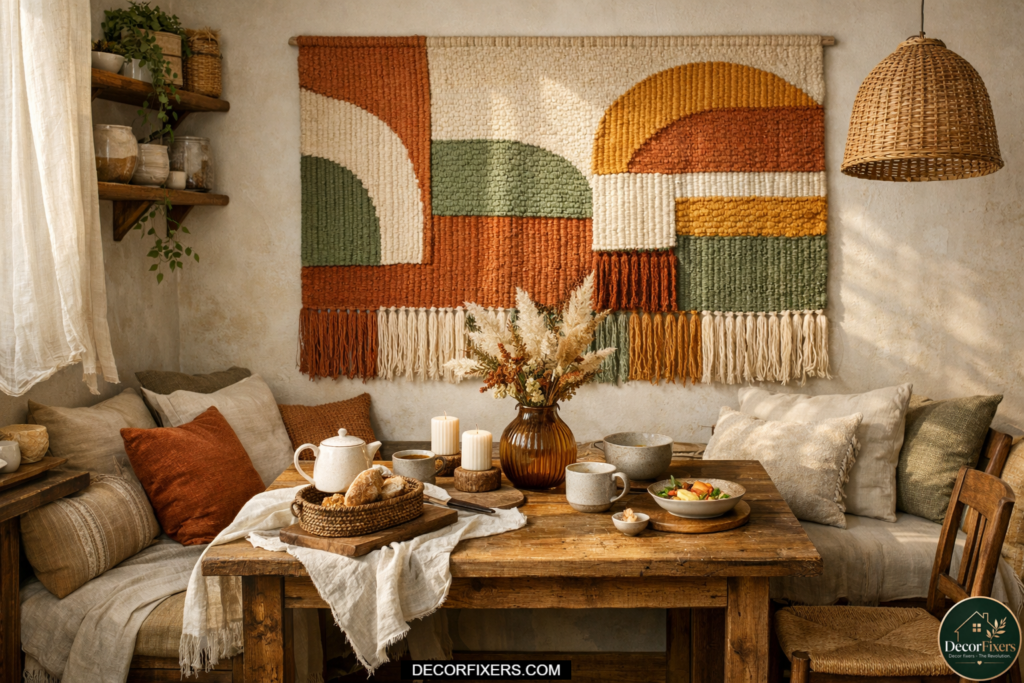
A large textile, whether a printed tapestry, a handwoven wall hanging, or even a vintage fabric panel, does something paint alone never can: it adds warmth, sound absorption, and tactile texture all at once.
For a kitchen, focus on the wall behind a dining table or breakfast nook, or the large wall facing you as you enter. Size matters here. A piece that’s too small gets lost. Aim for something at least 36 inches wide.
Look for geometric patterns, sun motifs, or earthy floral designs in terracotta, sage, mustard, and cream. Anthropologie has excellent options at the higher end; Urban Outfitters and Society6 offer more budget-friendly prints starting around $40.
16. Use Wooden Serving Boards and Utensils as Counter Decor
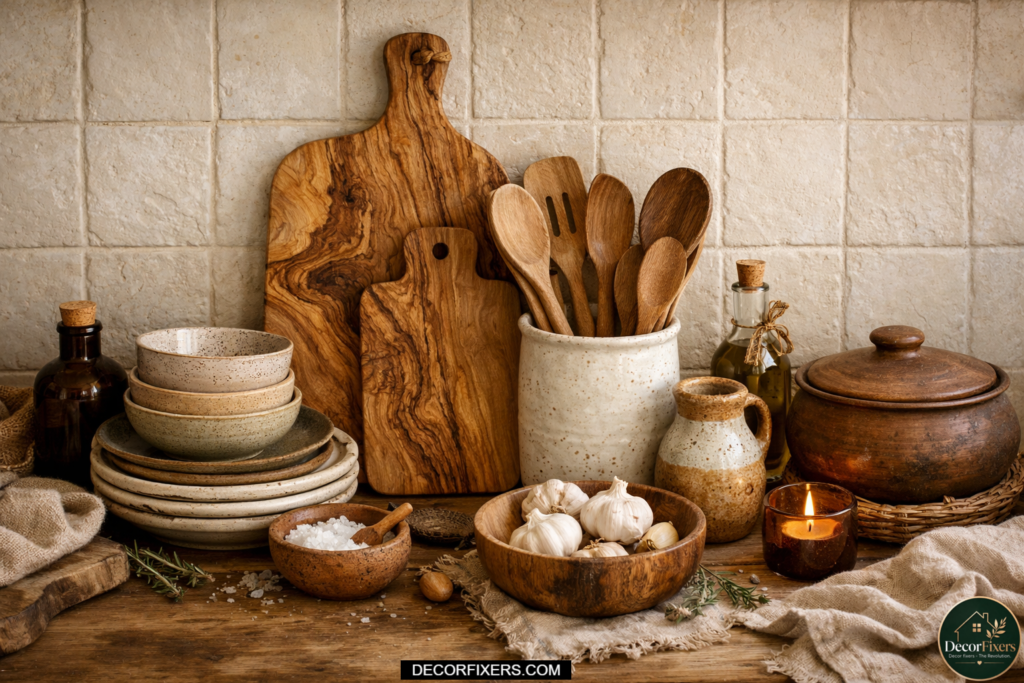
This is one of those styling tricks where functional objects become decorative objects, and you don’t have to sacrifice an inch of counter utility to pull it off. A beautiful olive wood cutting board leaning against the backsplash. A ceramic utensil holder filled with wooden spoons and a whisk.
A small wooden tray corralling your coffee setup, the French press, a jar of sugar, and a small plant. These groupings look styled and curated, but they’re just your kitchen tools, organized with intention. The tray is key: it frames the vignette and makes a collection of random objects look deliberate.
17. Find One Statement Vintage Piece at a Thrift Store or Flea Market
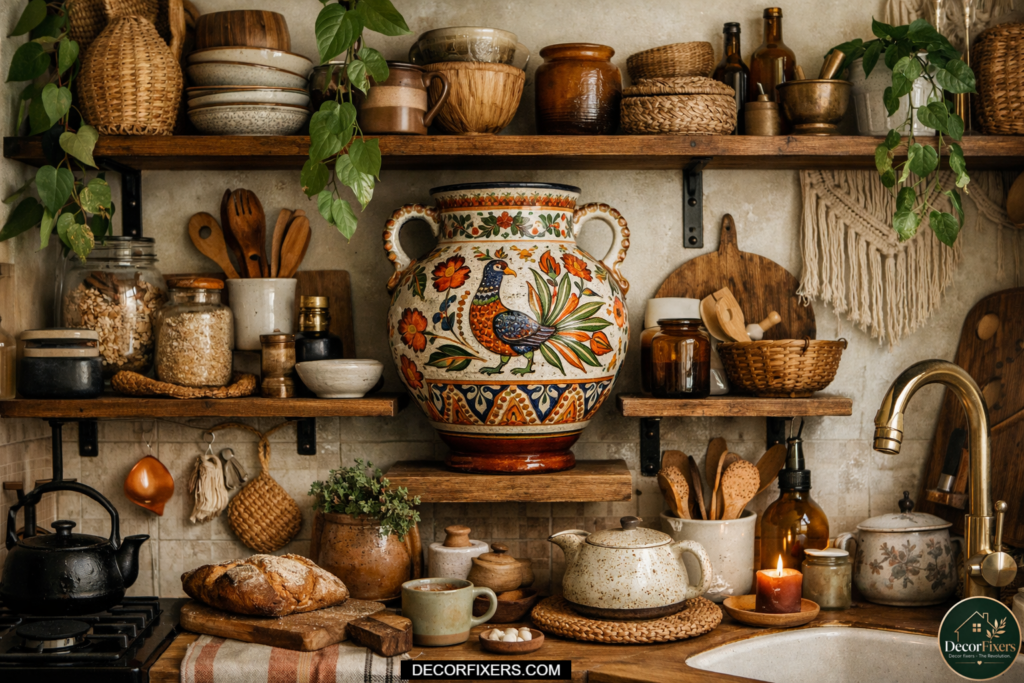
Every boho kitchen has one piece that makes you stop and ask where it came from. That piece is rarely new. It came from a thrift store, a flea market, a grandparent’s attic, or an estate sale.
It could be an antique ceramic canister set, a hand-painted Mexican serving bowl, a vintage spice rack, or an old enamel breadbox. The specifics don’t matter. What matters is that it has a story, even if you made that story up. ‘I found it at a Sunday flea market in Portland’ is a complete sentence that makes any decor item 40% more interesting. Look for one statement piece, give it a prime spot, and let it anchor the room.
18. Layer Different Textures in Your Table Setting and Placemats
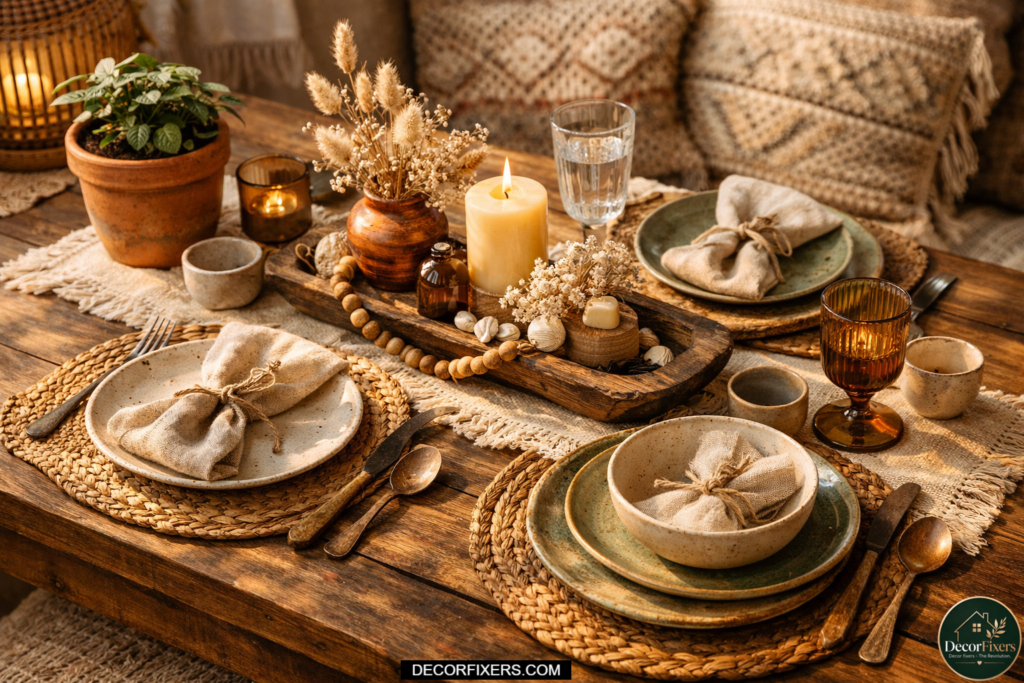
Your kitchen table or breakfast bar is staging you to reset every day, whether you realize it or not. The boho move is to treat it like a decor moment, not just a place to put plates.
Woven seagrass placemats, linen napkins, mismatched ceramic plates, a wooden centerpiece tray, and a small succulent in a terracotta pot. These layered textures create a table that feels genuinely warm and welcoming. You don’t need a full set of matching anything.
In fact, the more you avoid matching, the more boho the result. Mix a ceramic plate with a rattan placemat and a linen napkin, and you’ve done more table styling than most magazines bother to explain.
19. Paint One Accent Wall in a Warm Earthy Tone, Terra, Sage, or Ochre
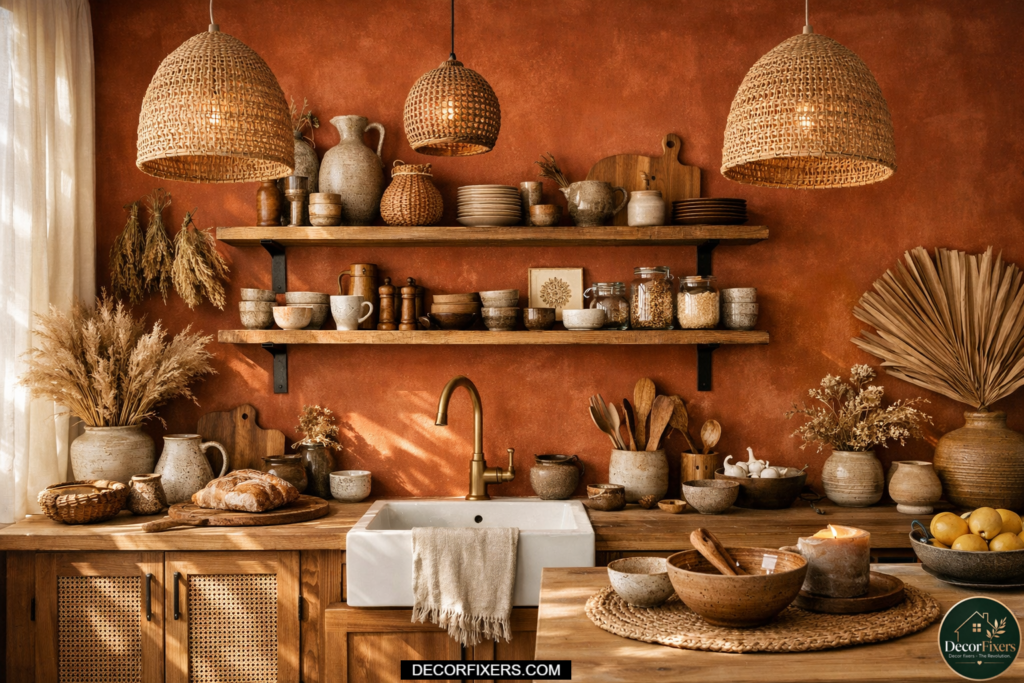
Look, if you’re in a rental and you have permission to paint (or if you’re a homeowner who’s been staring at white walls for two years), one accent wall in a warm, earthy tone is the move that changes everything.
Terracotta, burnt sienna, warm sage, or deep ochre, any of these transforms a cold, generic kitchen into something that feels like it has a personality. You don’t need to paint all four walls. One wall behind your shelves, your stove, or your dining nook is enough. Use a low-VOC paint from Benjamin Moore or Sherwin-Williams, pick a matte or eggshell finish, and the whole project costs around $40–$60 in paint. The visual return is enormous.
20. Add a Beaded or Fringe Curtain to a Pantry or Doorway
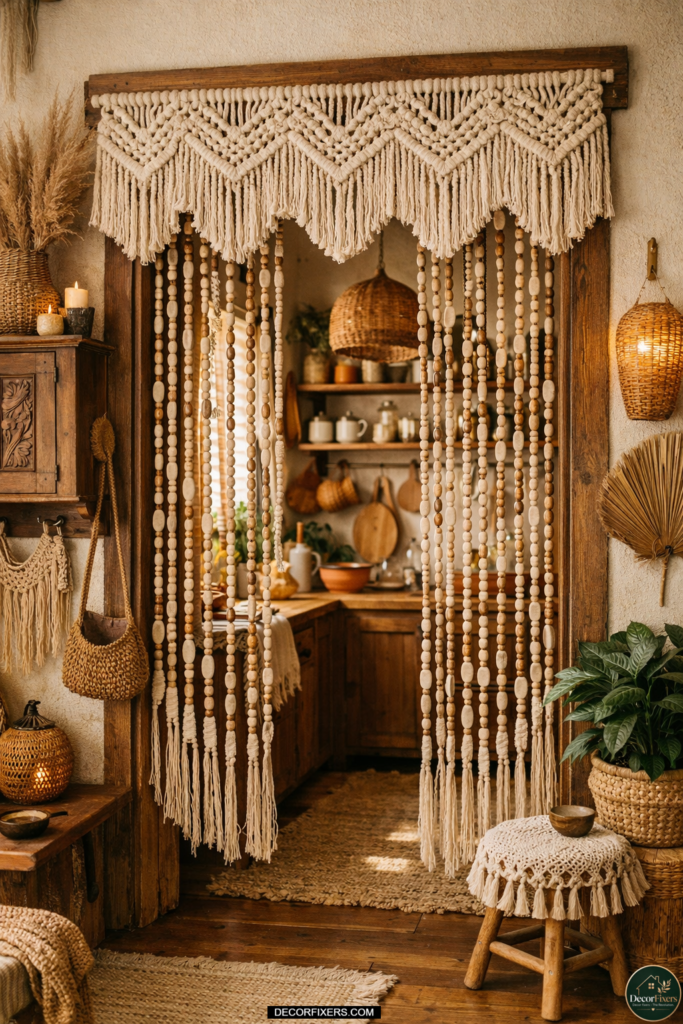
This is one of the quirkier ideas on this list, and I’ll say up front: it’s not for every kitchen. But if you have a pantry opening, an open doorway between your kitchen and dining area, or even a window you want to style differently, a beaded curtain or macramé fringe panel is the most committed boho move you can make.
Wooden bead curtains have a warm, earthy texture without the tacky 1970s throwback feel of plastic beads. Macramé fringe panels are softer and more modern. Both cost $25–$60 on Etsy or Amazon. The effect is immediate: a doorway that felt like dead space becomes a focal point that actively contributes to the room’s personality.
21. Collect and Display a Row of Mismatched Vintage Glassware
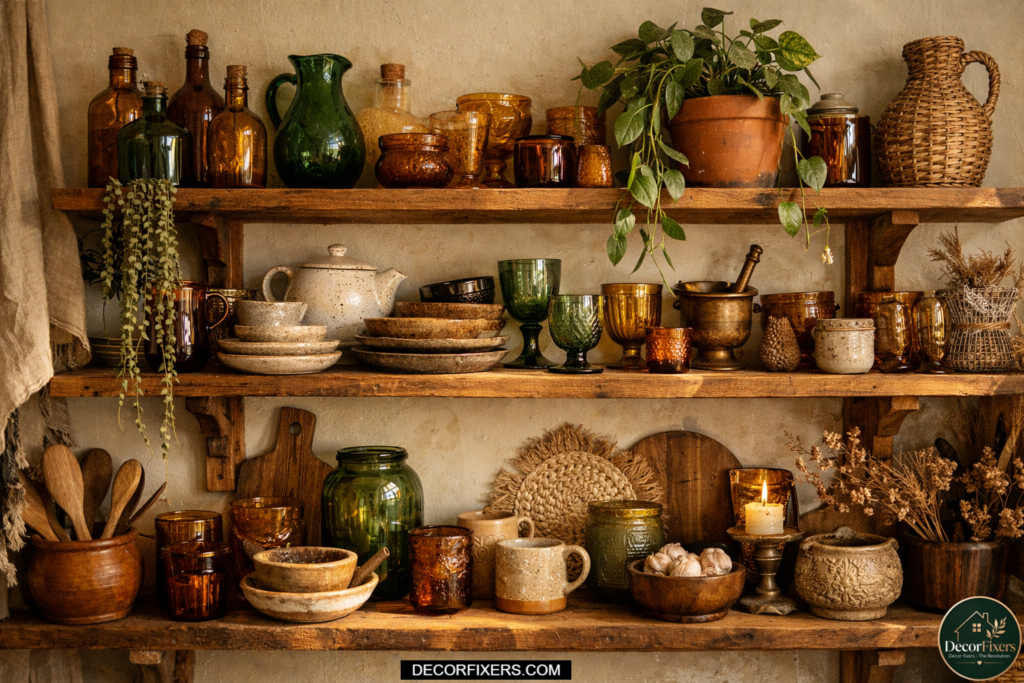
Open shelving is a canvas. What you put on it tells the story of who you are. Nothing tells that story better than a carefully assembled collection of mismatched vintage glasses, bottles, and carafes, all in amber, green, or clear glass.
Thrift stores are the only place you need to shop for this. An amber glass bottle, a green Depression glass tumbler, and a clear ribbed water glass from the 1960s, arrange them by height on one shelf section, and the grouping looks like it belongs in a lifestyle magazine. Total cost: $8–$20. Total time: one Saturday afternoon at Goodwill. The payoff is outsized.
22. Use a Wooden Ladder Shelf as Extra Storage and Display Space
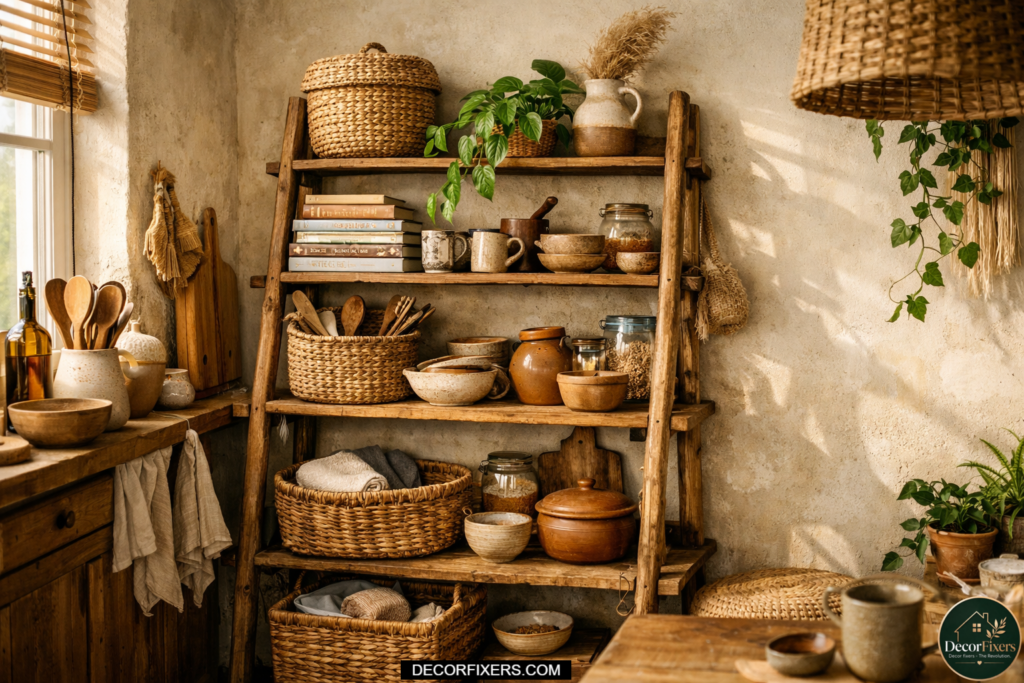
Small kitchens especially love this one. A freestanding wooden ladder shelf, the kind that leans against the wall and has three to four rungs, adds vertical storage without requiring any installation and costs $40–$100 at most home stores.
Style the rungs with plants, cookbooks, and a woven basket on the bottom, and small ceramics on the middle shelves. It functions as extra storage and acts as a visual anchor in any corner it inhabits. Because it’s freestanding, it moves with you. Because it’s wooden, it immediately reads as warm and intentional. It’s one of the most versatile pieces in the boho kitchen toolkit.
23. Add Ambient Candlelight With Moroccan Lanterns or Clay Candle Holders
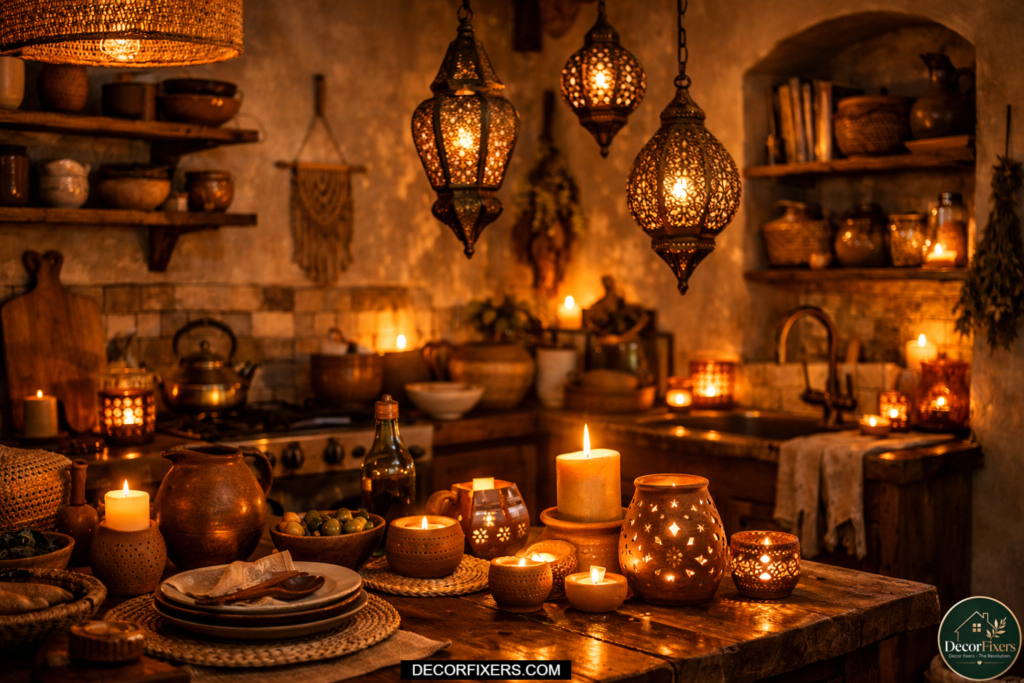
Overhead lighting tells you where you are. Candlelight tells you how you feel. The boho kitchen plays with both.
A Moroccan-style lantern on the counter, a cluster of clay tea light holders near the window, a pillar candle in a hammered brass holder on the dining table, these are small, inexpensive moves that completely shift the atmosphere of the kitchen in the evening.
Cost per piece: $8–$35. The warmth they add in the evening, especially during dinner, transforms a functional room into one that feels genuinely alive. This is the kind of detail that your kitchen photos will never fully capture, but the people in your kitchen will feel it immediately.
24. Layer a Boho-Patterned Tablecloth or Runner Over Your Dining Table
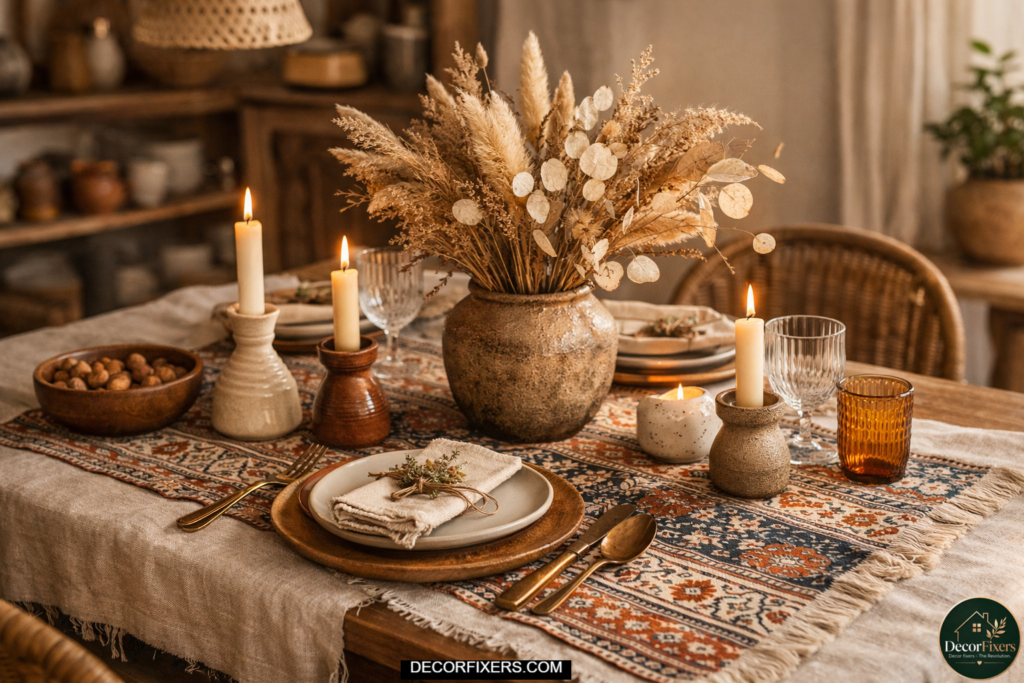
The table is the last surface people usually think about, and it’s one of the easiest to transform. A boho-patterned tablecloth, block-printed cotton, ikat, or a hand-stamped geometric changes the entire character of a dining area in seconds and costs $25–$60.
If a full tablecloth feels like too much, use a table runner down the center instead. Layer it over a solid linen cloth for depth. Add a small vase of dried stems or a ceramic candle holder in the center. That’s a fully styled dining area with three objects and a $30 investment. Sometimes the simplest layering moves are the most effective, and this one proves it every time.
Quick Comparison:
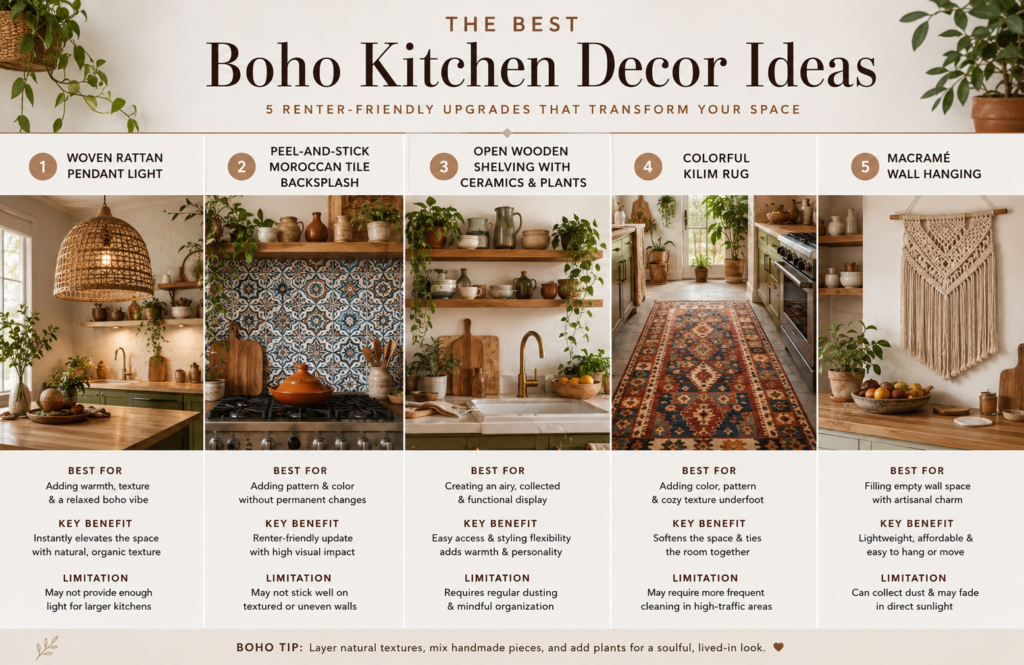
| Option | Best For | Key Benefit | Limitation |
| Rattan Pendant Light | Renters, budget buyers | Instant boho warmth, no renovation | Needs existing fixture |
| Peel-and-Stick Tile Decals | Renters who can’t retile | Dramatic backsplash effect, removable | Heat/moisture durability varies |
| Open Wooden Shelving | First-time homeowners | Display ceramics add depth | Requires wall anchoring |
| Kilim or Jute Rug | Anyone, any kitchen type | Color/texture, fully removable | Needs a cleaning routine |
| Macramé Wall Hanging | Small kitchens need texture | Zero-commitment wall decor | It can look cluttered if oversized |
The #1 Boho Kitchen Mistake (And How to Avoid It)
Most guides skip this. Every top-ranking article I’ve read focuses on what to add, and almost none of them talk about what to hold back.
The single biggest mistake people make when creating a boho kitchen is overcrowding. They buy everything on a list like this one and put it all out at once. The result isn’t bohemian, it’s chaotic. It looks like a storage unit wearing a Pinterest costume.
The boho aesthetic is about layering, not accumulating. Choose one or two focal points, a statement pendant light, an accent wall, a well-styled shelf, and keep the rest of the surfaces relatively calm. The space between objects is as important as the objects themselves. Give your kitchen room to breathe, and it’ll look intentional. Fill every surface, and it’ll just look full.
This works best for: renters and first-time homeowners who want the boho look without permanent changes. It does NOT address full renovation projects, open-plan kitchen redesigns, or new construction builds; those are different conversations entirely.
What Actually Makes a Kitchen Look Boho?
A boho kitchen isn’t about any single item; it’s about how elements combine. According to Architectural Digest’s 2025 design report, 72% of homeowners now prioritize natural materials in their kitchen updates, which aligns directly with the core boho palette: wood, rattan, ceramic, jute, and stone.
The elements that make a kitchen read as genuinely bohemian are: a warm, earthy color palette (terracotta, sage, ochre, cream), at least two natural material textures (wood + rattan, or ceramic + jute), one handmade or vintage piece with visible imperfection, and organic elements, live or dried plants, botanicals, or natural fibers. I’ve seen conflicting advice on whether pattern is essential; some sources say maximalist pattern is the signature, others say restraint reads as more modern and sophisticated. My read: one strong pattern (a rug OR a backsplash, not both) is the sweet spot for most kitchens.
Conclusion:
I’ll be real with you: when I started digging into what actually works in boho kitchens, I expected the answer to be a long shopping list. It’s not. The boho kitchen aesthetic is about intention over accumulation. It’s about choosing the three or four things that speak to each other and giving them room to do their work.
You don’t need $10,000. You don’t need a contractor. You don’t even need a weekend; some of these moves take 20 minutes. What you need is the willingness to start with one thing: maybe the rug in front of the sink, or the rattan pendant, or a single handmade ceramic bowl on your counter.
Once that first piece is in, you’ll see the potential. The kitchen will start to tell you what it needs next. That’s how boho spaces are really built, one layered decision at a time, each one making the last one look more intentional.
Your kitchen doesn’t have to look like a hotel. It can look like you. Start this weekend.
FAQs:
Q: What’s the best way to start a boho kitchen on a tight budget?
A: Start with three things: a rattan or woven pendant light ($35–$80), a kilim or jute rug for in front of the sink ($25–$60), and one handmade ceramic piece for the counter ($20–$40). Those three items alone shift the entire feel of a kitchen and cost under $180 total. Add everything else gradually over time; the boho look is supposed to feel collected, not purchased all at once.
Q: How do I make my kitchen look bohemian without painting the walls?
A: You don’t need paint. Focus on textiles, lighting, and organic objects: swap your light fixture for a rattan pendant, add a kilim rug, hang a macramé piece on one wall, style your open shelves with ceramics and plants, and use peel-and-stick tile decals on your backsplash. That combination creates the full boho effect with zero permanent changes.
Q: Should I use real plants or dried plants in a boho kitchen?
A: Both work and both are encouraged in boho styling. Dried botanicals, pampas grass, eucalyptus, and dried citrus are zero-maintenance and last months. Live plants, trailing plants, and herbs in terracotta pots add color and movement. The best boho kitchens layer both. Use live herbs on the windowsill, dried stems in a vase on the counter, and a trailing plant on top of the cabinets.
Q: Why does my boho kitchen look cluttered instead of layered?
A: Because there’s too much of it. Boho layering works when there’s negative space between objects, empty shelf sections, clear counter stretches, and breathing room between things. If your kitchen looks chaotic, remove one-third of the objects and see how it reads. The missing pieces will make the remaining ones look more intentional, not less.
Q: When should I invest more versus keep it budget-friendly?
A: Invest in the pieces you see every day and touch every day: your light fixture, your rug, and your one statement ceramic or vintage piece. Keep the smaller accent items budget-friendly: the dried flowers, the jute rope wrapping, the thrift store glassware. The pieces that get close attention deserve quality; the background texture elements just need to do their job.
Creator of DecorFixers, sharing practical home and interior ideas focused on real-life usability, simple design improvements, and budget-friendly solutions.