

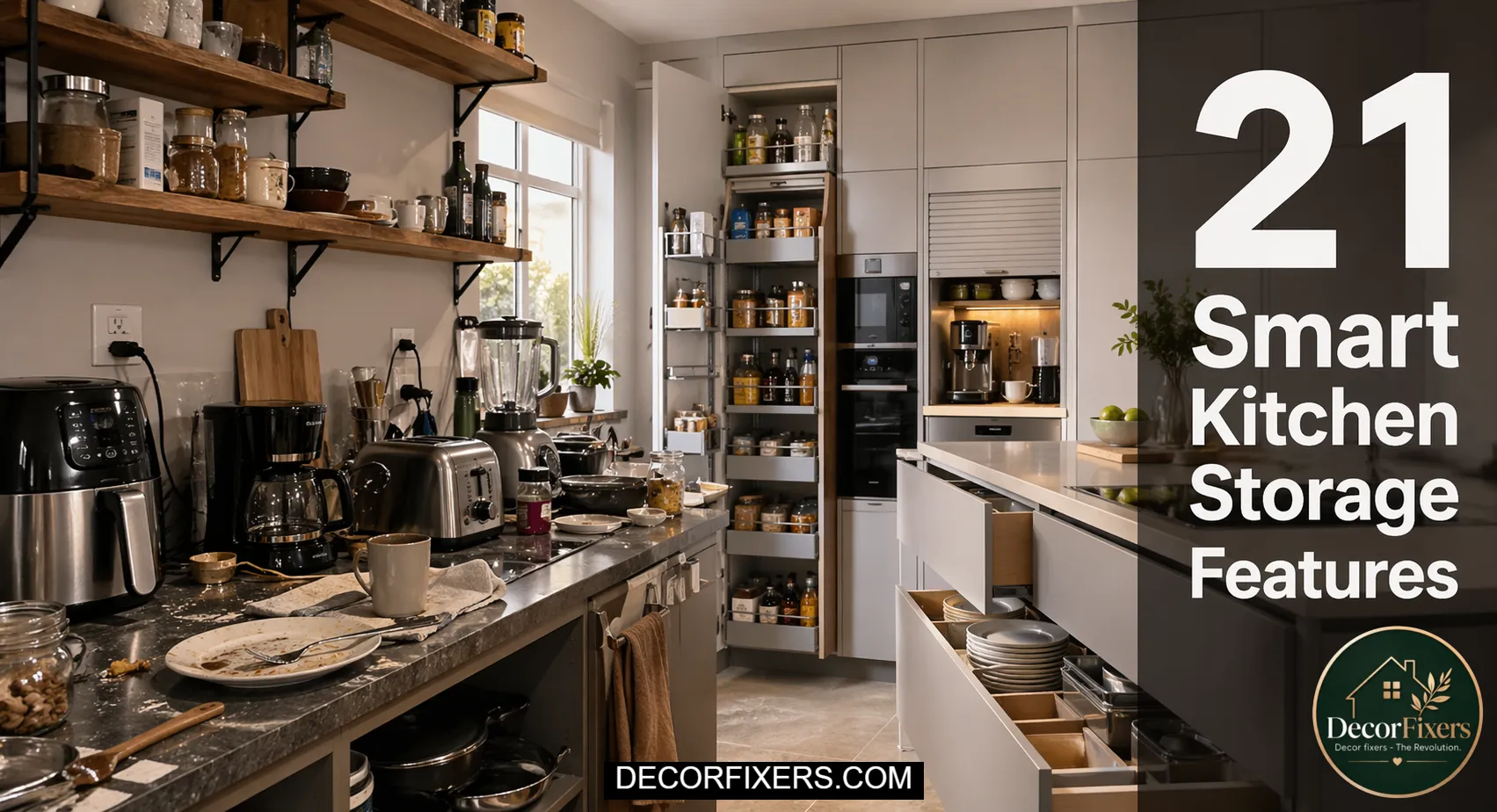
The term smart kitchen features and storage trends refers to the integration of technology-driven systems, motion sensors, modular hardware, IoT connectivity, and intelligent cabinetry into residential kitchens to improve daily functionality, accessibility, and visual order. The category ranges from in-cabinet LED lighting (£80 retrofit) to AI-connected refrigerator inventory systems (£2,000+), and the ROI varies just as widely.
Not all of it is worth your renovation budget. This breakdown ranks 21 real ideas by practical impact, from the ones that pay off in week one to the ones that sound impressive in showrooms and collect dust by month three.
Why Smart Storage Has Become the Priority (Not Just the Trend)
Here’s the thing: most kitchens weren’t designed badly. They were designed for a different version of how people cook. The 2026 storage trends are solving something specific: the gap between available cubic space and actually usable cubic space.
Smart kitchen storage in 2026 means systems that go beyond physical containers. It refers to hardware and technology combinations, motion-sensor lighting, sensor-based pull-outs, modular insert configurations, and IoT-adjacent features that make stored items more visible, accessible, and logically organized without adding surface clutter.
In-Cabinet Motion-Sensor LED Lighting
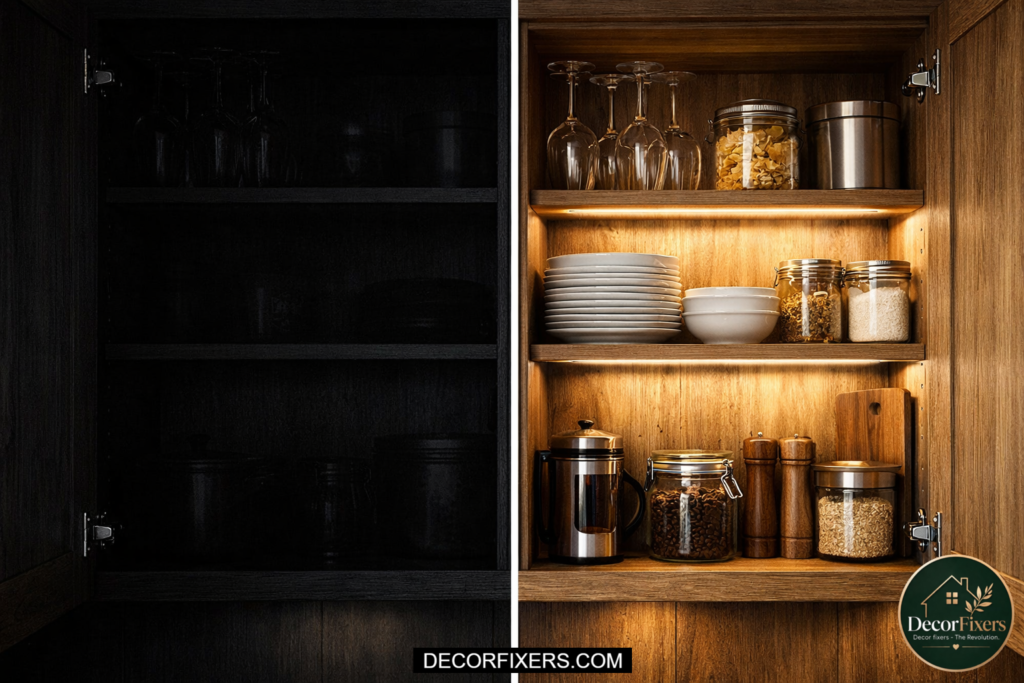
This is the single highest-ROI retrofit in the list. Not because it’s the most exciting feature—it isn’t—but because it solves a problem you probably don’t realize is costing you usable storage every single day.
Deep upper cabinets and tall pantry units get ignored. Not because you don’t need what’s inside. Because you can’t easily see it, your brain defaults to what’s at eye level.
According to the 2026 U.S. Houzz Kitchen Trends Study, in-cabinet lighting popularity has risen 3 percentage points year over year, the steepest single-year jump of any individual kitchen storage feature tracked. Motion-activated LED strips (puck lights, tape lighting, or recessed mini-spots) eliminate the visual dead zone at the back of any cabinet.
Blum’s InnoTech Atira drawer system integrates internal LED strips with wiring channels built into the drawer side panels, no exposed cables, a clean install, and immediate functional payoff.
Most people assume in-cabinet lighting is cosmetic. The data disagrees; it drives measurably better utilization of storage volume that already exists.
Custom-Fitted Drawer Inserts (Not Generic Trays)
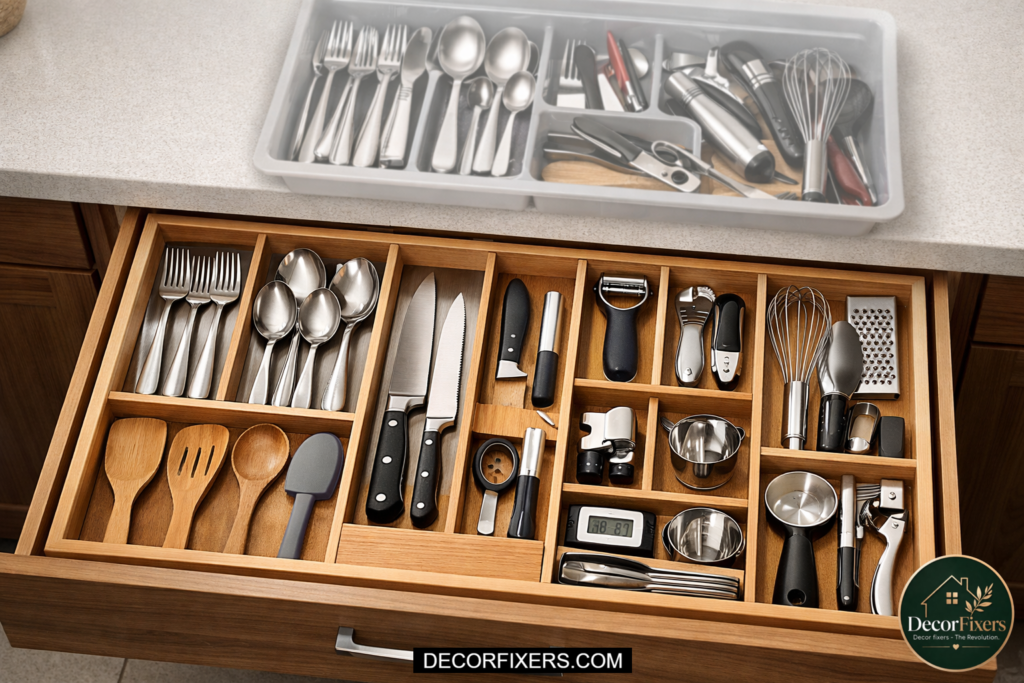
Generic drawer organizers fail for one specific reason: they’re built to fit a box, not your drawer. Most slide around, lose their configuration within a week, and don’t account for your actual drawer depth.
88% of homeowners who installed properly fitted drawer organization systems reported improved kitchen functionality, according to Acacio Market Research (2025). The operative word is “properly fitted”, custom-configured to drawer width, depth, and category of contents.
Hettich’s InnoTech Atira wirework, now available in Anthracite color-matched to drawer sides, offers modular divider systems that lock into position. You configure it once. It doesn’t move.
Quick note: custom inserts work effectively in drawers 450 mm deep or wider. Shallower drawers need door-mounted racks or shallow-pull organizers instead; don’t force a deep-insert system into a 300mm drawer.
The spice drawer format belongs in this section: horizontal spice storage, flat and label-up, in a shallow drawer near the hob. It protects spices from light and heat (extending shelf life), and turns a chaotic wall rack into a scannable grid. Small change. Genuinely different daily experience.
Toe-Kick Drawers
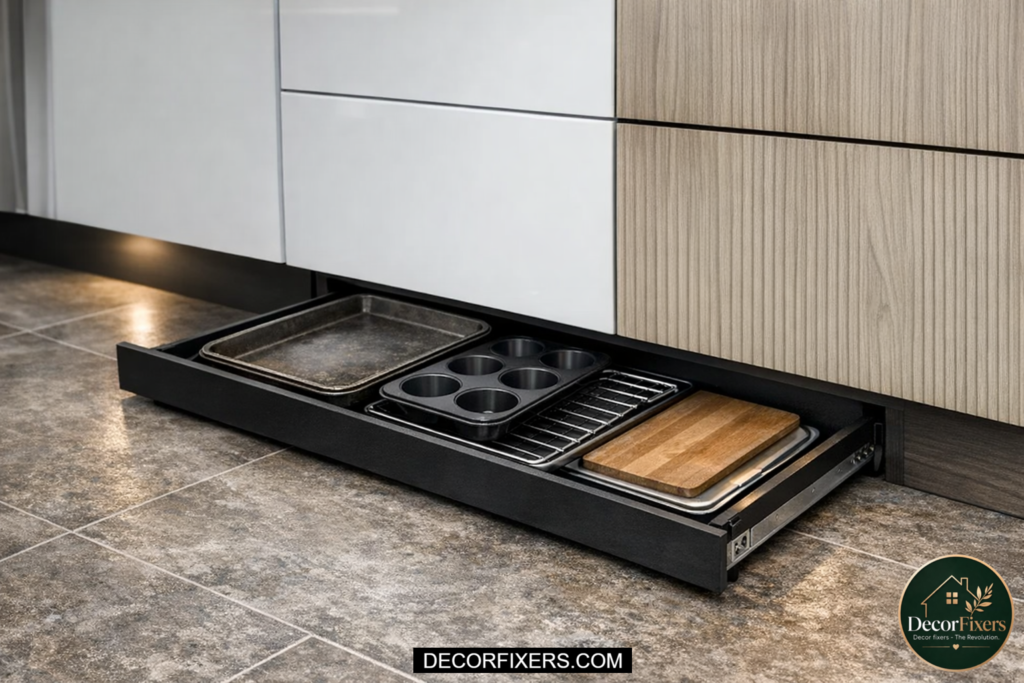
These are the most underused features in residential kitchen design. The toe-kick, the recessed panel at the base of every floor cabinet, hides a continuous strip of shallow storage space that most kitchens completely waste.
Retrofit toe-kick drawers typically run 100–120 mm in height, and the full width of the cabinet runs. That’s enough for flat items: baking trays, chopping boards, placemats, pet food, and bulky cleaning supplies. Items that currently live stacked in awkward positions elsewhere.
Installation requires removing the existing kickboard panel and fitting a face-frame drawer mechanism. It works with most standard base cabinet carcasses and doesn’t require structural changes.
Look, if you’re renovating on a constrained budget and trying to add meaningful storage without touching the cabinet carcasses, toe-kick drawers are the move. No other retrofit adds storage volume at that cost point.
Corner Smart Lift Units (ROEASY-Style)
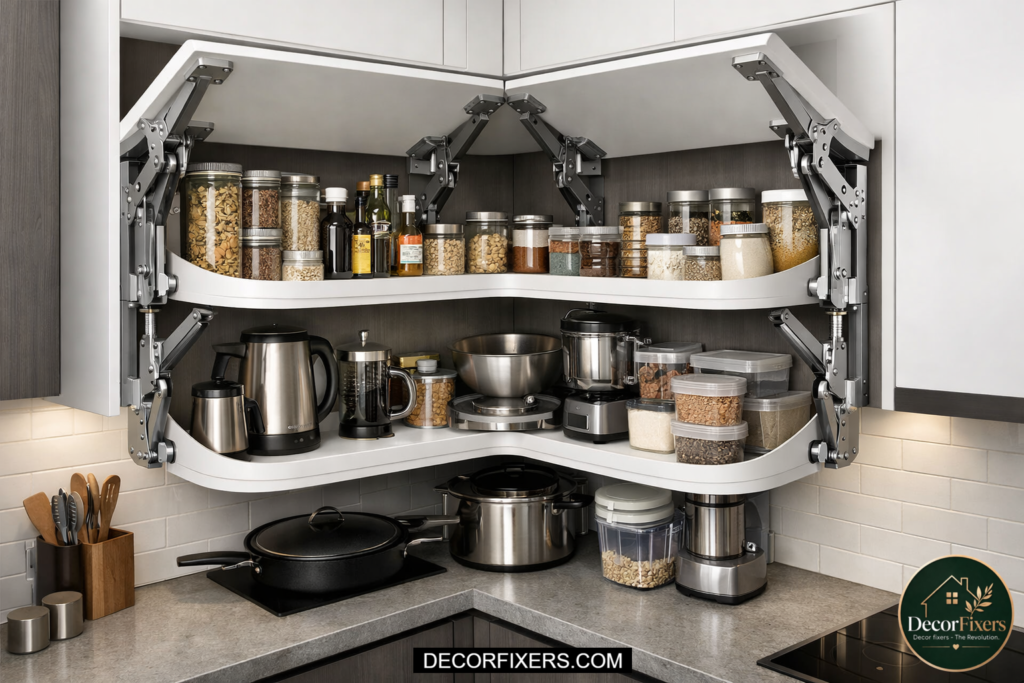
Dead corners have been a kitchen design failure for 40 years. The classic carousel lazy Susan helped marginally; items in the back were still inaccessible, the mechanism jammed, and the rotating motion meant you could only use part of the space at any given moment.
ROEASY’s hidden smart lift corner basket system takes a genuinely different approach: when the adjacent cabinet door opens, the entire corner unit rises vertically on a lift mechanism, bringing all stored items up and forward into reachable range. No crouching. No blind reaching. Full visual access.
Quick Comparison: Corner Storage Options
| Option | Best For | Key Benefit | Limitation |
| ROEASY Smart Lift Corner Unit | Compact kitchens, awkward corner geometry | Full contents visible and reachable on open | Higher cost; requires soft-close hinge compatibility |
| Diagonal Corner Drawers | Large L-shaped kitchens with wide runs | Full drawer depth; high storage volume | Needs significant clearance on both cabinet sides |
| Lazy Susan Carousel | Budget retrofits, existing cabinet reuse | Low-cost, widely compatible hardware | Back items are still difficult to reach; jam-prone over time |
| Pull-Out Corner Shelves | Mid-range kitchens, partial corner access | Better access than static; easy install | Weight limits; slower access than the lift mechanism |
| Magic Corner Pull-Out | Medium kitchens, wide blind corner cabinets | Swings out fully; good for heavy items | More moving parts; requires a minimum 900mm corner cabinet |
Some designers argue that diagonal corner drawers are the superior solution for total storage volume. That’s fair for large L-shaped kitchens with ample run. For compact urban kitchens
Ceiling-Height Cabinets
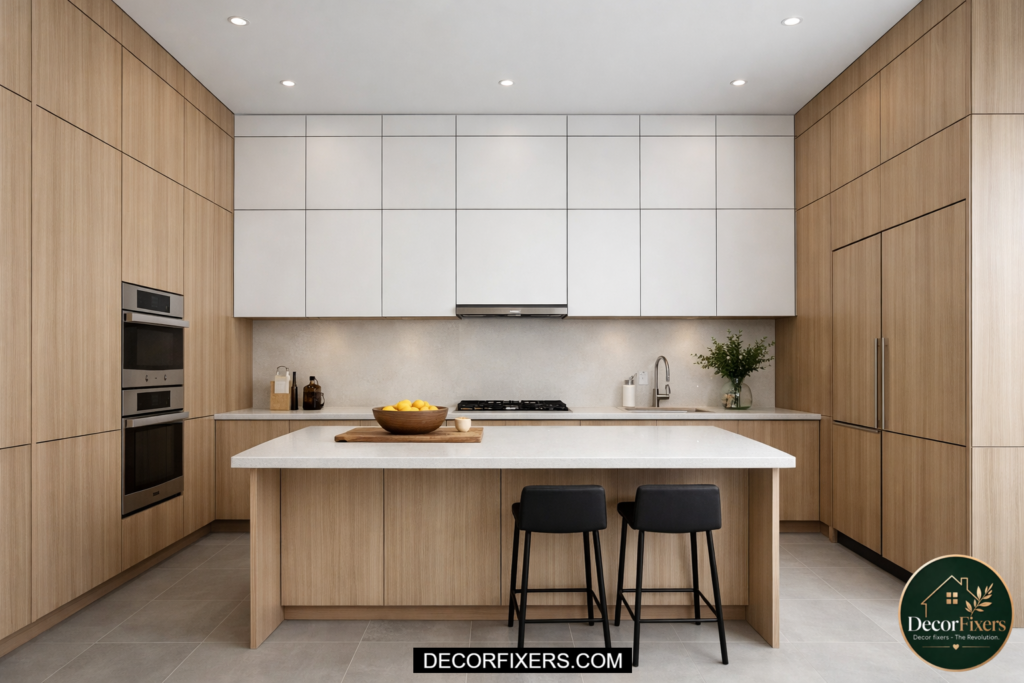
Stop leaving the top 400–600 mm of your kitchen walls empty.
According to the 2026 Houzz and Newsweek kitchen trend analysis, ceiling-height cabinets are among the most-loved designs in the 2026 Best of Houzz award winners. They add significant storage without consuming floor space, and they visually elongate the kitchen, making the ceiling appear higher and the room more spacious.
The uppermost shelves store seasonal cookware, bulky items used occasionally, and excess stock. Everything below remains in the primary access zone.
Floor-to-ceiling cabinetry also eliminates the dust-collecting gap between cabinet tops and ceiling, a genuinely underrated benefit for anyone who’s ever had to clean that space.
Bifold and Retractable Cabinet Doors
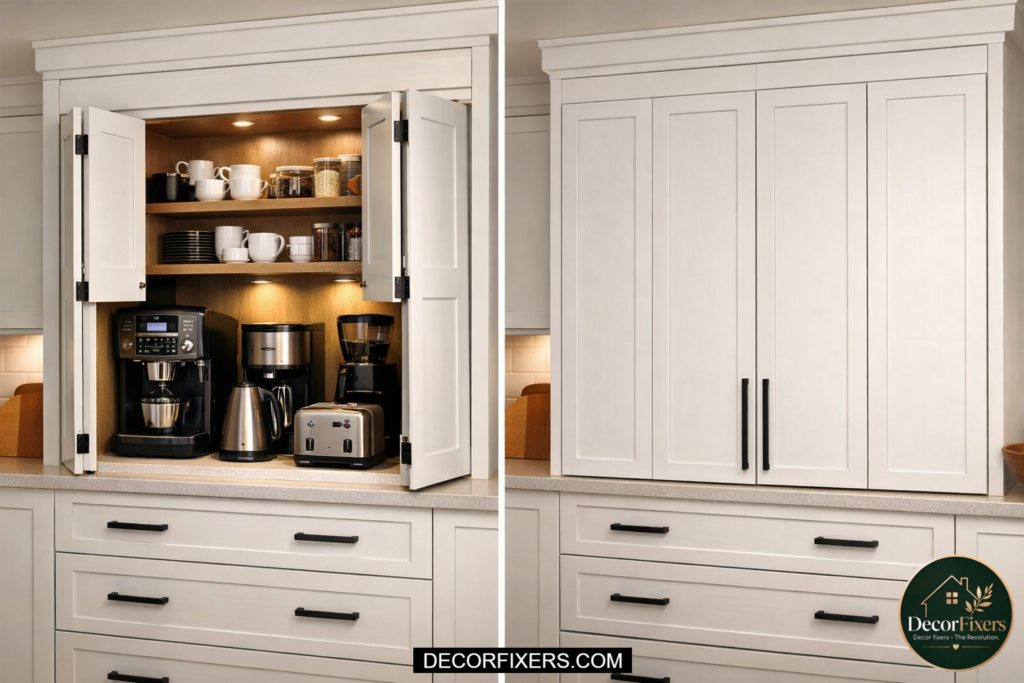
Can’t decide between open and closed storage? The 2026 answer is you don’t have to.
Bifold doors and retractable sliding panels let the cabinet switch modes, concealed for a streamlined look, and open for easy scanning and access. According to Houzz’s 2026 kitchen trend reporting, these are appearing consistently in Best of Houzz award-winning kitchens as a practical solution for homeowners who want visual flexibility without committing to fully open shelving.
They’re particularly effective for appliance zones: keep the espresso machine, toaster, and kettle behind a retractable panel during the work week. Open the panel on weekends when you’re entertaining and want everything accessible.
Or maybe I should say it this way: the trend isn’t really about doors. It’s about the ability to control what your kitchen looks like at any given moment.
Pull-Out Pantry Columns
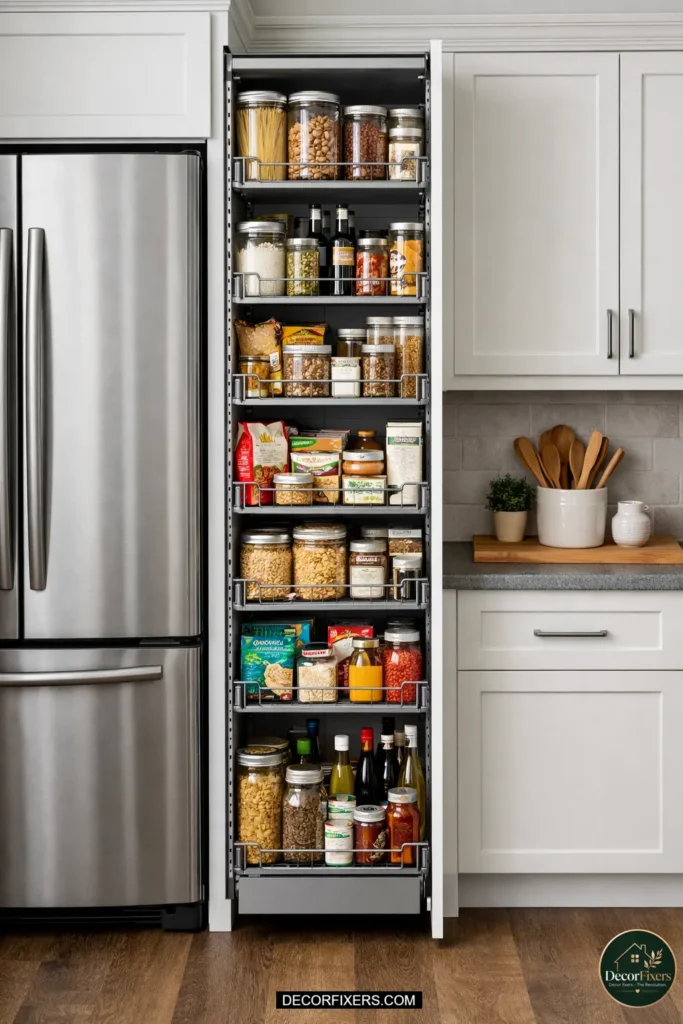
Narrow pull-out pantry columns, typically 150–300 mm wide, turn a sliver of space beside a fridge, oven, or at the end of a cabinet run into a fully organized dry-goods store.
Every shelf is visible on the pull-out. Every item within reach. No stacking, no hunting, no forgotten tins.
Simon Collyns, Sales and Marketing Director at Symphony Group, noted in a 2025 KBB Review feature that pull-out pantry demand is rising sharply among homeowners with smaller kitchens who lack a dedicated pantry room: they want butler’s pantry functionality in a fraction of the footprint.
A 300mm pull-out column, fully extended, can store the equivalent of four standard cabinet shelves’ worth of goods in a single linear strip. The access isn’t just convenient; it’s faster than opening and searching a standard cabinet because the entire inventory is visible simultaneously.
Pocket Door Appliance Stations
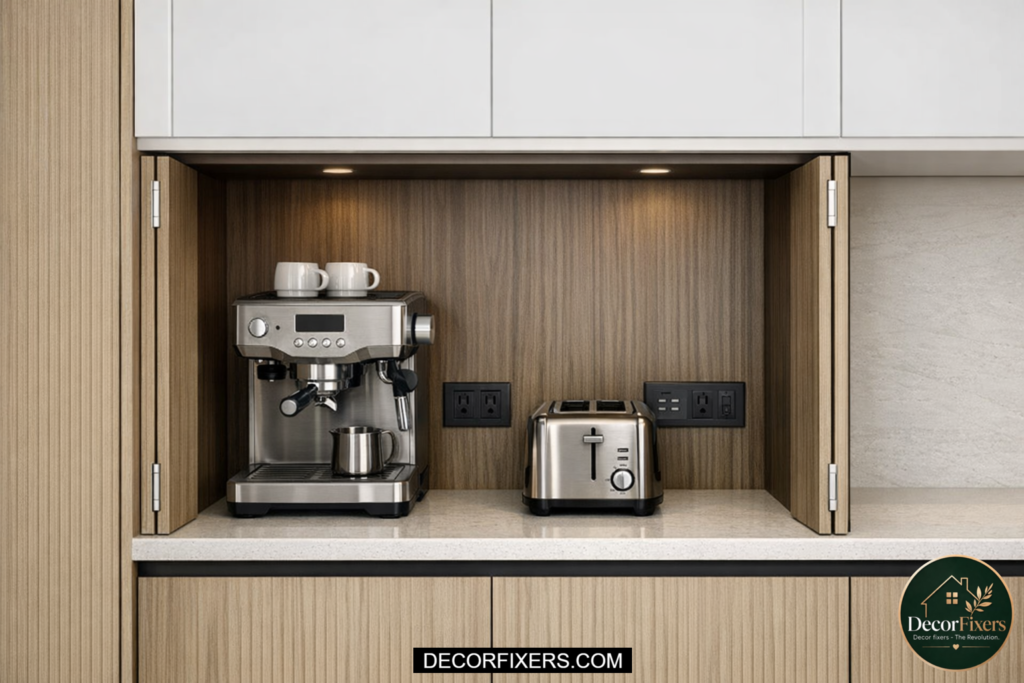
The appliance garage had the right idea. The execution was wrong.
Classic appliance garages created one problem: they put a door in front of clutter instead of solving it. If the interior isn’t organized with intent, power outlets, correct depth for the appliances, and proper ventilation, the door just adds a step.
The 2026 version is the pocket door appliance station: a dedicated section of cabinetry where appliance-specific shelving, built-in power outlets, and the correct depth for each appliance are configured before anything goes in. The pocket door slides flush into the wall or cabinet frame when open, with no door swinging into the counter workspace.
Google searches for breakfast nook features rose 30% in 2025, according to Masterclass Kitchens brand manager Cassie Jones (KBB Review, April 2025). That trend is directly connected to this one: homeowners want a dedicated, organized zone for everyday appliances that disappears visually when not in use.
Glass-Front Cabinet Doors with Interior Lighting
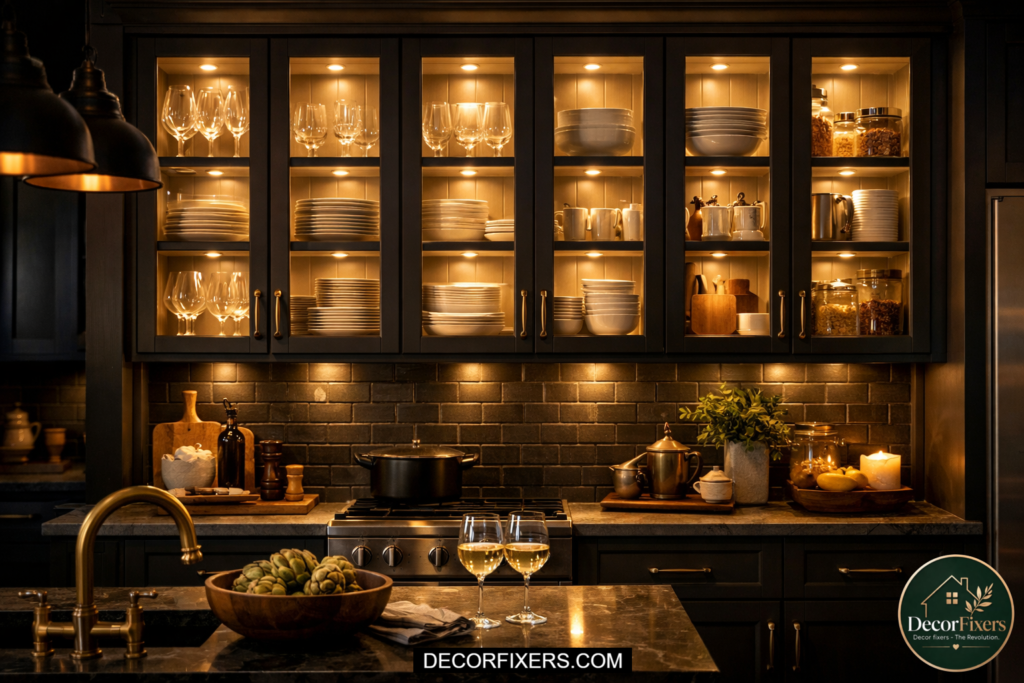
Glass-front doors serve a dual purpose that solid-door cabinets can’t: they break up the visual density of a full cabinet run while letting you see what’s inside without opening anything.
Add interior LED strip lighting (motion-activated or switched), and the cabinet becomes both a storage solution and a display feature. Dishware collections, glassware, and serving pieces that you’re proud of get showcased; everything else stays behind solid doors.
The 2026 Houzz data shows glass-front cabinetry appearing consistently in award-winning kitchen designs, often combined with in-cabinet lighting for maximum visual impact.
This works best in kitchens with curated dishware you actually want to see. It won’t help if your cabinet is storing mismatched Tupperware and expired spices. In that case, fix the organization first, then consider glass fronts.
Sink Cabinet Optimization (Blum Sink Cabinet System)
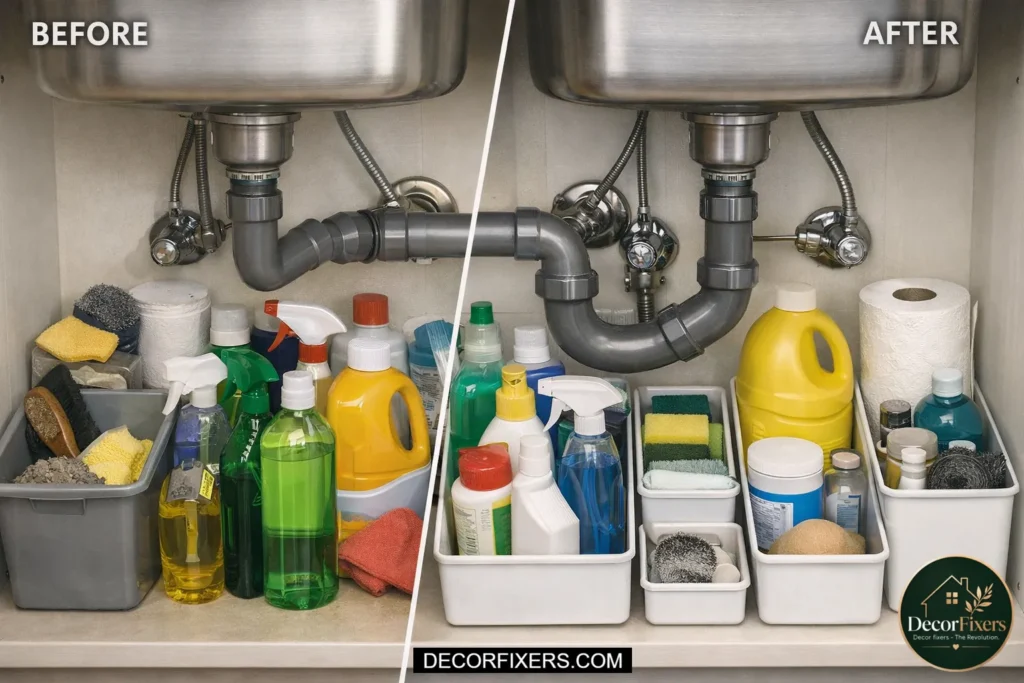
The space under the sink is one of the most wasted zones in any kitchen. The curved plumbing, the moisture risk, and the odd shape make it awkward to organize with standard trays.
Blum’s Sink Cabinet system was designed specifically for this geometry. It works around the U-bend and waste trap with a ventilated inner tray system that separates damp items (sponges, brushes) from dry ones (cleaning products, spare cloths), with a towel rail on the door for the dishcloth.
The result is a space that previously held a chaotic pile of bottles now functioning as organized, accessible under-sink storage, with no risk of moisture damage to the cabinet base.
It’s not glamorous. But under-sink chaos is one of the most common frustrations homeowners mention in kitchen functionality surveys, and this solves it completely.
Soft-Close and Push-to-Open Mechanisms
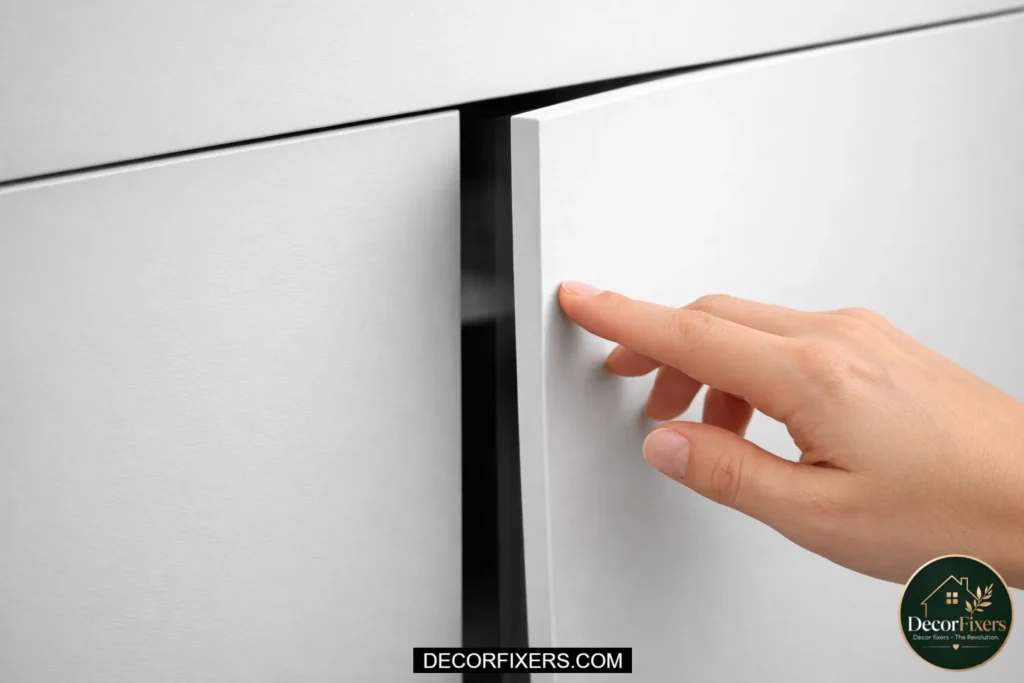
This one doesn’t get enough credit for what it actually does.
Soft-close drawer and cabinet mechanisms eliminate the single most common cause of cabinet hardware failure: impact damage from slamming. They also eliminate the noise that makes every kitchen interaction feel louder than it needs to, particularly relevant in open-plan homes where the kitchen and living space share the same acoustic environment.
Push-to-open (handleless) mechanisms take it further: no handle hardware means no hardware to loosen, tarnish, or break. The cabinet face stays continuous. The visual result is the clean-line look that defines the best 2026 kitchen design.
Blum and Hettich both produce push-to-open systems compatible with most modern carcass types. Retrofit cost is low. Longevity improvement is significant.
In-Drawer USB and Wireless Charging Stations
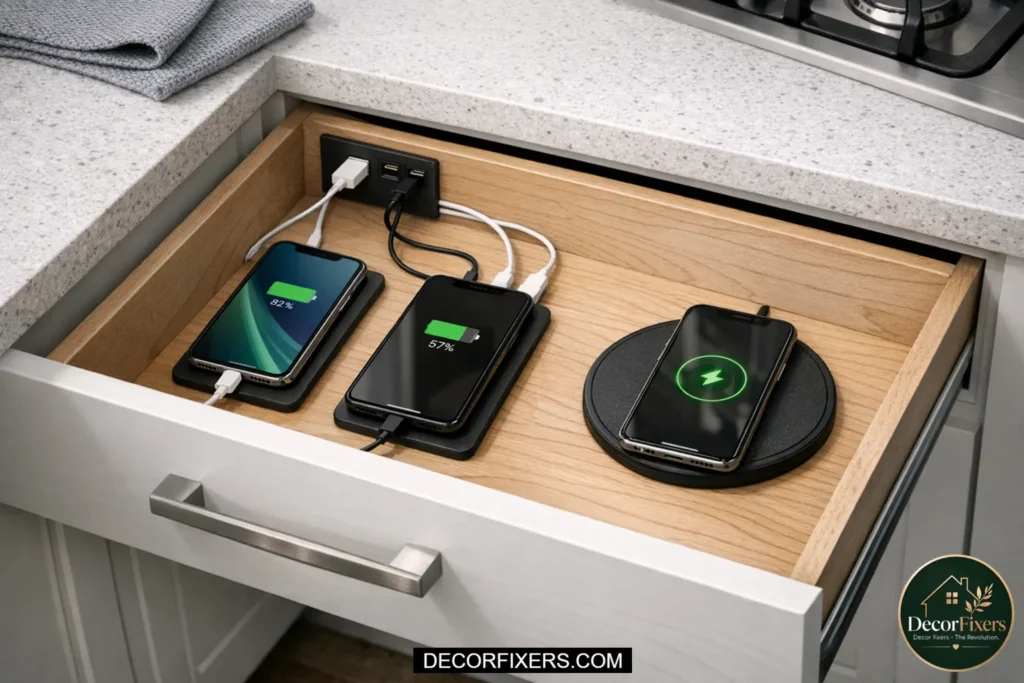
The kitchen has become a work-from-home hub for a significant portion of the population. Tablets, phones, earbuds, and smart devices charge in the kitchen because that’s where people spend time.
The problem: charging cables on countertops are one of the primary drivers of surface clutter.
In-drawer USB and USB-C charging inserts, as pioneered commercially by Docking Drawer, solve this by routing power into a drawer interior. Devices charge inside the drawer, cables stay hidden, and the counter stays clear.
The 2026 version of this includes Qi wireless charging pads embedded in drawer bases, no cable at all, just place the phone in the drawer and close it.
It’s worth noting: this works well only if the drawer is dedicated to device charging and not also holding spatulas and measuring cups. Configuration matters.
Vertical Tower Storage Units
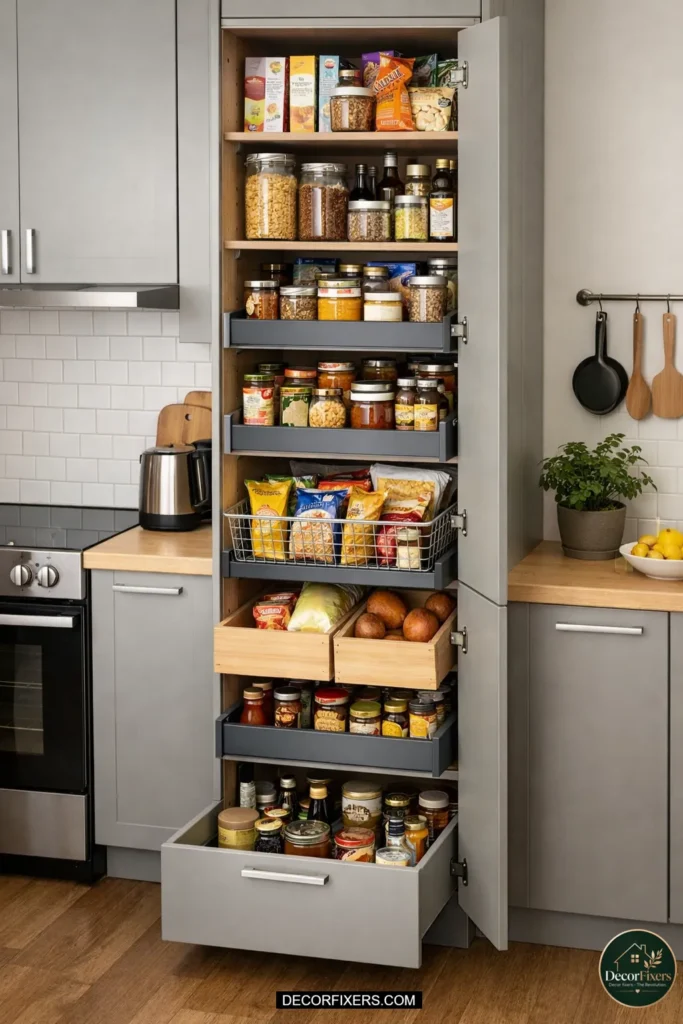
Countertop tower cabinets, freestanding or built-in, floor-to-near-ceiling, solve a specific problem in kitchens that have enough wall run but not enough vertical organization.
A 300mm-wide tower unit, configured with a mix of shelves, pull-out drawers, and door-mounted racks, can store the equivalent of a small pantry room’s worth of goods in a single column. According to Newsweek’s 2026 smart storage trends feature, these are gaining popularity in both kitchen and bathroom contexts, particularly when fitted with electrical outlets for device charging.
In compact kitchens, slot a tower between appliances or at the end of a peninsula. In larger kitchens, position as a visual break in a long cabinet run.
Custom-built to ceiling height with a built-in step stool in the lower section? That’s the 2026 full build. Practical, smart, and eliminates the need for a separate step stool stored elsewhere.
Deep Pot Drawers (Replacing Base Cabinet Shelves)
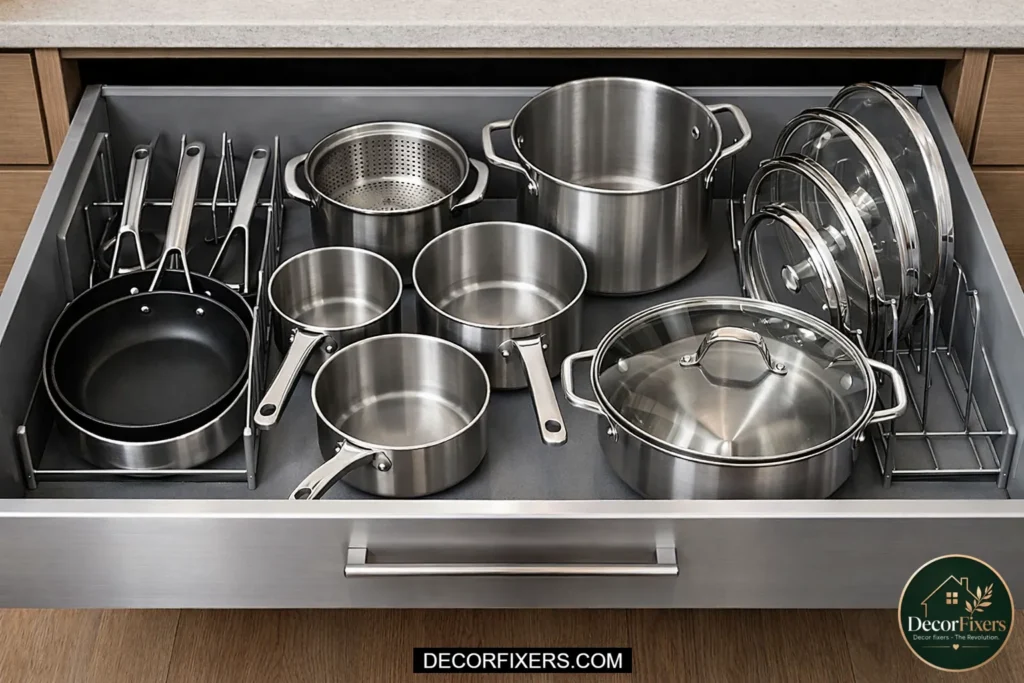
This is one of the most effective cabinet conversions available and still one of the most underused.
Standard base cabinets with fixed shelving are inefficient for storing cookware; pots get stacked precariously, lids live separately, and retrieval means dismantling a stack every time. A deep base drawer, configured with two sections (a deep zone for large pots, shallow roll-out for lids and trivets), eliminates all of that.
The drawer extends fully. Everything is visible. Nothing needs to be unstacked to reach the item at the back.
OPPEIN’s 2026 kitchen design breakdown specifically identifies deep drawers for pots and pans as a core functional upgrade in modular system builds, noting that it’s one of the features most consistently requested by homeowners in kitchen design consultations.
This works in any cabinet 500 mm wide or greater. Installation requires removing the existing shelf and fitting full-extension drawer slides rated for the load, typically 50 kg minimum for cookware drawers.
Modular Reconfigurable Insert Systems
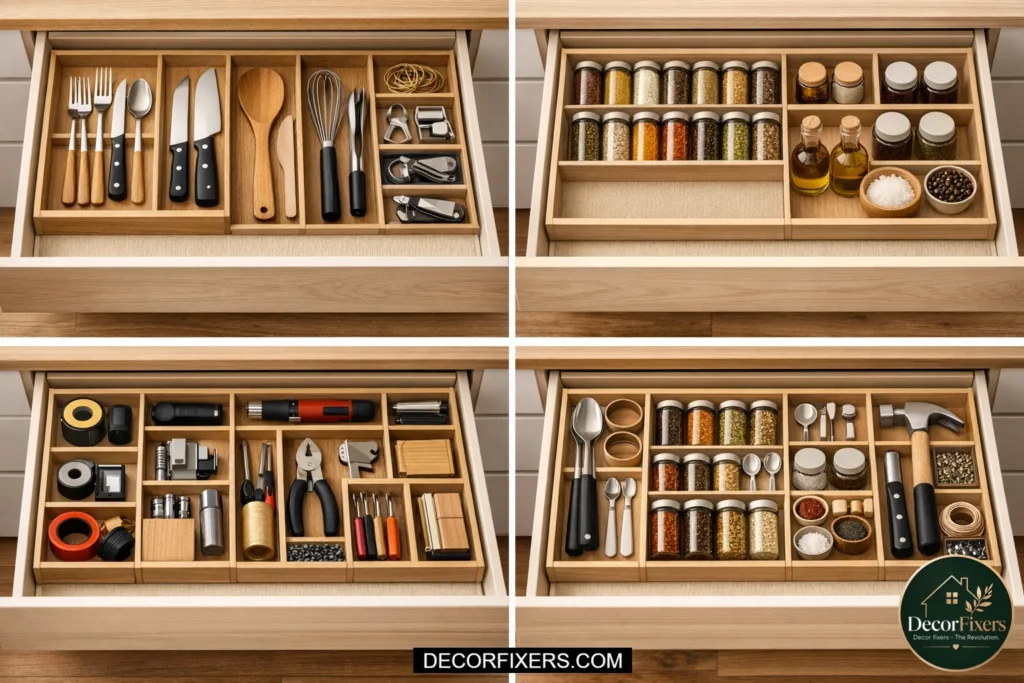
This is where 2026 differs most sharply from every kitchen storage article written before 2023.
Traditional storage solutions are fixed. You buy the organizer, you configure it, and it stays that way until you move house or throw it away. But household composition changes, families grow, cooking habits shift, and dietary needs evolve.
72% of consumers prefer multi-tiered, reconfigurable storage formats, according to Acacio’s 2025 market data, driven significantly by urban homeowners whose kitchens need to serve multiple functions across a day.
Modular insert systems, where components interlock, stack, and rearrange within the same drawer or cabinet carcass, address this directly. Move the knife block insert to a different drawer. Swap the spice grid for a dry-goods tray. Reconfigure without any tools, without any hardware changes.
Hettich and Blum both offer modular liner systems. IKEA’s VARIERA series is the entry-level equivalent. The principle is consistent: treat the drawer as a blank canvas, not a fixed container.
Hidden Recycling and Waste Sorting Stations
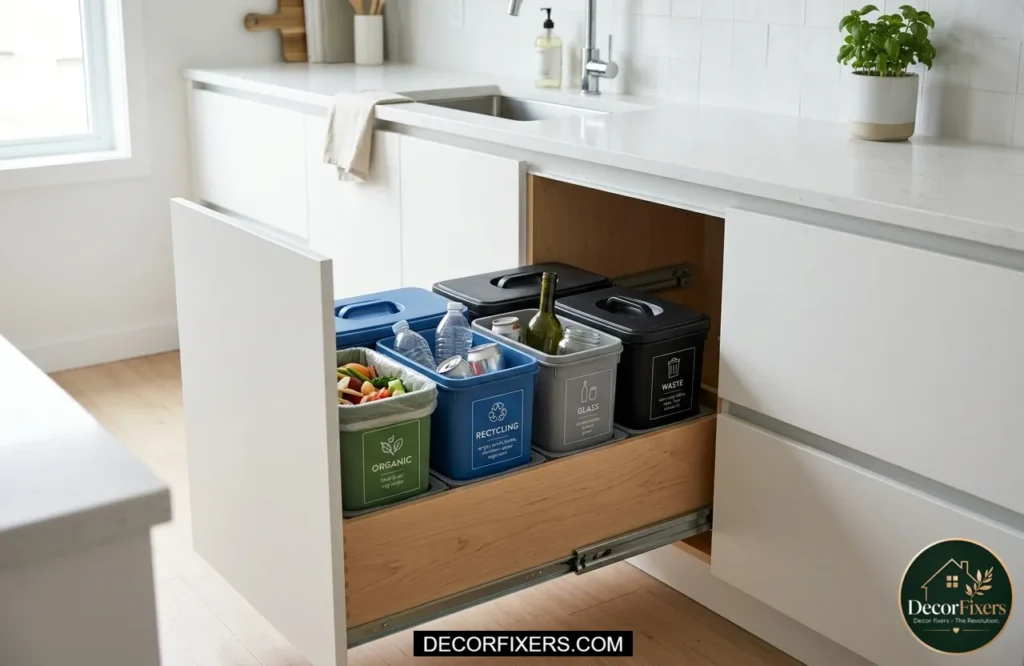
Waste bins sitting on the kitchen floor are a solved problem that most kitchens haven’t solved yet.
Built-in pull-out waste and recycling stations, integrated into a base cabinet with separate compartments for general waste, recycling, and compost, remove bins from the floor entirely. The cabinet door conceals everything. The pull-out mechanism brings all compartments forward simultaneously for easy sorting.
In 2026, the more advanced version adds smart sensors that alert when bins are full, per the About Kitchens and More 2026 remodeling analysis. That’s genuinely useful, particularly for compost bins where overflow creates odor problems quickly.
The simpler version (no sensors, just pull-out compartments) still solves 90% of the problem, discounting the cost. Start there.
False-Front Sink Drawers
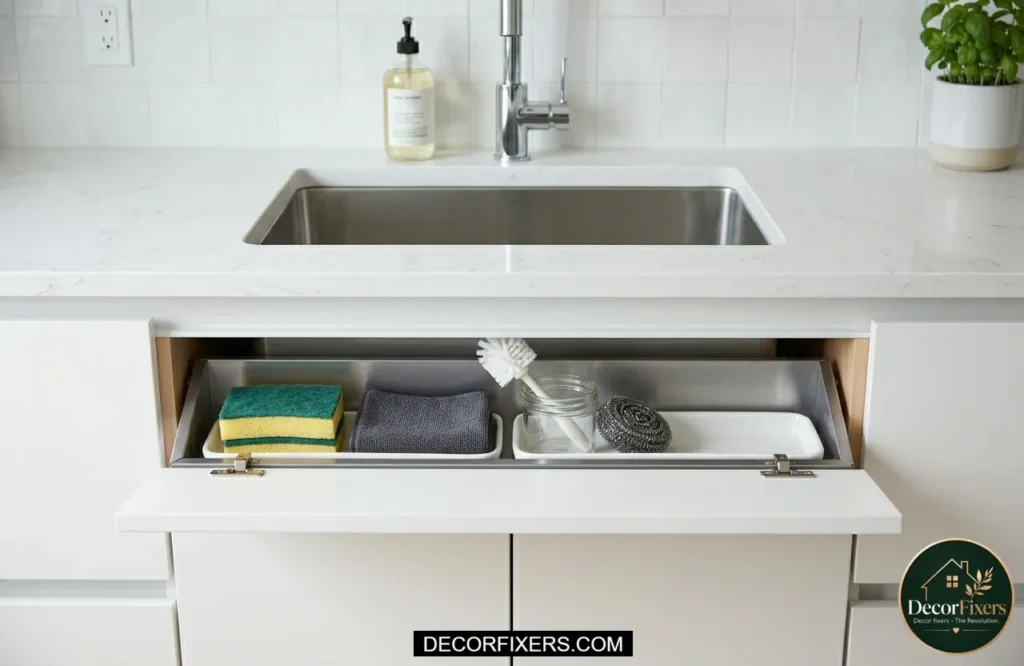
Most kitchens have a decorative false front below the kitchen tap; it looks like a drawer but opens to nothing. This is a missed opportunity.
Converting it with a tilt-out mechanism and a stainless-steel inner tray creates concealed storage for sponges, scrub brushes, and soap—wet items that would otherwise sit on the counter or under the sink, mixed with cleaning products.
The retrofit is low-cost and widely compatible. The result is a counter that stays clear and an organized spot for items used after every single meal.
It’s a small idea. The daily impact is disproportionate to its cost.
Climate-Controlled and Humidity-Regulated Storage
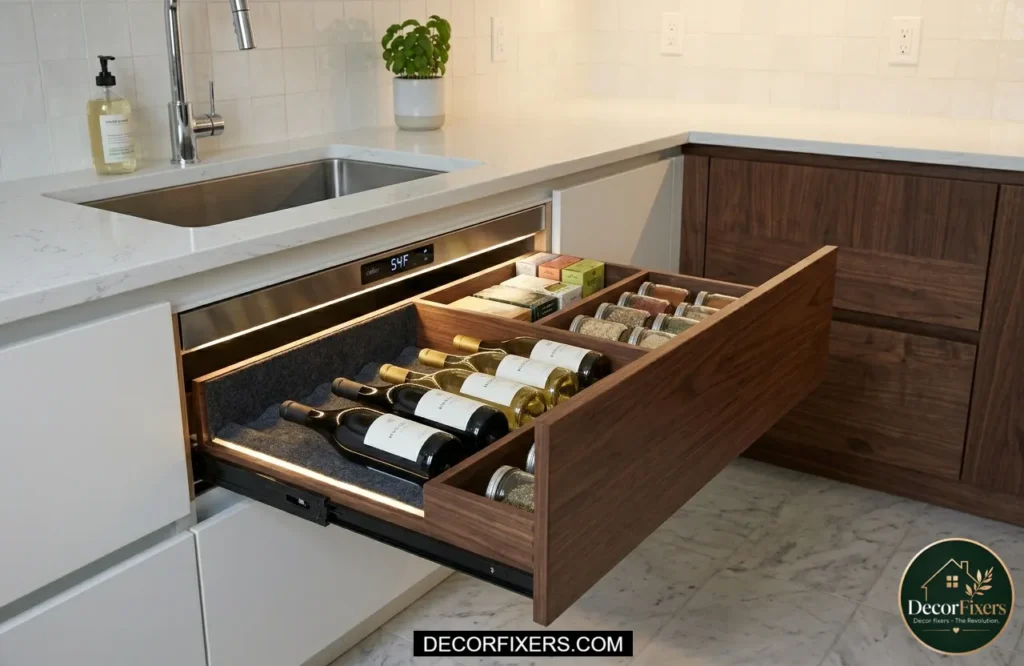
This one is for specific use cases, not a blanket recommendation for every kitchen.
Wine storage: Humidity-regulated glass-front cabinets with app-based remote temperature monitoring (smart wine cooler integration) preserve bottles correctly without a separate wine fridge taking up floor space.
Dry goods and specialty ingredients: Climate-controlled pantry drawers with temperature sensors prevent moisture damage to flour, nuts, coffee, and other humidity-sensitive items stored long-term.
Built-in climate-control cabinet systems with temperature sensors are appearing in 2026 premium kitchen builds, according to Cabi NetIQ’s smart technology integration guide (December 2025). The category is real and growing. But the ROI is only there if you regularly store items that genuinely need it.
I’ve seen conflicting data on how widely this is adopted in mid-range renovations; some sources call it a mainstream trend; others position it firmly in the luxury segment. My read: it’s a luxury feature moving toward mid-range, not yet there. Worth planning space for, not necessarily budgeting for now, unless the use case is specific.
Overhead Rail and Pegboard Wall Systems
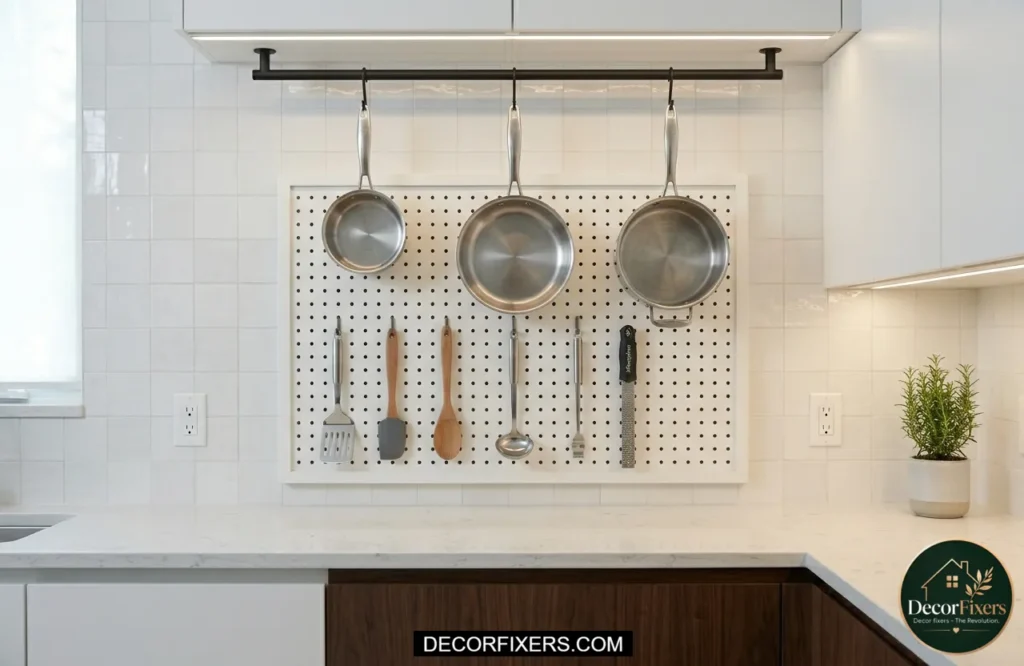
Not every storage upgrade requires cabinetry.
Overhead pot rails, wall-mounted magnetic knife strips, and pegboard wall panels create vertical storage without touching a single cabinet carcass. They’re particularly effective in kitchens with limited base and wall cabinet space, rented kitchens, studio flats, or galley kitchens with no room to add cabinetry.
The 2026 version of this is more considered than the Instagram-famous “everything hanging on a pegboard” look. Smart use is selective: the items hanging are the ones used daily, chosen to reduce reach and retrieval time, not to look productive.
Magnetic knife strips deserve a specific mention: they’re one of the most space-efficient storage solutions available per item stored, they keep knives safer (no drawer blade contact), and they cost under £30 to install on any wall.
One honest caveat: overhead pot rails only work in kitchens with 2.4m+ ceiling height and adequate clearance from the cooktop. In low-ceiling kitchens, they create safety hazards and visual congestion. Know your ceiling before committing.
Open Shelving, The Honest Take
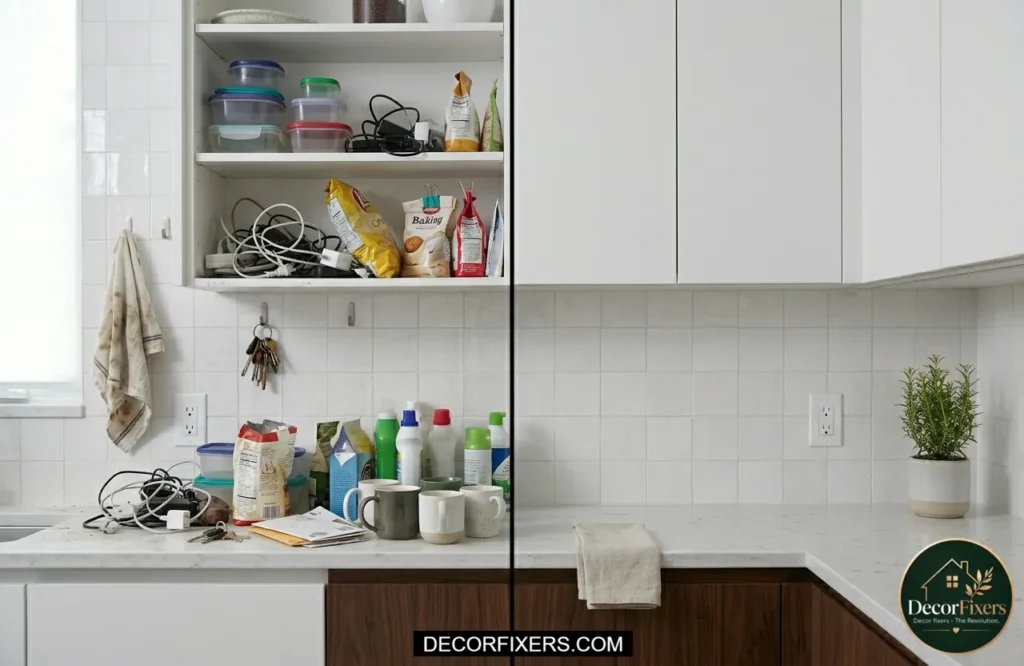
Open shelving is trending. Open shelving is also the most overhyped storage format in residential kitchen design right now.
Some experts argue that open shelves create visual openness and make items accessible at a glance. That’s valid for kitchens where the occupants are disciplined about what lives on the shelf, how it’s arranged, and how consistently it’s maintained. Styled kitchen shoots look the way they do because someone spent 45 minutes arranging them before the photographer arrived.
In daily use? Open shelves collect grease, dust, and visual noise faster than any closed storage format. They work when they’re deliberate. They fail when they’re used as default overflow storage.
The 2026 design direction is specific: reserve open shelving for display, not function. Ceramics you love. A few cookbooks. Plants. Items chosen for their appearance, not their utility. Everything functional goes behind a door.
Glass-front closed cabinets deliver the “open” visual, readable without opening, without the maintenance burden.
AI-Connected Inventory and Smart Pantry Systems
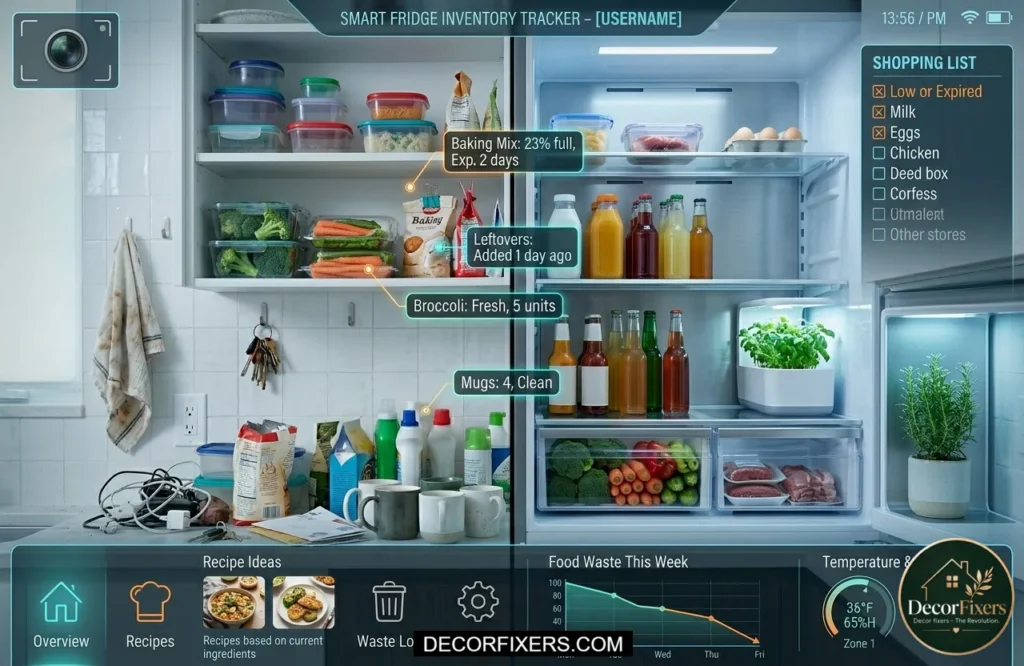
The most futuristic feature on the list. And the one with the most honest caveat.
AI-powered pantry systems, refrigerators with internal cameras that track inventory and expiration dates, smart cabinets with weight sensors that note when items run low, and app-connected grocery reordering exist, function, and are being built into 2026 kitchen designs by early adopters.
Samsung’s SmartThings, LG’s ThinQ, and Bosch’s Home Connect are the three major IoT kitchen ecosystems in this space, according to Developer’s 2026 Smart Kitchen Software analysis. Each allows appliances to communicate across the network; your fridge can flag a low item to your phone, which can trigger an Amazon Fresh reorder.
Here’s the honest reality: for most residential kitchens in 2026, this technology is solving a problem that most households don’t have at scale. Inventory tracking works well for high-volume households, large families, frequent entertainers, and households with complex dietary requirements. For a two-person household that shops weekly? The friction of setting up and maintaining the system often exceeds the time it saves.
The one AI-adjacent feature that IS broadly worth considering right now: smart refrigerators with internal cameras. The ability to see what’s in your fridge while standing in the supermarket aisle prevents duplicate purchases and reduces food waste consistently, regardless of household size.
Plan the infrastructure. Adopt selectively.
READ MORE: 22 Modern Kitchen Design Trends 2026: What’s In, What’s Out, and How to Actually Apply Them
The Right Order to Implement These
Not every idea on this list requires the same budget, disruption, or timing. Here’s a practical phasing framework:
Phase 1, Retrofit now, no carcass changes required (£80–£600 total):
Motion-sensor LED strips → Custom drawer inserts → False-front sink conversion → Magnetic knife strip → Toe-kick drawer retrofit
Phase 2, Cabinet-level changes, moderate budget (£600–£2,500):
Corner lift unit → Pull-out pantry column → Deep pot drawer conversion → Pocket door appliance station → Bifold or retractable door upgrade
Phase 3, Full remodel integration (£2,500+):
Ceiling-height cabinetry → Modular reconfigurable insert systems → Climate-controlled storage zones → In-drawer charging infrastructure → Smart pantry/IoT planning
This works best for homeowners who own their kitchen and plan to stay for 3+ years. It won’t help if you’re in a rental where structural retrofits aren’t permitted; in that case, Phase 1 items and vertical tower units are your usable toolkit.
Conclusion:
Most kitchens don’t suffer from a lack of space; they suffer from wasted space and poor usability. That’s the uncomfortable truth this entire list points to. Adding more cabinets or dashing “luxury” features won’t fix a layout that already fails in daily use.
The real winners in 2026 are not the flashy, AI-heavy systems marketed in showrooms. They are the quiet upgrades that directly improve how you move, reach, store, and retrieve things: better drawer organization, smarter lighting inside cabinets, pull-out systems that eliminate dead zones, and storage that adapts to how you actually live.
If you strip away the marketing noise, the scaling is simple. Start with visibility and access. Then fix the organization. Only then consider automation or smart integration.
The kitchens that feel graceful in daily life aren’t the most expensive ones; they’re the ones where nothing is hidden, nothing is awkward to reach, and nothing is left to chance. That’s the standard to aim for.
FAQs:
Q: What’s the best smart storage upgrade for a small kitchen in 2026?
A: Start with custom drawer inserts and motion-sensor LED lighting inside existing cabinets. These cost £80–£400 total, don’t require structural changes, and improve daily functionality immediately. Add a corner lift unit like ROEASY if corner access is your specific pain point.
Q: How do I add kitchen storage without a full remodel?
A: Retrofit toe-kick drawers under base cabinets, convert the false-front sink panel to a tilt-out tray, add motion-LED strips inside upper cabinets, and install a slim pull-out pantry column in any gap beside the fridge or oven. All work within existing carcasses.
Q: Should I choose open shelving or closed cabinets in 2026?
A: Use closed cabinets for functional storage and open shelving only for deliberate display, ceramics, cookbooks, and plants. Glass-front closed cabinets give you the visual accessibility of open shelving without the daily maintenance burden.
Q: Why does my kitchen feel cluttered even with enough cabinet space?
A: Volume isn’t the problem; accessibility and visibility are. Deep cabinets with no internal organization, dead corners with no retrieval system, and drawers without configured inserts reduce how much of your storage you actually use consistently. The solution is hardware, not more space.
Q: When are AI smart kitchen features actually worth paying for?
A: When your household is large, you shop frequently, or you manage complex dietary needs across multiple people. For most households, smart refrigerators with internal cameras are the only AI feature with a clear universal ROI right now. Full IoT pantry integration is best planned for, but adopted selectively.

Welcome to DecroFixers! I’m Mujahid Ali
4 thoughts on “21 Smart Kitchen Storage Features That Actually Deserve Counter Space”