

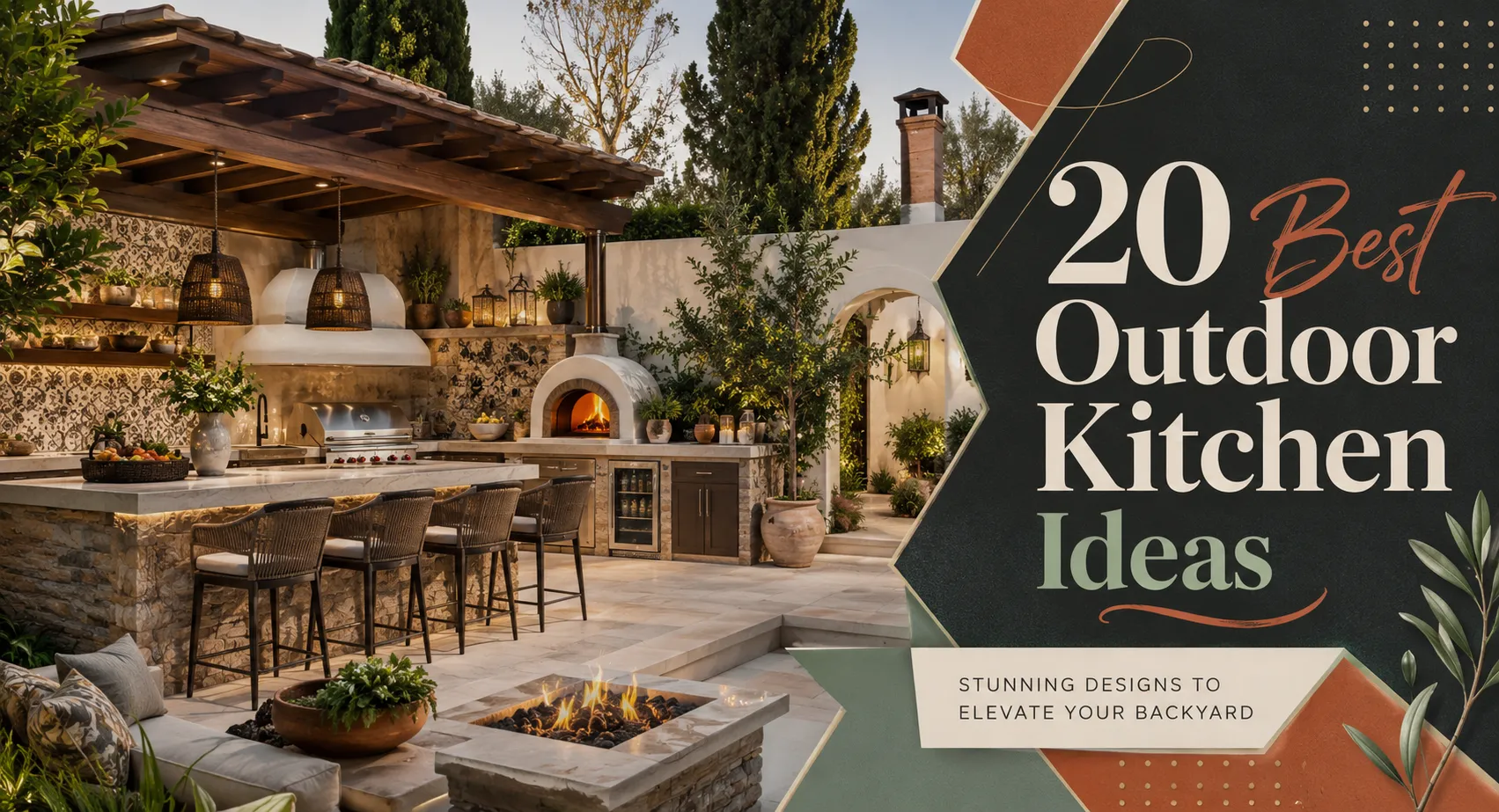
An outdoor kitchen is a backyard cooking and prep area that brings the core functions of an indoor kitchen, grilling, food prep, storage, and seating, outside, ranging from a single built-in grill station to a fully covered, multi-appliance layout. The right setup depends less on square footage and more on how you actually plan to use it.
Most people land here after one of two things happens. Either they just finished an indoor kitchen remodel and want the backyard to match, or they’ve spent a few too many summer weekends hauling trays back and forth from the kitchen island to the grill. Either way, the photos online don’t usually answer the question that matters: what would actually work in my space, at my budget?
| The best outdoor kitchen ideas for 2026 lean function-first: a grill, a covered prep counter, weatherproof storage, and seating positioned so the cook isn’t cut off from guests. Style choices (stone type, color, pergola shape) should come after the layout, not before it. |
1. Start With the Layout, Not the Finishes
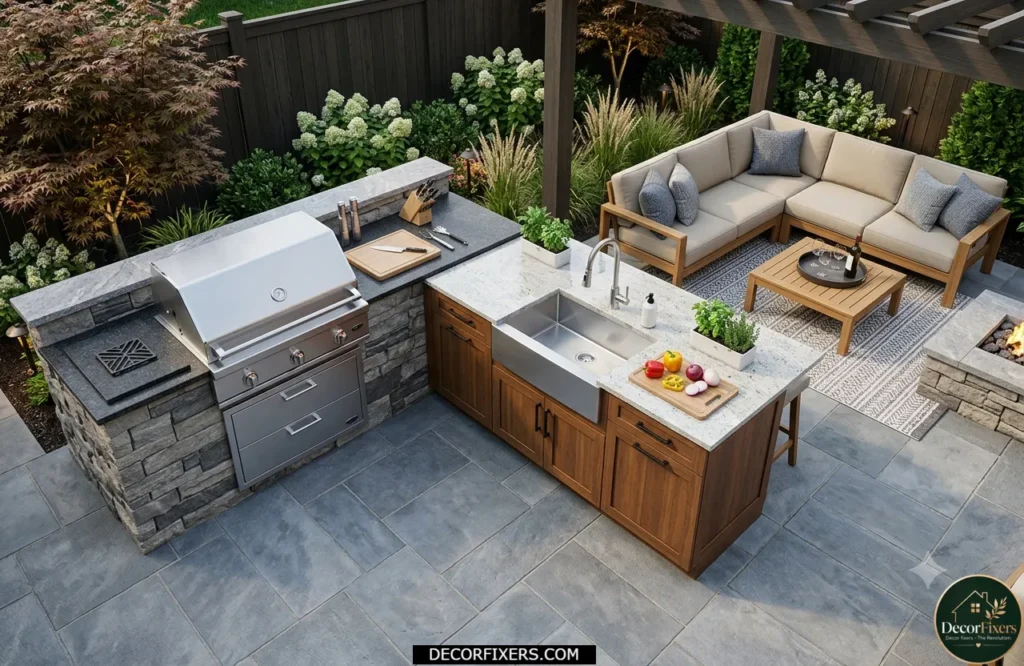
Before picking a single material or photo, lay out three zones, kept close but not cramped: a cook zone (grill, side burner, or pizza oven, with 12–18 inches of heat-safe landing space on either side), a prep-and-storage zone (counter space, a sink if plumbing allows, weatherproof cabinets), and a social zone close enough that the cook isn’t cut off from guests.
James King, VP of Design at RTA Outdoor Living, calls this the biggest shift for 2026: a move from aesthetics-first design to function-first design, built around the same kitchen-triangle logic used in indoor kitchens. Most people assume bigger is better here.
The data says otherwise: 67% of recent kitchen renovators kept their existing footprint rather than expanding it, because a tighter, well-sequenced layout usually beats a sprawling one that forces extra steps between stations.
2. A Single-Line Galley Kitchen for Small Patios
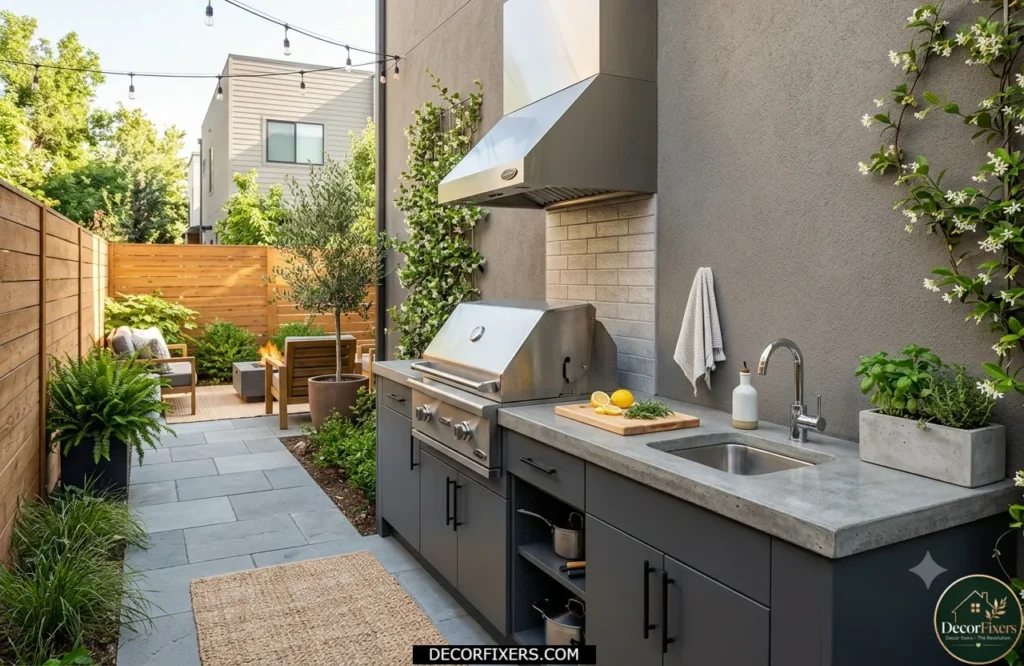
For patios and narrow side yards under 100 square feet, a galley layout against one wall or railing works best: grill, narrow counter, slim weatherproof cabinet, done. Skip the island here; in tight spaces, it becomes a walking obstacle, not a feature.
| A small outdoor kitchen needs about 4–6 linear feet for a galley layout with a grill and a narrow counter. Most homeowners renovating outdoor or indoor kitchens in 2026 keep their existing footprint rather than expand it, which makes this compact layout the more common and more practical choice. |
3. A Portable Outdoor Kitchen Cart Under $260
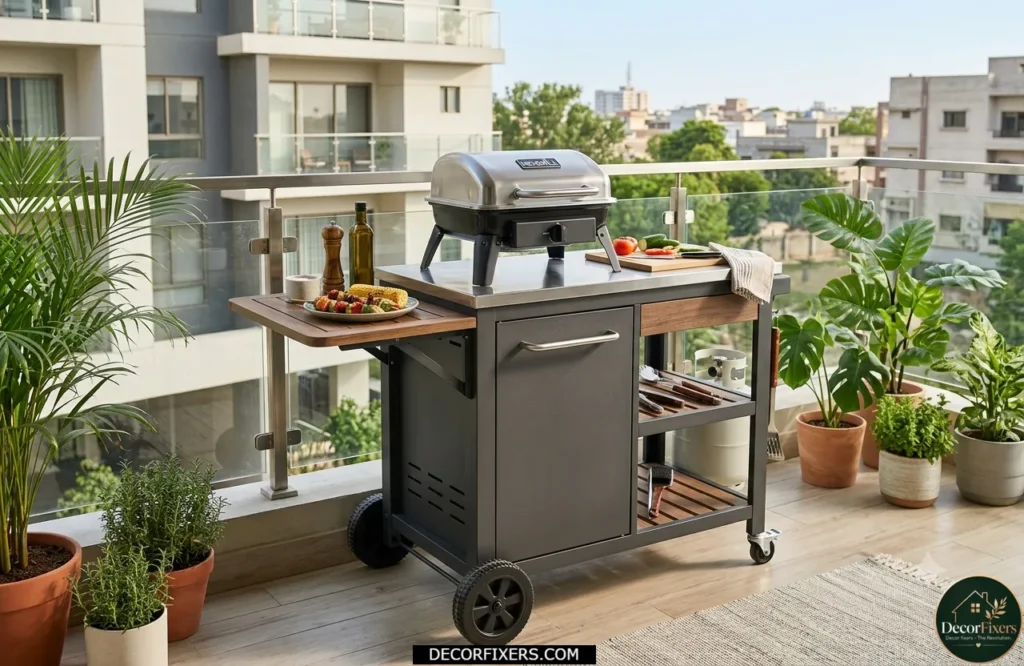
This solves a problem most galleries ignore entirely: renters and apartment-patio owners with no permanent-structure budget. Several well-reviewed rolling grill carts with a fold-out prep shelf now sit under $260, giving you a real cook station or outdoor kitchen without touching the lease.
4. A Modular Flat-Pack Kitchen Unit
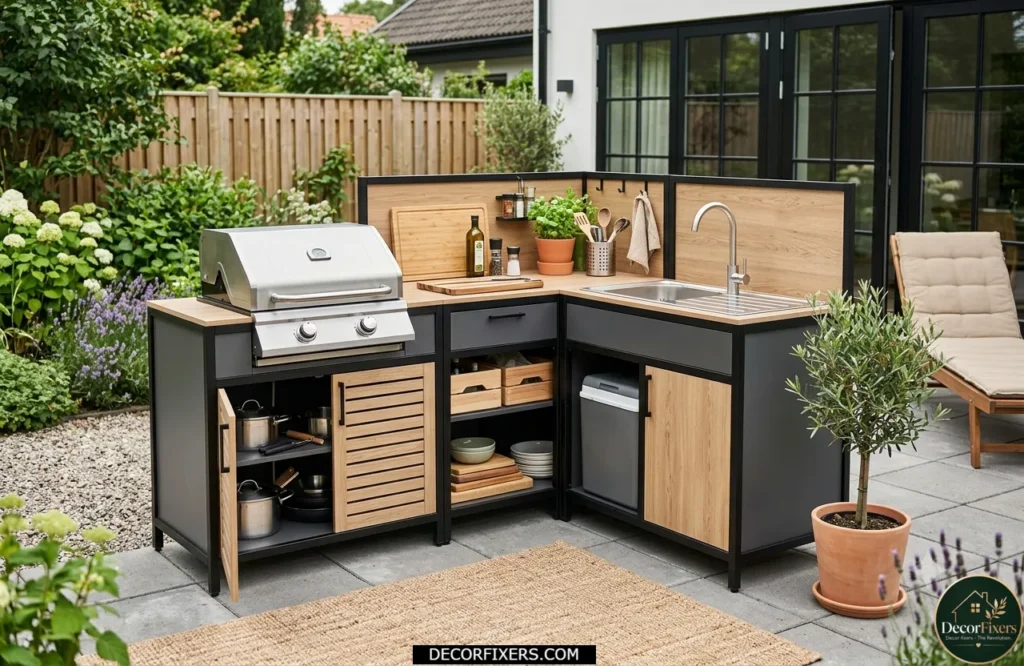
Modular flat-pack outdoor kitchen units, IKEA has one priced under $500, barely existed in outdoor kitchen content two years ago. No permanent installation, no plumbing, and it moves with you if you relocate.
5. A Wall-Mounted Fold-Down Counter
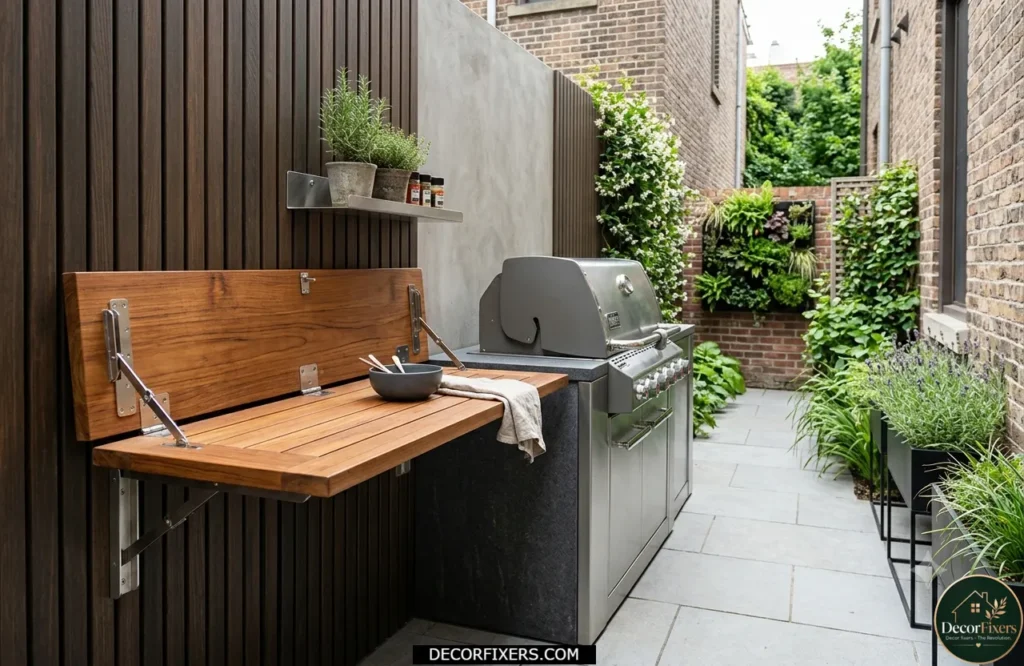
For the tightest spaces, a counter that folds flat against the wall when not in use keeps a narrow patio walkable the rest of the time. Pair it with a small built-in grill, and you’ve got a full outdoor kitchen or cook station that disappears after dinner.
6. An L-Shaped Layout for Mid-Size Backyards
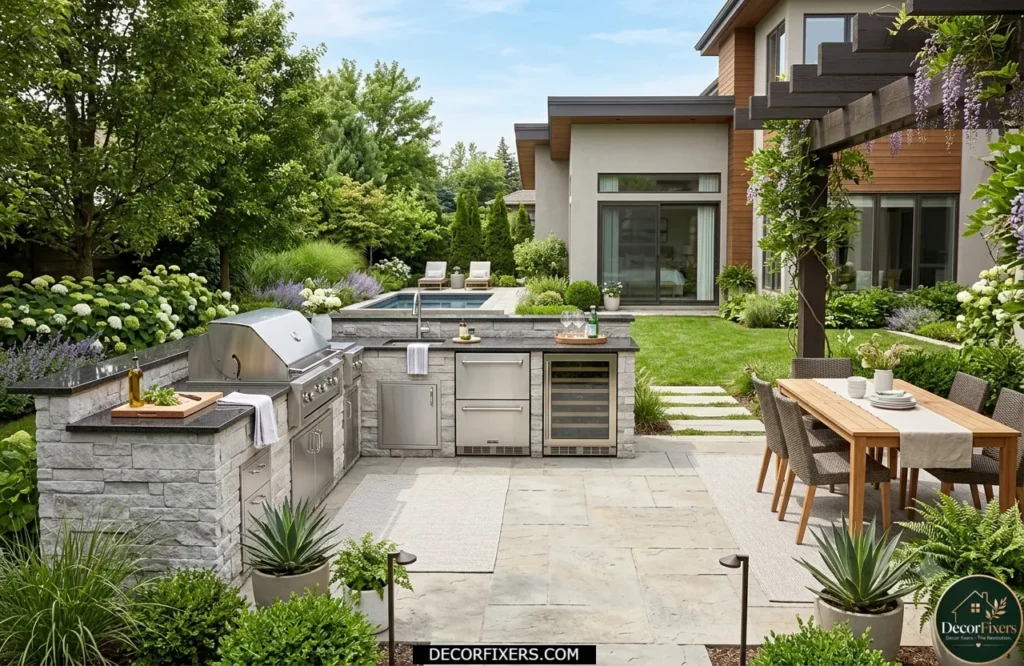
For yards in the 100–300 square foot range, an L-shaped or peninsula layout separates the cook zone from the dining area while keeping both within easy reach. It’s the configuration that shows up most often in 2026 design coverage, a full grill, fridge, and sink combination rather than a single appliance.
7. Bar-Height Seating Facing the Cook
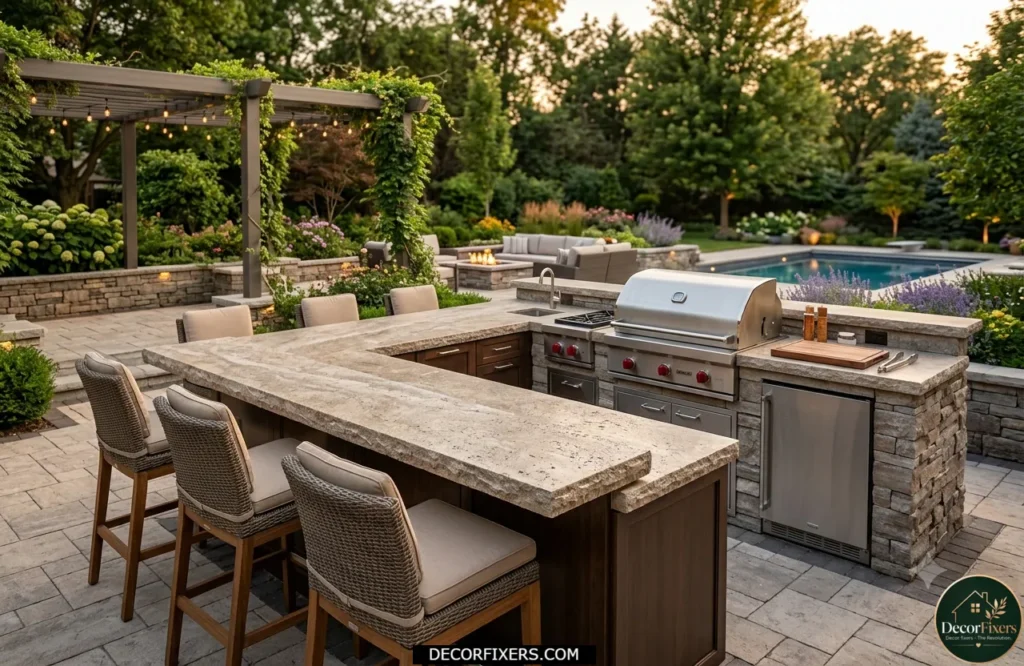
Run bar stools along the open side of an L-shaped counter so guests face the grill instead of the cook’s back. It’s a small layout choice that does most of the work in making an outdoor kitchen feel social rather than functional-but-isolated.
8. A Small Shade Sail Over the Cook Zone Only
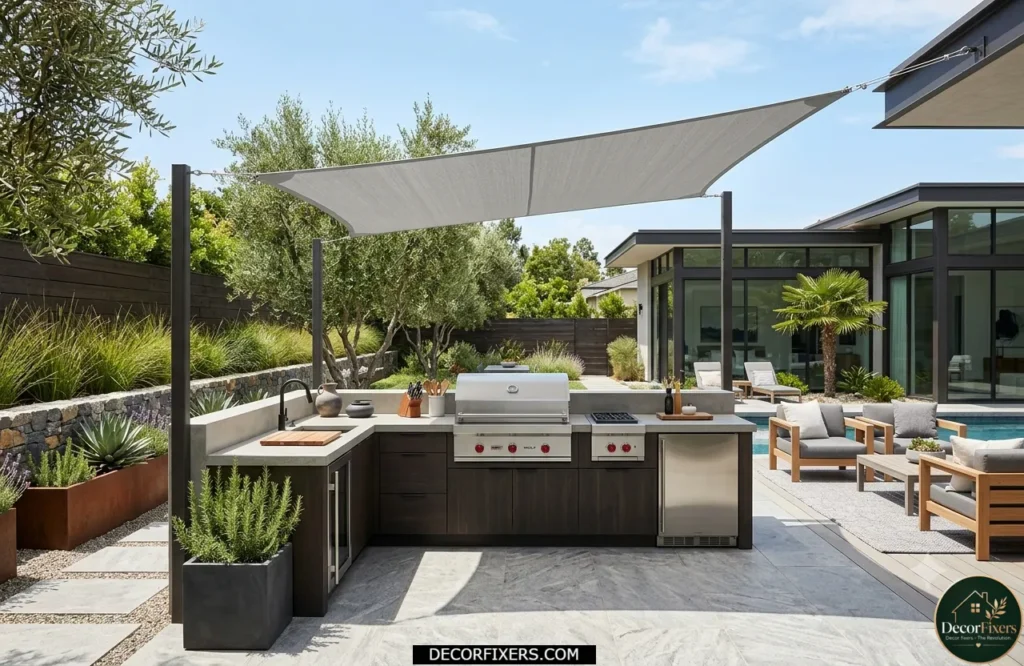
At mid-size, you don’t need full coverage. A shade sail or cantilever umbrella positioned over just the grill and prep counter keeps the cook in the outdoor kitchen out of direct sun without the cost of a full pergola structure.
9. A U-Shaped or Two-Island Layout for Large Yards
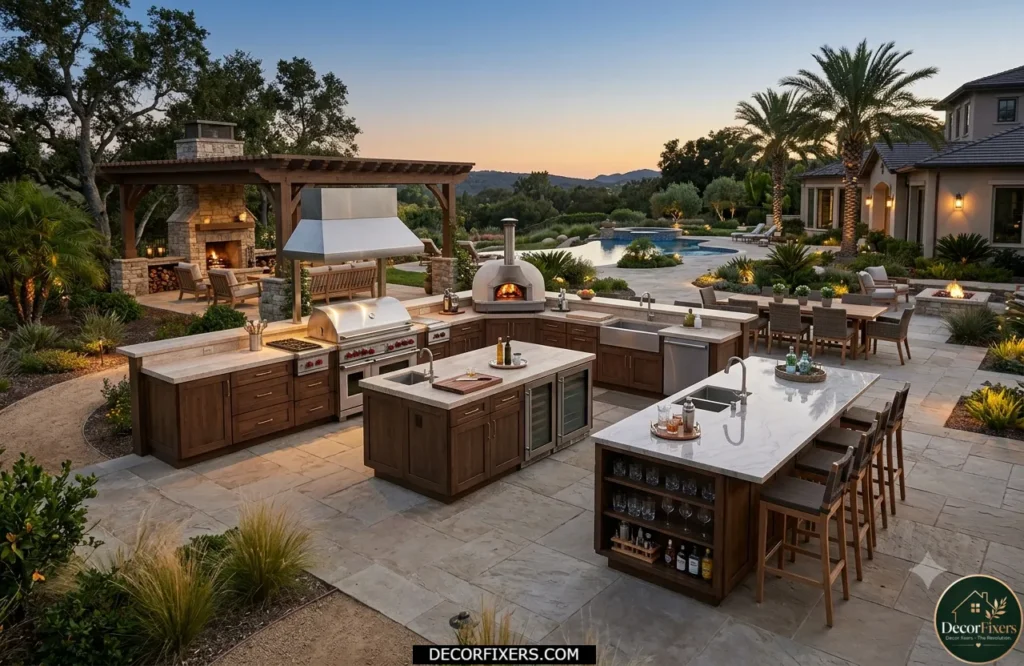
Above 300 square feet, a U-shaped or two-island configuration lets you separate outdoor kitchen cooking from a dedicated bar or beverage station entirely. It’s the most workflow-efficient layout, though also the most expensive in materials and labor.
10. A Full Roof Structure With Ceiling Fans
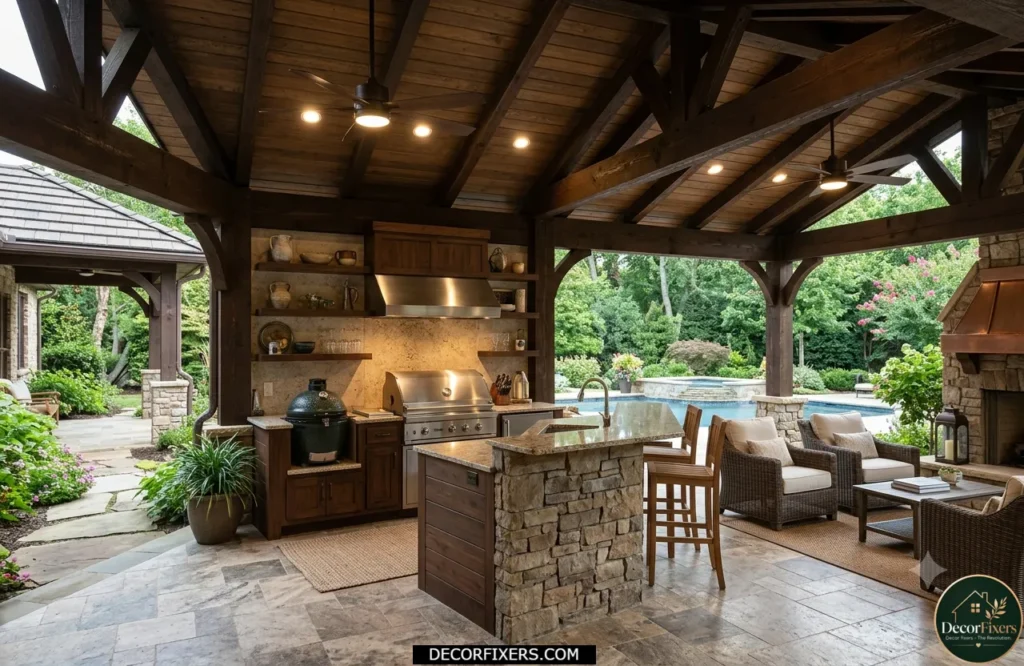
Once you’re building an outdoor kitchen at this scale, a full roof with electrical for ceiling fans and lighting turns the space into a year-round room in milder climates, not just a summer feature.
11. A Separate Pizza Oven and Smoker Station
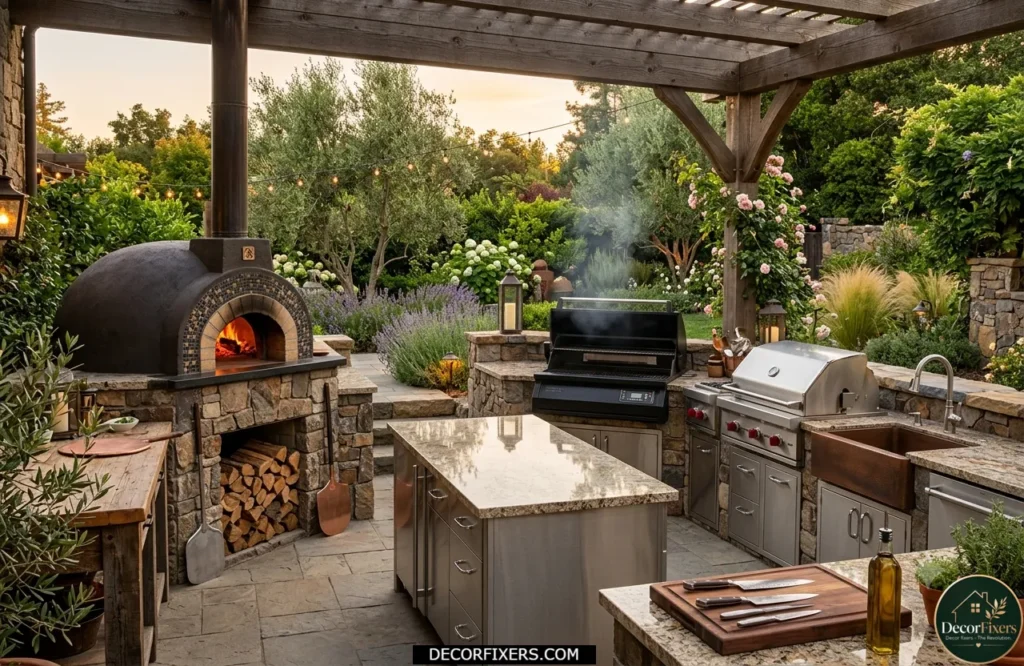
The 2026 trend toward multifunctional outdoor kitchens means treating the pizza oven and smoker as their own stations rather than crowding them next to the main grill.
Homeowners increasingly want complete cook-and-entertain spaces with pizza ovens, smokers, refrigerators, and beverage stations rather than a single grill setup.
12. A Fire Feature Set Back From the Cook Zone
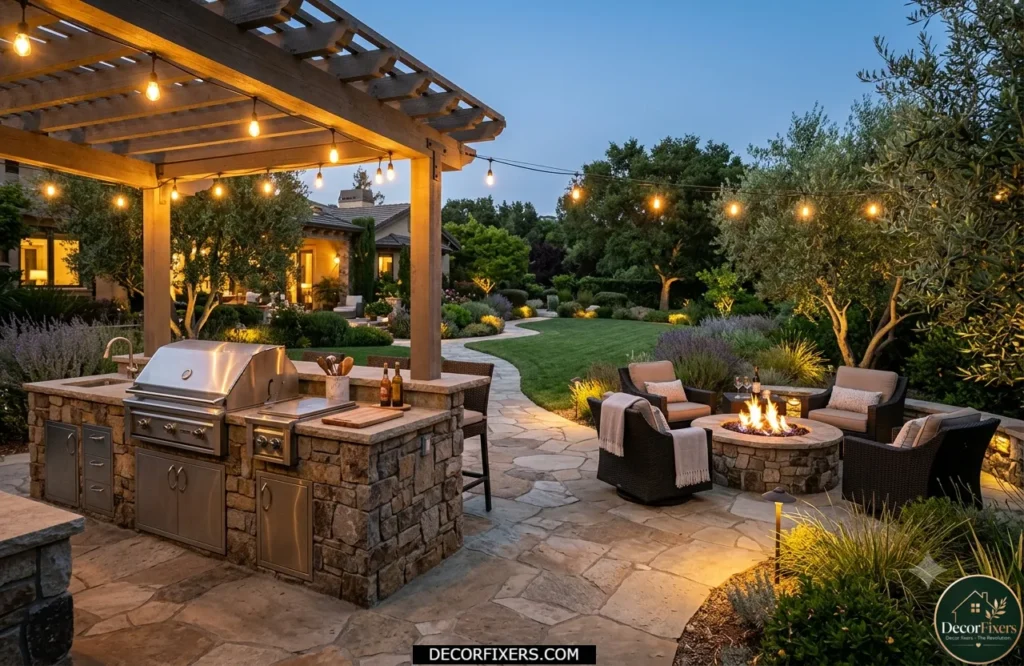
Position a fire pit or fireplace at least 10 feet from the cook zone, both for safety and to extend the social area into cooler evenings once the grill has gone quiet.
If you’re planning to debut the new setup around a summer gathering, our 4th of July backyard decorating guide covers the seasonal styling, string lights, table settings, and color schemes that pair naturally with a fire feature and a fresh outdoor kitchen build.
13. Stone-Clad Cabinetry That Matches the House
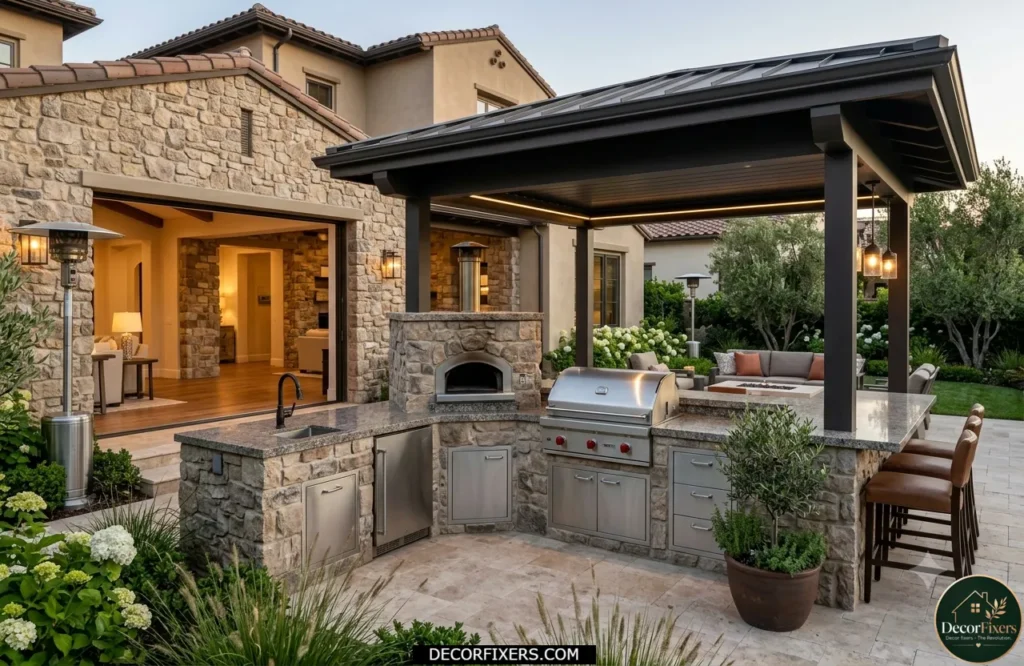
At the higher end, matching cabinet fronts, hardware, and stone tone to the indoor kitchen creates seamless indoor-outdoor continuity, increasingly treated as the new luxury marker in 2026 outdoor kitchen design, rather than an afterthought add-on.
It’s worth checking current kitchen design trends before finalizing finishes here, since 2026’s indoor-outdoor continuity push means a lot of what’s happening inside the house is now showing up on the patio too.
14. Cold-Climate Materials That Survive Freeze-Thaw
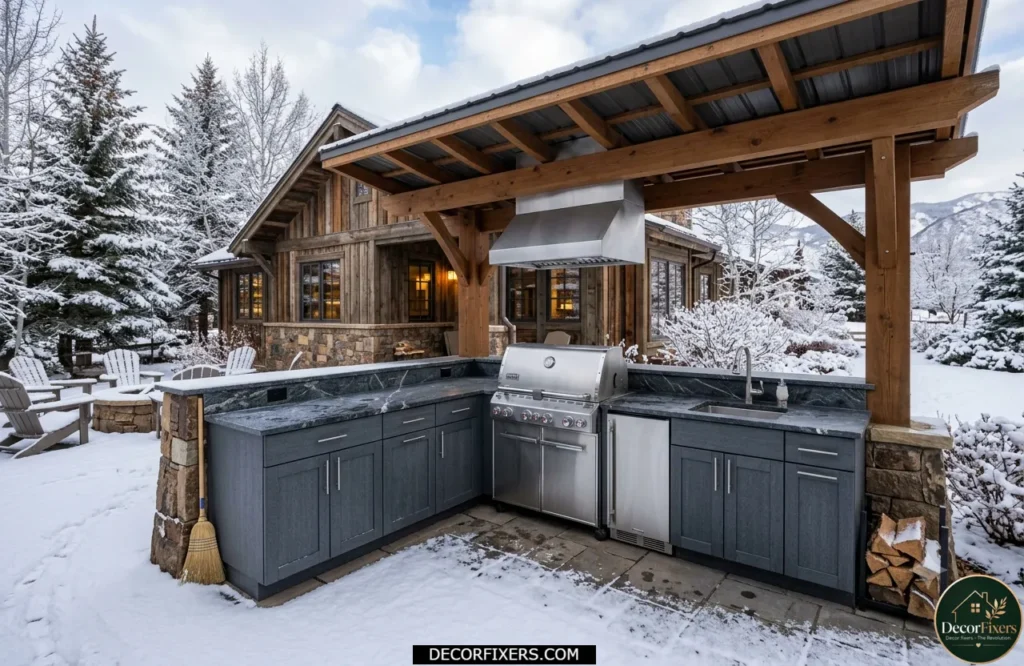
What most guides skip: a natural stone counter that’s fine in Phoenix can crack in Minneapolis after a few freeze-thaw cycles. In cold climates, avoid porous stone and unsealed wood, which absorb moisture that expands when it freezes.
Engineered quartz, sealed granite, and UV-stabilized HDPE cabinetry hold up far better than painted wood or basic powder-coated metal. For a deeper look at which surfaces handle daily wear best, our kitchen countertop ideas guide breaks down durability and maintenance by material; most of it applies outdoors, too, once you factor in the climate notes here.
15. Coastal-Climate Materials That Resist Corrosion
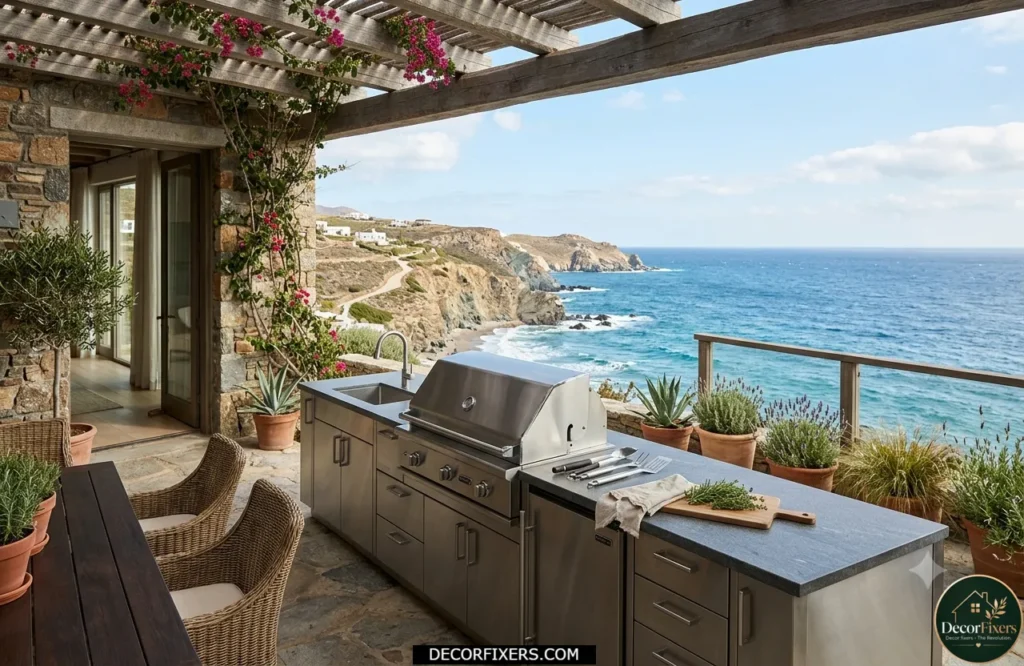
Salt air accelerates corrosion on almost every outdoor kitchen material, but marine-grade stainless steel, 304 stainless, resists coastal conditions noticeably better than 430, so check the grade before buying a grill or hardware. Mold-resistant grout and sealed stone are worth the upcharge near the Gulf Coast or Southeast coastline.
16. Hot-Climate Materials That Handle UV Exposure
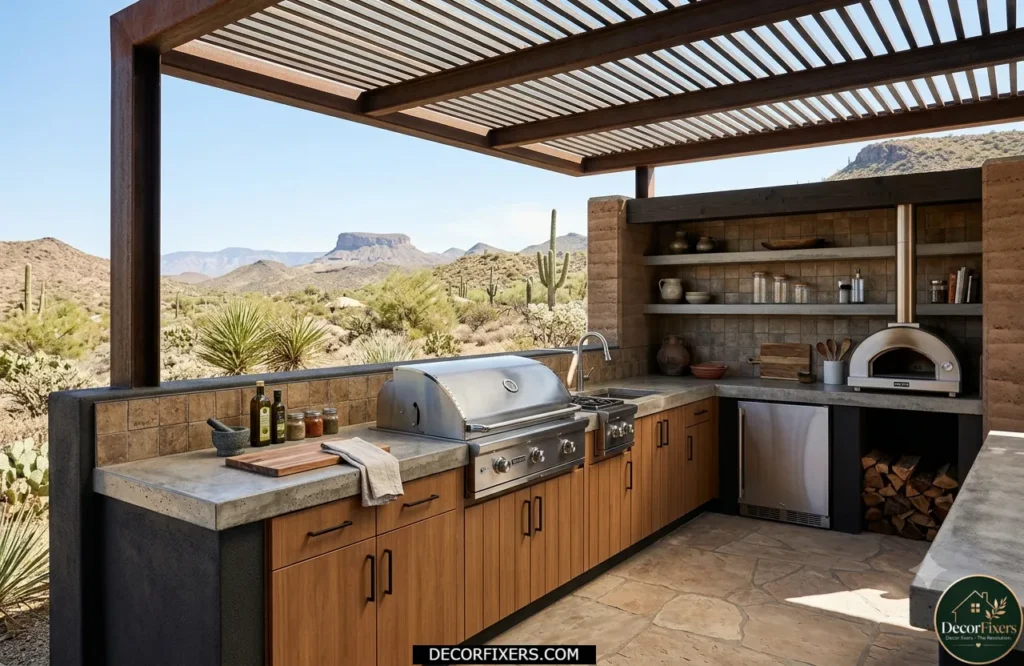
Direct sun fades and warps untreated wood fast. Stone, concrete, and HDPE cabinetry handle UV exposure with minimal maintenance, which is part of why HDPE has become a default material recommendation for 2026 outdoor cabinetry in the Southwest and similarly sun-heavy regions.
17. Warm, Textured Color Palettes Over Stark White-and-Steel
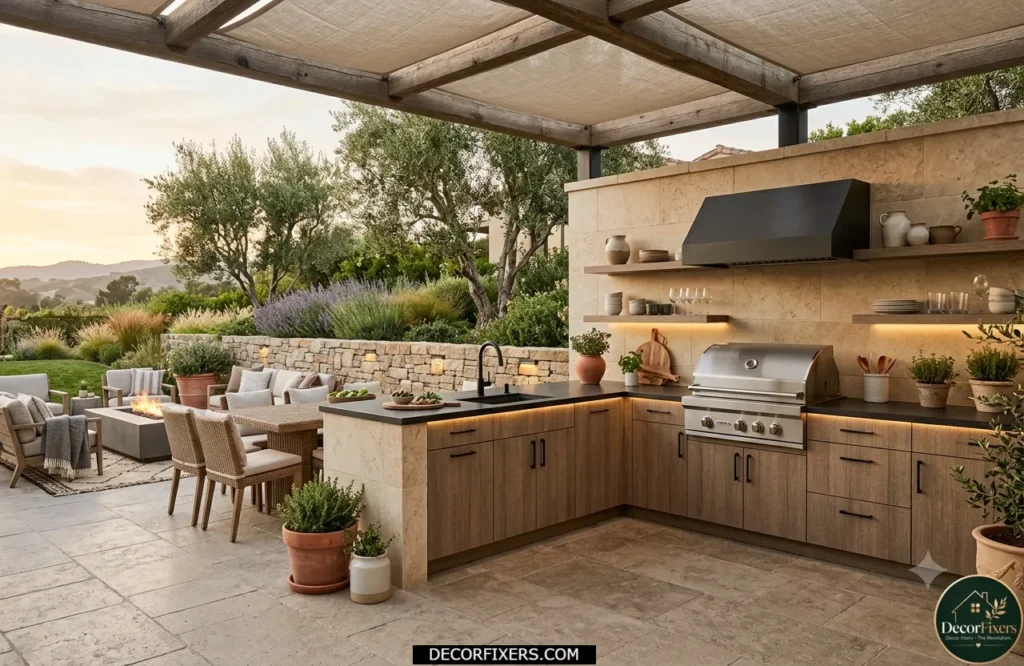
2026 marks a shift away from the minimalist, industrial white-and-steel look that’s dominated outdoor cabinetry for years. Designers describe this as the year color and texture take over, with soft neutrals and natural materials replacing the stark palette.
18. Mediterranean-Influenced Layouts
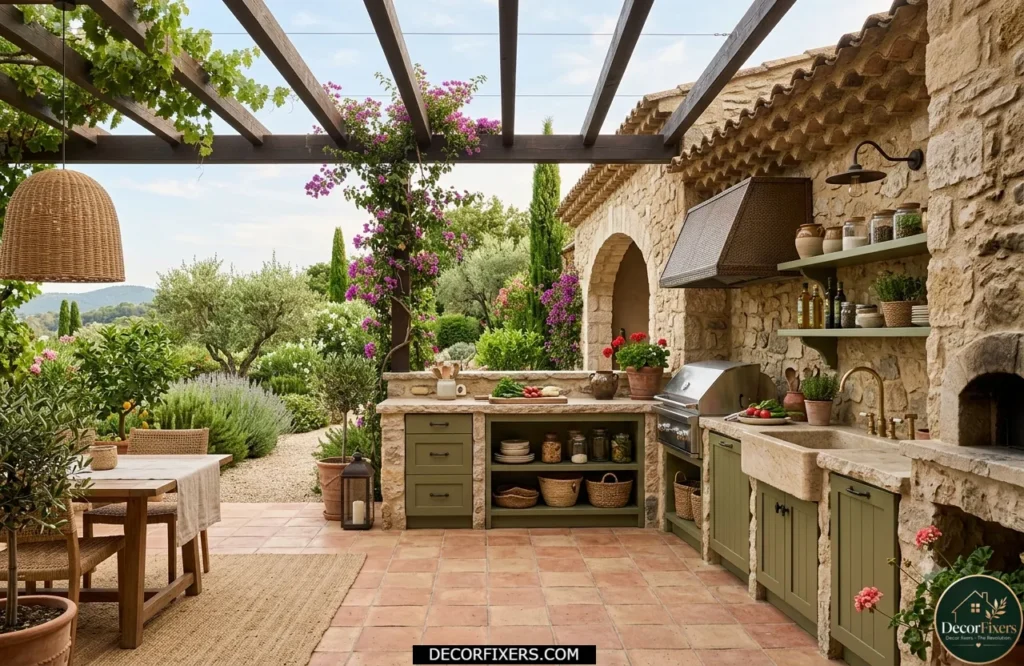
Stone surfaces, olive-toned greens, and woven textures reflect a broader shift toward treating the backyard as a daily-use extension of the home rather than a once-in-a-while barbecue spot, closer to a Mediterranean lifestyle outdoors than a builder-basic patio add-on.
19. A Complementary (Not Matching) Palette on a Smaller Budget
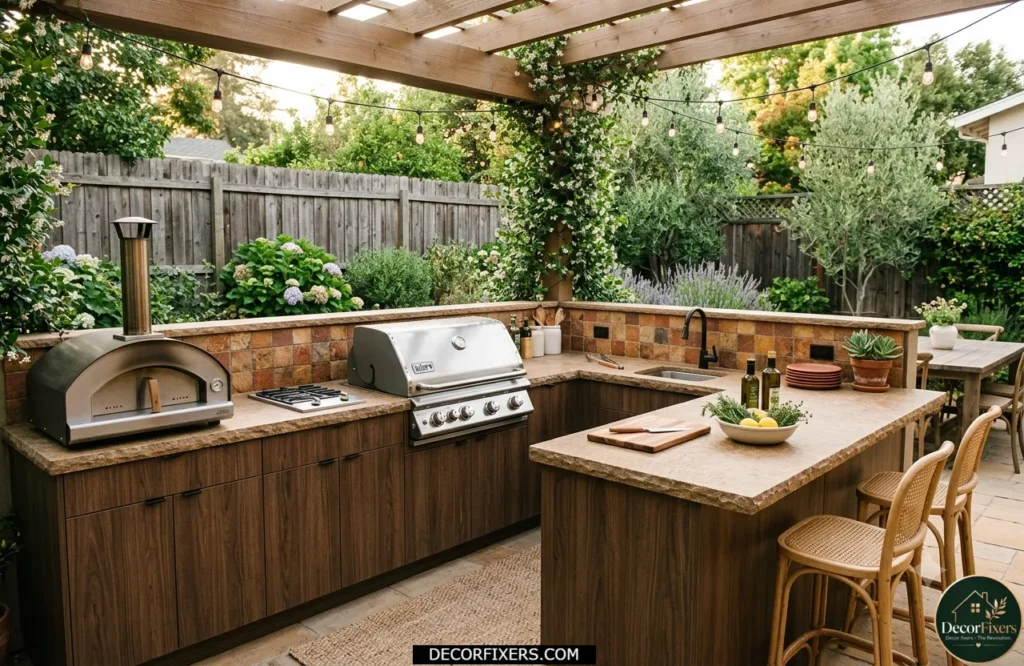
Chasing the matched-indoor-outdoor look is overrated for budgets under $15,000. It looks fantastic in a $60,000 build where the cabinetry can be color-matched and weatherproofed to spec.
a smaller budget, a deliberately different complementary outdoor palette, same warmth, different material, usually reads as more intentional than a mismatched attempt at twinning the two spaces.
20. Budget the Whole Project Like a Kitchen Remodel, Not an Add-On
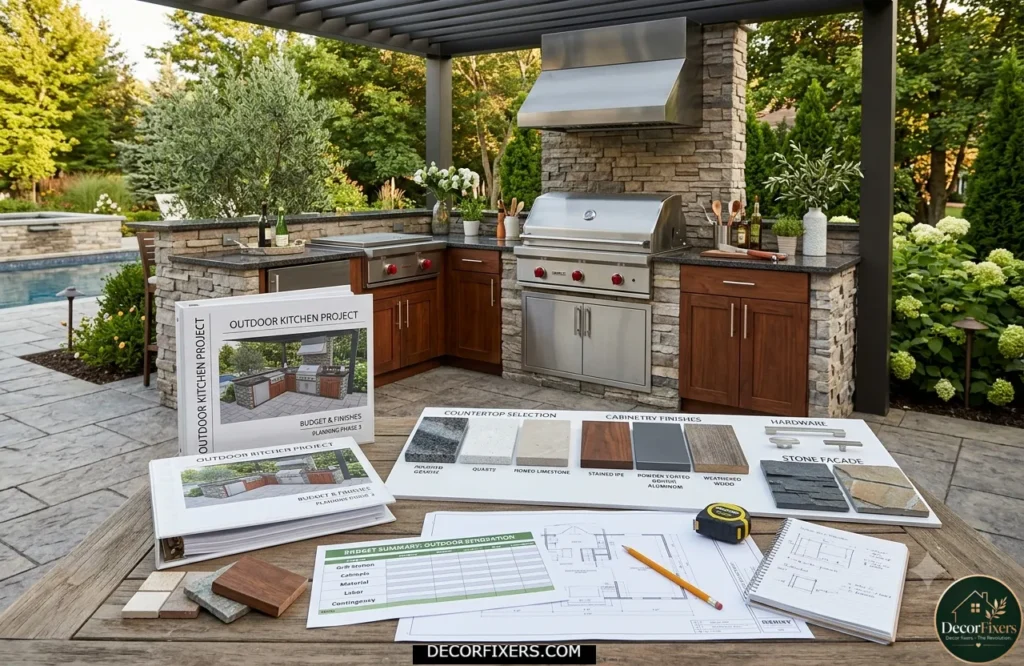
Outdoor kitchen pricing follows the same cost logic as indoor remodels: scope, materials, and local labor rates drive the number more than style choices do.
As a benchmark, the national average cost of a kitchen remodel in 2026 is roughly $27,000 to $35,000, with most projects landing between $15,000 and $75,000 depending on size and finish level.
Outdoor builds track lower at the entry end, you’re skipping plumbing-heavy work like dishwasher hookups, but similar at the high end once weatherproofing is factored in.
| Direct Answer Basic built-in outdoor kitchens start around $1,000–$10,000. Full L-shaped builds with a sink and fridge typically run $10,000–$40,000. Resort-style builds with a pizza oven, smoker, and full roof structure run $40,000 and up, tracking close to a mid-to-high-end indoor kitchen remodel. |
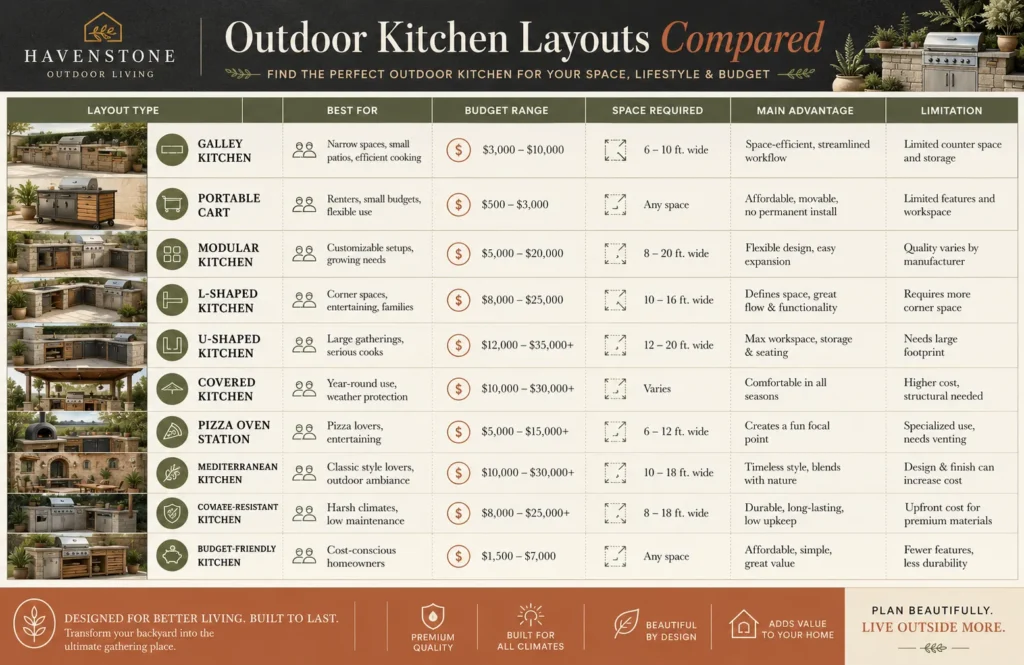
Quick Comparison: Layout Styles
| Option | Best For | Key Benefit | Limitation |
| Galley / single-line | Small patios, renters | Low cost, minimal footprint | No room for a separate dining zone |
| L-shaped / peninsula | Mid-size yards | Separates cook and dine zones | Needs at least 100 sq ft to feel open |
| U-shaped / two-island | Large yards, frequent hosts | Most workflow-efficient | The highest material and labor cost |
| Modular/portable | Renters, no permanent budget | No installation, fully movable | Smaller cooking surface, less storage |
CONCLUSION:
Out of these 20 ideas, the one worth not skipping is the very first: figuring out your three zones before falling in love with a stone color or a pergola shape. Homeowners who start with finishes almost always end up reworking the layout anyway; the zones dictate what materials and features actually fit, not the other way around.
If you’re working with a small patio, start with idea 2 or 3 and treat the rest of this list as a future upgrade path rather than a single shopping list. If you’ve got the space and budget for a full build, ideas 9 through 13 are where the real planning happens; that’s also where it pays to bring in a local outdoor living contractor rather than DIYing the layout.
Either way, the photos are the easy part. Layout, climate-appropriate materials, and an honest budget tier are what actually decide whether this space gets used every week, or turns into an expensive backdrop for one barbecue a summer.
FAQs:
Q: What is the best layout for a small outdoor kitchen?
A: A single-line galley layout against one wall, with a built-in or portable grill and a narrow counter, fits most small patios without blocking walkways.
Q: How much does a basic outdoor kitchen cost?
A: Basic built-in setups start around $1,000–$10,000, while full L-shaped builds with sink and fridge typically run $10,000–$40,000, depending on materials.
Q: Should I match my outdoor kitchen to my indoor kitchen?
A: Only if your budget allows real material continuity. Below roughly $15,000, a complementary but distinct palette usually looks more intentional than a partial match.
Q: Why does my outdoor counter material matter so much?
A: Climate determines durability. Porous stone cracks in freeze-thaw regions, untreated wood warps in dry heat, and standard steel corrodes near saltwater coastlines.
Q: When should I add a pergola or roof to an outdoor kitchen?
A: Add shade once your layout is finalized, not before. A small shade sail over just the cook zone works for mid-size yards; full roofs make more sense above 300 square feet or in climates with strong year-round sun.

Creator of DecorFixers, sharing practical home and interior ideas focused on real-life usability, simple design improvements, and budget-friendly solutions.