


I remember the day I bought a beautiful decorative tray, set it on my coffee table, and then just stared at it. Empty. I had no idea what was supposed to go inside it. I’d seen all those perfectly styled Pinterest images with stacked books and sculptural objects, but when I tried to recreate even one of them, the result looked like a garage sale.
That moment is more common than you’d think. The coffee table sits dead center in your living room. It’s the first thing guests notice, it’s what your eyes land on every time you sit down, and somehow it ends up being the hardest surface to get right.
Below are 15 coffee table decor ideas built around real-use scenarios, honest budget tiers, and styling rules that hold up after the photoshoot ends.
What Is Coffee Table Decor?
Coffee table decor refers to the intentional arrangement of objects, trays, books, plants, candles, and accent pieces on a coffee table surface to create visual interest and reflect the room’s overall style.
1. Use the Rule of Three to Build Instant Visual Balance
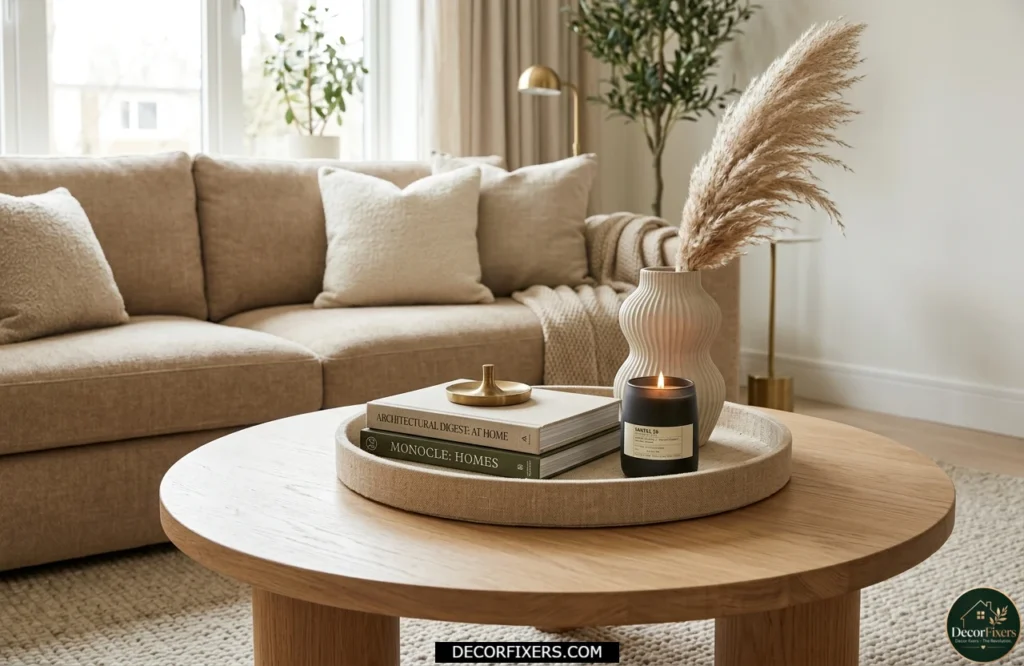
Designers don’t freestyle their coffee table styling; they use formulas. The most reliable one is the rule of three: group three items at different heights so the arrangement reads as intentional, not random.
Start with something low, like a tray or a stack of two books. Add a mid-height piece, a candle, a small bowl, or a lidded box. Finish with something taller: a vase with a single stem, a small sculpture, or a potted plant. That’s it. Three pieces. Done.
This works because the human eye naturally seeks groups of odd numbers. Even a sparse minimalist table benefits from this rule.
Quick note: if your table feels cluttered despite following this formula, subtract, don’t rearrange. Less is almost always more on a coffee table surface.
2. Start With a Tray to Create a Visual Anchor
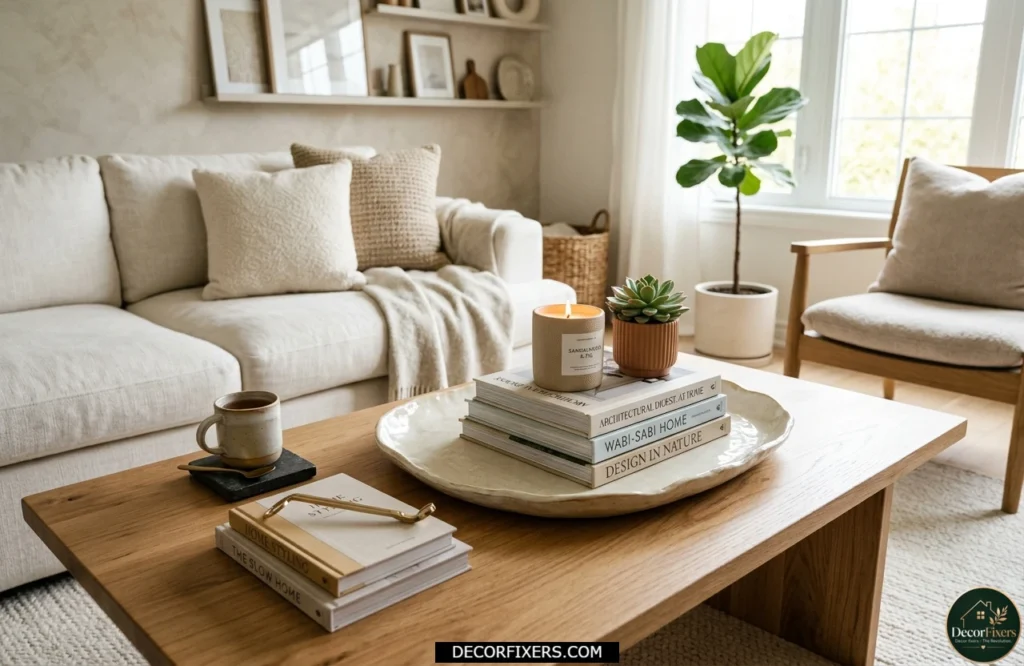
A tray is the single most useful tool in coffee table styling. It creates a defined zone that tells the eye where the “display” ends and where life, remotes, coasters, your half-empty mug, begins.
For a smaller table, one large tray centered works well. For a longer rectangular table, two smaller trays side by side can visually divide the surface into distinct zones. McGee & Co. makes some of the best organic-shaped trays on the market if you’re looking for that warm, modern look without being too precious about it.
The tray also makes cleaning up fast. Movie night? Slide the whole tray to one side. Guests arriving in 20 minutes? Everything goes into the tray, looks tidy instantly.
How to Style a Coffee Table Tray in 4 Steps
- Place the tray slightly off-center or centered, depending on the table length.
- Add a low base item, a book stack, or a flat decorative object.
- Layer a mid-height accent, a candle, or a small ceramic.
- Finish with one living element, a sprig of eucalyptus or a tiny potted succulent.
3. Stack Books the Right Way, Spines Out, Colors Coordinated

Coffee table books get overdone fast. You know the look: three oversized design books stacked with their pages facing out, all neutral covers, zero personality. That aesthetic is officially out.
Here’s what actually works in 2026: mix topics. One architecture book, one travel title, one photography or art book. The variety signals that a real person lives here, not a showroom. Interior designer Timothy Godbold puts it well: the book selection should always be a mix of topics, because people actually do read them.
Face the spines outward so the colors read as part of the room’s palette. Group by tone, warm, neutral, or cool, so they don’t visually fight each other.
Stack them with the largest at the bottom and the smallest on top. Leave a small gap between the top of the book and your tray or candle. That breathing room is what separates styled from cluttered.
4. Add a Living Element, Plants, Stems, or Branches
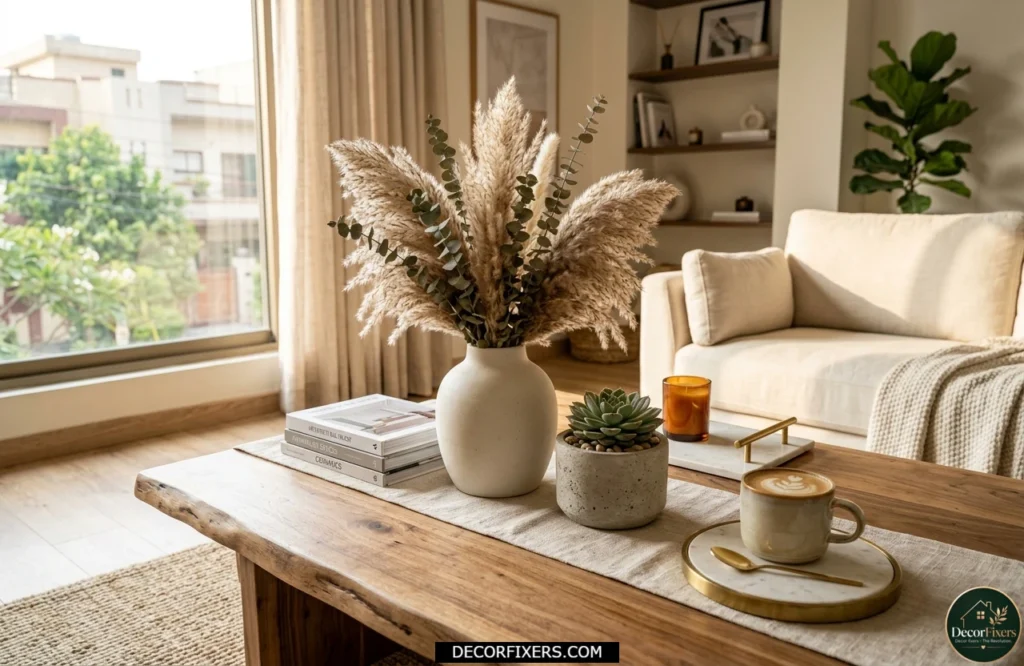
Nothing makes a coffee table feel more complete than something alive. It doesn’t have to be a full floral arrangement. A single dried pampas stem in a matte vase, a small potted succulent, or three stems of eucalyptus in a glass bottle, any of these works.
The living element creates organic contrast against hard surfaces like wood, marble, or glass. It also pulls the table into the seasonal rotation naturally: swap in fresh tulips in spring, a small citrus branch in fall, a pine sprig in winter.
Look, if you’ve been avoiding plants because you kill everything, dried botanicals are completely maintenance-free and still carry the same visual weight. Dried pampas, cotton branches, and preserved eucalyptus last for months.
5. Choose Decor by Your Table’s Surface Material
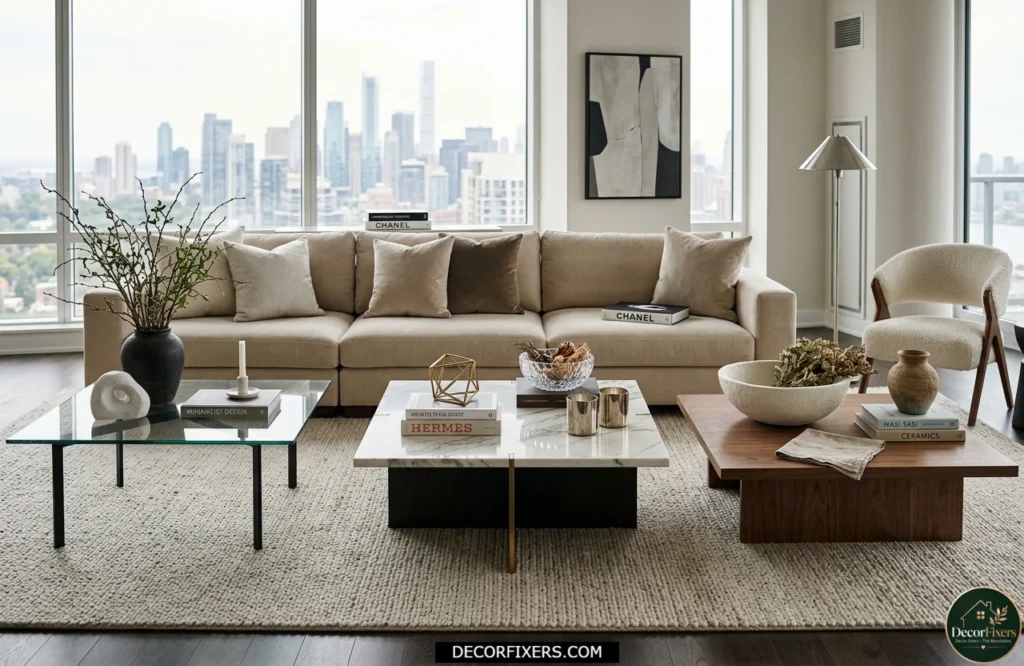
Here’s a detail most styling guides skip entirely: what goes on a coffee table should respond to what it’s made of. The surface material changes everything about how decor reads.
Quick Comparison: Decor by Table Surface
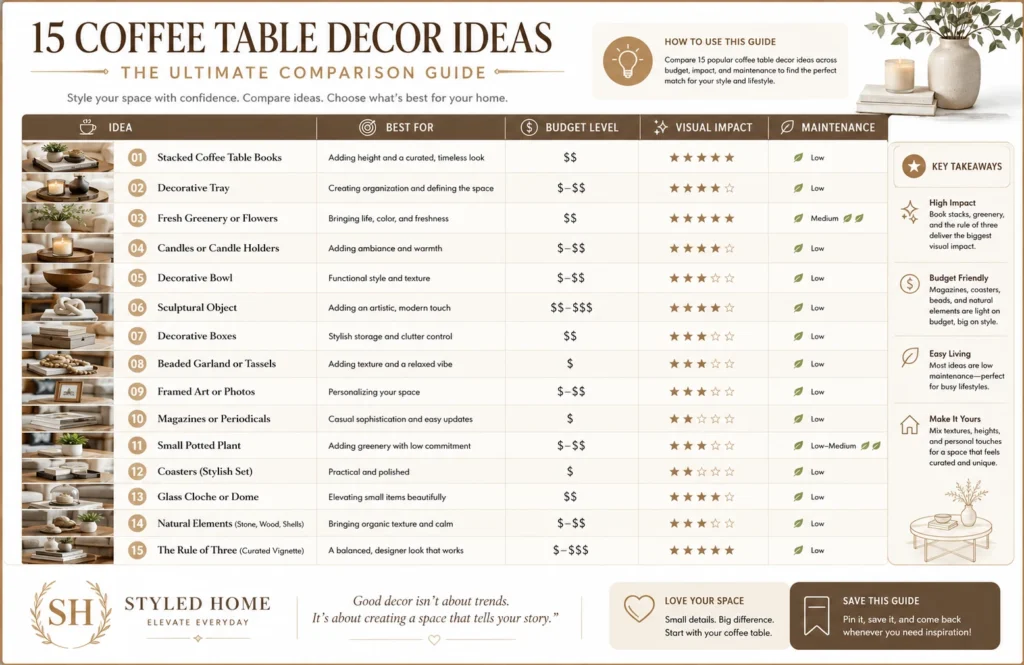
| Surface | Best Decor Style | Key Benefit | Watch Out For |
| Glass top | Minimal, clean objects | Airy and modern feel | Shows every fingerprint |
| Matte wood | Warm textures, ceramics | Hides smudges naturally | Can look too rustic if overdone |
| Marble | Sculptural, metallic accents | Luxury feels instantly | Competing patterns clash |
| Ottoman/fabric | The lacquer tray is required first | Soft, family-friendly | No stability without a tray |
A glass surface needs restraint, go minimal, or the clutter shows twice (once live, once reflected). Matte wood forgives more and pairs naturally with organic textures like rattan, linen, and terracotta.
6. Style for Function First, Then Aesthetics
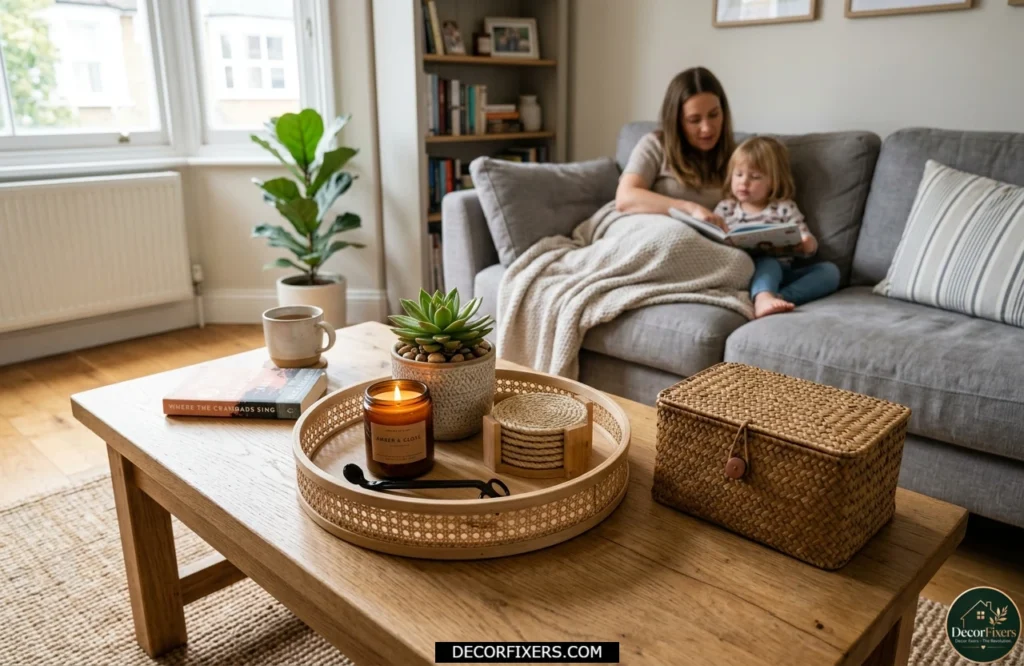
This is where most styling advice completely fails real people. Every beautiful coffee table you see in a magazine has been cleared of real life before the photo was taken.
Your coffee table probably holds a remote, charging cables, a coaster, maybe your kid’s book, or a dog toy that migrated in. That’s not a problem to hide; it’s a design challenge to solve.
Use lidded boxes or woven baskets to store remotes and small clutter. Keep coasters in a small dish rather than scattered. If you have kids, a lidded rattan box can store toy cars or crayons while still looking intentional as a decor piece. The key is making your real life part of the styling, not pretending it doesn’t exist.
7. Try the Budget Tier System, Decor That Fits What You Have
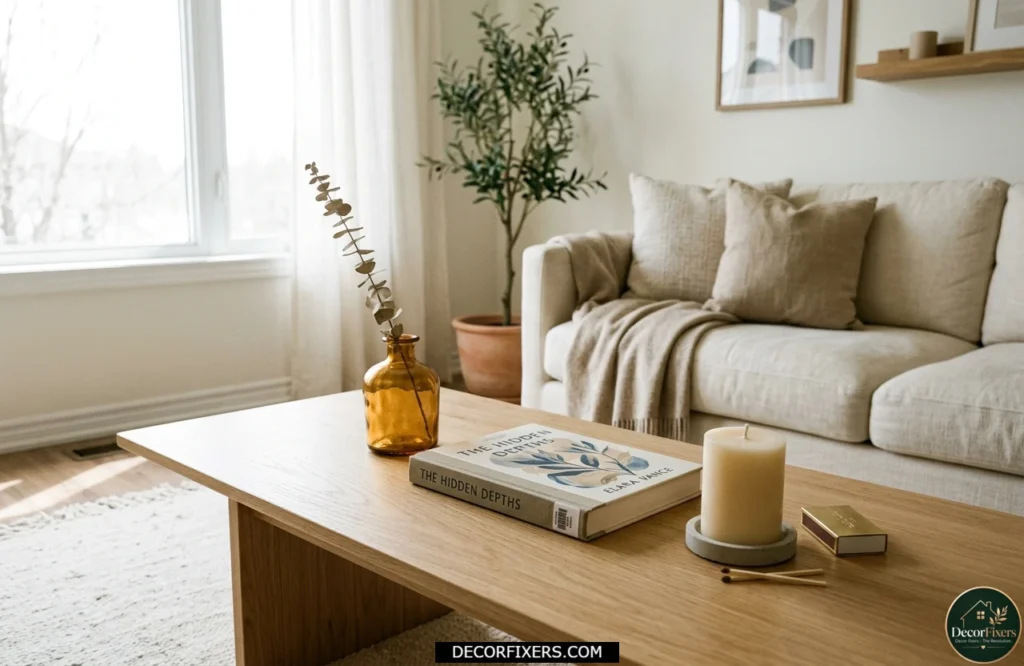
One of the biggest gaps in coffee table content online is that nobody tells you what any of this actually costs. Here are three tiers that work for US readers:
- Under $30: A single stem in a thrifted bud vase + one candle + a library book with a beautiful cover. Done.
- $30–$100: A sculptural tray from CB2 or Target’s Studio McGee line + a stack of two curated books + a small plant pot.
- $100+: An artisan ceramic bowl, a quality candle (Boy Smells or Apotheke), a design book, and one statement object, a stone sphere or brass sculpture.
The $30 version can look just as intentional as the $100 version if the formula is right. Price doesn’t determine style; placement does.
8. Use Seasonal Swaps to Keep the Table Fresh All Year
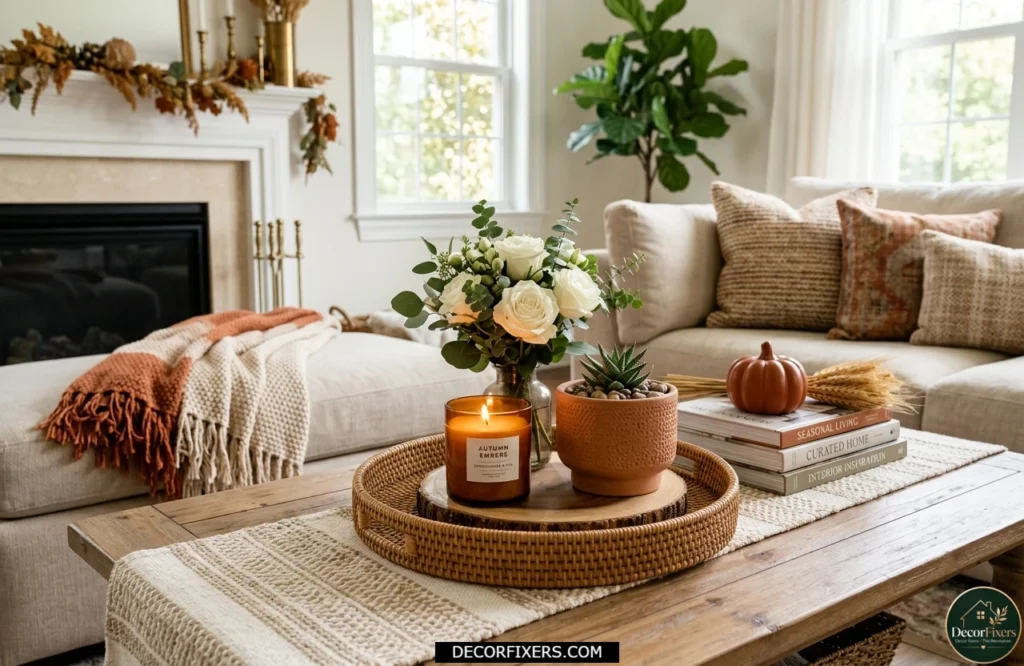
You don’t need to restyle your coffee table from scratch every season. The base, your tray, your books, and your key object stay put. What changes are the small accents?
Spring: swap in light-colored book covers, fresh white flowers, and a clear glass vase. Summer: add a small woven object, a linen coaster set, something with warm natural texture. Fall: introduce a small gourd, a dark amber candle, and a terracotta pot. Winter: pine sprig, brass candleholder, a chunky woven coaster.
Or maybe I should say it this way: treat the tray like a frame and just change what’s inside it. That’s the fastest, lowest-cost refresh possible.
9. Scale the Decor to Your Table’s Actual Size
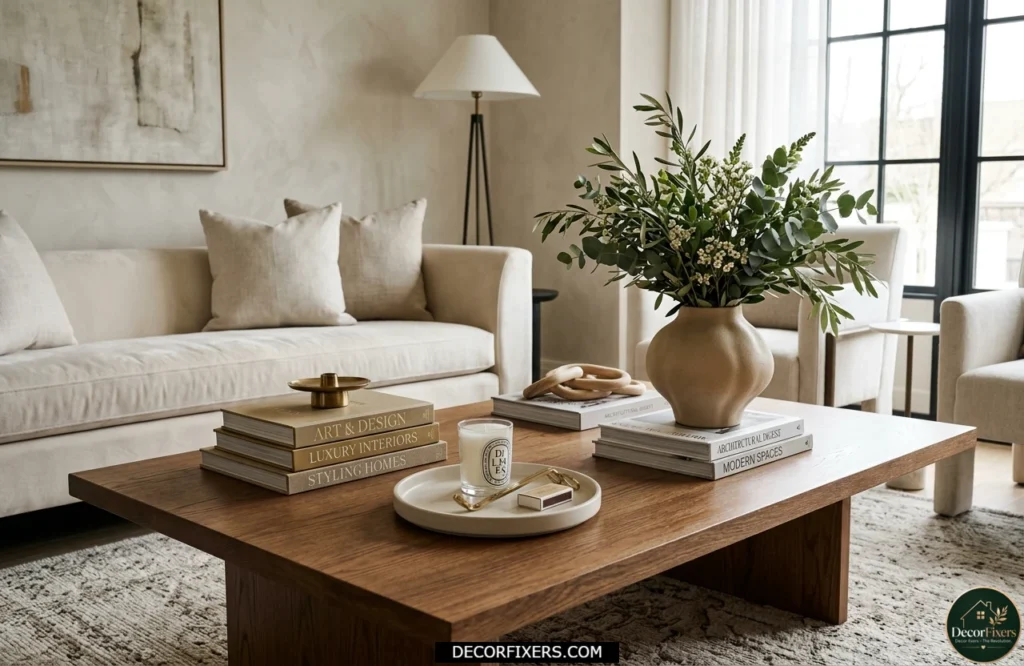
Oversized decor on a small table looks crowded. Tiny objects on a large table look lost. This seems obvious, but it’s the most common mistake I see when people share their coffee table styling attempts.
The rule: the total footprint of your decor grouping should cover roughly 60% of the table surface, leaving 40% visually clear. On a small table under 24 inches, one tray grouping of three items is enough. On a large rectangular table over 48 inches, two distinct groupings work better than one centered arrangement.
10. Incorporate Personal Objects That Tell a Story
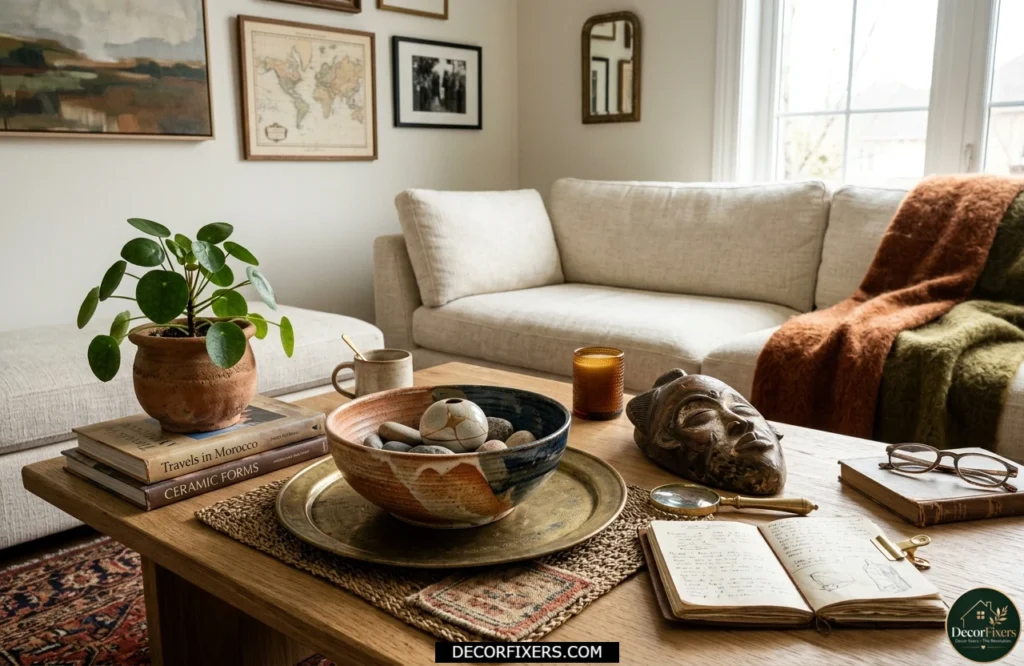
The design world has shifted hard on this. Interior designer Paloma Contreras said it clearly in 2026: there’s a return to warmth and collected layers rather than perfectly curated vignettes. Fewer matching books, more meaningful pieces.
A small sculpture you bought at a market. A ceramic bowl you got on a trip. A wooden object your kid made. A vintage trinket that belonged to someone you loved. These don’t have to look expensive; they have to look chosen.
How to decorate a coffee table with personal objects:
Layer meaningful items with functional ones so the table doesn’t read as a museum display. One sculptural personal object paired with a useful tray and a living plant hits the right balance of curated and livable. Keep the total count under five items to maintain visual breathing room.
11. Match Decor Style to Your Room’s Overall Palette
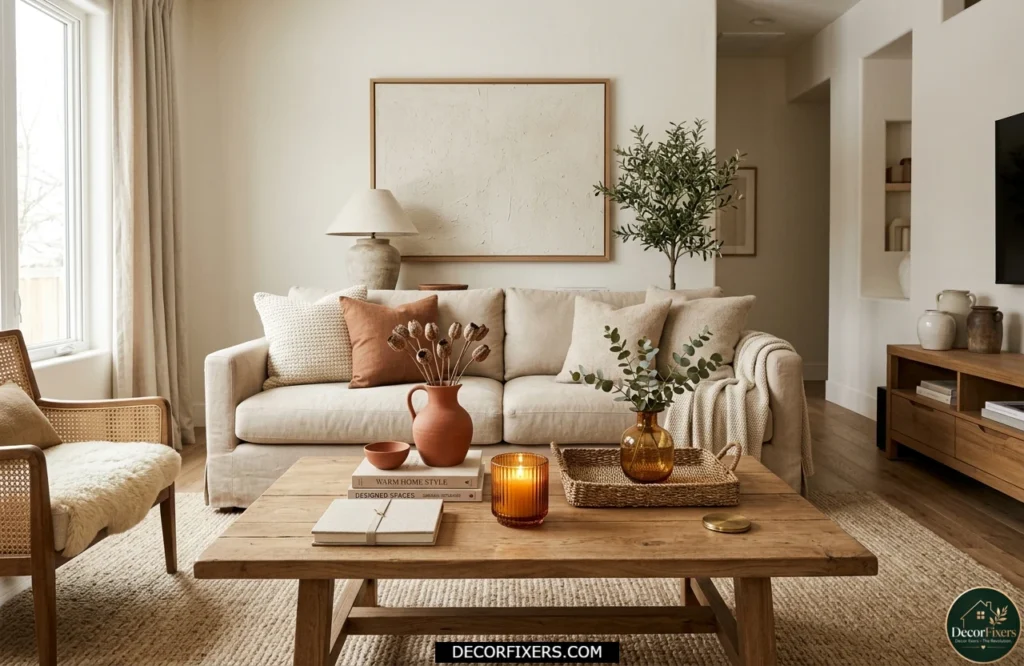
Your coffee table doesn’t exist in isolation. It needs to talk to the room around it, the sofa color, the rug pattern, the curtains, and the wall tone.
If you have a neutral room with warm beige and cream tones, your table decor should pull those same warm colors: terracotta ceramics, natural rattan, warm amber glass. If your room runs cool, grey, blue-green, white, go for objects in slate, sage, matte black, or pale ceramic.
For rooms with patterned rugs or bold curtains, keep the coffee table decor simpler. The table is not competing with the room; it’s completing it. Speaking of which, if your window treatments are due for an update, check out our guide on Living Room Curtains for styles that work with every kind of living room palette.
12. Try Nesting Objects for Depth and Dimension
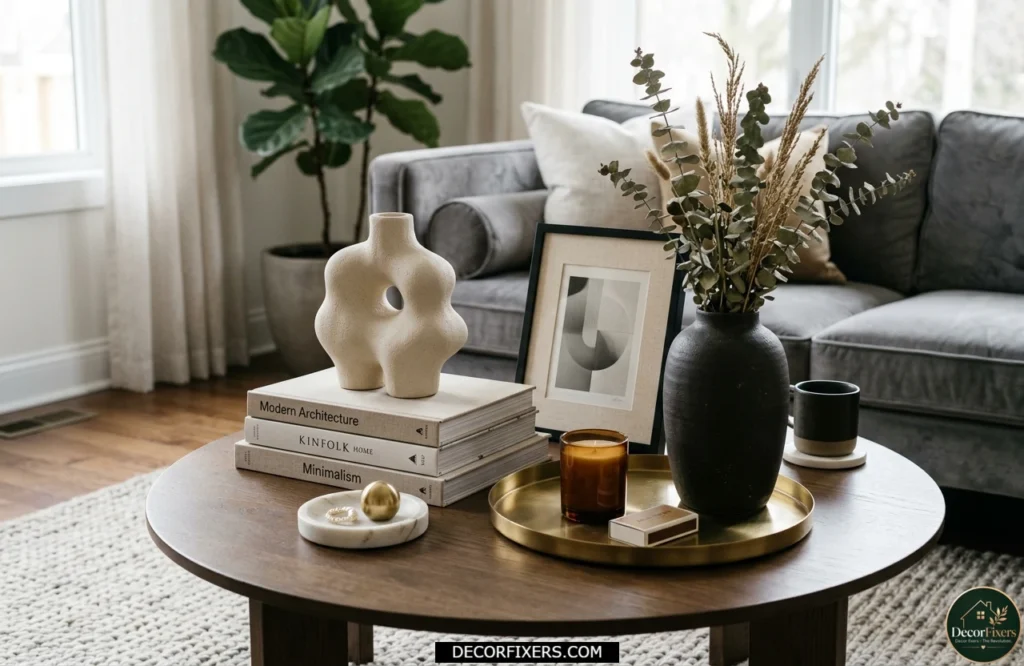
Flat arrangements look flat. The trick to a table that photographs well and reads as designed in real life is nesting, placing one object slightly behind or overlapping another.
Rest a small ceramic on top of your book stack. Lean a small framed print against the back of a vase. Tuck a coaster set partially under the edge of your tray. These small overlaps create depth and make the arrangement look like it was built by someone who knew what they were doing.
CB2 makes excellent sculptural accent pieces with enough visual weight to hold their own when nested; their matte ceramic and stone objects are worth the investment for this exact reason.
13. Design Around Your TV Wall for a Cohesive Look
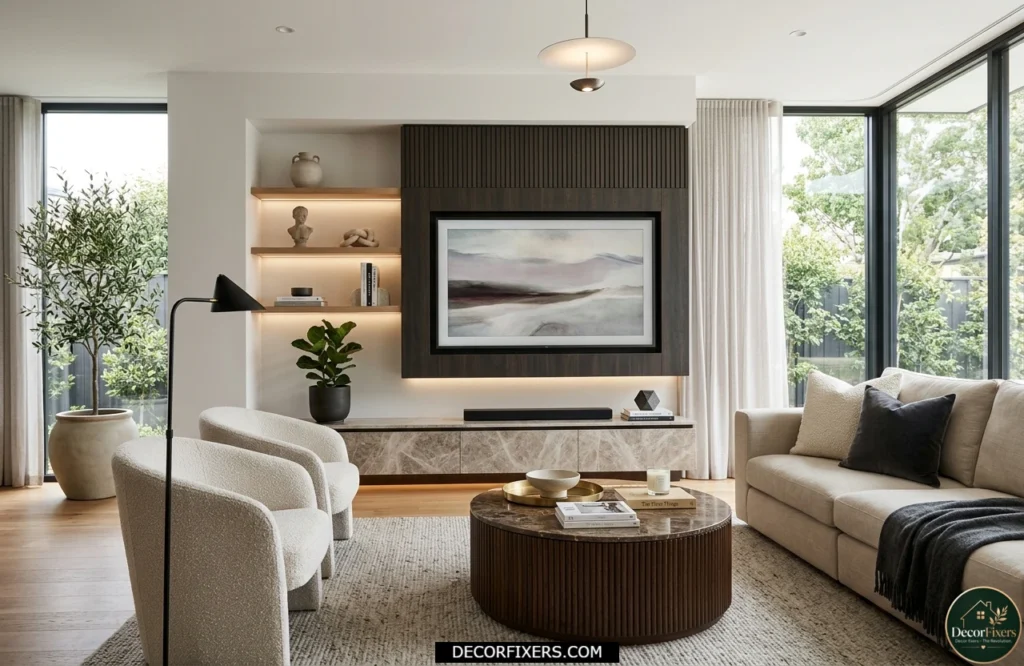
Here’s an insight most decor articles completely miss: your coffee table and your TV wall should be styled in conversation with each other, not independently.
If your TV wall has floating shelves with plants and art, your coffee table can afford to be more minimal. If the TV wall is clean and bare, the coffee table can carry more visual weight. The two surfaces anchor opposite sides of the seating area. When they’re balanced, the whole room clicks into place.
We’ve covered this connection in detail in our guide on TV Wall Designs, specifically how to align your vertical and horizontal display surfaces so the room reads as a unified space rather than a series of unrelated vignettes.
14. Go Minimal If You’re Working With a Small Living Room
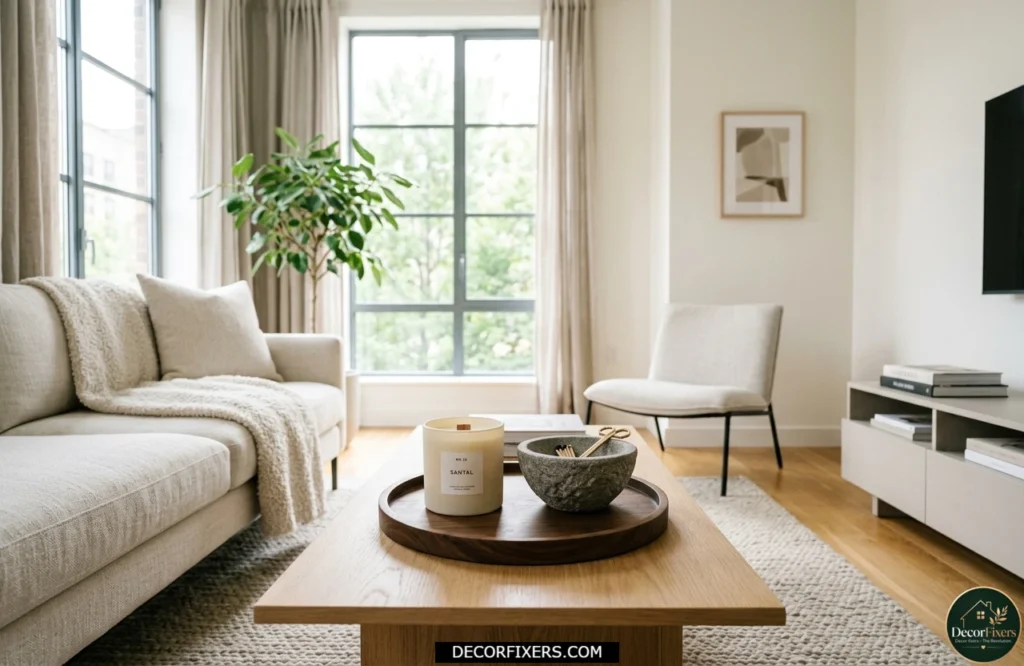
Small rooms need edited tables. That’s not a limitation, it’s a design principle. A coffee table loaded with objects in a compact space makes the whole room feel smaller and more chaotic.
For a small living room, one tray with two objects inside is the maximum. Choose a single statement piece with enough visual weight to anchor the table, a beautiful stone object, a large candle in a quality vessel, or a low bowl with texture. Let that be enough.
We go deep on this in our piece on Small Living Room design, including how to choose a coffee table size that doesn’t consume the floor space you actually need to move around in.
15. Audit and Edit Every Few Months, Decor Creep Is Real
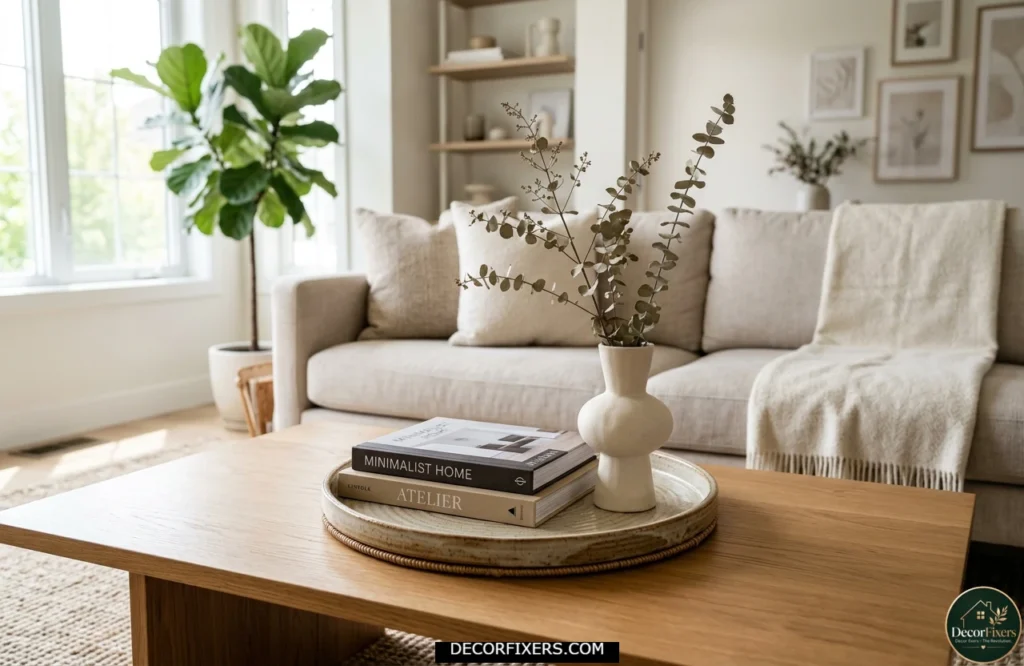
Decor creep is what happens when a well-styled table slowly accumulates objects over time until it looks nothing like it did when you first set it up. A new candle here, a random object there, a book someone left out, and suddenly the table looks cluttered again.
I’ve seen conflicting data on this; some sources say people prefer more objects because it signals warmth, others say restraint always reads as more elevated. My read is: it depends on the room. Dense, layered rooms need restrained tables. Minimal rooms can carry a bit more.
CONCLUSION:
The most beautiful coffee table I ever styled wasn’t the most expensive or the most elaborate. It was a simple round wooden table with a linen tray, two books I genuinely loved, a dried pampas stem in a thrifted vase, and a lidded rattan box that held my TV remote and charging cable.
It looked curated. It survived daily life. And every time a guest sat down, they leaned forward and picked up one of the books.
That’s what good coffee table decor actually does: it starts a conversation, reflects your taste, and holds up when real people use it. Not just when the camera’s on.
Start with one tray. Add three objects. Adjust until it feels right. That’s the whole formula.
FAQs:
Q: What’s the best way to style a coffee table?
A: The best approach is the rule of three: one low item (tray or books), one mid-height accent (candle or ceramic), and one taller living element (plant or stem). Keep total items under five and leave 40% of the surface visually clear.
Q: How do I make my coffee table look less cluttered?
A: Remove everything first, then add back only what serves a clear purpose or looks intentional. Use a tray to contain small objects. Hide remotes and cables in a lidded box. Fewer items at different heights always beat many items at the same level.
Q: Should I use a tray on my coffee table?
A: Yes, a tray is the single most useful styling tool for a coffee table. It creates a defined zone, makes cleanup instant, and gives your arrangement a contained, intentional look even when life gets messy around it.
Q: What do interior designers put on coffee tables?
A: Most designers today use a mix of books, one organic or natural object, a small plant or stem, and one personal piece that reflects the homeowner’s story. The shift is away from generic decor objects and toward meaningful, collected items.
Q: When should I change my coffee table decor?
A: Swap seasonal accents, flowers, candles, and textures every two to three months. Do a full audit and reset at least twice a year to avoid decor creep. The base tray and books can stay year-round; the accent pieces are what rotate.

Creator of DecorFixers, sharing practical home and interior ideas focused on real-life usability, simple design improvements, and budget-friendly solutions.