

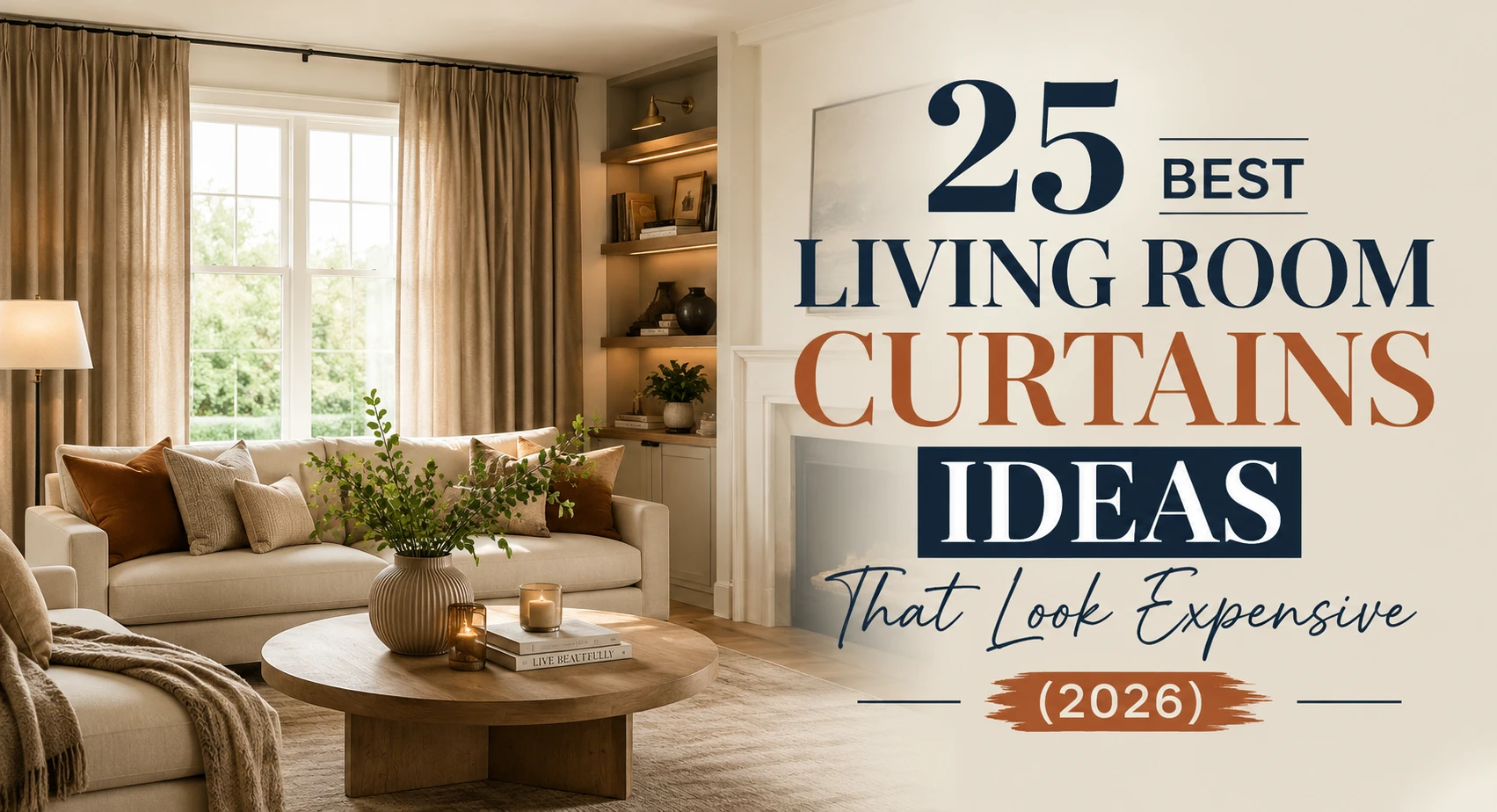
I’ve stood in the middle of a beautifully arranged living room and still felt something was off. New sofa, fresh paint, the right rug, and it still looked unfinished. Then I finally hung the right curtains. That was it. That one change pulled every single thing together, and I couldn’t believe I’d waited so long.
Curtains are the most underestimated design element in a living room. They control light, add height, introduce texture, and set the entire mood. And the best part? You don’t need a designer budget to get a designer result.
In this guide, I’m sharing 25 living room curtains ideas that genuinely look expensive, most of them well under $2,500, with specific fabric tips, color direction, and styling notes for each. Whether your small living room is sun-drenched or large and dark, there’s a curtain idea here that was made for your space.
This guide covers standard and large living rooms with standard ceiling heights. If you have specialty windows (arched, skylights, floor-to-ceiling glass walls), some ideas here may need custom modifications.
What Are Living Room Curtain Ideas?
Living room curtain ideas refer to style, fabric, length, and color choices that help homeowners select window treatments that balance light control, privacy, and interior design. The right curtain idea transforms how a room feels, making it taller, cozier, or more refined, without structural changes.
1. Floor-to-Ceiling Linen Drapes for an Instant Height Illusion
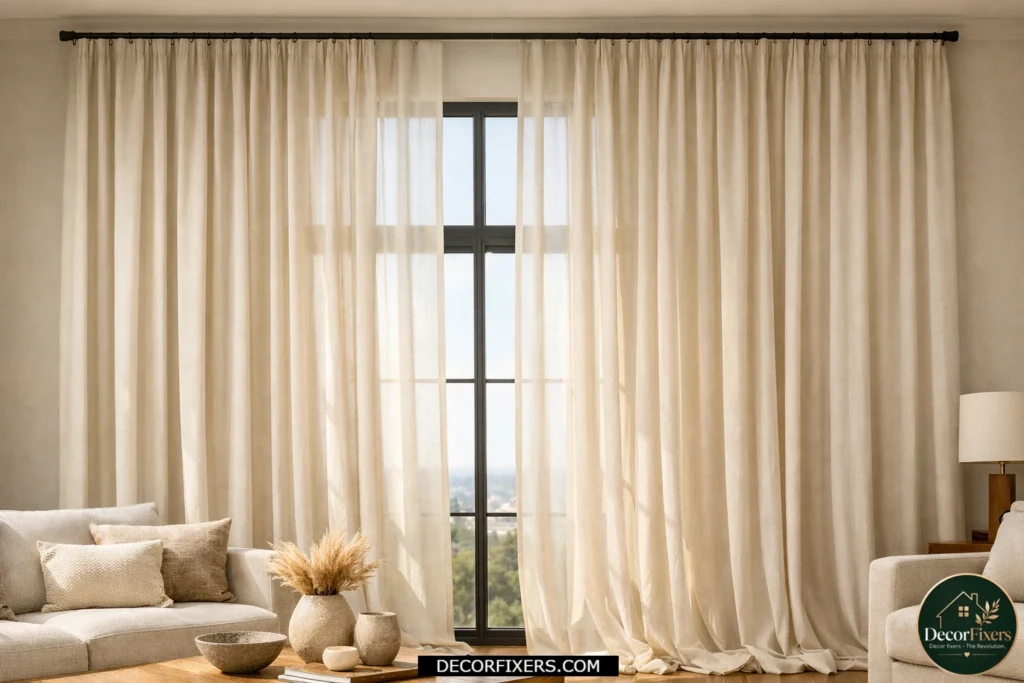
This is the single trick interior designers use more than any other, and it costs less than most people assume. Hang your curtain rod as close to the ceiling as possible, even if your window sits halfway down the wall. Let the linen panels fall straight to the floor. The result is a wall of soft, breathable fabric that makes any room feel taller by at least two feet.
Linen is the fabric of choice here because it drapes with natural weight and a slight texture that looks collected and expensive, not stiff. Expect to spend $80–$180 per panel for quality linen; two panels per window is typically enough. Pottery Barn’s Belgian Flax Linen Curtain (around $130–$160 per panel) is one of the best mid-range options on the market right now for this exact look.
2. Sheer White Curtains That Filter Light Like a Dream
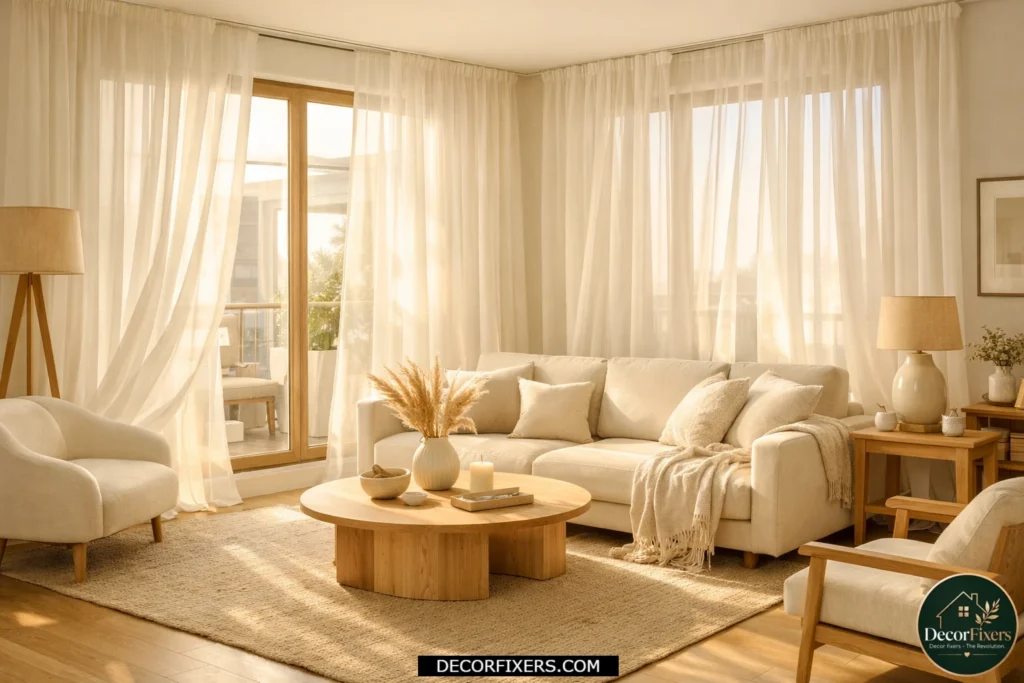
Sheer white curtains are having a serious moment in 2026, and not the flimsy polyester kind your grandmother used. I’m talking about voile or cotton-gauze panels that diffuse sunlight into something that feels almost golden in the afternoon. They soften every harsh edge in the room without making it dark.
The trick with sheers is fullness. Buy panels that are at least 2x the width of your window so they look rich rather than skimpy when closed. IKEA HANNALILL sheer curtain at around $30–$50 per pair is genuinely one of the best budget finds available. For a more elevated option, look at the West Elm Belgian Linen Sheer at $79–$99 per panel.
3. Layered Sheers + Blackout Panels, The Designer Combo
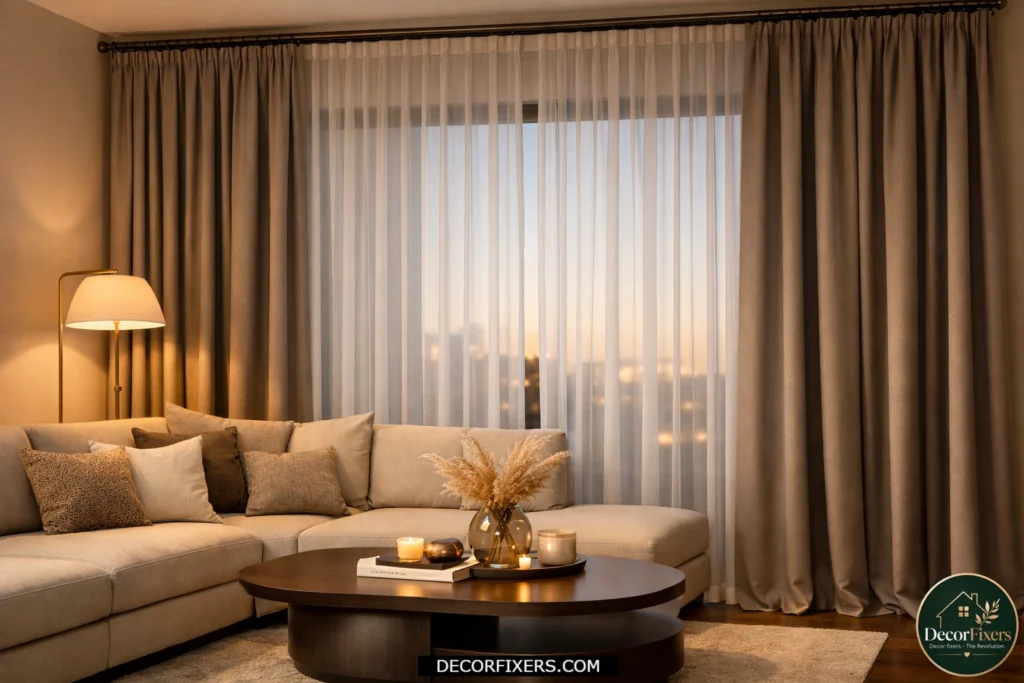
Here’s the thing: choosing between light and privacy is a false choice. Layering solves both problems at once, and it’s the number-one curtain trend heading into the second half of 2026. The system is simple: hang a sheer panel on a separate inner rod, then a heavier blackout or opaque panel on the outer rod.
During the day, close the sheers for privacy and keep the room bright. At night, close the outer panels completely. The layered look also adds depth to a wall, making the entire window feel like an architectural feature. Budget around $200–$400 per window for both sets of panels, still far less than custom window shades.
4. Velvet Curtains in Deep Jewel Tones for Cozy Drama
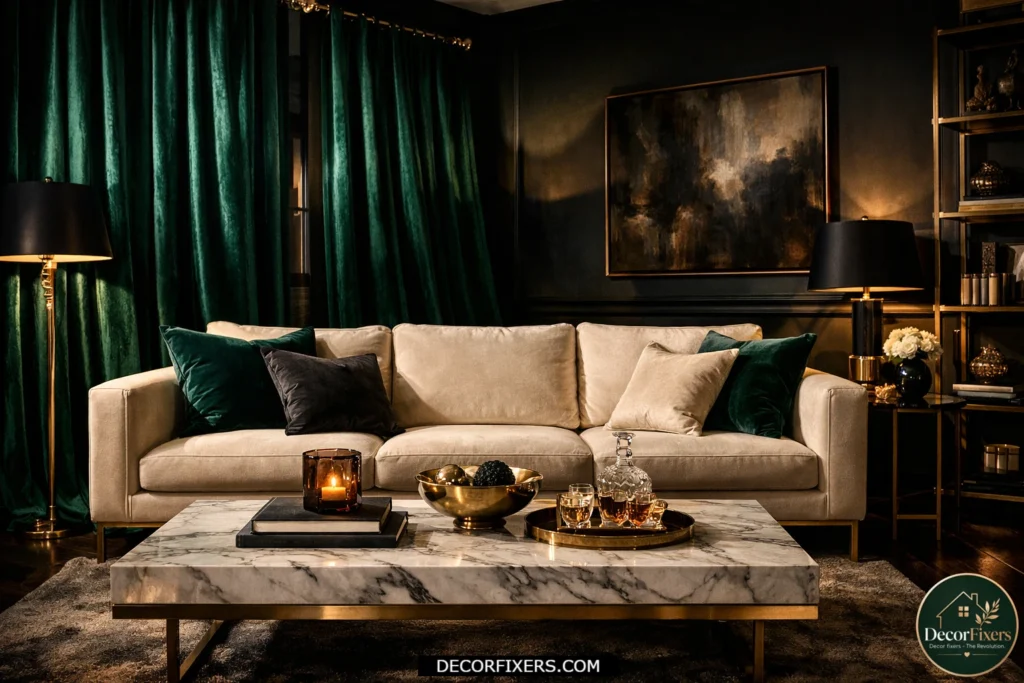
Velvet is the single fastest fabric upgrade you can make in a living room. It absorbs light differently than any other material, giving the room a low-level glow that looks like something out of a boutique hotel. Deep emerald, burgundy, navy, and forest green are the tones leading the charge in 2026.
Don’t worry about velvet feeling too heavy or old-fashioned; the key is pairing it with lighter furniture and clean-lined hardware. A brushed brass or matte black curtain rod pulls the look into the present immediately. Amazon Basics Velvet Blackout Curtain starts at $45–$70 per panel, while RH custom velvet drapes can run $400–$900 per panel for the full luxury version.
5. Curtains Hung Wide Beyond the Window Frame
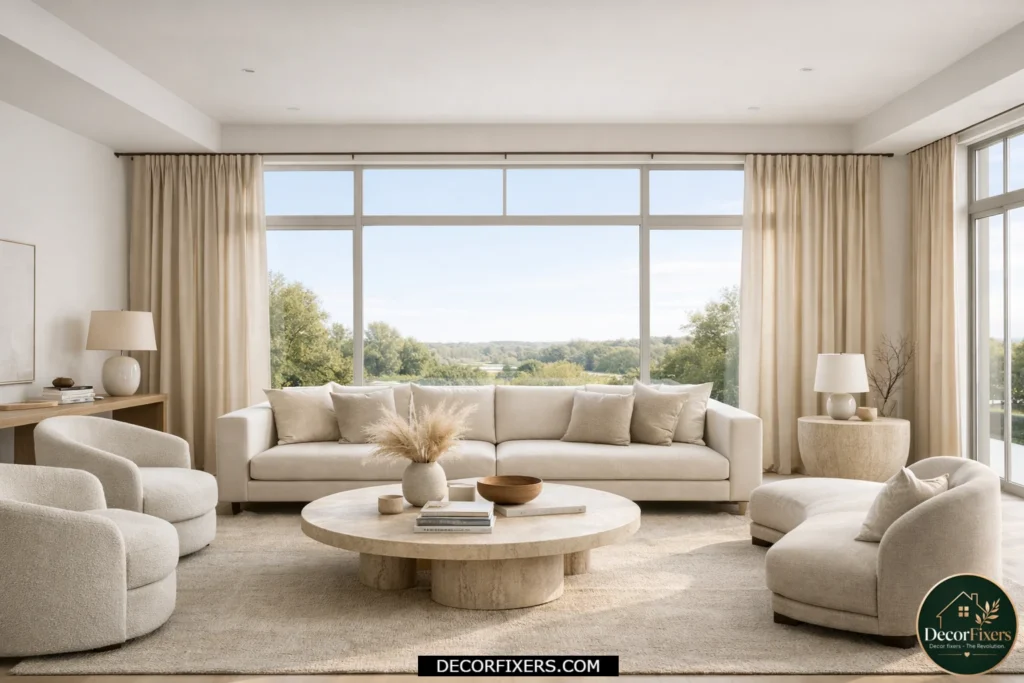
This is one of those ideas that costs nothing extra but changes everything. When you hang your curtain rod 8 to 12 inches wider than the window frame on each side, the curtain panels stack off the glass entirely when open. The window appears significantly larger, and the room gets lighter.
It’s a technique used in nearly every professionally styled living room, and yet most homeowners skip it because the standard curtain rod just fits the window width. Buy a rod at least 12 inches longer than your window on each side. The whole look changes. You’ll see it immediately.
6. Warm Earth-Tone Curtains, Terracotta, Taupe, and Ochre
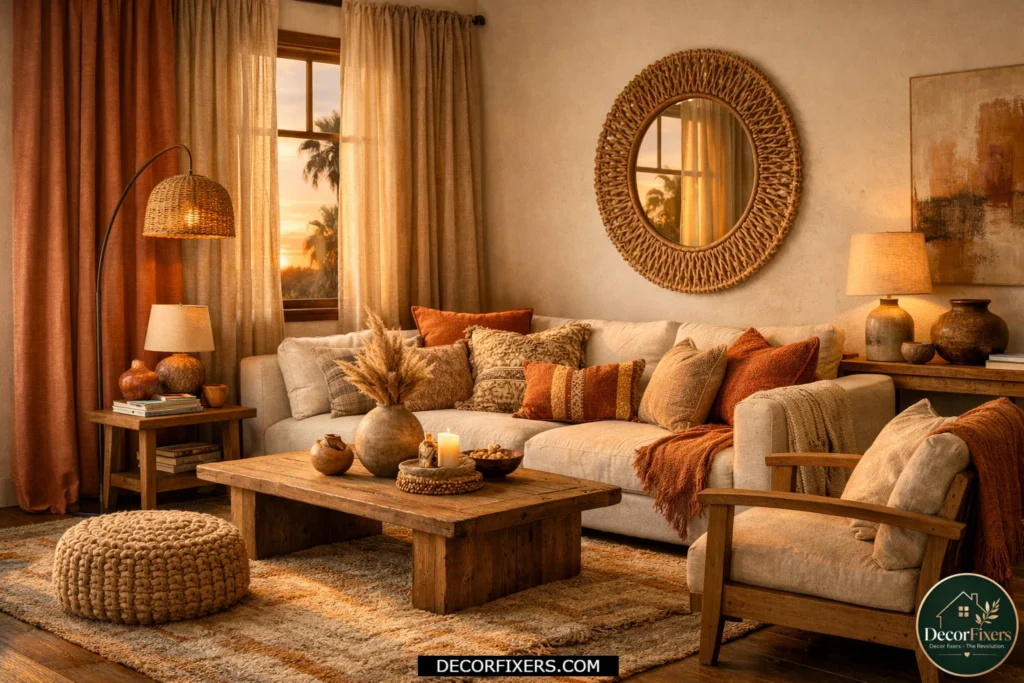
If your living room has white or light grey walls, warm ground tones in the curtains are the fastest way to stop a space from feeling experimental. Terracotta, ochre, warm taupe, and sandy brown are all leading color trends in 2026, and they work with virtually every furniture style from Scandinavian-minimalist to traditional.
Or maybe I should say it this way: these colors don’t just ‘work’, they make a room feel lived-in and intentional in a way that cool neutrals rarely achieve. A good linen or cotton-blend panel in warm terracotta starts at $60–$120 per panel. H&M Home and CB2 both have strong options in this palette right now.
7. Pinch Pleat Curtains for a Polished, Tailored Look
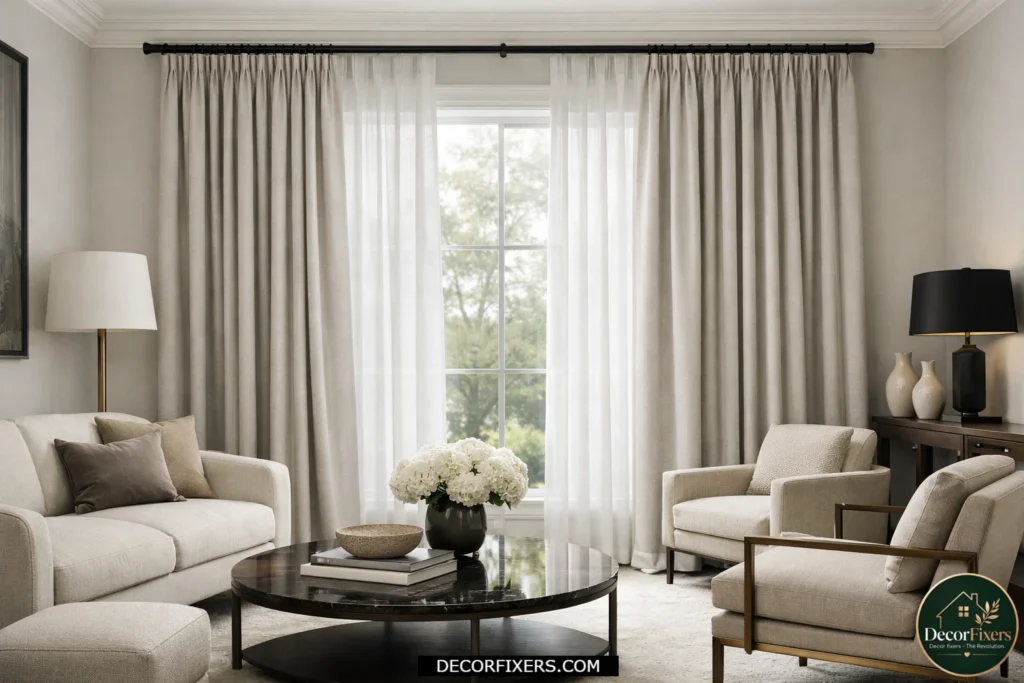
Pinch pleats are the heading style that separates a curtain from a drape. That structured fold at the top, usually two or three fingers of fabric pinched together, gives any panel an immediately formal, tailored finish. It’s the curtain equivalent of a well-fitted blazer.
What most guides skip is this: pinch pleat curtains require more fabric than flat panels, usually 2.5x the window width, which means they naturally look fuller and richer even in budget fabrics. Expect to pay $100–$250 per panel from retailers like Restoration Hardware or Pottery Barn for ready-made options. Custom pinch pleats from a local workroom can run $300–$700 per panel, but last decades.
8. Blackout Curtains That Don’t Look Like Blackout Curtains
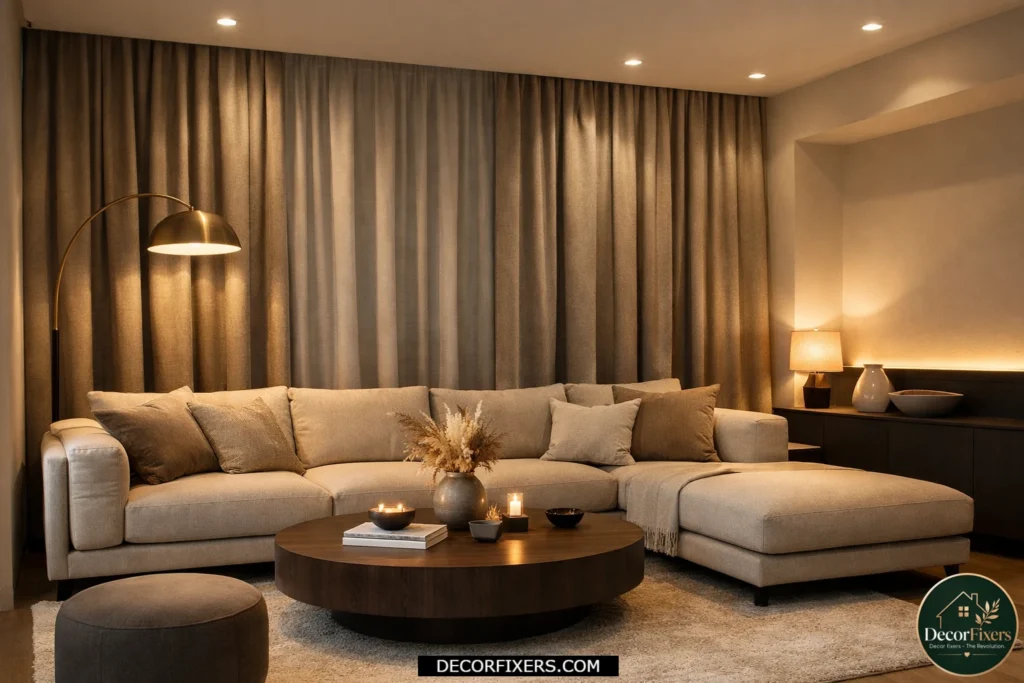
Most people assume blackout curtains have to look heavy, stiff, and unattractive. That was true ten years ago. In 2026, the best blackout panels come in soft, natural-looking fabrics, linen blends, jacquard weaves, even velvet, that happen to block 95–99% of light. You get full light control without sacrificing style.
This matters most for west-facing living rooms, where afternoon glare can make the space nearly unusable. Look for ‘lined’ or ‘thermal blackout’ options rather than panels coated in black backing; the lined versions drape and look far better. The NICETOWN Blackout Linen Curtain runs around $35–$65 per panel and consistently outperforms its price point.
9. Neutral Greige Curtains, The Most Versatile Color You Can Pick
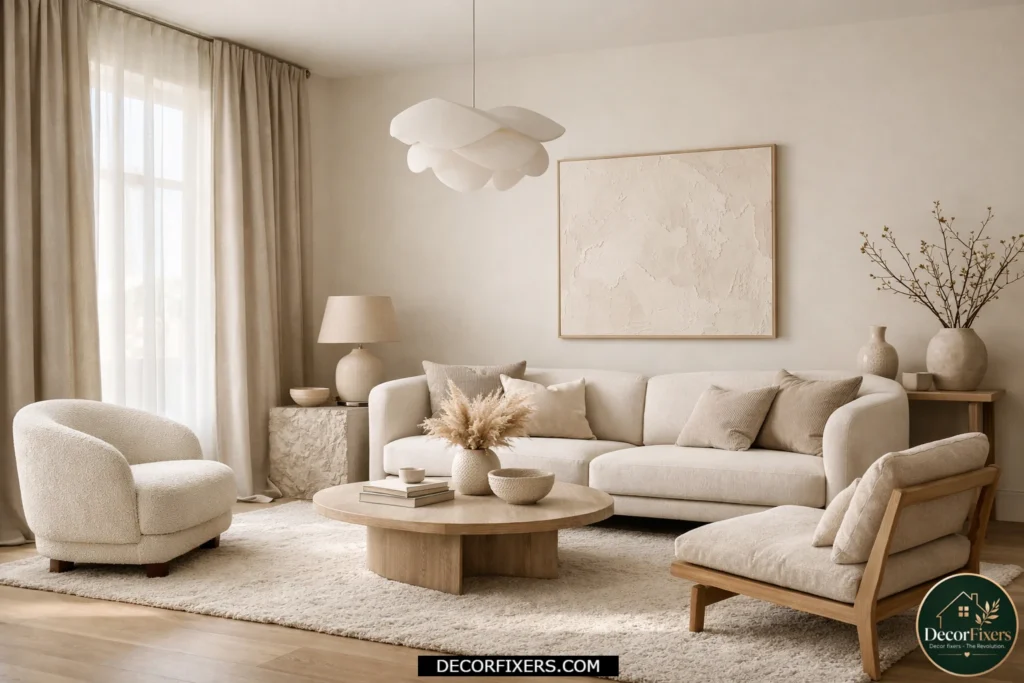
If you’re paralyzed trying to choose a curtain color, start with greige. It’s that warm grey-beige blend that reads as a soft neutral from a distance but has just enough warmth to keep the room from feeling cold. It works against white walls, blue walls, green walls, and everything in between.
I’ve seen conflicting data here; some design sources say white is the most universally versatile curtain color, while others point to greige as the safer choice for warm-toned rooms. My read is that greige wins in most US and UK homes because the majority of interior palettes lean warm, not cool. A greige cotton or linen panel from Target’s Threshold line starts at $30–$60 per panel, making it the most accessible luxury-adjacent choice on this list.
10. Grommet-Top Curtains for Clean, Modern Hardware Lines
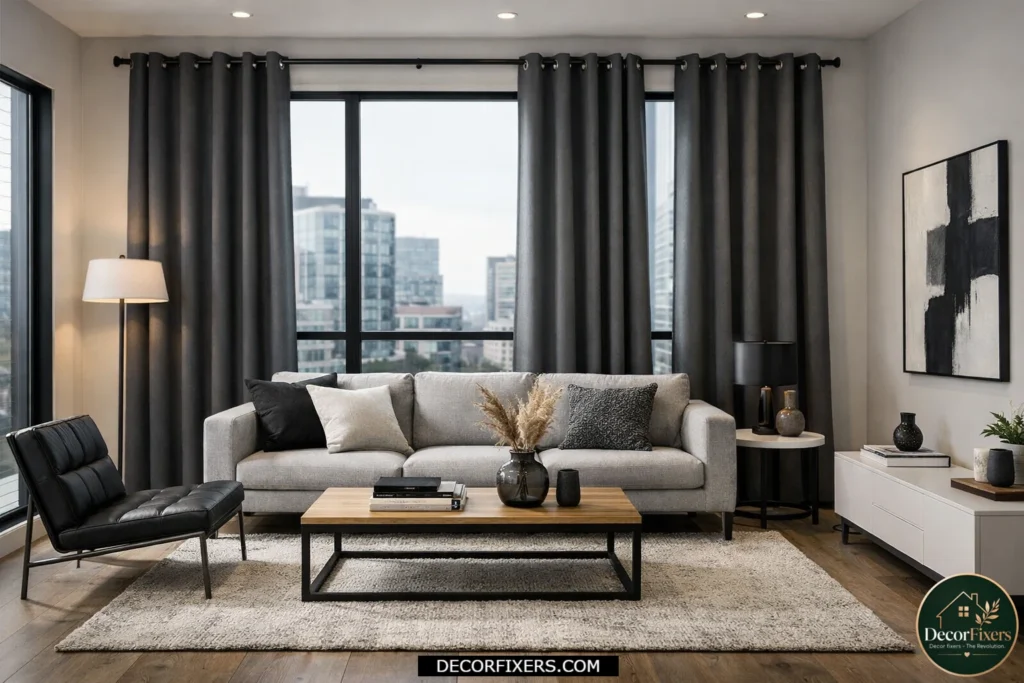
Grommet curtains, those metal rings punched directly through the fabric at the top, create clean, even folds and slide effortlessly along any rod. In modern and minimalist living rooms, they’re the most functional heading style available. No hooks to adjust, no pleats to straighten.
The fold pattern they create is uniform and graphic, which works particularly well with solid-color fabrics. They’re less suited to very formal rooms but ideal for contemporary spaces. Budget between $40–$120 per panel, depending on fabric weight. IKEA MAJGULL blackout grommet curtain at around $40–$60 per pair remains one of the best-value modern options available in 2026.
11. Striped Curtains for Vertical Energy and Visual Height
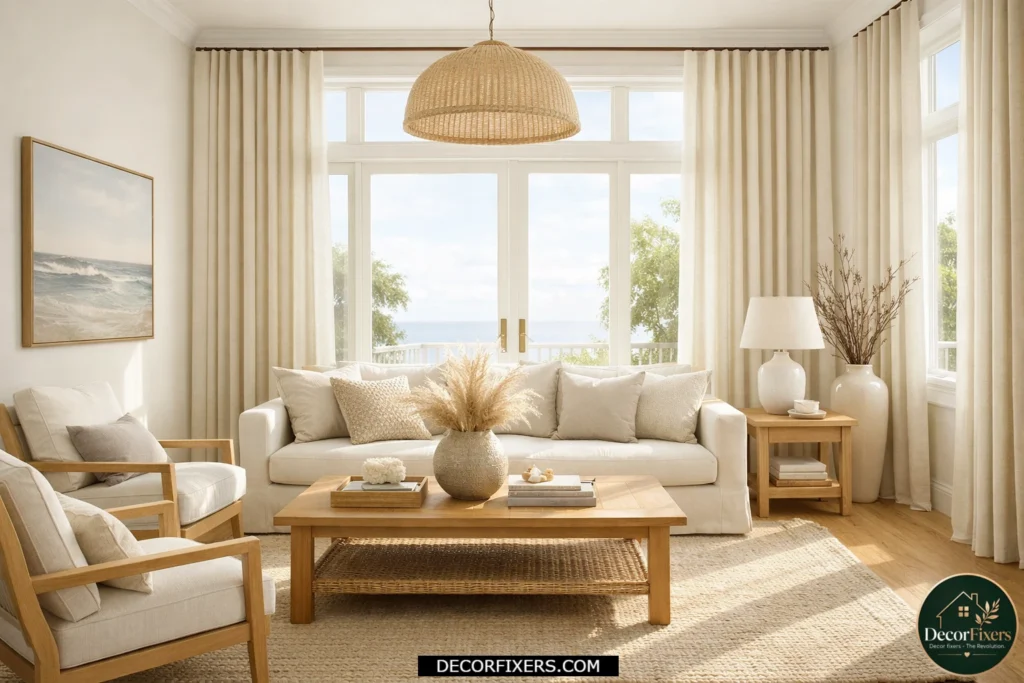
Vertical stripes in curtains do exactly what they do in clothing: they elongate. A room that feels low-ceilinged or compact can gain an immediate sense of height with the right stripe pattern. Keep the stripes narrow and the color contrast soft for a sophisticated result rather than a circus tent.
Ticking stripe and subtle woven-stripe fabrics are the best versions of this idea. They read as elevated and intentional rather than loud. A two-tone ticking stripe linen panel in cream and warm sand creates a look that works in coastal, farmhouse, and contemporary living rooms equally well. These run $60–$150 per panel from most mid-range retailers.
12. Botanical and Floral Print Curtains as a Statement Wall
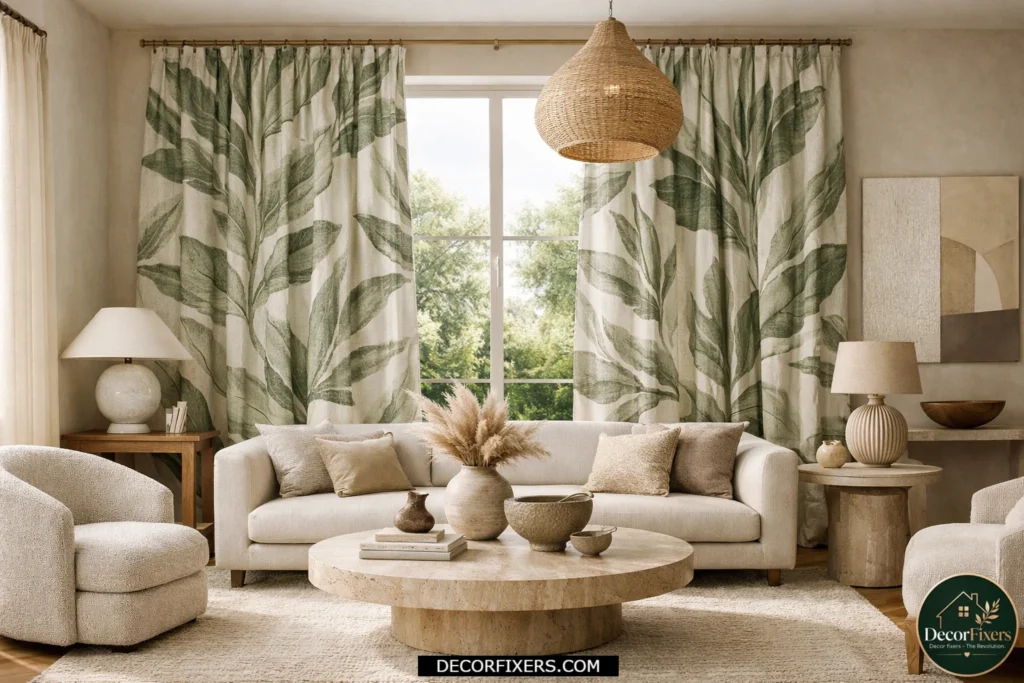
A living room without pattern can feel flat, even when it’s perfectly furnished. Botanical and large-scale floral curtains are one of the most impactful ways to introduce pattern without painting the walls.
In 2026, the prints trending are loose and organic, think oversized leaves, soft watercolor florals, and muted botanical repeats rather than tight, traditional chintz. Look, if you’re in a neutral room that feels underdressed, this is what actually works.
One pair of statement printed curtains in a living room does the work of three throw pillows, a rug, and an art piece combined. Budget options start at $50–$90 per panel. For higher-end botanical prints, Anthropologie and Pottery Barn both carry options in the $120–$200 per panel range.
13. Navy Blue Curtains Against White Walls, A Classic That Never Ages
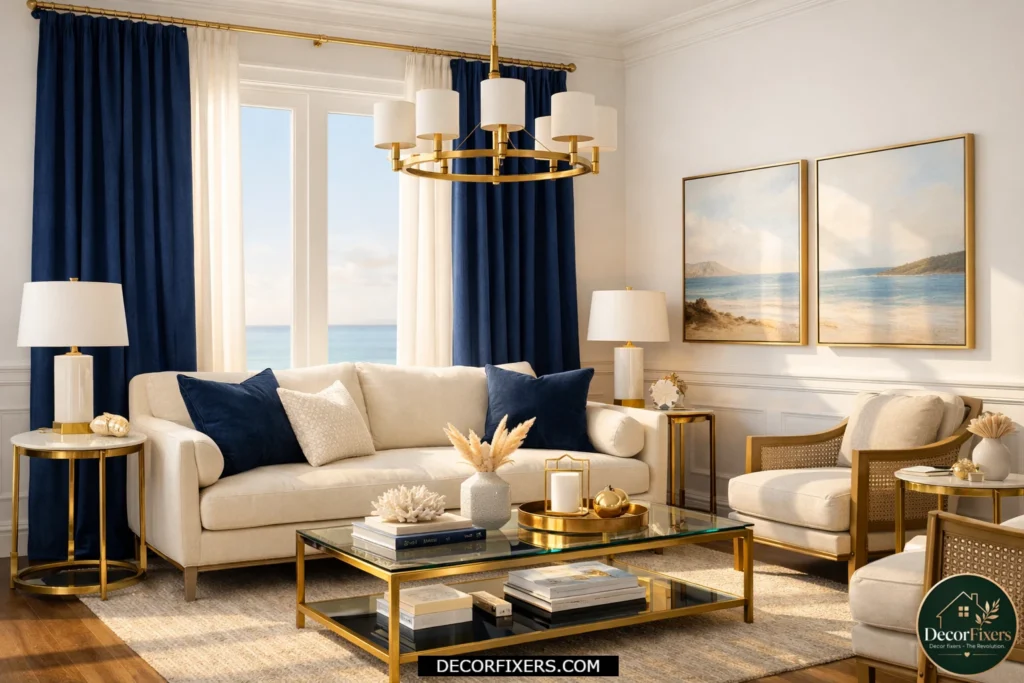
Deep navy curtains against white or off-white walls is one of those combinations that simply cannot fail. It’s crisp, nautical without being themed, and works from traditional to modern interiors without adjustment.
The Navy also has the useful quality of making any natural light that enters the room feel more golden and warmer by contrast. The fabric choice matters here more than in almost any other color.
Navy velvet creates drama and warmth. Navy linen reads as casual and breezy. Navy cotton is the cleanest, most architectural version. Choose based on the mood of your room. Panels start at $45–$80 for polyester velvet blends, up to $180–$300 for quality linen in this color.
14. Sage Green Curtains for a Calming, Nature-Inspired Living Room
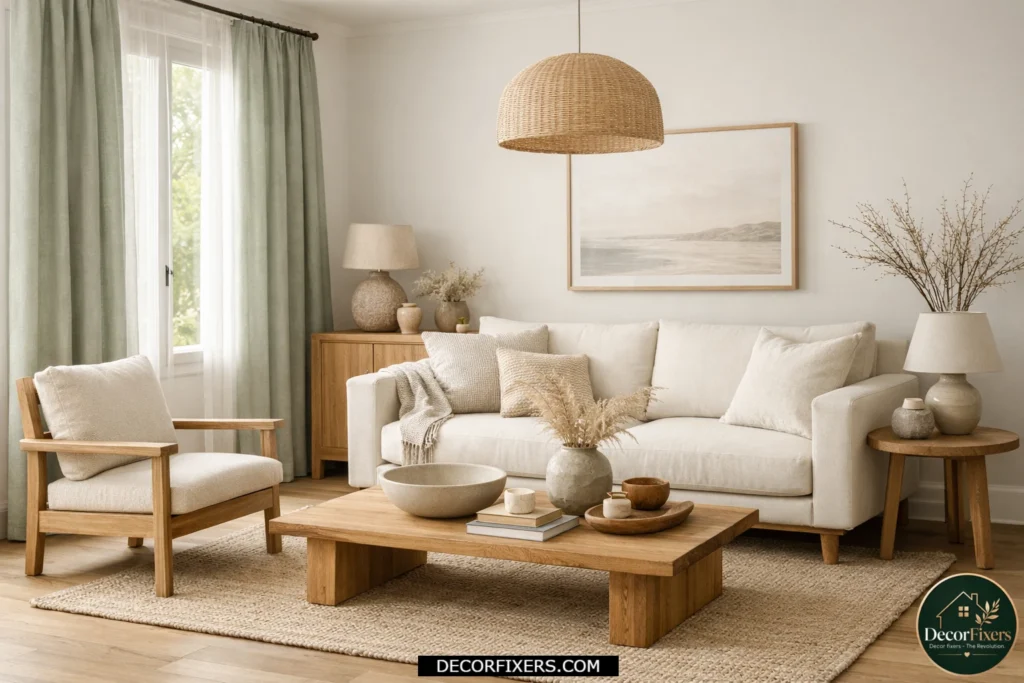
Sage green has become the defining interior color of the mid-2020s, and for good reason; it sits comfortably between green and grey, making it both calming and sophisticated.
In curtain form, sage green works best in linen or cotton-linen blends where the natural fiber texture complements the earthy tone. It pairs beautifully with natural wood furniture, cream upholstery, terracotta accents, and rattan. It also works against warm white, pale grey, and even dusty pink walls.
This is the color I’d recommend for a first-time curtain shopper who wants something on-trend but not risky. Quality options run $65–$130 per panel from West Elm, H&M Home, and Amazon premium listings.
15. Wave Heading Curtains for a Contemporary, Ripple-Fold Look
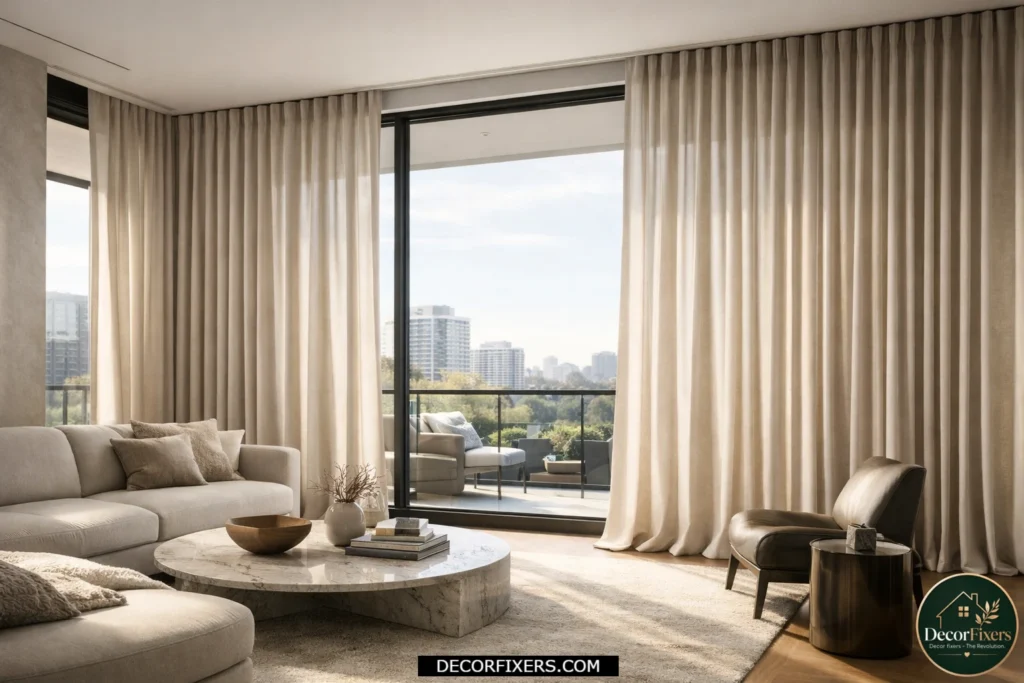
Wave-fold or ripple-fold curtains are the heading style you see in high-end hotels and interior design magazines, evenly spaced, with gentle S-curves running the full length of the panel.
Unlike pinch pleats, which create structured folds, wave headings create a continuous, soft undulation that looks architectural and modern. These require a specialized track rather than a standard rod, which adds cost.
But the installed result is genuinely stunning and justifies it. The track itself typically runs $50–$150, and quality wave-fold panels in linen or velvet range from $100–$350 per panel. This is a mid-tier investment with a decidedly premium result.
16. Curtains with Contrast Lining for a Surprise Detail
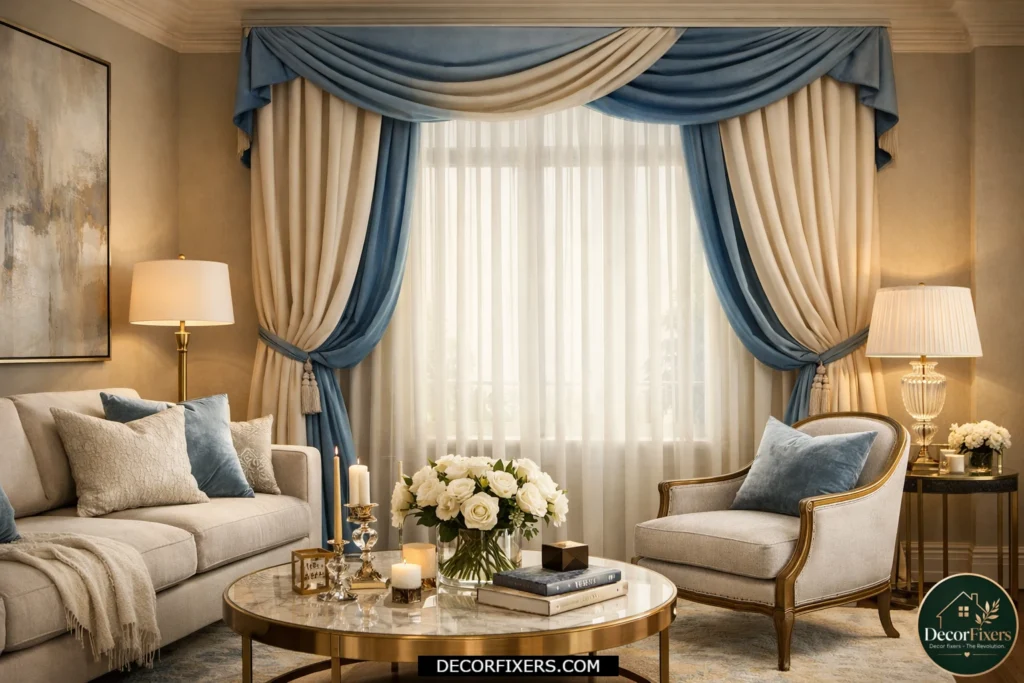
This is one of the most underused ideas in residential design. A curtain with a contrasting lining, say, a soft cream outer fabric with a dusty blue lining, reveals a second color only when the panels move or are pulled back.
It’s a subtle detail that experienced eyes notice immediately, and that gives a room a sense of layers and craft. Interior designer Lucy Marsh of Lucy Marsh Interiors recommends this particularly for French windows or rooms that are visible from outside: the lining becomes the exterior-facing ‘face’ of the curtain.
Custom contrast-lined curtains start at $200–$500 per panel. Some fabric shops will line standard panels for $40–$80 per panel if you supply both fabrics.
17. Rust and Burned Orange Curtains for Warm Maximalist Energy
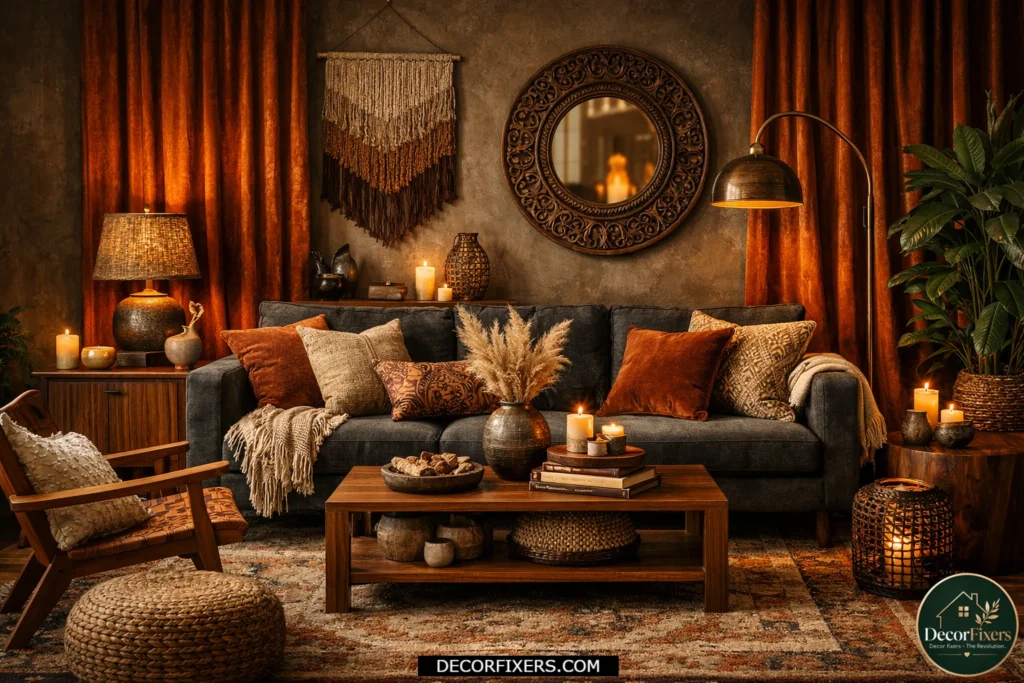
Rust, burnt orange, and cayenne curtain panels are the color choice for living rooms that want personality without going full maximalist. These tones work because they read as warm and earthy, they don’t fight with your furniture, they amplify it.
Against a dark charcoal sofa or a warm wood coffee table, rust curtains create a cohesive warmth that beige simply can’t achieve. The fabric weight matters significantly with these tones. Rust in velvet is rich and cozy. Rust in linen is relaxed and bohemian.
Rust in a sheer is light and unexpected. Budget $70–$160 per panel for quality options. Look at ARHAUS, West Elm, and CB2 for the best current selection in these tones.]
18. Café Curtains on Lower Windows for a European Kitchen-Living Look
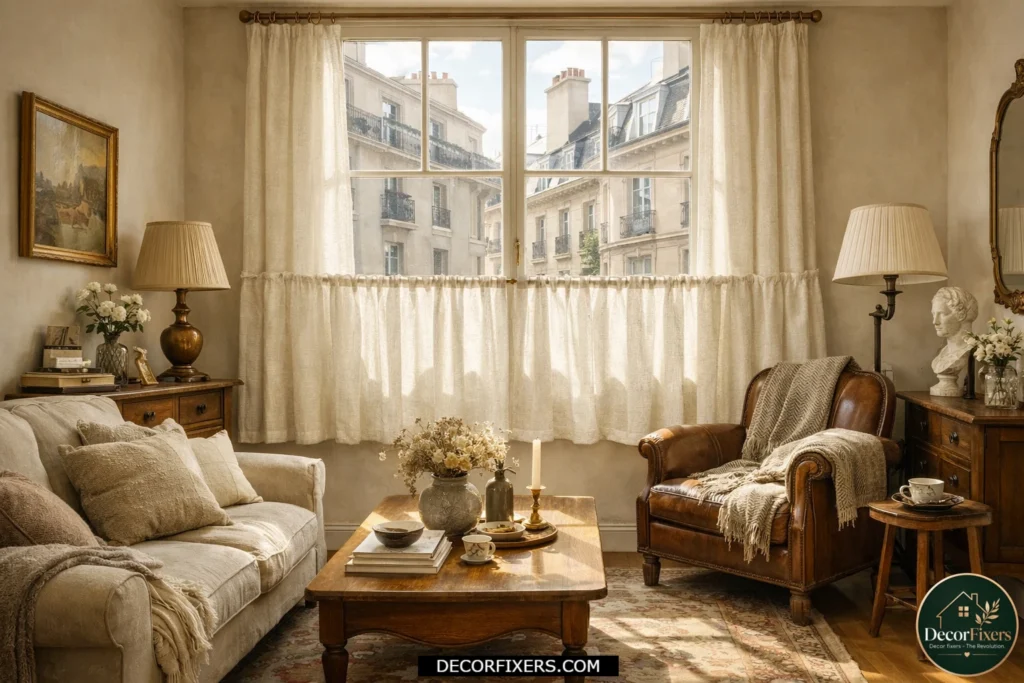
Café curtains, panels that cover only the lower half of a window, are traditionally a kitchen idea that is migrating fast into living rooms, particularly those with street-facing windows or in urban apartments where privacy is needed but light isn’t something you can afford to lose.
They look especially good on sash windows and double-hung windows where the upper glass stays clear, and the lower half is covered.
A simple rod mounted at the mid-point of the window is all the hardware you need. These are the most affordable options on this list: a set of cafe curtains typically runs $25–$75, making them perfect for renters or anyone in need of a temporary high-impact fix.
19. Curtains That Match the Wall Color for a Tone-on-Tone Effect
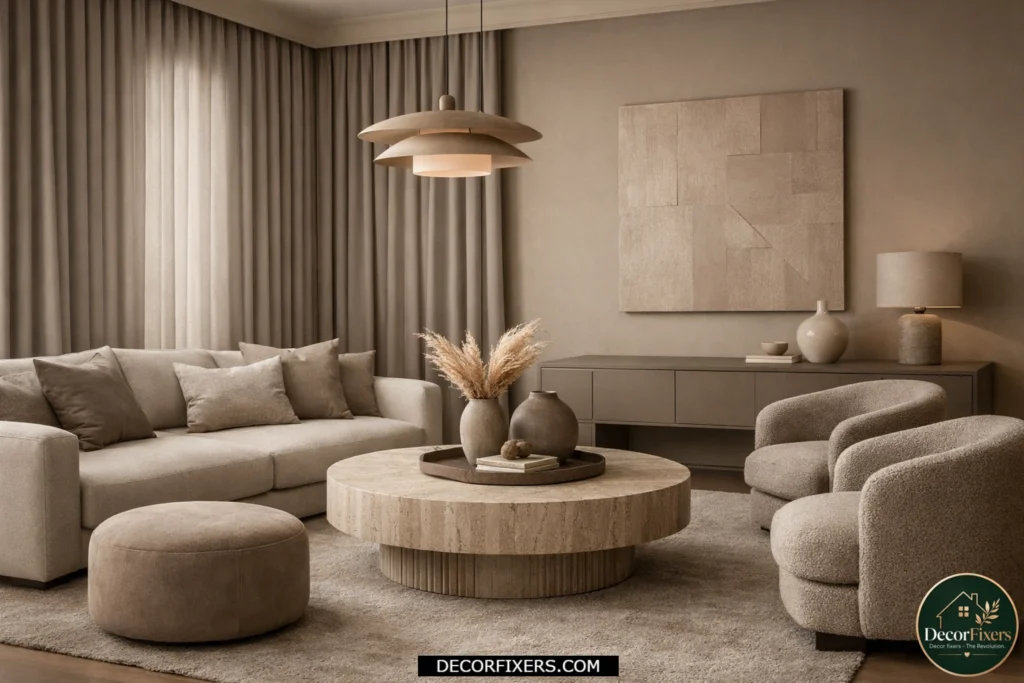
This is the idea that looks the most ‘designer’ from a distance and the least obvious up close. When you hang curtains in the same color as your walls, or within one or two shades, the windows disappear into the room. The effect is enveloping, curated, and surprisingly easy to achieve.
It works best in deeper colors: sage-green walls with sage-green curtains, dusty-rose walls with blush panels, warm putty walls with oyster panels. The key is to vary the texture between wall and curtain so the tonal similarity reads as intentional rather than accidental.
This technique can be done at any budget; panels from $40–$200 per panel work equally well here because the color match matters far more than the price.
20. Curtains with Fringe, Tassel, or Trim Details for Instant Personality
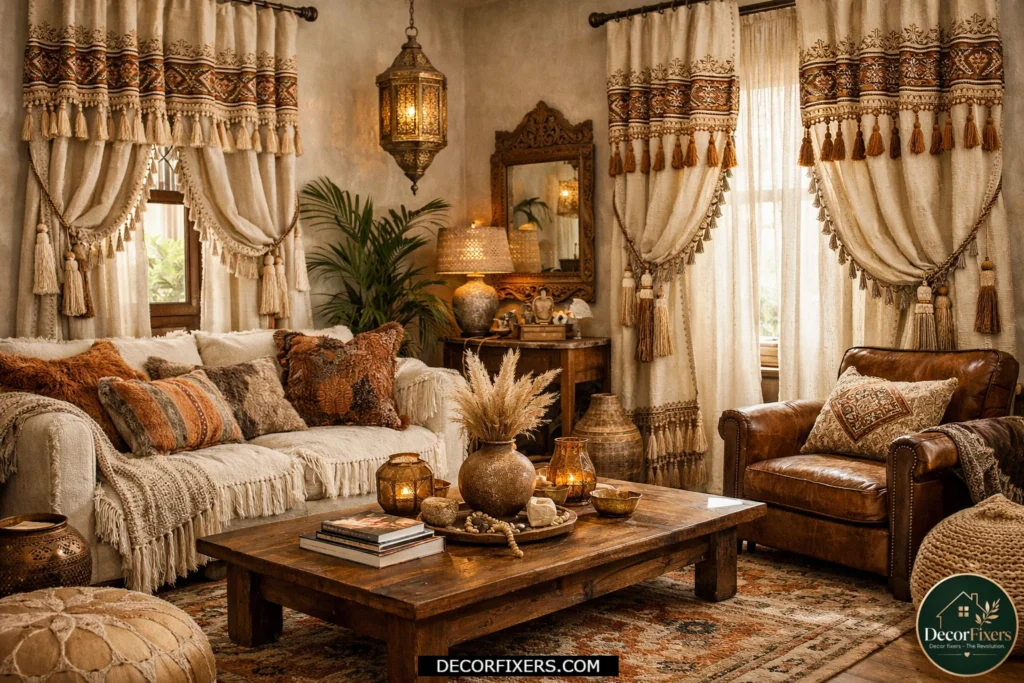
A plain panel becomes something else entirely with the right trim. Fringe, pom-poms, embroidered edges, and tassel tiebacks are all having significant moments in 2026, particularly in maximalist-leaning, bohemian, and global-inspired living rooms.
The detail doesn’t need to be large; a subtle fringe border down the leading edge of a curtain panel is enough to change the entire register of the room.
Anthropologie specializes in this category, with embroidered and trimmed panels ranging from $80–$180 per panel. If you already own plain panels, a dressmaker or fabric shop can add custom trim for $15–$40 per panel, one of the best low-cost upgrades on this list.
21. Pelmet Curtains and Valances for a Grand, Layered Top
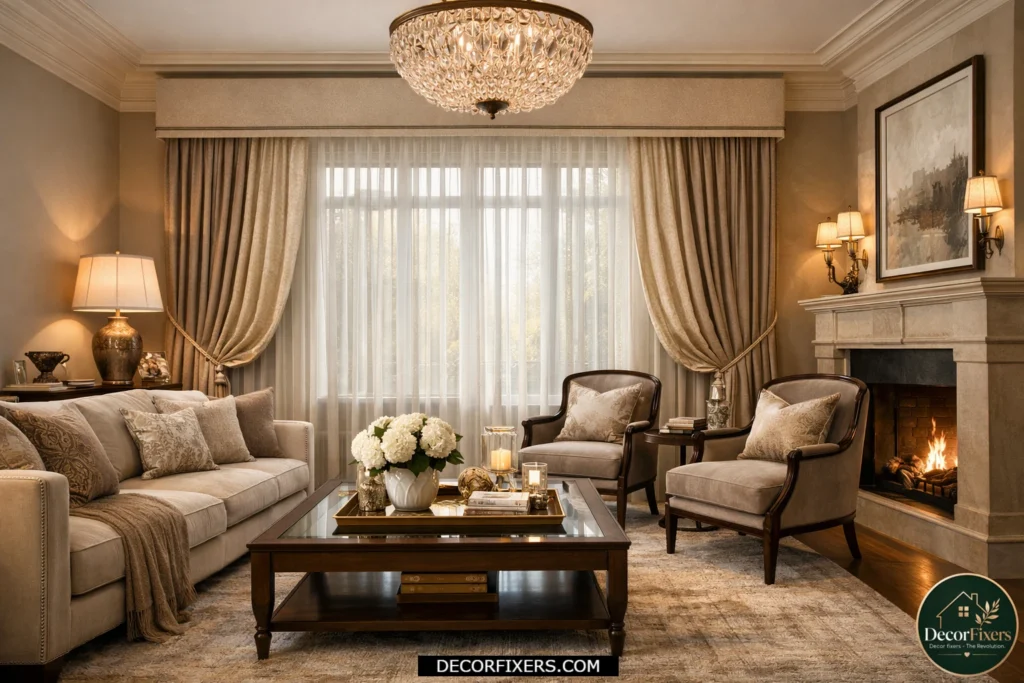
Pelmets, those rigid, upholstered boxes mounted above a curtain rod, are officially back in 2026 after years of minimalism pushing them out. They add architectural weight to a window, conceal the rod and hardware entirely, and give any curtain arrangement a finished, almost theatrical quality.
A wood pelmet covered in the same or contrasting fabric to the curtain panels below creates a cohesive window treatment that looks fully custom even when the panels themselves are off-the-shelf.
Fabric-covered pelmets can be made DIY for $80–$150 in materials, or sourced from custom workrooms for $300–$800, depending on size and fabric choice.
22. Patterned Jacquard Curtains for Textural Depth Without Loud Color
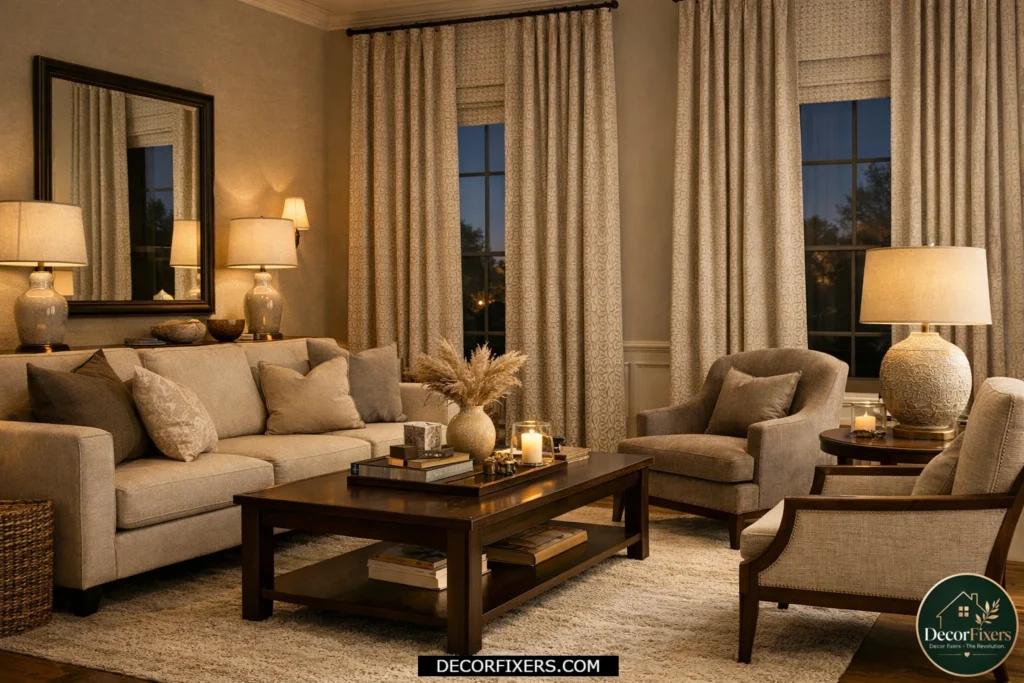
Jacquard fabric is woven with its pattern built into the textile structure rather than printed on the surface. The result is a curtain with visible texture that shifts in different light, subtle in daylight, more pronounced in evening lamplight.
It’s one of the most versatile approaches to adding pattern to a room without committing to a strong color. Geometric jacquards, damask weaves, and abstract woven patterns all work here.
They’re particularly effective in classic or transitional living rooms where the goal is richness without drama. Jacquard panels typically run $90–$250 per panel, with higher-end versions from Pottery Barn and Crate & Barrel reaching $200–$400 per panel.
23. Motorized Smart Curtains for Modern Convenience and Clean Walls
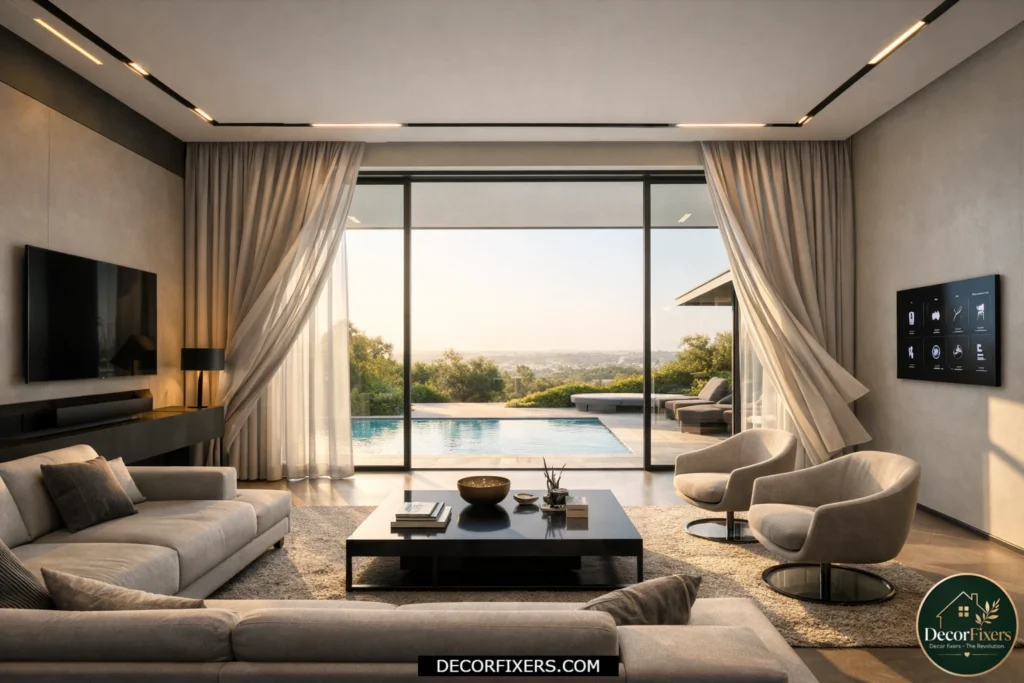
Smart curtains, motorized panels controlled by app, voice, or a wall switch, are no longer a luxury reserved for high-end renovations. In 2026, the technology has matured enough that a mid-range motorized track system is accessible, reliable, and genuinely useful.
They’re especially valuable in rooms with hard-to-reach windows or for households where consistent morning and evening light routines are important. The Lutron Serena motorized shade system integrates with Alexa, Google Home, and Apple HomeKit and starts at around $350–$600 for a complete window setup.
IKEA FYRTUR motorized blackout blind is a more budget-friendly entry point at $130–$160 per window, though it’s a roller blind rather than a curtain panel. Full motorized curtain track systems with fabric panels start at $400–$900 per window.
24. Silk or Faux-Silk Curtains for a Formal, Light-Catching Finish
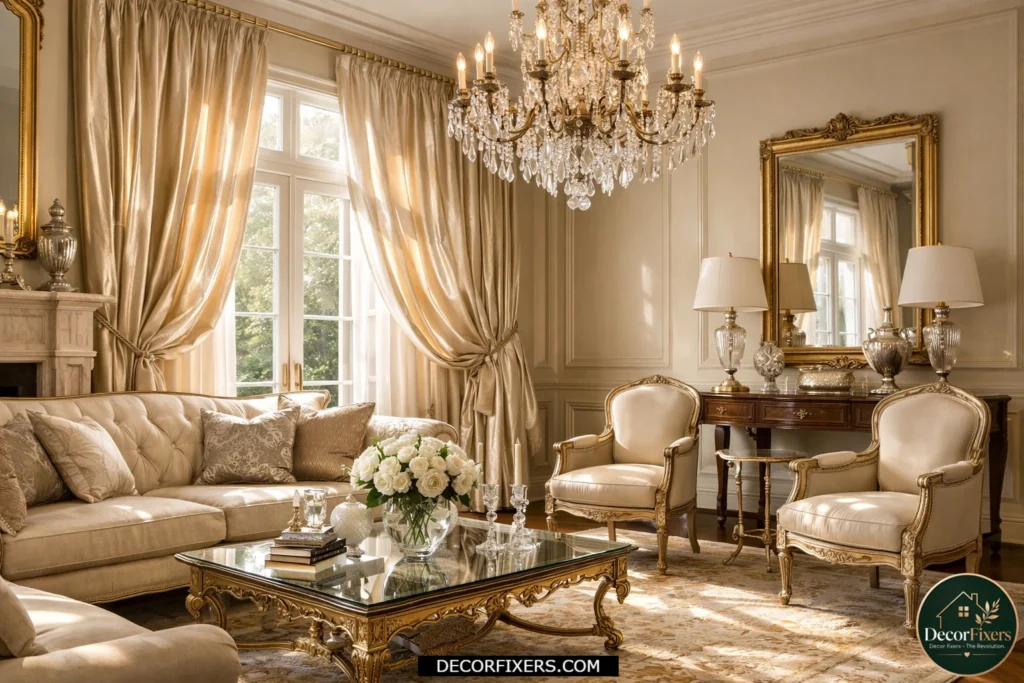
Real silk curtains are the pinnacle of formal window dressing; they catch light in a way no other fabric can replicate, shifting between deep richness in shadow and bright luminosity in direct light.
They’re best in formal living rooms, dining rooms, and spaces that don’t receive heavy direct sunlight (which degrades real silk quickly). For most living rooms, a quality faux-silk or satin-weave polyester achieves 80% of the visual effect at 10% of the cost.
These panels start at $40–$80 per panel for decent faux-silk options, while real silk from specialty curtain makers runs $300–$1,200 per panel, depending on weave weight and dye quality. Unless your room is genuinely formal and controlled in terms of light and humidity, I would lean toward the faux-silk option every time.
25. Puddle Curtains, Let Your Fabric Touch the Floor Generously
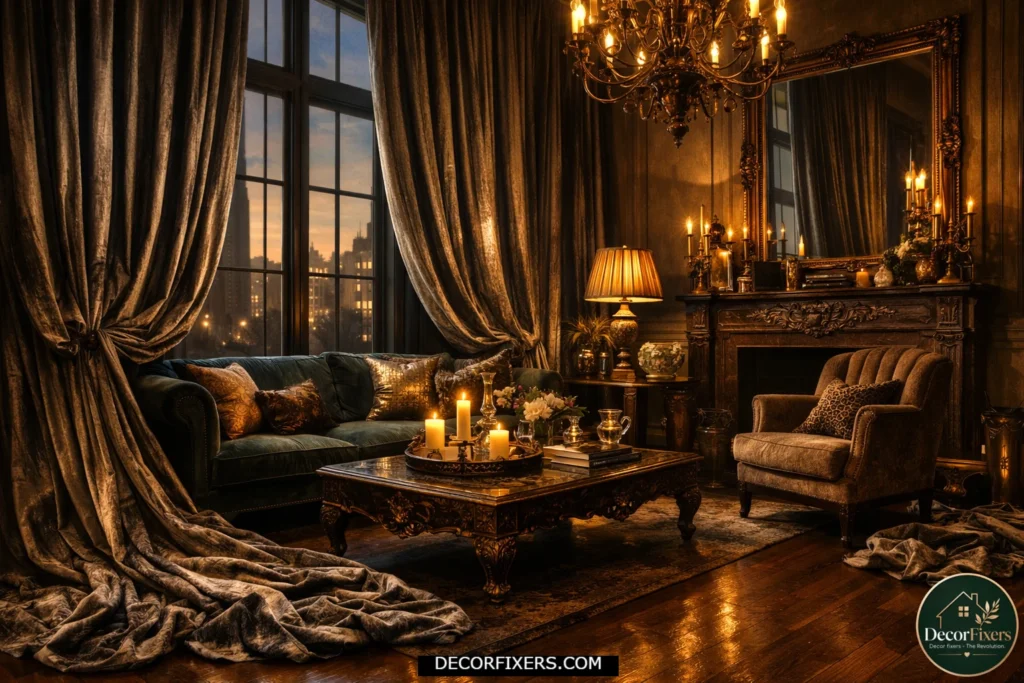
The puddle. It’s the most divisive curtain technique on this list; designers either love it or avoid it entirely. A puddle is when the curtain panel is intentionally cut longer than the floor height, allowing 3 to 6 inches of fabric to rest on the floor in a gentle pool. Done with the right fabric, it looks impossibly romantic and abundant.
It works best with heavy fabrics, velvet, thick linen, wool blends, in formal or maximalist living rooms. Cotton and lightweight linen are too casual to puddle elegantly; they end up looking like a mistake rather than a choice.
If you’re willing to commit to it, a puddle curtain arrangement in deep velvet or heavyweight silk is the single most dramatic living room statement you can make without spending more than $400–$600 total for a standard window.
Quick Comparison:
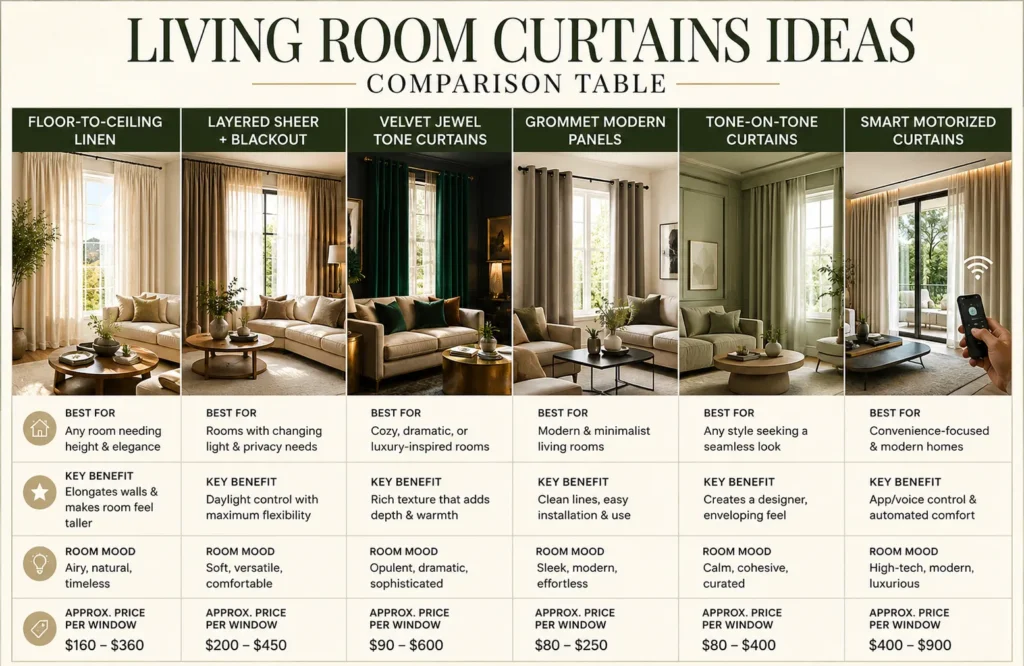
Use this table to match your room situation to the right curtain idea from the list above.
| Style | Best For | Key Benefit | Approx. Cost Per Window |
| Floor-to-ceiling linen | Any room needing height | Elongates walls | $160–$360 |
| Layered sheer + blackout | Light-changing rooms | Full flexibility | $200–$450 |
| Velvet jewel tones | Cozy, dramatic rooms | Rich light absorption | $90–$600 |
| Grommet flat panels | Modern/minimalist rooms | Clean, effortless look | $80–$250 |
| Tone-on-tone wall match | Any style room | Designer enveloping feel | $80–$400 |
| Smart motorized | Convenience-focused homes | Voice/app control | $400–$900 |
CONCLUSION:
After going through all 25 of these ideas, I keep coming back to the same honest advice: start with length and color before you worry about anything else. Most living rooms look underdressed because the curtains are too short and too narrow, not because they chose the wrong fabric or the wrong heading style.
Hang them on the ceiling. Extend the rod past the window. Let them reach the floor. Then pick a color that you can live with for five years, a warm neutral, a deep jewel tone, or a sage green. That alone will do 90% of the work. Everything else, the trim details, the heading style, the layering, is refinement you add over time.
The ideas above span $25 cafe curtains all the way to $900+ motorized systems, and I genuinely believe the right choice at any budget is one that’s hung correctly and chosen with intention. That’s it. That’s the whole secret.
According to Grand View Research (2024), the global window covering market is valued at USD 27.5 billion and growing at 5.5% CAGR through 2030, which tells you one thing clearly: people care deeply about their windows. Your living room deserves that same attention.
FAQs:
What’s the best curtain color for a living room?
Neutral tones, warm white, greige, taupe, and sage green, work universally well and won’t date. For more personality, deep navy or terracotta make strong statements that still feel current in 2026.
How do I make my living room curtains look more expensive?
Hang them ceiling height, extend the rod 10–12 inches wider than the window on each side, and ensure panels nearly touch or skim the floor. Fullness and length do more for perceived quality than fabric price.
Should curtains touch the floor in a living room?
Yes. Floor-length curtains, whether they skim, touch, or puddle, always look more intentional and elegant than curtains that hang short. Short curtains should only be used in specific cases, like cafe-style half coverage.
What curtain fabric is best for a living room?
Linen and linen-blend fabrics are the most versatile: they work in modern and traditional rooms, drape beautifully, and age well. Velvet adds luxury and warmth. Sheer voile is ideal when natural light is the priority.
When should I use blackout curtains in a living room?
Use blackout curtains in west-facing rooms that receive intense afternoon sun, in living rooms that double as home theaters, or in rooms where nap-friendly darkness matters. Layer them with sheers to keep daytime flexibility.

Creator of DecorFixers, sharing practical home and interior ideas focused on real-life usability, simple design improvements, and budget-friendly solutions.
1 thought on “25 Best Living Room Curtains Ideas(That Look Expensive)”