

I still remember the night I stood in my new living room and just stared at it. The TV was mounted, sure. But it looked like a black hole floating on a beige wall. Cables dangling. No shelf, no panel, no context. My whole setup screamed ‘college dorm’ even though I’d just spent months hunting for the right sofa, the right rug, the right pendant light.
Sound familiar? You’re not alone. The TV is arguably the hardest design problem in any small living room; it’s large, it’s dark, and it dominates attention whether you like it or not. The difference between a room that looks polished and one that looks unfinished almost always comes down to how that screen sits within the wall.
Here’s the thing: A feature TV wall doesn’t have to mean a six-figure custom millwork job. In 2026, there are more materials, modular systems, and LED options than ever before for every budget, every aesthetic, and every skill level. Whether you’re going full built-in or just adding a paneled backdrop behind a floating console, this article covers all 25 ideas with real material choices, cost ranges, and what actually works.
What Is a Modern Feature TV Wall?
A modern feature TV wall is a designed accent wall that integrates your television into a cohesive architectural composition, combining panels, built-in storage, LED lighting, and cable concealment so the screen feels intentional rather than added as an afterthought. Done right, it functions as the visual anchor of the entire room.
1. Full-Height Fluted Wood Panel TV Wall With LED Backlight
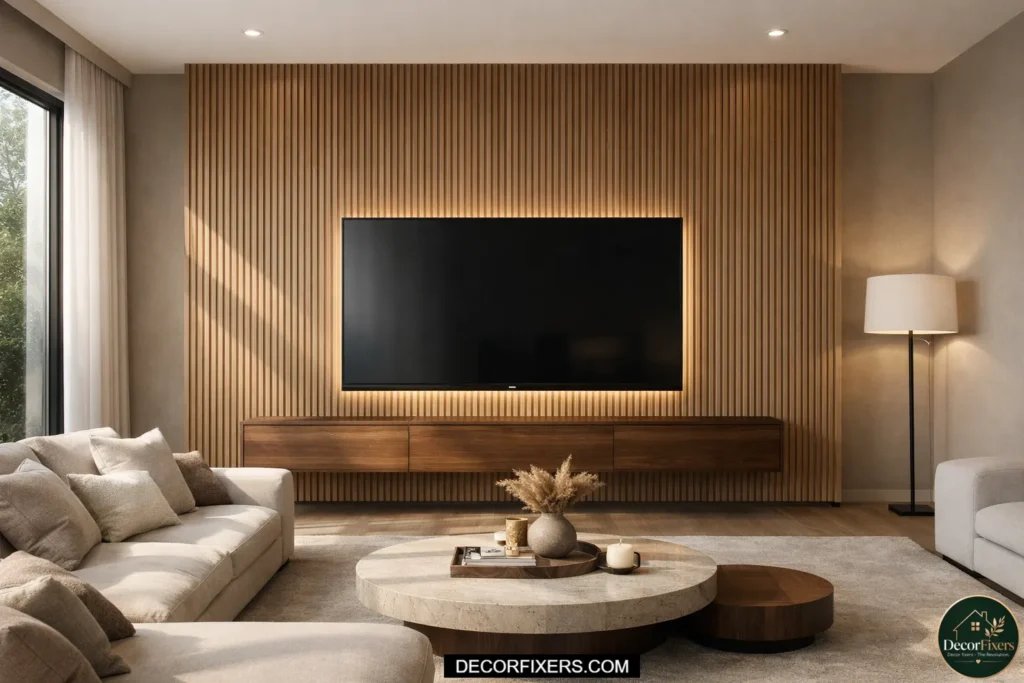
This is the design that’s breaking the internet right now, and for good reason. Vertical fluted (ribbed) wood-slat panels running floor to ceiling create an almost architectural richness that plain drywall simply can’t match. The TV sits centered within the paneling, mounted flush, with a warm LED strip tucked behind the screen for bias lighting. The result feels high-end but approachable.
In 2026, the most popular execution uses pre-finished oak or walnut veneer slat panels from suppliers like Rona, Wayfair, or specialist panel suppliers. A full 10-foot wall in fluted MDF panels typically runs $800–$2,200 DIY in materials, while a contractor builds lands around $3,000–$5,500 installed. For the LED strip,
What’s the best TV wall design for 2026?
Fluted wood-slat panels paired with LED bias lighting and a recessed power outlet are the most sought-after TV wall design in 2026. According to design trend data from Houzz and Homedit (Feb 2026), paneling systems that extend beyond the TV zone are replacing single-unit console setups in designer living rooms across the U.S.
2. Minimalist Floating Console With Dark Accent Wall Paint
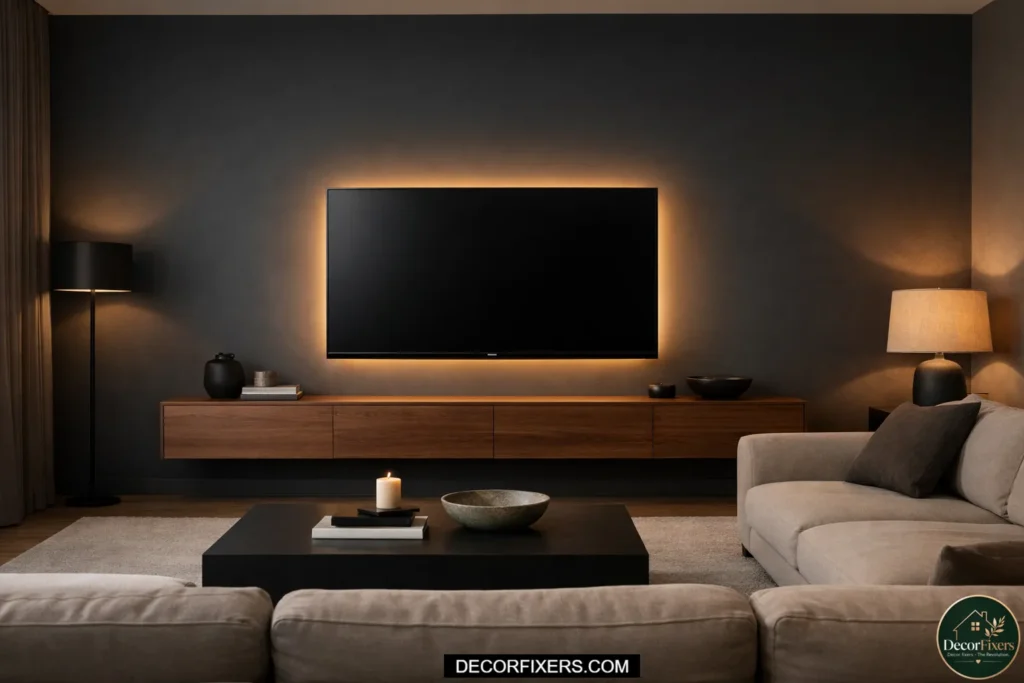
Not every strong TV wall needs panels or built-ins. Sometimes the most impactful move is surprisingly simple: paint the entire wall a deep, saturated color ‘ charcoal, forest green, navy, even a warm near-black ‘ mount the TV, add a slim floating console below, and call it done.
The dark backdrop makes the black TV screen visually disappear when off. It’s one of the most underrated tricks in living room design and costs almost nothing relative to the impact. A gallon of quality paint runs $45–$85; a floating media console from IKEA’s BESTÅ system starts around $250 and looks far more expensive than it is. Total wall cost? Potentially under $400.
3. Built-In TV Wall Unit With Hidden Storage Cabinets
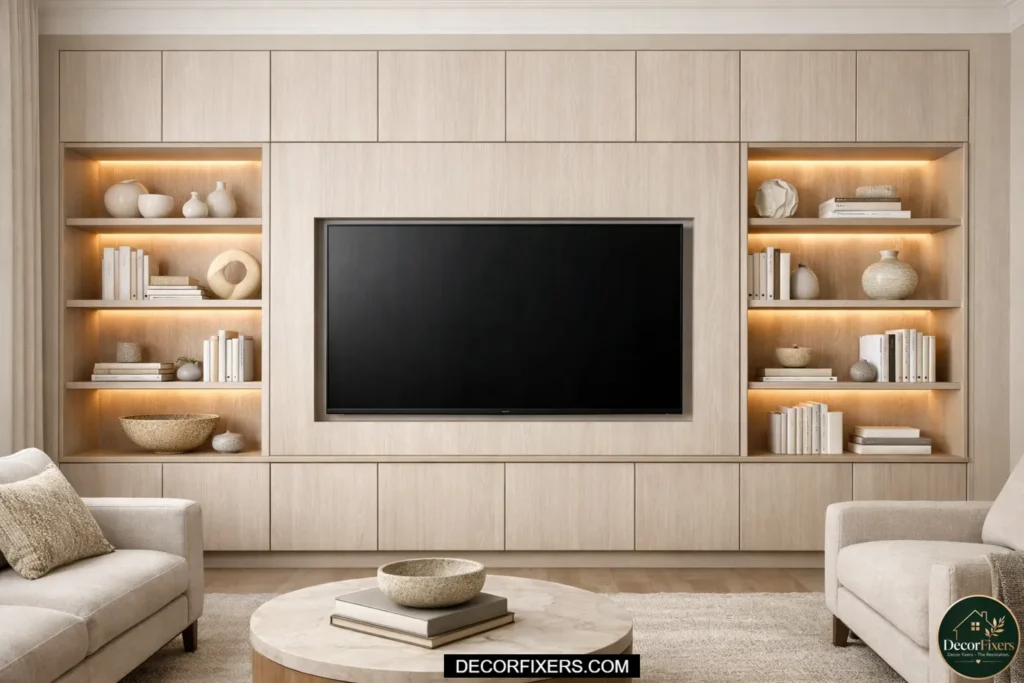
Built-in wall units are the gold standard. When done well, they look like the house was designed around them: symmetrical cabinetry flanking the TV, a mix of open shelving for books and decor, and closed cabinets below for media equipment, all integrated into one continuous composition. The TV looks embedded, not placed.
The cost range here is wide. A DIY approach using IKEA BILLY bookcases hacked with custom doors runs $600–$1,500 for a full wall, and there’s a massive community of tutorials showing exactly how to do this convincingly. A custom carpenter built using MDF and lacquer typically runs $4,000–$9,000, depending on size and detail level. Real hardwood pushes that figure higher.
4. Stone or Ledger Panel TV Feature Wall
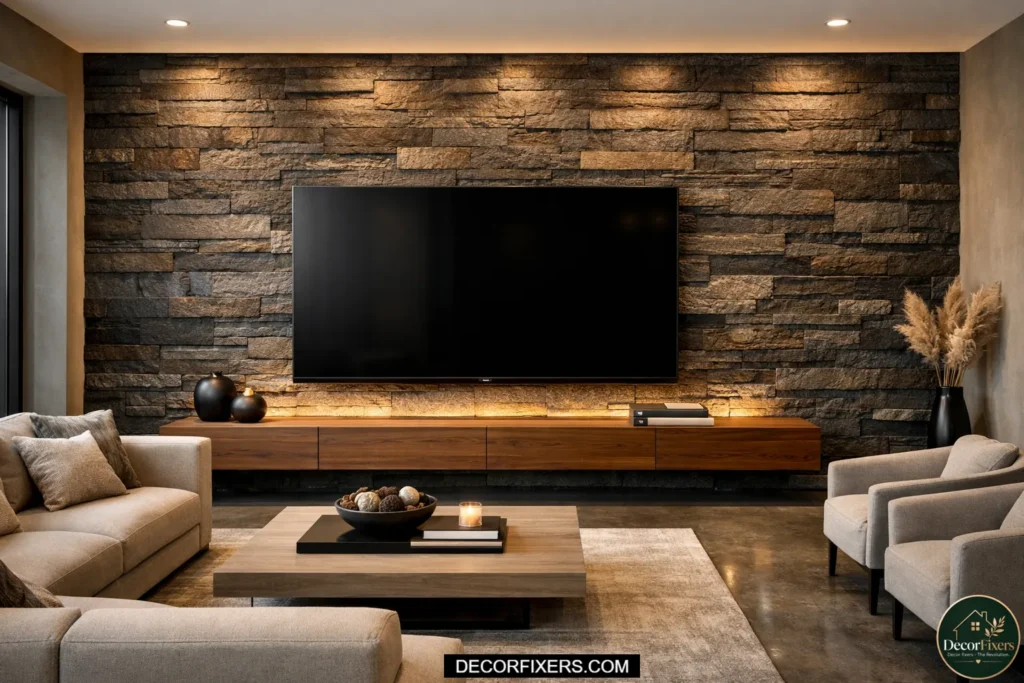
Stone cladding on a TV feature wall signals permanence and luxury in a way no painted surface can replicate. In 2026, the trend has moved away from rough fieldstone toward refined ledger panels ‘ thin-sliced stone in linear stacks that read as modern rather than rustic. Slate, quartzite, and manufactured stone veneer are the three most popular options.
Manufactured stone veneer (like Versetta Stone or Eldorado Stone) is the smart middle-ground choice. It costs $8–$15 per square foot in materials, installs over cement board, and weighs far less than full-thickness real stone, meaning you don’t need structural reinforcement for a standard interior drywall setup. A 120-square-foot accent wall runs $960–$1,800 in materials plus $1,200–$2,500 in professional installation.
5. Samsung The Frame TV Integrated Into a Gallery Wall
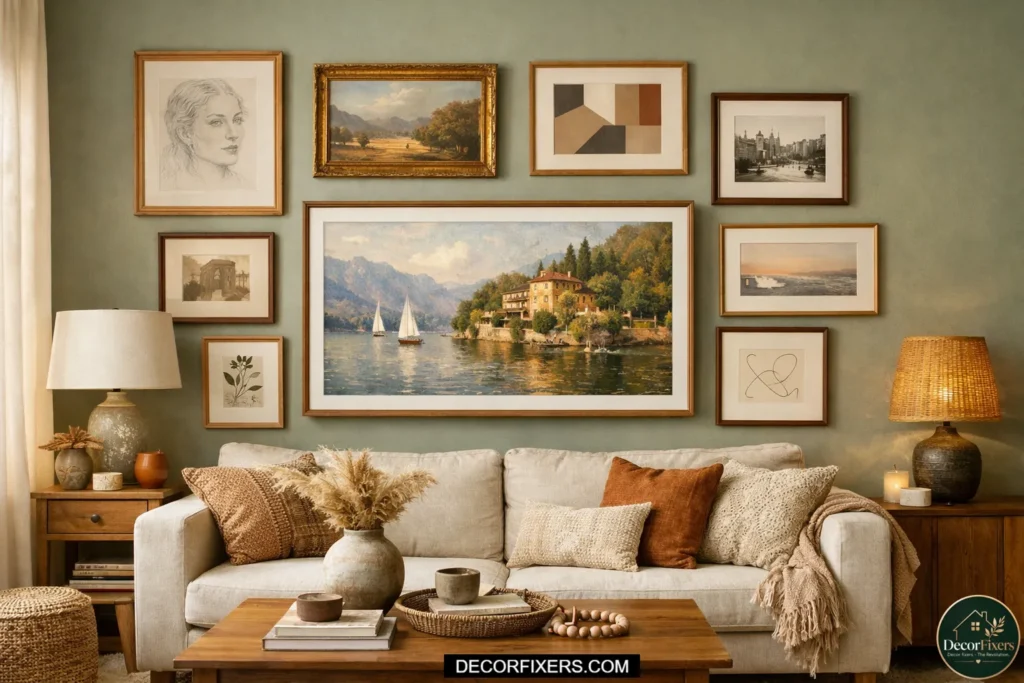
The Samsung The Frame TV is built for exactly this scenario. When it’s off, it displays artwork ‘ paintings, photography, custom images ‘ in a matte finish that genuinely reads as framed art to anyone who doesn’t know better. Mount it within a curated gallery wall arrangement, and the television simply disappears into the composition.
This design works best with a warm-toned wall color (think terracotta, warm cream, or sage) and matching gallery frames at a consistent depth. The Frame comes in sizes from 32 to 85 inches and starts around $800 at the 55-inch mark. The ‘Art Mode’ subscription (around $5/month) unlocks thousands of artworks, though you can also upload your own images for free.
Quick Comparison:
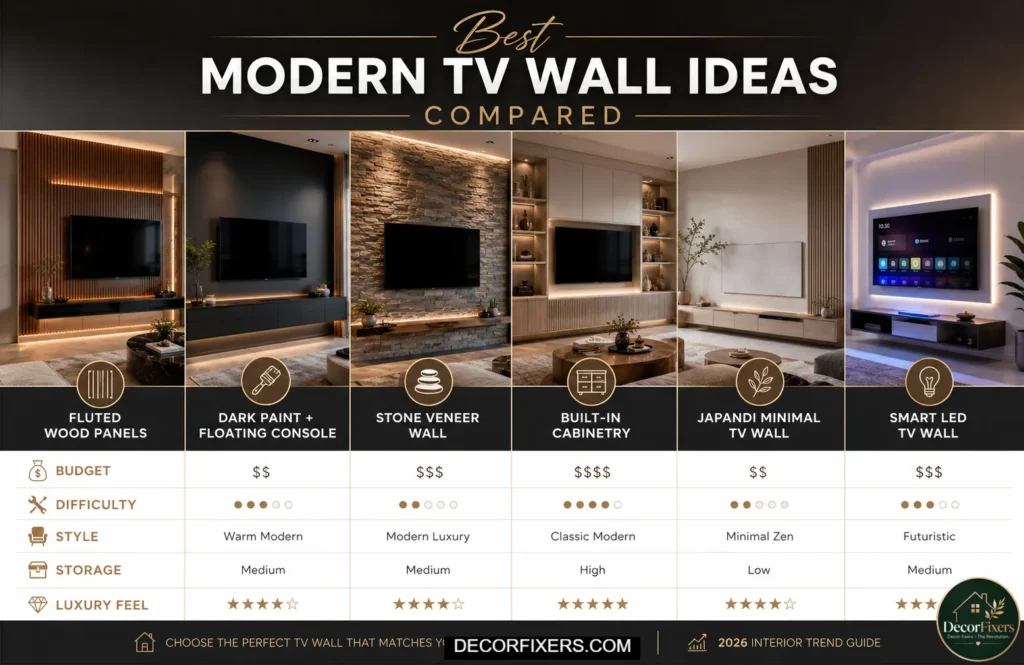
| Option | Best For | Key Benefit | Limitation |
| Dark Paint + BESTÅ Console | Budget / Renters | Under $500, reversible | No structural storage |
| Fluted Panel + LED Backlight | Mid-budget DIY | High visual impact | Requires panel installation |
| IKEA Built-In Hack | Mid-budget, DIY-skilled | Custom look, affordable | Time-intensive planning |
| Manufactured Stone Veneer | Mid-to-high budget | Luxury feel, durable | Needs cement board prep |
| Custom Carpenter Built-In | High budget | Fully tailored result | $4,000–$9,000+ cost |
6. Shiplap TV Wall With Rustic Floating Shelves
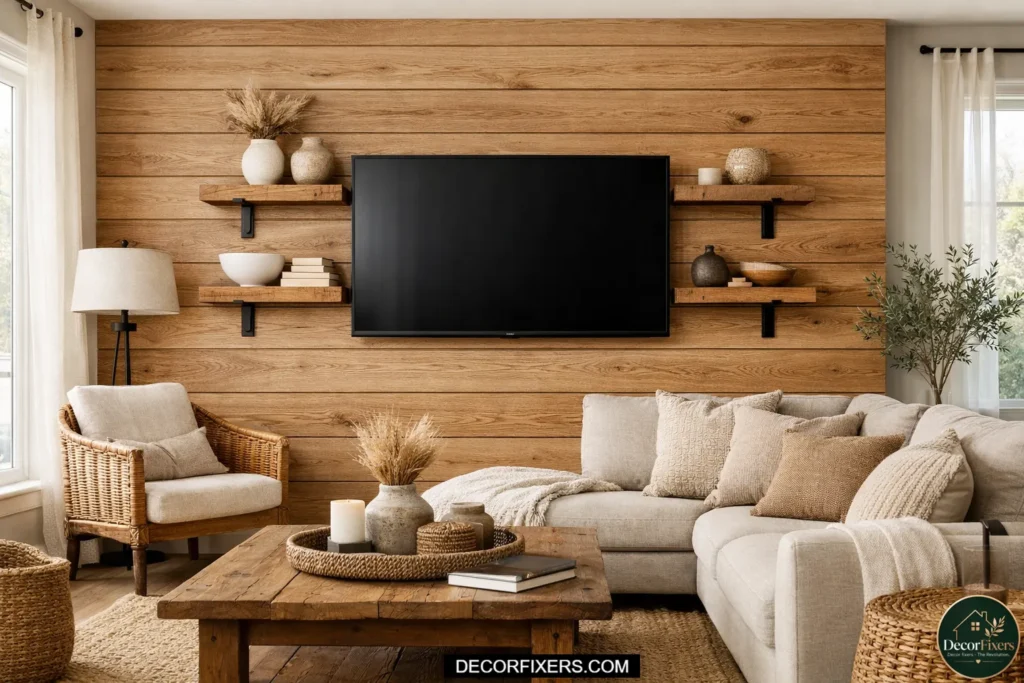
Shiplap remains one of the most DIY-friendly wall treatments available, and when paired with the right accessories, it reads as intentional farmhouse-modern rather than dated rustic. The horizontal lines add width to a room, the natural wood texture introduces warmth, and the tongue-and-groove installation is genuinely achievable for a competent first-time DIYer on a weekend.
Materials for a standard 12-foot shiplap wall run $300–$700, depending on your choice between real pine, MDF tongue-and-groove, or pre-finished PVC (the latter being the most moisture-stable option). Add brackets and shelves for another $150–$350.
7. TV Wall With Integrated Electric Fireplace
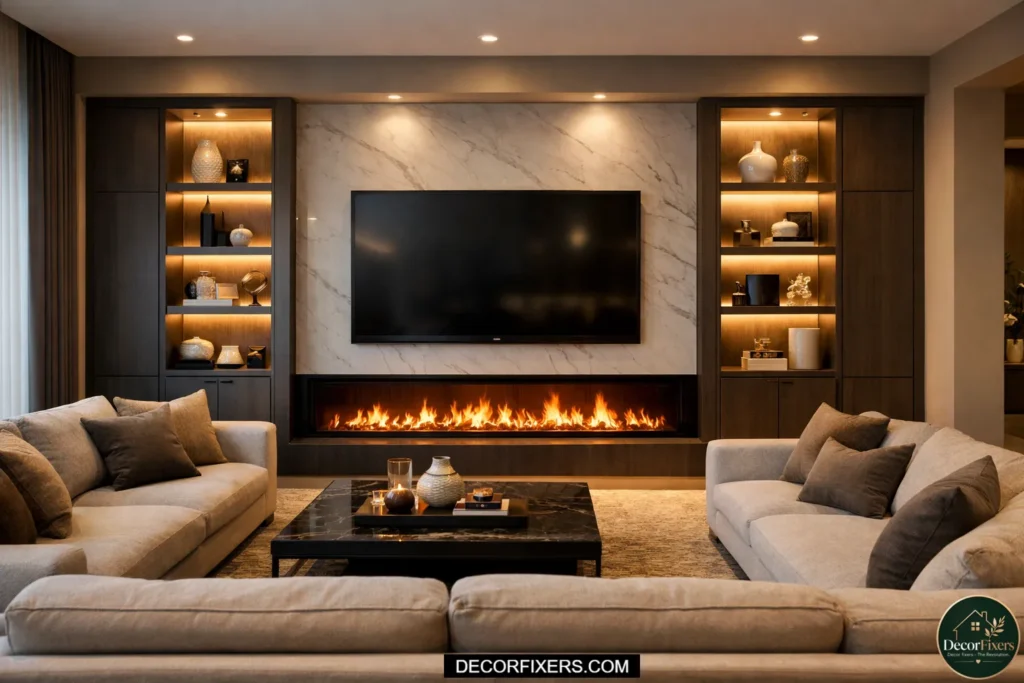
Combining a TV and electric fireplace in one feature wall is the single upgrade that transforms a living room from comfortable to genuinely impressive. The composition becomes a full architectural moment: fire below, screen above, symmetrical cabinetry flanking both sides. It’s also one of the most-searched design configurations online right now.
Electric fireplaces don’t require venting, making them safe for integration into interior walls. Common insert widths run 50–72 inches. Budget-friendly units from Amazon start around $200–$400, while mid-range options from Touchstone or Dimplex run $600–$1,200 and offer more realistic flame effects with adjustable heat settings. The wall build-out ‘ framing, MDF paneling, finishing ‘ typically adds $800–$2,000 to the project.
One thing most people get wrong: they mount the TV too high when placing it above a fireplace. The center of the screen should sit at approximately 42 inches from the floor, roughly at eye level. Above a standard 12-inch fireplace mantel, this means the TV’s bottom edge lands at about 30–34 inches. Use a downward-tilting mount to compensate for any additional height.
How to Build a Basic TV Feature Wall: Quick Steps
- Plan your layout. Decide on TV height (center at 42 inches from the floor), panel width, and storage needs.
- Prep the wall: patch holes, sand flat, and install cement board if using stone or tile.
- Install a recessed outlet. Hire an electrician to place a power point directly behind the TV location.
- Mount your panels or apply wall treatment from the center outward.
- Install the TV mount, then hang the TV.
- Add LED strips behind the TV and route cables through the wall or via a cable raceway.
8. Geometric 3D Wall Panels Behind the TV
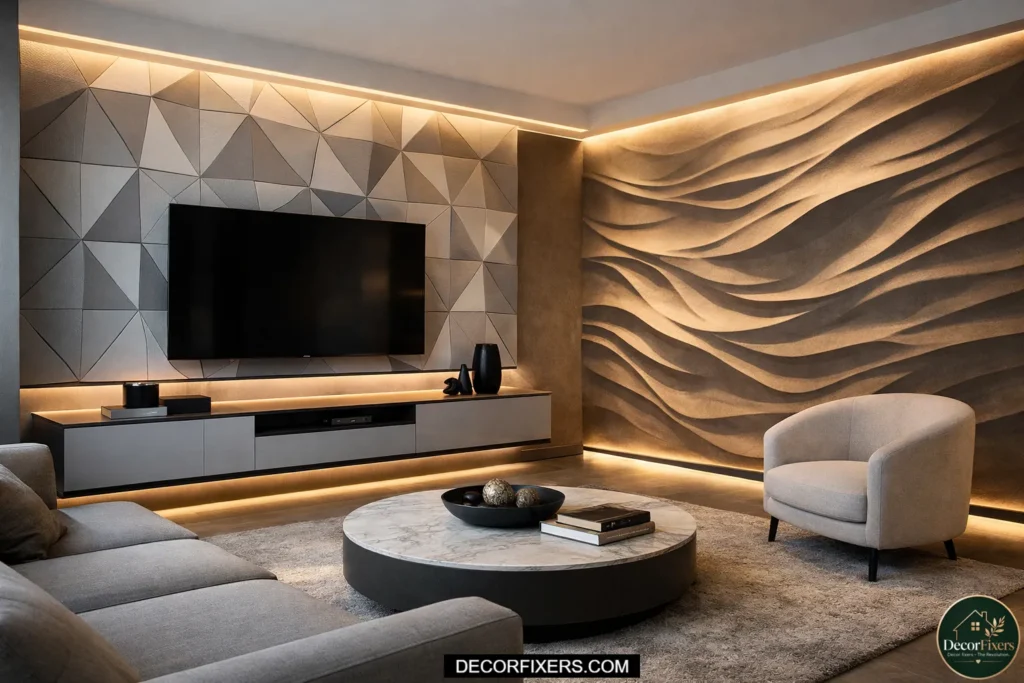
Three-dimensional wall panels add depth and texture without committing to heavy materials. In 2026, the most popular choices are wave-pattern and diamond-grid PVC or gypsum 3D panels ‘ lightweight, paintable, and surprisingly easy to install with construction adhesive. They photograph exceptionally well and add shadow play that changes throughout the day as natural light shifts.
PVC 3D panels run $2–$5 per square foot; gypsum versions are slightly more expensive at $4–$8. A full feature wall behind a 65-inch TV covering roughly 60–80 square feet of panel area costs $120–$640 in materials. Paint them the same color as the surrounding walls for a subtle, tonal effect, or go bold with a contrasting shade to let the geometry really pop.
9. Marble or Marble-Look Porcelain Slab TV Wall
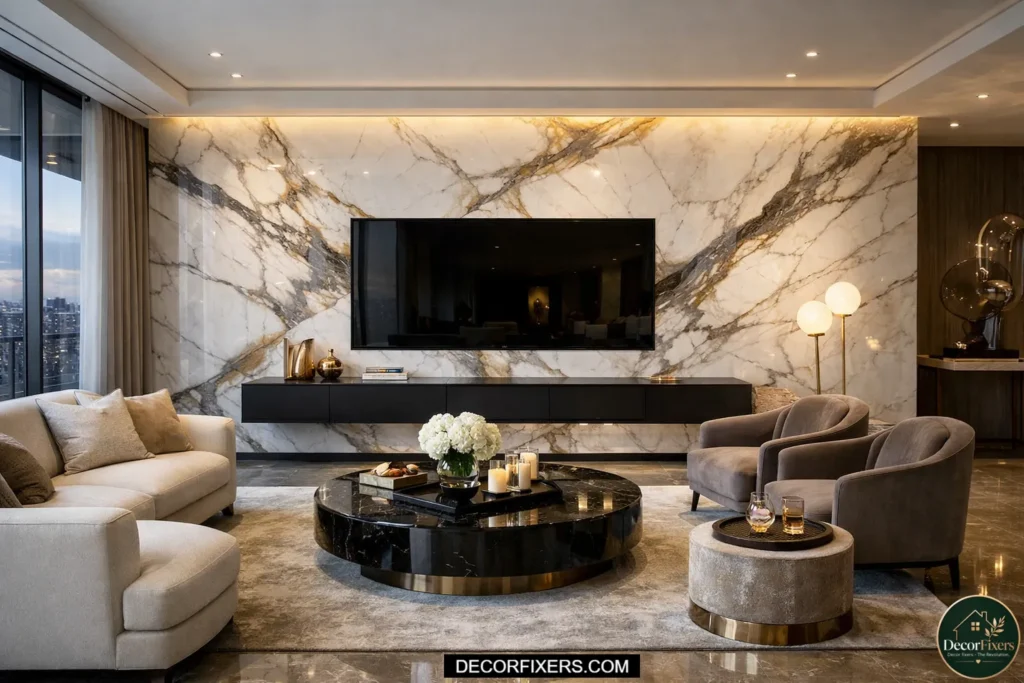
A single slab of Calacatta marble or a large-format marble-look porcelain tile makes a TV feature wall look genuinely expensive with almost no additional styling required. The veining does all the work. This approach is common in luxury interiors but increasingly accessible thanks to high-quality porcelain slabs that cost a fraction of natural stone.
Large-format porcelain slabs (24×48 inches or larger) in marble patterns run $4–$12 per square foot at tile distributors and big-box stores. Natural Calacatta marble starts at $15–$40 per square foot and climbs quickly for premium book-matched slabs. Both require professional installation with epoxy adhesive. Don’t skip this step, as standard thinset isn’t adequate for heavy slabs on a vertical surface.
Or maybe I should say it this way: the porcelain route isn’t a compromise. For a TV feature wall (where you’re not walking on it or exposing it to high impact), a quality large-format porcelain is virtually indistinguishable from natural stone at typical viewing distances.
10. Recessed TV Niche With Flush-Mounted Look
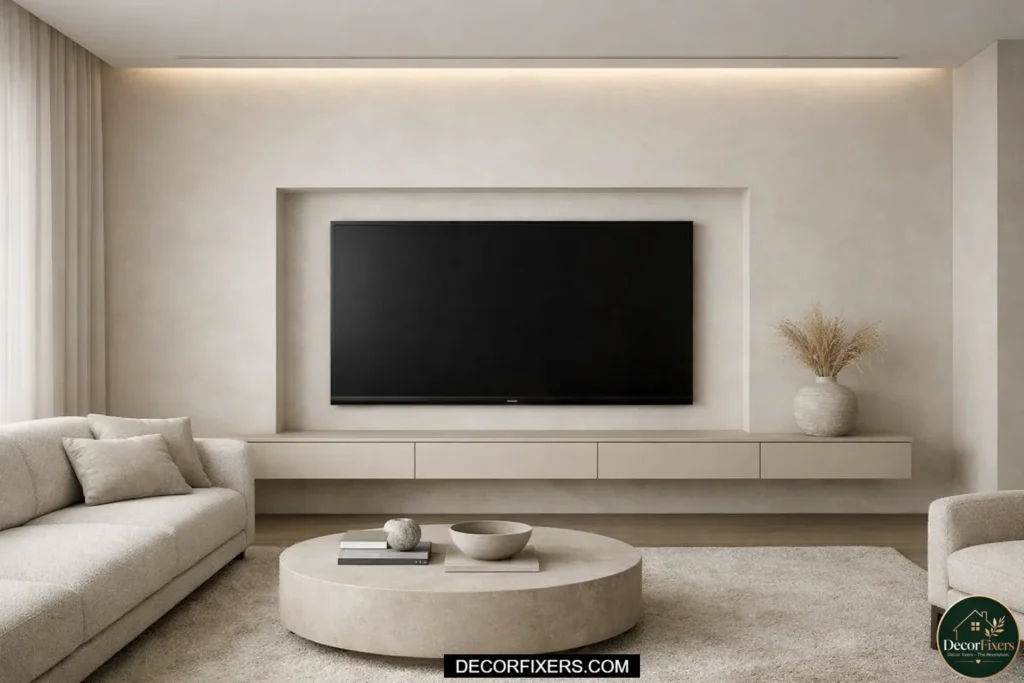
Recessing the TV into the wall so its face sits flush with the surface is the cleanest possible solution, no gap between screen and wall, no visible mount hardware, no shadow around the perimeter. It looks architectural, almost museum-like, and makes even an average room feel purposefully designed.
This approach requires framing a niche in the wall, typically by doubling up studs and creating a box recess of 3–4 inches (enough for most slim TV profiles). It’s a moderate carpentry project, not a beginner DIY, and typically costs $500–$1,500 in labor when hired out, plus whatever finish material you apply inside the niche. The payoff is a TV wall that looks genuinely custom.
11. Industrial-Style TV Wall With Black Metal and Exposed Brick
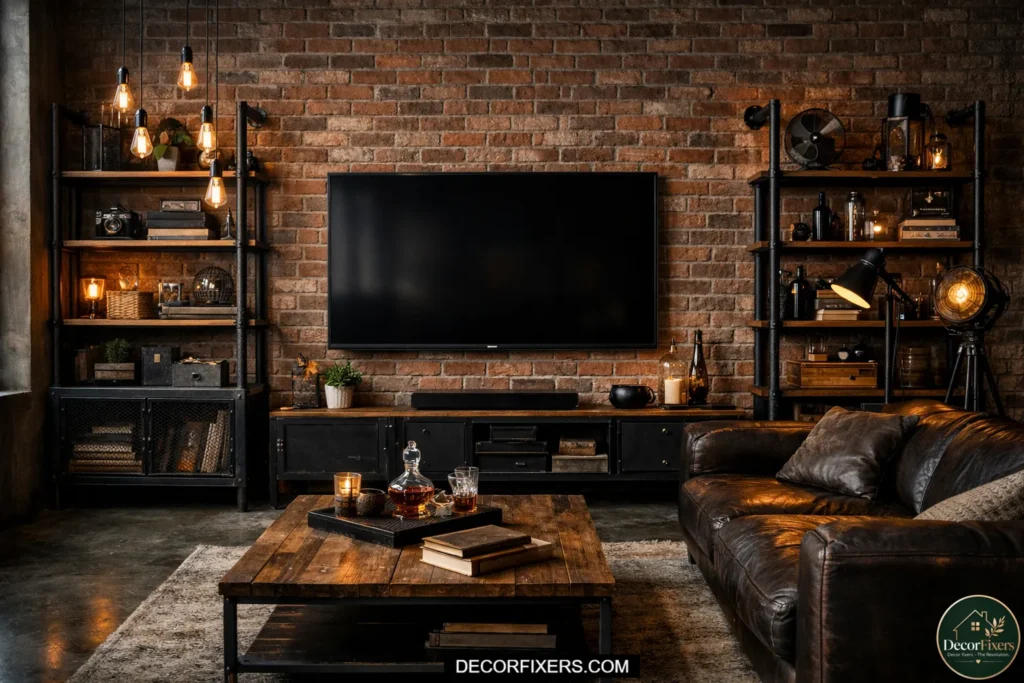
The industrial aesthetic has evolved in 2026, it’s less raw warehouse and more curated urban loft. Think exposed brick behind the TV (real or faux brick panels), matte black open shelving on iron pipes, and a dark-framed TV mount that reads as a design element rather than hardware. The result has genuine character.
Faux brick panels (thin veneer on a mesh backing) run $2–$8 per square foot installed and bypass the complexity of real masonry entirely. Pair them with black powder-coated pipe shelving from a supplier like Kalalou or Etsy metalwork shops for $150–$400 per shelf setup. The overall wall can come together for $700–$2,000, depending on how many linear feet of shelving you include.
12. Limewash Paint TV Feature Wall
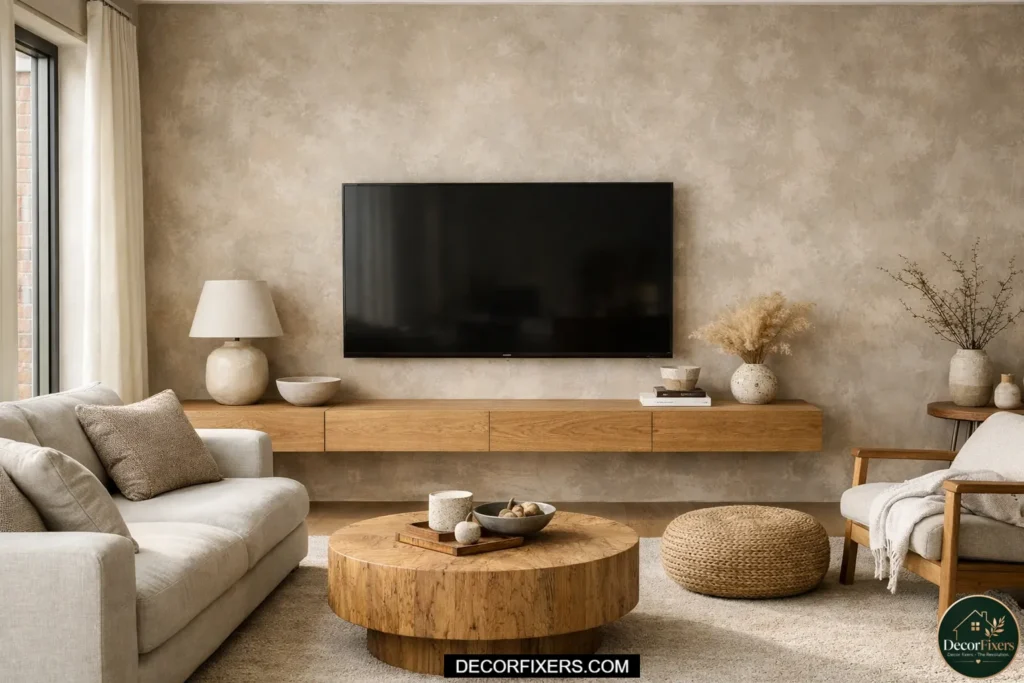
Limewash paint is the texture trend that’s been building for two years and shows no sign of peaking. Unlike regular paint, limewash creates a mottled, aged plaster-like effect with depth and movement that changes under different lighting conditions. It’s applied by brush in overlapping strokes and dries to a soft, organic finish.
Brands like Portola Paints Classico Limewash and Rome Finish by Behr are widely available and run $60–$130 per gallon, covering about 250–400 square feet depending on application technique. A single feature wall costs $80–$200 in materials plus a few hours of your time. Limewash pairs beautifully with natural wood consoles and linen sofas; it adds age and warmth without any structural work.
13. Full-Wall Dark Bookcase With TV Center Panel
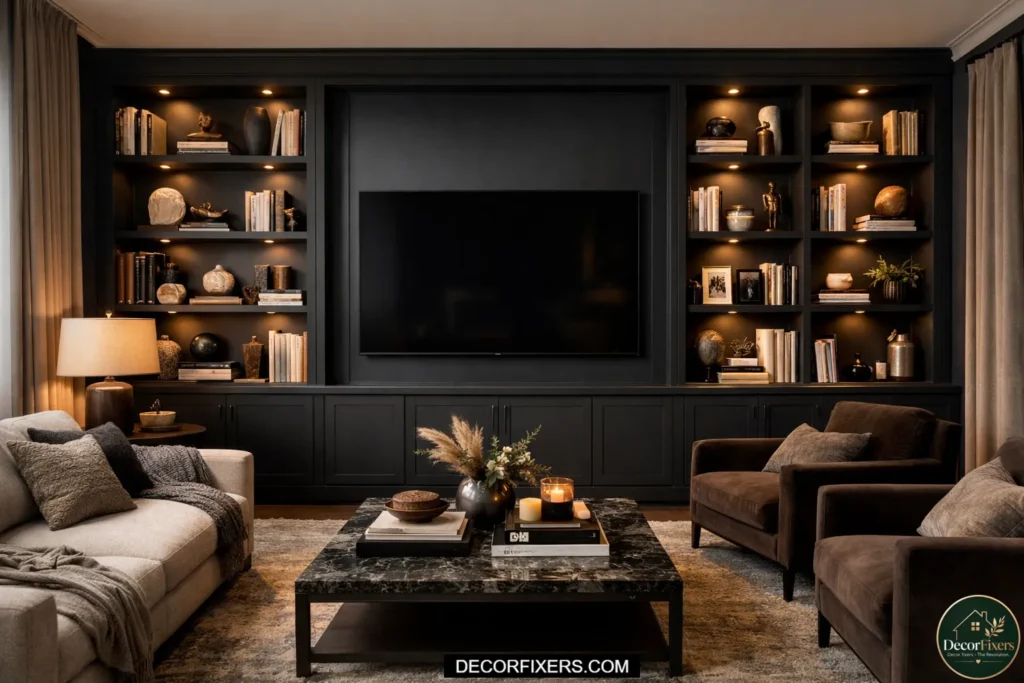
A wall of dark bookcases flanking a centered TV is one of the most timeless and livable designs in residential interiors. The books, objects, and plants create visual richness; the TV anchors the composition; the cabinetry provides real-world storage. When painted in a deep tone, ‘ charcoal, navy, dark forest green, ‘ the entire wall reads as a single architectural element.
The most accessible execution is painting existing IKEA BILLY bookcases in a deep color, adding crown moulding at the top to run them to the ceiling, and inserting cabinet door fronts from a supplier like Semihandmade or Reform (IKEA-compatible aftermarket doors). The full wall transformation ‘ six to eight BILLY units with custom fronts and crown ‘ typically costs $1,800–$4,000 and takes a weekend to install.
14. Japandi-Inspired TV Wall With Natural Materials and Negative Space
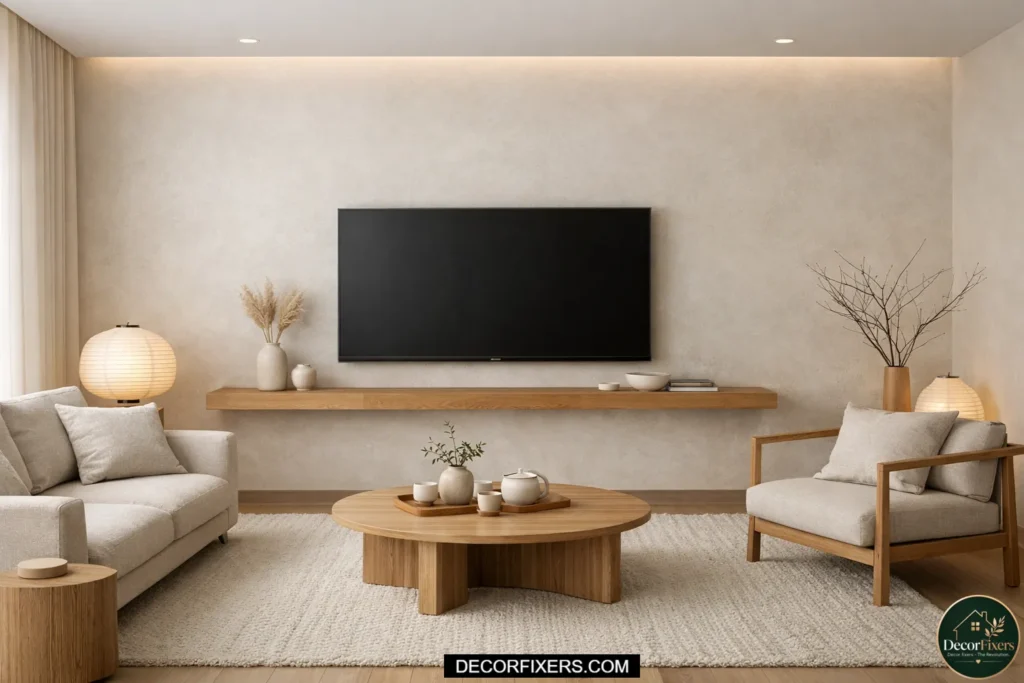
Japandi, ‘ the hybrid of Japanese minimalism and Scandinavian functionality, ‘ is arguably the most sophisticated TV wall aesthetic right now. It relies on restraint: a single horizontal floating shelf below the TV, a textured plaster or limewash wall, perhaps a single ceramic or wooden sculptural object on each side. Nothing more.
The negative space is intentional. Most people’s instinct is to fill every inch of a TV wall with more shelves, more decor, more lighting. Japandi says the opposite: what you remove matters as much as what you keep. Natural materials (bamboo, rattan, raw linen) and a muted palette of warm whites, warm grays, and sandy tones complete the look. Total material cost is often the lowest of any approach on this list, under $300 if you already own a floating shelf.
15. Paneled TV Wall With Integrated Soundbar Shelf
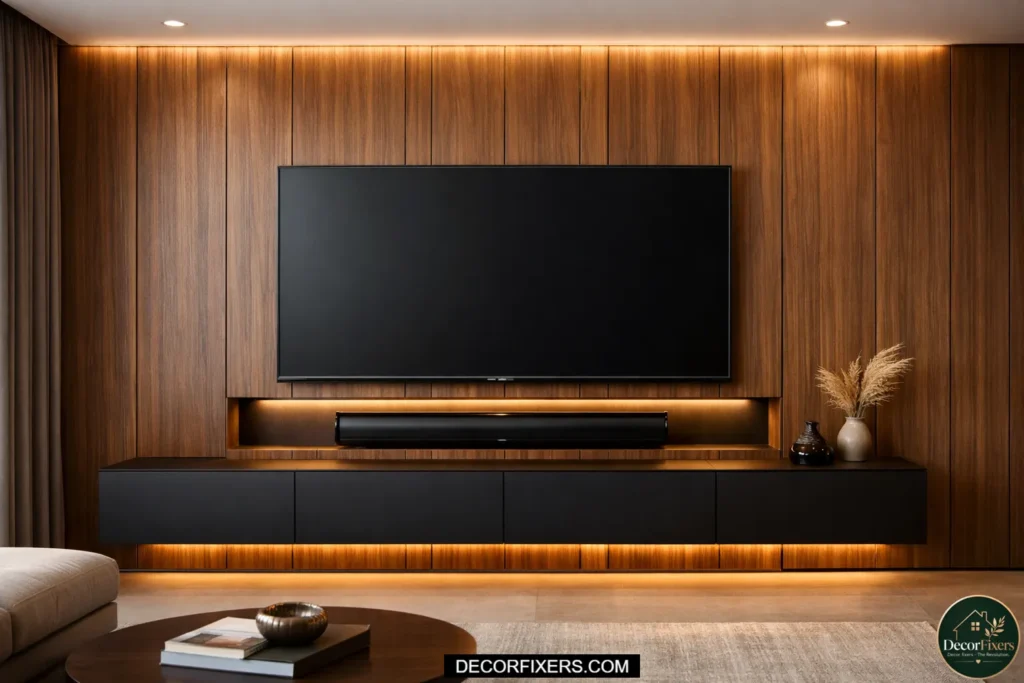
Most soundbar installations look like an afterthought, a horizontal bar sitting awkwardly on a console table or resting on the edge of the TV mount. A well-designed TV feature wall integrates the soundbar into its own dedicated shelf or niche, typically centered below the TV at the same depth as the panel system.
This requires planning during the design phase: a soundbar niche is typically 4–6 inches deep, 36–48 inches wide, and 5–6 inches tall. Built into an MDF panel wall, it adds $200–$500 to the cost but eliminates the soundbar placement problem permanently. Some homeowners also run HDMI and optical cables through the wall cavity during this step, which eliminates any visible wiring entirely.
16. Micro-Cement TV Feature Wall
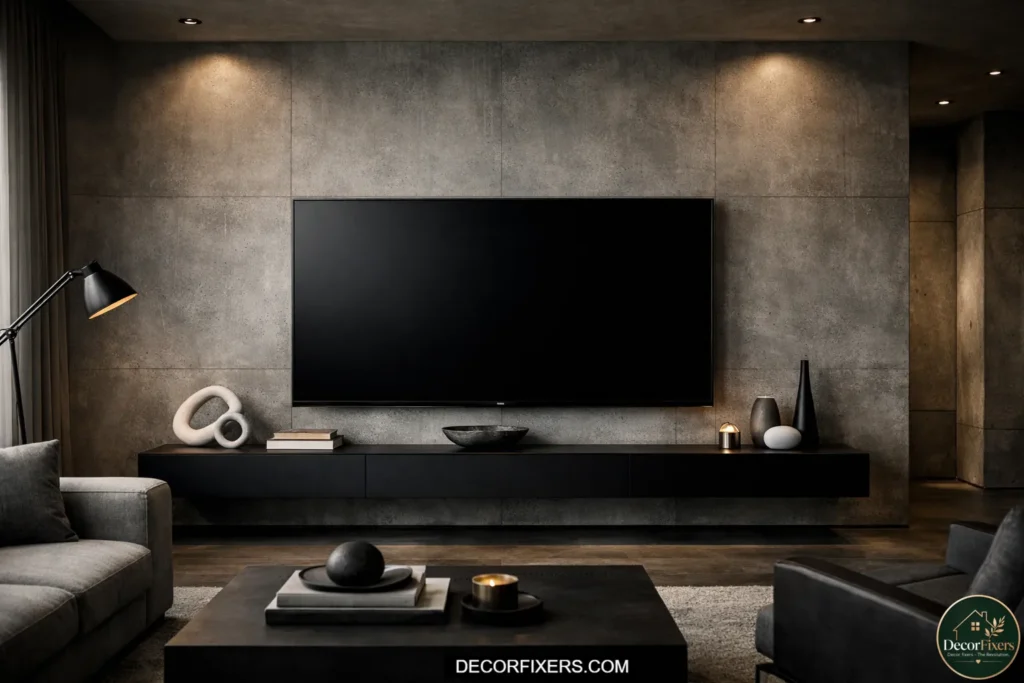
Micro-cement (also called microtopping or concrete overlay) is a skim-coat finish applied over existing drywall to create a seamless, matte concrete-look surface. It reads as poured concrete but weighs a fraction and applies to vertical surfaces without structural concerns. In 2026, it’s one of the most requested finishes among design-forward homeowners who want an industrial edge without the industrial bulk.
Professional micro-cement application on a single feature wall costs $1,500–$3,500, depending on size and finish quality. There are DIY micro-cement kits on the market ($150–$400), but they require very careful surface prep and application. The learning curve is steep, and mistakes are difficult to fix. For first-timers, a test patch on a utility wall first is strongly recommended before committing to the TV wall.
17. Grasscloth or Textured Wallpaper TV Accent Wall
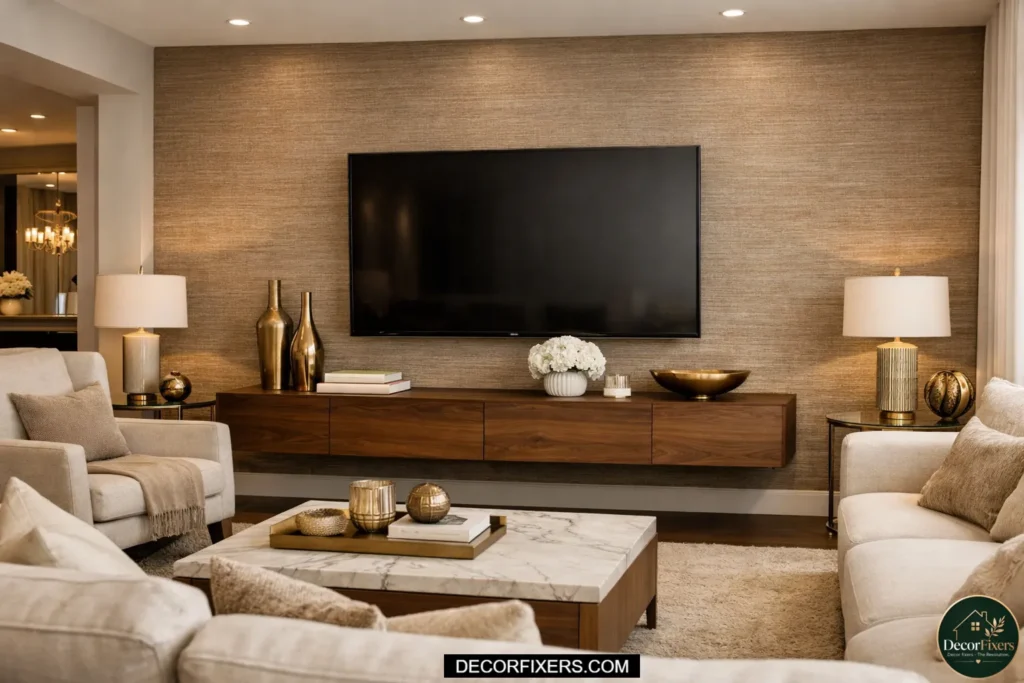
Wallpaper has had a full cultural rehabilitation, and it deserves its place on this list. Textured wallpapers, especially grasscloth, linen-weave, and embossed geometric patterns, add a tactile, layered quality to a TV wall that paint simply can’t replicate. They also photograph beautifully and work across a range of aesthetics from coastal to maximalist to transitional.
Grasscloth runs $4–$12 per square foot in material cost. A standard accent wall (roughly 12 feet wide by 9 feet tall) requires 10–15 double rolls at $50–$200 per roll, depending on quality. Professional installation adds $300–$700. The total investment for a high-quality grasscloth feature wall lands at $800–$2,500, and it’s one of the more reversible options since wallpaper can be stripped without damaging drywall when properly hung.
18. Dark Stained Plywood or OSB Panel Wall (Budget Statement)
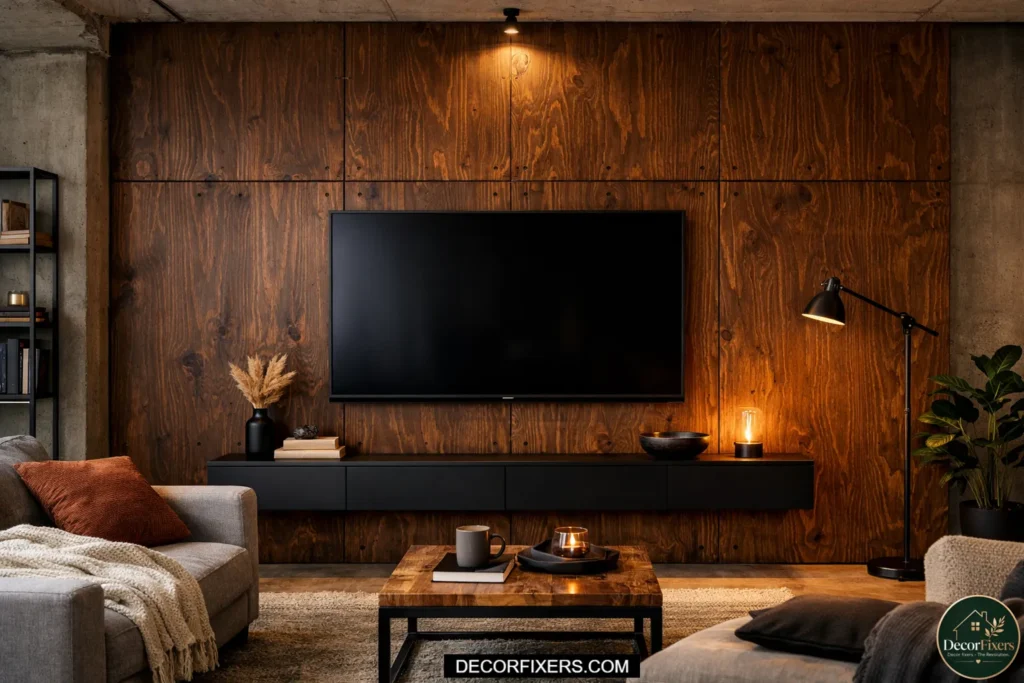
Here’s an opinion some designers would push back on, but I’ll give you the reason: plywood and OSB, properly finished, can look genuinely beautiful in a TV wall context. Dark-stained plywood panels with a matte sealer have a raw, tactile quality that no manufactured panel product fully replicates. They’re also dramatically cheaper than almost any alternative.
A sheet of 3/4-inch Baltic birch plywood costs $70–$120 at most lumberyards. A full 12-foot TV wall requires five to six sheets plus stain, sealer, and adhesive ‘ total materials budget of $500–$900. The caveat: the execution quality matters enormously. Crisp reveals between panels, consistent stain application, and flush mounting make the difference between ‘intentional design’ and ‘unfinished basement.’ Take your time on the prep.
19. Paneling With Integrated Plant Niches and Biophilic Elements
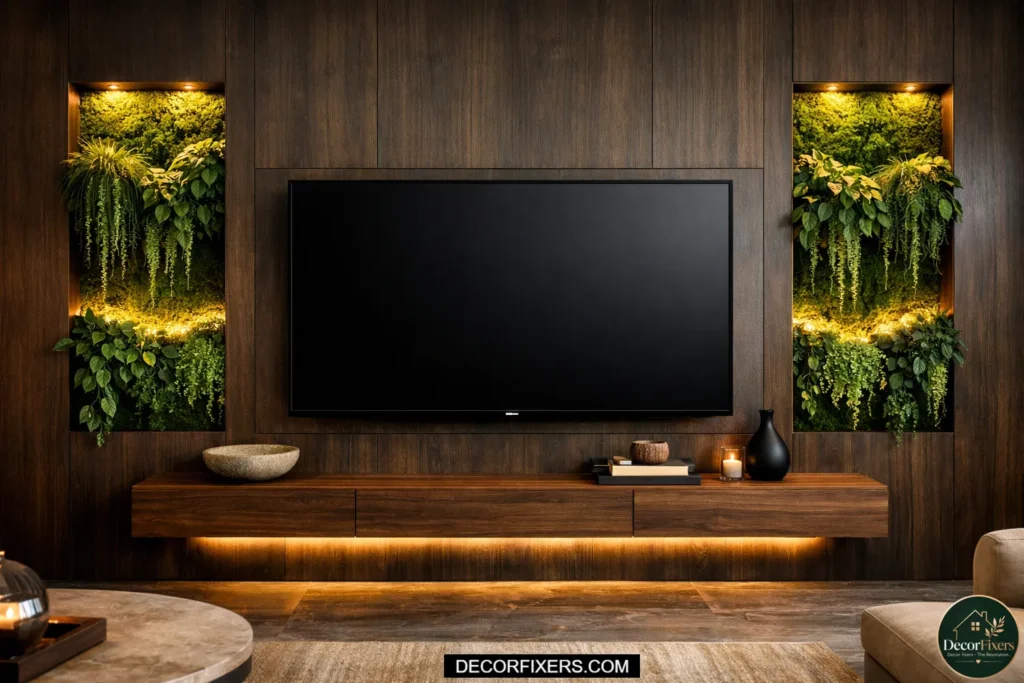
Biophilic design, ‘ integrating natural elements into the built environment, ‘ is no longer just an architectural buzzword. It’s showing up in TV feature walls in the form of built-in planting niches: small recessed pockets within the panel system that hold trailing pathos, ferns, or preserved moss panels. The contrast of lush green against a dark panel wall is striking.
The structural approach is the same as a standard MDF panel wall, with the addition of recessed boxes framed out at planting locations. Each niche should be at least 6 inches deep, 10–14 inches wide, and positioned to receive indirect light. For low-maintenance execution, preserved moss panels (no watering, no light requirements) cost $30–$120 per panel and mount directly onto any surface.
20. Board-and-Batten TV Wall With Mid-Century Console
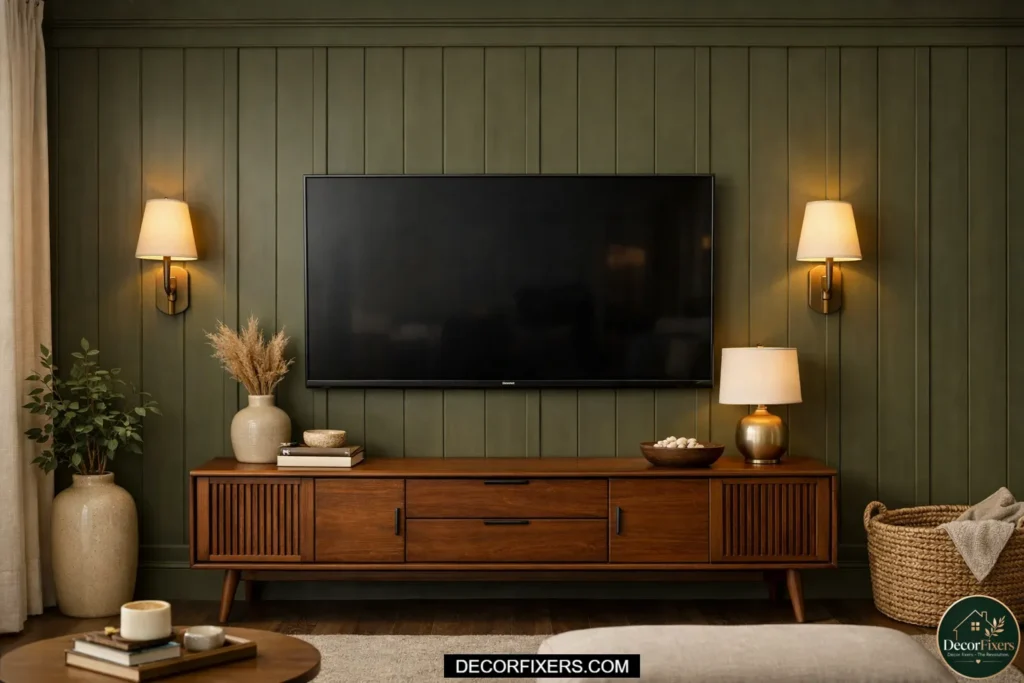
Board-and-batten is the vertical-stripe wall treatment that bridges traditional and contemporary design effortlessly. Baseboards run horizontally, top and bottom; vertical battens at regular intervals (typically 12–18 inches apart) create a grid that adds depth and architectural interest to a flat drywall surface. Paint the whole assembly in a single color for maximum impact.
This is one of the most beginner-friendly TV wall options available. MDF baseboard and batten strips cost $1.50–$4.00 per linear foot; a standard TV wall uses $200–$500 in materials plus a couple of gallons of paint. Pair with a tapered-leg mid-century walnut console for a retro-modern combination that’s genuinely timeless. The contrast between the structured wall geometry and the organic wood grain of the console is what makes the composition work.
21. Concealed Sliding Panel TV Cover (Hidden TV Design)
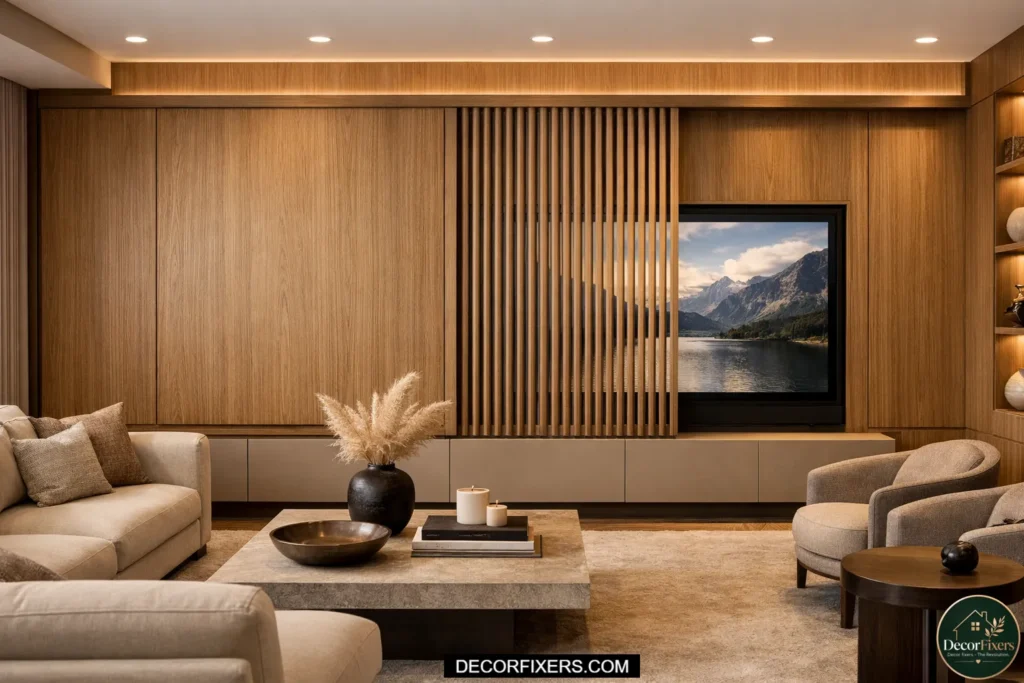
Some homeowners don’t want the TV visible at all when it’s off. A sliding panel system, ‘ motorized or manual, ‘ conceals the screen behind a decorative panel that slides aside when viewing begins. The panel itself can be artwork, a mirror, a chalkboard surface, or a fabric-wrapped acoustic panel. It’s the most dramatically ‘invisible’ TV solution available.
Custom motorized panel systems run $2,000–$6,000+ installed by a specialist. Manual sliding barn-door style panels are far more accessible. A quality barn door track kit runs $150–$400, and the panel itself can be any material you choose. This design works best in rooms where the TV is used occasionally rather than daily, since opening and closing a large panel frequently becomes its own ergonomic consideration.
22. Asymmetrical TV Wall With Off-Center Composition
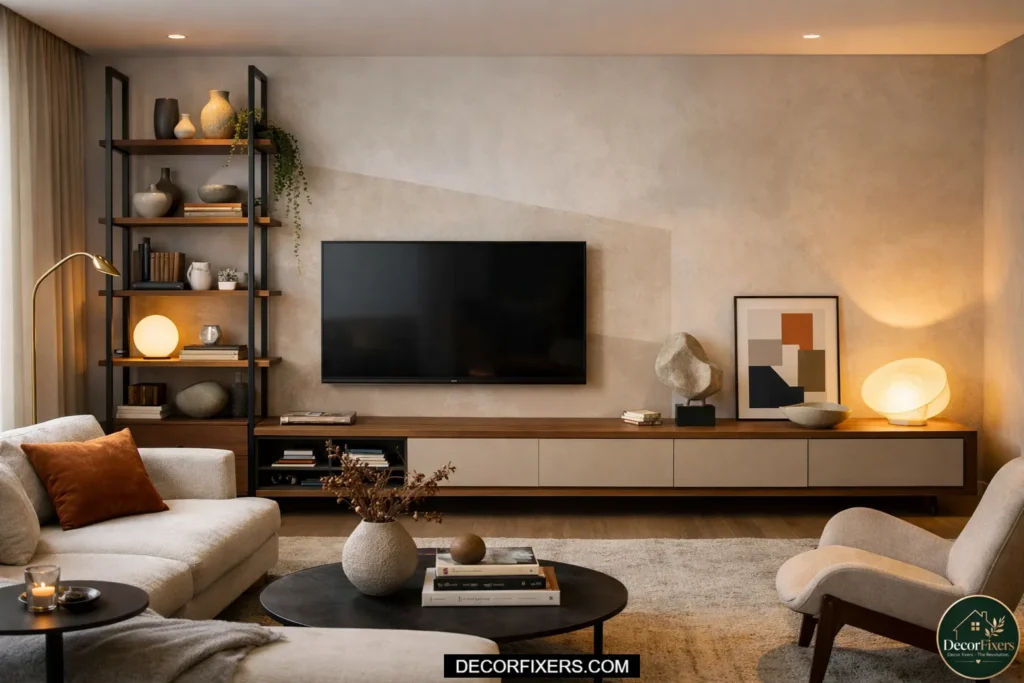
Most TV walls are perfectly symmetrical, matching cabinets on each side, the TV centered, and balanced shelving. Asymmetrical designs break this convention deliberately, shifting the TV slightly off-center and using different storage elements on each side of the composition. The result feels more like collected, evolved furniture than a pre-planned unit.
The risk with asymmetry is that it can look accidental rather than intentional. The key is to balance visual weight rather than physical symmetry: a tall, narrow bookcase on one side can balance a wider, lower cabinet on the other if the overall composition has a natural equilibrium. Sketch or use a free room-planning tool (like IKEA’s planning app) before committing to proportions.
23. Velvet or Fabric-Paneled TV Wall
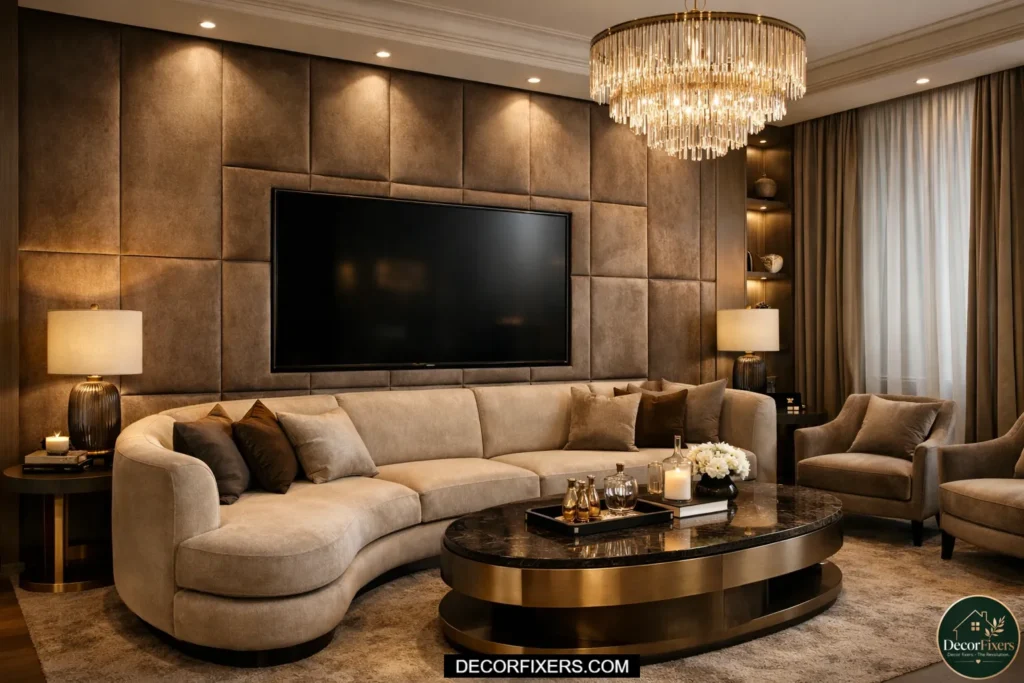
Upholstered walls aren’t just for bedrooms or home theaters. A fabric-paneled TV feature wall ‘ stretched linen, velvet, or a performance fabric over a thin batting and plywood substrate ‘ adds an unexpected layer of acoustic absorption alongside its visual softness. In rooms where hard surfaces create echo problems, this is a functional upgrade disguised as a design choice.
Professional upholstered wall panels run $30–$70 per square foot installed. DIY versions using fabric, 3/4-inch plywood, 1-inch foam batting, and a staple gun are genuinely achievable at $8–$15 per square foot in materials. Choose a fabric with at least 50,000 double-rub abrasion resistance for longevity; most upholstery-grade fabrics meet this threshold; drapery or decorative fabrics often don’t.
24. Floor-to-Ceiling Grid-Style Open Shelving TV Wall
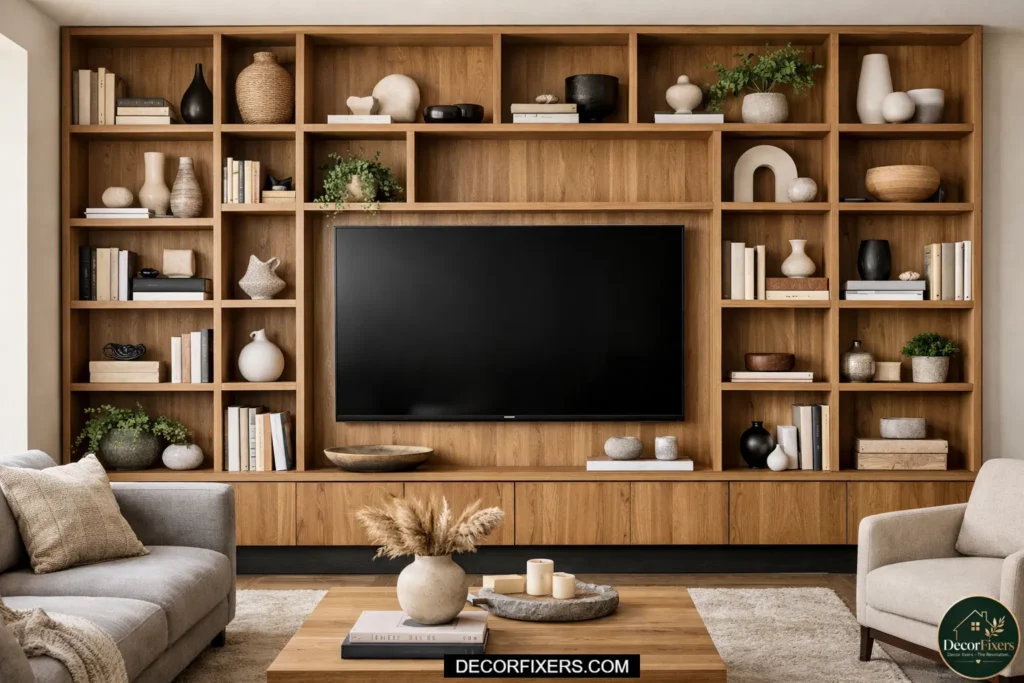
Open grid shelving systems ‘ modular cubes or rectangular compartments arranged in a grid pattern across the entire wall create a graphic, architectural backdrop for the TV that’s deeply functional at the same time. The grid accommodates books, plants, objects, baskets, and media equipment in a single integrated system. Nothing is hidden, so the styling has to be intentional.
The IKEA KALLAX system is the most accessible grid shelving option, starting at $60 per 2×2 unit. Stringing multiple KALLAX units together with consistent finishing (wall mounting, uniform paint color, cabinet inserts for closed storage zones) creates a convincingly custom look for $800–$2,500, depending on wall coverage. The TV can sit on a separate floating shelf centered within the grid, or you can leave a TV-sized gap in the arrangement.
25. Smart TV Wall With Motorized Mount and Voice-Controlled LED Ecosystem
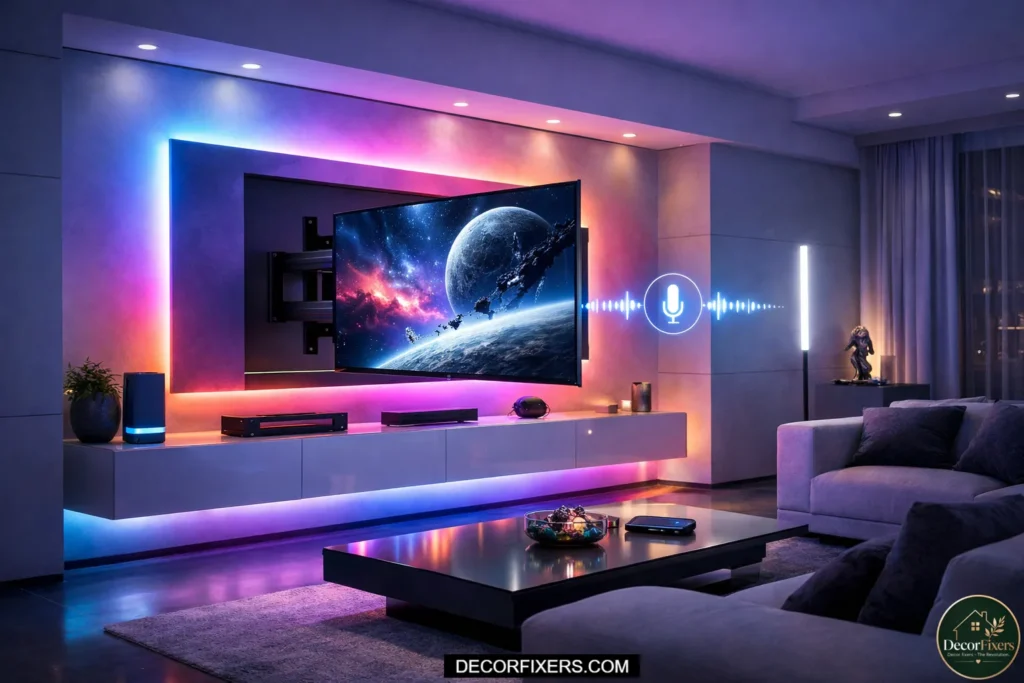
The final idea on this list isn’t about a particular material or visual style- it’s about the technology layer underneath whatever surface treatment you choose. A motorized full-motion TV mount ($200–$600) that tilts, swivels, and extends at the touch of a button transforms how you use a mounted TV. Pair it with Govee smart LED strips synced to Google Home or Amazon Alexa, and you have a TV wall that responds to voice commands for lighting scenes.
This approach works best when the technology is planned into the wall from the beginning: recessed outlets for the mount mechanism, in-wall cable management from the TV position to the media console below, and LED strips with controllers that integrate into your existing smart home ecosystem. The hardware adds $400–$1,000 to any wall build but dramatically increases day-to-day usability.
TV Feature Wall Materials and Cost Guide
Understanding material options is essential before you commit to a design direction. Here’s the honest breakdown:
| Material | DIY Cost / sq ft | Pro Installed / sq ft | Difficulty |
| Dark paint (2 coats) | $0.25–$0.60 | $1.50–$3.00 | Beginner |
| Board & batten (MDF) | $1.50–$4.00 | $6–$12 | Beginner-Moderate |
| Fluted MDF panels | $3–$8 | $12–$22 | Moderate |
| Limewash / micro-cement | $2–$6 | $15–$35 | Moderate–Advanced |
| Manufactured stone veneer | $8–$15 | $18–$30 | Advanced |
| Large-format porcelain slab | $4–$12 | $20–$40 | Advanced (pro rec.) |
| 3D PVC wall panels | $2–$5 | $8–$15 | Beginner-Moderate |
Why This Renovation Category Is Booming in 2026
The data backs up what we’re seeing in design spaces online. According to the 2026 U.S. Houzz & Home Study, surveying more than 20,000 U.S. homeowners, 27% of renovating homeowners purchased new TVs during their renovation in 2025, and the median renovation spend held at $20,000, signaling that living room upgrades are a mainstream priority, not a luxury decision.
The same study shows that millennials now account for 10% of renovating homeowners (up from 8% the year prior), with Gen Z growing from 0.2% to 0.5% ‘ these are the same audiences driving TV wall content across YouTube and Instagram. The TV wall isn’t a trend; it’s a renovation staple for a new generation of homeowners who want their spaces to reflect the intentional design they see in their digital feeds.
DIY vs. Contractor TV Wall Build: Which Approach Is Right?
DIY is better suited for painted accent walls, board-and-batten, panel systems, and IKEA hacks ‘ projects where mistakes are recoverable, and no specialized trades are involved. Contractor builds are better when your design involves electrical work (recessed outlets), stone installation, micro-cement application, or structural framing for a fireplace niche. The key difference: any project involving electrical, structural changes, or materials requiring curing and sealing warrants professional involvement for both safety and finish quality.
CONCLUSION:
After going through every one of these 25 ideas with clients and in my own research, the design that keeps delivering ‘regardless of budget or aesthetic ‘is the fluted panel wall with LED bias lighting and a recessed power outlet. Not because it’s the flashiest. But it consistently turns a plain wall into something that makes people stop when they walk into the room.
That said, the dark paint plus BESTÅ console approach is the honest MVP for anyone who wants a real upgrade without a renovation budget. Spend $400, spend a weekend, and your TV wall will look more considered than 80% of the living rooms in any neighborhood.
The biggest mistake I see people make isn’t choosing the wrong material. It’s skipping the cable management step. You can have the most beautiful panel system in the world, and a dangling HDMI cable will make it look unfinished. Start there ‘seriously, book the electrician first ‘and build the rest of the wall around that decision.
FAQs:
Q: What’s the best TV wall material for a budget under $500?
A: Dark paint on the accent wall combined with an IKEA BESTÅ floating console and Govee LED bias lighting behind the TV gives you a polished feature wall for $350–$500 total, and it’s fully reversible for renters.
Q: How do I hide TV cables on a feature wall?
A: The cleanest method is having an electrician install a recessed outlet behind the TV mount location ($150–$300). For a cable-free look without electrical work, an in-wall cable management kit (like the Power bridge solution, $30–$80) routes cables through the drywall cavity between an existing outlet and the TV position.
Q: Should I mount my TV above the fireplace?
A: Technically yes, but with a tilting mount that angles the screen slightly downward to compensate for the elevated position. The center of the screen should land at approximately 42 inches from the floor; above a standard fireplace, this means using a mount that tilts 10–15 degrees downward.
Q: Why does my TV wall look cheap even after I added panels?
A: Visible cables are almost always the culprit, followed by a TV mount that leaves too large a gap between the screen and the wall surface. Address both ‘recessed outlet plus a low-profile fixed mount ‘before adding any decorative elements.
Q: When should I hire a professional for a TV feature wall?
A: Any time the project involves moving or adding electrical outlets, installing heavy stone veneer, applying micro-cement, or building a fireplace niche. These are the four areas where DIY mistakes are either dangerous, structurally problematic, or visually unrecoverable without starting over.

Creator of DecorFixers, sharing practical home and interior ideas focused on real-life usability, simple design improvements, and budget-friendly solutions.
1 thought on “25 Stunning TV Wall Designs for Modern Living Rooms (2026 Guide)”