

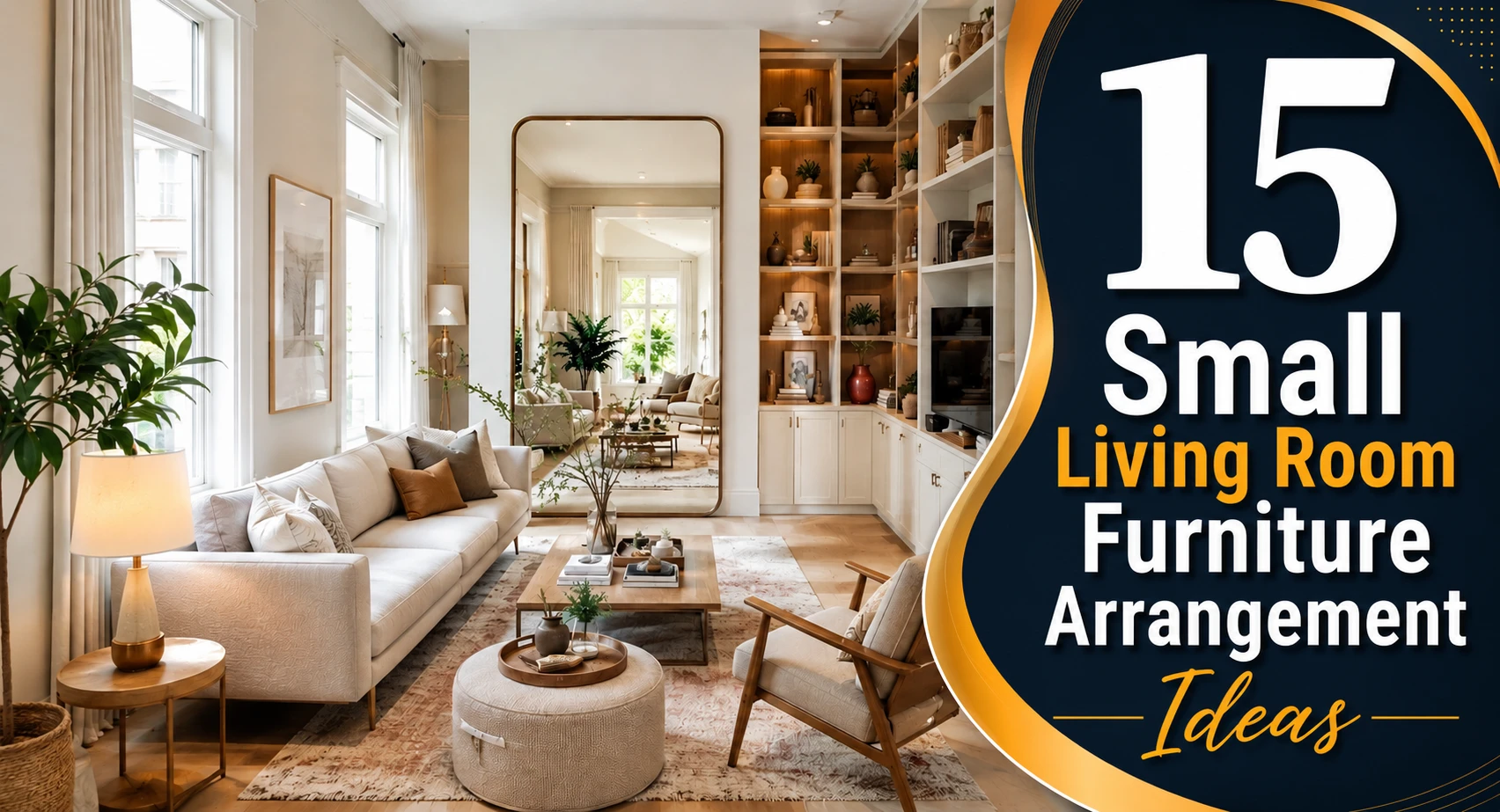
I remember standing in the doorway of my first apartment living room, measuring tape in hand, staring at 11 feet of wall and wondering how on earth a sofa, a TV, and any life were going to fit in there. I pushed the furniture against every wall. Twice. It still felt like a storage unit, not a place to breathe.
Here’s the thing: the problem was never the furniture size. It was the living room layout, and I had no idea there were actual, tested configurations that work for small living rooms. Not vague tips like “use lighter colors.” Real numbered arrangements with real measurements.
So I did the research, tested the principles, and put together 15 small living room furniture arrangement ideas that genuinely work, mapped to specific room shapes, with the spacing numbers you actually need.
What is a Small Living Room Furniture Arrangement?
Small living room furniture arrangement refers to the strategic placement of sofas, chairs, tables, and storage in rooms typically under 200 square feet, using defined pathways, a single focal point, and zone-based groupings to maximise function and visual space. The goal is not to fit more in; it’s to create a layout that feels intentional and comfortable.
1. The Classic Sofa-Facing-Focal-Point Layout
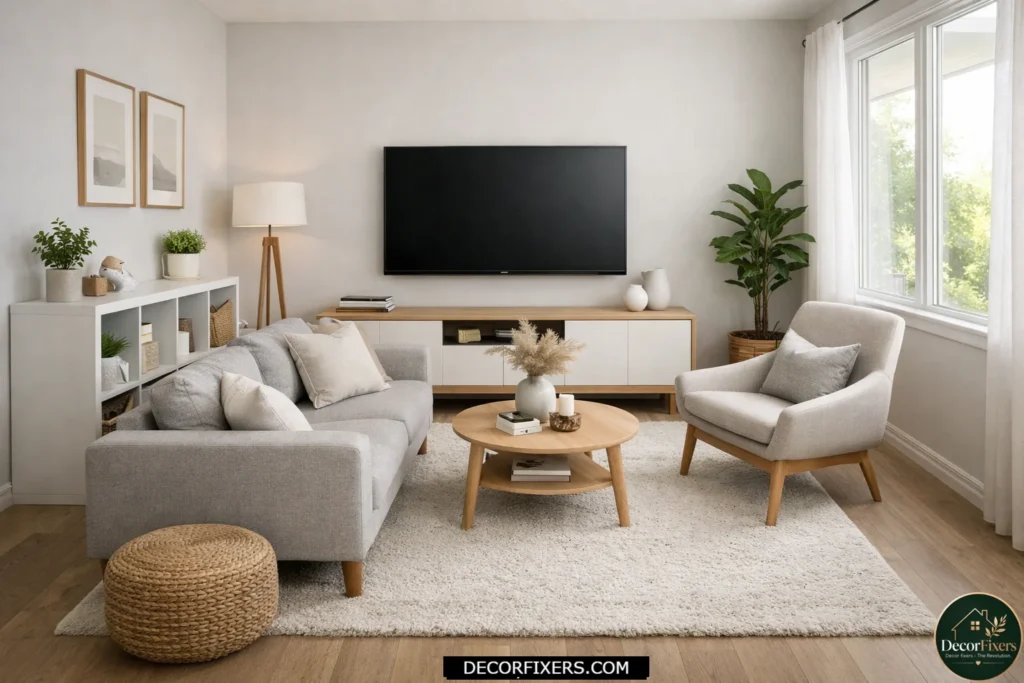
This is the most reliable starting point for any small living room. Place your sofa directly across from the room’s focal point, typically the TV wall or fireplace, at a distance of 7 to 10 feet. Add one accent chair at a 30-degree angle to complete the conversation triangle.
Keep a minimum 36-inch walkway clear between the sofa edge and any side wall or coffee table edge. This single measurement is what separates a layout that works from one that feels like an obstacle course. The IKEA KALLAX shelving unit works perfectly as an anchor piece on the side wall here, adding storage without blocking the sightline.
2. The Floating Furniture Cluster for Square Rooms
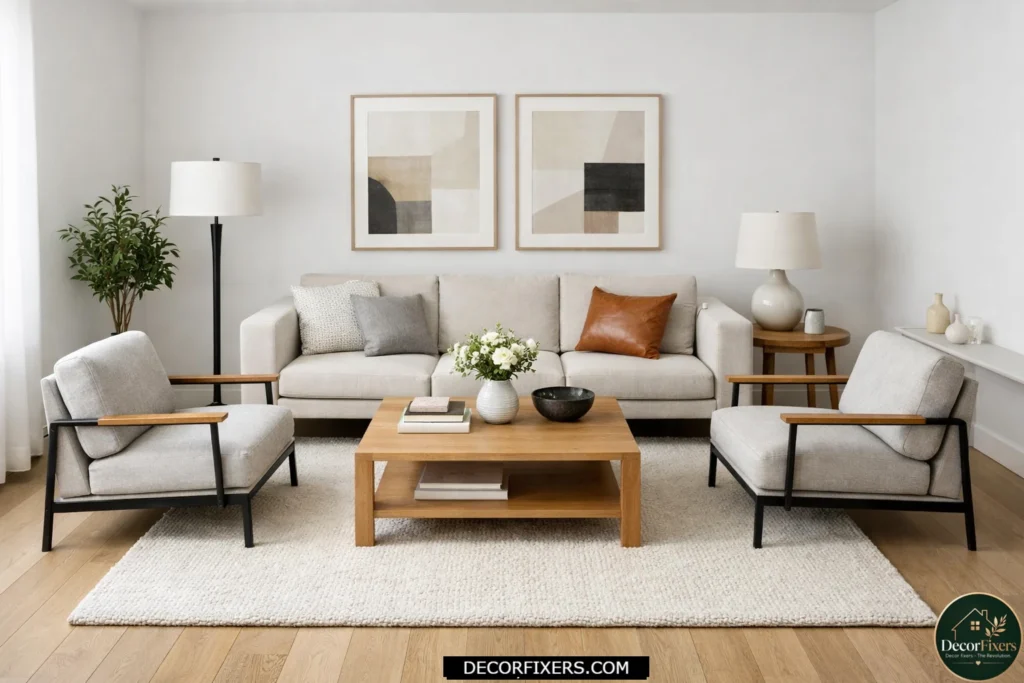
Square rooms are notoriously awkward. Pushing everything against the walls, the instinct almost everyone has, actually makes a square room feel smaller, not larger. Pull all your furniture 12 to 18 inches away from every wall instead.
Group the sofa, coffee table, and one or two chairs into a central island. Leave a walkway around the perimeter. This layout creates visual breathing room and, counterintuitively, makes the room feel bigger. Or maybe I should say it this way: the walls become the frame, not the furniture holders.
3. The L-Shaped Sectional for Open-Plan Apartments
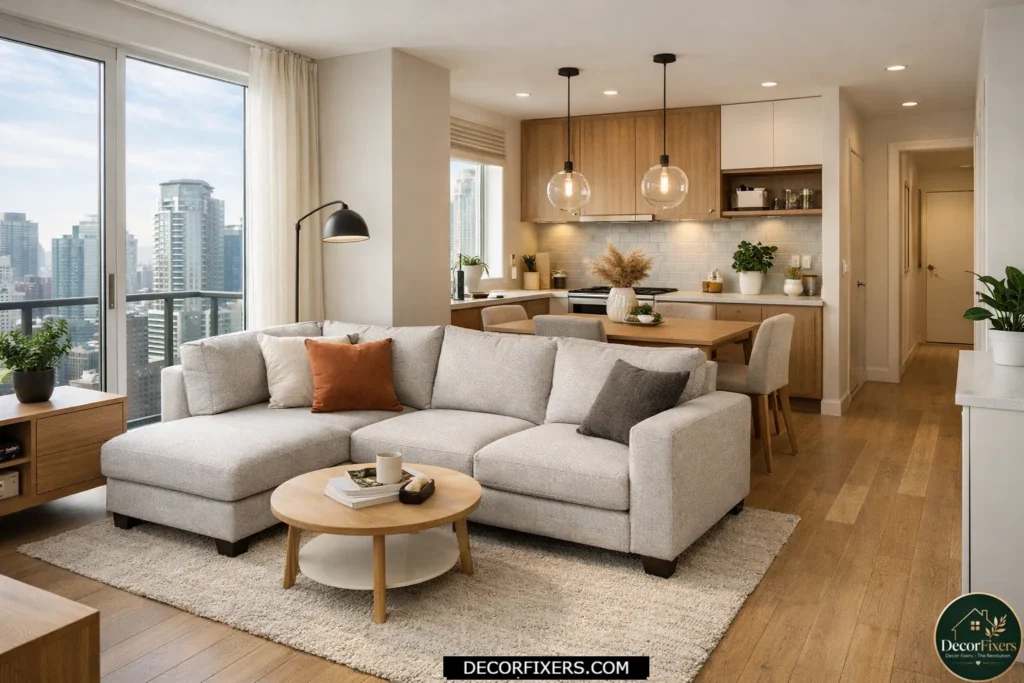
If you live in an open-concept studio or one-bedroom, the L-shaped sectional is your best spatial tool. It defines your living zone without needing walls. Orient the long side of the L parallel to the longest wall, and the short side pointing into the room to act as a soft room divider.
Look for compact sectionals in the 84 to 96-inch range. The Pottery Barn PB Comfort Square Arm Sofa at 84 inches is a widely recommended fit for rooms under 150 square feet. Americans living in one-bedroom apartments average just 735 square feet total (RentCafe, 2025), so every inch of the sectional’s footprint matters.
4. The Angled Sofa Layout for Boxy Rooms
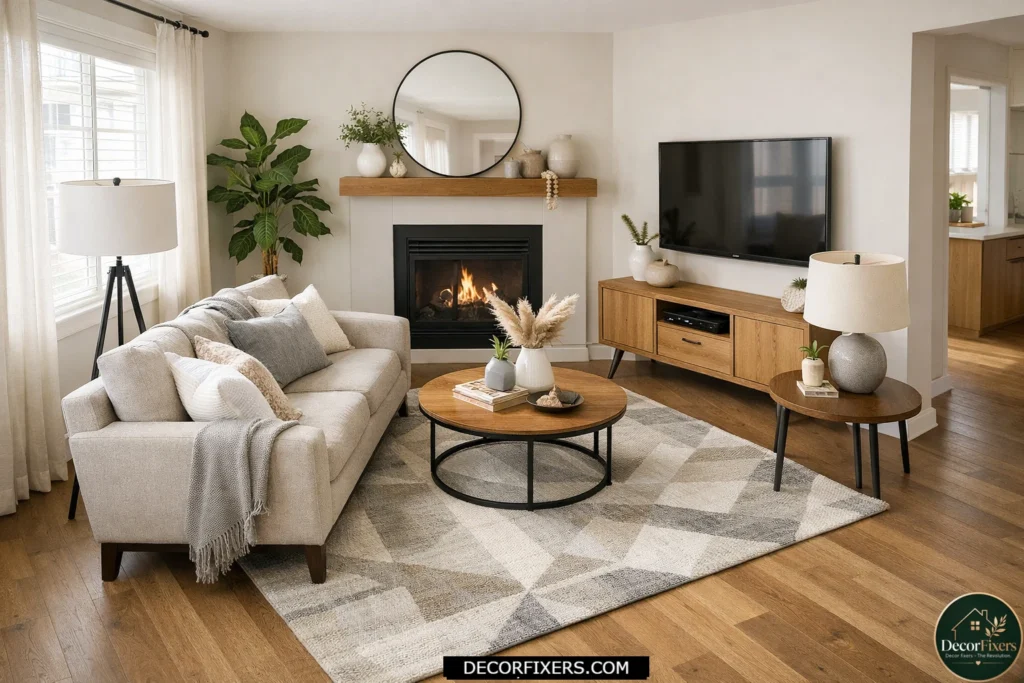
Turning the sofa 45 degrees to face a corner focal point breaks the boxy rigidity of a square room and adds visual depth instantly. The diagonal line draws the eye across the widest part of the room, making it feel wider than it is.
Anchor the angled arrangement with a rug placed at the same angle. One caveat worth acknowledging: you lose the corner space behind the sofa. If storage matters to you, this trade-off may not be worth it. But if your primary goal is visual openness, it delivers.
5. The Single Sofa + Storage Ottoman for Studios Under 400 Sq. Ft
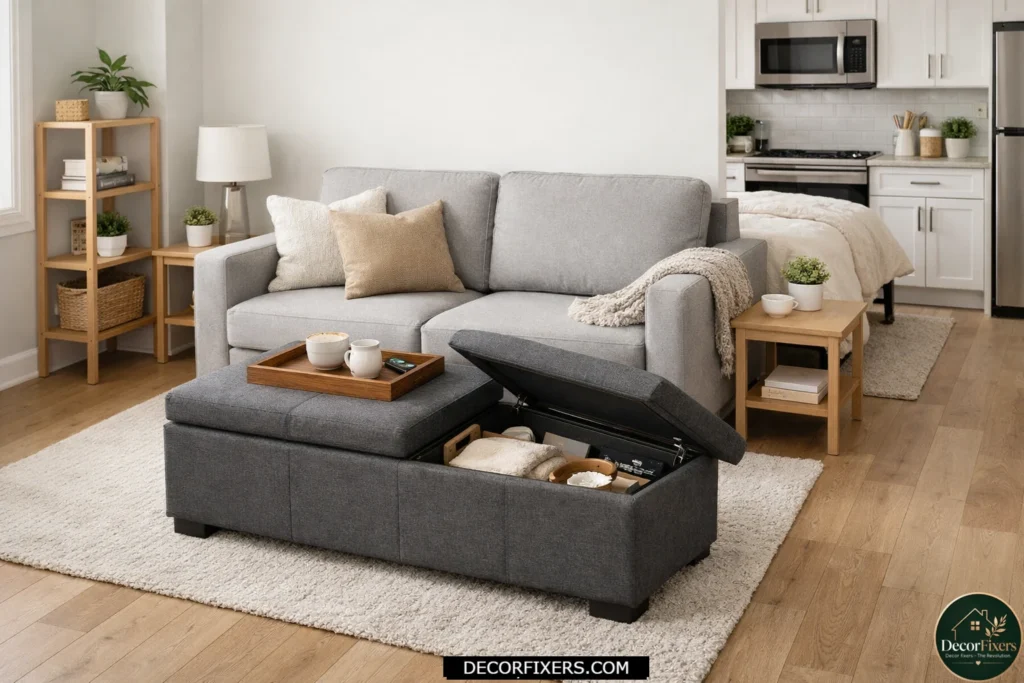
One large, well-placed sofa plus a storage ottoman does more work in a micro-living space than three mismatched pieces ever could. This is the layout for studio apartments where the living room, bedroom, and sometimes dining area share one room.
The ottoman replaces the coffee table (saves 12 to 18 inches of clearance), provides hidden storage, and doubles as extra seating when you have guests. If you’re decorating on a limited budget, this is where to start, and you can find practical ideas tailored to tight spending in our guide on Budget Living Room Decor Ideas, which covers affordable pieces that don’t sacrifice style.
6. The Symmetrical Two-Chair Layout (No Sofa)
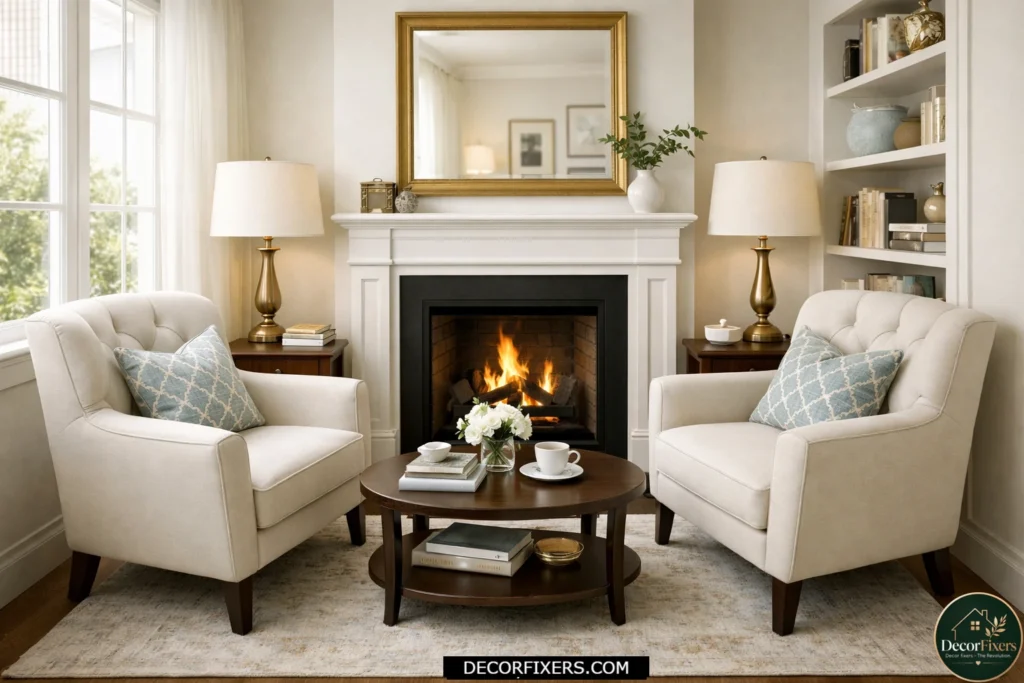
Most guides won’t tell you to skip the sofa entirely. But in rooms under 120 square feet, two matching armchairs placed opposite each other across a small coffee table often work better. You get a genuine conversation zone, equal visual weight, and a full 12 to 15 inches of extra floor space.
This layout works especially well for readers and remote workers who use the living room solo most of the time. I’ve seen this approach transform studios that felt suffocating into rooms that feel curated. Face both chairs toward a single focal point, a fireplace, a bookshelf wall, or a window view, and use matching side lamps to anchor the symmetry.
7. The Narrow Rectangle Layout for Long Thin Rooms
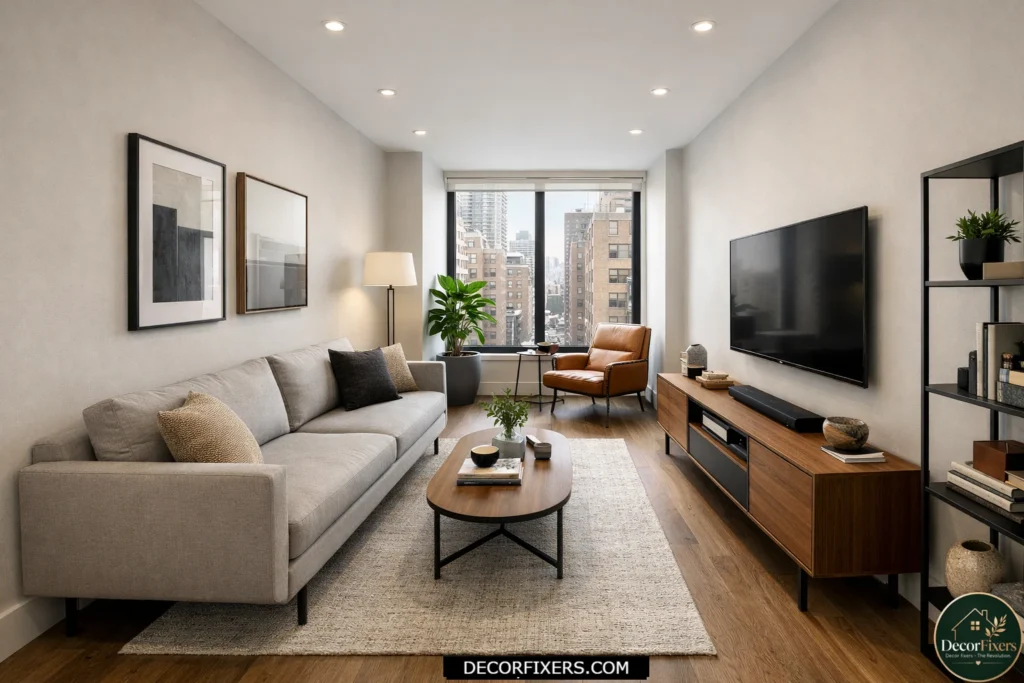
Long, narrow living rooms, common in urban row houses and older UK and US apartment conversions, need a different strategy than square rooms. The mistake here is placing the sofa on the short wall and a TV on the opposite short wall, which forces everyone to sit in a tunnel.
Instead, place the sofa along the long wall and float it 10 to 12 inches out from that wall. Position the TV on the opposite long wall. This turns the narrow dimension into depth and the long dimension into width, a simple perceptual trick that opens the room visually. Residents in cities like London, New York, and Sydney, where terraced and converted apartments are widespread, will find this layout immediately applicable to their floor plans.
Before You Move a Single Piece of Furniture
Most people skip this and regret it. Measure your room’s exact length, width, and ceiling height before anything else. Note every door swing, window position, and electrical outlet; these are fixed constraints your layout must work around, not afterthoughts.
Write down your single primary activity: TV-watching, hosting, reading, or working. That one answer determines which of the 15 layouts below is your starting point. A room with one honest purpose always outperforms a room trying to do everything.
The best layout for a small living room starts with identifying one clear focal point, a TV wall, a fireplace, or a window, and arranging your main seating to face it. According to interior design guidelines, seating should be no further than 8 feet apart, and main walkways should stay at least 30 to 36 inches wide for comfortable movement.
Quick Comparison:
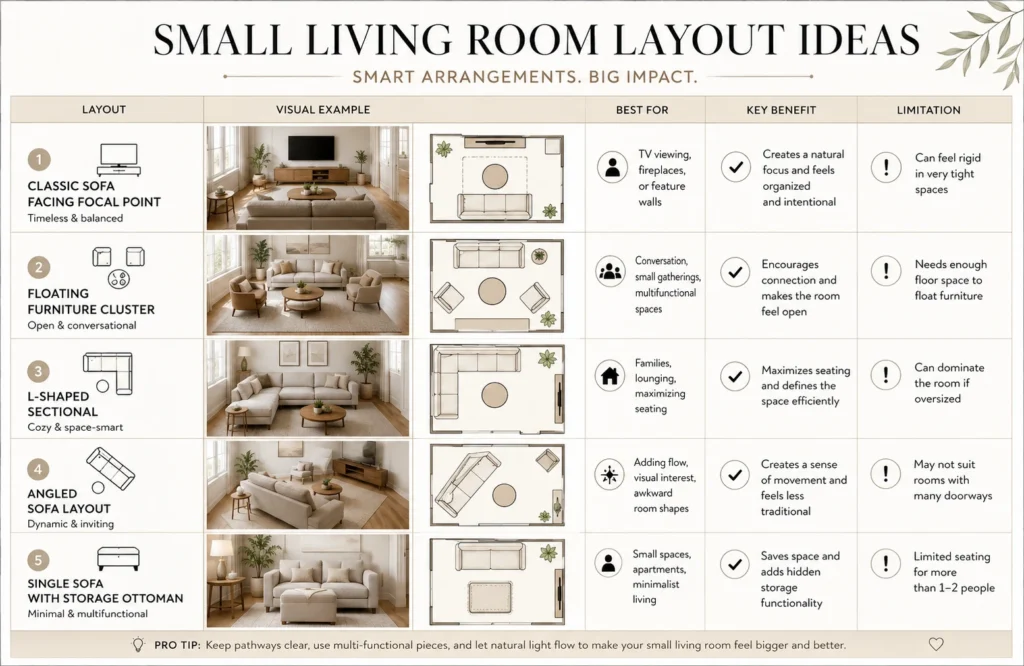
| Layout Type | Best For | Key Benefit | Limitation |
| Sofa + 2 Chairs Facing. | Square rooms, TV focus | Natural conversation zone | Needs 12×12 ft minimum |
| L-Shaped Sectional | Open-plan small apartments | Defines a zone without walls | Can block traffic flow |
| Angled Sofa to Corner | Boxy square rooms | Adds depth, breaks rigidity | Wastes corner space |
| Floating Central Cluster | Rooms with multiple entries | A walkway on all four sides | Feels exposed in small rooms |
| Single Sofa + Ottoman | Studio under 400 sq ft | Multi-function, saves sq ft | Limited guest seating |
Should You Push Furniture Against the Walls in a Small Room?
This is the most counterintuitive insight in small room design. Most people assume that pushing furniture against the walls maximises floor space. The opposite is true.
Pulling furniture 10 to 18 inches away from walls creates a breathing gap that makes the overall room feel more spacious, not less. According to guidelines consistently cited by interior designers, floating furniture creates a visual perimeter, a frame, that the eye reads as intentional and open. The central grouping feels curated rather than crammed.
Some experts argue that wall-hugging is necessary in rooms under 120 square feet. That’s valid for micro-studios where any floating gap eliminates functional pathways entirely. But if you have even 10 feet of room width to work with, floating almost always produces a better result than wall-hugging.
8. The Corner Sofa Layout for Rooms With Awkward Entries
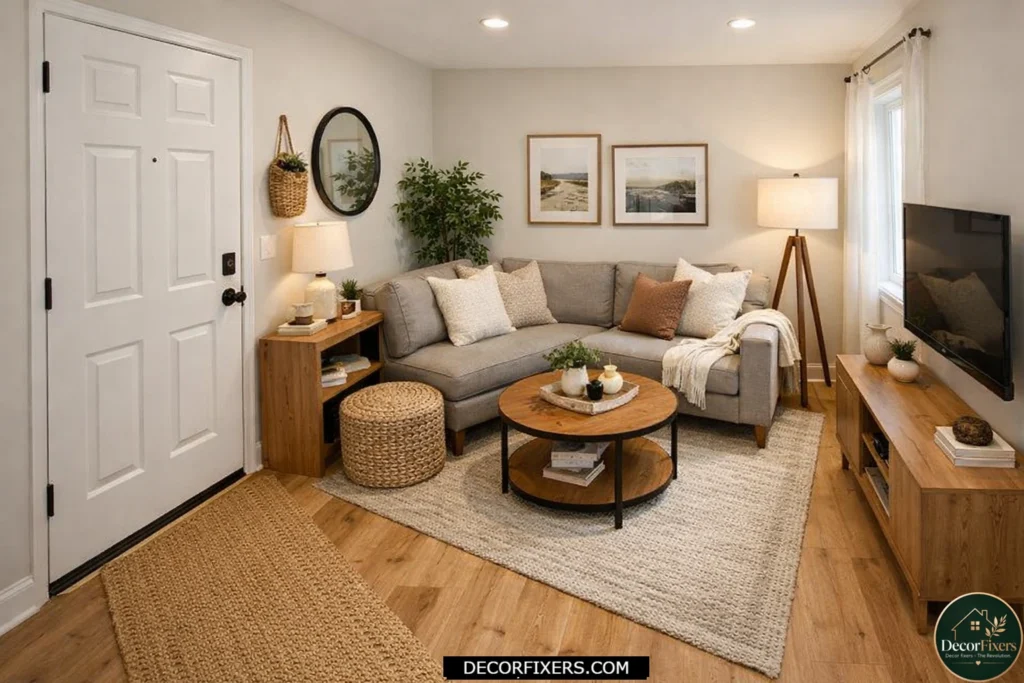
When a room has a door that opens directly into the main seating area, the corner sofa layout protects the flow. Position the sofa in the far corner of the room, facing the entry at a diagonal, so incoming traffic naturally flows alongside the seating rather than cutting through it.
Keep the area between the door and the sofa completely clear, that’s your welcome pathway. Look, if you’re in a rental where the door opens right onto the only wall the sofa could logically go, this diagonal corner placement is what actually works. No other layout handles this awkward entry gracefully.
9. The Zone-Split Layout for Living-Dining Combos
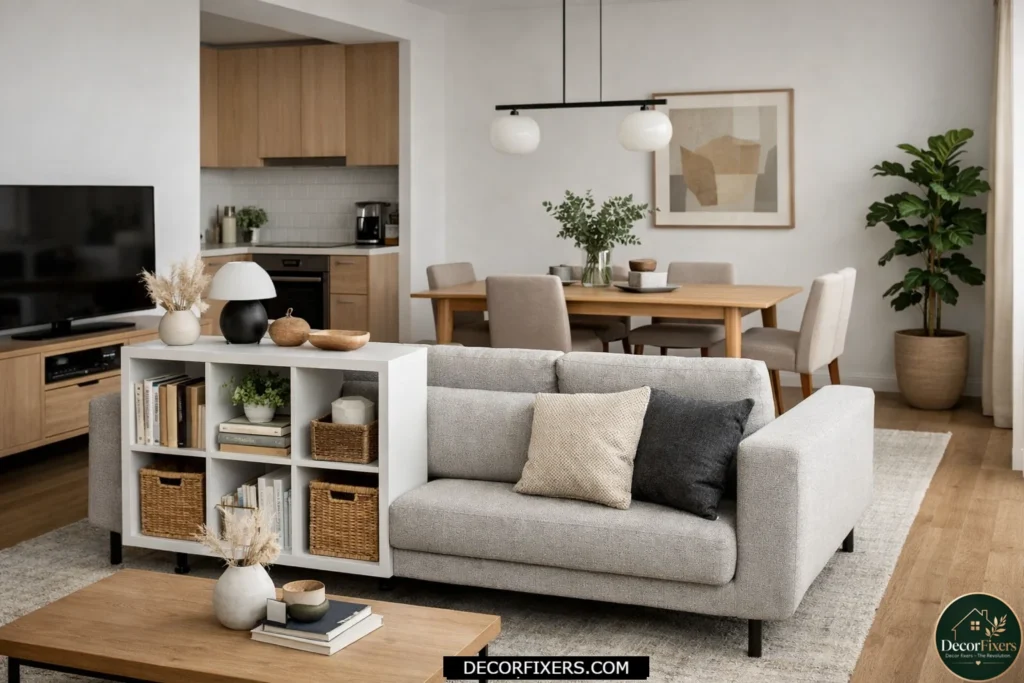
A combined living and dining room in under 300 square feet is one of the most common layouts in modern apartments, and one of the most mishandled. The typical approach is to divide the space by pushing the sofa against the wall that “belongs” to the living zone. It always feels arbitrary and cluttered.
The correct approach: use the back of the sofa as a natural room divider. Float the sofa at least 18 inches from the dining table, with its back facing the dining zone. This creates visual separation without any physical partition. A low bookshelf, like the IKEA KALLAX in a 2×2 configuration, placed beside the sofa end, reinforces the boundary elegantly. If you love the calm, uncluttered quality of this zoned approach, it connects closely to the philosophy behind Japandi Living Room Ideas: Calm & Minimalist Design Tips, which explores how minimalist furniture placement and intentional spacing create livable, serene rooms.
10. The TV-Free Layout for Conversation-First Rooms
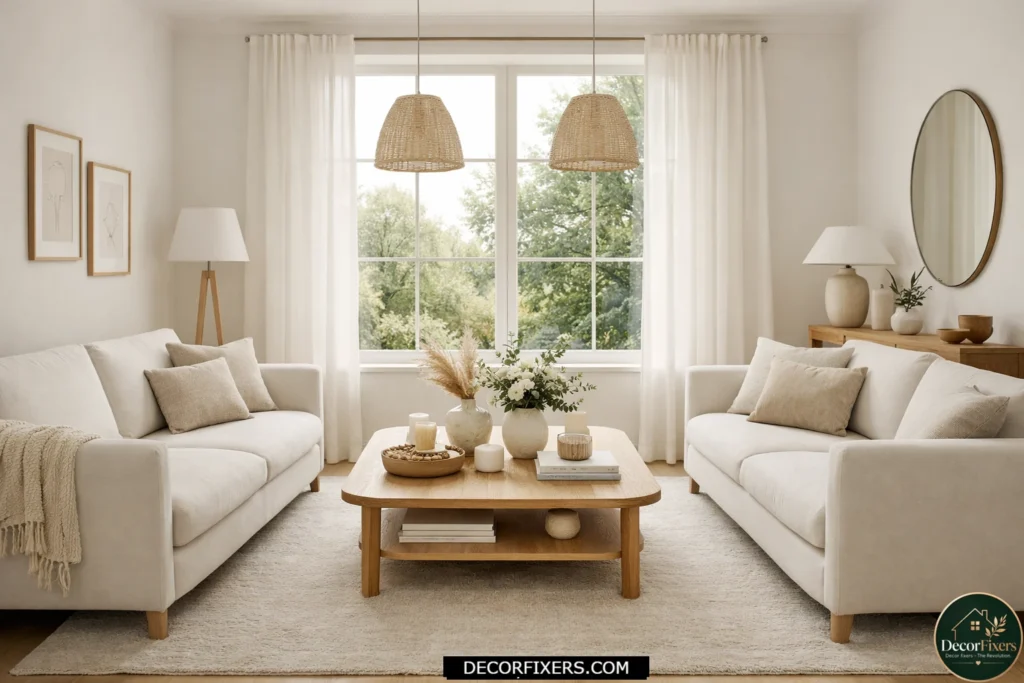
Not every small living room needs a television. For households that stream content primarily on laptops or use a bedroom TV, removing the TV from the living room equation frees up the most contested wall in the house and completely changes the layout possibilities.
With no TV wall to organise everything around, the focal point becomes a fireplace, a gallery wall, a large window, or a bookshelf. Two sofas facing each other or a circular seating arrangement both become viable, layouts that would otherwise feel too formal for a media-centred room. This is increasingly popular in Scandinavian and Japanese-influenced interiors across Northern Europe, Canada, and Australia.
11. The Rug-First Layout: Let the Rug Define the Zone
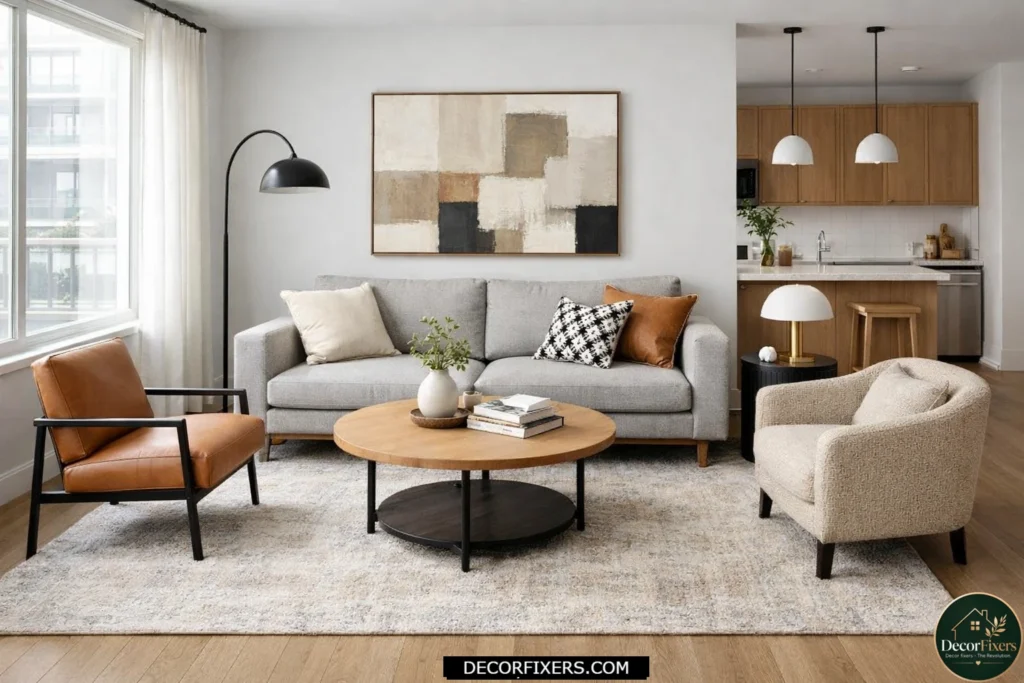
Here’s a layout strategy that starts from the floor up, not the furniture out. Choose your rug before placing any furniture. A rug sized to hold all four legs of the sofa and chairs defines the seating zone as a distinct space, even in an open-plan room with no walls separating areas.
The minimum rug size for a small living room seating zone is 5 x 8 feet. For a full furniture grouping, aim for 8 x 10 feet. A rug that is too small, a mistake most people make by choosing the wrong size first and building around it, visually fragments the space and makes the room feel disjointed and smaller than it really is.
12. The Vertical Storage Layout for Rooms With Low Square Footage
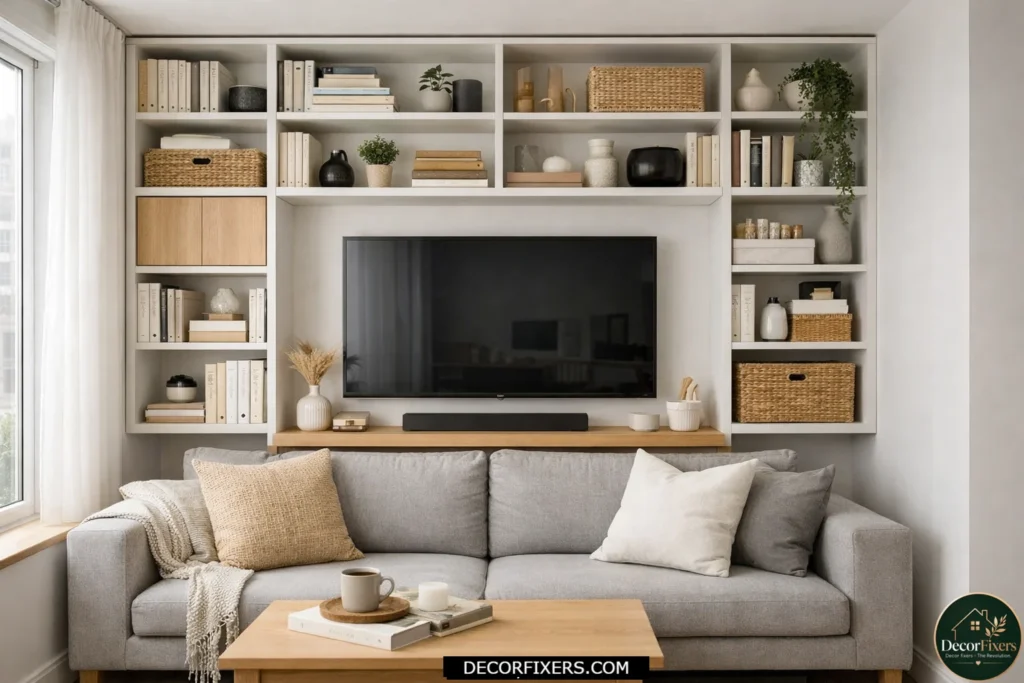
When floor space is gone, go up. The vertical storage layout pairs a standard sofa arrangement with wall-mounted shelving above and beside the TV, reaching up to ceiling height. This keeps the floor plan identical to a standard layout but adds significant functional storage without consuming a single square foot of floor space.
The IKEA KALLAX 4×4 wall-mounted configuration above a media unit is a practical starting point for this approach. Residents in high-density urban environments in the UK, Canada, and Australia, where small apartments are particularly common, frequently cite vertical storage as the single most impactful change they made to a small living room.
What Is the Best Layout for a Small Living Room With a TV?
The most reliable layout for a small living room with a TV places the screen on the shortest wall of the room. This creates the longest possible viewing distance, even in a narrow room, and leaves the longer walls available for the sofa and storage.
According to interior design spacing standards, the ideal TV viewing distance is 1.5 to 2.5 times the screen’s diagonal measurement. For a 55-inch TV, that’s roughly 7 to 11 feet. In rooms where this distance isn’t achievable, wall-mounting the TV higher (at eye level when seated) and angling it downward creates an acceptable viewing line without requiring extra depth.
13. The Multifunctional Furniture Layout for Small Apartments
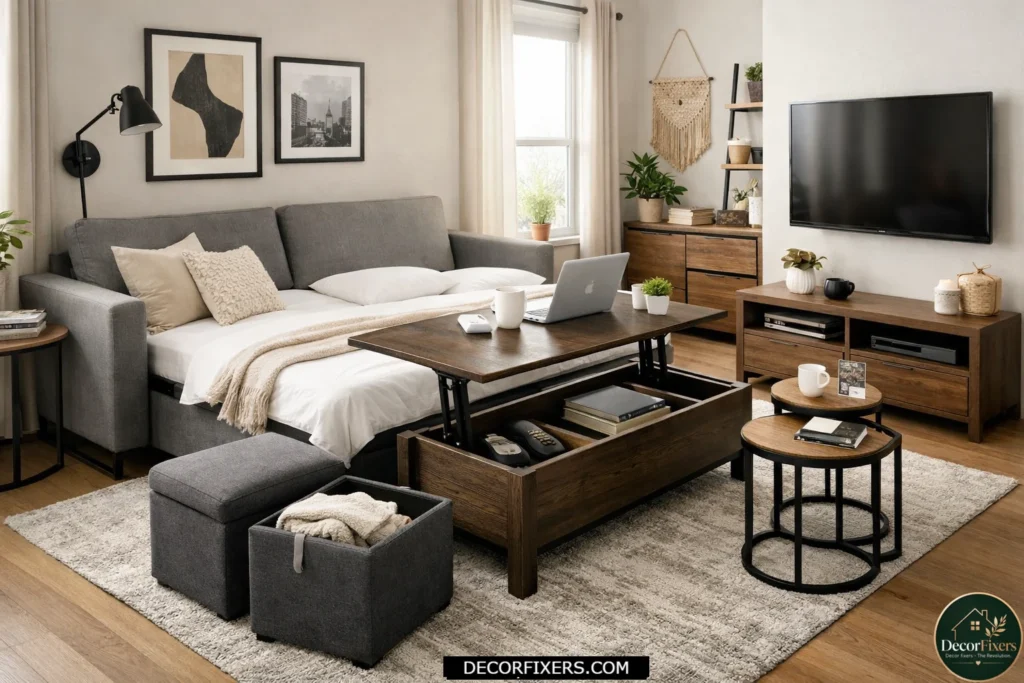
Every piece of furniture in a small living room should ideally do two jobs. The multifunctional layout is built around this principle: sofa bed for overnight guests, lift-top coffee table for dining or working, storage ottomans that replace side tables, and nesting tables that collapse when not in use.
This is not about buying gimmicky furniture. It’s about choosing pieces whose secondary function you will genuinely use at least twice a week. If you’re equipping a small living room on a tight budget, which is the reality for most renters in tier-one cities, every piece needs to justify its floor footprint twice over.
14. The Fireplace-Centred Layout for Older Homes and Conversions
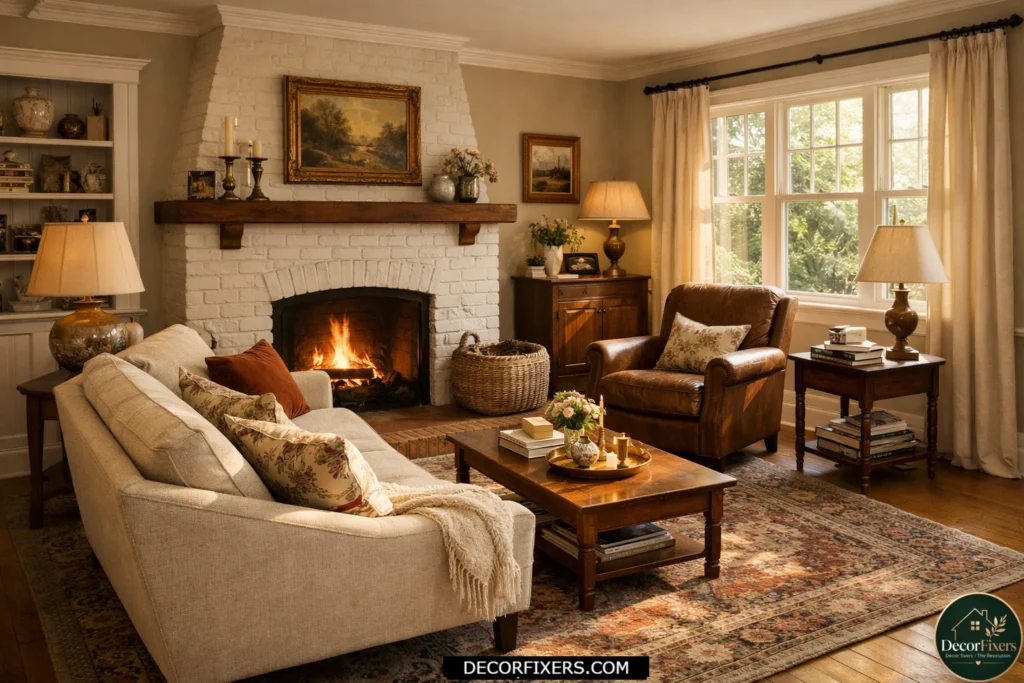
Older homes, Victorian conversions, and heritage apartments in the UK, Canada, Ireland, and Australia often have a working or decorative fireplace positioned off-centre on one wall. Most people shove the sofa to face it and call it done, but this rarely accounts for the door and window positions that these rooms also come with.
The correct approach: treat the fireplace as one of two focal anchors. Place the sofa facing the fireplace at a 45-degree angle, so it also has a sightline to the main window or secondary wall. Add one accent chair that faces the fireplace directly. This gives the arrangement visual layering rather than a rigid line of sight, and it respects the architectural idiosyncrasy of older rooms that were never designed for a 90-degree furniture grid.
15. The Mirror-and-Light Layout: A Visual Expansion Strategy
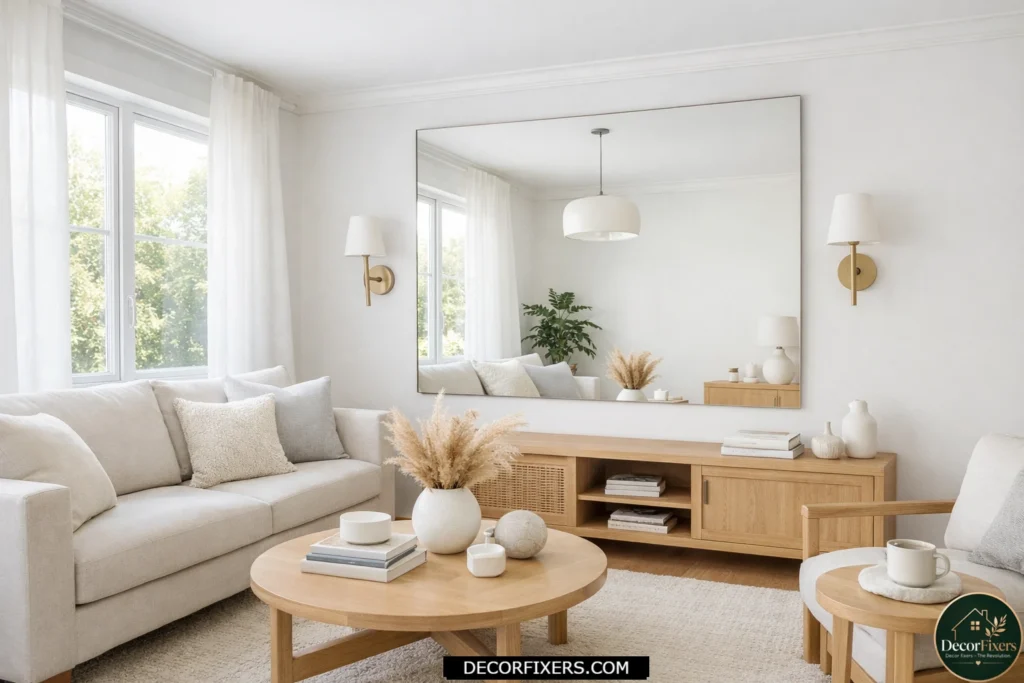
This is less a furniture layout and more a spatial amplification layer that works on top of any of the 14 arrangements above. Position a large mirror, minimum 24 x 36 inches, directly opposite the room’s main light source, whether natural or artificial. The reflection doubles the perceived depth of the room and bounces light into corners that always feel dark.
Pair this with wall-mounted sconces instead of floor lamps (saves floor footprint), and use light-colored or transparent furniture legs where possible, acrylic and light oak frames visually recede against floors. If you want to go deeper on how lighting, color, and layout interact in a compact space, our guide to Small Living Room Design Ideas covers the full visual toolkit alongside the furniture placement principles.
How to Arrange Furniture in a Small Living Room: Step-by-Step
- Measure the room, length, width, door swings, and window positions.
- Identify your focal point, TV wall, fireplace, or main window.
- Choose your layout type from the 15 options above based on room shape.
- Map it digitally using the free Magicplan app before moving anything physically.
- Check three key measurements: 36-inch walkway, 18-inch sofa-to-coffee-table gap, 8-foot maximum seating distance.
Key Spacing Measurements Every Layout Needs
| Measurement | Recommended Distance |
| Main walkway width | 30–36 inches minimum |
| Sofa to coffee table | 14–18 inches |
| Seating distance between pieces | Maximum 8 feet |
| Sofa to TV screen | 7–10 feet |
| Minimum rug size (seating zone) | 5×8 feet |
Conclusion:
I’ve helped enough people rethink their small living rooms to say this without hedging: the layout is doing the heavy lifting, not the paint color, not the accessories, and not a bigger budget. When the sofa is in the right position, when there’s a clear 36-inch walkway, and when every piece relates to a single focal point, the room exhales.
Start with one layout from this list that matches your room shape. Map it in Magicplan before you move anything. Check the three critical measurements. Then live in it for two weeks before you decide it’s wrong.
Most people who do this realise the room wasn’t too small. The arrangement just hadn’t been given a real chance.
FAQs:
Q: What’s the best small living room furniture arrangement for a square room?
A: For a square room, use either a floating central furniture cluster with walkways on all sides, or angle the sofa 45 degrees to a focal corner. Both approaches break the boxy symmetry that makes square rooms feel cramped.
Q: How do I arrange furniture in a small living room with a fireplace and TV?
A: Mount the TV above the fireplace to combine both focal points, then place the sofa directly facing them at 7 to 9 feet. Add one accent chair angled toward the fireplace to complete a natural conversation triangle.
Q: Should furniture legs be on or off the rug in a small living room?
A: Front legs on the rug is the minimum. All four legs on the rug are preferred if the rug is large enough; it reads as a unified zone. A rug with no furniture legs on it always makes the room feel disconnected and smaller.
Q: How do I arrange a small living room with a sectional sofa?
A: Place the long side of the L along the longest wall, with the short arm pointing into the room as a zone divider. Leave at least 36 inches between the sofa arm and any opposing furniture or wall.
Q: When should I use an ottoman instead of a coffee table?
A: In rooms under 150 square feet, always. An ottoman gives you 12 to 18 inches of extra walkway clearance compared to a rigid coffee table, plus hidden storage and the flexibility to use it as extra seating when guests arrive.

Creator of DecorFixers, sharing practical home and interior ideas focused on real-life usability, simple design improvements, and budget-friendly solutions.