

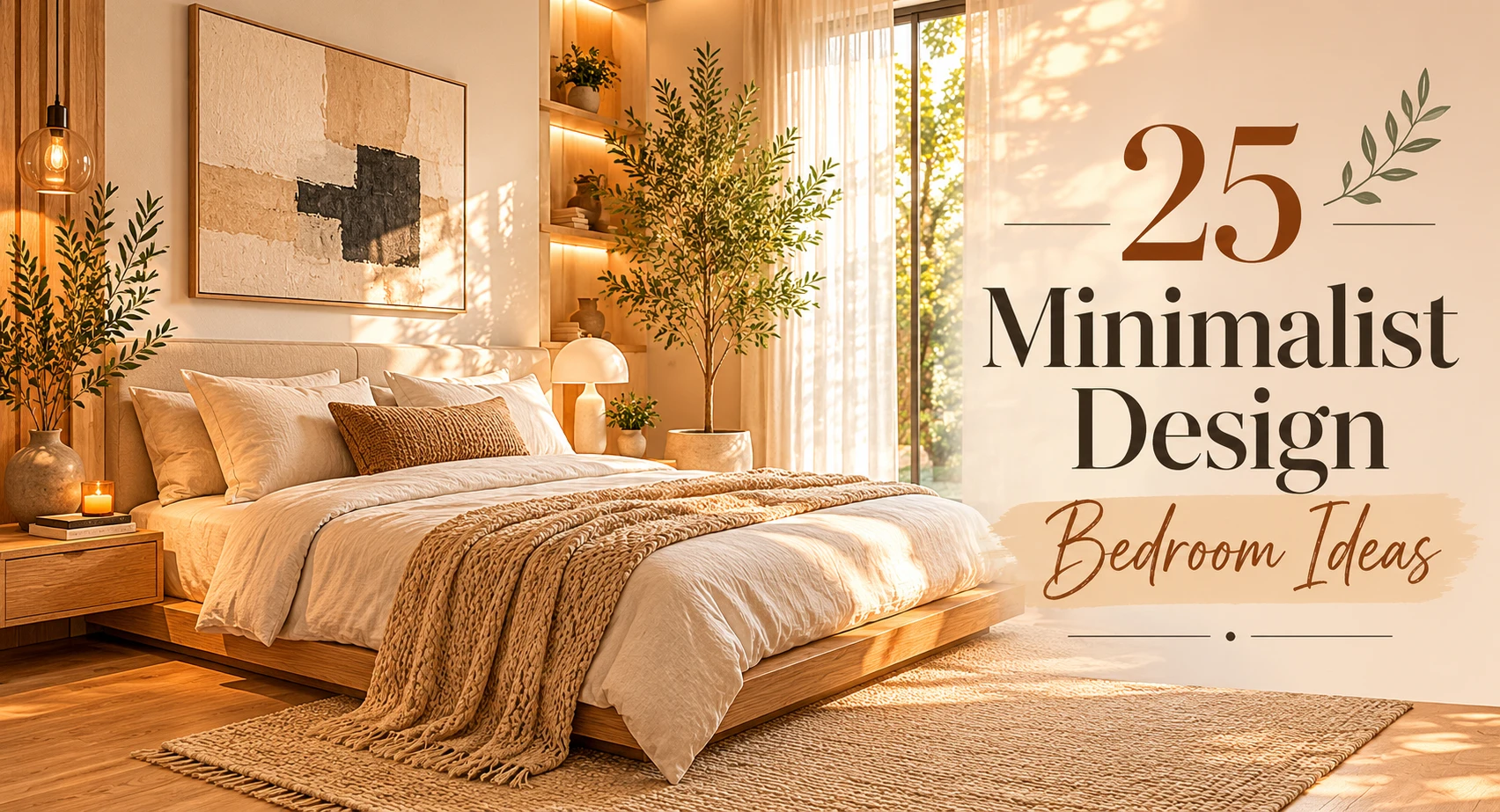
I remember standing in my bedroom at midnight, staring at the mess, the chair covered in clothes, the nightstand piled with three books I hadn’t touched in weeks, the plastic storage bins that were supposed to fix everything but just moved the chaos. I’d spent weekends reorganizing. I’d followed every Pinterest board I could find. And nothing
felt calm. It just looked different.
That was the moment I realized the problem wasn’t clutter. It was that I had no design framework to replace the clutter with. I was removing things without adding intention.
If you’ve been there, tried the organizational bins, pinned the all-white minimalist rooms that felt sterile and cold, and rearranged furniture without a clear direction, this guide is exactly what you were searching for before you gave up and left the room the same.
| Minimalist design bedroom ideas refer to intentional design choices that strip a bedroom down to only functional, beautiful, or meaningful elements. Unlike sparse interiors, a well-executed minimalist bedroom feels warm, calm, and deeply personal, not empty. The goal is visual quiet, not visual nothing. |
| Minimalist bedroom design is not about owning the least possible; it’s about eliminating everything that doesn’t serve rest, calm, or function. In 2026, the trend has shifted away from stark all-white interiors toward ‘warm minimalism’: neutral palettes layered with natural textures (linen, wood, boucle) that feel inviting rather than clinical. The principle is intentional curation, not deprivation. |
1. Go Low with a Platform Bed
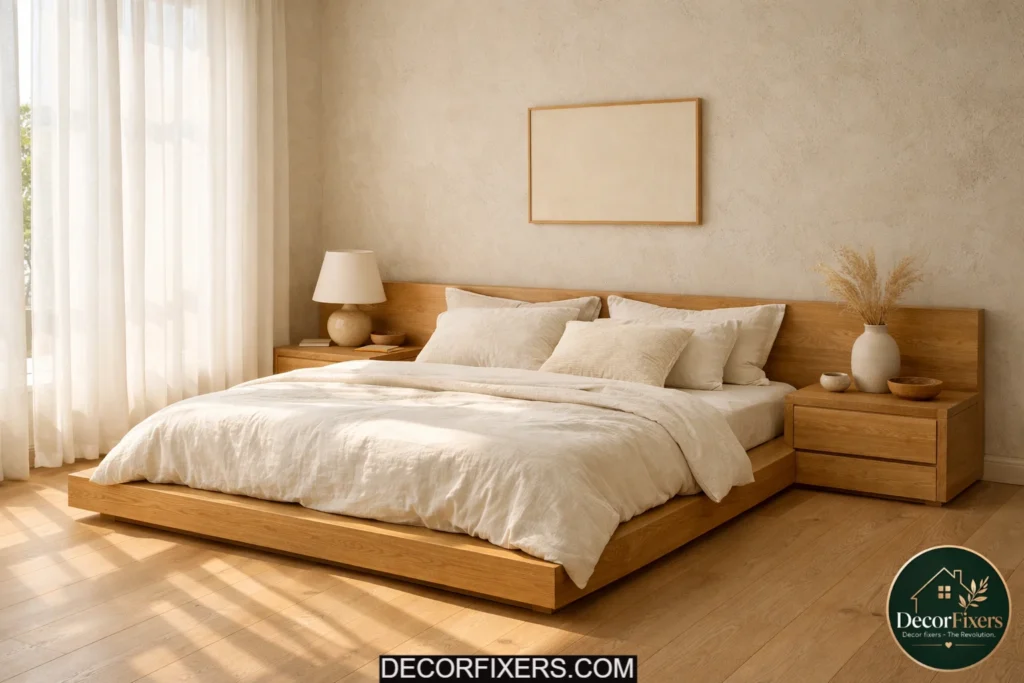
A low-profile platform bed is the single most impactful minimalist bedroom furniture move you can make. It grounds the room visually, creates the illusion of more ceiling height, and immediately reads as intentional.
The IKEA MALM bed frame is the most accessible option; it’s low, clean-lined, and available in white and walnut veneer. For a step up, Muji’s solid oak platform bed delivers the same silhouette with better materials. Skip the box spring. Skip the ornate headboard.
2. Choose One Dominant Neutral and Commit
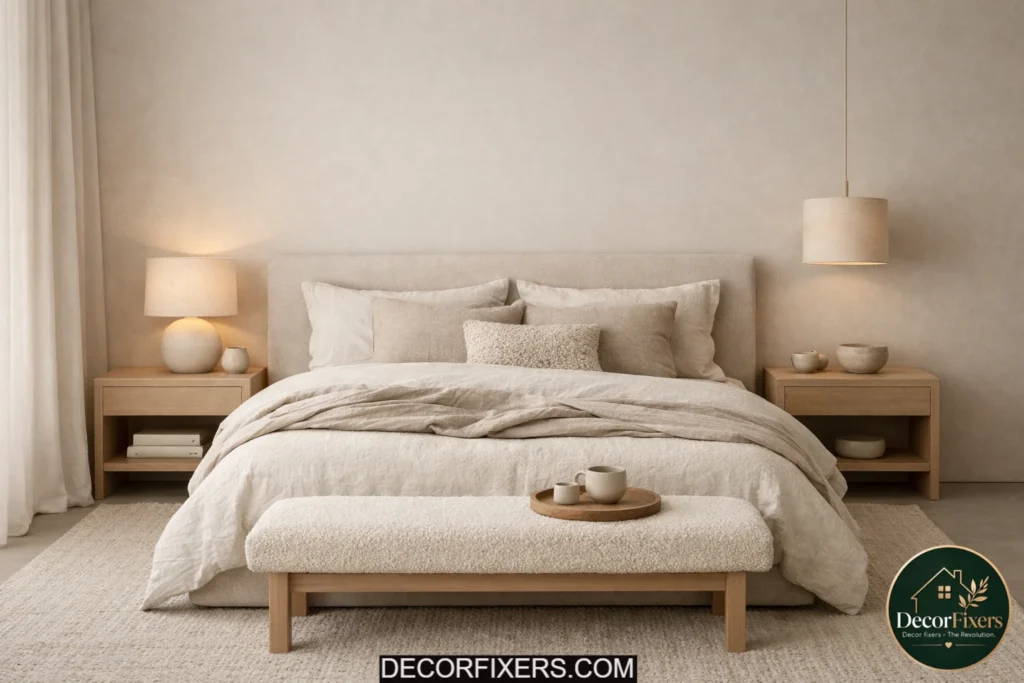
The mistake most people make is using five ‘neutral’ colors that don’t actually harmonize: soft grey walls, beige rug, white bedding, brown wood, cream curtains. It looks busy even though nothing is bright.
Pick one dominant neutral, warm white, greige, or soft taupe, and build everything around it. Your textures and materials do the visual work. The palette stays quiet. This is the discipline minimalist bedroom decor actually demands.
3. Use Floating Nightstands to Clear the Floor
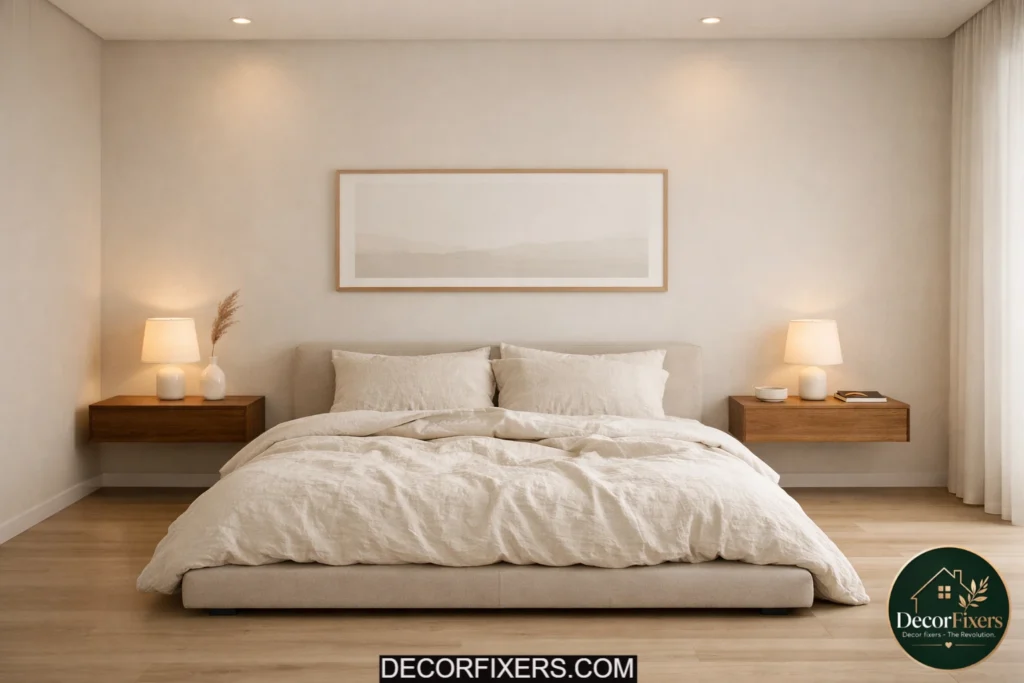
Floor space is breathing room. Every leg on every piece of furniture creates a visual interruption. Wall-mounted floating nightstands give you the surface you need without the visual weight.
Keep them small; you need space for a lamp, a book, and nothing else. A floating nightstand with a single drawer is ideal. If you’re renting and can’t wall-mount, choose a nightstand with thin hairpin legs to mimic the same visual lightness.
If you are working with limited square footage, these space-saving principles become even more important. Smart vertical storage and visually lightweight furniture are core strategies used in modern Small Bedroom Ideas for making compact rooms feel open rather than crowded.
4. Layer Textures, Not Colors
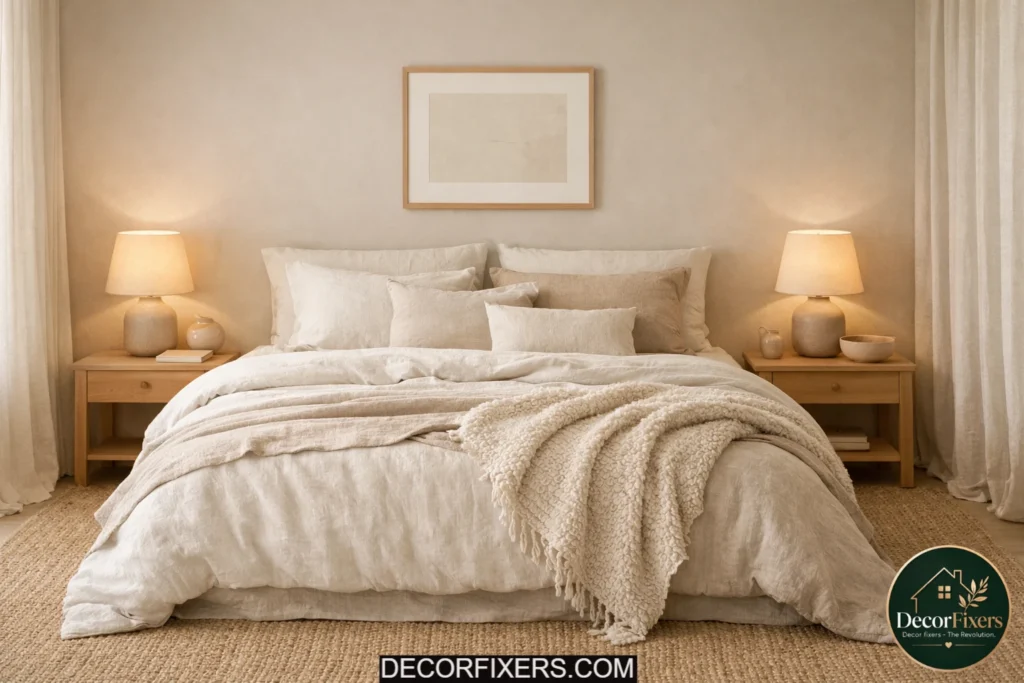
This is the secret to a cozy minimalist bedroom that doesn’t feel flat. Keep your palette monochrome or tonal, but vary the textures: linen duvet, boucle throw, cotton fitted sheet, jute rug. Four textures, one color family.
The eye wants something to travel across. When you strip the color, the texture becomes the visual journey. This is how boutique hotels create rooms that feel expensive and restful at the same time.
5. Treat Lighting as Architecture, Not Decoration
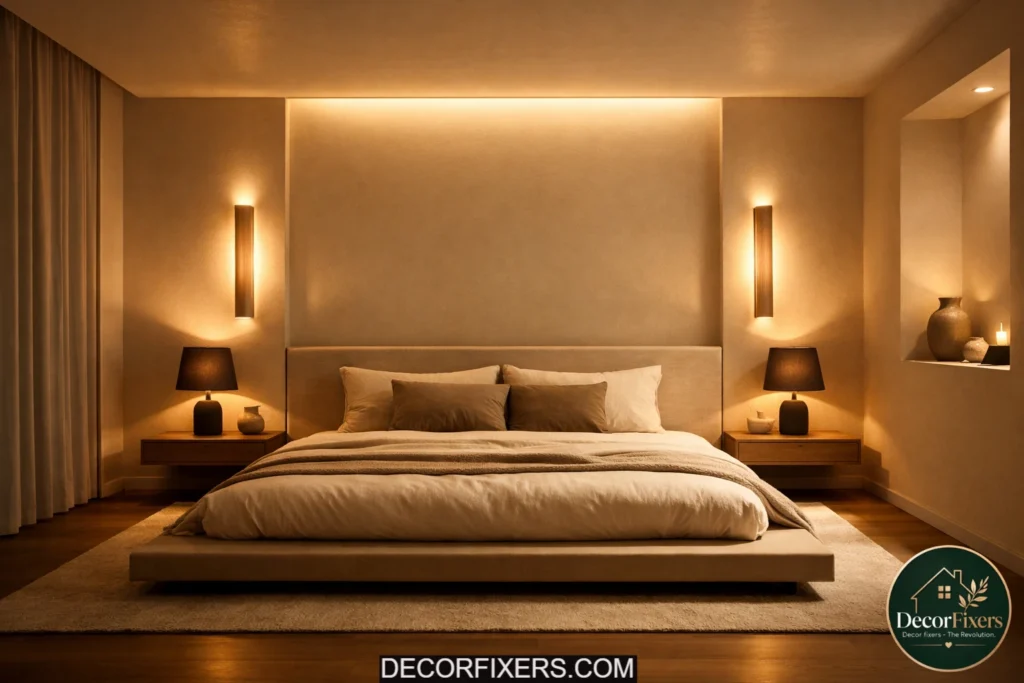
Harsh overhead lights are the enemy of a minimalist bedroom. A 2024 report by the American Lighting Association found 72% of homeowners rank lighting comfort above style or cost when redesigning their bedroom.
Replace or bypass your ceiling fixture with layered lighting: a warm-toned table lamp (2700K maximum), a wall sconce or two if possible, and a dimmer switch. The goal is pools of warm light, not a lit-up room.
6. Adopt a Strict One-In-One-Out Rule for Bedroom Objects
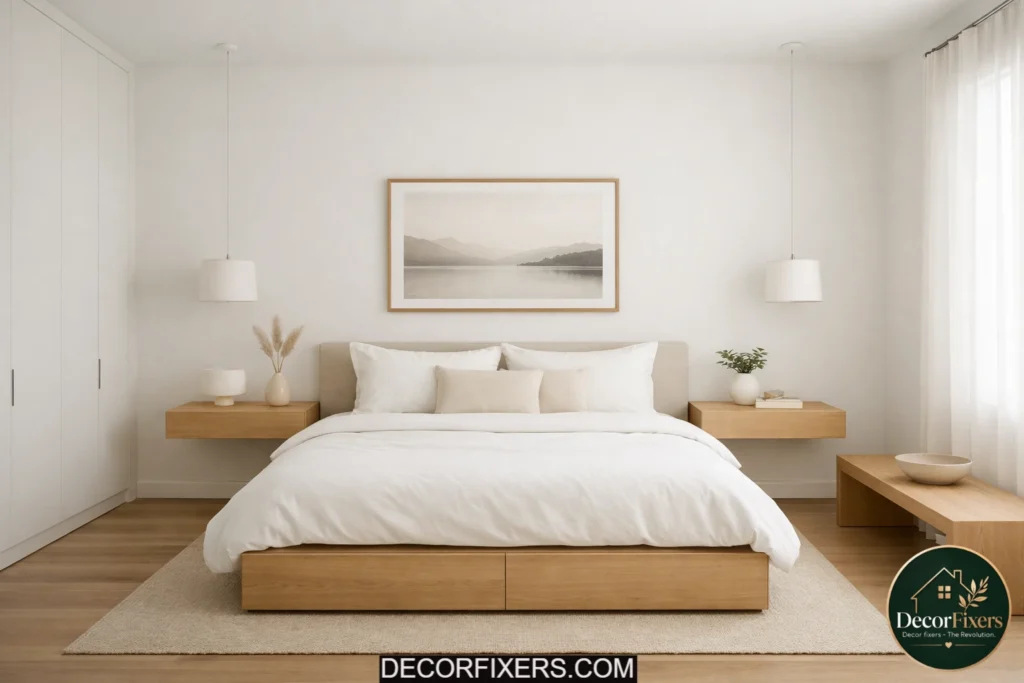
This isn’t a design tip; it’s a maintenance system. Every object you bring into the bedroom displaces the calm you’ve built. A new candle means an old item leaves. A new book on the nightstand means the finished one goes to the shelf.
Minimalist bedroom decor doesn’t fail at the design stage. It fails at the maintenance stage. The one-in-one-out rule is the only system that actually holds.
7. Use Japandi Design Principles for Instant Calm
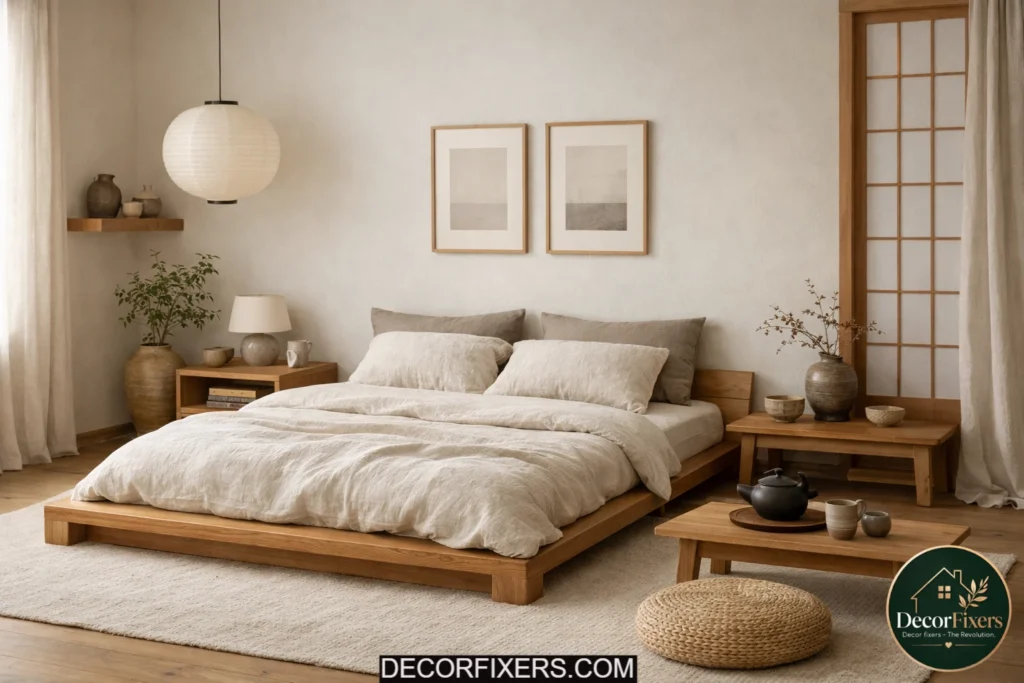
Japandi, the fusion of Japanese wabi-sabi and Scandinavian hygge, is the most practical minimalist bedroom style for people who want warmth without clutter.
The core principles: natural wood in warm tones, handcrafted ceramics, linen and cotton textiles, earthy neutrals, and zero synthetic materials in sight. One ceramic lamp, one wooden tray on the dresser, one plant. That’s it. That’s the whole look.
8. Pick Curtains That Touch the Floor
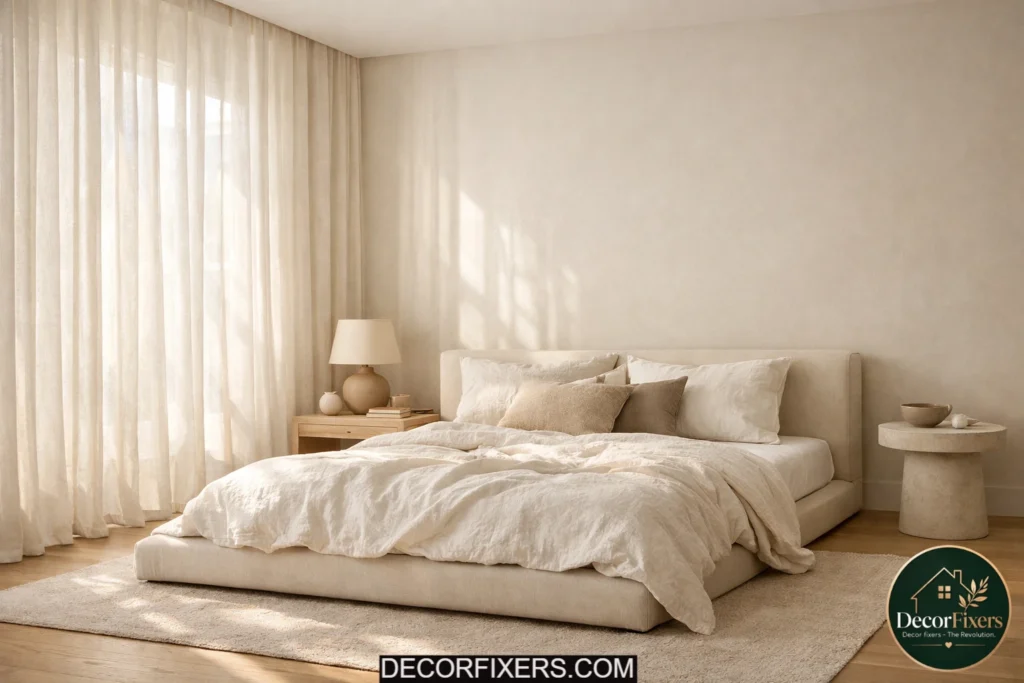
Floor-length curtains do two things at once: they make ceilings feel higher, and they replace a visual interruption (window trim, blinds, awkward valances) with a clean, unbroken vertical line.
Go with linen or cotton in a tone that matches or is slightly lighter than your walls. In a minimalist bedroom, curtains are architecture, not decor. They should whisper, not speak.
9. Clear Your Dresser Down to Three Items
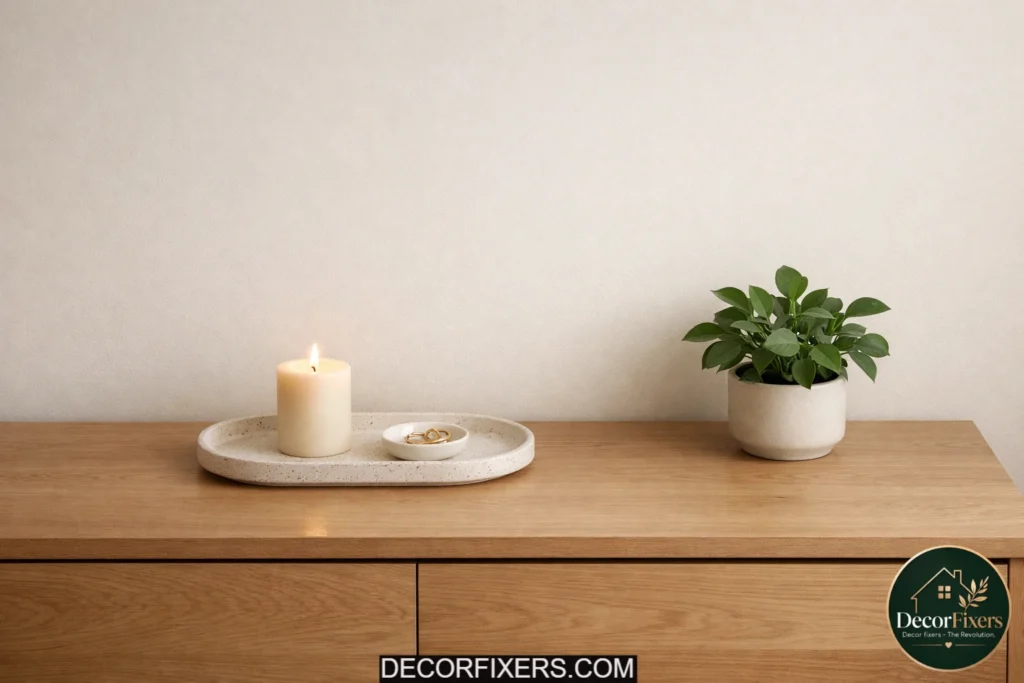
Most dressers become flat filing cabinets, keys, coins, chargers, perfume bottles, and random receipts. Strip it down to exactly three items: one object of beauty (a single candle or small plant), one functional item (a tray), and nothing else on the surface.
A tray is key. It creates a visual boundary that signals ‘this is intentional’ rather than ‘this is where things land.’ One tray. Three items inside it. Done.
10. Choose an Upholstered Headboard in a Muted Tone
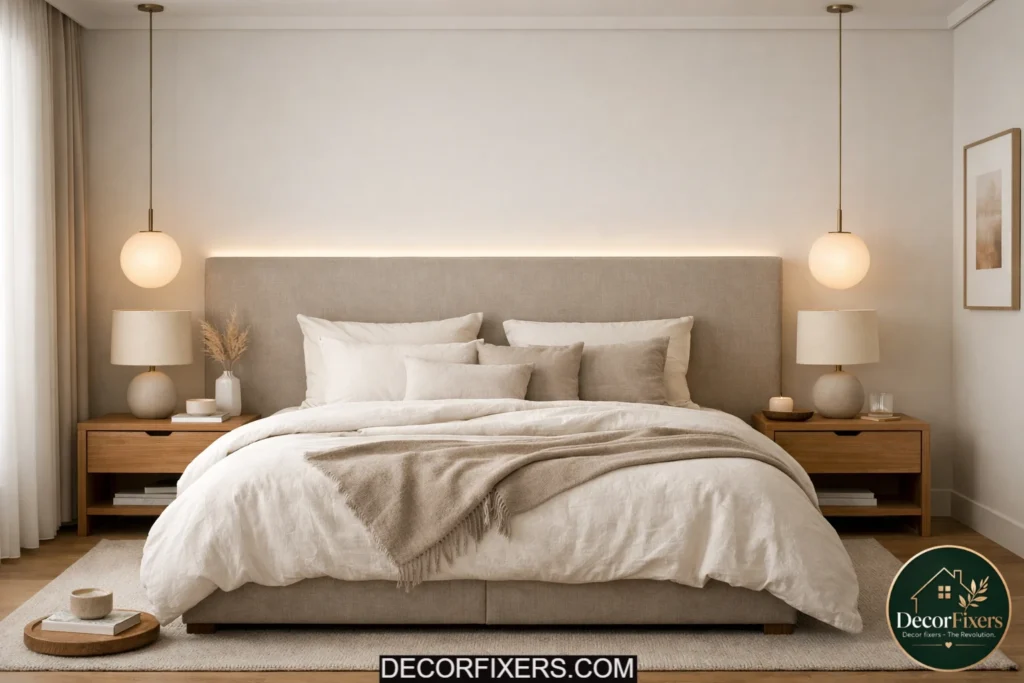
If you do add a headboard, make it earn its place. An upholstered headboard in warm greige, dusty sage, or soft charcoal adds softness to a room without adding visual weight.
Skip the ornate carved wood. Skip the tufted maximalist velvet. The best minimalist bedroom headboard is one you almost don’t notice; it’s just there, grounding the bed, adding texture.
11. Use Under-Bed Storage to Reclaim Closet Space
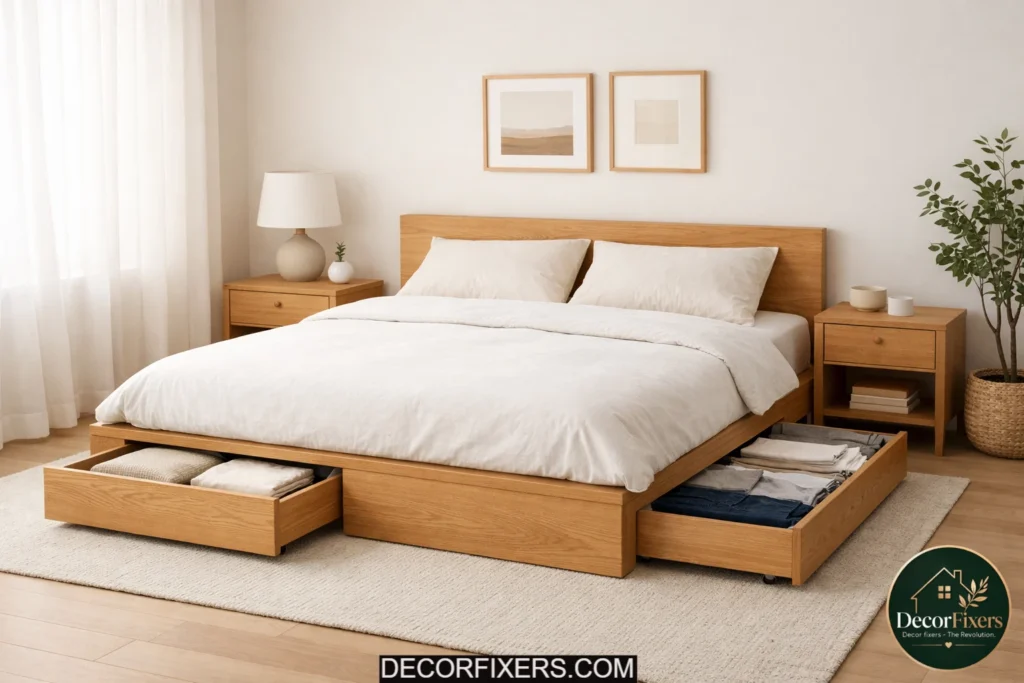
Minimalism doesn’t mean you own less; it means less is visible. Under-bed storage is the most underused square footage in most bedrooms. Flat storage bins in linen or cotton fabric keep seasonal items, spare bedding, and off-season clothes invisible.
Quick note: if you use a platform bed without a frame gap, you’ll need low-profile bins. Measure first. The IKEA SKUBB under-bed bags work in most platform setups and stay completely hidden.
12. Introduce One Plant, Not Five
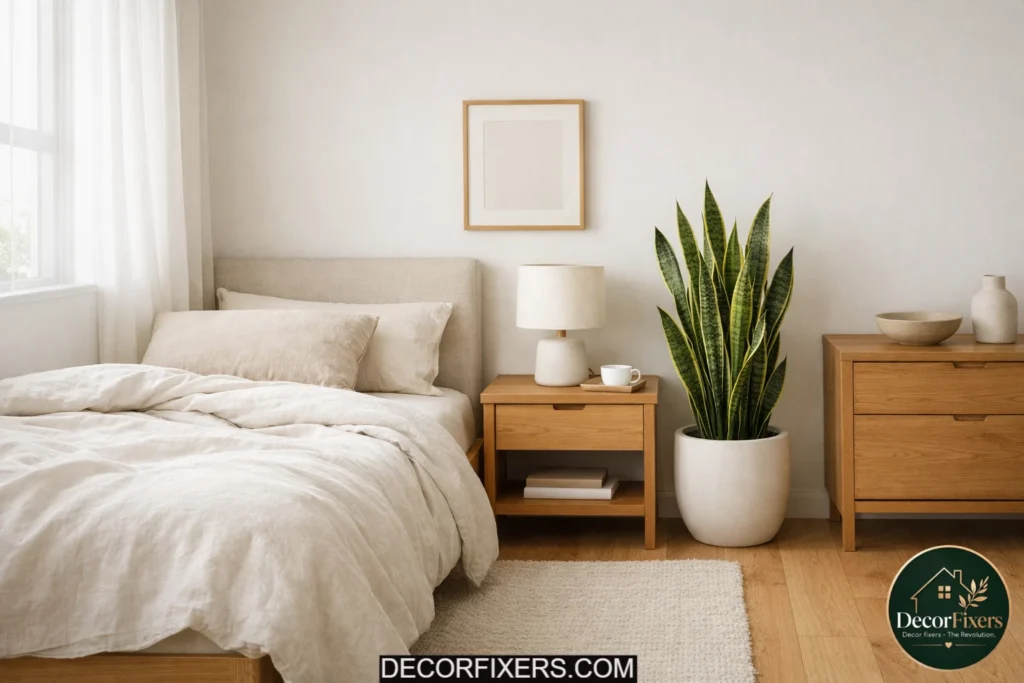
Biophilic design improves sleep quality and reduces stress, but a minimalist bedroom doesn’t become a greenhouse. One plant, one pot. Choose something low-maintenance that fits the palette: a snake plant in a matte white ceramic pot, a small pathos in terracotta, a single stem of eucalypt in a bud vase.
The plant is a design element, not a hobby corner. If you can’t commit to caring for it, use a single branch of dried pampas grass or eucalyptus. Same visual effect, zero watering schedule.
13. Remove the TV, Or Hide It Completely
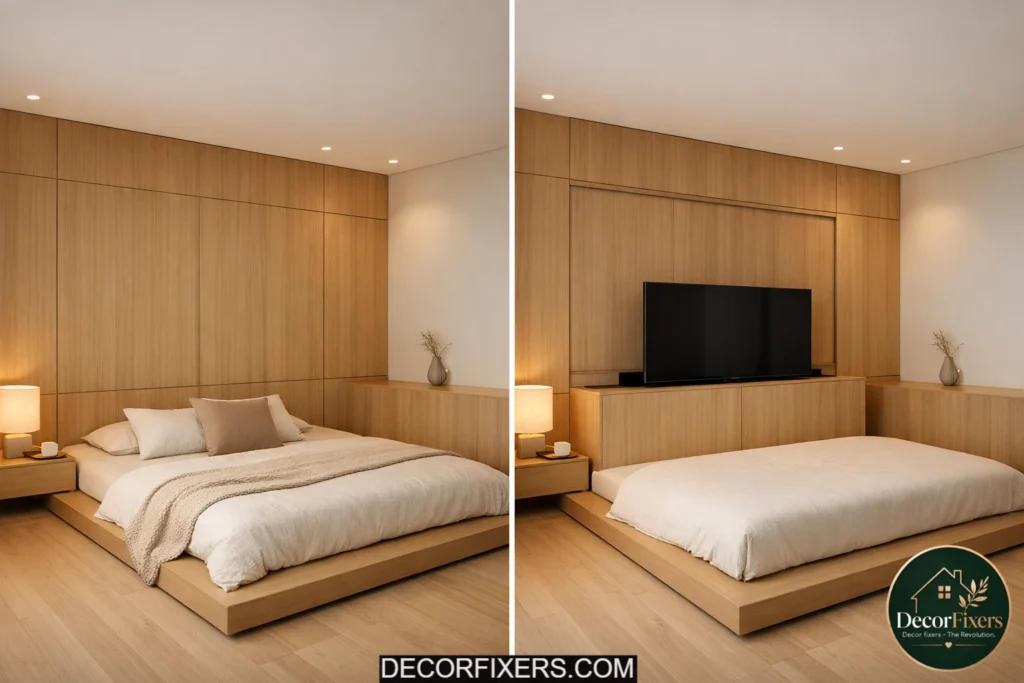
This is the opinion readers push back on most, and I’m standing by it with full reasoning. A TV in the bedroom is the single biggest visual disruptor in a minimalist space. It’s a black rectangle that dominates the room when off and dominates your attention when on.
If removing it entirely isn’t realistic, mount it inside a wardrobe that closes, put it in a wooden TV chest at the foot of the bed, or use a motorized lift mount. The goal is: when you’re not watching, it doesn’t exist.
14. Paint an Accent Wall, But Only with a Tone, not a Color
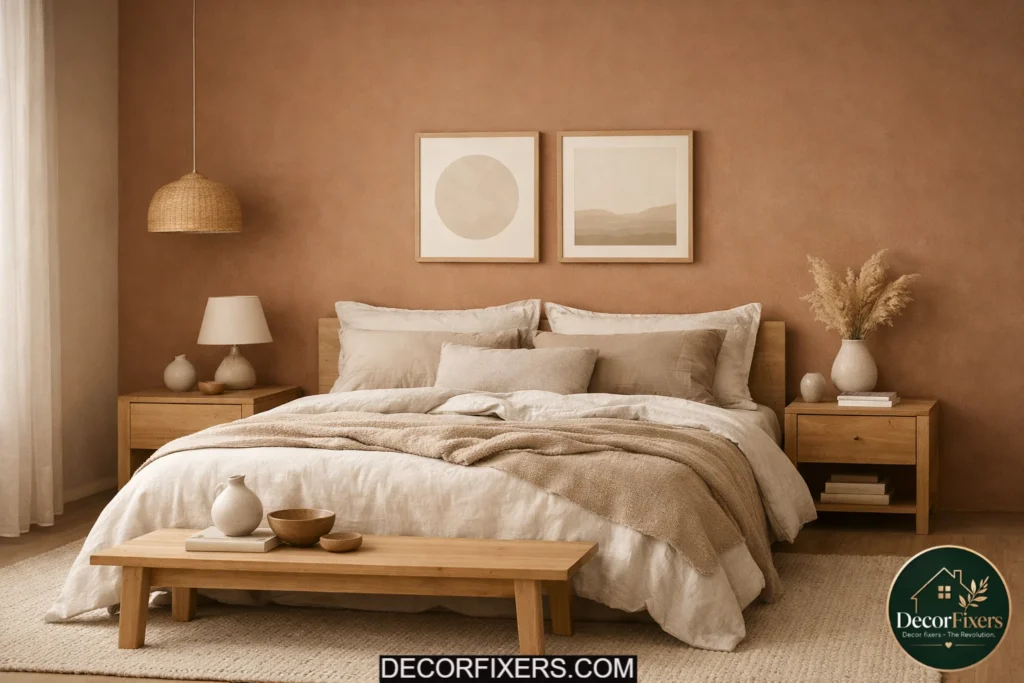
A full accent wall in a bright or saturated color breaks the visual quiet of a minimalist bedroom. But a tonal accent wall, the same family as your other walls, just one or two shades deeper, adds dimension without disruption.
Dusty sage behind the bed. Warm clay on the wall facing the window. Soft charcoal behind a floating shelf. These are accent walls that earn the name
15. Choose a Rug That Anchors the Bed
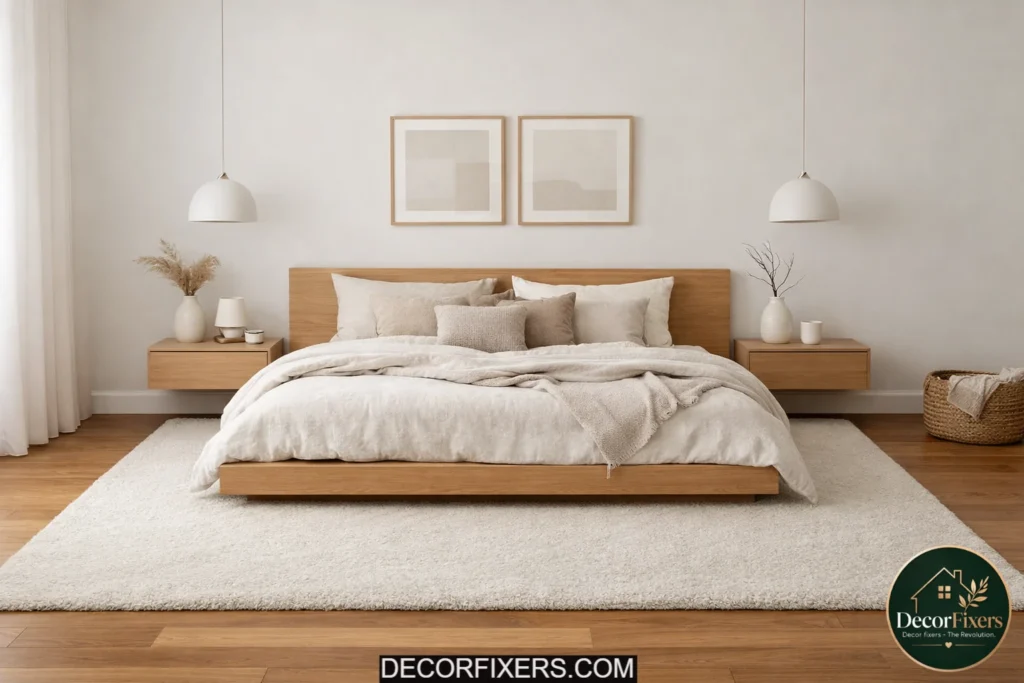
A rug should be large enough that the front legs of the bed rest on it. This is the most common rug sizing mistake in bedroom design. People buy a rug too small, and it floats in the middle of the room like a bath mat.
For a minimalist bedroom, choose a flat-weave or low-pile rug in a natural fiber: jute, sisal, or wool. No patterns. The texture does the work. An 8×10 or 9×12 anchors a queen or king bed correctly in most bedroom sizes.
16. Use Warm White Bedding as Your Reset Button
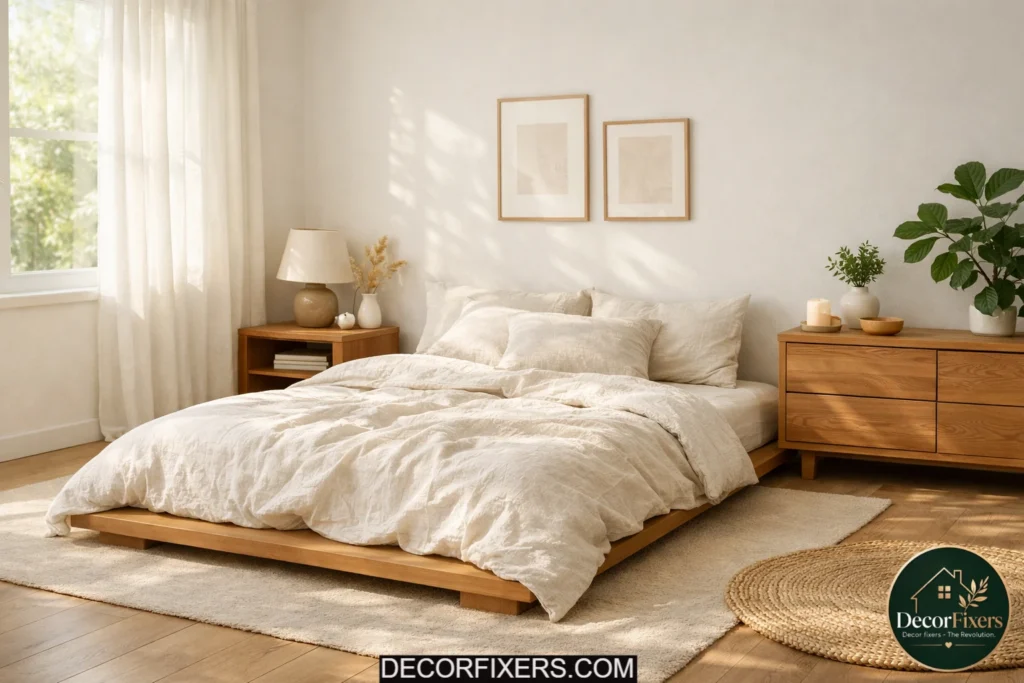
Your bedding is the focal point of a minimalist bedroom. It should be the calmest thing in the room. Not perfectly pressed hotel white, that feels cold. Warm white or ecru, in linen or cotton percale.
The West Elm Solid Linen Duvet Cover in White or Natural is one of the most practical picks: it wrinkles beautifully (intentional, not sloppy), breathes well, and gets softer with every wash. That lived-in softness is what separates a real minimalist bedroom from a staged one.
17. Replace Open Shelving with Closed Storage
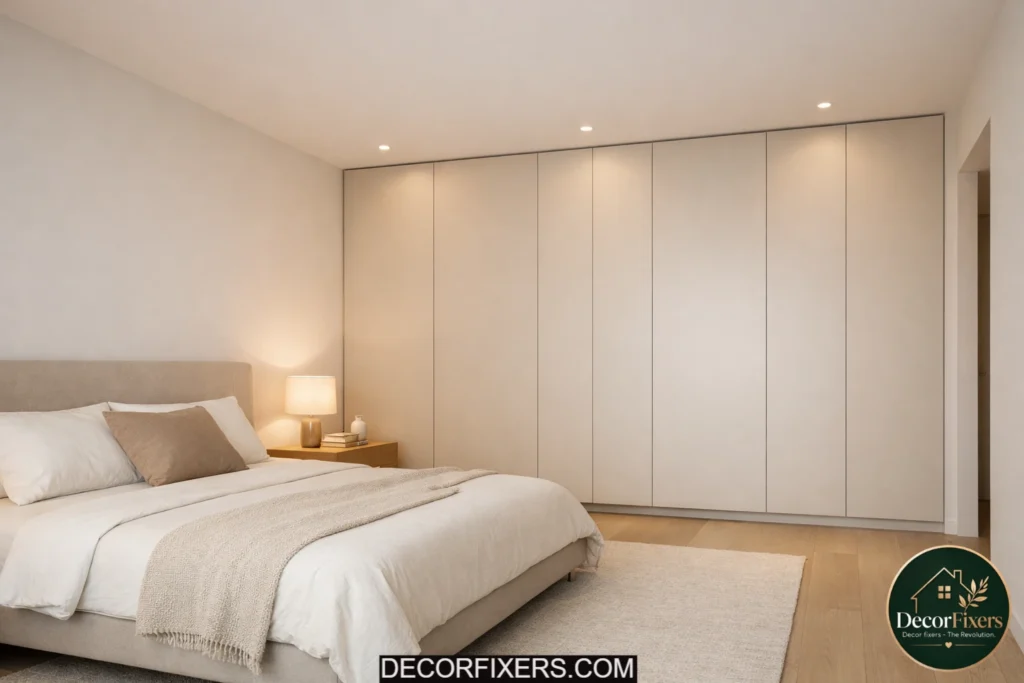
Open shelving in a bedroom is a mess waiting to happen. Even styled beautifully on day one, it collects dust, gains random items, and becomes a visual stress point within weeks.
If you need storage, close it. A wardrobe with solid doors over an open rack every single time. A dresser over a floating shelf for everyday items. The best minimalist bedroom storage is the storage you never have to look at.
A well-designed wardrobe does more than store clothes; it protects the visual calm that minimalist bedrooms depend on. Built-in cabinetry, flush doors, and concealed storage layouts commonly featured in Wardrobe Design Bedroom Ideas help maintain a cleaner and more cohesive bedroom aesthetic
18. Embrace Negative Space as a Design Element
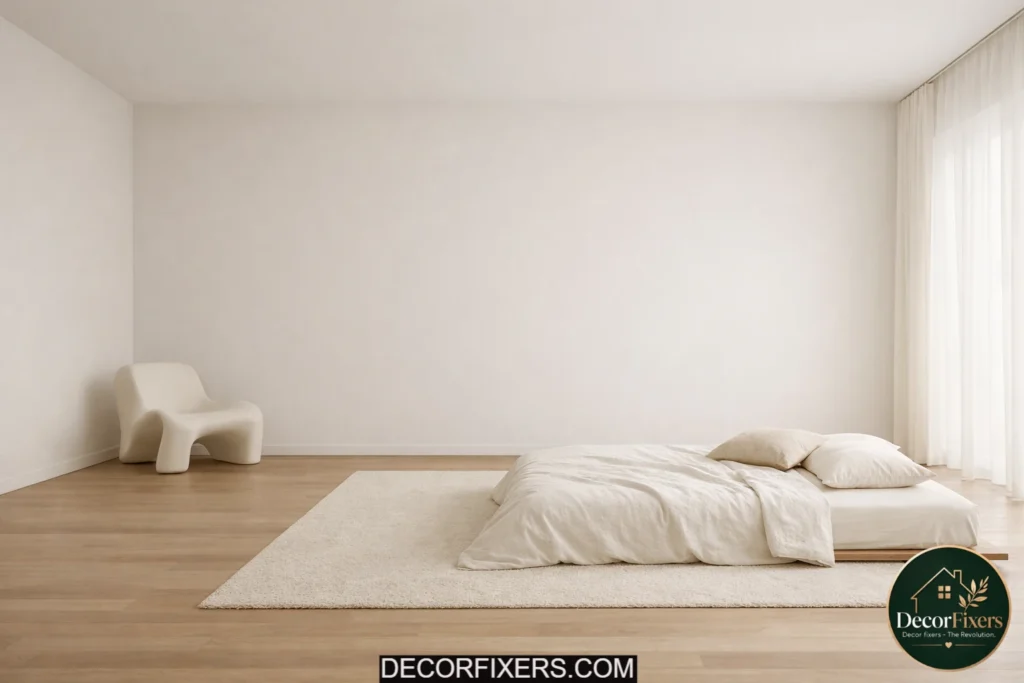
Most people see an empty corner and feel an urge to fill it. In minimalist design, that corner is doing its job. Negative space, empty areas of floor, wall, or surface, is where the eye rests.
I’ve seen conflicting approaches: some designers argue that every corner needs something. Others say negative space is the actual material of minimalist design. My read: one intentionally placed object per corner, maximum. And one corner should always be empty, it’s what makes the room breathe.
19. Hang One Piece of Art, Centered Above the Bed
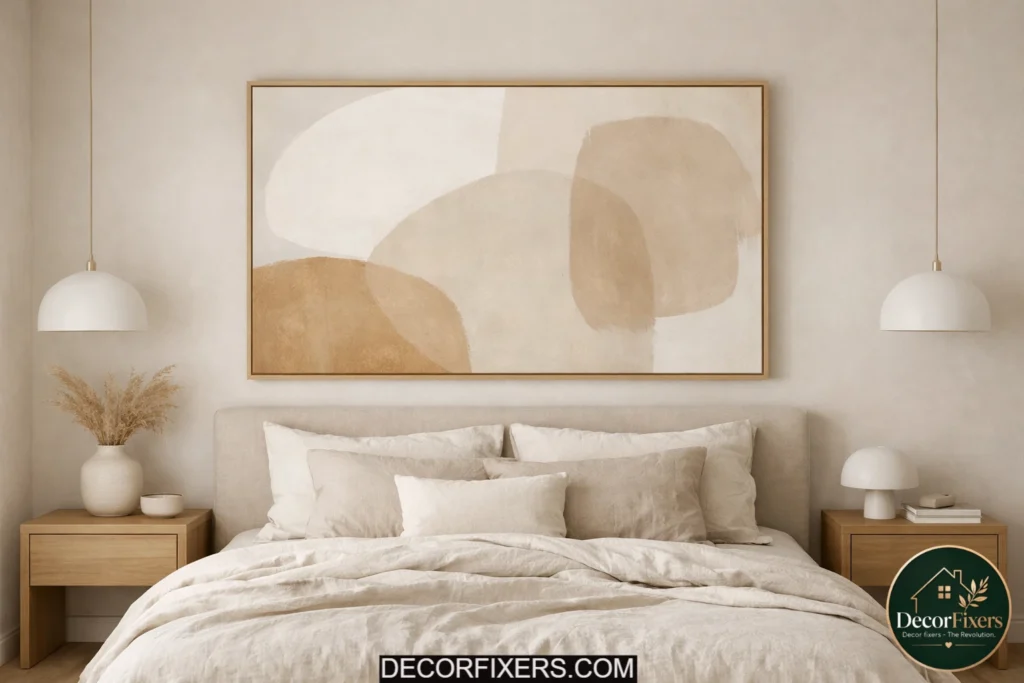
Not a gallery wall. Not three prints in a row. One piece. Centered. At eye level when standing.
The art doesn’t need to be expensive; it needs to be intentional. A simple line drawing, a single photograph, a textile piece. In a minimalist bedroom, one piece of art carries more visual weight than a gallery wall because nothing is competing with it.
20. Use a Bedside Tray to Control What Lives on Your Nightstand
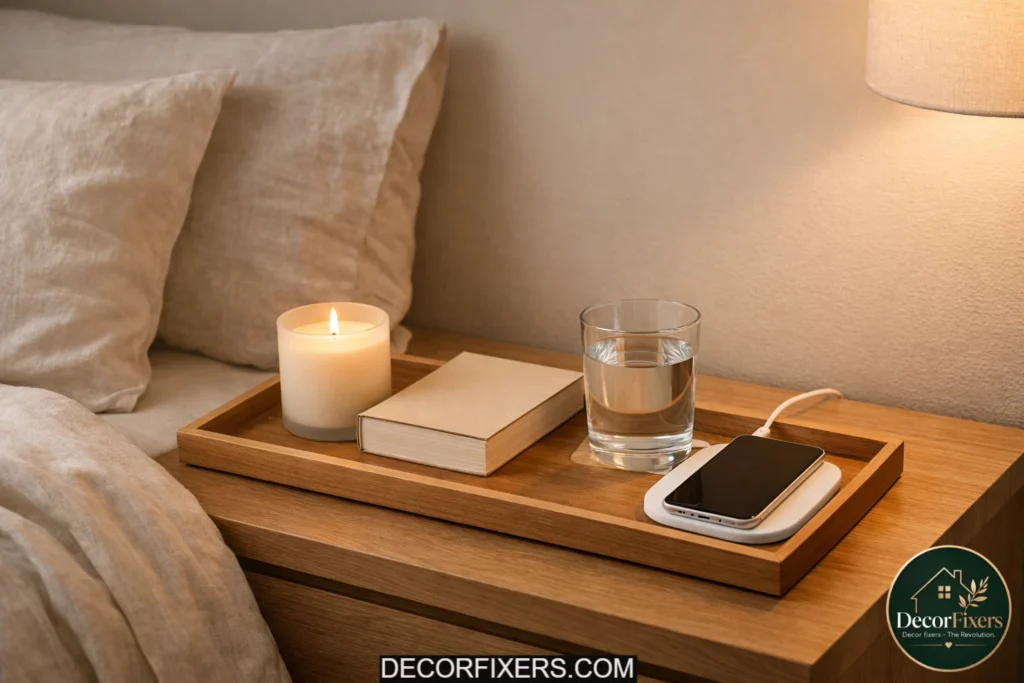
A nightstand without a tray becomes a dumping ground. A tray creates a visual boundary. Anything that doesn’t fit in the tray doesn’t belong on the nightstand.
Ceramic, wood, or woven, the material of the tray should match your palette. Keep it to four items: lamp, book, phone charger, water glass. That’s the full list. Nothing else earns a spot.
21. Go Frameless for Mirrors
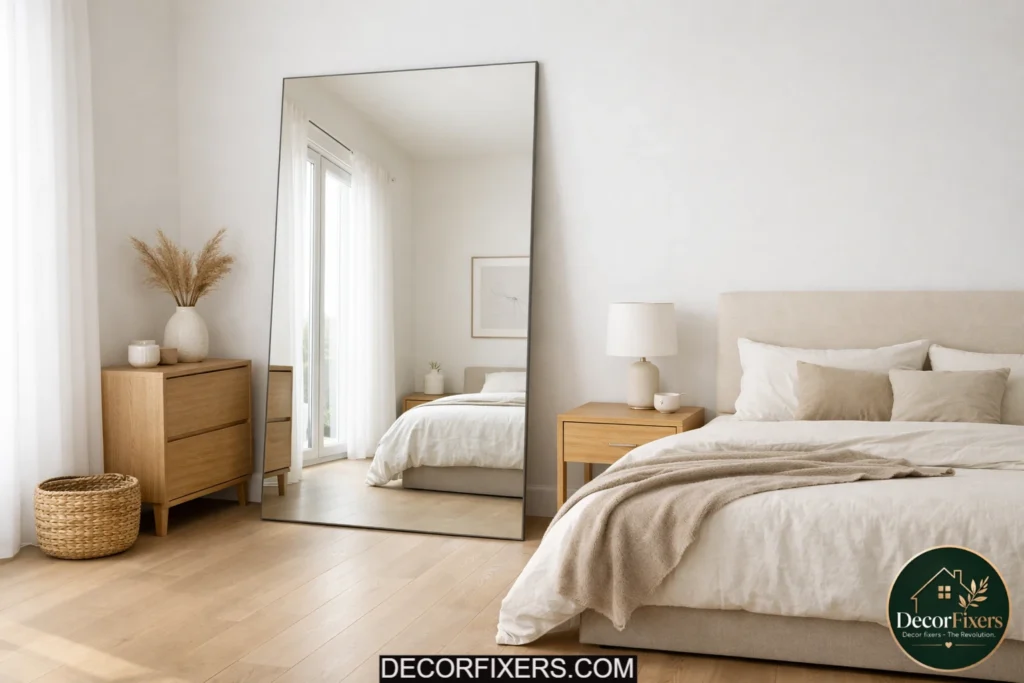
A heavy ornate mirror frame in a minimalist bedroom is like a shout in a library. It draws attention to itself rather than serving its function. A frameless mirror, or one in a thin metal profile, disappears into the wall.
Position it where it catches natural light and reflects the room’s best angle: usually the wall opposite the window. A leaning floor mirror in a thin black or brass frame works beautifully in small minimalist bedrooms.
22. Use Natural Wood Tones to Add Warmth Without Color
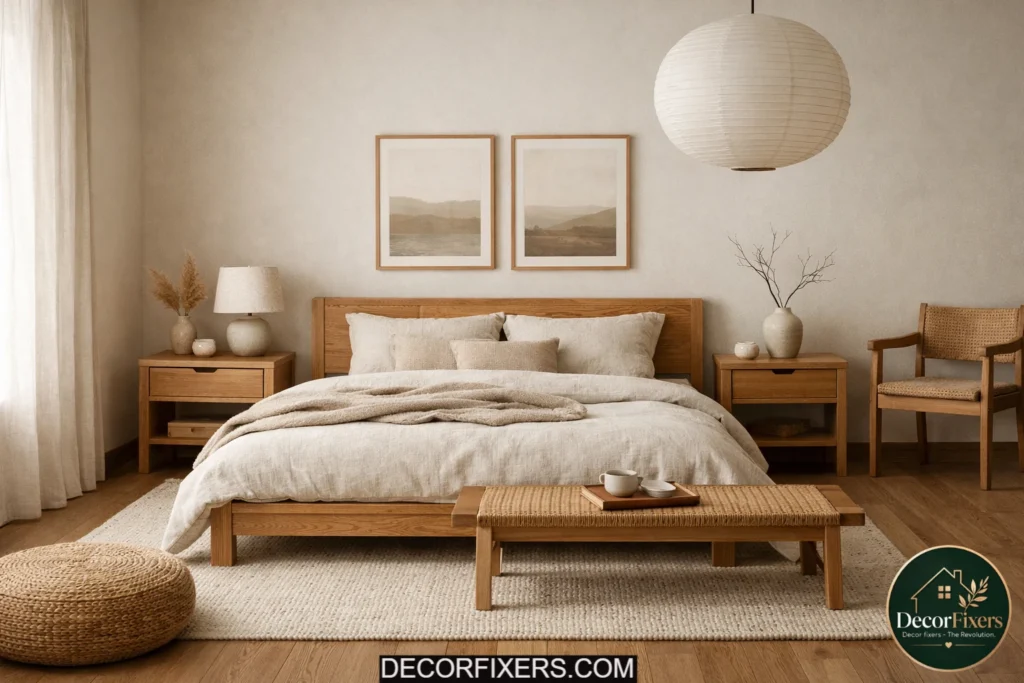
Wood is one of the few materials that adds warmth to a space without introducing a color that needs to be coordinated. In a neutral-palette bedroom, the grain and tone of natural wood do the heavy lifting.
Stick to one wood tone throughout; mixing pine, walnut, and oak in the same small room creates a cluttered feel even when surfaces are empty. Warm mid-tones (oak, ash, teak) are the most forgiving in minimalist bedroom furniture layouts.
23. Let in Maximum Natural Light
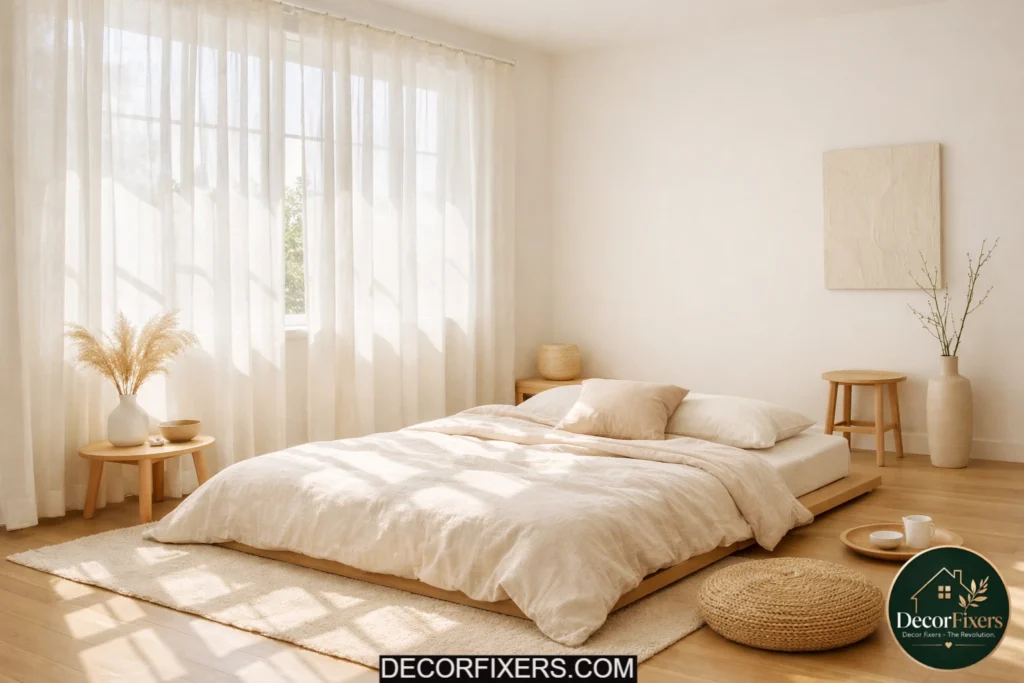
Natural light is the best design element that costs nothing. A minimalist bedroom needs it. Heavy blackout curtains (except for sleep purposes) kill the open, airy feel that makes minimalist spaces work.
Use sheer linen panels during the day to diffuse light without blocking it. If your room faces west or south, a warm afternoon light through linen curtains will do more for the room’s atmosphere than any decorating decision you make.
24. Limit Your Throw Pillows to Three
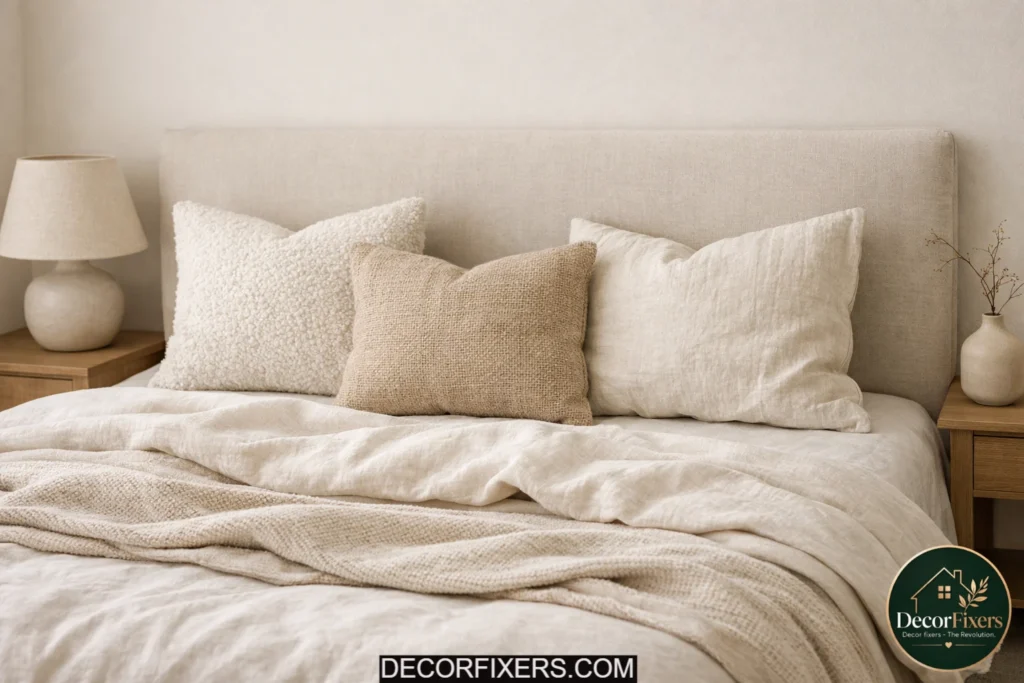
More than three decorative pillows and you’re not designing a minimalist bedroom, you’re staging a hotel brochure. Two sleeping pillows, one lumbar or accent pillow in a contrasting texture. That’s the formula.
The accent pillow should introduce one tactile variation, boucle against linen, ribbed cotton against smooth linen. Not a different color. Just a different surface.
25. Build a Transition Ritual Into the Room’s Layout
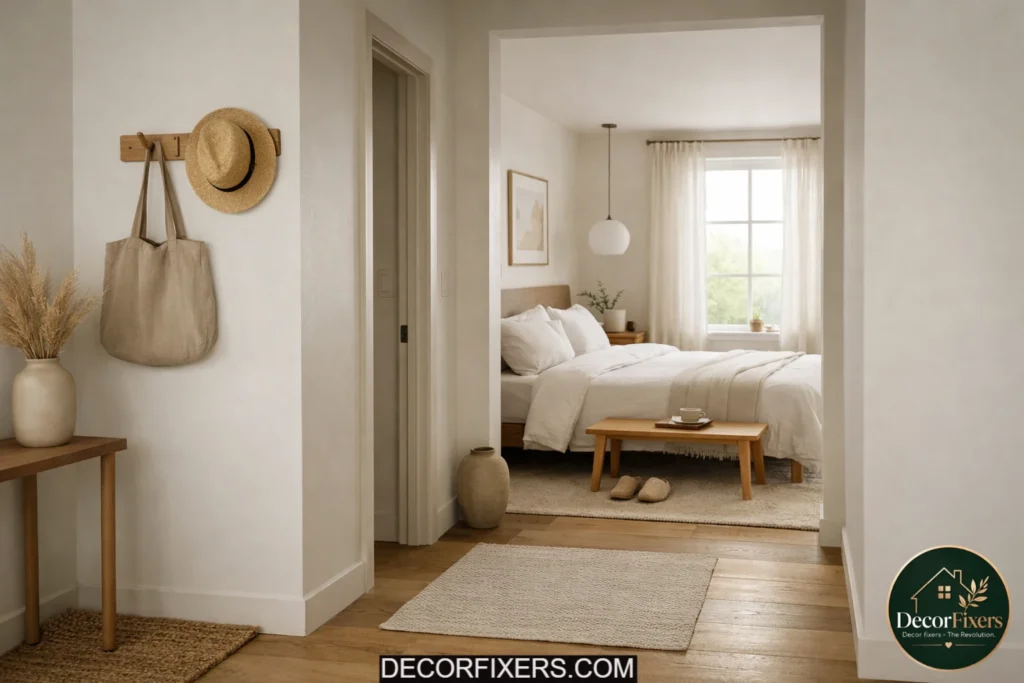
This is what most minimalist bedroom design guides completely miss. A room can be perfectly designed and still feel stressful if you haven’t thought about how you move through it.
Build a transition zone, even just a single hook near the door, a small bench at the foot of the bed, a dedicated spot for tomorrow’s clothes. When you enter the room, your eyes should move from this transition area to the bed to the window. That visual sequence is the difference between a bedroom that calms you and one that just looks calm in photos.
Warm Minimalism vs Cold Minimalism: Which One Actually Works for You
Here’s the thing: most articles don’t make this distinction, and it’s the reason half the people who try minimalist bedrooms end up reverting to their old setup within a month.
Cold minimalism uses stark whites, bare floors, and near-empty surfaces. It’s photogenic. It also feels like a hospital room after two nights.
Warm minimalism uses the same clean principles, fewer objects, cleaner lines, and intentional layout, but grounds them with creamy neutrals, tactile textures, and natural materials. Think linen duvet covers, a single piece of art, warm-toned lighting, and a low platform bed in oak or walnut.
Some experts argue that any color or texture breaks minimalism. That’s valid if you’re designing for a magazine shoot. But if you’re designing for a human being who has to sleep, work, and live in that room every day, warm minimalism wins. Every time.
| Warm minimalism vs cold minimalism: cold minimalism relies on stark whites, bare surfaces, and space, visually clean but often emotionally detached. Warm minimalism uses the same uncluttered layout but layers in natural materials like linen, wood, and wool. For most people designing a bedroom they actually sleep in, warm minimalism is the practical and sustainable choice. |
Quick Comparison: Minimalist Bedroom Style Variants
| Style Variant | Best For | Key Benefit | Limitation |
| Cold Minimalism | Studio apartments, renters | Max visual space | Feels sterile, hard to sustain |
| Warm Minimalism | Families, long-term homes | Cozy yet uncluttered | Requires thoughtful layering |
| Japandi Minimalism | Zen + Scandi lovers | Nature + calm merged | Harder to source authentic pieces |
| Eco Minimalism | Sustainability-focused | Guilt-free simplicity | Higher upfront cost |
| Cozy Minimalism | Cold climates, renters | Warmth without clutter | Easy to overdo textures |
CONCLUSION:
I spent a long time thinking I needed the perfect furniture, the right paint color, the exact bedding, before I could have the bedroom I actually wanted. What I actually needed was to stop adding and start editing.
The 25 ideas above aren’t a checklist to execute all at once. Pick the three that feel most urgent, probably the platform bed, the lighting, and clearing your surfaces, and start there. Let the room tell you what it needs next.
A minimalist bedroom doesn’t stay minimal on its own. You have to keep choosing it. But once you’ve felt what it’s like to wake up in a room that doesn’t have anything competing for your attention, you won’t want to go back.
FAQs:
Q: What’s the best color palette for a minimalist bedroom?
A: Warm whites, soft greiges, and earthy taupe tones work best. Stay within one dominant neutral and vary textures rather than colors. Avoid mixing more than two neutral families in one room.
Q: How do I make a minimalist bedroom feel cozy and not cold?
A: Layer natural textures, linen bedding, a boucle throw, a jute rug, and wooden surfaces. Warm lighting under 2700K makes the biggest single difference. Cold minimalism feels bare because it skips texture; warm minimalism uses texture as the design language.
Q: How do I declutter my bedroom before decorating in a minimalist style?
A: Empty every surface completely. Return only items you use daily or that bring you genuine calm. Store everything else in closed storage, under the bed, in drawers, inside the wardrobe. Then apply design ideas to the cleared space.
Q: Should I remove the TV from a minimalist bedroom?
A: If possible, yes. A TV is a visual disruptor even when off. If removing it isn’t realistic, hide it inside a closed wardrobe, a TV chest at the foot of the bed, or use a motorized wall mount that retracts when not in use.
Q: When should I use a rug in a minimalist bedroom?
A: Always, but size it correctly. The front legs of the bed should rest on the rug. A too-small rug reads as an afterthought. Choose natural fiber in a flat weave: jute, wool, or sisal in a neutral that matches or complements your floor.

Creator of DecorFixers, sharing practical home and interior ideas focused on real-life usability, simple design improvements, and budget-friendly solutions.