

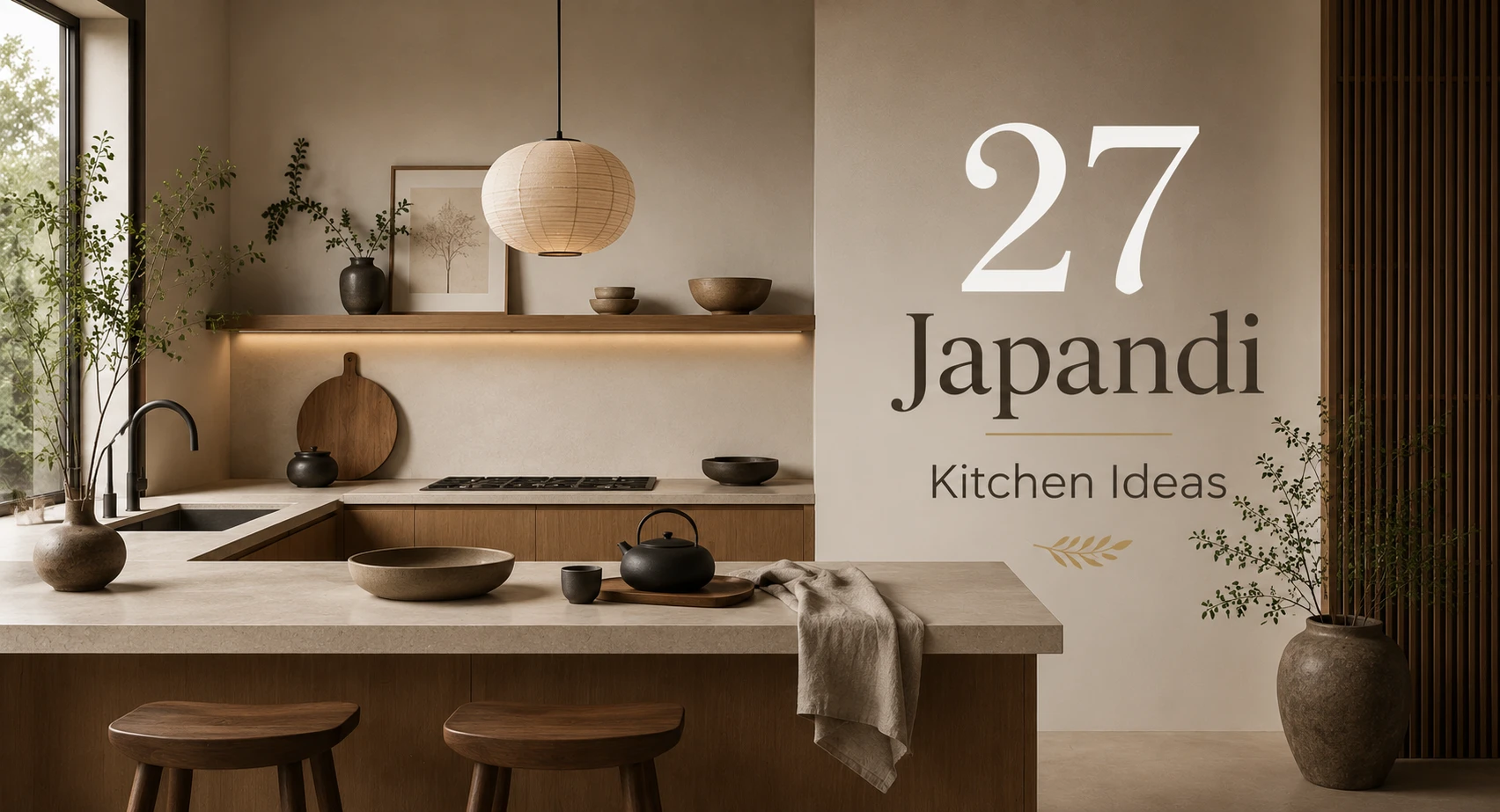
I remember standing in my own kitchen a couple of years ago, staring at a countertop covered in gadgets I barely used, cabinets crammed with things I didn’t need, and walls painted a shade of white that somehow managed to feel both clinical and chaotic. The space that was supposed to be the heart of the home felt more like a storage unit with a stove.
I’d saved hundreds of Pinterest pins. Scrolled through Instagram at midnight. I knew the aesthetic I wanted, clean, warm, calm, but I couldn’t name it, and I definitely couldn’t figure out how to achieve it without spending a fortune or hiring a designer.
Then I found Japandi. And suddenly, everything made sense.
This guide covers 27 specific, actionable ideas, from cabinetry choices and color palettes to lighting, hardware, and how to make the style work in a small kitchen. It won’t address commercial kitchen renovations or listed heritage buildings, where structural changes apply different rules. But if you’re a homeowner ready to transform your kitchen into something that actually feels good every single day, you’re in the right place.
What is Japandi kitchen design?
Japandi kitchen design is a fusion aesthetic that blends Japanese minimalism and Scandinavian functionality into a single, cohesive style. It prioritizes natural materials, neutral color palettes, clean-lined cabinetry, and intentional simplicity, creating spaces that feel both calm and warm rather than cold or cluttered.
1. Start with Flat-Panel Handleless Cabinets
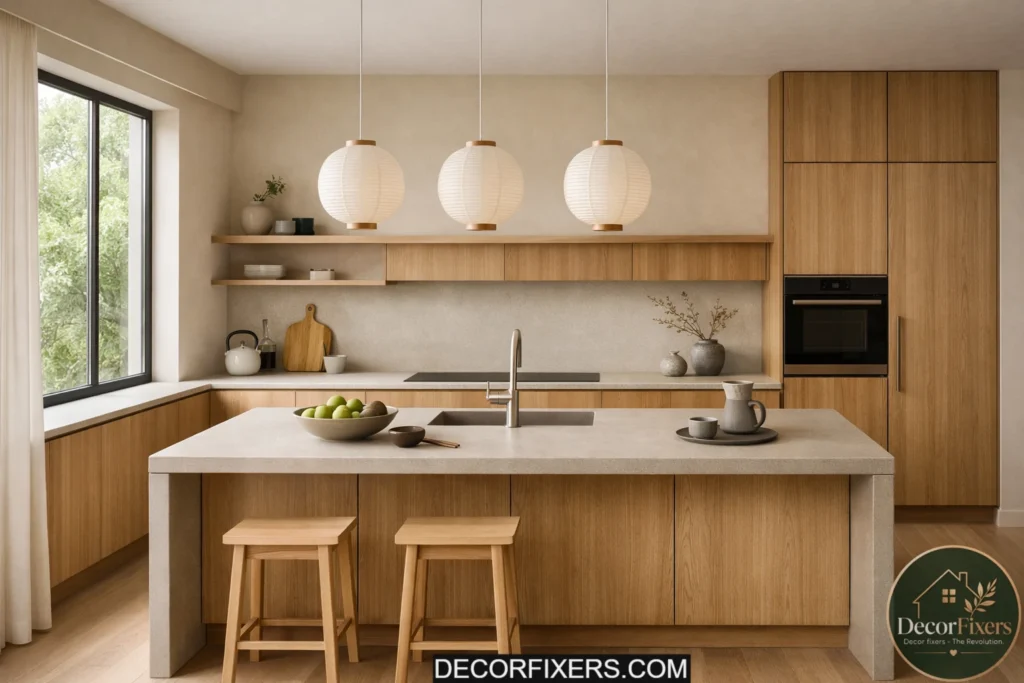
The cabinet is where Japandi lives or dies. Flat-panel doors with no hardware, or integrated touch-to-open mechanisms, are the single most defining element of this style.
If you’re working with a budget, IKEA’s SEKTION cabinet system with AXSTAD matte grey or white fronts gets remarkably close to the look. For a step up in quality, Bertch Cabinetry offers oak and walnut finishes specifically suited to Japandi interiors. Skip any cabinet with a raised center panel, ornate molding, or high-gloss lacquer; those belong in a different kitchen entirely.
2. Resolve the Wood Tone Dilemma the Right Way
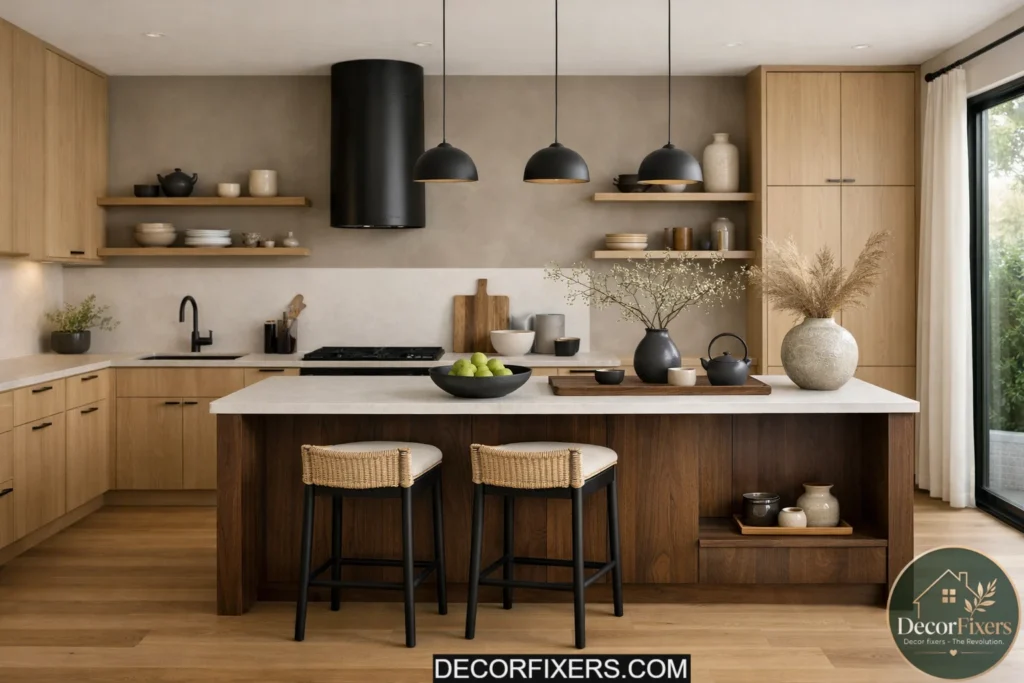
Here’s the thing: this is where most Japandi kitchen articles leave you stranded. Japanese design traditionally favors dark timbers, such as walnut, ebony-stained oak, and deep-grain woods. Scandinavian design leans toward light oak, ash, and pale pine.
The resolution isn’t choosing one over the other. It’s using both deliberately. Light oak for perimeter cabinets keeps the room airy. A single walnut island or a dark-stained lower cabinet run adds the depth Japanese aesthetics demand. One rule: stick to two wood tones maximum, and make sure their undertones match, warm to warm, never mixing cool grey-toned wood with warm honey oak.
Quick Comparison: Japanese vs. Scandinavian vs. Japandi
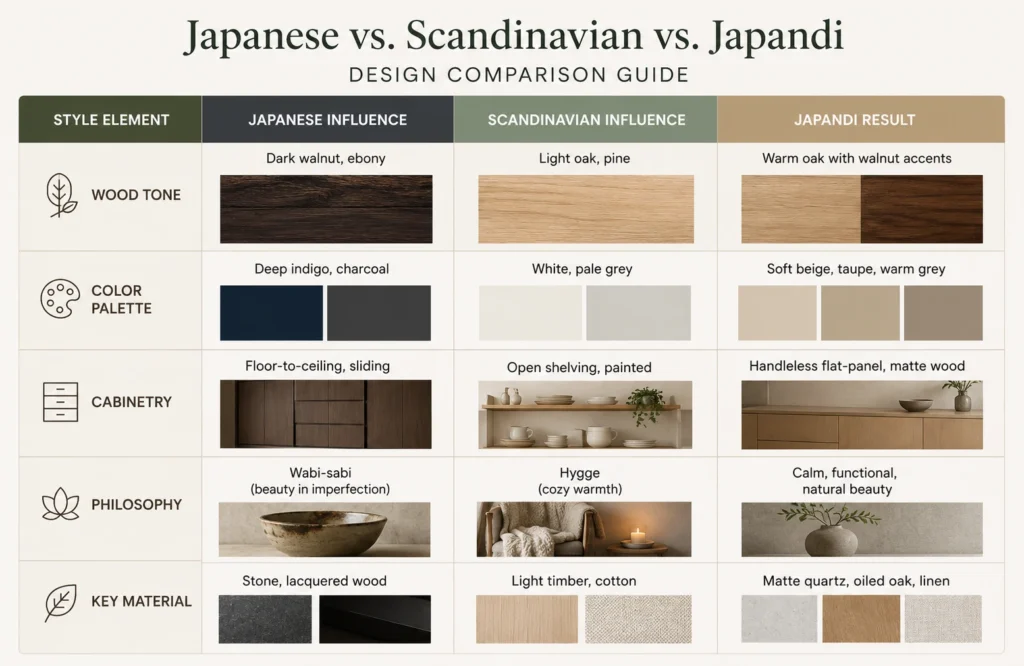
| Style Element | Japanese Influence | Scandinavian Influence | Japandi Result |
| Wood Tone | Dark walnut, ebony | Light oak, pine | Warm oak with walnut accents |
| Color Palette | Deep indigo, charcoal | White, pale grey | Soft beige, taupe, warm grey |
| Cabinetry | Floor-to-ceiling, sliding | Open shelving, painted | Handleless flat-panel, matte wood |
| Philosophy | Wabi-sabi (beauty in imperfection) | Hygge (cozy warmth) | Calm, functional, natural beauty |
| Key Material | Stone, lacquered wood | Light timber, cotton | Matte quartz, oiled oak, linen |
3. Build Your Color Palette Around One Anchor Neutral
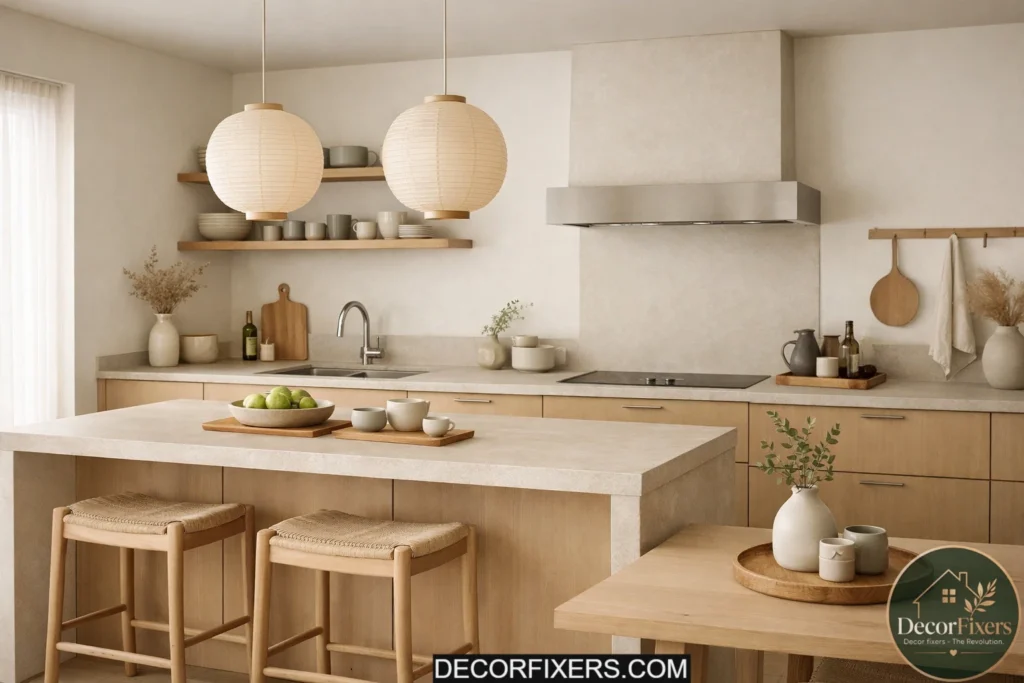
Neutral doesn’t mean boring. The Japandi color palette is warm white, taupe, sandy beige, or soft stone grey as the dominant base, and those tones do the heavy lifting. Walls, countertops, and large surfaces should stay within that range.
The accent layer is where you earn character: muted sage green, soft charcoal, or a single terracotta element. Nothing loud. Nothing competing. Think of it as a conversation between tones rather than a statement; each color acknowledges the others without shouting.
If you’re planning a broader renovation beyond Japandi styling, our guide to Modern Kitchen Design Trends explores the materials, layouts, and quiet-luxury concepts shaping contemporary kitchens across North America, the UK, and Australia. It also explains how Japandi fits into the wider movement toward calmer, more functional living spaces.
4. Choose Matte Stone for Countertops, Not High-Gloss Quartz
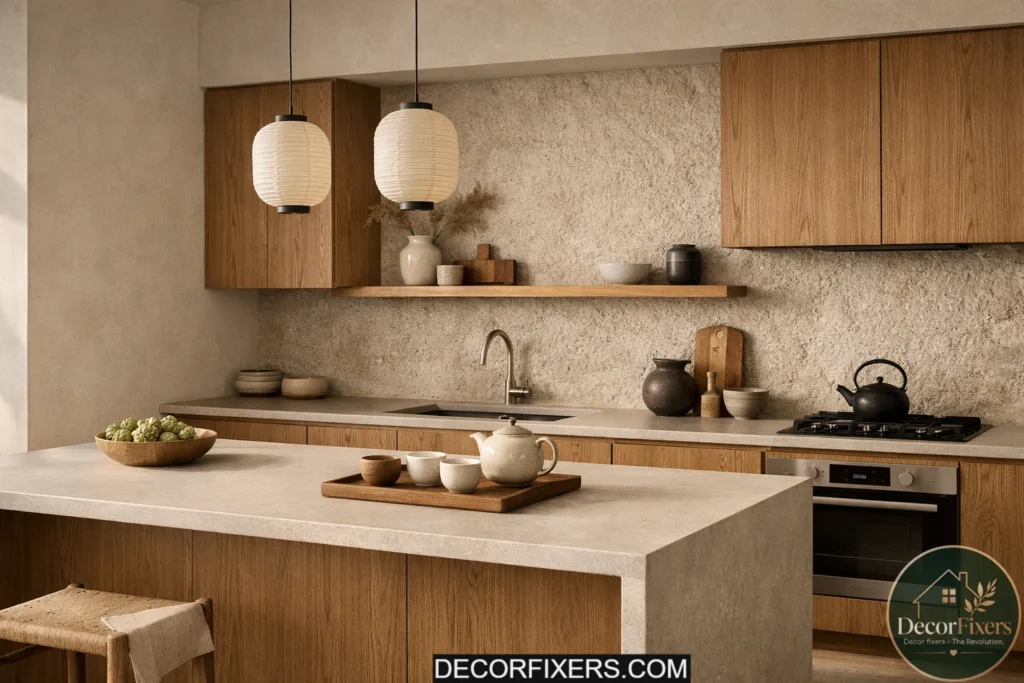
Glossy surfaces reflect light in a way that feels sharp and manufactured, the opposite of what Japandi is going for. Matte stone, whether natural or engineered, absorbs light and creates that quiet, grounded feel the style demands.
Caesarstone’s concrete and raw-look quartz finishes are a strong choice at the mid-range price point. For natural stone, honed (matte) limestone or leathered granite work beautifully. The goal is a surface that looks like it was quarried, not manufactured. A polished white quartz would technically fit the color palette, but kill the mood entirely.
5. Use Open Shelving, But Only for What’s Worth Seeing
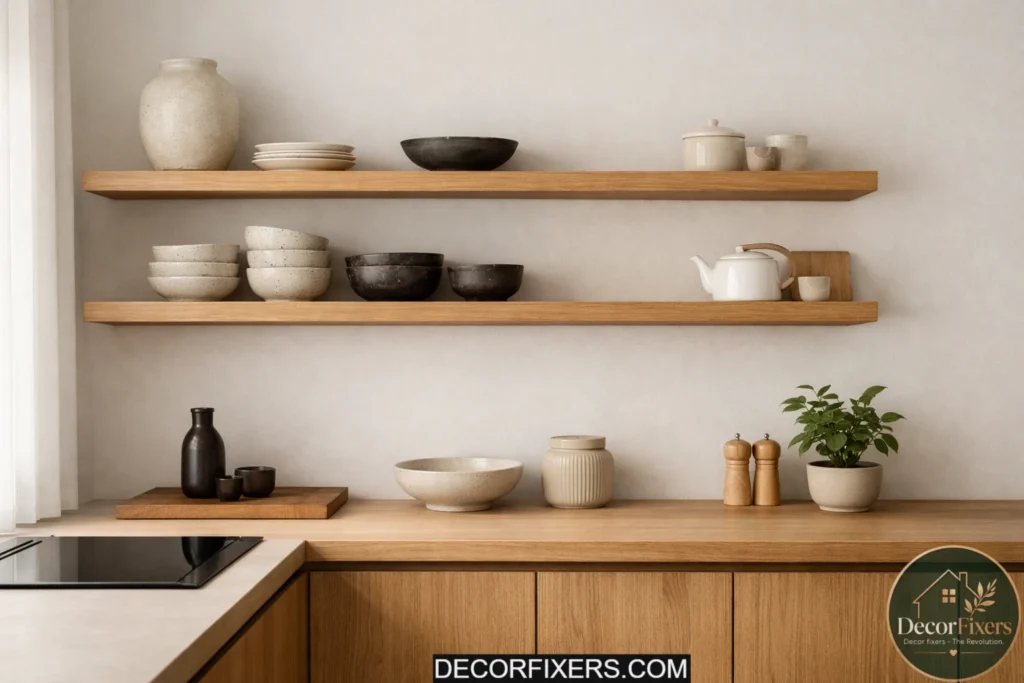
Open shelving in Japandi kitchens isn’t a display opportunity; it’s a discipline. If everything on the shelf earns its place, open shelving adds warmth and airiness. If it becomes the place where random mugs and half-used condiments land, it becomes visual noise.
Keep shelves to two or three items per shelf: a handmade ceramic bowl, a small plant, and a timber board. Float the shelves in solid oak or walnut with invisible brackets. And be ruthless: the moment something looks like clutter, it goes inside a cabinet. That’s the whole deal.
6. Add Matte Black Hardware as the Sole Accent
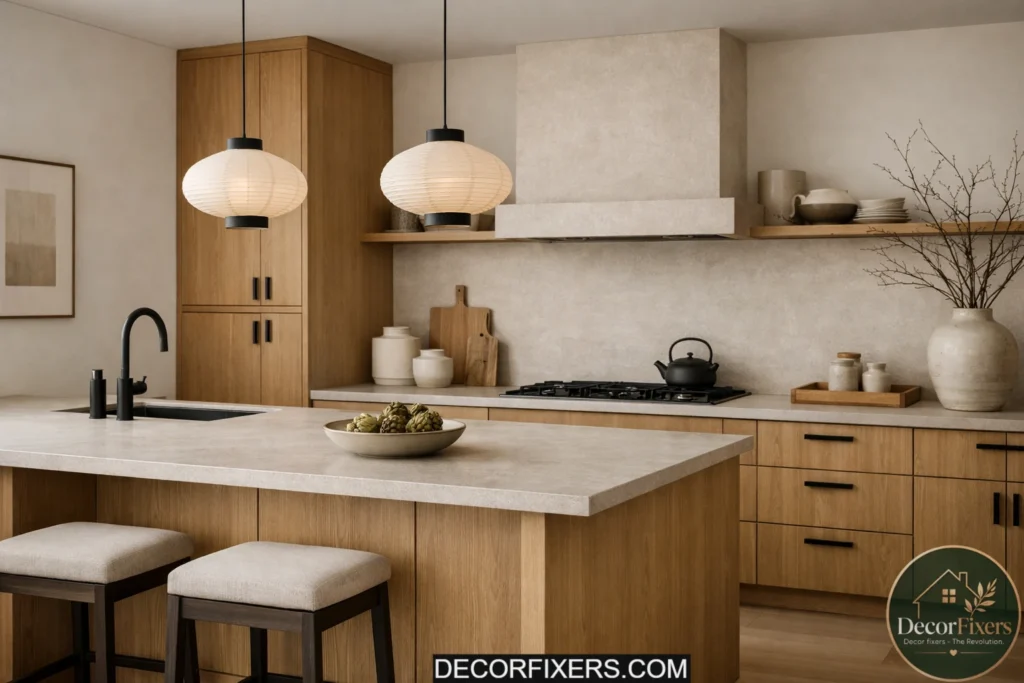
If you’re not going fully handleless, matte black hardware is the Japandi answer. Not brushed gold. Not chrome. Matte black, flat, non-reflective, graphite-like in its restraint.
Or maybe I should say it this way: matte black hardware is where Japandi borrows most clearly from Japanese aesthetics, that appreciation for dark, deliberate accents against natural wood. A simple bar pull or a small recessed grip in matte black on warm oak cabinets is one of the most elegant combinations in contemporary kitchen design.
7. Design for Small Kitchens Using Vertical Space
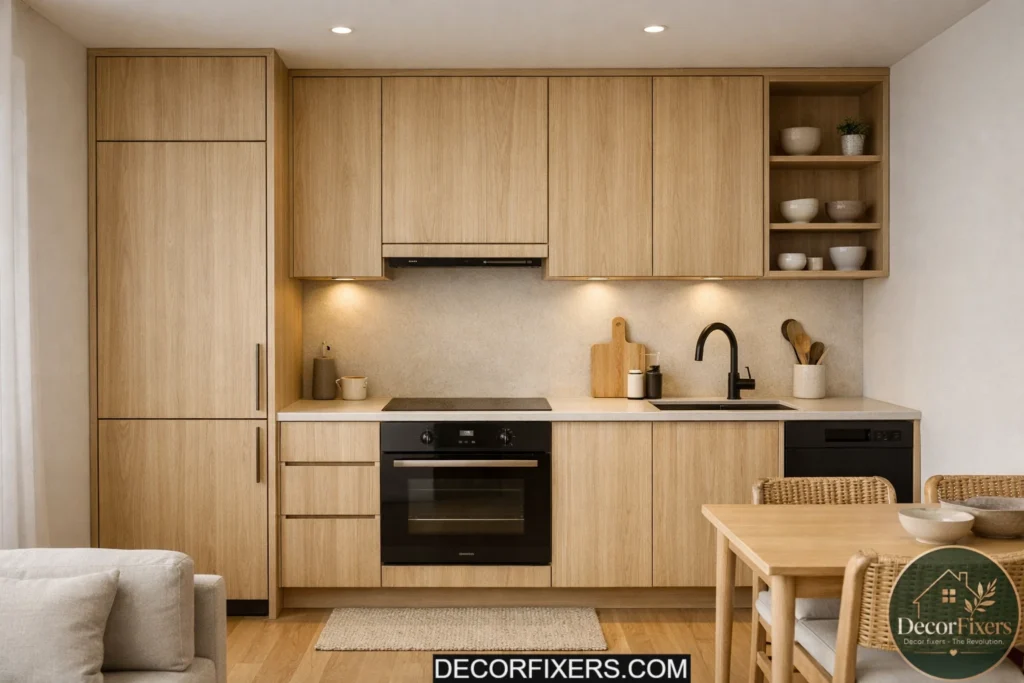
Look, if you’re working with a galley kitchen or a small apartment kitchen, Japandi is actually your best friend. The style’s obsession with smart storage and uncluttered surfaces makes compact spaces feel deliberately designed rather than cramped.
Floor-to-ceiling cabinetry draws the eye upward and eliminates dead space. Integrated appliances, built-in fridge, flush dishwasher, and remove visual interruptions. Keep the counter completely clear except for one or two intentional objects. A small kitchen done right in Japandi style feels spacious because every inch is intentional.
8. Hang Washi Paper or Rattan Pendant Lights
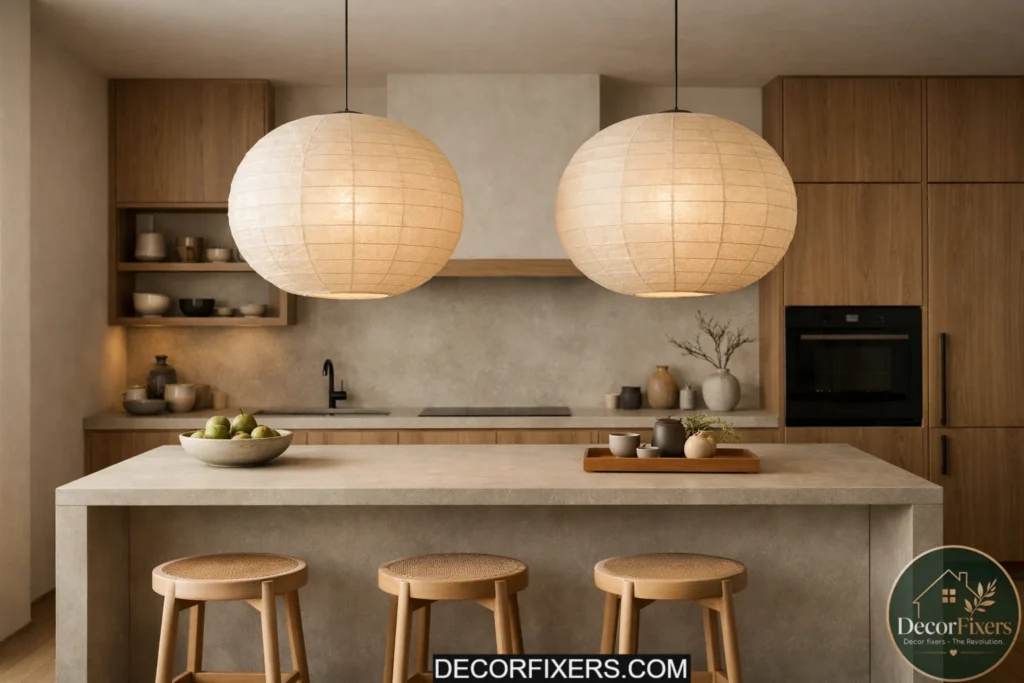
Lighting in a Japandi kitchen shouldn’t feel designed. It should feel discovered, as if the light source is part of the natural environment rather than a fixture.
Washi paper pendants (the Japanese lantern style) or hand-wrapped rattan pendants hung over an island are the signature Japandi lighting move. They cast a warm, diffused glow that contrasts beautifully with the cool precision of flat-panel cabinetry. Keep ceiling spots recessed and minimal. Wall sconces in aged brass or black iron work for ambient layers. The goal is layered warmth, not uniform brightness.
9. Bring in Stone with a Honed Marble Backsplash
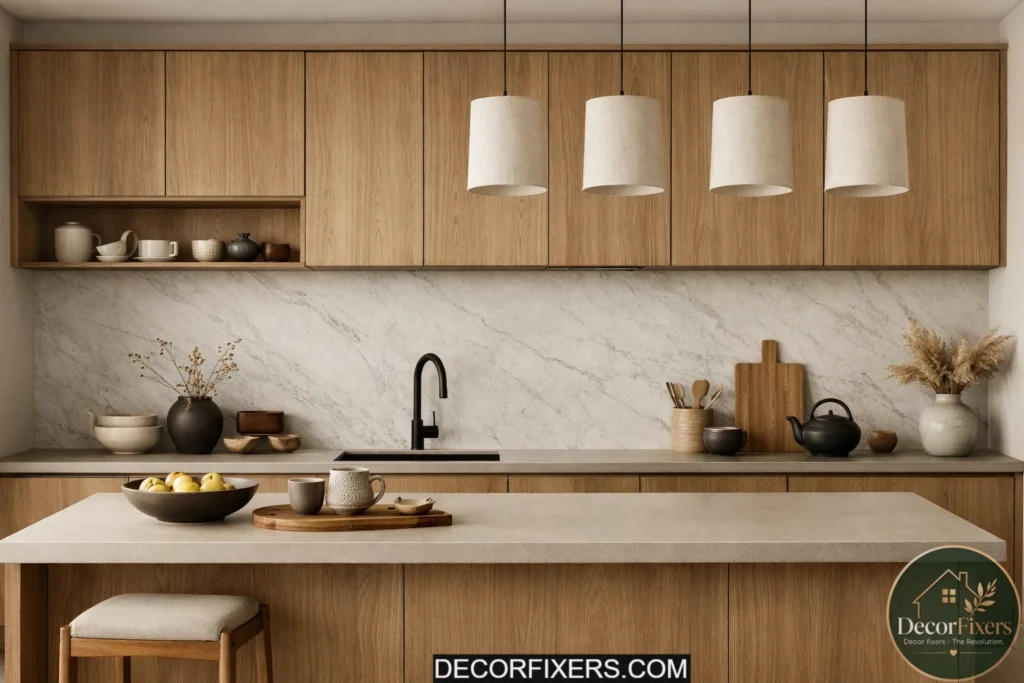
A honed (not polished) marble or porcelain slab backsplash that runs seamlessly from countertop to ceiling is arguably the most sophisticated single move in Japandi kitchen design.
It removes the visual break of a tiled backsplash, creates a sense of continuity and height, and brings in the natural stone texture that both Japanese and Scandinavian aesthetics prize. Match the stone as closely as possible to your countertop material for a monolithic, calm effect. If slab stone is over budget, large-format matte porcelain in a limestone or travertine pattern achieves nearly the same result.
10. Keep Appliances Hidden, Or Choose Matte Black Ones
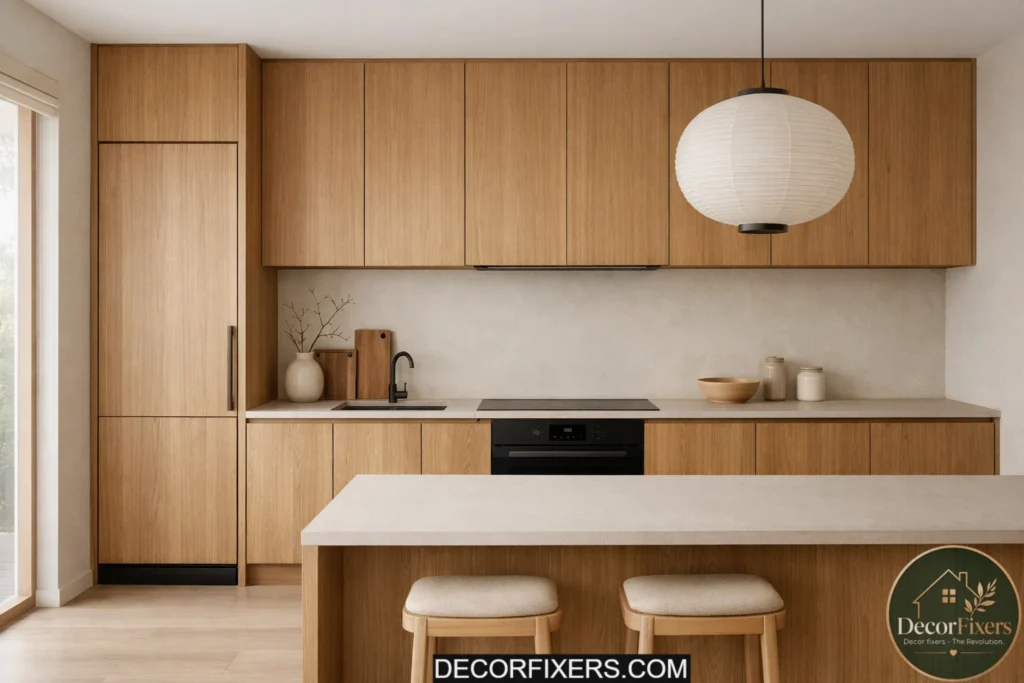
Stainless steel appliances, the default in most kitchens, are reflective, industrial, and visually loud. They clash with Japandi’s quiet, organic aesthetic almost every time.
The ideal solution is integration: cabinet-fronted fridge, dishwasher behind a matching panel, microwave tucked into a deep drawer or cabinet. Where that’s not possible, matte black appliances from brands like Smeg (retro black range) or Samsung’s Bespoke line in matte grey work surprisingly well. The rule is simple: if it reflects, hide it. If it can’t be hidden, go matte.
11. Use a Single Statement Plant, Not a Garden
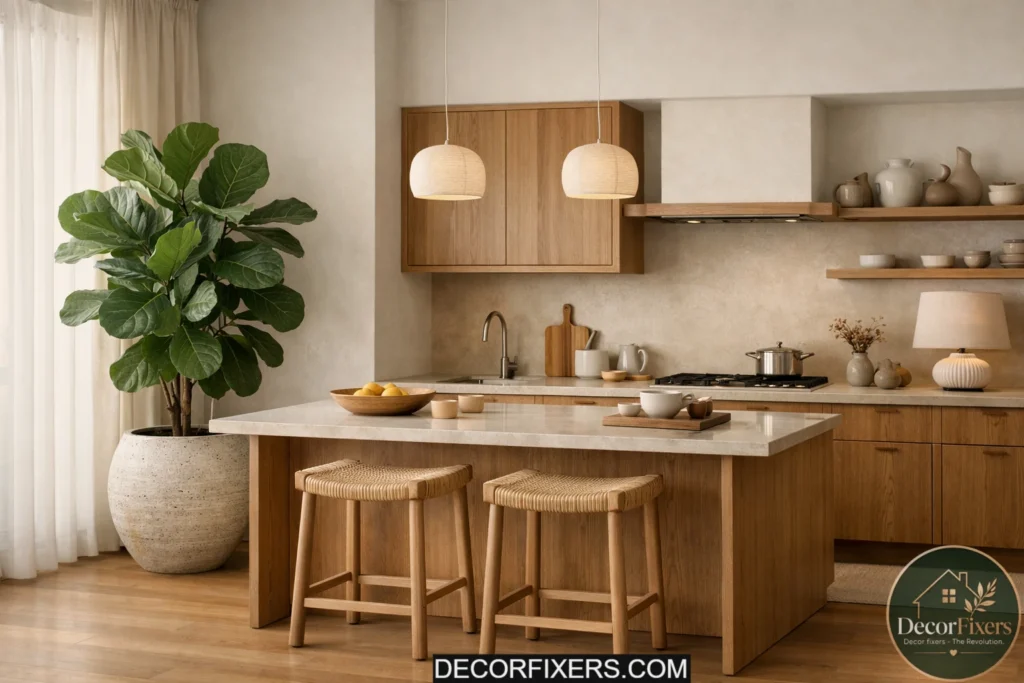
Biophilic design is central to both Japanese and Scandinavian traditions. But Japandi doesn’t mean covering every surface in trailing plants and herb pots, which tips into maximalism.
One considered plant, in a handmade ceramic or raw clay pot, is placed with intention. A fiddle leaf fig in a corner. A snake plant on an open shelf. A single stem in a bud vase on the counter. The restraint is the point. It signals that the plant was chosen, not accumulated.
12. Add Wabi-Sabi Through Handmade Ceramics
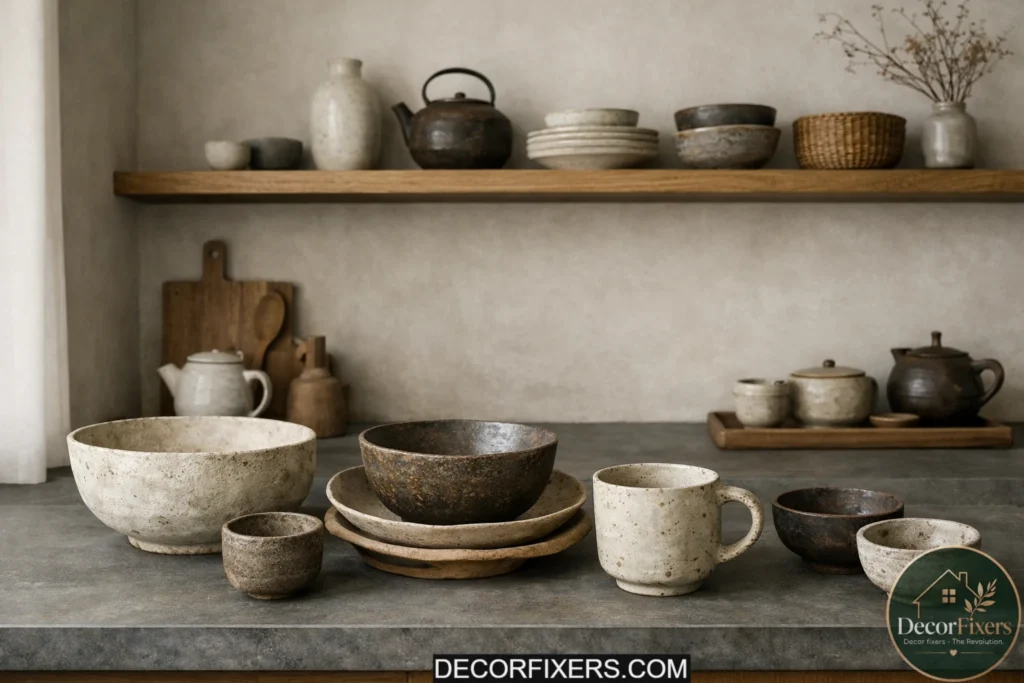
Wabi-sabi, the Japanese philosophy of finding beauty in imperfection, is what stops Japandi from becoming just another cold minimalism trend.
Handmade ceramics are the easiest way to bring it into your kitchen. A set of hand-thrown stoneware mugs with slightly uneven rims, a ceramic serving bowl with a natural ash glaze, and a matte clay oil bottle on the counter. These things introduce organic irregularity into a space that might otherwise feel too controlled. It’s a small detail that makes a large difference in how the room feels to actually live in.
13. Integrate Sage Green as Your One Muted Accent Color
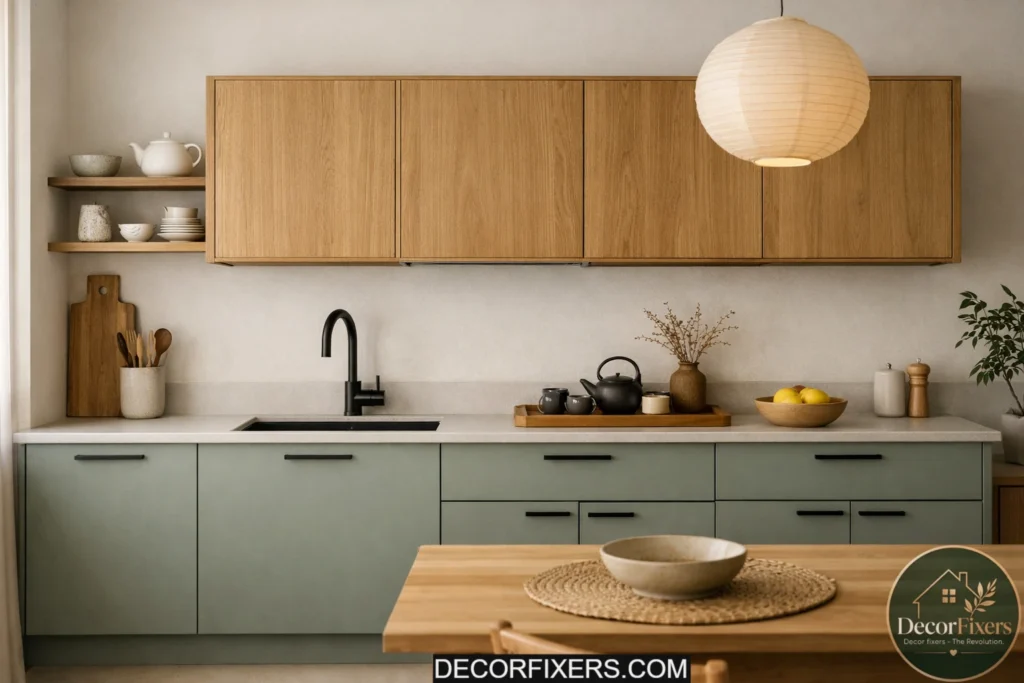
I’ve seen conflicting data on this one; some Japandi purists argue for strict neutrals only, while 2025 kitchen trend reports from designers like Roundhouse consistently highlight muted greens (sage, olive, matcha) as the accent color that’s defining the evolution of Japandi right now. My read: sage green is the safest, most universally successful accent in this style.
Use it on lower cabinets only, or on a kitchen island. Keep upper cabinets in warm white or light oak. The green grounds the room in nature without competing with the wood tones, and it photographs beautifully, which matters if you’ll ever list the home.
14. Choose a Waterfall Island in Warm Wood or Stone
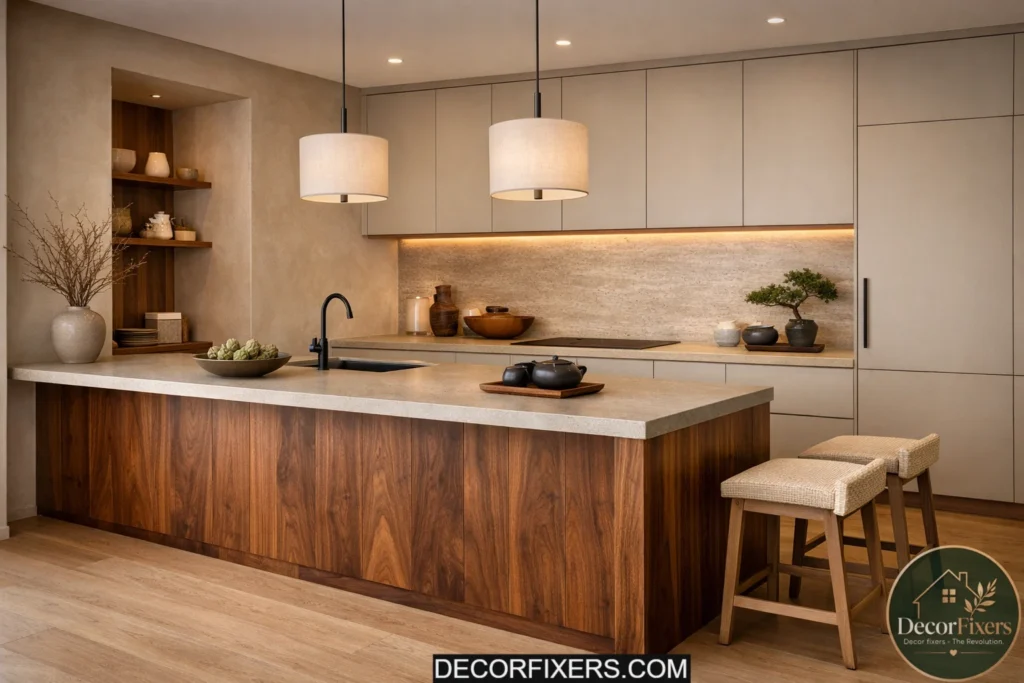
A waterfall island, where the countertop material continues vertically down the sides to the floor, is one of the cleanest architectural moves in contemporary kitchen design.
In a Japandi context, a walnut wood-grain waterfall island or a matte stone one creates an anchor point for the room. It’s sculptural without being decorative. If your kitchen has an island, the waterfall treatment elevates it from functional furniture to a considered design element, which is exactly the Japandi intention.
15. Maximize Natural Light With Minimal Window Treatments
Both Japanese and Scandinavian design philosophies treat natural light as a primary material, not just a functional necessity but an element that shapes the room’s mood throughout the day.
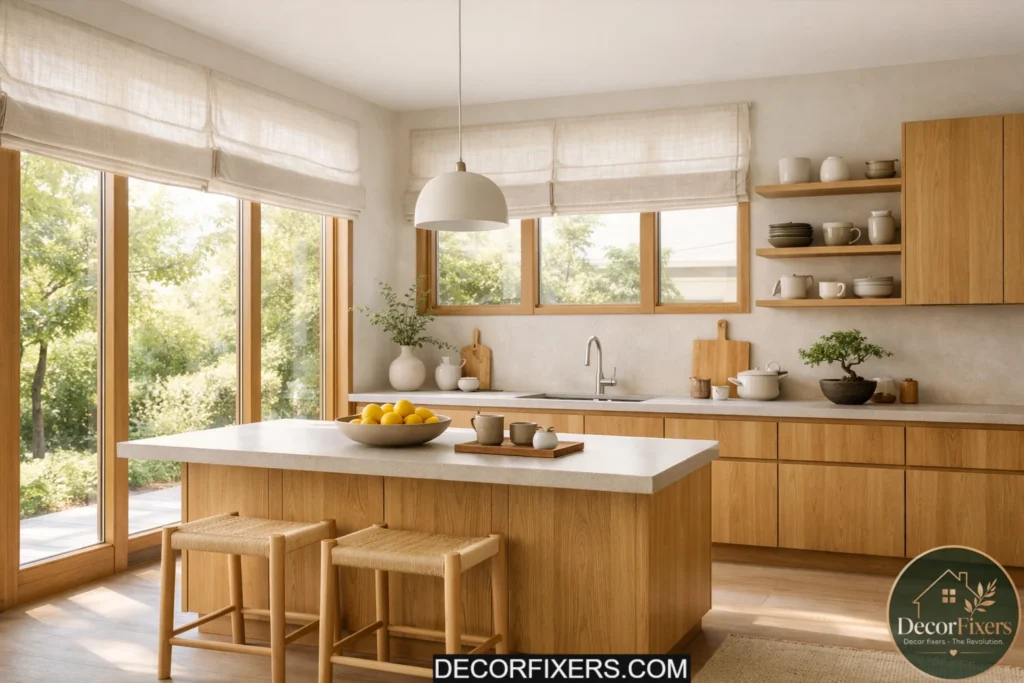
In a Japandi kitchen, this means minimal window treatments. If privacy isn’t an issue, leave windows completely bare. Where coverings are needed, linen roman blinds in natural, undyed fabric are the right choice. No heavy drapes, no patterned valances, nothing that interrupts the flow of light into the space.
16. Lay Engineered Oak or Limestone Tile Flooring
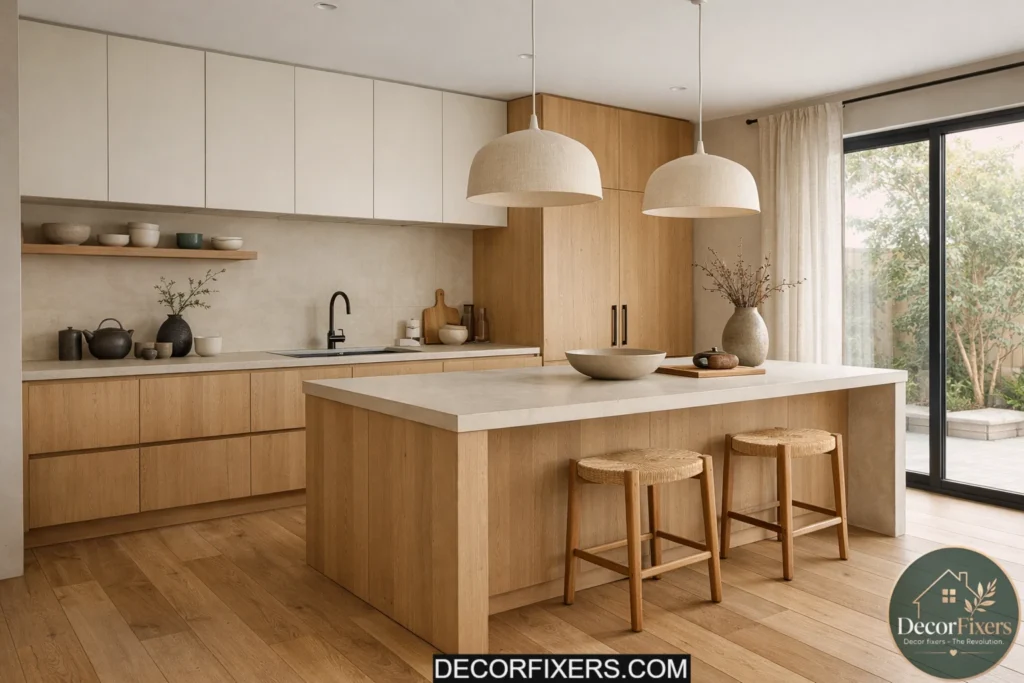
Floor choice ties the whole room together, and in a Japandi kitchen, continuity is everything. Wide-plank engineered oak flooring (in a natural or light brushed finish) flows beautifully from the kitchen into adjoining living spaces, reinforcing the connected, open quality of the style.
Large-format matte limestone or concrete-look porcelain tile works equally well, particularly if you want a more Japanese aesthetic lean. What to avoid: heavily veined high-gloss tiles, dark wood floors with a reddish undertone, and anything with a pattern that competes with the cabinetry for attention.
17. Install Pull-Out Drawer Systems for Hidden Storage
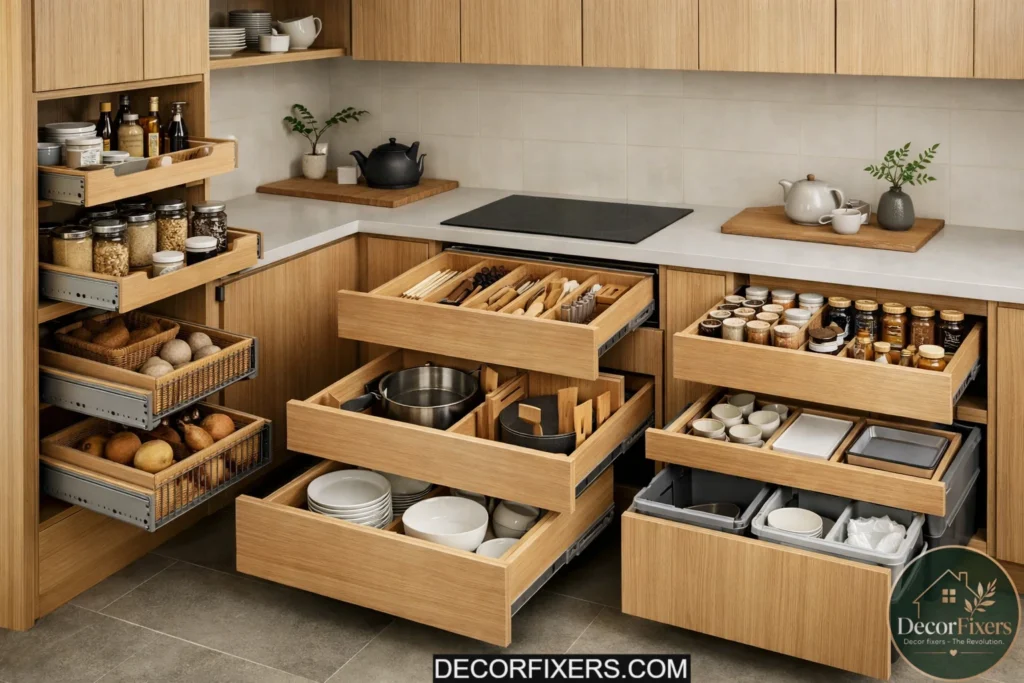
This is what most guides skip entirely: the inside of your cabinets matters as much as the outside. A Japandi kitchen’s clean surfaces only stay clean if the storage behind those flat-panel doors is genuinely organized.
Pull-out drawer systems from brands like Blum (Legrabox series) or IKEA’s MAXIMERA drawer inserts make the interior as intentional as the exterior. Bamboo or solid wood drawer organizers, uniform container sets for pantry items, and dedicated zones for specific categories make it possible to maintain the surface calm. The philosophy extends inward: every object has a home, and that home is out of sight.
If maintaining a visually calm surface feels challenging, these Kitchen Counter Styling Ideas offer practical ways to curate everyday objects without making the space feel empty or overly staged. The focus is on balance, texture, and intentional simplicity rather than decoration for its own sake. For homeowners prioritising organisation as much as aesthetics, integrating Smart Kitchen Storage Features like pull-out pantry systems, hidden charging drawers, and modular inserts can dramatically improve how a Japandi kitchen functions day to day. These upgrades support the uncluttered philosophy that the style depends on.
18. Use a Timber Breakfast Bar for Informal Dining
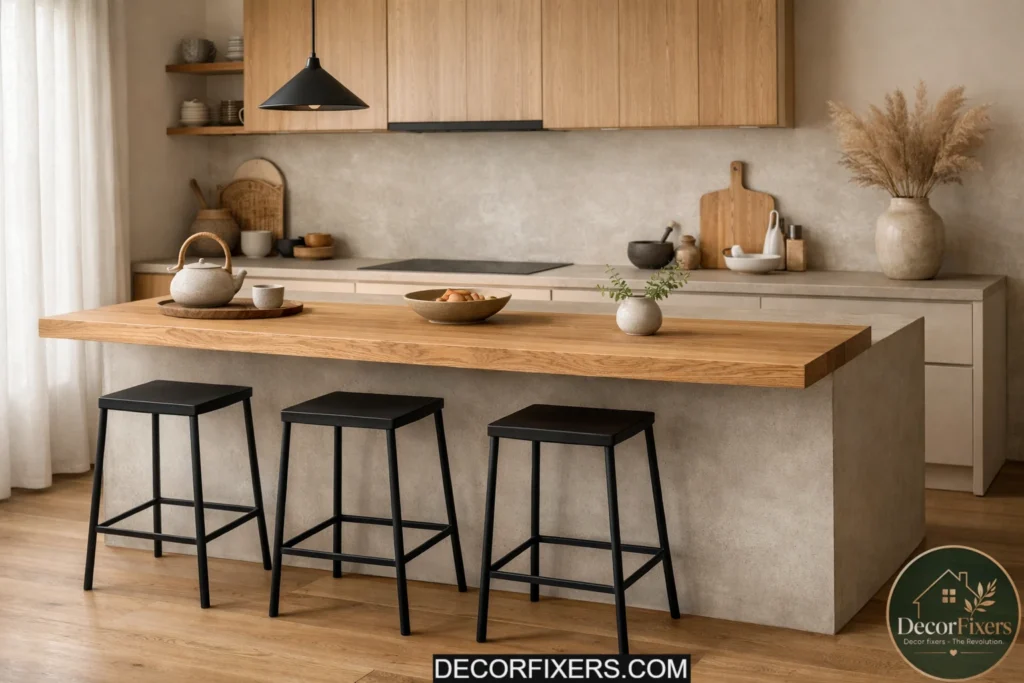
A solid timber breakfast bar, either a live-edge slab or a simply finished solid oak counter, extending from the island or peninsula, adds warmth and casual functionality.
Pair it with minimal stools: black powder-coated metal legs with a natural wood or leather seat pad. No upholstered bar stools with busy fabric. The stool should look like it was made for this kitchen, not pulled from a different room. Two or three stools maximum, anything more and the space starts to feel crowded, and the composition breaks down.
19. Introduce Texture with Fluted Glass or Reeded Wood Panels
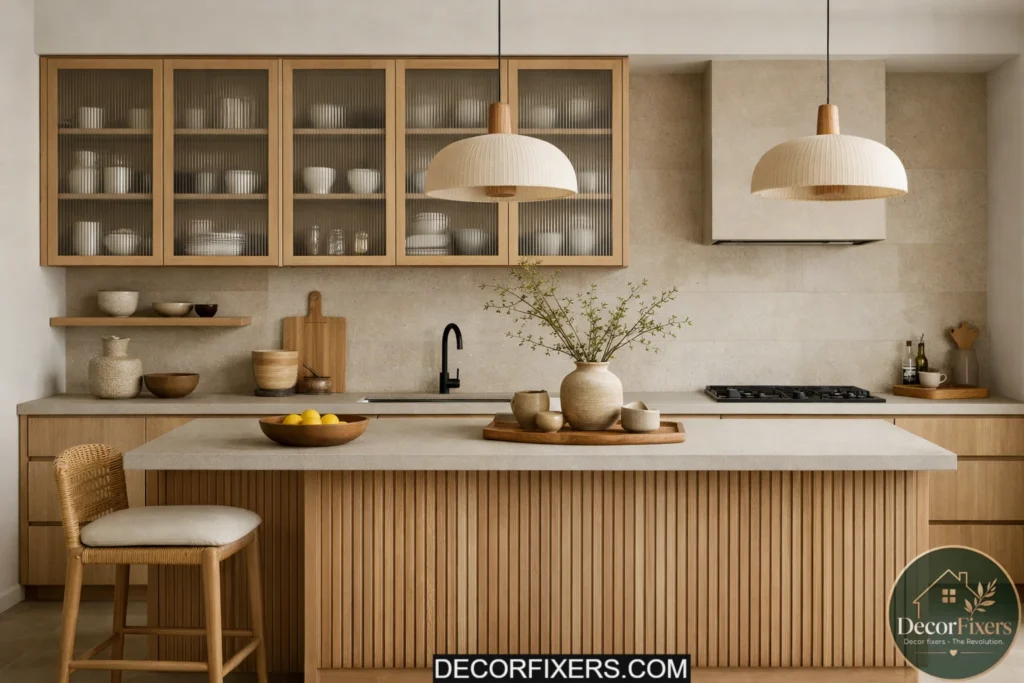
Flat-panel everything can tip into monotony if there’s no textural variation. Fluted (reeded) glass on a select few upper cabinet doors introduces visual interest without breaking the minimal spirit.
The frosted, ridged texture of fluted glass keeps the interior contents partially visible, which encourages you to keep those contents curated, while adding a hand-crafted quality that feels authentically Japandi. Alternatively, reeded solid wood panels used as a feature end panel on an island bring the same organic texture in a different material. Either option adds depth without adding visual noise.
20. Keep the Sink Area Entirely Clear
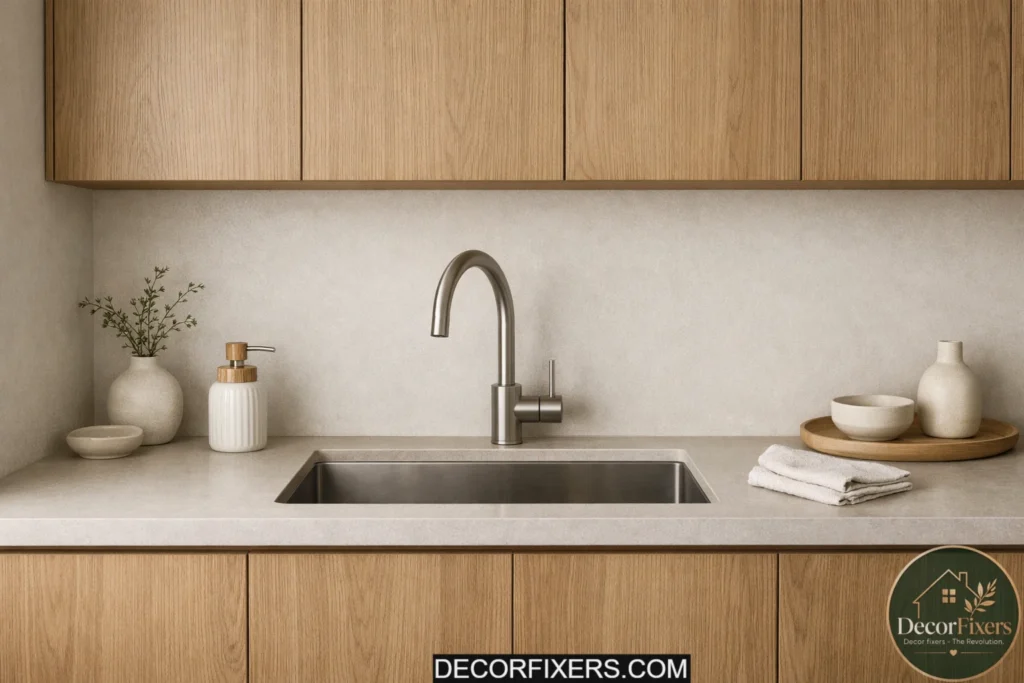
The sink area is where Japandi discipline gets tested daily. Dish soap dispensers, sponge holders, dish racks, small cutting boards, they all accumulate in the sink zone and collectively destroy the calm atmosphere you’ve worked to create.
The Japandi approach: an undermount sink (no rim to collect grime or visual clutter), a single quality dish soap in a refillable ceramic pump, and a dish brush laid flat. That’s it. A drying mat is tucked away in a drawer when not in use. The moment you can leave the sink area and it looks like it belongs in a design magazine, you’ve achieved the goal.
21. Select Integrated Under-Cabinet LED Lighting
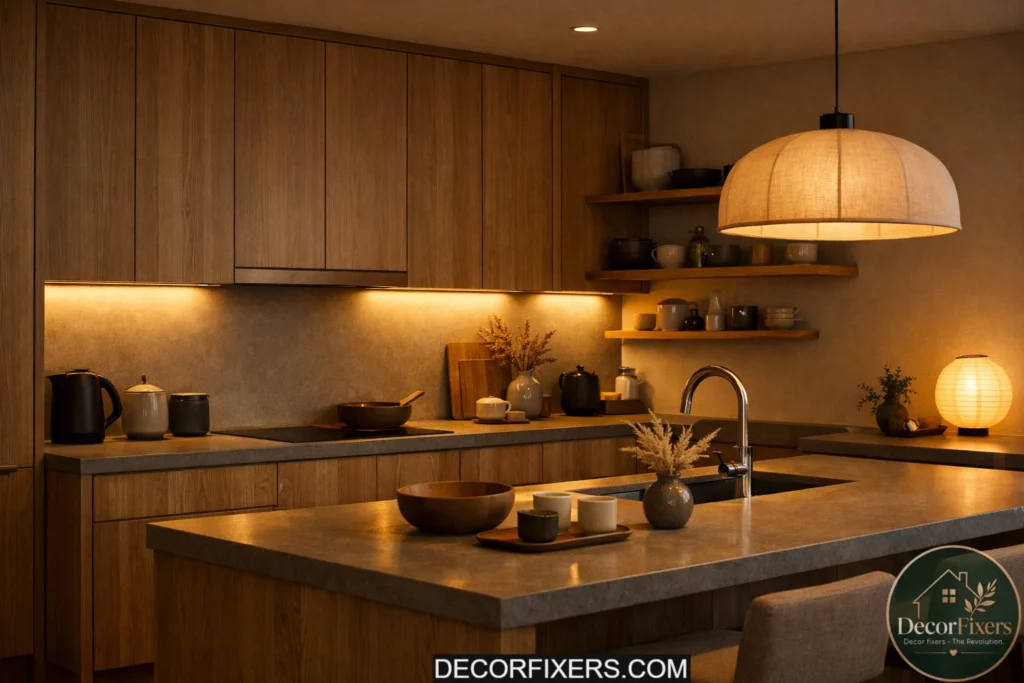
Under-cabinet lighting in a Japandi kitchen serves two functions: it’s practical for food prep, and it creates the warm glow that makes the kitchen feel lived-in and inviting after dark.
Choose warm white LEDs (2700K–3000K color temperature) recessed into a channel or mounted flush behind a thin lip that hides the strip from direct view. The light should illuminate the countertop without the source being visible. Cold white LEDs (4000K+) shatter the warmth of wood and stone immediately; avoid them entirely in this context.
22. Add a Shoji-Inspired Room Divider for Open-Plan Spaces
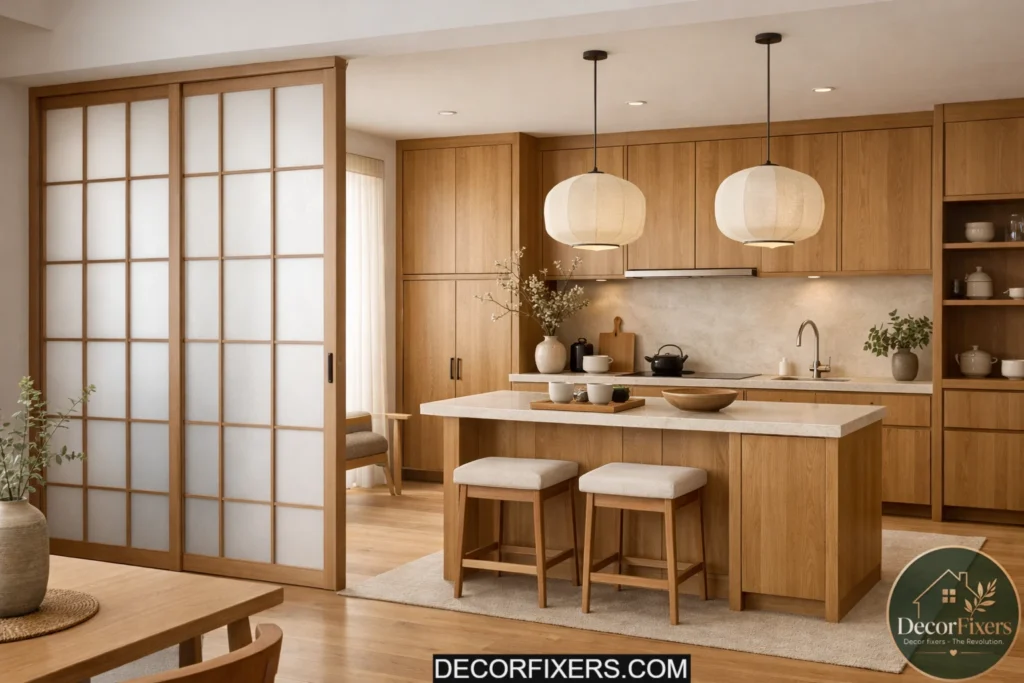
In open-plan homes, the kitchen needs a way to transition into the living area without a hard architectural divide. A shoji-inspired sliding panel, a wooden frame with frosted or washi-style glass inserts, is the most authentically Japandi solution.
It filters light beautifully, creates a soft zone separation without completely closing off the space, and brings a direct Japanese design reference into a room that might otherwise lean more Scandinavian. It’s a statement piece that earns its place functionally, aesthetically, and culturally.
23. Choose a Concrete or Matte Plaster Finish for One Wall
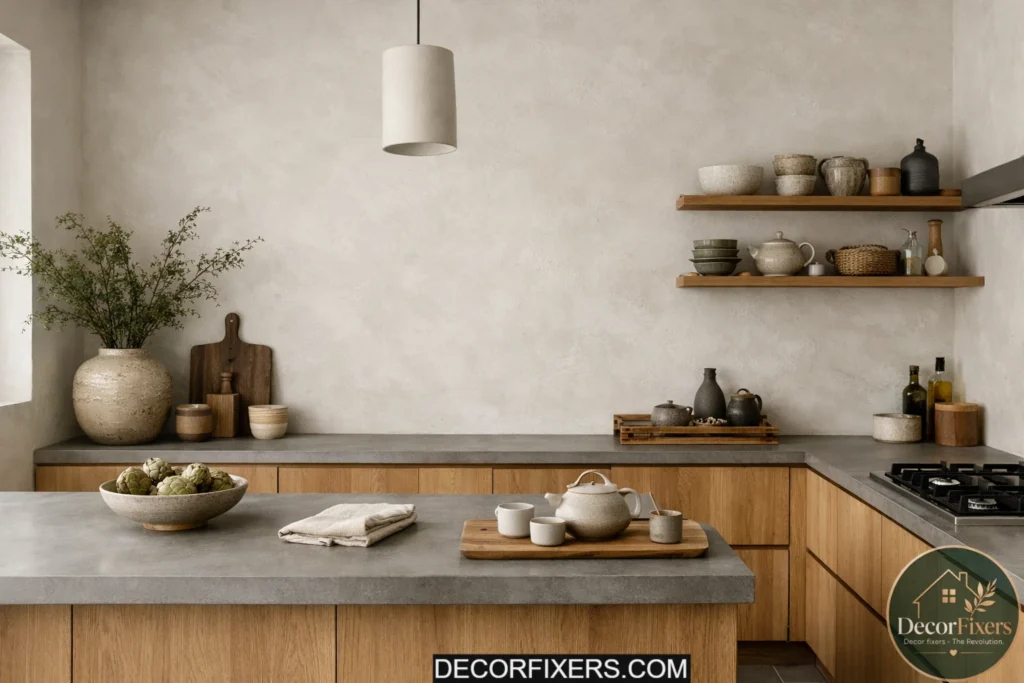
A single textured wall, in micro-cement, matte plaster, or a limewash technique, introduces the Japandi value of handcrafted, imperfect beauty without overwhelming the space.
The keyword here is single. One textured wall behind the kitchen run, or as the backdrop to an open shelving section, creates depth and warmth. All four walls would be too much; it would read as rustic rather than Japandi. Paired with flat cabinet fronts and a smooth stone countertop, one textured wall creates exactly the kind of quiet tension that makes a room interesting.
24. Incorporate Linen or Cotton Textiles Sparingly
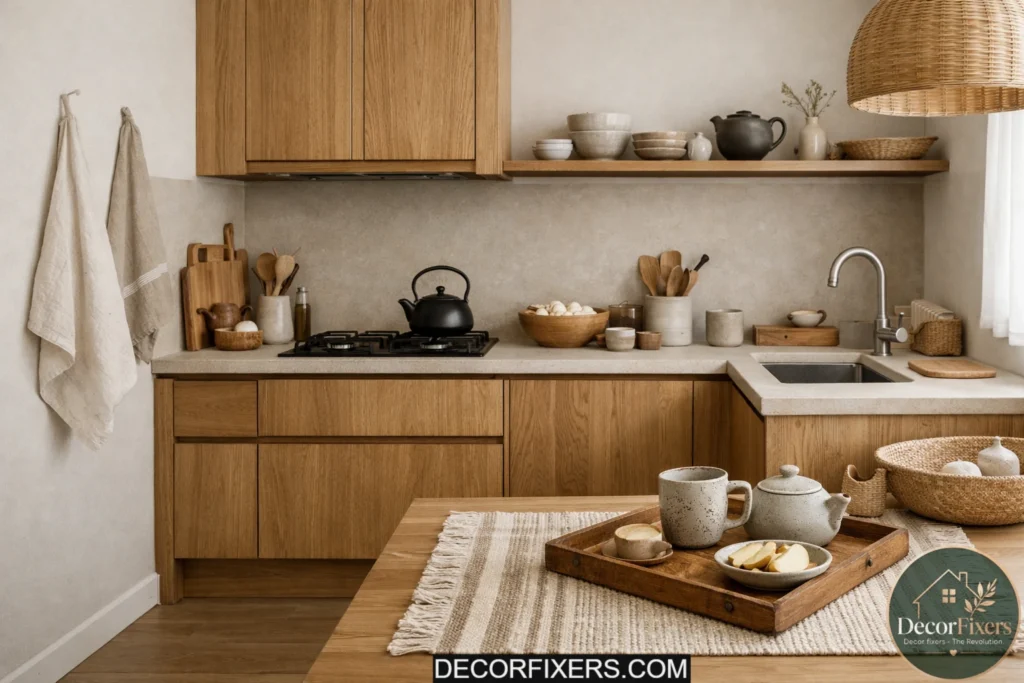
Textiles are the Scandinavian contribution to Japandi that prevents the style from feeling austere. A natural linen tea towel is draped over the oven handle. A woven cotton table runner on the breakfast bar. A single raffia trivet on the counter.
Nothing with a pattern, nothing synthetic, nothing brightly colored. The textile’s job in a Japandi kitchen is tactile; it’s there to be touched, to remind you that the space is lived in and warm. Two or three textile elements maximum. Any more and the minimalist discipline starts to erode.
25. Invest in a One Quality Wooden Cutting Board as Decor
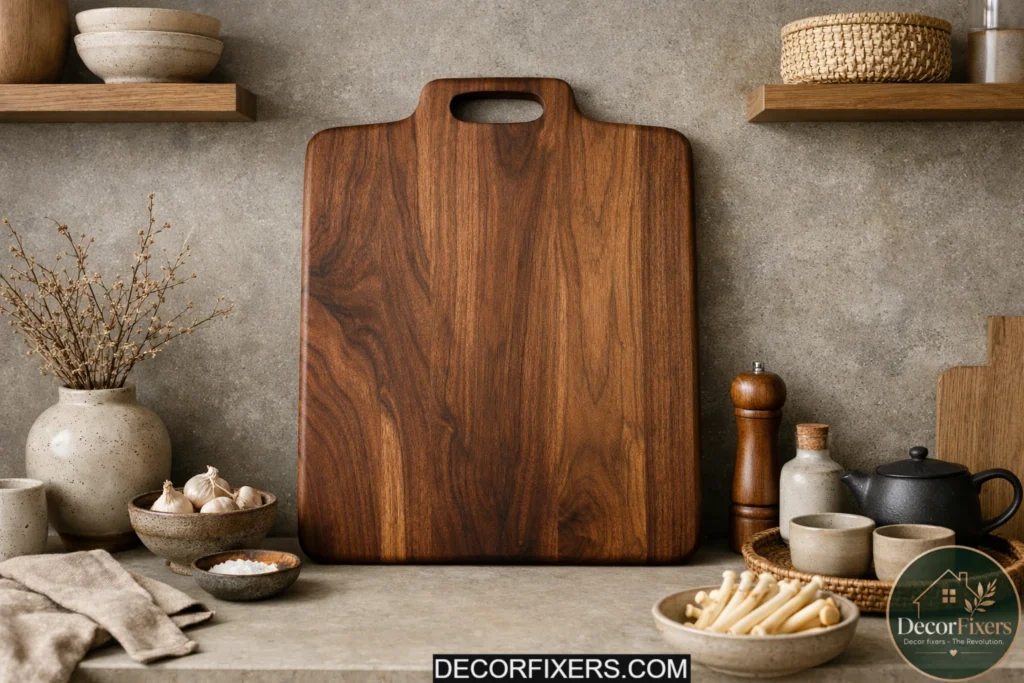
Quick note: functional objects in a Japandi kitchen are also decorative objects. There’s no separation between what’s used and what’s displayed.
A large solid walnut or maple end-grain cutting board, propped against the backsplash when not in use, serves as both a kitchen tool and a natural work of art. It brings warmth, grain texture, and craft into the room. This is the wabi-sabi principle in its most practical form: beauty found in an everyday object that earns its place by being genuinely useful. It costs less than a piece of wall art and works harder.
26. Design the Cabinet Interior Like a Retail Display
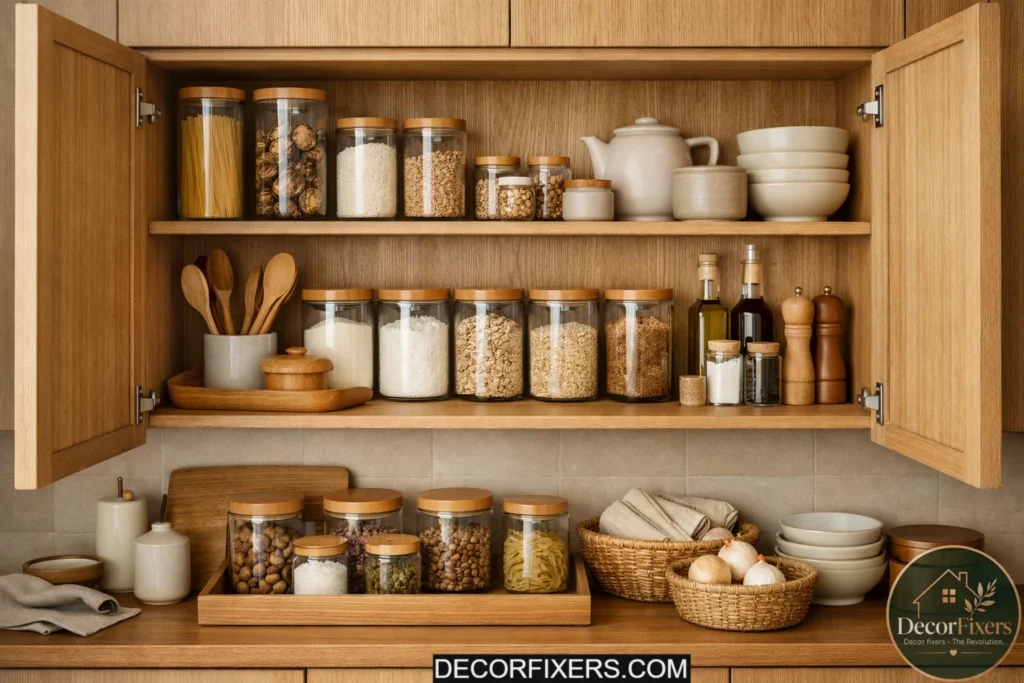
Here’s an opinion that might push back on your instincts: in a Japandi kitchen, open any cabinet and it should look like it was designed to be seen. Because eventually, it will be.
Uniform storage containers in glass or matte ceramic for pantry items, a matching set of wooden cooking utensils, stacked bowls in the same clay finish, and measuring cups on a small hook. This isn’t precious, it’s practical. When your storage is organized and beautiful, you stop losing things, you waste less food, and the kitchen stays calmer because there’s never a rummage-through-everything moment. The Japanese concept of ma, meaningful space, applies here too: every cabinet should have room to breathe.
27. Keep the Kitchen Counter to Three Objects Maximum
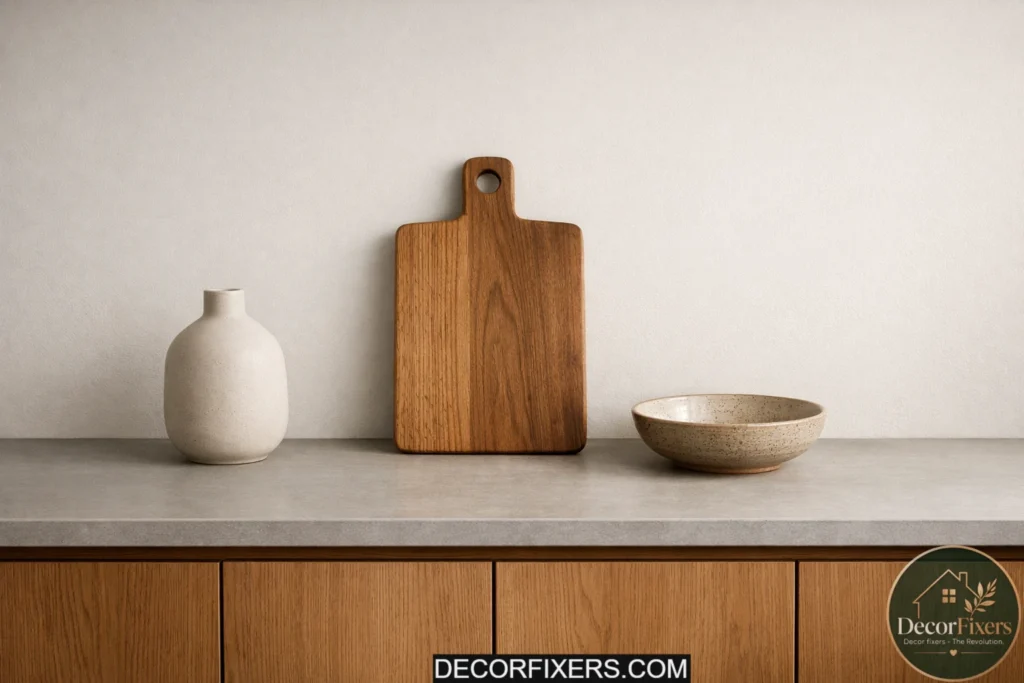
The single most practical Japandi principle, and the hardest to maintain. Three objects on the counter. That’s the rule.
It sounds extreme until you try it. And then it becomes the thing that makes you feel calm every single time you walk into the kitchen. Not because minimalism is a virtue in itself, but because clarity in your environment creates clarity in your thinking. The Japanese call it ma, the intentional use of space. Scandinavians call it hygge, the feeling of genuine comfort. In a Japandi kitchen, the empty counter is the design. It’s not waiting to be filled. It is the statement.
If maintaining a visually calm surface feels challenging, these Kitchen Counter Styling Ideas offer practical ways to curate everyday objects without making the space feel empty or overly staged. The focus is on balance, texture, and intentional simplicity rather than decoration for its own sake.
How to start a Japandi kitchen: 5 steps
- Choose flat-panel handleless cabinets in oak, walnut, or matte painted finish.
- Set your color palette: warm white or taupe base, one muted accent (sage, charcoal, or clay).
- Select matte stone or concrete-look countertops, and avoid high-gloss surfaces.
- Remove all counter clutter; keep a maximum of three intentional objects visible.
- Add one natural light source, one handmade ceramic, and one organic textile element.
CONCLUSION:
I didn’t renovate my kitchen overnight. I started with the countertop rule, three objects maximum, and a drawer full of matching glass jars. That’s it, for two weeks. Just living with that discipline.
And I’ll tell you honestly: the room felt different before anything else changed. Calmer. More intentional. Like a kitchen in a house where someone had made real choices rather than accumulated defaults.
That’s what Japandi kitchen ideas actually deliver, not a look, but a feeling. The 27 ideas in this guide range from structural decisions you make once (cabinetry, countertops, flooring) to daily habits (the three-object counter rule, the curated open shelf). Some will cost money. Many cost nothing except attention.
Start with one. The one that resonates most with where your kitchen already is, or where you most want it to go. The style is forgiving in that way; it rewards iteration and patience more than any other design approach I’ve encountered. Because ultimately, a Japandi kitchen isn’t built in a weekend renovation. It’s chosen, object by object, decision by decision, until the space around you finally reflects the calm you were looking for all along.
FAQs:
Q: What’s the best color for a Japandi kitchen?
A: Warm white, taupe, sandy beige, or soft stone grey as a base, with one muted accent in sage green, charcoal, or clay. Avoid cold whites or any bright, saturated color.
Q: How do I achieve Japandi style on a budget?
A: Start with IKEA SEKTION cabinets and AXSTAD matte fronts, add matte black hardware, and clear your countertops. The style is more about restraint than expensive materials.
Q: Should I use dark or light wood in a Japandi kitchen?
A: Both, used deliberately. Light oak for upper cabinets and perimeter keeps the room airy. A darker walnut island or lower cabinet run adds Japanese-inspired depth. Stick to two tones with matching warm undertones.
Q: Why does a Japandi kitchen feel so calm?
A: The combination of natural materials, muted neutrals, and intentionally cleared surfaces reduces visual stimulation. The brain registers fewer competing elements, which produces a genuine sense of rest.
Q: When should I choose Japandi over pure Scandinavian design?
A: Choose Japandi when you want warmth without clutter. Scandinavian design can feel too cool and stark in a kitchen. Japandi adds the wabi-sabi warmth and depth that pure Scandi sometimes lacks.

Creator of DecorFixers, sharing practical home and interior ideas focused on real-life usability, simple design improvements, and budget-friendly solutions.