

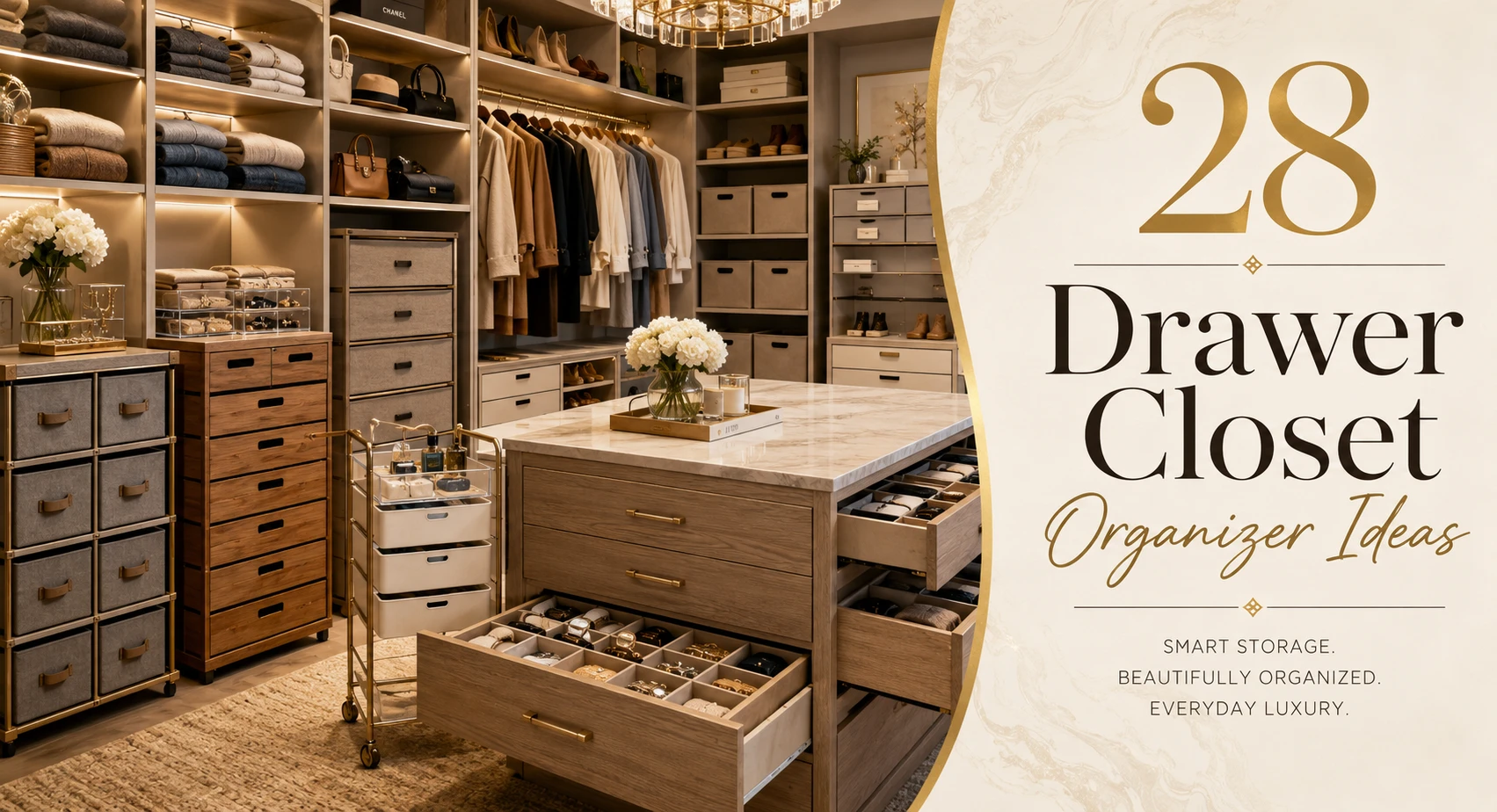
You open the closet, reach for a sweater, and three other sweaters fall on the floor. Sound familiar? That’s not a clutter problem; it’s a drawer organizer problem. And open shelves alone will never solve it.
Here’s the thing: most closet organizer guides focus on what looks pretty on Pinterest. They skip the part where you have to measure your actual closet, figure out whether a freestanding drawer tower will even fit under your hanging rod, and decide if fabric drawers will sag under heavy denim. This guide doesn’t.
Below you’ll find 28 drawer closet organizer ideas, broken into real categories by type, material, and closet setup, so you can pick what actually works for your space, not just what looks good in a stock photo.
What Is a Drawer Closet Organizer?
A drawer closet organizer refers to any freestanding, modular, or insert-based storage unit with pull-out drawers designed to live inside or alongside a closet system. Unlike open shelves, drawers contain folded items, hide visual clutter, and allow you to use vertical closet space that would otherwise go to waste.
1. Freestanding Fabric Drawer Tower
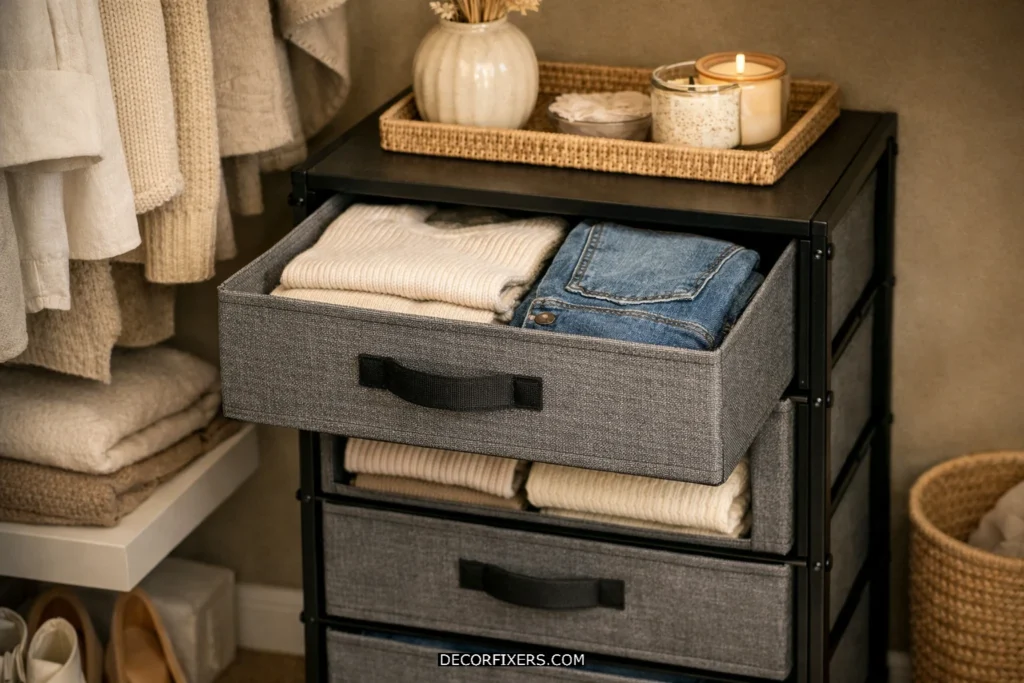
A fabric drawer tower is the quickest, most renter-friendly fix for a closet with zero built-in drawer storage. You slide it onto the closet organizer floor under hanging clothes, and you’re done. No tools, no wall anchors, no weekend project.
Look for a steel frame with non-woven fabric drawers; the frame is what keeps the whole unit from collapsing under a pile of jeans. Units with 5 to 7 drawers in the 13-inch-wide range will typically slide under a standard 66-inch hanging rod without eating your entire closet floor.
2. Stackable Wooden Drawer Units
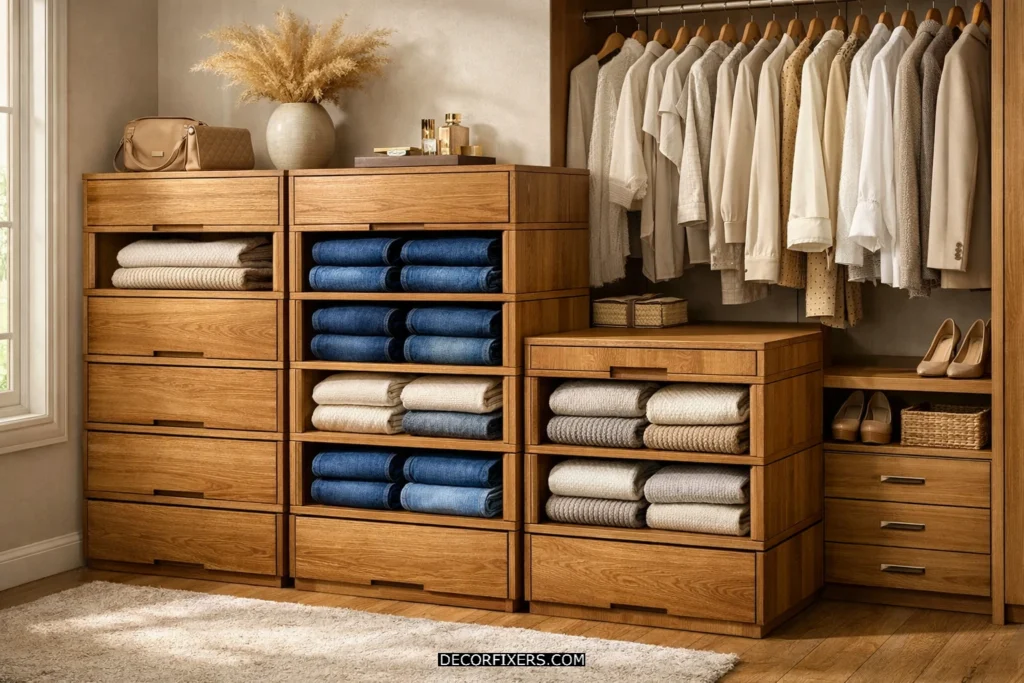
These are the modular dresser alternative that lives inside your closet. You buy them in 2- or 3-drawer stacks and build up as tall as your space allows. Brands like BOLUO and Prime Zone sell stackable wood closet drawers specifically sized for closet interiors, usually 15 to 24 inches wide.
The real advantage here over fabric? Wooden drawers glide smoothly on rails, handle heavier items like jeans and sweaters without sagging, and look intentional. Stack two 3-drawer units side by side and you’ve effectively replaced a full dresser, without moving a single piece of bedroom furniture.
3. IKEA KOMPLEMENT Pull-Out Drawer Insert
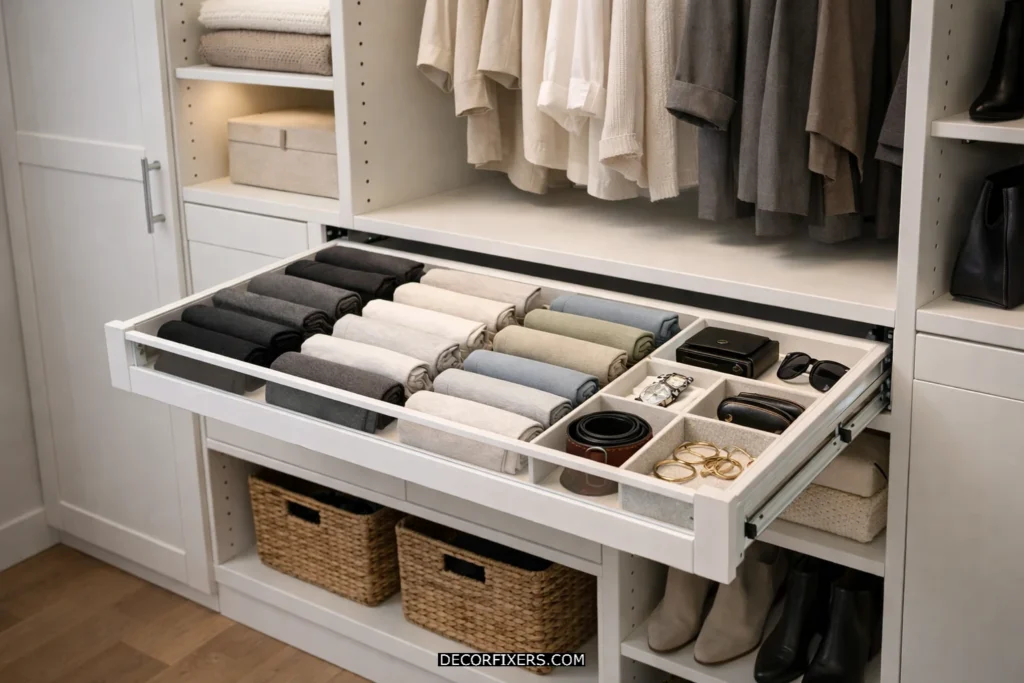
If you already own a PAX wardrobe, this is the obvious upgrade. The IKEA KOMPLEMENT drawer fits directly into the PAX frame and comes in full-extension glides, meaning the drawer pulls all the way out so you can see everything inside without digging.
KOMPLEMENT drawers come in several widths to match different PAX frame sizes. The 18-inch depth is the standard, and it handles everything from folded t-shirts to bulkier knits. Pair it with the KOMPLEMENT drawer insert tray for subdividing socks, underwear, and accessories inside the drawer.
4. The Container Store Elfa Décor Drawer System
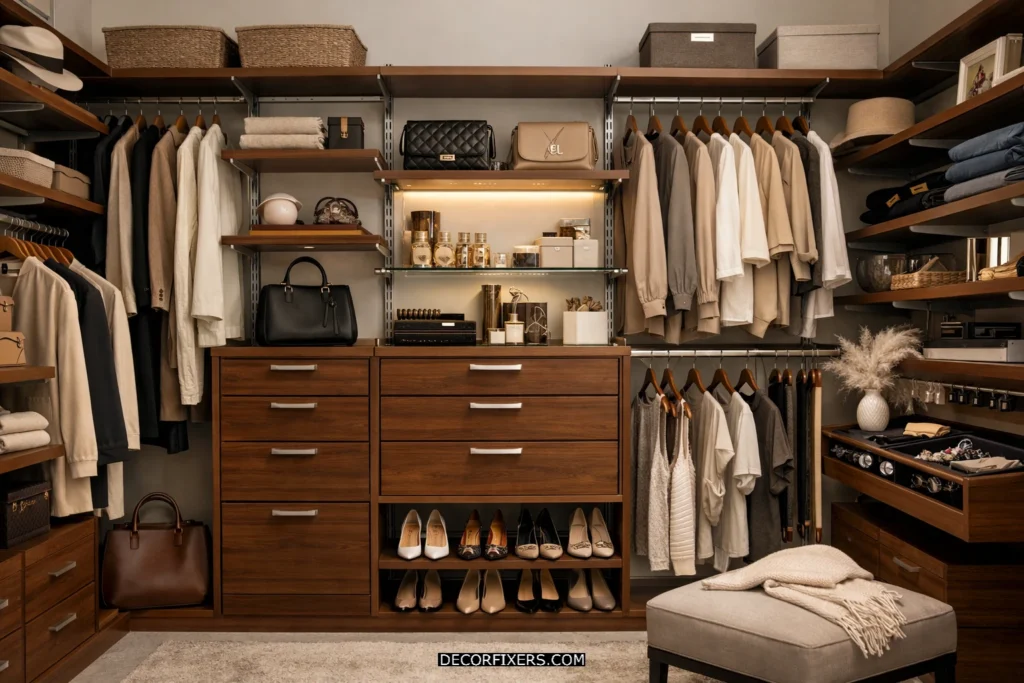
The Elfa Décor Drawer System from The Container Store is a wall-mounted modular setup that hangs from a top track. Drawers attach to vertical rails and can be repositioned without drilling new holes. If your closet already has Elfa tracks installed, adding a drawer column is genuinely one of the most satisfying upgrades you can make.
What makes Elfa worth the higher price point is adjustability; you can move the drawer unit up, down, or to a different rail entirely if your storage needs change. It’s not cheap, but users who’ve invested in Elfa consistently report it outlasts and outperforms every budget alternative they tried first.
5. ClosetMaid Modular Storage Drawer Tower
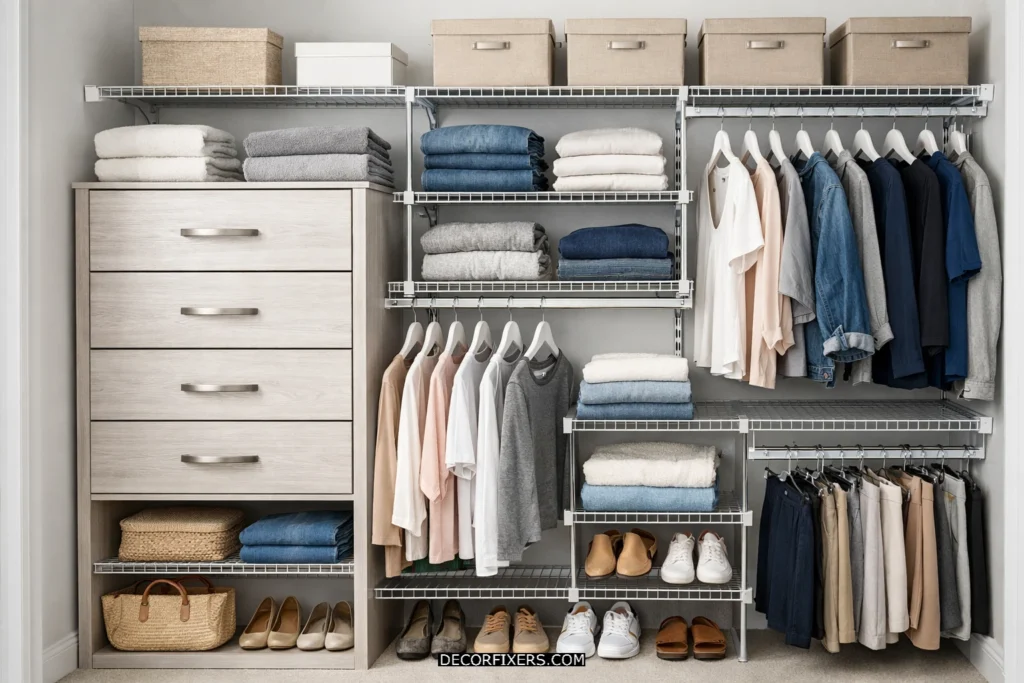
ClosetMaid’s modular system sits in the middle ground between IKEA’s value and Elfa’s premium pricing. Their drawer towers use laminated wood panels with a furniture-board construction and are designed to work alongside their ShelfTrack wire shelving systems.
The advantage of staying within the ClosetMaid ecosystem is that the drawers, shelves, and hanging rods all share the same rail mounting system. That means you can plan a full closet with coordinated pieces rather than cobbling together products from five different brands.
6. Plastic Stackable Drawer Cart
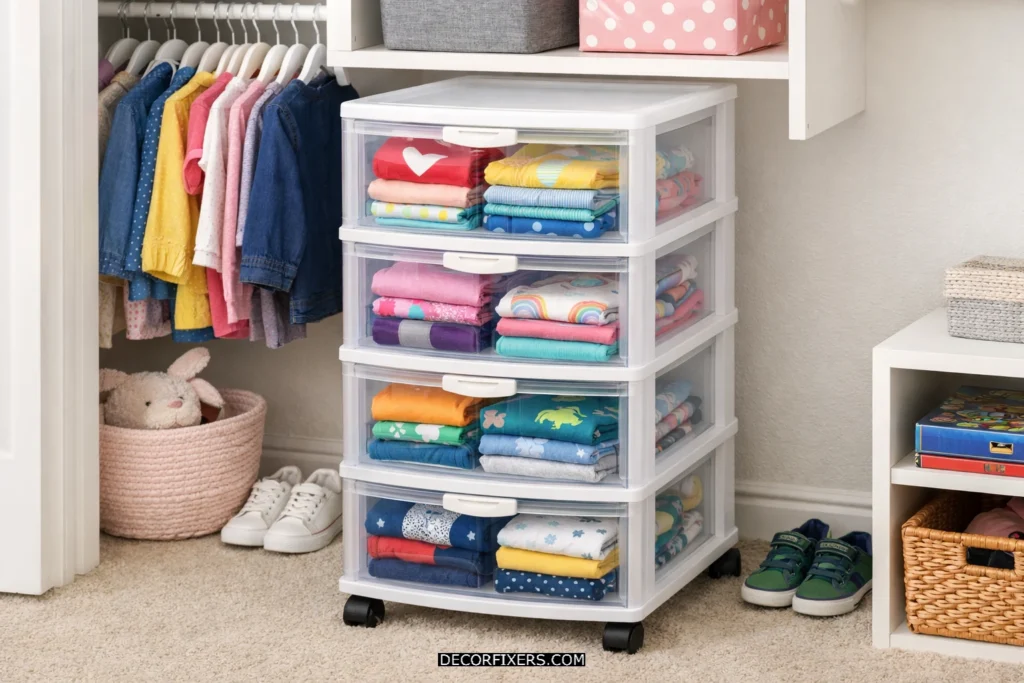
Plastic drawer carts, think Sterilite or similar clear-drawer units, are the budget-friendly shortcut for a guest closet, laundry room overflow, or kids’ closet where the stakes are lower. They’re lightweight, easy to move, and often transparent, so you can actually see what’s inside each drawer.
Quick note: plastic carts work best for lighter items. Overloading them with heavy denim or dense wool sweaters causes the drawers to bow and eventually crack at the rails. They’re ideal for socks, underwear, swimwear, workout gear, and accessories, not a full wardrobe.
7. Wire Basket Drawer System
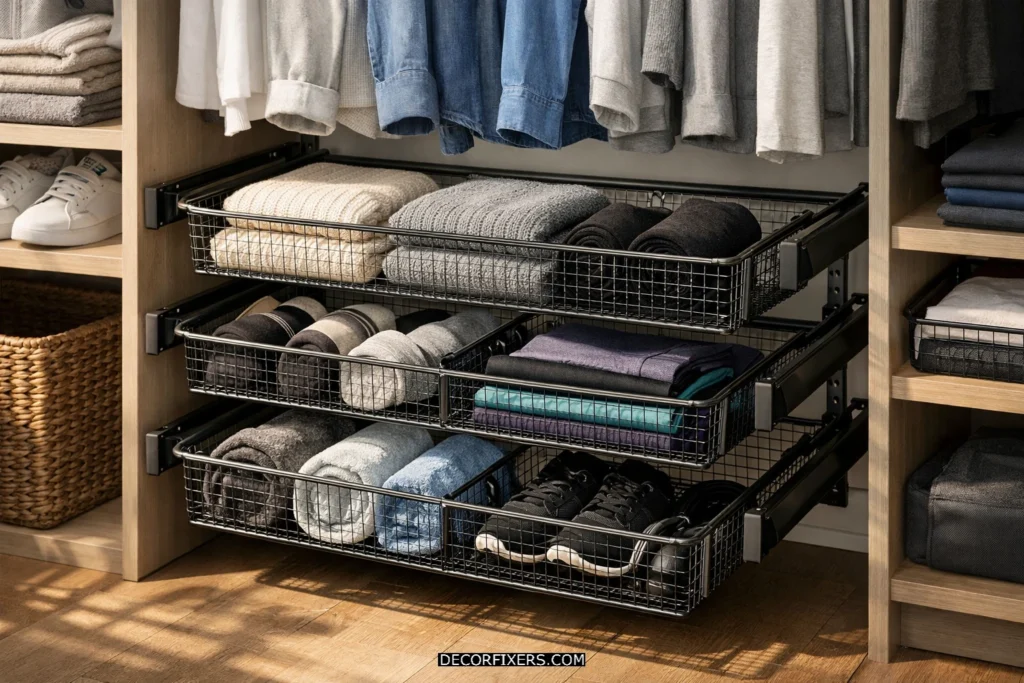
Wire basket drawers, the kind that pull out from a frame on runners, are the best choice for a humid closet or anywhere you want maximum airflow around your clothes. Unlike solid-panel drawers, wire baskets don’t trap moisture, which matters in older homes with poor closet ventilation.
Several closet systems, including EasyTrack kits, offer wire pull-out baskets as add-on modules. They’re also sold as standalone units that slide under a hanging rod. The open design lets you scan the contents at a glance without opening anything, a genuinely underrated benefit at 6:30 AM.
8. Under-Shelf Fabric Drawer Bins
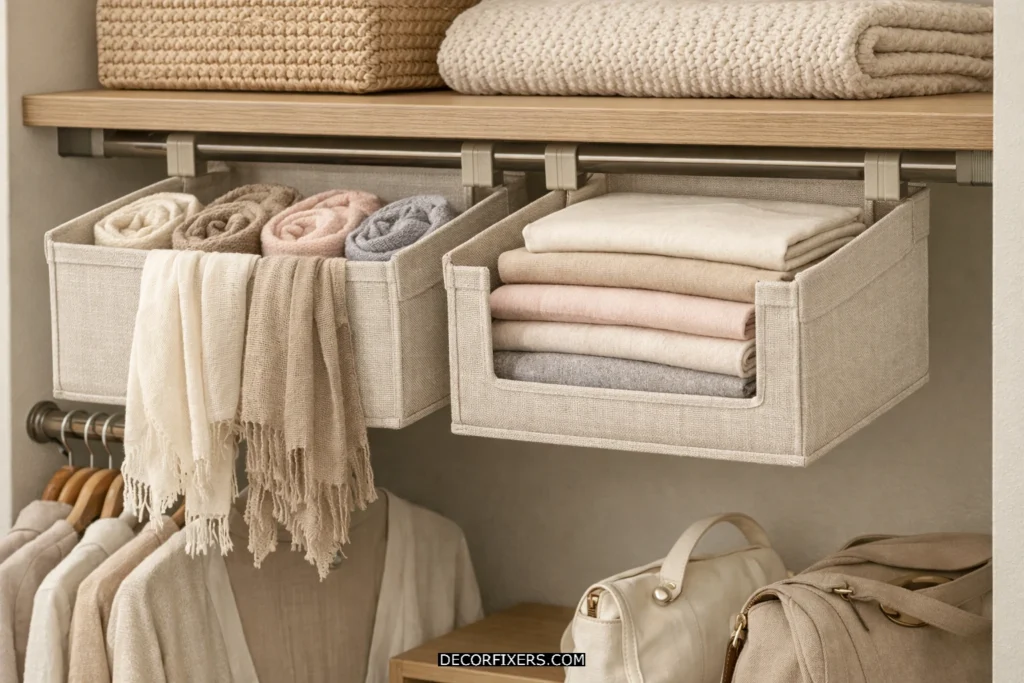
If your closet has fixed shelves with open space below them, under-shelf fabric bins are a clever way to add drawer-like storage without any installation. They clip or hang from the bottom edge of an existing shelf and pull forward like a shallow drawer.
These work best for lightweight items, folded scarves, thin knits, workout tops, or extra linens. They won’t hold jeans. But for accessories and lightweight layers, they turn dead under-shelf space into real usable storage without spending more than $20 to $30.
9. Cube Organizer with Fabric Drawer Bins
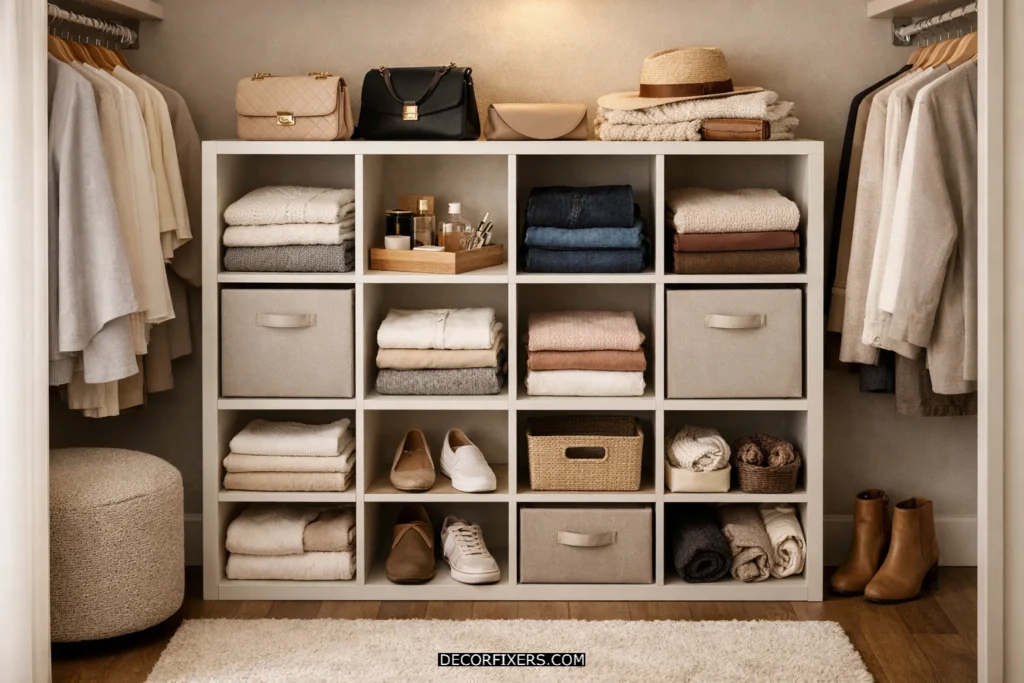
A cube organizer, the kind with 9 or 16 open cubbies, becomes a full drawer system once you drop fabric bins into each slot. You can mix drawers and open cubes, using some slots for folded display storage and others for concealed bin-drawer storage.
This is one of the most flexible setups for a walk-in closet where you want a built-in dresser look without the cost. Closet Maid Cubicles are a popular choice. Add a wooden top, and it doubles as a surface for folding, laying out outfits, or staging bags.
10. Rolling Drawer Cart for Narrow Closets
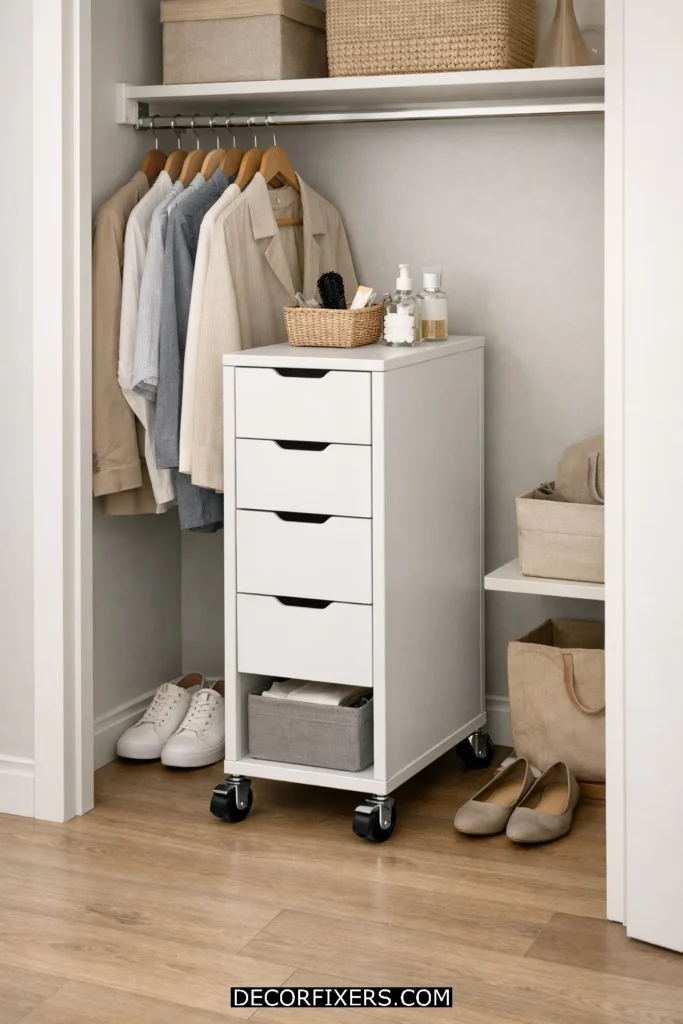
Narrow reach-in closets, anything under 24 inches deep, don’t leave much room for a standalone dresser. A rolling drawer cart solves this by sitting on the closet floor during the day and rolling out to the bedroom when you’re getting dressed.
Look for a cart no wider than 16 inches to leave room for hanging clothes beside it. Locking casters are worth paying for; you don’t want the cart rolling away every time you open a drawer.
And if the problem extends beyond the closet to the rest of your home, our roundup of Proven Home Storage and Organization Ideas covers room-by-room solutions that work alongside a drawer-based closet system.
11. Modular Drawer Inserts for Existing Closet Systems
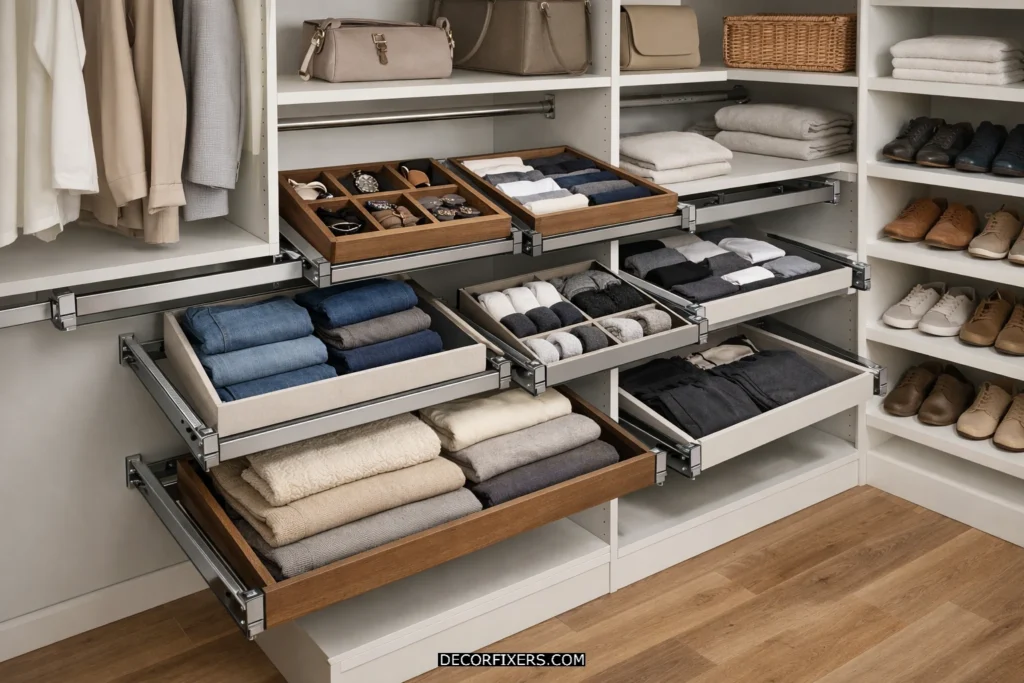
If you already have a track-based closet system with shelves and rods, modular drawer inserts are the add-on to buy next. These are pre-built drawer boxes, usually in 2- or 3-drawer configurations, that mount directly onto existing vertical rails or sit on existing shelves.
Or maybe I should say it this way: this isn’t about buying a new closet system. It’s about making the one you already have do more. Ever Bilt, Easy Track, and Elfa all sell drawer add-ons that work with their own rail systems. Measure your existing rail spacing before ordering; not all drawer kits are cross-compatible.
What’s the Difference Between a Freestanding and a Modular Drawer Organizer?
A freestanding drawer organizer is a self-contained unit that stands on its own on the closet floor, while a modular drawer organizer attaches to an existing track or rail system. Freestanding units are easier to set up and move; modular units integrate with systems like Elfa or ClosetMaid and feel more custom. According to home organization experts, the right choice depends on whether you already have a closet system installed.
12. Bamboo Drawer Organizer Inserts
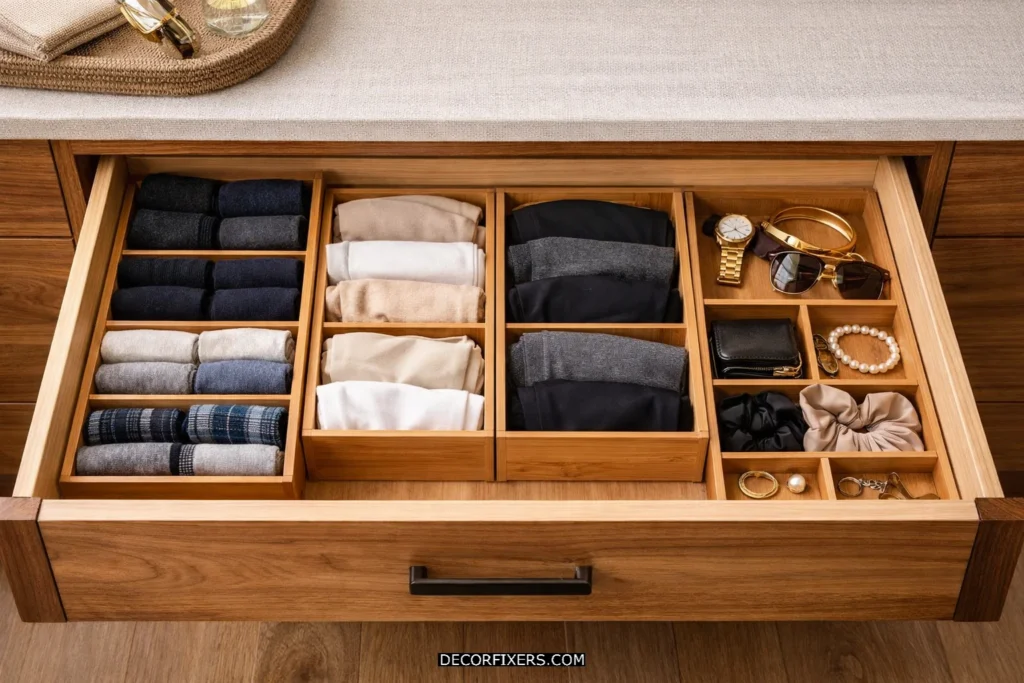
Bamboo drawer inserts fit inside an existing dresser or closet drawer to subdivide the space into smaller compartments. They expand to fit different drawer widths, typically ranging from 11 inches up to 20 inches, and create distinct sections for socks, underwear, accessories, and small folded items.
Look, if you’re in a situation where your drawers already exist but everything inside them is chaos, this is what actually works. Bamboo inserts are more durable than plastic dividers and look noticeably cleaner inside a drawer. The Container Store sells several expandable versions worth considering.
13. Dresser Drawer Dividers for Folded Clothes
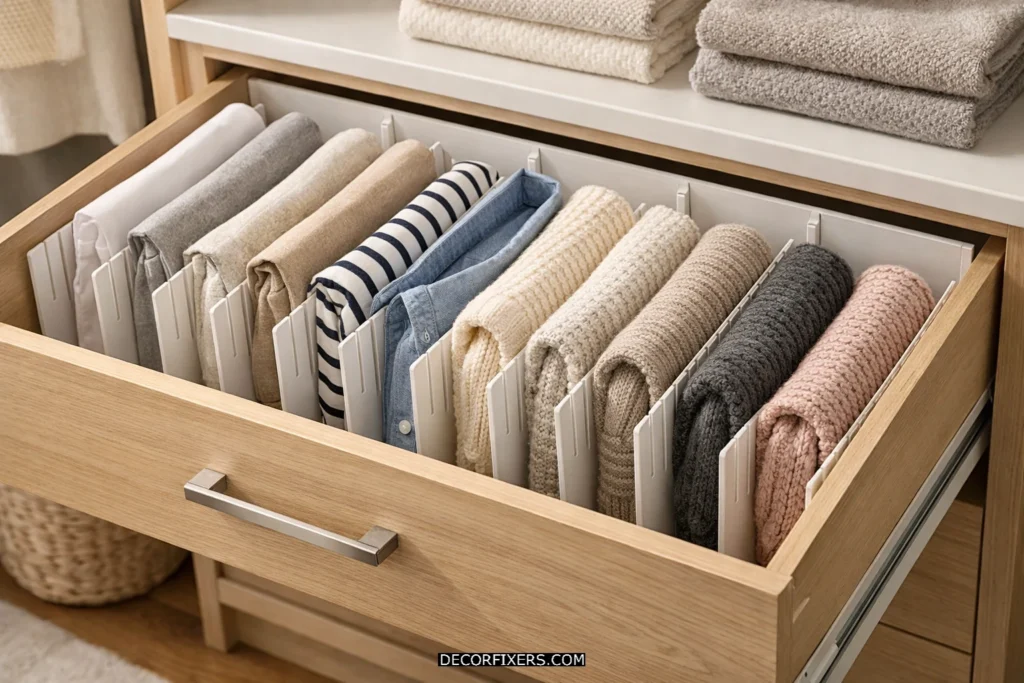
Dresser drawer dividers are expandable vertical panels that slot into a drawer and create sections. Think of them as walls inside your drawer that prevent folded stacks from leaning and collapsing into each other.
The OXO Good Grips Expandable Dresser Drawer Dividers scored notably well in comparative closet organizer reviews for 2025. They grip securely, stay put, and fit drawers from 11 to 17 inches wide. This is a sub-$30 fix that has a disproportionate impact on how your morning routine feels.
14. Acrylic Drawer Organizer Trays
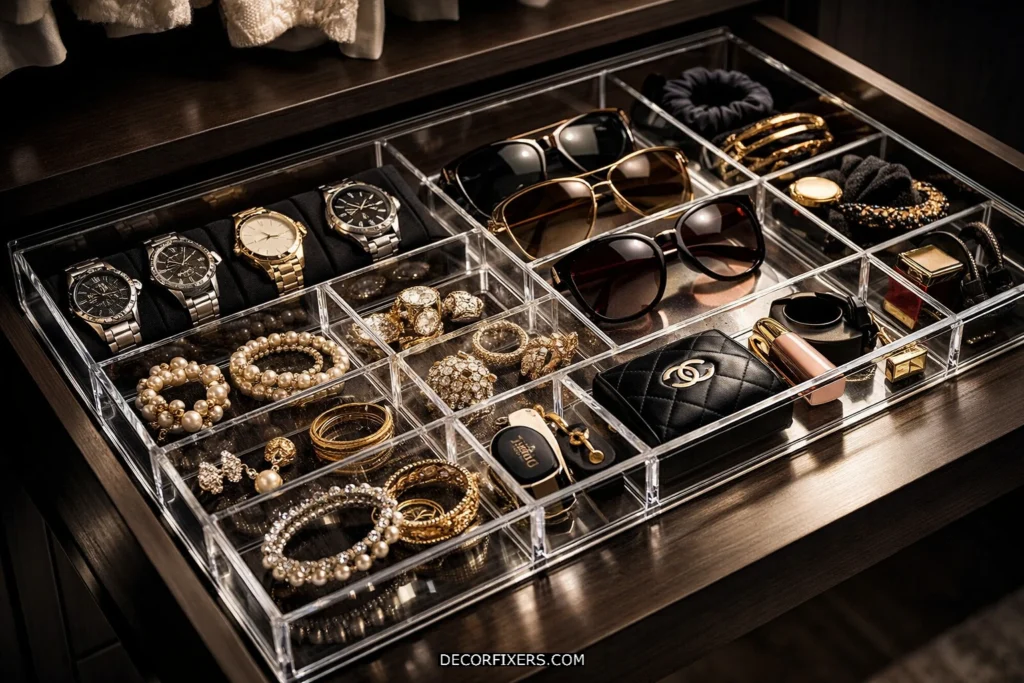
Acrylic trays inside a drawer are the premium version of bamboo inserts, and they’re worth it in a bedroom closet where you open the drawer daily and want the contents to stay exactly where you put them. Clear acrylic shows you everything at a glance and wipes clean in seconds.
These work best in shallow drawers for jewelry, watches, sunglasses, and small accessories. They won’t accommodate folded clothing well, but for a dedicated accessories drawer or a built-in nightstand drawer, they’re the most functional and visually organized option available.
15. Velvet-Lined Jewelry Drawer Insert
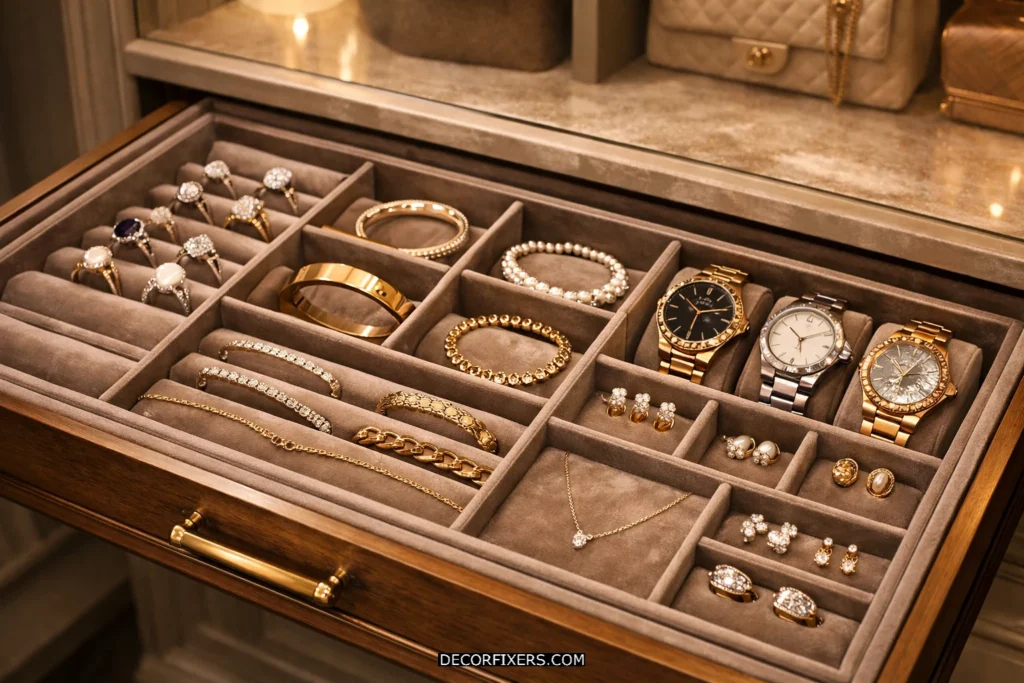
A velvet-lined insert turns any shallow closet drawer into a jewelry organizer. Rings, earrings, bracelets, and watches sit in individual compartments without sliding around or getting tangled.
Most velvet inserts are stackable, so a deeper drawer can hold two layers, one for daily jewelry on top, one for occasional pieces underneath. This is especially useful in a walk-in closet where a full vanity isn’t an option, but you still want proper accessory storage.
16. Sock and Underwear Honeycomb Drawer Insert
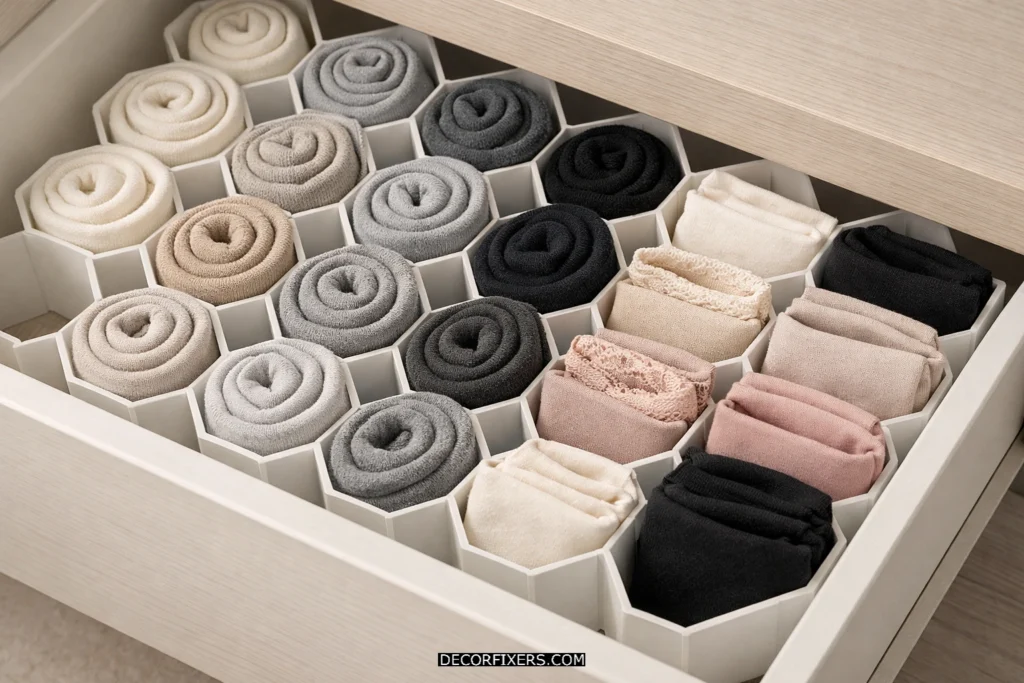
Honeycomb drawer inserts, hexagonal fabric or cardboard cells, are specifically designed for socks and folded underwear. Each item gets its own cell, which means you can see everything without disturbing anything else.
If you’ve tried the KonMari folding method and your socks keep collapsing back into a pile, the problem isn’t your folding technique. It’s that the drawer has no structure to keep the upright folds standing. A honeycomb insert fixes that in about ten minutes.
17. Clear Plastic Drawer Organizer for Accessories
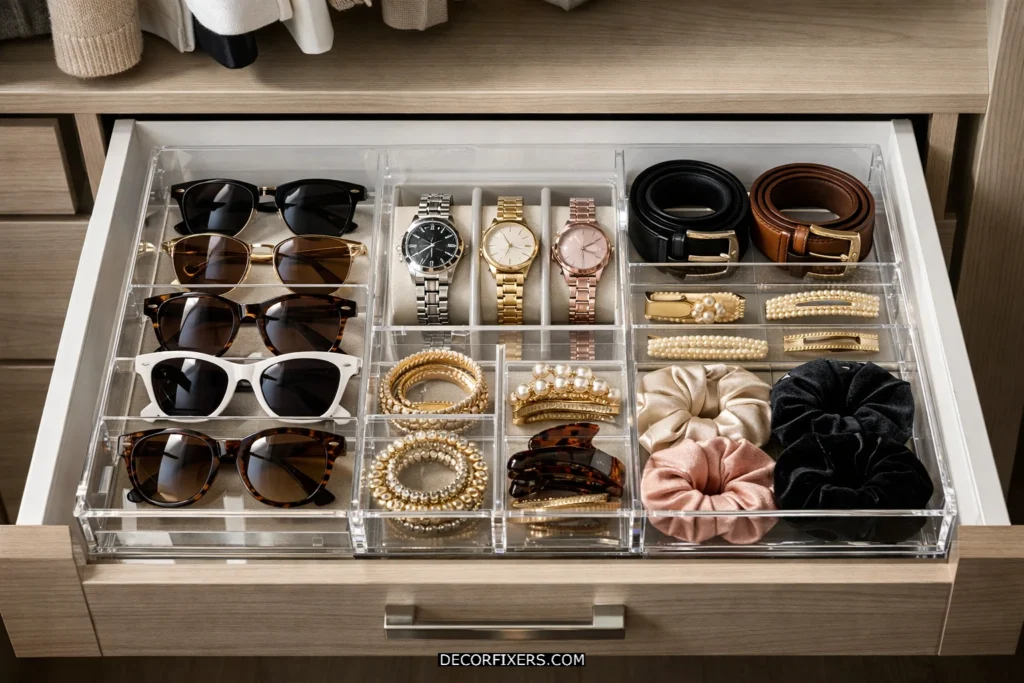
Clear plastic multi-compartment organizers, the ones with 6 to 20 individual cells, are ideal for a junk drawer that’s trying to become an accessories drawer. Sunglasses, hair ties, belts, watches, and small tech accessories each get a dedicated slot.
The benefit of clear plastic over opaque bins is visibility. You don’t have to open multiple containers to find your watch. You see it immediately. For busy mornings, that 30 seconds of not searching matters actually.
How Do You Organize a Closet with Only Shelves and No Drawers?
To organize a closet with only shelves and no drawers, use stackable drawer units placed on the lower shelf, fabric bins that function like drawers in cube organizers, or hanging fabric shelves with pocket drawers that attach to the existing rod. The goal is to add contained, pull-out storage that mimics drawer function without requiring installation.
18. Floating Drawer Cabinet Mounted Inside Closet
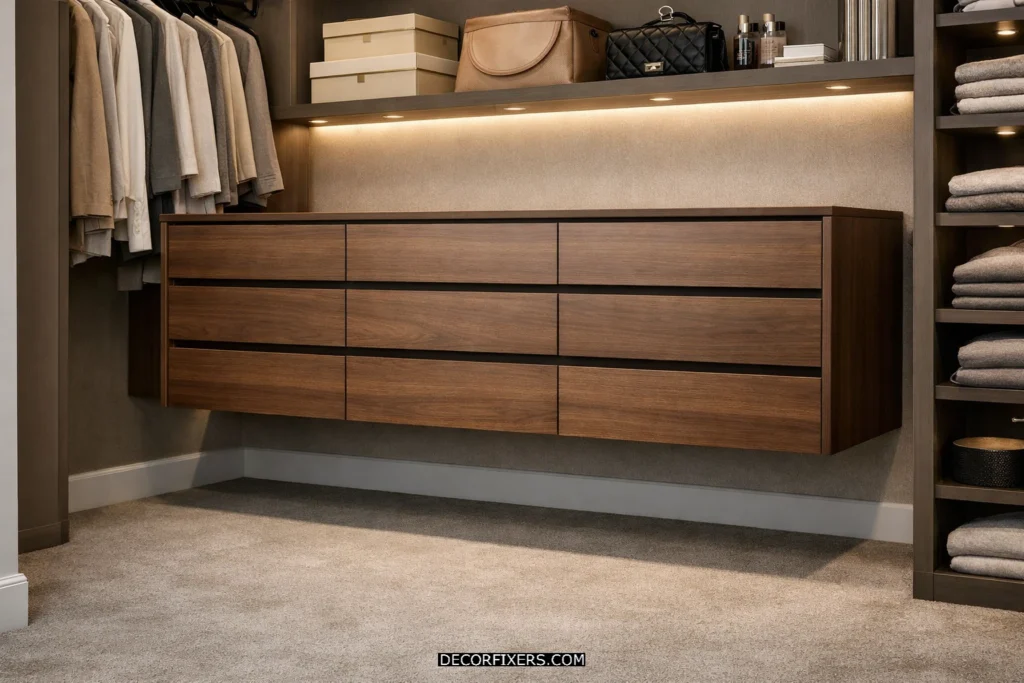
A floating drawer cabinet, typically 2 to 4 drawers mounted to the closet wall at a convenient height, clears floor space completely. This is the right choice for a small walk-in closet where every square inch of floor space is precious.
Wall mounting requires finding studs and using appropriate hardware. For renters, this typically isn’t an option. But for homeowners with a walk-in closet and no floor space to spare, a floating drawer unit is one of the highest-impact upgrades available, and it looks expensive even when it isn’t.
19. Hanging Fabric Shelf with Drawer Pocket
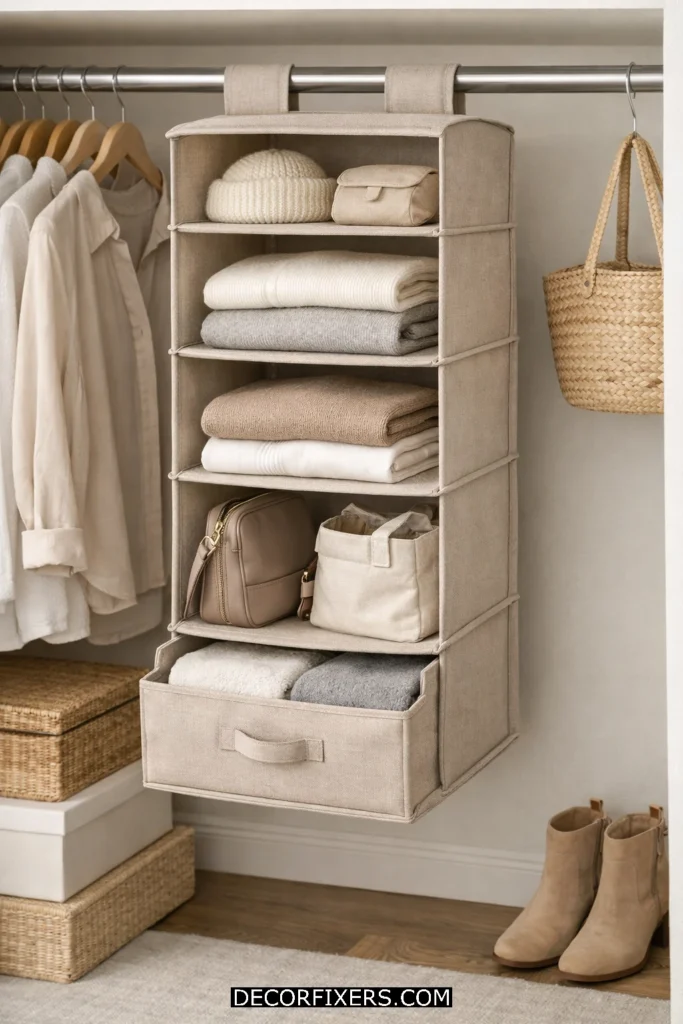
Hanging fabric shelves with drawers attached to the existing closet rod via a bracket or hook, and drop down with multiple shelf levels, plus a fabric drawer pocket at the bottom. They take zero floor space.
These are genuinely useful in a reach-in closet where the rod is the only structure you have to work with. The drawer pocket at the bottom handles folded items like t-shirts, pajamas, or sweaters. Multiple shelf levels above it handle shoes, bags, or folded jeans. All of it, suspended from one rod.
20. Double-Rod Closet Setup with Drawer Unit Below
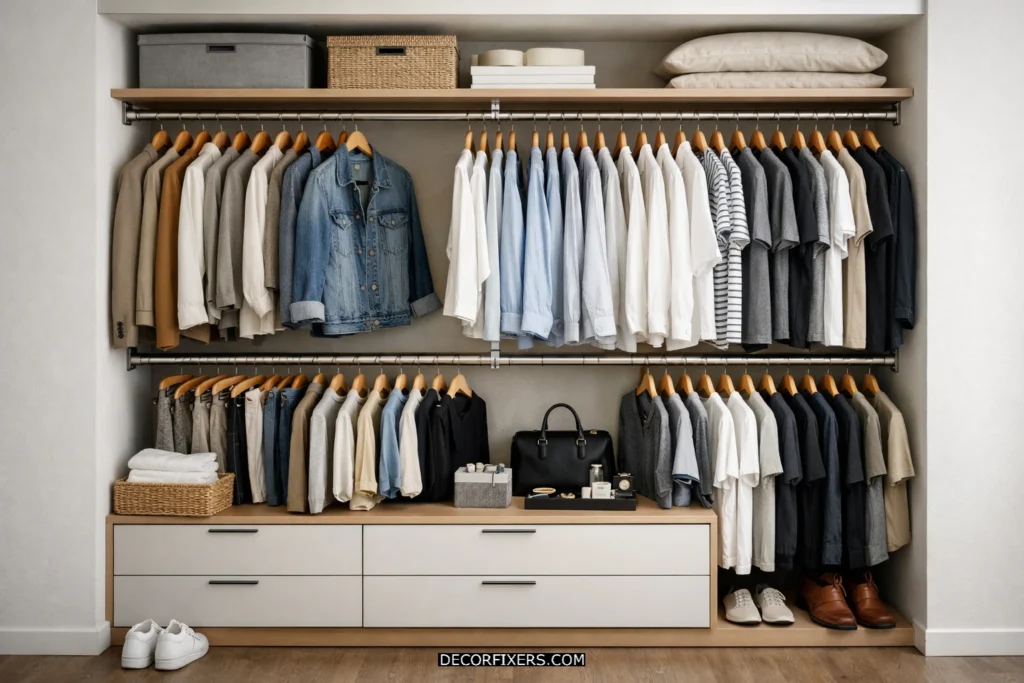
A double-rod configuration doubles your hanging space by stacking two rods, one for shirts, jackets, and shorter pieces on top; one for the same below. The bottom rod sits about 40 inches from the floor, which leaves just enough room for a low-profile 2-drawer unit to slide underneath.
This is one of the most efficient configurations for a reach-in closet with a single long hanging rod. You gain double the hanging capacity and add dedicated drawer storage without touching the walls or buying a new closet system. Worth measuring before anything else.
If your closet has more shelf space than drawer space, your starting point is understanding what lives on shelves versus what belongs in drawers. Our guide on Small Closet Shelving Organization Ideas walks through how to layer shelving and drawer storage so neither type of space goes to waste.
21. Modular Closet Organizer with Drawers, Walk-In Setup
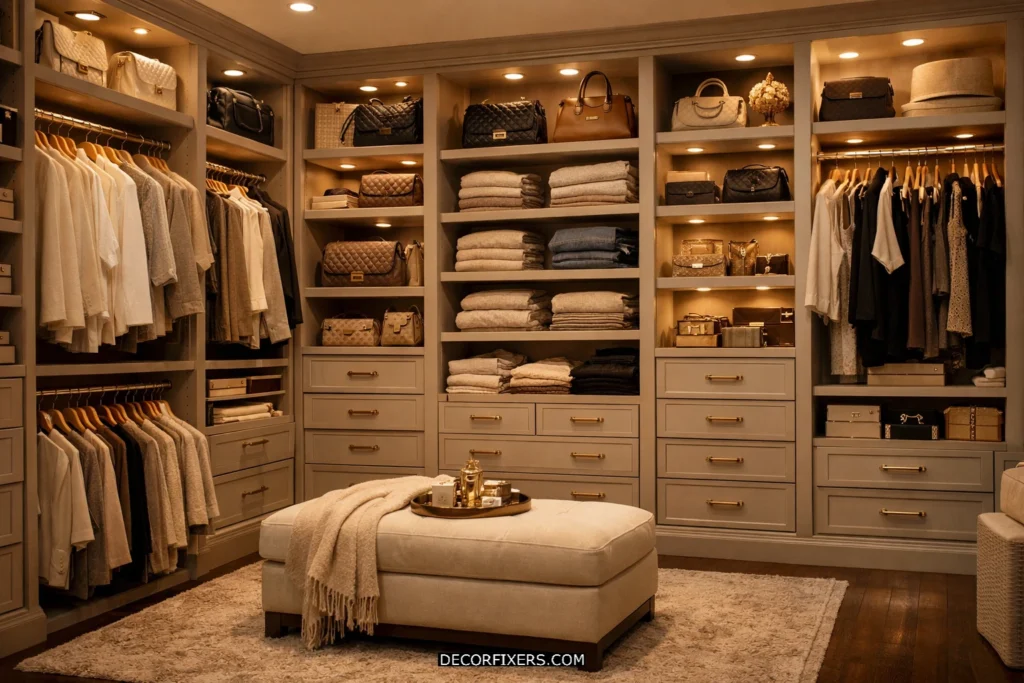
For a walk-in closet, modular systems with drawers built into the tower design offer the most complete solution. Units like the Wayfair walk-in systems, and freestanding sets with 3 towers, 6+ drawers, and multiple hanging rods, can transform an empty walk-in shell into a fully functioning wardrobe.
The key measurement is floor-to-ceiling height. Most walk-in modular systems top out at 75 to 80 inches, which works for standard 8-foot ceilings. Verify the unit’s footprint against your available floor area before ordering; a 96-inch-wide system needs, at minimum, 96 inches of uninterrupted wall.
Freestanding Drawer Tower vs. Modular Drawer Add-On: Which Is Right for You?
This is the question most articles never answer clearly. Here’s the honest version:
Freestanding drawer towers are better suited for renters, people starting fresh, or anyone who doesn’t already have a closet system. They’re self-contained, no installation, no wall damage, no compatibility concerns. You buy it, you place it, it works.
Modular drawer add-ons work better when you already have a track-based closet system (Elfa, ClosetMaid, Easy Track) and you want to extend it with drawer storage. The key difference is that modular drawers integrate with your existing rails and feel like part of a cohesive built system, not an afterthought sitting on the floor.
22. Kids’ Closet Drawer System with Low Reach
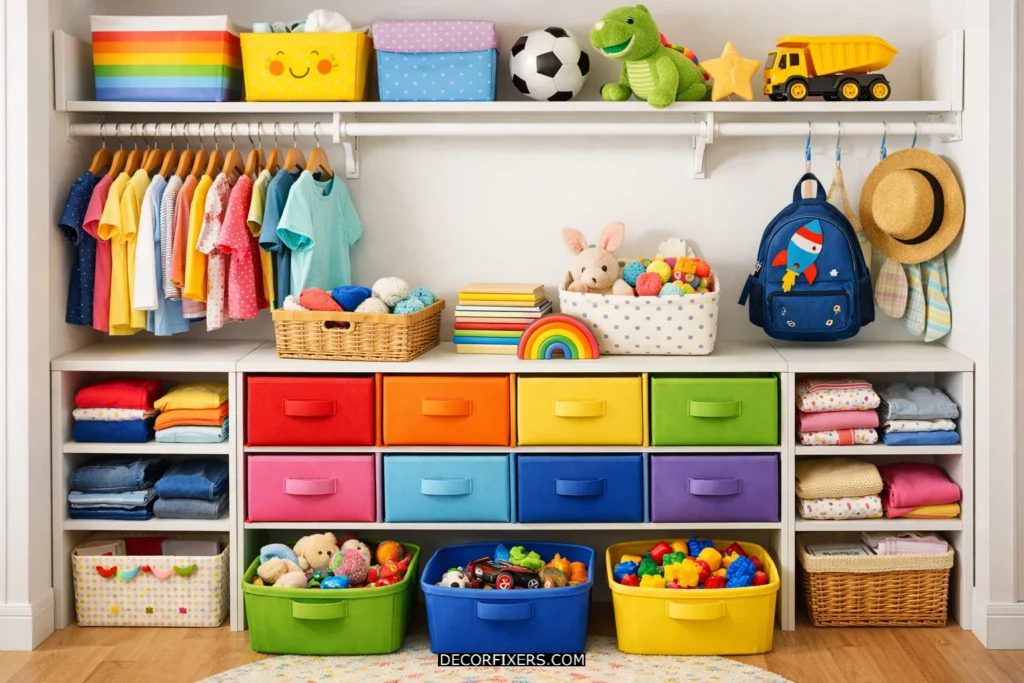
A kids’ closet drawer system needs to be low enough for the child to access independently. The standard rule is: the bottom drawer is no higher than 18 inches from the floor for children under age 8. Units with 4 to 6 colorful fabric drawers sized at lower heights hit this requirement well.
Also, anti-tip hardware. Non-negotiable. Any freestanding drawer unit in a child’s room must be anchored to the wall. Both the CPSC and major pediatric safety organizations recommend this regardless of how stable a unit feels when empty.
23. Seasonal Rotation Drawer System
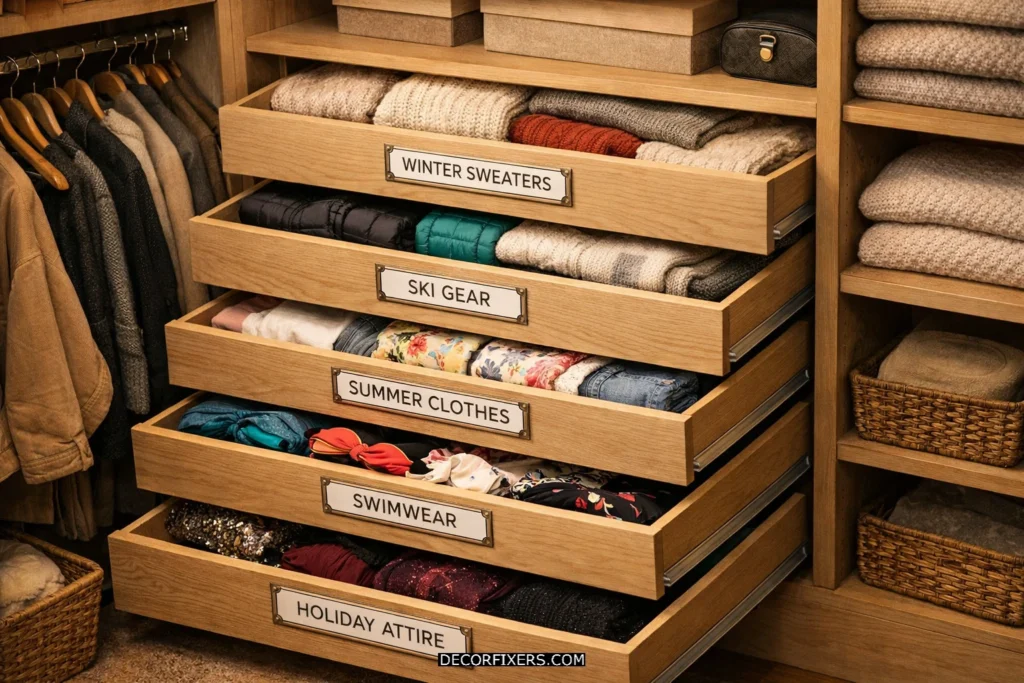
A seasonal rotation drawer system is a dedicated set of deep drawers used exclusively for off-season clothing. Instead of storage bins on a high shelf that require getting down a step ladder, you use a 3- to 5-drawer unit positioned at the back of a walk-in closet to store out-of-season pieces.
Deep drawers,18 inches or deeper, handle folded sweaters, thermal layers, and light puffer jackets better than standard drawers. Label each drawer by season and do a full swap twice a year. The system works because everything has a defined home, and the swap takes under an hour.
24. Closet Island with Drawers (Walk-In)
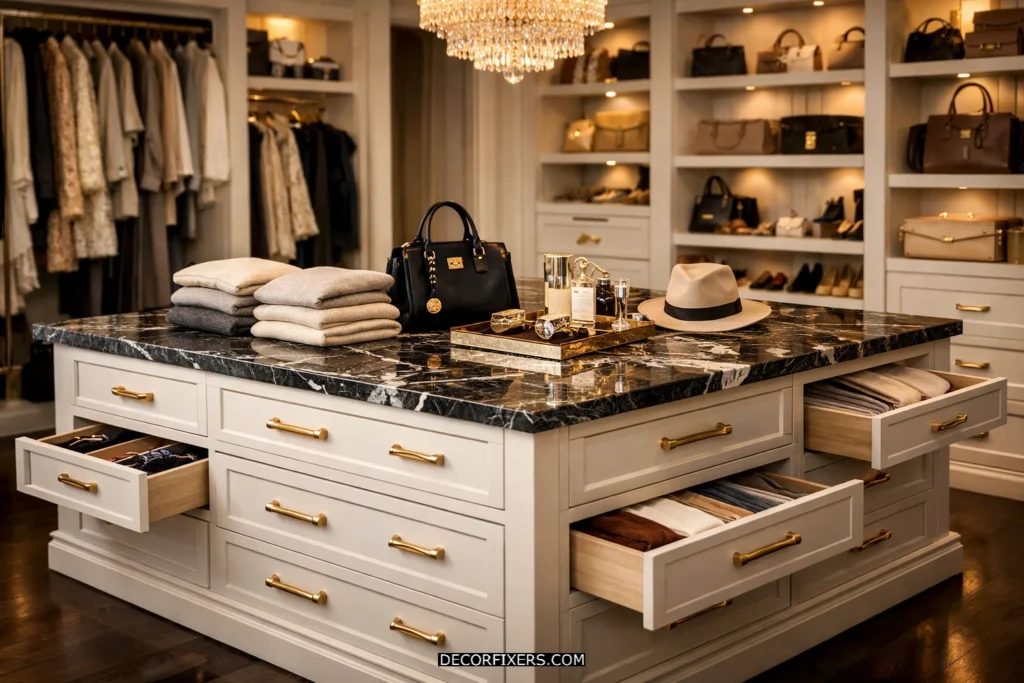
A closet island is a freestanding center unit, usually waist-height, with drawers on all sides and a flat top for folding. It’s the luxury closet staple that also works at a much more modest price point with the right piece of furniture.
A small dresser, repurposed as a closet island, works just as well as a purpose-built unit. Look for a piece that’s 36 to 48 inches wide and no taller than 34 inches; that’s the standard counter height. Drawers on both sides mean two people can use the unit simultaneously, which matters in a shared walk-in.
25. Built-In Look with Freestanding Drawer Towers + Crown Molding
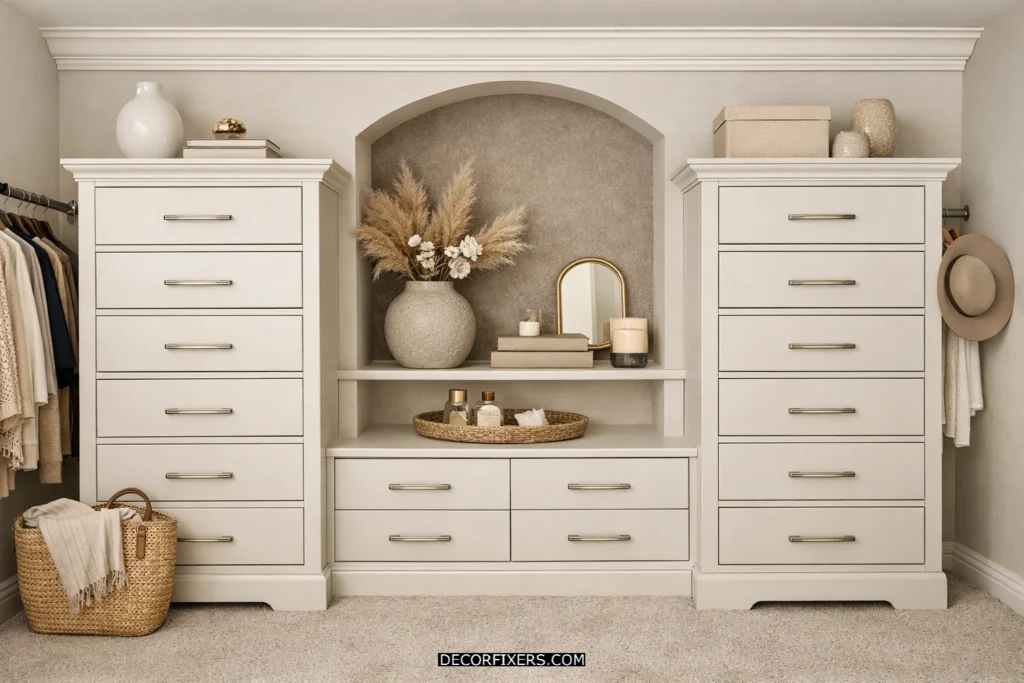
Here’s a trick I’ve seen work really well: place two matching freestanding drawer towers side by side, add a simple board across the top to connect them, and finish with adhesive crown molding. From a distance, it looks like a built-in. From close up, it still looks intentional.
The gap between towers becomes a natural display niche for a plant, mirror, or jewelry stand. The crown molding, even just a painted foam version from a craft store, adds the visual weight that makes the whole setup read as furniture, not as storage equipment.
26. Drawer Organizer for Linen Closet
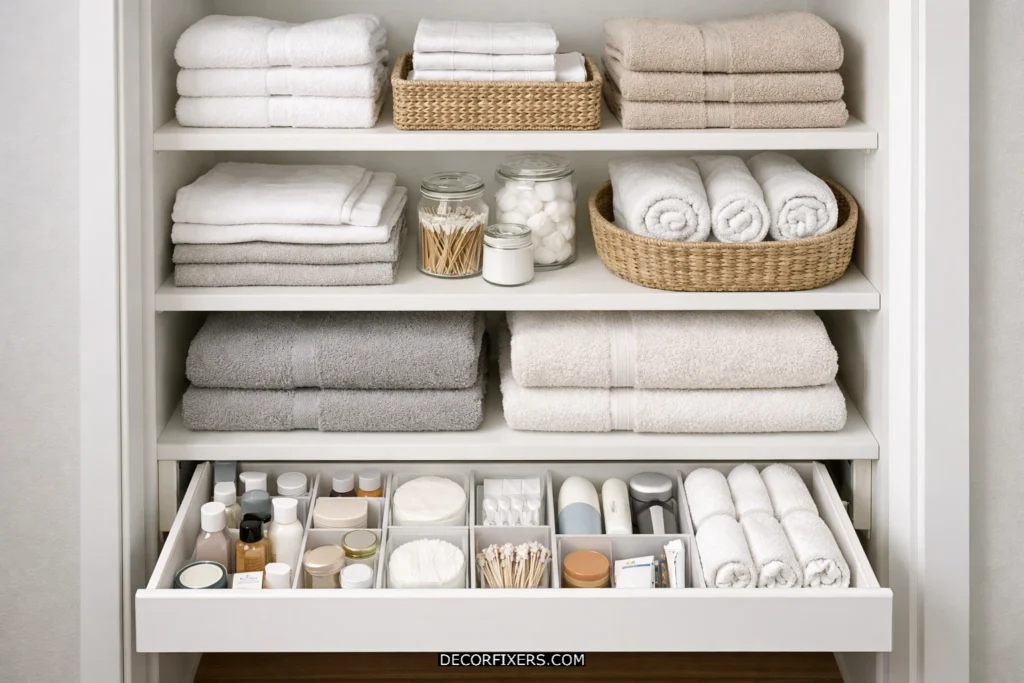
A linen closet typically has wide shelves and no drawers at all. Adding a shallow 2- to 3-drawer unit on the bottom shelf converts that dead zone into a proper storage area for small linens, toiletries, first aid items, and bathroom extras.
For a linen closet specifically, you want a narrower unit,18 to 24 inches wide, that leaves room on the same shelf for standing items like bottles and spray cleaners. Don’t try to fill the whole bottom shelf with a drawer unit; leave some open shelf space alongside it.
27. Entryway Closet Drawer System
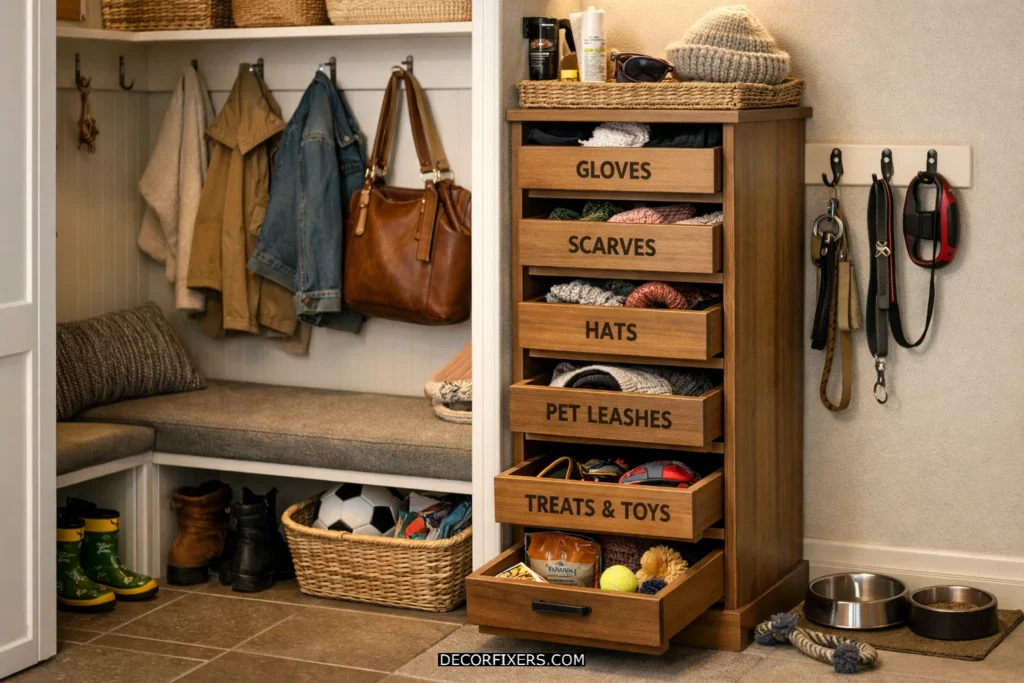
An entryway closet suffers from a different problem than a bedroom closet: it needs to hold gloves, scarves, hats, masks, dog leashes, and dozens of small items that have no natural home on a shelf or rod. A narrow 3-drawer unit on the closet floor handles exactly these items.
Shallow drawers,8 to 12 inches deep, are better here than deep ones. Small items get lost in deep drawers. Label each drawer with its category and commit to it. A labeled entryway drawer system is one of those changes that feels trivial to set up and enormous to live with.
28. Custom DIY Drawer Insert from Craft Organizer Boxes
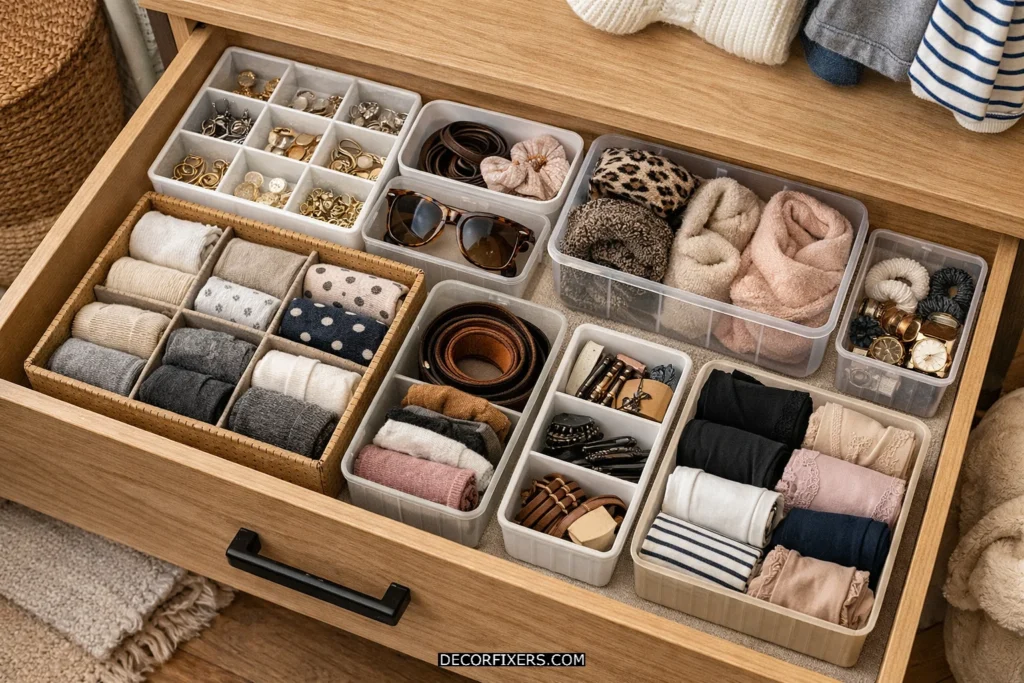
For budget-conscious organizers, a DIY drawer insert using craft organizer boxes or repurposed gift boxes is a legitimate approach. Line the bottom of an existing drawer with small boxes cut to size, secure them with double-sided tape, and assign each box a category.
It doesn’t look as clean as bamboo or acrylic, and it won’t last forever, but for someone deciding whether drawer organization actually changes daily life before spending money on proper inserts, this is a worthwhile test run. Many people who start here quickly upgrade. That’s the point.
Quick Comparison:
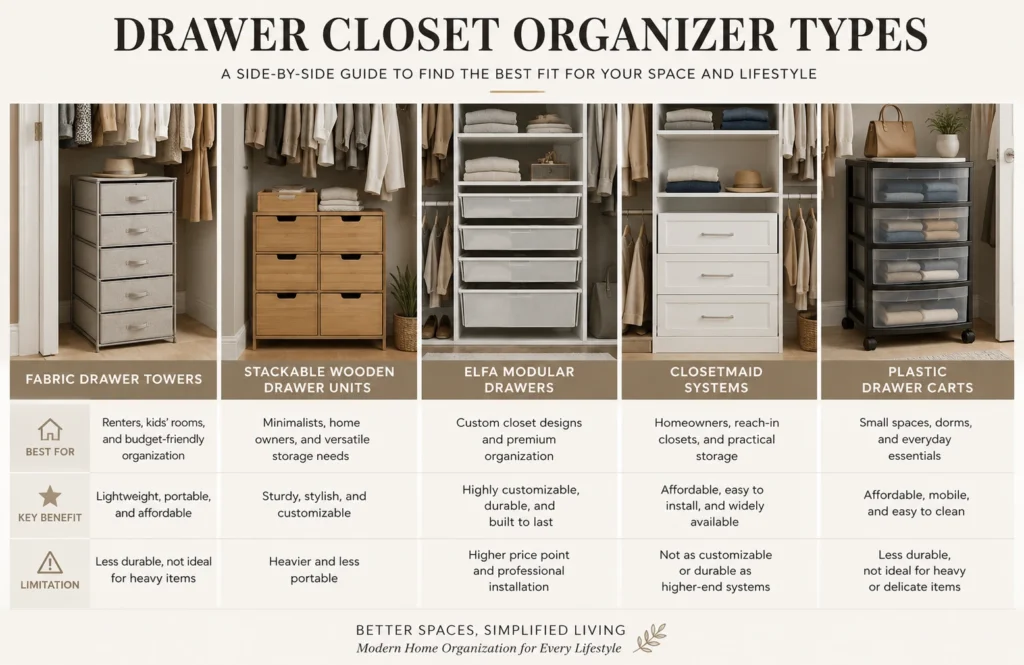
| Option | Best For | Key Benefit | Limitation |
| Fabric Drawer Tower | Renters, reach-in closets | Zero tools, fast setup | Sags under heavy items |
| Stackable Wood Units | Walk-in closets, shared spaces | Sturdy, handles heavy clothing | Requires assembly time |
| Elfa Décor Drawer | Homeowners with Elfa tracks | Fully repositionable | Higher cost |
| ClosetMaid Modular | Mid-budget full closet builds | Works within one system | Less flexible than Elfa |
| Plastic Drawer Cart | Kids, guest closets, light items | Budget-friendly, transparent | Not for heavy clothing |
How to Measure Your Closet Before Buying a Drawer Unit
This is what most guides skip, and it’s exactly why people return organizers or end up with a unit that doesn’t fit under their hanging rod. Measure before you buy. Every time.
To choose the right drawer closet organizer, follow these steps:
- Measure the width of your available floor space (wall to wall, or between existing units).
- Measure the height from the floor to the bottom of your lowest hanging rod; this is your maximum drawer unit height.
- Measure the depth of your closet floor (front to back). Most closets are 24 inches deep; some reach-ins are shallower.
- Note whether you have a center hanging rod or side-mounted rods; this changes where a drawer unit can be placed.
- Write down all three numbers before visiting a store or adding anything to a cart online.
Conclusion:
A closet stays organized when folded clothes have structure, containment, and a dedicated place to live. That’s the real advantage of drawer-based storage over open shelving alone. Whether you choose a simple fabric drawer tower for a reach-in closet, a modular Elfa setup for a walk-in, or small drawer inserts to fix messy existing drawers, the goal is the same: make everyday storage easier to maintain.
The best drawer closet organizer is the one that fits your actual closet dimensions, clothing habits, and budget — not just the one that photographs well online. Start by measuring your space carefully, deciding whether you need freestanding or modular storage, and focusing first on the categories that create the most clutter in your daily routine.
Even adding one well-placed drawer unit can completely change how your closet functions.
FAQs:
Q: What’s the best drawer organizer for a reach-in closet?
A: A fabric 5- to 7-drawer tower is the best starting point for most reach-in closets. It slides under the hanging rod, requires no tools, and can be repositioned easily. Look for a steel frame, not just a cardboard or plastic base, so it holds weight without collapsing.
Q: How do I add drawers to a closet with only shelves?
A: Place stackable drawer units on the lower shelf or floor, or hang a fabric shelf organizer with a drawer pocket from the existing rod. You can also add cube organizer units with fabric bin drawers along the back wall without drilling anything.
Q: Should I use fabric or wood drawers in my closet?
A: Fabric drawers are lighter, cheaper, and better for renters; wood drawers are more durable and handle heavier clothing without sagging. For everyday use with jeans and sweaters, wood stackable units hold up significantly better over time.
Q: Why do my closet shelves get messy even after I organize them?
A: Open shelves lack containment, and folded stacks fall because nothing is holding them in place. Drawers solve this by giving folded items a closed, defined space. Even adding a few drawer inserts or bins converts loose shelf space into structured storage.
Q: When should I use a modular drawer system instead of a freestanding unit?
A: Use a modular drawer system if you already have a track-based closet system like Elfa or ClosetMaid installed. Modular drawers integrate with existing rails for a cohesive look. If you’re starting fresh or renting, a freestanding unit is faster and more flexible.

Creator of DecorFixers, sharing practical home and interior ideas focused on real-life usability, simple design improvements, and budget-friendly solutions.
1 thought on “28 Drawer Closet Organizer Ideas (That Actually Work)”