

I used to eat dinner standing at the kitchen counter. Not because I enjoy it, but because every layout I tried in my 9×10 dining room made the table feel like a roadblock. Chairs couldn’t pull out. Guests had to turn sideways. The whole thing felt like a design failure, not a space problem.
Then I started measuring. Not just the table, but the clearances, the space between the chair back and the wall, the walkway behind a seated guest, and the swing radius of the door. That’s when everything changed.
If your dining room feels smaller than it should, the issue usually isn’t the size. It’s the arrangement. The wrong layout wastes more space than a wrong-sized table ever could.
This guide covers 15 real small dining room layout ideas, each matched to a specific room shape, size, and lifestyle. You’ll get exact measurements, honest trade-offs, and the furniture names. No filler.
| Small dining room layout ideas refer to strategic furniture arrangements designed to maximize seating, traffic flow, and visual space in dining areas under 150 square feet. The right layout depends on room shape, door placement, and how many people need to sit comfortably. |
1. The Round Pedestal Table, The One Layout That Works in Almost Any Small Room
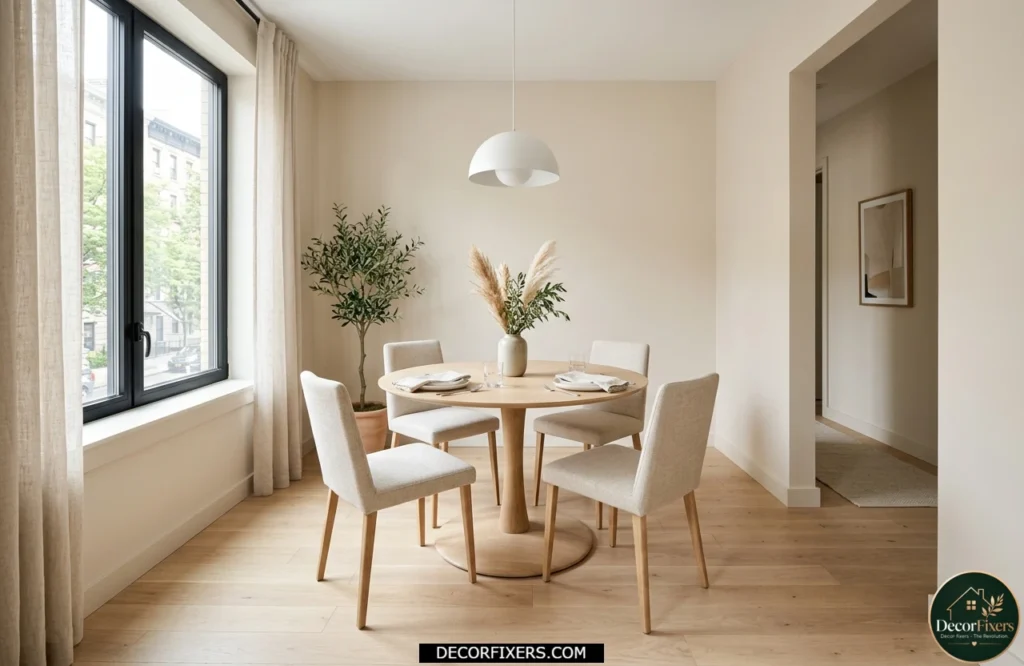
Round tables don’t have corners. That sounds noticeable, but the implication is massive for small spaces; there’s no dead corner to navigate around, no sharp edge blocking a walk-through, and no ‘bad seat’ that’s wedged against a wall.
A 36–42-inch round pedestal table is the most versatile layout choice for rooms under 120 sq ft. The pedestal base eliminates corner legs, freeing up legroom on all sides. Its narrow base keeps the floor visually open while seating four without crowding.
Clearance rule: Leave at least 36 inches between the table edge and any wall for chair pull-out. In a pinch, 30 inches works if one side faces an open area or the chairs are armless and slim.
2. The Wall-Flush Rectangle, Best for Narrow Galley-Style Dining Areas
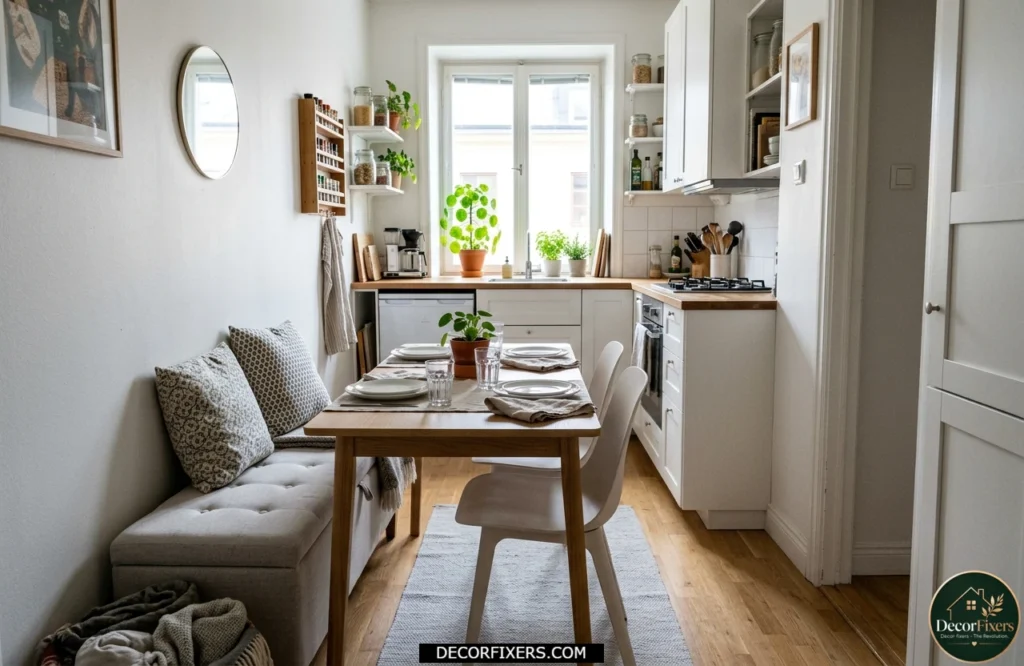
Push a rectangular table against the wall. It’s the first thing most people try, and it half-works. Here’s the thing: the reason it fails isn’t the idea; it’s the chair choice. Most people keep four chairs, which means the two wall-side seats are impossible to get in or out of cleanly.
Swap the wall-side chairs for a bench or built-in banquette, and the layout transforms. Benches slide in and out without needing swing room. IKEA’s NORBERG wall-mounted drop-leaf table takes this even further; it folds completely flat when not in use, reclaiming the full floor area. Pair it with two stackable stools, and you’ve got a functional dining spot that disappears when breakfast is done.
Ideal for: Rooms 8 feet wide or narrower, rentals where you can’t install built-ins, and studios where the ‘dining room’ is actually a kitchen corner.
3. The Corner Banquette, Turns a Dead Corner Into the Best Seat in the House
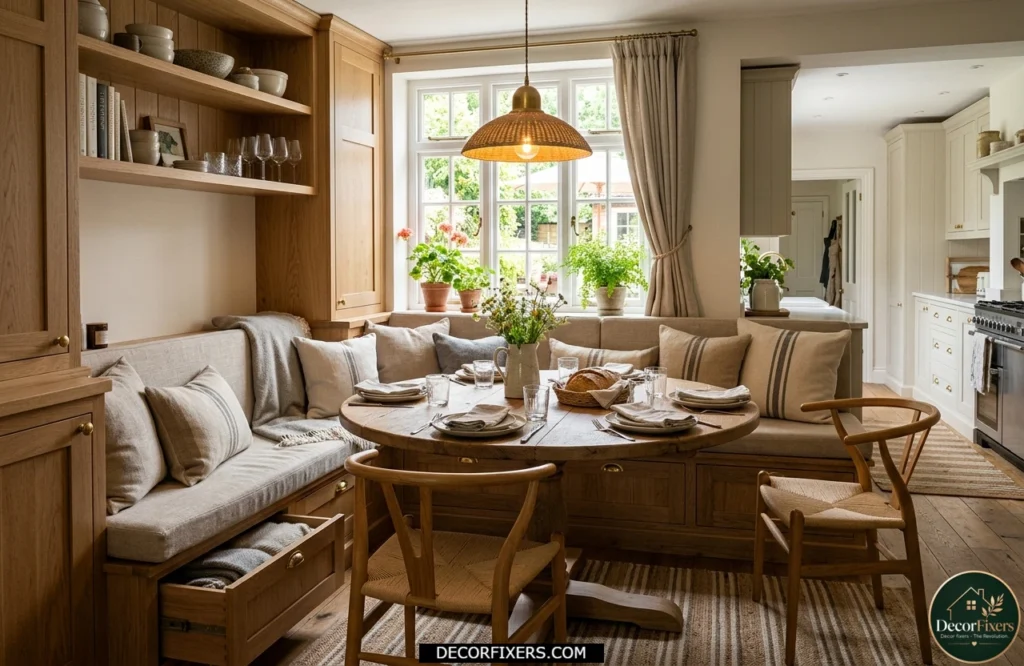
Corner seating gets underused in small homes. Most people put a plant there, or nothing at all. A banquette layout, L-shaped bench seating tucked into the corner, can seat four to six people in a footprint that a standard four-chair square table couldn’t manage.
The practical advantage: banquette seating doesn’t need chair-pull clearance on the bench sides. That alone can save 18–24 inches on two walls simultaneously.
Many built-in versions include storage underneath, a useful bonus for dining rooms that moonlight as junk drawers. Fred Horlock, design director at Neptune, recommends built-in bench storage specifically for small dining areas because it removes the need for a separate credenza.
Look, if you’re dealing with an awkward corner near a window, this layout actually works. It turns a design liability into the coziest spot in the home.
4. The Extendable Table, Compact Every Day, Ready for Guests on Demand
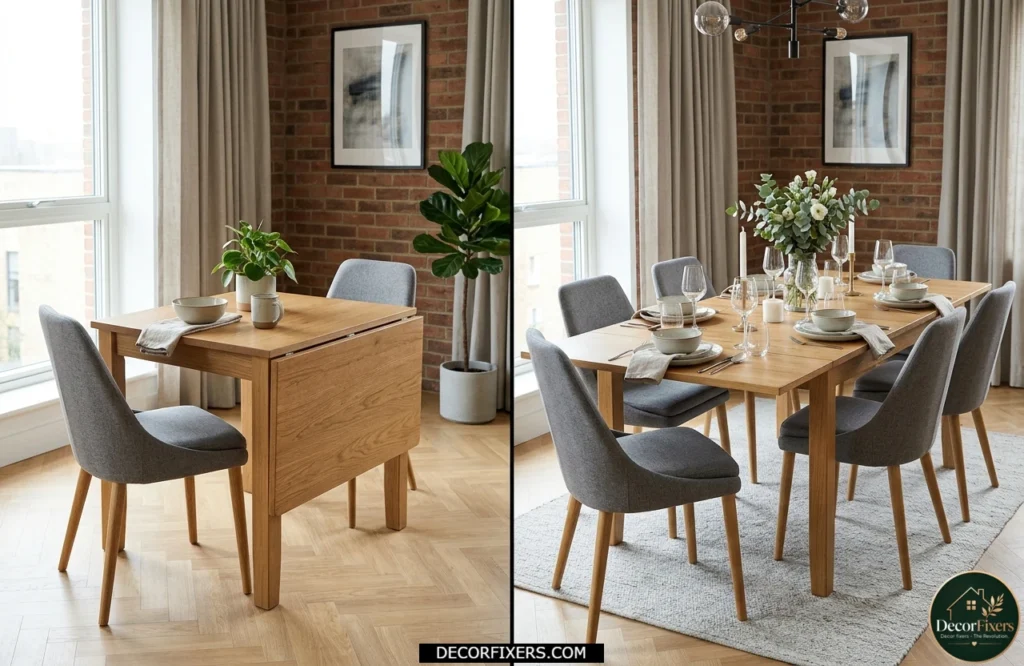
An extendable table is the dining room equivalent of a sofa bed: slightly unglamorous to talk about, incredibly useful in reality. A table that seats two or four when closed but expands to seat six or eight gives small-space dwellers something most compact layouts can’t: genuine hosting ability.
IKEA’s GAMLEBY drop-leaf dining table collapses to just 18 inches wide against a wall, then opens to a full four-person table in under 30 seconds. For something with more design credibility, West Elm’s Rowan Expandable Table delivers a cleaner aesthetic without sacrificing the fold-flat function.
Measure the swing arc when the table is fully open. In tight rooms, an open extendable table can block a doorway or restrict kitchen access.
Trade-off: Extendable mechanisms add weight and cost. In rooms under 80 sq ft, a wall-mounted drop-leaf is a smarter bet.
5. The Open-Plan Zone Layout, When Your Dining Room Is Really Part of the Living Room
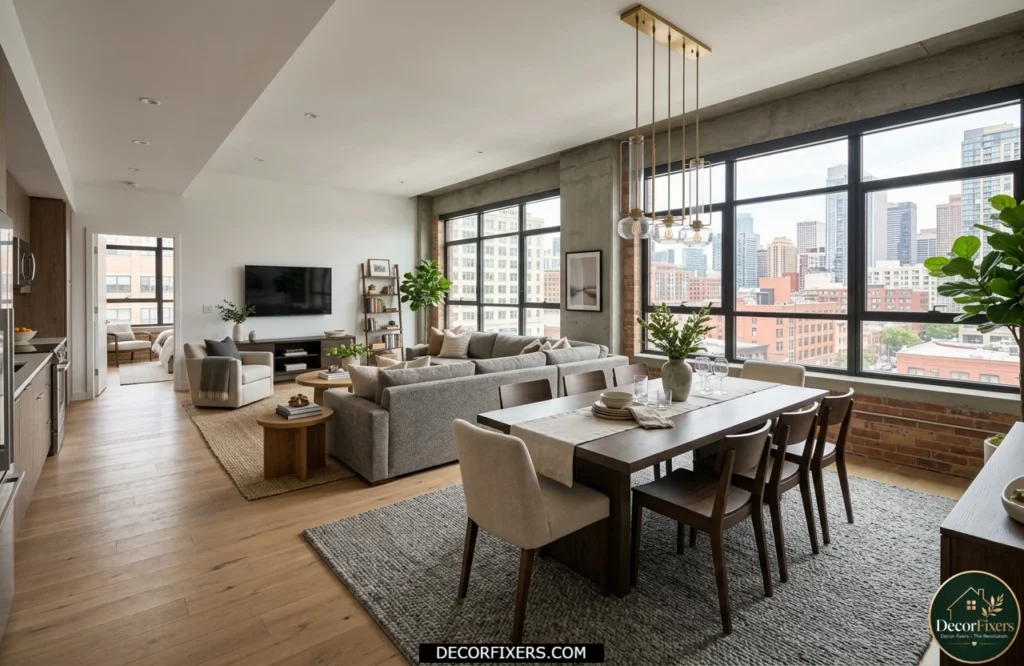
This is the scenario most layout guides ignore. In apartments and open-plan homes, the dining area isn’t a room; it’s a zone within a larger room. The biggest layout mistake here is placing the table so it floats in the middle of everything, belonging to neither the dining nor the living area.
The fix is zone anchoring: define the dining area with a rug, a pendant light directly overhead, and furniture positioned with intention. Place the back of your sofa toward the dining table; this creates a natural physical boundary between the two zones. Spook’s free online room layout planner includes dining room templates built specifically for open-plan scenarios, and it’s worth using before buying a single piece of furniture.
For tier 1 renters in cities like London, Toronto, or Sydney, where open-plan studio and one-bedroom living is the norm, zone anchoring is not optional. It’s the difference between a space that reads as intentional and one that looks cluttered.
If you’re working with an open-plan space and want to push the aesthetic further, our guide on Modern Dining Room Ideas covers how to layer lighting, materials, and minimalist furniture to make an open-plan dining zone feel deliberately designed, accidentally assembled.
6. The Diagonal Table Placement, Breaking the Grid to Gain Space
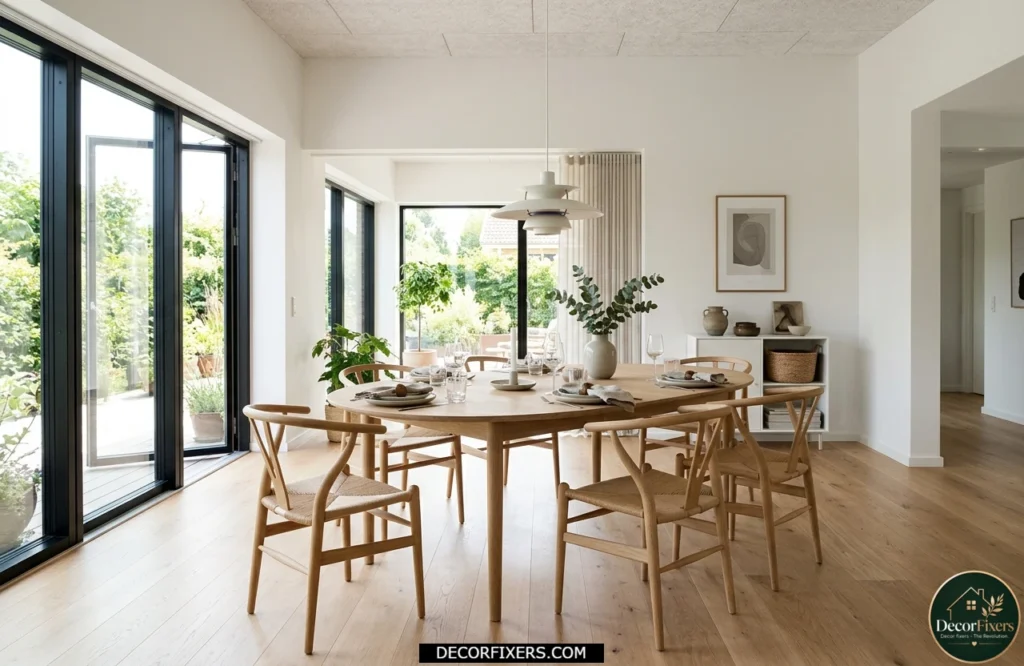
Placing a table at a 45-degree angle to the walls is counterintuitive enough that most people never try it. It works for a specific reason: diagonal placement opens up corner-to-corner sightlines, which makes a room read as larger to the eye even when no floor space is actually gained.
This layout works best in square rooms where centered placement feels boxed in. Use a round or oval table; rectangular tables placed diagonally create sharp corner protrusions that interrupt traffic flow. One caveat: it requires slightly more free floor area to execute cleanly, so it’s not ideal for rooms under 90 sq ft.
7. The Bench-and-Table Duo, Eliminate Chair Swing Space Entirely
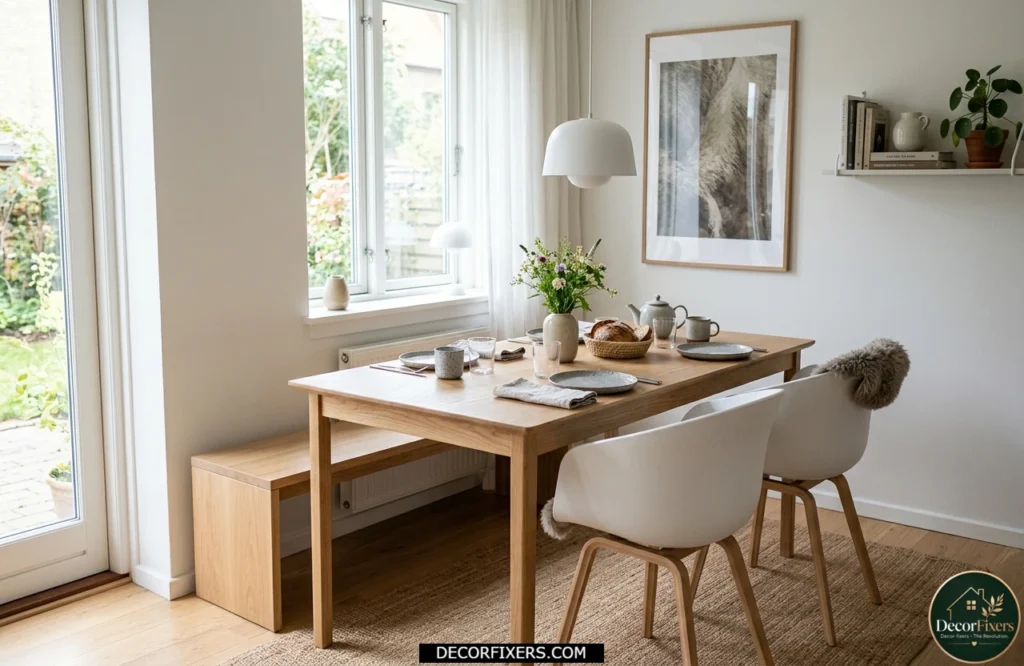
Standard dining chairs need 18–24 inches of clearance behind them to push in and out. In a room where every inch counts, that’s a significant spatial tax. Replacing chairs with benches, particularly on the wall-facing side of a rectangular table, removes that clearance requirement almost entirely.
A bench can be pushed flush with the table between meals, freeing the entire walkway. IKEA’s SKOGSTA bench pairs cleanly with most narrow dining tables and costs under $100. The less glamorous truth: benches are less comfortable for long dinners, and guests with mobility challenges may struggle with them. For everyday meals with kids or a partner, though, they’re a genuine space solution.
| How to Choose a Small Dining Room Layout, 5 Steps |
| 1. Measure your room, note every doorway, window, and fixed obstacle. |
| 2. Decide your seating minimum, how many people dine daily vs. occasionally? |
| 3. Identify your room shape: square, rectangular, L-shaped, or open-plan zone. |
| 4. Choose table shape first, round for square rooms, oval/rectangle for narrow rooms. |
| 5. Confirm clearances, minimum 30 inches behind each chair; 36 inches for primary walkways. |
8. The Floating Table With Leggy Chairs, Keep the Floor Visible, Keep the Room Open
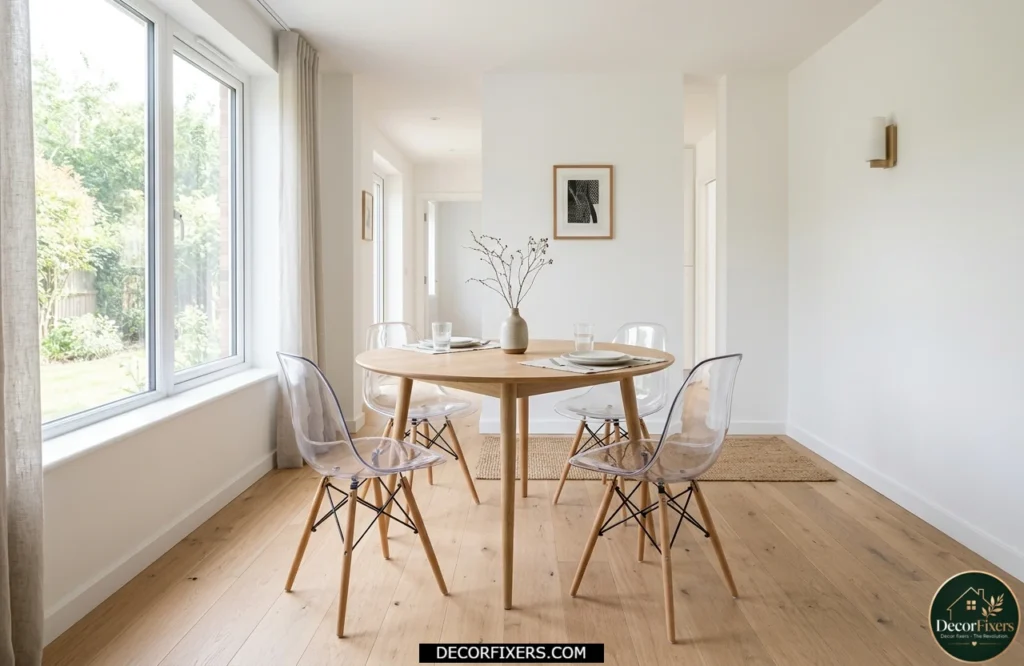
Visual weight matters as much as physical footprint. A table with thick legs, heavy chairs, and a dark rug can make a small room feel like a storage unit even when there’s technically enough space. Switching to
furniture with exposed legs, the more floor you can see beneath a piece, the larger the room reads. Eames-style DSW chairs (manufactured by Herman Miller or their licensed vendors) are the canonical example: their thin leg profile and translucent shell options keep sightlines open and light moving through the space.
Pair leggy chairs with a light-toned round table and a low-pile rug that’s slightly smaller than the table diameter, and the room will read as 20–30% larger than it measures.
9. The Built-In Nook, Custom Efficiency for the Long Term
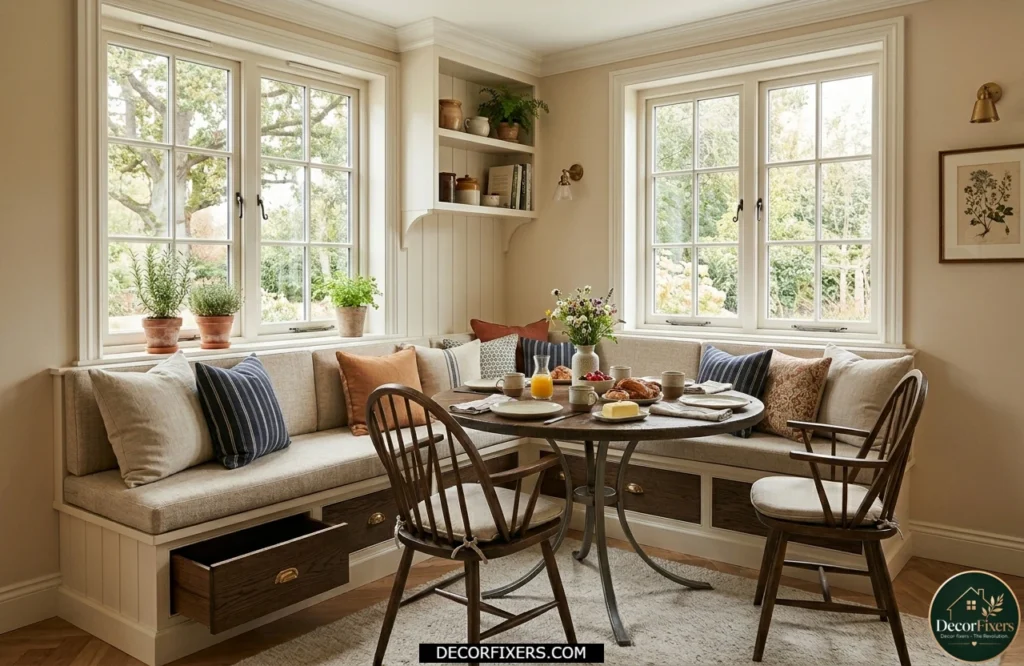
A built-in breakfast nook is the most spatially efficient dining layout that exists for small homes. It uses corners that would otherwise be wasted, eliminates the need for four-direction chair clearance, and integrates storage underneath the bench seating.
Built-in nooks aren’t cheap; expect to pay $800–$2,500 for a custom installation, depending on size and finish. But for homeowners (not renters) who are staying put, the per-year cost amortizes quickly. A 6×5 ft nook can comfortably seat four adults and replaces what would otherwise require a 10×10 ft conventional dining arrangement. Or maybe I should say it this way: the nook doesn’t shrink the experience, it concentrates it.
Once your nook layout is sorted, the next challenge is making the space feel warm rather than compact. Our article on Small Dining Room Décor Ideas walks through color palettes, textile choices, and lighting configurations that work specifically in nook and corner dining setups, including how to handle low ceilings without making the space feel like a cave.
10. The Murphy Bed + Dining Table Hybrid, When the Bedroom IS the Dining Room
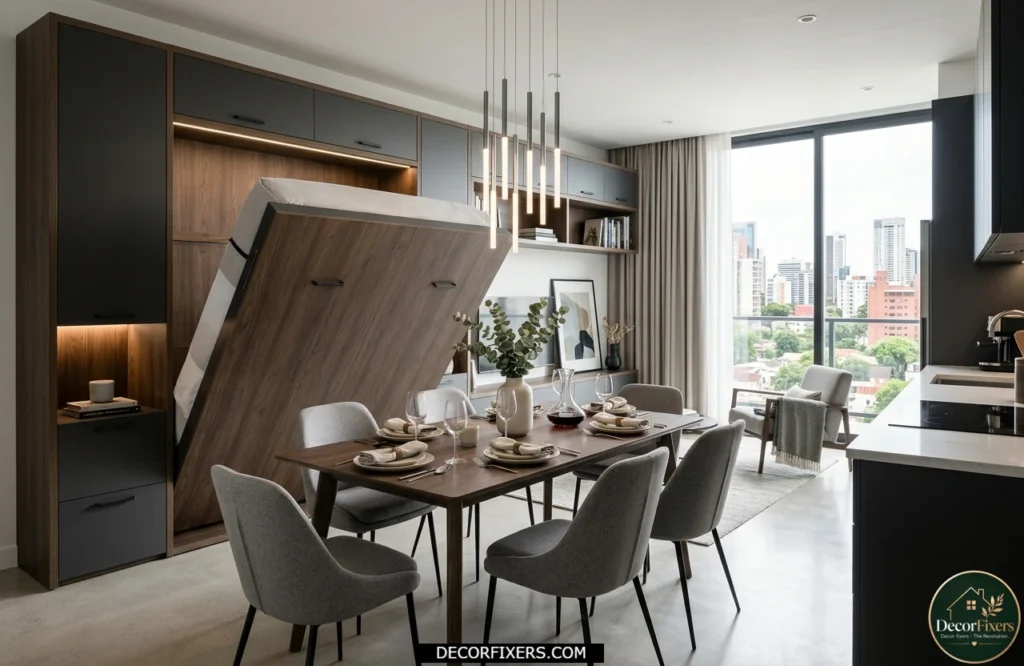
This layout is the nuclear option for studio apartments. A wall-mounted Murphy bed folds away to reveal a full dining table setup, effectively making the sleeping space serve double duty as a genuine dining room.
In an 800 sq ft Manhattan apartment, Apartment Therapy documented a custom Murphy bed that flips away to reveal a six-person dining table. It’s an extreme solution, but it proves the point: in small homes, the most useful layouts are the ones that refuse to let a room serve only one purpose.
This won’t work for everyone. But if you’re genuinely stuck between sleeping space and dining space in a studio, this is the solution most guides never mention.
11. The Foldaway Wall Table, The Best Layout for Rooms Under 80 Square Feet
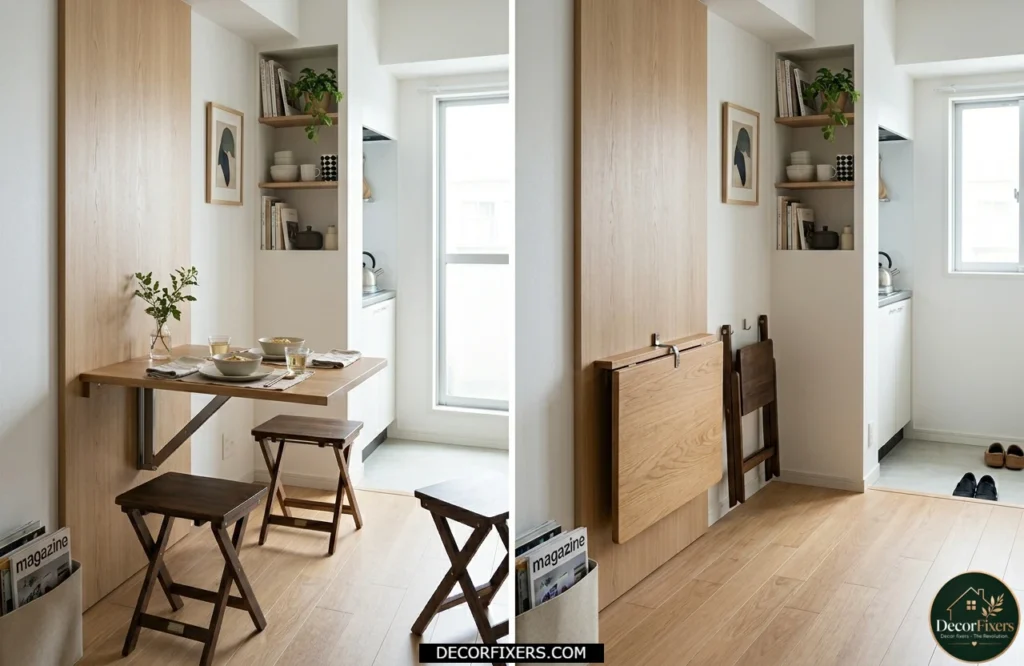
When there’s simply no room to leave a dining table set up permanently, a wall-mounted foldaway table is the honest answer. It mounts flat against the wall, drops down for meals, and folds back up in under ten seconds.
IKEA’s NORBERG and KALLAX-with-leaf combinations are the most widely used. Pair with two folding stools that hang on the wall or slide under a cabinet when not in use, and the entire dining setup occupies essentially zero floor space between meals. This is the layout used in the most space-constrained apartments in Tokyo, Hong Kong, and London, three cities where the demand for clever small-space layouts has driven real product innovation.
Clearance needed: As little as 8 inches of wall depth. The table surface itself is typically 18×29 inches, enough for two people to sit without elbowing each other.
12. The Oval Table Layout, The Underrated Middle Ground Between Round and Rectangle
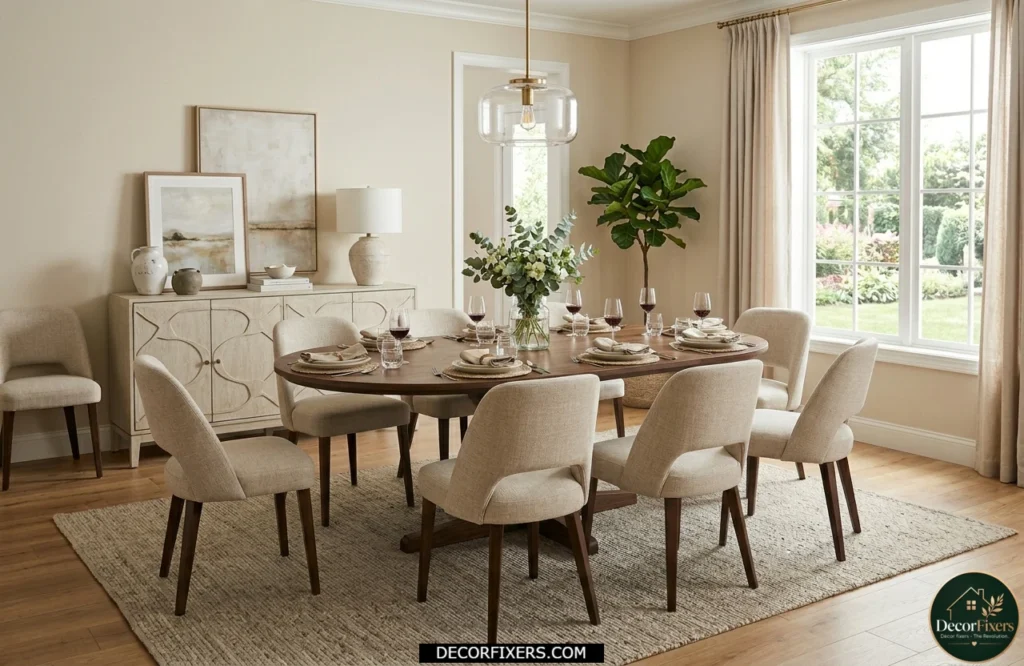
Oval tables solve a specific problem: you want the traffic-flow softness of a round table, but you need to seat six. A standard 60×36 inch oval seats six adults comfortably and can be positioned closer to walls than a round table of equivalent seating capacity.
The base version of an oval table is the key detail; four-legged ovals create the same corner obstruction as squares. A pedestal keeps legroom open at all six seats and allows chairs to slide in from any angle. Better Homes & Gardens and most interior designers flag this as the single best table choice for small dining rooms that regularly host guests.
| Round vs. Rectangle in Small Dining Rooms |
| Round tables suit square rooms best; no corners mean smoother traffic flow and equal access from all sides. |
| Rectangle tables work better in narrow rooms; they align with the room’s longest wall and seat more people per square foot. |
| Key difference: round tables feel more social; rectangular tables feel more formal and are easier to extend. |
13. The Mirror-and-Light Illusion Layout, Hack the Perception of Space
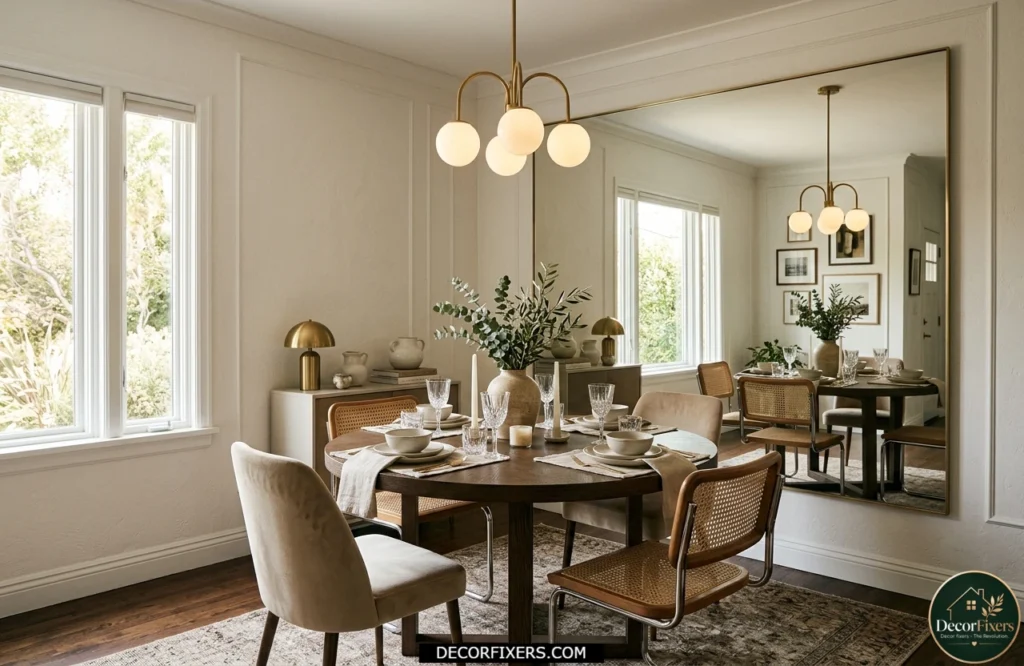
This isn’t a furniture layout in the traditional sense; it’s a visual one. A large mirror placed on the wall directly opposite the main sightline of the dining room effectively doubles the perceived depth of the space. Combined with a pendant light positioned low over the table, it creates a focal point that draws the eye in rather than letting it register the walls.
I’ve seen conflicting opinions on mirror sizing; some designers argue that a small mirror is worse than none, while others say any reflective surface helps. My read: go large or skip it. A mirror that spans at least 60–70% of the wall width is the threshold at which the illusion actually registers. Smaller mirrors look decorative without delivering the spatial expansion.
Lighting matters here, too. A pendant hung 30–34 inches above the table surface creates warmth and draws attention downward, away from the tight walls. This is also where Gold Abstract Canvas Wall Art earns its place; a single bold piece on the wall opposite the mirror gives the reflection something interesting to double, turning a functional trick into a genuine design statement.
14. The Rug-Defined Zone, Carve Out a Dining Area Without Any Walls
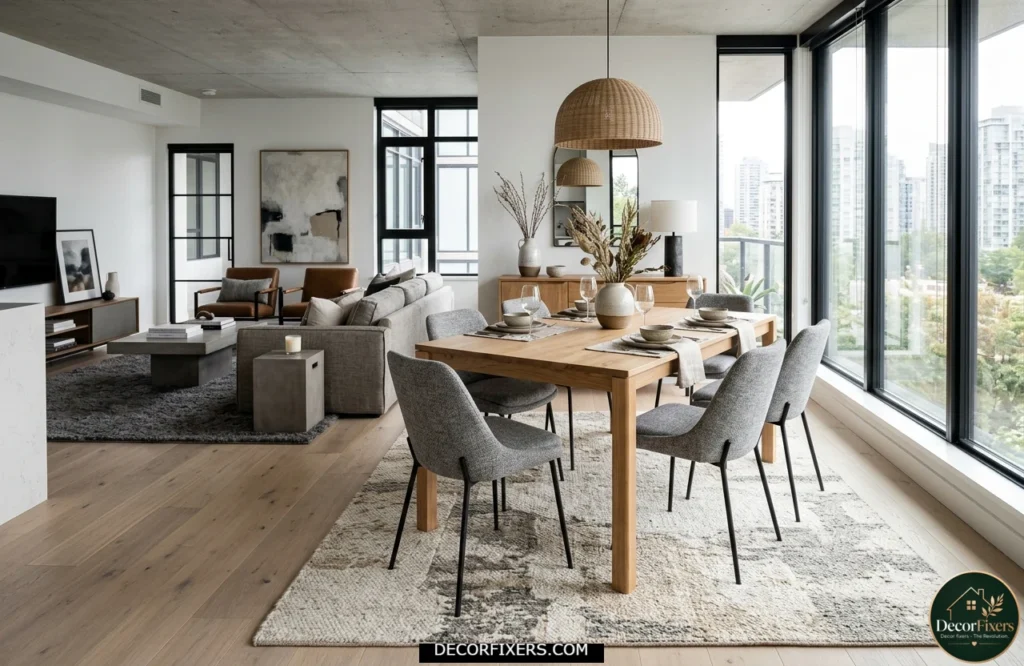
In open-plan homes, the dining area often has no natural boundary. A rug is the lowest-cost, most effective way to create one. The rule is simple: the rug should be large enough that all four chair legs sit on it, even when the chairs are pulled out for sitting.
For a four-person table, that typically means a 5×8 ft rug minimum. A 6×9 ft rug is usually better. The rug doesn’t need to match the dining furniture; it needs to anchor the zone. A contrasting texture or color actually strengthens the visual separation between dining and living areas in an open plan.
Get the rug size wrong, and the table looks like it’s floating on an island. Get it right, and the zone reads as a proper room.
15. The Dual-Purpose Layout, When the Dining Table Also Needs to Be a Desk
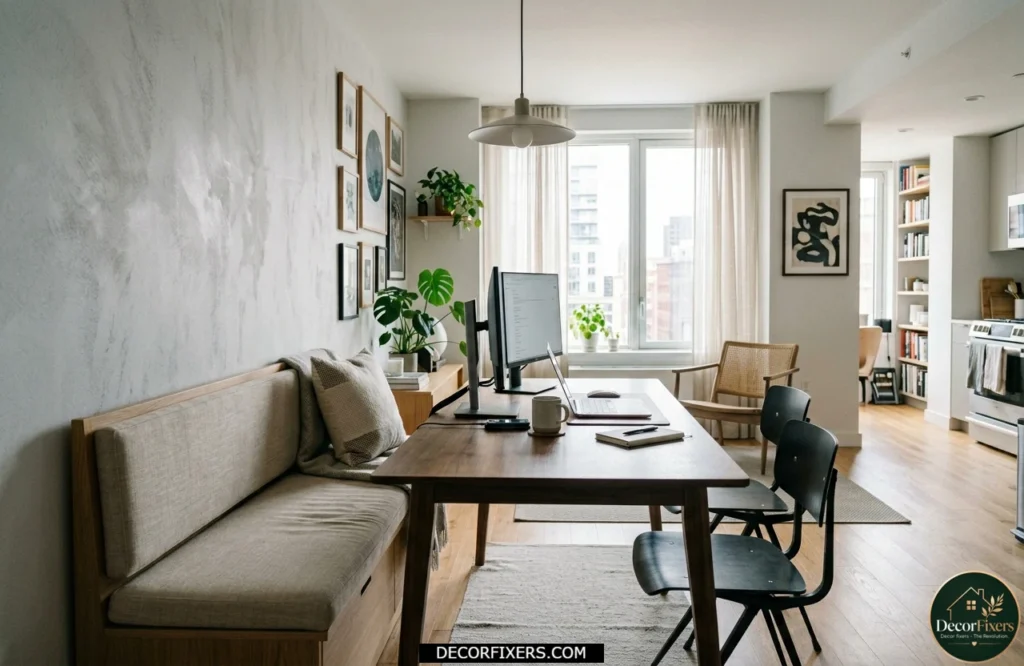
For the majority of remote workers in small homes, the dining table is also the office. Designing a layout around this reality, rather than pretending it away, makes the whole space function better.
The key is choosing a table at standard desk height (29–30 inches) with a clean, uncluttered surface. A narrow table (28–32 inches deep) works for both purposes without crowding the room. Keep one side of the table accessible for chair pull-out, and use the other side for a built-in bench or against the wall. This keeps the desk-to-dining transition simple.
Wireless charging pads, a single cable management solution, and two slim task chairs complete the setup. The dining layout and the workspace don’t fight each other; they share the same table without demanding separate square footage.
Quick Comparison:
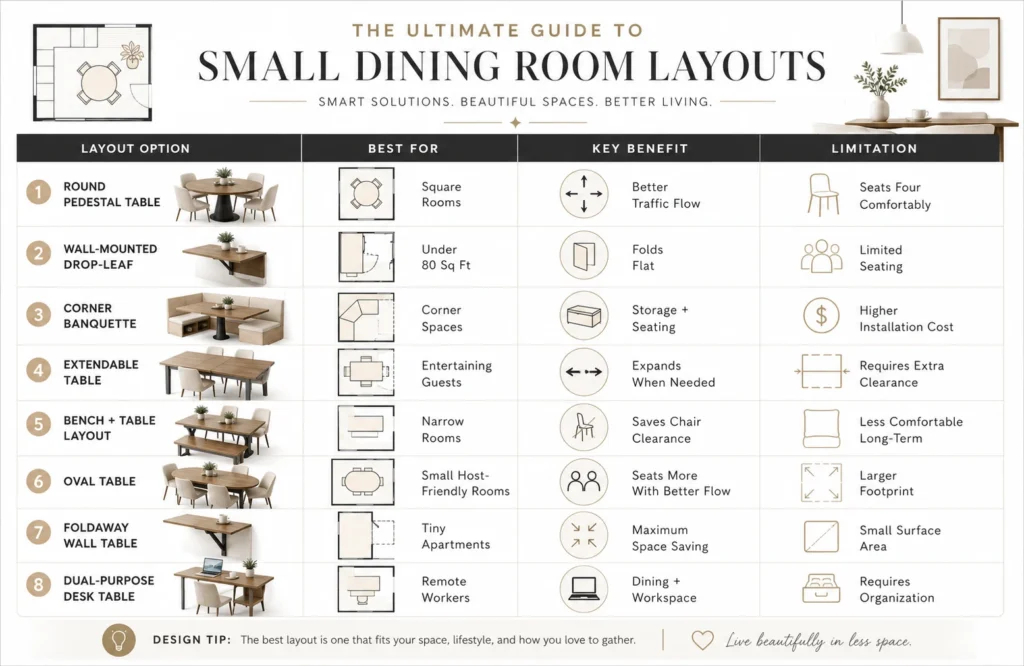
Use this to match your room situation to the right layout before committing to furniture.
| Layout Option | Best For | Key Benefit | Limitation |
| Round Pedestal Table | Square rooms, 4 people | No corners = better flow | Limited seating past 4 |
| Wall-Mounted Drop-Leaf | Rooms under 80 sq ft | Folds flat when unused | One side against the wall only |
| Corner Banquette | L-shaped or corner spaces | Adds storage + seating | Custom-built costs more |
| Extendable Rectangle | Hosts who entertain guests | Compact daily, expands when needed | Fully open = tight walk-around |
| Bench + Table Against Wall | Narrow/galley dining areas | Removes the chair swing space needed | One bench side is less comfortable |
CONCLUSION:
Every layout in this list came from a real constraint: a room that was too narrow, a corner that was wasted, a dining table that blocked every walkway it touched. None of it is theoretical.
The one thing I wish I’d known earlier: the clearances matter more than the furniture. You can have a beautiful table in the wrong layout and feel cramped every single meal. You can have a $200 IKEA drop-leaf in the right layout and feel like the space was designed for you.
Measure twice. Choose your layout first. Buy the furniture second-hand.
Scope note: This guide covers dining rooms and dining zones up to approximately 150 square feet. It does not address large formal dining rooms, open-plan great rooms over 400 sq ft, or layouts that require structural renovation.
FAQs:
Q: What’s the best layout for a small dining room under 100 square feet?
A: A round pedestal table with armless chairs or a wall-mounted drop-leaf table with stools. Both minimize clearance requirements and keep floor space open between meals.
Q: How do I arrange a small dining room and living room together?
A: Anchor the dining zone with a rug that’s large enough for all chair legs, hang a pendant light directly over the table, and position the sofa back to face away from the dining area. This creates a visual divider without any physical partition.
Q: Should I use a round or rectangular table in a small dining room?
A: Round for square-shaped rooms, it improves traffic flow and social comfort. Square for narrow or galley-shaped rooms, it aligns with the walls and maximizes linear seating.
Q: Why does my small dining room always feel cramped, no matter what I try?
A: Usually it’s a clearance issue, not a size issue. If chair backs are within 18 inches of a wall when pushed in, the room will feel tight regardless of furniture size. Rearranging.
Q: When should I consider a built-in banquette over a standard dining set?
A: When you own the home and plan to stay for three or more years. Banquettes cost more upfront but save more space long-term, especially in corner rooms where a standard table and four chairs can’t physically fit without constant rearranging.

Creator of DecorFixers, sharing practical home and interior ideas focused on real-life usability, simple design improvements, and budget-friendly solutions.
1 thought on “15 Small Dining Room Layout Ideas: Arrangements That Actually Work in Tight Spaces”