

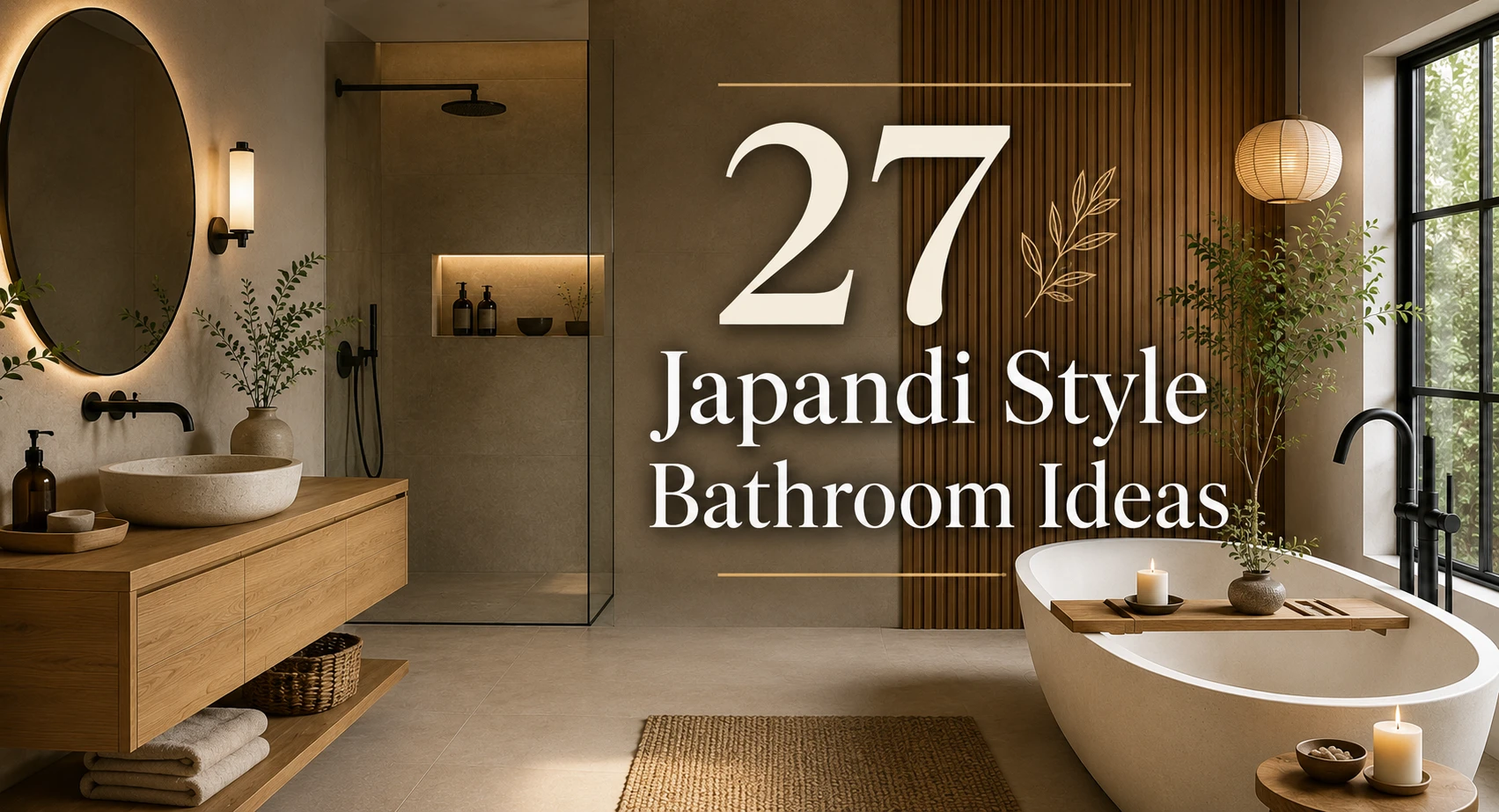
I remember standing in my bathroom one morning, staring at a shelf of half-used products, a towel rail that held too many towels, and tiles that managed to be both aggressively beige and somehow cold, and thinking: this should not feel this bad. I’d spent two weekends on Pinterest. I’d decluttered. I’d bought a bamboo tray and one small plant. Nothing worked. The space still felt wrong.
That frustration is exactly what leads people to search for Japandi-style bathroom ideas, not because they want a design magazine bathroom, but because they want their daily routine to feel calm. The shower you step into before a hard day. The sink area that doesn’t make your chest tighten. A bathroom that actually restores you instead of just existing.
What Is Japandi Style?
Japandi style bathroom ideas deliberately design concepts that blend Japanese minimalism with Scandinavian functionality to create calm, uncluttered spaces organized on natural materials, neutral color palettes, and focused storage. The philosophy draws from Japan’s wabi-sabi (beauty in imperfection) and Scandinavia’s hygge (cozy, human-scaled warmth), producing rooms that feel both refined and livable.
1. The Japandi Bathroom Color Palette, Warm Neutrals, Not Cold Whites
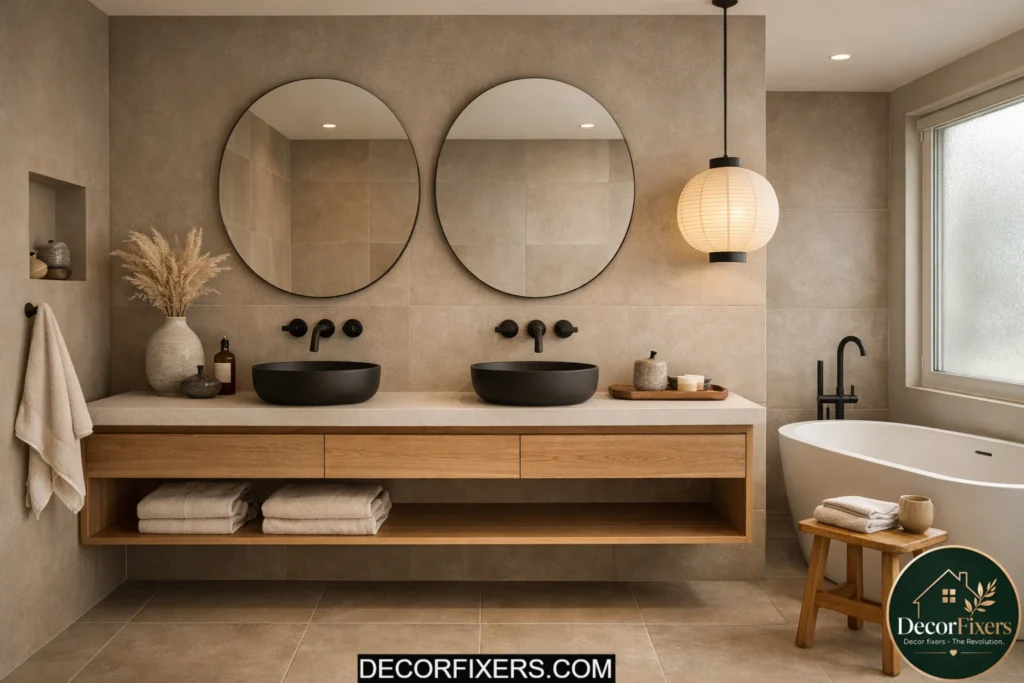
Most people get this wrong. They go white. Brilliant white reads as clinical; it’s what you find in hospital corridors and rental apartments. True Japandi bathroom color palette choices lean toward warm off-whites, clay beige, soft taupe, and muted sage. Think the inside of an oyster shell, or the muted linen of a well-worn towel.
The psychological difference is real. Warm undertones (yellow, pink, red) reduce perceived stress and elevate feelings of comfort, while cool-based whites do the opposite in enclosed spaces. For walls, consider Farrow & Ball’s Elephant’s Breath, Benjamin Moore’s White Dove, or a custom mix using warm gray as your base.
2. Use a Floating Vanity, It Changes the Entire Energy of the Room
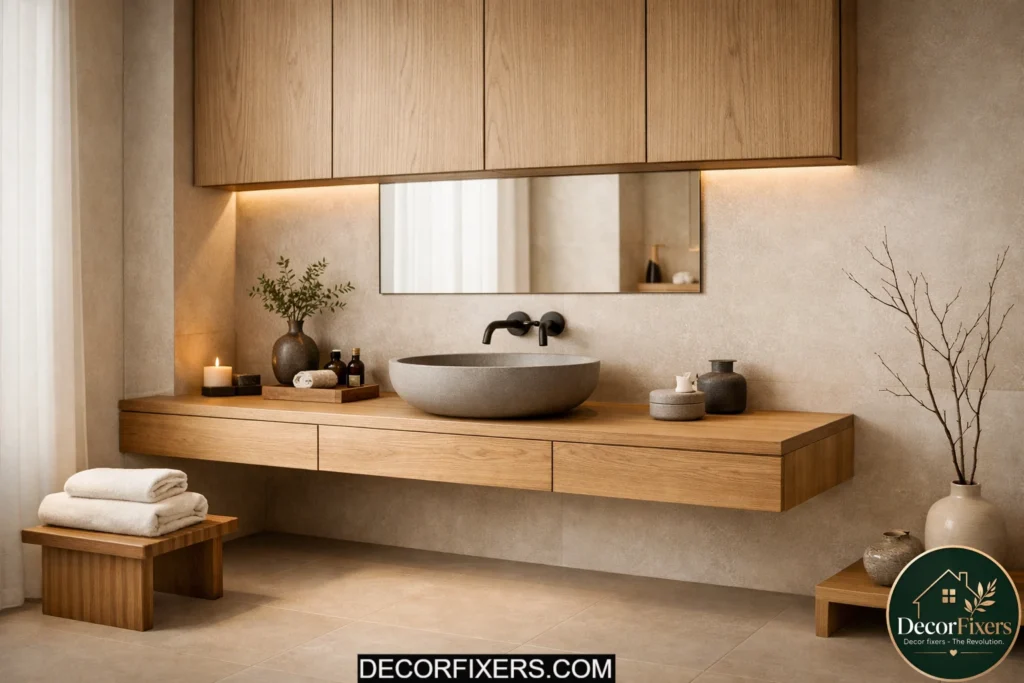
A floor-standing vanity cuts the room in half visually. Floating vanities, wall-mounted with nothing touching the floor, create an unbroken line of floor tile that makes even a small bathroom feel like it breathes. This is one of those details that competent designers mention first, but most renovation guides skip entirely.
IKEA’s HAVBACK series is one of the most accessible options on the market: bamboo-adjacent finishes, handle-free drawers, clean lines, and a price point that doesn’t require a renovation loan. Pair it with a matte stone basin, and you’re 60% of the way to a proper Japandi bathroom vanity without hiring anyone.
If you’re planning a renovation and want more inspiration before choosing cabinetry, these Bathroom Vanity Ideas explore floating vanities, natural wood finishes, and space-saving layouts that pair perfectly with Japandi design principles. A thoughtfully selected vanity often becomes the defining feature that sets the tone for the entire bathroom.
3. Embrace Wabi-Sabi, Stop Chasing Perfection, Start Chasing Character
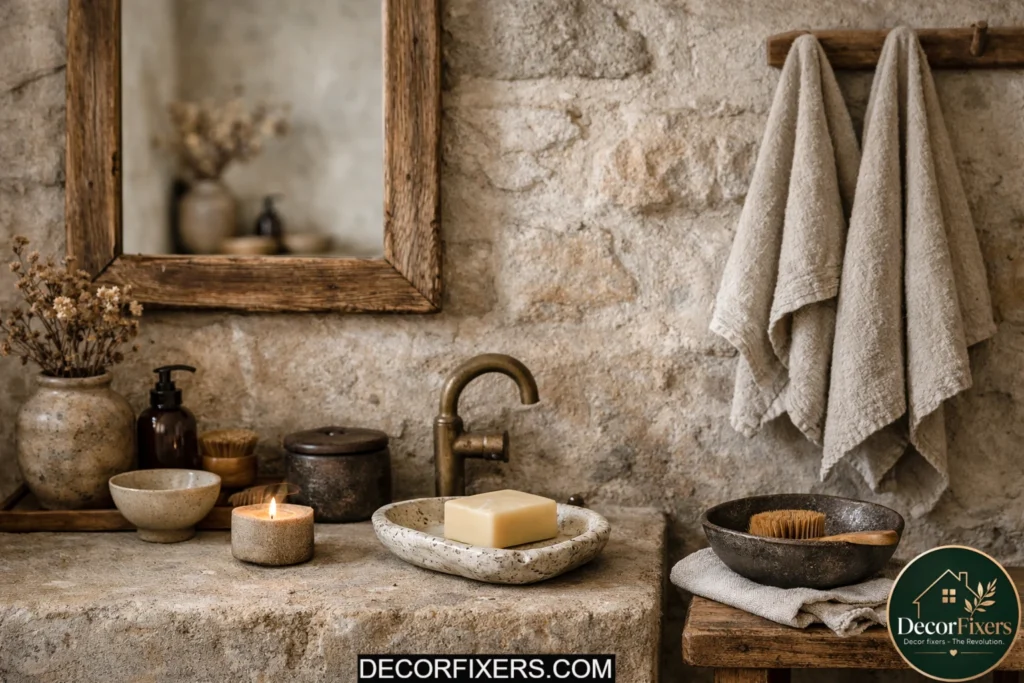
Here’s the thing: most design guides describe the Japandi style without ever explaining wabi-sabi honestly. It isn’t ‘rustic chic’ or an excuse for worn-out fittings. Wabi-sabi is a Japanese philosophy that finds beauty in the incomplete, impermanent, and imperfect, the natural crack in handmade ceramic, the way teak darkens over time, the organic edge of a stone tile that wasn’t cut perfectly straight.
In practice, this means: choose handmade over machine-perfect. A ceramic soap dish with a slightly uneven glaze. Tiles with natural variation in tone. A mirror frame with visible wood grain. These aren’t flaws; in a Japandi bathroom, they’re the whole point.
4. Japandi Small Bathroom Design, How Minimalism Fixes Tight Spaces
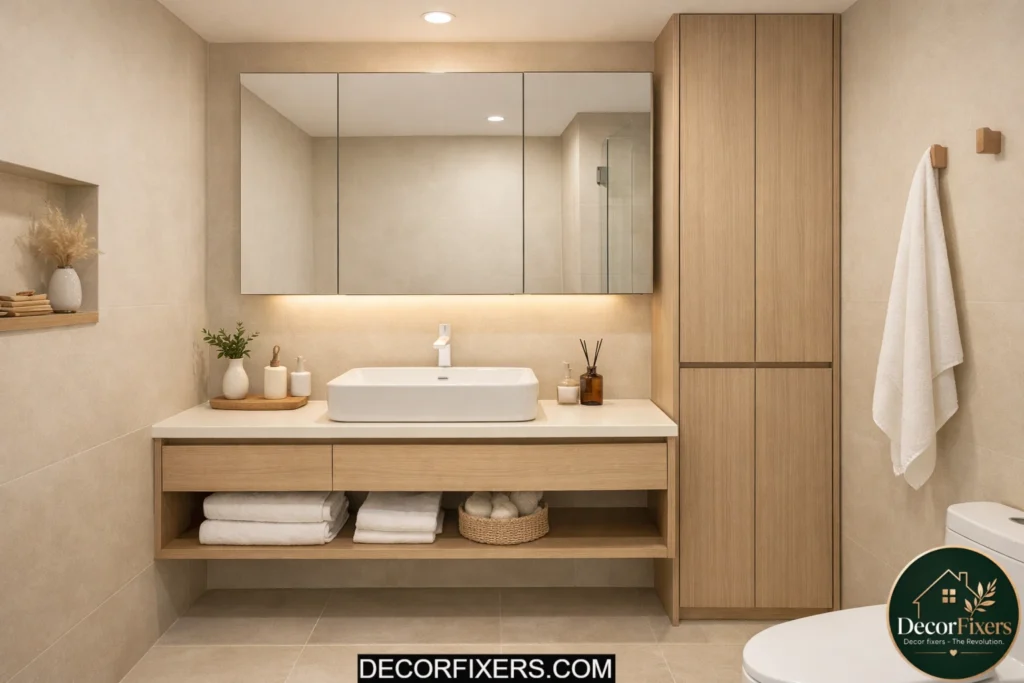
Small bathrooms break people. I’ve seen conflicting data on this; some sources say under-vanity storage is more efficient, others argue that wall-mounted open shelving reduces perceived clutter better. My read: concealed storage wins in tight spaces, open shelving works when items are curated to fewer than five visible objects per shelf.
For a bathroom under 50 square feet, the Japandi small bathroom design playbook is specific: one floating vanity, one recessed medicine cabinet (not a protruding box), one narrow floor-to-ceiling built-in if wall depth allows, and zero freestanding objects on the floor. The floor being visible in its entirety isn’t a luxury; it’s the single biggest trick for making a small bathroom feel larger.
5. Matte Finishes, Why Japandi Avoids Gloss
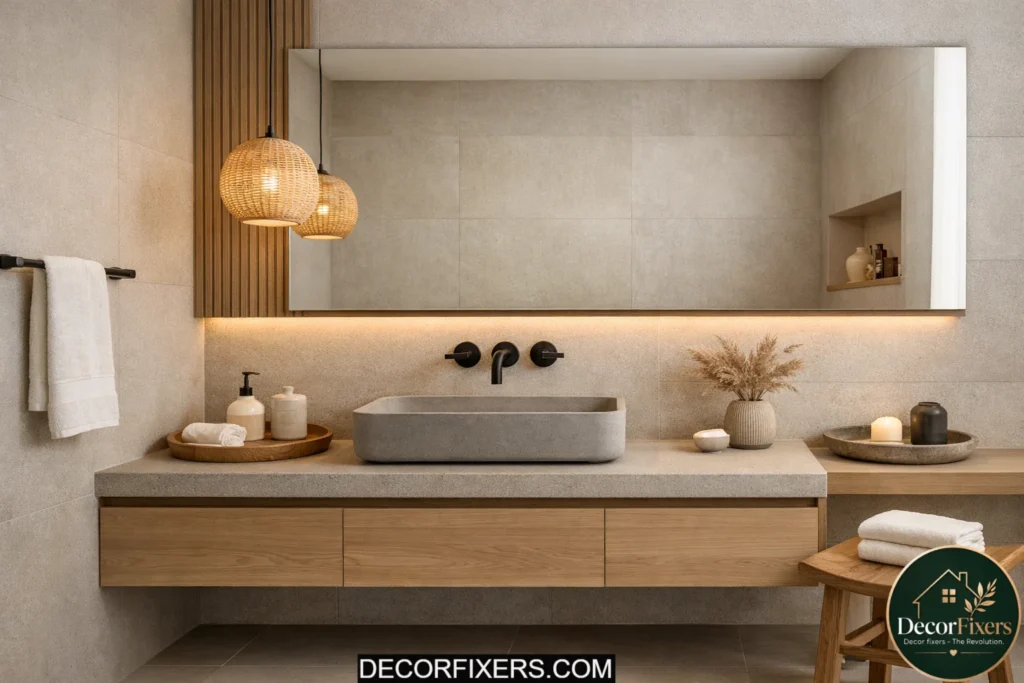
Gloss tiles and polished chrome fittings were the aesthetic of the 2010s. Japandi bathrooms run on matte everything: matte black or brushed bronze taps, matte ceramic tiles, matte stone counters. The reason isn’t arbitrary. Matte surfaces reduce light scatter, which creates softer, more even ambient light throughout the room, exactly the quality that makes a bathroom feel like a retreat instead of a showroom.
Quick note: matte black faucets do require slightly more maintenance than chrome; water spots show more easily. Wipe down after use, or accept the spots as part of your wabi-sabi practice.
6. Natural Wood Elements, Teak, Oak, and Why It Matters
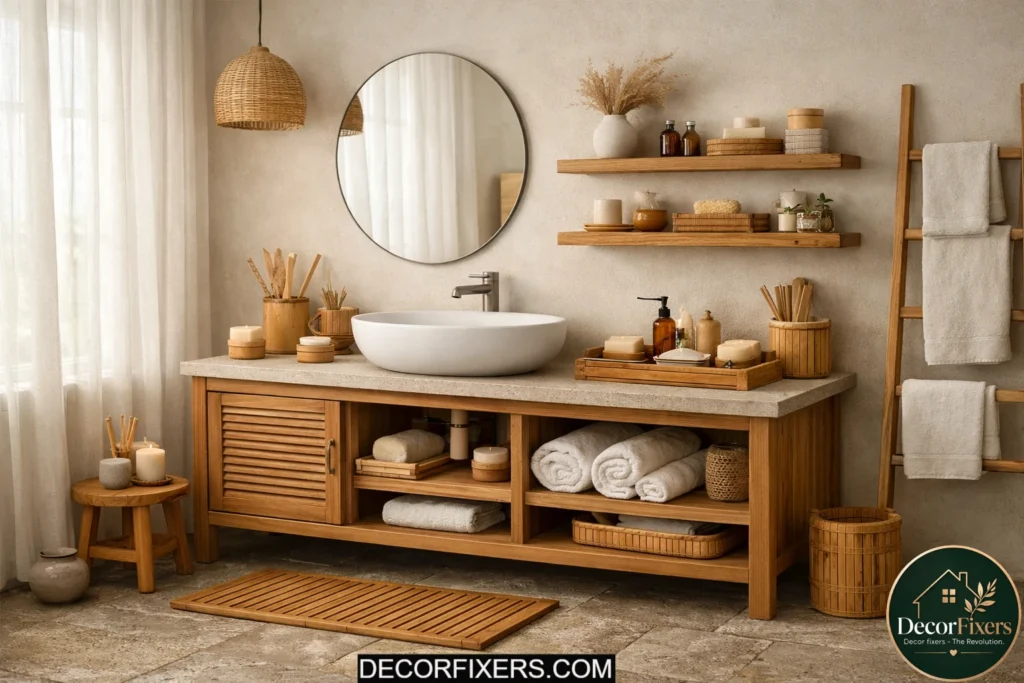
Wood in a wet environment terrifies homeowners. The fear is valid; the wrong wood, improperly sealed, will warp, discolor, or rot. But the right choices are genuinely durable. Teak is the gold standard: naturally water-resistant, dense, and rich in silica that prevents bacteria. Bamboo, while technically a grass, performs similarly and is more sustainable.
Use wood for: vanity fronts, open shelving, a bath tray across the tub, a slatted bath mat, or wall-panel accents kept above the wet zone. Keep it away from regular direct water contact. Seal with teak oil annually. Even a single wood element, a shelf, a tray, changes the warmth of a Japandi bathroom more than any other single material choice.
Quick Comparison: Wood Options for Japandi Bathrooms
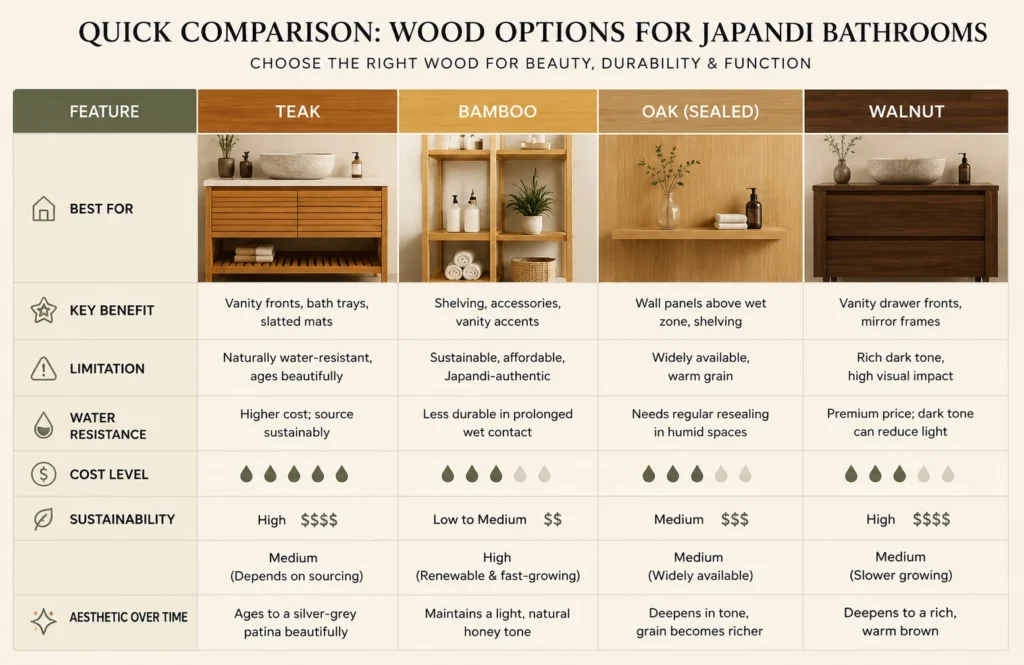
| Option | Best For | Key Benefit | Limitation |
| Teak | Vanity fronts, bath trays, slatted mats | Naturally water-resistant, ages beautifully | Higher cost; source sustainably |
| Bamboo | Shelving, accessories, vanity accents | Sustainable, affordable, Japandi-authentic | Less durable in prolonged wet contact |
| Oak (sealed) | Wall panels above the wet zone, shelving | Widely available, warm grain | Needs regular resealing in humid spaces |
| Walnut | Vanity drawer fronts, mirror frames | Rich dark tone, high visual impact | Premium price; dark tone can reduce light |
7. Stone Basins and Countertops, The Detail That Signals Intentional Design
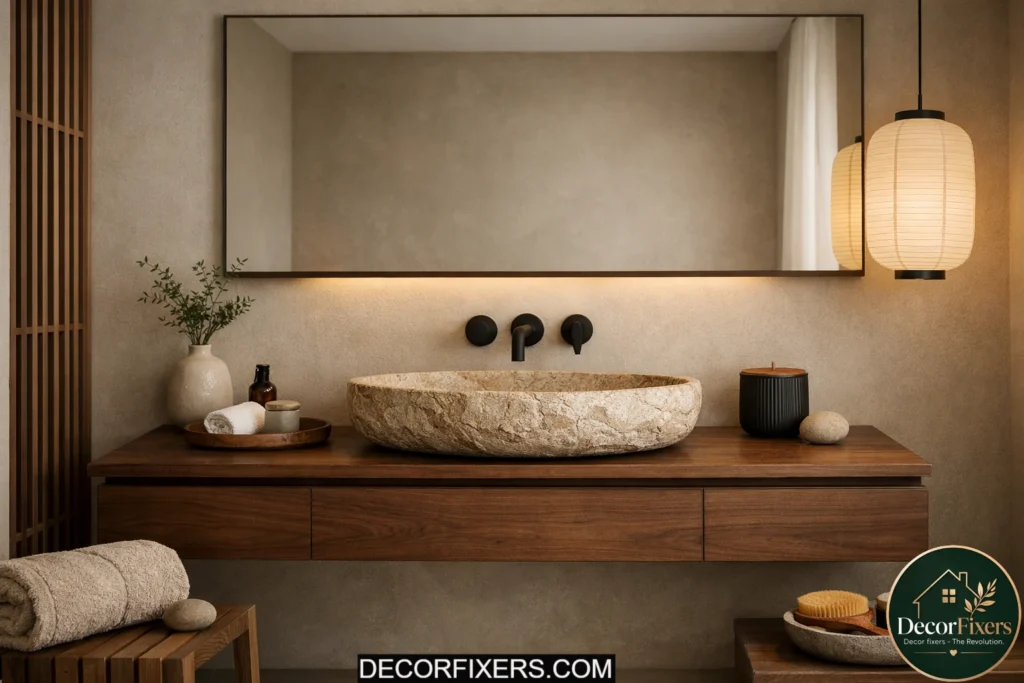
A basin is the focal point of the bathroom. Stone basins, vessel sinks in natural travertine, limestone, or concrete, communicate deliberate design in a way no porcelain drop-in ever will. They’re also genuinely tactile: the slight weight, the cool surface, the natural variation in stone tone. These things register unconsciously as quality.
If a full stone basin isn’t in budget, a stone-effect countertop under a simple undermount sink achieves 80% of the same result. Dekton, Neolith, and Sintered Stone products replicate natural stone textures at lower cost and higher durability. No one who walks into your bathroom will know the difference unless they scratch it with their car keys.
8. Concealed Storage, The Rule That Separates Japandi from Just Minimalist
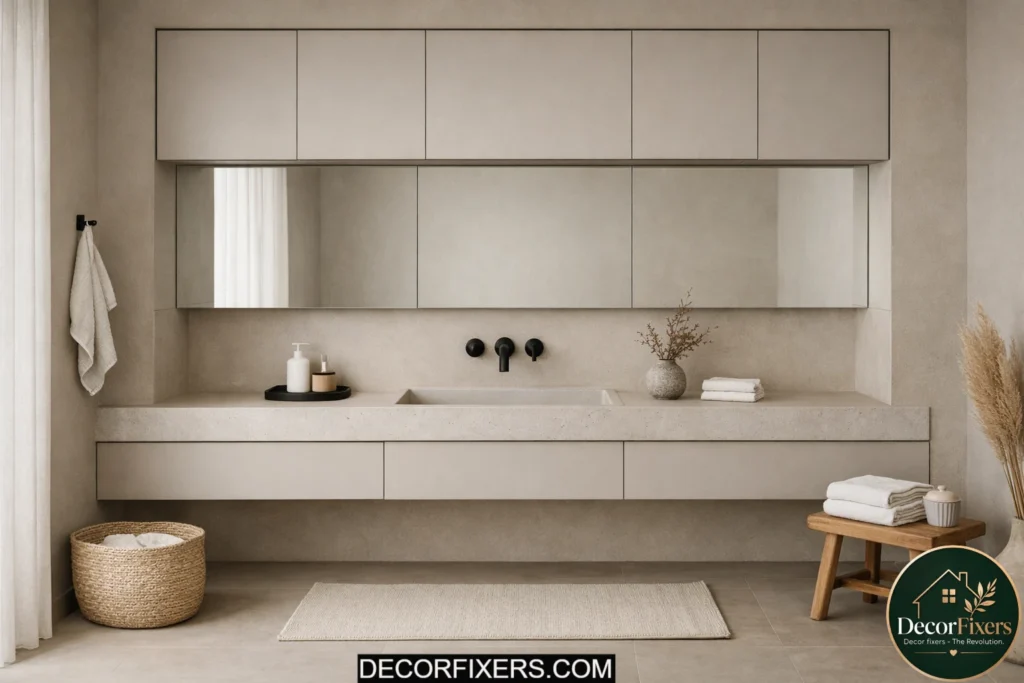
Minimalism says: own less. Japandi says: hide what you own beautifully. There’s a meaningful practical difference. Most people aren’t willing to reduce their bathroom products to a single bar of soap and a comb. Japandi doesn’t ask you to. It asks you to put your twelve skincare products behind a closed door, your spare towels in a built-in niche, and your cleaning supplies under the vanity where no one sees them.
Laila Rietbergen, author of Japandi Living, makes this point clearly: the declutter comes before the storage, not after. If you install beautiful concealed storage and then fill it beyond capacity, the serenity still leaks out through open drawers and overflowing countertops. Audit what you keep in the bathroom first. Then design the storage around what’s left.
If you’re still struggling with overflowing cabinets and crowded counters, these Minimalist Bathroom Closet Organization ideas can help create the same calm, concealed-storage approach that defines authentic Japandi interiors. The focus is not just on storing more, but on reducing visual noise so the entire bathroom feels lighter and easier to use every day.
9. Japandi Shower Design, Open, Frame-Free, and Stone-Lined
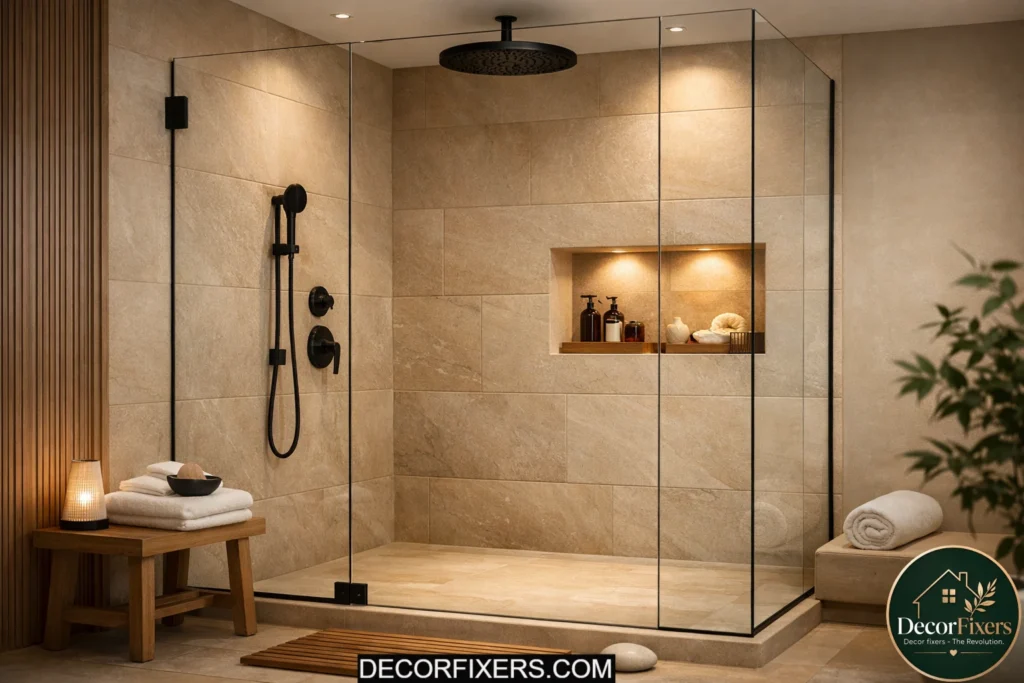
Shower enclosures with thick chrome frames are architectural noise. They divide a bathroom visually and immediately date the space. Frameless glass shower screens, either a single fixed panel or a minimal pivot door, disappear into the room and let the wall tile become the feature instead.
For the shower floor, textured stone tile or slip-resistant matte porcelain in warm grey or beige. For the walls, large-format tiles (600x1200mm or bigger) with near-invisible grout lines. Fewer grout lines mean the eye reads the tile as one continuous surface, calmer, larger, more intentional.
10. Freestanding Bathtubs, When the Tub Is the Whole Statement
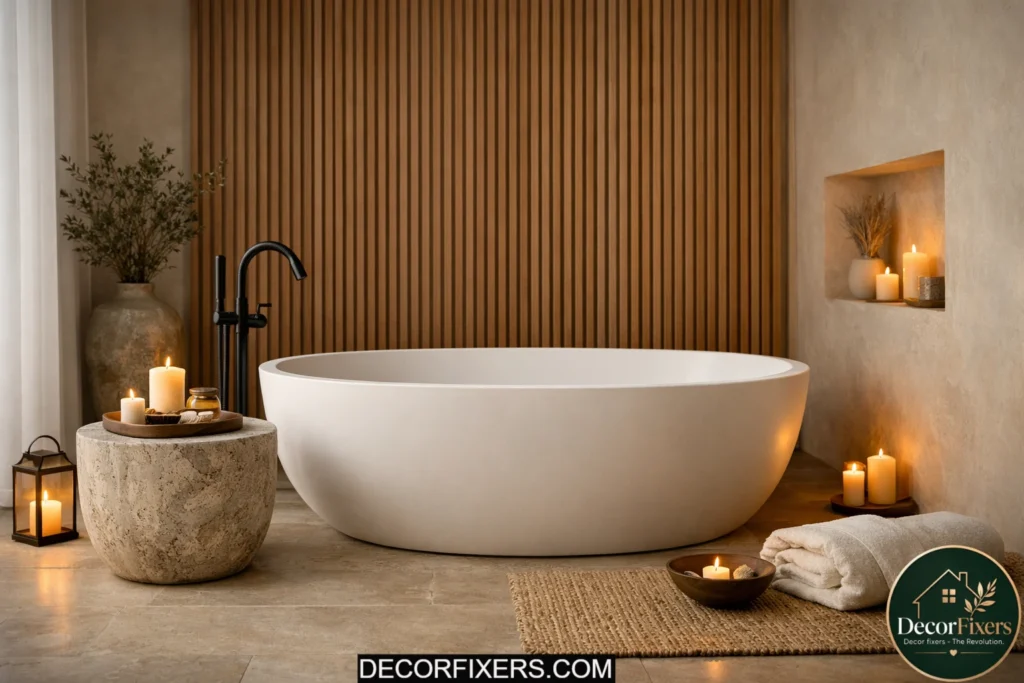
If your bathroom has space, a freestanding bath is the single highest-impact investment in Japandi bathroom design. Not because it’s luxurious, though it is, but because it anchors the room around a single, sculptural object and demands that everything else stay quiet. Nothing competes with a freestanding tub. Which means the rest of the room has to be minimal to work.
KOHLER’s Evok freestanding oval bath is specifically designed within their Japandi line, with ergonomic curves, a clean silhouette, and no decorative elements. Pair it with a floor-mounted matte black tap and a simple stone side table. That’s the entire setup. You don’t need more.
11. Warm Lighting, Japandi Bathrooms Are Not Lit Like Dental Clinics
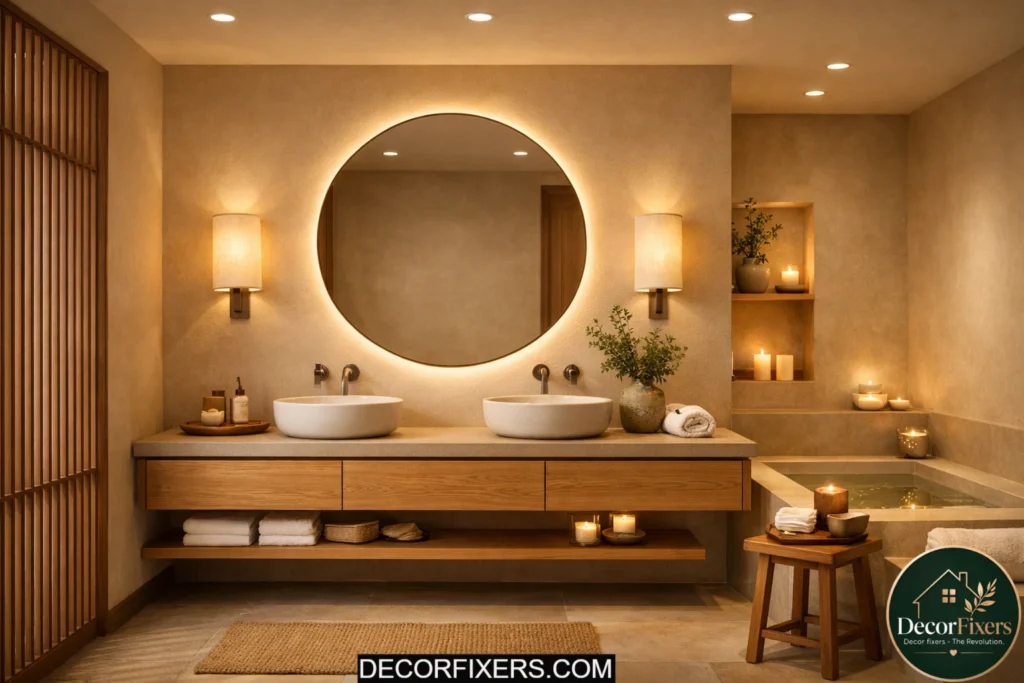
Overhead fluorescent or cool-white LED lighting is the single most common mistake in bathroom renovation. Japandi bathrooms use warm-toned light (2700K–3000K color temperature) from multiple low sources, recessed ceiling spots, backlit mirrors, and small wall sconces, rather than one glaring overhead fixture.
The effect is layered, ambient light that shifts the room from functional to genuinely restorative. An LED backlit mirror, set to a warm tone, performs double duty: it provides close-range task lighting for grooming while creating a soft glow that diffuses through the whole room at night. This is the same lighting logic used in high-end hotel bathrooms.
12. Japandi Bathroom Natural Materials, Linen, Stone, and Organic Textures
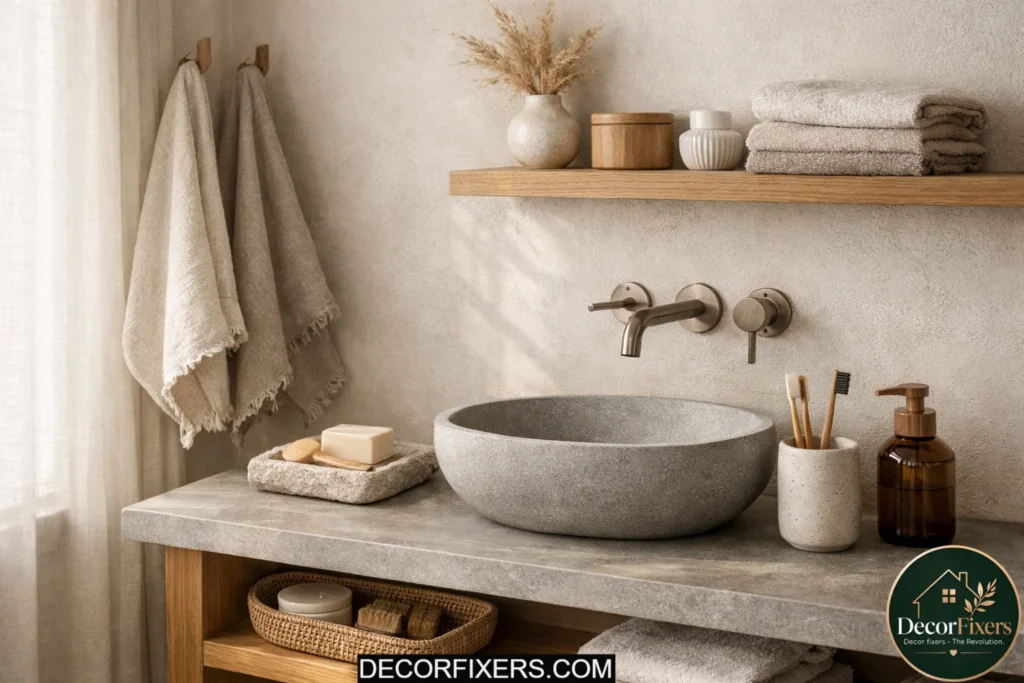
A Japandi bathroom should engage multiple senses, not just sight. Linen towels instead of thick cotton terry. Stone soap dishes instead of plastic. A ceramic cup for toothbrushes rather than a plastic holder screwed to the wall. These aren’t expensive swaps; they’re considered ones.
The cumulative effect of replacing four or five synthetic or plastic bathroom accessories with natural equivalents is transformative. Your brain registers texture differently from how it registers color. Running your hand across a stone soap tray or wrapping it in a loose-weave linen towel signals calm in a way that a white plastic soap pump simply cannot.
13. Greenery, One Plant, Placed Well, Is Better Than Six Plants Placed Badly
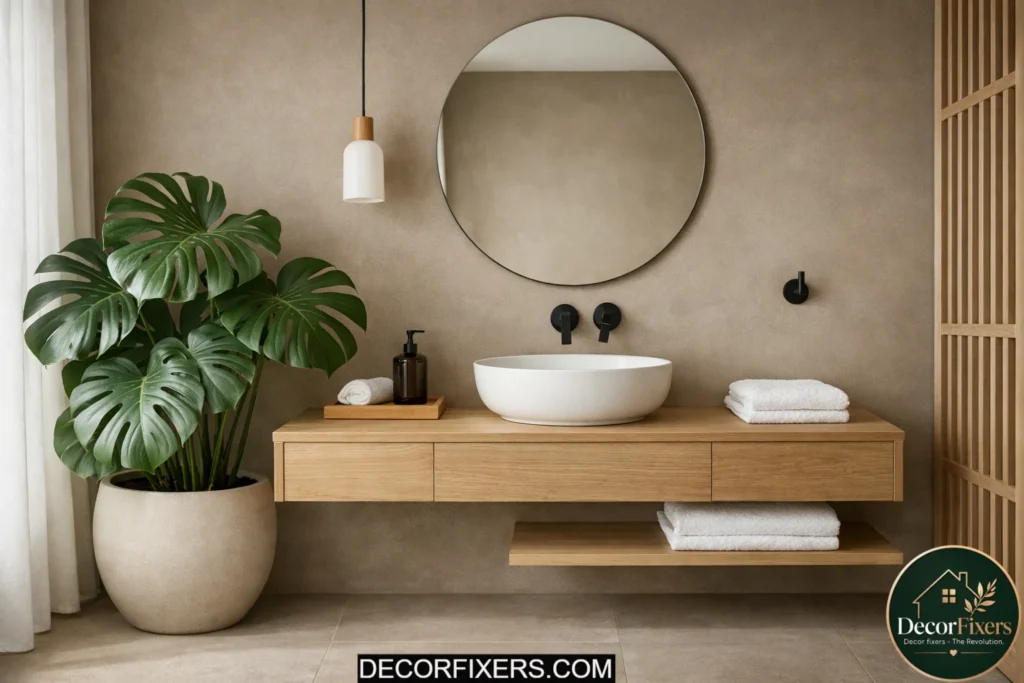
Yes, plants belong in a Japandi bathroom. No, you don’t need a jungle. One well-chosen plant in the right spot, a sculptural monstera in a matte ceramic pot near a window, a trailing pothos on a high shelf, a single bonsai on the vanity counter, does more for the room than six competing plants in mismatched pots.
Best plants for low-light or steam-heavy bathrooms: snake plants (incredibly tolerant), bamboo in water (authentic to the aesthetic and needs zero soil), and peace lilies (will literally indicate when they need water by drooping). Choose a pot in matte black, white, or terracotta, no decorative prints, no metallic glazes.
14. Japandi Bathroom Decor, The Rule of Three Objects Per Surface
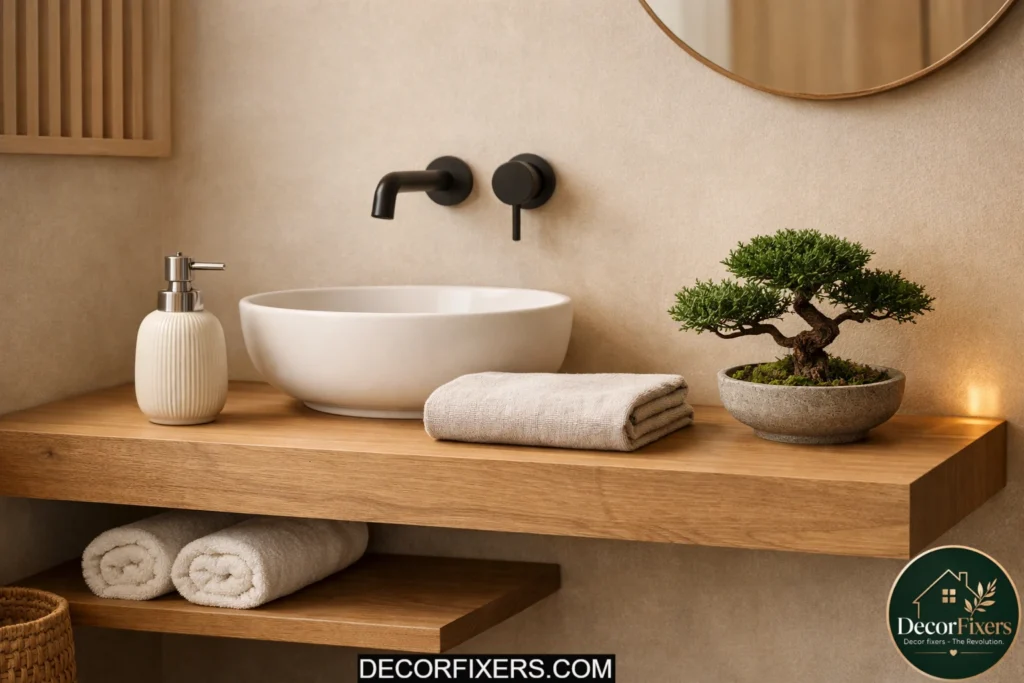
Look, if you’re in the middle of a Japandi refresh and still feel like the bathroom looks cluttered despite decluttering, here’s what actually works: the rule of three. No surface should hold more than three objects. The vanity counter: soap dispenser, hand towel, and one small plant. The window sill: one object, maximum. The shelf: three items, spaced deliberately.
This isn’t arbitrary minimalism for its own sake. It’s how the eye works. Three objects or fewer on a surface reads as curated. Four or more reads are accumulated. The distinction between a Japandi bathroom and a merely tidy bathroom is exactly this: intentional curation versus organized storage.
15. Wall Panels and Slat Walls, Texture Without Clutter
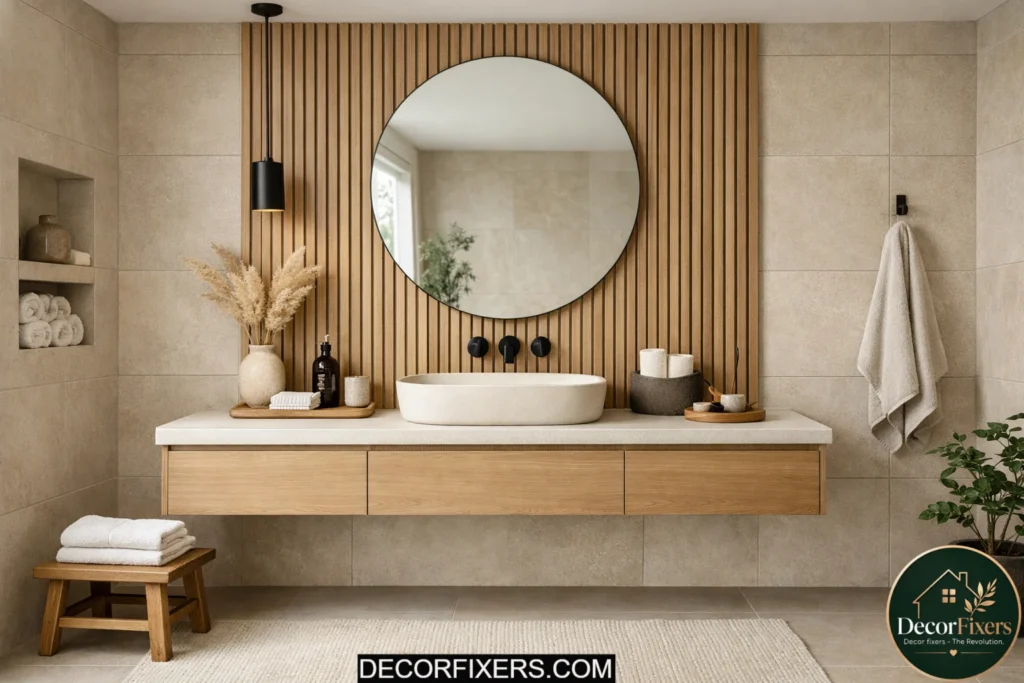
Solid painted walls are the correct choice for most Japandi bathrooms. But one textured accent wall, done right, adds the tactile depth that keeps a minimal room from feeling empty. Wood slat panels (vertical, evenly spaced, in oak or bamboo) are the Japandi choice. They’re warm, geometric without being busy, and they photograph beautifully, which is why you see them in every well-executed Japandi bathroom you’ve bookmarked.
Install them on the wall behind the vanity or bath, not on all four walls. Keep the color in the warm neutral range. Seal properly for humidity. One wall of slats, three walls of smooth, warm paint, that’s the ratio.
16. Japandi Bathroom Mirrors, Understated Shapes, No Ornate Frames
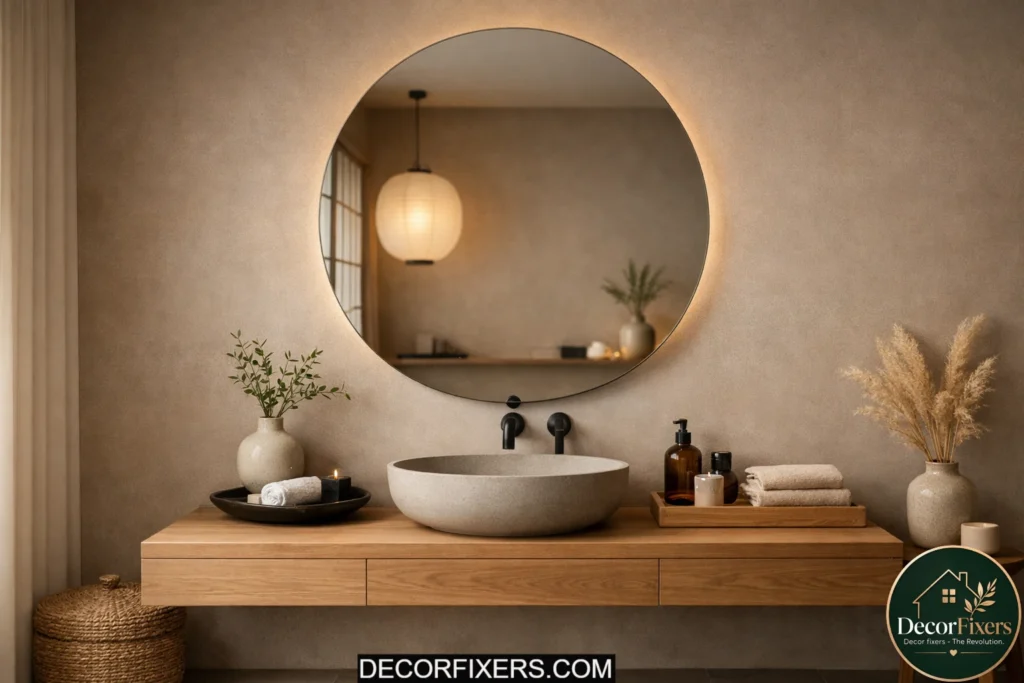
A mirror is the one item in a Japandi bathroom that can break the whole aesthetic if chosen carelessly. Avoid decorative frames with carved detail, colored trim, or ornate shapes. Japandi mirrors are either frameless, minimally framed in light wood, or architecturally functional (integrated LED, built-in cabinet behind).
Shapes worth choosing: a simple round mirror (softens the geometry of a tile-heavy room), a horizontal rectangle that spans the full vanity width (makes the wall feel wider), or a full-length panel that leans against the wall if the room is narrow. The mirror is a functional item. Its job is to reflect light and your face. Nothing more.
17. Large-Format Floor Tiles with Minimal Grout Lines
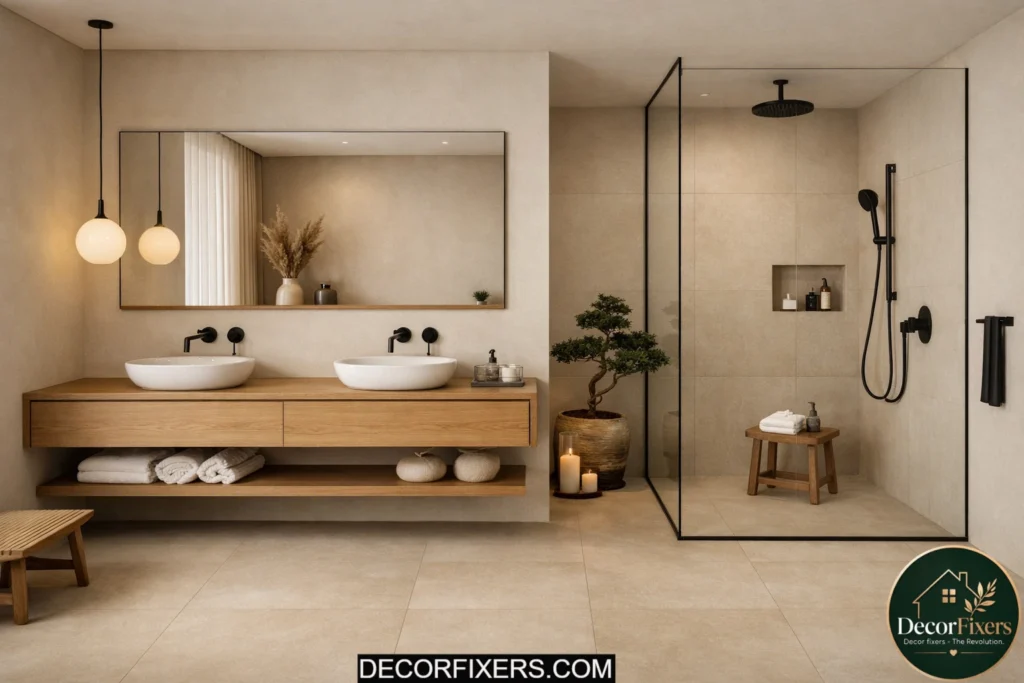
Tile selection makes or breaks the foundation of Japandi bathroom design. Large-format tiles, 600x600mm minimum, ideally 800x800mm or larger for floors, reduce the number of visible grout lines and create a continuous, calm surface. Smaller mosaic tiles, hexagon patterns, or busy geometric formats all contradict Japandi’s visual logic.
Tone: warm grey, sand, taupe, or cream. Grout color: matched to the tile (not contrasting). The goal is to make the grout invisible. When grout contrasts, it creates a grid pattern that fragments the floor visually, the opposite of the unified, calm Japandi style.
18. Bring In Hygge, Warmth That Stops Japandi Feeling Cold
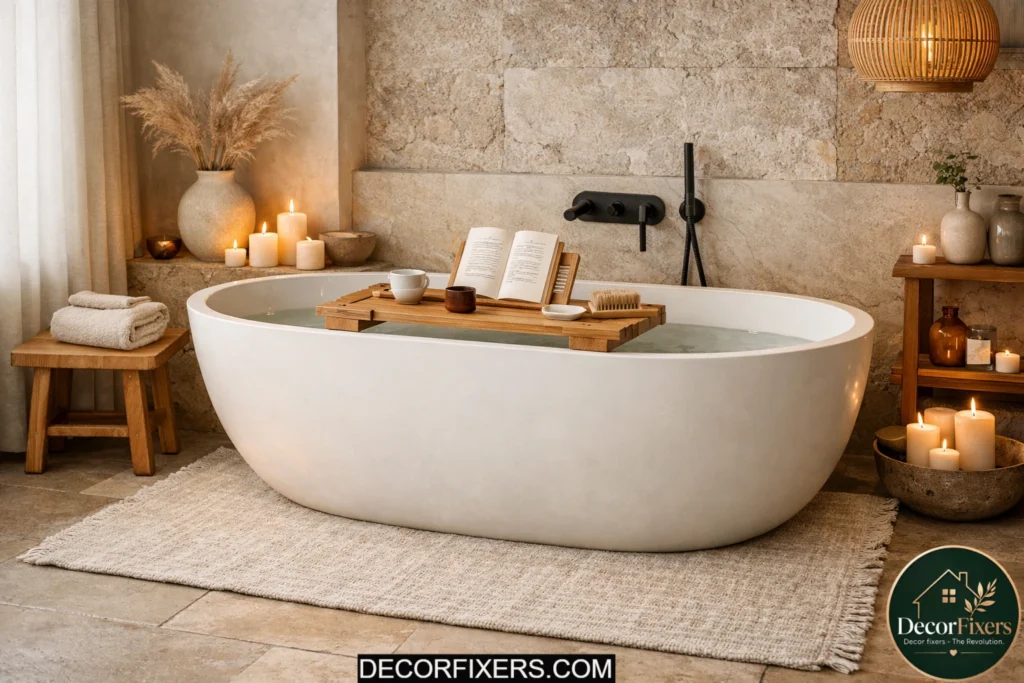
Here’s the tension designers rarely name: strict minimalism can produce spaces that feel cold, empty, or inhospitable. The Scandinavian concept of hygge, loosely, creating coziness and human warmth, is what prevents a Japandi bathroom from becoming a sterile showroom.
Hygge in the bathroom means: a warm-toned candle on the tub edge, a thick linen bath mat rather than a thin woven one, a tray with a small tumbler of bath salts, a hook for a robe rather than a cold towel bar. These aren’t extravagances. They’re the functional warmth layer that makes the space feel like it’s for you, not for a photoshoot.
19. Matte Black Accents, Used Sparingly, They Define the Space
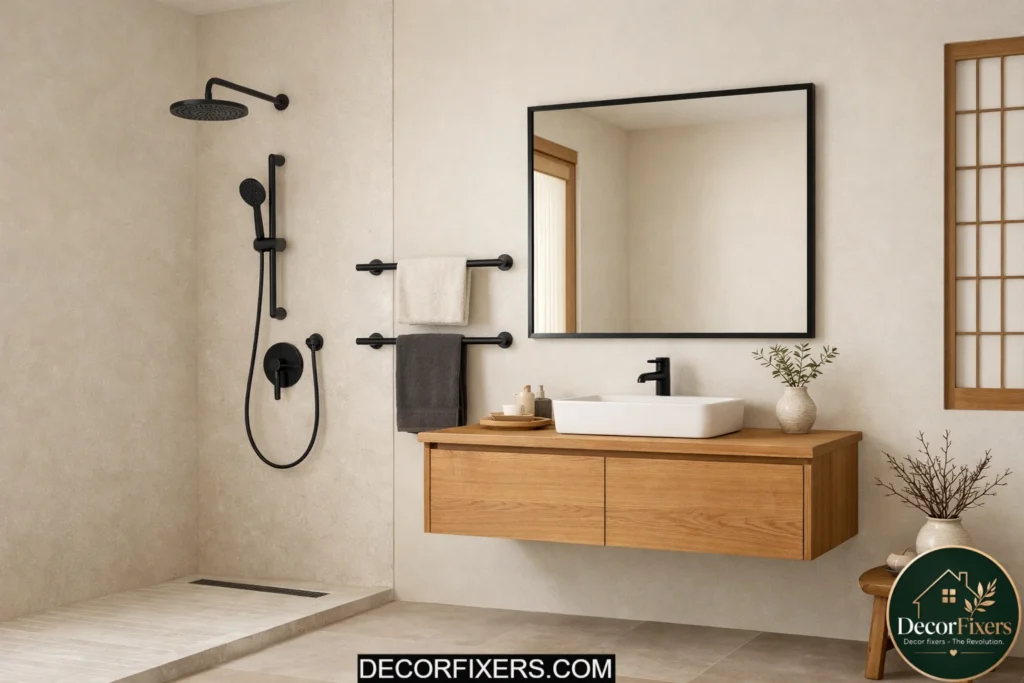
Matte black is the accent color of Japandi bathrooms. Taps, shower heads, towel rails, door hardware, and mirror frames, if any, all in matte black. It’s grounding without being aggressive, and it provides the visual contrast that keeps a warm-neutral palette from going flat.
The rule is restraint. All black fittings should be the same finish; mixing matte black with polished black or dark bronze creates visual noise. And the black should be an accent, not dominant: if the overall impression is ‘black bathroom,’ the ratio is off. Pull back until it reads as ‘warm neutral bathroom with black details.
For homeowners who prefer stronger visual contrast while still keeping a refined aesthetic, these Black and White Bathroom Designs show how matte black fixtures and soft white surfaces can work beautifully without losing the warmth that Japandi bathrooms are known for. The key is balancing contrast with natural textures so the room still feels calm rather than overly stark.
20. Japandi Bathroom Accessories, What Muuto Gets Right
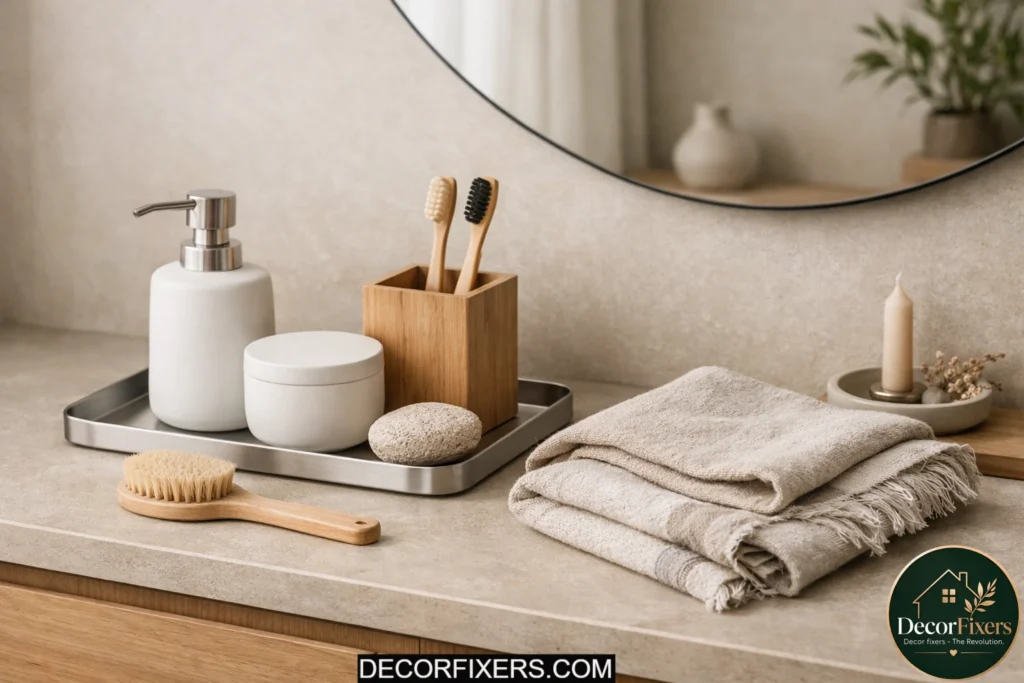
Most bathroom accessory sets look like they came from a supermarket home section. They’re plastic, vaguely coordinated, and aesthetically empty. Muuto, the Scandinavian design brand, produces accessories that align precisely with Japandi’s material philosophy: natural materials, functional forms, honest construction.
Or maybe I should say it this way: it’s not about brand-name accessories. It’s about the principle Muto embodies: every object in the bathroom should be made well and look intentional. A soap pump in brushed aluminum. A cotton bud holder in matte ceramic. A toothbrush holder in solid wood. When every accessory communicates the same design language, the bathroom coheres.
21. Scent as a Design Layer, Diffusers, Not Air Fresheners
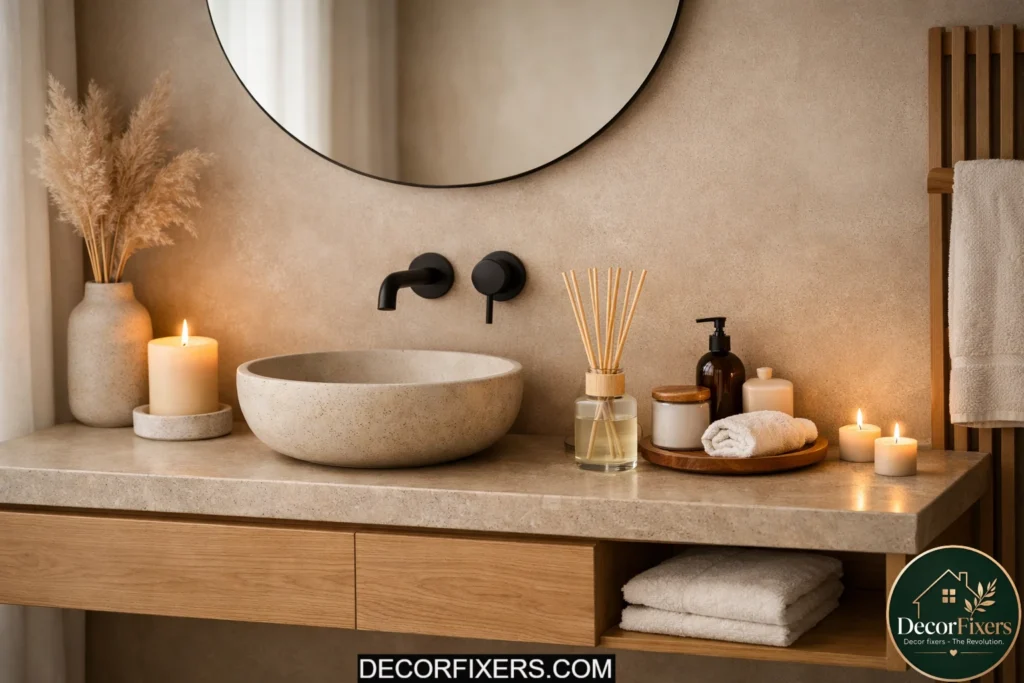
Scent is underrated in bathroom design. A reed diffuser in white cedar, hinoki, or eucalyptus doesn’t just smell good; it signals a considered space the moment someone enters. Aerosol air fresheners signal the opposite.
Placement: one diffuser on the vanity or windowsill, chosen for a calming rather than sweet scent profile. Japanese hinoki wood and Nordic birch are the two most on-brand choices. Keep it subtle; the goal is a room that smells like a high-end spa, not like you tried hard.
22. Black Window Frames, Architectural Detail That Ties the Room Together
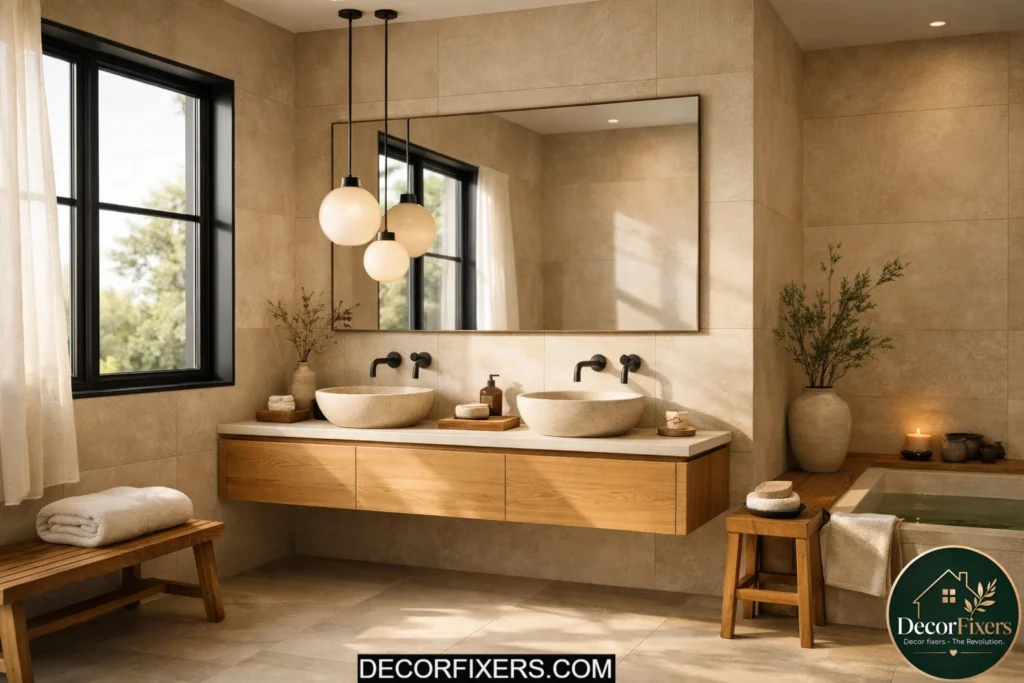
If you’re renovating to the extent of replacing windows or internal window casings, matte black or dark bronze window frames create a remarkable vertical accent in a Japandi bathroom. The frame becomes an intentional architectural line; it connects with the matte black fittings, frames the natural light entering the room, and adds structural interest without decoration.
This isn’t achievable in every renovation. But even in an existing bathroom, painting the window casing in a deep charcoal or matte black creates a type of the same effect at a low cost.
23. Integrated Niches, Built-In Shower Storage That Doesn’t Interrupt the Wall
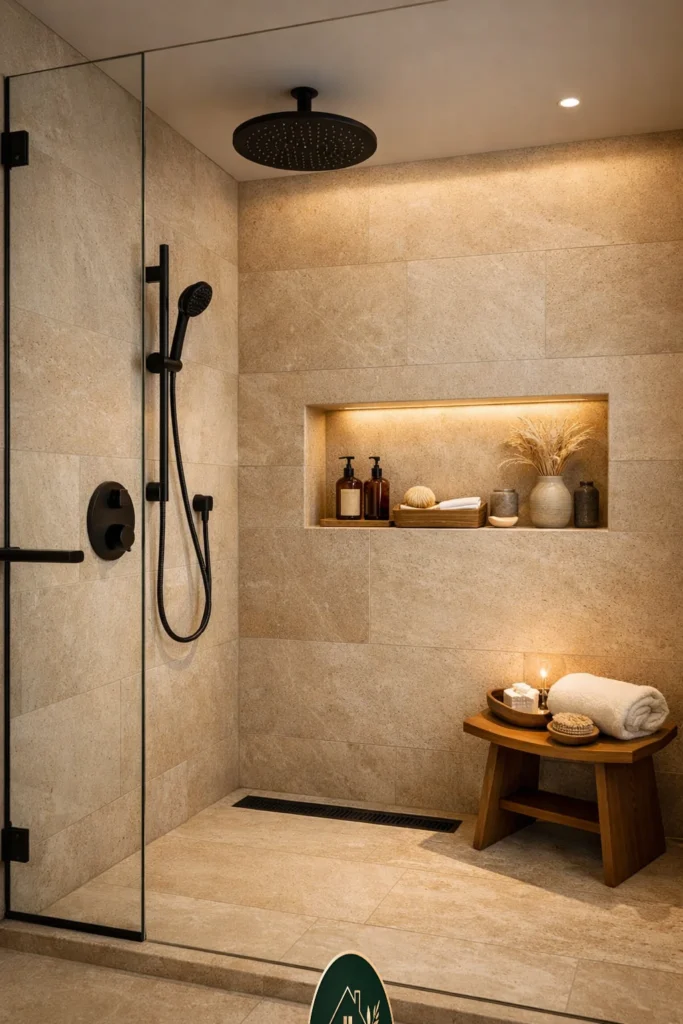
Shower caddies are an eyesore. Recessed tile niches, built into the shower wall, lined in the same tile as the wall or contrasting stone, solve storage completely without adding visual clutter. A single horizontal niche at shoulder height holds shampoo, conditioner, and soap. No rack. No hooks. Nothing hanging.
Some experts argue that open niches accumulate product buildup and become maintenance issues. That’s valid for households with heavy product usage. If you’d keep more than five bottles in the shower, consider a small door, a recessed cabinet with a tile-matched front that blends entirely into the wall. It disappears when closed.
24. Japandi Toilet Area, The Most Overlooked Part of the Design
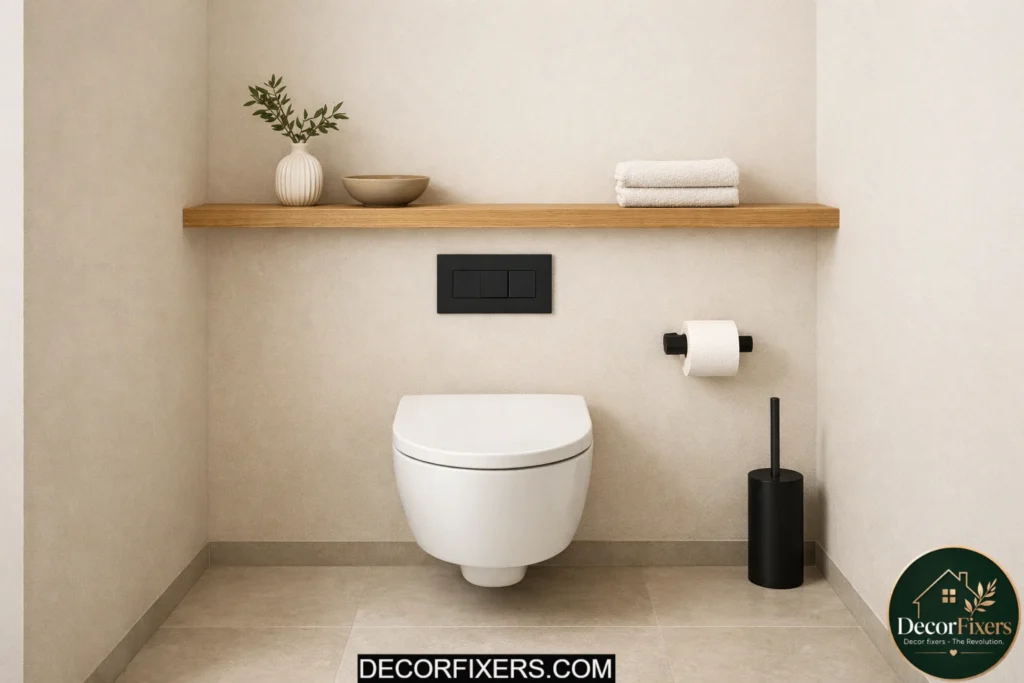
Most Japandi bathroom guides show the vanity and bath in detail, then skip to the conclusion. The toilet area gets one sentence. This is a real gap, because a wall-hung toilet, paired with a slimline cistern hidden behind a wall panel, completely changes the spatial reading of a bathroom.
KOHLER’s Veil wall-hung toilet is their flagship Japandi product for a reason: no exposed cistern, no visible fixings, clean horizontal lines, and an integrated cleansing function that removes the need for a separate bidet. The floor beneath it stays clear. A concealed cistern eliminates the visual bulk of a standard tank toilet. These two changes alone, a wall-hung toilet and a concealed cistern, make a bathroom feel more considered than almost any other single decision.
25. Japandi Bathroom on a Budget, Three Tiers That Actually Work
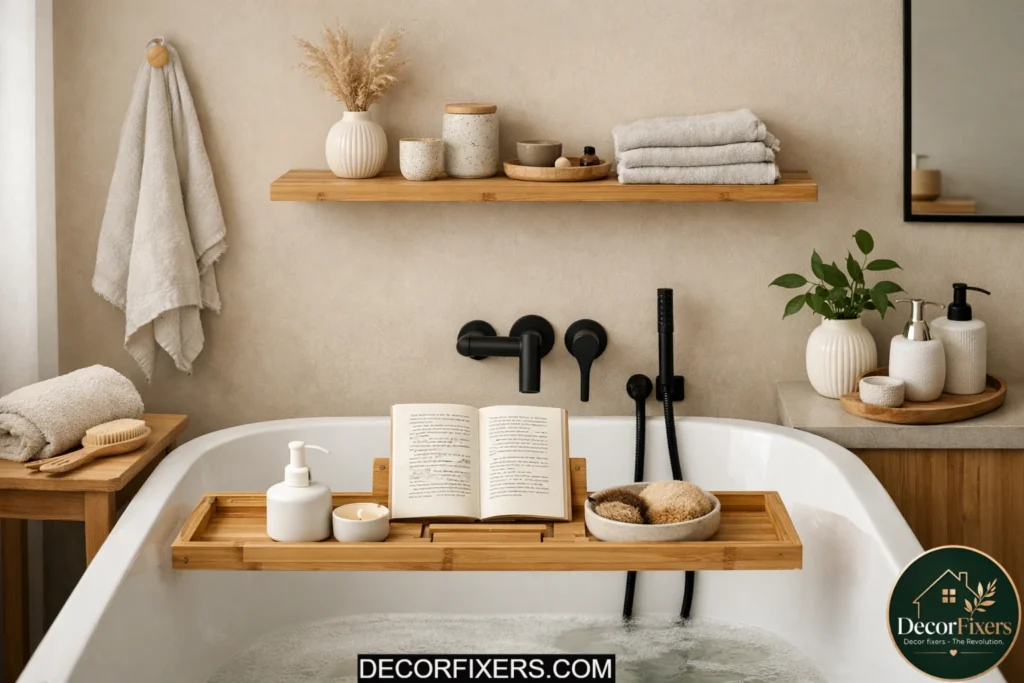
Under $200, Accessories and Styling Only
Replace plastic accessories with ceramic or wood alternatives. Add a reed diffuser. Swap a synthetic bath mat for a linen or jute one. Declutter by the rule of three per surface. Change the light bulb to 2700K warm white. This costs almost nothing and changes the feel of the room immediately.
$200–$1,500, Fixtures and Furniture
IKEA HAVBÄCK floating vanity installation. A new round frameless mirror. Matte black tap replacement. A wood slat shelf or accent panel. A recessed medicine cabinet if an existing surface-mount cabinet is being replaced.
$1,500+, Structural Renovation
Large-format floor tile replacement. Frameless shower screen. Wall-hung toilet with concealed cistern. Freestanding bath if space allows. This tier delivers the SERP-magazine result but requires a plumber, tiler, and carpenter.
26. What to Avoid in a Japandi Bathroom, The Anti-List
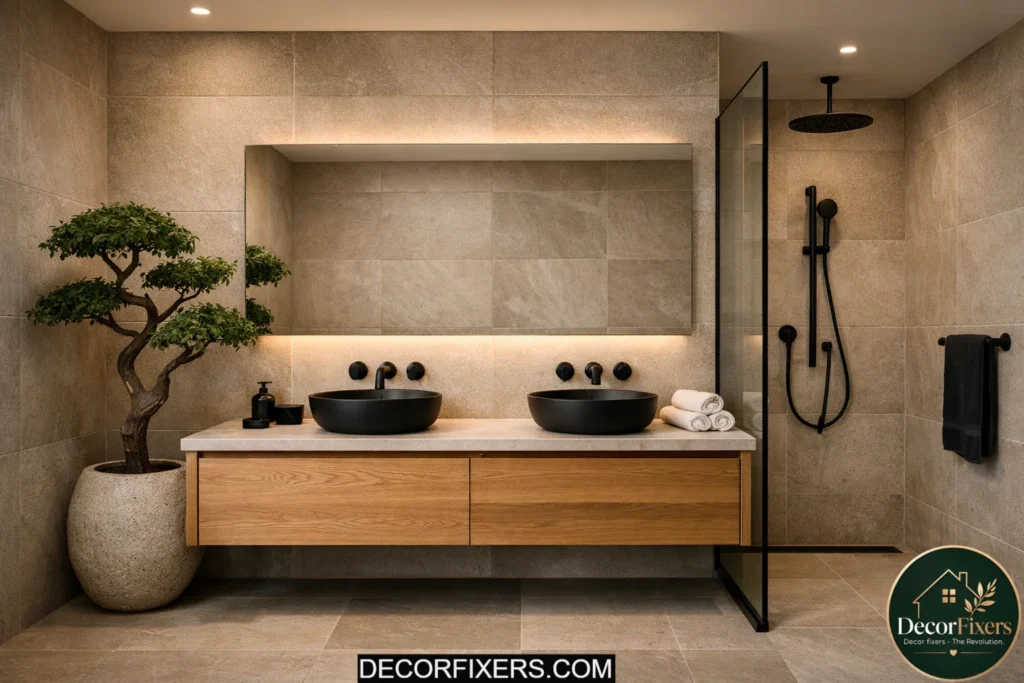
Patterns and prints. Geometric accent tiles, floral wallpaper, and patterned shower curtains all contradict Japandi’s visual quiet. Use texture instead of pattern.
Open shelving overloaded with products. Five bottles on an open shelf read as clutter. Three curated objects read as Japandi. The shelf itself isn’t the problem; what’s on it is.
Mismatched finishes. Chrome tap, brushed nickel towel rail, and matte black mirror frame in the same room. Pick one metal finish and use it throughout. Consistency of finish is what signals intentional design.
Overcrowded greenery. One strong plant beat six struggling ones. More plants don’t mean more Japandi; they mean more maintenance and visual noise if not perfectly curated.
Warm and cool tones mixed without an anchor. Warm wood next to cool grey stone is fine; it’s the Japandi tension that works. But if you also have cool-white walls, chrome fittings, and a blue-toned light, the warm elements get cancelled out, and the room just feels confused.
27. The Japandi Bathroom Philosophy, Why It Works Beyond Design Trends
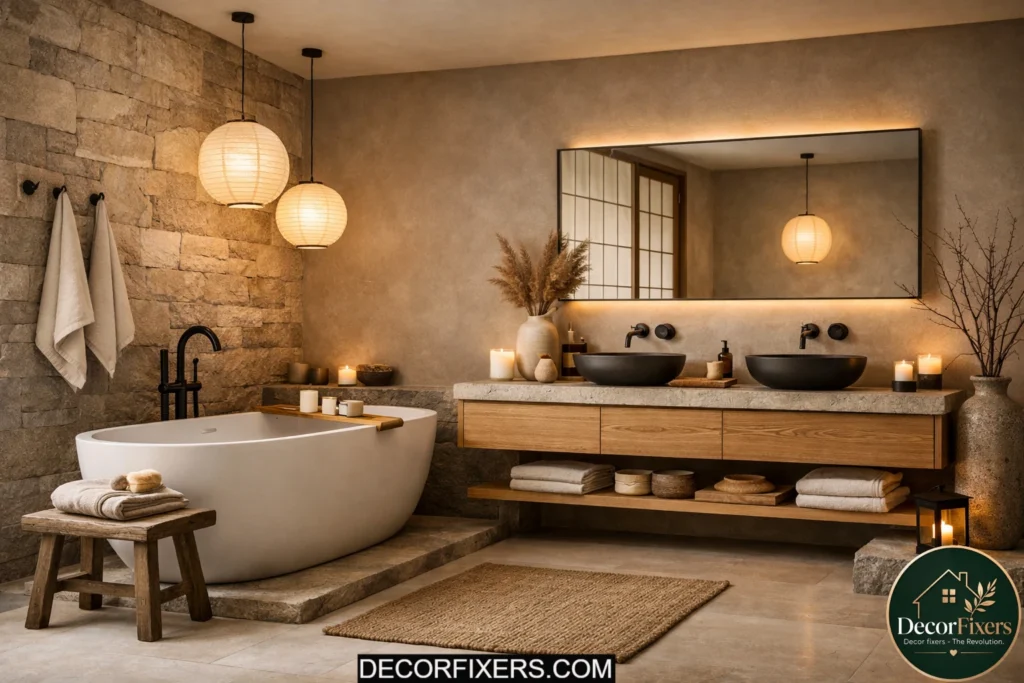
According to a 2024 Pinterest Trends Report, searches for ‘Zen bathroom’ surged 200% between June 2023 and June 2025. ‘Zen house’ searches rose 405% in the same period. These aren’t just numbers; they tell you something about what people are actually looking for in their homes right now.
It’s not just bathrooms. It’s a response to chronic overstimulation. Phones, screens, notifications, packed schedules, people are desperate for physical spaces that give their nervous systems a break. Japandi bathrooms work because they’re built on exactly this logic: remove everything that doesn’t need to be there, make what’s left beautiful and tactile, and let the room do the work of calming you down.
That’s why this aesthetic is more than a trend. Minimalism as a style trend comes and goes. But the physiological need for calm, low-stimulus physical environments isn’t going anywhere. Japandi solves a problem that won’t become unfashionable.
How to Start Your Japandi Bathroom Transformation
To create a Japandi-style bathroom, follow these steps:
- Declutter first, remove everything from counters and surfaces before buying anything
- Choose a warm neutral wall color (taupe, clay, warm white, not cool white)
- Replace one tap, mirror, or vanity with a matte-finish alternative
- Add a single curated plant in a matte ceramic or terracotta pot
- Switch bulbs to 2700K warm white LEDs throughout the bathroom
- Replace plastic accessories with ceramic, wood, or stone equivalents one by one
- Add a reed diffuser in a woody or clean botanical scent
CONCLUSION:
There’s a specific feeling you get in a well-designed Japandi bathroom, the first morning you use it after everything’s right. The light is warm. The counter is clear. The towel is linen and slightly rough in the way that signals quality. The tap is matte black and closes with a satisfying resistance. There’s one plant doing well because it’s the right plant in the right spot.
It doesn’t feel like an Instagram photo. It feels like relief.
That’s what all 27 of these ideas are aiming for. Not a trend you’ll be tired of in two years. A room that makes you feel, every single morning, like your home is working for you. The philosophy behind Japandi style bathroom ideas, calm over stimulation, natural over synthetic, considered over accumulated, doesn’t expire.
Start with one thing. The tap. The lighting. The bamboo tray. You don’t have to renovate everything at once. The philosophy scales down to a $40 accessory swap as naturally as it scales up to a full structural renovation.
Make one change. See if the room breathes differently. It usually does.
FAQs:
Q: What’s the best color for a Japandi bathroom?
A: Warm neutrals, taupe, clay beige, off-white, or muted sage. Avoid cool-toned whites. The warm undertone is what creates the calm hygge quality and prevents the space from reading as clinical.
Q: How do I make my small bathroom look Japandi?
A: Use a floating vanity to expose the full floor, keep surfaces to three objects maximum, use large-format tiles with matching grout, and add one well-placed plant. Visible floor space is the single most effective trick for making small bathrooms feel larger.
Q: Should I use open or closed storage in a Japandi bathroom?
A: Closed storage for everything except three or fewer curated items. Open shelving works only when each item on it has been deliberately chosen, and the shelf isn’t crowded. When in doubt, close the door.
Q: Why does wabi-sabi matter in a Japandi bathroom?
A: Wabi-sabi prevents the aesthetic from becoming sterile. It’s the philosophical permission to use imperfect handmade ceramic, natural wood grain, and organic stone variation, all of which add warmth that machine-perfect surfaces can’t replicate.
Q: When should I invest in a full Japandi bathroom renovation versus just restyling?
A: Restyling (accessories, lighting, decluttering) works if the existing layout, tile, and fixtures are in good condition and already neutral in tone. Full renovation makes sense when existing tiles are patterned, fittings are chrome/polished, or the layout prevents a floating vanity installation.

Creator of DecorFixers, sharing practical home and interior ideas focused on real-life usability, simple design improvements, and budget-friendly solutions.