

There is a specific kind of frustration I recognize immediately: you have saved 30 images labelled “Japandi bedroom” on Pinterest. They all look effortlessly calm. You feel certain you understand the aesthetic. Then you walk into your own room and cannot figure out why it still feels wrong.
Here’s the thing: most of what gets published about Japandi bedroom ideas is long on inspiration and short on instruction. Nobody explains the single most important distinction, why some Japandi rooms feel warm and lived-in, and why others feel cold enough to chill a bottle of wine. I kept finding the same gap in every article I read, so I decided to address it properly here.
What follows is 27 genuinely actionable ideas, with real furniture names, three budget tiers, and the warm-versus-cold distinction explained at last. Whether you’re working with a studio flat in London or a generous bedroom in Toronto, there’s a path forward here.
What are Japandi bedroom ideas?
Japandi bedroom ideas refer to design approaches that blend Japanese minimalism with Scandinavian hygge, producing rooms that are calm, clutter-free, and warm. The core principles are a muted neutral palette, low-profile furniture, natural materials such as oak and linen, and deliberate empty space used as a design element, not an oversight.
1. Start with a Low-Profile Bed Frame
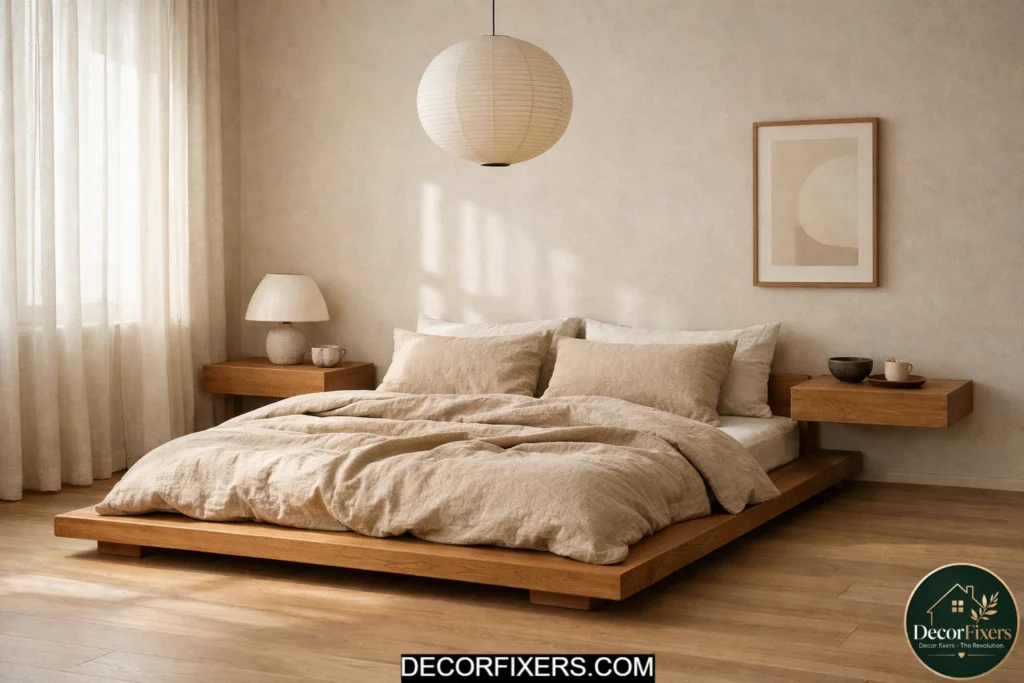
The bed is the non-negotiable anchor of every Japandi bedroom. Low-profile frames, sitting 30 to 45 centimeters from the floor, create the visual calm that defines the aesthetic by lowering the visual center of gravity and making the ceiling feel taller. This is design physics, not opinion.
Look for solid oak, walnut, or ash with clean, unadorned lines. The HAY Uchiwa and Muuto Outline are benchmark pieces. At an accessible price, the IKEA GLADSTAD in Kabuas natural achieves the silhouette without the premium outlay. Avoid bed frames with storage drawers built in; they read as bulky and undermine the floating quality that makes low beds work visually.
2. Build Your Color Palette from Five Neutrals or Fewer
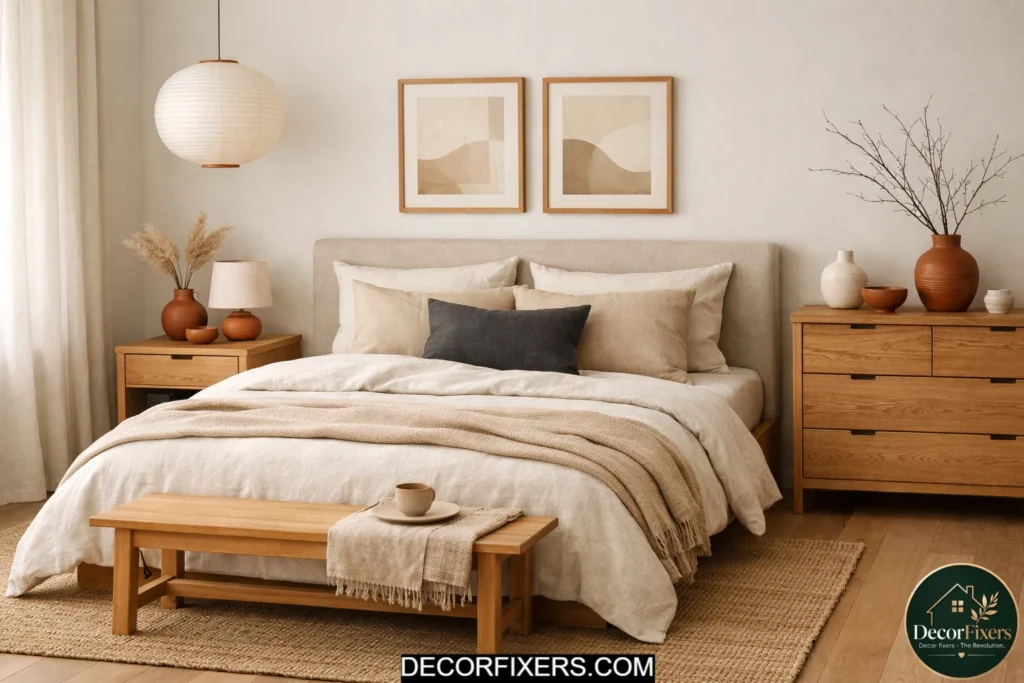
Japandi bedroom decor lives and breathes through its color restraint. The palette is intentionally narrow: warm white or oat for walls, a mid-tone natural wood for furniture, a darker accent in charcoal or deep forest green for one or two objects, and the natural tones of whatever textile you choose, undyed linen, raw cotton, or flecked wool.
The 2025 evolution of this palette has shifted slightly warmer. Shelley Cochrane, accessories buyer at Furniture Village, noted that the style has embraced “warmer, softer brown tones alongside the traditional neutral palette of oat, stone and beige”, largely influenced by Pantone’s 2025 Color of the Year, Mocha Mousse. In practical terms, this means swapping cold grey accents for warm terracotta or warm taupe. The room immediately feels more inhabited.
3. Choose Warm White Walls, Never Stark White
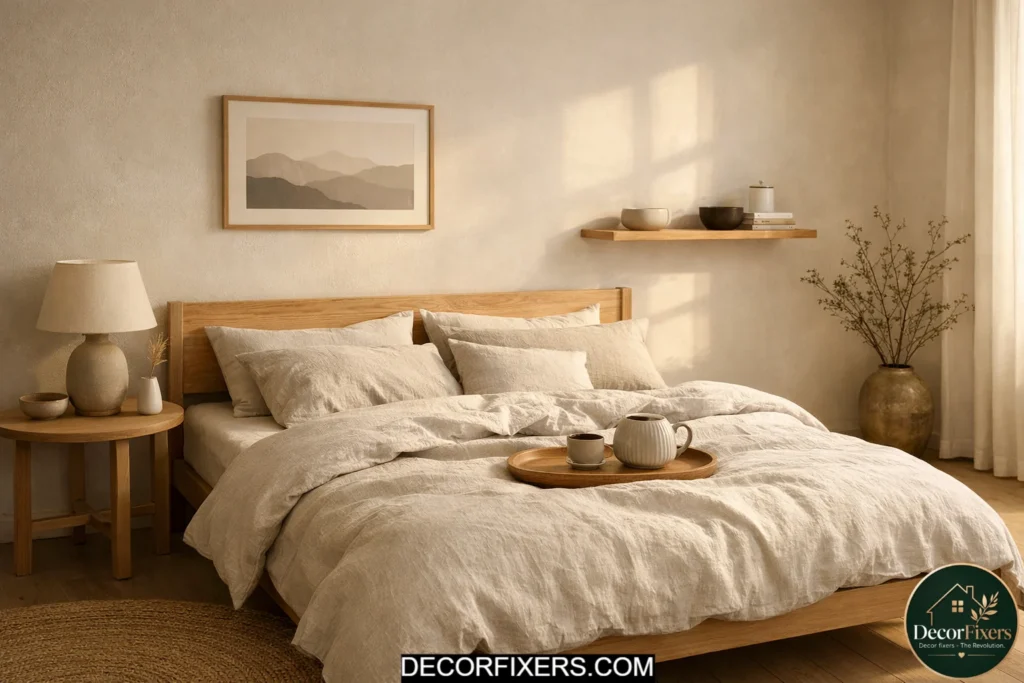
Stark white walls are the fastest route to cold Japandi. They amplify every shadow and strip warmth from every piece of furniture. The fix is simple: choose an off-white with a warm undertone, Farrow & Ball’s All White (for the UK/Australia/Canada), Benjamin Moore’s White Dove (US), or Dulux Natural White are reliable choices across Tier 1 countries.
If white feels too cautious, warm clay or soft stone work equally well as a primary wall color. These sit within the Japandi palette and add immediate depth without requiring a single additional decorative element.
4. Layer Three Different Textures on the Bed
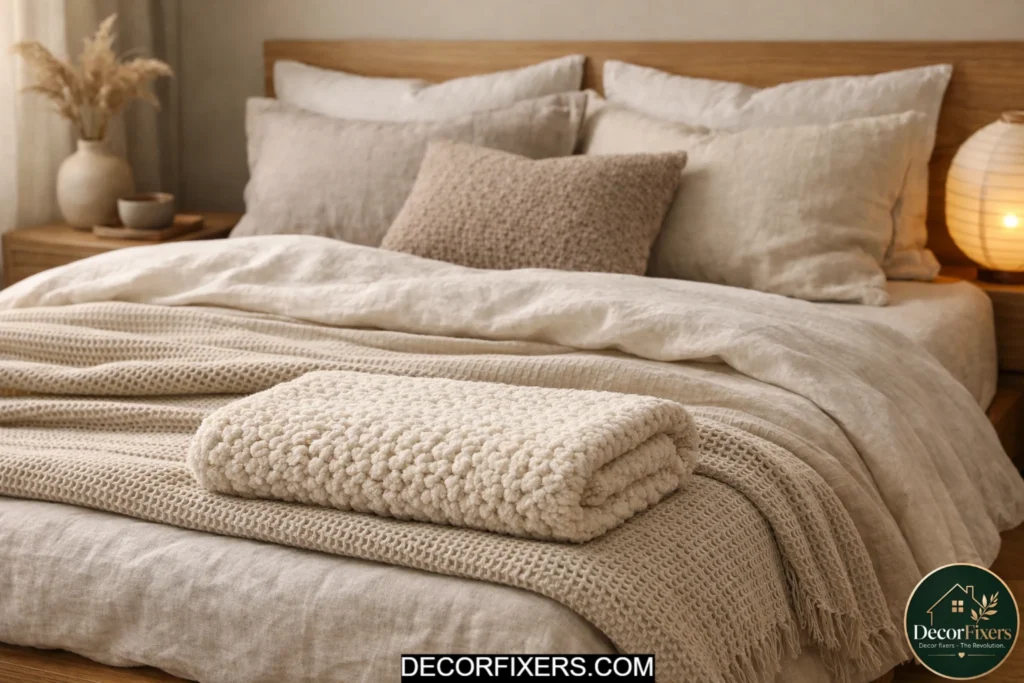
This is the technique that separates warm Japandi rooms from every other photo you have saved. The formula is reliable: a smooth base layer (fitted linen sheet), a woven or waffle-weave mid-layer (lightweight blanket or coverlet), and a chunky tactile top layer (a knitted or boucle throw folded across the foot of the bed).
You are not decorating; you are building a sensory environment. Each texture layer catches light differently, reads differently in photography, and, most practically, feels different to the hand. The room stops looking like a hotel turndown and starts looking like a place someone actually sleeps in.
If you enjoy bedrooms that feel calm but still expressive, Transform Your Space with Style explores how layered textures and thoughtful styling choices can completely shift the emotional tone of a room. Many of the same principles apply here in Japandi design, especially when warmth matters more than perfection.
5. Replace Overhead Lighting Entirely
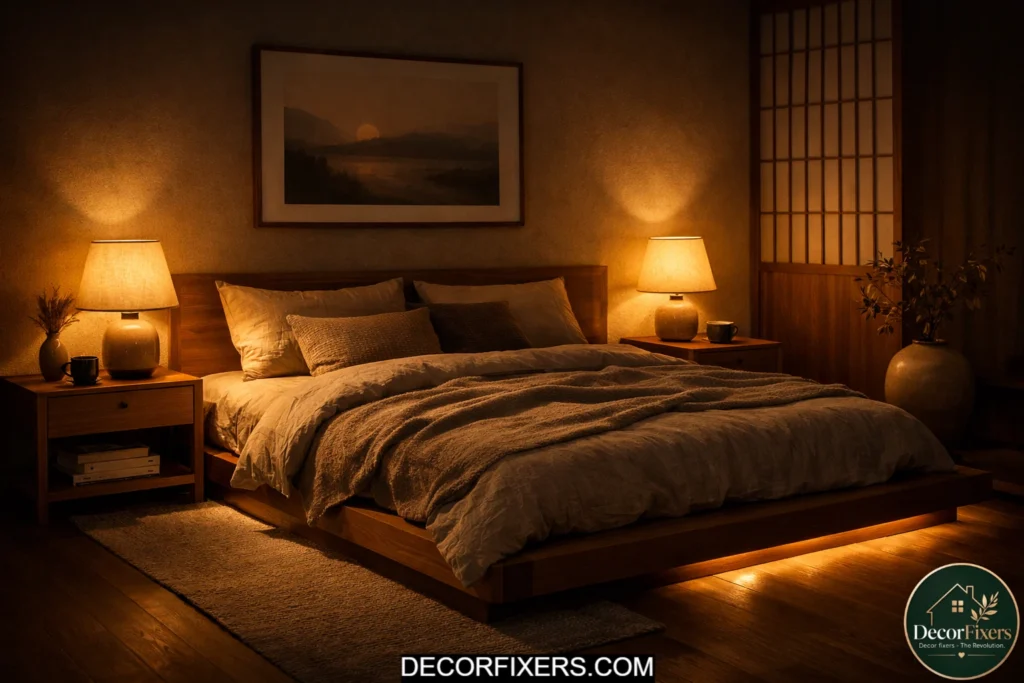
Nothing undermines a Japandi bedroom faster than a central ceiling pendant throwing flat, bright light across the whole room. It removes shadow, kills warmth, and makes 11 pm feel like 11 am. This is non-negotiable: if you can do one thing this weekend, change the lighting.
Replace overhead white light with 2,700K warm-white bulbs in bedside lamps and a single low floor lamp or wall-mounted reading light.
According to Ameri Sleep’s 2025 Japandi design guide, 2,700K to 3,000K bulbs mimic candlelight and sunset, actively signaling relaxation and preventing the alertness triggered by cool-white or daylight bulbs. The room looks better. You also sleep better. Both matter.
6. Use a Woven Rattan or Seagrass Pendant as a Feature Light
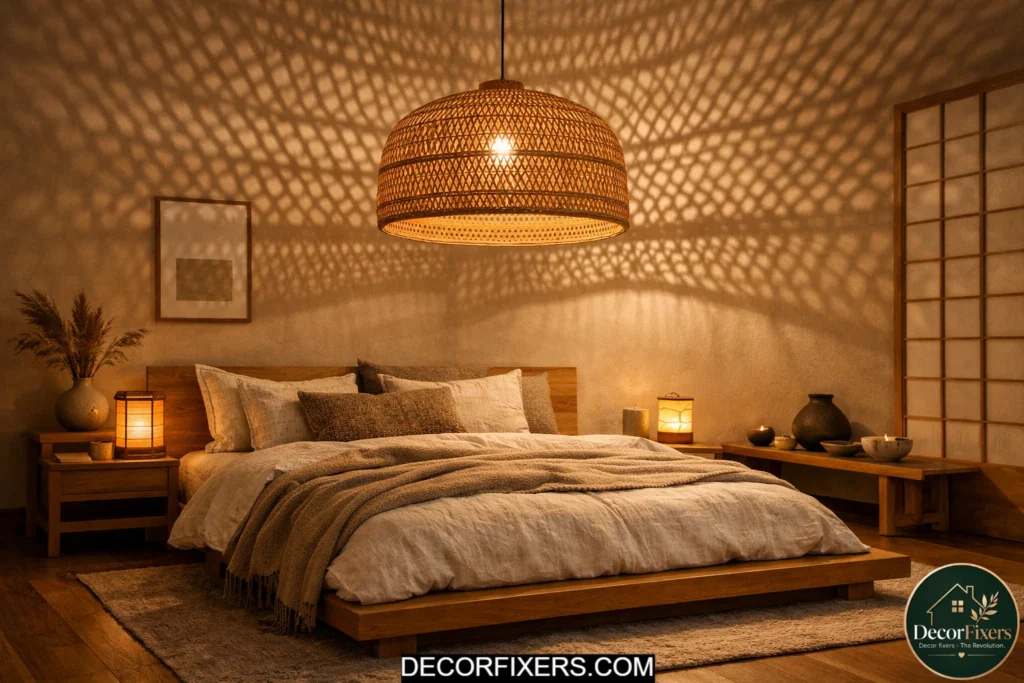
When a pendant lamp is needed, in a bedroom with high ceilings, or a walk-in where overhead light is functional, a rattan or seagrass woven shade is the Japandi choice. The woven structure diffuses light, casting warm, patterned shadows across walls and ceiling that shift subtly throughout the evening.
The IKEA SINNERLIG pendant in seagrass is the accessible version. Muto’s Paper Shade is a mid-range option. For an investment piece, a Japanese-style washi paper lantern from a specialist studio maker delivers the same quality as a room-specific commissioned piece. The material matters; plastic that imitates rattan does not achieve the same effect.
Why Japandi bedrooms can feel cold, and how to fix it
Japandi bedrooms feel cold when too much is removed without texture being layered back in. According to Sattva’s 2024 trend report, nature-inspired design is gaining popularity because it restores sensory warmth, tactile textiles, organic forms, candlelight-temperature lighting, which pure minimalism strips away. Adding one chunky textile, one warm-toned lamp at 2,700K, and one handcrafted object is typically enough to shift a clinical room into a genuinely calming one.
Quick Comparison: Warm Japandi vs Cold Japandi vs Plain Minimalism
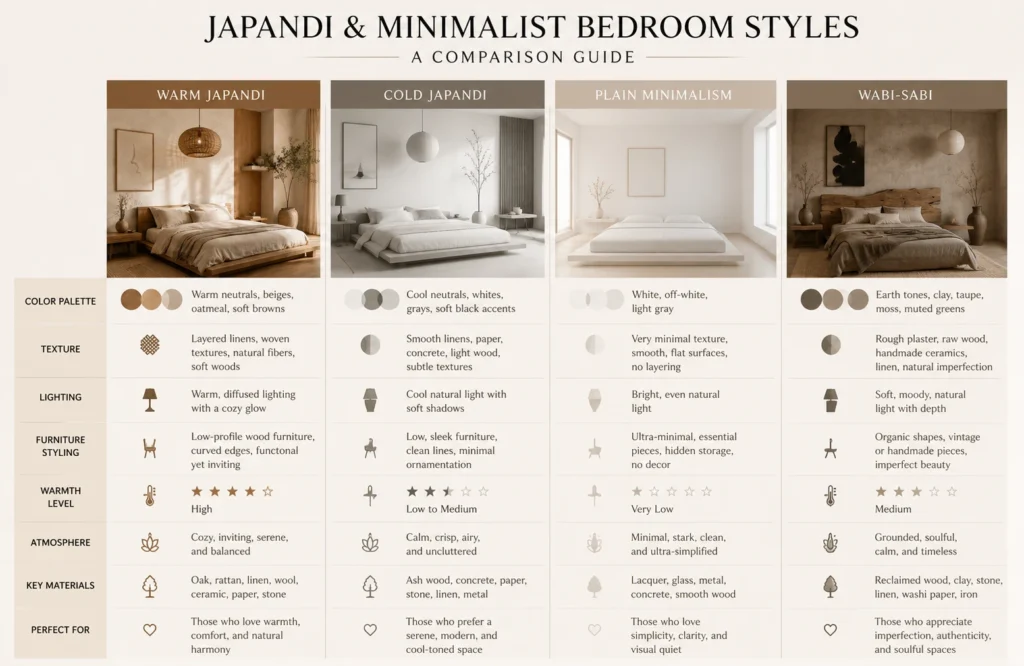
| Style | Best For | Key Benefit | Risk |
| Warm Japandi | Most bedrooms | Calm without coldness; layered texture | Can tip into clutter if overdone |
| Cold Japandi | Very small rooms | Maximum visual space | Feels sterile and unwelcoming |
| Plain Minimalism | Studio flats | Extreme simplicity, low maintenance | No warmth or personality |
| Wabi-Sabi | Maximizing character | Imperfection celebrated, deeply personal | Harder to keep visually cohesive |
7. Choose Natural Wood Over Veneer Wherever Possible
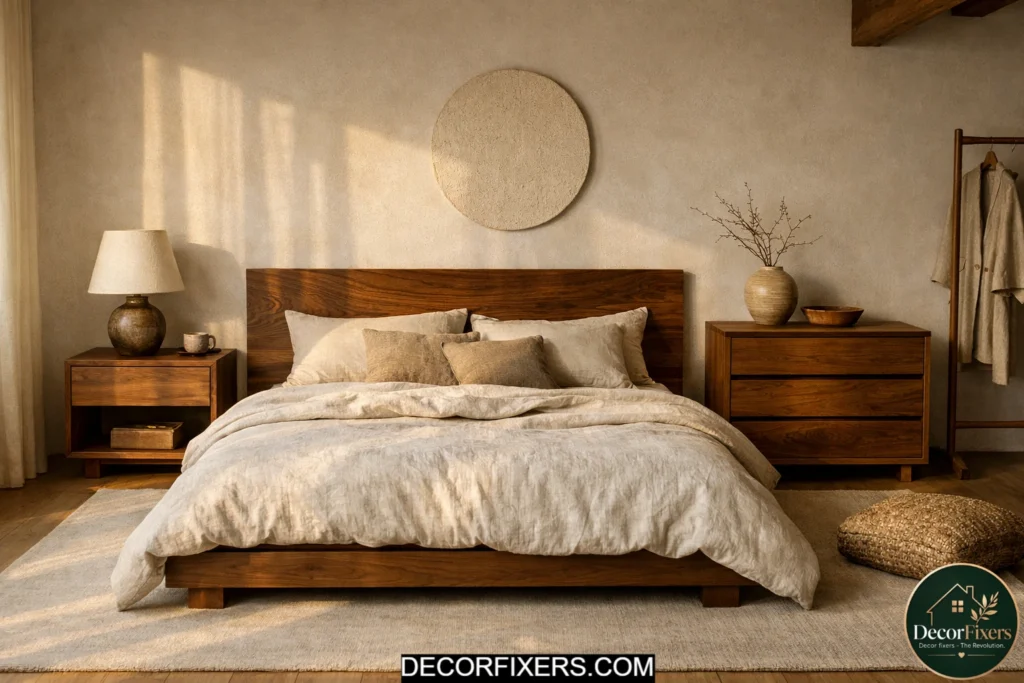
Solid oak, ash, and walnut express what veneer cannot: a surface that changes over time, that carries the character of the tree it came from, and that reads differently in morning light than in evening light. This is wabi-sabi in material form.
I’ve seen conflicting advice on this; some budget guides argue that a good veneer is indistinguishable from solid wood at a distance. That’s true for photographs. In the room, at arm’s length, solid wood has a warmth and depth that MDF veneer does not. My read is: priorities solid wood for the pieces you touch daily (bed frame, bedside tables), and use veneer or melamine for storage where tactile quality matters less.
8. Keep the Floor Partially Visible
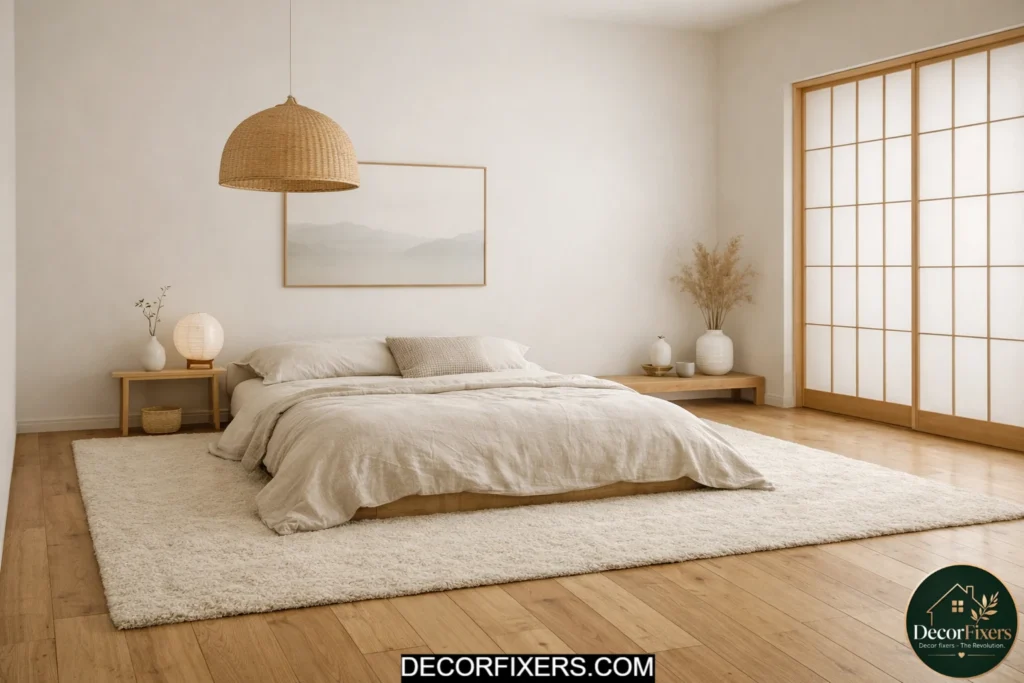
Clear floor space is one of the active design elements in a Japandi bedroom, not simply the absence of clutter. Japanese aesthetic traditions treat negative space as meaningful; the gaps between objects are considered as important as the objects themselves. In practice, this means keeping at least 40 per cent of the floor unobstructed.
A single large rug, placed with two-thirds of it under the bed, extending 40 to 50 centimeters on each side, anchors the room without filling it. Wool or jute in a natural, undyed tone works best. Avoid patterned rugs; the texture of the weave provides all the visual interest the Japandi palette needs.
9. Add a Single Meaningful Piece of Handcrafted Ceramics
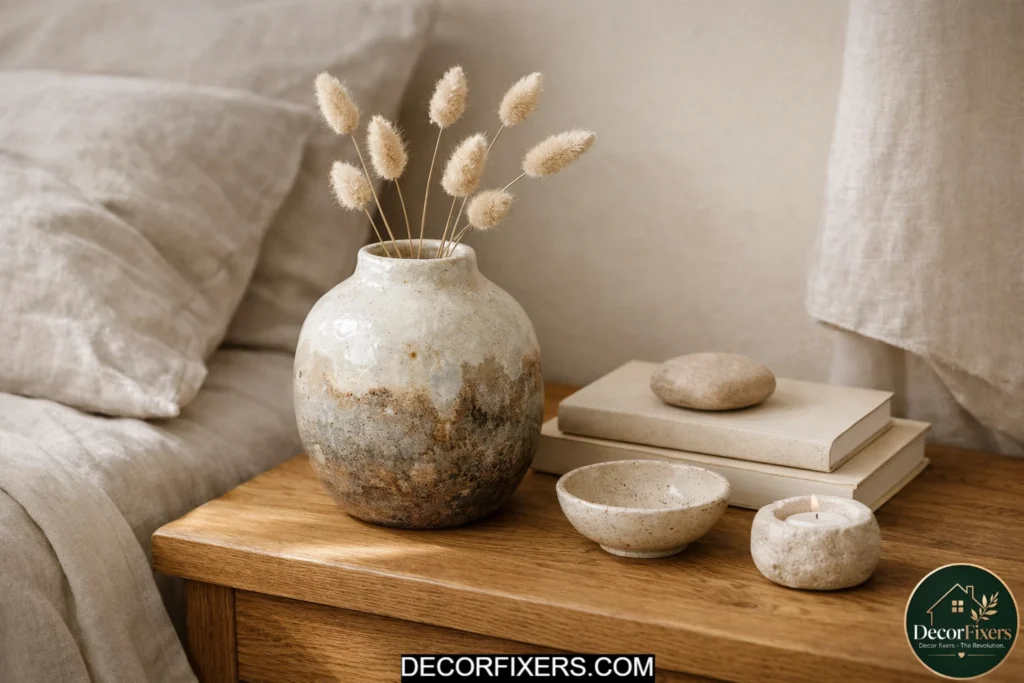
Japandi decor is not decoration-free; that is the cold version. Warm Japandi uses one or two genuinely meaningful objects rather than a shelf of curated items. A handcrafted ceramic jug or vase with an irregular glaze, placed on the bedside table or a low shelf, achieves more than six matching objects from a high-street homeware shop.
The HAY Dot ceramic tableware range and anything from a local studio potter both serve this function well. The object does not need to be expensive. It needs to look as though someone made it with intention, and as though you chose it for a reason beyond filling a surface.
10. Introduce One Living Plant, Not a Collection
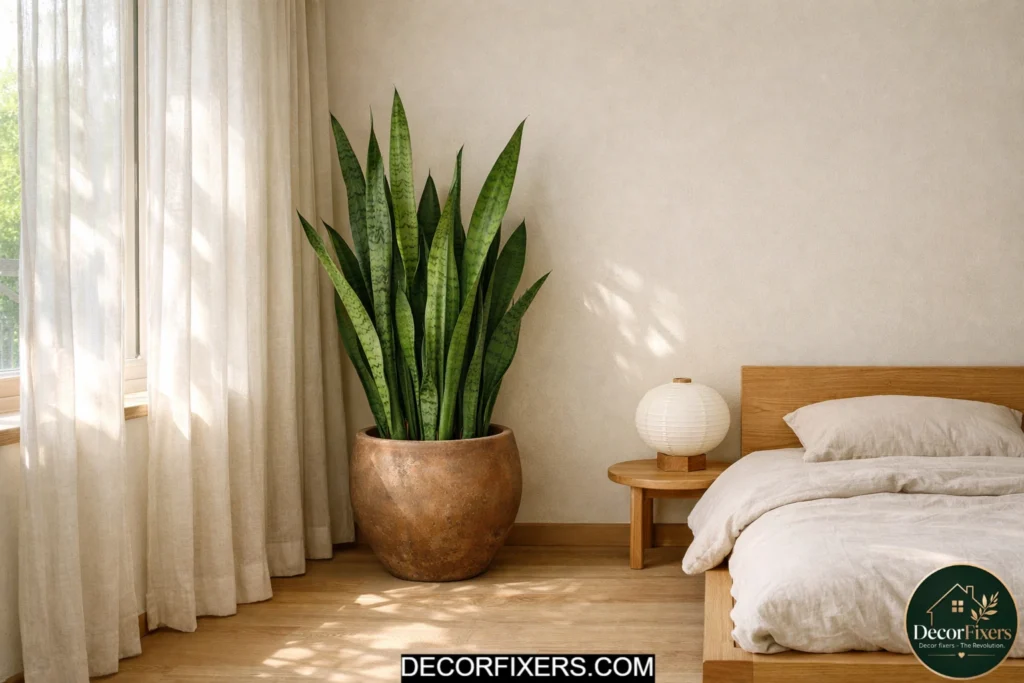
This is a point on which reasonable people disagree, and I’ll give my view with the caveat that it is a view. Some guides recommend multiple plants for a Japandi room. I think one well-chosen plant, in a simple clay or stone pot, does more work than four plants in a row. A single large-leaf Monstera, a sculptural snake plant, or a trailing pothos in an otherwise still corner has presence. Multiple plants of similar size start to look like a display, which is a different energy entirely.
Place the plant where natural light is strongest, beside a window or in the corner closest to it. The living element reinforces the biophilic principle at the heart of both Japanese and Scandinavian design traditions: that a room connected to nature, even symbolically, lowers the nervous system.
11. Use Linen Bedding, Always
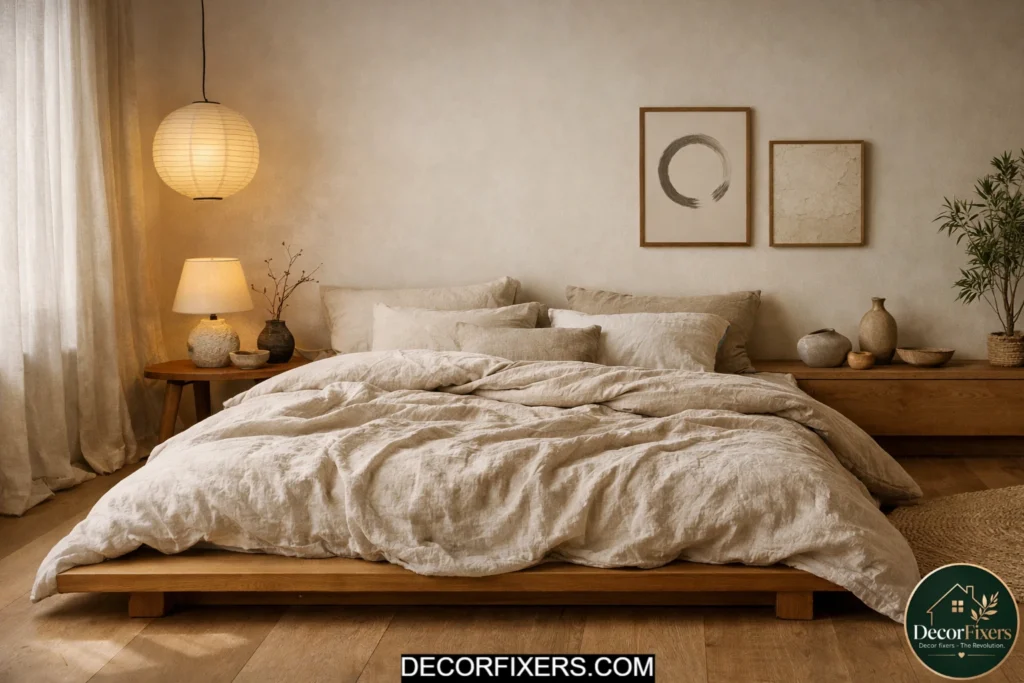
Linen is the one material that makes a Japandi bedroom feel authentic, regardless of budget. It crinkles naturally; that slight imperfection is wabi-sabi in textile form. It breathes better than cotton. It gets softer with every wash. And it photographs with a quality that reads as expensive even when the brand is a supermarket own-label option.
In undyed or oat tones, linen bedding becomes part of the neutral palette rather than a decorative element. Add a single contrasting cushion in a darker tone, deep charcoal or warm terracotta, if the all-neutral look feels flat. That is usually enough contrast to make the bed feel considered rather than unfinished.
12. Hide All Cable and Cord Management
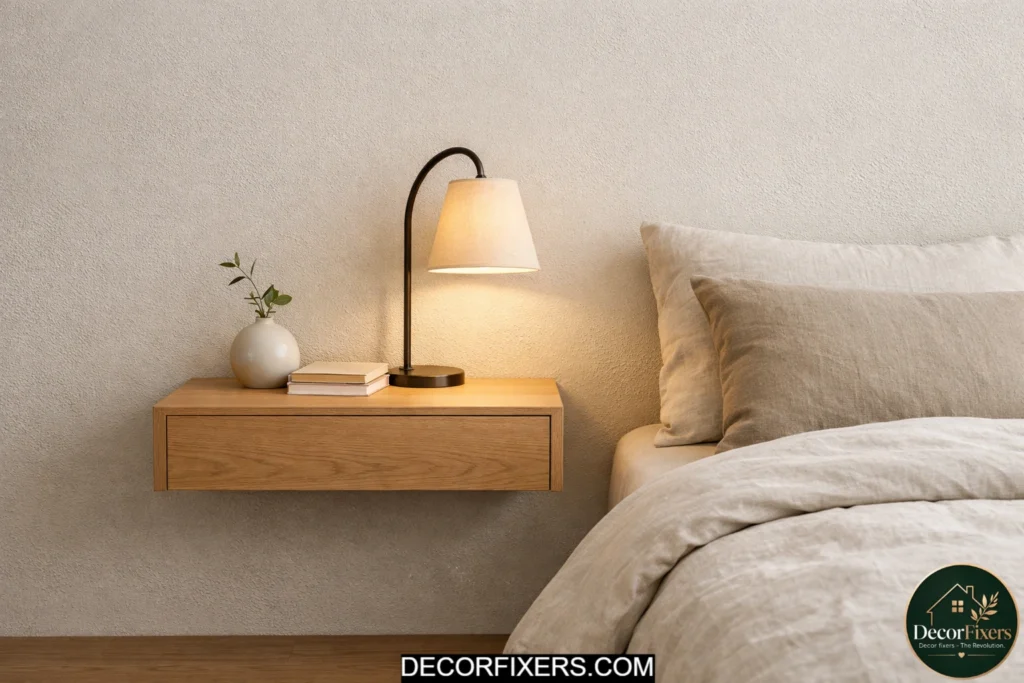
Cords are the enemy of Japandi calm. A phone charger draped across a bedside table, a lamp cord trailing down the wall, a power strip visible from the doorway, each one introduces visual noise that no amount of linen or oak can neutralise.
The fix is unglamorous but effective: cable management clips in a matching wall color, a small drawer or hollowed-out box on the bedside table that the charger sits inside, and wall-mounted reading lights that hardwire directly rather than using a trailing flex. This takes one afternoon and costs almost nothing. The effect is immediate and significant.
13. Mount Bedside Lighting on the Wall
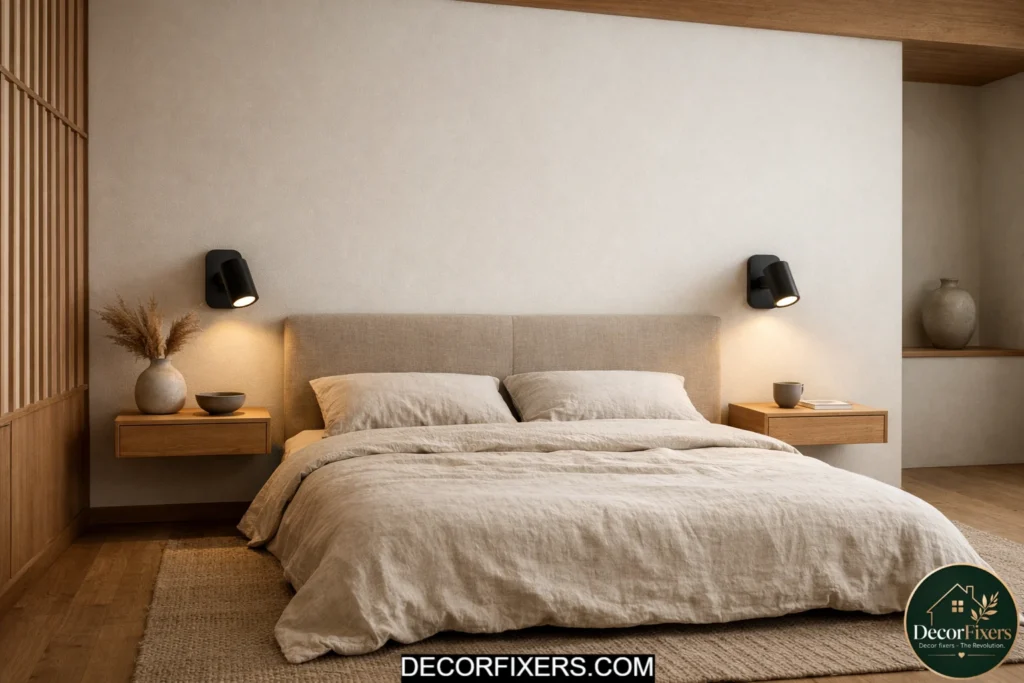
Wall-mounted reading lights do two things at once: they free the bedside table entirely (critical in a small room), and they direct light precisely where you need it without illuminating the whole room. This is both practical and aesthetically precise, which is exactly the Japandi double standard every piece must meet.
Choose a simple articulated arm in brushed brass or matte black. Both sit within the palette. Avoid chrome, it is too cold and too reflective for the warm tone the room is trying to achieve. Plug-in wall sconces avoid the need for an electrician and work in rental properties across the UK, US, Australia, and Canada with an adhesive cable guide.
14. Build a Low Shelf Along One Wall
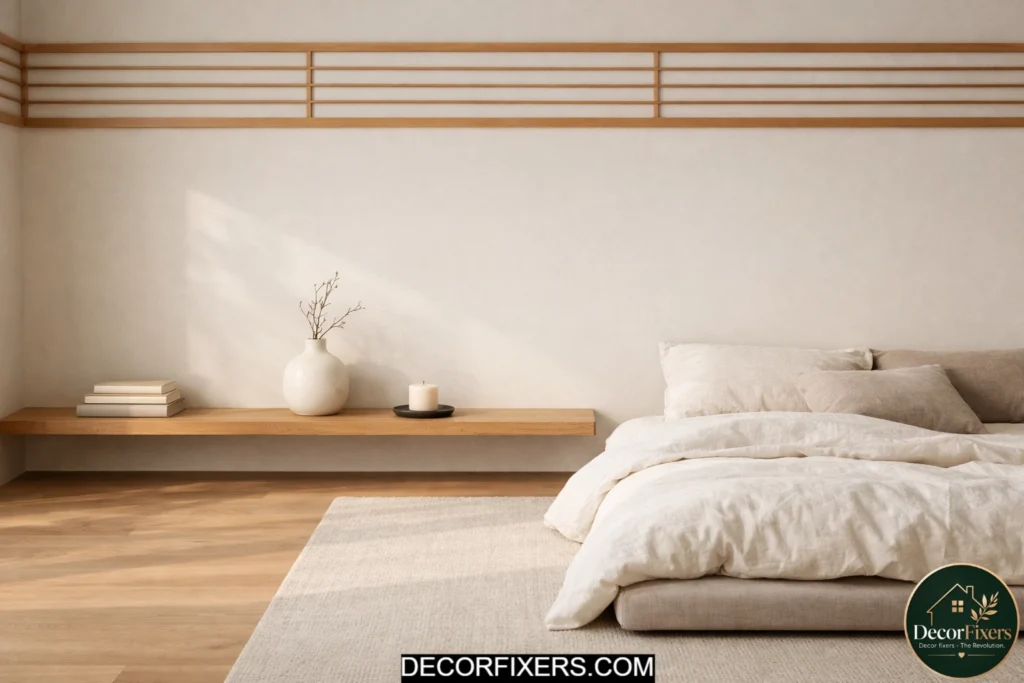
A single low shelf running the length of one wall,30 to 40 centimetres from the floor, is one of the most effective Japandi bedroom decor moves available. It references the Japanese tradition of keeping objects close to the ground, maintaining a lower visual horizon that makes the room feel expansive rather than cluttered.
Keep the shelf sparsely occupied: one stack of books, a small plant, a candle. The shelf is not storage, it is a display surface for three things chosen with care. IKEA’s KNOXHULT floating shelf or a custom-cut oak board on invisible brackets both work. The material should match or complement the bed frame.
15. Use Curtains, Not Blinds, for Softness
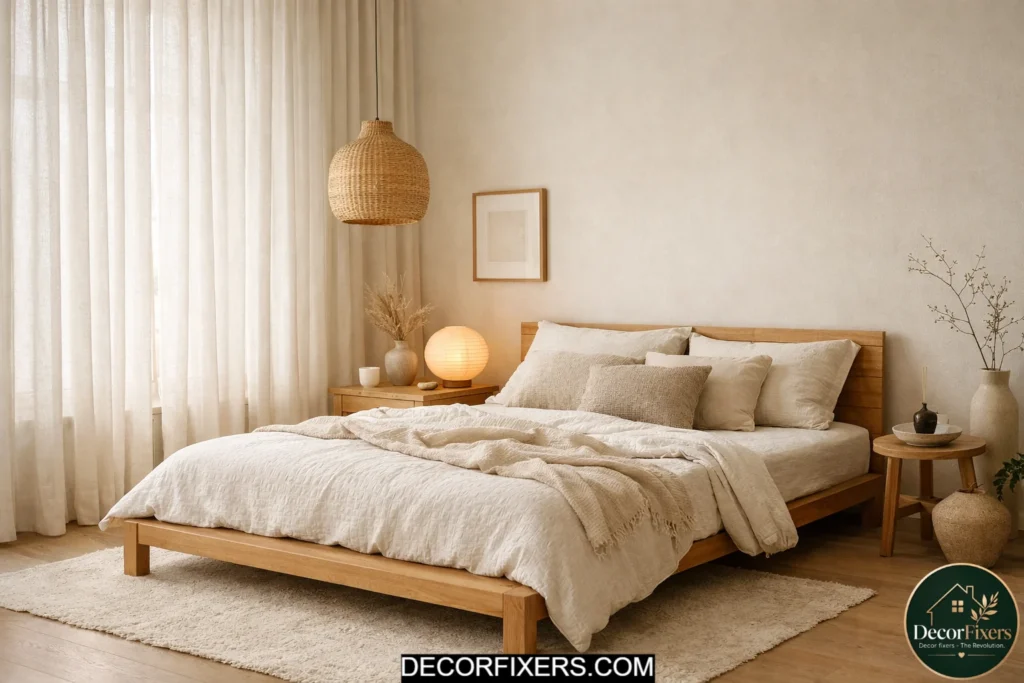
Roller blinds are efficient. Curtains are warm. In a Japandi bedroom, warmth wins. Floor-to-ceiling curtains in undyed linen or heavyweight cotton, hung from a simple steel or brass rod, soften the window architecture and add vertical movement that punctuates the horizontal calm of low furniture.
Hang the curtain rod 10 to 15 centimetres above the window frame and extend it 20 centimetres on each side so the curtain, when open, clears the glass entirely. This maximises natural light during the day and makes the ceiling appear higher than it is. Both are central to the Japandi small bedroom ideas toolkit.
16. Add a Solid Wood Bench at the Foot of the Bed

A simple solid oak or ash bench at the foot of the bed performs multiple roles: it anchors the space visually, provides a surface for the folded extra throw, gives you somewhere to sit while putting on shoes, and signals considered layering without adding visual weight the way a chair would.
The bench should be slightly narrower than the bed, and unupholstered or very simply upholstered in a natural canvas or linen. Muuto’s Align bench and HAY’s Rel bench both hit the Japandi brief precisely at mid-range prices. At Tier 1, a solid wood IKEA stool placed sideways achieves a similar function.
17. Leave the Walls Mostly Bare
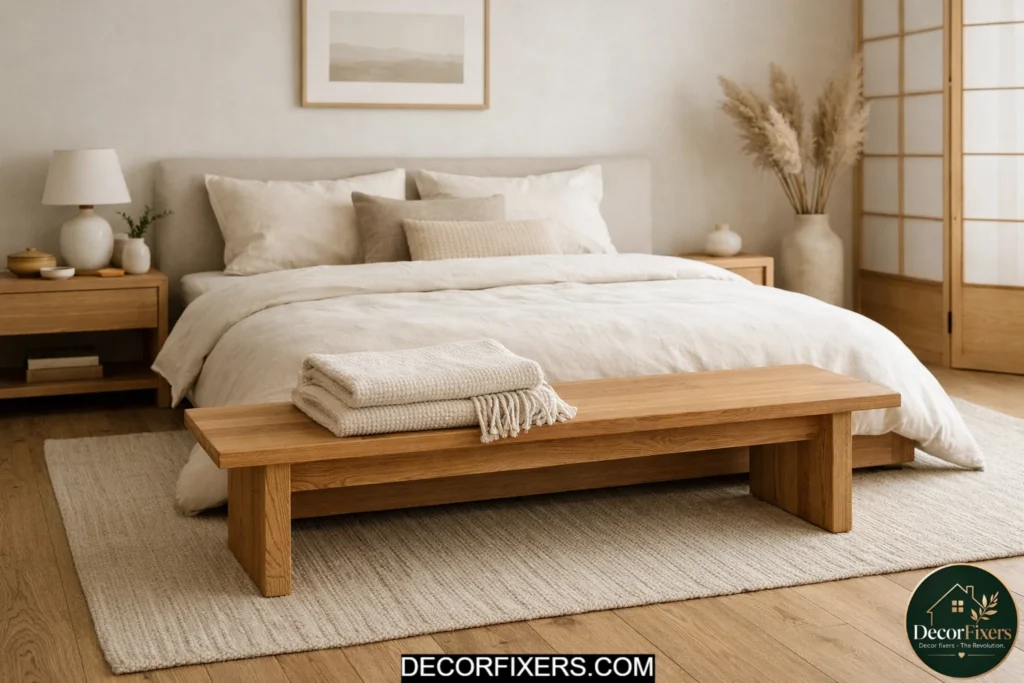
Look, if you’ve been conditioned by years of gallery-wall culture, leaving a wall bare feels wrong at first. Give it a week. What was uncomfortable becomes the room’s best feature: the wall becomes a surface for light to move across, for shadows from a plant to gesture on, for the eye to rest on without demand.
If a single artwork is right for the room, one piece of framed abstract art in earth tones or a simple botanical print placed at low height, just above the bed frame line, not centred on the wall, maintains the Japandi register. One piece. Not two. Never a grid.
18. Japandi Small Bedroom Ideas: Use Vertical Space Deliberately
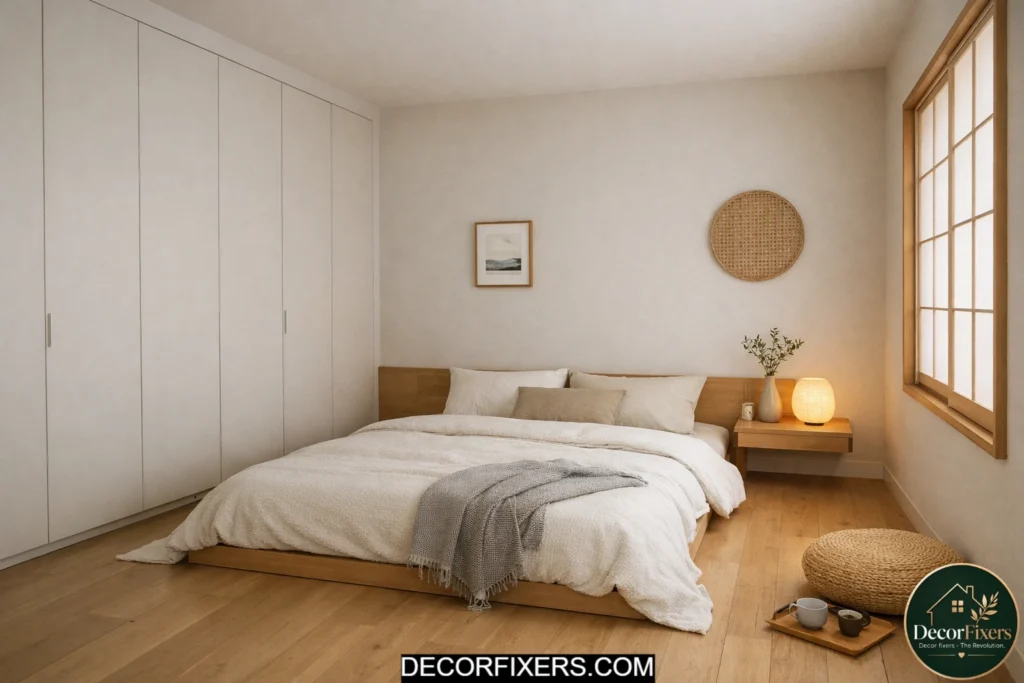
In a small room, the Japandi instinct to clear floor space is even more powerful. But the risk is using vertical space inefficiently in compensation. The Japandi small bedroom response is specific: tall, narrow, built-in cabinetry with push-to-open doors in a wall-matching finish, rather than freestanding wardrobes that interrupt the sightline.
This is the style’s strongest performance in compact spaces. By integrating storage into the architecture, handle-free, matte finish, floor to ceiling, the room regains visual width that a wardrobe steals. For renters, PAX wardrobes in a natural veneer with simple doors achieve the same optical effect without permanent installation.
19. Introduce Bamboo or Rattan Furniture as a Secondary Material
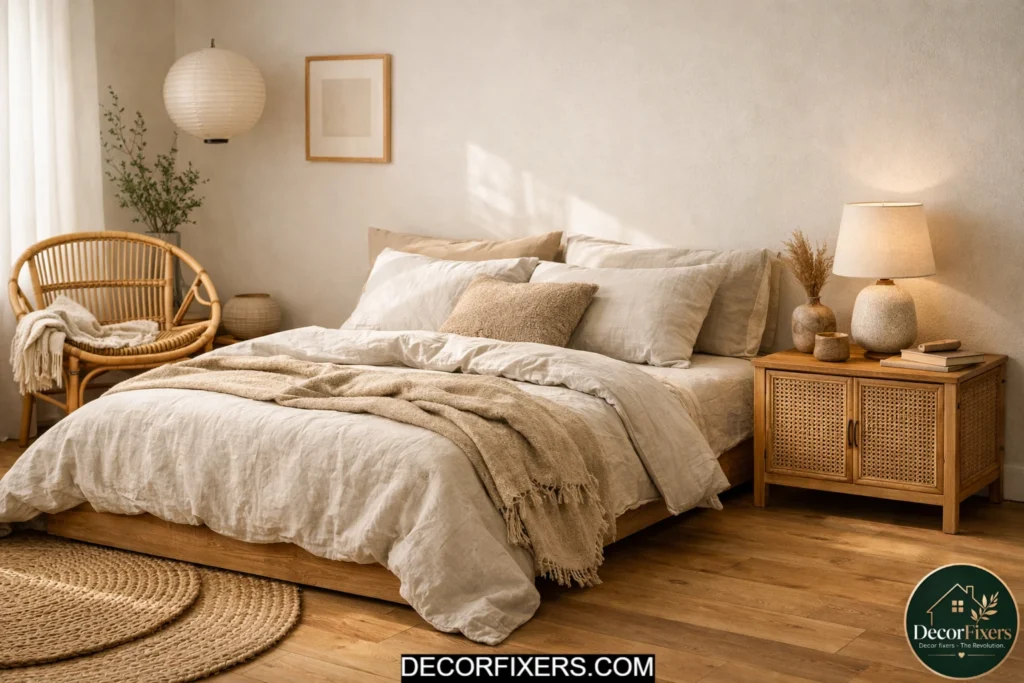
Bamboo and rattan bring a quality of lightness to a Japandi bedroom that solid wood cannot: the visual permeability of the weave, you can see through it and around it, reduces visual weight without reducing function. A rattan bedside table, a bamboo chair in the corner, or a rattan mirror frame each adds texture while maintaining the calm tone.
These materials also reference the Japanese design tradition directly; bamboo is deeply embedded in the aesthetic vocabulary of Japanese interiors. Paired with Nordic oak, the combination reads as Japandi rather than either style alone. IKEA’s LUSTIG rattan collection and Bloomingville’s bamboo ranges sit well within Tier 1 and Tier 2 budgets, respectively.
20. Use Scent as the Invisible Design Element
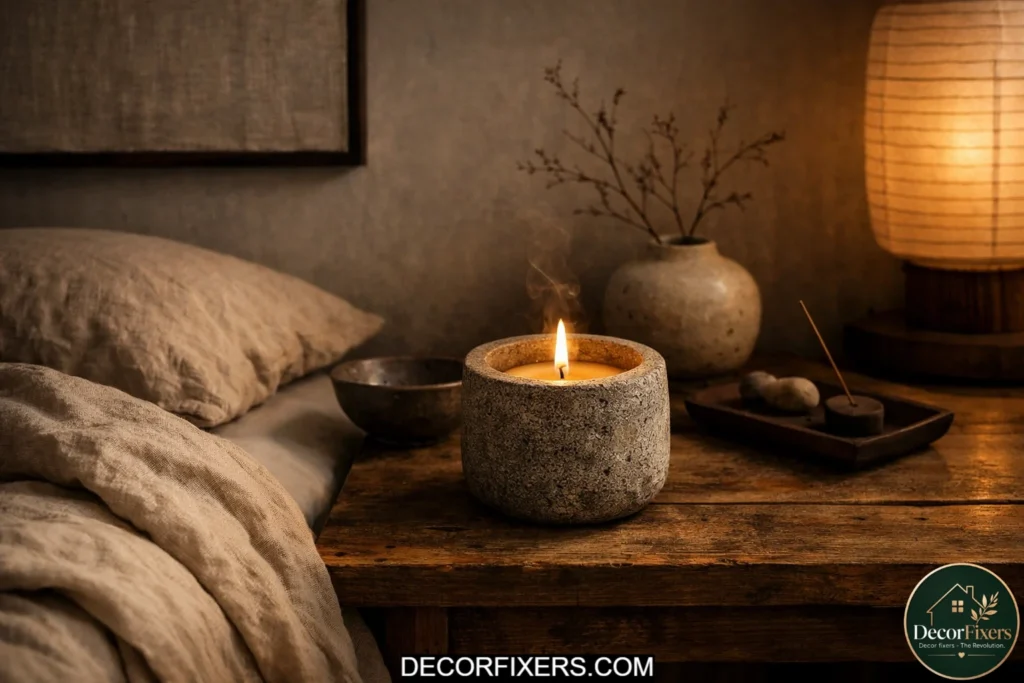
Japandi bedroom design engages all the senses, not just sight. Scent is the element most guides skip, and it is one of the most powerful tools available. A simple beeswax or soy candle in a cedarwood, hinoki cypress, or green tea fragrance takes the room from visually calm to sensorially calm. The two are different experiences.
One candle, in a simple clay or stone vessel, placed where the flame won’t be a hazard, is all the room needs. This is the most affordable upgrade on this entire list. It works in every budget tier. And it makes every moment you spend in the room feel intentional in a way that no piece of furniture entirely replicates.
21. Declutter to One-Third of What You Own in That Room
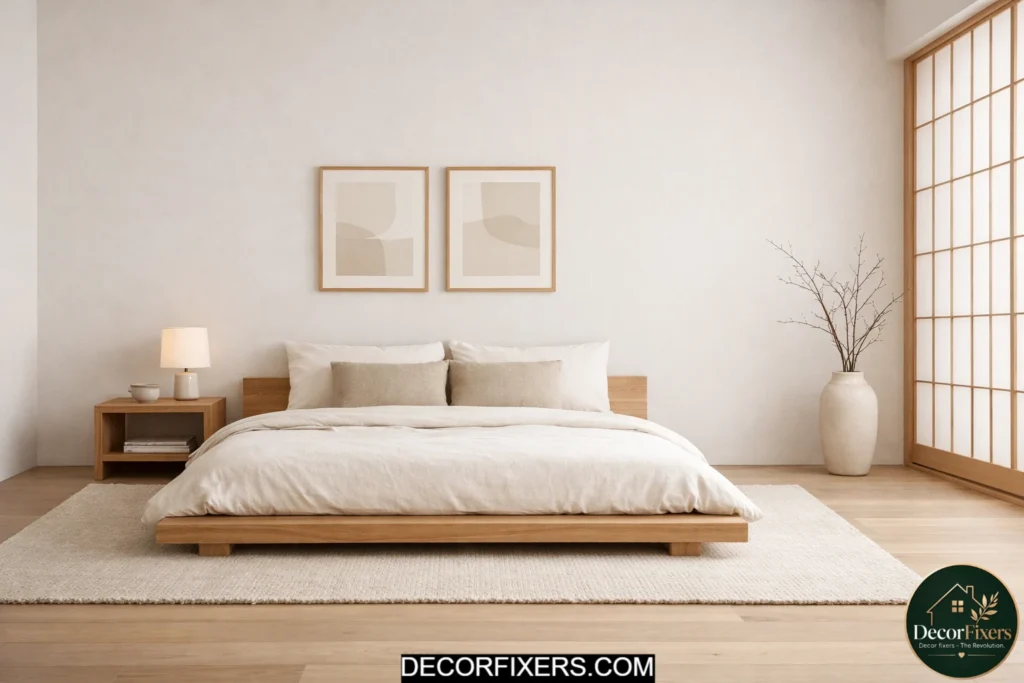
Anyway, the hardest idea is always the most important one. The most consistent mistake people make when attempting minimalist bedroom ideas is partial decluttering, removing the obviously unnecessary items, but leaving behind the passive accumulation that makes a room feel busy without a single statement object.
The Japandi standard is strict: every object in the room earns its place by being either functional (you use it regularly) or beautiful (it gives you genuine pleasure). Objects that are neither should leave the room. This is not minimalism for its own sake; it is the precondition for everything else on this list to actually work.
22. Install Shoji-Inspired Room Dividers for Multi-Use Spaces
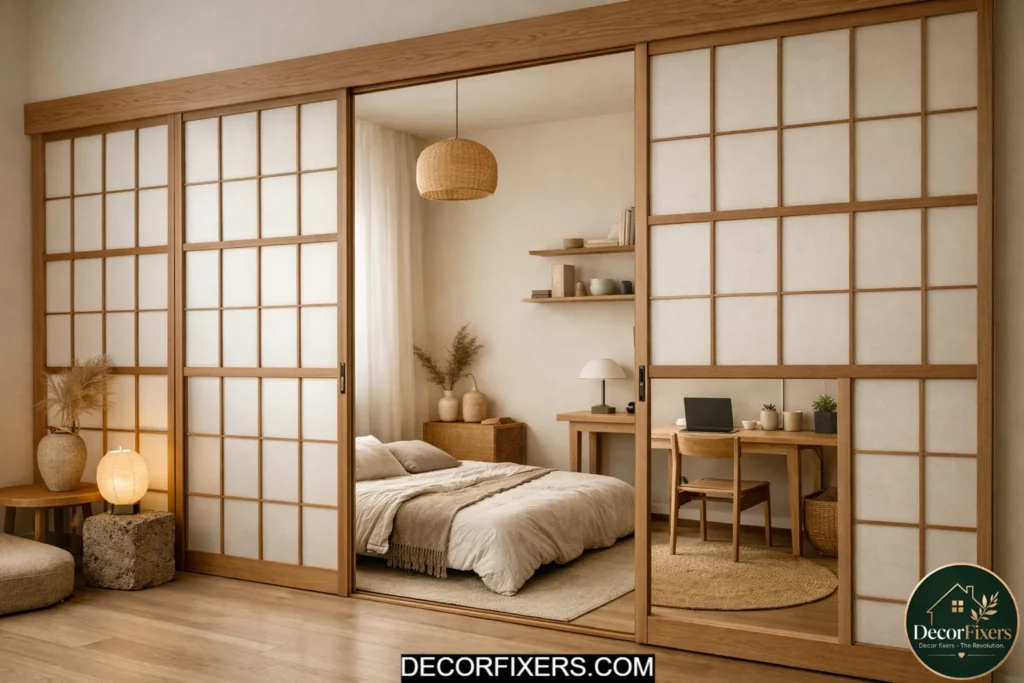
In a studio flat or open-plan sleeping area, a shoji-inspired screen, a light timber frame with rice paper or translucent panel inserts, creates the visual boundary of a bedroom without a wall. The screen diffuses light rather than blocking it, maintains the airiness of the space, and introduces Japanese architectural vocabulary in a way that reads immediately.
These work particularly well as a separation between a sleeping area and a working desk. The screen signals “work ends here” at a visual level, which has genuine sleep-hygiene implications in a space where both activities happen. Ready-made shoji screens are available through Japanese import retailers in the UK, US, and Australia from around £120 to £400.
23. Choose Storage That Disappears into the Walls
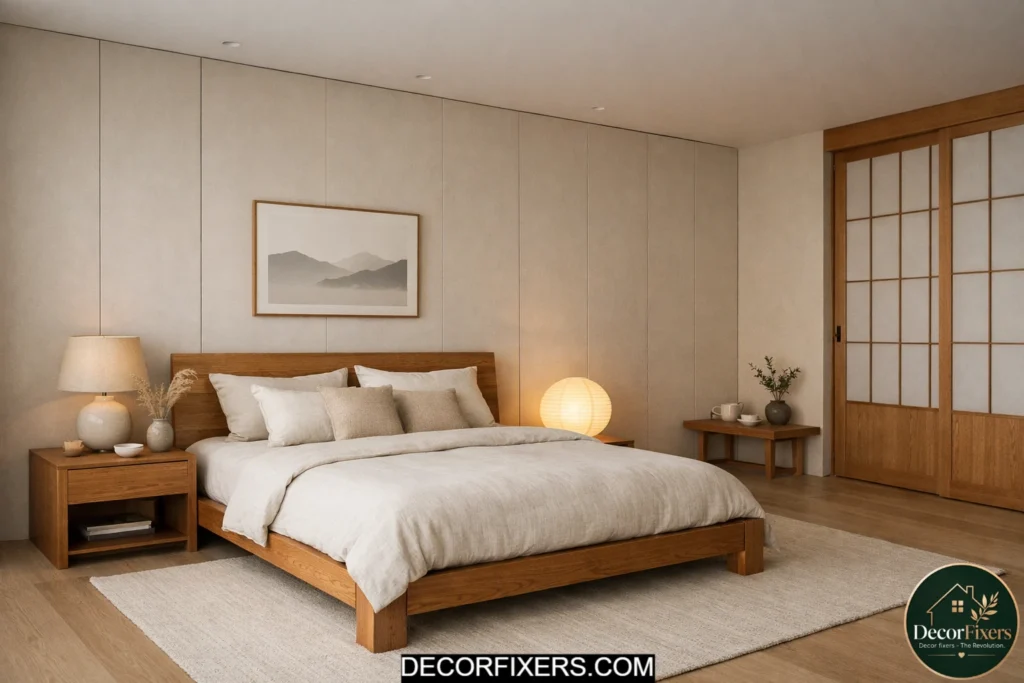
Visible storage is the design equivalent of a raised voice in a library. In a Japandi bedroom, the ambition is for storage to be either invisible, built into the architecture with flush doors, or so quietly beautiful that it reads as furniture rather than utility. A simple lathed solid wood wardrobe with a push-to-open mechanism falls into the second category.
What most guides skip is the importance of interior storage organisation. A wardrobe that closes neatly but opens onto chaos undermines the psychological calm the room is trying to achieve every time it is opened. Simple uniform hangers, folded items by category, and a single cotton drawer divider inside each drawer cost very little and complete the system properly.
24. Try a Tatami or Natural Fibre Floor Mat
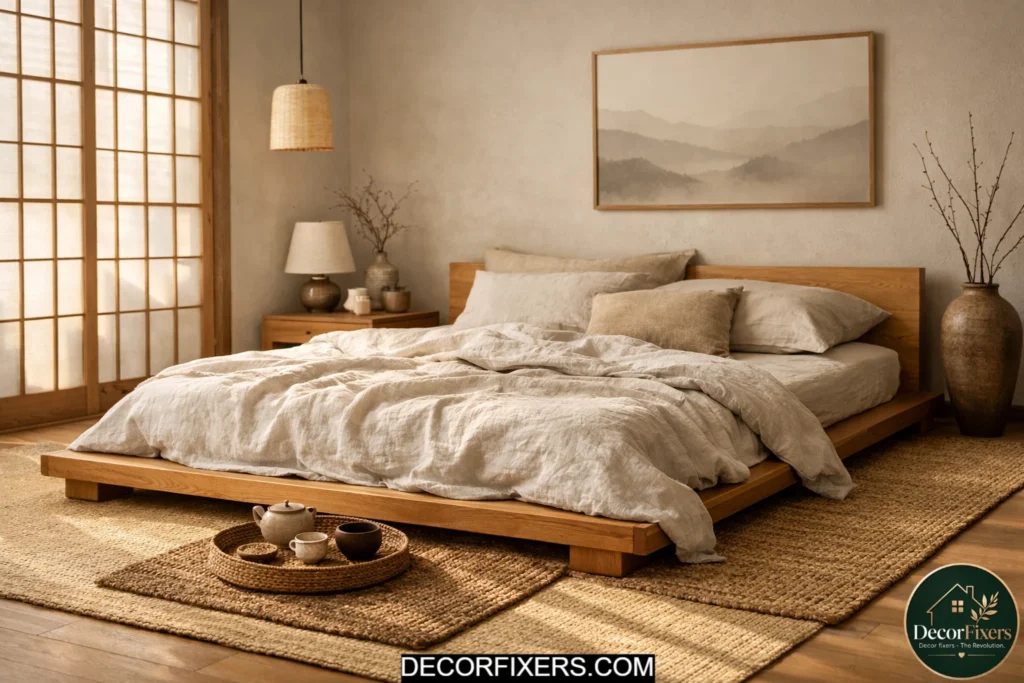
A tatami mat alongside the bed, not beneath it, but beside it as the surface your feet first touch in the morning, is a direct reference to Japanese bedroom tradition and one of the most texture-rich elements available at low cost. Natural rush tatami mats are available from specialist importers and some natural home retailers in the UK, US, and Australia from around £60 to £150.
If tatami reads as too culturally specific for your room, a woven rush or coir mat serves the same sensory function without the direct cultural reference. The material warmth underfoot, the natural scent when new, and the slight irregularity of the weave all sit within the wabi-sabi principle. It also protects the floor around the bed from wear, which is purely practical, and Japandi appreciates both.
25. Wabi-Sabi Bedroom Ideas: Welcome Intentional Imperfection
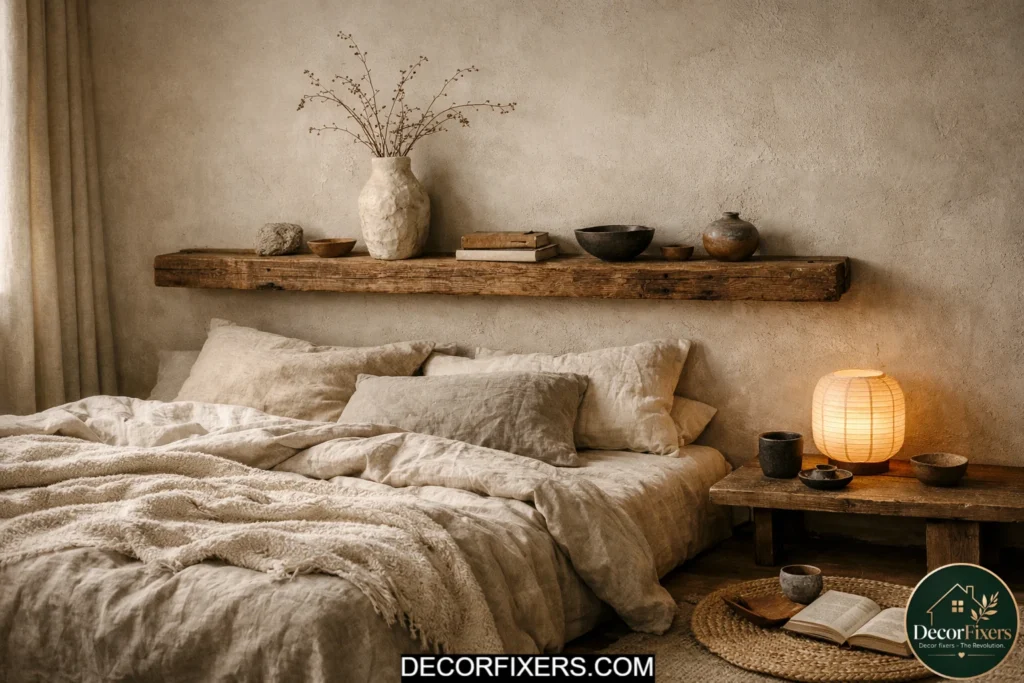
If the Japandi room you have built still feels slightly sterile, wabi-sabi bedroom ideas are the corrective. Wabi-sabi is the Japanese philosophy that finds beauty in the impermanent, imperfect, and incomplete, and it layers into Japandi naturally, because both traditions share the same reverence for natural materials and restraint.
In practice, wabi-sabi additions to a Japandi bedroom mean: a handmade ceramic with uneven glaze, a piece of reclaimed timber on a low shelf, a linen curtain with natural nubbles in the weave, or a vintage textile folded across the bench at the foot of the bed. Each object carries evidence of how it was made, or how it has aged. That evidence is the warmth that polished, mass-produced objects cannot provide.
For readers drawn to more relaxed and expressive interiors, these Boho Bedroom Ideas offer another approach to creating warmth through texture, natural materials, and lived-in character. Boho and Japandi styles differ visually, but both rely heavily on comfort, softness, and personal atmosphere rather than trend-driven decoration.
26. Muuto Restore Cushions and Layered Textiles for Depth
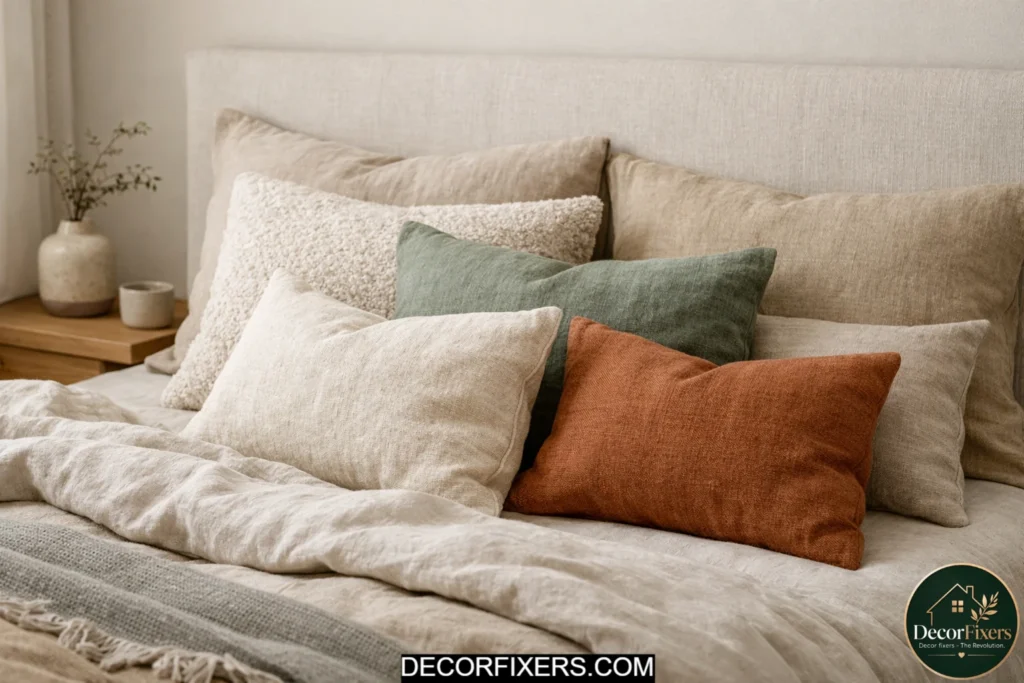
Cushions in a Japandi bedroom follow the same restraint rule as every other element: two or three, in tonal variations of the same neutral family, in genuinely different textures. The Muuto Restore cushion range, made from recycled materials in muted sage, oatmeal, and clay tones, is one of the most considered Japandi-compatible cushion ranges at a mid-range price. They sit together without matching, which is the goal.
Avoid cushion arrangements that look “styled”, pyramid stacks, alternating sizes, and color-coordinated pairs. Japandi cushions look as though they were placed by someone who uses the bed, not by someone photographing it. Two cushions, slightly different in texture, leaned against a simple linen headboard, which is the correct register.
27. Design the Room You Will Actually Wake Up In, Not the One You’ll Photograph

The deepest Japandi principle is one that does not appear in most guides: the room is for living in, not for performing. A bedroom designed with the Japandi philosophy should feel better at 7 am, when your eyes adjust to the light, when your feet touch the floor, when the first sensory impressions of the day form, than it looks in any photograph.
That is the test. If the room functions as a genuine retreat from the demands of the day, with materials that feel good, lighting that does not assault, and enough clear space to breathe, then it is Japandi regardless of whether every piece was sourced from the right brand. The aesthetic is the outcome of the values, not the other way around.
How to Make a Japandi Bedroom Work in a Small Space
A Japandi bedroom in a small space works by treating empty floor area as a design element, not wasted space. Low-profile beds, wall-mounted storage with flush push-to-open doors, and curtains hung from ceiling height all create the perception of more space than exists. According to Amerisleep’s 2025 Japandi guide, the style’s uncluttered approach makes small spaces feel significantly larger by removing visual noise and maintaining clear sightlines across the floor.
The key move for a small room is keeping furniture on one wall, the bed against the longest wall, the wardrobe built in alongside it, and allowing the opposing wall to remain almost entirely clear. This counterintuitive arrangement is more effective than distributed furniture and is standard in Japanese interior planning for compact spaces.
Japandi Bedroom Furniture: What to Prioritise
Japandi bedroom furniture prioritises three things: a low-profile bed in solid natural wood, integrated storage that disappears into the room, and one or two secondary pieces of genuine quality rather than several average ones.
According to Livingetc’s 2025 Japandi guide, citing designer Frederik Werner of Norm Architects, “the Scandinavian and traditional Japanese design traditions are bound by a shared understanding of simplicity, functionality, refinement, and attention to detail”, meaning every piece must justify its presence by serving both function and aesthetic purpose simultaneously.
Quick note: the common error is buying the right-looking pieces, but too many of them. One excellent bedside table beats two average ones. One well-chosen pendant beats a set of matching table lamps. Fewer decisions, made more carefully, is the Japandi furniture method.
Conclusion
I came to Japandi design not through a Pinterest board but through exhaustion, a bedroom so full of objects that walking into it added to the noise of the day rather than subtracting from it. What I found, working through these principles, was that the hardest part is not buying the right furniture. It is resisting the urge to fill the space back up once it has been cleared.
The room that works is the one where nothing is there by accident. The linen on the bed. The one ceramic on the table. The warm lamp in the corner and the plant beside the window. Each choice is made because it earns its place, either because it is genuinely beautiful or because it serves you every single day. That is not a trend. That is just a room designed with intention.
This guide covers bedroom applications of the Japandi aesthetic. It does not address kitchens, living rooms, or bathrooms, each of which brings its own spatial and material considerations that would require separate treatment.
FAQs:
Q: What’s the best color palette for a Japandi bedroom?
A: Warm whites, oat, stone, light oak, and muted sage or terracotta as a single accent. Limit the palette to three or four tones and let texture provide variation. Avoid stark white; it reads as cold rather than calm.
Q: How do I stop my Japandi bedroom from feeling cold and clinical?
A: Add texture in layers, a linen duvet, a woven throw, a chunky knit across the foot of the bed. Swap overhead lighting for 2,700K warm-white bedside lamps. Add one handcrafted object with an irregular surface. These three changes resolve the clinical feeling in most rooms.
Q: Should I use IKEA furniture for a Japandi bedroom?
A: Yes, selectively. The GLADSTAD bed, SINNERLIG pendant, and MALM oak-veneer dresser all sit within the Japandi register. The discipline is restraint: choose fewer pieces and resist the urge to add IKEA accessories from the homeware section, which tend to break the aesthetic.
Q: Why does my Japandi bedroom look like a hotel room and not a home?
A: You have likely removed too much and not replaced it with enough warmth. Add one wabi-sabi element, a handmade ceramic, a slightly imperfect linen cushion, a plant with visible soil, and one layer of personal meaning, such as a single book you are actually reading left on the bedside table.
Q: When should I use wabi-sabi ideas instead of strict Japandi?
A: Use wabi-sabi elements when the room feels overly polished or lacks warmth. Imperfect, handmade, or aged objects, reclaimed wood, irregular ceramics, and vintage textiles introduce character without compromising the calm. Wabi-sabi is the corrective for Japandi that has tipped too far toward sterility.

Creator of DecorFixers, sharing practical home and interior ideas focused on real-life usability, simple design improvements, and budget-friendly solutions.