

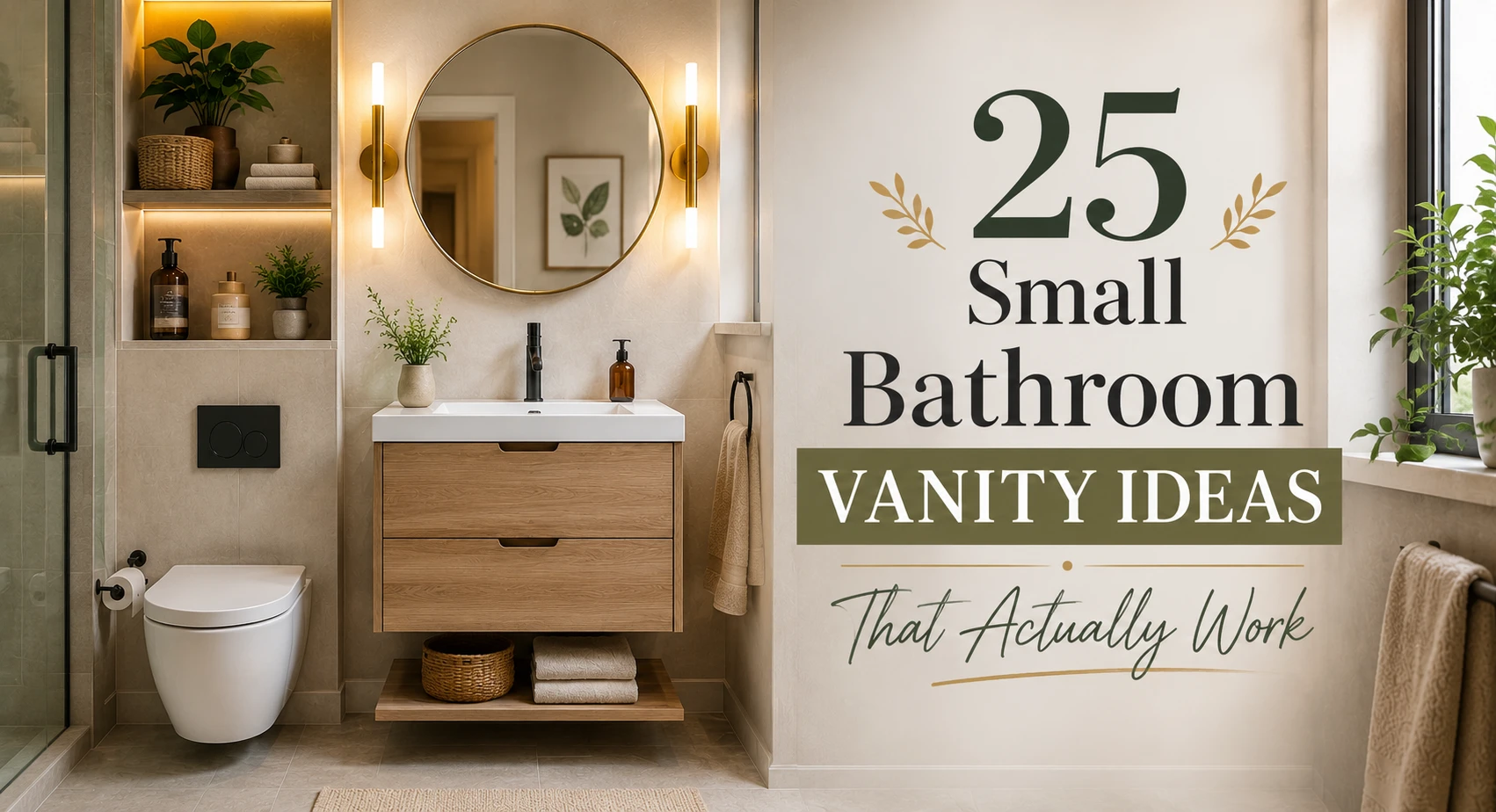
I’ve stood in a 38-square-foot bathroom staring at a 36-inch vanity that took up nearly half the wall, and I get it. That moment of ‘this doesn’t fit my life’ is exactly what sends you down the Pinterest rabbit hole at 11 PM. You save fifty photos. None of them has measurements. You close the tab more confused than when you opened it.
This guide is different. Every single one of these small bathroom vanity ideas comes with real dimensions, a style note, and honest storage advice. No fluff. No vague ‘make it cozy’ tips. Just 25 ideas that work in tight spaces, and one comparison table that’ll save you three hours of research.
| 📌 Quick Definition: What Is a Small Bathroom Vanity? |
| A small bathroom vanity is a combined sink cabinet unit designed for bathrooms under 60 square feet, typically ranging from 18 to 36 inches wide. Unlike standard vanities, small-space versions prioritize a reduced footprint while still delivering usable counter space and organized under-sink storage. |
How to Choose the Right Small Bathroom Vanity (Before You Buy Anything)
Most people pick a vanity by how it looks in a photo. That’s how you end up with a cabinet that blocks the door swing or leaves you sideways-shuffling past the toilet every morning. The right call starts with three numbers: your wall width, your door clearance, and your plumbing rough-in location.
According to the National Kitchen and Bath Association (NKBA) 2024 Design Trends Report, the 30-inch vanity is the single most selected width in small and secondary bathroom renovations, chosen in roughly 42% of compact remodel projects. That number makes sense. It’s wide enough for a real sink and a bar of soap, narrow enough to leave walking room in most layouts.
Quick note: NKBA guidelines recommend at least 30 inches of clear floor space in front of any lavatory. Measure that first. If you can’t hit 30 inches with your preferred vanity width, size down, not up.
| ✅ How to Size a Vanity for a Small Bathroom (3 Steps) |
| 1. Measure available wall width in inches; this is your absolute maximum vanity width. |
| 2. Measure floor clearance from vanity face to opposite wall or fixture, aim for 30 inches minimum. |
| 3. Locate your plumbing rough-in: floor-mounted suits freestanding; wall-mounted suits floating vanities. |
Quick Comparison: Small Bathroom Vanity Types
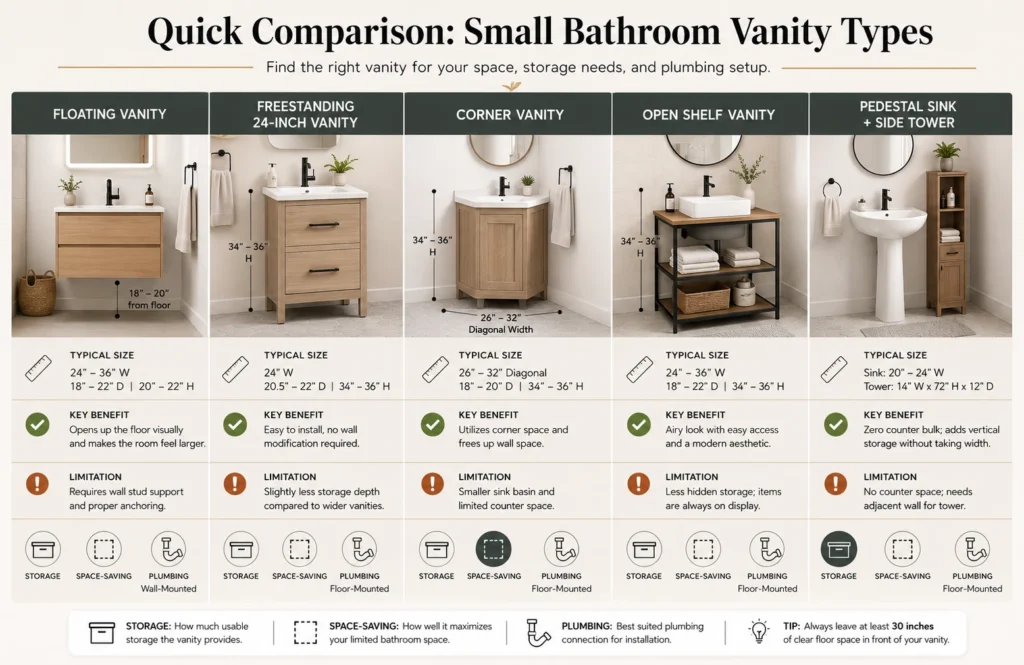
| Type | Best For | Key Benefit | Limitation |
| Floating Vanity | Modern, tight floors | Opens up the floor visually | Needs wall stud framing |
| Freestanding 24″ | Renters, quick updates | No plumbing move needed | Less storage depth |
| Corner Vanity | Diagonal wall space | Saves linear wall space | Limited sink size |
| Open Shelf Vanity | Style-forward spaces | Airy, clutter-free look | Less hidden storage |
| Pedestal + Side Tower | Powder rooms | Zero counter bulk | Needs an adjacent wall |
1. Floating Vanity With a Flat-Panel Door
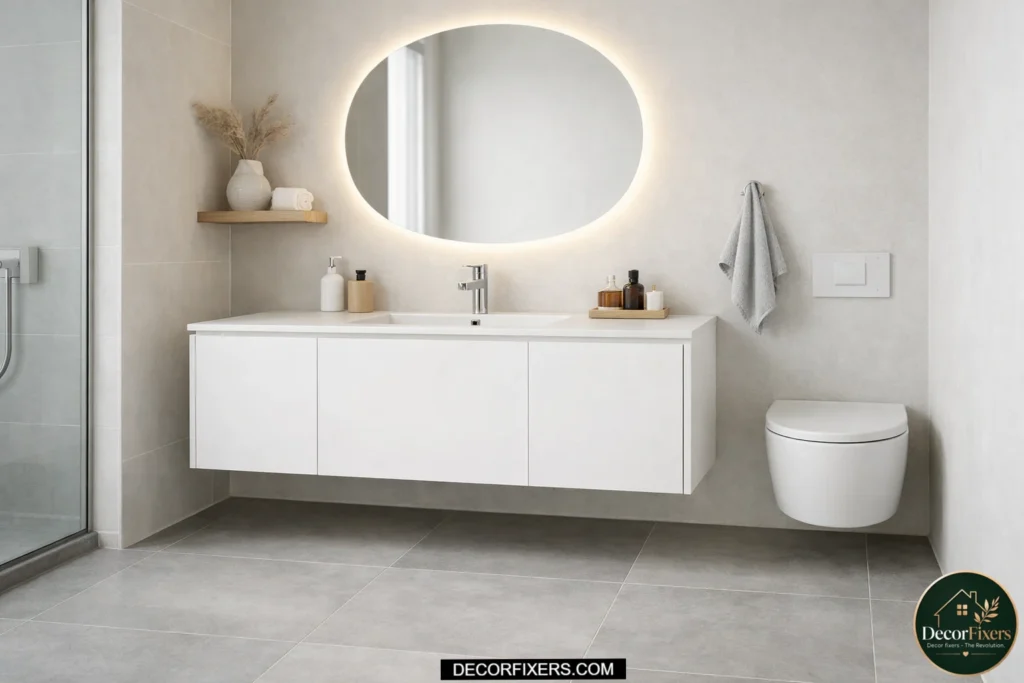
Wall-mounted floating vanities are the single most effective trick for a small bathroom, full stop. By lifting the cabinet 6 to 8 inches off the floor, your eye reads the room as larger because you see more tile. The visual breathing room is immediate.
A 24-inch IKEA GODMORGON floating unit retails for around $229–$299 and mounts to standard stud walls. Install a plywood backer panel between studs if your walls can’t anchor at the exact right spot. This is the step most guides skip, and the main reason floating vanities pull from walls after a year.
2. 24-Inch Single Sink Vanity With Drawers
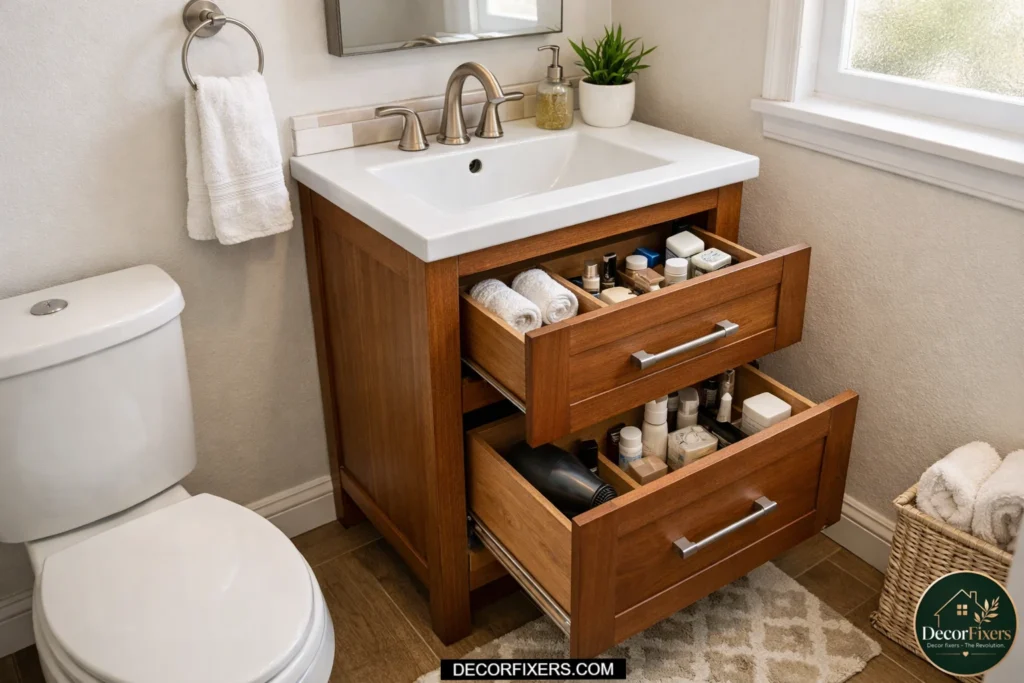
The 24-inch vanity is the workhorse of small bathroom renovations. It fits on walls that would reject a 30-inch model without touching the toilet flange or door casing. Two full-extension drawers beat a cabinet door in a tight space every single time. You pull, you grab, you’re done.
Drawer depth matters. Look for soft-close slides rated for 75 lbs; anything rated lower tends to fail within two years of daily use. Budget range for a quality 24-inch drawer vanity: $350–$650. Fresca Torino makes a solid narrow-depth version at 20.5 inches deep, which is a full inch shallower than standard.
3. Corner Vanity for the Diagonal Dead Zone
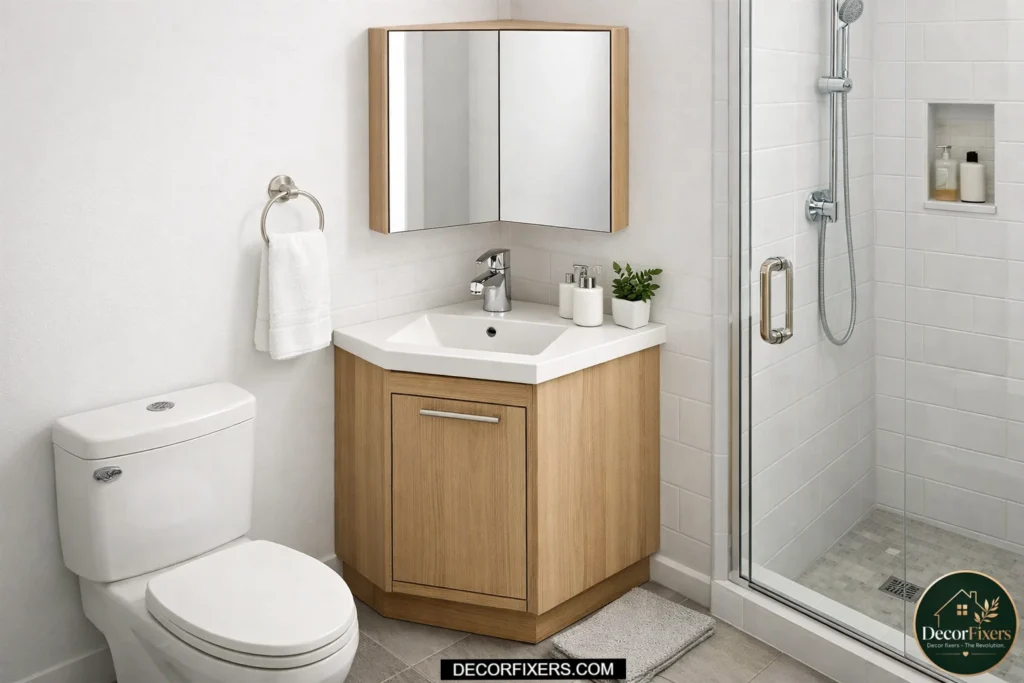
Corner vanities solve a specific problem: bathrooms where every straight wall has a conflict, a door, a toilet, a shower. They’re not common, but they’re genuinely clever. Most sit between 26 and 32 inches diagonally, letting you reclaim wall space that would otherwise hold a towel hook and a prayer.
The tradeoff is sink size. Corner sinks tend to run smaller, 12 to 15 inches across the basin, which limits them to powder rooms or secondary baths. If you’re the only person using the bathroom, that’s plenty.
4. Pedestal Sink Paired With a Freestanding Storage Tower
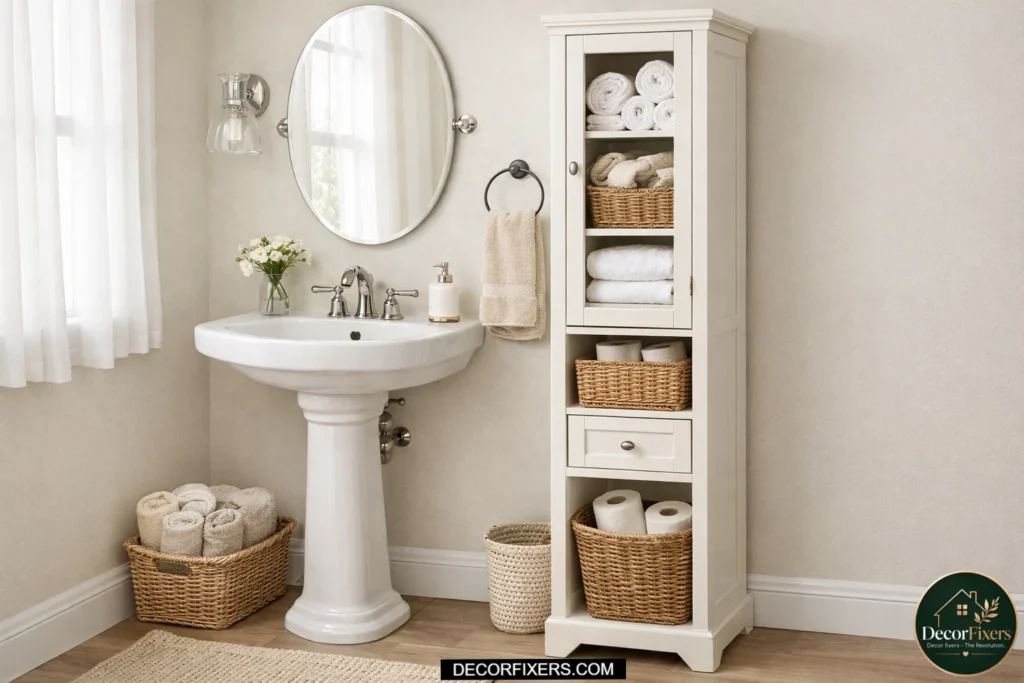
Pedestal sinks get a bad reputation for zero storage, and honestly, that reputation is earned. But pair one with a freestanding linen tower placed 6 inches beside it, and you’ve got a setup that uses vertical wall space instead of horizontal floor space. That’s the whole game in a small bathroom.
Tower cabinets in the 14 × 72-inch range cost between $180 and $420 at most home improvement stores. Pick one with adjustable shelves, your hair dryer, and your spare soap don’t want to be roommates on a fixed shelf.
5. Open Shelf Vanity for an Airy, Minimalist Look
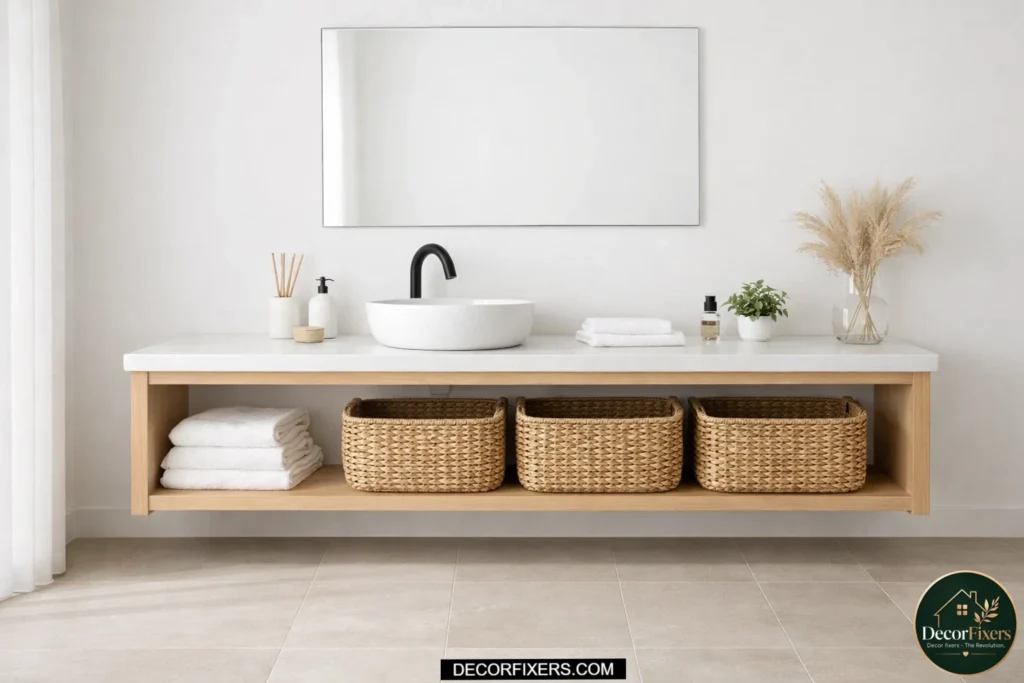
Open shelving under a vanity makes a bathroom look bigger because there’s no visual mass at floor level. It’s a real effect, not just design-blog wishful thinking. The catch? Every product under that sink is on display at all times. Baskets are your best friend here.
Use two matching 10-inch seagrass baskets to corral the under-sink chaos. One for cleaning supplies, one for personal products. The whole setup looks intentional. If you’ve ever tried to organize a traditional under-sink cabinet with a garbage disposal eating half the space, this open approach is a revelation.
6. 18-Inch Mini Vanity for Half Baths and Powder Rooms
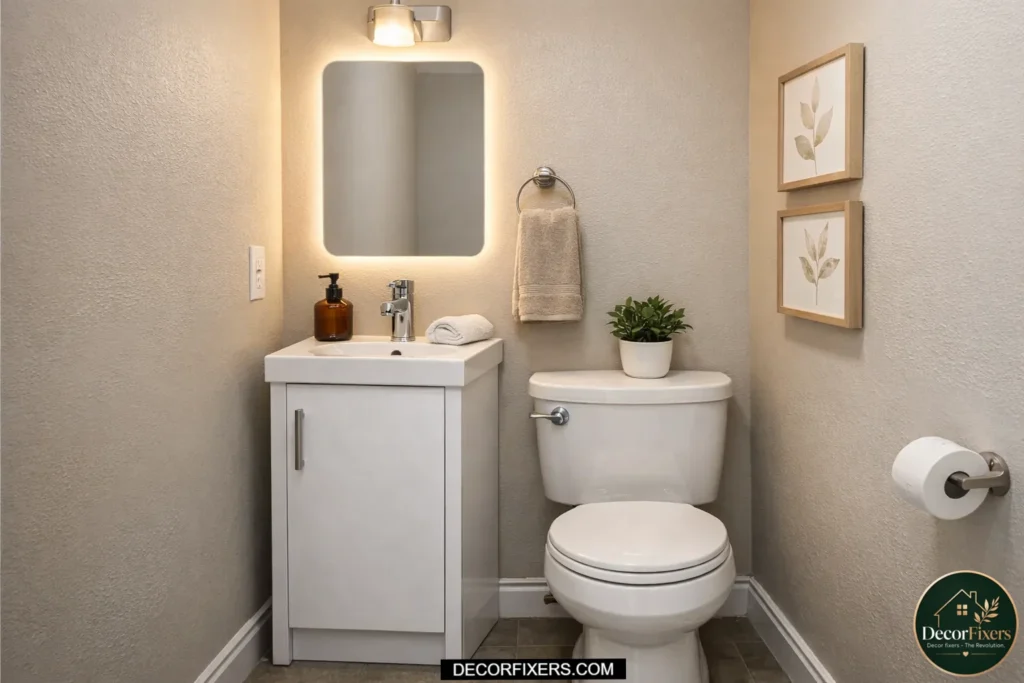
The 18-inch vanity exists specifically for spaces where anything wider would hit the toilet or the door. These aren’t compromises, they’re purpose-built. Foremost Bath makes a solid 18-inch freestanding model for around $210–$280 that includes a ceramic sink and cabinet storage.
What most guides skip: the rough-in depth on mini vanities is often only 16 inches, which means you can push them closer to an adjacent wall without the counter lip creating a hazard. Worth checking spec sheets before you buy.
7. Vessel Sink Vanity to Fake More Counter Space
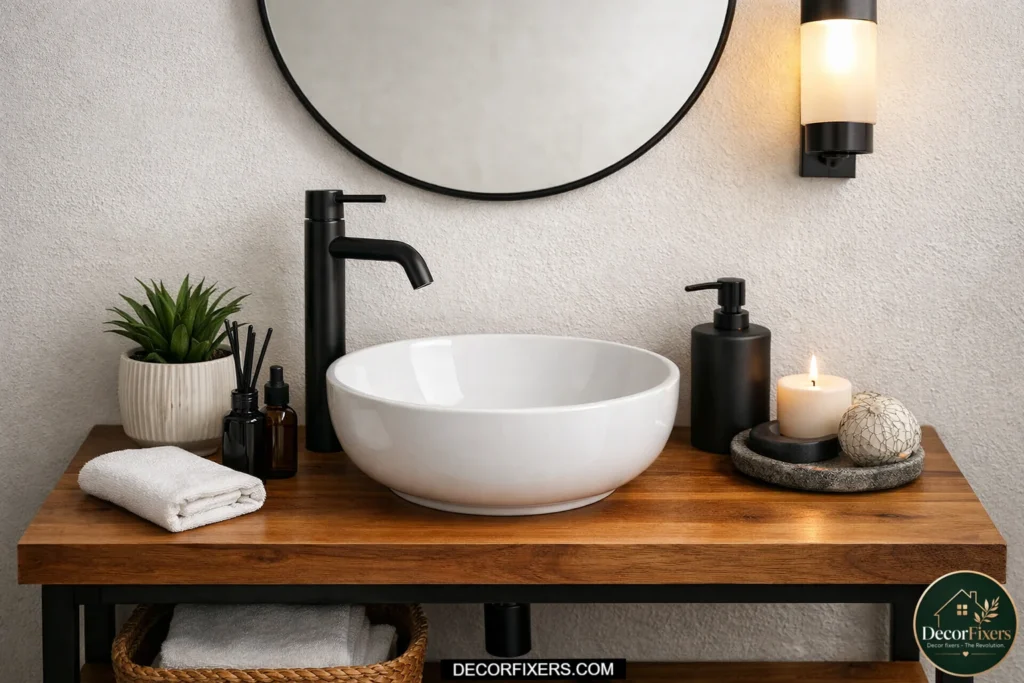
Here’s the thing: a vessel sink sits on top of the counter instead of cutting through it. That means the entire countertop surface stays intact underneath, no cutout eating into your space. In a small bathroom, that extra few inches of usable counter space feel significant at 7 AM.
Vessel sinks do add height. Your faucet needs to be a tall-neck style, at least 9 to 11 inches, to clear the basin rim. Factor that into your mirror and medicine cabinet placement: the standard 65-inch mirror mounting height may need to move up 3–4 inches.
8. Shallow-Depth Vanity at 16 to 18 Inches Deep
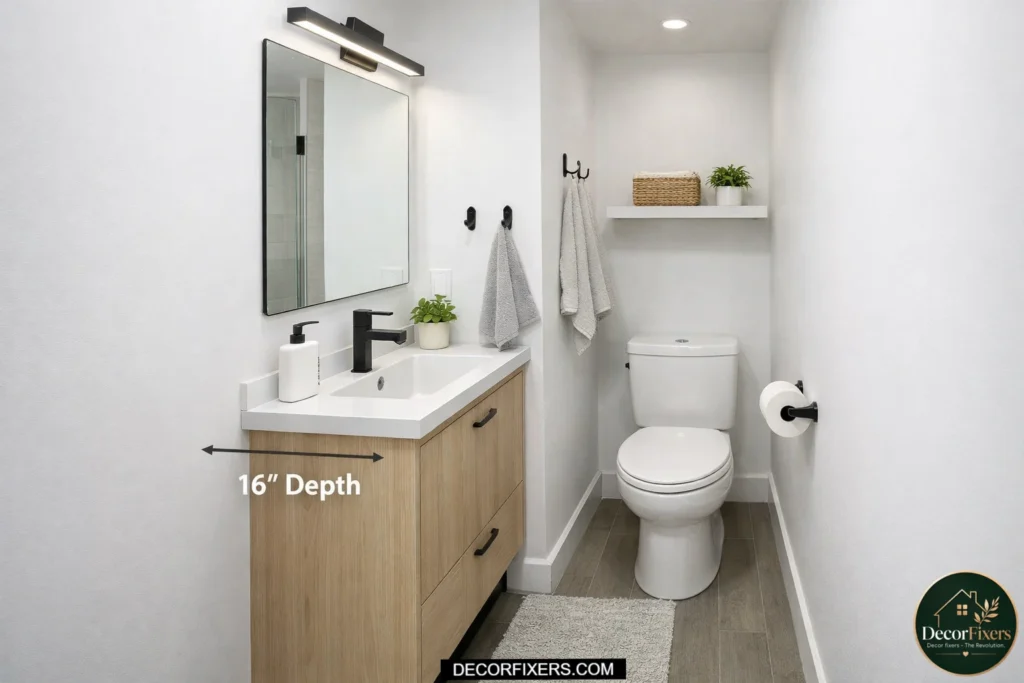
Standard vanities run 20 to 22 inches deep. A shallow-depth version at 16–18 inches save you a real 4–6 inches of floor clearance, which is the difference between a bathroom that feels workable and one that feels like an obstacle course. That space translates directly into easier door swing and better movement past the toilet.
The tradeoff is faucet reach. With a shallower counter, a standard center-set faucet may place the water stream very close to the back of the basin. Test faucet projection specs before purchasing; you want at least 4 inches of spout reach from mounting holes to the water stream.
9. Two-Toned Vanity for Visual Depth
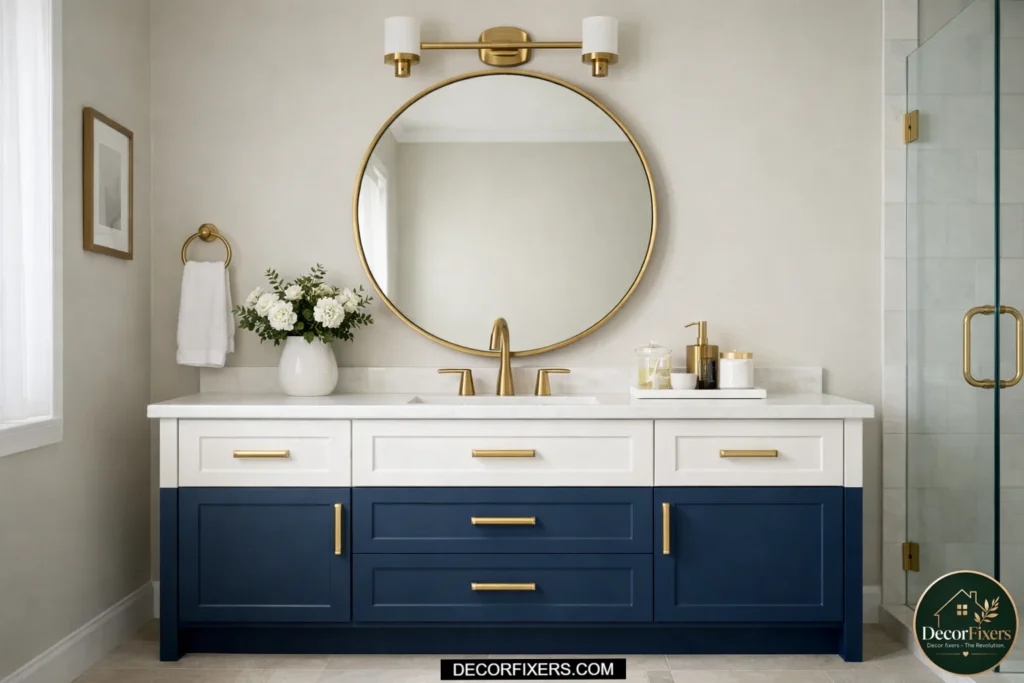
A two-toned vanity, light upper cabinet, darker lower base, creates a visual anchor that makes a small bathroom feel intentionally designed rather than accidentally furnished. The contrast draws the eye downward and outward, which reduces the closed-in feeling of tight walls.
This works especially well with a white or cream basin paired with a navy or forest green cabinet. You don’t need a custom piece for this effect. Some off-the-shelf vanities come in two-tone from the factory, or you can repaint a lower cabinet with a water-resistant satin finish paint for around $40–$60 in materials.
10. Built-In Niche Shelving Above the Vanity
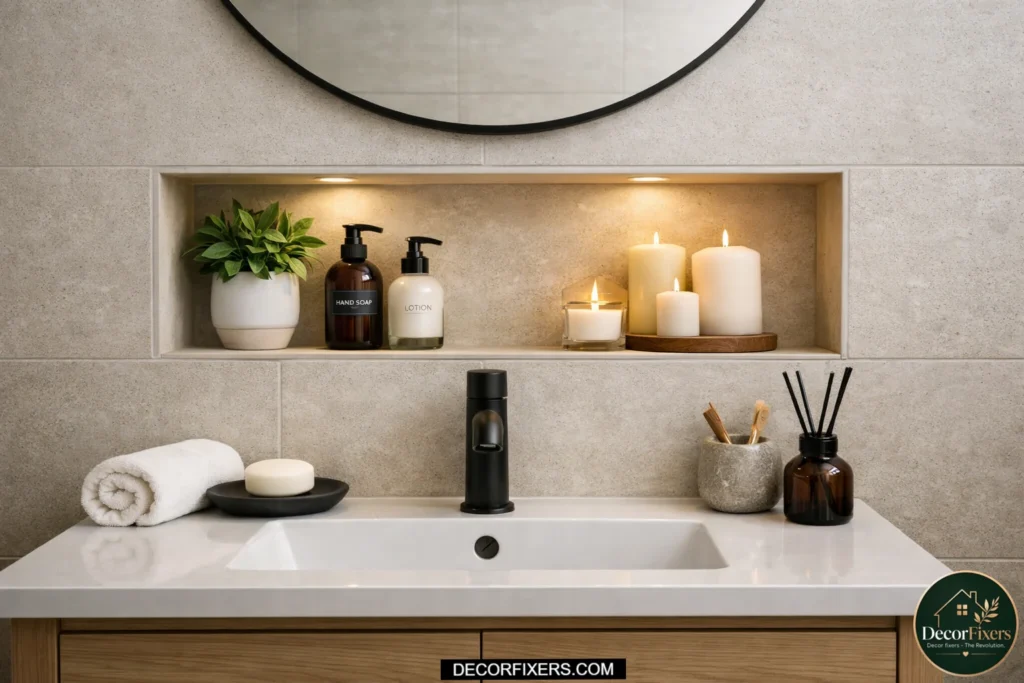
If the wall above your vanity has empty drywall between studs, that’s 3.5 inches of recessed storage you’re walking past every day. A recessed niche, cut in and tiled or trimmed out, holds soap, a candle, and a small plant. It adds visual interest and functional storage without adding a single inch to the room’s footprint.
Recessed niche installation by a contractor runs $150–$400, depending on tile work. DIY-friendly if the wall is exterior-free and no electrical is in that cavity, check with a stud finder and wire detector before you cut.
11. Medicine Cabinet Instead of a Bulky Mirror
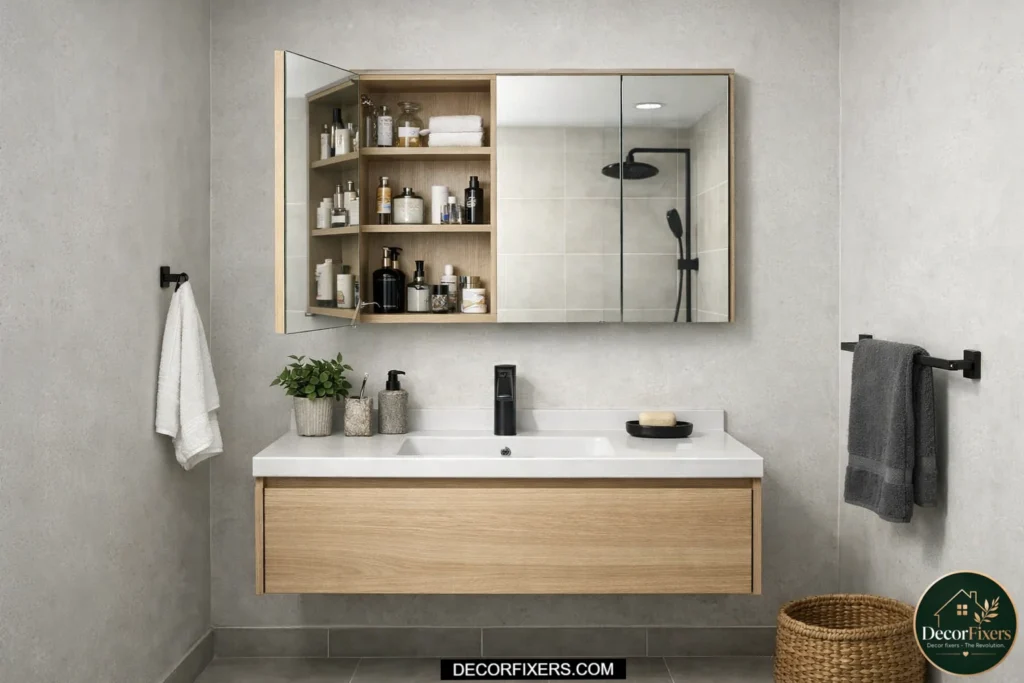
Swapping a flat mirror for a recessed medicine cabinet is one of the highest ROI moves in a small bathroom. You gain 4 to 6 inches of recessed storage without adding any projection into the room. That’s toothbrushes, prescriptions, and contact solution out of the drawer and off the counter.
Recessed models require cutting between wall studs; standard stud spacing of 16 inches OC is typically enough for a 14 × 24-inch cabinet. Surface-mount medicine cabinets avoid the cutting but project 3–4 inches into the room. In a narrow bathroom, recessed is almost always the right call.
12. Floating Double Vanity in 48 Inches for Shared Small Baths
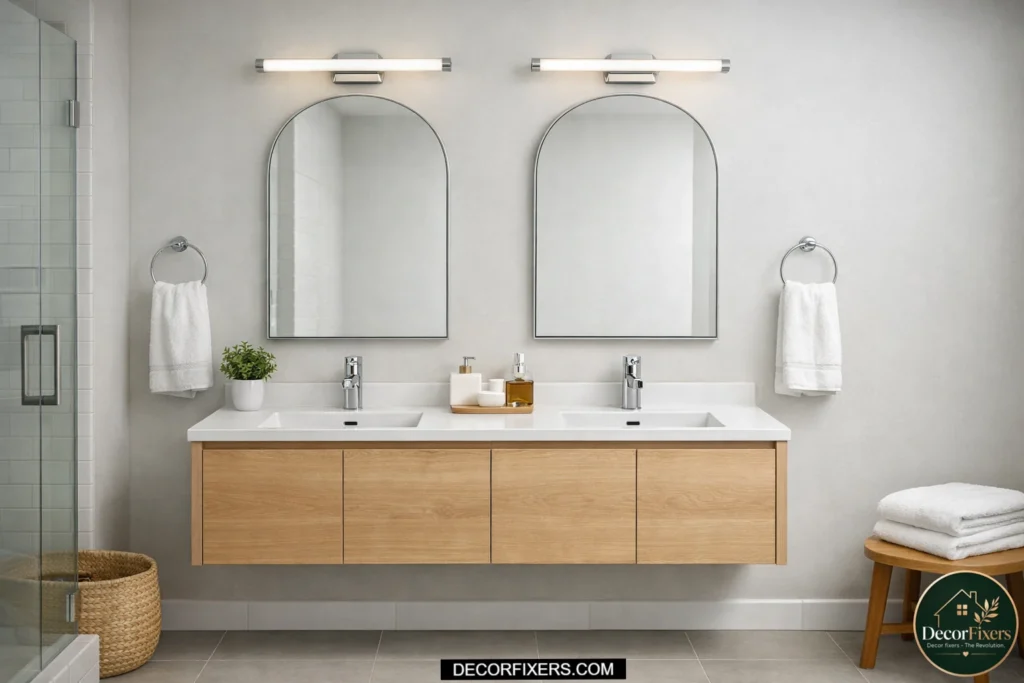
Look, if you’re sharing a bathroom with someone and the space is under 70 square feet, a 48-inch floating double vanity is worth serious consideration. It’s wider than a single, but the wall-mounted design preserves the floor plane, keeping the room from feeling boxed in. Two small basins, two sets of drawers, shared mirror.
The plumbing challenge is real: you need drain lines for two basins and supply lines branched from one source. That adds $300–$600 to installation costs over a single-sink setup. Worth it if you’re both standing at the sink at 7:30 AM fighting for space.
13. Farmhouse Style Vanity with an Apron Sink
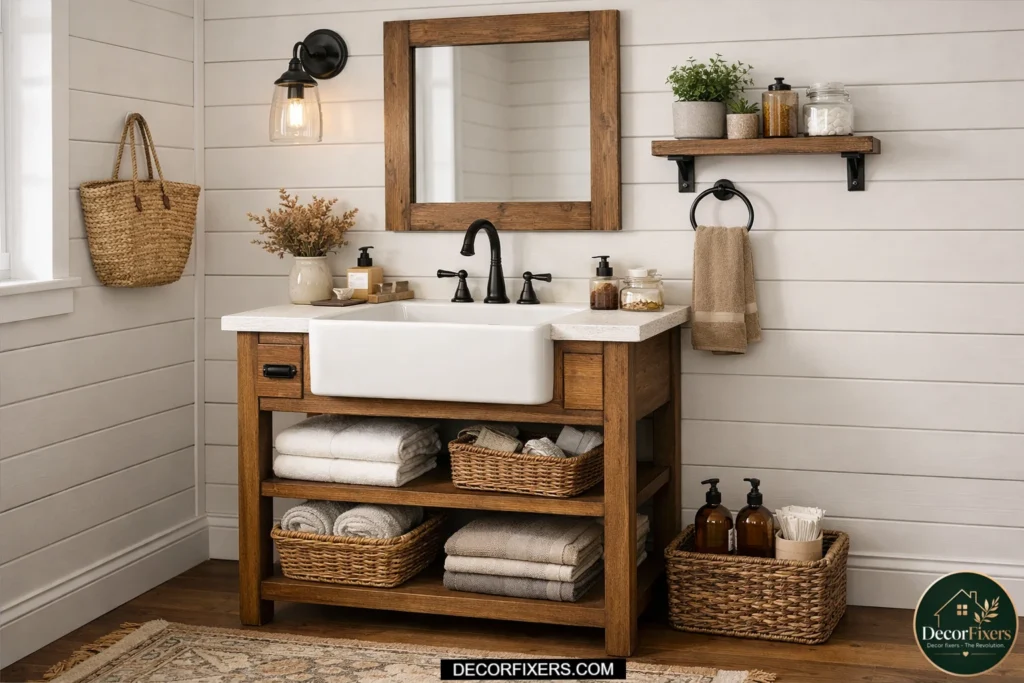
Farmhouse vanities with apron-front sinks work surprisingly well in small bathrooms because the exposed front of the sink adds visual interest that makes the space feel styled, not cramped. The sink face becomes a design element rather than just a functional piece.
Stick to 24-inch apron sinks in small bathrooms; the 30- and 36-inch versions overwhelm the wall. Pair with open shelving below (apron sinks rarely have under-cabinet storage) and a side storage tower for toiletries.
14. Glass or Lucite Vanity for a See-Through Effect
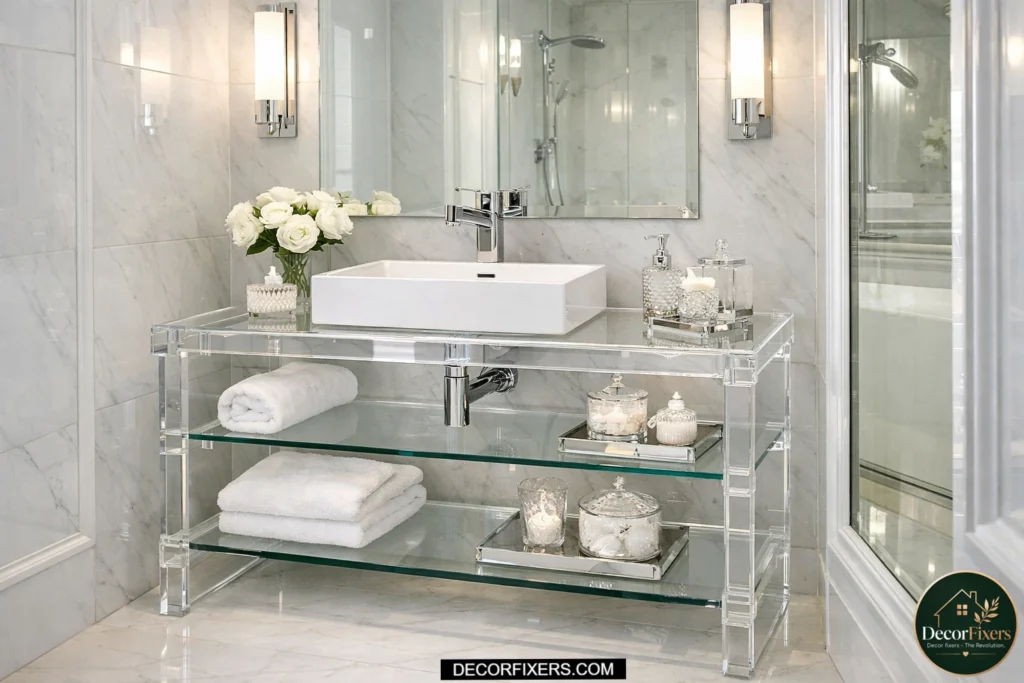
Transparent materials, glass cabinet fronts, acrylic drawer pulls, or full lucite bases, reduce visual weight in small rooms. The eye passes through rather than stopping at the surface, which makes the room read as larger. It’s the same principle as a glass shower door outperforming a curtain.
Or maybe I should say it this way: the vanity doesn’t shrink when it’s transparent, the room just stops feeling divided by it. Full lucite vanity bases are a specialty item, starting around $800–$1,400, but glass-front cabinets are widely available from $320 upward.
15. Vintage Dresser Converted into a Bathroom Vanity
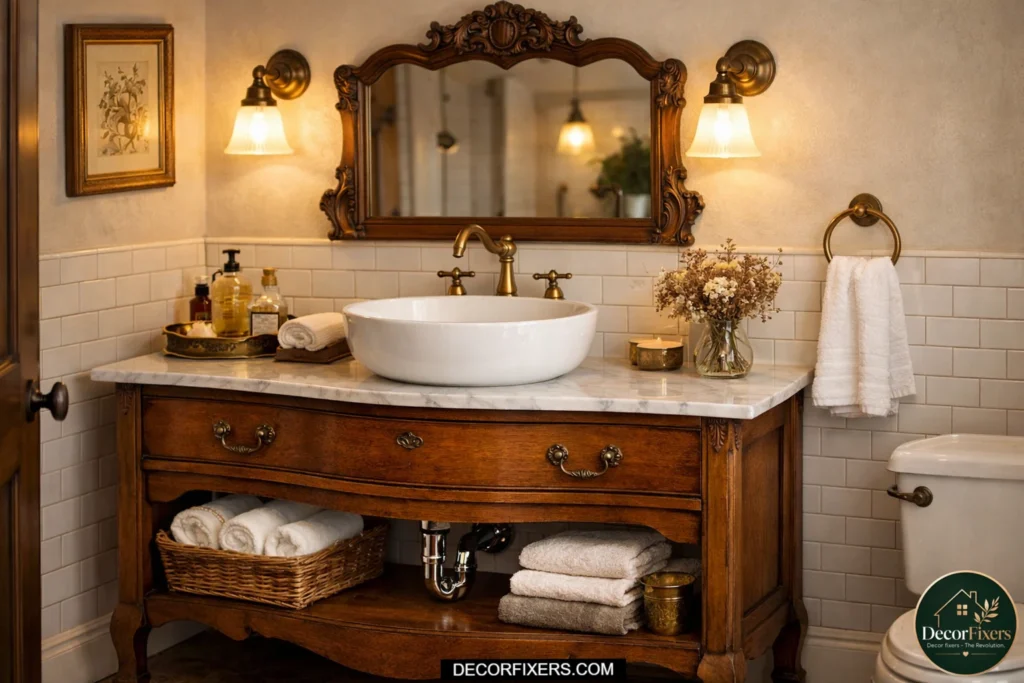
A converted dresser vanity is polarizing. I’ve seen conflicting opinions from designers on this one. Some argue the wood isn’t built for humidity exposure. Others say a proper sealant job makes it entirely viable. My read: seal every surface twice with water-resistant polyurethane, install a vessel sink with no cutout, and run the drain through the back of the dresser. Done right, it looks custom and costs a fraction of a purpose-built vanity.
A thrifted dresser costs $30–$150 at estate sales. Add plumber’s work, a vessel sink, and sealant, and you’re still likely under $400 total, for something that looks like it cost twice that.
16. Mirrored Vanity Front for Light Amplification
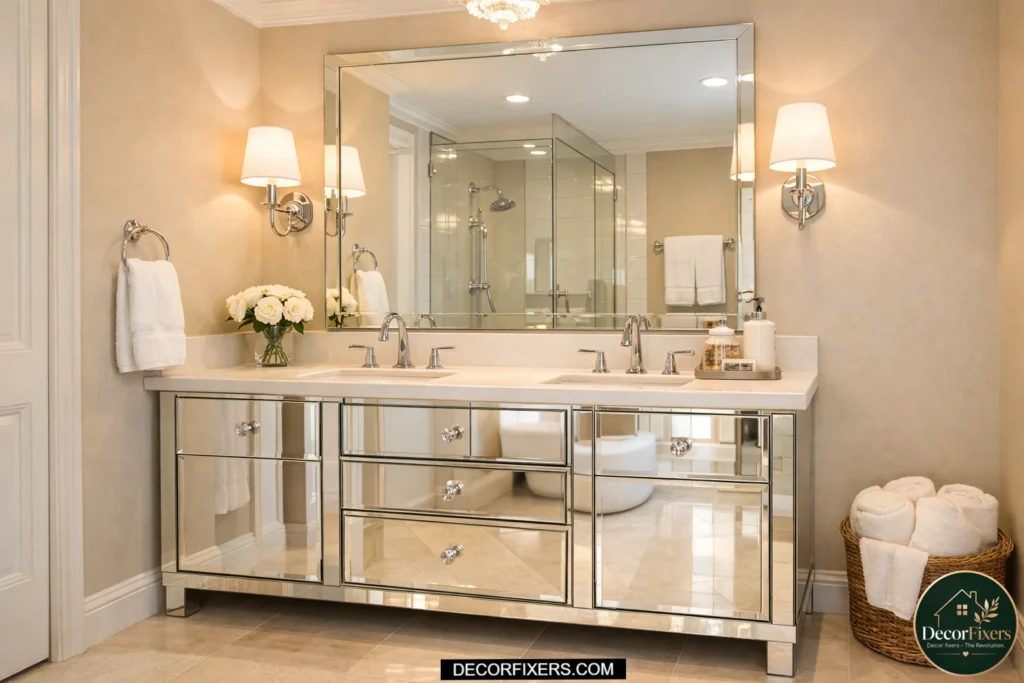
Mirrored cabinet fronts bounce light from your vanity fixture back across the room, making small bathrooms feel better-lit and more open. This works even in bathrooms with one small window; the mirror surface doubles your light source without adding any fixture.
Pair a mirrored vanity front with warm-white bulbs at 2700–3000K rather than cool daylight bulbs. Cool light hitting mirrored surfaces in small rooms creates a clinical feel that works against the space. The warm tone keeps it comfortable.
17. Tall Vanity Cabinet for Vertical Storage
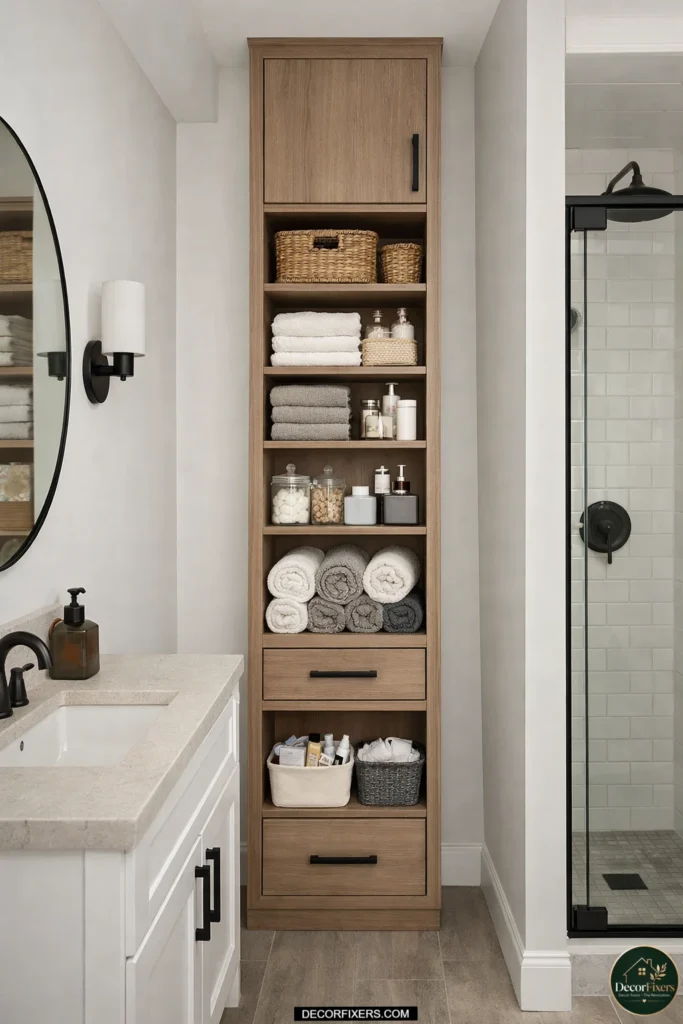
Most small bathroom guides obsess over counter width and ignore height entirely. That’s a mistake. A vanity cabinet that runs 72 inches tall instead of 32 gives you the storage equivalent of adding a full linen closet to the bathroom, without needing the square footage for one.
Tall cabinet vanities work best along the long wall of a narrow bathroom. Keep the base 18 inches wide or less so the tall footprint doesn’t create a visual barrier. Think vertical column, not horizontal bulk.
18. Matte Black Vanity for a Bold, Space-Defining Look
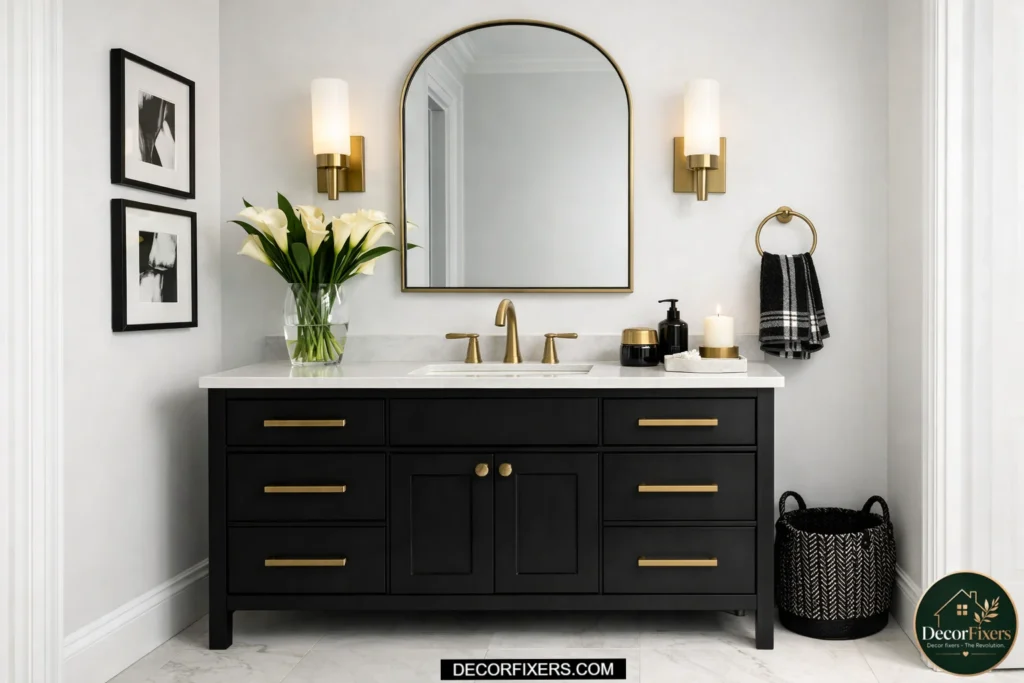
Counterintuitive design move: a matte black vanity in a small white bathroom actually makes the space feel more intentional, not more cramped. The contrast creates definition. The room stops looking like a box and starts looking like a designed space.
This only works if the walls and floor stay light. Dark vanity, light everything else. If you go dark vanity, dark tile, and a small window, you’ve built a cave. Pull handles in brushed brass or matte gold bridge the contrast without fighting it.
19. Space-Saving Vanity with Built-In Electrical Outlets
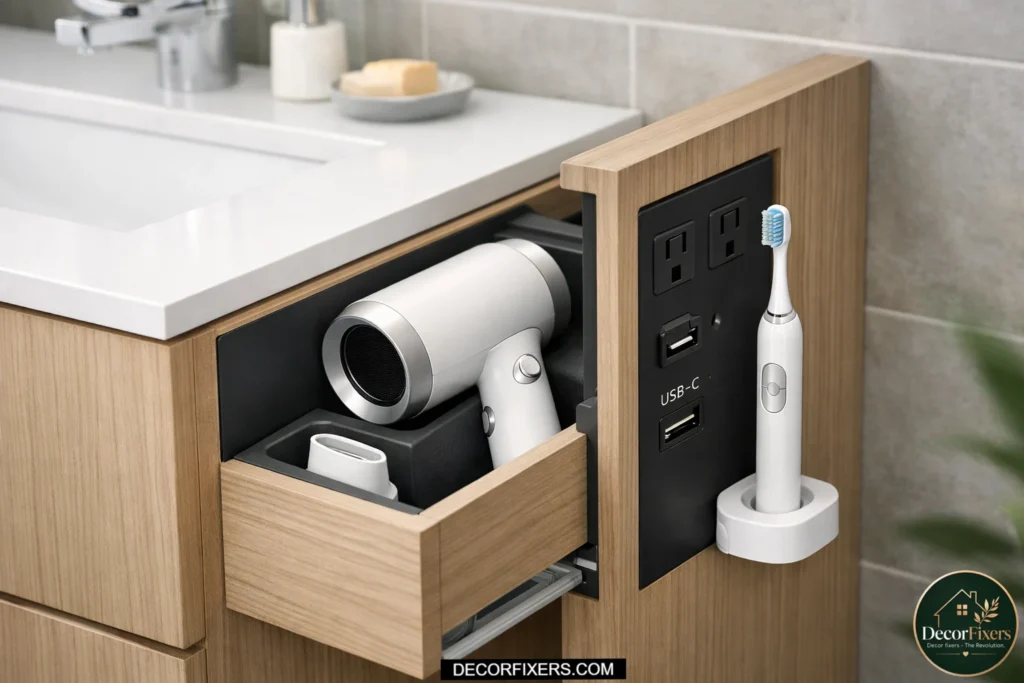
Modern vanities with integrated USB-C outlets and standard plugs built into the drawer face or side panel eliminate the power strip on the counter. In a small bathroom where counter space is precious, this single feature frees up roughly a third of your usable surface.
Brands like Ronbow offer mid-market options with side-panel power integration. Budget range: $550–$950. If you’re renovating anyway and running new circuits, adding a built-in outlet to a standard vanity is a $80–$150 add-on that your electrician can handle in the same visit.
20. Bamboo or Teak Vanity for a Spa-Inspired Feel
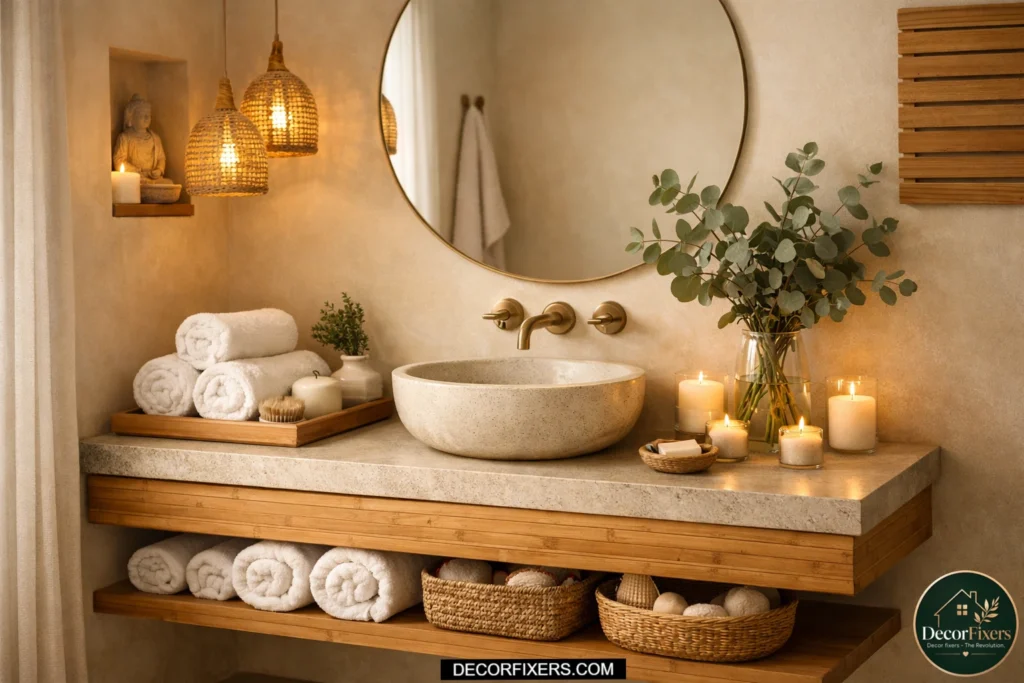
Natural wood tones in a small bathroom create warmth that painted or laminate surfaces can’t replicate. Bamboo and teak are the right wood choices here; both are naturally moisture-resistant and dimensionally stable in humid environments, unlike pine or oak, which swell and crack.
A 24-inch bamboo floating vanity runs $380–$580 from specialty suppliers. Pair with stone or concrete-look countertops rather than white marble, as marble shows humidity staining in poorly ventilated small bathrooms faster than most people expect.
21. Under-Sink Organizer System to Triple Your Storage
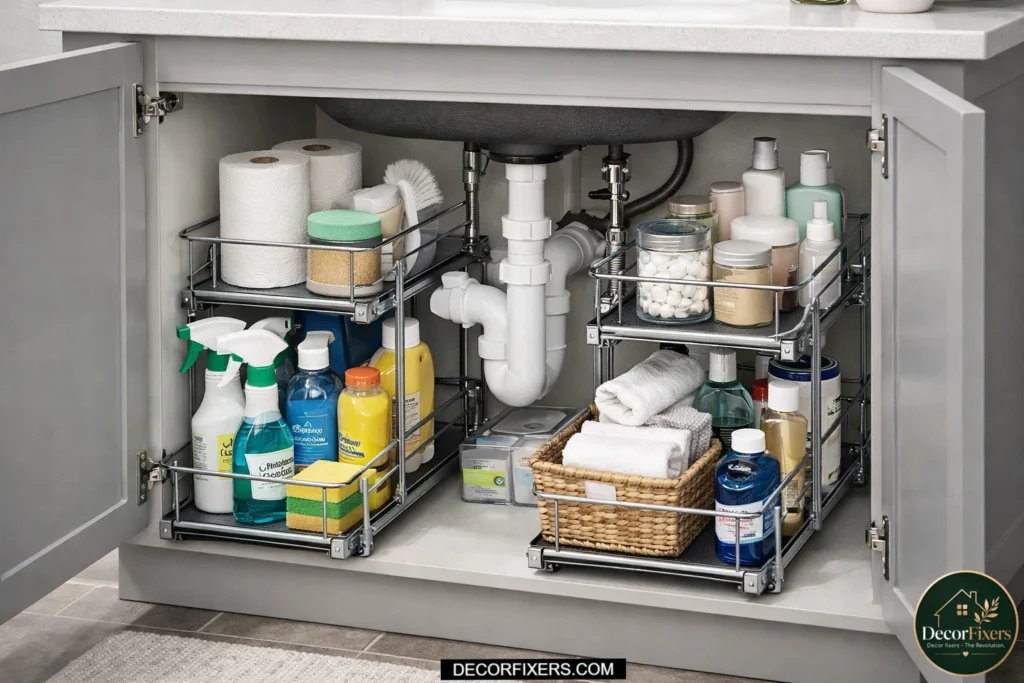
This one isn’t a vanity replacement; it’s a vanity upgrade. A two-tier under-sink organizer with U-shaped shelves (designed to clear the P-trap) turns the dead space under your sink into organized, accessible storage. The plumbing takes up roughly 30% of the under-cabinet space; the right organizer uses the other 70% efficiently.
ShelfGenie specializes in exactly this type of pull-out under-sink storage. Off-the-shelf versions from Amazon or The Container Store run $25–$85 and require zero installation. Custom pull-out systems run $150–$400 installed. For a bathroom you use daily, the custom version pays for itself in time saved looking for things.
22. Sconce Lighting Integrated into the Vanity Frame
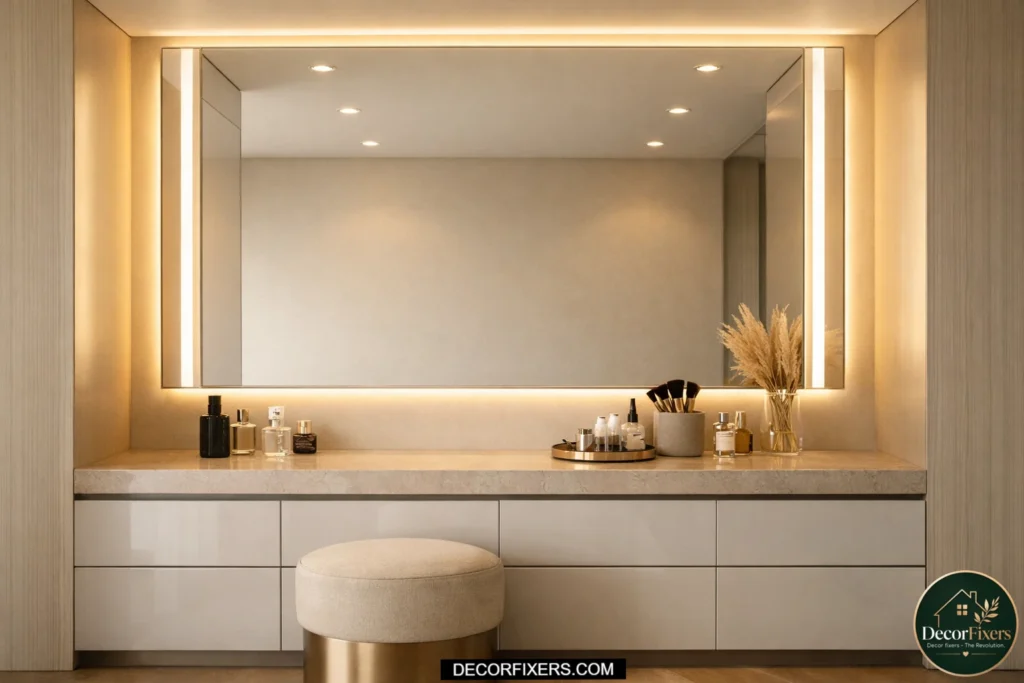
Vanity lighting mounted inside the mirror frame or directly on the vanity side panels does two things: it eliminates the overhead shadow that makes traditional bathroom lighting so unflattering, and it removes the sconce hardware from the wall entirely, freeing up space on either side of the mirror for storage hooks or a small shelf.
Look for vanities with LED strip lighting integrated into the top rail of the cabinet at 2700K. This is a growing category in 2025-bathroom design and available from multiple manufacturers in the $400–$750 range for 24-inch models.
23. Repurposed Nightstand as a Small Bathroom Vanity
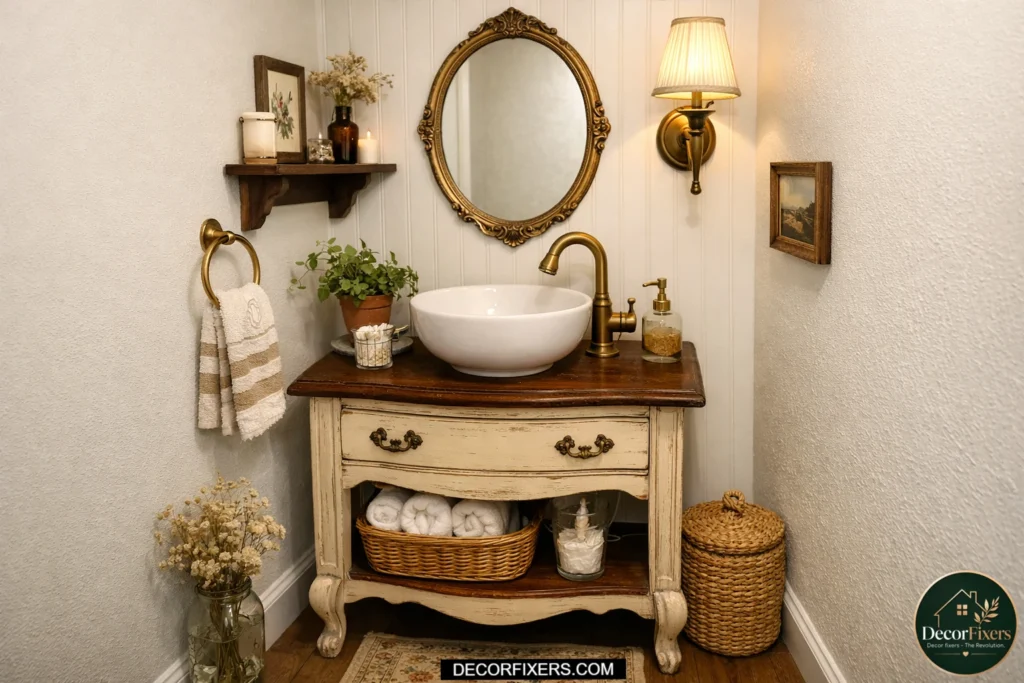
A nightstand conversion is the smallest and most budget-friendly vanity option, and it works specifically in half baths where you need a hand-wash sink and nothing else. The footprint of a standard nightstand (20 × 22 inches typically) fits in spaces where no prefab vanity would go without modification.
You’ll need a vessel sink, a flexible supply line, and a pop-up drain assembly. The plumber’s bill for hooking up a vessel sink to an existing supply is usually $90–$180 for a straightforward connection. Total project cost with a thrifted nightstand: under $300.
24. Navy or Forest Green Vanity for Color-Led Design
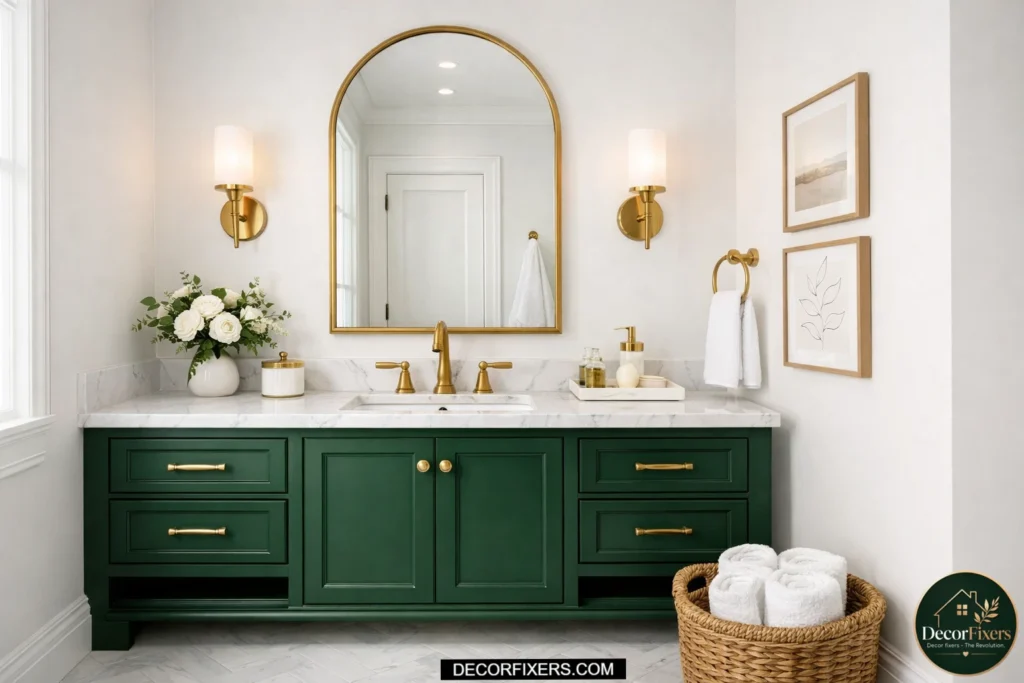
Colorful vanities in small bathrooms were once considered a mistake, the assumption being that small spaces needed light neutrals to survive. That assumption is wrong. A bold navy or forest green vanity in a small bathroom creates a focal point that makes the space feel curated, not crowded.
The rule: one bold element, everything else restrained. Colorful vanity, white walls, simple chrome or brass hardware. Don’t also do bold tile and a patterned floor; that’s three design statements in 40 square feet, and it reads as chaos.
25. Integrated Sink and Countertop in One Molded Piece
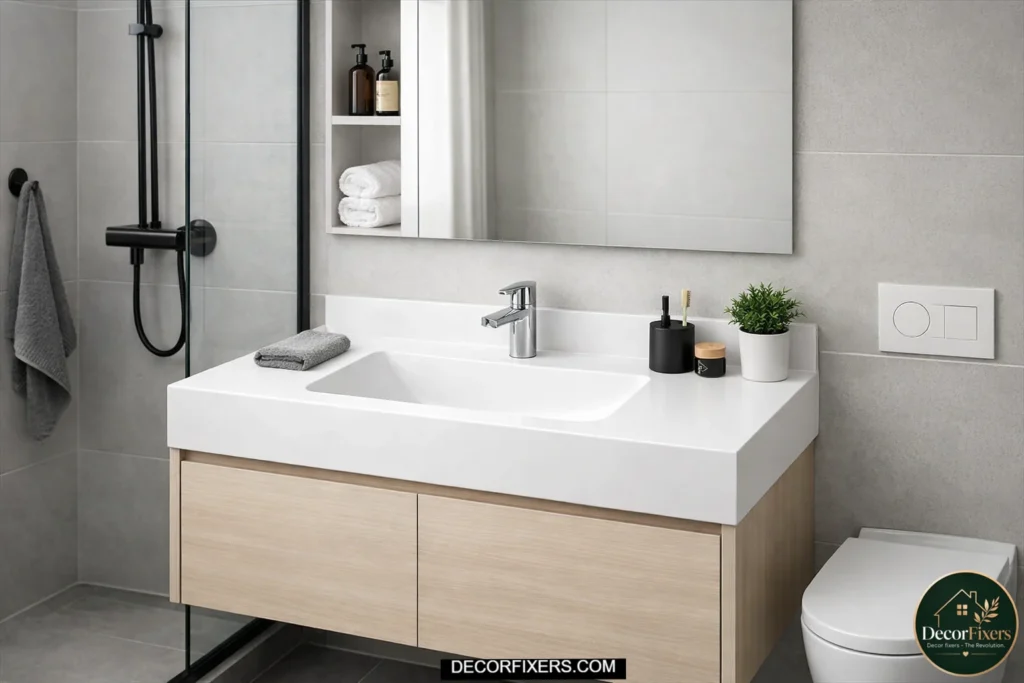
A molded one-piece sink-and-counter, often in solid surface, composite, or cultured marble, eliminates the seam between basin and countertop where mold loves to live in small, poorly ventilated bathrooms. One surface, no grout lines, easy clean.
These are especially smart for small bathrooms because the lack of a sink cutout maximizes usable counter space on a narrow footprint. A 24-inch molded unit runs $280–$480. Less than a separate sink and countertop combo, and far easier to keep clean long-term.
CONCLUSION:
I spent a long weekend planning my own small bathroom overhaul and went through every mistake this guide tries to help you avoid, saving photos without measurements, falling for a vanity that was beautiful in a 200-square-foot showroom and absurd in my 42-square-foot bathroom. The ideas in this list aren’t theoretical. They’re what actually works in tight spaces, backed by real dimensions and honest tradeoffs.
If I had to pick one starting point: a 24-inch floating vanity with two drawers. It fits nearly any small bathroom, opens up the floor, and gives you real storage without the visual mass of a floor-mounted cabinet. From there, the rest of the decisions get easier.
This guide covers standard residential small bathrooms (under 60 sq ft). It does not address ADA-compliant layouts, RV or boat bathrooms, or bathrooms requiring full plumbing relocation; those have additional constraints that deserve their own deep dives.
FAQs:
Q: What’s the best vanity size for a small bathroom?
A 24 to 30-inch single-sink vanity works best for most small bathrooms under 50 square feet. According to the NKBA 2024 report, the 30-inch width is the most-selected size in compact renovations. Always leave at least 30 inches of clear floor space in front.
Q: How do I make a small bathroom vanity look bigger?
Mount it as a floating vanity 6–8 inches off the floor, use a wide mirror that spans the full vanity width, and add vertical sconce lighting on both sides. These three moves combined make a 24-inch vanity read larger than it is.
Q: Should I choose a floating or freestanding vanity for a small bathroom?
Floating vanities visually open the floor and are easier to clean around, better for tight spaces. Freestanding vanities need no wall modification and suit renters. The key difference: floating requires proper wall anchoring with a plywood backer; freestanding does not.
Q: What color vanity makes a small bathroom look bigger?
White and light gray vanities reflect the lightest. Counterintuitively, a bold single-color vanity against white walls (navy, forest green) also works; the contrast creates definition rather than clutter. Avoid matching vanity color to wall color; it flattens the room.
Q: When should I hire a plumber for a small bathroom vanity install?
Hire a plumber whenever you’re changing the location of the drain or supply lines, switching from floor-mounted to wall-mounted plumbing, or adding a second sink. Straight swaps (same size, same position) are often DIY-friendly if you’re comfortable with basic connections.

Creator of DecorFixers, sharing practical home and interior ideas focused on real-life usability, simple design improvements, and budget-friendly solutions.
3 thoughts on “Small Bathroom Vanity Ideas: 25 Space-Saving Styles That Work”