

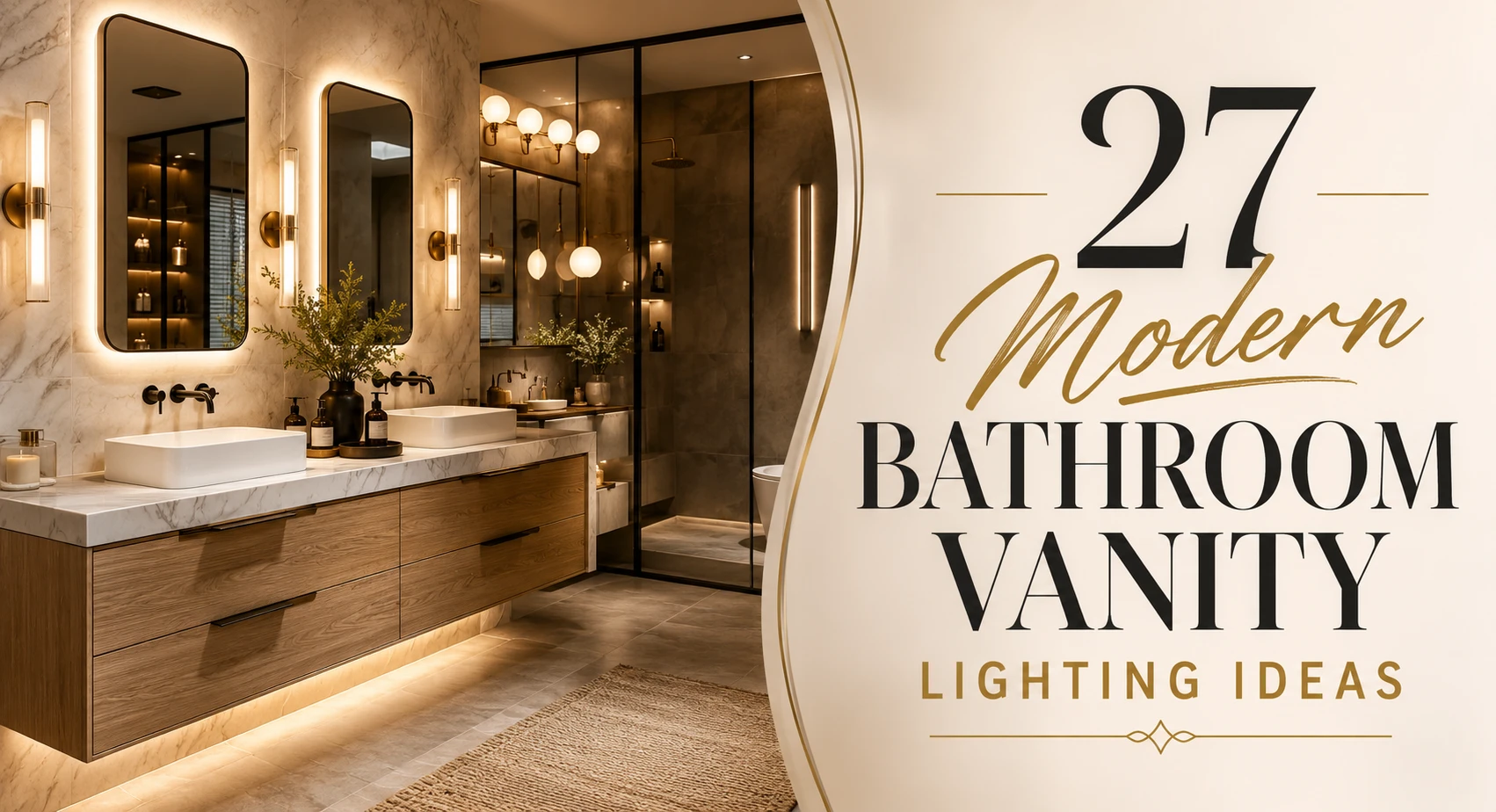
I thought swapping the bulb would fix it. It did not.
My old vanity bar threw shadows straight down my face every single morning — and no wattage upgrade in the world was going to change that. It was a placement problem, a fixture problem, and honestly, a design problem I had been ignoring for two years.
If you’re here, you’ve probably felt the same frustration: the bathroom looks fine until you stand in front of the mirror. Then the lighting tells the truth. Harsh lines, flat skin tones, a fixture that clashes with everything you spent months choosing.
This guide covers standard residential vanity lighting scenarios for primary bathrooms, powder rooms, and guest baths. It does NOT address wet-zone lighting (fixtures inside shower enclosures), commercial restroom lighting, or smart home integration beyond basic dimmer compatibility. Consult a licensed electrician for any new wiring work.
1. Classic Satin Nickel Bath Bar (The Safe Bet That Never Fails)
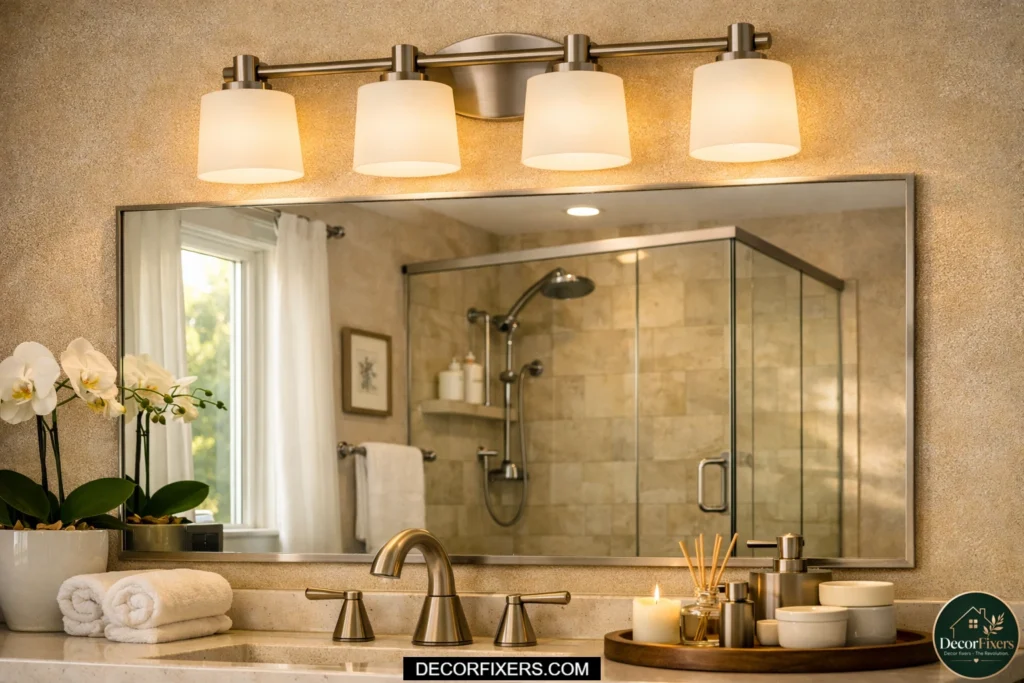
If there’s one fixture that works in almost every bathroom style without fighting anything else, it’s a satin nickel bath bar. The finish bridges warm and cool tones effortlessly — it doesn’t clash with brushed gold, chrome, or matte black the way a polished finish can.
Look for a 3-light or 4-light version spanning 24–36 inches for a single vanity. Brands like Progress Lighting offer dimmable options with frosted glass shades starting around $80–$180 — they look far more expensive than they are. The frosted glass is the key: it diffuses the bulb’s harshness and keeps light soft against your face.
2. Matte Black Vanity Bar for a Moody, High-Contrast Look
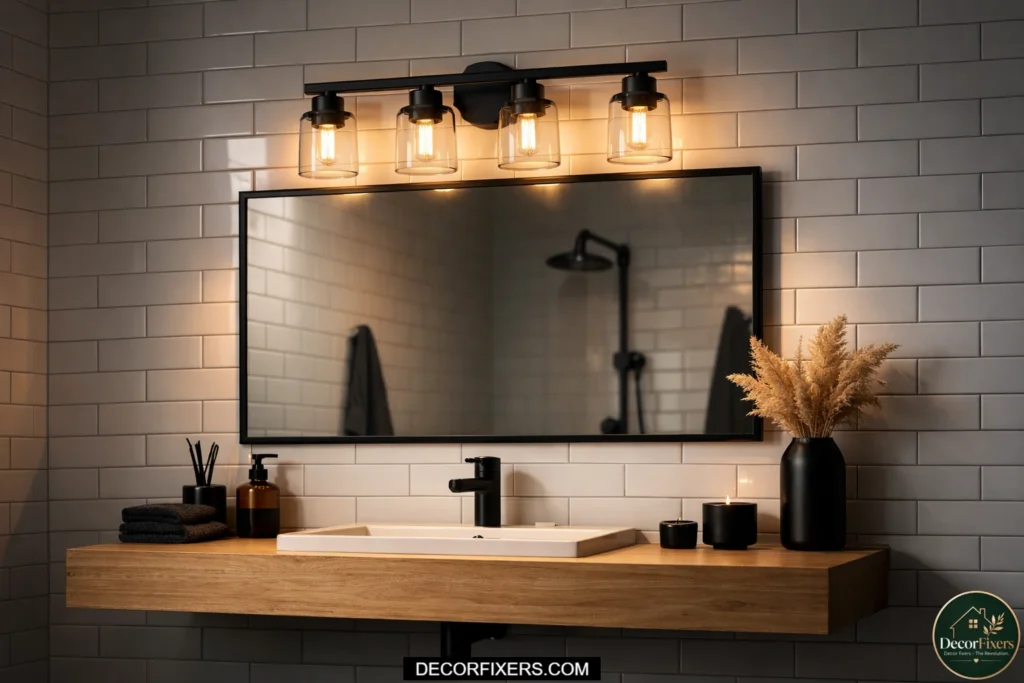
Matte black fixtures became a trend a few years back and genuinely earned their place. What separates a good matte black bar from a cheap one is the depth of the finish and the weight of the metal — thin stamped steel looks hollow; cast metal looks architectural.
Pair a matte black bar with warm-white LED bulbs (around 2700K) to soften the contrast between the dark frame and the light it throws. A 4-light matte black bar from Kichler or a similar quality brand typically runs $120–$350. The visual payoff against white tile or a light wood vanity is genuinely dramatic — in the best way.
3. Globe Vanity Lights for a Warm, Hollywood-Inspired Glow
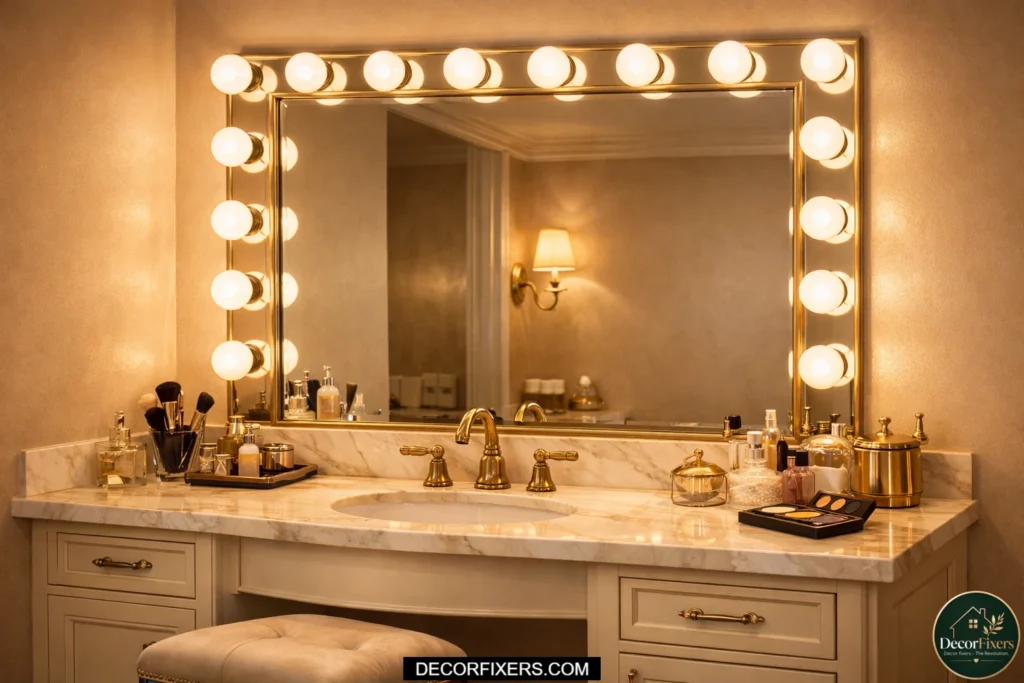
Globe vanity lights — those exposed-bulb strips that ring the top and sides of a mirror — deliver the warmest, most flattering illumination of any fixture type. The light comes from multiple points around the face rather than a single source, which is why makeup artists still swear by the setup.
The trick is bulb temperature. Go with 3000K Edison-style LEDs rather than warm incandescents — you get the vintage look without the heat or the electricity bill. A quality globe strip with 10–12 bulbs runs $150–$400. It’s a statement piece that doubles as task lighting, which is genuinely rare.
4. Side Sconces — The Gold Standard for Makeup-Accurate Light
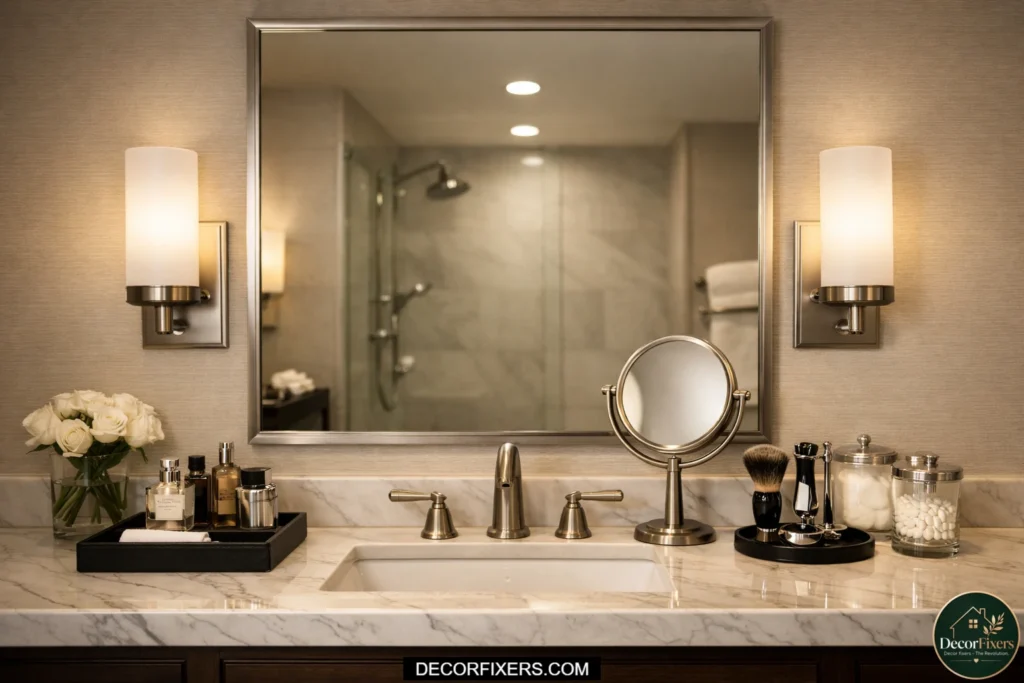
\I’ve seen conflicting data on this — some guides say overhead bars are fine with the right diffuser, others say side sconces are non-negotiable. My read is that for anyone applying makeup daily, side sconces win every time. The physics are simple: light from two sides eliminates the single-source shadow that overhead fixtures always create to some degree.
Mount them 28–36 inches apart and 60–65 inches from the floor. Frosted or opal glass shades soften the output even further. Progress Lighting and Kichler both make sconce pairs in the $120–$320 range that look far more boutique-hotel than big-box store. This is the upgrade that genuinely changes how your mornings feel.
5. Brushed Gold Vanity Bar for a Warm, Luxurious Statement
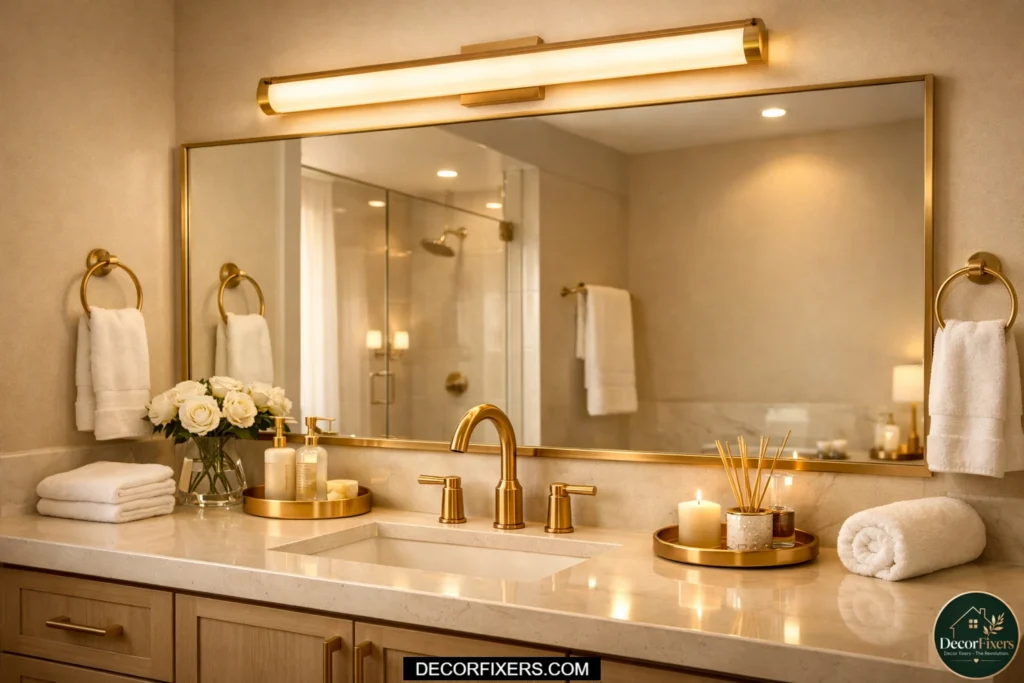
Brushed gold — sometimes labeled aged brass or champagne bronze — hit a sweet spot between trendy and timeless. It’s warmer than satin nickel, more subtle than polished gold, and works beautifully against both white and dark vanity finishes.
The key is “brushed” — the matte texture diffuses reflection and reads as intentional rather than flashy. Look for fixtures in the $150–$450 range from Kichler’s Everly collection or similar lines. Pair with a brushed gold faucet to create that put-together, curated look without buying a whole new bathroom.
6. LED Backlit Mirror — The Space-Saving Modern Upgrade
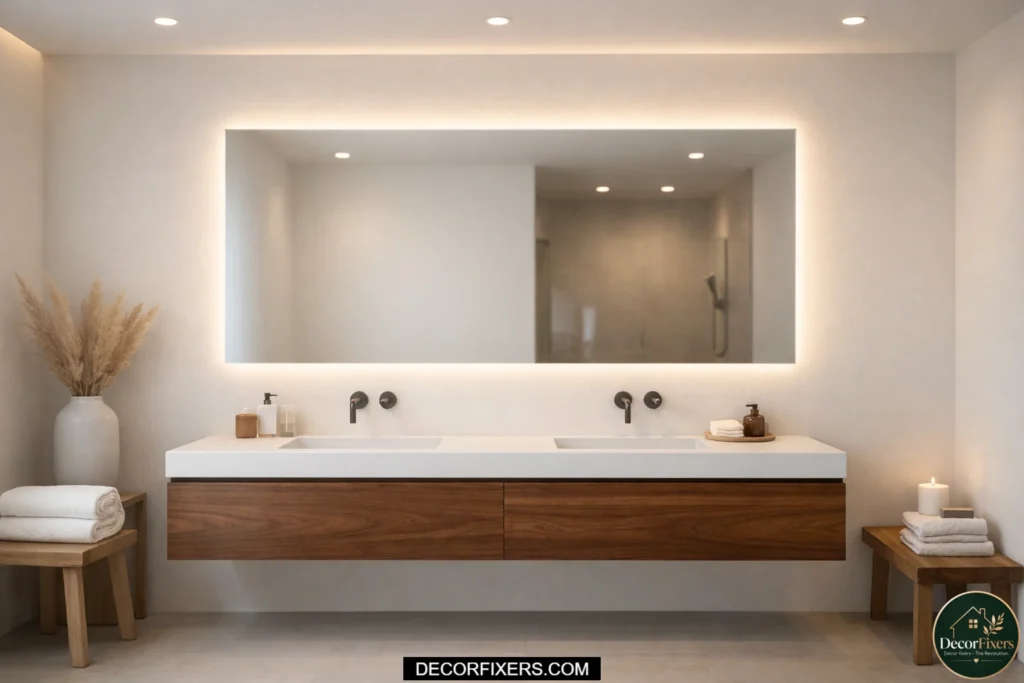
A backlit LED mirror does two things at once: it functions as your light source and your mirror without requiring any additional wall space or wiring above the mirror. The light emanates from behind the mirror’s edge, wrapping the face in a soft, even glow that’s genuinely flattering.
The quality range is wide here. Budget models under $200 often have inconsistent color temperature and dim outputs below 3000 lumens. Mid-range options in the $350–$900 range — like those from Kichler or specialty bathroom brands — include dimmable LED arrays with CRI ratings above 90. For small bathrooms or powder rooms, this is the cleanest possible solution.
7. Vertical Sconce Pairs for a Boutique Hotel Feel
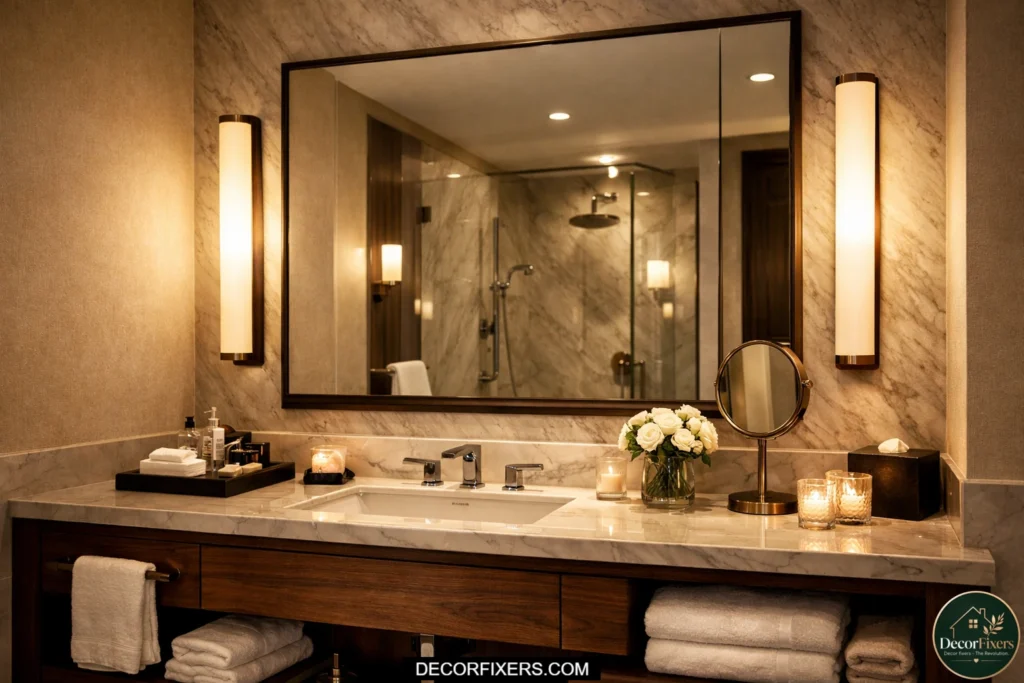
Vertical sconces — taller fixtures with the light source running top to bottom — wrap the mirror on both sides and deliver light along the full height of the face. It’s the setup you see in well-designed hotel rooms, and for good reason: it eliminates both high shadow and low shadow simultaneously.
They work best in bathrooms with mirrors that are 36 inches or taller. The fixtures themselves typically run $180–$500 per pair. Choose a style with a frosted shade or diffuser — bare-bulb vertical sconces can create glare at eye level if you’re shorter or taller than the average mounting height.
8. Warm White LED Vanity Strip for Makeup Artists’ Accuracy
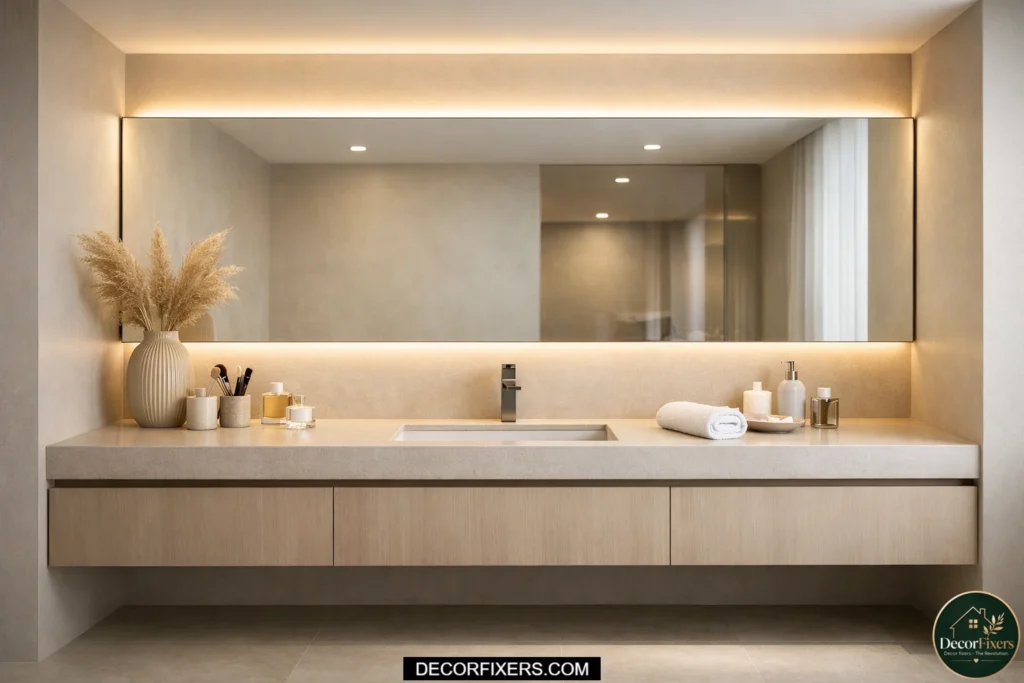
Look — if you’re applying foundation, concealer, or any color-matched product, your light’s CRI matters more than almost any other spec. A warm white LED strip with a CRI of 90 or higher at around 3000K–3500K shows skin tones as they actually are, which means what you see in the mirror matches how you look outside.
Integrated LED vanity strips — the kind that mount flush to the wall and project outward — start around $90 and reach up to $400 for longer, dimmable versions. Brands like Lumens.com curate a strong selection. The strip design reads as ultra-modern and sleek against tile, which is a bonus.
9. Industrial-Style Edison Bulb Vanity Bar
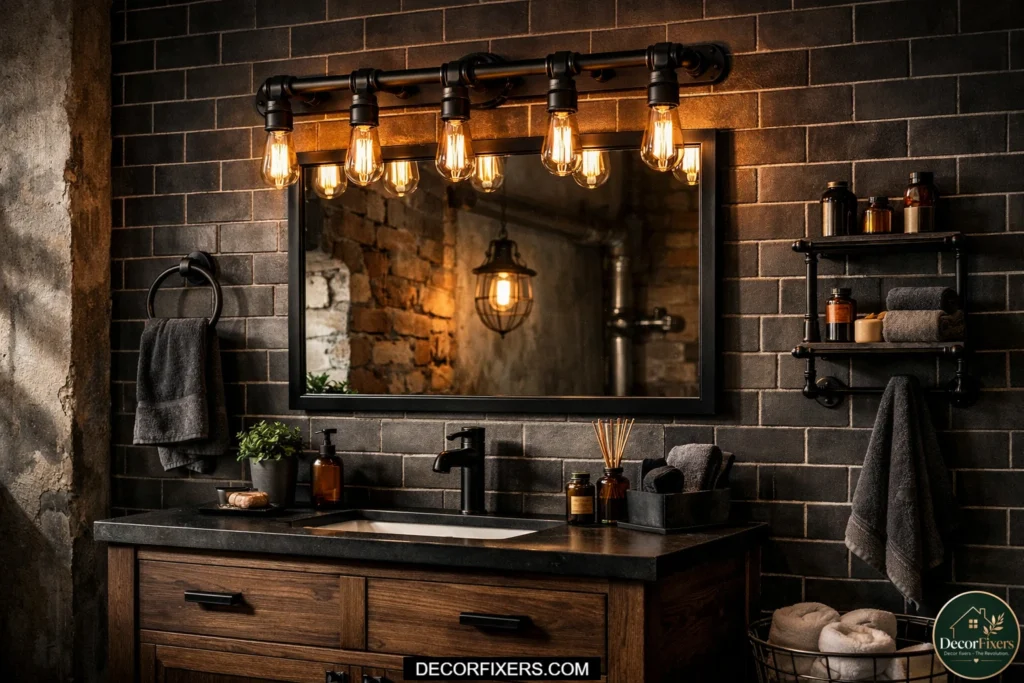
The industrial look — exposed bulbs, black pipe hardware, raw metal — has proven more lasting than people expected. Done well, it adds character without pretension. Done poorly, it looks like a loft apartment bathroom from 2013.
The difference is restraint. Stick to 2–4 bulbs maximum, use warm filament LEDs (not incandescent — the heat adds up in small bathrooms), and pair with darker grout or a wood vanity to complete the material story. A quality fixture in this style runs $100–$300. Pair with a matte black faucet, and it looks completely intentional.
Why Your Current Vanity Light Is Probably in the Wrong Place
Here’s the thing: most bathrooms are wired for a single overhead fixture centered above the mirror. That’s the builder’s default — not a designer’s choice. Light coming from directly above hits the top of your head, your nose, and your chin, leaving your eyes and cheeks in soft shadow.
Side-mounted sconces at 60–70 inches from the floor eliminate that shadow completely. The light wraps around your face the way a ring light does — evenly, flatly, without drama.
If side wiring isn’t possible, the second-best option is a wide horizontal bath bar spanning at least 80% of the mirror’s width. Narrow bars centered above a mirror are the worst offenders. Wide bars distribute light across a broader angle and reduce the shadow canyon effect significantly.
10. Chrome Vanity Bar for a Timeless, Clean Aesthetic
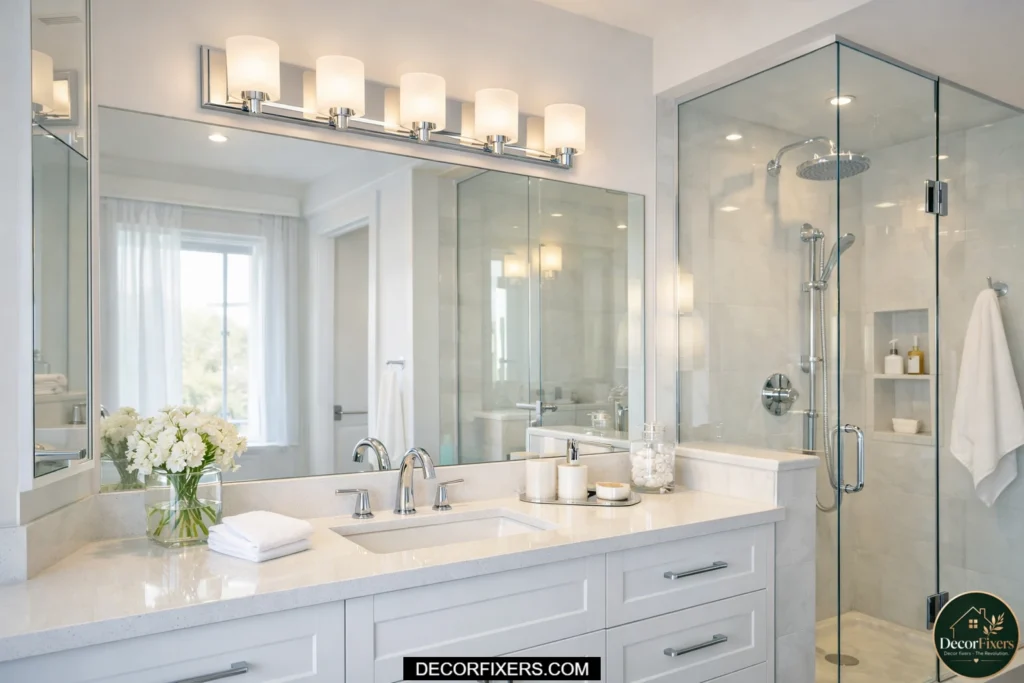
Chrome is the finish that never actually goes out of style — it just cycles between “everyone has it” and “it’s back.” The polished surface reflects light cleanly, which slightly amplifies the output of your bulbs without changing the fixture’s wattage.
Or maybe I should say it this way: chrome fixtures tend to look brighter than equivalent fixtures in matte finishes, which is a legitimate advantage in a smaller or darker bathroom.
Quality chrome bath bars range from $70–$250. Choose frosted glass shades over clear glass if the bathroom has warm-toned paint — it prevents the bulbs from reading too cold against the walls.
11. Minimalist Flat-Panel LED Vanity Light
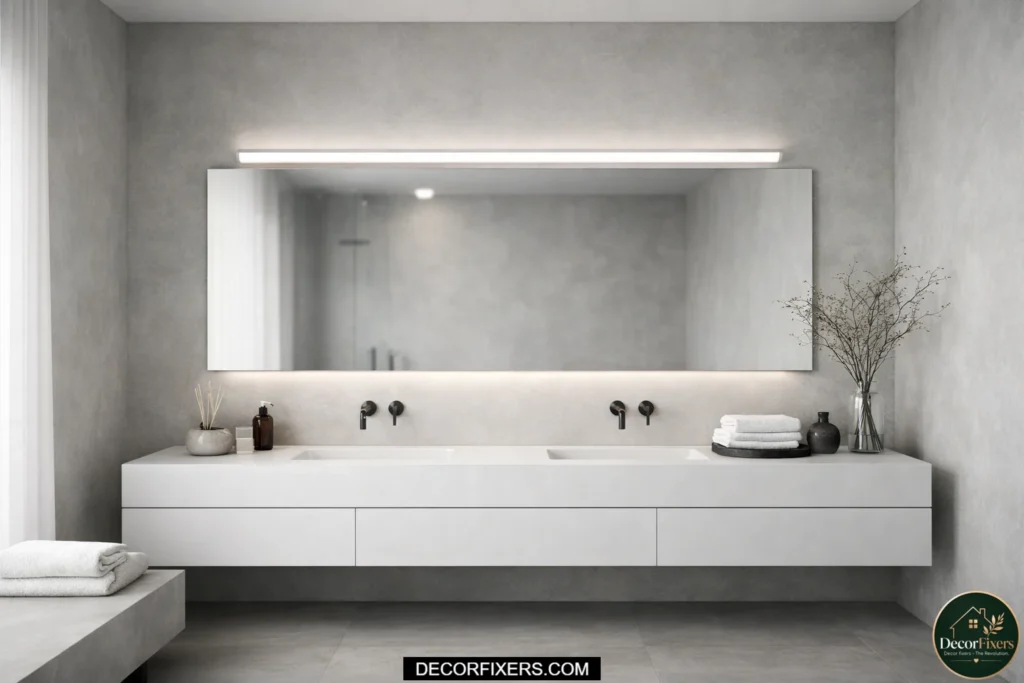
Flat-panel LED vanity lights — integrated fixtures with no visible bulb — are the choice for anyone who wants their bathroom to feel like a spa and not a showroom. The light diffuses evenly across the entire panel face, producing a broad, soft source that mimics natural window light better than point-source fixtures.
The downside is repairability: unlike modular fixtures, integrated LEDs can’t have their bulbs swapped. That said, quality panels carry lifespans of 30,000–50,000 hours, so it’s rarely an issue within the first decade of use. Look for dimmable models in the $150–$500 range with clearly labeled color temperature options.
Quick Comparison:
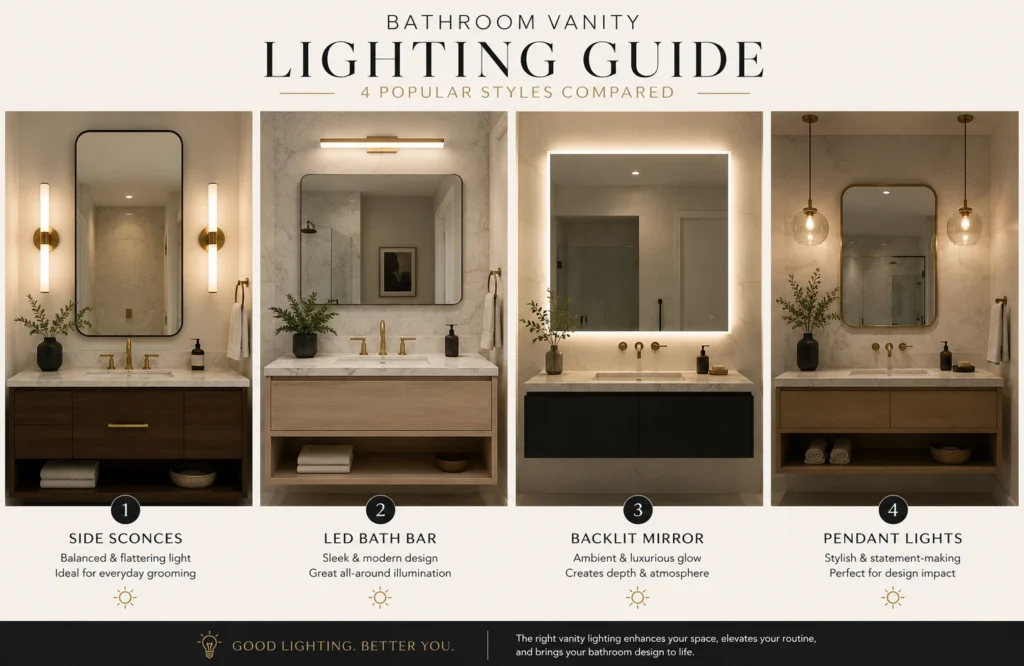
| Option | Best For | Key Benefit | Limitation |
| Side Sconces | Makeup accuracy | Shadow-free face light | Needs 2 wall boxes |
| LED Bath Bar | Double vanities | Uniform coverage | Can cast downward shadows |
| Backlit Mirror | Small bathrooms | Space-saving, minimal | Less punch than sconces |
| Pendant Lights | Statement design | Dramatic visual impact | Not ideal as sole source |
12. Two-Fixture Setup for Large or Double Vanities
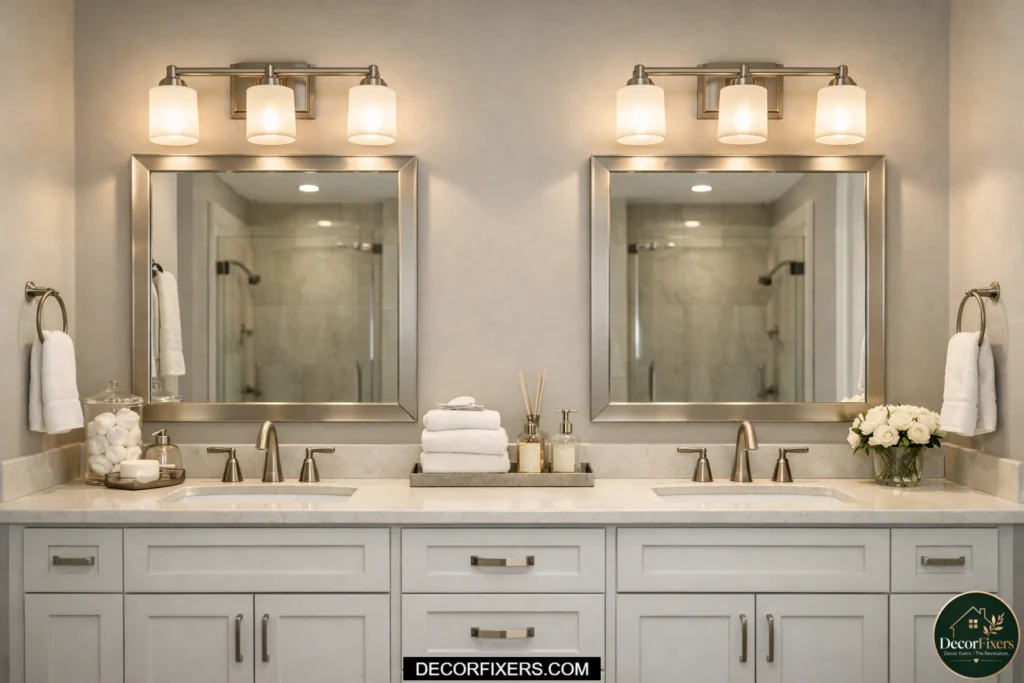
A double vanity with one long bar above both sinks is a common mistake. The center of the bar sits above neither person’s reflection, so both users get off-center light. Better move: two matching fixtures, one above each sink.
This keeps the light balanced for both users and gives the design a more deliberate, symmetrical look. Two quality 3-light bars in matching finishes — say brushed nickel from the same product line — typically run $160–$500 total. It’s the same price as one premium single bar, with measurably better lighting coverage.
13. Pendant Lights as Vanity Statement Pieces
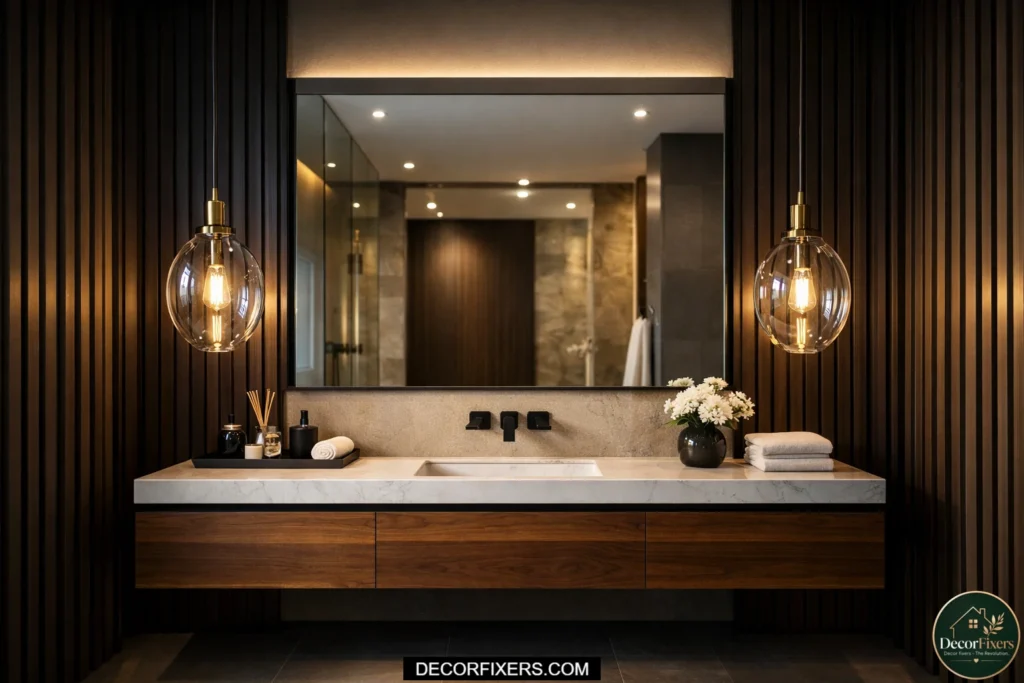
Pendant lights at the vanity are a genuine design risk — and when they work, they’re extraordinary. The key is treating them as a supplement to ambient lighting rather than the primary task source. A pendant hanging at 60 inches on each side of the mirror adds warmth, visual height, and a distinct design personality that no bar fixture can replicate.
Use pendants with clear or seeded glass shades and warm filament LEDs for best results. Matching pairs run $180–$600, depending on glass quality and hardware. Do not use opaque shades — they direct too little light toward the face for grooming use.
14. Medicine Cabinet with Integrated Vanity Lighting
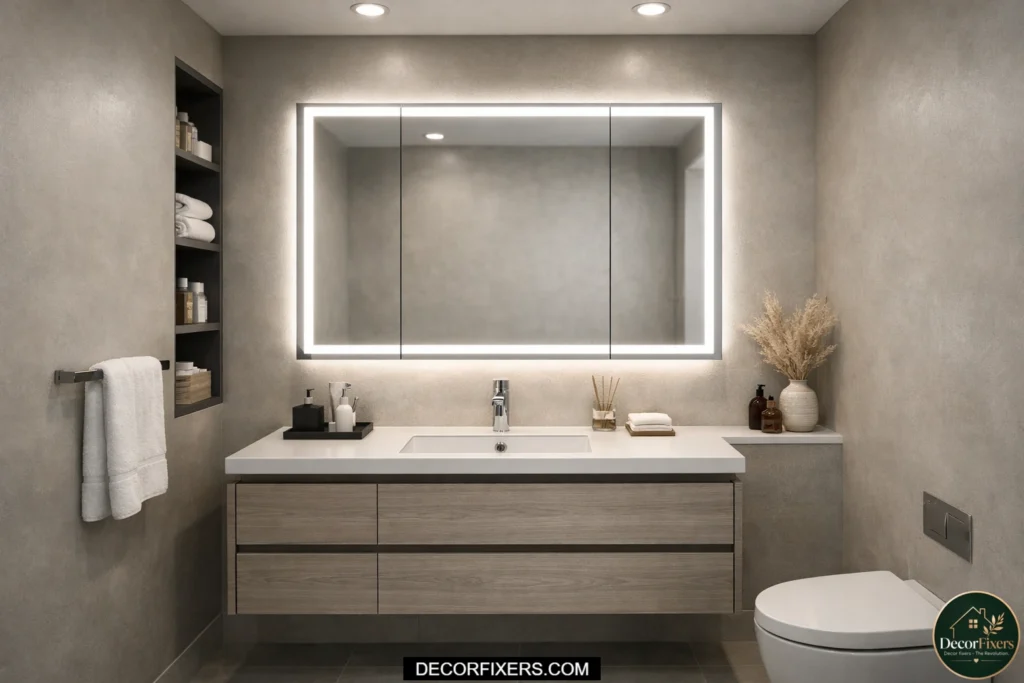
For anyone renovating a smaller bathroom, a lit medicine cabinet is one of the smartest investments available. You get storage, a mirror, and task lighting in a single footprint — without needing to run additional wiring for separate fixtures.
Models with integrated LED strips around the mirror frame start around $250 and climb to $1,200 for deeper cabinets with dimmable, color-tunable lighting. The key spec to check: make sure the integrated lighting is rated at CRI 90+. Cheaper models often ship with generic LED strips that render skin tones poorly.
What Is Modern Bathroom Vanity Lighting?
Modern bathroom vanity lighting refers to fixtures — bars, sconces, backlit mirrors, or pendant lights — installed specifically to illuminate the face and mirror area. The goal is shadow-free, color-accurate light for grooming tasks. It differs from ambient lighting by targeting the vanity zone directly.
Quick note: mounting height matters more than fixture style. Get the height right first, then pick the fixture you love.
15. Under-Cabinet LED Strip Lighting for Layered Warmth
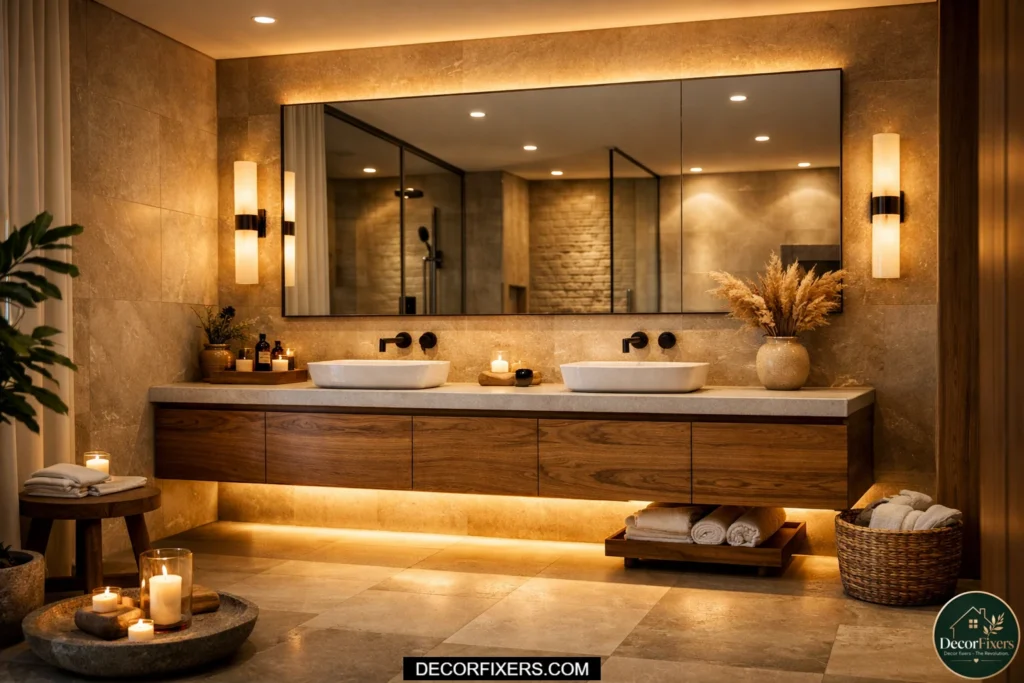
Under-cabinet LED strips are not primary vanity lighting — they’re the layer that makes the room feel finished. A soft glow beneath a floating vanity changes the entire perceived weight of the piece, making it look lighter and more architectural.
Stick to 2700K–3000K warm white strips for under-cabinet use — cool or daylight strips look clinical underneath warm wood or painted cabinetry. A quality LED strip kit with adhesive backing and a dimmer runs $30–$120 and installs in under an hour. It’s the highest-impact low-effort addition on this entire list.
16. Frosted Glass Vanity Sconces for Soft, Diffused Lighting
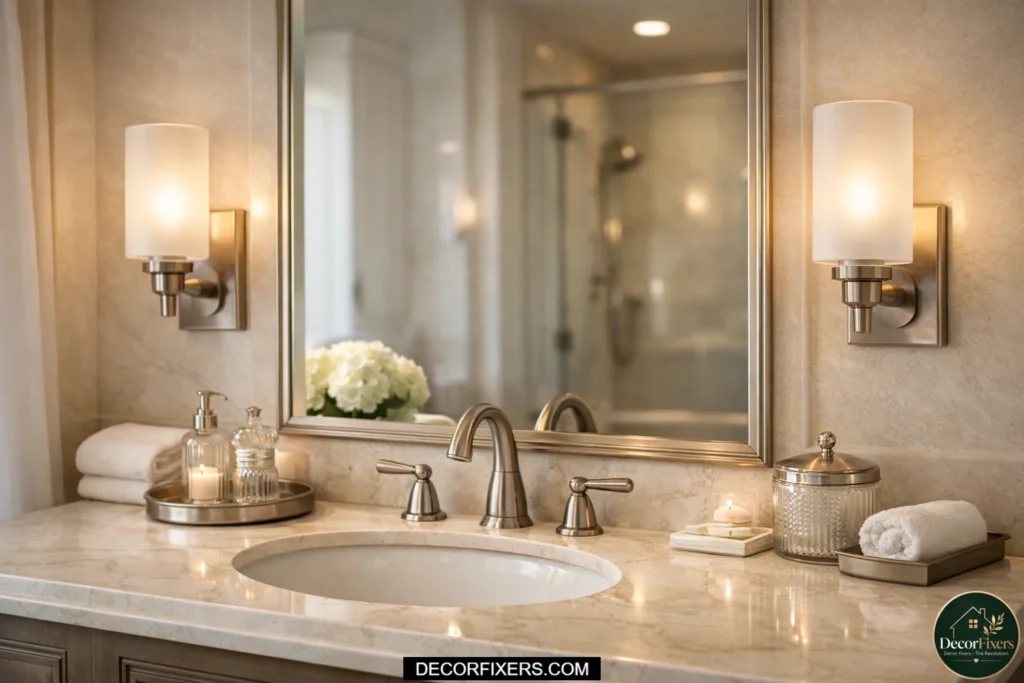
Frosted glass is the single easiest way to upgrade the quality of light from any fixture. The frosted surface scatters the bulb’s output across a wider angle, eliminates visible hot spots, and reduces glare without meaningfully reducing the overall lumens that reach the mirror.
Any frosted glass sconce — even at the $60–$160 end of the market — will outperform a clear-glass fixture at twice the price for grooming use. The frosted look also photographs beautifully, which is worth noting if you plan to sell the home eventually. Choose a warm white bulb (3000K) inside frosted glass for the most flattering possible combination.
17. Warm Brass and Marble Combination for Elevated Luxury
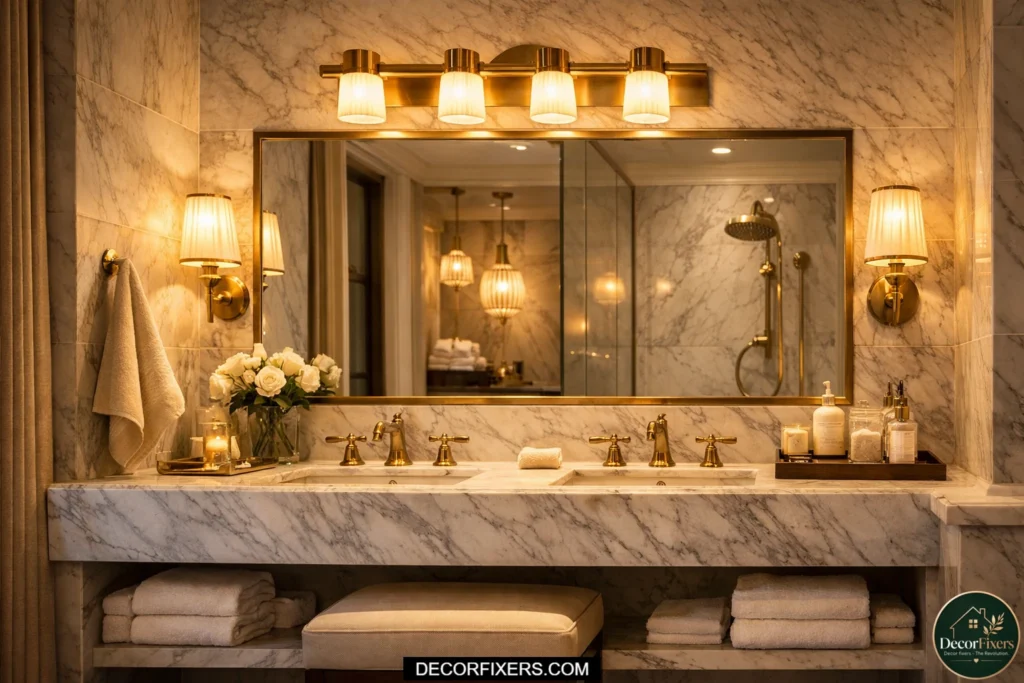
Brass and marble are a pairing that reads as genuinely expensive — and yet it’s achievable without a full bathroom gut. A warm brass fixture (burnished or brushed, not polished) above a marble-look surface creates a material contrast that feels intentional and boutique.
Brass fixtures in the $180–$600 range exist from multiple quality manufacturers. The warm metal tone reads particularly well with the veined ivory-and-grey palette of Carrara-look porcelain or quartz — a combination that photographs like a hotel room and costs a fraction of one. Pair with a 2700K warm bulb to keep the warmth coherent throughout.
18. Backlit Mirror + Overhead Bar Combination
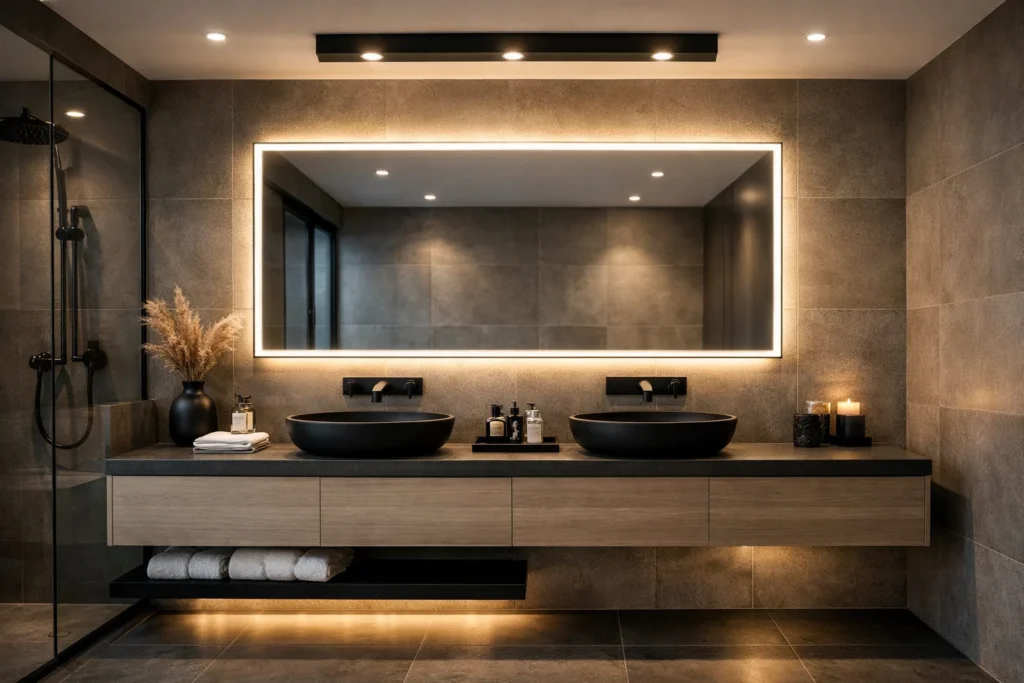
Some experts argue that a backlit mirror alone is sufficient for most grooming tasks. That’s valid for powder rooms or bathrooms used primarily for quick touch-ups. But if you apply detailed makeup, the combination of a backlit mirror plus a supplemental overhead bar gives you a level of illumination that neither fixture alone can match.
The backlit mirror provides wrap-around ambient glow; the bar above adds targeted punch where needed. Budget $400–$1,200 for the combined setup. It looks intentional rather than excessive, and the layered lighting quality is noticeable — the kind of thing guests always comment on without knowing exactly why the bathroom feels so well-lit.
Backlit Mirror vs Vanity Lights: Which One Should You Choose?
Backlit mirrors work best in small bathrooms or minimalist designs where wall space is limited and a single clean source is preferred. Dedicated vanity lights — bars or sconces — perform better for detailed grooming because they provide more focused, higher-lumen output. For most bathrooms, the combination of a backlit mirror plus a supplemental bar or sconces delivers the most versatile result: ambient glow from the mirror, task punch from the fixture.
19. Smart Dimmable Vanity Lighting with App Control
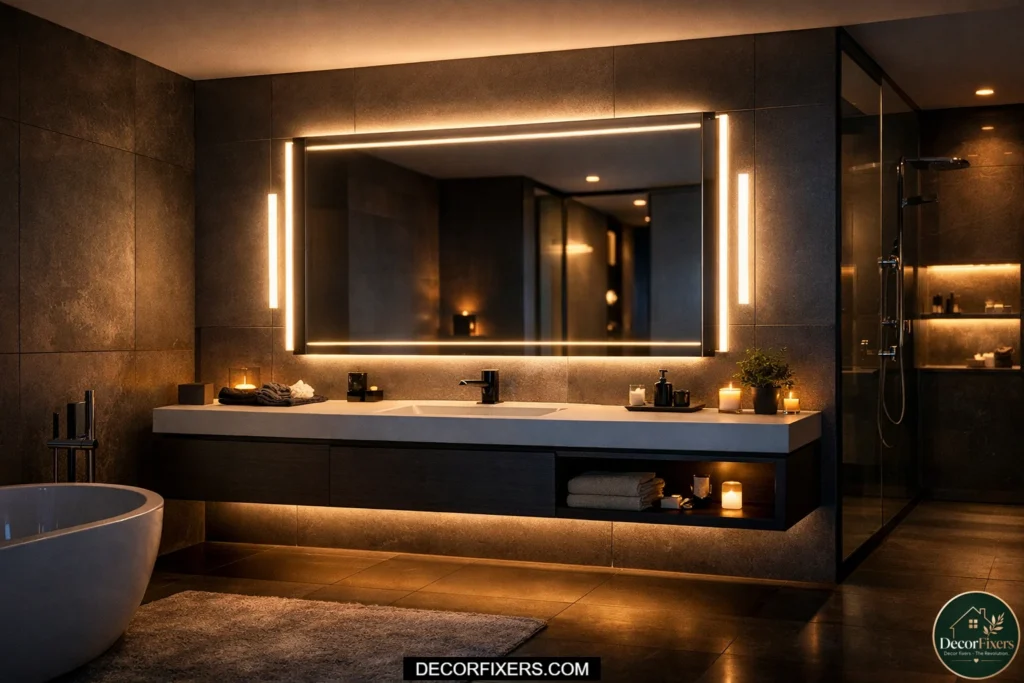
Smart vanity lighting — dimmable fixtures connected to an app or voice system — sounds like a luxury add-on, but the practical value is real. Morning grooming at 100% brightness and evening wind-down at 30% are fundamentally different lighting needs, and a simple dimmer switch handles both without requiring two separate fixture setups.
Dimmable vanity lights start around $90, and smart-home-integrated options (compatible with Alexa, Google Home) run $200–$600. The important spec: make sure the fixture’s LED is rated as dimmable, and pair it with a compatible dimmer switch — generic dimmers on non-rated LEDs cause flickering and shortened bulb life.
20. Vintage-Inspired Milk Glass Sconces
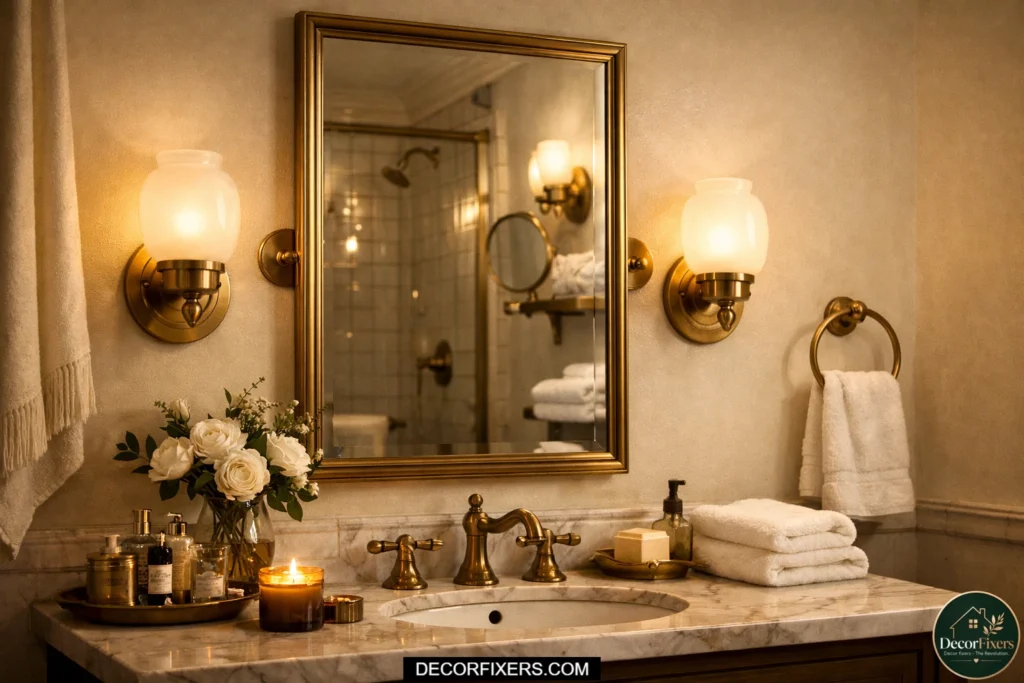
Milk glass sconces — those opaque white globe fixtures — have the interesting quality of looking both retro and contemporary depending on the hardware finish you choose. In an antique brass mount, they read as a 1920s boutique hotel; in brushed nickel, they read as minimalist Scandinavian.
The milk glass diffuses light more aggressively than frosted glass, producing an extremely soft output with minimal directionality. This makes them beautiful ambient pieces, but slightly limited as sole task lighting. Use them as the primary fixture only if supplemented by a backlit mirror or under-cabinet strips. Quality milk glass sconces run $80–$280 per pair.
21. Linear LED Bar for a Sleek, Minimalist Statement
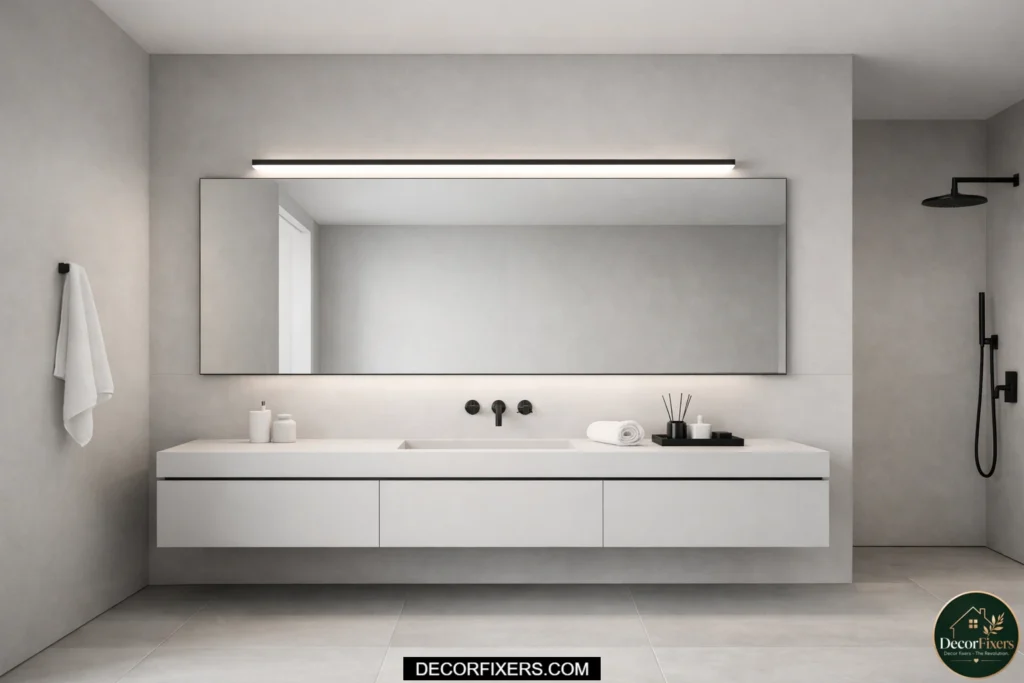
Linear LED bars — the slim, elongated fixtures with no visible bulb housing — are the default choice for anyone building a truly minimalist bathroom. No glass shades, no exposed hardware, just a thin rectangle of light above the mirror.
The design works best in bathrooms where every other element is also stripped back: frameless mirrors, handleless cabinetry, matte surfaces. In a busier bathroom, the bar can look unfinished rather than refined. Quality linear LED bars run $120–$500. Look for CRI 90+ and a dimmable driver — some cheaper linear fixtures are not dimmable, which limits their versatility significantly.
22. Three-Light Globe Cluster Above a Single Mirror
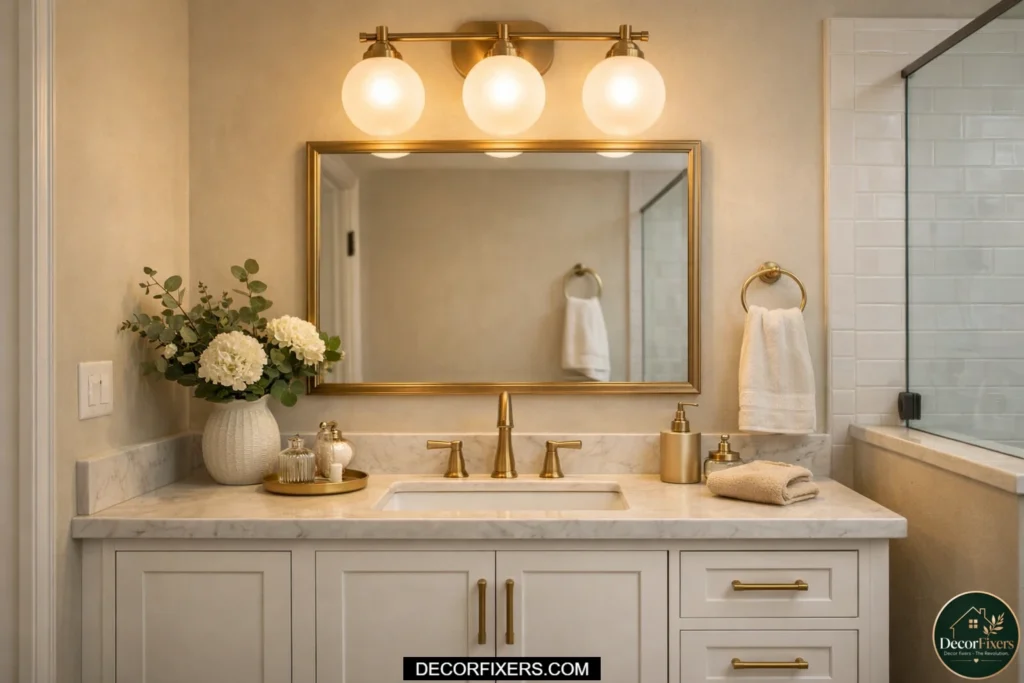
Three-globe cluster fixtures — where three glass globes are arranged on a horizontal bar or clustered on a single mounting plate — are one of the most versatile vanity options at mid-range prices. They work in modern, transitional, and even farmhouse bathrooms without requiring a complete commitment to any single style.
Seeded glass globes add texture and warmth; clear glass reads more industrial; frosted glass delivers the softest output. The three-point light source also reduces shadow better than a single-bulb fixture. Expect to pay $100–$380 for a quality 3-globe cluster from brands like Kichler or similar lines. Dimmable versions are widely available in this category.
23. Flush-Mount Ceiling Light as Supplemental Vanity Lighting
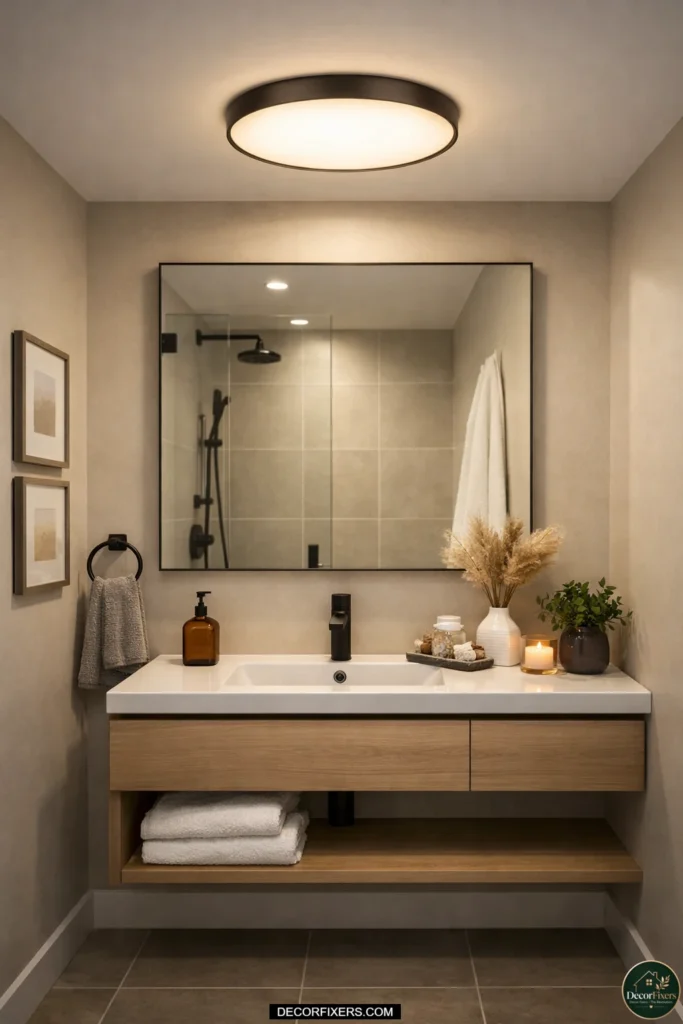
In small bathrooms where wall space around the mirror is limited, a quality flush-mount ceiling fixture centered directly over the vanity zone functions as effective supplemental task lighting. It won’t replace side sconces for makeup work, but it adds meaningful lumens and prevents the “cave” effect that under-lit bathrooms create.
The key is a flush mount with a frosted or opal diffuser — not a bare-bulb design — and a bulb in the 3000K–3500K range. A quality flush-mount for bathroom use runs $80–$350. Choose a damp-rated fixture — not all ceiling fixtures are appropriate for bathroom humidity levels, and installing the wrong type voids the warranty and creates a safety concern.
What Color Temperature Is Best for Bathroom Vanity Lighting?
The best color temperature for bathroom vanity lighting is 2700K–3500K — a warm-to-neutral white range. According to Lumens.com, this range provides flattering illumination for grooming while preserving reasonably accurate color rendering. For makeup-critical tasks, stay closer to 3000K–3500K. Warmer temps below 2700K flatter skin but distort color accuracy enough to affect foundation and blush matching.
24. Lantern-Style Vanity Sconces for a Transitional Look
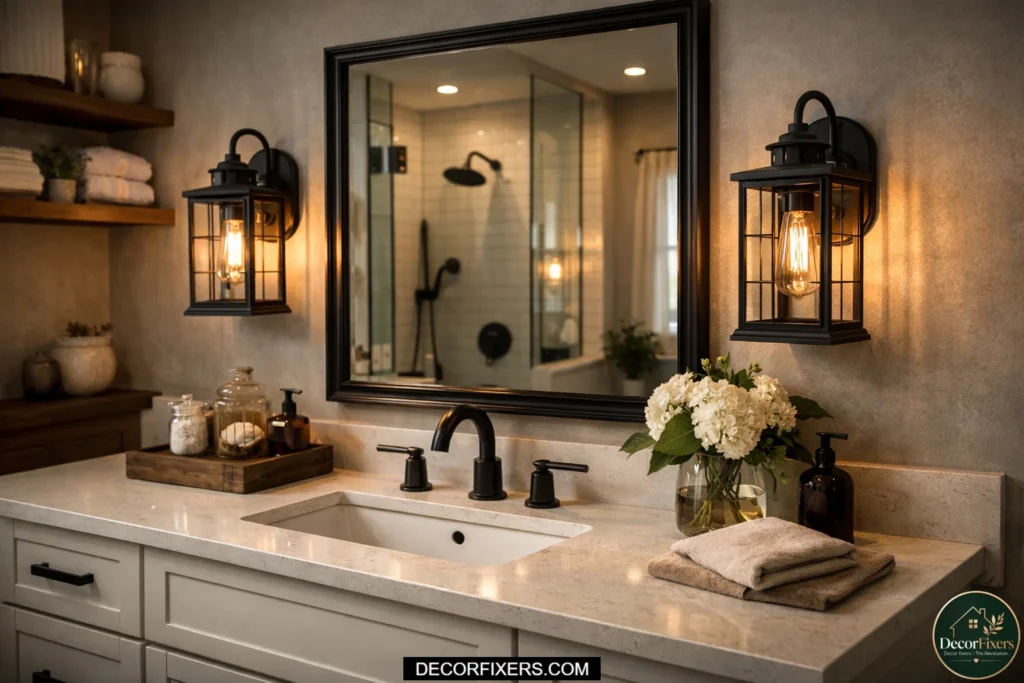
Lantern sconces — small cage-like fixtures with exposed bulbs behind wire or glass panels — bring a warmth and dimensionality that most flat-profile fixtures can’t replicate. They work best in transitional bathrooms: spaces that blend modern materials (quartz counters, frameless mirrors) with traditional details (shaker cabinets, chrome hardware).
The exposed-bulb design means bulb choice matters enormously. Use a warm filament LED (2700K, 40–60W equivalent) rather than a standard bulb — the filament pattern is visible through the cage and is part of the visual. Quality lantern sconce pairs run $140–$480. They’re harder to date than globe sconces, which is a meaningful advantage for resale.
25. Black and Gold Mixed-Metal Vanity Fixture
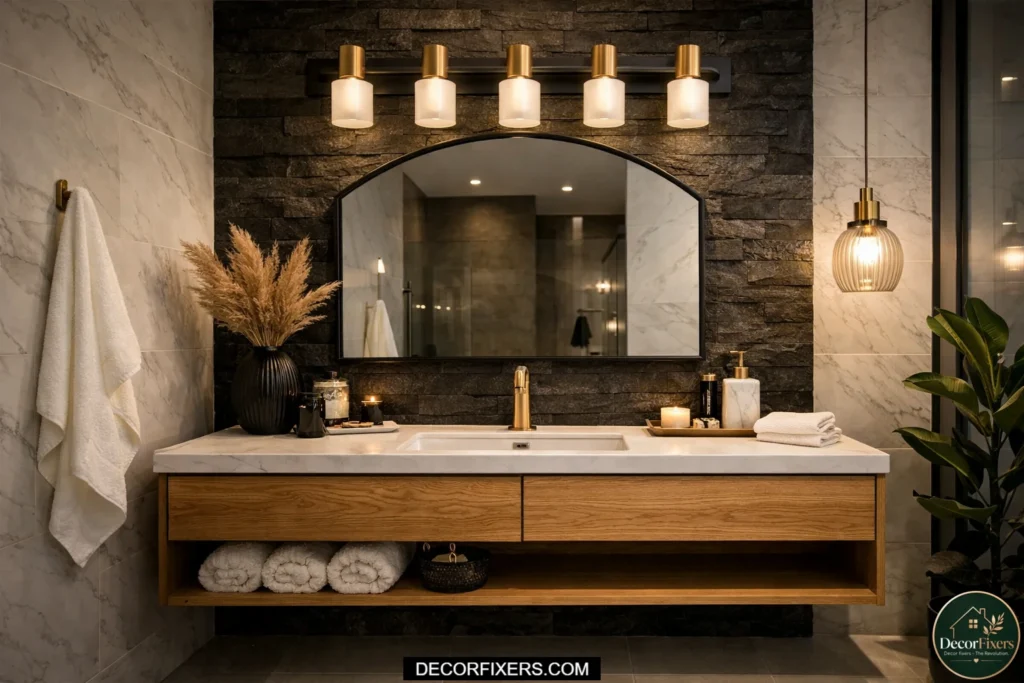
Mixed-metal fixtures — matte black body with brushed gold hardware accents, or vice versa — have moved from trend to fixture category in recent years. They solve a real design problem: bathrooms that have both warm and cool finishes, where a single-metal fixture always fights one of them.
The combination works specifically when the dominant metal matches your primary fixture (usually the faucet) and the accent metal picks up a secondary detail (towel bars, cabinet pulls). Quality mixed-metal vanity fixtures run $180–$550. Avoid fixtures where the two metals look randomly assembled — the best examples have a clear visual hierarchy between the primary and accent finishes.
26. Waterfall or Curved Arm Vanity Sconces for a Sculptural Look
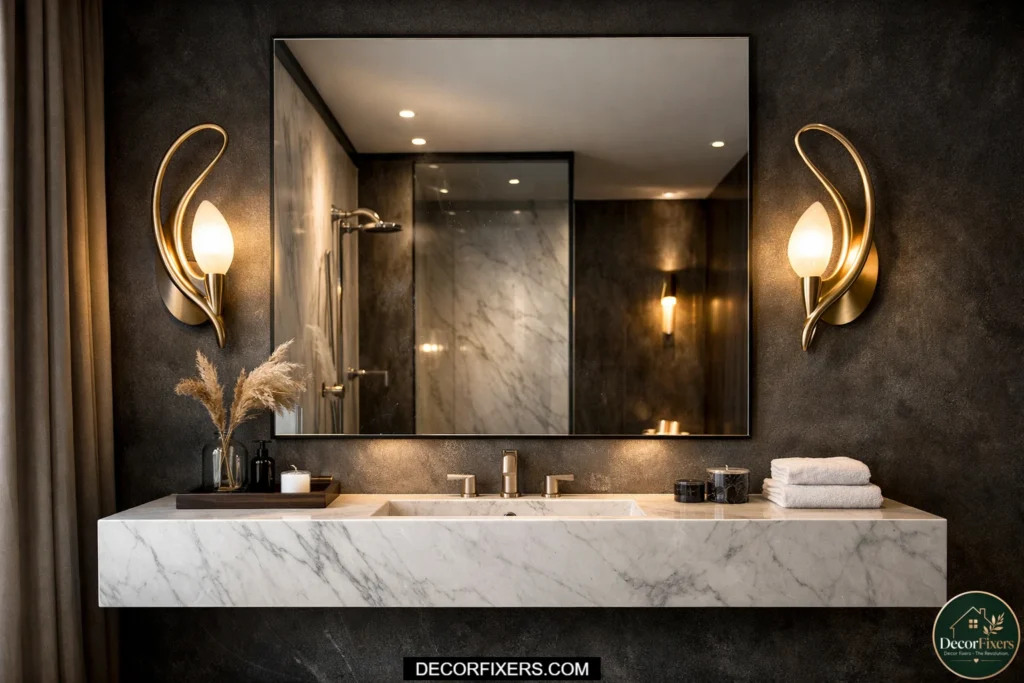
Curved or sculptural vanity sconces — fixtures with arched arms, asymmetrical shades, or flowing silhouettes — are the category for anyone who wants their bathroom lighting to function as art. They’re statement pieces first, task lights second, and they require the rest of the bathroom to be simple enough not to compete.
These fixtures tend to run higher: $300–$1,200 per pair from quality manufacturers. But the visual effect — especially flanking a large frameless mirror — is something no standard bar fixture can replicate. Pair with a CRI 90+ warm bulb to make sure the sculptural form isn’t undermined by clinical-looking light.
What Height Should Bathroom Vanity Lights Be Mounted?
Side sconces should be mounted at approximately 60–70 inches from the floor — roughly eye level for most adults. According to Lumens.com, cross-illumination at this height provides the most shadow-free result for grooming tasks. Overhead bars should sit 75–80 inches from the floor to avoid direct glare into the eyes while preserving even mirror coverage.
27. Recessed Downlights Over the Vanity for a Clean, Architectural Finish
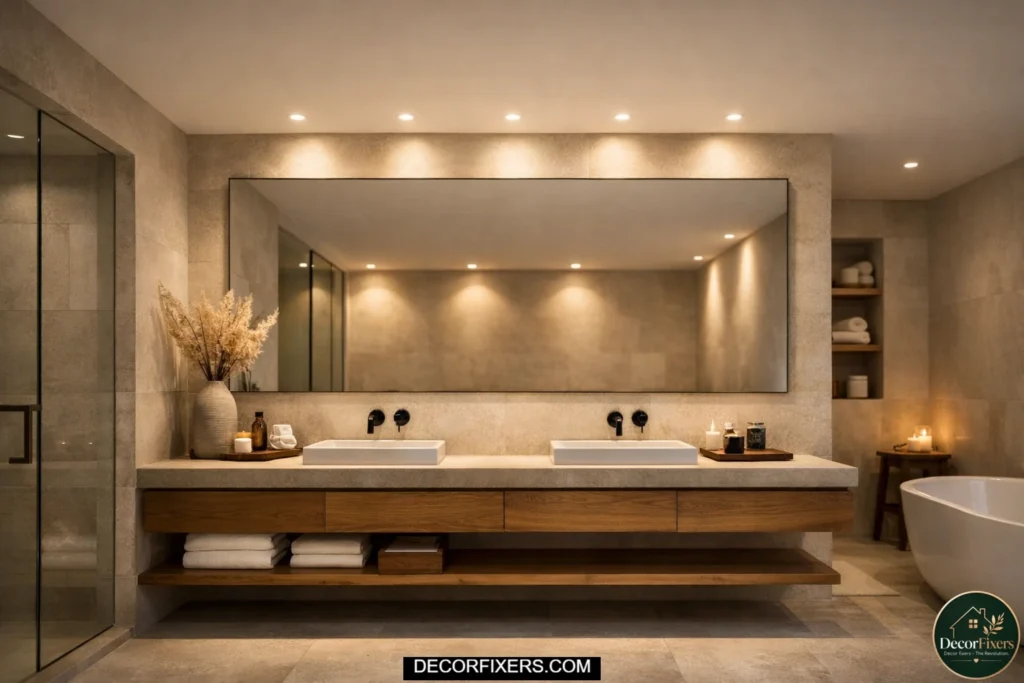
Recessed downlights are the choice for anyone who wants zero visible fixture above the vanity — just a flush ceiling and pools of focused light. Done well, it’s the most architecturally sophisticated option on this list. Done poorly — with too few fixtures or wrong placement — it creates the same shadow problem as a single overhead bar.
The rule: two recessed fixtures positioned 18–24 inches apart, directly over the vanity zone, not centered over the room. Use 3000K, CRI 90+ LEDs in a gimbal (adjustable) housing so you can angle them toward the mirror rather than straight down. Expect $80–$250 per fixture for quality damp-rated housings, plus installation cost if rewiring is needed. This is the only idea on this list that typically requires professional installation.
CONCLUSION:
The bathroom I mentioned at the start? I eventually replaced that narrow overhead bar with a pair of frosted-glass sconces mounted at 64 inches — roughly eye level for me. The difference was immediate. Not just brighter; genuinely different quality of light. The shadows were gone. My skin tone looked normal instead of flat. I stopped second-guessing my makeup before leaving the house.
Most of the 27 ideas above solve the same root problem: light from the wrong position, diffused poorly, at the wrong color temperature. The fixture style matters far less than those three variables. Get those right, stay within your budget (everything here lands under $2,500, most well under $500), and your bathroom will look — and work — like a different room.
For curated modern fixture options, Lumens.com carries one of the most thoughtfully edited selections available — worth browsing before any purchase decision.
FAQs:
Q: What’s the best vanity lighting for applying makeup?
A: Side-mounted sconces at eye level (60–65 inches from the floor) with a CRI of 90 or higher and a color temperature of 3000K–3500K. They eliminate shadow better than any overhead placement.
Q: How do I choose the right size vanity light for my mirror?
A: For a single mirror, choose a bar that’s about 75–80% of the mirror’s width. For sconces, place them 28–36 inches apart, centered on the mirror’s midpoint. Wider is almost always better than narrower.
Q: Should I use warm or cool light in my bathroom?
A: Warm (2700K–3000K) for ambiance and relaxation; neutral (3000K–3500K) for accurate grooming. A dimmable fixture in the 3000K range handles both with a simple adjustment.
Q: Why does my bathroom vanity light cast shadows on my face?
A: Single overhead fixtures cast a shadow downward. Move to side sconces, widen a narrow overhead bar, or add a backlit mirror. The fix is usually placement, not wattage.
Q: When should I hire an electrician for vanity lighting?
A: Whenever you’re adding a new junction box, moving an existing one, or installing recessed lighting. Replacing a like-for-like fixture on an existing box is a standard DIY task requiring only a screwdriver and wire connectors.

Creator of DecorFixers, sharing practical home and interior ideas focused on real-life usability, simple design improvements, and budget-friendly solutions.