

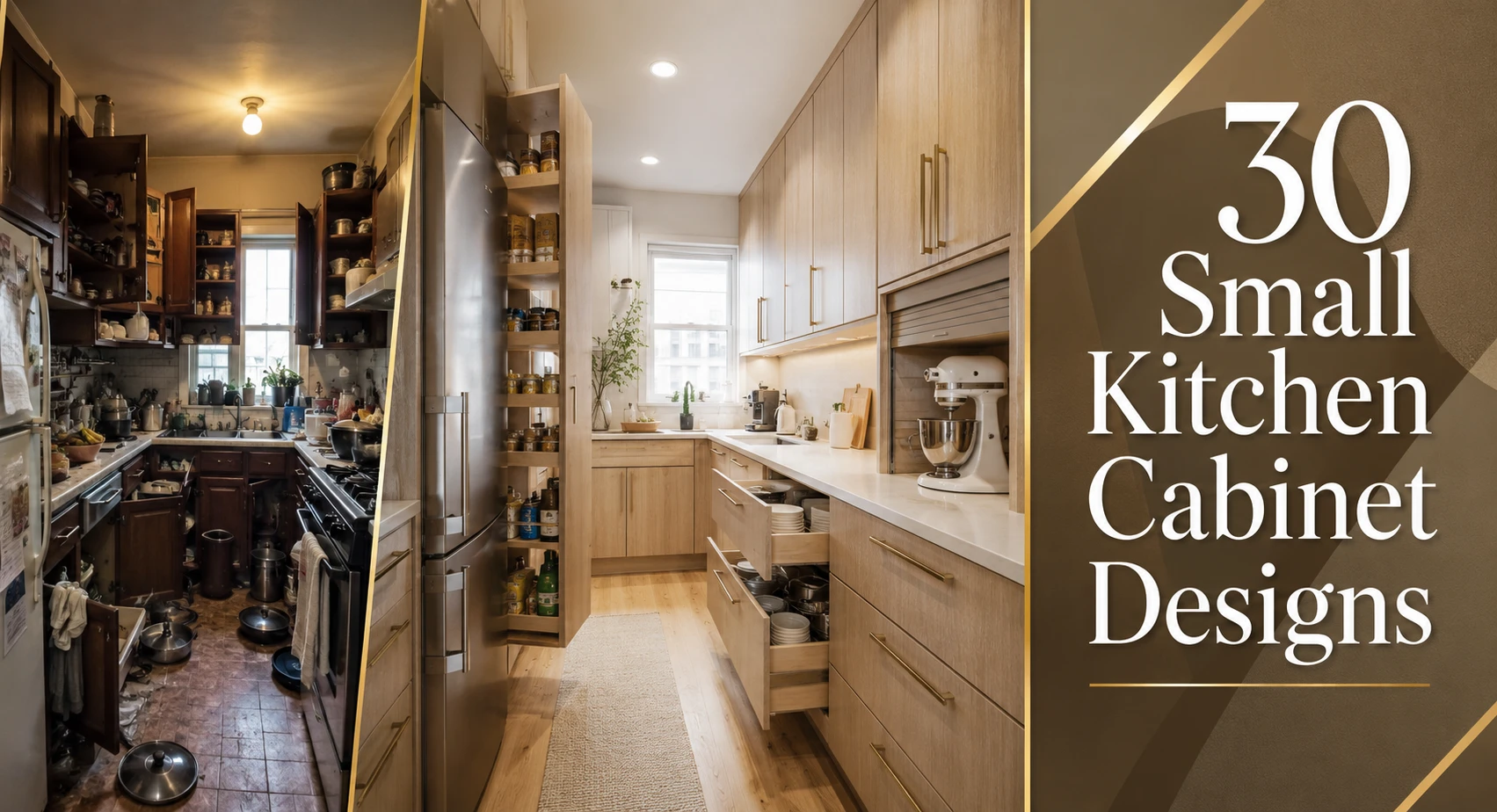
I had a $22,400 remodel quote in one hand and a completely unusable kitchen in the other. Counters buried. Base cabinets a black hole. Every time I opened one, three lids fell out. That quote went in the trash.
What I needed was not a renovation. It was a smarter cabinet strategy. Most guides on this topic give you aesthetics: light paint, open shelves, a cute plant. None of that tells you which system to buy, what layout fits a galley, or how to spend $3,000 to $8,000 in a way that actually solves the clutter problem.
This guide does. Thirty specific small kitchen cabinet designs for small spaces on a budget, real products, real costs, real trade-offs. Let’s get into it.
Small kitchen cabinet designs for small spaces on a budget refer to cabinet layouts, systems, and storage solutions specifically chosen to maximize usable storage in kitchens under 100 sq ft (the NKBA benchmark for a small kitchen) while keeping total cabinet costs between $3,000 and $8,000. These designs prioritize function per square inch over aesthetics-first choices.
1. Go Drawer-Dominant on Your Lower Cabinets
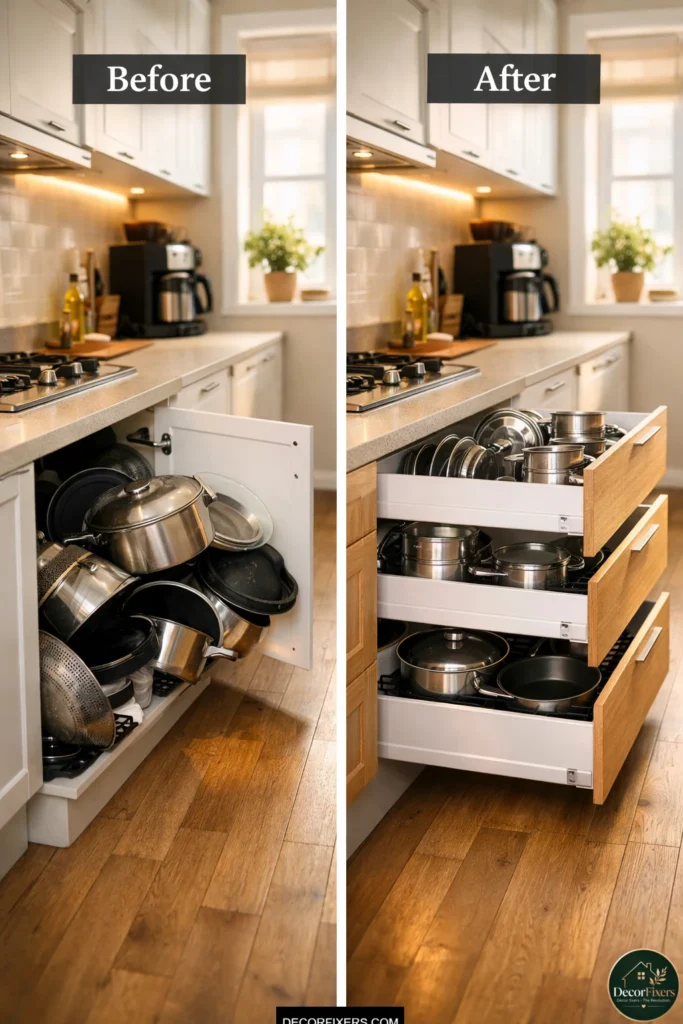
This is the single upgrade I wish I’d made sooner. Replacing traditional door-and-shelf base cabinets with deep three-drawer stacks makes every pot, pan, and Tupperware lid retrievable without crouching and digging. The IKEA SEKTION base cabinet with MAXIMERA drawers is the most accessible entry point.
The door cabinets are basically a black hole with hinges. NKBA’s 2025 Trends Report confirms this isn’t a niche preference: 91% of industry professionals agree that multi-function, space-optimized designs are now the top homeowner priority.
2. Floor-to-Ceiling Upper Cabinets for Vertical Storage
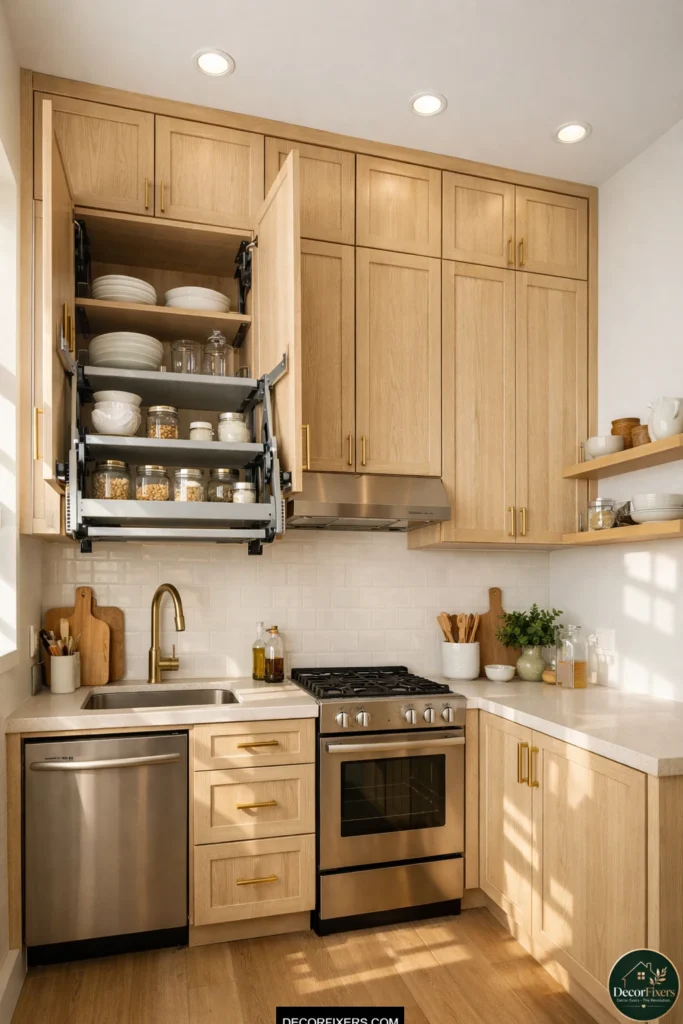
In a small kitchen, your ceiling is storage you are probably not using. Floor-to-ceiling upper cabinets can increase storage capacity by up to 40% without consuming additional floor space, according to OPPEIN’s 2024-2025 project analysis.
The top section handles rarely used items: stand mixer, holiday dishes, and extra canned goods. Use pull-down shelf hardware (around $50 to $150) for easy access. IKEA SEKTION wall cabinets stack and join cleanly, making the ceiling-height run genuinely doable on a DIY weekend.
3. The Classic Galley Layout Optimized for Under 80 Sq Ft
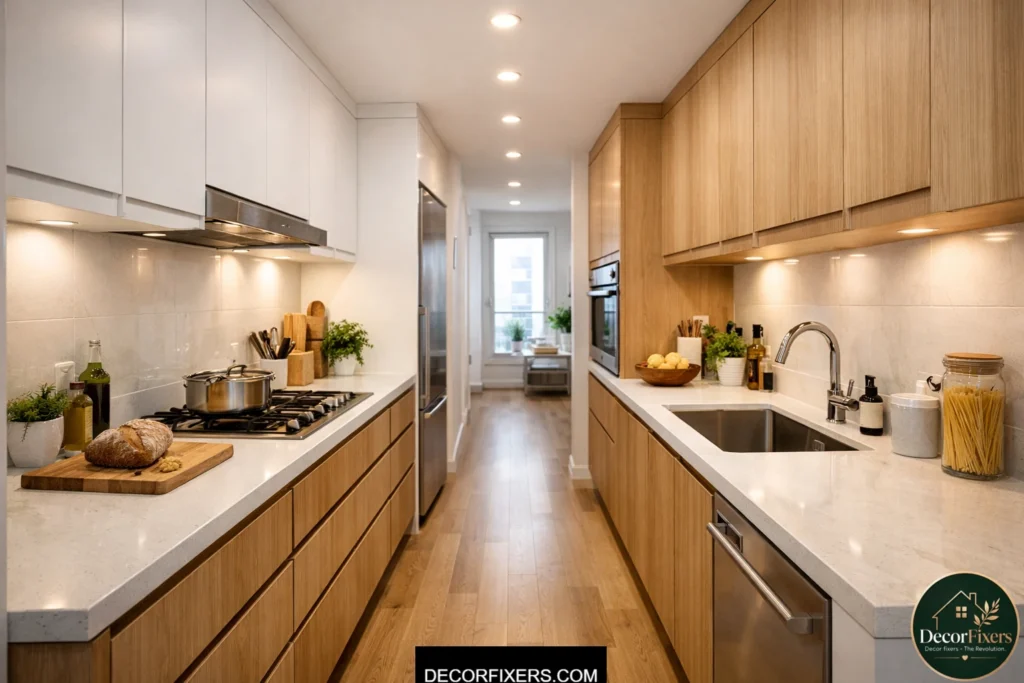
If your kitchen is long and narrow, think 8 feet wide or less, the galley layout is your best friend and your biggest constraint at the same time. Two runs of cabinets facing each other, with a walkway of at least 42 inches between them (48 inches if two cooks share the space).
The mistake most people make is treating both walls identically. Instead, load the longer wall with full uppers and deep base drawers, and use the shorter or window wall for a shallower run of wall cabinets only. This keeps the space visually open on one side without sacrificing function on the other. IKEA SEKTION 15-inch-deep wall cabinets (versus the standard 24-inch depth) are the right tool for the shallower wall run.
4. L-Shaped Cabinet Layout for Corner Kitchens
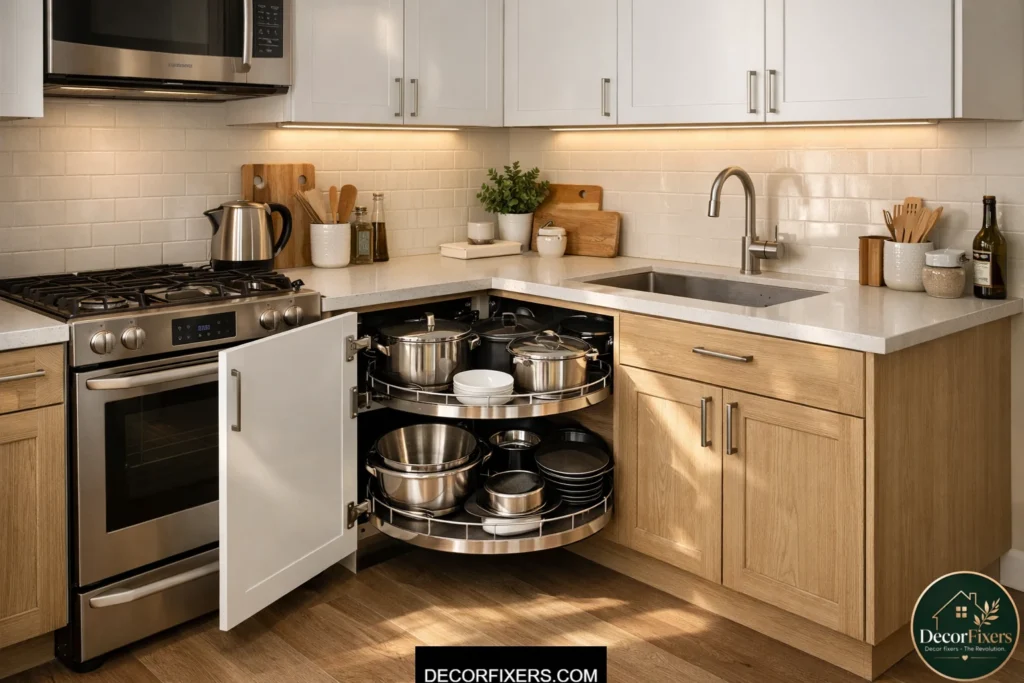
The L-shaped layout works brilliantly in studio apartments and open-plan condos where one wall meets another at 90 degrees. The key budget-cabinet decision in an L-shape is what you do with the corner, because a poorly planned corner cabinet is where functional square footage goes to die.
Skip the traditional 36-inch blind corner base and go straight to a lazy Susan (Rev-A-Shelf makes a two-tier kidney-shaped version for around $80 to $150) or a pull-out corner drawer system. Either option costs less than a custom corner solution and retrieves 70 to 80% more of that dead corner space than a standard shelf.
5. IKEA SEKTION System, The Most Flexible Budget Cabinet for Small Apartments
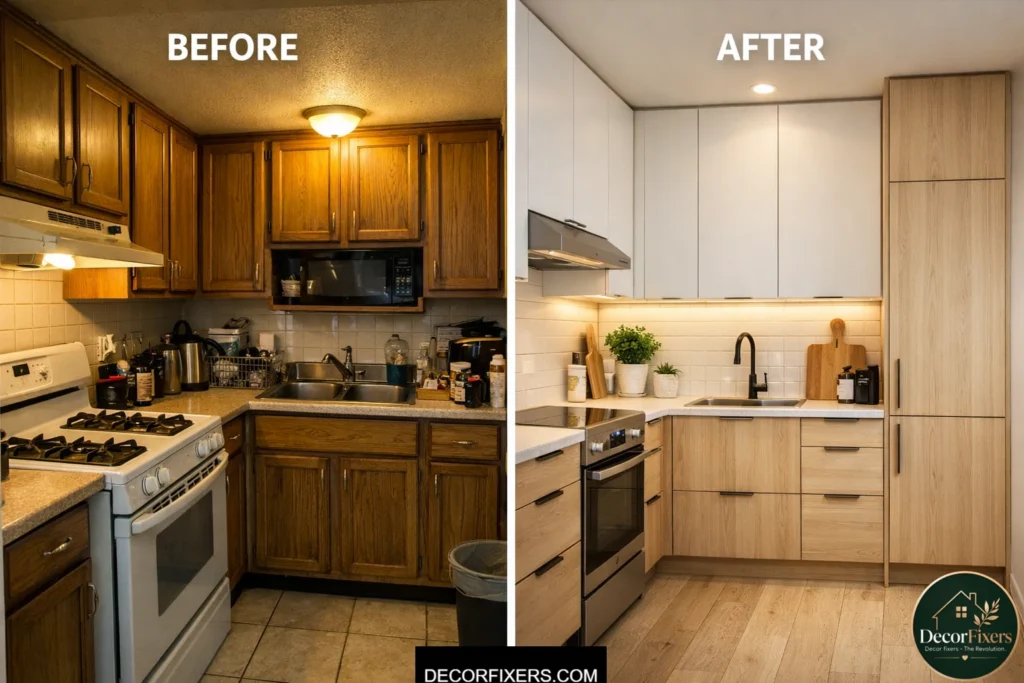
IKEA SEKTION is the most widely used modular cabinet system for small-budget kitchens in the US, UK, and Canada. Base cabinet boxes start under $150, and the system’s genius is the separation of the box from the door front, meaning you pick the structural unit for function and the face for aesthetics.
For renters doing a semi-permanent upgrade, that separation also means you can potentially rehang your original doors when you move out. A full 10×10 small kitchen in SEKTION materials (no installation) typically runs $2,000 to $4,000, depending on your door front choice.
This is where I’ve seen conflicting data; some sources quote as low as $75 per linear foot for the most basic configuration, while others peg it at $150 to $300 per linear foot for a realistic mix of units. My read: budget $125 to $200 per linear foot for materials in a small kitchen with mixed uppers and base drawers.
6. RTA Cabinets for Semi-Custom Look on a Stock Budget
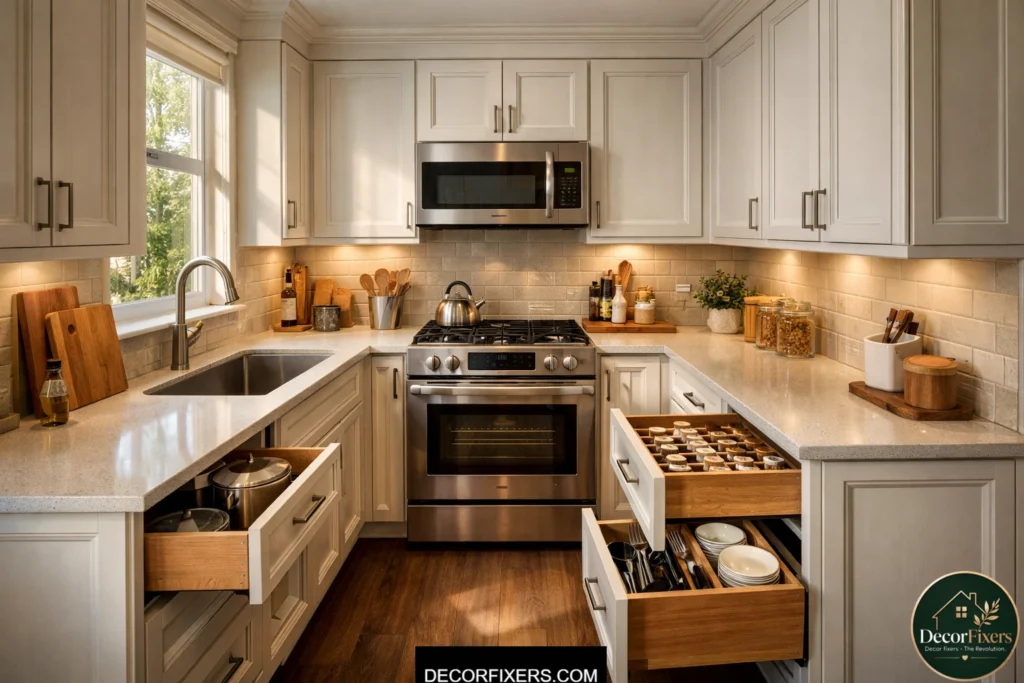
Ready-to-assemble (RTA) cabinets from online suppliers like RTA Cabinet Store deliver a semi-custom finish, soft-close hinges, dovetail drawer boxes, and solid-wood face frames at stock cabinet prices. A 10×10 layout in RTA typically runs $2,000 to $6,000, depending on door style, which is competitive with IKEA once you factor in the higher-quality construction on box joints and drawer hardware.
The trade-off is you’re ordering online sight-unseen, and shipping damage is a real possibility. Always inspect deliveries immediately and document any issues with photos before the driver leaves.
For galley kitchens specifically, RTA cabinets work especially well because the straightforward layout minimizes the number of filler pieces and specialty corner units you need.
7. Floating Wall Cabinets Instead of Soffit Bulkheads
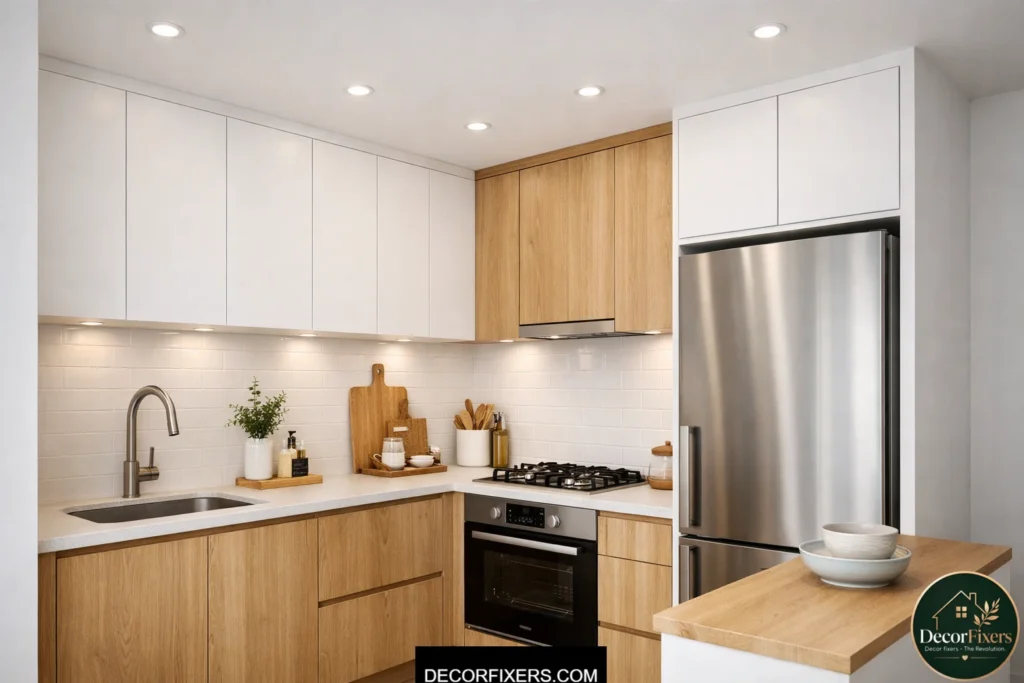
If your kitchen has a soffit, that boxed-in section above upper cabinets that serves no purpose except collecting dust and reducing height, removing it and replacing it with taller floating wall cabinets instantly adds both storage and visual ceiling height.
This is a mid-difficulty DIY project (you’ll need to patch drywall), but it costs almost nothing beyond the new cabinet units. IKEA wall cabinets in 30-inch and 40-inch heights give you the most flexibility. Even without soffit removal, adding floating wall cabinets above the refrigerator or over a doorway uses vertical space that most kitchens completely waste.
8. Open Lower Shelving on One Side of a Galley
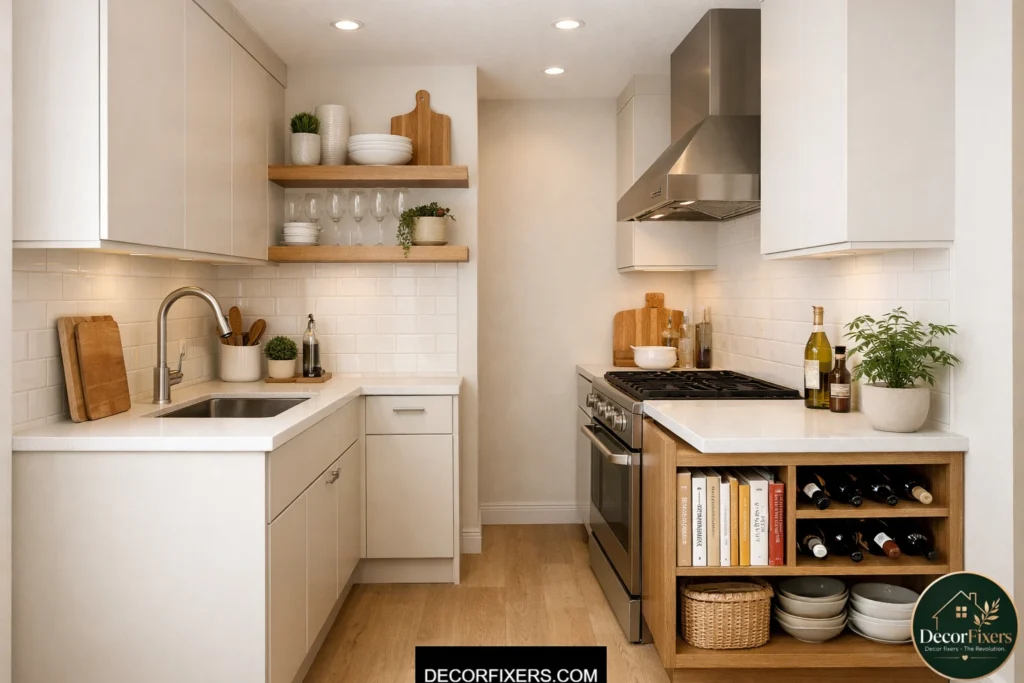
Some experts argue open lower shelving creates a lighter, more airy galley kitchen. That’s valid for a rental where you can’t install new closed cabinets. But if you’re dealing with actual daily cooking clutter, and most people are, open lower shelves, just put your mess on display without solving it.
The middle ground: use open lower shelving for one section only (a dedicated cookbook area or a wine storage nook) while keeping the rest of the lower run as enclosed drawers. This gives you the visual break without the functional penalty.
QUICK COMPARISON:
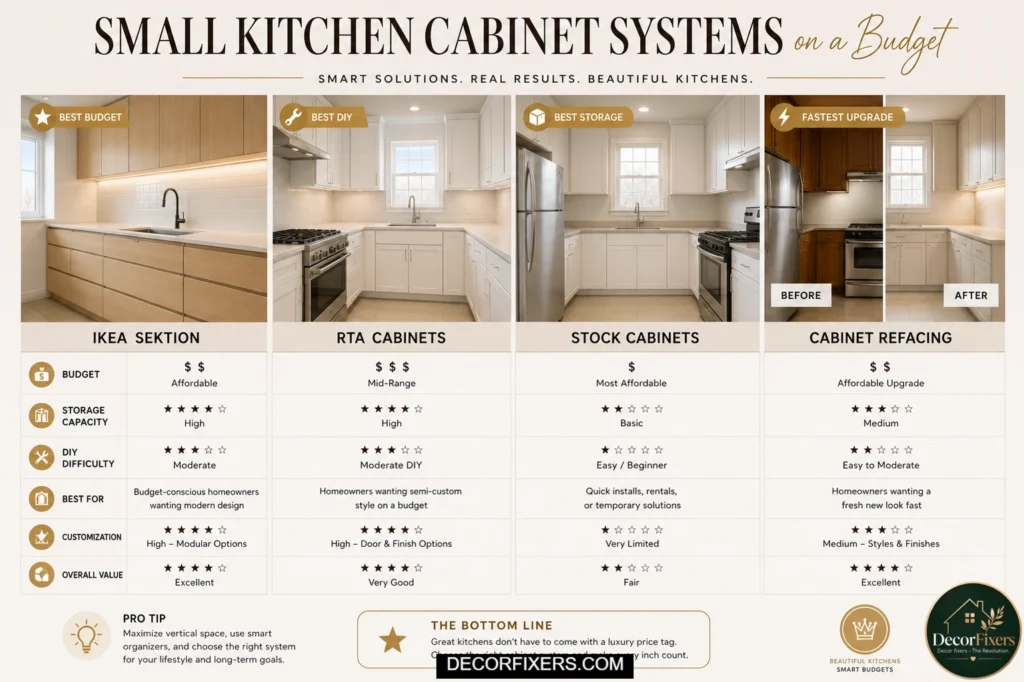
| Option | Best For | Key Benefit | Limitation |
| IKEA SEKTION | DIY renters & first-time buyers | Modular, starts under $150/unit, 25-yr warranty | Assembly required; specific sizing only |
| RTA Cabinets | Budget semi-custom look | Semi-custom quality at stock prices, faster shipping | Can’t see before you buy; varies by brand |
| Stock Cabinets (HD/Lowe’s) | Fast turnaround, local pickup | Immediate availability, easy returns | Limited sizes, fewer interior options |
| Cabinet Refacing | Keeping the existing layout | 50-70% cheaper than full replacement | Only cosmetic, doesn’t fix the bad layout |
These are organized from layout decisions (the structural ones you make first) through storage inserts and finish upgrades (the things you bolt on or swap without a contractor). Work top to bottom, nail the system before you buy the accessories.
9. Handleless Push-to-Open Cabinet Doors
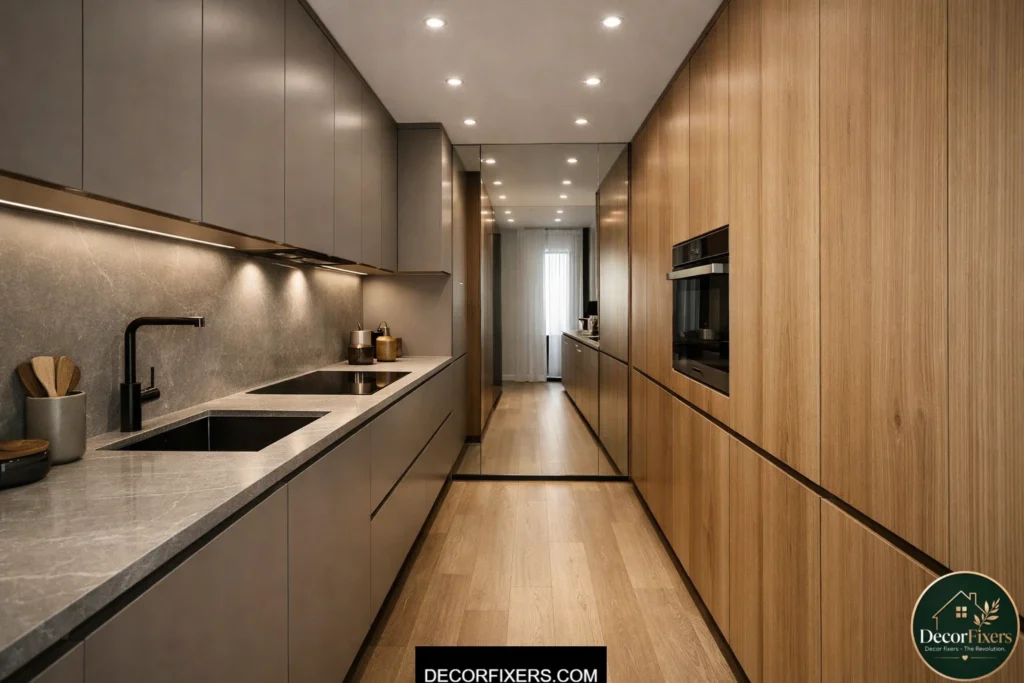
Handleless cabinets, either push-to-open mechanisms or integrated edge pulls, create cleaner sightlines in tight kitchens, which directly affects how spacious the room feels. In a narrow galley, protruding handles on every cabinet actually reduce the effective walkway width by an inch or two on each side.
Push-to-open hardware costs $3 to $15 per door, making it one of the cheapest high-impact upgrades you can make. IKEA’s SEKTION boxes are compatible with standard push-to-open hardware from most brands. If you want to keep hardware, integrated aluminum edge pulls (flat, recessed) are the next best choice for a space-forward look.
10. Two-Tone Cabinets to Create Visual Separation in Open Plans
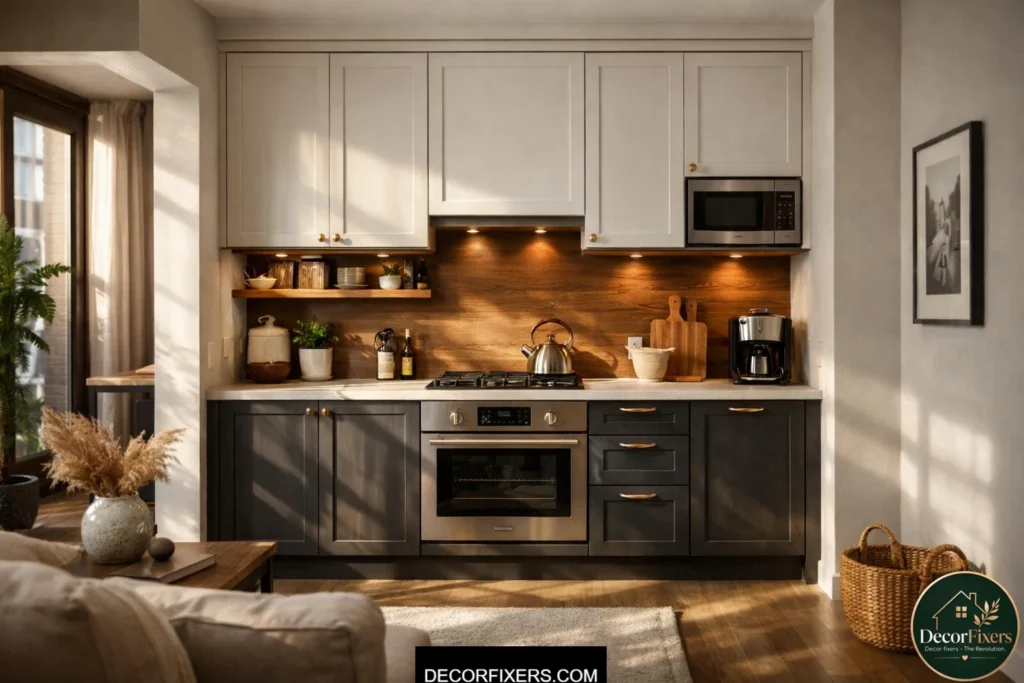
Two-tone cabinet layouts, a darker shade on lowers, lighter on uppers, do two things in small kitchens: they ground the lower half of the room without making it feel heavy, and they create a visual distinction that makes an open-plan kitchen feel more intentional, less like a one-wall kitchen.
The budget play here is paint. If you’re working with existing cabinets in reasonable condition, a professional spray paint job runs $200 to $600 for a small kitchen. If you’re buying new, order upper and lower fronts in different finishes from the same system (IKEA SEKTION fronts swap easily) rather than purchasing two different cabinet lines.
11. Toe-Kick Drawers, The Most Underused Storage in Every Small Kitchen
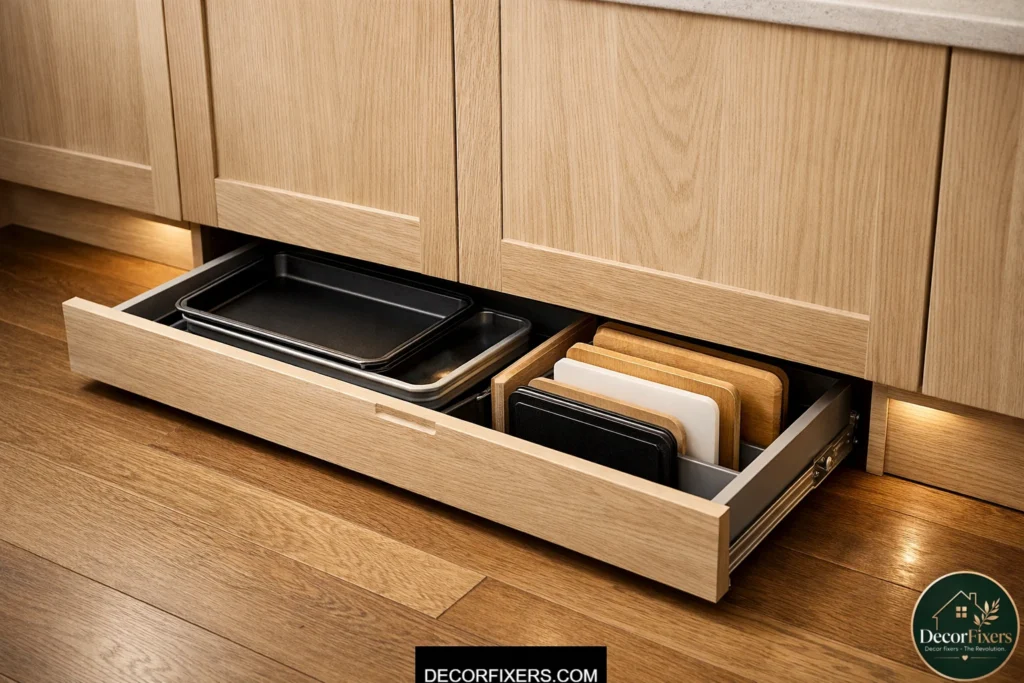
The 4 to 5 inches of space beneath your base cabinets, the toe-kick zone, is storage most people never think about. Toe-kick drawers installed in that recess can hold serving trays, flat baking sheets, placemats, and cutting boards that would otherwise eat up valuable cabinet space.
Rev-A-Shelf makes retrofit toe-kick drawer kits starting at around $60 to $90. If you’re installing new SEKTION cabinets, plan the toe-kick drawer openings at the design stage; it’s significantly easier than retrofitting. Match the drawer front to your cabinet finish, and it looks completely intentional.
12. Pull-Out Pantry Cabinet in a Narrow Gap
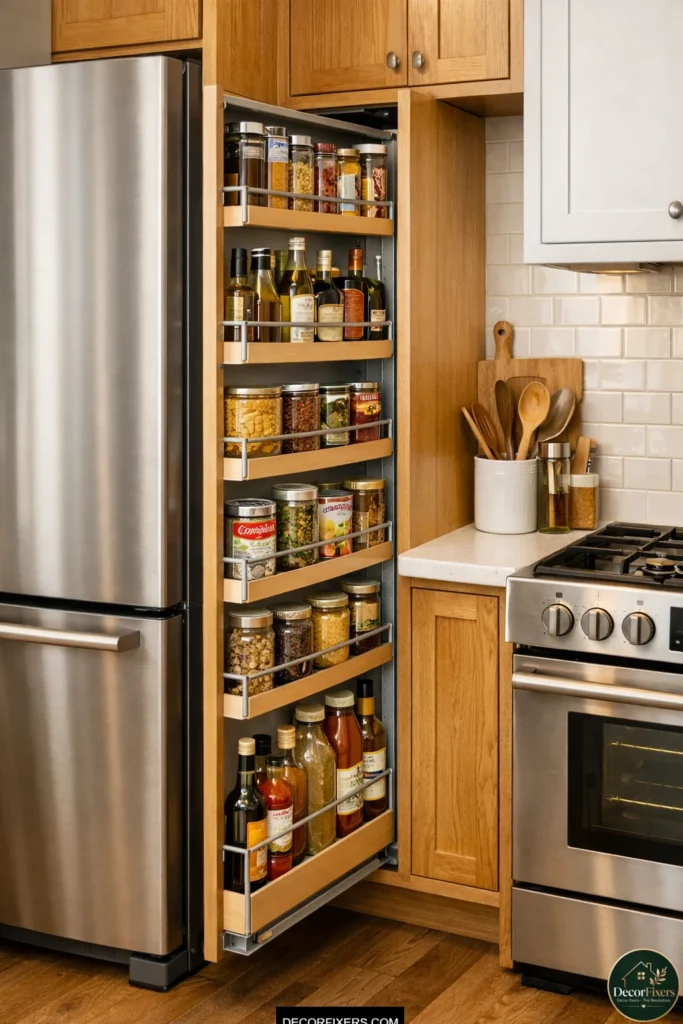
Look, if you’re in a galley kitchen and there’s even a 9-inch gap between your refrigerator and the wall, that gap is a pull-out pantry waiting to happen. Narrow pull-out pantry cabinets (also called ‘larder pull-outs’ in the UK market) are available in 9, 12, and 15-inch widths and can hold 20 to 30 cans, spices, bottles, and packaged goods on both sides.
Rev-A-Shelf sells freestanding pull-out units that retrofit into an existing gap without cabinetry. The 18-inch model runs around $150 to $250. This is arguably the best dollar-for-dollar storage upgrade in a small kitchen: zero floor footprint, maximum capacity, no contractor required.
13. Lazy Susan Inserts for Corner Cabinet Dead Space
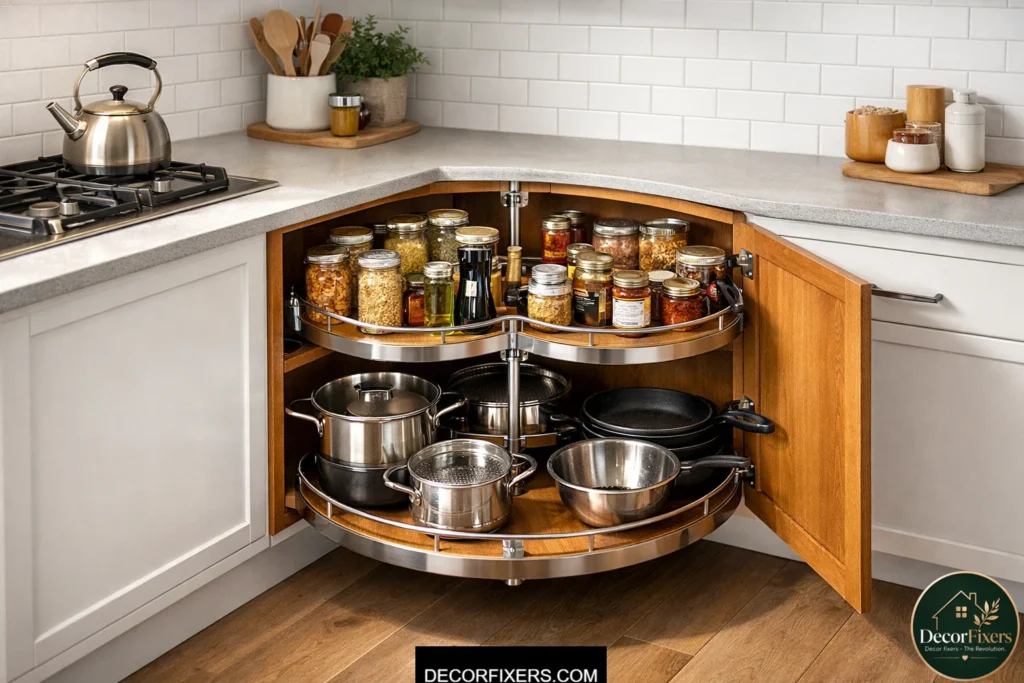
Standard corner base cabinets waste roughly 30 to 40% of their theoretical storage because the back corners are physically impossible to reach. A lazy Susan, particularly the kidney-shaped two-tier rotating version from Rev-A-Shelf (around $80 to $150), solves this by rotating all stored items to the front with a single spin.
If your corner cabinet already exists, this is a retrofit install that takes about 20 minutes and a screwdriver. If you’re designing from scratch, consider a corner drawer system (two overlapping drawers that pull forward at an angle) as an alternative; they cost more but deliver better accessibility.
14. Under-Cabinet Pull-Out Knife and Cutting Board Storage
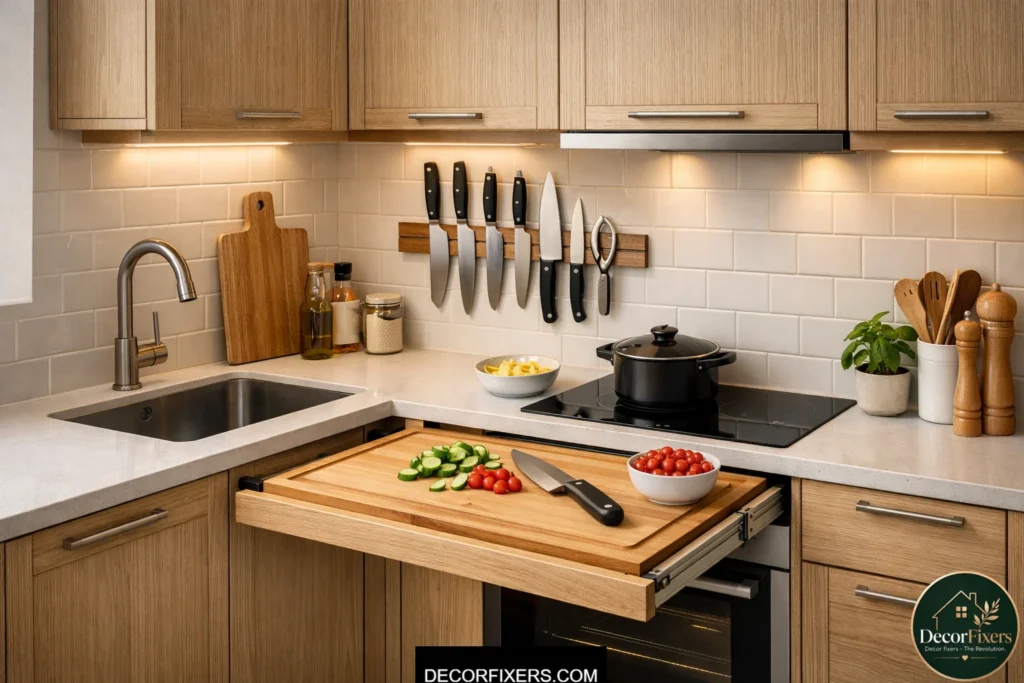
Knife blocks on countertops eat 2 to 3 inches of prep space you don’t have. Under-cabinet magnetic knife strips (around $20 to $40) mount underneath wall cabinets and put your knives at eye level, clearing the counter entirely.
Pair this with a pull-out cutting board drawer installed in one of your upper base cabinets. IKEA sells a compatible pull-out work surface with the SEKTION MAXIMERA system, and you’ve just recovered six to eight linear inches of countertop permanently.
15. Glass-Front Upper Cabinet Doors for Visual Depth
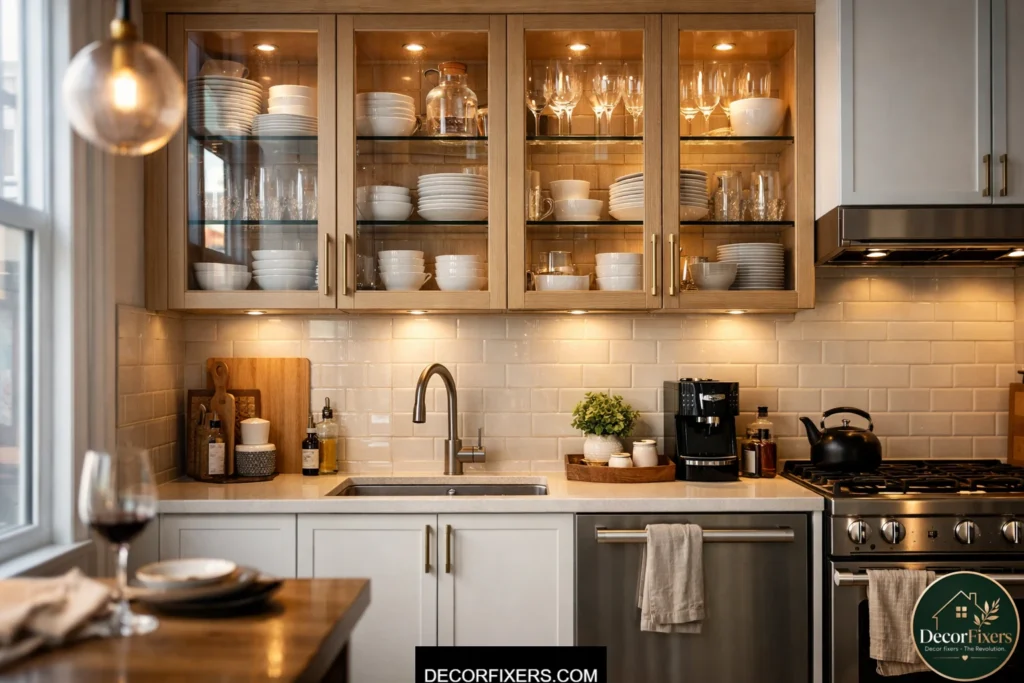
Swapping solid-front upper cabinet doors for glass-front panels makes a small kitchen feel 15 to 20% larger by creating visual depth; your eye reads ‘inside the cabinet’ rather than stopping at a flat surface. The budget approach is replacing just two or four doors (not all of them) on the most visible upper run.
IKEA sells glass-front door options for SEKTION that pair with the same box as solid doors, so the swap is direct. Style your visible cabinet contents intentionally: grouped by color or item type. Random clutter behind glass defeats the purpose.
16. Magnetic Spice Rails Mounted Inside Cabinet Doors
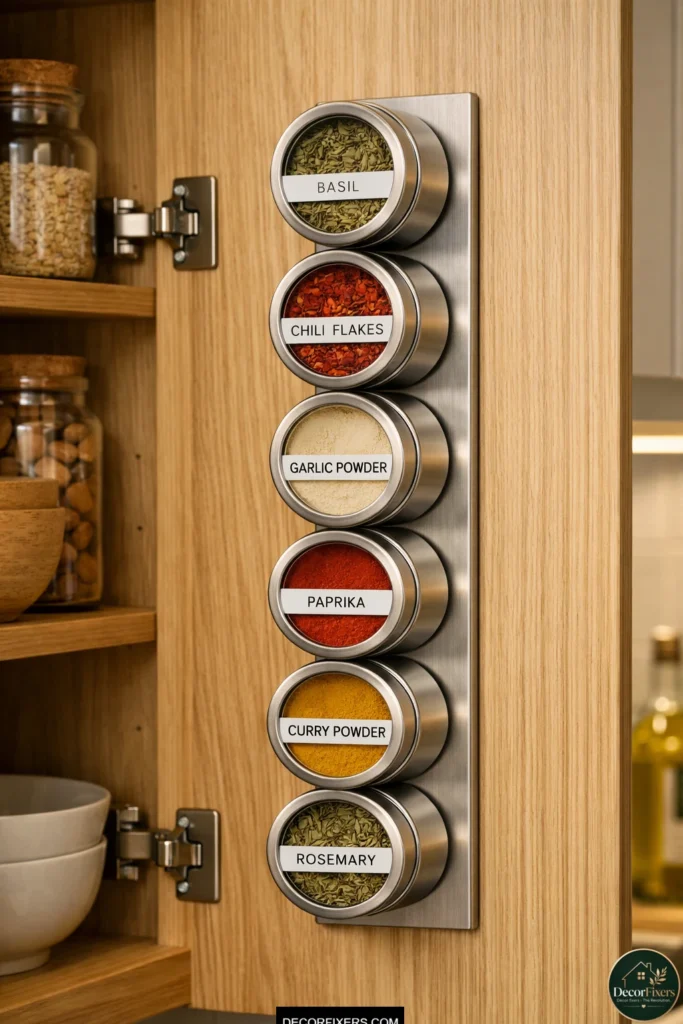
The inside surface of a base cabinet door is 12 to 15 inches of storage you’re using for nothing. Magnetic spice rail systems, a strip of magnetic metal with matching labeled magnetic tins, mount inside that door surface and hold 15 to 20 spice jars in a space that was previously air.
IKEA’s KUNGSFORS magnetic rail and container set runs under $30 for the basic version. The payoff: your upper cabinet or counter spice collection moves inside a door, and you get that shelf or counter space back.
17. Pull-Out Trash and Recycling Cabinet Under the Sink
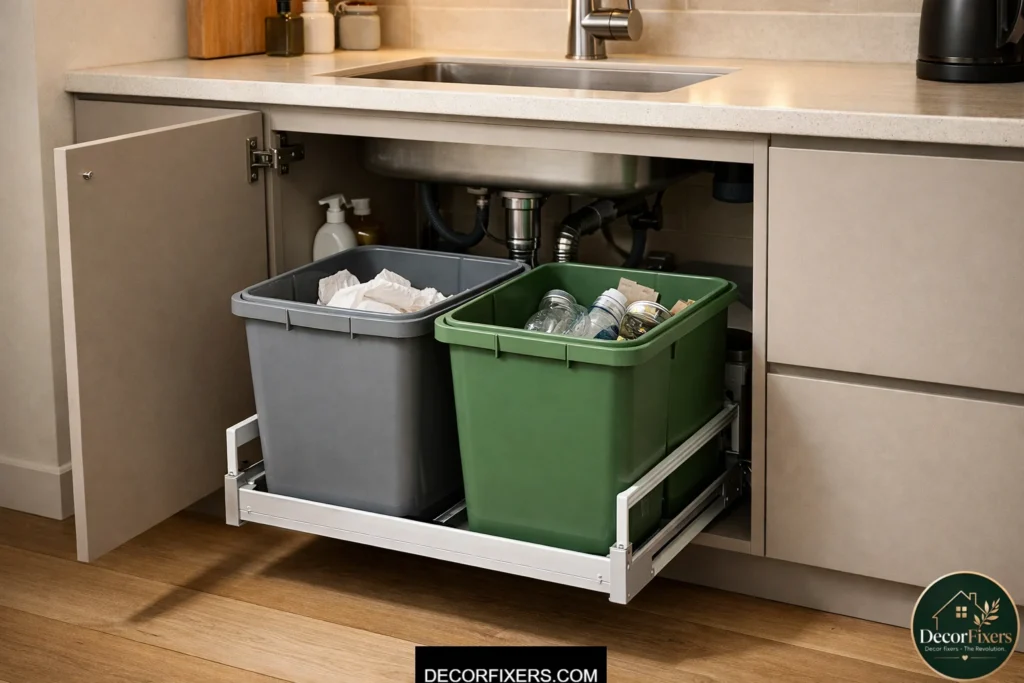
A freestanding trash can occupying 2 square feet of floor space is one of the most expensive things in your kitchen, expensive in square footage terms. A pull-out under-sink trash and recycling system mounts inside the base cabinet beneath the sink and pulls out on a drawer runner, keeping both a trash bin and a recycling bin organized and concealed.
Rev-A-Shelf’s double bin pull-out (14-inch width) runs $60 to $120 and fits most standard 36-inch sink base cabinets. This frees the floor footprint of your current trash can for a cart, a step stool, or simply walking space.
18. Full-Height Pantry Cabinet in a Single Column
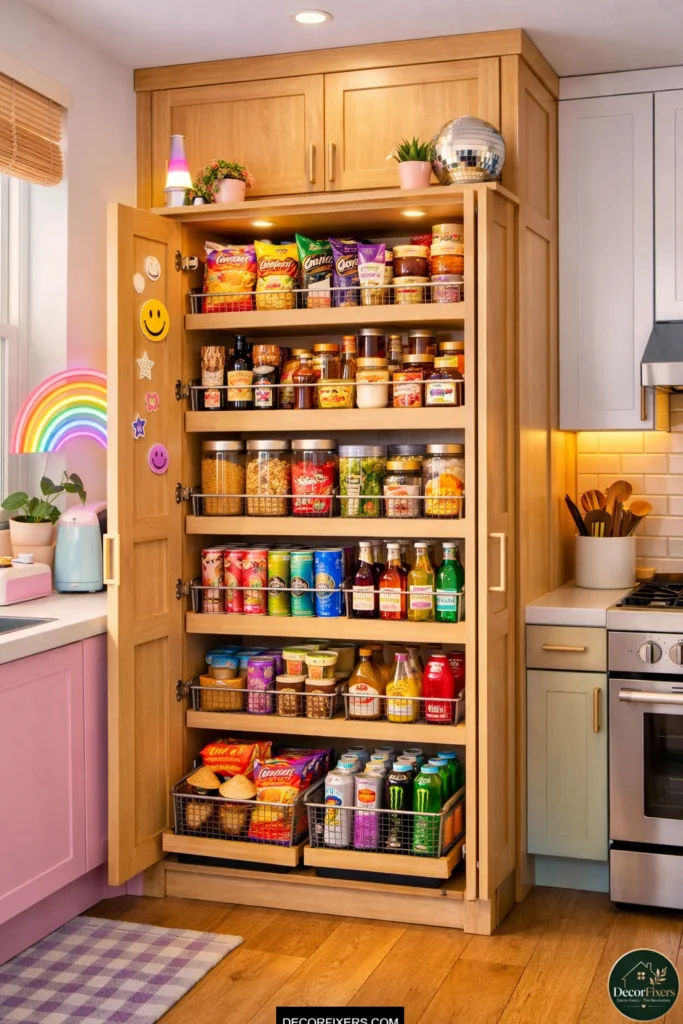
If you have even 12 inches of free wall space at the end of a cabinet run, a tall pantry cabinet (typically 84 to 90 inches high, 12 to 18 inches deep) does the storage work of three standard upper cabinets stacked in a single footprint.
IKEA’s SEKTION tall cabinet in 12-inch depth runs under $400 for the box, and configured with adjustable shelves and pull-out drawer inserts, it handles dry goods, cleaning supplies, small appliances, or all three. This is the cabinet equivalent of going vertical, maximum storage, minimum floor space.
19. Cabinet Refacing on a Tight Budget, Refresh Without Replacing
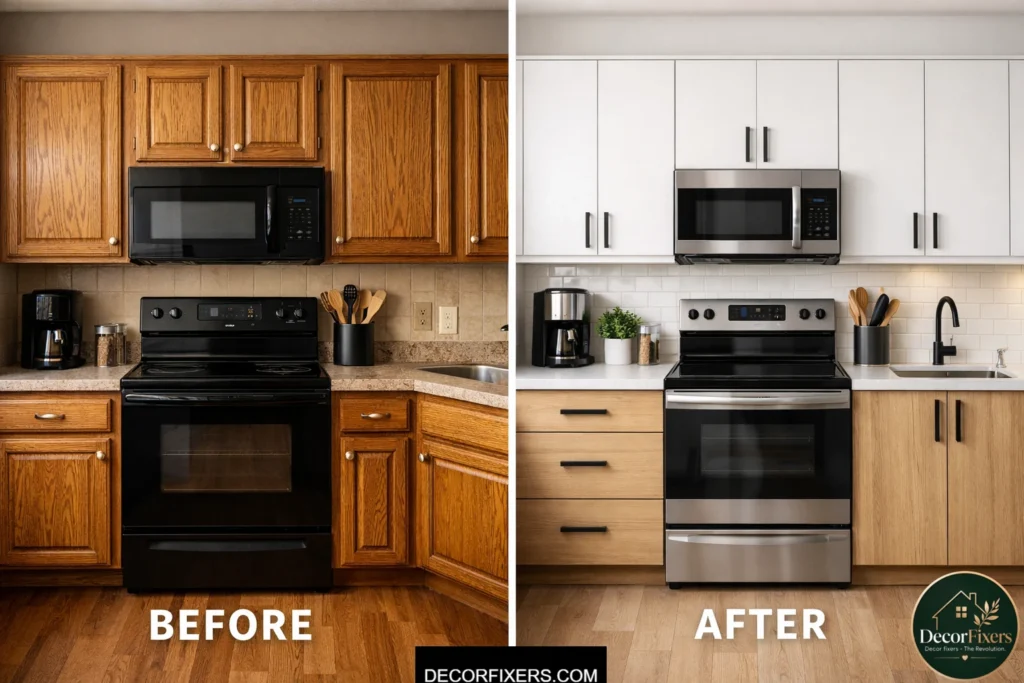
Cabinet refacing, replacing only the doors, drawer fronts, and visible side panels while keeping the existing box structure, costs 50 to 70% less than full cabinet replacement. For a small kitchen with structurally sound boxes, this is the single highest-ROI cosmetic upgrade available. Refacing companies typically charge $1,500 to $4,500 for a small kitchen.
The DIY version (replacing door fronts yourself) can drop that under $800 using IKEA door fronts, which are sold separately from the SEKTION box and mount on standard European hinges. The one thing most guides skip: refacing is purely cosmetic. If your layout is the problem, refacing just makes the bad layout look prettier.
20. Shallow Wall Cabinets Above the Sink Window
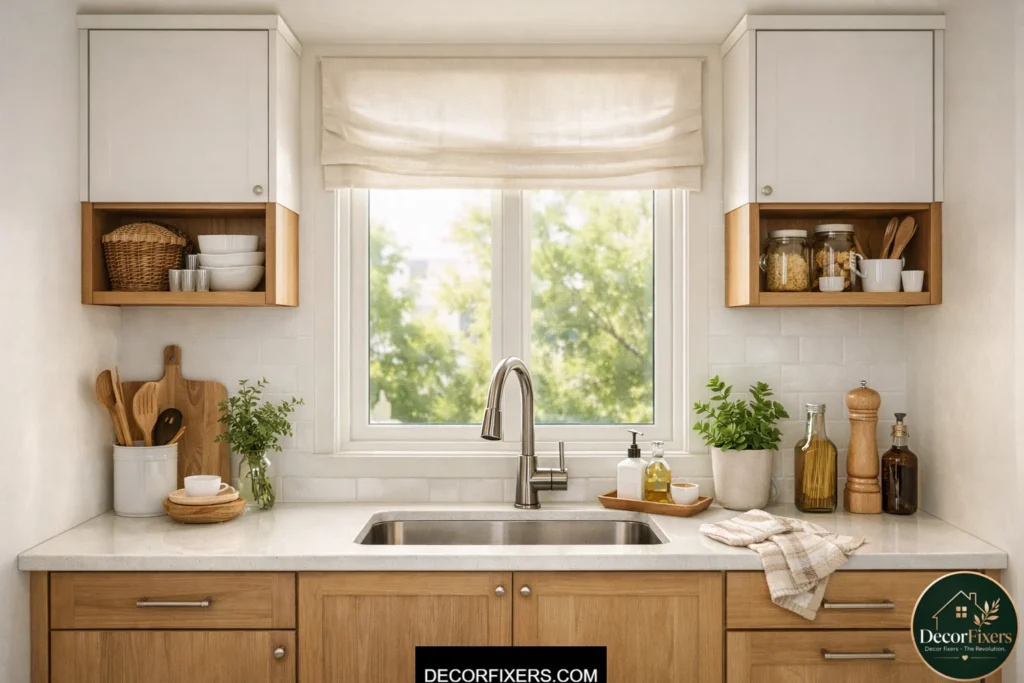
The wall directly above your sink, if it has a window, is usually left bare or decorated with a small shelf. A pair of shallow (12-inch deep) wall cabinets flanking the window, instead of centering a single cabinet above it, gives you two organized storage zones without blocking natural light.
IKEA SEKTION wall cabinets in 15-inch depth are nearly flush with most window frames and create a custom built-in look without the custom built-in price. Use this zone for glasses, everyday dishes, or frequently grabbed items. The direct above-sink placement means less carrying distance for wet hands.
21. Appliance Garage Under Upper Cabinets
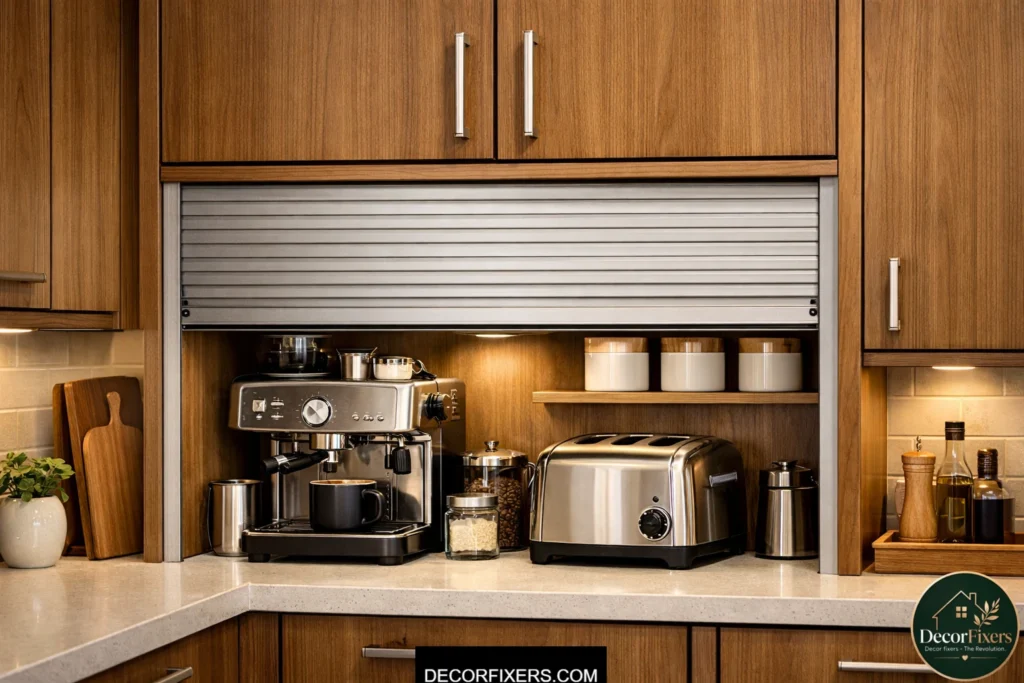
A countertop appliance garage, a small enclosed cabinet section with a roll-up or fold-up door that sits on the counter under your uppers, hides your coffee maker, toaster, or blender in a dedicated zone and lets you close the door on kitchen clutter when you’re done.
IKEA SEKTION customizers and woodworkers on Etsy sell pre-built appliance garage inserts compatible with SEKTION upper cabinets for $150 to $400. The appliance stays plugged in, stays in place, and completely disappears when the company comes. In a small kitchen, this is a genuine sanity upgrade.
22. Peg Drawer Inserts for Plate and Bowl Organization
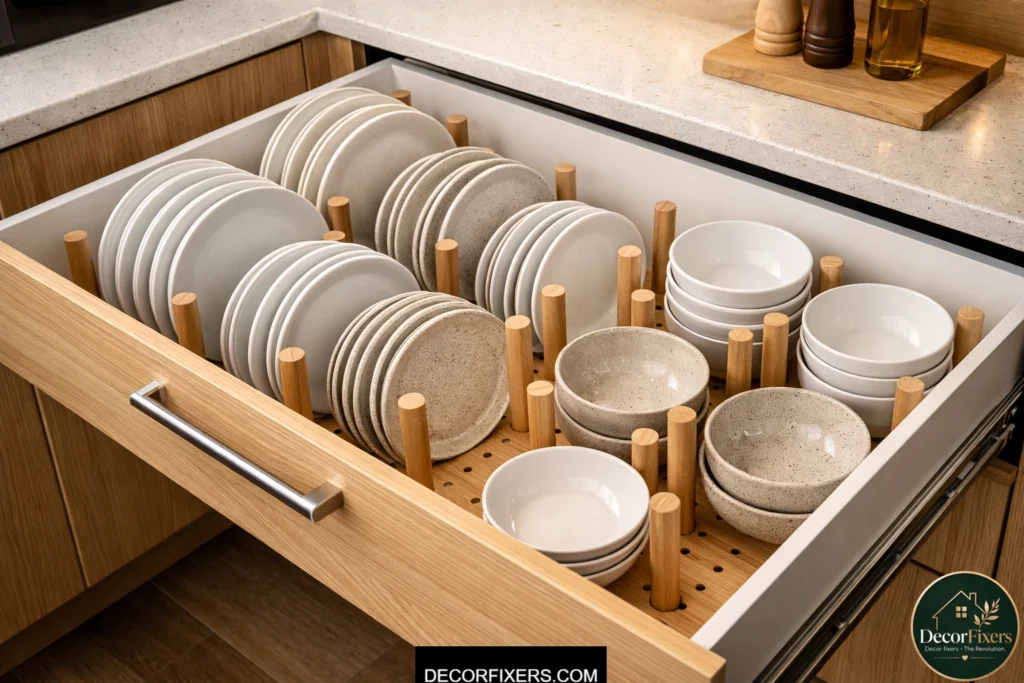
Deep base drawers are only as useful as what’s inside them. Without organization, a 24-inch deep drawer becomes a second version of the cluttered cabinet it replaced. Peg drawer inserts, adjustable wooden or rubber-tipped pegs that create custom compartments for plates, bowls, and lids, transform a generic drawer into a precision storage tool.
IKEA’s VARIERA and ORGANIZE series offer peg insert systems starting at around $20 to $40. Rev-A-Shelf makes a higher-end version ($60 to $100) with stainless pegs. Either way, plates stored flat in a drawer take half the vertical space they need standing upright in a cabinet, and retrieval time drops from 15 seconds of digging to a two-second grab.
23. Under-Cabinet LED Strip Lighting for Visual Space Expansion
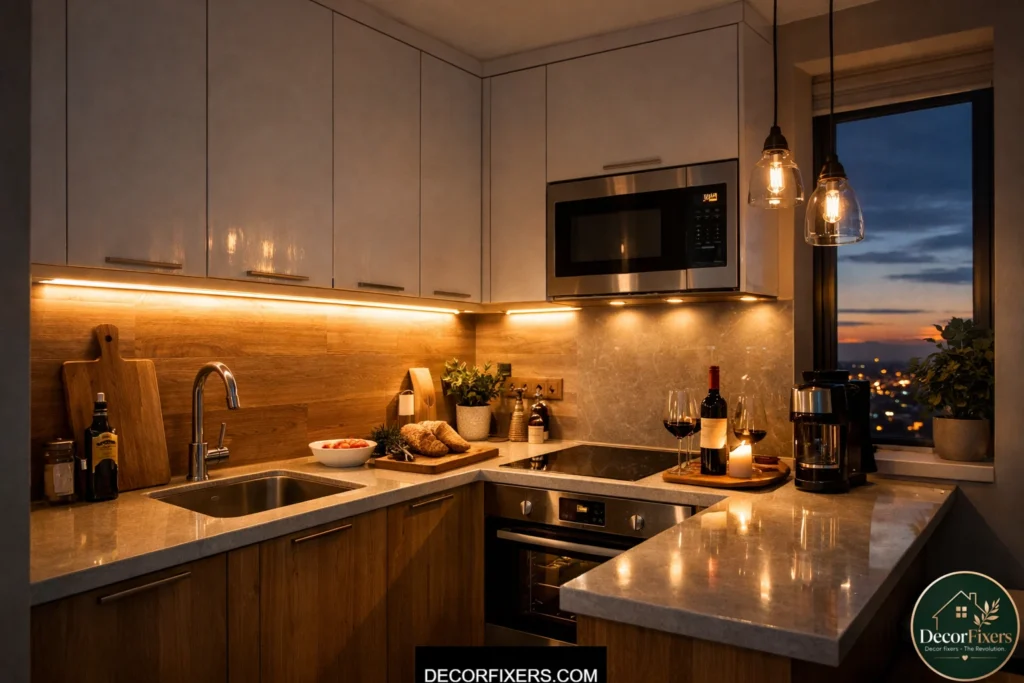
Under-cabinet LED lighting does two things in a small kitchen: it illuminates the counter work surface (genuinely useful for prep), and it creates the perception of a taller room by brightening the zone between the counter and the lower edge of the upper cabinets.
LED strip lighting reduces energy use by up to 75% compared to older under-cabinet fluorescent fixtures, and plug-in versions require zero electrical work.
A full run of under-cabinet LED strips for a 10-foot galley kitchen costs $30 to $80 in materials. This is one of the easiest $40 improvements you can make to both the functionality and the perceived scale of a small kitchen.
24. White Oak or Light Wood Cabinet Fronts to Open Up the Space
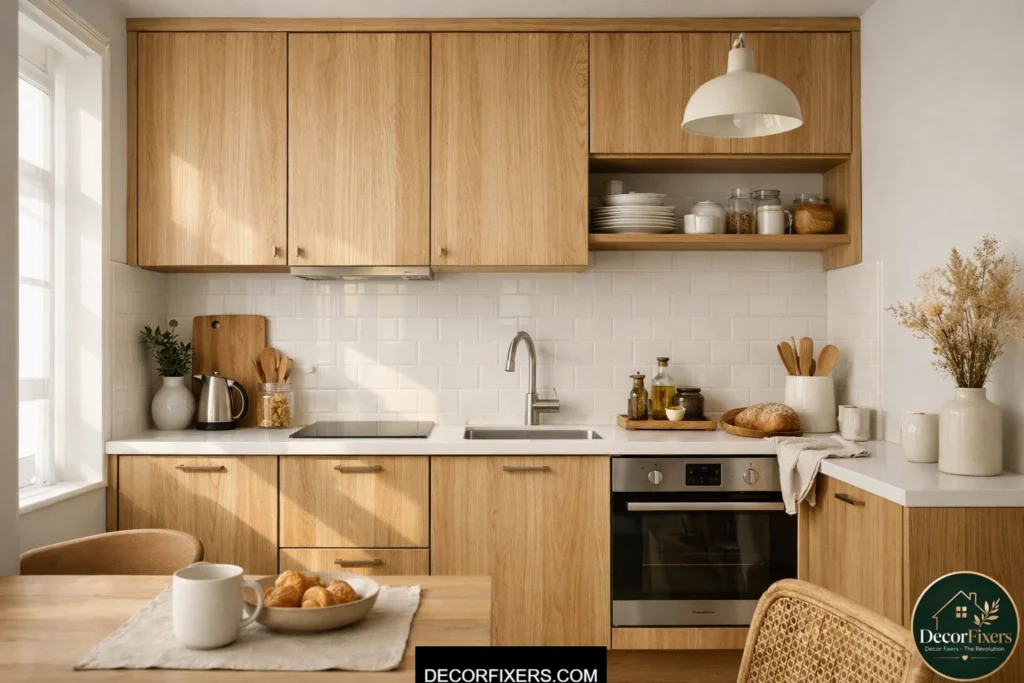
The NKBA 2025 Kitchen Trends Report is unusually specific on this one: white oak is the clear favorite cabinet finish for 2025, cited by 59% of industry professionals.
In a small kitchen, this preference isn’t arbitrary; light wood grain finishes reflect natural light, read as warm rather than cold (unlike stark white), and add the visual texture that makes a kitchen feel designed rather than default.
For budget application, consider IKEA’s Tistorp or Enköping door fronts for SEKTION, both of which carry a wood-look finish at under $100 per door. Natural warmth without the lumber yard price tag.
25. Integrated Pull-Out Spice Drawer Next to the Stove
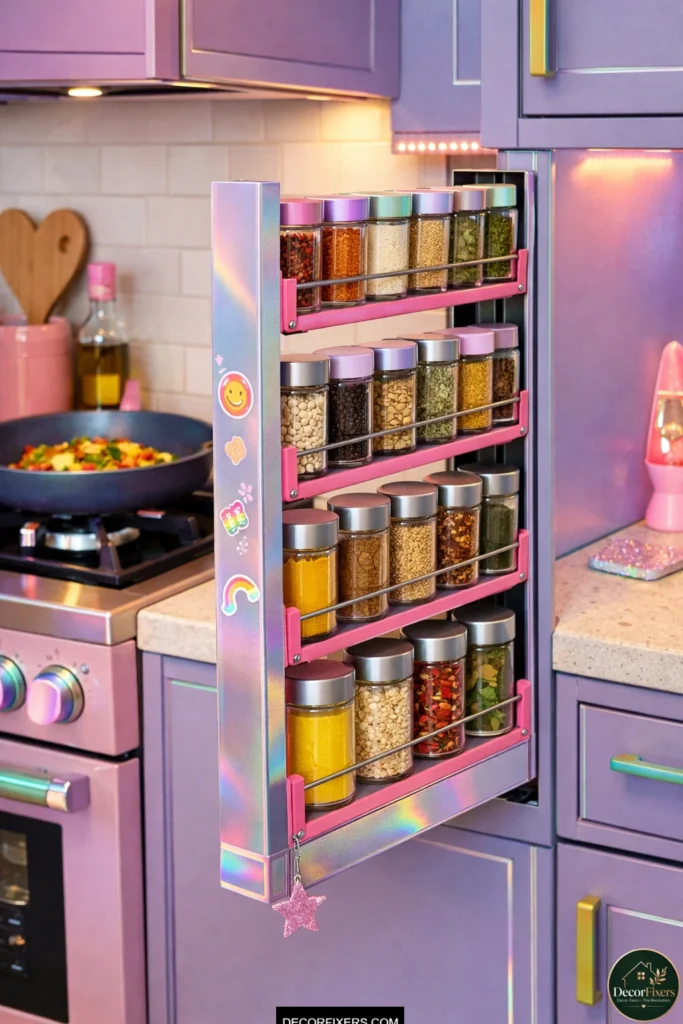
The 3 to 6-inch gap that often exists between a stove and an adjacent base cabinet is prime real estate for a narrow pull-out spice rack. Rev-A-Shelf sells single-column pull-out spice racks in 3, 6, and 9-inch widths, ranging from $40 to $120.
These mount inside an existing narrow base cabinet or in a purpose-built gap cabinet and keep your 20 most-used spices within arm’s reach of the burners. No more excavating the back of a shelf in the middle of cooking.
This is one of those upgrades where the actual time saved per week, maybe 5 minutes total, seems trivial until you realize it’s 4 hours per year of your life spent looking for cumin.
26. Cabinet Crown Molding to Create a Built-In Look on a Stock Budget
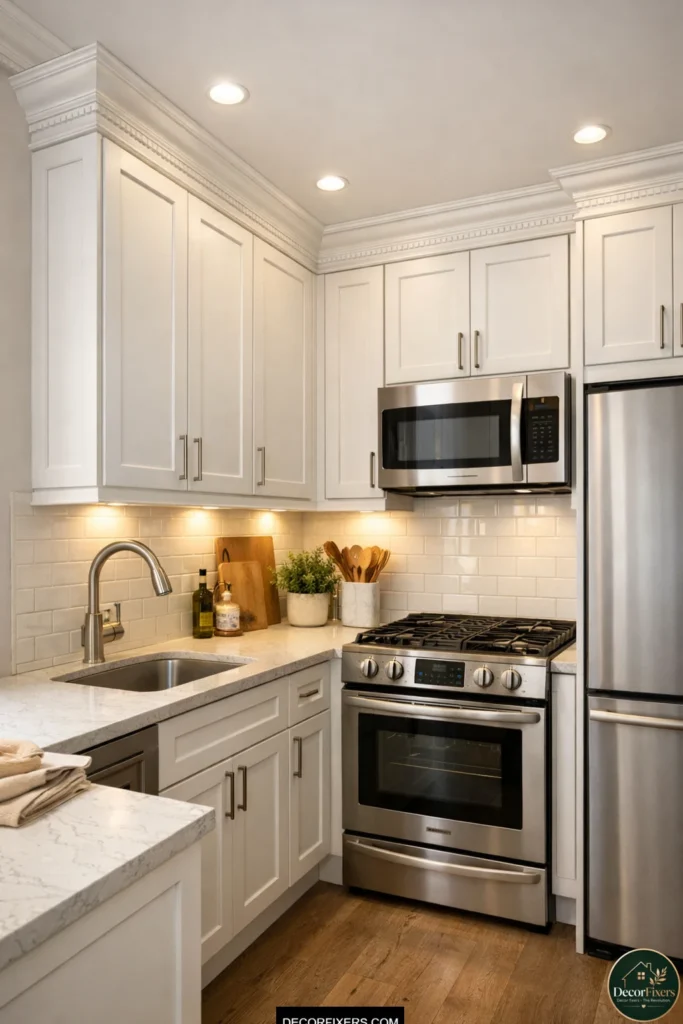
Stock cabinets stop 12 to 18 inches below the ceiling and look like what they are: stock boxes stuck to a wall. Crown molding bridging that gap transforms the same cabinets into something that reads as a built-in; the visual difference is significant, and the material cost is $30 to $80 in molding plus a few hours of installation.
This is one of the most cost-effective ways to elevate budget kitchen cabinets without touching the cabinets themselves. For painted cabinets, use MDF crown molding (paintable, moisture-resistant, inexpensive). For wood-look fronts, match the species with a wood or wood-look veneer molding.
27. Mirrored or High-Gloss Cabinet Fronts on One Wall
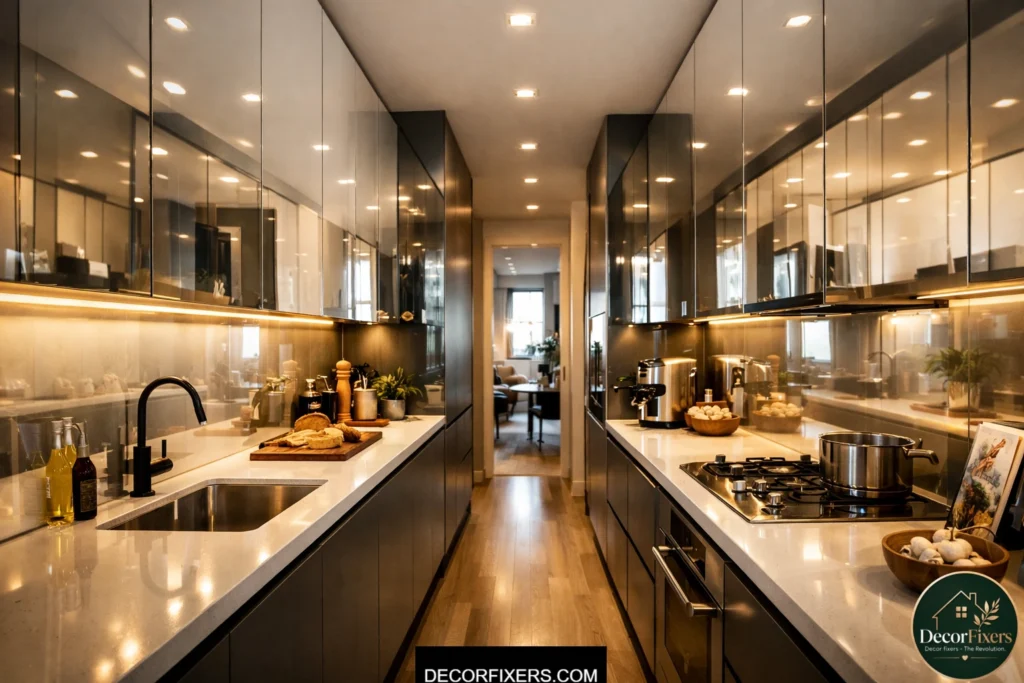
High-gloss cabinet fronts, particularly on upper cabinets, reflect light and visually double the perceived width of a narrow galley. IKEA’s VOXTORP high-gloss finish (available in several colors, including white and dark brown) is the most accessible budget entry to this look.
You don’t need to go all-in: applying high-gloss fronts on one wall (usually the longer upper run) while keeping matte or wood-tone fronts elsewhere creates contrast that actually reads as more sophisticated than a uniform finish throughout. Mirror-fronted upper cabinets achieve the same spatial effect but require professional installation to stay level, not worth the complication for most renters.
28. Open Corner Shelf Unit as an Alternative to a Corner Cabinet
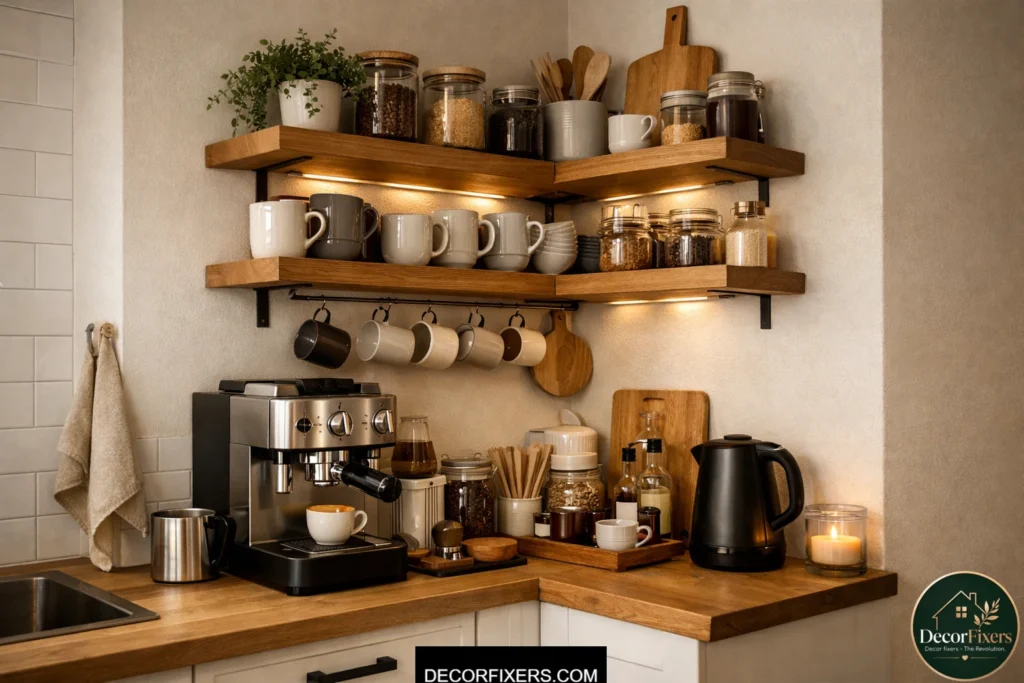
Instead of wrestling with a corner cabinet (lazy Susan, magic corner, blind base, all expensive, all imperfect), consider replacing the corner base with an open corner shelf unit at counter height.
This creates a small prep nook or display area, removes the awkward door-swing conflict in tight kitchens, and costs almost nothing if you build a simple bracket shelf. The trade-off is open storage, so whatever goes here is always visible.
Best use case: A dedicated coffee station corner where the espresso maker, mugs, and small containers are items you genuinely want accessible and don’t mind displaying.
29. Cabinet Door Organizers for Cleaning Supply Storage
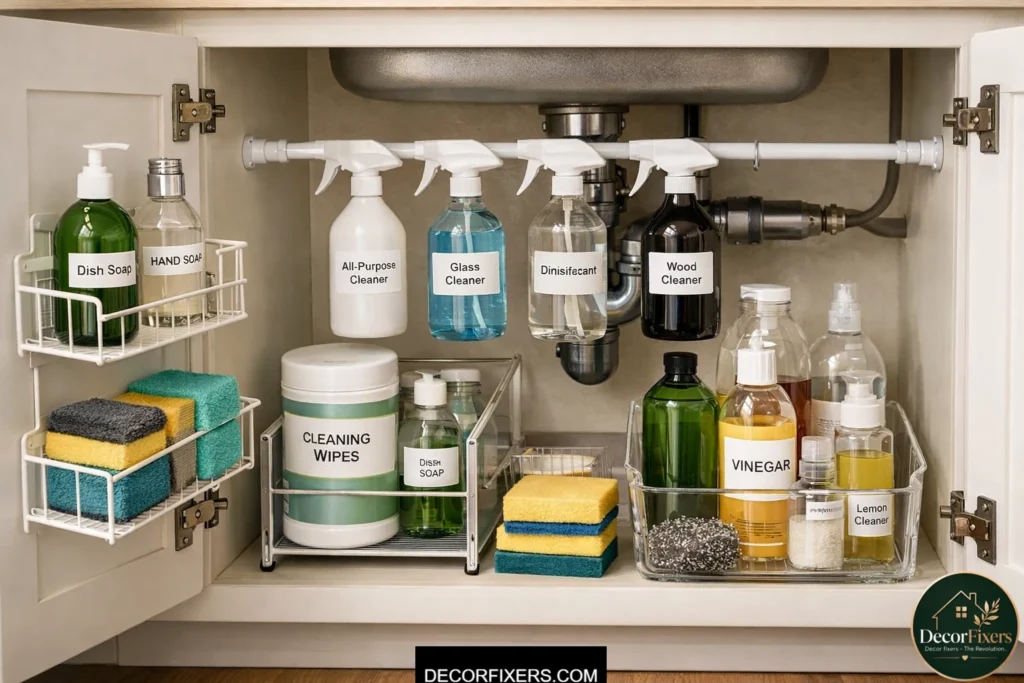
The inside of your sink base cabinet door is almost always bare. Mounting an over-door organizer on that surface ($10 to $30 from any hardware store or IKEA’s VARIERA range) creates a dedicated zone for cleaning sprays, dish soap, and sponges that currently sit on the counter or get jumbled in the bottom of the sink cabinet.
Pair this with an under-sink tension rod (about $5) to hang spray bottles by their trigger; both items together cost under $20 and clear the counter of at least four regularly used cleaning products.
30. Magnetic Cabinet Door Dampers and Soft-Close Hinges as a Finishing Upgrade
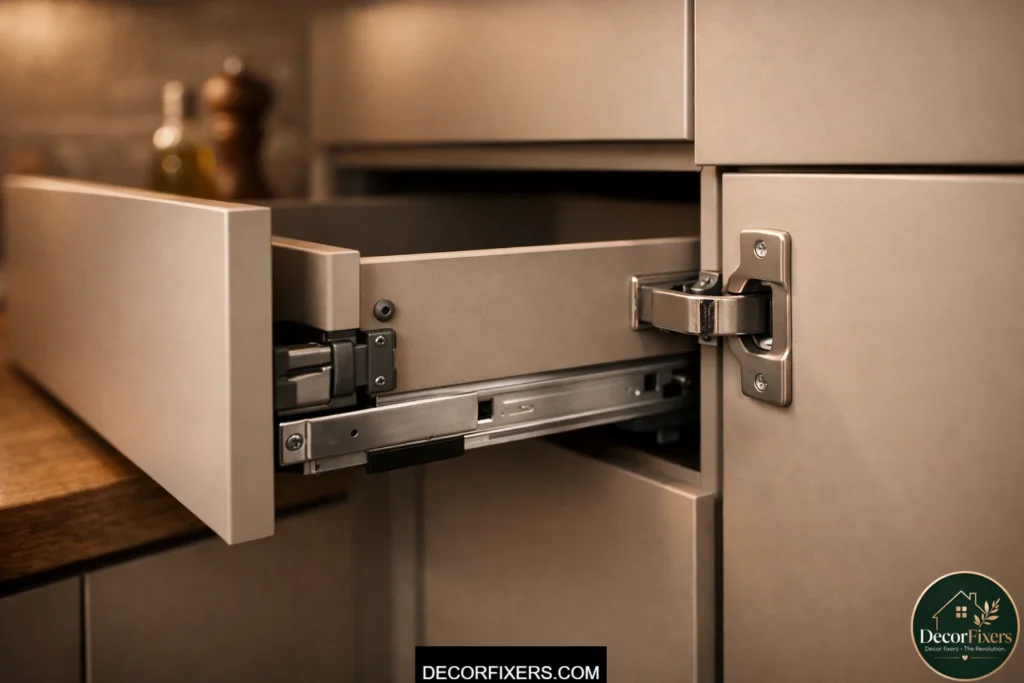
This is the last thing you install and the first thing you’ll notice every single day. Soft-close hinges ($1.50 to $4 per hinge) retrofit onto almost every existing cabinet hinge mount and transform a kitchen that slams and rattles into one that closes quietly and precisely.
Combined with soft-close drawer runners ($8 to $25 per pair), this upgrade makes stock or RTA cabinets feel like semi-custom cabinetry without changing a single visual element. For a 15-cabinet small kitchen, the full retrofit costs $80 to $150 and takes an afternoon. It’s the last 2% of a cabinet upgrade and delivers 20% of the daily satisfaction.
The Budget Reality: What Cabinets Actually Cost in a Small Kitchen
Before we get into specific designs, let’s talk money, because most of the guides you’ve already read skip this conversation entirely, and that’s why people end up surprised at checkout.
Cabinets typically account for approximately 41% of total kitchen remodel costs (Highland Cabinetry, 2026 analysis). In a $10,000 small-kitchen upgrade, that’s roughly $4,100 going toward cabinetry alone, which is why choosing the right cabinet system upfront matters more than any single accessory decision.
For a small kitchen under 100 sq ft, here’s a realistic budget framework:
- IKEA SEKTION full set (materials only): $2,000 to $4,000 for a standard 10×10 layout
- RTA Cabinets (RTA Cabinet Store or similar): $2,000 to $6,000, depending on door style and finish
- Stock cabinets from Home Depot or Lowe’s: $3,000 to $7,000 installed
- Cabinet refacing: $1,500 to $4,500 for a small kitchen
- Pull-out inserts (Rev-A-Shelf, etc.): $30 to $300 per unit; these are where you squeeze out extra functionality without a full rip-out
Quick note: IKEA installation labor adds $1,000 to $2,500 on top of materials. If you’re handy and have a patient helper, DIY assembly typically takes two adults about eight hours for ten cabinets, a real weekend investment but a real cost saving.
HOW TO MAXIMIZE STORAGE IN A SMALL KITCHEN, 5 Steps:
- Measure every wall and note window/door locations before ordering any cabinets.
- Choose a cabinet system (IKEA SEKTION, RTA, or stock) based on your budget and layout constraints.
- Replace at least 50% of lower door cabinets with deep drawer units.
- Add vertical storage, floor-to-ceiling uppers, or a single tall pantry column.
- Install pull-out inserts (lazy Susan, spice pull-out, under-sink organizer) to eliminate dead space.
Is It Cheaper to Buy or Build Kitchen Cabinets?
Buying pre-made cabinets, stock or RTA, is almost always cheaper than building custom cabinets for a small kitchen budget. Custom built-in cabinetry runs $500 to $1,200 per linear foot installed, compared to $100 to $400 for stock and $150 to $700 for semi-custom RTA units.
The exception: if you have basic woodworking skills and access to a table saw, DIY-building simple open shelving or a single freestanding pantry unit from lumber and plywood can cost as little as $100 to $300 in materials, well below any comparable purchased unit. For structural base and wall cabinets, though, the time-to-quality ratio almost always favors purchasing over building.
According to HomeGuide’s 2026 pricing data, the cheapest entry point for installed kitchen cabinets is basic stock units in synthetic materials starting at $60 to $70 per linear foot, roughly one-eighth the cost of high-end custom alternatives. For a small kitchen with 15 to 20 linear feet of cabinetry, that’s a $900 to $1,400 floor for materials before installation labor.
How Do I Maximize Storage in a Small Kitchen Without a Full Remodel?
The highest-impact changes that don’t require a full cabinet replacement are: adding pull-out shelf inserts to existing base cabinets ($30 to $80 each), installing toe-kick drawers ($60 to $90 per unit), mounting a tension-rod system under the sink for cleaning spray storage ($5), and adding a freestanding pull-out pantry in any gap wider than nine inches ($150 to $250). These four changes together cost under $500 and address the three most common small kitchen complaints: inaccessible base cabinet storage, lost corner space, and counter clutter.
What most guides skip: the order matters. Fix the layout problem first (swap shelves for drawers), then address the dead spaces (corners, toe kicks, gaps), then add organizational inserts. Doing it in reverse order, buying organizers before fixing the cabinet system, means you’re organizing chaos instead of building efficient storage.
Conclusion:
Looking back at that kitchen, the one that gave me the $22,400 quote and the corresponding headache, I would have made three decisions faster and stopped overthinking the rest.
First, I’d have ripped out the base cabinets immediately and replaced them with drawer stacks. Every time I open a base drawer now, instead of crouching in front of a shelf, I feel it. It’s not a subtle upgrade.
Second, I’d have gone straight to IKEA SEKTION for the box and a Rev-A-Shelf pull-out pantry for the gap beside the fridge. Both decisions together cost less than one contractor’s estimate for labor alone.
Third, and this is the honest part, I’d have stopped looking at Pinterest. Not because the images aren’t beautiful, but because they were solving for a different kitchen than mine. The open-shelf, marble-backsplash, 12-foot-island kitchens are real. They’re just not in apartments under 100 square feet, and designing for the kitchen you have instead of the kitchen you’ve bookmarked is the actual mindset shift this whole thing requires.
The 30 ideas in this guide aren’t a checklist. Pick five that match your layout, your budget, and, honestly, your tolerance for DIY. Start with the drawer-dominant lower cabinet swap if you’re doing it properly, or start with a Rev-A-Shelf pull-out pantry if you need a win this weekend without a contractor. Either way, you’re solving the real problem: your small kitchen isn’t failing because it’s small. It’s failing because the storage system inside it wasn’t designed for daily life.
Fix the system. The rest follows.
FAQs:
Q: What’s the best cabinet layout for a small galley kitchen?
A: A galley layout works best with full-height uppers on the longer wall, drawer-dominant base cabinets on both sides, and at least 42 inches of clearance between the two runs. Avoid upper cabinets on both sides if your kitchen is under 8 feet wide; the visual compression makes cooking feel claustrophobic.
Q: How do I add storage to a small kitchen without tearing out cabinets?
A: Install pull-out shelf inserts in existing base cabinets, add a narrow freestanding pull-out pantry in any available gap, mount magnetic spice rails inside door surfaces, and use toe-kick drawer kits beneath existing base cabinets. Cost: under $500, zero cabinet replacement.
Q: Should I use IKEA SEKTION or RTA cabinets for a small kitchen budget?
A: IKEA SEKTION is the better choice if you want to see and touch the product before buying, need a specific modular configuration, or prefer in-store design help. RTA cabinets win if you want higher-quality drawer construction (dovetail joints, solid wood) at a similar or lower price and are comfortable ordering online. Both systems fit a $3,000 to $8,000.
Q: Why does my small kitchen feel cluttered even after organizing?
A: Most kitchen organization focuses on what’s visible rather than fixing the underlying cabinet system. If your base cabinets are door-and-shelf units, no amount of basket-and-bin organizing will give you the retrievable, clutter-free storage that deep drawer units provide. The clutter problem is usually a layout problem in disguise.
Q: When should I hire a kitchen designer for a small kitchen remodel?
A: Hire a designer when your kitchen has an unusual layout (odd angles, multiple doorways, structural walls), when you’re considering moving plumbing or electrical, or when your budget exceeds $10,000 and the decisions feel overwhelming. For a straight stock or RTA cabinet installed in a standard galley or L-shape, most homeowners can execute a successful design using IKEA’s online kitchen planner without paid design help.

Creator of DecorFixers, sharing practical home and interior ideas focused on real-life usability, simple design improvements, and budget-friendly solutions.
1 thought on “30 Small Kitchen Cabinet Designs for Small Spaces on a Budget”