


I moved into my first city apartment at 27 and made every lighting mistake you can think of.
One massive arc floor lamp was shoved in the corner. A single warm Edison bulb overhead. A dimmer switch I installed myself that buzzed every time I turned it on. The room felt like a cave, but a trendy cave, I kept telling myself. It wasn’t until I started deliberately layering light, three sources, different heights, different purposes, that the room finally felt like an actual living room instead of a storage unit where I also watched TV.
That one shift changed everything. And it didn’t cost me a security deposit.
If your small living room still feels flat, dim, or smaller than it should, even after you’ve bought a lamp or two, this guide is for you. These 15 ideas are sequenced the way a lighting designer actually thinks: start with your base layer, then build up. By the end, you’ll have a real plan, not just a shopping list. Before investing in new fixtures, it helps to think about lighting as part of your overall Budget Living Room Decor strategy, since the right lighting often delivers a bigger visual impact than expensive furniture upgrades.
What Is Layered Lighting for a Small Living Room?
Layered lighting for small living rooms means using three distinct types of light: ambient (general), task (functional), and accent (decorative), placed at different heights across the room. Each layer serves a separate purpose, and together they eliminate the flat, one-source effect that makes compact spaces feel smaller.
1. Start With the Right Color Temperature (This Comes Before Any Fixture)
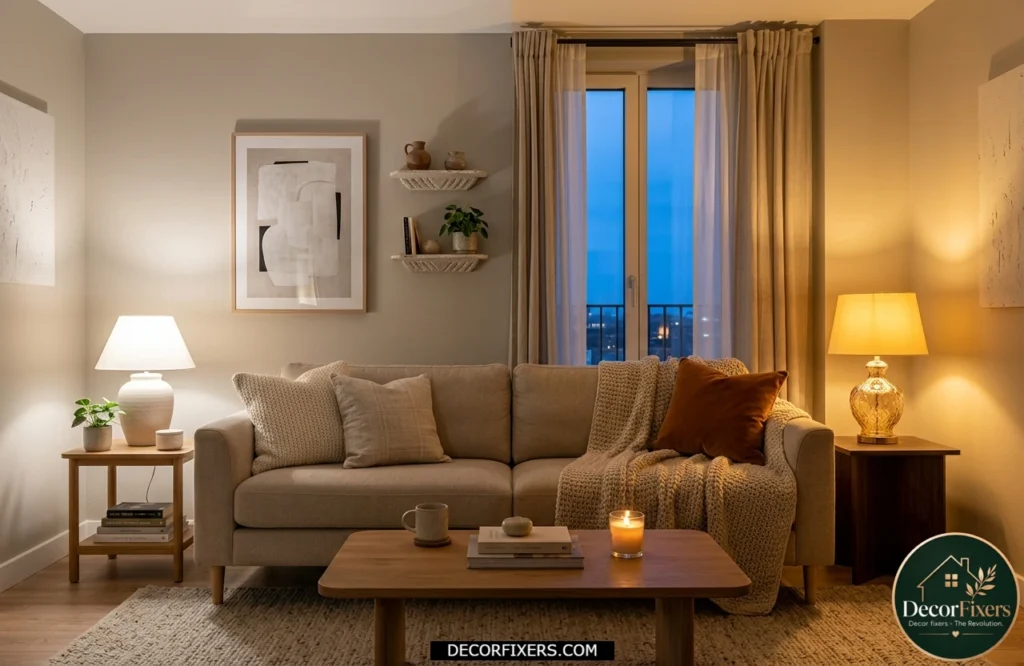
Most people pick a lamp, then a bulb. That’s backwards.
Color temperature is the single variable that decides whether your room feels warm and inviting or cold and clinical, no matter what fixture you put it in. For small living rooms, the sweet spot is 2700K to 3000K. That range sits between the glow of a traditional incandescent bulb (2700K) and a clean, modern soft white (3000K). It’s warm enough to feel residential, bright enough to avoid that yellow-muddy look you get with older bulbs.
Anything above 3500K starts to creep toward office lighting. Your room will look more spacious, technically, but it’ll feel sterile. And sterile is the enemy of cozy.
Your bulb selection should also complement your Living Room Color Schemes, as wall colours and lighting temperatures work together to influence how spacious and comfortable a room feels.
2. Add a Dimmer Switch Before You Add Any New Fixture
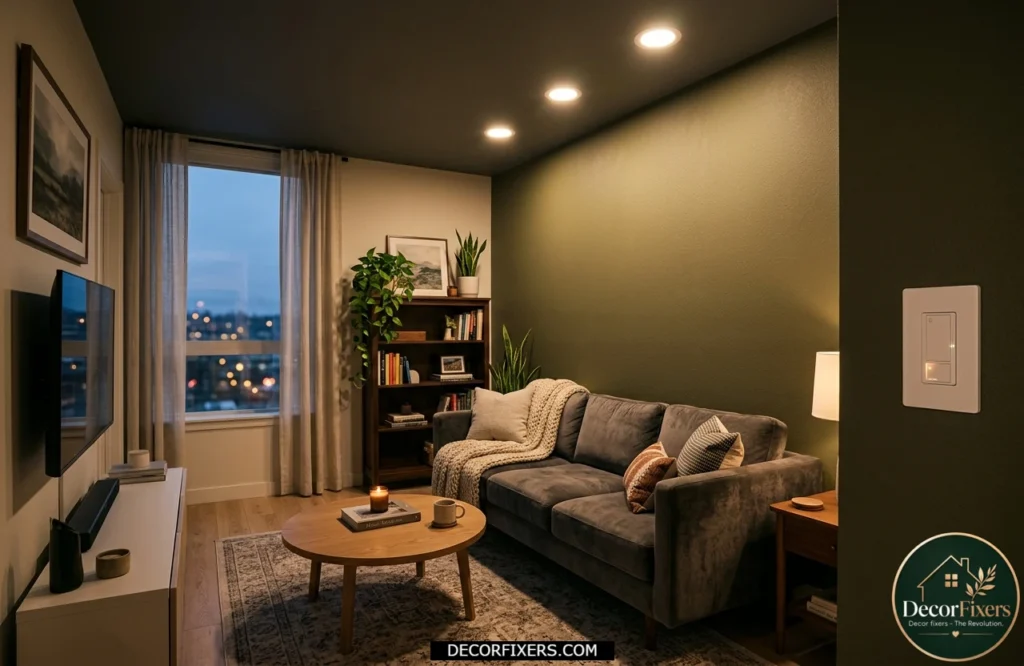
The Lutron Casetta dimmer switch is the most underrated upgrade in home lighting. Seriously.
Before you spend a dollar on a new lamp, dimming your existing overhead light will transform the room. A harsh ceiling fixture at full blast flattens everything. That same fixture at 40% brightness suddenly becomes the ambient base layer you’ve been missing, and it pairs with everything else you add. The Lutron Casetta works without neutral wiring in most apartments, and it installs in about twenty minutes. No electrician needed, no damage to the wall.
Here’s the thing: most renters skip this because it sounds complicated. It isn’t. It’s the highest-ROI lighting change you can make in a small living room.
3. Use an Arc Floor Lamp to Replace a Missing Overhead Light
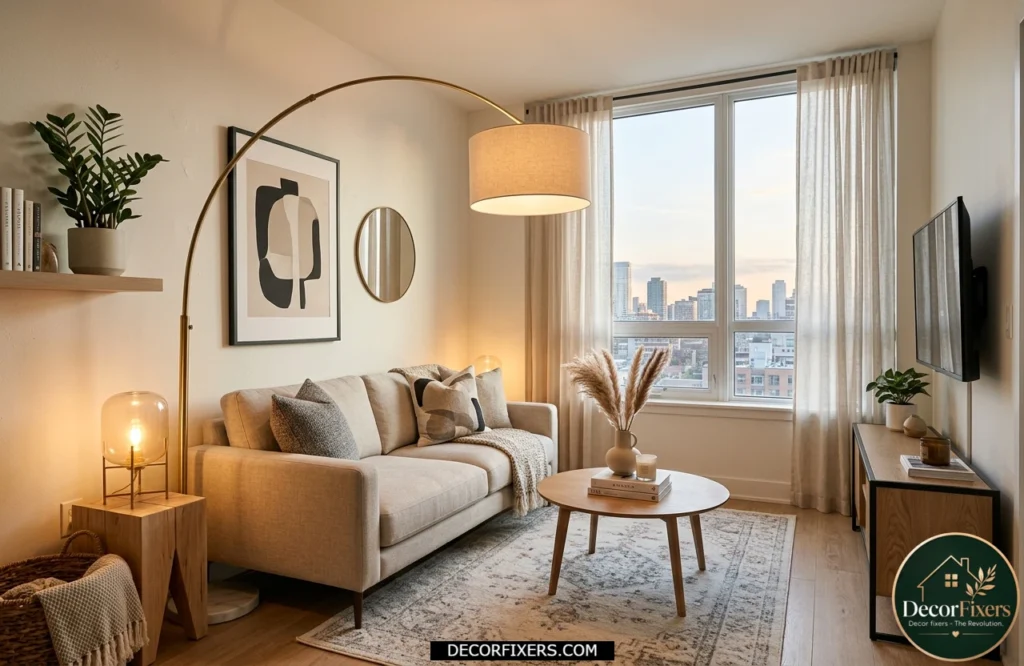
No overhead light at all? An arc floor lamp is the fix.
The arc floor lamp is the renter’s best friend precisely because it’s not on the ceiling. The long-curved arm extends over your sofa or seating area, casting downward ambient light exactly where you’d want a pendant or recessed fixture, without touching a single wire. In a room under 200 square feet, a single well-placed arc lamp at the back-left or back-right of your sofa becomes the dominant ambient layer. Look for models with an adjustable arm and a fabric or linen diffuser shade; these scatter light more evenly than metal or opaque shades.
4. Place Table Lamps at Two Different Heights on Opposite Sides of the Room
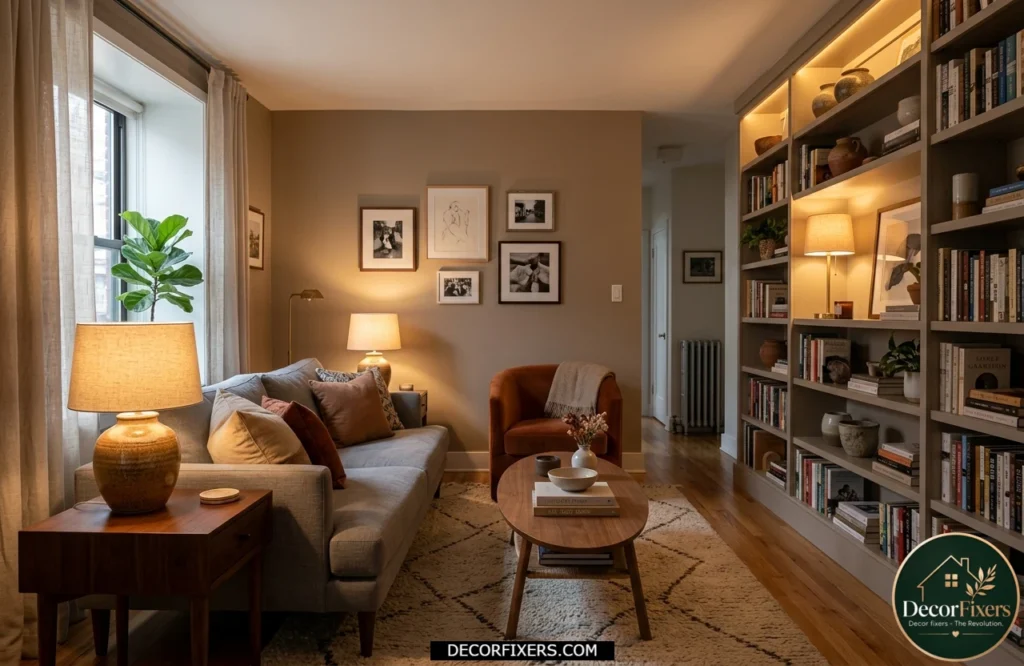
One table lamp creates one bright spot. Two table lamps at staggered heights create depth.
The placement matters more than the lamp itself. Put one lamp on a side table at sofa height (roughly 24–26 inches) and a second, shorter lamp on a bookshelf or console on the opposite wall at around 18–20 inches. This height difference produces what designers call a diagonal light line; the eye follows it across the living room, making the space appear longer and wider. IKEA’s RANARP lamp works perfectly as a budget-friendly option for one of these layers: it’s directional, has a minimal footprint, and you can angle it toward a wall to bounce light rather than beaming it straight down.
Quick Comparison: Renter-Friendly Lighting Options
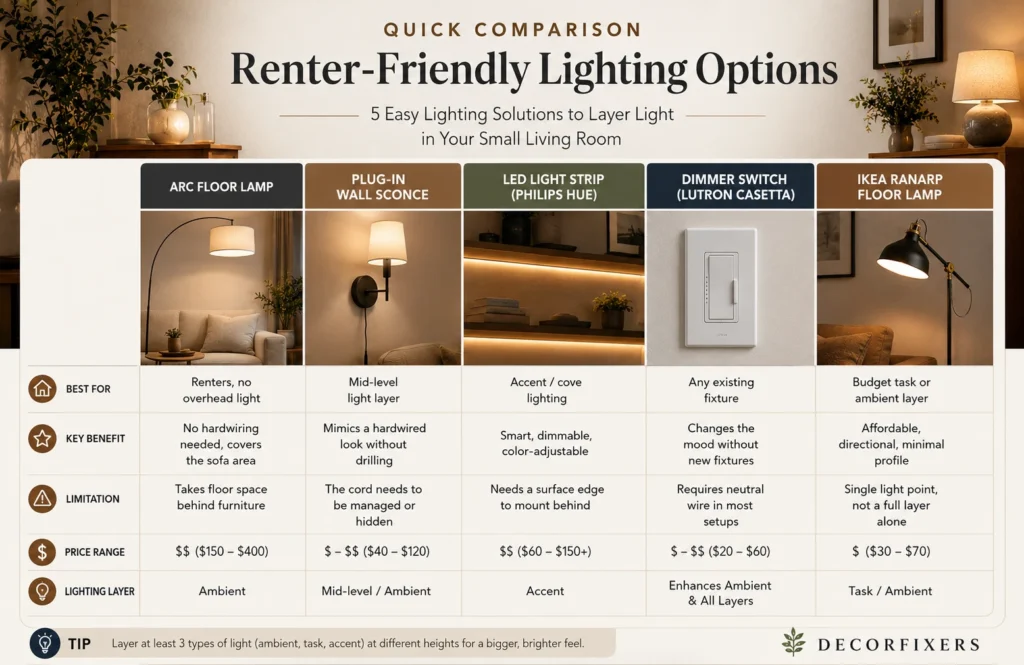
| Option | Best For | Key Benefit | Limitation |
| Arc Floor Lamp | Renters, no overhead light | No hardwiring needed, covers the sofa area | Takes floor space behind furniture |
| Plug-in Wall Sconce | Mid-level light layer | Mimics a hardwired look without drilling | The cord needs to be managed or hidden |
| LED Light Strip (Philips Hue) | Accent/cove layer | Smart, dimmable, color-adjustable | Needs a surface edge to mount behind |
| Dimmer Switch (Lutron Casetta) | Any existing fixture | Changes the mood without new fixtures | Requires neutral wire in most setups |
| IKEA RANARP Floor Lamp | Budget task or ambient layer | Affordable, directional, minimal profile | Single light point, not a full layer alone |
5. Use Wall-Washing to Make a Compact Room Feel Physically Larger
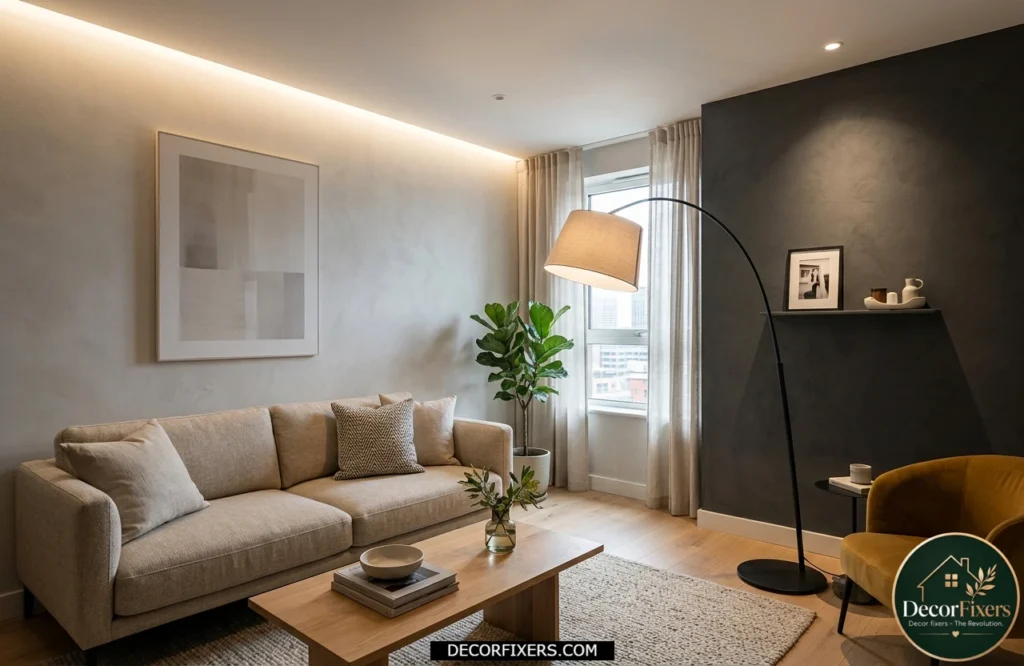
This is where the science gets interesting.
Wall-washing is simple. Point a floor lamp or a plug-in sconce toward a bare wall rather than outward into the room. The wall becomes a glowing, reflective surface. It pushes the perceived boundary of the room outward. In a small living room, wash your longest wall, usually behind or beside the TV, and the effect is immediate.
This technique becomes even more effective when paired with thoughtful Living Room Wall Decor, as artwork, mirrors, and decorative features can reflect and distribute light throughout the space.
6. Add Plug-In Wall Sconces to Build Your Mid-Level Light Layer
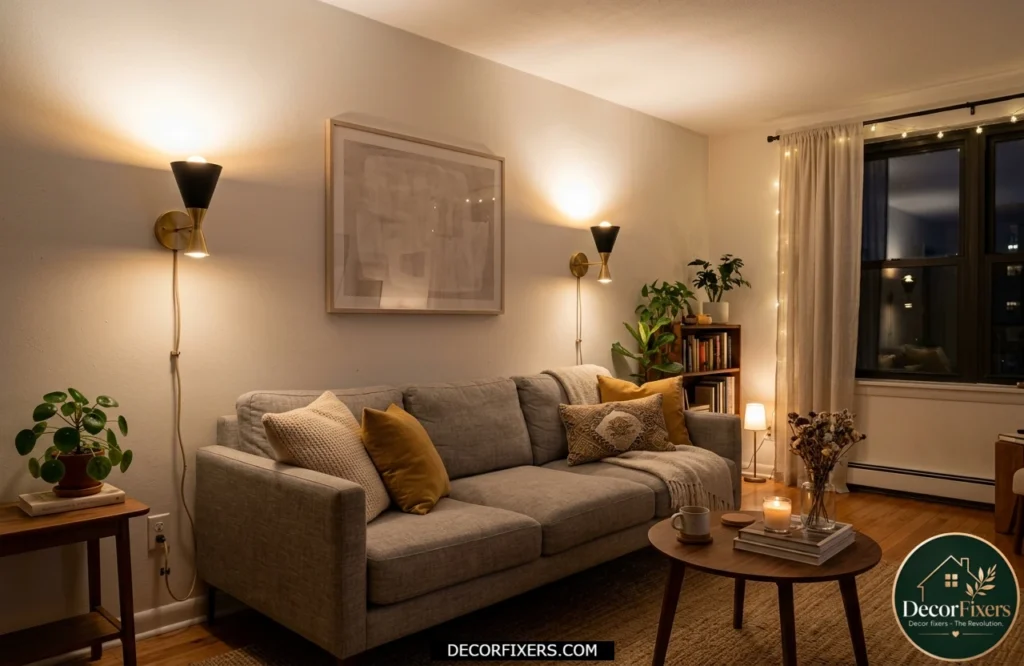
Most living rooms are lit from the top (ceiling) and the bottom (floor lamps). The middle is a dead zone.
Plug-in wall sconces solve this without any hardwiring. They mount to the wall with a single hook or adhesive strip, and the cord either runs behind furniture or gets dressed with a cord cover kit. Installed at about 60 inches from the floor, eye level when standing, they hit the mid-layer gap perfectly and prevent the top-heavy lighting scheme that makes low ceilings look even lower. Choose sconces with upward-facing shades: they bounce light toward the ceiling, which visually raises the room.
Look, if you’re renting and panicking about holes in the wall, command hook-style cord kits exist specifically for plug-in sconces. Zero damage. Fully reversible.
7. Use LED Light Strips Behind the TV or Along Shelving for an Accent Layer
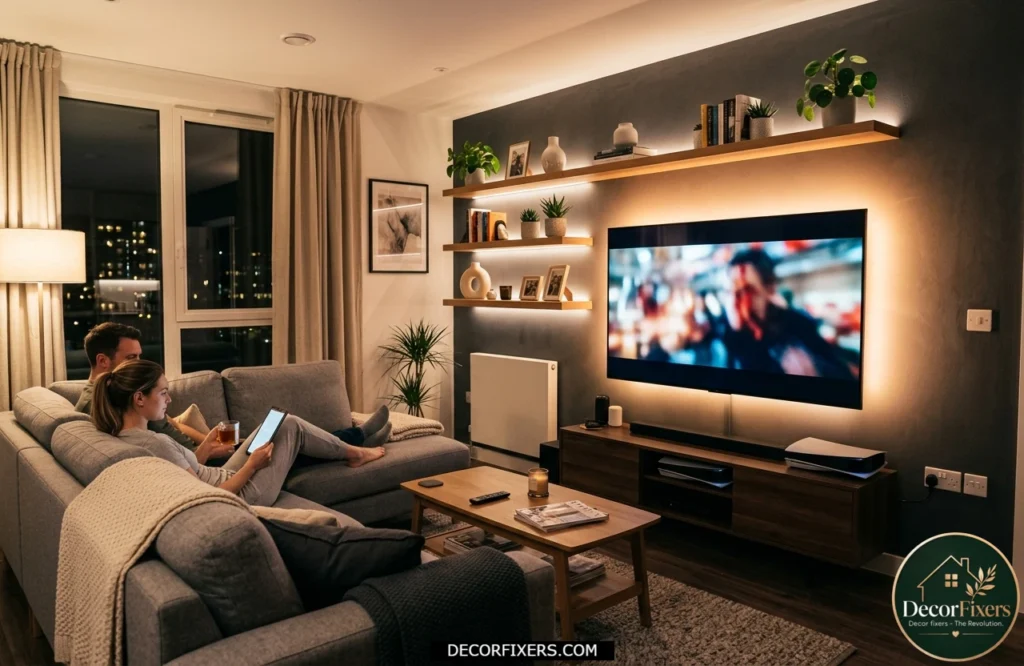
The accent layer is what makes a room look styled, not just lit.
Philips Hue gradient light strips are the easiest entry point here. Stick them along the back edge of a TV console, behind open shelving, or underneath a floating shelf. When you’re watching something in the evening, they cast a soft, warm halo that eliminates the harsh contrast between a bright screen and a dark room, and that contrast is one of the main reasons small living rooms feel uncomfortable at night. The gradient feature means the strip shifts color gradually, which looks more natural than a flat single-color strip. Set it to 2700K amber in the evenings, and it becomes a proper accent layer.
One caveat: don’t make this your only light source in the evening. Accent lighting works because it contrasts with, not replaces, ambient light.
8. Bounce Light Off the Ceiling with a Torchiere Floor Lamp
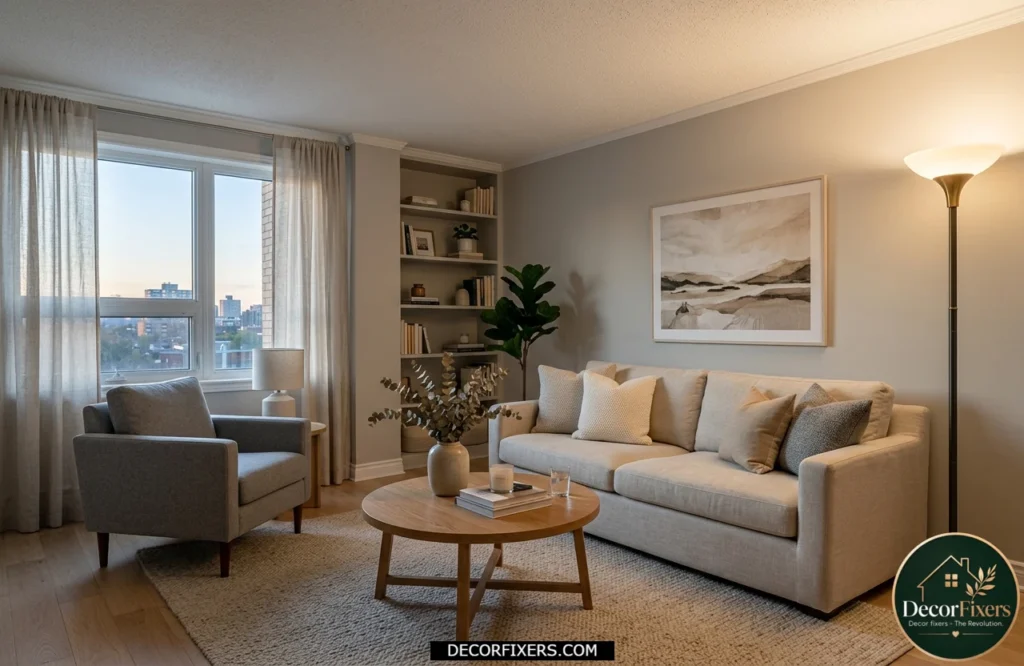
A torchiere floor lamp faces up. That’s the whole point.
Instead of throwing light downward onto the floor (which creates a pool effect and actually makes the living room look smaller), a torchiere bounces light off the ceiling and lets it wash back down evenly across the whole room. In a living room under 200 square feet, a single torchiere in one corner combined with your table lamps creates a surprisingly full, balanced ambient layer without the harsh single-source problem. Aim for a model with a built-in dimmer so you can dial it back in the evenings; a ceiling that’s too bright will blow out the warm mood you’re building with the rest of your lighting scheme.
How many light sources does a small living room need?
A small living room needs a minimum of three to four separate light sources to feel balanced. One ambient source, one or two mid-level lamps, and at least one accent layer. According to lighting design guidance, spreading multiple sources at different heights eliminates the single-source flatness that makes compact rooms feel smaller.
9. Use Mirrors Strategically to Multiply Your Light Sources
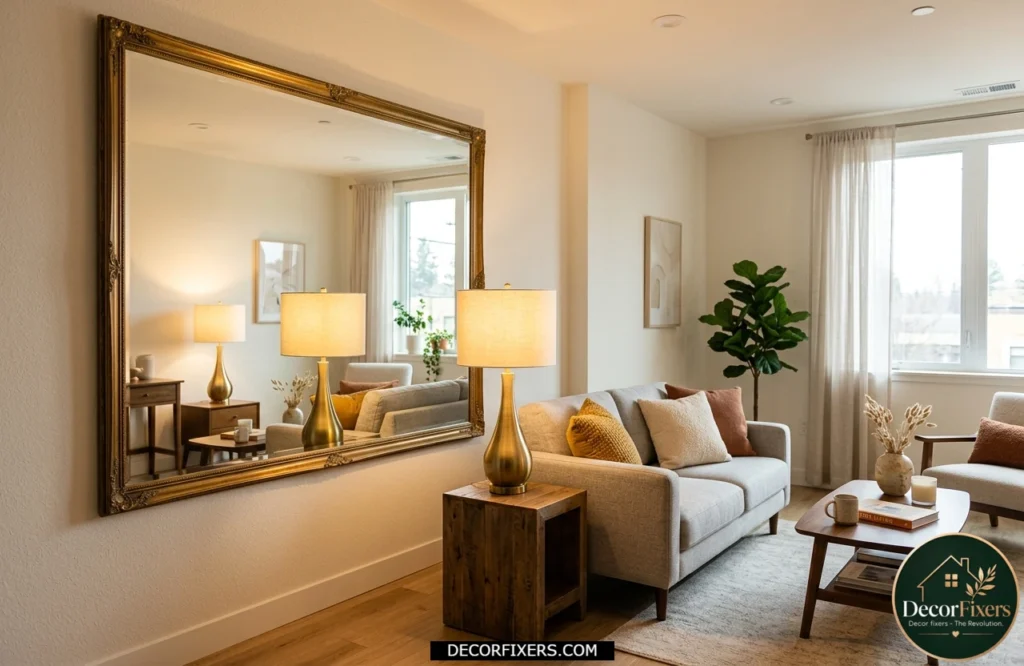
A mirror placed opposite a light source is effectively a free light source.
This isn’t a decorating trick; it’s geometry. When a table lamp or sconce faces a mirror directly, the reflected light adds perceived depth and brightness to the opposite wall. In a small living room, a full-length or oversized round mirror on the wall facing your primary lamp doubles the supposed brightness without adding any fixtures. Keep the mirror frame lean and simple so it doesn’t add visual weight. And be deliberate: a mirror that reflects a pile of clutter or an ugly corner is worse than no mirror at all.
Or maybe I should say it this way: the mirror doesn’t light your room, it amplifies what you’ve already built. Get your light layers right first, then add the mirror.
10. Light Your Corners, They’re Making the Room Look Smaller
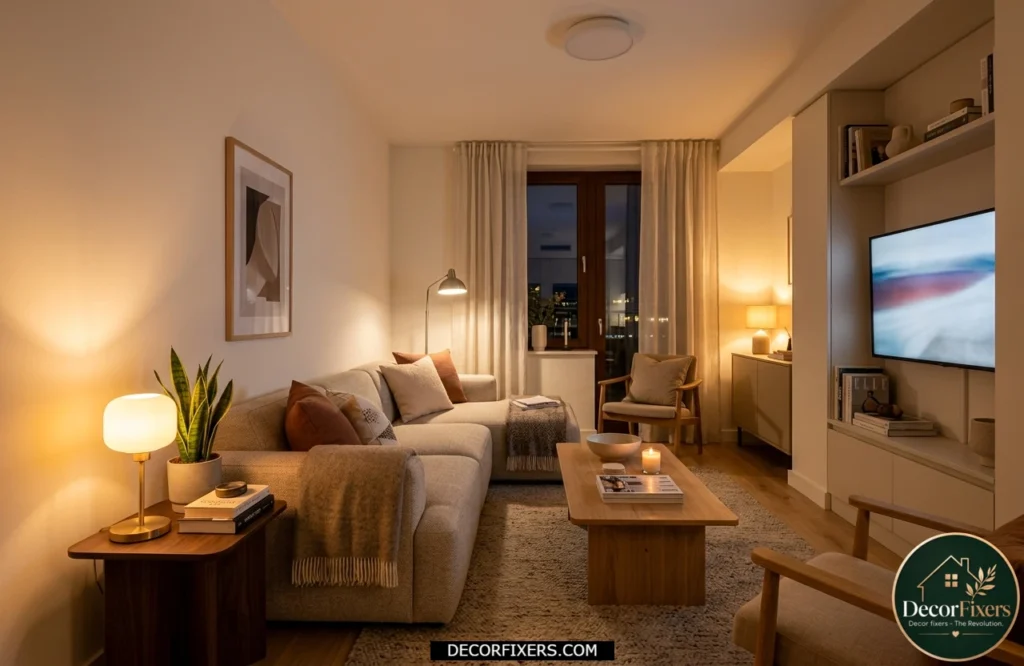
Dark corners shrink rooms. It’s that simple.
When the edges of a room fade into shadow, the brain reads the space as smaller than it is. A small rechargeable table lamp, a low-profile LED lantern, or even a plug-in corner floor lamp tucked into an unlit corner instantly pushes the perceived boundary of the room outward. You don’t need a bright light; a soft 40-watt-equivalent (450 lumens) warm bulb is enough. The goal isn’t illumination; it’s eliminating the visual cutoff point where light ends, and darkness begins.
Users who’ve tried this consistently report that corner lighting delivers the single biggest ‘room feels bigger’ effect of any change they make. The cost? Often under fifteen dollars.
How to Layer Lighting in a Small Living Room (Step by Step)
- Set color temperature: choose all bulbs in the 2700K–3000K range.
- Install a dimmer on your existing overhead fixture (Lutron Casetta if renting).
- Add your ambient base: arc floor lamp or torchiere in the corner opposite your seating.
- Add your mid-level layer: plug-in sconces at 60-inch wall height.
- Add your task layer: one directional floor or table lamp near seating.
- Add your accent layer: LED strip behind the TV or along shelving.
- Light your corners: a small rechargeable lamp in the darkest corner.
11. Use a Pendant Light on a Plug-In Swag Kit for a Focal Point Without Hardwiring
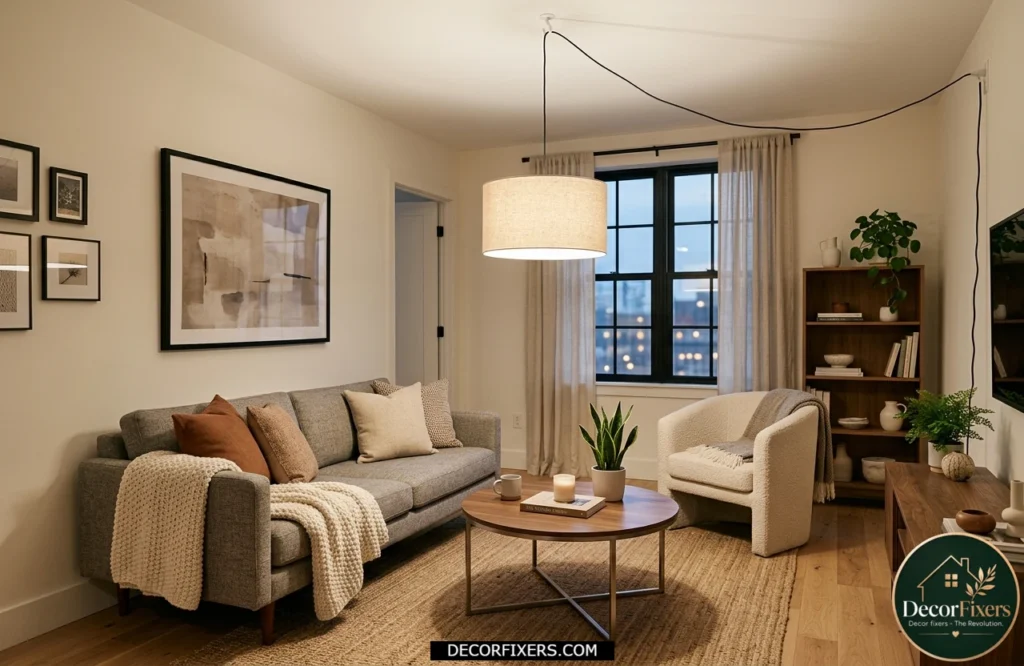
A pendant light in a small living room feels expensive. A swag-style plug-in pendant costs almost nothing to install.
A swag kit lets you hang a pendant from a ceiling hook and run the cord along the ceiling to the nearest outlet, no electrician, no ceiling medallion, no drilling into drywall. In a room under 200 square feet, a single pendant above the coffee table or centered over the seating area acts as a visual anchor and adds the overhead presence that makes the room feel designed rather than just furnished. Choose a compact shade, nothing over 14 inches in diameter, with a semi-translucent material that diffuses light rather than hiding it. A small drum or globe shade works best in tight spaces.
12. Add a Task Lamp Near Your Reading Chair, It Does More Than Help You Read
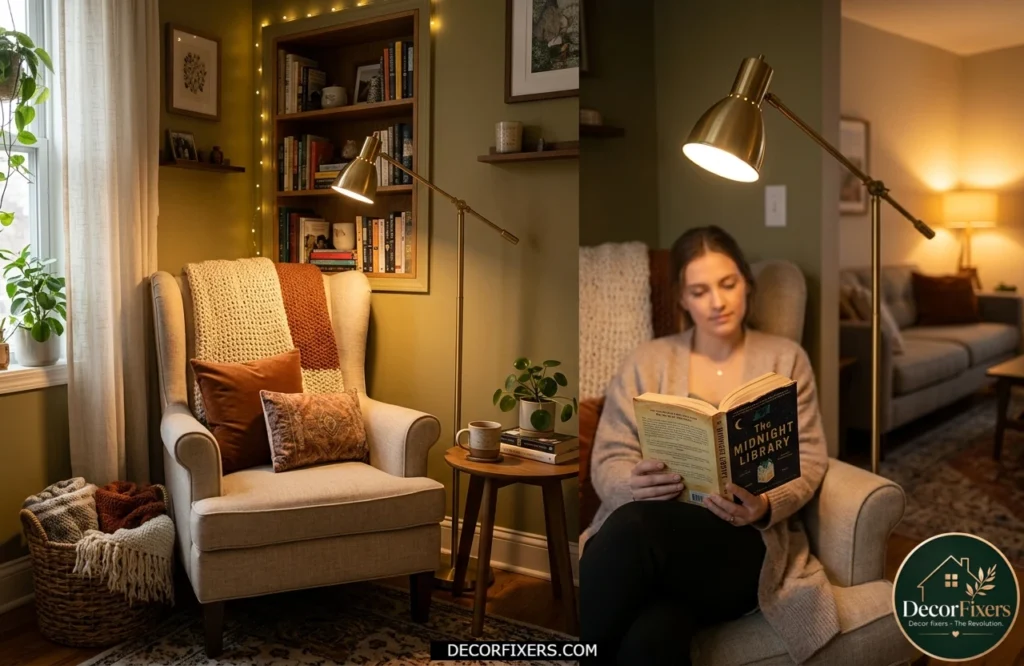
Task lighting isn’t just practical. It creates a zone.
In a living room under 200 square feet, zoning is how you make one room feel like it has multiple purposes, and multiple purposes make a small room feel more generous. A directional task lamp aimed over a reading chair or side of the sofa creates a distinct ‘reading nook’ feeling, even in a studio apartment with no actual separate nook. This zoned light also means you can run the task lamp alone on quiet evenings, turning down or off the rest of the room’s layers, and a partially lit, small room, layered correctly, feels intimate rather than dim.
13. Go Vertical with Up lights to Draw the Eye (and the Ceiling) Upward
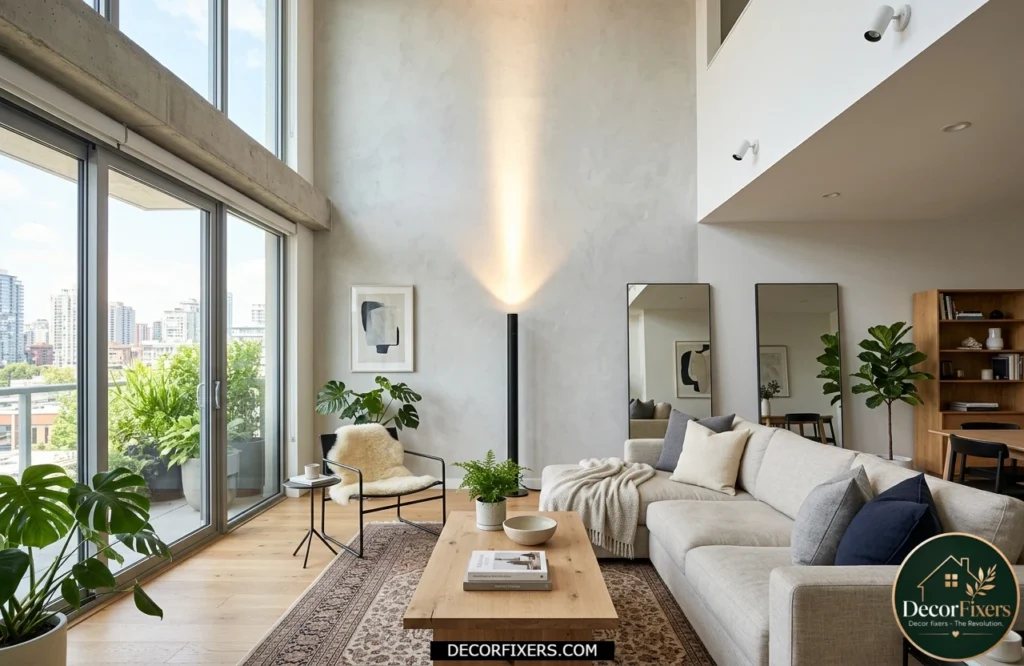
Height sells space. Low-slung lighting flattens it.
A small floor-level uplight, the kind you’d normally see in a plant corner or behind a tall bookshelf, aimed upward at a bare wall or toward the ceiling, creates a vertical stripe of light that draws the eye up. The moment your eye moves vertically, the living room feels taller. Taller rooms feel bigger. This works especially well in rooms with white or light-colored walls and ceilings: the uplight bloom spreads softly rather than creating a harsh spotlight. One uplight in a small living room is plenty. Two starts to look theatrical.
14. Use Warm Candle Light or LED Candles as a Fourth Accent Layer
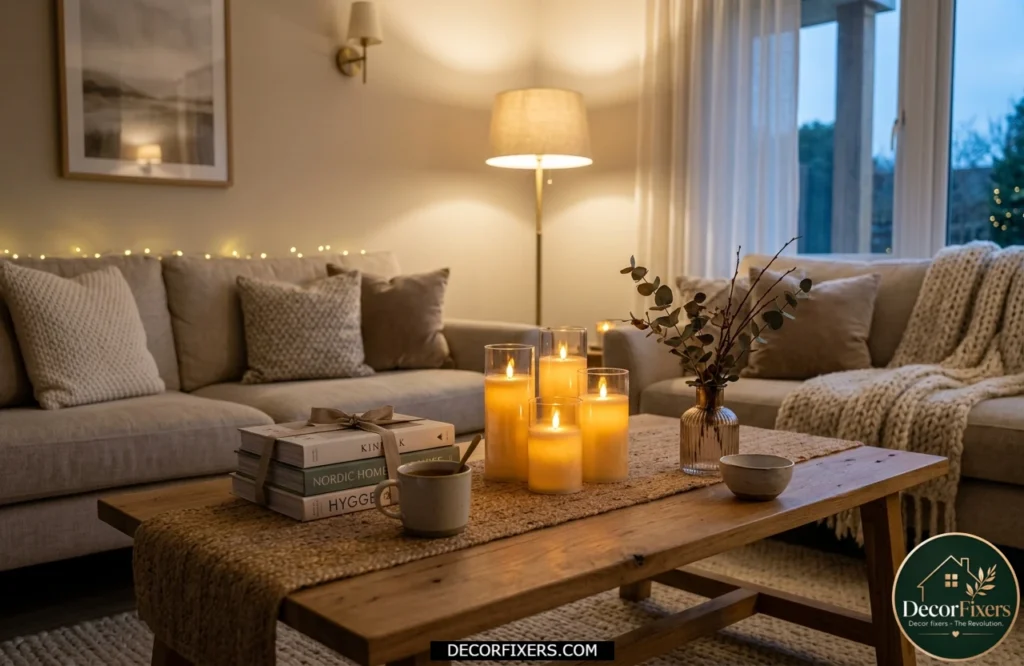
This one sounds decorative. It’s actually structural.
Candles, or high-quality LED candles, which flicker realistically and are considerably safer in a small space, add a fourth micro-layer of light at table height or floor height. Grouped on a coffee table or lined along a console, they fill the space between your floor lamp’s pool of light and the floor itself: a zone that almost every lighting plan leaves dark. Even a group of three LED tea lights on a tray adds warmth and visual texture at that low level. Anyway, the psychological effect of candlelight in an otherwise well-lit room is documented: it signals rest, triggers warmth relations, and makes an imperfect living room feel deliberately cozy rather than accidentally dim.
15. Use Smart Bulbs to Control Every Layer from One App
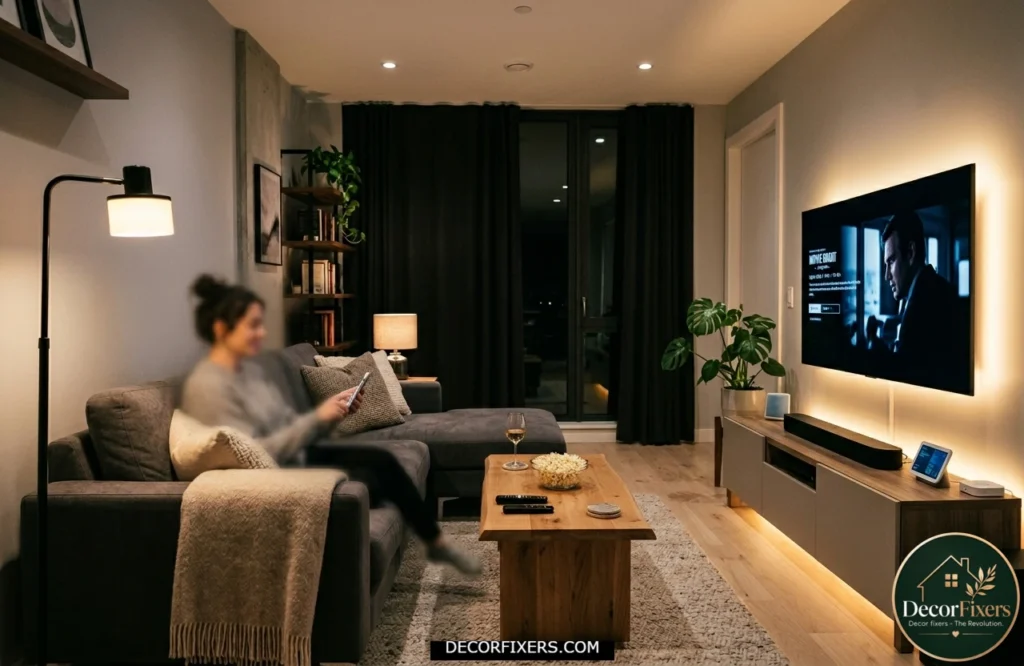
Layered lighting only works if you actually use every layer together.
The single reason most people stop using their carefully arranged lights? It’s annoying to walk around switching four things on and off every night. Smart bulbs, specifically Philips Hue, which work in standard screw-base sockets, solve this entirely. You set a ‘movie night’ scene that dims the overhead to 30%, turns the accent strip amber, and keeps the corner lamp at 15%, all with one tap. Smart bulbs don’t require a hub in most cases anymore, and they’ll retrofit into every existing lamp you already own. In a small living room where you’re managing three to five light sources, this isn’t a luxury; it’s what makes the whole layered system actually livable.
Can lighting actually make a small room look bigger?
Yes, and there’s research supporting it. A study published in Building and Environment found that wall-washing and indirect cove lighting produce a statistically significant increase in perceived room size compared to general overhead lighting. Lighting your walls and corners, not just the floor, is the mechanism behind the effect.
CONCLUSION:
I’ve now lived in four different apartments since that first cave of an IKEA-lit studio. The rooms have gotten slightly bigger. My lighting instincts have gotten considerably sharper.
Every time I walk into a new space, I do the same thing: I turn off the overhead, stand in the dark for a second, and think about where the three layers will go. Where’s the ambient base? Where’s the mid layer? What corner is going to get lit first? It takes about thirty seconds now. What used to feel like an interior design problem I wasn’t qualified to solve turned out to be a sequencing problem anyone can crack.
Your small living room isn’t the issue. It’s the single light source making it look that way.
Start with the dimmer. Add the arc lamp. Wash one wall. Light one corner. The room you’ve been trying to fix with furniture reorganizations will finally start feeling like the space it actually could be, just from changing what you’re helpful and how.
FAQs:
Q: What’s the best floor lamp for a small living room?
A: An arc floor lamp with a fabric diffuser shade placed behind the sofa. It provides overhead-style ambient light without hardwiring and keeps the floor footprint minimal.
Q: How do I light a living room with no overhead light?
A: Use an arc floor lamp as your ambient base, plug-in sconces at mid-wall height, and a task lamp near seating. Aim for 1,500–2,000 total lumens distributed across three sources minimum.
Q: Should I use warm or cool light in a small living room?
A: Warm light. Choose bulbs in the 2700K–3000K range across all your sources. Cool light above 3500K makes a small room feel bright but sterile, which works against the comfortable atmosphere you’re creating.
Q: Why does my living room still look dark even with lamps?
A: Because you likely have one or two light sources creating pools of brightness with dark gaps between them. Add a source in each unlit corner and aim at least one lamp toward a wall to wash it with light instead of pointing it outward.
Q: When should I use LED strip lights in a living room?
A: Use LED strips as an accent layer, not a main light source. Mount them behind a TV, along the back of shelving, or under a console at 2700K. They create depth and eliminate harsh screen-to-dark-room contrast in the evenings.

Creator of DecorFixers, sharing practical home and interior ideas focused on real-life usability, simple design improvements, and budget-friendly solutions.