

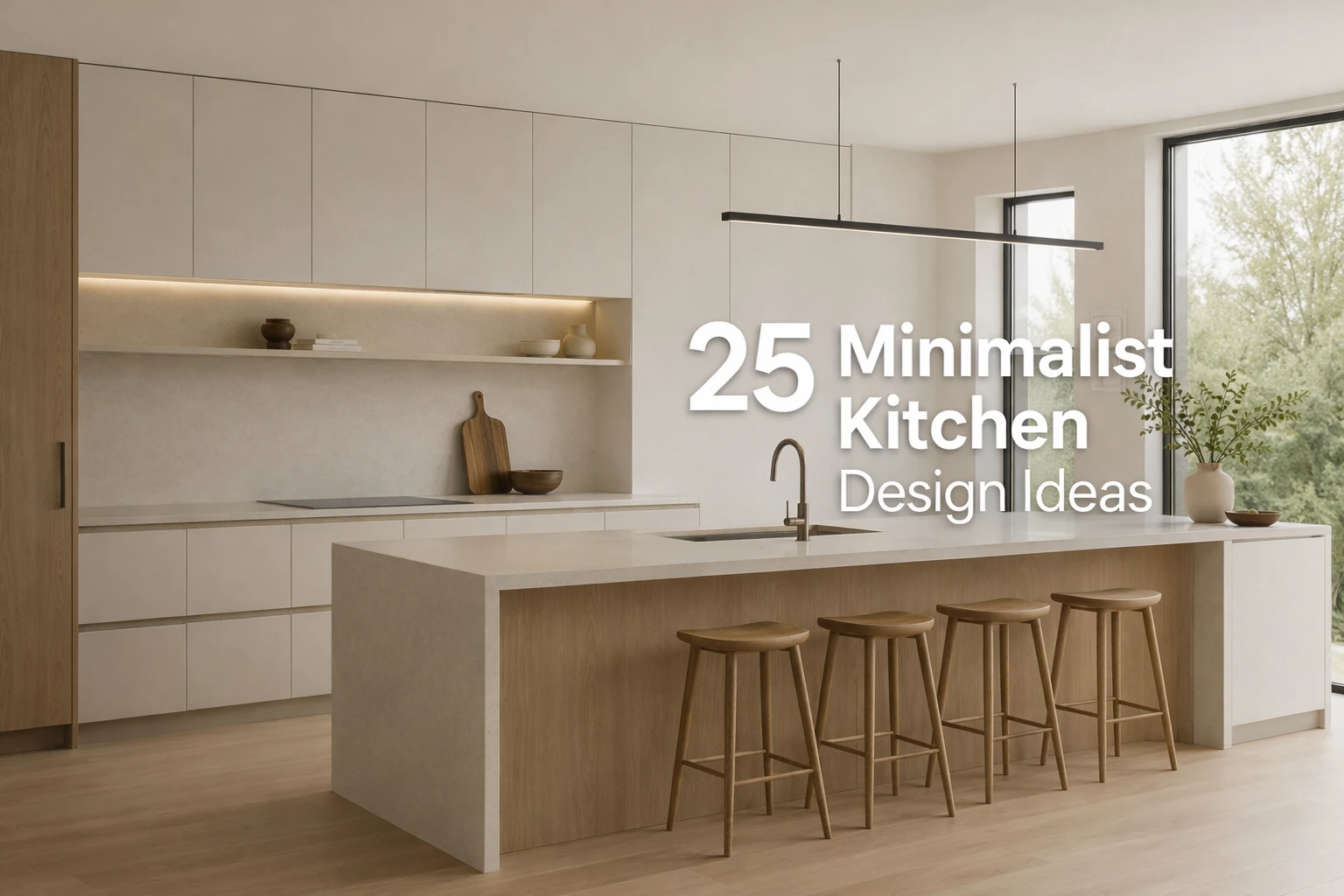
I’ll be honest with you. I used to think a minimalist kitchen just meant getting rid of stuff, tossing the toaster, hiding the kettle, pretending you don’t cook. What I actually found, after going down every Pinterest board and Houzz rabbit hole available, is that minimalist kitchen design has nothing to do with deprivation. It’s about designing so intentionally that clutter doesn’t have room to live.
Here’s the thing: most people who search for minimalist kitchen design ideas aren’t looking for a cold, magazine-ready room they’re afraid to touch. They want calm. They want to walk into their kitchen in the morning and not feel immediately overwhelmed by visual noise, mismatched handles, appliances crowding every surface, and cabinets that don’t quite work together.
That frustration? It’s more common than you’d think. And the solution isn’t always a full gut renovation. Sometimes it’s a smarter layout, a change in hardware, or understanding which minimalist substyle actually fits your life. This guide covers 25 real, practical ideas, from budget-friendly swaps to full redesign principles, so you can figure out exactly where to start.
What is minimalist kitchen design? Minimalist kitchen design is a style focused on clean lines, hidden storage, and a deliberately limited color palette to create a calm, clutter-free cooking space. Every element earns its place; nothing is decorative without also being functional.
Minimalist Kitchen Color and Surface Ideas
1. Build Your Palette Around Three Tones Maximum
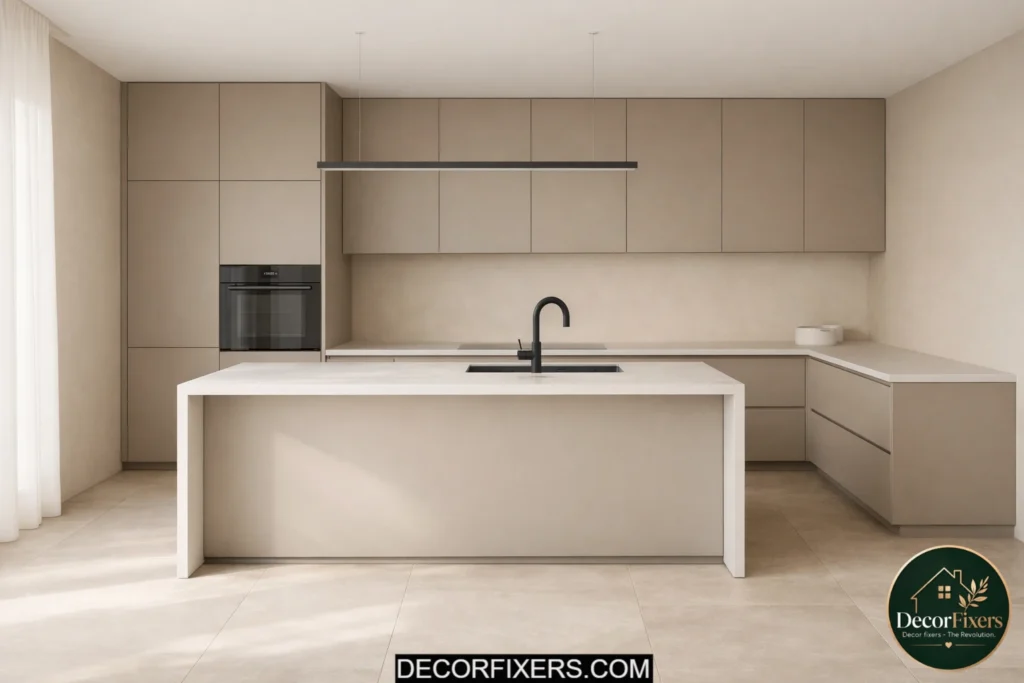
Choose one dominant tone (80% of the space), one secondary (15%), and one accent (5%). In a minimalist kitchen, the accent does the heavy lifting: a matte, black tap, a brushed, brass pendant, and a single terracotta bowl on the counter. Three tones create cohesion; four or more create the visual noise you’re trying to eliminate.
Neutral doesn’t have to mean white. Warm greige, soft sage, and deep slate are all genuinely neutral in the right light conditions and look far more interesting at scale than stark white ever will.
2. Go Matte on Cabinet Finishes
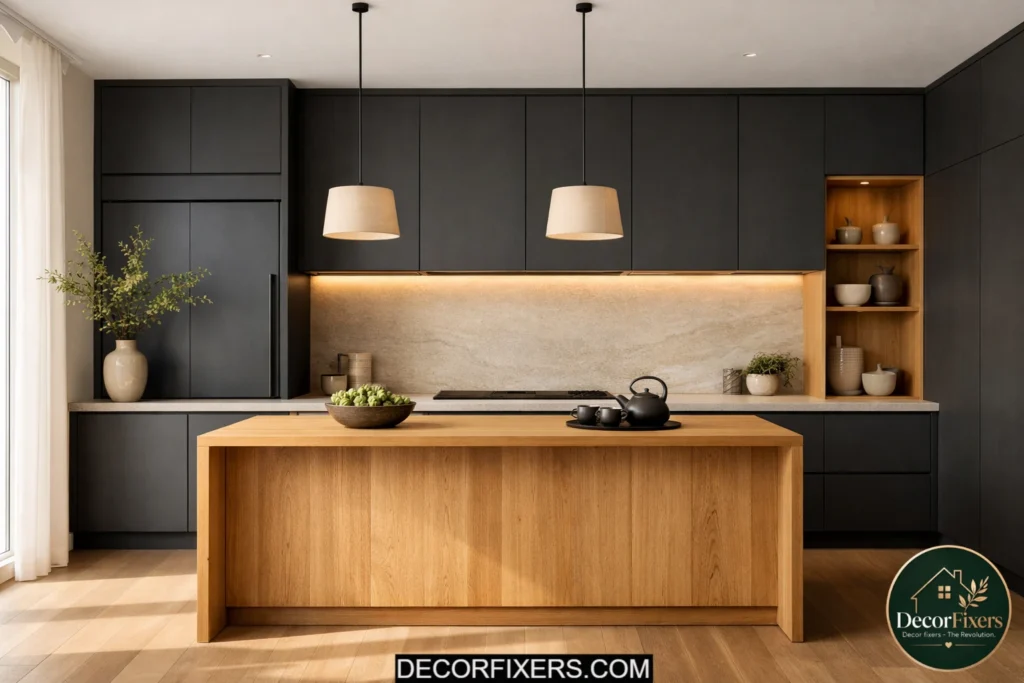
Gloss finishes amplify every fingerprint, every smear, every shadow inconsistency. Matte, whether on cabinetry, countertops, or taps, diffuses light gently, reads more softly, and requires less maintenance to look good. Super, matte lacquer finishes (used by brands like Rotpunkt) have become a defining feature of premium minimalist kitchens because they photograph beautifully and age even better.
I’ve seen conflicting data on this; some sources suggest high gloss is making a small comeback in 2026. My read is that it’s coming back only in very specific applications: a single gloss panel as an accent, or a gloss finish island against matte uppers. Full gloss everywhere feels dated now.
3. Match Your Countertop to Your Cabinetry Undertone
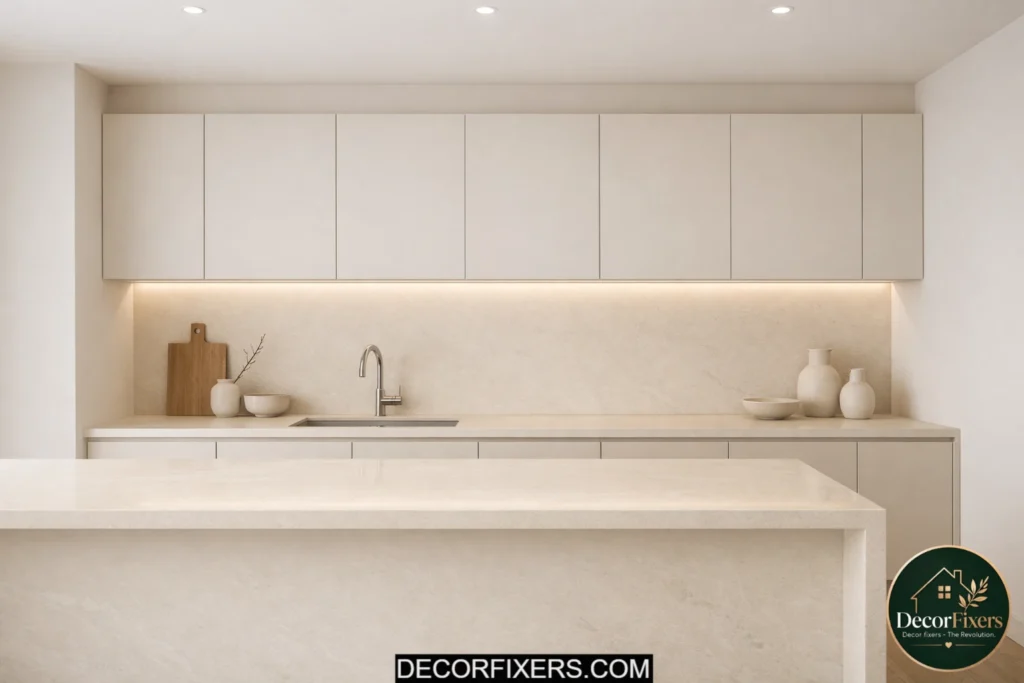
One of the easiest mistakes to make: choosing a countertop in isolation. Hold your countertop sample against your cabinet door in your actual kitchen lighting before committing. A cool, grey quartz beside warm oak reads wrong in natural light; your eye detects the undertone mismatch even if you can’t name it.
Continuous surfaces, using the same material on the countertop and backsplash, are a favourite technique in small minimalist kitchens because they visually elongate the room and reduce the number of transitions the eye has to process.
4. Use Warm Whites, Not Cool Whites
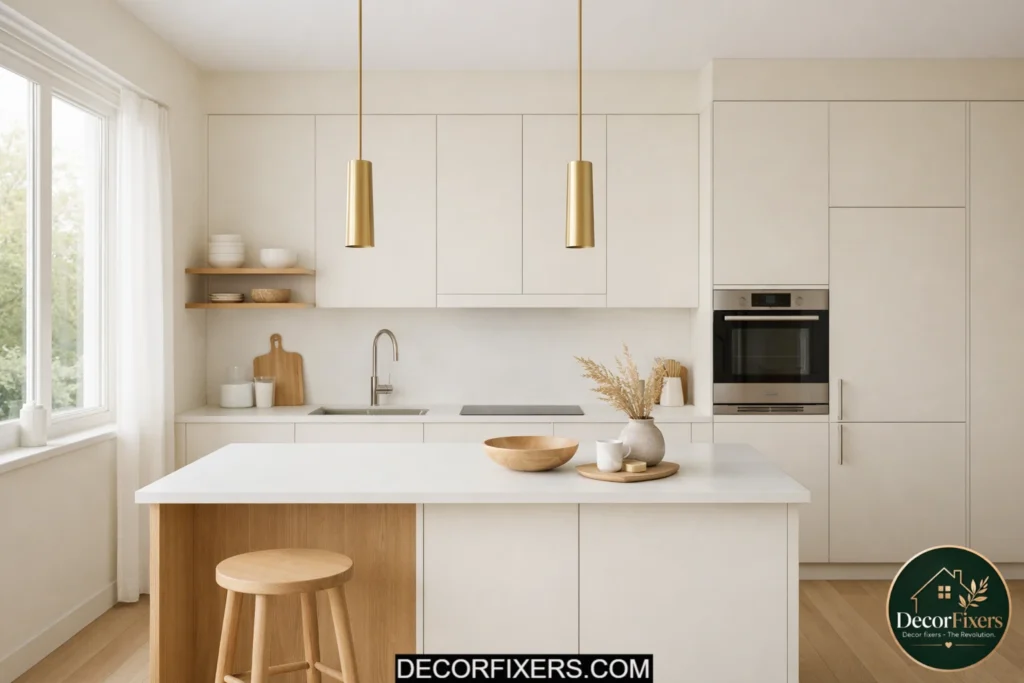
Cool whites (blue or grey undertones) make a minimalist kitchen feel clinical rather than calm. Warm whites, those with a subtle yellow or cream undertone, photograph the same but feel completely different when standing in. If you’re painting walls or choosing cabinet color, test Benjamin Moore ‘White Dove’ or Farrow & Ball ‘All White’ rather than pure brilliant white.
Walls don’t need to be white at all. Soft off-white, warm plaster, or pale stone work just as well and often better in rooms with limited natural light.
5. Try a Tonal Backsplash Instead of a Patterned One
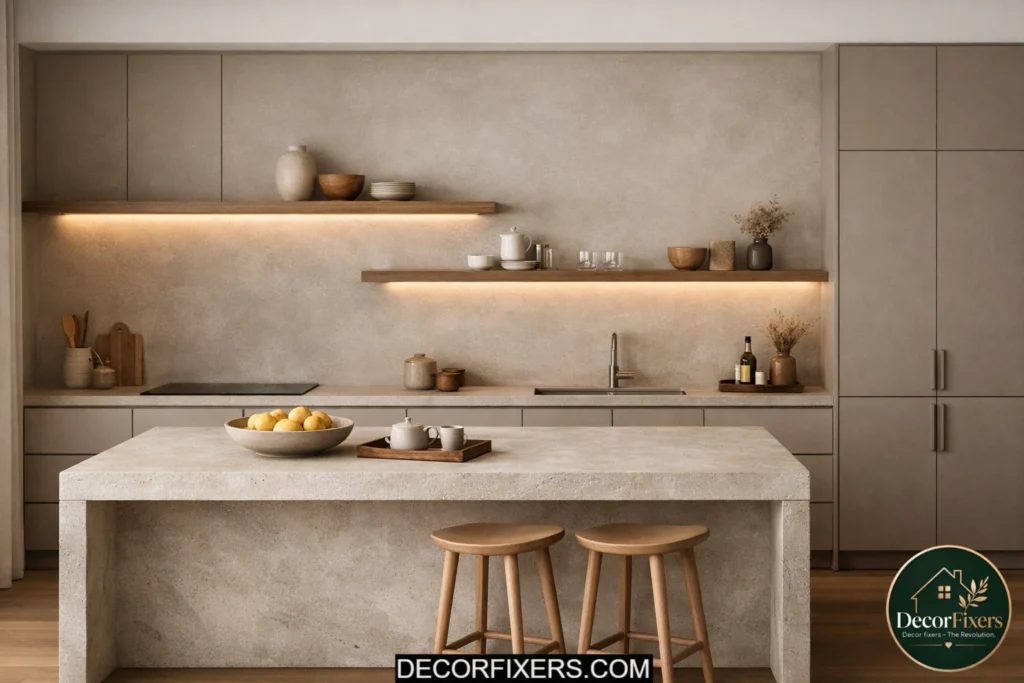
Patterned backsplashes are popular, but in a minimalist kitchen, they compete with every other surface for attention. A tonal backsplash (same color family as your cabinets or countertop, different finish or texture) adds depth without visual interruption. Microcement, honed stone, and matte large-format tile all achieve this well and are easy to source at mid-range price points.
6. Don’t Skip the Ceiling
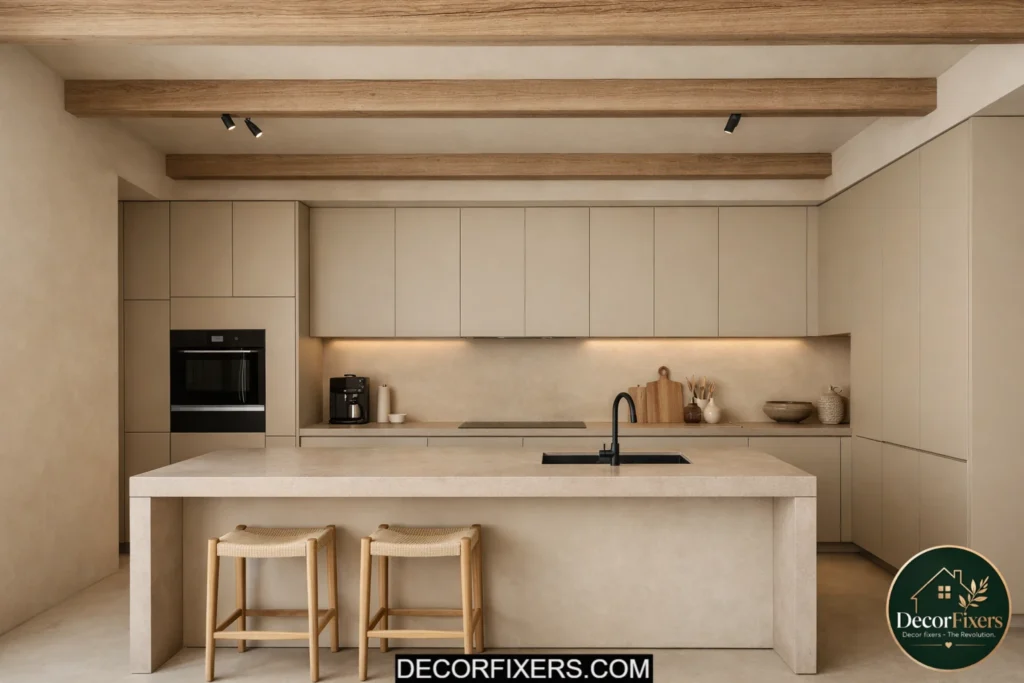
Most people design their kitchen from the countertop up and forget the ceiling entirely. In a minimalist kitchen, a ceiling treated in the same color as the walls (or a shade slightly lighter) makes the space feel taller and more intentional. Exposed ceiling beams in natural wood work beautifully in Japandi and Scandi styles. Houzz’s 2025 Emerging Trends Report noted searches for ‘wood beams’ were up 3.5x year over year.
Quick Comparison: Minimalist Kitchen Sub, Styles
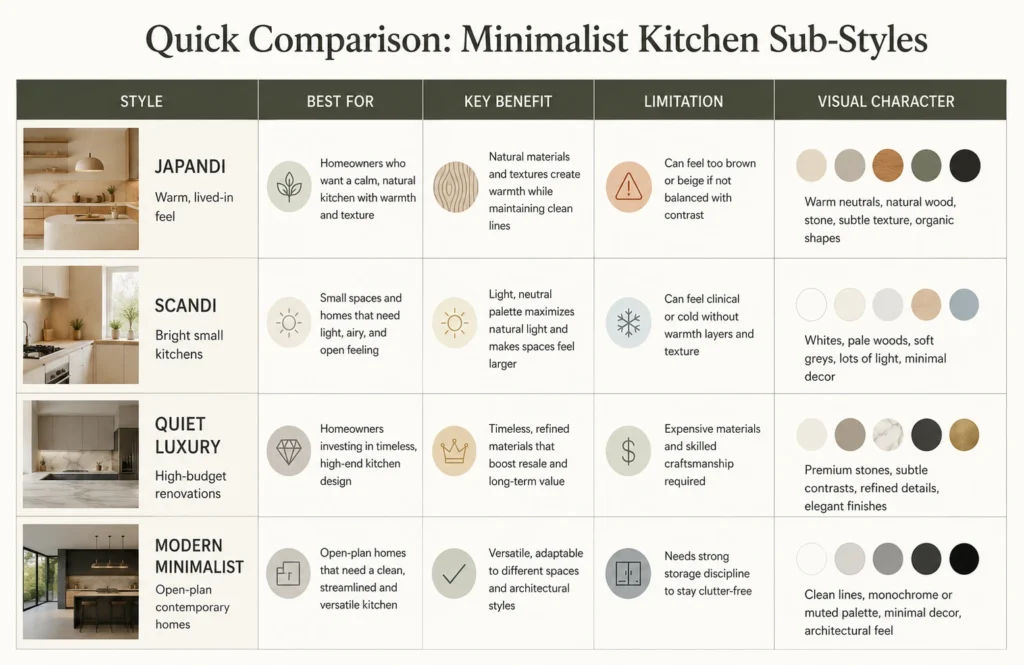
| Style | Best For | Key Benefit | Limitation |
| Japandi | Warm, lived-in feel | Natural textures + clean lines | Can feel too brown/beige |
| Scandi | Bright small kitchens | Light, maximising palette | Can feel clinical without warmth layers |
| Quiet Luxury | High-budget renovations | Timeless, resale, boosting look | Expensive materials required |
| Modern Minimalist | Open, plan contemporary homes | Versatile and widely compatible | Needs strong storage discipline |
Minimalist Kitchen Cabinet and Storage Ideas
Here’s the part most minimalist kitchen articles get completely wrong: they show you a beautiful handleless kitchen with no upper cabinets and then don’t explain where everything goes. Minimalism without good storage isn’t minimalism, it’s just chaos moved out of sight.
How to plan minimalist kitchen storage in 5 steps:
- Audit everything on your countertops, decide what must stay out vs. what can be stored
- Assign a closed cabinet zone for every daily-use appliance
- Use tall pantry pull-outs to replace multiple upper cabinets
- Add inner drawer dividers, one deep drawer beats three cluttered ones
- Assign a “re-entry zone” near the entry point for keys, mail, and miscellaneous items
7. Switch to Handleless Cabinets
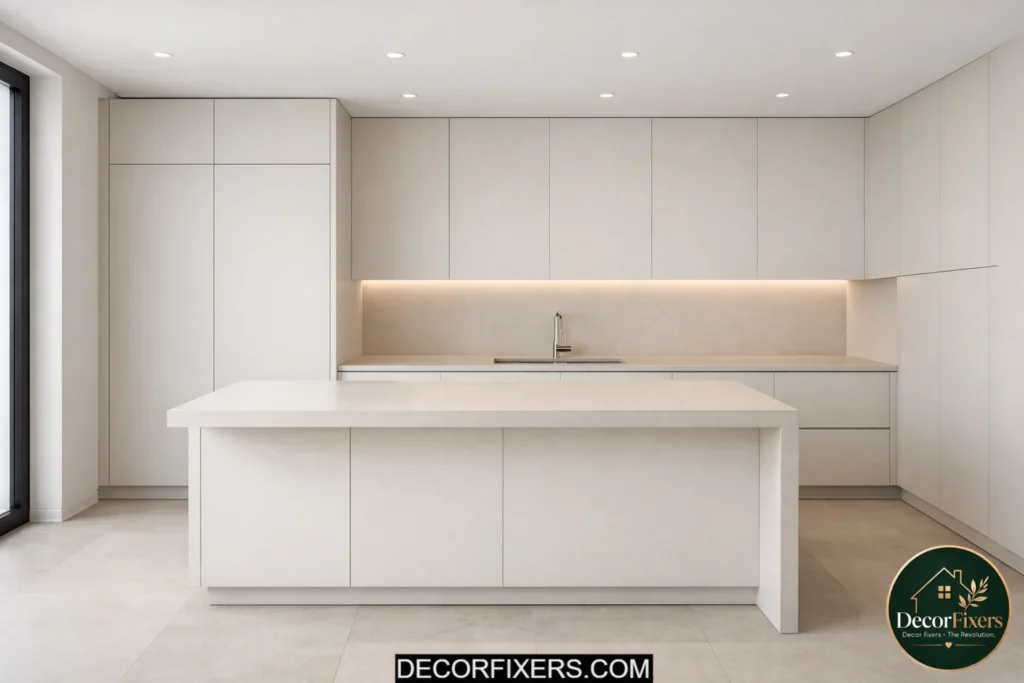
Handleless cabinetry is the single most impactful visual change you can make without touching your layout. Removing hardware from the eye line reduces visual fragmentation across an entire run of cabinets. Push-to-open mechanisms and J, pull profiles are the two most practical options; both deliver a truly handleless look without sacrificing daily usability.
For those in rental properties who can’t replace cabinets, recessed pull bars can often be retrofitted to existing doors for a fraction of the cost of new cabinetry. Not the same effect, but a real improvement.
8. Keep Upper Cabinets, But Rethink Them
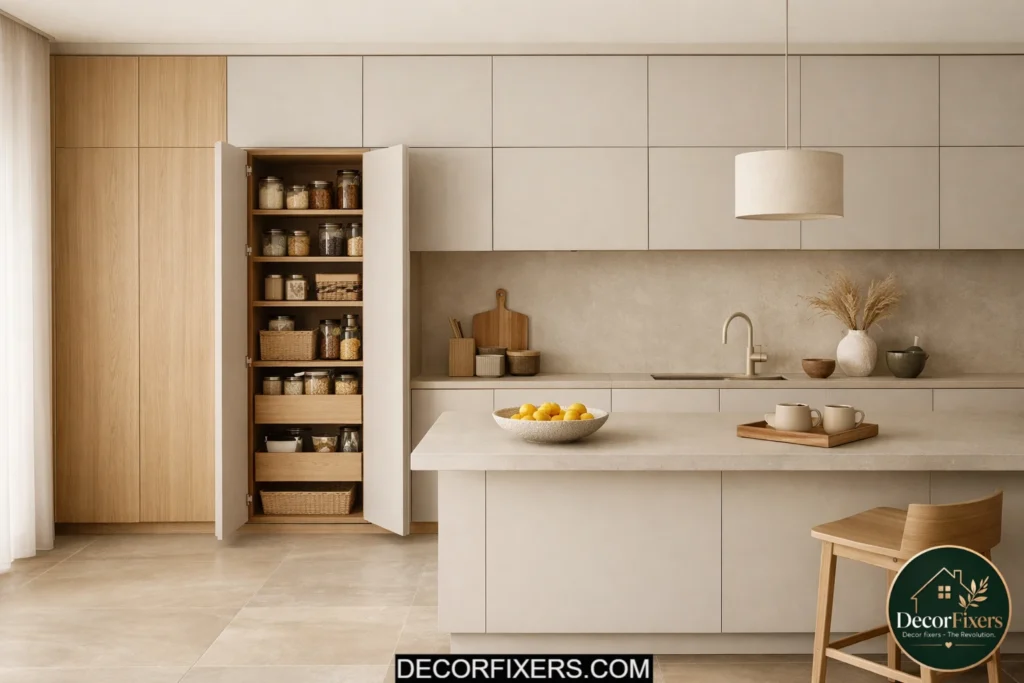
Some experts argue for eliminating upper cabinets to create an airier, more minimalist look. That’s valid for large kitchens with generous island storage. But if you’re dealing with a standard galley or L-shaped kitchen, losing your upper cabinets means your countertops become the storage, and that defeats the whole purpose.
The better approach: keep upper cabinets but choose flat, panel doors with no visible frame or handle, carry them to ceiling height to eliminate the dust, collecting gap, and ensure they’re all the same depth. Consistency in depth and door profile makes a row of cabinets read as a single surface rather than individual units.
If you’re planning a larger renovation, many of these layout choices also align with current Modern Kitchen Design Trends, particularly the shift toward seamless cabinetry, integrated appliances, and visually quiet surfaces that make everyday kitchens feel more architectural rather than overly decorative.
If you’re planning a larger renovation, many of these layout choices also align with current Modern Kitchen Design Trends, particularly the shift toward seamless cabinetry, integrated appliances, and visually quiet surfaces that make everyday kitchens feel more architectural rather than overly decorative.
9. Add a Tall Pantry Pull, Out Column.
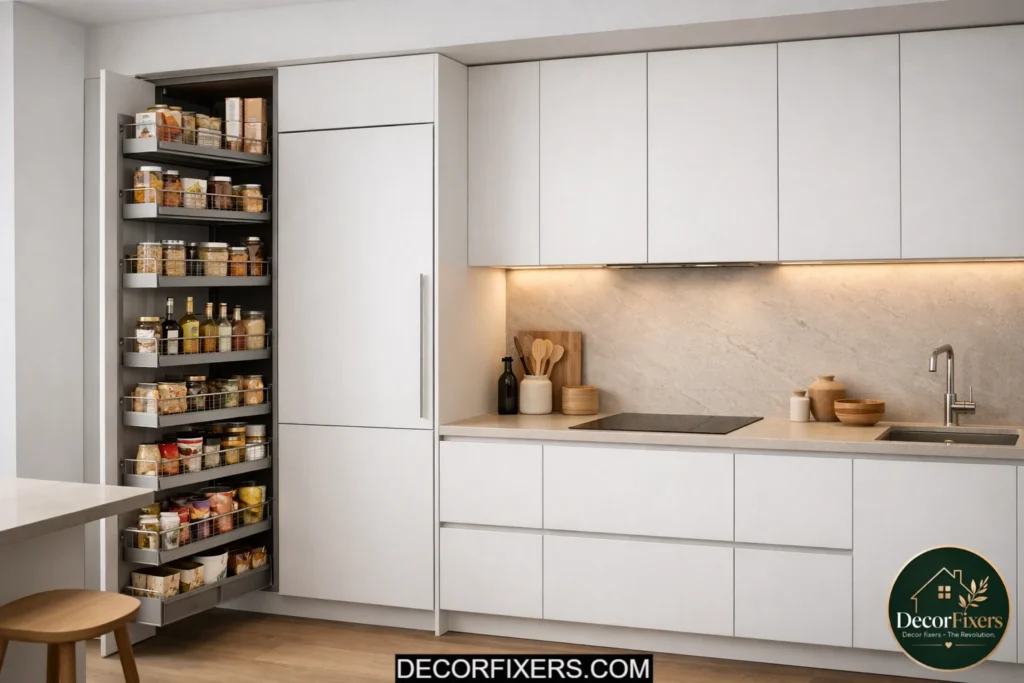
A single full-height pantry column with internal pull-outs can replace three to four separate upper cabinet units. It consolidates food storage into one clear, accessible zone, which means you actually use what you have rather than forgetting what’s in the back of a shelf. IKEA SEKTION cabinets paired with Häcker, style pull, and out inserts deliver this at a mid-range budget, and it’s one of the modifications that consistently makes smaller kitchens feel calmer and more intentional.
10. Use Toe, Kick Drawers for Hidden Storage
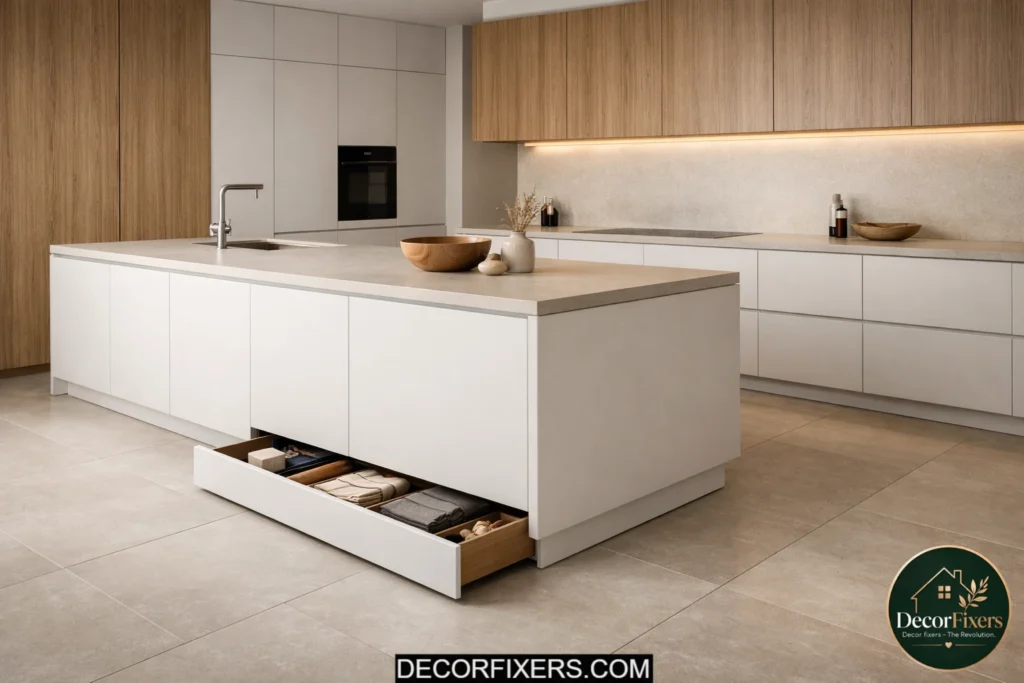
The space between the base of your cabinets and the floor is almost universally wasted. Toe, kick drawers, shallow, full, width drawers installed at floor level, are ideal for flat items: baking trays, placemats, spare linens, and infrequently used tools. You won’t find them in many budget kitchen builds, but any custom or semi-custom joiner can add them.
Look at where your clutter actually lives, and design storage there.
11. Build an Appliance Garage
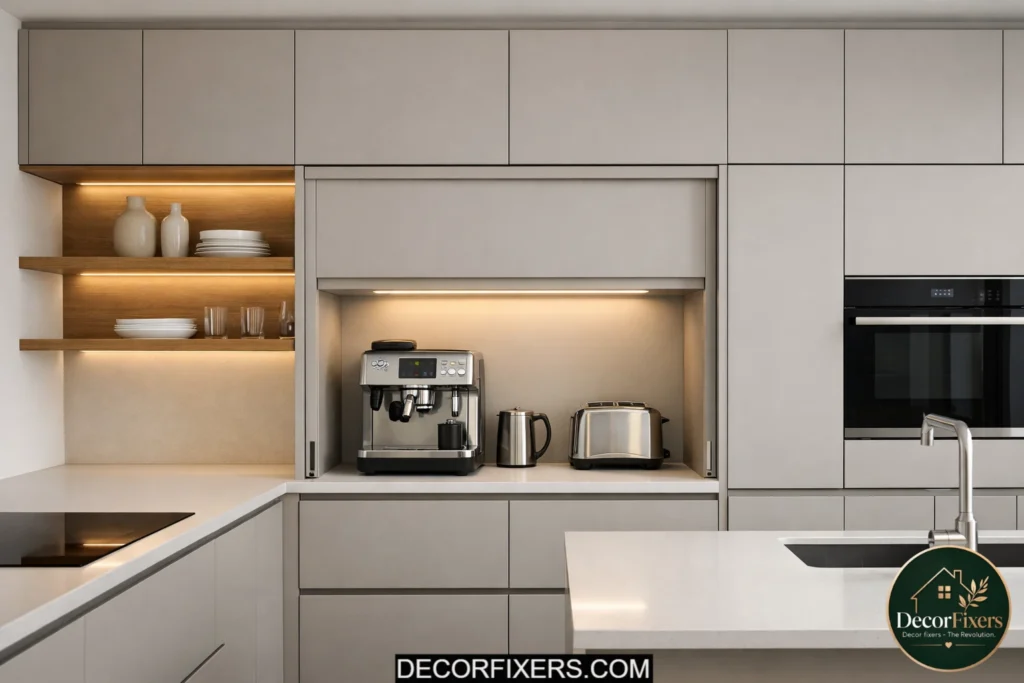
An appliance garage is a dedicated section of upper cabinetry, usually at counter height, with a tambour or lift-up door that conceals the toaster, kettle, coffee machine, and anything else that needs to be accessed daily but doesn’t need to live on show. The key spec detail: match the interior of the appliance garage to your countertop material so it reads as a continuation of the surface when open.
This is one of the most practical minimalist kitchen ideas because it doesn’t require moving plumbing or restructuring a layout, just smarter cabinet design in one section.
12. Integrate Your Refrigerator
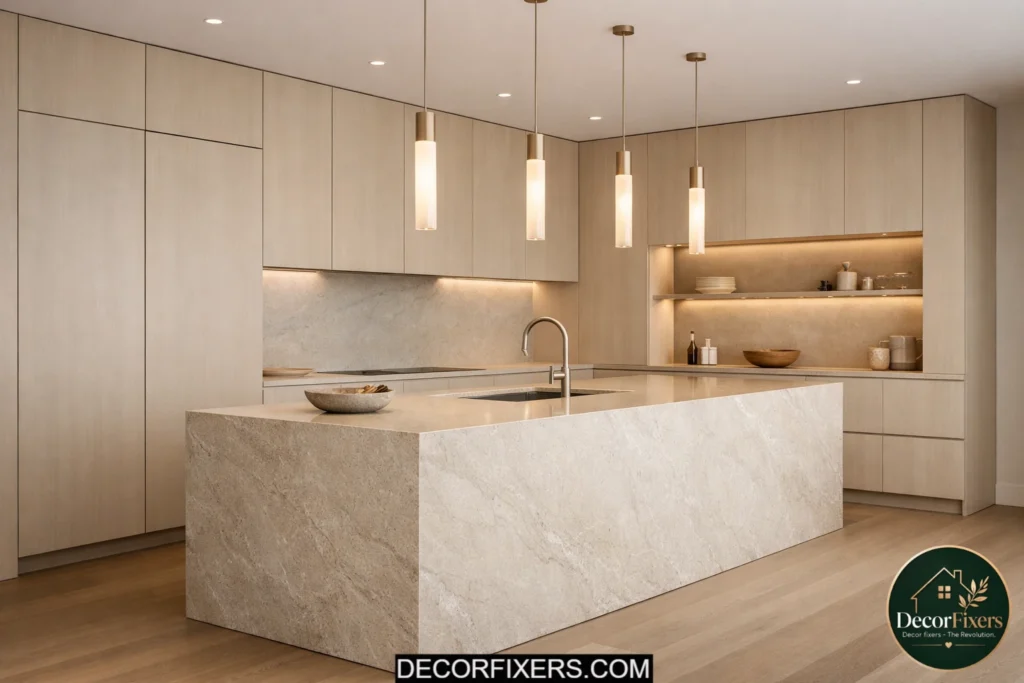
A freestanding refrigerator, however nice, reads as a foreign object in a minimalist kitchen. Panel-ready refrigerators with a cabinet and matched doors are the premium solution. At a mid-range price point, a counter-depth refrigerator in a grey or black finish slots far less obtrusively into a neutral palette than standard white or silver models.
Masterclass Kitchens and Rotpunkt both offer full integration systems in which the fridge door is hinged to match the cabinet’s swing direction and depth, genuinely seamless from three feet away.
Minimalist Kitchen Lighting and Material Ideas
13. Layer Three Types of Lighting
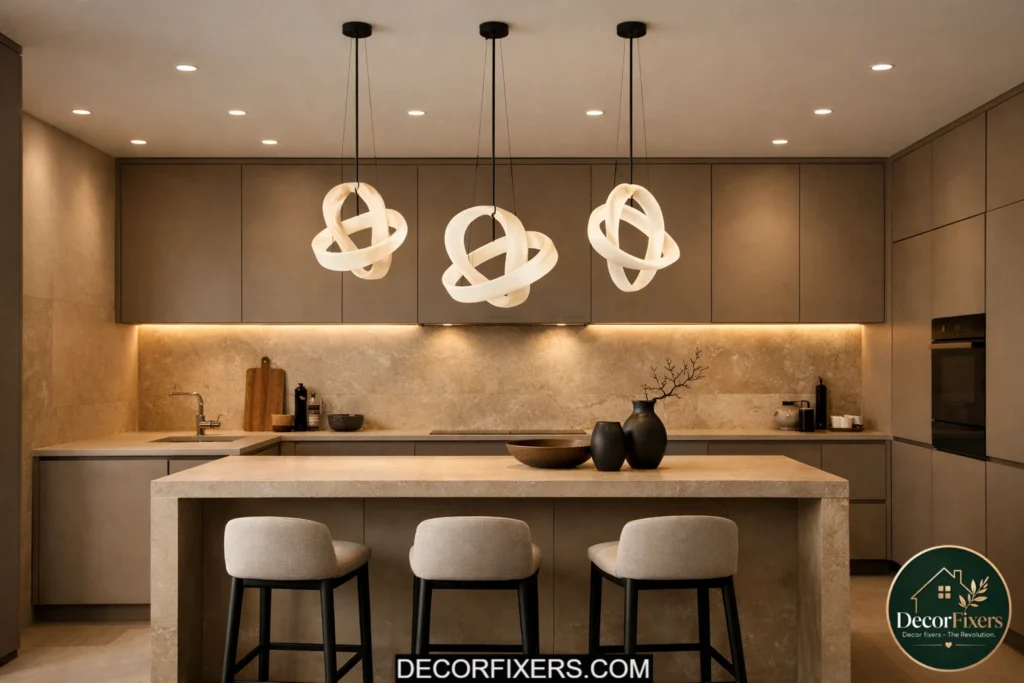
Minimalist kitchens often have only recessed ceiling lighting, and it shows. Recessed lights create flat, even light that eliminates shadow and depth. Real lighting design layers three types: ambient (ceiling), task (under, cabinet), and accent (pendant or LED strip).
Under-cabinet LED strips are one of the highest-impact, lowest-cost upgrades available. They illuminate the countertop working zone, make the backsplash visible, and create the warm sense of depth that distinguishes a well-designed kitchen from a functional one. Keep them warm, white, 2700K to 3000K, not cool white.
14. Choose Natural Stone Over Engineered Stone Where You Can
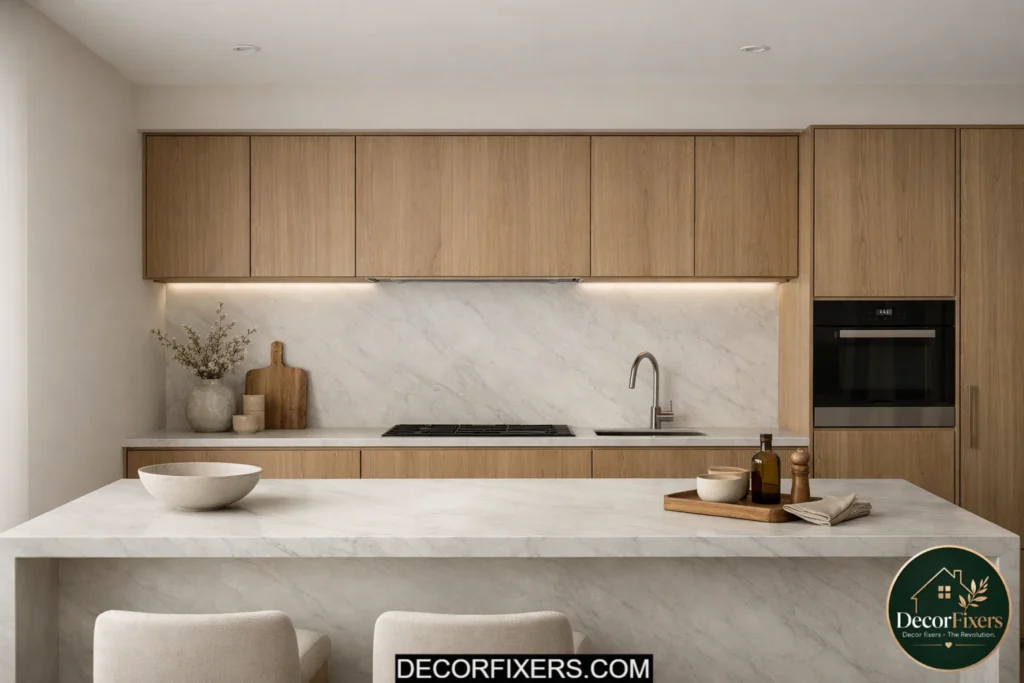
Engineered quartz is predictable. Same vein pattern, same depth, same movement across the slab. Natural stone, marble, quartzite, and honed granite have variations that add character without adding visual noise. In a minimalist kitchen where every surface is doing a lot of work, natural stone reads as warmth rather than decoration.
The counterargument: natural stone requires sealing and more careful maintenance. If you cook heavily and aren’t prepared for that, engineered stone is the right practical choice. But don’t let the maintenance conversation end at stone, the newest thing, format sintered stone slabs (Dekton, Neolith) offer natural stone aesthetics with near-zero maintenance requirements.
15. Add Texture Through Wood
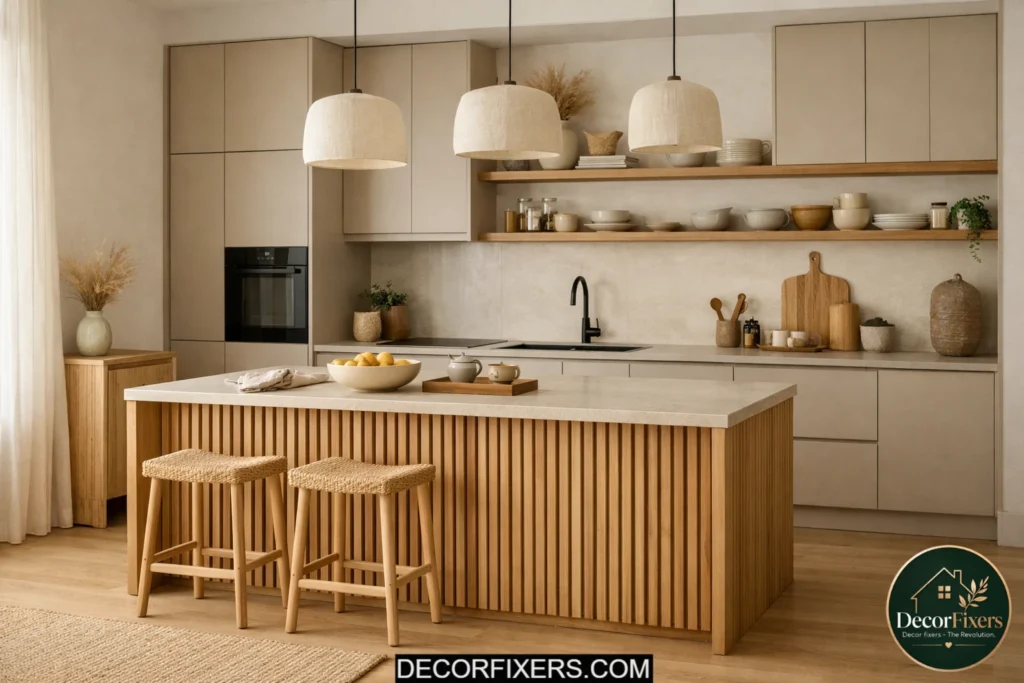
The most common mistake in minimalist kitchen design is confusing minimal with flat. Flat surfaces everywhere, white quartz, white laminate, white walls, feel sterile and acoustically dead. Natural wood introduces texture without color noise: a timber floating shelf, a wood slat breakfast bar panel, an oak island top against painted lower cabinets.
In Japandi design, oak and walnut are the two workhorses. Oak is lighter, warmer, and better for smaller spaces. Walnut is deeper, more dramatic, and better as an accent element in a largely neutral kitchen.
16. Use Large Format Floor Tiles
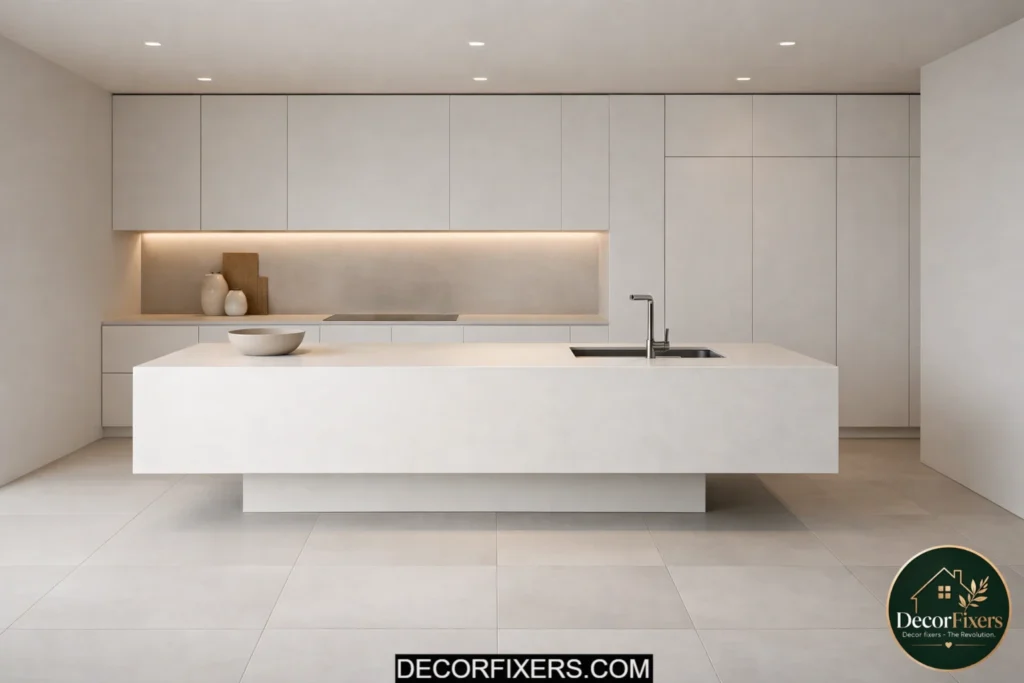
Grout lines are visual noise. A kitchen tiled in 300x300mm tiles has more than twice the grout lines of the same floor in 600x600mm tiles, and the brain registers every line as an interruption. Large, format porcelain (600x600mm or 1200x600mm) in a neutral matte finish is the most practical flooring choice for a minimalist kitchen. It reads cleaner, is faster to clean, and makes small kitchens feel larger.
Quick note: Avoid large-format tiles on uneven floors. Any flex in the substrate causes cracks. Get the floor levelled before tiling, it’s worth the extra cost.
17. Try Microcement for Walls or Countertops
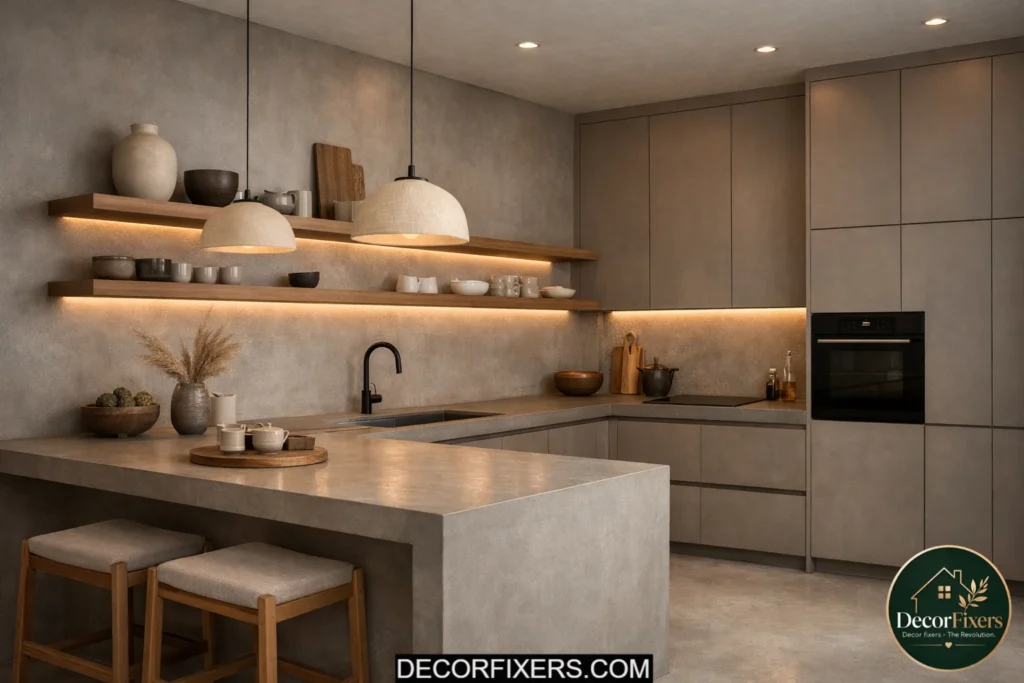
Micro cement has moved from an architect’s only material to a genuinely accessible option. Applied as a seamless coating over existing surfaces, it’s available from specialist applicators in most major cities and can be applied to walls, floors, and even countertops without a full refit. No grout lines. No visible seams. The result is a monolithic, matte surface that works perfectly in minimalist, Japandi, and industrial, leaning kitchens.
It does require professional application and proper sealing. DIY microcement products exist, but the finish quality is noticeably inferior.
Minimalist Kitchen Layout and Functionality Ideas
Minimalist kitchen layout prioritises the working triangle, the relationship between the sink, hob, and refrigerator. According to research from the National Kitchen & Bath Association, the most cited renovation goals in 2025 are storage efficiency, easier cleaning, and improved workflow. A minimalist layout addresses all three simultaneously: fewer surfaces mean fewer places for clutter to land, and a clear workflow means fewer steps between tasks.
18. Reduce Your Countertop Footprint with a Smarter Island
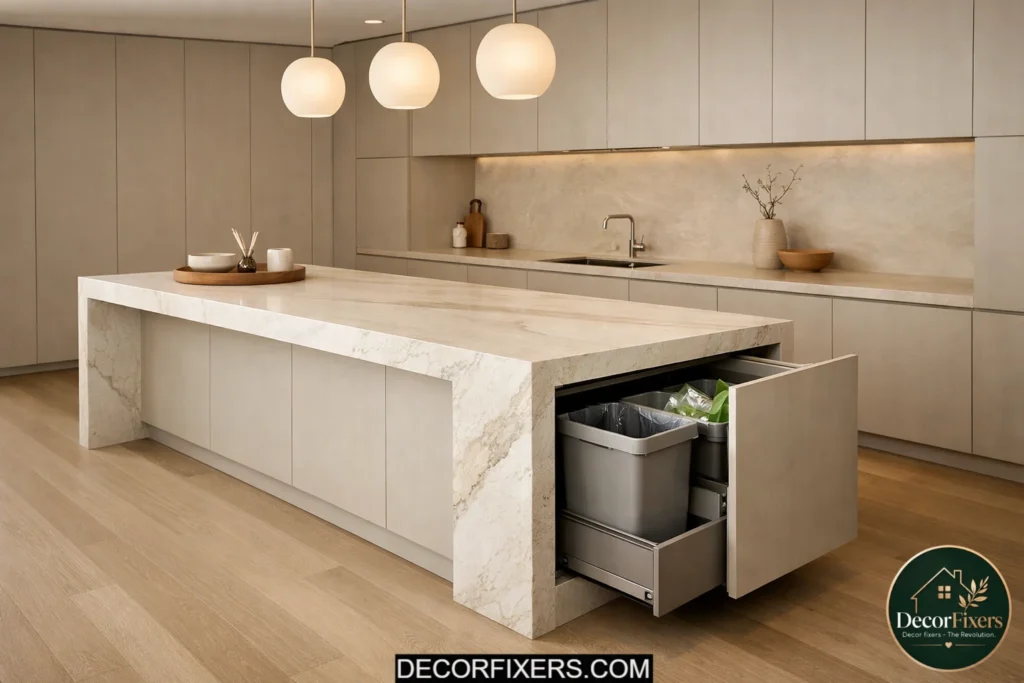
A kitchen island only improves a minimalist kitchen if it has full-height storage underneath, fits your circulation space (minimum 900mm clearance on all sides), and doesn’t duplicate a surface you already have. An island that just adds more countertop usually adds more clutter.
The best minimalist islands have a waterfall edge in a contrasting material (stone or timber against painted cabinetry), integrated bin storage, and no visible legs or kickplate, a floating island visual that makes the floor read as larger.
19. Extend Cabinets to Ceiling Height
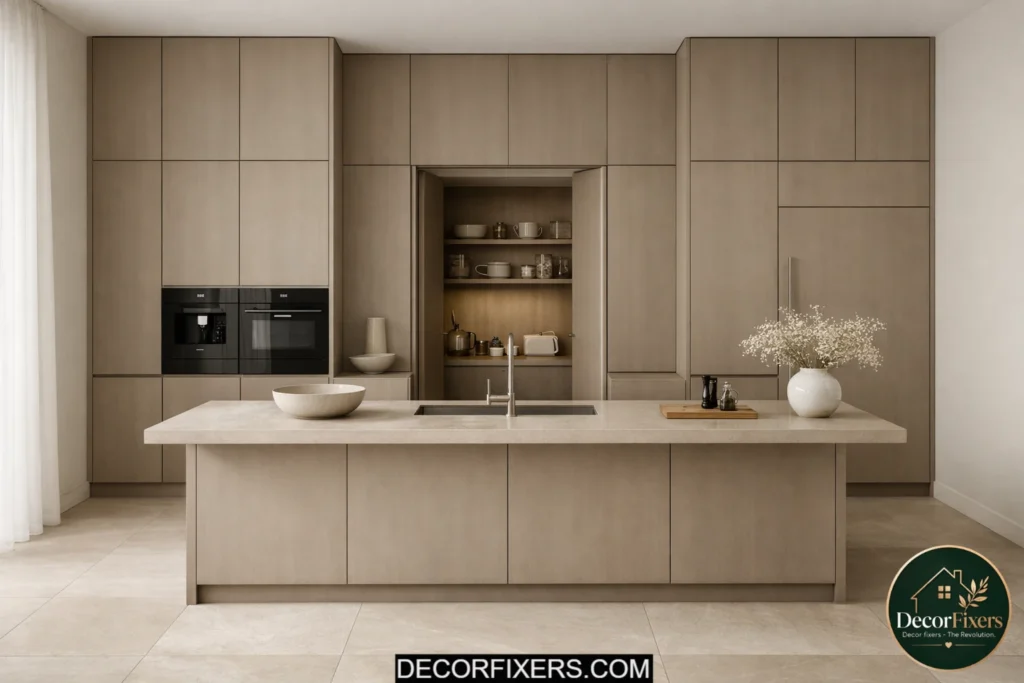
The gap between cabinet tops and the ceiling, sometimes called the ‘dust shelf’, is one of the easiest details to eliminate that has a dramatic visual impact. Cabinets taken to ceiling height elongate the room vertically, eliminate a horizontal line that caps the space, and add meaningful storage. It costs more than standard height cabinets. It’s worth it.
Look, if you’re in a kitchen with standard 2.4m ceilings and only have budget for one upgrade, extend the cabinets to ceiling height. The vertical proportions shift the entire feel of the room.
20. Design a Dedicated Countertop, Clear Zone
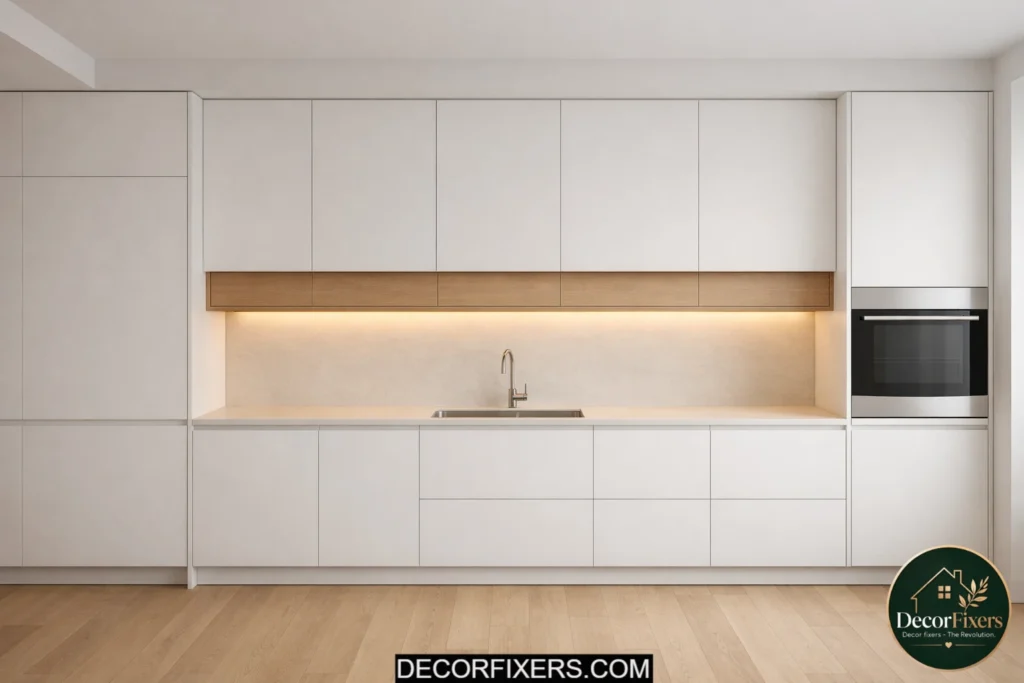
Pick one section of countertop, ideally adjacent to the hob, and commit to keeping it completely clear at all times. That’s your working zone. Everything else (kettle, toaster, coffee machine) gets its own designated spot elsewhere, ideally in the appliance garage or inside a cabinet. Discipline beats willpower here: if the storage doesn’t exist, the clutter returns.
This is the single behaviour change that separates a kitchen that stays minimal from one that only looks minimal in photos.
kitchenThis is also where Smart Kitchen Storage Features become genuinely valuable in daily life. Hidden charging drawers, pull-out pantry systems, integrated recycling bins, and appliance garages are not just luxury additions — they actively support the minimalist goal of maintaining calm, functional surfaces with less visual interruption.
21. Try an Open Plan Galley Layout
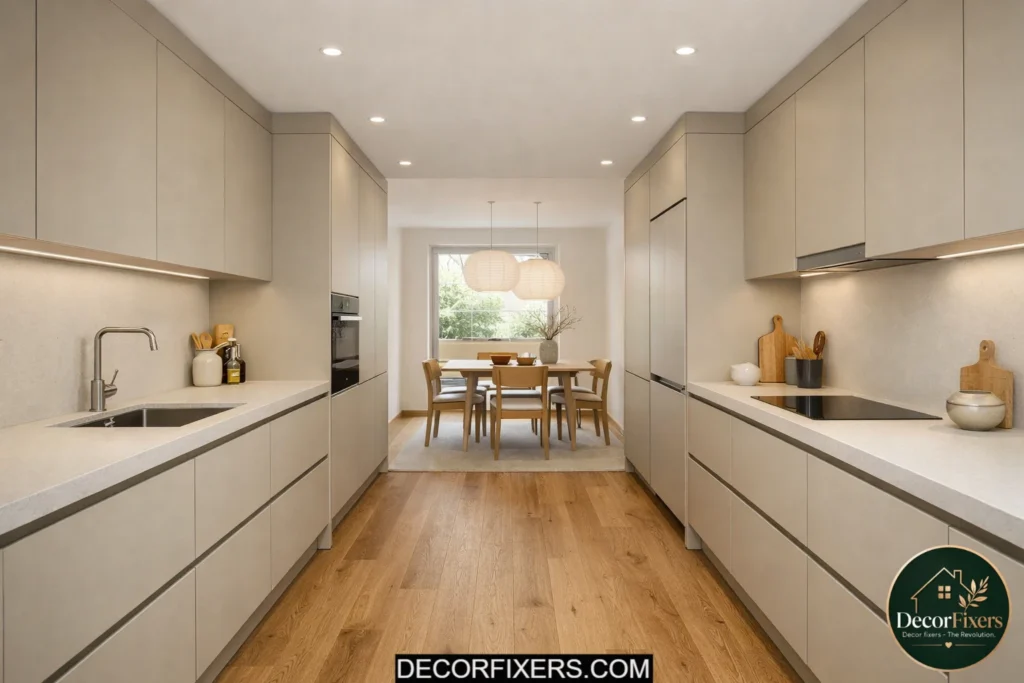
The galley kitchen, two parallel runs of cabinets with a corridor between, is the most functionally efficient layout for most households. When opened up to an adjacent dining or living area, a galley layout creates the clean, linear aesthetic that’s central to minimalist kitchen design. The key is ensuring both runs of cabinets are identical in height, door profile, and color; any inconsistency in a symmetrical layout reads immediately.
22. Add a Single Statement Detail
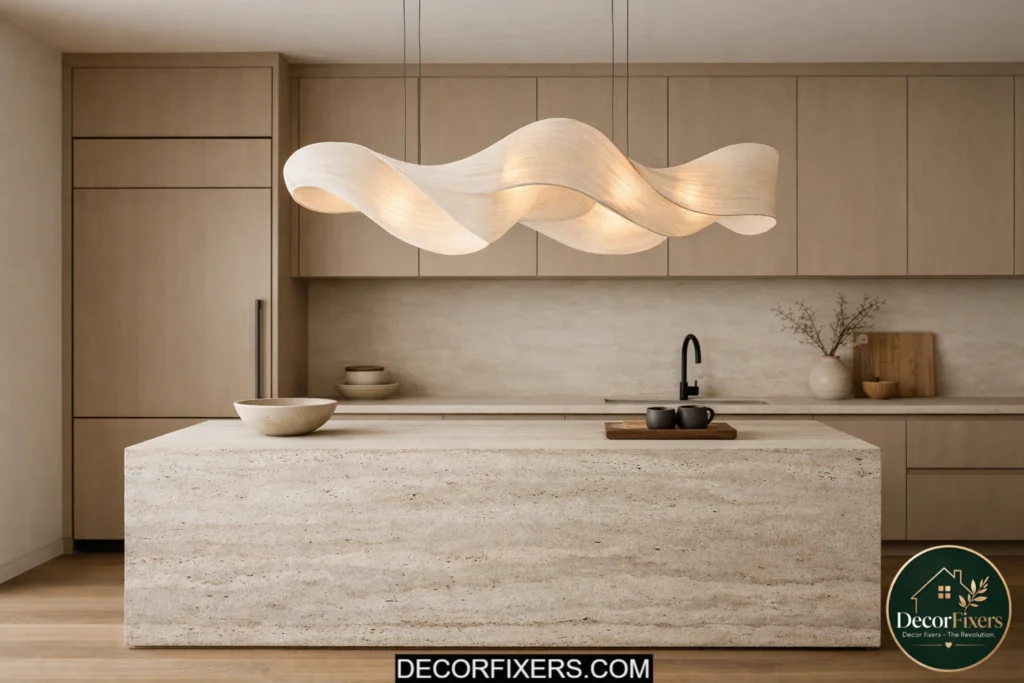
Minimalist kitchens are sometimes criticised as soulless. The fix isn’t adding more, it’s adding the right thing. A sculptural pendant light over the island. A floating shelf in blackened steel. A single large ceramic vase at the end of a run of cabinets. One deliberate, unexpected element gives the eye somewhere to rest and makes the room feel curated rather than bare.
Small Minimalist Kitchen Ideas and Finishing Touches
Small minimalist kitchens present a unique challenge: storage needs are identical to a larger kitchen, but there’s less room for cabinetry. The most effective small minimalist kitchen ideas are those that work vertically, extending cabinets to ceiling height, using tall pull-out pantry columns, and integrating appliances so they don’t occupy valuable countertop space.
23. Declutter to a “One In, One Out” Rule
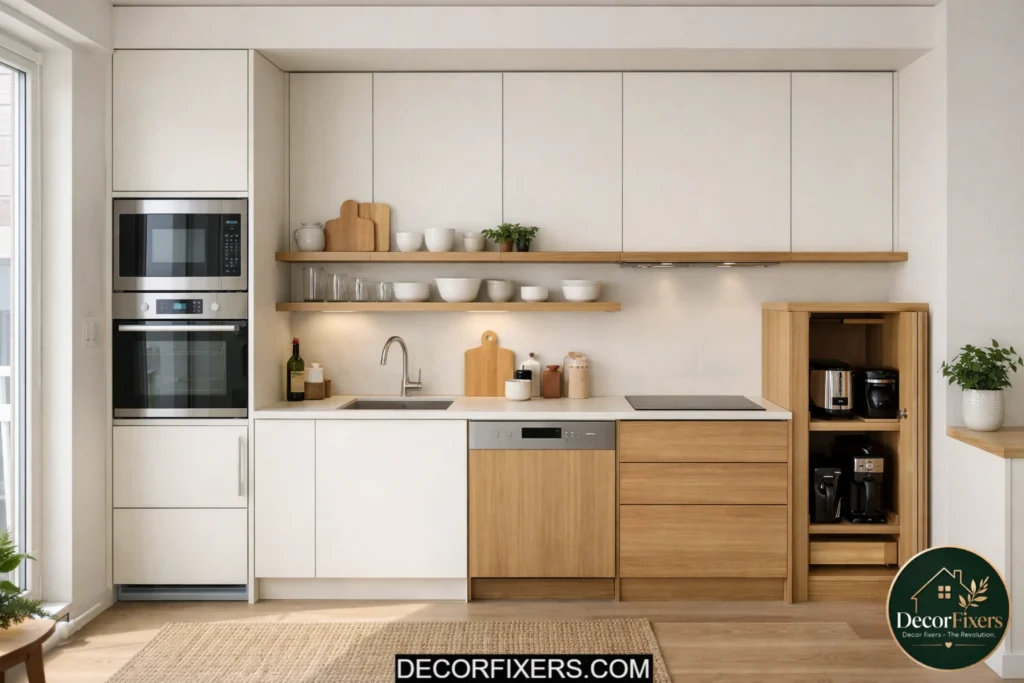
The most common failure in minimalist kitchen maintenance isn’t design, it’s behaviour. Every item you add without removing something creates drift. The one-in, out rule is simple: when a new kitchen tool, appliance, or decorative object enters the kitchen, one existing item leaves. Permanently. Not to a drawer. Not to a garage shelf.
This is what real minimalist kitchen design actually requires. It’s not just beautiful storage. It’s a commitment to owning less.
24. Add Plants Strategically
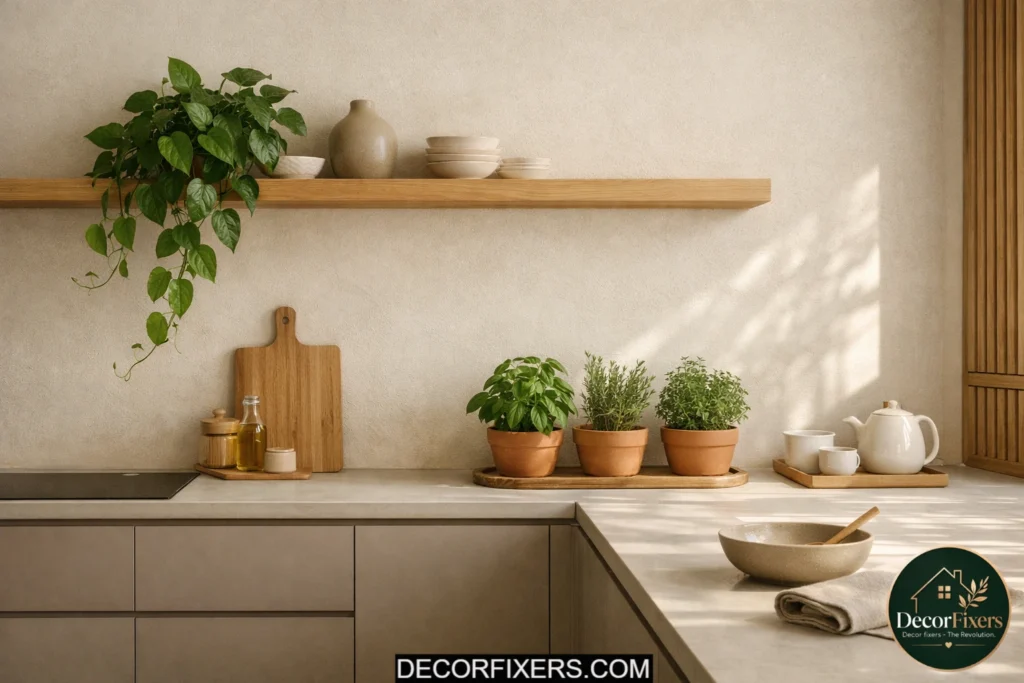
A small potted herb on the windowsill. A single trailing plant on an open shelf. One low-maintenance species (eucalyptus, pothos, a simple succulent) at the end of the island. Plants bring organic contrast that makes a neutral, matte kitchen feel alive rather than empty. The rule: one or two plants, not a collection. Collections become visual noise. A single well-placed plant is a design decision.
In Japandi design specifically, a single bonsai or a small terracotta pot with fresh herbs is considered a foundational styling element, not decoration, but a connection to natural material that the rest of the design is building toward.
25. Audit Your Kitchen Every Six Months
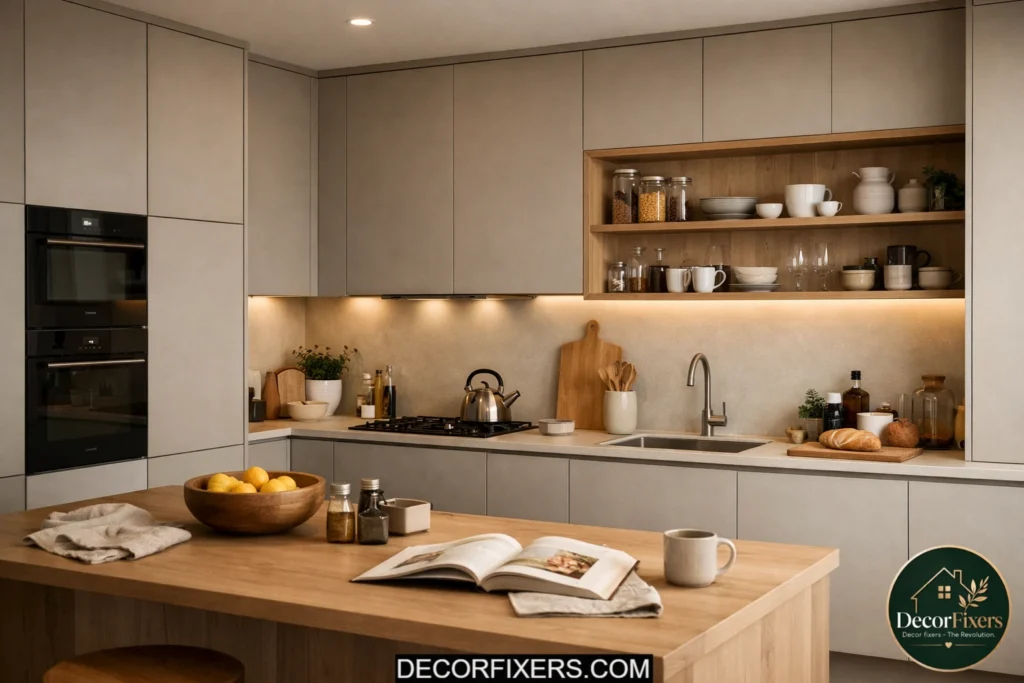
The minimalist kitchen isn’t a destination. It’s an ongoing practice. Every six months, pull everything out of your cabinets, countertops, and drawers, and ask the same question for every item: Does this have a clear home and a clear purpose? If not, it leaves.
Most households find the second audit easier than the first, not because they have less, but because they’ve stopped buying things without a designated place for them. That’s when the kitchen actually starts to stay minimal without effort.
CONCLUSION:
The kitchens that stay minimal aren’t the ones that got the most expensive redesign. They’re the ones where the storage was actually designed around how the household uses the space, where there’s a real home for every item, and no surface has to double as a dumping ground.
What I’ve found, looking at dozens of real kitchen renovations rather than magazine shoots, is that the most satisfied homeowners made two or three high-impact decisions: handleless cabinets, ceiling, height uppers, an integrated appliance zone, and then committed to the behaviour change of keeping surfaces clear. Design and habit together. Neither one alone is enough.
Start small if the full renovation isn’t feasible yet. Clear the countertops. Replace the hardware. Paint the walls one consistent tone. See how it feels to live in a calmer kitchen for a few months before spending on structure. The clarity might surprise you.
FAQs:
Q: What’s the best color for a minimalist kitchen?
A: Warm white, soft greige, or pale sage, all with warm undertones. Cool or blue, grey whites can feel clinical. The best approach is to choose a base tone that reads neutral in your kitchen’s specific natural light, then test a sample before committing to all cabinetry.
Q: How do I make my small kitchen look minimalist without a full renovation?
A: Clear all countertops to zero, replace mismatched cabinet hardware with one consistent pull or switch to push, open magnets, and repaint walls in a single warm neutral. These three changes cost under $200 combined and produce 70% of the visual impact of a full minimalist redesign.
Q: Should I remove upper cabinets for a minimalist kitchen look?
A: Only if you have sufficient base and island storage to compensate. Removing upper cabinets without solving your storage needs leads to cluttered countertops, which is the opposite of minimalist. Consider replacing one section of upper cabinets with a floating shelf as a test before committing fully.
Q: Why does my minimalist kitchen still look cluttered?
A: Likely because the storage isn’t designed to absorb what you’re trying to hide. A minimalist visual only works when every daily, use item has an assigned, enclosed home. If storage is full or inconveniently placed, items migrate to countertops. The fix is smarter storage placement, not more decluttering willpower.
Q: When should I use open shelving in a minimalist kitchen?
A: Open shelving works in minimalist kitchens only when backed by strong closed storage elsewhere. Use open shelves for items you can commit to keeping styled consistently, a row of matching glass jars, a cookbook, and two ceramics, one plant. Never for everyday chaos items like cleaning products, packaged food, or accumulated tools.

Creator of DecorFixers, sharing practical home and interior ideas focused on real-life usability, simple design improvements, and budget-friendly solutions.