

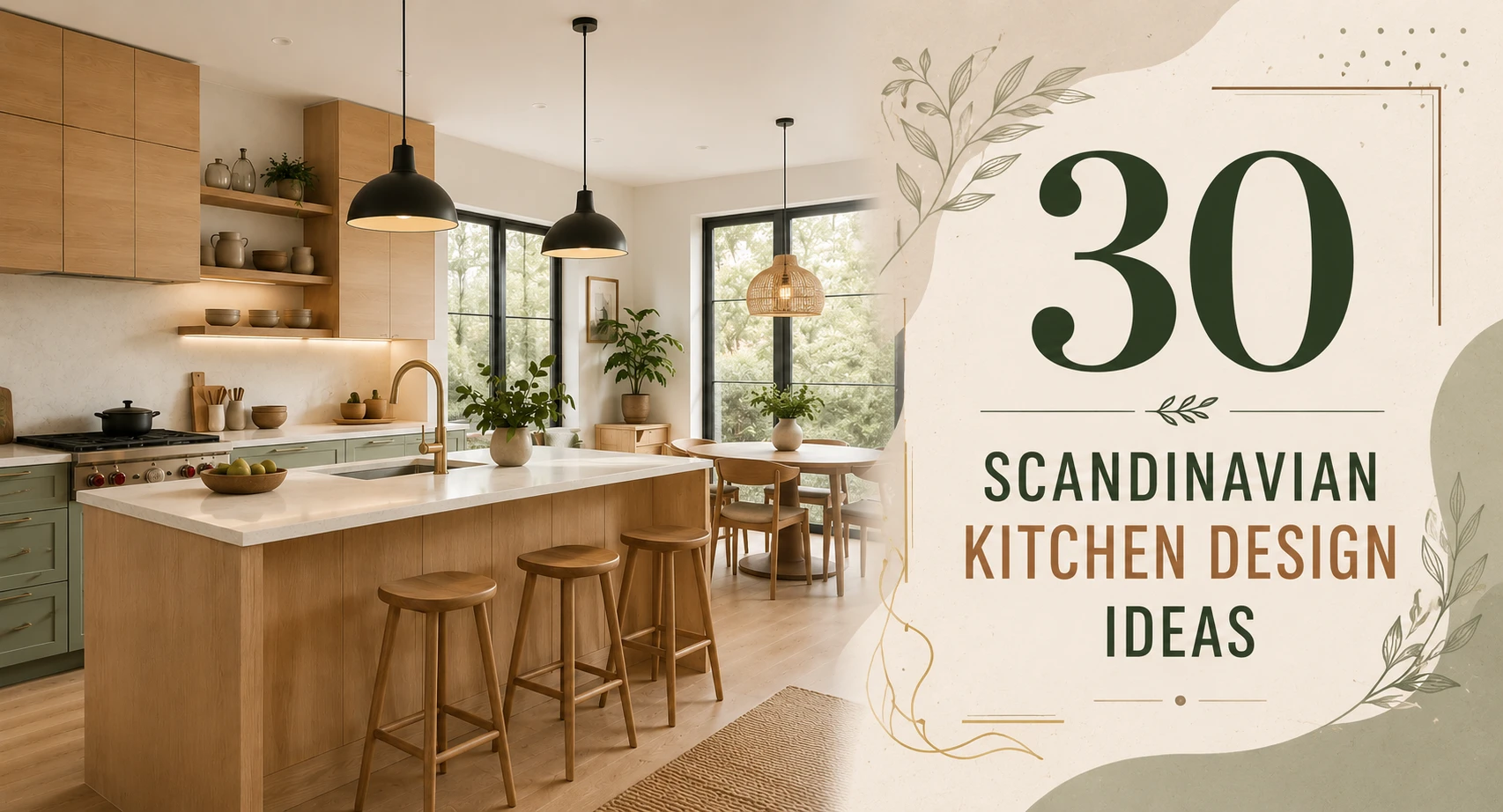
I’ll be honest with you. The first time I sat down and really studied a Scandinavian kitchen, not a Pinterest photo, but an actual occupied home, my immediate reaction was: this doesn’t look designed at all. It looked lived-in. Quiet. Like nothing was fighting for your attention.
And that’s the whole point.
Most guides will tell you to use white cabinets, light wood, and clean lines. True. But none of that explains why so many people end up with a Scandi-inspired kitchen that looks cold in real life, even though it looked stunning on mood boards. The gap between inspiration and execution is where renovations go sideways, and it usually comes down to misunderstanding two concepts: hygge and lagom.
This guide covers all 30 Scandinavian kitchen design ideas you actually need, with material choices, budget breakdowns, and the kind of honest context most articles skip. It’s built around the latest Nordiska Kök 2025 trend data and real design decisions, not just aesthetics.
What Is Scandinavian Kitchen Design?
Scandinavian kitchen design is a Nordic-rooted philosophy that prioritises natural light, organic materials, functional storage, and a warm-minimal aesthetic. It is guided by the Swedish concept of lagom (“just enough”) and the Danish concept of hygge (cosy, lived-in comfort). The result is a kitchen that feels. uncluttered without feeling empty, purposeful without being cold.
1. What Is Scandinavian Kitchen Design? (The Philosophy That Changes Everything)
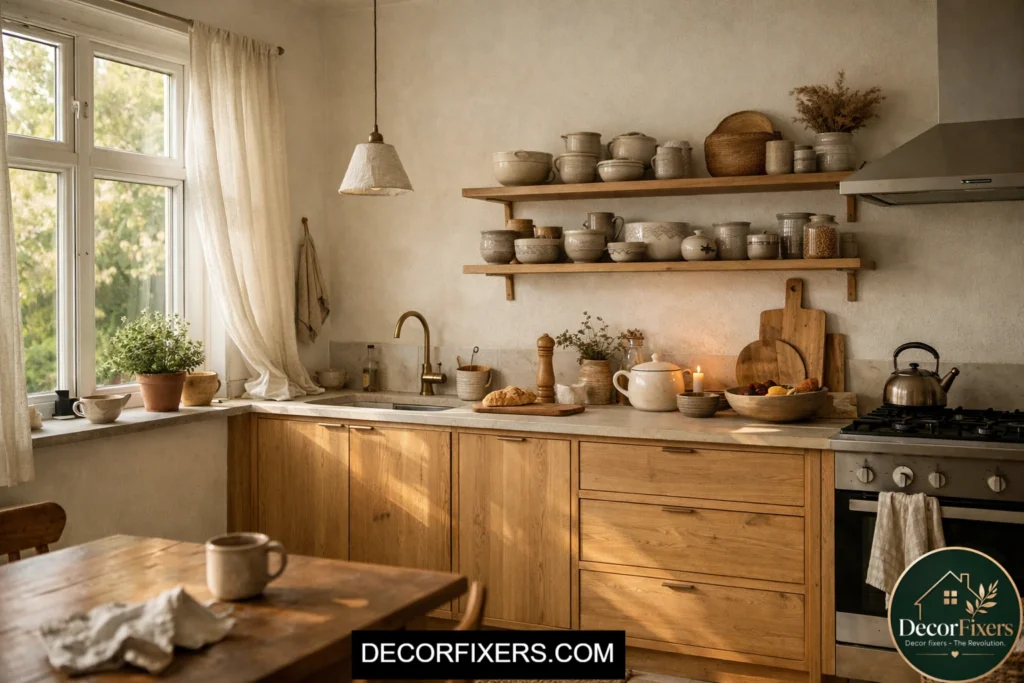
Scandinavian kitchen design isn’t a colour palette. It’s a decision-making framework. Every choice from the cabinet handle to the countertop material runs through one filter: Does this earn its place here?
The concept of lagom, pronounced lar-gohm, is Swedish for “just the right amount.” It isn’t minimalism for its own sake. It’s the philosophy that guides how much storage you build, how many open shelves you leave, and how you mix materials without tipping into clutter.
Then there’s hygge, a Danish-Norwegian word pronounced hue-gah. Where lagom sets the structure, hygge brings the warmth of the candle on the counter, the ceramic bowl by the sink, the worn butcher-block cutting board that has earned its scratches. Together, they explain why Scandinavian kitchens feel cosy rather than clinical.
Most guides describe what a Scandi kitchen looks like. What they skip is why it works, and what happens when you copy the look without the logic.
Direct Answer: What makes a kitchen “Scandinavian”?
A kitchen earns the Scandinavian label when it balances three things simultaneously: natural materials that.
add warmth (pale oak, limestone, linen), a functional layout with intentional hidden storage guided by lagom,
and a lighting strategy that compensates for limited natural daylight. According to Nordiska Kök’s 2025 trend
report, Soft Scandinavian design featuring curved organic forms and warm natural materials is the dominant
kitchen aesthetic heading into 2026 for the second consecutive year.
2. The Colour Palette That Keeps a Nordic Kitchen Warm (Not Washed Out)
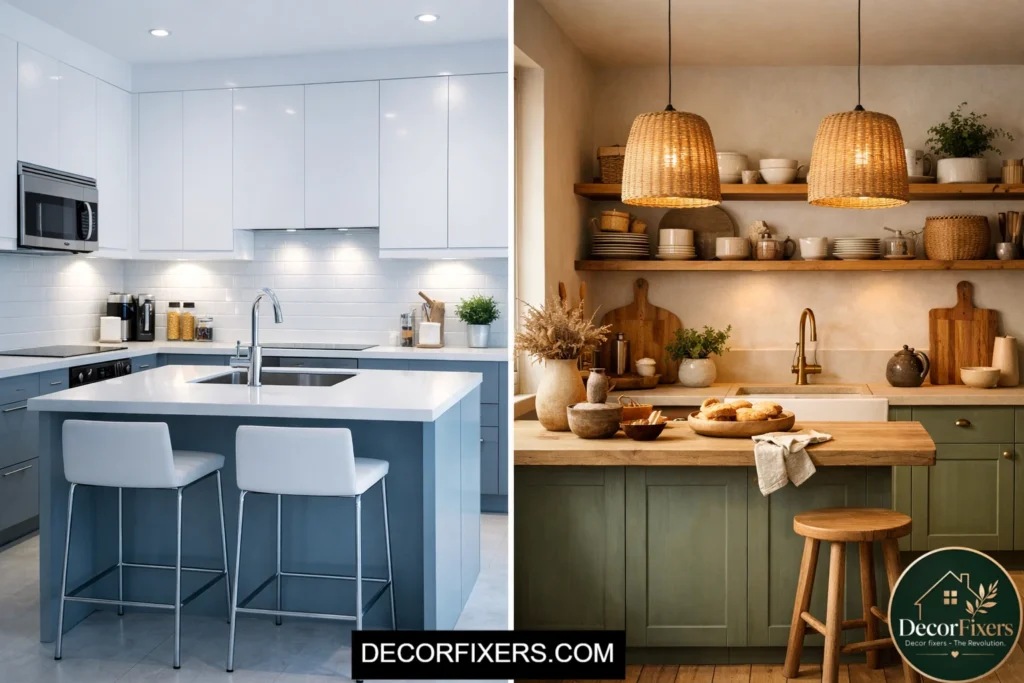
Here’s the thing: most people over-whiten a Scandinavian kitchen and then wonder why it feels like a hospital corridor. White is a base, not a complete colour scheme.
The classic Scandi palette works in layers. Start with white or off-white walls, specifically warm whites with a slight yellow or pink undertone, not cool blue-toned whites. Then layer in a secondary tone: muted sage green, soft clay, warm taupe, or dusty slate. Reserve actual colour for a third layer, earthy tiles, ceramic accessories, or a single painted cabinet door.
In 2025, earthy, muted tones have become the dominant evolution of the Scandi palette. Sage green, terracotta, and warm clay are replacing the all-white approach in newer renovations; they maintain the calm, clean feeling while adding genuine warmth. Pair them with natural wood accents and matte finishes.
[IMAGE: Side-by-side comparison, cool-white Scandi kitchen vs warm-white with sage lower cabinets]
3. Light Wood Cabinetry: The Material That Ties the Whole Room Together
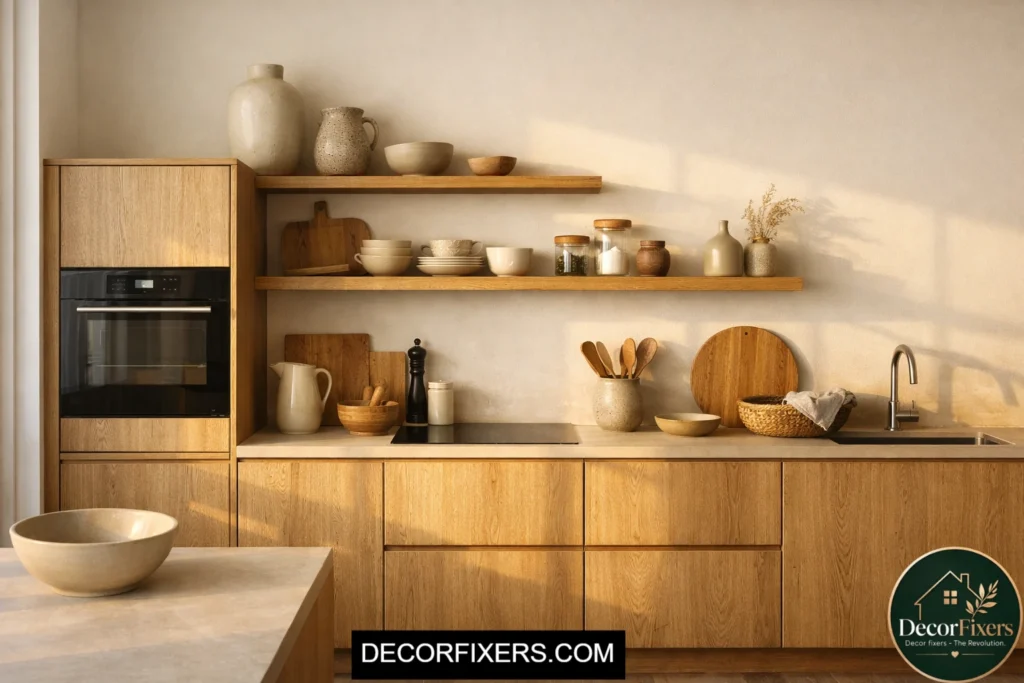
Oak is the workhorse of Scandinavian kitchen design. Pale, natural-grain oak, specifically wire-brushed or lightly oiled finishes, appears in everything from cabinet fronts to open shelving, bar stools, and floating shelves. It’s warm enough to counteract white walls but neutral enough not to dominate.
Not all wood reads as ‘Scandi.’ Avoid dark mahogany, cherry stains, or high-gloss lacquered wood; those belong to a different design tradition. The sweet spot is a light-to-medium oak tone with visible grain texture, kept in its natural or lightly washed state.
IKEA’s ENHET oak-effect range within the METOD system is a reliable entry point. It captures the aesthetic at a fraction of bespoke cost. For a mid-range upgrade, Kvik’s Mano series from Denmark handles fronts with real-wood-effect finishes that sit clearly above flatpack quality, without the bespoke price.
4. Handleless Cabinetry: The Cleanest Look in Nordic Kitchen Design
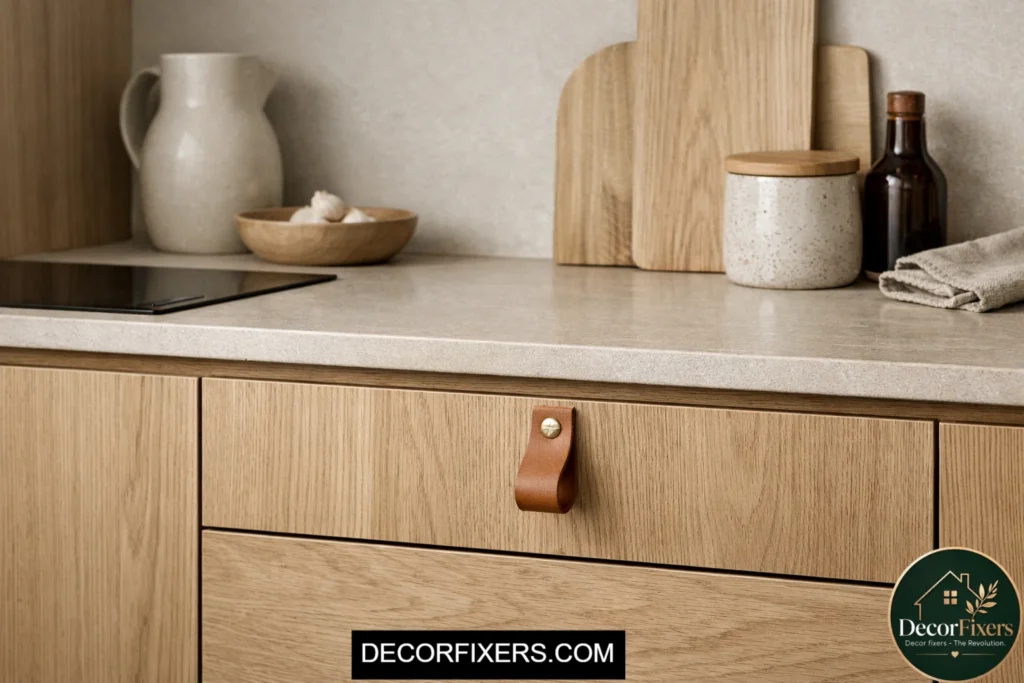
Push-to-open or J-pull handleless cabinets are a cornerstone of the modern Scandi kitchen. They remove visual clutter at eye level, the place your brain processes first when you walk into a room, and the result is a dramatic, immediate sense of calm.
That said, completely handle-free can tip into sterile territory. The smarter approach: handleless upper cabinets, handleless lower cabinets for continuity, but a thin leather strap or minimal brass pull on one or two drawers for a tactile, artisanal counterpoint. This is the design equivalent of lagom, the small detail that proves the space was designed, not just assembled.
[IMAGE: Close-up of handleless oak cabinets with a single leather pull on one drawer]
5. Flat-Front Cabinet Doors: Why the Profile Matters More Than the Colour
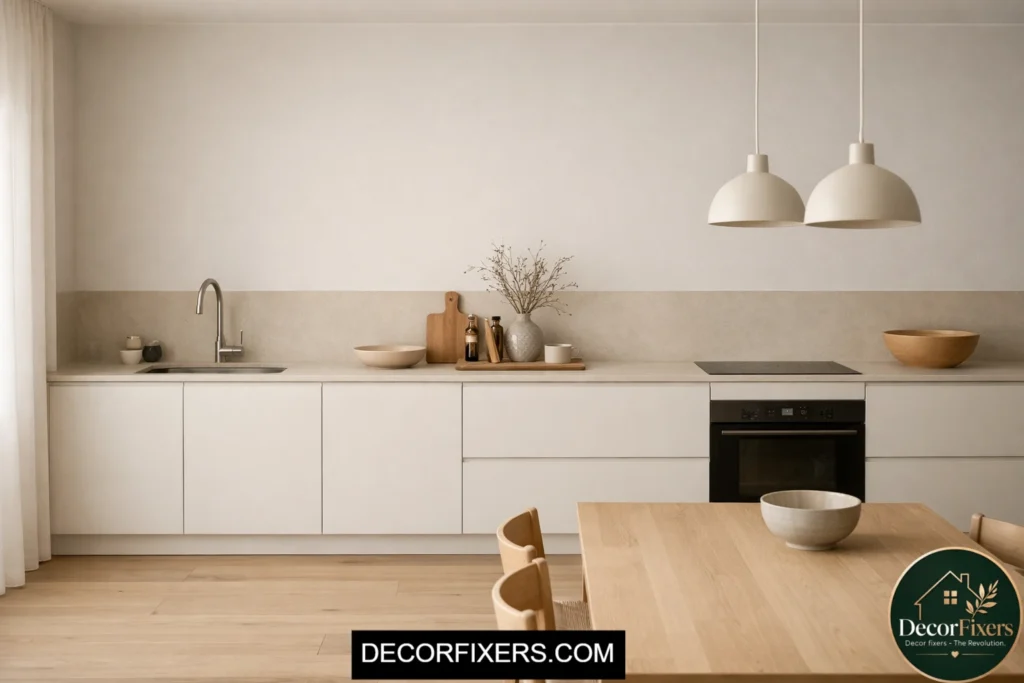
Raised-panel or shaker-style doors have their place, but not in a Scandinavian kitchen. Flat-front cabinet doors, sometimes called slab doors, maintain the clean surface plane that makes the eye move through the room without stopping.
The surface texture is where the interest lives. Matte lacquered finish, a lightly grained wood veneer, or a smooth vinyl wrap in a warm tone; these are the choices that separate an authentically Nordic result from a generic minimalist one. Gloss finishes feel too hard, too reflective. Scandi design prefers surfaces that absorb light softly rather than bounce it.
For budget-conscious renovations, IKEA’s VEDDINGE handleless white range paired with aftermarket oak-effect doors is a widely proven combination. You get the structural bones at IKEA prices and the visual quality of a mid-range result.
6. White Quartz Countertop, The Scandi Standard Worth the Investment
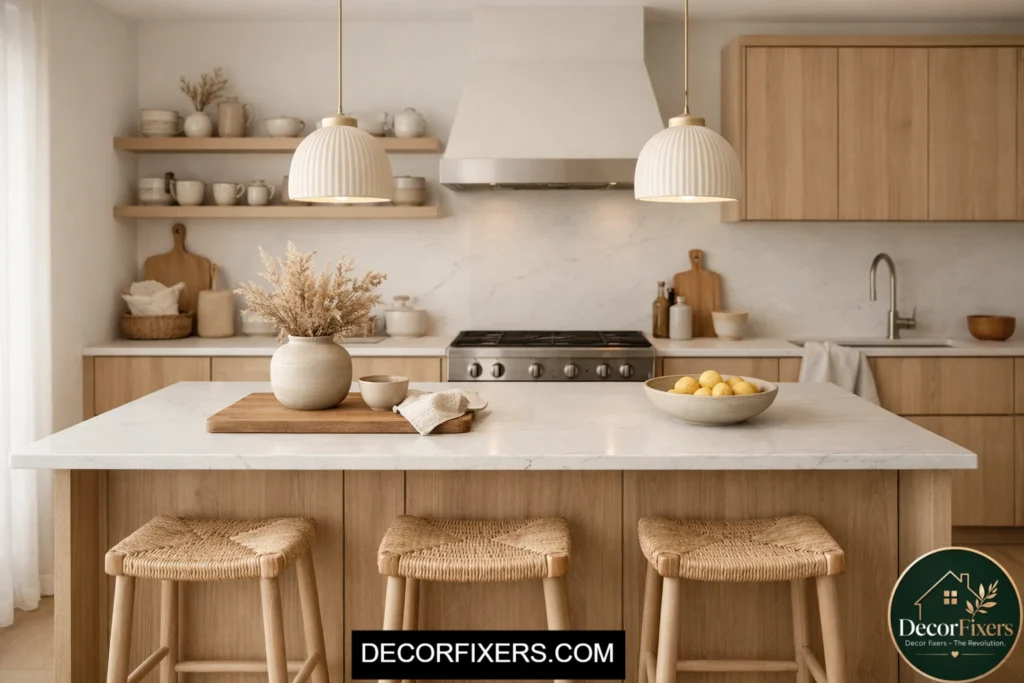
If there’s one surface worth spending real money on in a Scandinavian kitchen, it’s the countertop. White quartz, specifically soft white with minimal veining, is the industry benchmark for Nordic kitchens because it reflects light upward into the room, pairs with any cabinet colour, and requires almost no maintenance.
The alternatives are valid too. Honed limestone offers more warmth and a slightly softer visual. Butcher block adds hygge instantly, but needs oiling and is less practical around the sink. My read on this: quartz is the safest choice for longevity; butcher block wins on character. Choosing between them depends entirely on how much you actually cook in the space.
Quick Comparison:
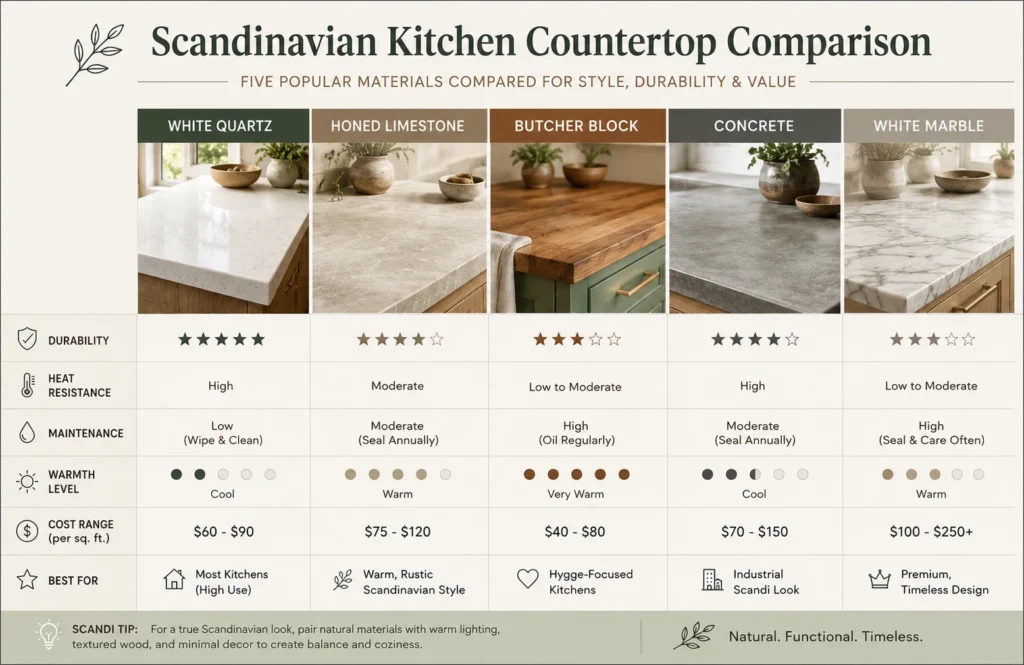
| Option | Best For | Key Benefit | Limitation |
| White Quartz | Most kitchens | Durable, low-maintenance, light-reflective | Cold if overused; cost ~$60–90/sqft |
| Honed Limestone | Warm, rustic Scandi aesthetic | Organic texture; ages beautifully | Porous; needs sealing annually |
| Butcher Block | Hygge-heavy, tactile design | Warm; adds instant character | Requires oiling; avoid near sink |
| Concrete | Industrial Scandi hybrid | Unique texture; mouldable to shape | Heavy; prone to staining |
| White Marble | Premium, timeless look | Unmatched natural beauty | High maintenance; scratches easily |
7. Open Shelving Done Right, The Scandi Approach to Display vs. Storage
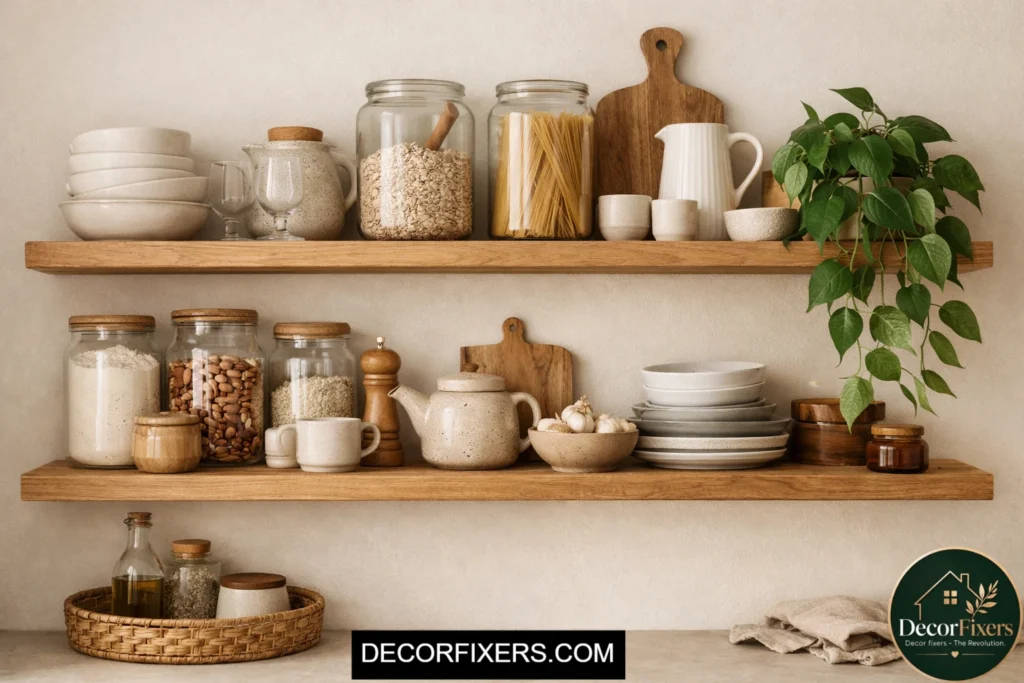
Open shelving in a Scandinavian kitchen isn’t decorative. It’s an intentional display, a curated selection of daily-use items that are beautiful enough to live in the open. The rule is simple: if it’s ugly or only used occasionally, it goes behind a door.
The most common mistake is treating open shelves as a Pinterest display board and loading them with items you never use. A real Scandi shelf holds: three to five everyday ceramics, one or two plants, and perhaps a row of glass jars with dry goods. That’s it. The restraint is what makes it work.
Wall-mounted oak floating shelves at two heights, one above the counter, one higher for less-accessed items, is the standard configuration. Keep the gap between the shelf and the wall consistent for a built-in feel.
8. Smart Hidden Storage: How Lagom Drives the Storage Philosophy
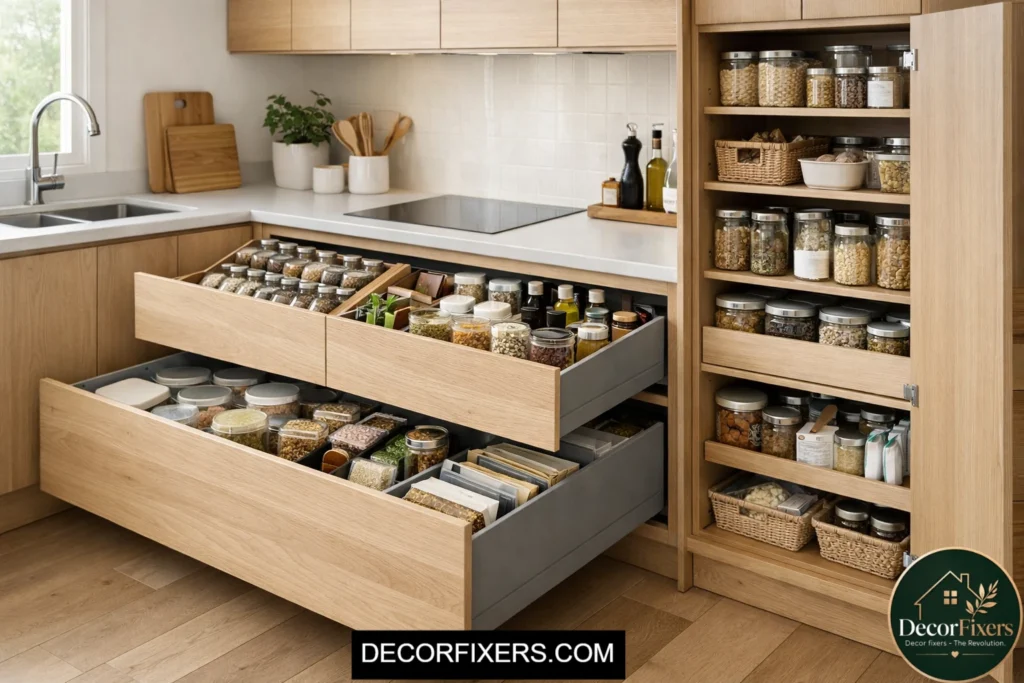
This is the section most guides skip entirely, and it’s the most important one for making a Scandi kitchen actually function. Lagom storage means designing exactly enough capacity for what you own, not more, not less. That sounds obvious, but in practice, it means most Scandi kitchens have more hidden storage than you’d expect from the outside.
Pull-out drawer systems, built-in spice organisers, pan drawers with internal dividers, and pantry columns disguised as regular cabinet doors- these are the workhorses. If you’re renovating with IKEA’s METOD system, their Smart Kitchen Storage Features drawer inserts and MAXIMERA deep drawers are worth every penny for the functional result they deliver.
The philosophy: everything that sits on your counter should earn that position every single day. If an appliance gets used fewer than three times a week, it belongs in a cabinet. This one discipline, applied consistently, is responsible for most of the ‘how do they keep it so clean’ reaction people have to Scandinavian kitchens.
9. Integrated Appliances: The Trick That Makes the Room Feel Larger
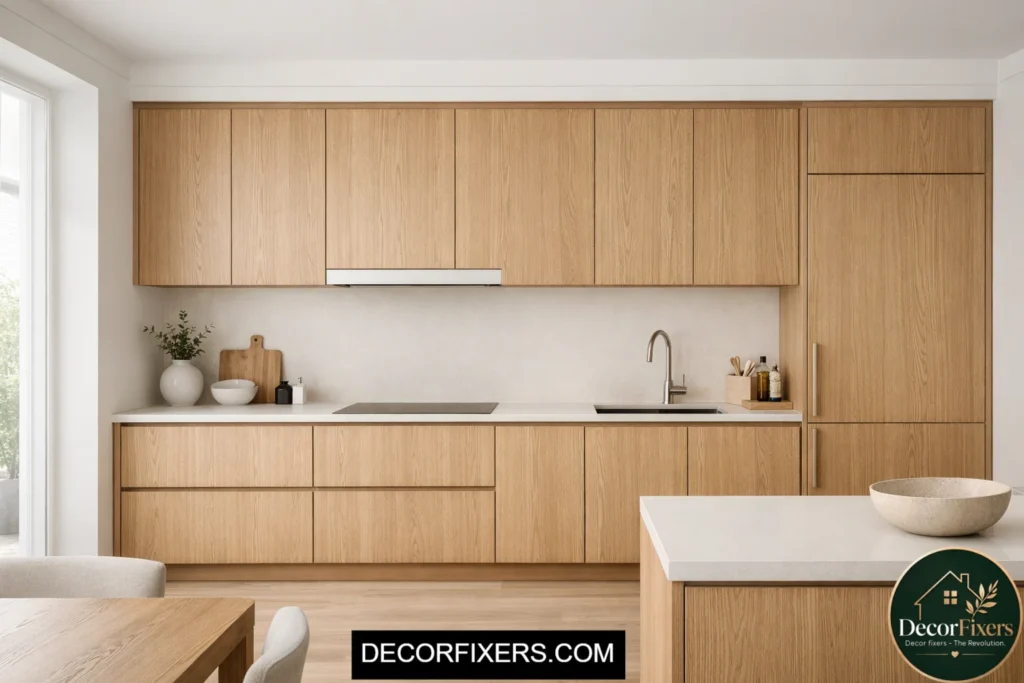
Panel-ready or fully integrated appliances where the dishwasher and fridge fronts match the cabinet doors exactly are a cornerstone of high-end Scandi kitchen design. They eliminate the visual break that standalone appliances create and make the room feel seamless, which in turn makes it feel bigger.
You don’t have to go fully integrated to get the effect. Even panel-fronted dishwashers and a fridge with matching door panels make a significant visual difference. The handles, or lack of them, matter here too. Integrated appliances with push-to-open mechanisms are the cleanest approach.
10. Natural Stone Backsplash Adding Texture Without Adding Noise
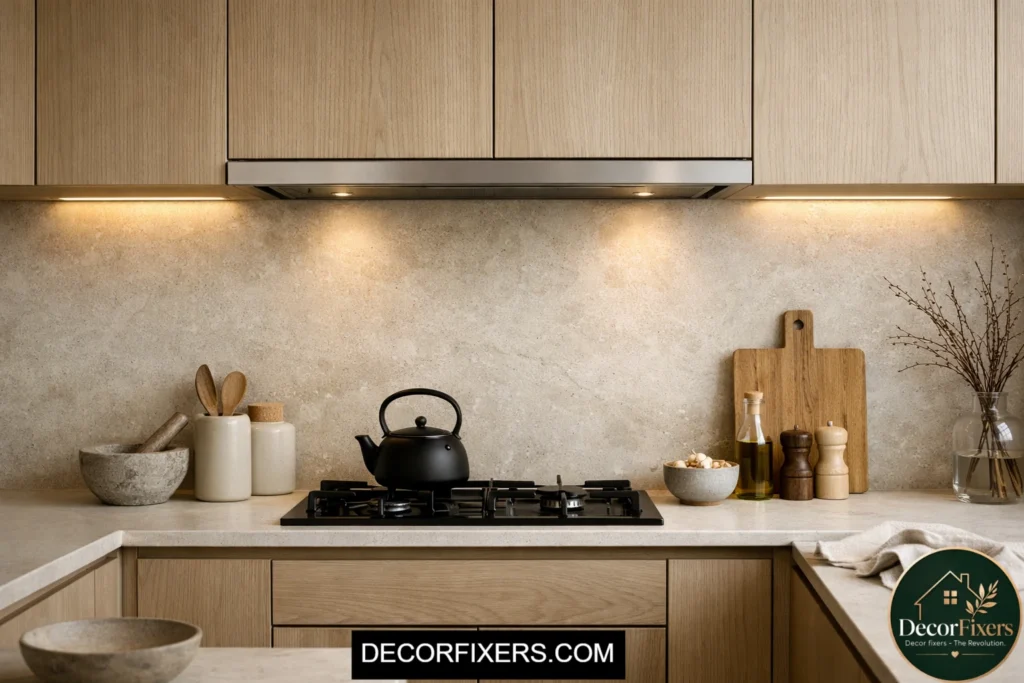
Subway tiles are overused. They’re not wrong for a Scandi kitchen, but they’re no longer interesting. The move that actually elevates the space in 2025 is a natural stone backsplash, specifically honed limestone, textured sandstone tiles, or a slab of book-matched marble behind the hob.
The key is to keep the finish matte. Glossy stone reflects light in a way that draws attention to itself; matte stone absorbs light and adds depth quietly. That quiet depth is exactly what separates a Scandinavian kitchen from a generic white kitchen with stone details.
11. Pendant Lighting: The Fastest Way to Shift the Mood in a Nordic Kitchen
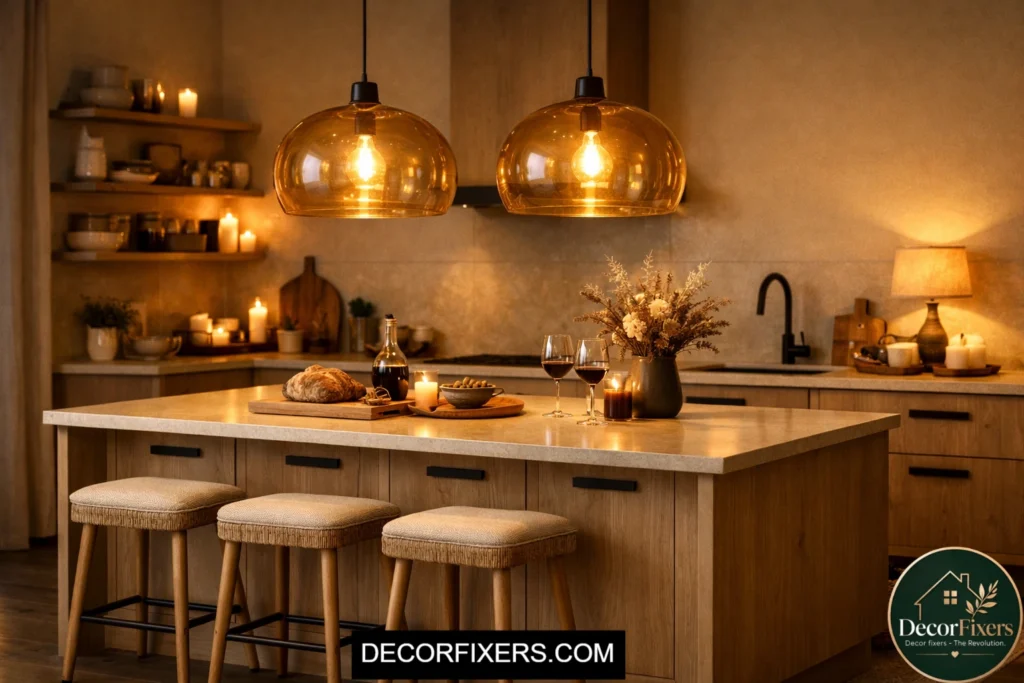
Scandinavian countries have some of the world’s longest winters. As a result, Nordic interior design has developed a sophisticated relationship with artificial lighting, not as a functional afterthought but as a mood-making primary element.
For kitchen islands and dining areas, warm Edison-tone pendants in black matte, brushed brass, or natural rattan are the standard. The Henningsen-family designs from Louis Poulsen set the gold standard, expensive, but genuinely life-changing in how they distribute warm light. For budget alternatives, HAY and IKEA’s own RANARP series offer functional versions of the same principle.
The golden rule: never rely solely on a single overhead light source. Layer it with pendants over the island, under-cabinet LED strips for the countertops, and a warm lamp or two for the corners.
12. Under-Cabinet LED Strips, The Upgrade That Costs Almost Nothing
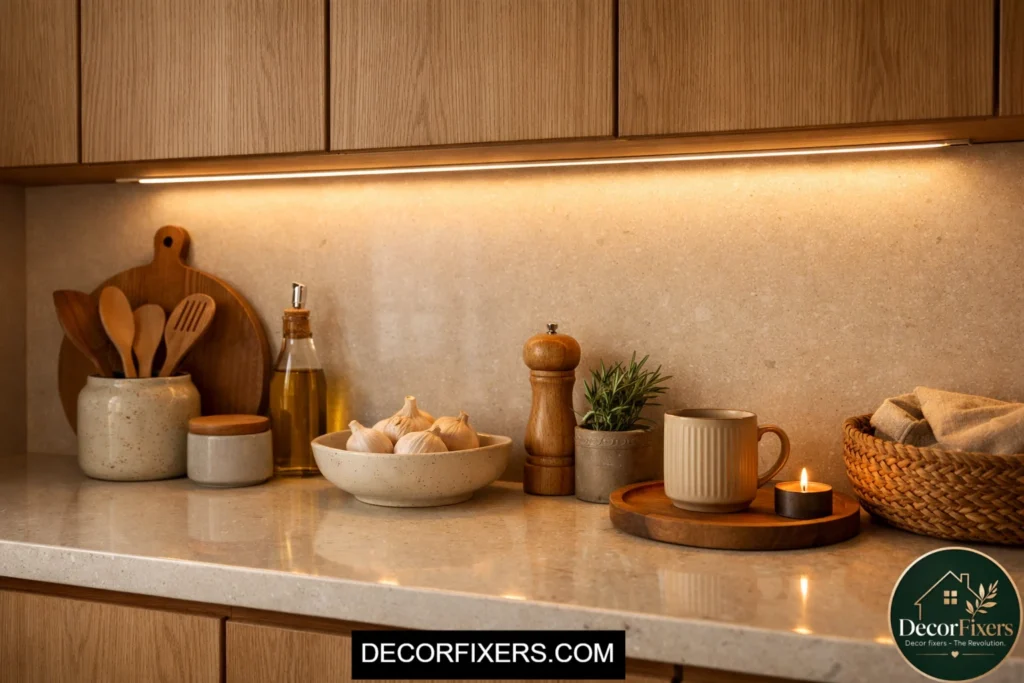
Under-cabinet lighting is the single most underrated upgrade in Scandinavian kitchen design. It costs perhaps $80–150 to install with warm-tone LED strips, and the transformation is immediate. Counter tasks become easier, the countertop material reads more richly, and the whole kitchen drops a notch in perceived formality.
Go 2700K–3000K colour temperature only. Anything cooler and you’ve introduced the cold, clinical feeling you’re working against. Warm, incandescent-tone LEDs are the choice.
13. The Japandi Kitchen, Where Scandi Meets Japanese Wabi-Sabi
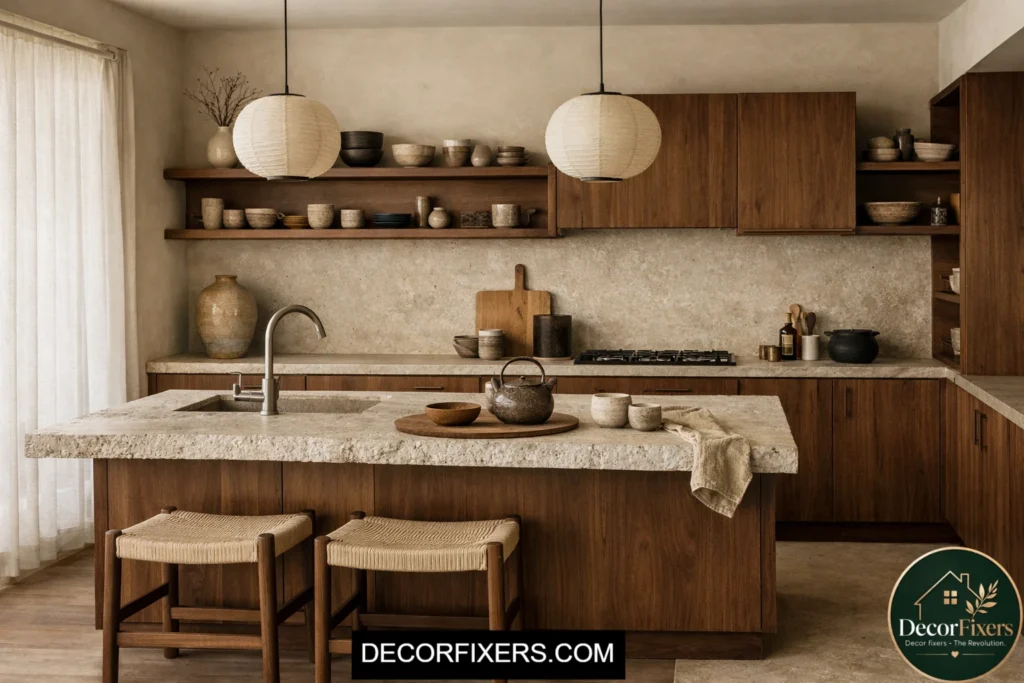
Japandi design is the hybrid that’s genuinely reshaping Nordic kitchen aesthetics in 2025. It combines Scandinavian functionality and warmth with Japanese wabi-sabi, the appreciation for imperfection and natural aging. The result is a kitchen that feels both modern and ancient simultaneously.
In practical terms, Japandi means slightly darker woods (walnut instead of oak), lower furniture profiles, handmade ceramics, and a willingness to let natural materials age visibly rather than sealing everything to perfection. Think wabi-sabi applied to a kitchen: a slight imperfection in the limestone countertop isn’t a defect, it’s evidence of realness.
According to Nordiska Kök’s autumn 2025 trend analysis, the Japandi aesthetic is reaching a new level of expression, with stone, dark wood, and textured surfaces combining for a rawer, more characterful kitchen environment that still retains Scandi’s fundamental calm.
14. Warm Wood Flooring, What Goes Under Your Feet Changes Everything
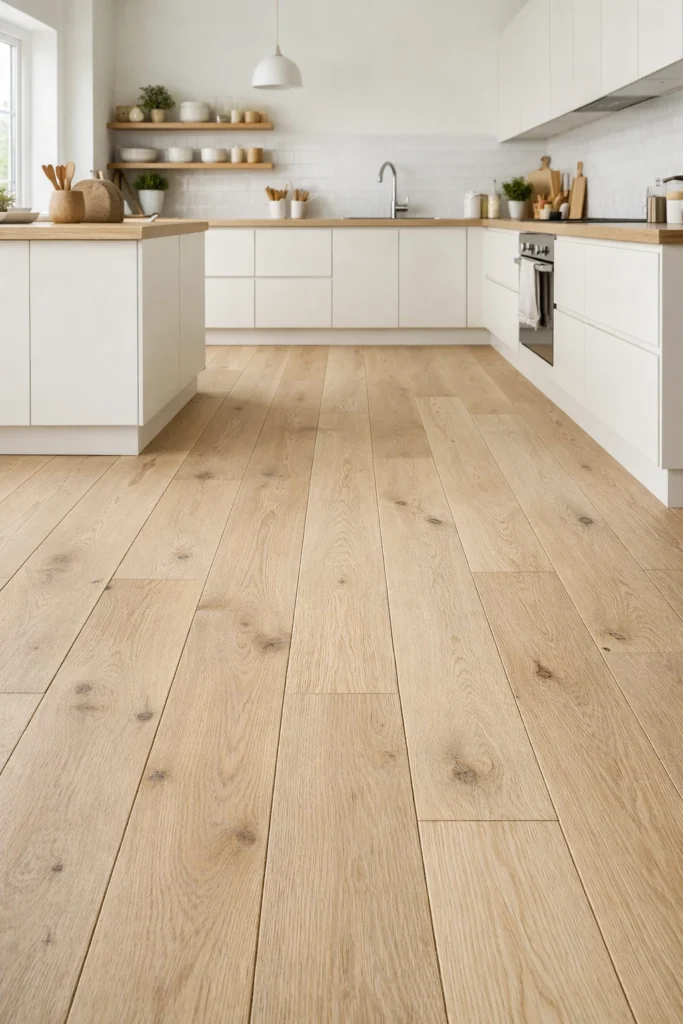
Wide-plank light oak flooring, ideally in a matte lacquered or oiled finish, is the most commonly specified floor in Scandinavian kitchen design. It brings continuity from the cabinets down to the floor, adds warmth, and feels completely appropriate in both formal and casual cooking spaces.
The alternative is large-format matte stone or concrete-effect porcelain. Both work, particularly in open-plan layouts. The rule of thumb: if your cabinets are warm oak, go with a cooler stone floor for contrast. If your cabinets are white or painted, bring the warmth through the floor.
One thing nobody mentions: heated underfloor systems under stone or tile flooring change the whole sensory experience of a kitchen. It’s a significant installation cost, but in a climate where you’re walking barefoot in winter, it’s pure hygge.
[IMAGE: Wide-plank pale oak flooring meeting white lower cabinet toe kicks, clean, warm transition]
15. Freestanding Kitchen Islands, Adding Function Without Blocking Flow
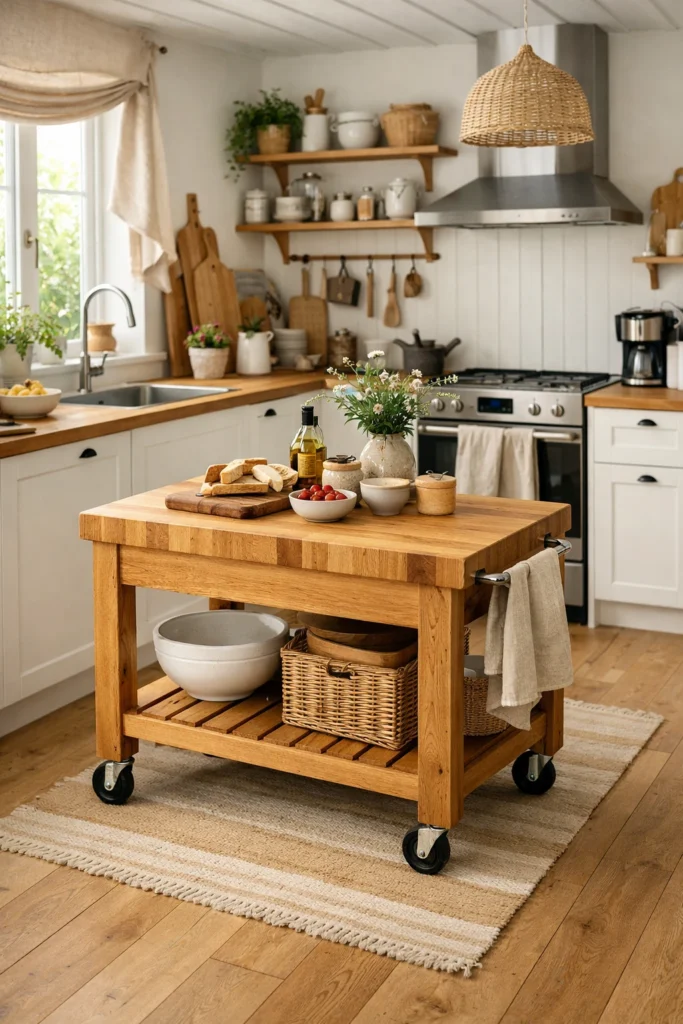
A fixed island isn’t always the answer. In smaller Scandi kitchens, a freestanding butcher-block island on casters is actually more functional; it can be moved, used as a serving piece, and pulled away for cleaning. It also introduces an artisanal, less-designed quality that reads as hygge rather than showroom.
For larger spaces, a fixed island in a contrasting material to the main cabinetry is the bold Scandi move of 2025. White perimeter cabinets with a dark oak or forest-green island create a grounded focal point without overwhelming the space.
16. Sage Green Cabinetry The Scandi Colour That Replaces All-White
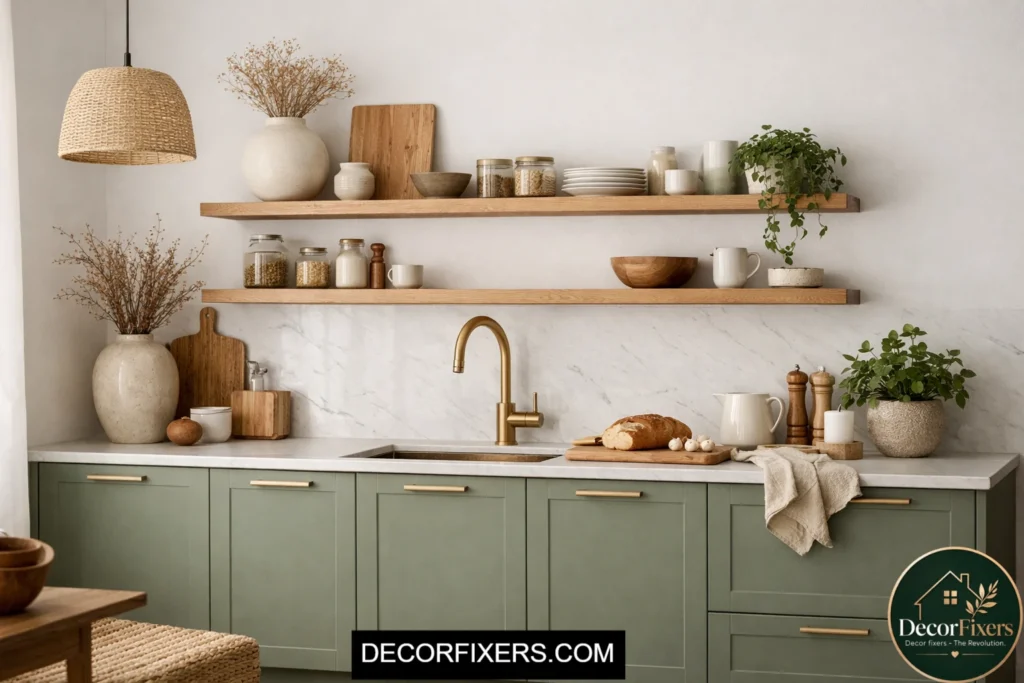
Sage green is having a moment in Nordic kitchen design, and for good reason. It reads as natural, it references the outdoors in a way that complements biophilic design principles, and it pairs cleanly with both white and oak without fighting either. It’s the one colour addition that immediately moves a Scandi kitchen from generic to considered.
Use it on lower cabinets only for a grounded, balanced result. Or go bold with a full-height pantry column in sage as a focal point against an otherwise white kitchen. The key is restraint, non-element, done well, rather than a saturated commitment to any single colour.
17. Ceramic Accessories and Handmade Details, Where Hygge Actually Lives
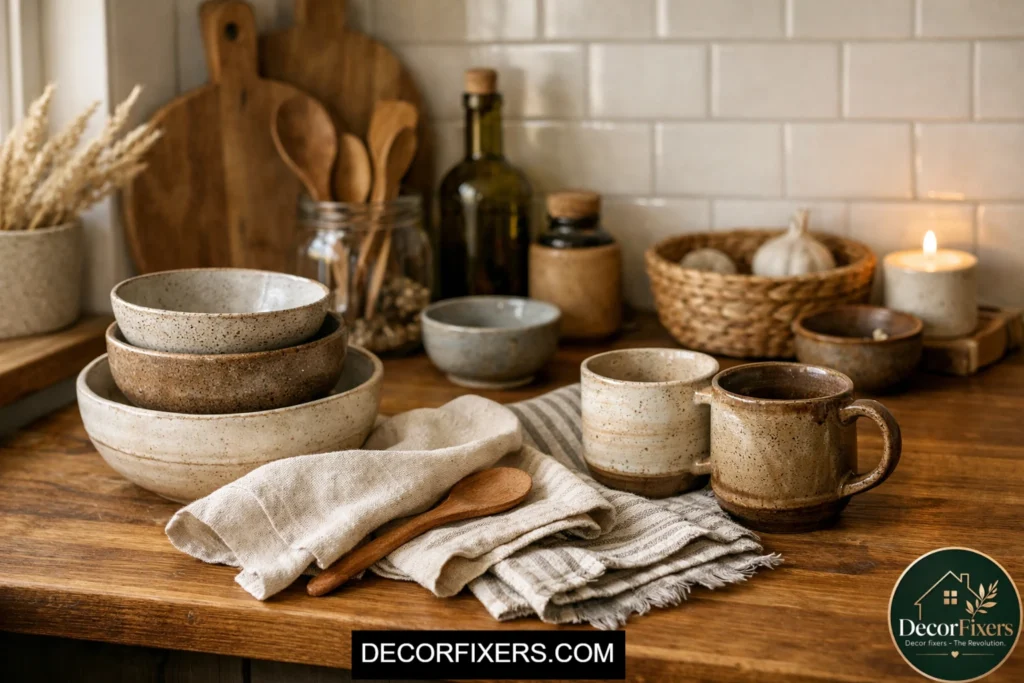
You cannot buy hygge wholesale. It accumulates in small, genuine decisions: a handmade ceramic bowl left on the counter, a linen tea towel hung on the oven handle, a pottery mug that doesn’t match anything else but earns its place. These details signal that a real person lives here.
The design principle: every surface accessory should be functional first. A beautiful ceramic pitcher that never holds anything is a decoration. A beautiful ceramic pitcher that you reach for every morning is hygge. The difference is in use, not aesthetics.
18. Indoor Plants and Biophilic Details, Bringing the Nordic Forest Indoors
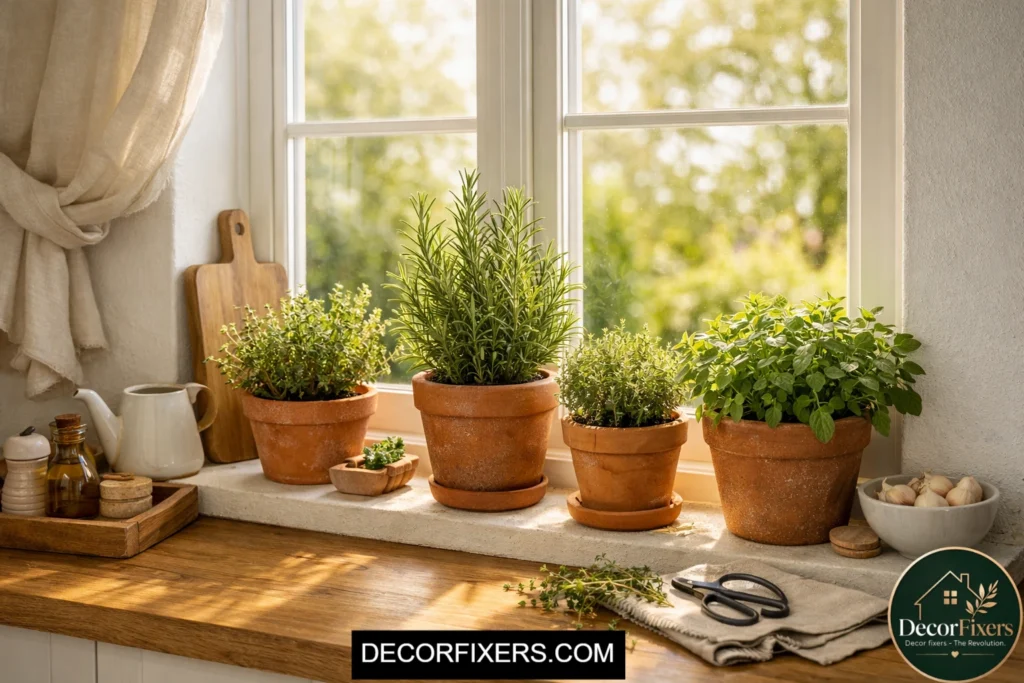
Biophilic design, the intentional integration of natural elements into built spaces, is a central principle of contemporary Scandinavian kitchen design. In practice, this means: plants on the windowsill, a small potted herb garden near the sink, or hanging eucalyptus near the window.
The species that work best in kitchen environments, tolerating humidity, occasional neglect, and lower light, include pothos, snake plants, and fresh herb varieties like rosemary, thyme, and mint. A small wooden tray near the window with two or three herb pots is a hygge detail that also earns its keep at the dinner table.
[IMAGE: Small herb garden in terracotta pots on a Scandi kitchen windowsill, warm light, white walls]
19. Neutral Linen and Textile Accents, The Layer That Stops Scandi Going Sterile
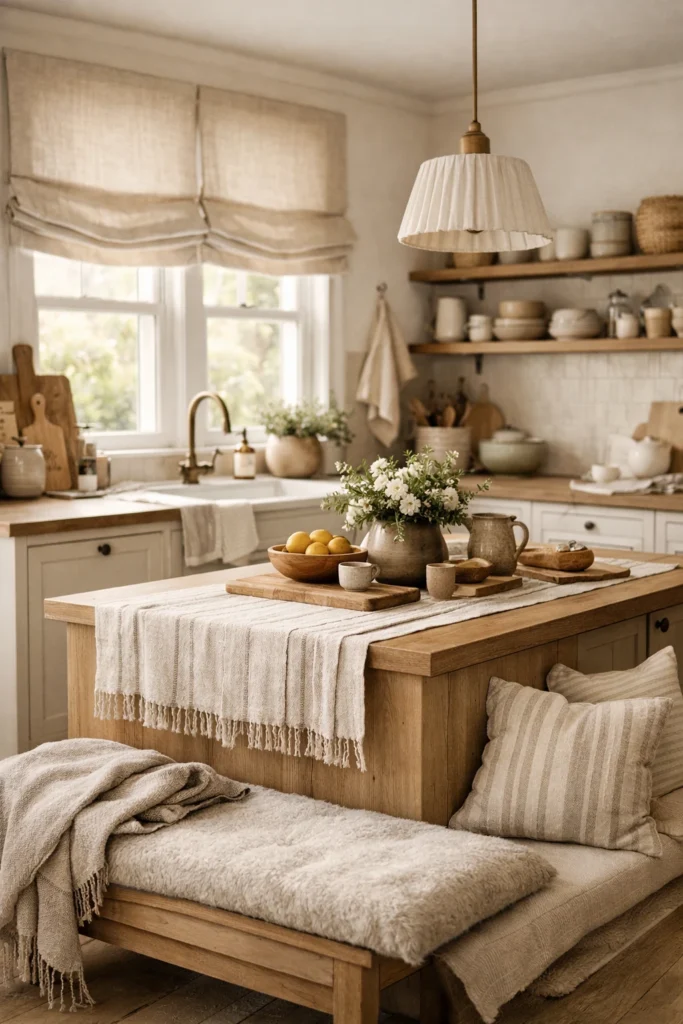
A white kitchen without textiles feels like a showroom. The textiles are what humanise it. In Scandi design, the choice is always natural fibres, linen, cotton, wool, in muted, undyed, or tone-on-tone tones. A raw linen blind. A nubby cotton runner on the island. A small wool cushion on the bench seating near the dining end.
These choices are cheap, and they work. More importantly, they’re easy to swap seasonally, bringing in warmer, darker tones in autumn and lighter, more washed-out tones in summer. That seasonal rotation is itself a very Nordic domestic ritual.
20. Shiplap Wall Paneling Adding Texture Without Adding Clutter
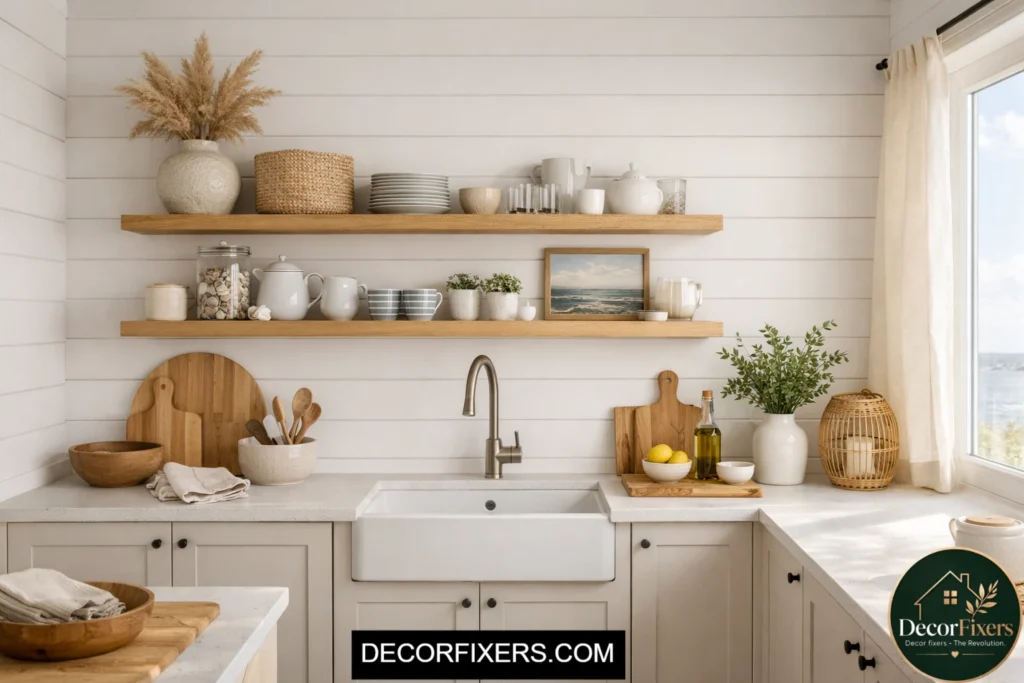
Bare walls in a Scandinavian kitchen can tip into sterile territory, particularly in larger, more open-plan spaces. Shiplap panelling, horizontal tongue-and-groove timber boards painted in the same white or off-white as the walls, adds subtle texture and a reference to Nordic coastal architecture without introducing pattern or colour.
It works particularly well on a feature wall behind open shelving or on the lower half of a kitchen wall as a pseudo wainscoting. Keep the reveal (the gap between boards) consistent, around 3–4mm, and paint it the same tone as the boards for the most refined result.
21. Matte Black Hardware and Fixtures e Contrast That Grounds the Space
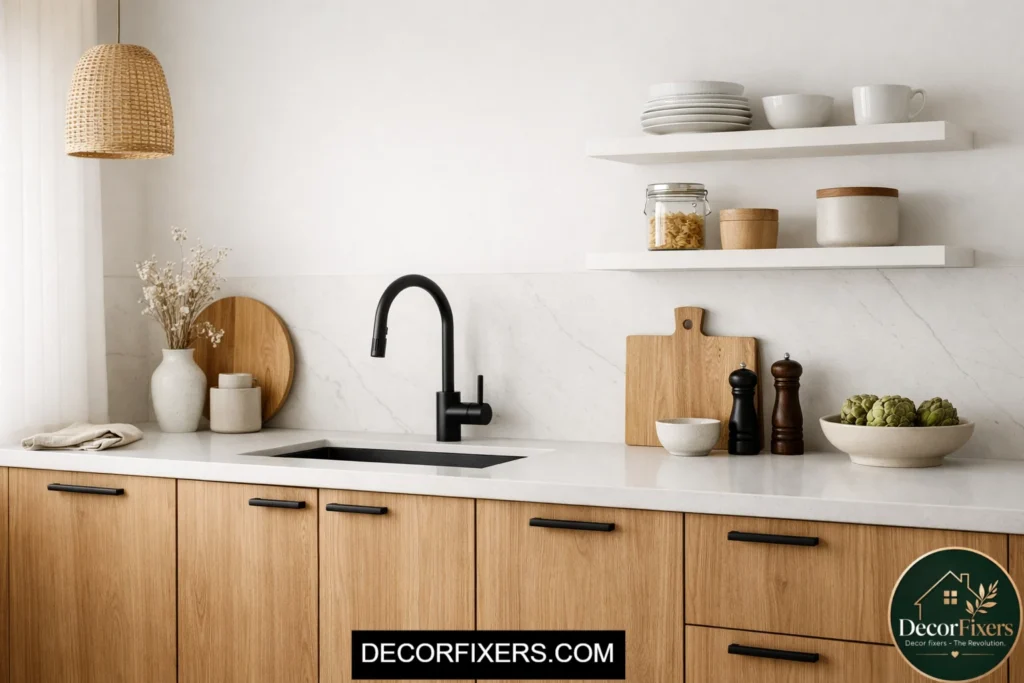
In an otherwise warm, pale Nordic kitchen, matte black fixtures act as punctuation marks. A matte black tap above a ceramic sink. Matte black pendant cables. A single matte black cabinet pull on a painted door. Each element provides a visual anchor that stops the whole space from dissolving into shapelessness.
The rule: pick one metal tone and use it consistently across all hardware. Mixing matte black with brushed brass with chrome creates chaos in a minimal space. Matte black is the most versatile choice; it pairs with white, sage, warm wood, and dark navy equally well.
22. Brushed Brass Accents, When Warmth Takes Precedence Over Edge
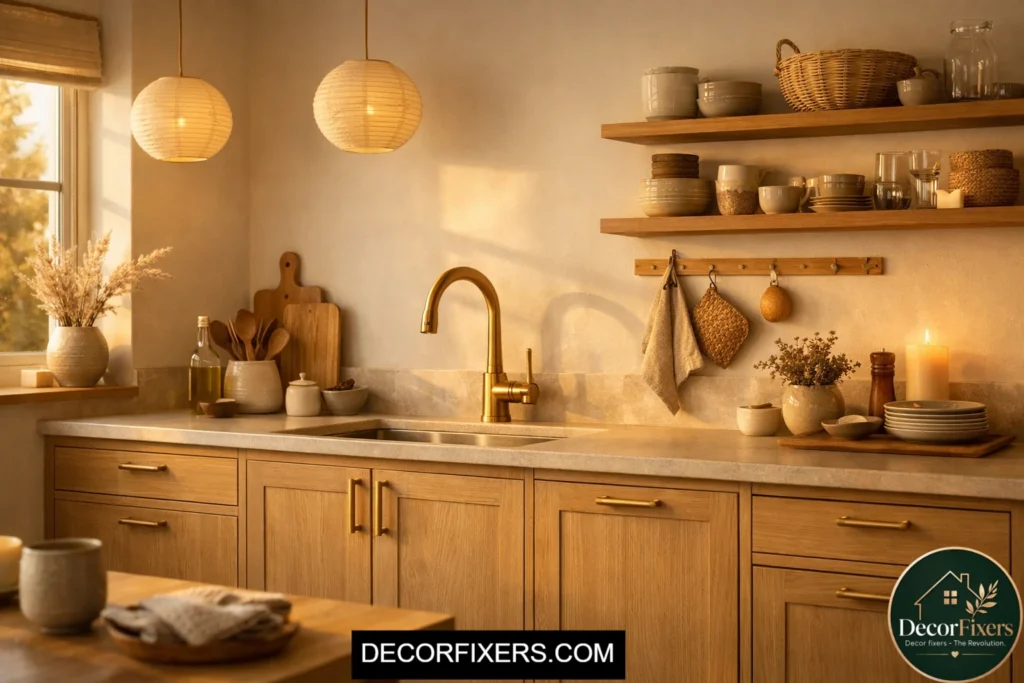
Brushed brass is the alternative to matte black for kitchens that lean warmer. It ages beautifully, pairs naturally with oak and limestone, and adds a suggestion of craft and quality that polished chrome doesn’t. Unlacquered brass, the kind that develops a genuine patina, is the most authentic Scandi choice.
Use it sparingly. Tap, pulls, and one or two light fixtures are the maximum. Beyond that, it starts to feel like a trend decision rather than a design decision.
23. A Deep Ceramic Sink: Functionality Elevated to Aesthetic Statement
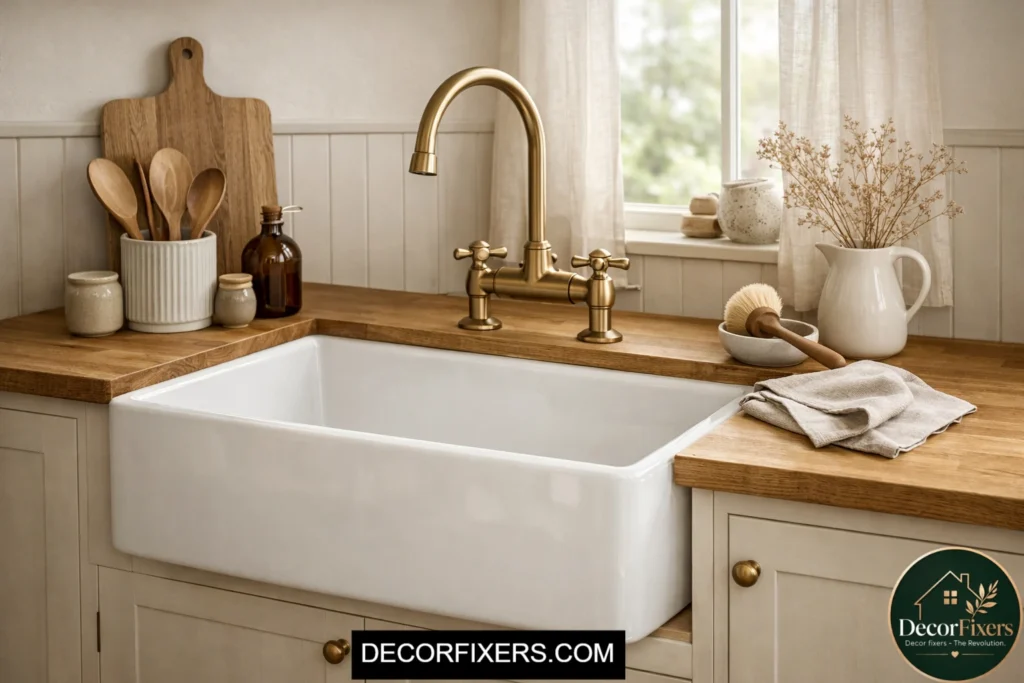
The sink is one of the most visible elements in a kitchen and one of the most underinvested. A deep, single-bowl ceramic farmhouse sink, sometimes called a Belfast or butler’s sink, is the Scandi upgrade that pays for itself in daily pleasure.
White ceramic ages with character rather than degrading. It absorbs scratch marks, develops a gentle patina, and pairs with both matte black and brushed brass taps without effort. In a Nordic kitchen built on natural materials, a ceramic sink is one of the few elements that feels genuinely traditional and genuinely contemporary at the same time.
24. Maximising Natural Light, The Design Priority That Drives Every Other Choice
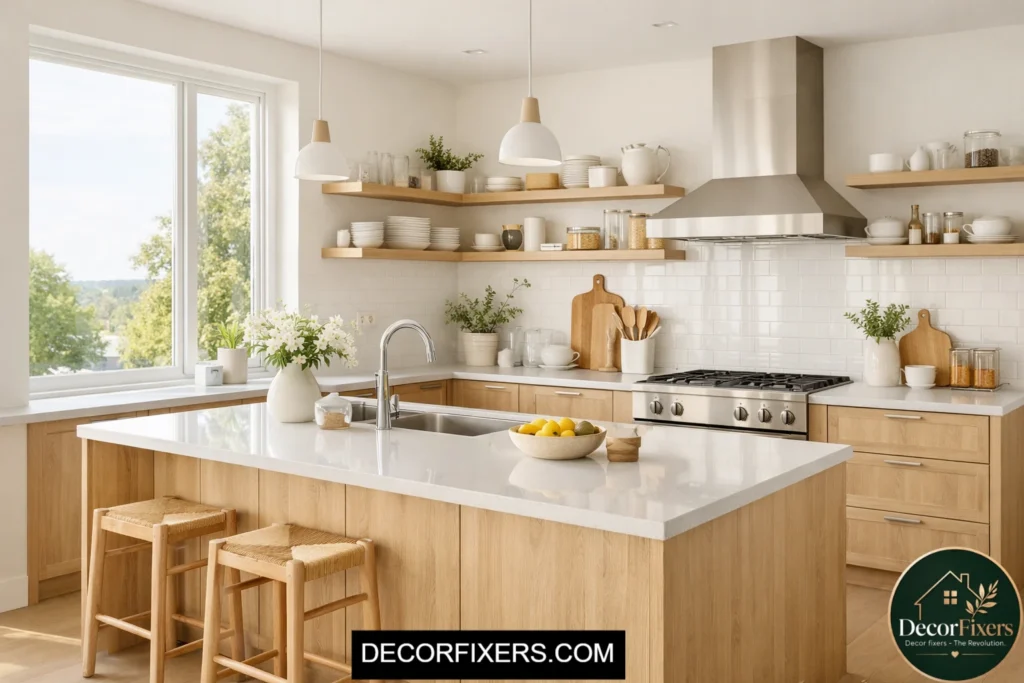
In Scandinavia, natural light is treated as a design material, not a nice-to-have. Windows are kept unadorned or covered with sheer linen panels only. Reflective surfaces (white walls, quartz countertops, pale oak) are positioned to bounce light deeper into the room. Mirror-finish cabinet interiors behind glass-fronted uppers are a less-obvious but effective technique.
The most impactful change you can make if your kitchen is dark: remove the upper cabinets on the window wall entirely. Open shelves or nothing at all, the light gain is dramatic, and the visual openness shifts the entire spatial experience of the kitchen.
25. The Display Cabinet Revival,n Autumn 2025 Scandi Trend Worth Knowing
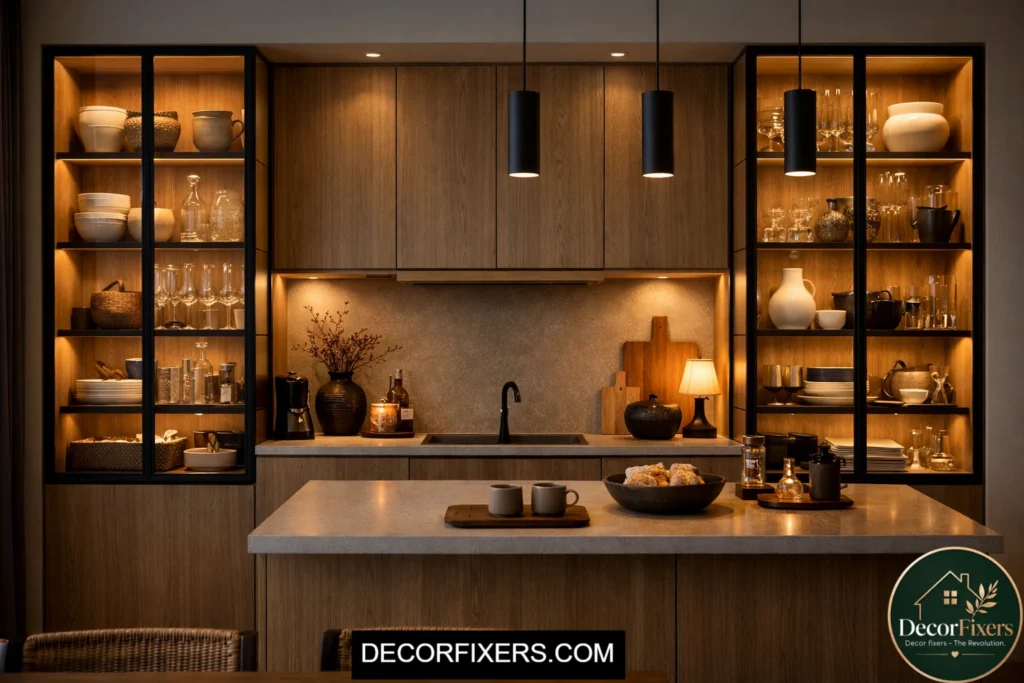
Long out of fashion in favour of completely flat, closed cabinetry, the glass-fronted display cabinet is making a genuine comeback in Scandinavian kitchens heading into 2026. But not in its traditional form. The new version is architecturally integrated, fl-height, slim-framed, with interior LED lighting and a curated selection of ceramics or glassware behind the glass.
It serves two purposes simultaneously: additional storage and a focal point. This is lagom thinking applied to a display feature; it justifies its own visual presence by also being genuinely useful.
26. Curved and Organic Shapes, The Newest Direction in Nordic Design
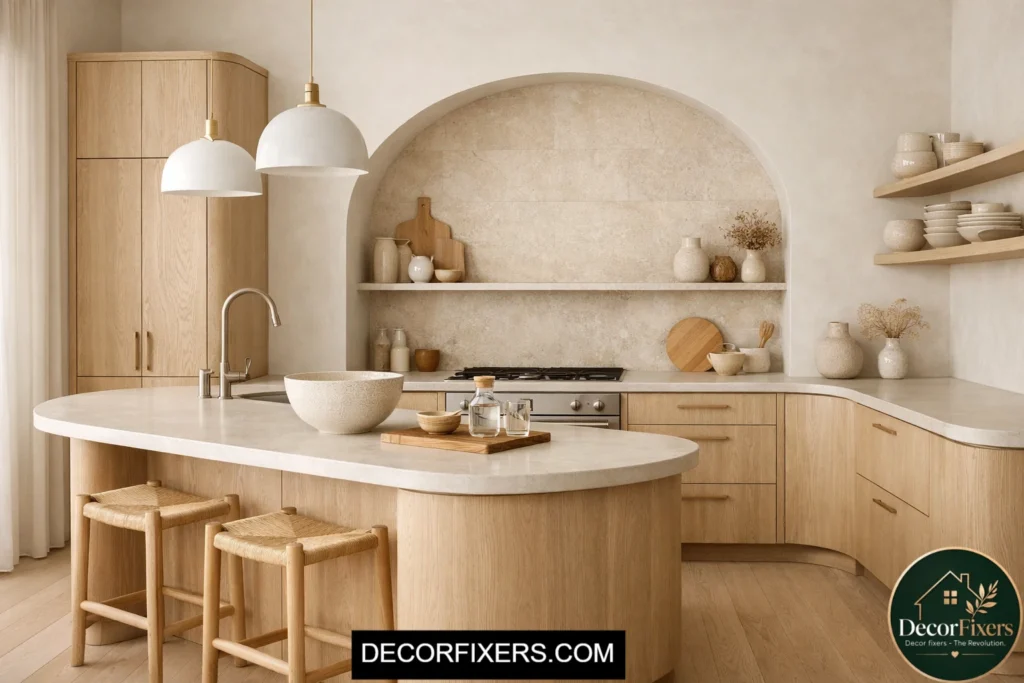
The hard-edged, strictly rectilinear Scandi kitchen is giving way to something more relaxed. Curved cabinet ends, rounded island corners, and arched range-hood surrounds; these organic forms appear throughout Nordiska Kök’s 2025 trend data as the leading edge of Soft Scandinavian design.
In practice, this means requesting a radiused corner on your island countertop, choosing a curved base cabinet for the end of a run, or installing an arched tile pattern in the backsplash. None of these changes is structural; they’re finishing decisions that soften the overall impression significantly.
27. The IKEA METOD System, How to Build Scandi on a Real Budget
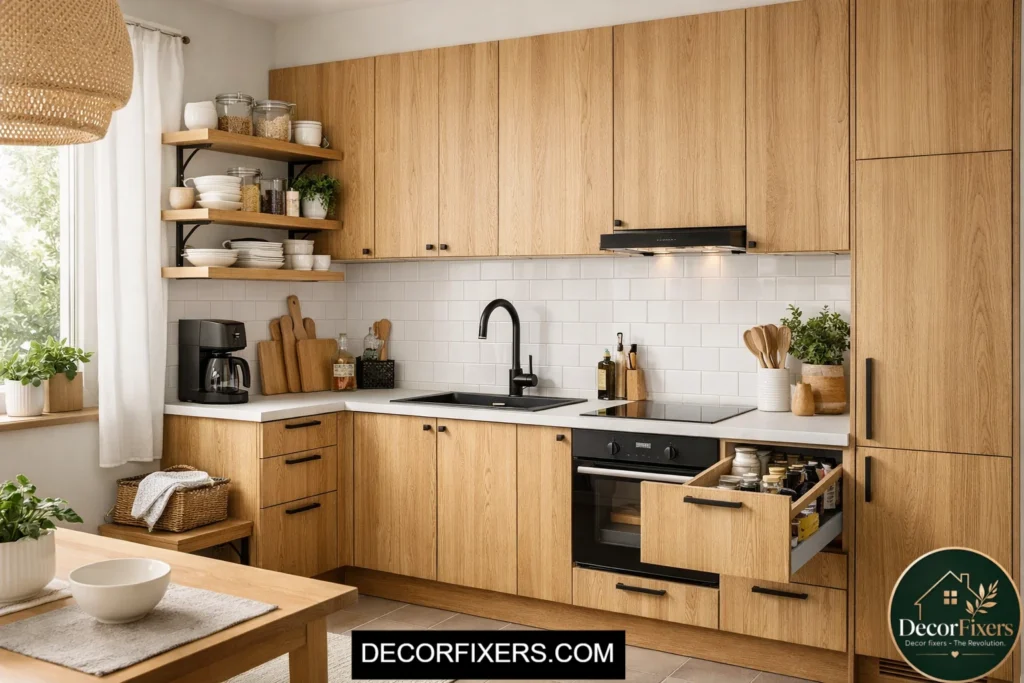
Here’s an opinion some designers would push back on: IKEA’s METOD system is genuinely excellent as a structural base for a Scandinavian kitchen, provided you layer it thoughtfully. The cabinet boxes are well-engineered, and the internal organisation system (MAXIMERA drawers, UTRUSTA pull-outs) is as functional as most premium alternatives.
The strategy: use IKEA METOD for every cabinet carcass. Then upgrade the fronts with aftermarket oak or painted slab doors from companies like Reform, Superfront, or Naked Doors, all of which make door fronts specifically for the METOD system. Finally, invest the savings in a quality countertop and a good tap. The result looks bespoke at roughly 40–50% of bespoke cost.
For the full picture on how this system integrates with Modern Kitchen Design Trends, including handle profiles and current front finish options, the IKEA planning tool is worth a serious hour of your time.
28. Realistic Budget Breakdown, What a Candid Kitchen Actually Costs in 2025
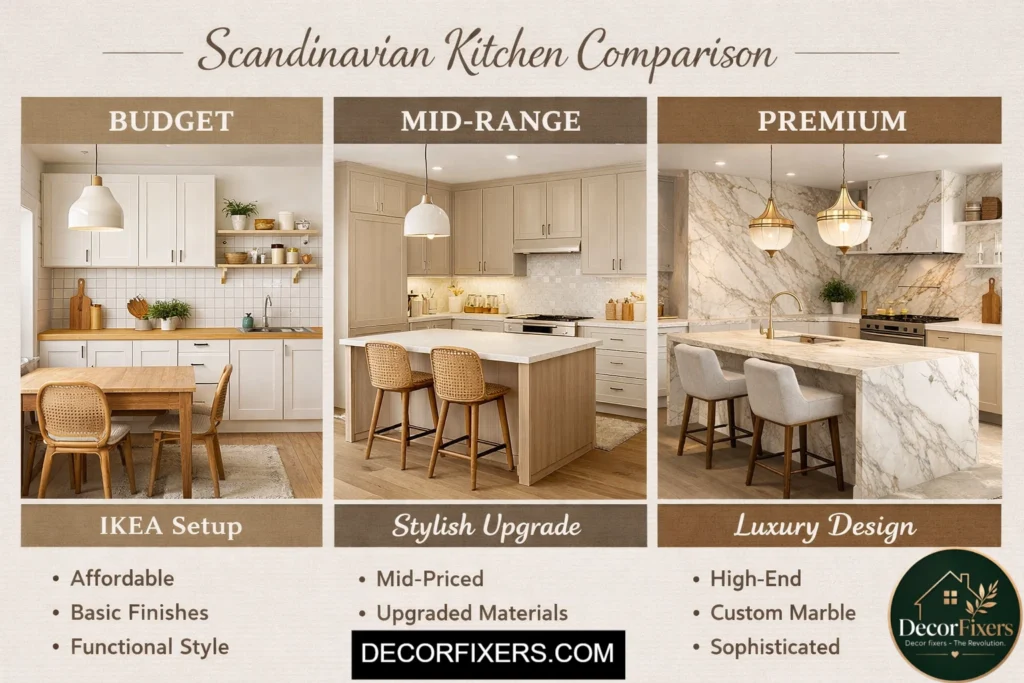
According to Houzz’s 2023 kitchen remodel data, the median kitchen renovation spend in the US hit $24,000. In practice, a Scandinavian kitchen can be executed across three budget tiers:
| Tier | Approach | Approx. Cost (USD) | Best For |
| Budget ($8K–15K) | IKEA METOD + aftermarket fronts + quartz countertop + matte black tap | $8,000–15,000 | Renters upgrading or first-time renovators |
| Mid-Range ($15K–30K) | Kvik Mano / semi-custom cabinets + limestone countertop + integrated appliances | $15,000–30,000 | Owner-occupiers doing a full refresh |
| Premium ($35K+) | Nordiska Kök bespoke / full custom + marble slab + Gaggenau appliances | $35,000–75,000+ | Long-term investment kitchens |
The most cost-effective layering strategy: start with IKEA cabinet boxes, upgrade the countertop to real quartz or limestone, invest in one good pendant light, and buy the best tap you can afford. These three touchpoints are where people’s hands and eyes go most often; they’re where perceived quality lives.
29. The Biggest Beginner Mistake: Over-Whitening and Stripping the Warmth
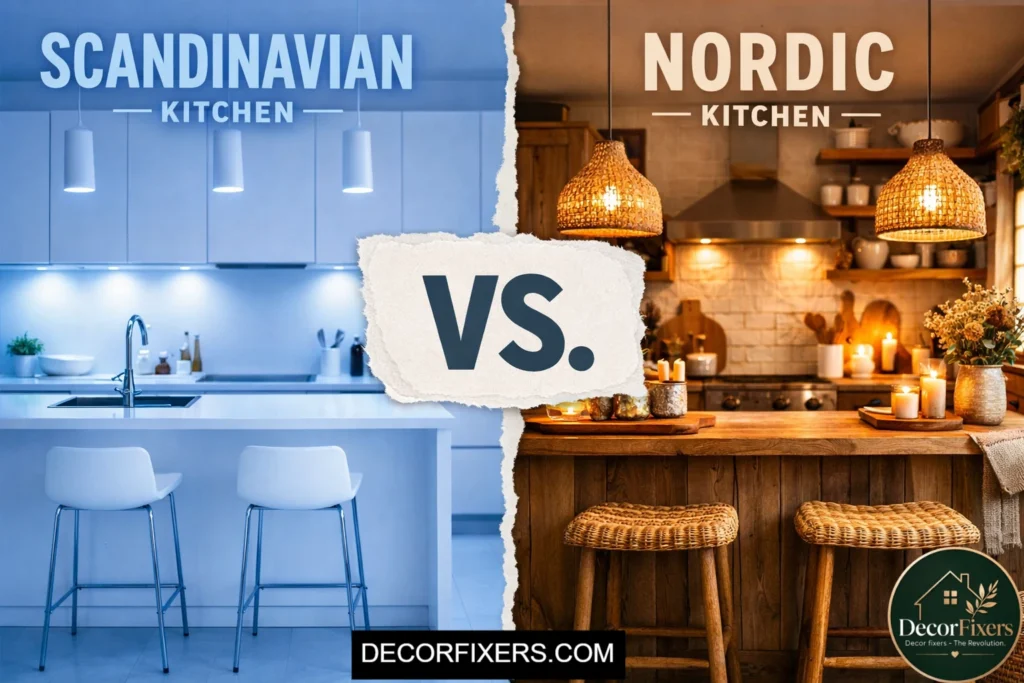
I’ve seen conflicting interpretations of this in various design guides; some say go fully white and let accessories add warmth, others say always use warm-toned cabinetry. My read: both can work, but only if you’re deliberate about it. The issue isn’t white, it’s cool white combined with cool stone, cool lighting, and no natural materials. That combination creates clinical, not Scandi.
The fix is simple in theory and easy to overlook in execution. Warm up your white wall paint by choosing a white with a yellow or red undertone (not blue). Use warm-tone bulbs at 2700K maximum. Have at least one natural wood element visible from the main viewpoint. And never install cold-white LED strips under cabinets in an otherwise warm kitchen.
Look, if you’re sitting with a contractor right now choosing between ‘pure white’ and ‘warm white’ wall paint, go warm. Every time. You can always layer in cooler elements later, but the underlying warmth of the space is set by that first decision.
30. Putting It All Together: The Real-World Scandi Kitchen Checklist
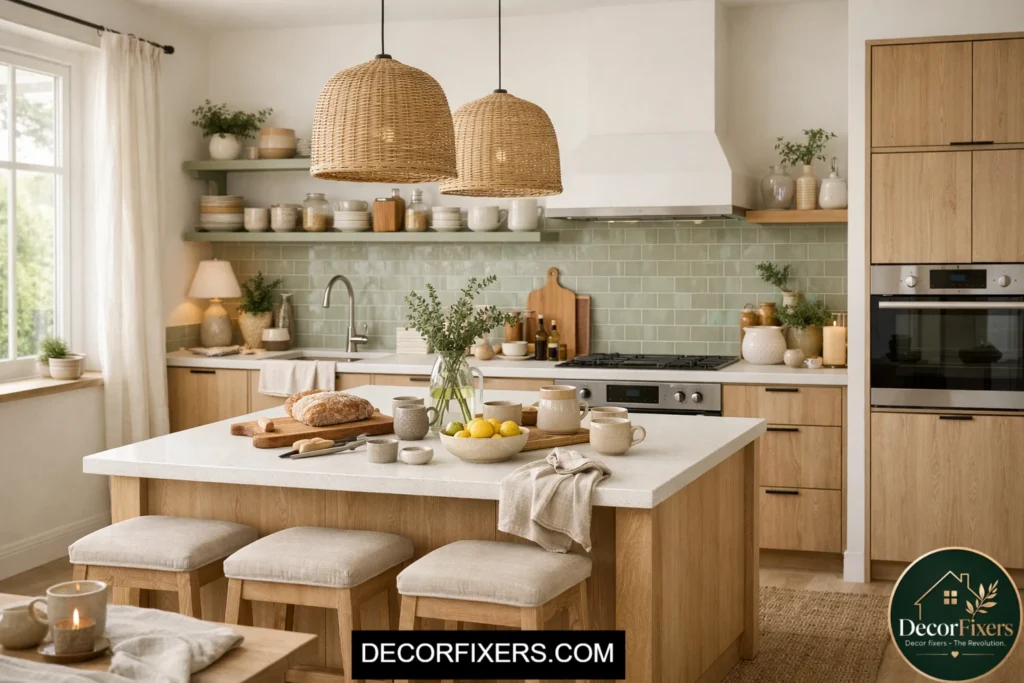
Scandinavian kitchen design isn’t complicated. What makes it hard is that it requires restraint at every decision point, and restraint is difficult when you’re standing in a showroom surrounded by options.
The practical checklist for a result that feels warm rather than sterile:
- Base palette: warm white walls, one secondary muted tone (sage, clay, or taupe) for cabinetry
- Materials: pale oak or oak-effect for at least one element, matte stone or quartz for counters
- Lighting: pendant at 2700K over the island or dining area, under-cabinet LED strips, no sole overhead fixture.
- Storage: enough hidden storage that counters can be 90% clear, apply lagom actively
- Handles: handleless or minimal pull, one consistent metal tone throughout
- Textiles: linen blind or cotton runner, natural fibres only, no synthetics
- One hygge element: a handmade ceramic, a plant, a candle tray, something that signals a real person lives here
How to Start a Scandinavian Kitchen Renovation (5-Step Quick Guide)
1. Define your budget tier (IKEA base / mid-range custom / bespoke) before choosing any materials.
2. Choose your secondary colour first (sage, clay, or taupe); this anchors every other decision.
3. Select your countertop material (quartz, limestone, or butcher block) as the tactile hero of the space.
4. Plan hidden storage capacity first; open shelves come last, curated with daily-use items only.
5. Layer lighting: pendant over the island, under-cabinet strips for tasks, warm lamp for atmosphere.
CONCLUSION:
The kitchens I’ve seen go wrong all share one characteristic: they chased the look without building the logic underneath it. White walls, handleless cabinets, a pendant light, nd nothing else. The space looked photographically correct and felt completely wrong to be in.
The ones that work, the kitchens where you actually want to stand around, where the act of making a cup of coffee becomes a small daily pleasure, those kitchens understood that Scandinavian design is a way of making decisions, not a set of colour codes.
Apply lagom to your storage. Introduce warmth deliberately. Let a few genuine objects accumulate character. And if you get stuck on the budget, remember: the countertop and the lighting are where the feeling of the space lives. Everything else is structure.
Or maybe I should say it this way, a Scandi kitchen doesn’t look designed. It just looks like home.
FAQs:
Q: What’s the best colour for a Scandinavian kitchen in 2025?
A: Warm white remains the foundation, but the dominant 2025 shift is toward muted earthy tones, sage green, soft clay, and warm taupe used on cabinetry while keeping walls white or off-white. Avoid cool-toned whites, which strip warmth from the space.
Q: How do I make a Scandi kitchen cosy instead of sterile?
A: Three things: warm-tone lighting at 2700K maximum, at least one natural wood element visible from the main viewpoint, and a genuine hygge detail, such as handmade ceramic, a plant, or a linen textile. Warmth comes from texture and light temperature, not just colour.
Q: Should I use open shelving in a Scandinavian kitchen?
A: Yes, selectively. Open shelves work when they hold daily-use items that are also beautiful, such as ceramics, glass jars, and a plant. If the shelf would hold anything you’d be embarrassed to display, it needs a door.
Q: Why does a Scandinavian kitchen feel larger than it is?
A: Flat-front cabinetry removes visual noise, light-toned surfaces reflect natural light, and the lagom approach to counter clutter keeps sight lines clear. The visual weight of the room is significantly lower than in a traditionally fitted kitchen.
Q: When should I invest in bespoke rather than IKEA for a Scandi kitchen?
A: Invest in bespoke when the kitchen is in a long-term home, the layout has unusual dimensions, or you want specific materials (solid oak, real limestone carcasses) unavailable through flatpack. For most renovations, IKEA METOD with upgraded fronts and a quality countertop delivers 80% of the bespoke result at 40% of the cost.

Creator of DecorFixers, sharing practical home and interior ideas focused on real-life usability, simple design improvements, and budget-friendly solutions.