

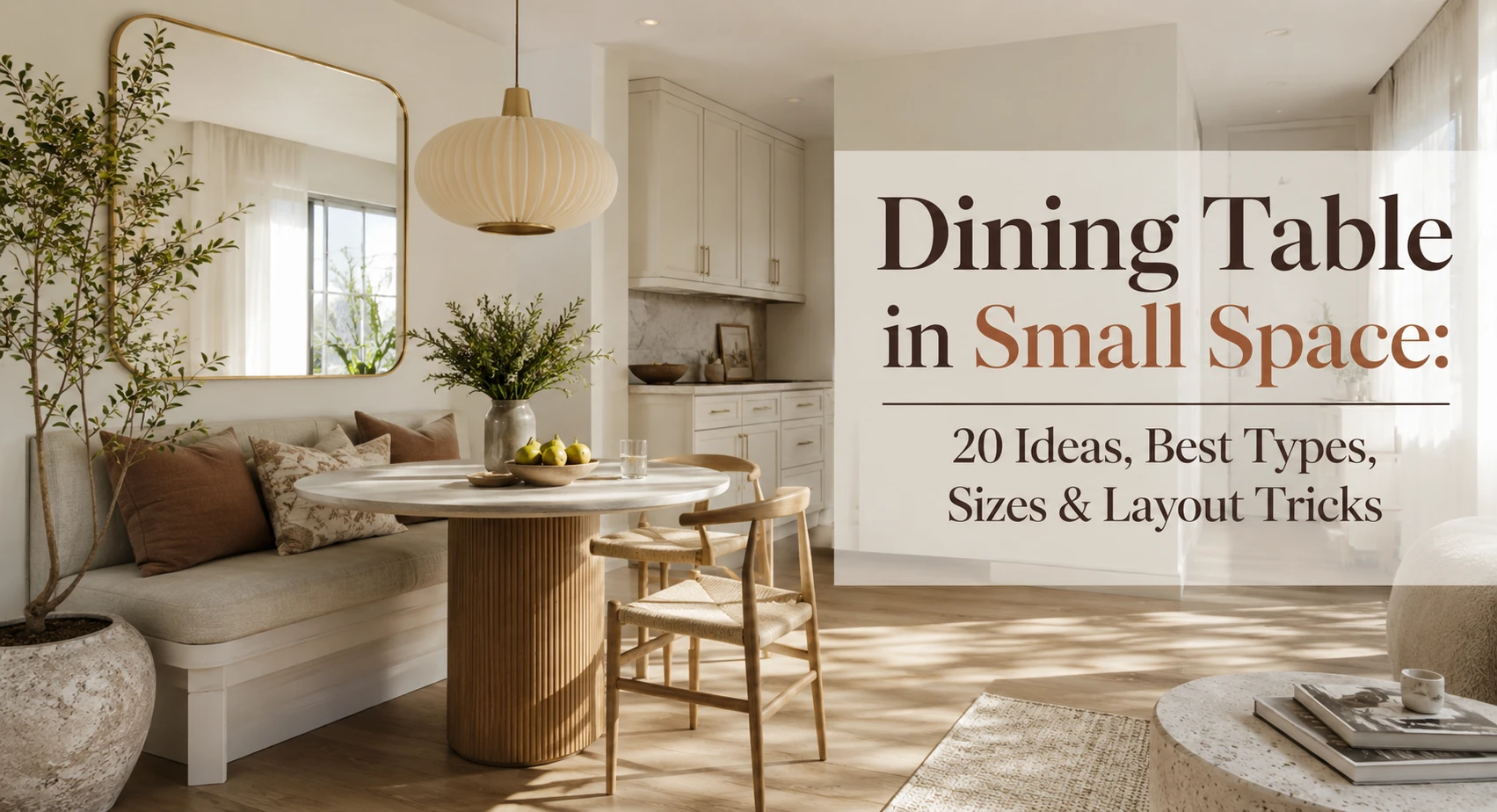
I spent three weekends measuring my 9×10-foot dining corner, scrolling through IKEA at midnight, and rearranging chairs that scraped every wall. Nothing fit, or so I thought. Turns out I wasn’t missing a bigger budget. I was missing the right rules.
Fitting a dining table in a small space isn’t about compromise. It’s about knowing exactly which table type, size, and layout actually works, and which ones only look good in showrooms. This guide gives you 20 practical ideas, the clearance measurements nobody tells you upfront, and real product names so you can stop guessing and start eating at an actual table.
A dining table in a small space refers to any table, round, drop-leaf, extendable, wall-mounted, or narrow rectangular, sized and positioned to leave at least 36 inches of clearance on active sides without overwhelming the room’s floor plan.
Here’s the thing: most people measure the table. They skip the chairs. Add 18–24 inches behind every seat for a pull-out room alone. A 48-inch round table in a 9×9-foot room leaves barely 18 inches on each side after chairs, workable only if two sides face a wall.
How to Size a Dining Table for a Small Room (5 Steps)
- Measure room length and width in inches.
- Subtract 72 inches (36″ × 2) from each dimension.
- The remainder = your maximum table dimension for that axis.
- Tape the outline on the floor and add chairs, walk around it.
- Buy only after the taped mock-up feels comfortable to move through.
1. Round Pedestal Table (No Corner Legs)
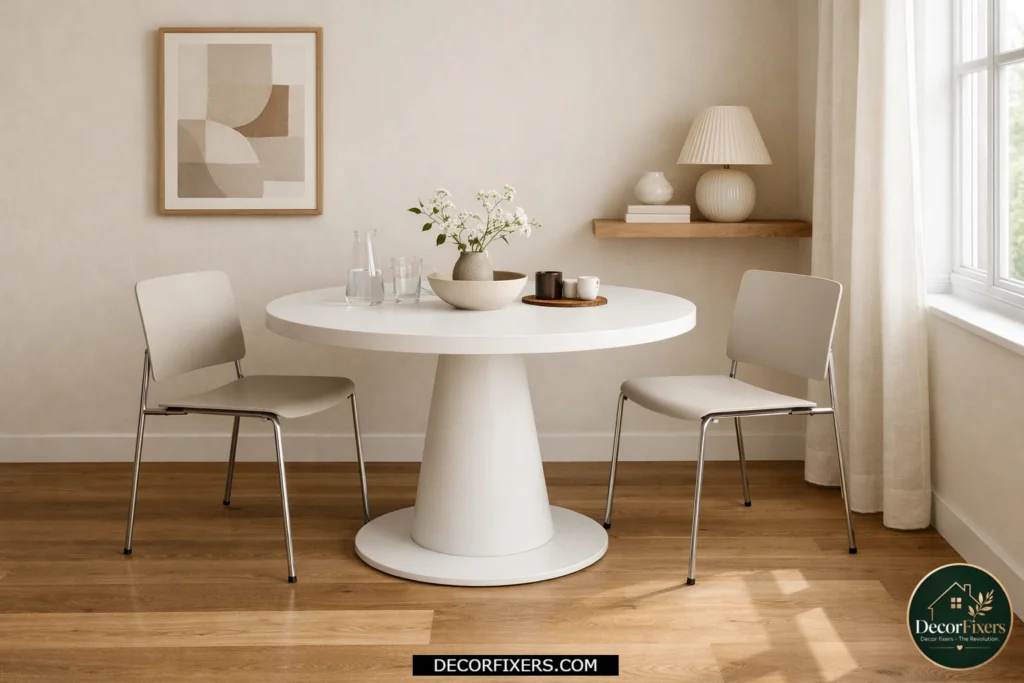
A pedestal base changes everything in a tight room. Without four corner legs, chairs slide freely in any position, no leg-corner collision mid-meal. A 36-inch round pedestal is the magic number for a true 2-person daily table; bump to 42 inches if you need four seats.
The West Elm Lola Pedestal starts around $499 and fits rooms as narrow as 9 feet wide with 36-inch clearance maintained. Pair it with stackable chairs to preserve floor space when you have guests. Round pedestals also read visually lighter than leg-base tables, which helps small rooms breathe.
2. Drop-Leaf Table Against the Wall
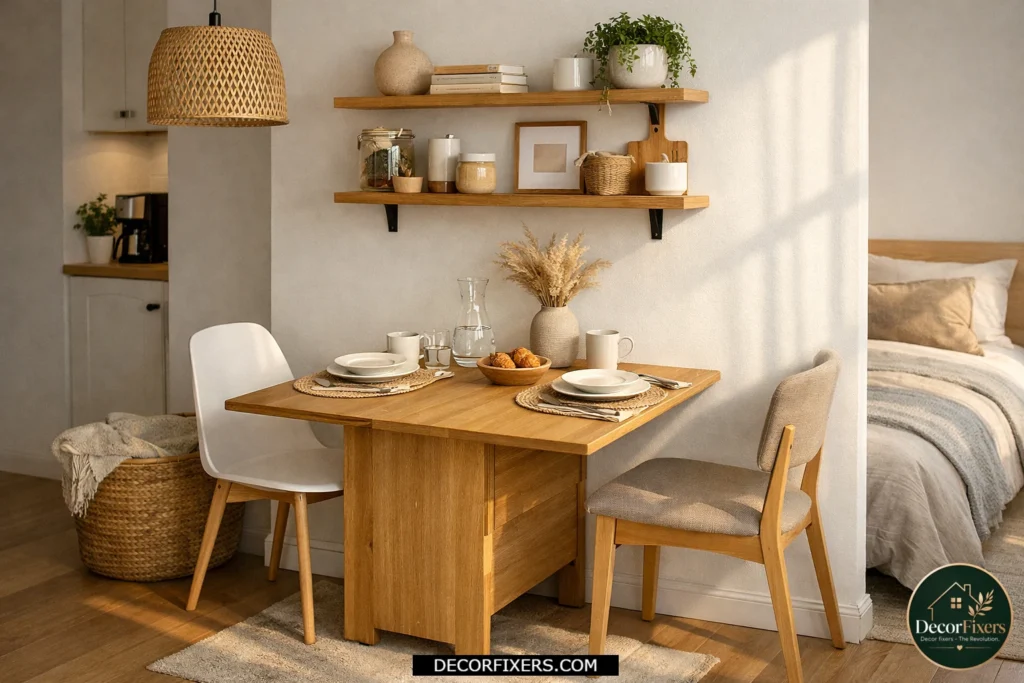
This is the most underused trick in small apartments. A drop-leaf table with both leaves folded down can measure as little as 12 inches deep, almost flush with a wall. Lift one leaf, and you have a two-seater. Raise both, and you seat four. The IKEA Gateleg and Ashley Gesthaven both execute this beautifully, with the Gesthaven available for around $180–$220.
Push it against the wall on a normal Tuesday and only pull it out when needed. The side against the wall doesn’t need clearance; only the active sides do. This layout trick alone can save you 18 to 24 inches of permanent floor space in your dining zone.
3. Extendable Butterfly Leaf Table
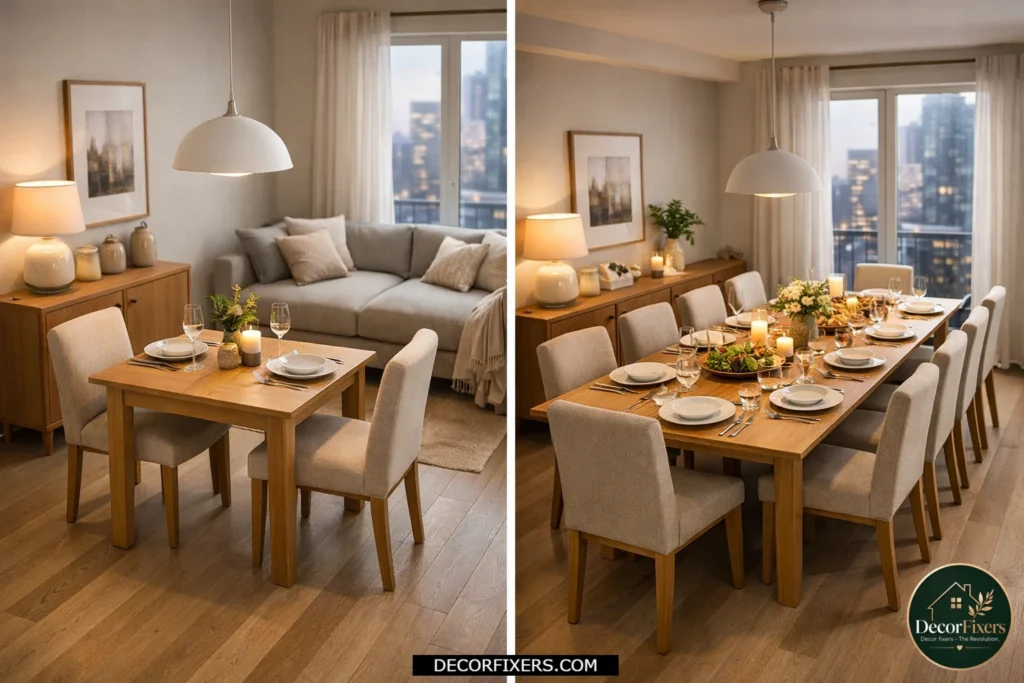
An extendable table hides its own leaf inside the base, so no storage scramble before dinner parties. The IKEA Bjursta is purpose-built for small spaces: it collapses to 35 inches long (a 2-seater) and extends to 61 inches (a 4-seater) or 83 inches (6 seats) with both leaves deployed. It starts at around $249, which is an exceptional value for three size configurations.
One thing most guides skip: make sure you measure both the collapsed AND fully extended dimensions, then tape both outlines on the floor. The extended version still needs full clearance on all sides; a table that fits closed doesn’t automatically fit open.
4. Wall-Mounted Fold-Down Table
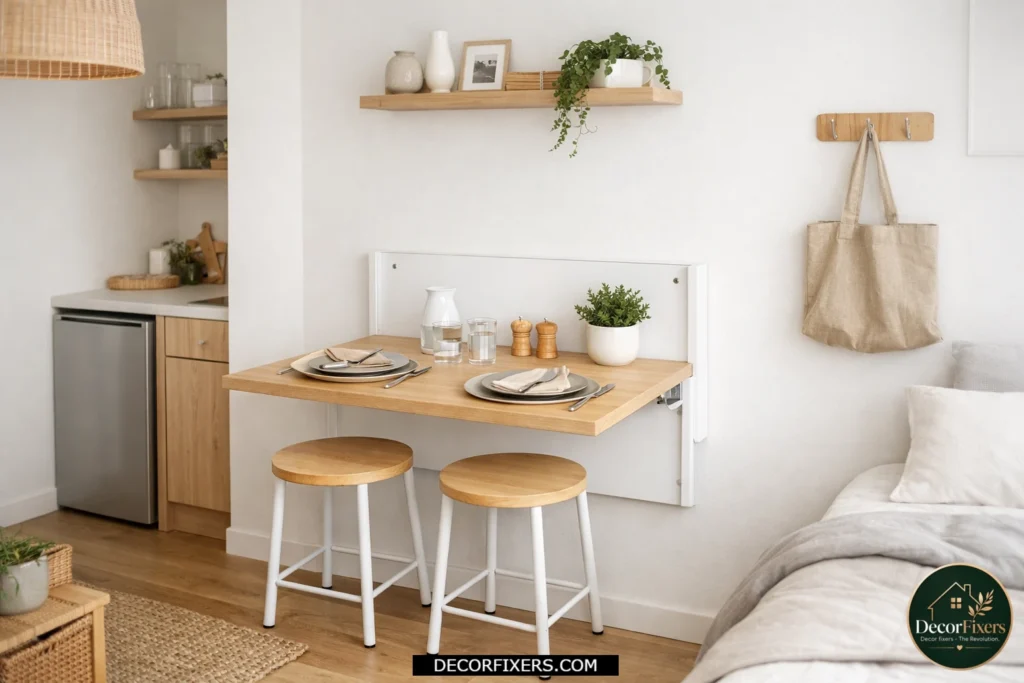
For micro-studios under 400 square feet, this is the only option that makes real sense. A wall-mounted fold-down table has zero floor footprint when folded up; it’s just wall art. Fold it down, and you have a work surface or dining table in seconds. Designs like the IKEA Norberg wall table cost around $45–$60 and hold up to 110 lbs fully extended.
The catch? You’re committed to one position. It can’t be moved, and the wall mounting must hit a stud for safety. Pair it with folding or stackable bar stools stored in a closet for a complete dining setup that disappears entirely when not in use.
5. Narrow Rectangular Table (Under 30 Inches Wide)
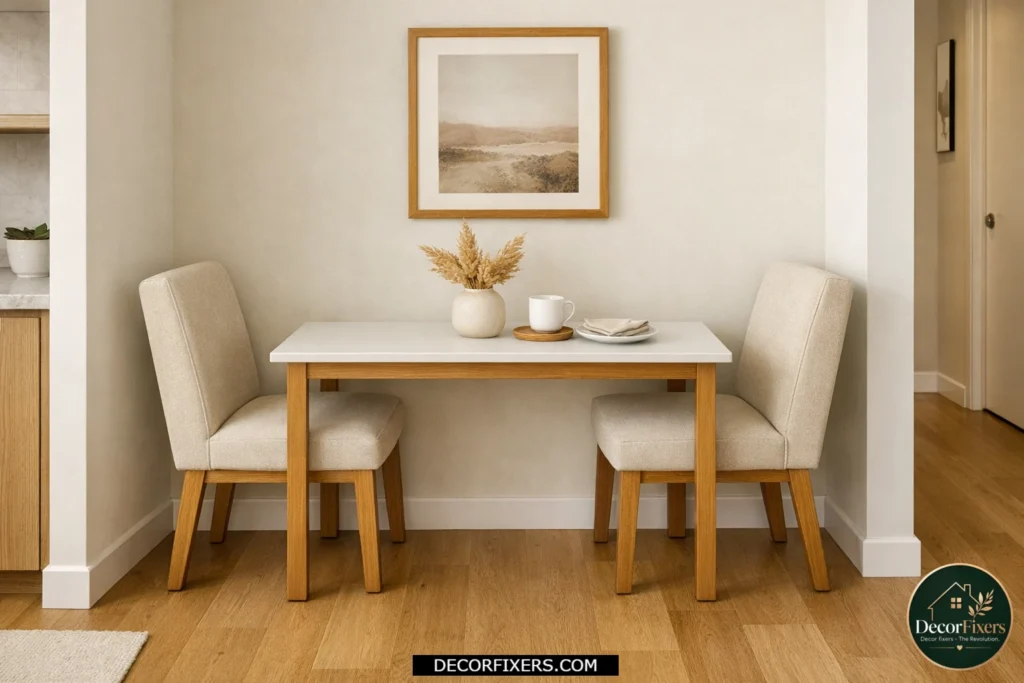
Standard dining tables run 36–44 inches wide. A narrow rectangular table, typically 28–30 inches wide, seats the same number of people lengthwise while recovering 6–14 inches of clearance on both sides. The CB2 Babylon dining table is built specifically for this use case: slim, wall-adjacent, and designed to disappear into narrow dining alcoves.
Narrow tables limit the center-of-table serving space, so family-style meals get a bit awkward. But for two people eating regular meals, which is the most weeknight reality, a slim table is genuinely more comfortable than cramming a wider one into a tight space.
6. Counter-Height Table With Bar Stools
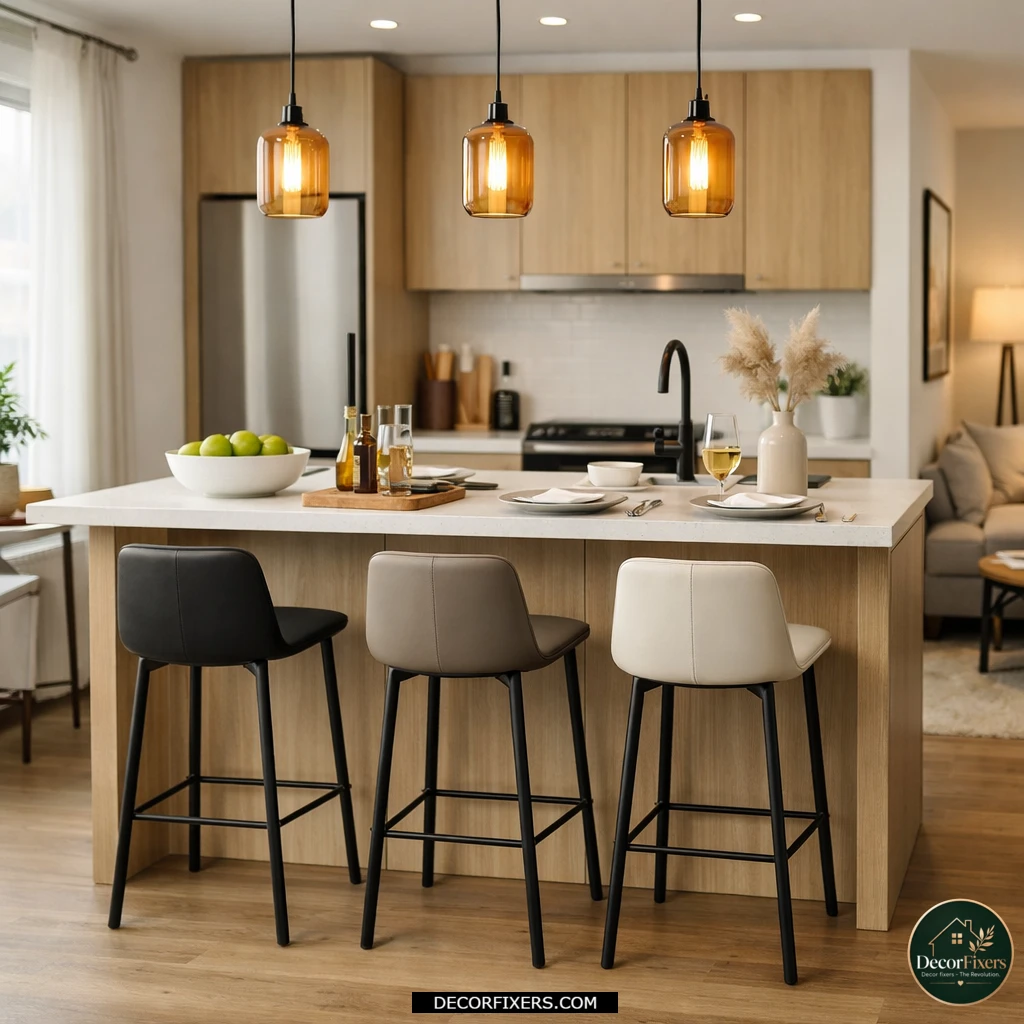
Raising your dining surface from standard height (28–30 inches) to counter height (34–36 inches) creates a surprising perceptual win: the room feels taller, more open. Bar stools also tuck further under the tabletop than dining chairs, which means your clearance footprint shrinks when no one’s sitting.
This works especially well in open-plan apartments where the dining area flows into a kitchen. A counter-height table visually aligns with kitchen counters, blurring the boundary between zones and making the whole space feel intentional rather than cramped.
What Size Dining Table Actually Fits in a Small Room?
The answer depends on one number you need to run before anything else. Measure your room length and width, then subtract 6 feet from both dimensions. What’s left is your maximum table size. A 10×10-foot room supports a table no larger than 48×48 inches, roughly a 4-person square. A 9×12-foot room gives you room for a 36×72-inch rectangle.
7. Glass-Top Table to Fake More Space
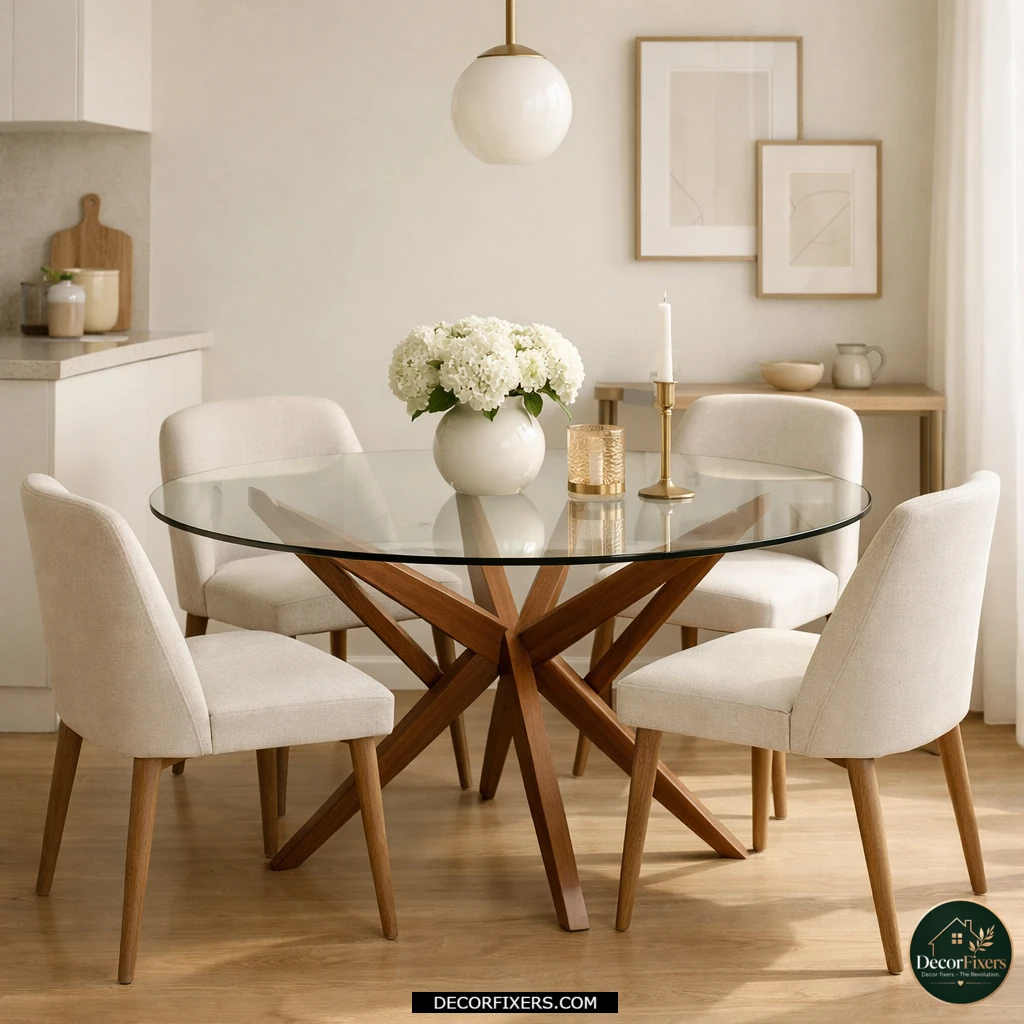
Glass doesn’t cheat physics, but it cheats perception. A glass-top dining table lets your eye travel through the surface rather than stopping at it, making the room read larger than it is. The West Elm Jensen Round Glass Table ($699, 42-inch diameter) is a strong example: the transparent top paired with a slim, angular wood base adds almost no visual weight to the room.
The tradeoff is maintenance. Glass shows fingerprints, smudges, and table rings immediately and constantly. If you have kids or prefer low-maintenance living, a smoked or frosted glass variant hides daily use better than clear glass.
8. Square Table for Square Rooms
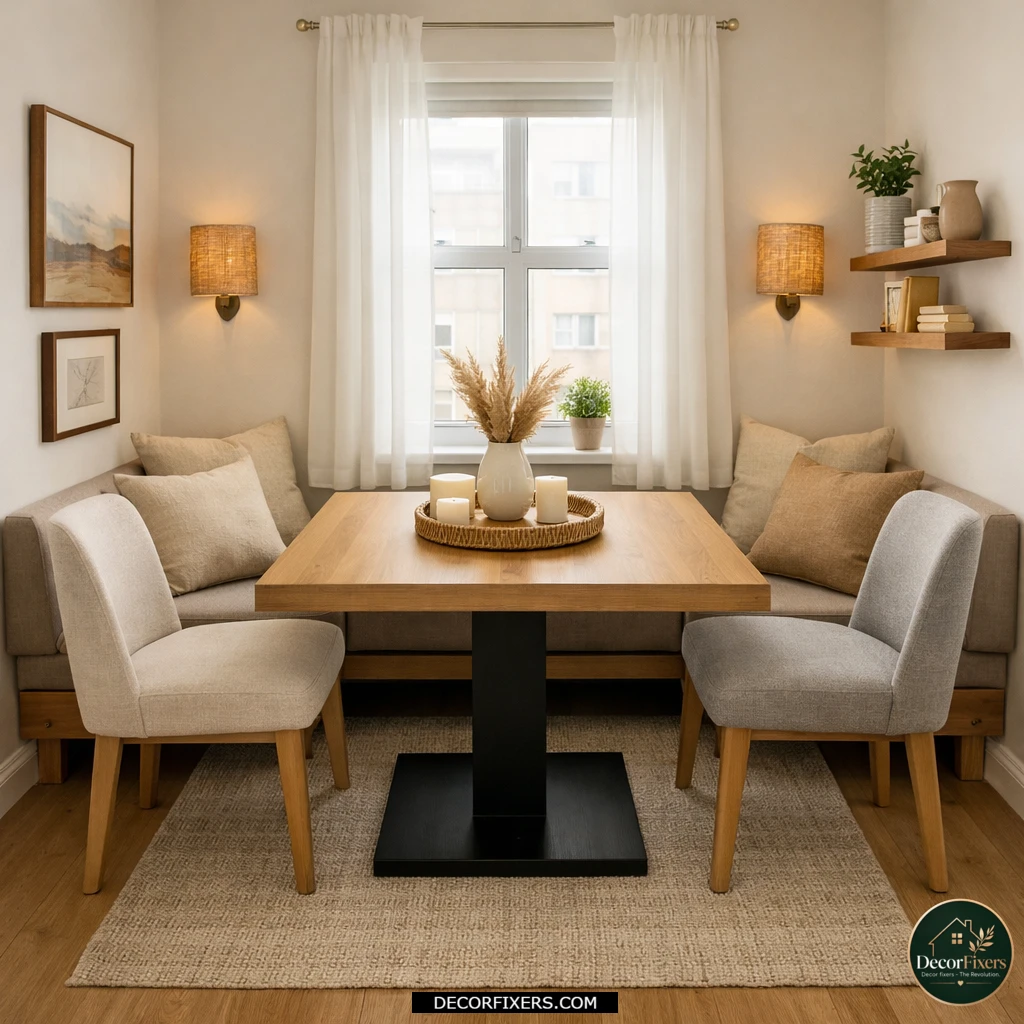
When your room is square, a square table matches its proportions, simple as that. A 36×36-inch square table seats four people (one per side) with every seat equidistant, which also makes conversation easier. It’s the shape interior designers reach for in breakfast nooks and square eat-in kitchens precisely because it doesn’t create awkward dead corners.
Square tables hit a ceiling at about 48×48 inches in small spaces before they start consuming all available clearance. Beyond that, round or extendable designs take over as the smarter option. But for rooms in the 9–11 square foot range, a 36-inch square table is often the perfect anchor.
9. Bench Seating on One or Two Sides
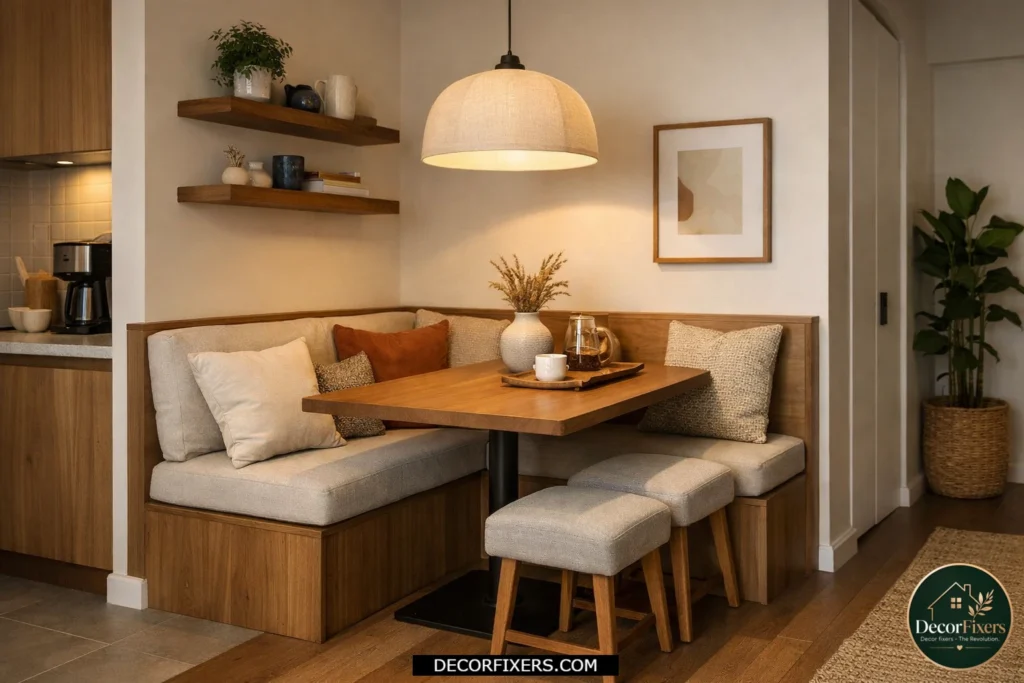
Swap one side of chairs for a bench. Benches slide completely under the table when not in use, unlike chairs, which hover several inches out. That’s a 6–10 inch floor space recovery on the bench side alone. In a tight room, that’s the difference between a workable walkway and a furniture obstacle course.
Banquette benches built into a corner are the most space-efficient version: the bench slides in, the table butts against two walls, and you’ve effectively carved a dining nook out of what felt like dead corner space. This layout also happens to be one of the coziest ways to eat in a small apartment.
10. Dining Table That Doubles as a WFH Desk
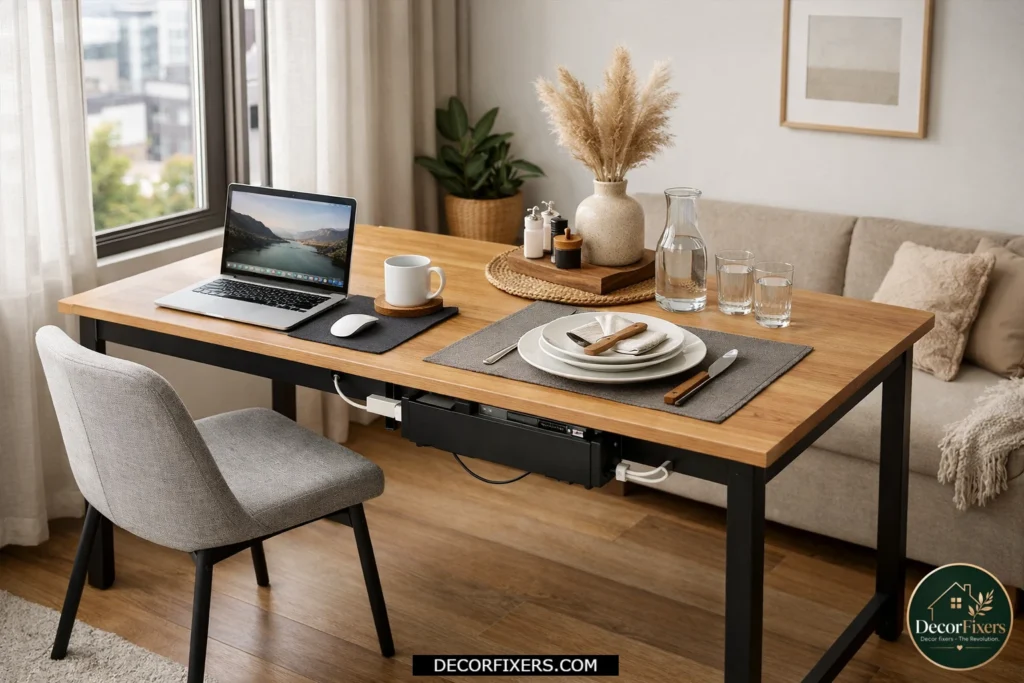
Post-pandemic, this isn’t a nice-to-have; it’s a necessity. A dining table positioned near a window, with cable management underneath and a desk lamp above, functions as both a dining surface and a home office. The key is choosing a table height between 28 and 30 inches, which works for both dining chairs and standard desk chairs.
Look for: a smooth, durable tabletop (no glass, laptop heat and glass don’t mix well), no center leg that blocks legroom, and enough depth for a monitor plus dinner plates. A 48-inch extendable table nails this dual role: collapse it for WFH days, expand it when you have dinner guests.
11. Lucite or Acrylic Table for Visual Lightness
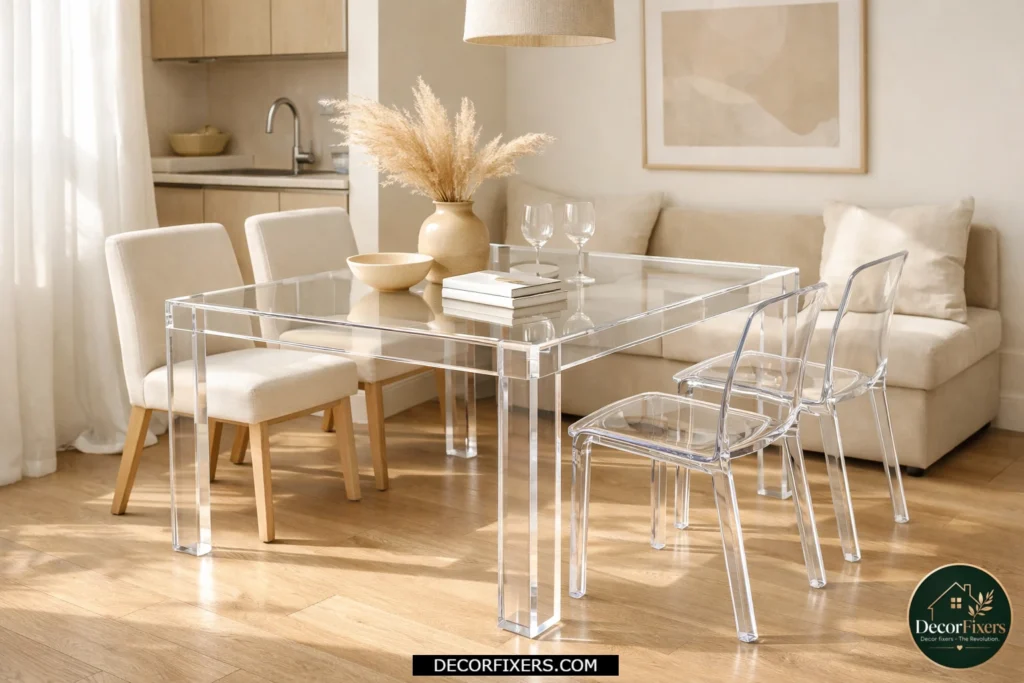
Acrylic tables carry the same optical trick as glass but are lighter in weight and shatter-resistant. They photograph beautifully (your dining area will always look bigger in photos) and create a genuine sense of open space in person. An all-acrylic 4-person table typically runs $300–$600, depending on thickness and manufacturer.
The downside: acrylic scratches relatively easily. Use placemats, avoid dragging objects across the surface, and clean with non-abrasive cloths. With basic care, an acrylic table holds up well for several years, long enough for most urban renters who expect to move and rethink their space anyway.
12. Tulip-Base (Single Leg) Round Table
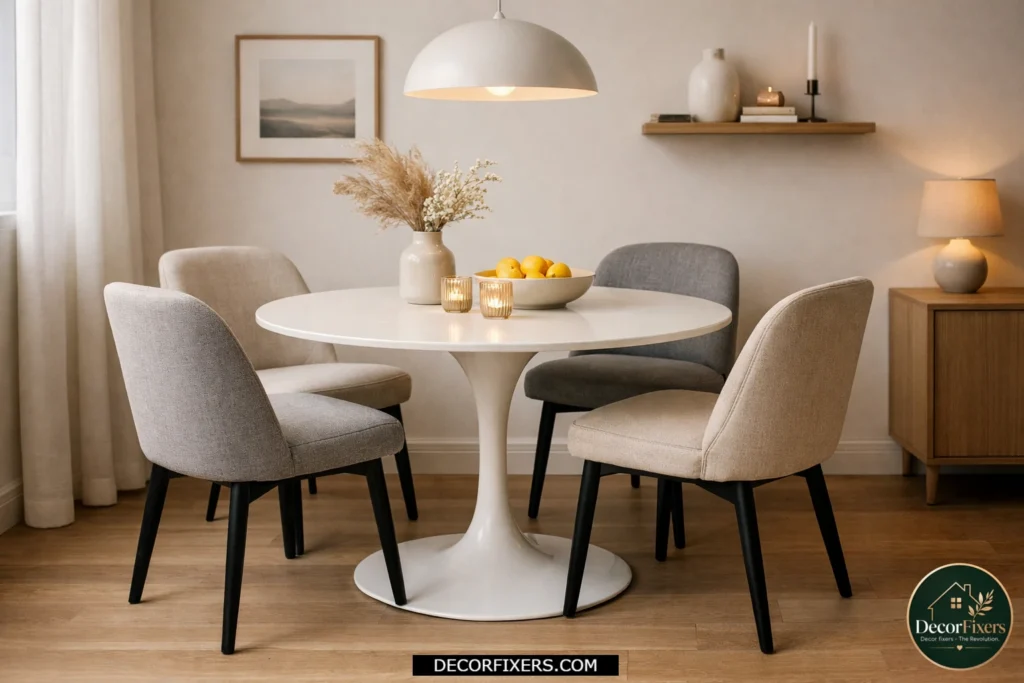
Eero Saarinen designed the tulip table in 1956 to solve a specific problem: the “ugly, confusing, unrestful world” of chair and table legs. In small dining spaces, a single central tulip base means zero leg interference at any chair position. You can seat five people at a 48-inch tulip table, where a four-leg version would only fit four comfortably.
The Knoll Saarinen Round Table (around $2,000+) is the original. More accessible versions from DWR or CB2 replicate the silhouette for $400–$700. Either way, it’s one of the genuinely great small-space furniture designs, still perfectly relevant 70 years after it was made.
Round vs Rectangular Dining Table for Small Spaces
Round wins in square rooms. Full stop. A round table with a pedestal base removes the four-leg obstacle, lets you pull chairs in from any angle, and, critically, has no corners jutting into walking paths. The West Elm Lola Pedestal Table at 36 inches in diameter fits a 9×9-foot room with comfortable clearance and seats four for daily meals.
Some experts argue that rectangular tables waste less wall space. That’s valid for rooms shaped like a long hallway. But if you’re dealing with a square or roughly square room, which most apartment dining corners are, rectangular tables force awkward chair placement on the short ends. Or maybe I should say it this way: the shape of your room should dictate the shape of your table, not the other way around.
Round vs Rectangular: A round table is better suited for square rooms and open-plan layouts because it allows 360-degree access and eliminates corner collisions. A rectangular table works better in narrow, elongated rooms where it can sit flush against one long wall. The key difference is how each shape interacts with walking paths.
13. Hairpin Leg Table for Visual Floor Access
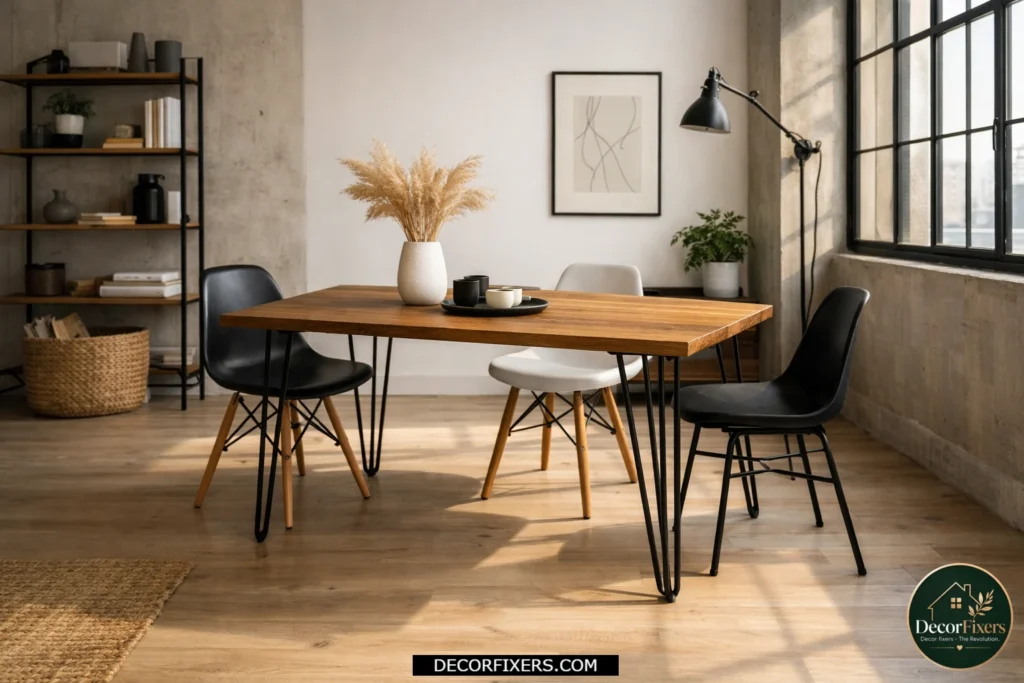
Thin hairpin legs do the opposite of what bulky furniture legs do: instead of blocking the floor visually, they expose it. The more floor you see, the larger the room feels. A 36×60-inch hairpin table in a small dining space reads as much lighter than the same dimensions on chunky square legs.
Hairpin tables are also easy to DIY, a tabletop from a lumber yard, hairpin legs from any hardware retailer for around $30–$60 per set of four. If you want a custom size that exactly fits your room’s math, this is the most cost-effective way to get it without buying an oversized table and hoping it fits.
14. Fold-and-Stack Dining Set
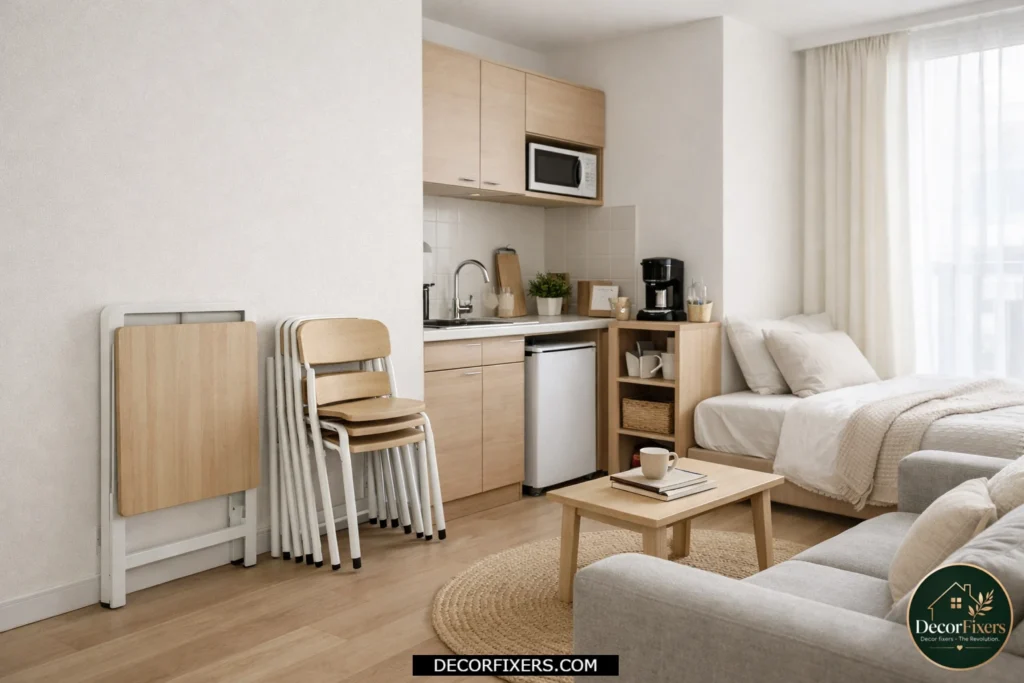
A folding table paired with stackable or folding chairs is the most aggressive space-saving configuration you can deploy. The entire dining set is stored in a closet or against a wall when not in use. Zero permanent footprint. This is the right choice for studio apartments where every square foot has to pull double or triple duty.
Look for tables with metal frames (lighter than wood fold-and-stack designs) and chairs that stack at least four high. A full 4-person fold-and-stack set can occupy a wall space of roughly 24 inches wide × 6 inches deep when fully stored, roughly the width of a coat closet shelf.
15. Built-In Banquette Dining Nook
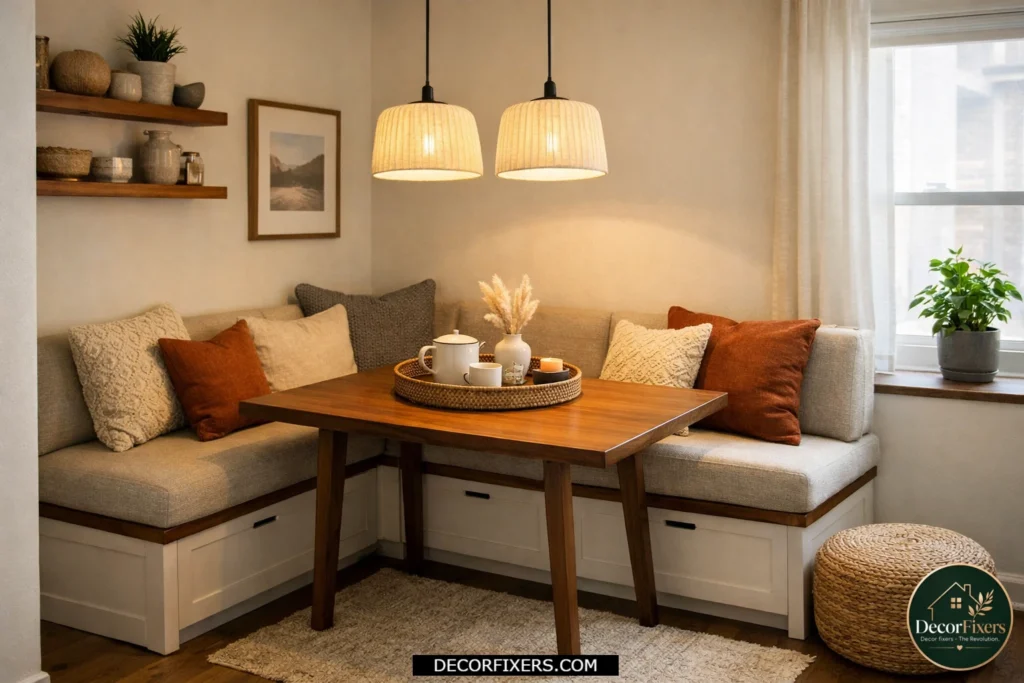
A built-in banquette turns dead corner square footage into a dedicated dining zone. Two bench seats running along two walls, with a table in between, is how restaurants pack in covers, and it works identically well at home. The seating stores flat, the table tucks in, and the corner feels purposeful rather than abandoned.
Built-in versions are the most space-efficient but require some carpentry. IKEA Kallax units with cushion tops serve as a DIY-friendly alternative: they double as storage benches and cost roughly $150–$300 per unit. Add a 36-inch table between two benches, and you have a full dining nook for under $500 total.
16. Oval Table as a Middle-Ground Shape
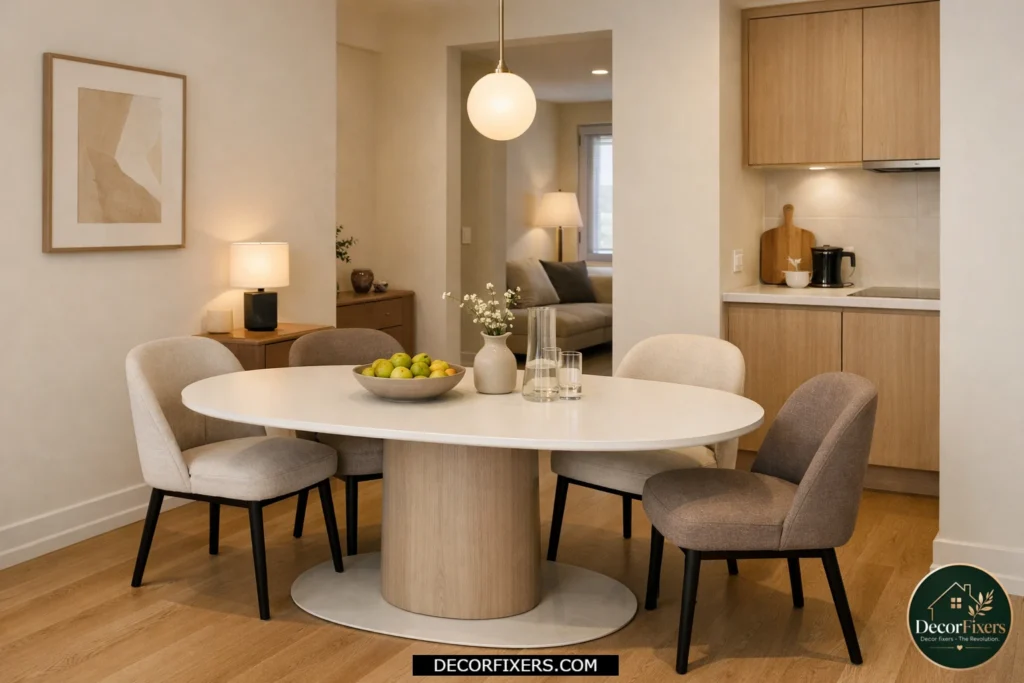
An oval table is a rectangular table with corners removed. That sounds trivial until you’re the person who stops clipping their hip on a corner every time they walk past the dining area. Oval tables seat the same number as a same-length rectangle but allow safer, easier circulation around the perimeter, especially in rooms where the table sits near a walkway.
The optimal oval for small spaces: 48 inches long × 30–32 inches wide. That seats four without expanding, fits against a wall on the long side, and leaves adequate clearance on the short ends. Sizes beyond 60 inches start behaving more like full-scale dining tables and lose the compact advantage.
Quick Comparison:
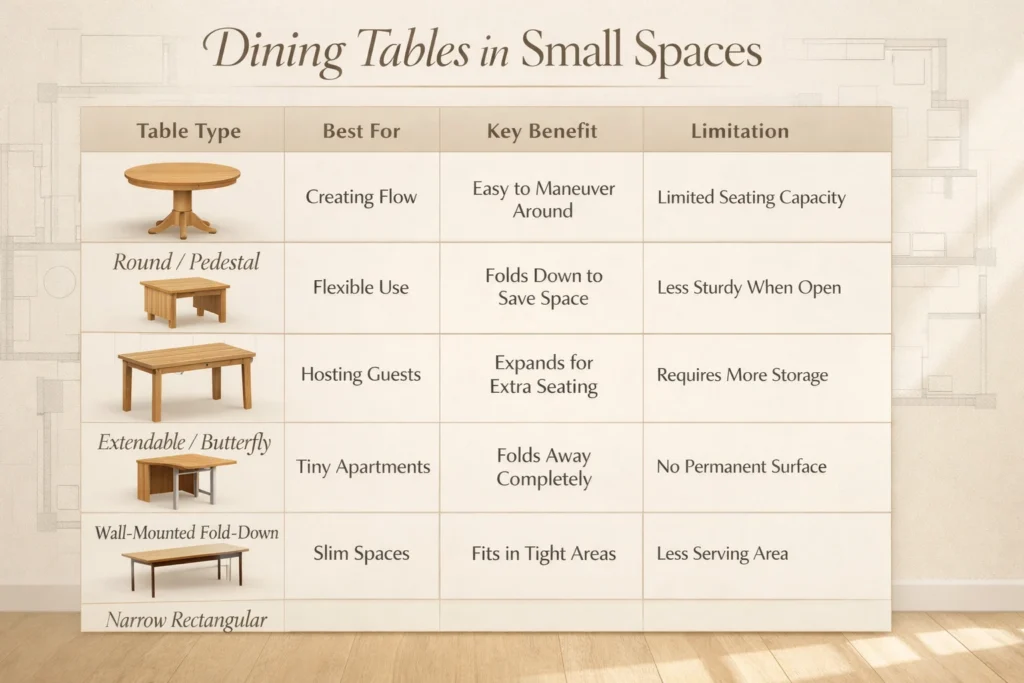
| Table Type | Best For | Key Benefit | Limitation |
| Round / Pedestal | Square rooms, solo or couple living | No corners = max floor flow | Less tabletop surface area |
| Drop-Leaf | Tiny kitchens & studio apartments | Collapses to under 12″ depth | Leaves need storage space |
| Extendable / Butterfly | Occasional entertainers | Grows from 2-seat to 6-seat | Heavier; harder to move |
| Wall-Mounted Fold-Down | Micro-studios under 400 sq ft | Zero footprint when closed | Fixed position; no flexibility |
| Narrow Rectangular | Long, slim dining alcoves | Seats 4 in <36″ width | Can feel formal/rigid |
17. Use a Rug to Define the Dining Zone (Size Matters)
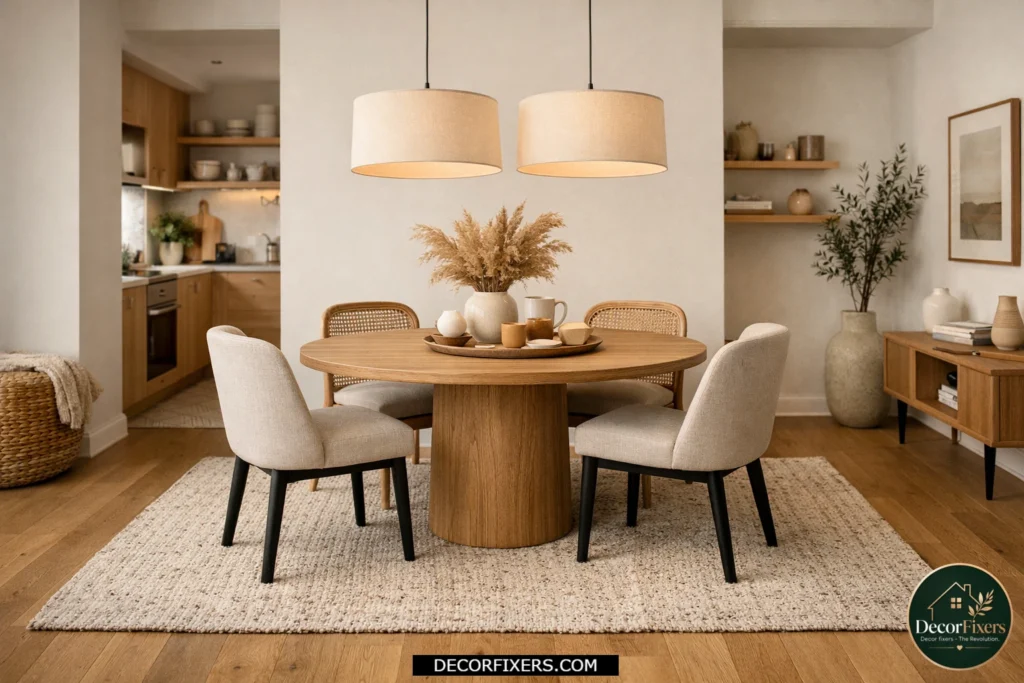
This isn’t about the table itself; it’s about how the table reads in the room. A dining rug that’s too small makes the space look accidental. The rule: the rug should extend at least 24 inches beyond the table edge on all sides, so chair legs remain on the rug even when pulled back. For a 42-inch round table, that means a rug of a minimum of 8 feet in diameter.
A correctly sized rug anchors the dining table visually, separating it from adjacent living or kitchen zones in an open-plan layout. It’s one of the cheapest ways to make a small dining setup look intentional. Most 8-foot round rugs run $100–$300, which is far less than a new table.
18. Place the Table Asymmetrically (Off-Center Works)
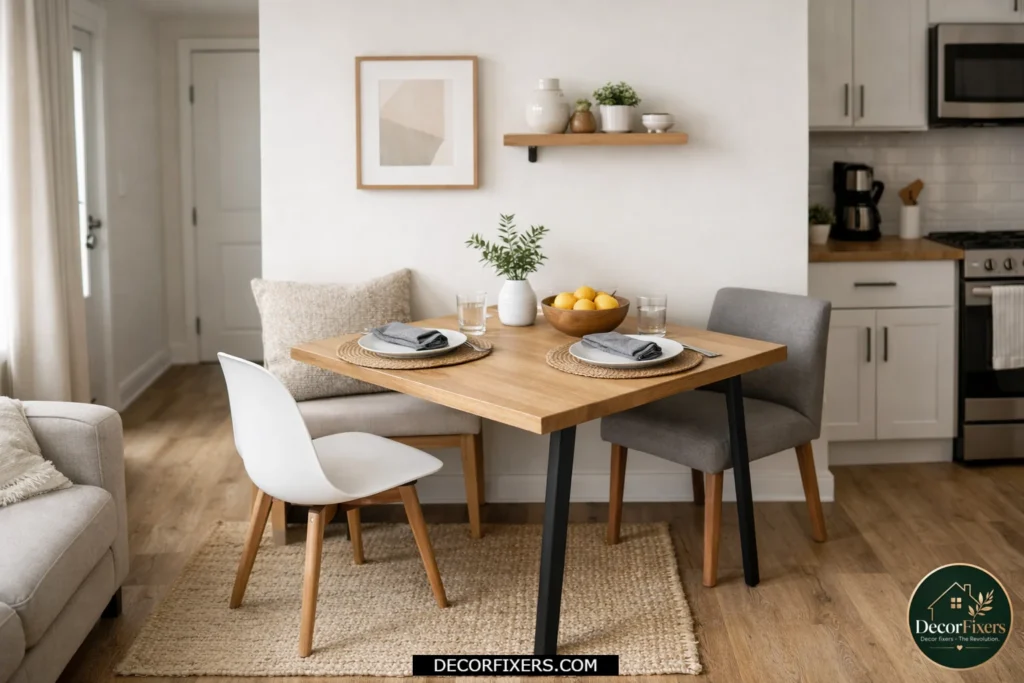
Most people default to centering the dining table in the room. In a small space, this is often the wrong instinct. Pushing the table to one side, with two chairs against a wall, two chairs in open space, frees up a large, uninterrupted walking path on the other side. It feels counterintuitive, but asymmetrical placement consistently makes small dining room function better.
The rule of thumb: the busiest traffic side (path to the kitchen, front door, bathroom) gets the most clearance. Push the table toward the quieter side. Tape test this before committing, you’ll be surprised how much better an off-center layout feels to walk through in a real room versus how it looks on a floor plan drawing.
19. Mirror or Light-Colored Wall Behind the Table
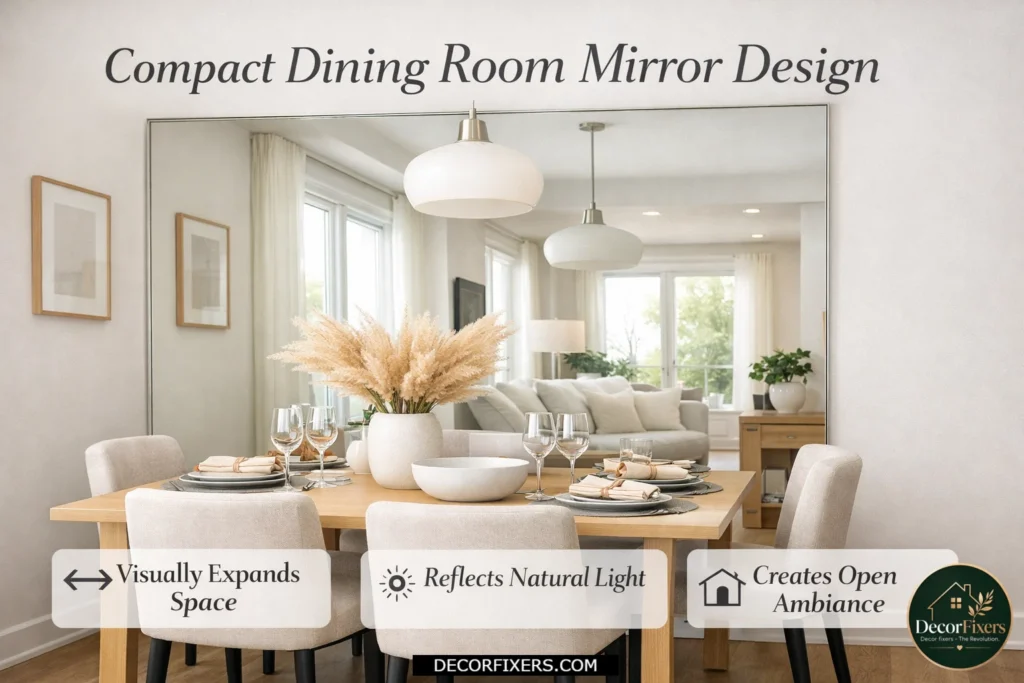
A large mirror on the wall behind a dining table doubles the perceived depth of the space. This isn’t a furniture trick, it’s a spatial illusion. A 36×48-inch mirror mounted on the wall your table faces can make a 9-foot room read like a 12-foot room. It also bounces natural light around, which makes the entire space feel less enclosed.
Light-colored paint achieves a similar effect at a fraction of the cost. A matte white or warm cream on the wall behind and adjacent to your dining area creates visual recession, the walls feel further away than they are. Combine a light wall with a glass or acrylic table, and you’ve layered two depth illusions simultaneously.
20. Pendant Light Positioned to Anchor the Table
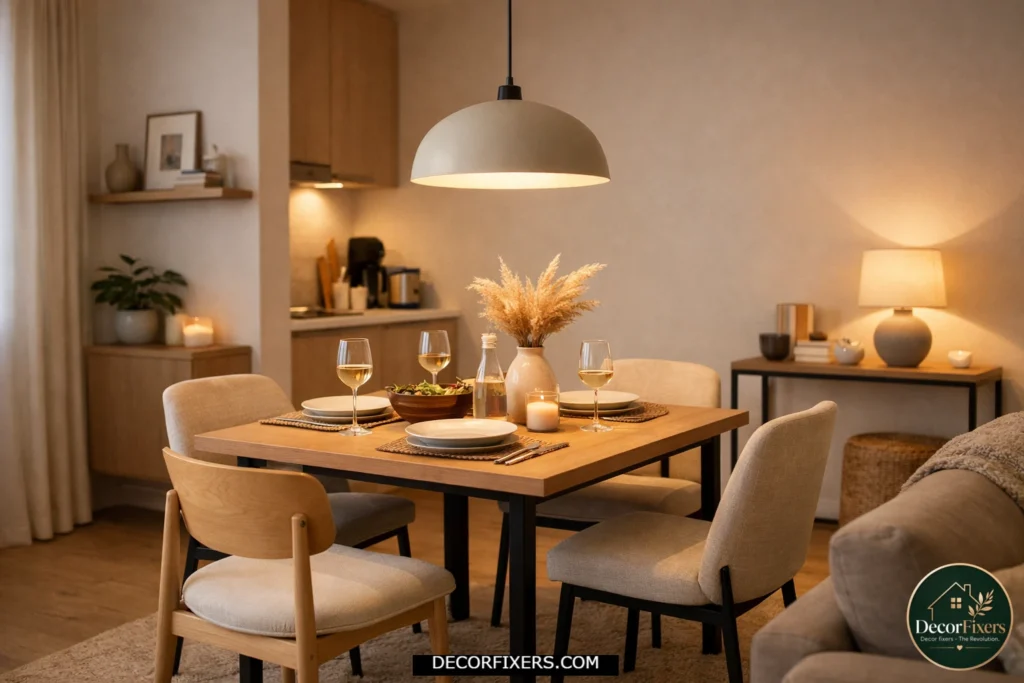
A pendant light hung 30–36 inches above the tabletop, centered over the table, does something important: it fixes the table’s position in the room visually and signals that this specific zone is the dining area. In open-plan small apartments where the dining table is also near the sofa and the kitchen, this visual anchoring matters more than people realize.
Keep the pendant’s footprint proportional, no wider than two-thirds the table’s diameter or length. An oversized pendant in a small room overwhelms the space; an undersized one looks like an afterthought. This is a $50–$200 change (depending on the pendant) that materially upgrades the intentionality of the whole setup.
CONCLUSION:
Here’s what I know after going through this process myself: the table that works isn’t the prettiest one on the IKEA landing page. It’s the one whose numbers match your room’s numbers, with enough leftover clearance that you don’t have to apologize every time someone tries to stand up from dinner.
Start with the 36-inch rule. Tape your floor. Test the mock-up before you buy. And if your space is genuinely tiny, don’t try to force a permanent setup; a drop-leaf or wall-mounted table that disappears when not in use is not a compromise. It’s the right answer for that room.
The global push toward multifunctional, space-smart living isn’t slowing down. The good news: furniture design has kept pace. There’s a working dining table for every room size that exists right now; you just need the right framework to find it.
Happy eating. At an actual table.
FAQs:
Q: What’s the best dining table shape for a small space?
A round table with a pedestal base is generally the best shape for small spaces. It eliminates corner collisions, allows 360-degree chair placement, and reads visually lighter than rectangular designs. For square rooms under 10×10 feet, a 36–42-inch round or square table works best.
Q: How do I fit a dining table in a small apartment?
Measure the room, subtract 72 inches (36″ per side), and use the result as your max table dimension. Then choose a drop-leaf, extendable, or wall-mounted table that meets those dimensions. Push one side against a wall to recover clearance; the wall side only needs chair pull-out depth, not full walkway clearance.
Q: Should I get a folding or extendable dining table for a small room?
Get an extendable table if you entertain occasionally, it gives you 2-seat daily functionality with 4–6 seat capacity on demand. Get a folding table if you need to clear floor space entirely on most days. Extendable tables are heavier; folding sets are more flexible but feel less permanent.
Q: Why does my small dining area feel cramped even with a small table?
Most likely a clearance problem. If the chairs have less than 36 inches behind them to push back, the area will feel tight regardless of table size. Try pushing the table against one wall to free up at least one full-clearance side, or switch to a bench on the wall side so seating can slide completely under the table.
Q: When should I use a wall-mounted dining table?
Use a wall-mounted fold-down dining table when your studio or micro-apartment is under 400 square feet, and you need the floor space for other uses on most days. It’s the right call for solo dwellers or couples who eat at a table only a few times per week. Pair with lightweight folding stools stored nearby.

Creator of DecorFixers, sharing practical home and interior ideas focused on real-life usability, simple design improvements, and budget-friendly solutions.
3 thoughts on “20 Dining Table in Small Space Ideas: Best Types, Sizes & Layout Tricks”