

I still remember standing in my first apartment’s “dining room”, which was really just a narrow corner between the kitchen and the couch, wondering how on earth I was supposed to host anyone there. The space was roughly 8 by 9 feet. My table took up nearly all of it.
That moment changed how I think about small dining rooms forever. It wasn’t a space problem. It was a strategy problem.
Whether you’re working with a studio apartment, a rented flat, or simply a home where the dining area drew the short straw, these 28 tiny dining room ideas for small spaces will show you exactly what works, with real product picks, honest price ranges, and zero renovation required. Let’s get into it.
| Tiny dining room ideas for small spaces refer to design strategies, furniture choices, and layout techniques that maximize function and visual space in dining areas under 120 square feet. The goal is a room that feels intentional, not cramped. |
Most small dining rooms don’t fail because of size. They fail because of scale. One oversized table, one bulky hutch, and suddenly a perfectly workable space feels like a storage closet you eat in.
1. Switch to a Round Table and Instantly Gain Breathing Room
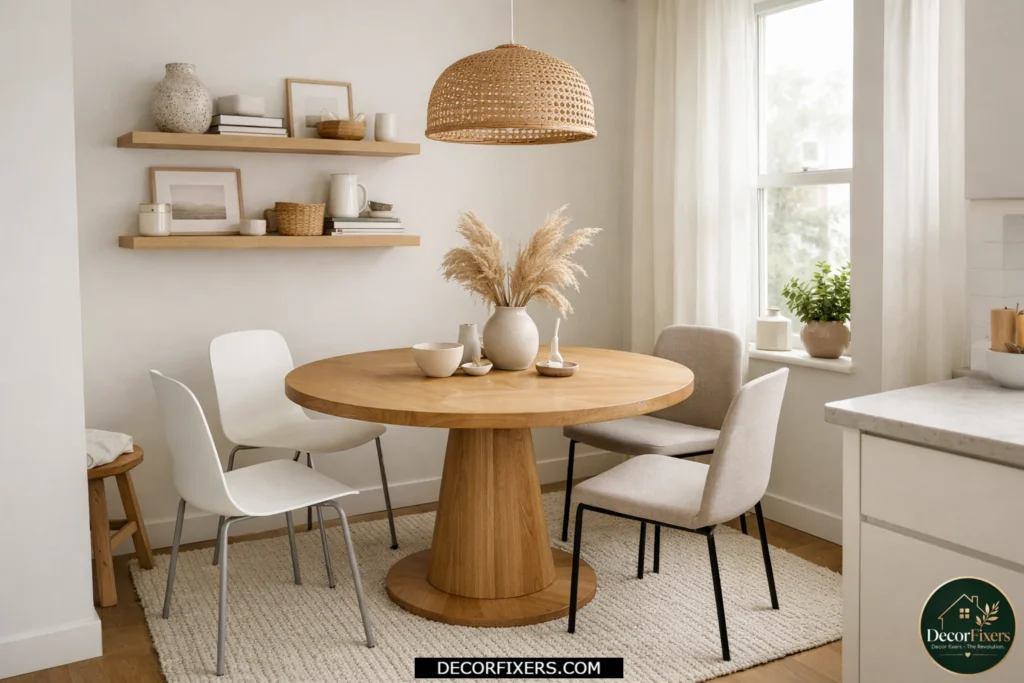
Round tables are the single most impactful swap you can make in a tiny dining room. There are no sharp corners cutting into your walkway, and every seat has equal access to the center, which just makes dinner feel more relaxed.
A 36-inch round table seats four comfortably and typically costs between $180–$450. The IKEA LISABO series starts at around $199 and works beautifully in rooms under 100 square feet. Pair it with chairs that have slim legs, and you’ve already made the room feel 20% more open without touching a single wall.
I’ve seen this swap transform a dining corner from stressful to genuinely charming in a single afternoon. It’s not magic, it’s geometry.
2. Use a Drop-Leaf Table That Disappears When You Don’t Need It
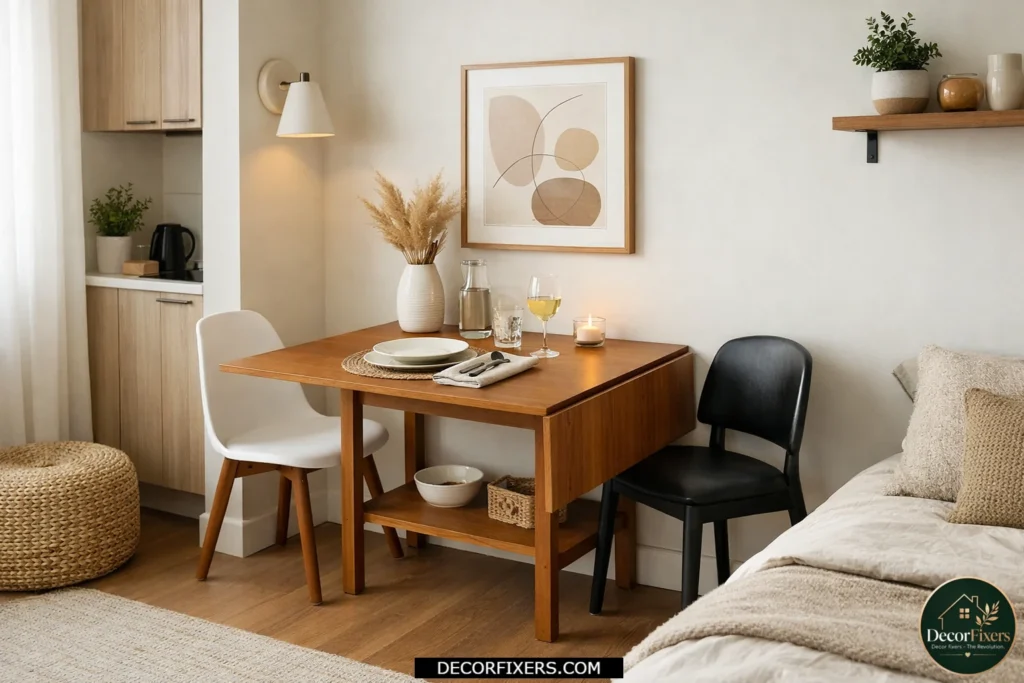
Drop-leaf tables are the unsung heroes of small dining room furniture ideas. In their compact form, they’re narrow enough to push flush against a wall, almost like a console. Flip up one or both leaves, and you’ve got a full dining surface for four.
West Elm’s Drop-Leaf Dining Table is one of the best-looking options on the market, retailing at around $499–$699. IKEA’s NORDEN drop-leaf in solid birch is a budget alternative at $299. Either way, you get a dining table that earns its square footage and then gets out of your way.
For renters especially, this is the move. No drilling, no commitment, no headaches.
3. Install a Wall-Mounted Fold-Down Table for a Zero-Footprint Dining Area
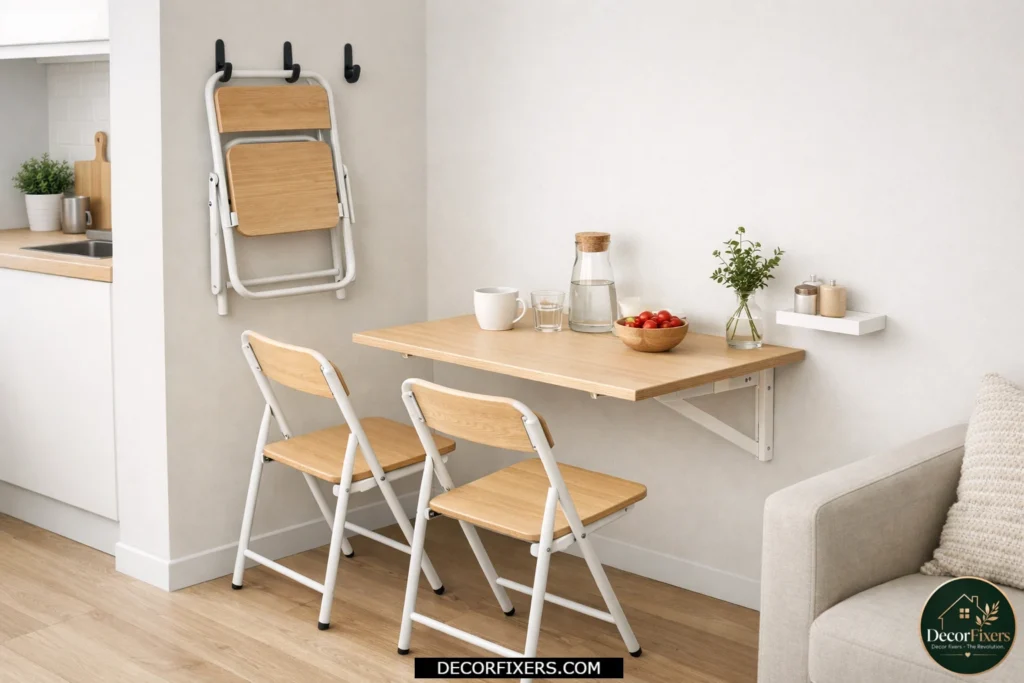
When you truly have almost no floor space to spare, a wall-mounted fold-down table is the answer. It mounts directly to the wall and folds flat when not in use, essentially becoming a piece of wall art between meals.
These range from about $80 for basic pine versions to $350 for sleek lacquered finishes. Pair one with two folding chairs that hang on hooks beside it, and you’ve created a full dining setup that takes up literally zero floor space when not in use. It sounds too clever to be this easy. It is this easy.
Quick note: check your wall type before installing. Drywall anchors work, but a stud mount is always stronger for anything you plan to eat regularly.
Round Table vs. Rectangular Table for Small Spaces
Round tables are better suited for rooms under 100 square feet because there are no corners restricting traffic flow, and the perimeter is shared more naturally among diners. Rectangular tables work better when the room is narrow and long (under 10 feet wide), where pushing the table against one wall maximizes the remaining walking space. The key difference is floor plan shape, not preference.
4. Choose an Extendable Table That Grows With Your Guest List
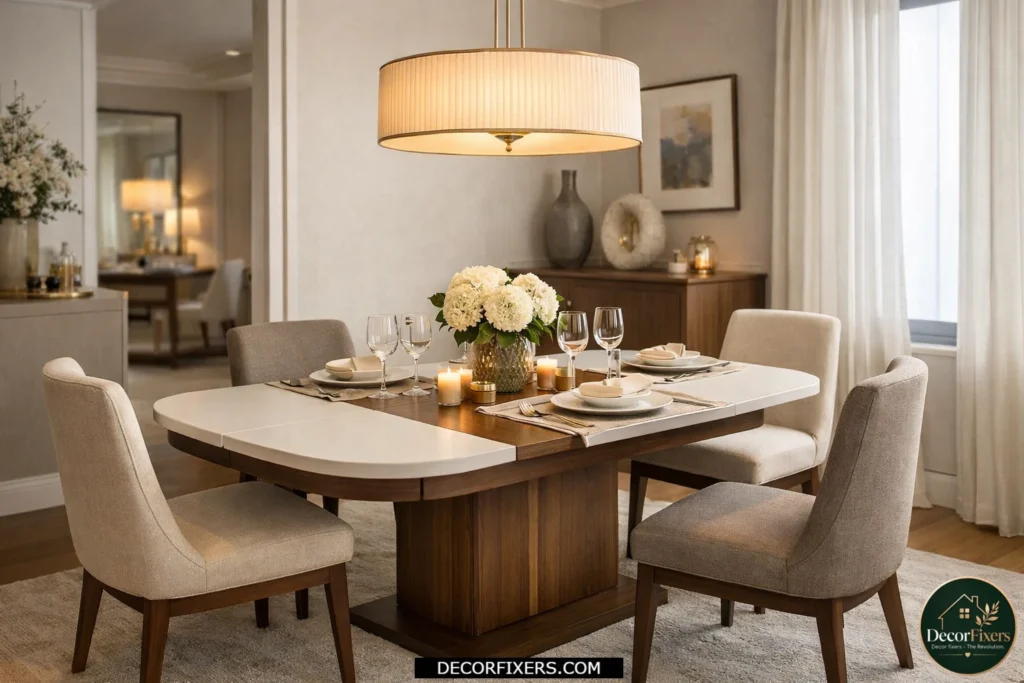
One table that works for Tuesday dinner and Saturday dinner parties? That’s the extendable table. It sits compact for daily use, often just 35 to 40 inches long, then extends to seat six or eight when needed.
The IKEA EKEDALEN extendable dining table starts at $299 and extends from seating four to seating six. For a more elevated look, Article’s Seno extension table runs $699–$899 and looks genuinely expensive. This is one of the best investments you can make in a small dining space if you entertain even occasionally.
Most people only discover extendable tables after buying a fixed one that’s too small for guests. Don’t make that mistake.
5. Build a Corner Banquette and Double Your Seating Without Doubling Your Footprint
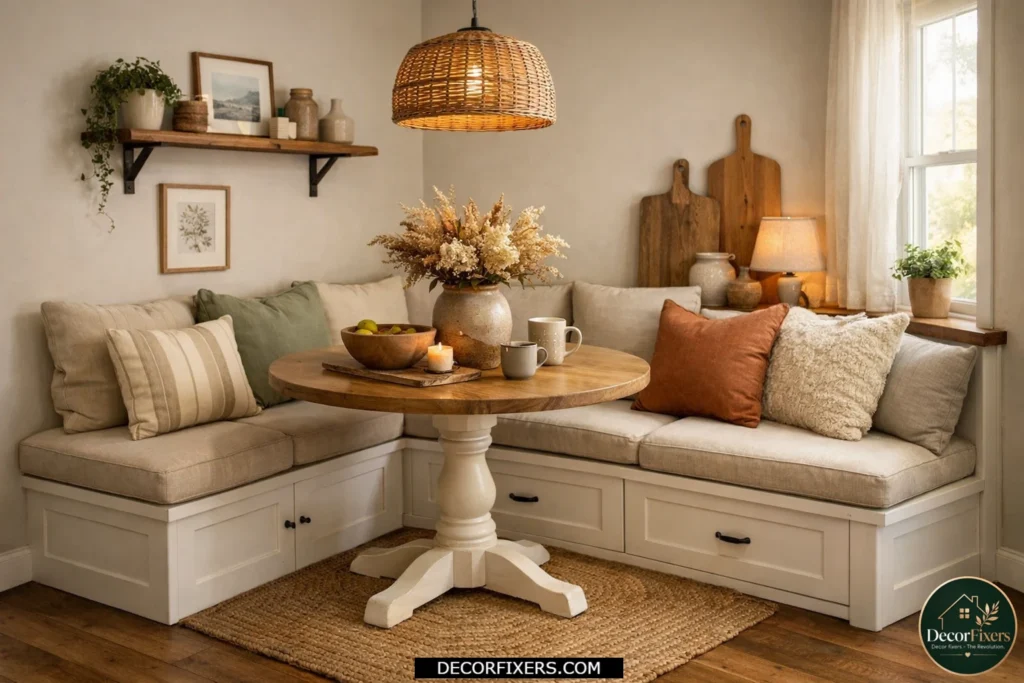
A corner banquette, that built-in L-shaped bench tucked into a corner, is the most space-efficient seating arrangement in small dining rooms. It uses dead corner space that a chair simply can’t access, and it seats more people than an equivalent number of chairs would.
A DIY corner banquette using IKEA KALLAX units as the base runs roughly $300–$600 in materials. Hiring a carpenter for a custom build typically costs $800–$1,800, depending on size and finish. Add seat cushions and throw pillows, and it reads completely luxurious; nobody would guess it started as flat-pack furniture.
The bonus nobody talks about: the storage underneath. It’s genuinely useful, not just a design trick.
6. Go Vertical With Floating Shelves Instead of a Bulky Sideboard
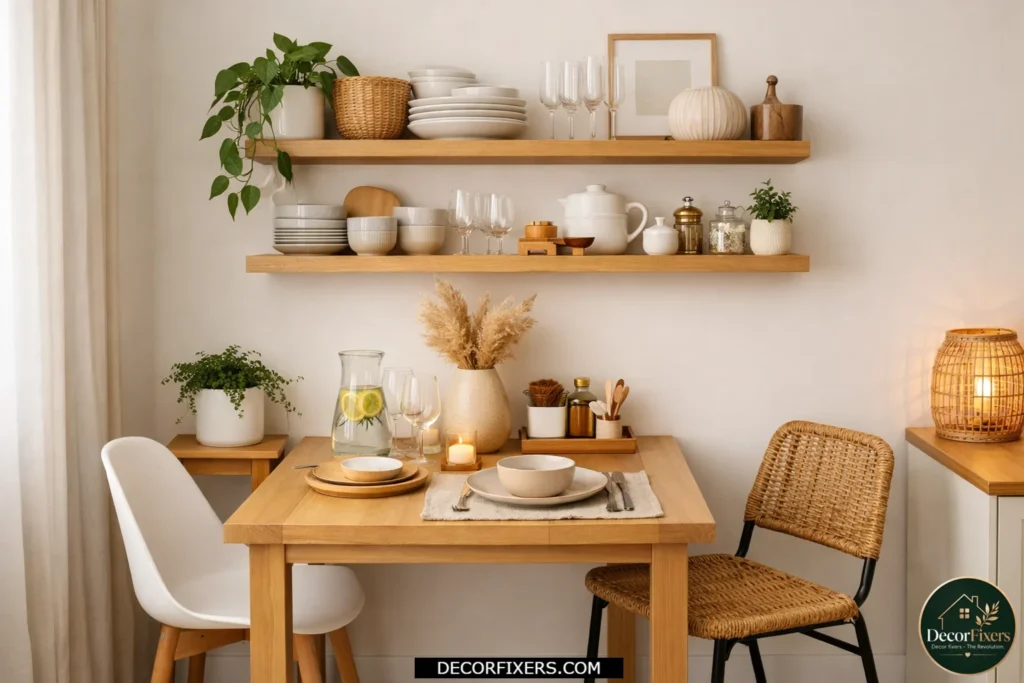
In a tiny dining room, a traditional sideboard or hutch can eat up a third of your visual space. The solution isn’t to skip storage, it’s to move it up the wall.
Two or three floating shelves above the dining area hold dishes, glassware, and decor without claiming a single square foot of floor space. IKEA BERGSHULT shelves with GRANHULT brackets cost $40–$80 per shelf. A set of three looks intentional and airy. Style them with a mix of functional items and decorative ones, not all dishes, not all vases, and the whole wall becomes a design moment.
This works especially well for renters. Most landlords allow standard picture-hook-level mounting with standard shelving brackets.
7. Add a Large Mirror to Visually Double the Room’s Depth
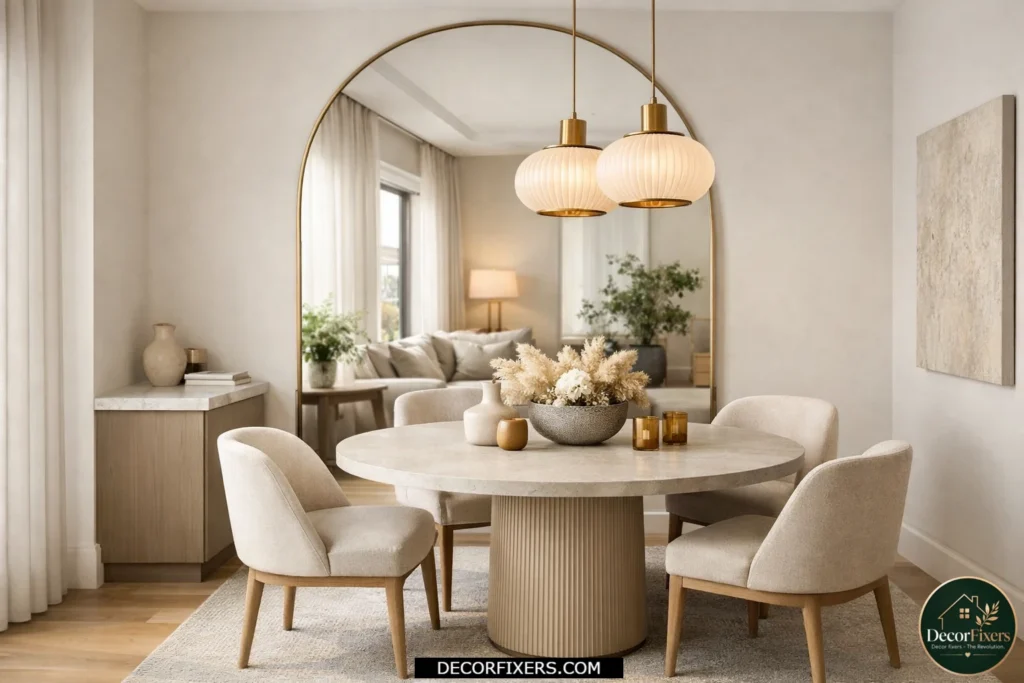
Mirrors work. It’s one of those design tricks that sounds cliché until you actually do it and realize the cliché exists because it genuinely works every single time.
In a small dining room, one oversized mirror, 24 x 36 inches or larger, hung on the wall opposite the main light source will reflect both light and space, making the room feel measurably deeper. A statement arch mirror from Target or Amazon runs $120–$280. For a more curated look, a vintage-framed mirror from a thrift store, stripped and painted, can cost as little as $30–$60.
Or maybe I should say it this way: the mirror doesn’t make the room bigger. It makes your eye stop looking for the wall.
8. Hang a Statement Pendant Light to Define the Dining Zone
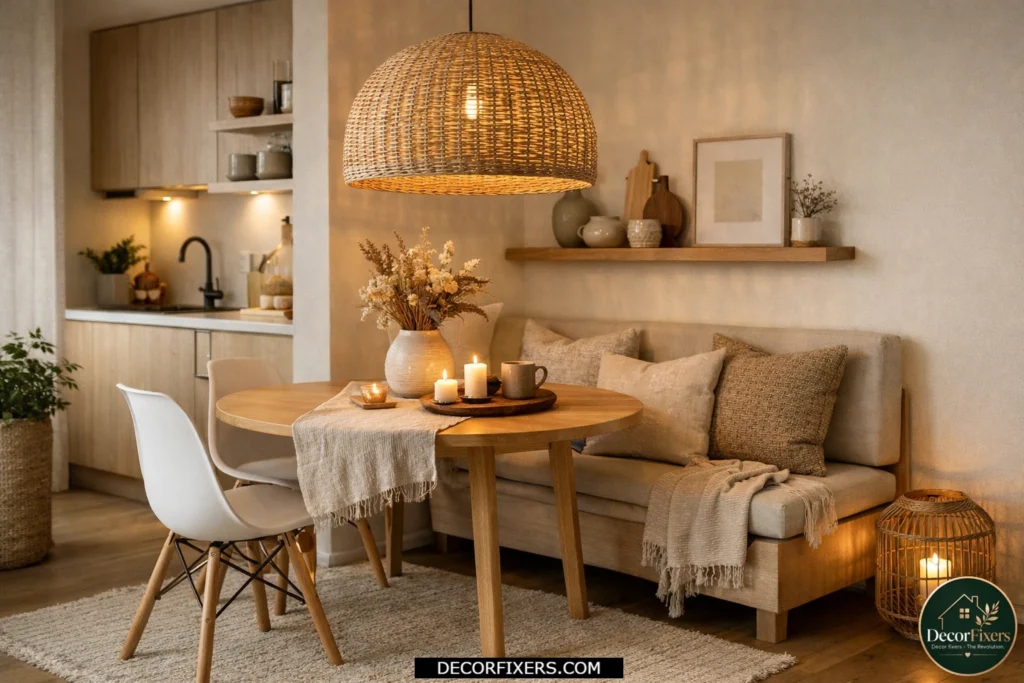
In open-plan apartments and kitchen-dining combos, one of the biggest problems is that the dining area doesn’t feel like its own space. A pendant light fixes that immediately. It draws a visual boundary around the table and says: This is where dinner happens.
A rattan or woven pendant from Amazon or Wayfair runs $60–$180. A more architectural concrete or blown-glass pendant can reach $250–$500. Hang it 28–32 inches above the tabletop for best proportions. This single change does more for the “feel” of a small dining room than almost any furniture swap.
I’ve seen rooms that had nothing else going for them transformed entirely by one well-chosen pendant. Light is not an afterthought. It’s architecture.
9. Use Acrylic or Ghost Chairs to Keep the Space Visually Light
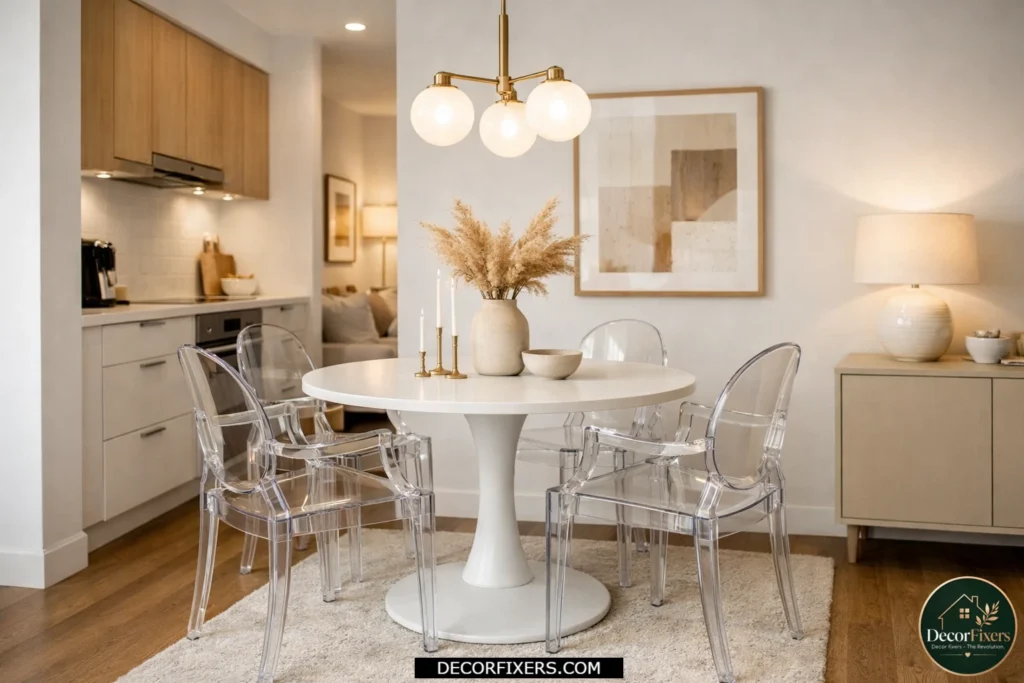
Solid chairs in a small dining room are visual blockers. They interrupt sightlines, make the room feel full, and create a sense of density that no paint color can fix. Acrylic ghost chairs solve this elegantly.
Because you can see through them, ghost chairs don’t register as “taking up space” the same way solid chairs do. A set of two authentic Kartell Louis Ghost chairs costs around $400–$500. Lookalike versions from Amazon run $120–$220 for a set of two and look nearly identical in photos. Combine them with a round table and a pendant, and your dining corner will look styled even before you add a single piece of decor.
10. Paint One Accent Wall a Deep, Moody Color to Create the Illusion of Depth
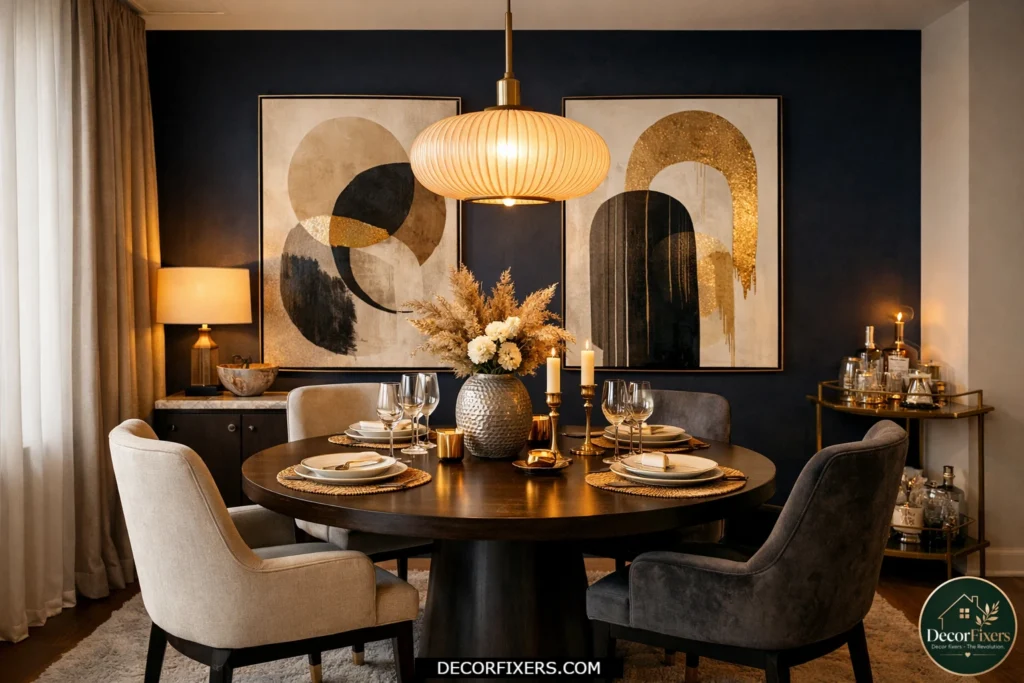
Here’s the thing: light colors make rooms feel bigger, but only up to a point. After that, they just feel… blank. A deep accent wall behind the dining area does something counterintuitive: it makes the room feel like it has layers.
Deep navy, forest green, or rich terracotta on the wall behind the table creates a focal point that pulls the eye, making the room feel intentional rather than small. A quart of Benjamin Moore Hale Navy or Sherwin-Williams Countryside costs $20–$35 and transforms the entire energy of the space. For renters, peel-and-stick wallpaper panels achieve a similar effect at $40–$90 and leave zero damage when removed.
Quick Comparison: Best Table Types for Tiny Dining Rooms
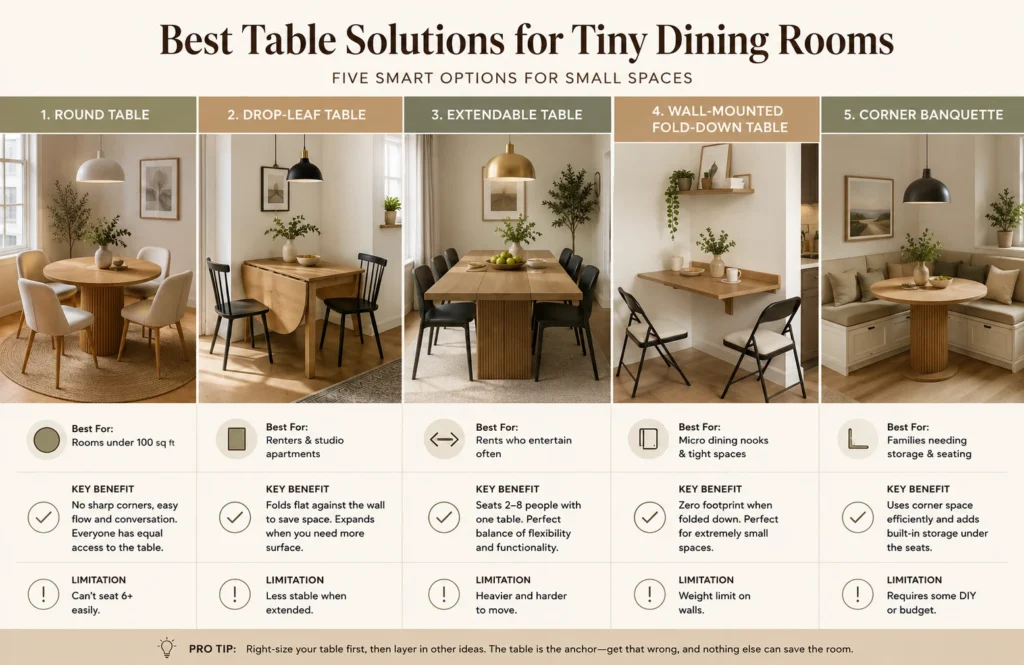
| Option | Best For | Key Benefit | Limitation |
| Round Table | Rooms under 100 sq ft | No sharp corners, easy flow | Can’t seat 6+ easily |
| Drop-Leaf Table | Renters & studio apartments | Folds flat against the wall | Less stable when extended |
| Extendable Table | Hosts who entertain often | Seats 2–8 with one piece | Heavier, harder to move |
| Wall-Mounted Table | Micro dining nooks | Zero footprint when folded | Weight limit on walls |
| Corner Banquette | Families needing storage | Built-in under-seat storage | Requires some DIY or budget |
11. Tuck a Bistro Table Into an Unused Corner and Create a Café Moment
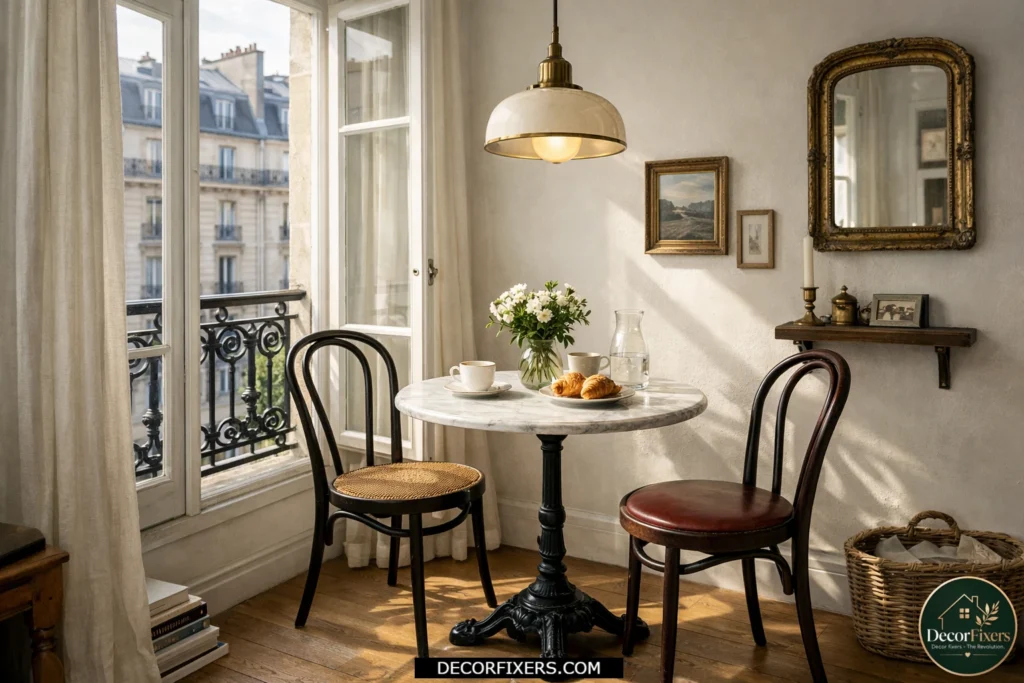
Every apartment has at least one corner that’s doing nothing useful. A small bistro table, typically 24 to 28 inches in diameter, turns that dead corner into a dining destination. It seats two comfortably and looks genuinely charming rather than compromised.
The Threshold Bistro Table from Target starts at $129. CB2’s marble-top versions run $350–$550 and feel considerably more elevated. Pair with two slim-profile metal chairs and one overhead pendant, and you’ve built a space that feels less like a backup plan and more like a deliberate design choice. Guests will think you’ve been to Paris.
This works especially well in apartments where the dining and living areas share a single room.
12. Replace Heavy Chairs With Stackable or Folding Chairs That Hide in a Closet
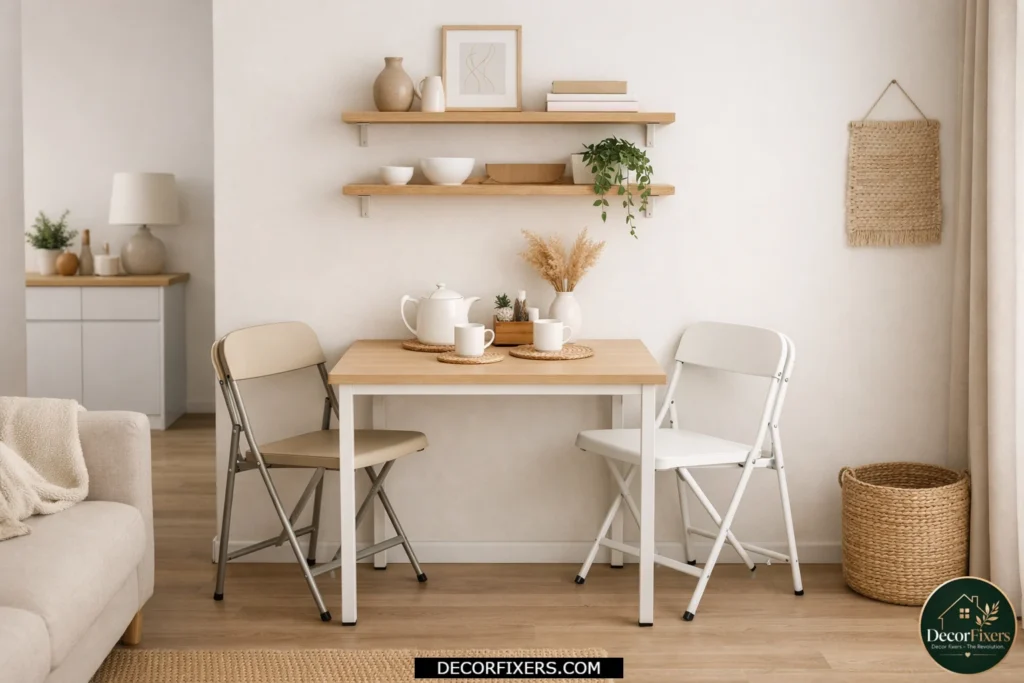
In a tiny dining room, chairs that aren’t in use still take up space. Folding or stackable chairs solve this problem entirely. Use them at the table, then stack or fold them into a closet between meals.
The HAY AAC 22 chair is the most beautiful folding option on the market at $280–$320 each. For budget-conscious buyers, the IKEA TERJE folding chair does the job at $35 each. Even dressed-up folding chairs take up only 2 inches of closet depth when hung on a door rack. It’s a minor life hack that genuinely improves daily living.
13. Use a Bench on One Side of the Table to Seat More People in Less Space
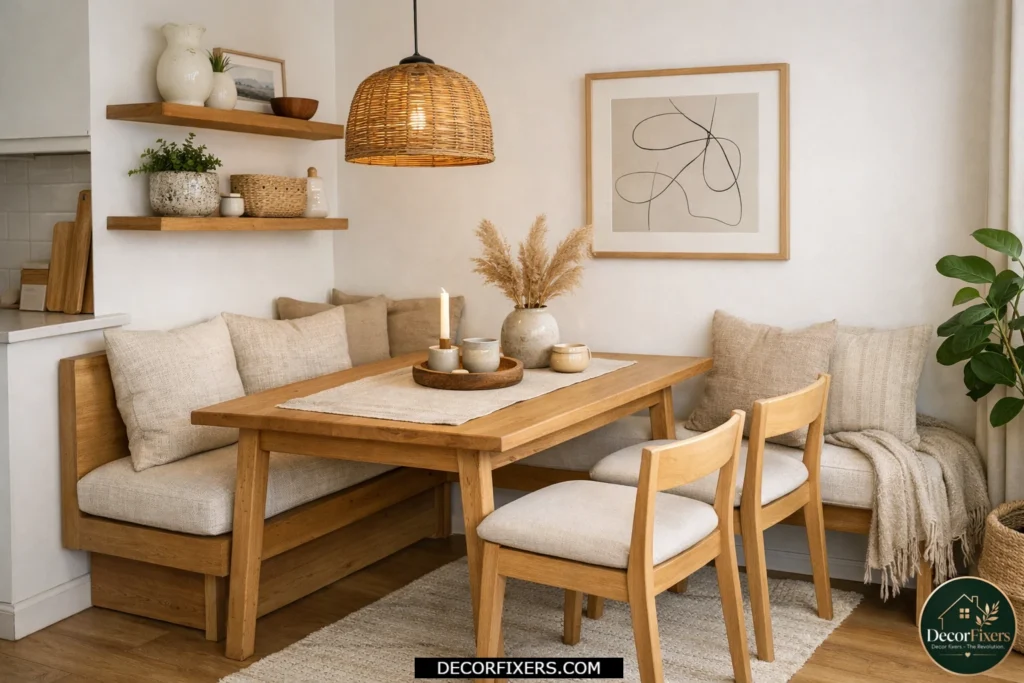
A bench on one side of a dining table seats 30% more people than individual chairs in the same footprint. When not hosting, it slides fully under the table, leaving the floor open. It’s the simplest space-saving upgrade most people overlook.
A solid wood dining bench from World Market or Article runs $150–$350. Add a seat cushion in linen or boucle fabric for $30–$80, and it reads as a genuine design choice, not a compromise. Pair it with two chairs on the opposite side for a classic mix-and-match look that’s very much trending in 2025 dining room design.
14. Hang Curtains High and Wide to Make Walls Feel Taller
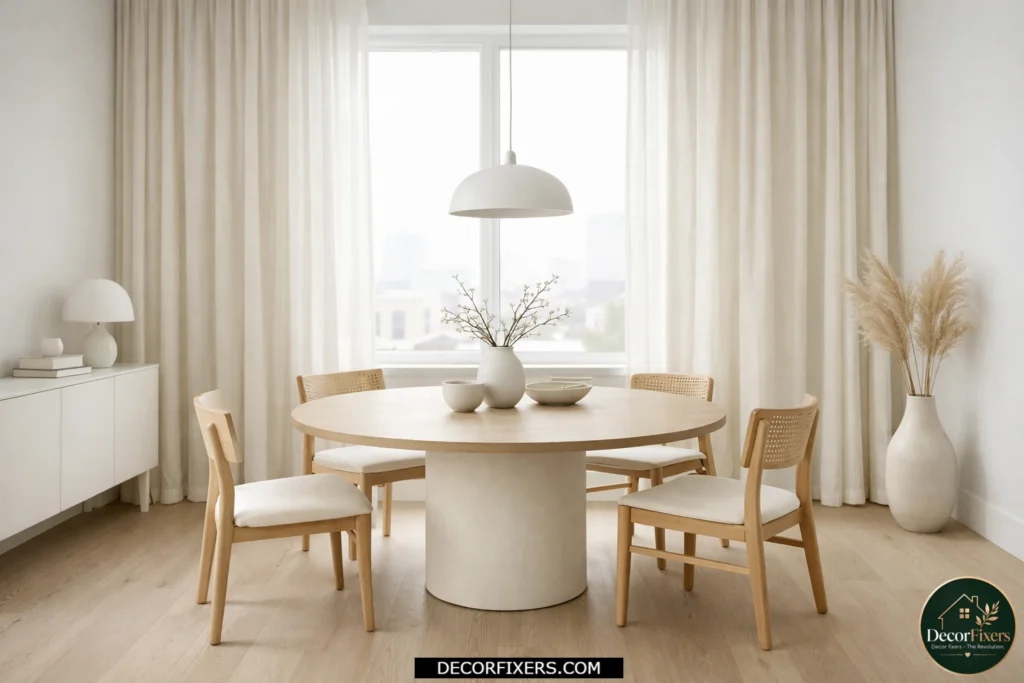
Curtains hung at ceiling height, not at the window frame, are one of the easiest tricks to make a small room feel dramatically larger. The eye reads the rod placement as the ceiling line, making the whole room feel taller and more expansive.
Linen or sheer curtain panels from IKEA or H&M Home run $30–$80 per panel. Mount the rod 4–6 inches above the window frame and extend it 8–12 inches on each side beyond the window edges. The window will look bigger, the room will feel taller, and the whole dining area will feel more considered. This costs almost nothing and works every time.
15. Use a Glass or Lucite Dining Table to Keep the Floor Visible
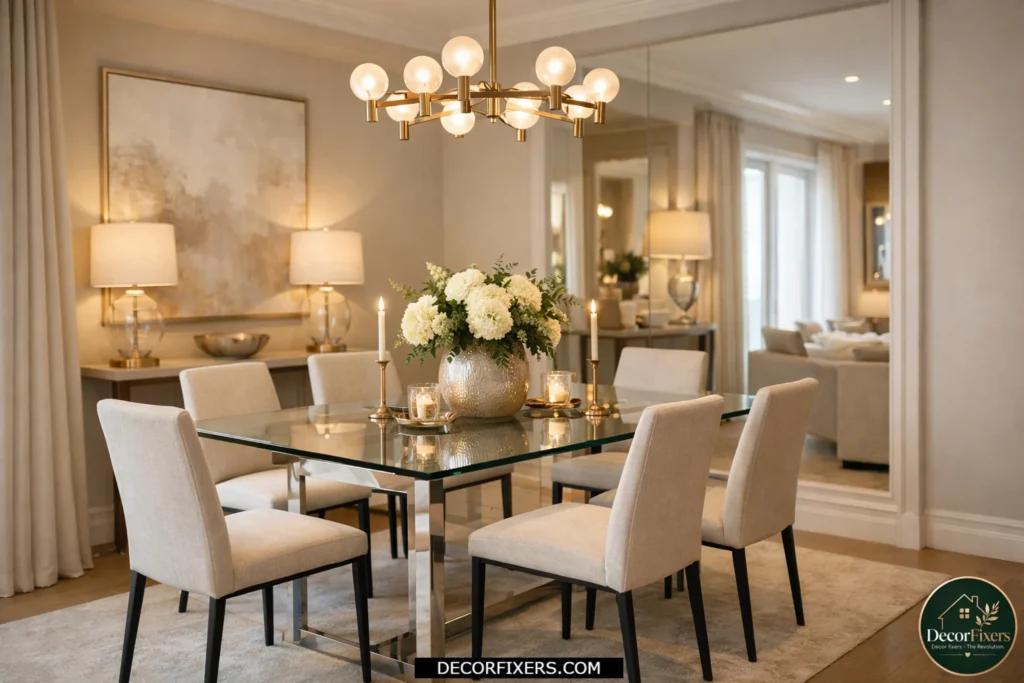
A glass-top table plays the same optical trick as ghost chairs: when you can see through it, your brain doesn’t register it as taking up space. The floor remains visible, the room feels open, and the table still serves its purpose completely.
A tempered glass dining table for four costs between $300–$800 depending on the base style. Chrome hairpin legs feel modern, black iron feels industrial, and brass or gold legs feel luxurious. Pair a glass table with linen chairs and a textured rug, and you’ll have a dining room that photographs beautifully and feels twice the actual size.
This is one of those ideas where conflicting opinions exist; some designers argue that glass shows fingerprints and feels cold. That’s true. My read: pair it with warm textiles, and you balance the effect completely.
16. Hang a Gallery Wall to Create Visual Height Without Taking Floor Space
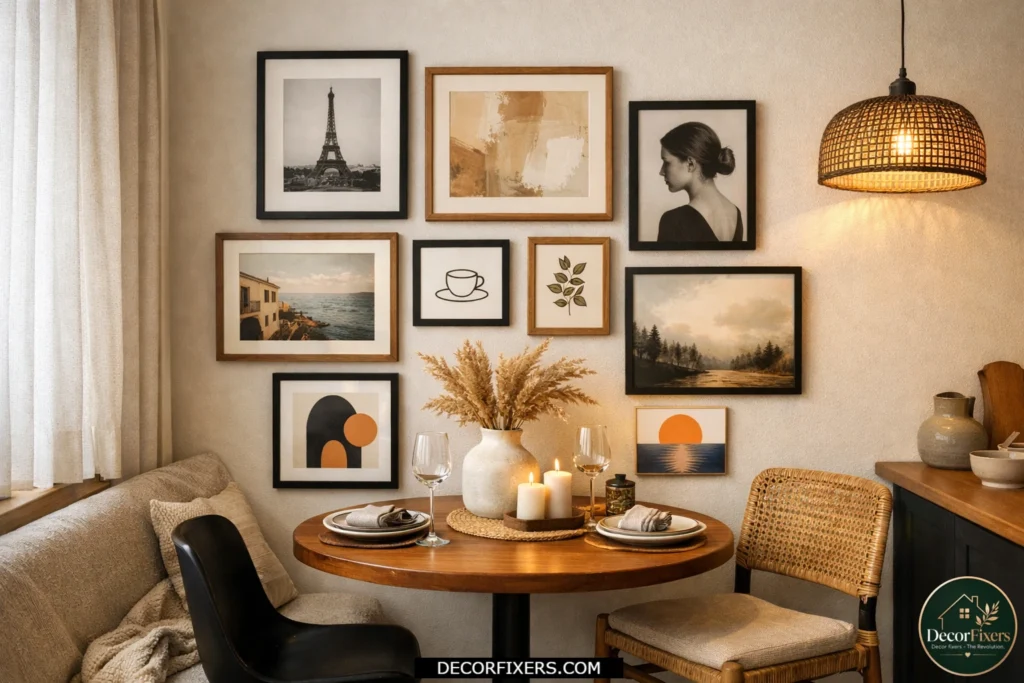
A gallery wall above and around the dining area does two things: it gives your eye somewhere interesting to travel, and it draws vertical attention, which makes the room feel taller. Done right, it’s one of the most cost-effective ways to make a small dining room feel layered and collected.
A mix of 6–9 frames in varying sizes, filled with prints from Etsy, family photos, or simple matted art, costs $80–$300 total, depending on frame quality. IKEA RIBBA frames are a reliable budget choice. The key is keeping the palette cohesive, black frames, or all natural wood, and mixing sizes intentionally, not randomly. This is worth the hour it takes to plan out on paper first.
17. Layer a Rug Under the Table to Define the Dining Zone
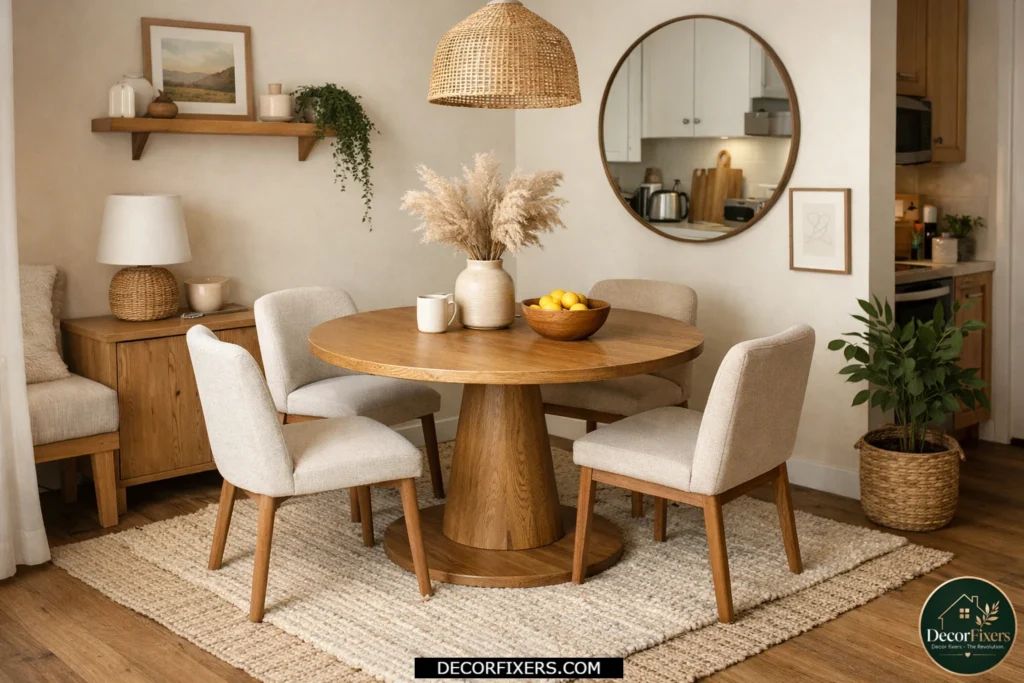
In open-plan homes and studio apartments, a rug under the dining table creates a distinct zone without any walls or dividers. It tells the eye: this space is for eating. Everything outside the rug is something else.
For a small dining table seating four, a 5×7 rug is the minimum; you want at least 18–24 inches beyond the chair legs when they’re pulled out. A wool or jute rug from Rugs USA or Wayfair in that size runs $120–$350. A machine-washable rug (Ruggable is popular) makes practical sense for a dining area specifically. Pattern adds personality; texture adds warmth.
18. Add Under-Table Storage Baskets for Clutter-Free Dining
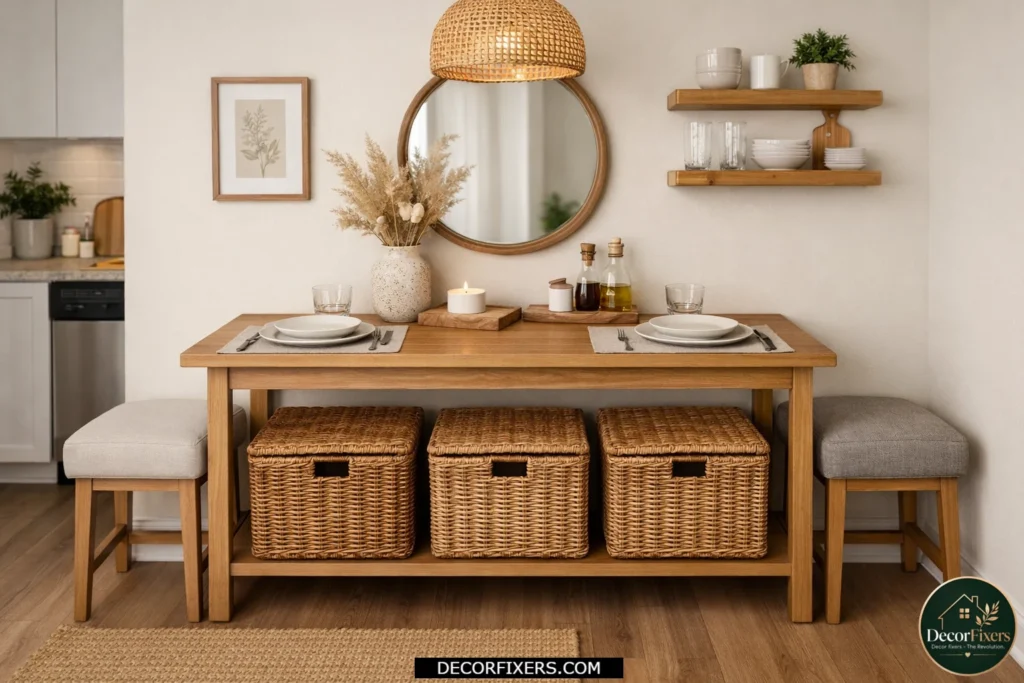
A cluttered dining room feels smaller than it actually is, always. The fix isn’t more space. It’s smarter storage. Wicker or rattan baskets tucked beneath a console-style table or along one wall add texture while keeping essentials out of sight.
A set of three nesting baskets from Target or World Market runs $35–$80. Use them for extra napkins, placemats, wine bottles, or whatever tends to accumulate on your dining table. When they’re in a beautiful basket, it’s decor. When they’re on the table, it’s clutter. Same stuff, totally different effect.
19. Use a Narrow Console Table as a Dining Surface for One or Two
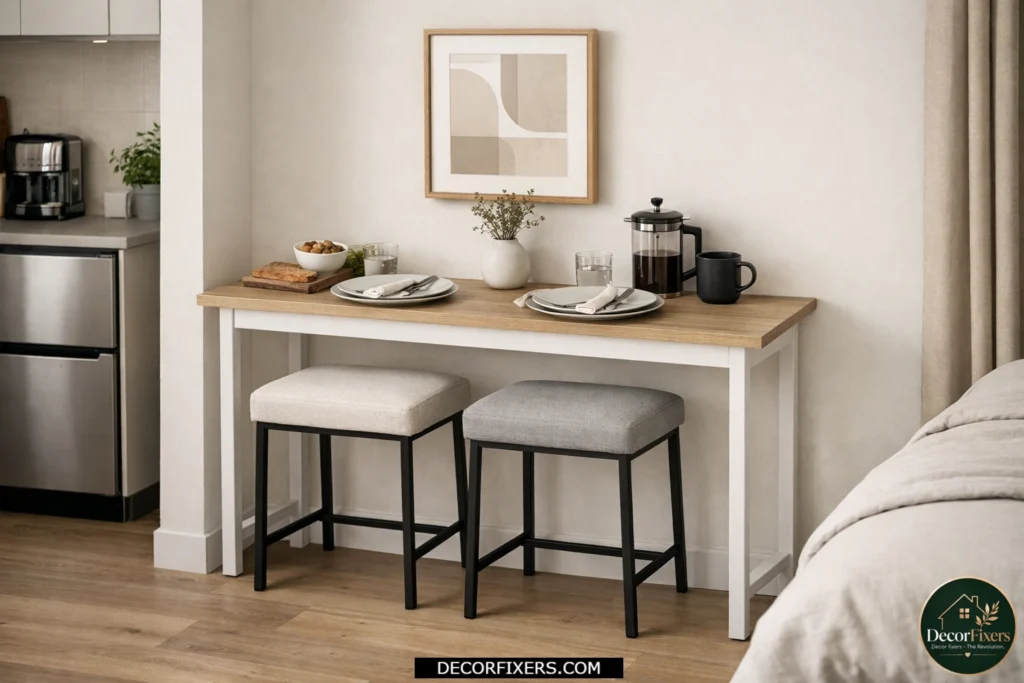
A console table, typically 12–16 inches deep, pressed against a wall, functions as a single-person or couple dining surface while taking up almost no floor space. It’s a counter-height dining setup that works beautifully in studios and micro-apartments.
West Elm’s Narrow Parsons Console runs $399–$499. IKEA’s HEMNES console table is $199 and comes in multiple finishes. Pair with two counter-height stools that tuck fully underneath, and you’ve created a functional dining setup with a footprint of roughly 3 square feet. For anyone who primarily eats alone or with a partner, this is the most space-efficient solution on this list.
20. Embrace Warm Lighting With Dimmers to Make the Room Feel Luxurious
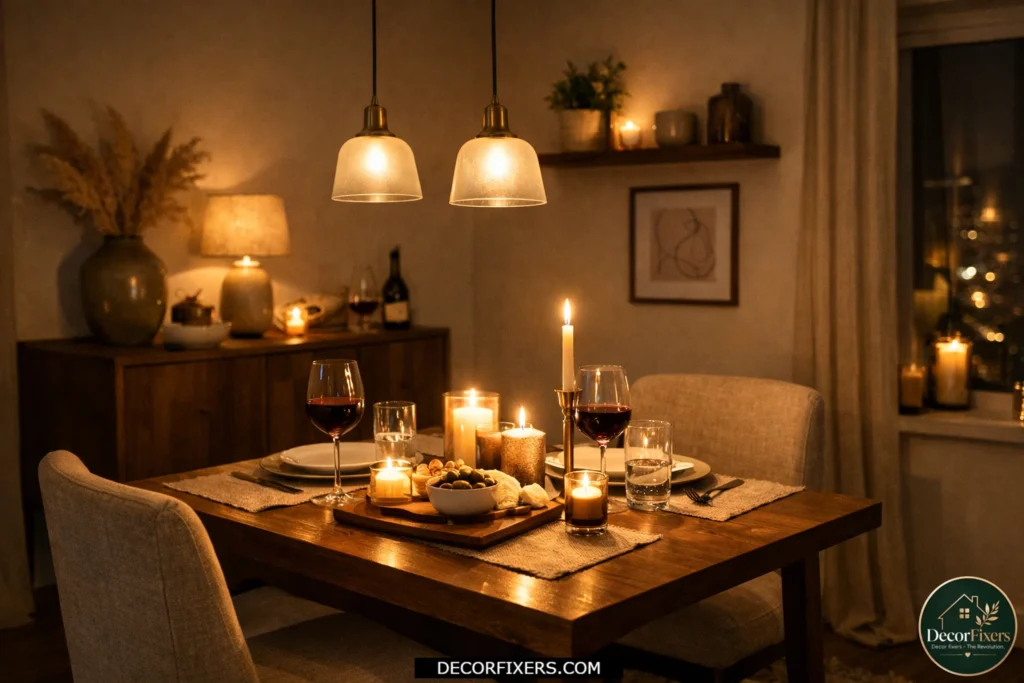
The difference between a cramped dining room and an intimate one is often just lighting. Warm bulbs at 2700–3000K, controlled by a dimmer, transform how a small space feels after sunset. Suddenly, tight feels cozy. Small feels intentional.
A Lutron plug-in dimmer (no electrician needed) runs $25–$45. Combine it with warm Edison-style LED bulbs at $12–$20 for a pack of four, and your dining room has two modes: practical daytime, and genuinely lovely evening. Add a candle on the table, and guests will forget the room is small entirely.
21. Install a Pass-Through Window Between Kitchen and Dining Area
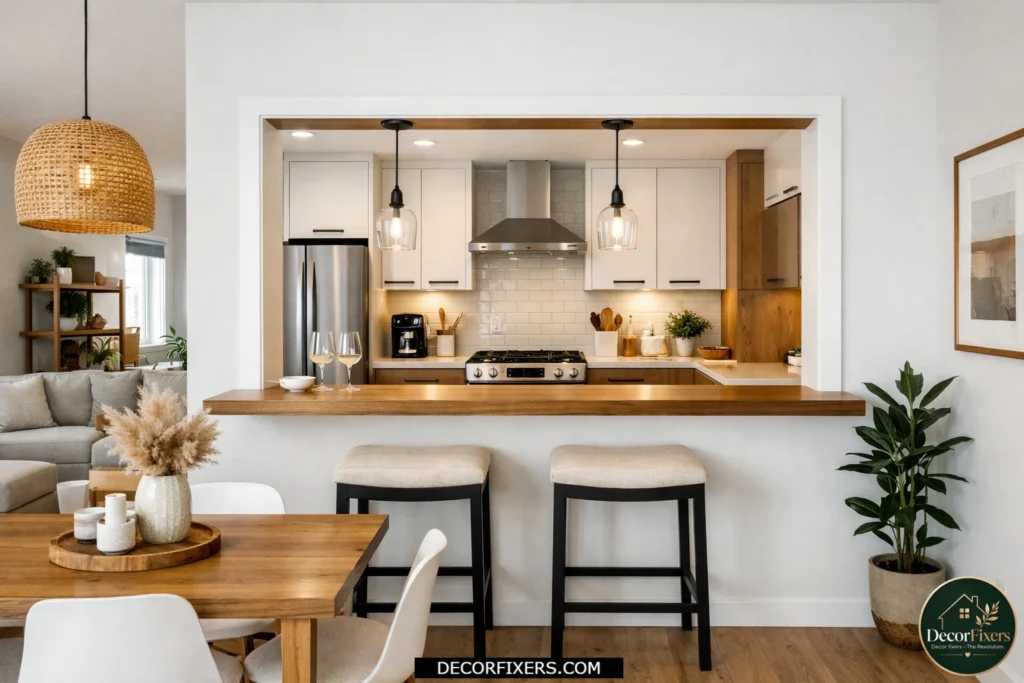
If your kitchen and dining room share a wall, opening a pass-through window between them does something remarkable: both rooms feel bigger because each can borrow visual space from the other.
This is more of a renovation play, but it’s one of the lower-cost structural changes you can make. A carpenter can cut and frame a pass-through for roughly $400–$1,200, depending on the wall type. The result is a bar-style ledge that works for serving food, casual breakfasts, and visual openness. For owned homes with a small dining area adjacent to the kitchen, this single change can feel transformative.
Renters: skip this one and see idea #19 instead.
22. Repurpose a KALLAX Shelf Unit as a Built-In Bench Base With Storage
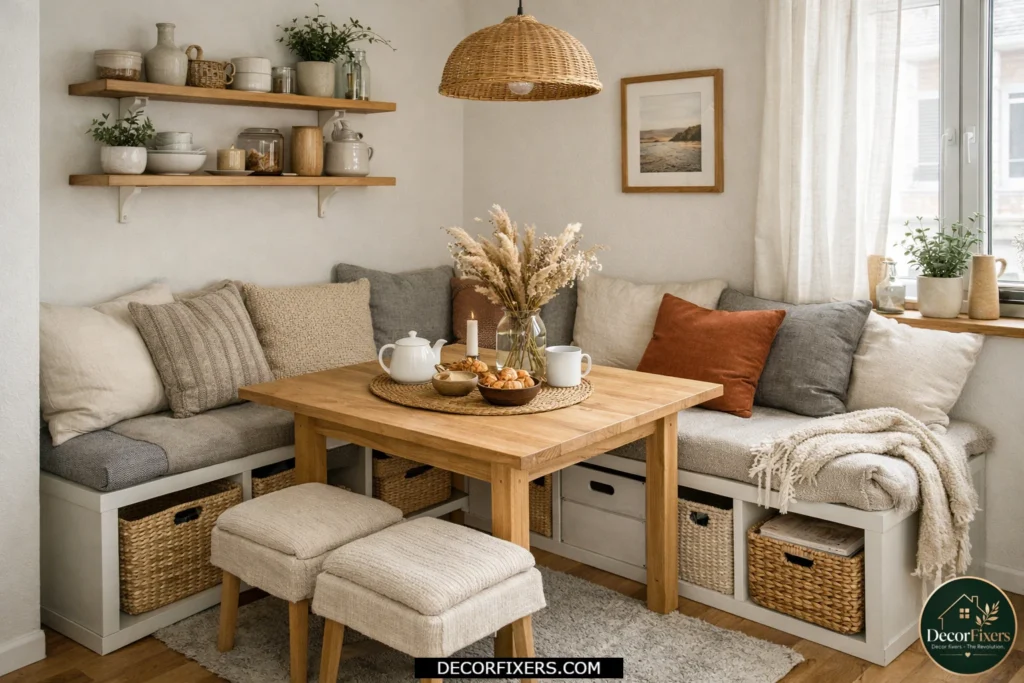
This one is an IKEA hack that earns its place on this list. The IKEA KALLAX shelf unit, placed on its side, becomes the base of a built-in bench with functional cube storage inside. Add a cushion on top, push it against the dining room wall, and it reads completely custom.
A 2×4 KALLAX unit costs $119. Add a custom foam cushion and fabric cover for $60–$120, and you’ve got a built-in bench with four storage cubes for under $250 total. Each cube holds seasonal serving dishes, extra linens, or whatever else needs a home. This is genuinely one of the cleverest small dining room storage ideas available at any budget.
23. Bring in a Statement Plant to Add Life Without Adding Visual Weight
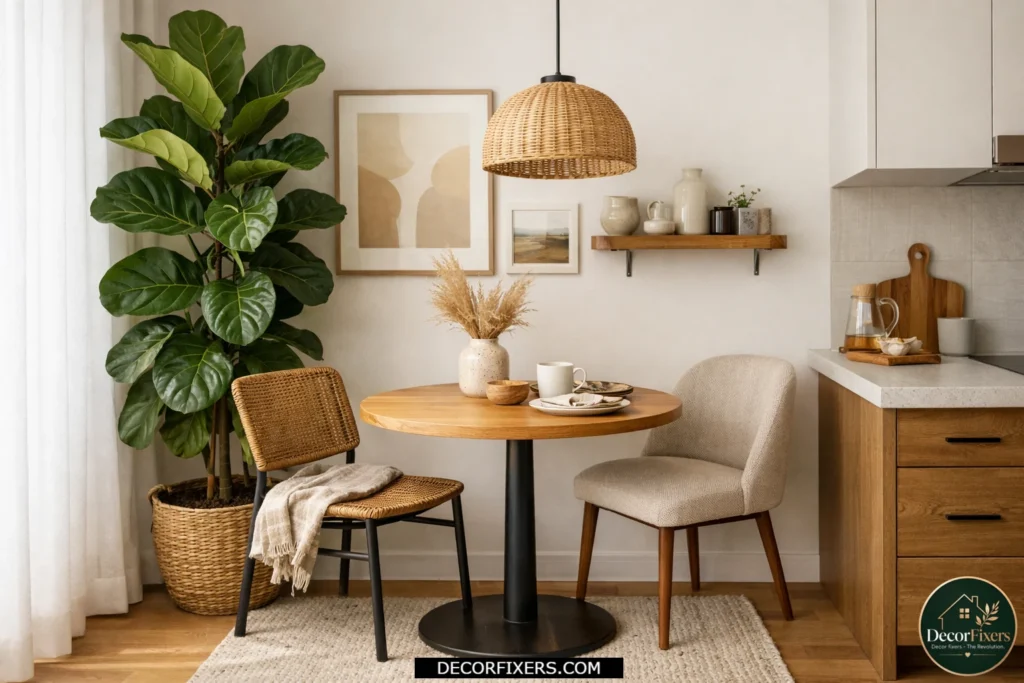
Greenery in a dining room does something no furniture can: it adds warmth, color, and life without adding visual mass. A tall fiddle-leaf fig in one corner, or a trailing pothos on a floating shelf above the table, shifts the whole feeling of a small space from tight to alive.
A 4-foot fiddle-leaf fig from a local nursery or The Sill typically costs $45–$95. A trailing pothos in a hanging planter runs $15–$30. Plants are the one decor element that genuinely does more work than their price tag suggests, and in a tiny dining room, anything that adds character without adding weight is worth its corner.
24. Use a Monochromatic Color Palette to Visually Expand the Space
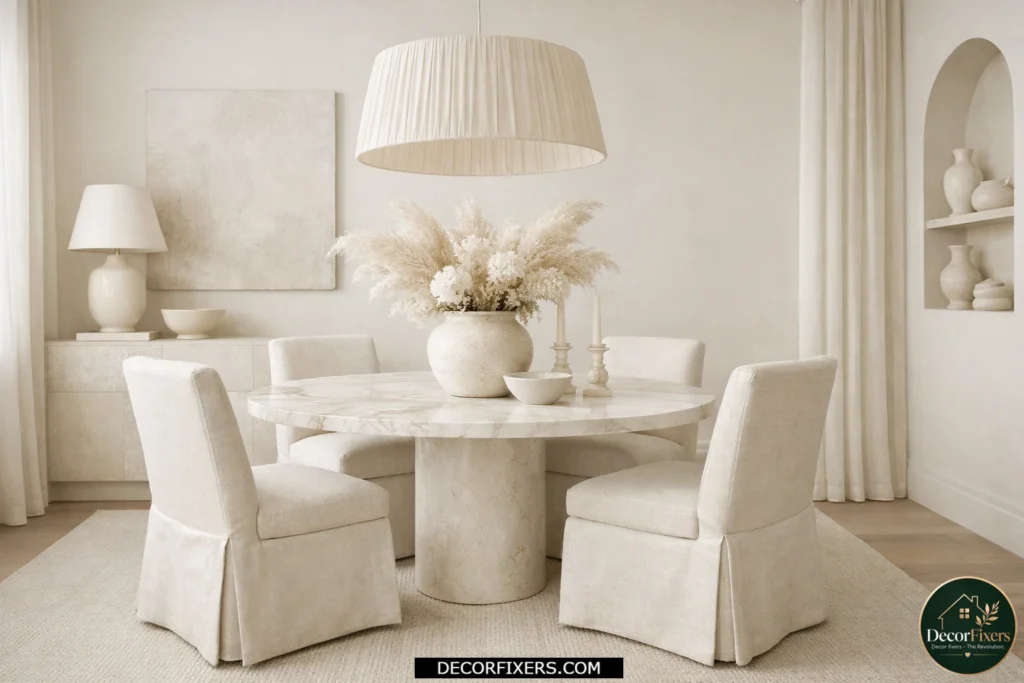
A monochromatic dining room, where wall color, table, chairs, and soft furnishings share the same color family with varying tones and textures, reads as one cohesive, expansive surface rather than a collection of separate, competing objects.
An all-white or all-cream palette with varied textures (linen chairs, marble table, matte painted walls) feels curated and spacious. An all-sage-green palette feels warm and collected. The investment here is mostly in paint, $20–$35 per quart, and in reupholstering or slipcovering existing chairs, which runs $30–$80 per chair for slipcovers. The visual effect is worth considerably more than the cost.
25. Add Wallpaper to One Wall for a Luxurious, Space-Defining Backdrop
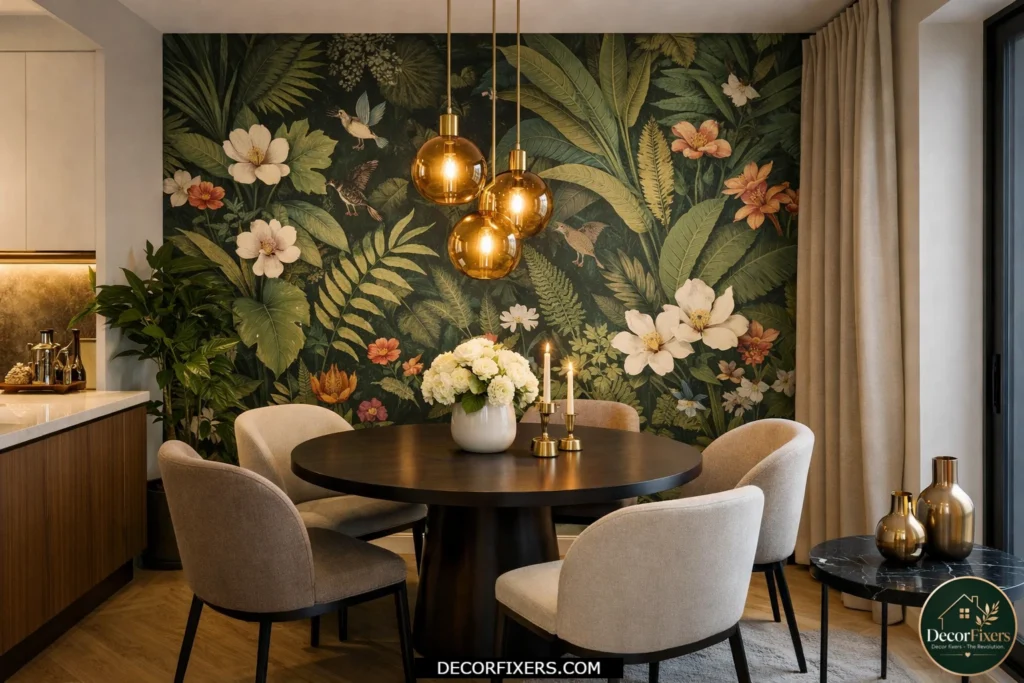
Patterned wallpaper on the wall behind a small dining table creates a feature wall effect that makes the space feel deliberate and designed, not accidental and cramped. The pattern draws the eye, the room gets a focal point, and suddenly the size of the space becomes secondary.
Peel-and-stick wallpaper from Tempaper or Chasing Paper runs $7–$14 per square foot, and a single accent wall behind a small dining table typically requires 20–30 square feet, $140–$420 total. Geometric patterns make rooms feel structured and intentional; botanical prints feel organic and warm. Either works. Both beat a plain white wall.
26. Use Sconces Instead of Table Lamps to Free Up Surface Space
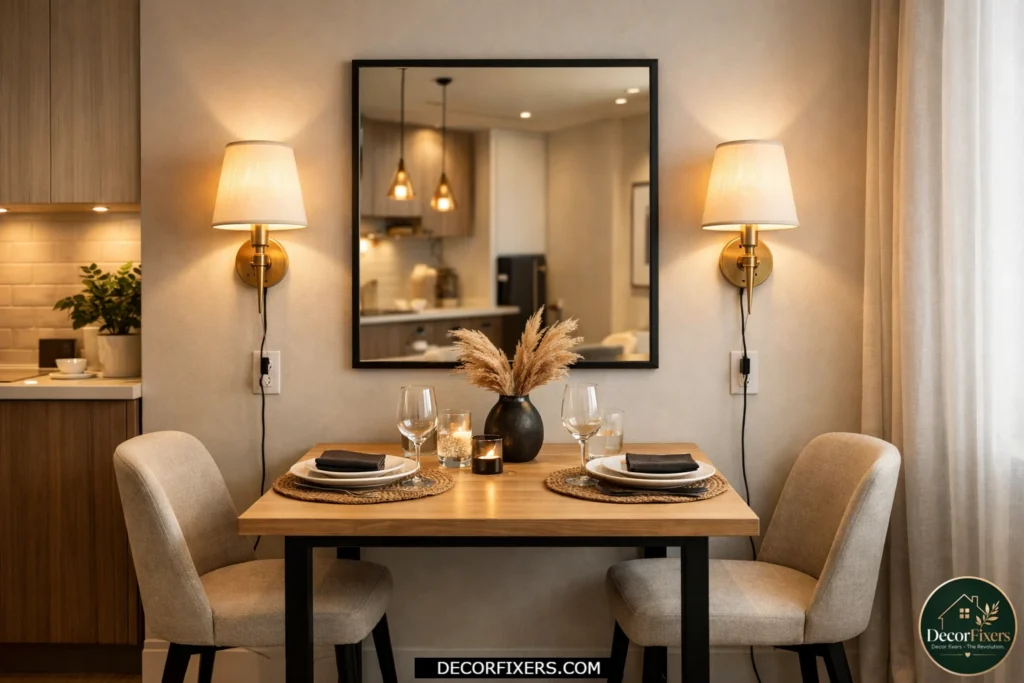
Table lamps on a sideboard or console take up precious surface area in a small dining room. Wall sconces give you the same warm, layered light effect without claiming an inch of floor or surface space.
Plug-in wall sconces (no electrician required) from Amazon or CB2 run $45–$180 per pair. Position them on either side of a mirror or the dining room’s accent wall for a symmetrical, hotel-lobby effect that looks considerably more expensive than it is. Warm bulbs only, cool white in a dining room feels clinical, not cozy.
27. Choose Multi-Functional Dining Furniture That Earns Its Space Twice Over
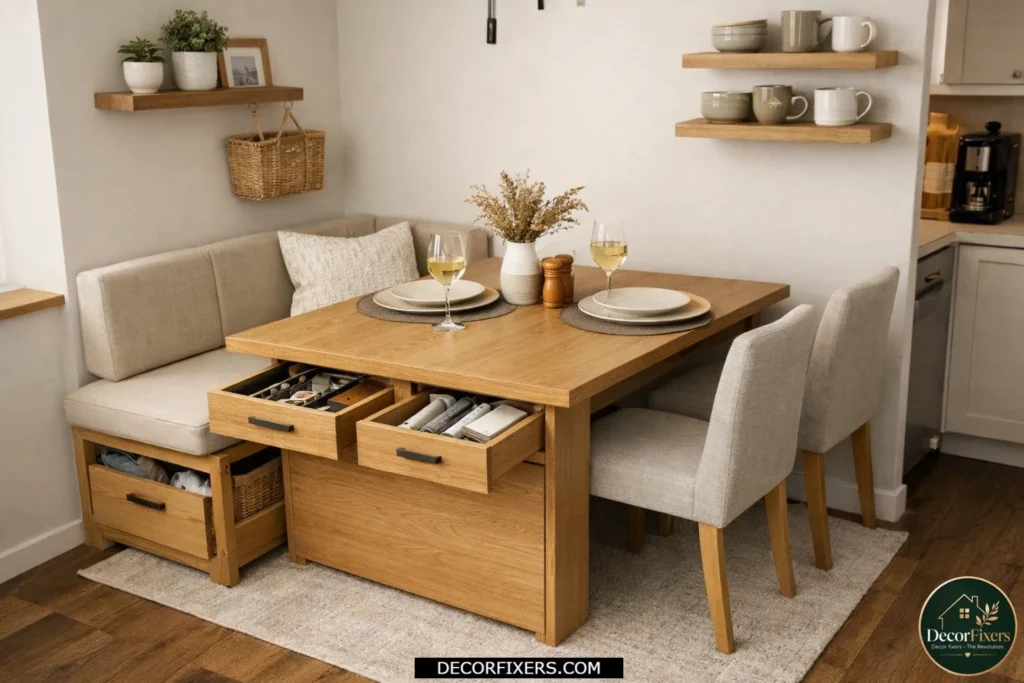
In a tiny dining room, every piece of furniture needs a reason to exist, and ideally, two reasons. A dining table with drawer storage, a bench with a hinged lid, or a sideboard that doubles as a bar cart all earn their square footage by serving multiple purposes simultaneously.
A dining table with built-in drawer storage from Pottery Barn or Crate & Barrel runs $699–$1,400. A storage bench with a hinged top from IKEA costs $149–$249. These aren’t luxury additions, they’re practical ones. Every item with two jobs means one fewer item needed. Fewer items means more open floor. More open floor means a room that feels bigger without changing size at all.
28. Style Your Table Setting Like a Restaurant to Elevate the Whole Room
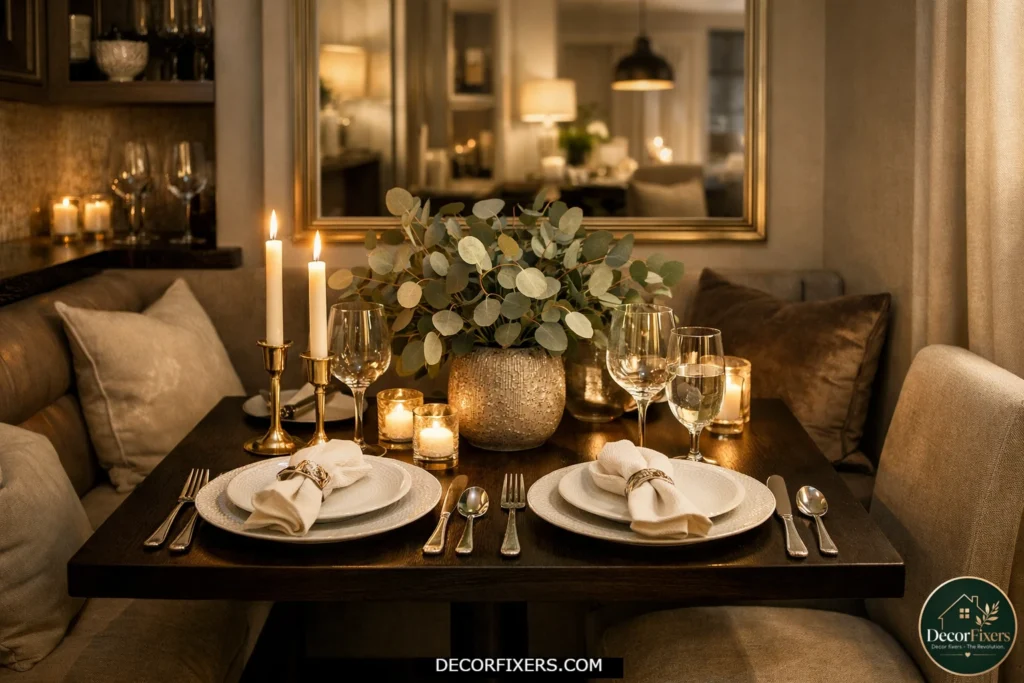
This one has nothing to do with furniture or layout, and it might be the most effective idea on this list. A beautiful, intentional table setting makes a small dining room feel curated and special, not cramped and apologetic.
Matching cloth napkins, a single bud vase with one stem of eucalyptus, and a set of consistent tableware transform the whole energy of a tiny dining room. A set of four linen napkins from H&M Home costs $25–$40. A simple ceramic bud vase from Target runs $12–$20. A matching four-piece dinnerware set from IKEA or Crate & Barrel costs $40–$150. Altogether, under $210, and the room feels like somewhere worth sitting down in.
That’s the real goal, isn’t it? Not a bigger room. A room worth staying in.
| How to Make a Tiny Dining Room Feel Bigger: 1. Replace your current table with a round or extendable option sized for the room. 2. Swap heavy chairs for slim-profile or acrylic/ghost chairs. 3. Add a large mirror opposite the main light source. 4. Hang a pendant light 28–32 inches above the table to define the zone. 5. Layer a rug 5×7 minimum under the table to anchor the space. 6. Use floating shelves or sconces to move storage and light off the floor. |
CONCLUSION:
I’ve spent a lot of time in small dining rooms, my own, and the ones I’ve helped others rethink. The ones that work aren’t the ones with the most tricks. They’re the ones where someone made a few smart choices deliberately, instead of filling the space with whatever fit.
Start with the table. Get the scale right. Add one light source that does something beautiful. Then layer in the details, a mirror, a rug, a plant, a really good table setting, until the room feels like yours.
You don’t need $2,500 to make this work. You need the right ideas applied in the right order. These 28 are a solid place to start.
This guide covers renter-friendly and low-renovation ideas for dining rooms under 150 square feet. It does not address commercial dining design or rooms requiring major structural changes.
FAQs:
| Question: | Answer: |
| What’s the best table shape for a tiny dining room? | A round table is best for rooms under 100 sq ft. No sharp corners mean better traffic flow, and the space feels less blocked. |
| How do I make my small dining room look bigger on a budget? | Use a mirror, hang curtains at ceiling height, swap solid chairs for slim or acrylic ones, and keep the floor as clear as possible. Total cost: under $200. |
| Should I use a rug in a small dining room? | Yes, but size up. A 5×7 is the minimum for a four-person table. Too-small rugs make the room feel more cramped, not less. |
| Why does my small dining room feel cramped even after decorating? | Usually, because the table is too large for the space, or the chairs are too bulky. Right-sizing the table is almost always the first fix needed. |
| When should I consider a wall-mounted dining table? | When your dining area is under 60 square feet, or you need the floor space entirely clear between meals. Wall-mounted tables work best for one to two diners daily. |

Creator of DecorFixers, sharing practical home and interior ideas focused on real-life usability, simple design improvements, and budget-friendly solutions.
3 thoughts on “28 Tiny Dining Room Ideas for Small Spaces That Feel Expensive”