

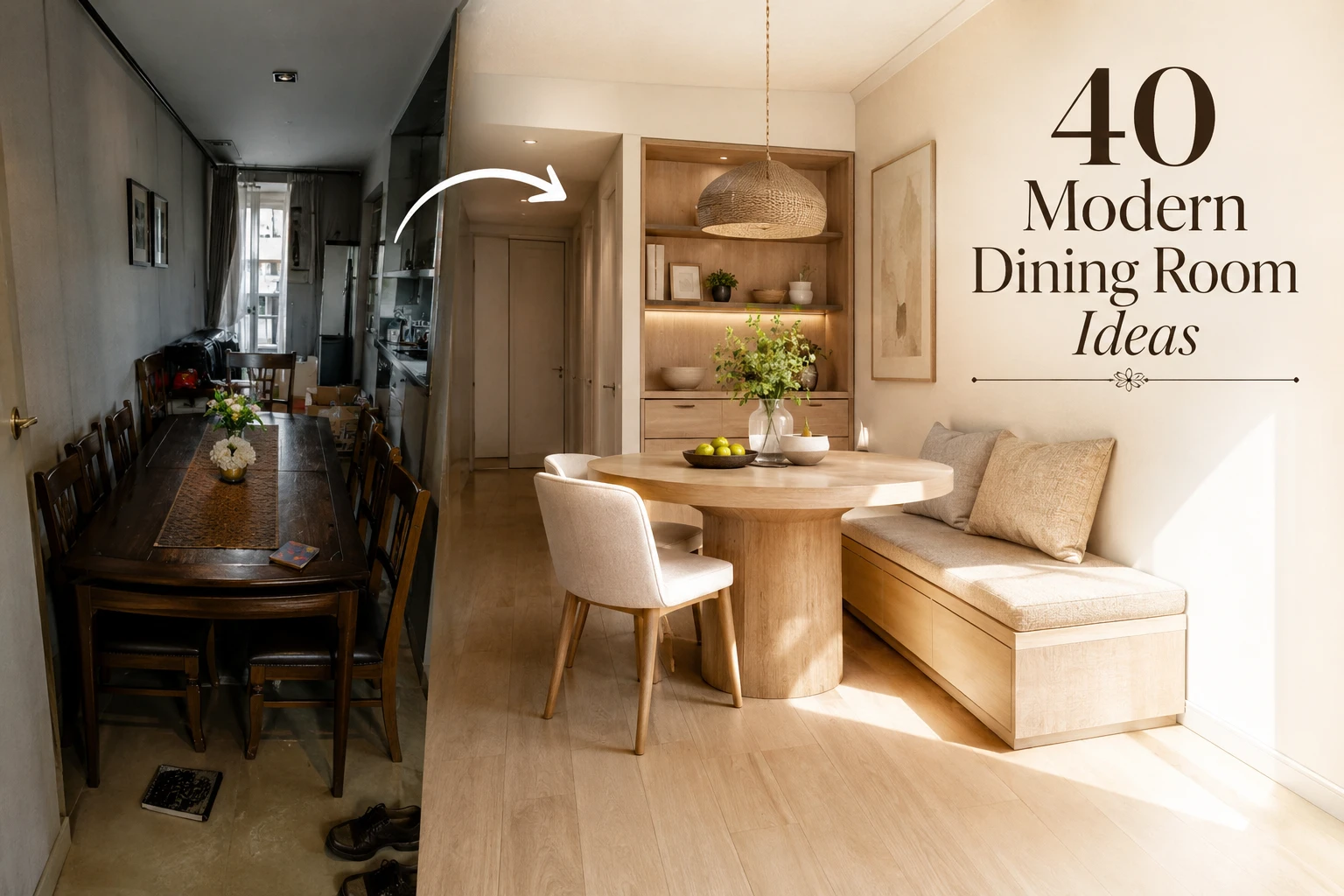
I’ll be honest with you. The first dining table I ever bought for my apartment was a complete disaster.
It was a gorgeous six-seater rectangular set, blonde wood, black hairpin legs, the kind that looks great on Instagram. I got it delivered, wrestled it through the door of my 650-square-foot apartment, and the moment all four chairs were in place, I had exactly 11 inches of walking space on either side. Eleven inches. My cat couldn’t walk past it without turning sideways.
I sat down on the floor and stared at it for a long time.
What follows are 40 real, tested, designer-approved modern dining room ideas for small spaces, from rules nobody tells you, to lighting tricks that literally make a room look wider, to the open-concept zone strategies that make a studio feel. Stick with it. By idea #10, you’ll already have three things you can do this weekend.
| What Are Modern Dining Room Ideas for Small Spaces? Modern dining room ideas for small spaces are design strategies that combine space-efficient furniture, optical illusion techniques, and smart layouts to make compact dining areas feel intentional, stylish, and functional. They typically focus on right-sized furniture, reflective surfaces, vertical space use, and multifunctional pieces, all without sacrificing a modern aesthetic. |
The good news? Every single one of the 40 ideas below was chosen specifically because it works in spaces where standard rules break down. This guide covers dining rooms from 60 to 150 square feet. It does NOT address large open-plan homes where space is not the primary constraint.
1. Switch to a Round Table, Immediately
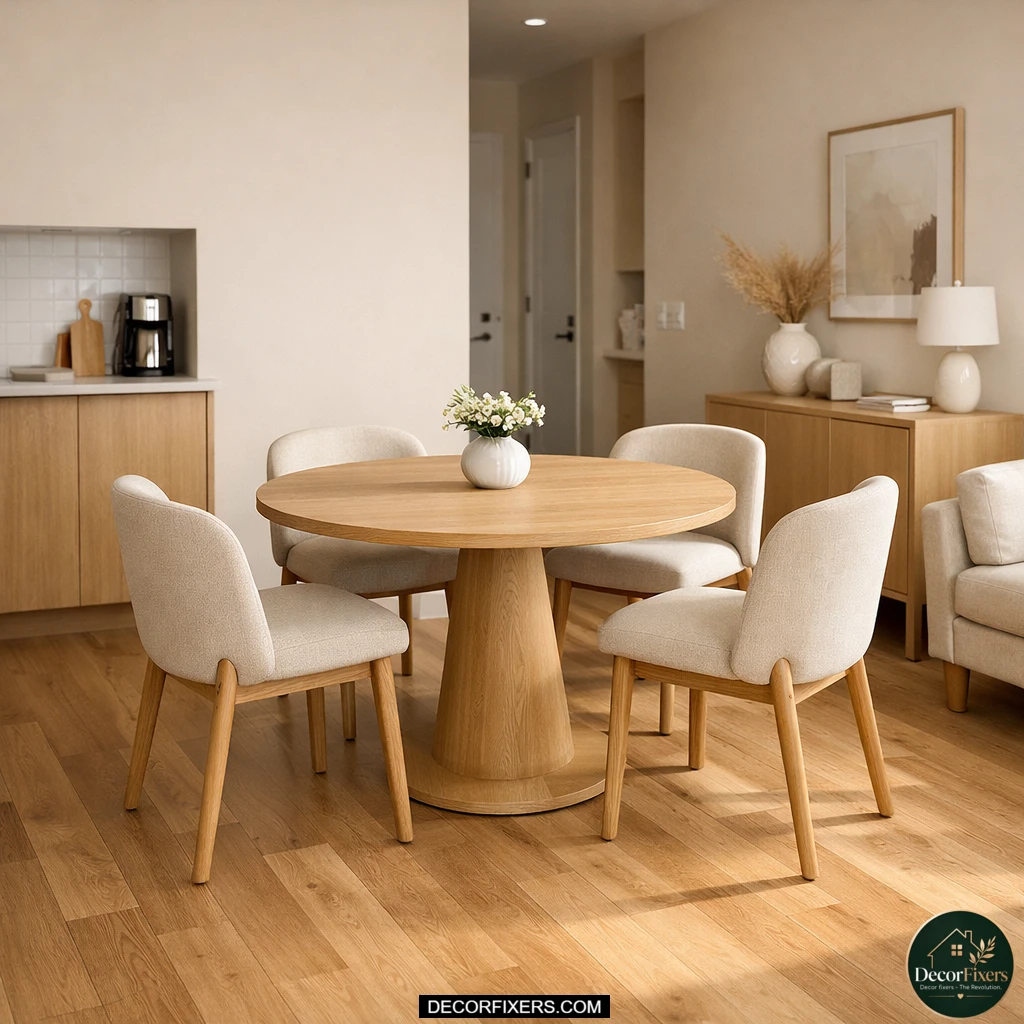
This is the single highest-impact swap you can make. A round table with a 36″ diameter seats four people comfortably and eliminates the dead corner space that kills rectangular tables in tight rooms.
There are no corners jutting into walkways. There’s no “bad seat” that faces a wall 8 inches from someone’s nose.
Round tables also encourage conversation in a way rectangular ones don’t; the geometry forces everyone to face each other. Interior designers have known this for decades; it’s just that most furniture stores don’t push it because rectangular sets are easier to photograph.
Look, if you’re in a dining area under 100 square feet, a round table isn’t just a preference. It’s the correct answer.
2. Go Pedestal Base, Not Four-Leg
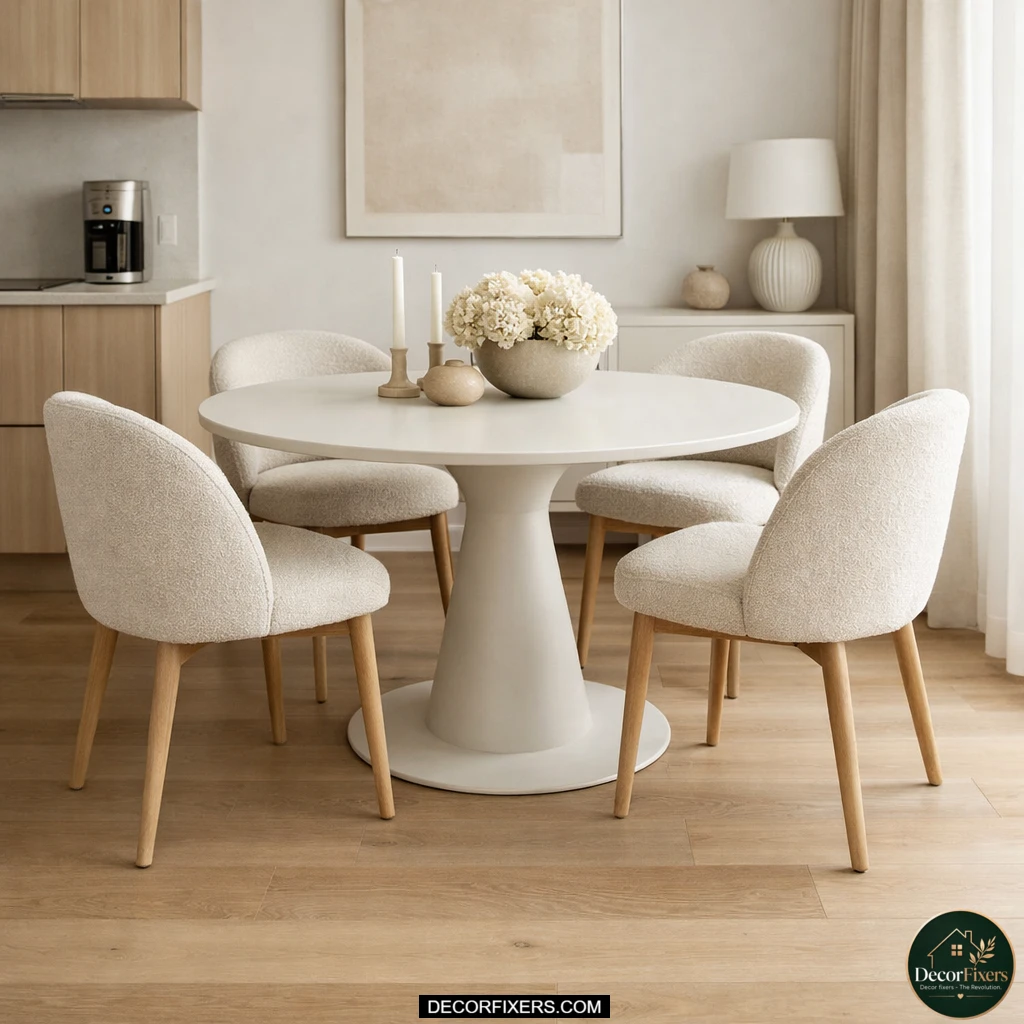
Four-legged tables have four corners. In a small room, those corners are obstacles, shin-catchers, chair-blockers, and visual clutter. A pedestal base concentrates all the structural support in one central column, which means the floor around the table stays visually open and physically clear.
West Elm’s Mid-Century pedestal round table has become a small-space standard for exactly this reason. The base is narrow, the top floats, and the whole piece reads as lighter than its actual footprint.
One caveat: some pedestal bases wobble under heavy use. Lean on it in the showroom before you commit.
3. Choose a Drop-Leaf or Extendable Table
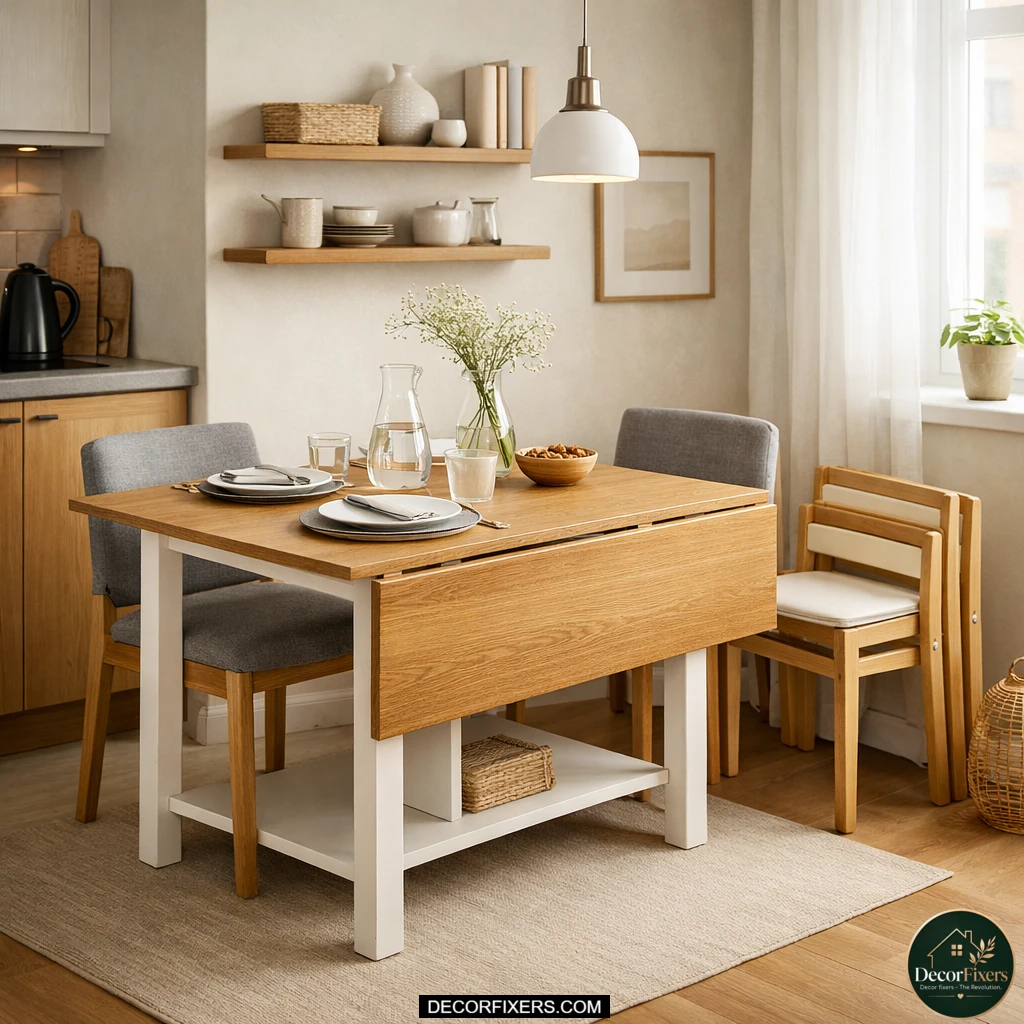
A drop-leaf table is one of the few pieces of furniture that genuinely earns its floor space in a small home. Every day it sits at its minimum footprint, sometimes as narrow as 12 inches when fully folded, and then expands when guests arrive.
The IKEA BJURSTA extendable dining table is the benchmark here. It extends from 35″ to 61″ and back again in under 20 seconds.
Hundreds of thousands of small-apartment dwellers have used it. It’s not glamorous, but it works with a reliability that more expensive options can’t always match.
Pair it with stackable chairs or a bench that slides fully under the table when not in use, and you’ve essentially created a dining room that can disappear.
4. Install a Wall-Mounted Fold-Down Table
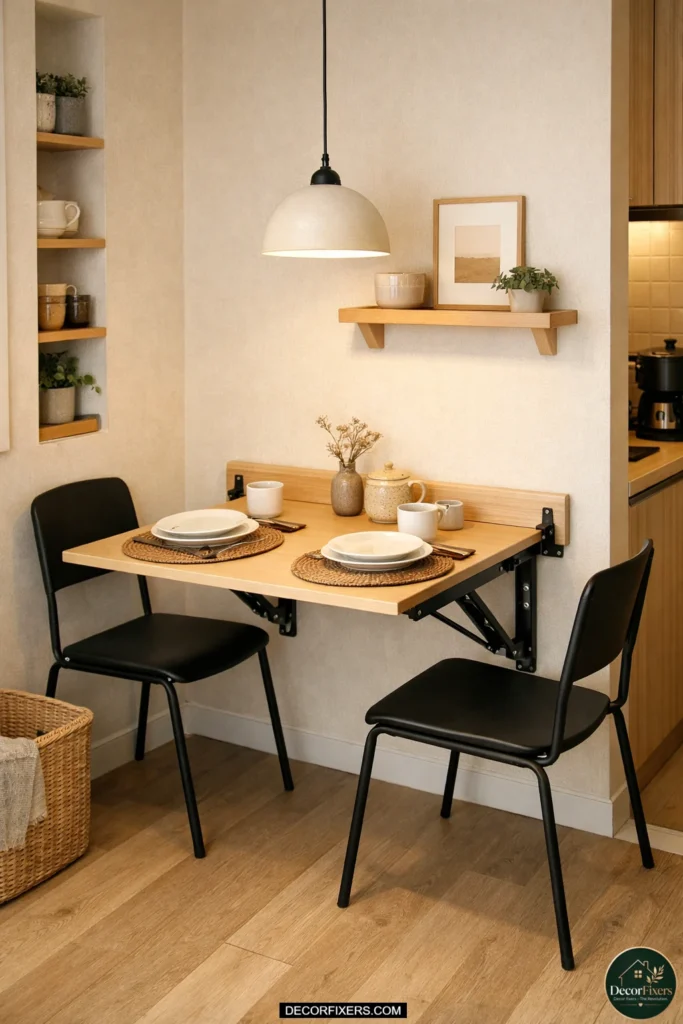
For the truly micro dining situation, a studio apartment, a narrow galley space, a dining area that’s really just a wide hallway, a wall-mounted fold-down table is the answer. When closed, it’s 4 inches off the wall.
When open, it becomes a full dining surface for two. This is the idea most articles skip because it sounds too extreme. It isn’t. It’s just honest about what the space actually needs.
5. Use a Dining Bench on One Side
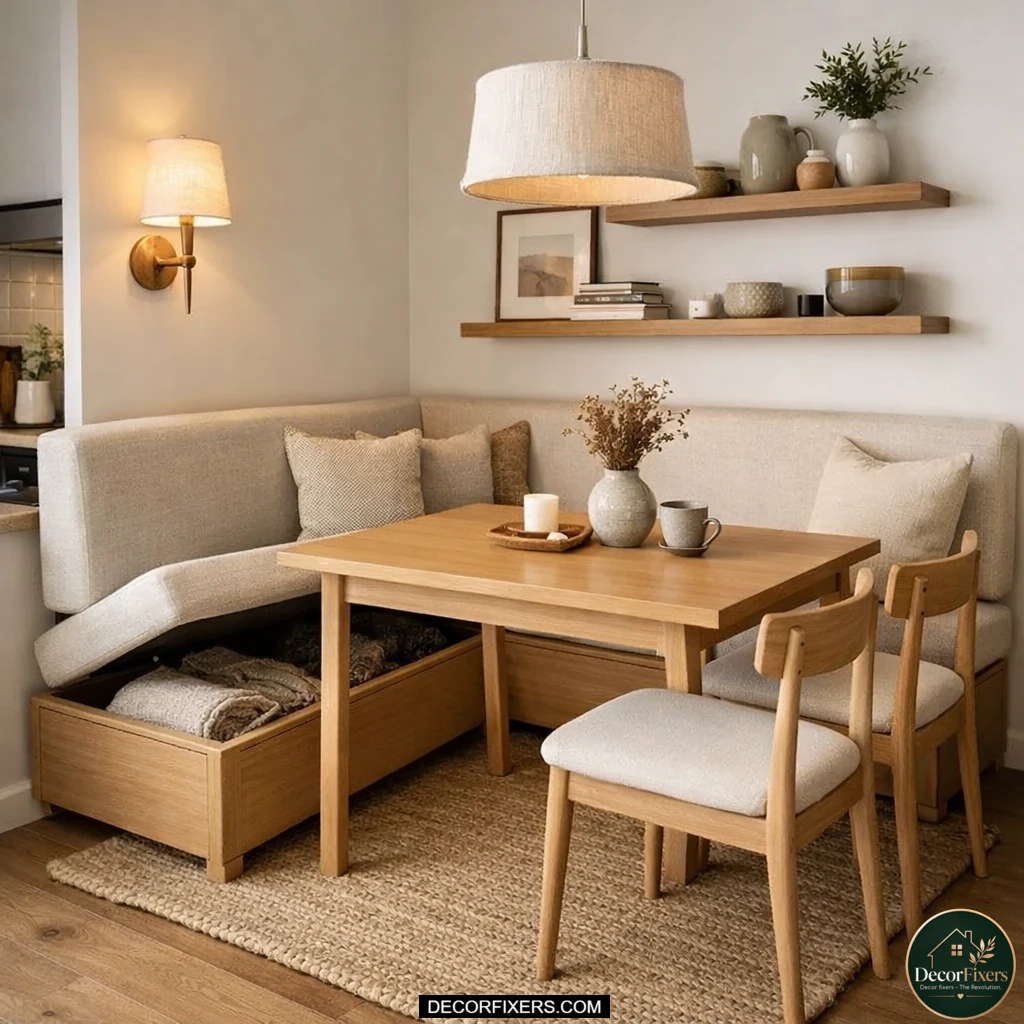
A bench on the wall side of your dining table does three things simultaneously: it seats more people per linear foot than chairs do, it can include hidden storage underneath, and it removes the chair-clearance problem on one side of the table entirely.
Article’s Seno dining bench is built exactly for this use case; it fits flush against a wall, has a clean, modern profile, and the seat doubles as storage for tablecloths, seasonal items, or anything you need out of sight. Push it under the table when not in use, and you reclaim 12 to 18 inches of floor space instantly.
6. Try Stackable or Folding Chairs
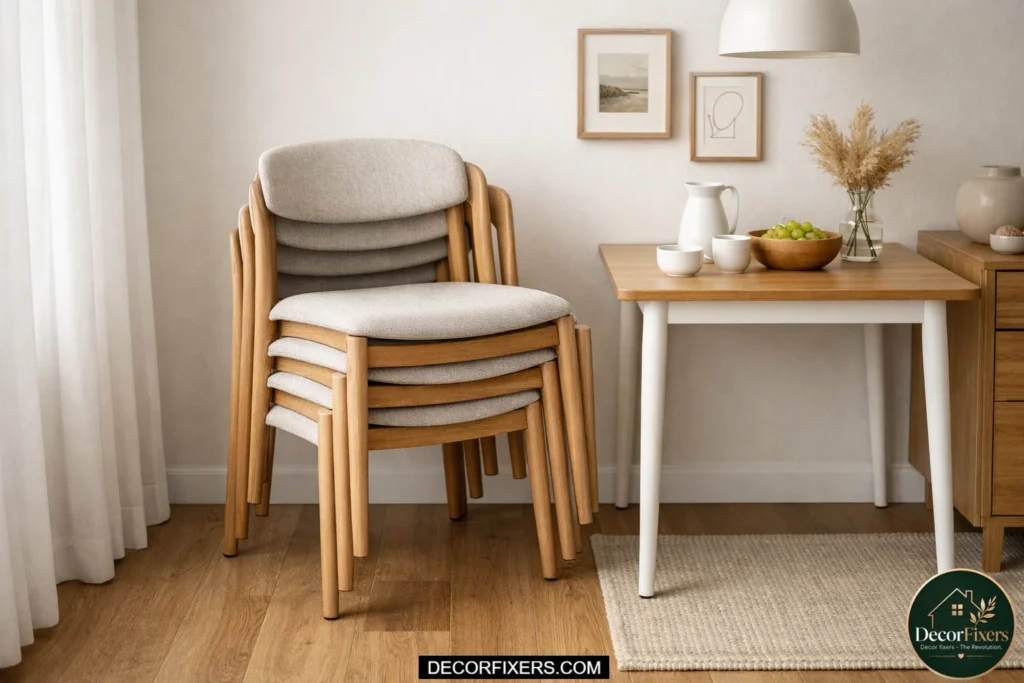
Standard dining chairs need about 18 inches of clearance behind them to be pulled out comfortably. In a room where every inch is strategic, that’s a significant tax on your space budget.
Stackable chairs, kept in a closet or against a wall, eliminate that tax entirely when you’re not hosting.
The objection I hear: “But they look cheap.” That’s a 2005 problem. The current market has stackable chairs in powder-coated steel, solid beech, and molded polypropylene that look genuinely sophisticated.
HAY’s About A Chair series, for one, is a benchmark of Scandinavian design and stacks four high.
7. Scale Every Piece to the Room, Not to a Showroom
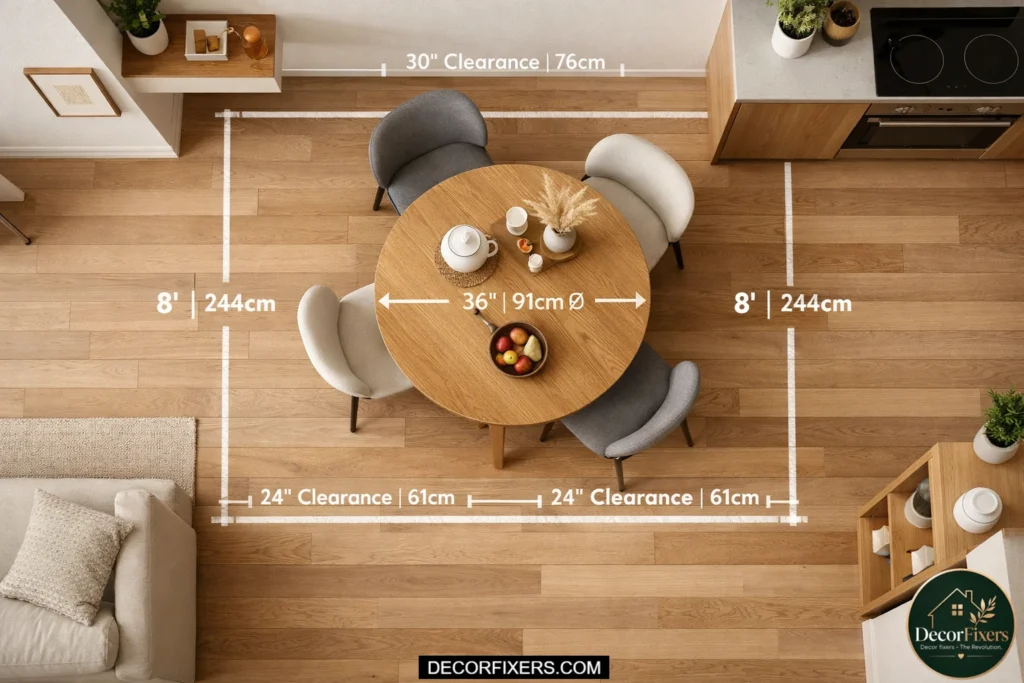
This is the rule that professionals apply first, and homeowners apply last, usually after one expensive mistake.
Before buying any dining furniture, you need three numbers: the room’s length, the room’s width, and the minimum clearance you can live with (36 inches is functional; 42-48 inches is comfortable; 30 inches is survivable but not ideal).
| How to Measure Your Small Dining Space Before Buying Anything 1. Measure room length and width at floor level. 2. Subtract 36″ from each wall for minimum chair clearance. 3. The remaining rectangle is your maximum table footprint. 4. Choose a table at least 10% smaller than that footprint. 5. Tape the table shape on your floor before ordering, every time. |
8. Try Transparent Furniture, Ghost Chairs, and Glass Tables
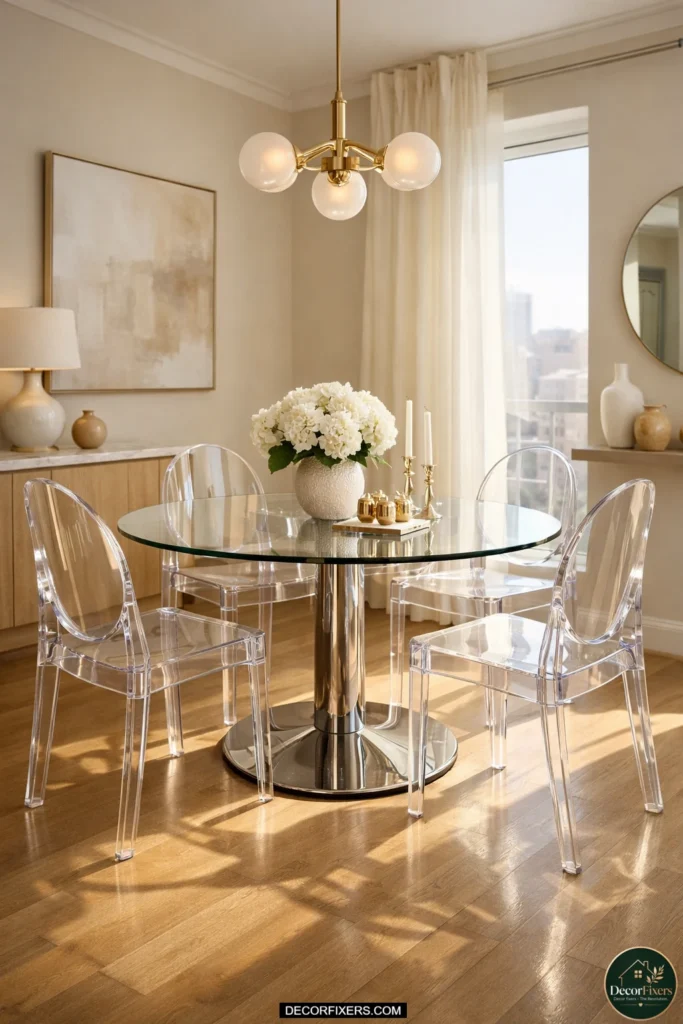
The human eye sees a chair or table as occupying space. A transparent version of the same piece, a polycarbonate ghost chair, and a glass-top table read as lighter, and the visual mass of the room drops significantly. This isn’t magic. It’s optics.
Kartell’s Louis Ghost Chair has been in continuous production since 2002 for a reason: it works in small spaces better than almost anything else at its size. A glass dining table with a pedestal base is the small-room formula that never goes out of style.
9. Choose Furniture With Exposed Legs
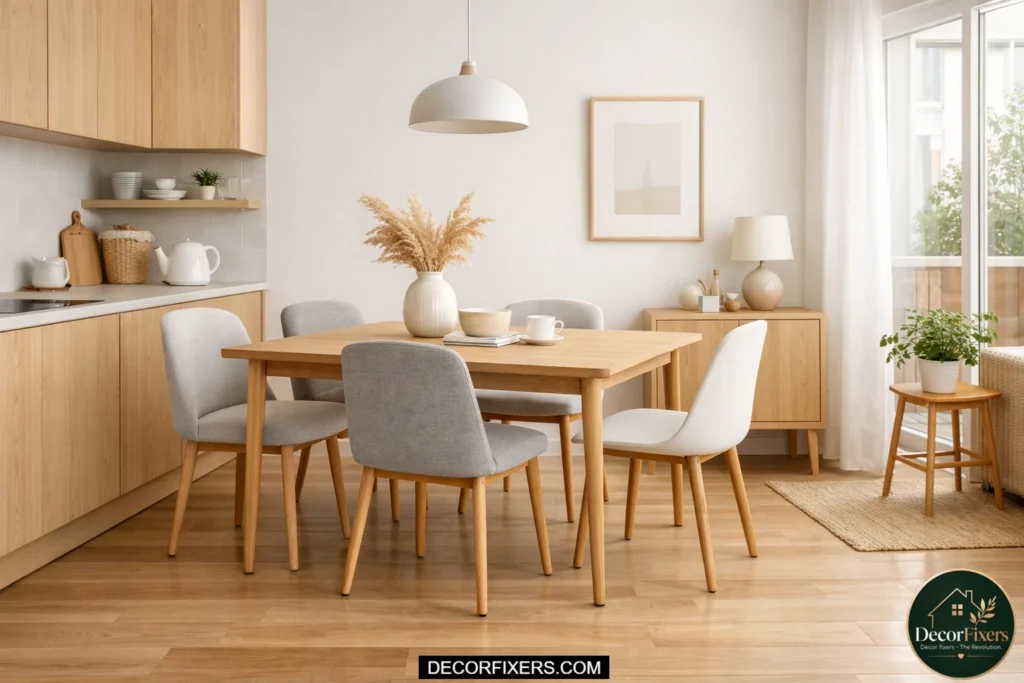
Furniture that sits on the floor, with a solid base, a skirt, or any opaque panel touching the floor, visually shrinks the room.
Furniture raised on legs allows the eye to see the floor underneath, which creates the perception of more space.
The rule: every piece in a small dining room should show floor beneath it. No exceptions.
10. Consider a Corner Banquette
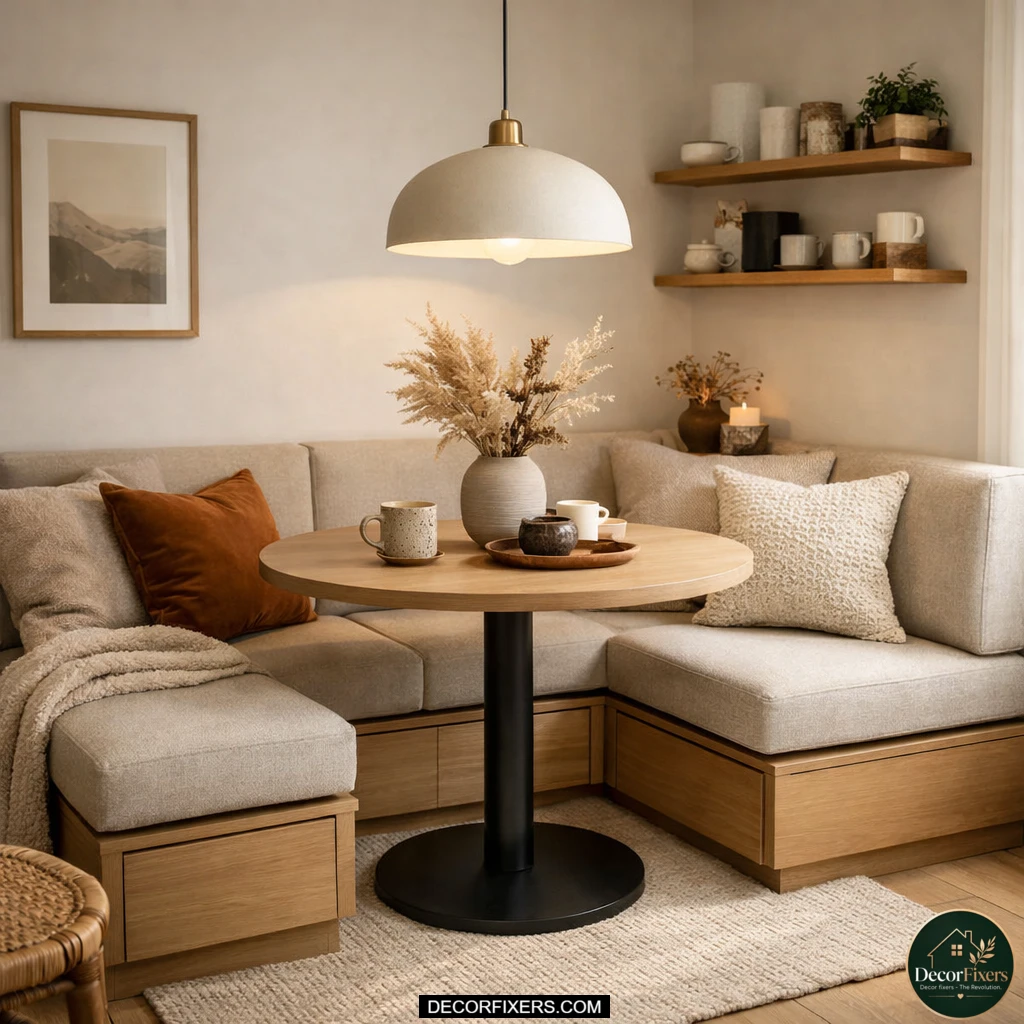
A built-in corner banquette, an L-shaped upholstered bench fitted into two walls of a corner, is one of the most space-efficient dining configurations that exists.
It presses seating completely against two walls, freeing the center of the room. It can be built with drawer storage below. It’s the reason diners and cafes have used the format for over a century.
It requires either a built-in installation or a careful search for modular sectional bench pieces that can be arranged in an L. Ikea’s HEMNES storage bench, arranged in an L-corner, approximates this at low cost.
Quick Comparison:
Not all small spaces are identical. Here’s a fast reference for the most common layouts.
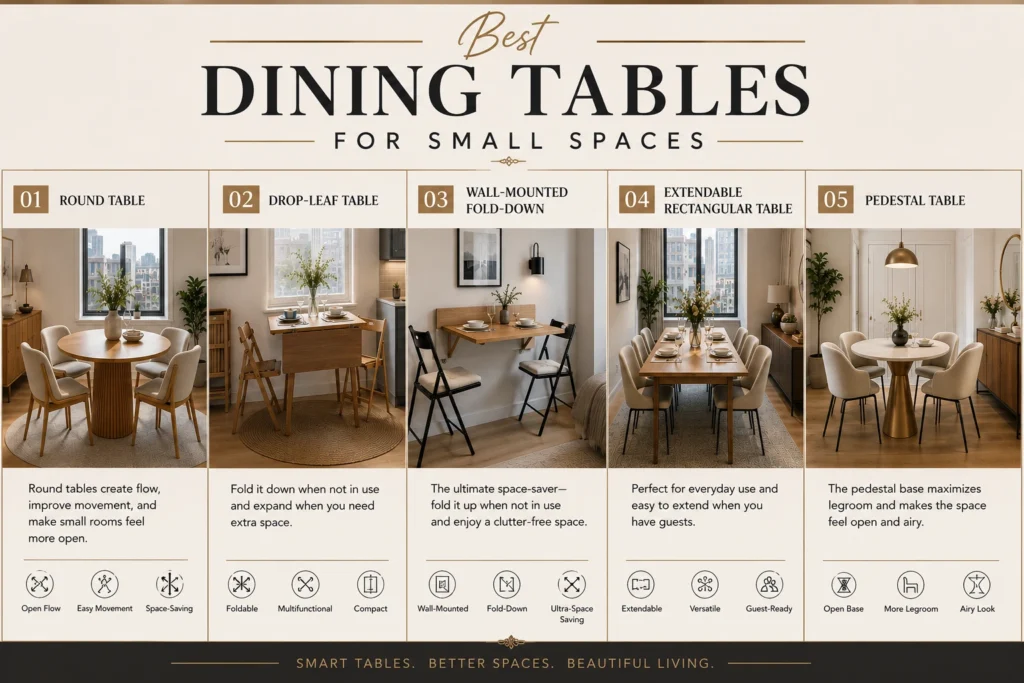
| Option | Best For | Key Benefit | Limitation |
| Round Table | Compact apartments | Saves 20% more floor space vs rect. | Max 4 seats comfortably |
| Drop-Leaf Table | Flexible households | Extends for guests, folds flat daily | Surface area is limited when folded |
| Wall-Mounted Fold-Down | Studio & micro apartments | Takes zero floor space when closed | Fixed to a wall location |
| Extendable Rect. Table | Growing families | Scales from 2 to 8 seats | Still bulky even at the minimum size |
| Pedestal Table | Design-forward spaces | No corner legs = easier movement | Can wobble under heavy use |
My honest read on this: I’ve seen conflicting recommendations, some sources say extendable rectangular tables are the most versatile, others argue a fixed round table is always the better small-space call.
The data I’ve seen from real apartment floor plans leans toward round or wall-mounted for spaces under 80 square feet, and drop-leaf rectangular for 80-130 square feet. Beyond 130 square feet, a compact extendable rectangular table works fine.
11. Define Your Zone With a Rug
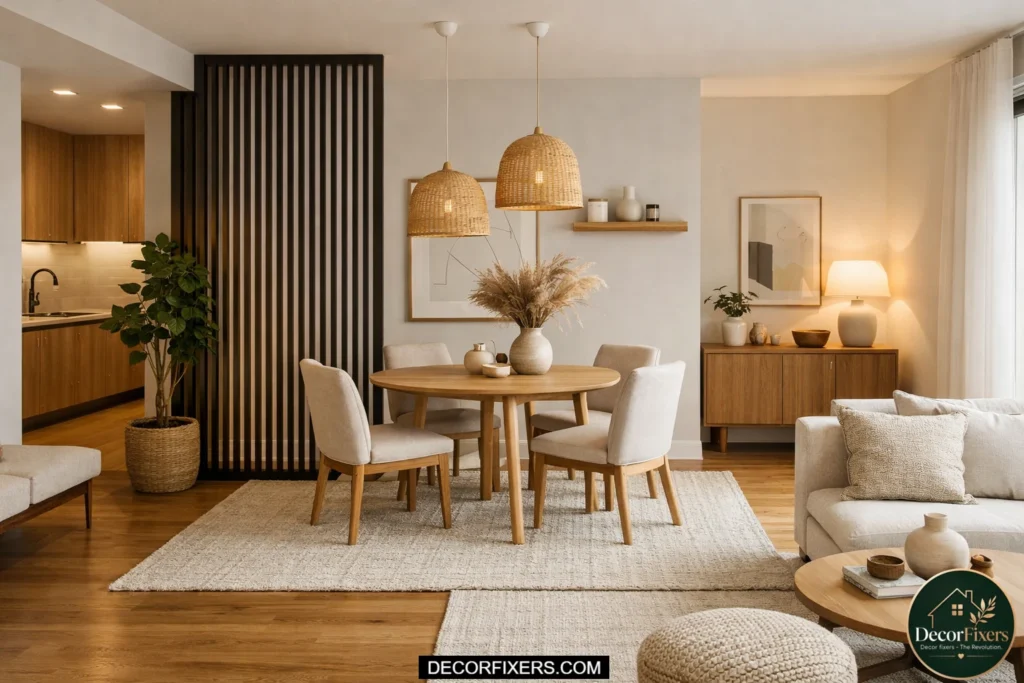
In an open-concept apartment, a rug is the cheapest, fastest way to create a visual dining room where none architecturally exists. It draws a boundary. It signals to the eye: this area has a different purpose.
The rug should be large enough that all chair legs land on it when chairs are pulled out, typically 8×10 feet for a four-person table. Go smaller, and the rug looks like it’s trying to escape from beneath the furniture.
12. Position the Table Against One Wall
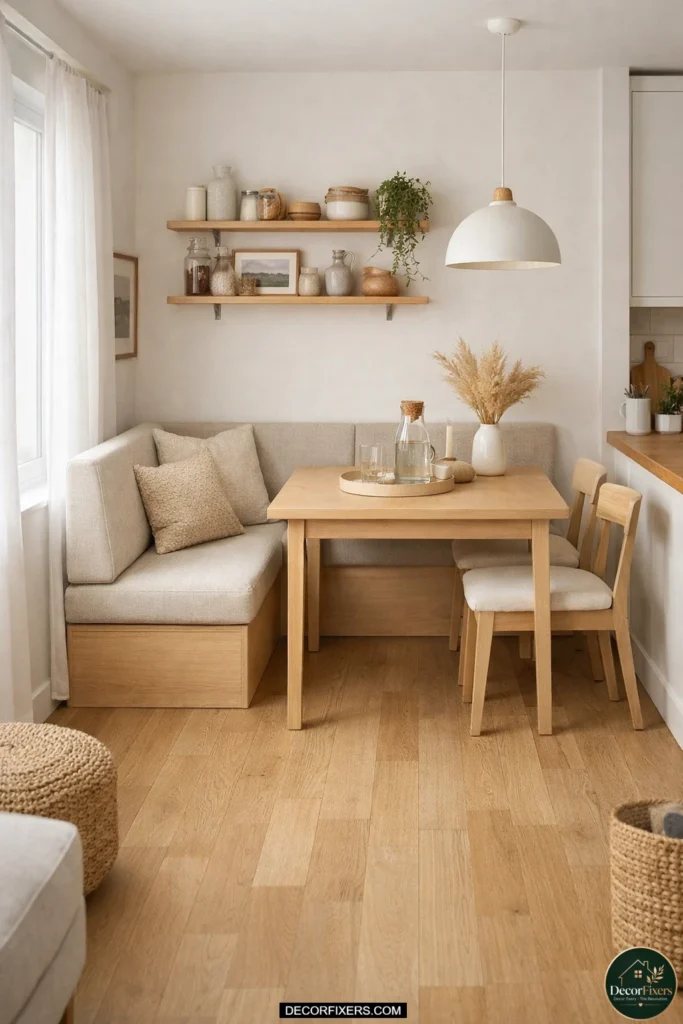
For rooms under 90 square feet, pushing the table against one wall and using bench seating on the wall side immediately gives you 18-24 inches of extra floor space on the room side.
You lose seating on the wall side only if you don’t use a bench; with a bench, you actually gain seating capacity while reducing the table’s effective footprint in the room.
13. Float the Table in the Center, For Larger Small Rooms
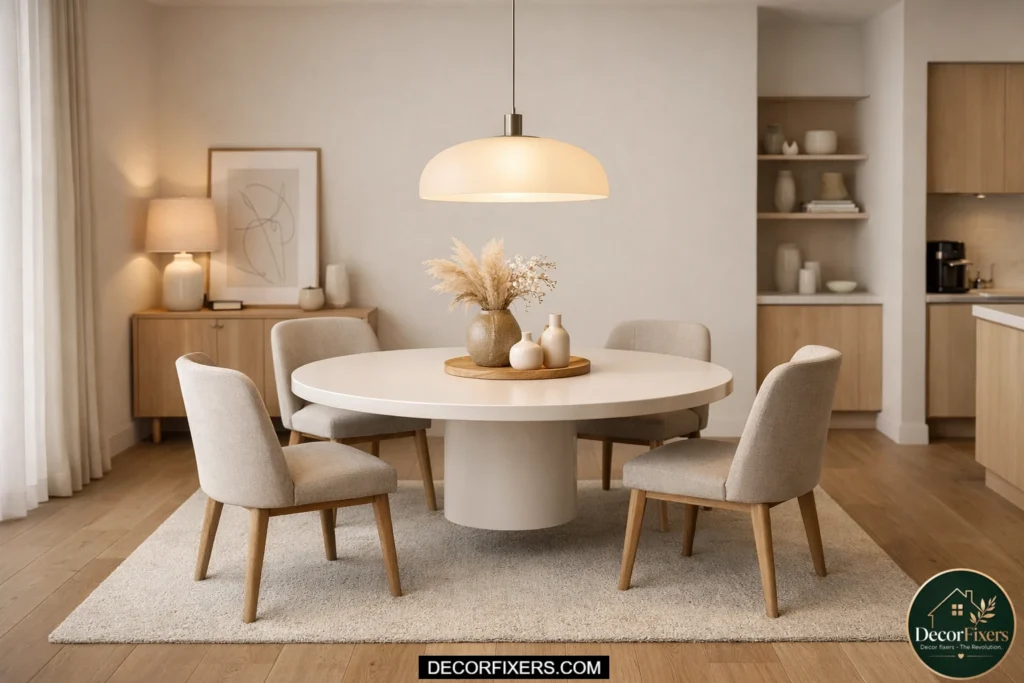
For rooms in the 120-150 square foot range, floating the table in the center (rather than pushing it against a wall) actually makes the room feel more intentional and designed. Walls-hugging furniture in a smaller room can look awkward, like the room doesn’t know what it is.
The clearance rule still applies: 36″ minimum on all sides, 42″ if you can get it.
14. Use Pendant Lighting to Anchor Your Zone
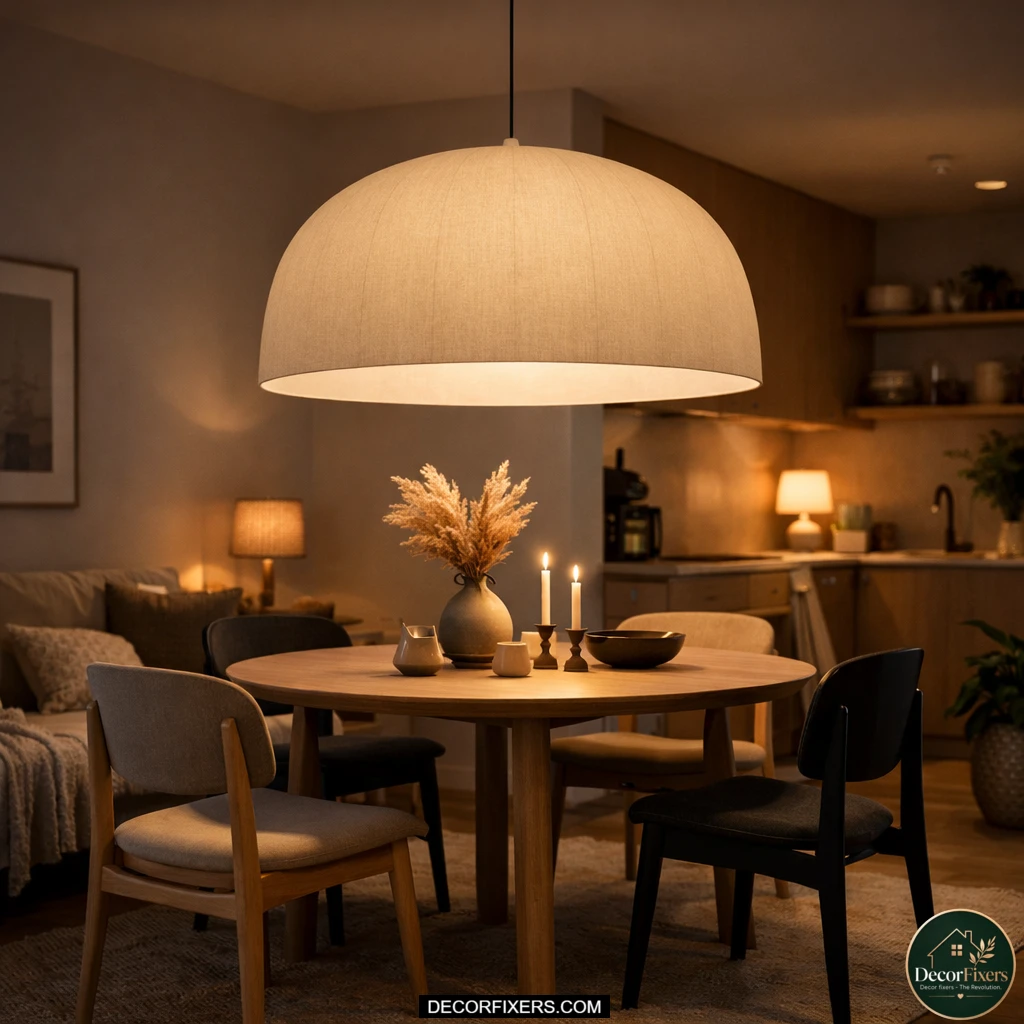
A pendant light hung directly over a dining table does something powerful: it tells anyone who walks into the room, “This is the dining area.” Even in a completely open-plan space with no walls to define a dining zone, the pendant light creates one.
The visual anchor is strong enough to work in a studio apartment where the dining table is 8 feet from the sofa.
Height matters: 30-36 inches above the table surface is the standard for a pendant over a dining table. Too high and it loses the anchoring effect. Too low and everyone ducks.
15. Create Visual Separation With a Partial Shelf Unit
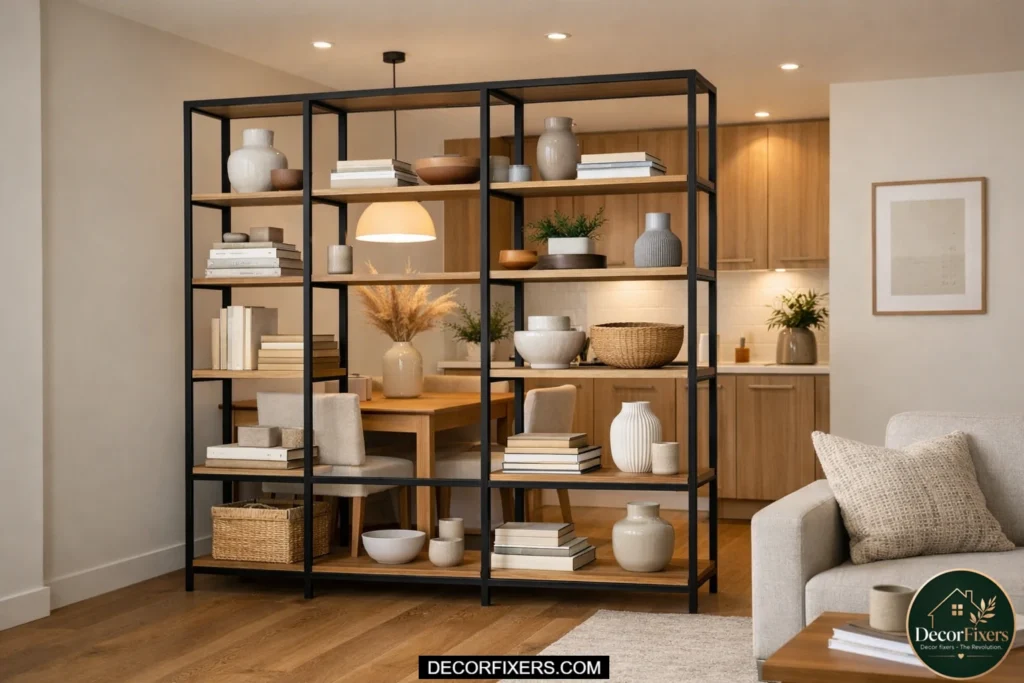
A bookcase or open shelving unit placed between a dining area and living area, not wall-to-wall but perhaps 60-70% of the width, creates a visual partition without closing off the space. It defines zones while keeping the open feel.
Bonus: it adds storage and display surface that a small apartment desperately needs.
16. Align Your Table With the Room’s Longest Axis
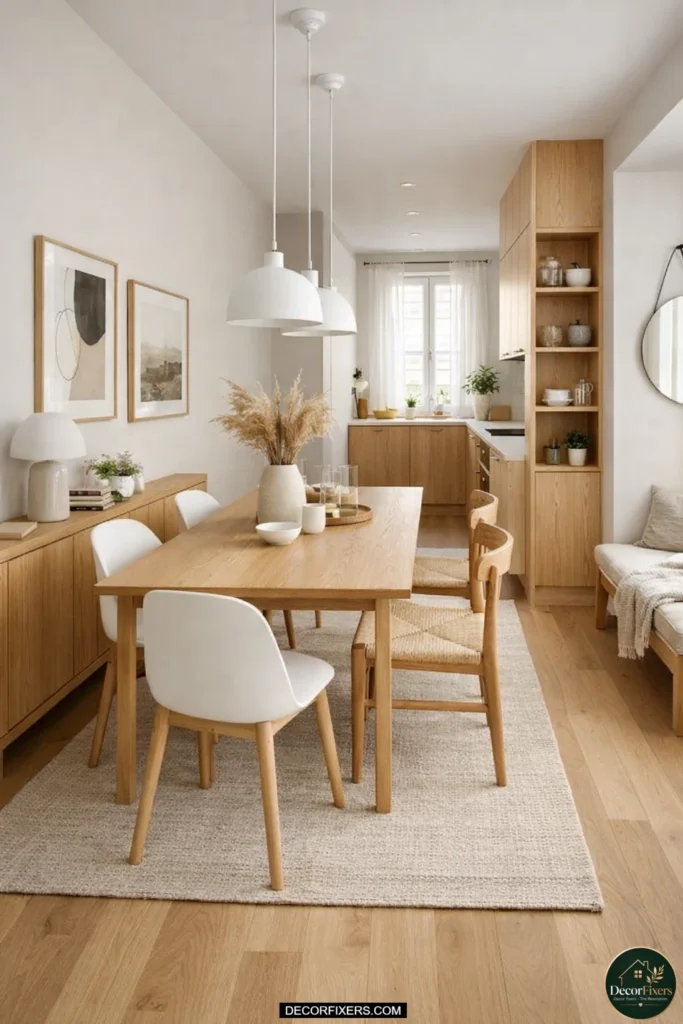
Most people instinctively center a table in a room regardless of its shape. In a narrow rectangular room, centering a rectangular table leaves very little clearance on the two long sides.
Rotating the table to run parallel to the room’s longest wall and pushing it toward one end can free up 30 to 40 percent more usable floor space. This one change can make the difference between a dining area that works and one that doesn’t.
17. Use the Kitchen Island as a Dining Table
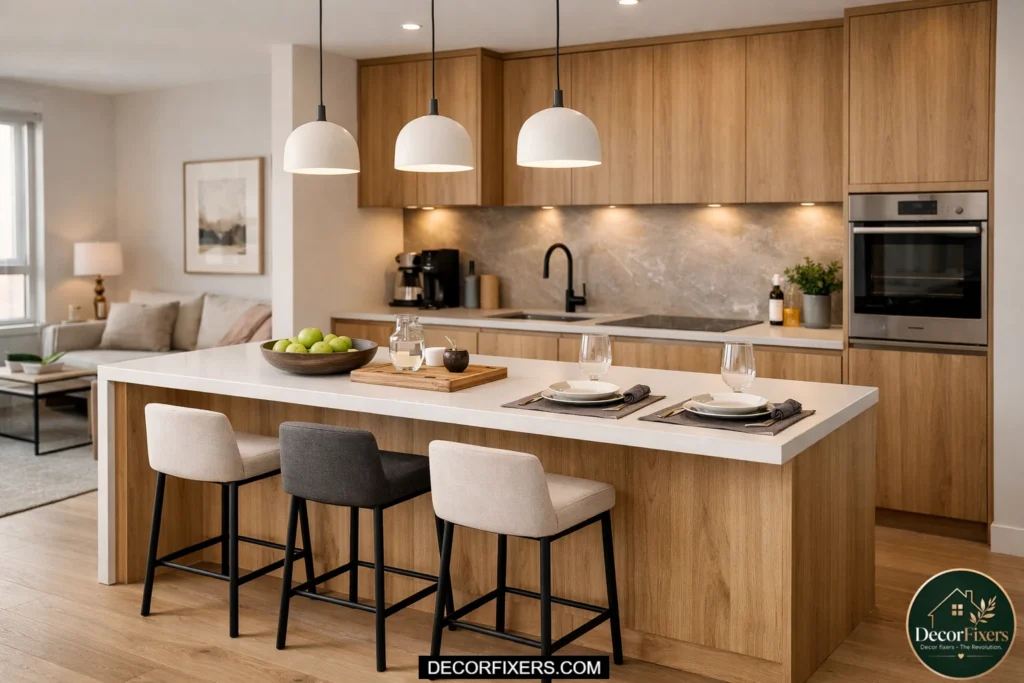
If your kitchen has or could have an island, this is the most space-efficient dining solution in existence: the island serves as prep surface, serving counter, and dining table.
Add counter-height stools on one side, and the dining function costs zero additional square footage.
This works beautifully in open-plan apartments. It doesn’t work in closed kitchens where the island would be isolated from the living/dining area.
18. Borrow Space From the Living Room, Strategically
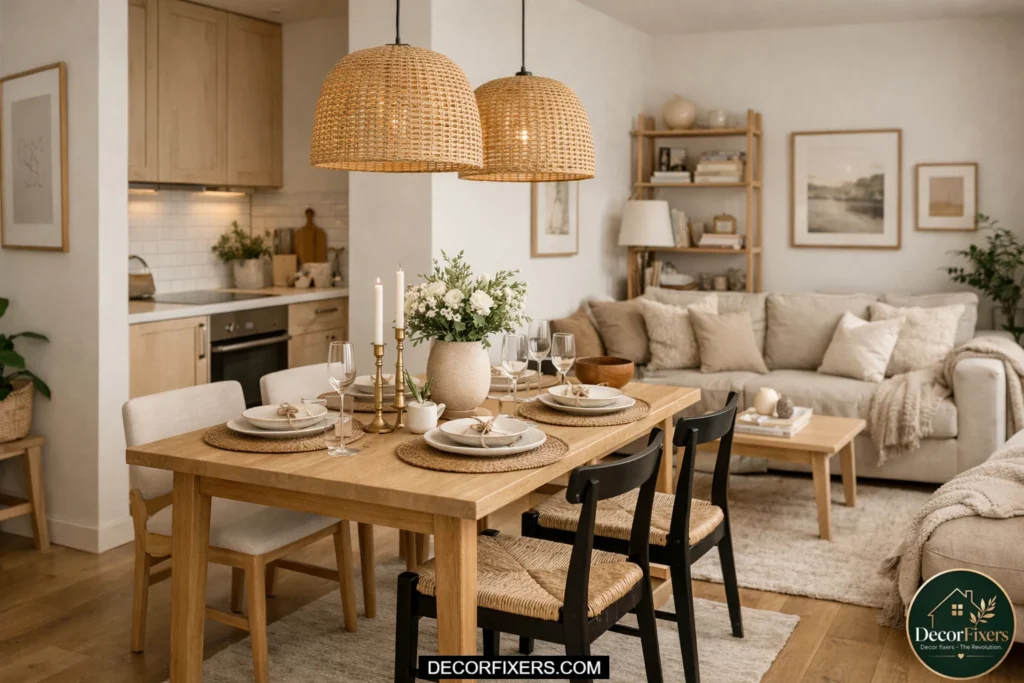
Here’s the thing: in apartments where the living and dining areas share one open room, you don’t have to accept the default proportions.
If you need more dining space, take it from the living area, push the sofa six inches toward the window, use a smaller coffee table, and arrange seating more tightly.
The living area will still function. The dining area will breathe.
19. Layer Three Types of Light
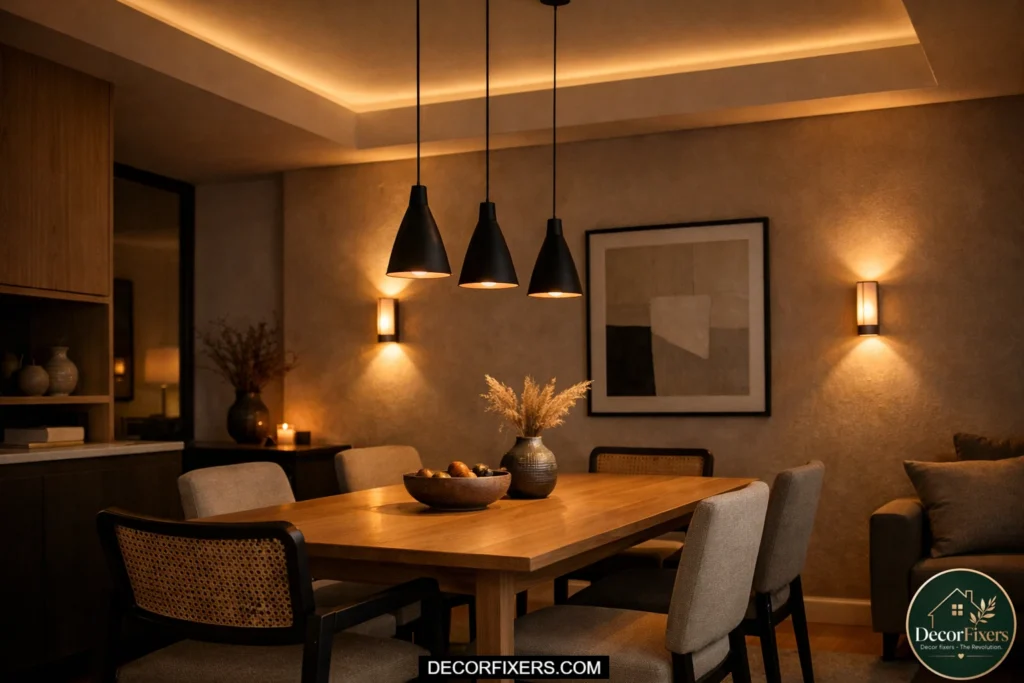
Professional designers use three lighting layers in every room: ambient (overall illumination), task (functional, directed light for the dining surface), and accent (decorative, mood-setting light).
Most small dining rooms have only ambient lighting, a single overhead fixture. Adding a pendant for task and a small wall sconce or LED strip for accent transforms the room’s atmosphere completely.
20. Install a Statement Pendant Light
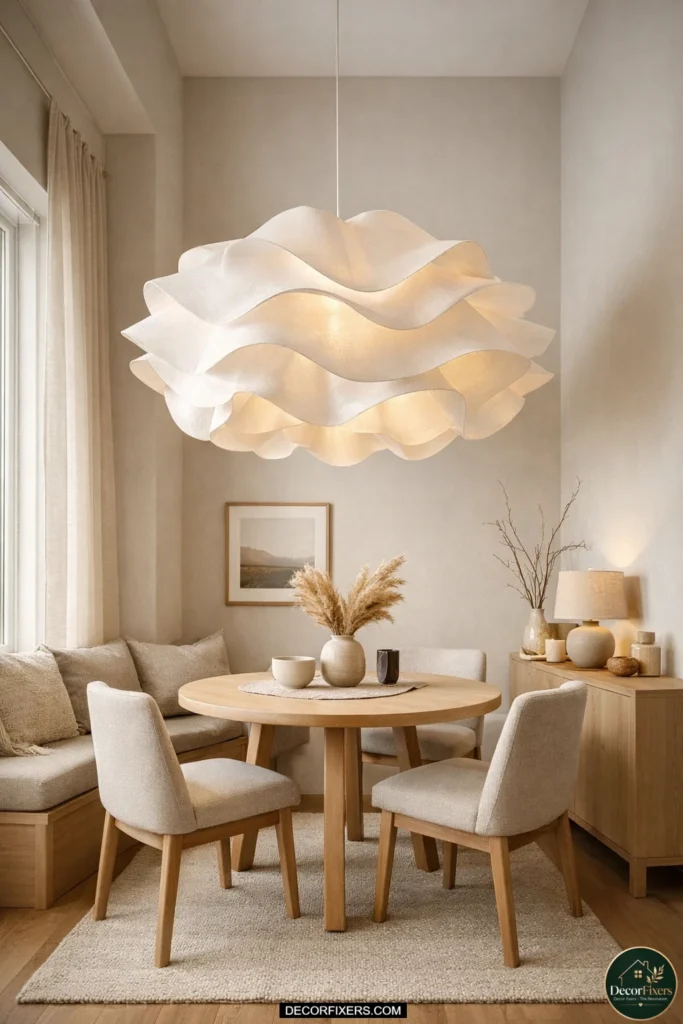
A bold pendant light over a small dining table is one of the most counterintuitive and effective small-space design moves.
It should feel slightly too large for the table; that visual tension draws the eye upward and makes the ceiling feel higher. Rattan pendants, sculptural matte black fixtures, and smoked glass globes are all strong choices for modern spaces.
21. Use Dimmable Lighting
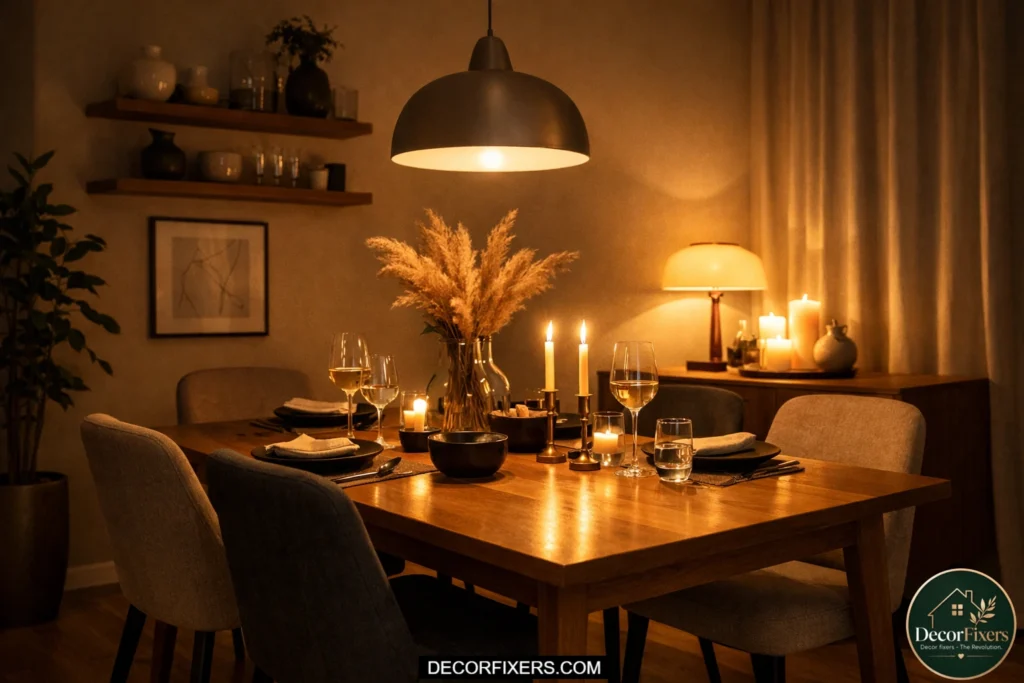
Bright, flat light makes a small room feel clinical and exposed. Dimmable lighting at 40-60% intensity creates warmth and depth; it makes the room feel intimate rather than cramped.
The investment is a smart dimmer switch, which costs under $30 and takes 20 minutes to install.
22. Add a Mirror Opposite the Window
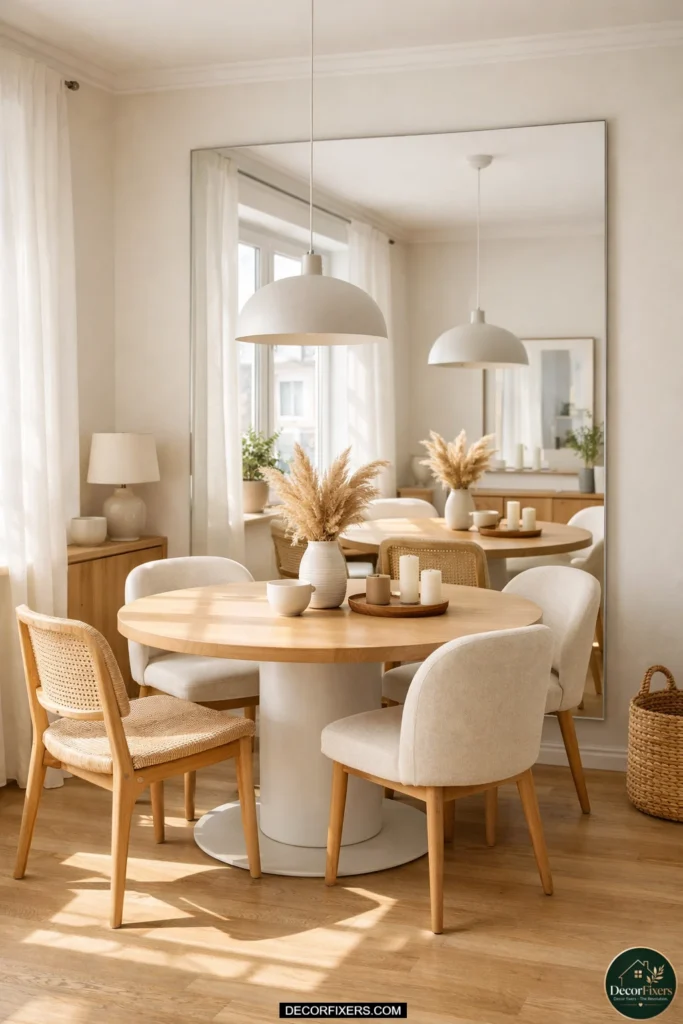
A mirror positioned to reflect natural light back into the room effectively doubles the perceived brightness of the space.
In a small dining room, a large rectangular mirror on the wall opposite the primary window does two things simultaneously: it bounces light deep into the room, and it creates the visual impression of a second space beyond the wall.
Or maybe I should say it this way: a mirror isn’t décor in a small room. It’s architecture.
23. Use Vertical Light Strips to Raise the Ceiling
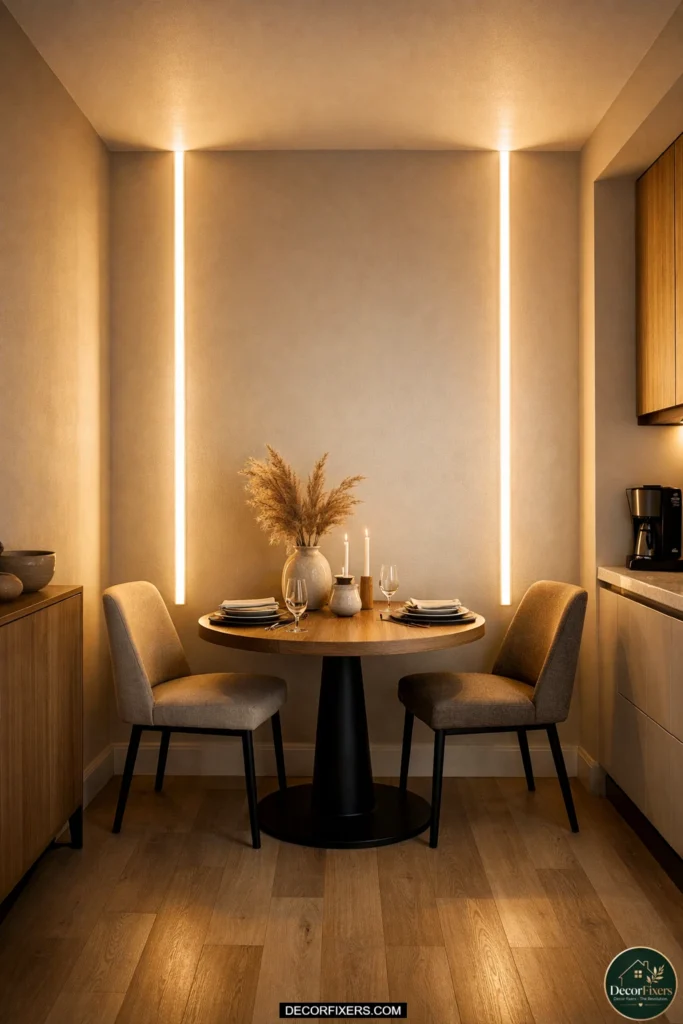
LED light strips installed vertically on walls, or picture lights mounted high and angled upward, draw the eye up the wall toward the ceiling.
This vertical visual travel makes the ceiling feel higher and the room taller. Cost: around $40 in LED strips. Impact: significant.
24. Go for Warm White Bulbs, Not Cool White
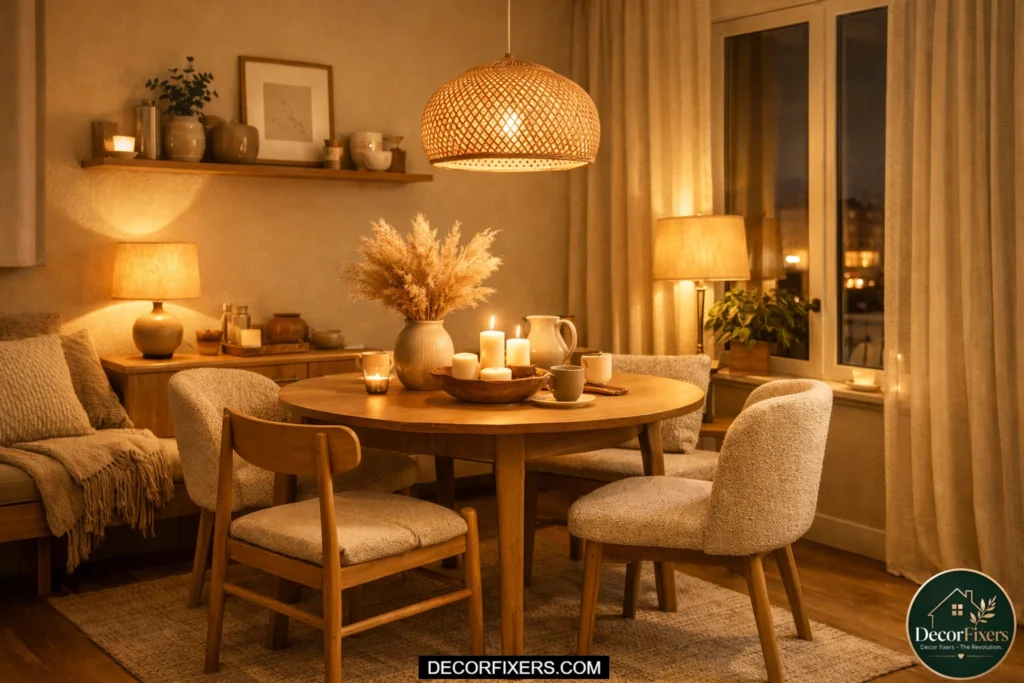
Cool white light (5000K+) reads as institutional. Warm white (2700-3000K) reads as residential and inviting.
In a small space where comfort is the goal, warm bulbs do measurable work; they soften edges, reduce the harshness of tight corners, and make the room feel like somewhere you want to linger.
25. Paint Walls and Trim the Same Color
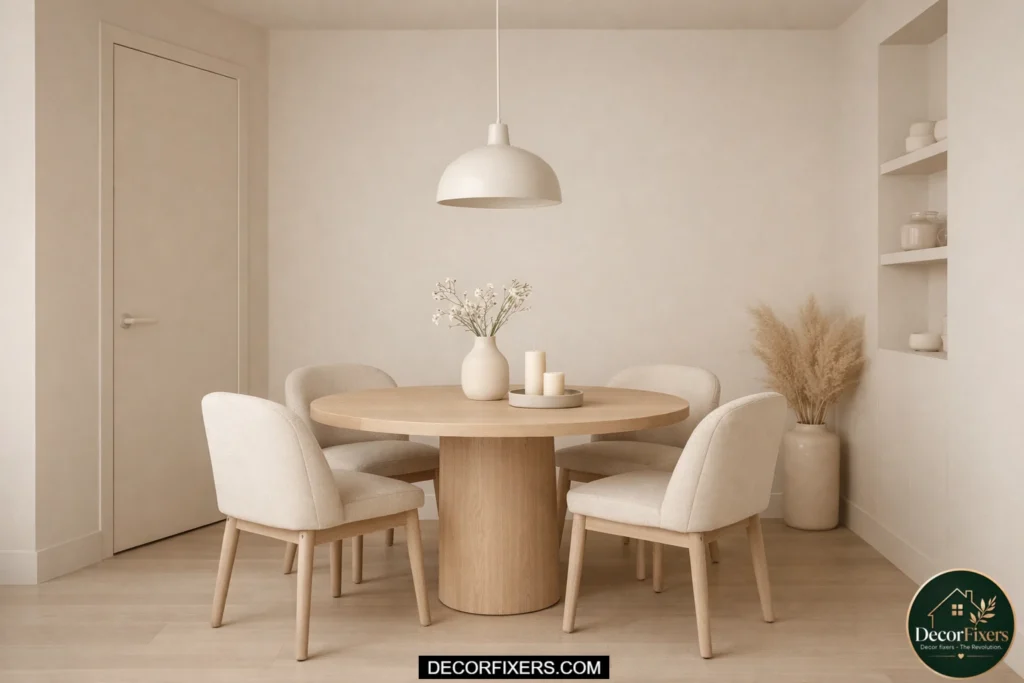
When walls, trim, and doors are all the same color, particularly in a neutral or light shade, the eye loses the visual boundaries that define the room’s edges.
The room reads as larger because the brain can’t easily identify where it ends. This is a designer trick used in small rooms worldwide. Same color, every surface.
26. Use an Accent Wall Instead of Four Painted Walls
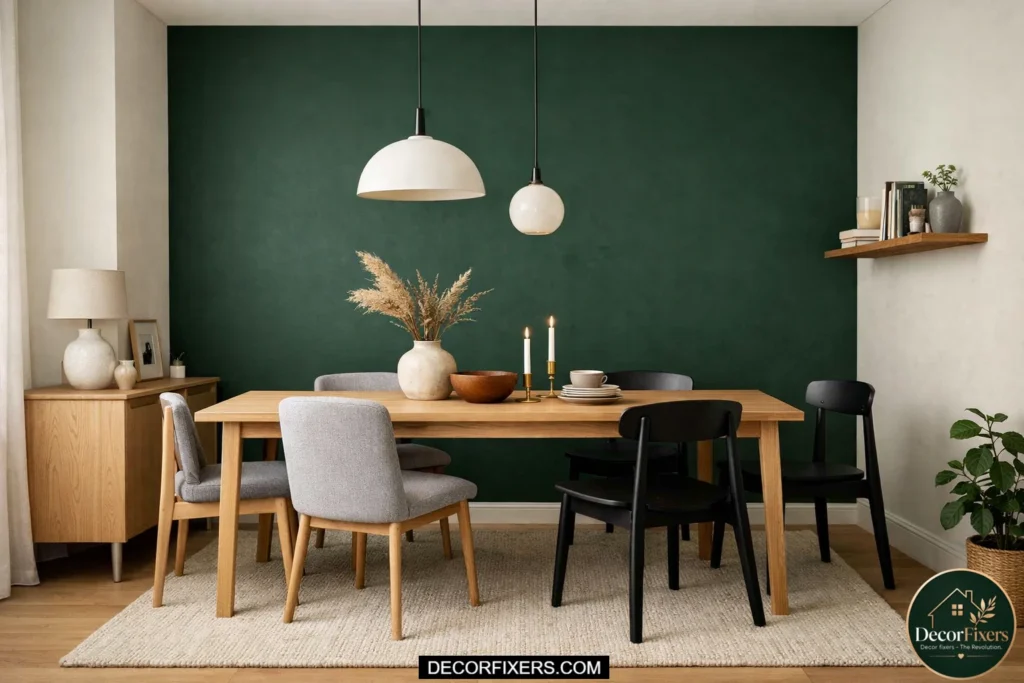
Some experts argue that light, neutral walls on all four sides are always best for small rooms. That’s valid for rooms where maximizing perceived size is the only goal.
But if you’re dealing with a dining space that’s architecturally sound but feels generic, a single bold accent wall, deep navy, forest green, warm terracotta, creates drama and depth without shrinking the room the way all-dark walls would.
27. Try Tone-on-Tone, One Color Family, Multiple Shades
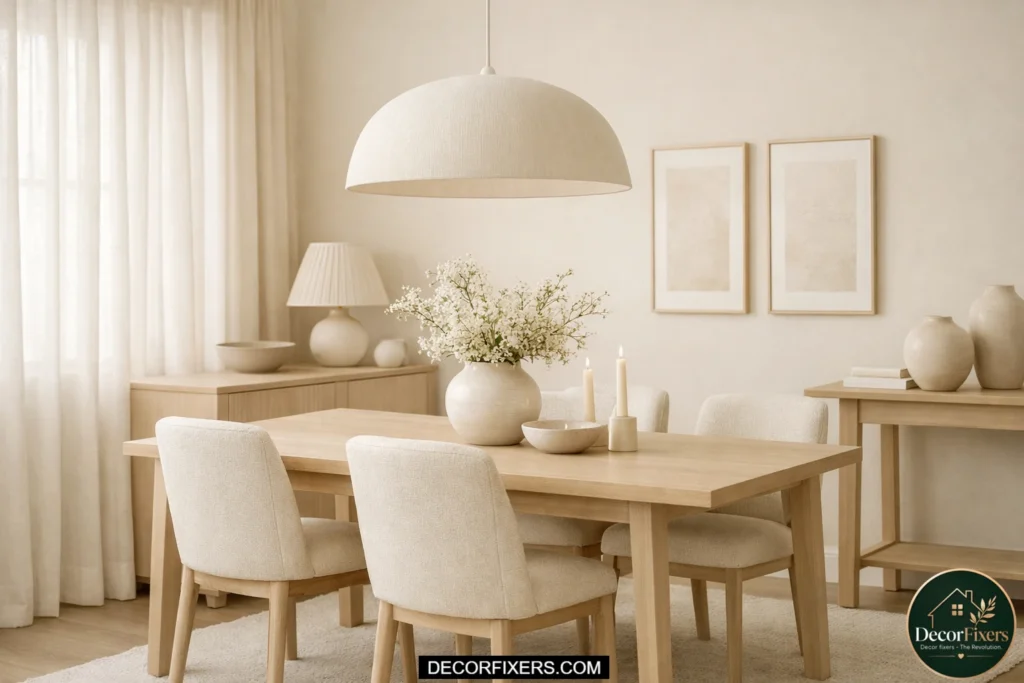
A dining room where walls, furniture, and textiles all live within the same color family (say, cream, sand, warm linen, and pale oak) reads as cohesive and larger because there’s no visual interruption.
The eye travels across the room without stopping at contrasting boundaries. This is the quietest version of color strategy and one of the most effective.
28. Use Large-Format Flooring or Continuous Flooring
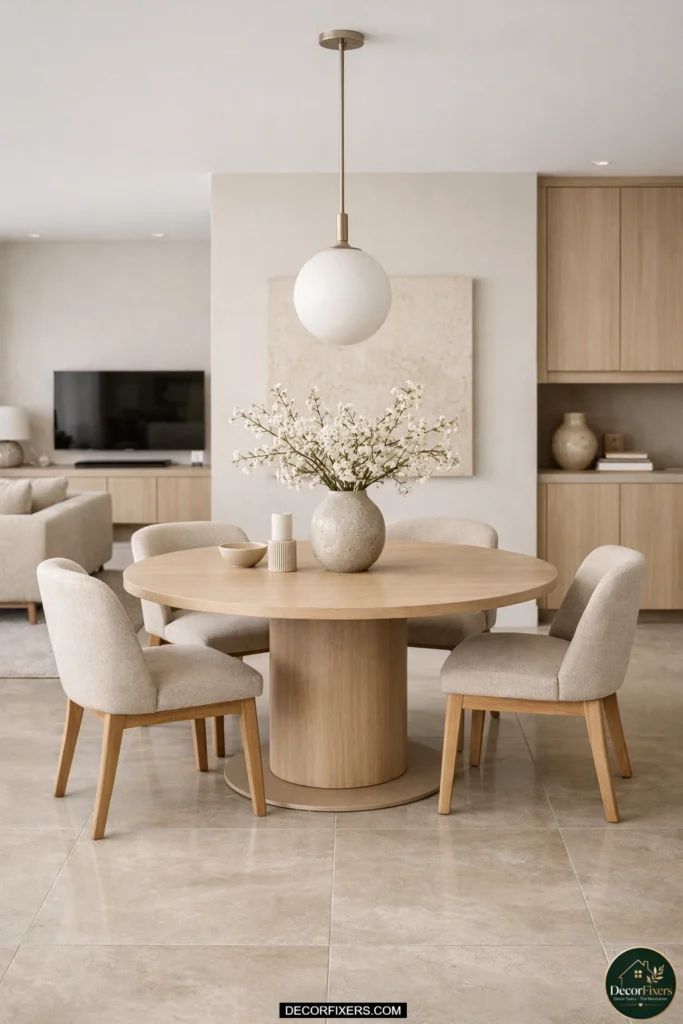
Small floor tiles, or flooring that changes material at the dining area boundary, visually chop the space into pieces.
Large-format tiles (24″x24″ or bigger) or continuous hardwood that runs unbroken through the dining area and adjacent rooms make the space read as one cohesive, larger whole.
29. Install Vertical Stripes or Vertical-Patterned Wallpaper
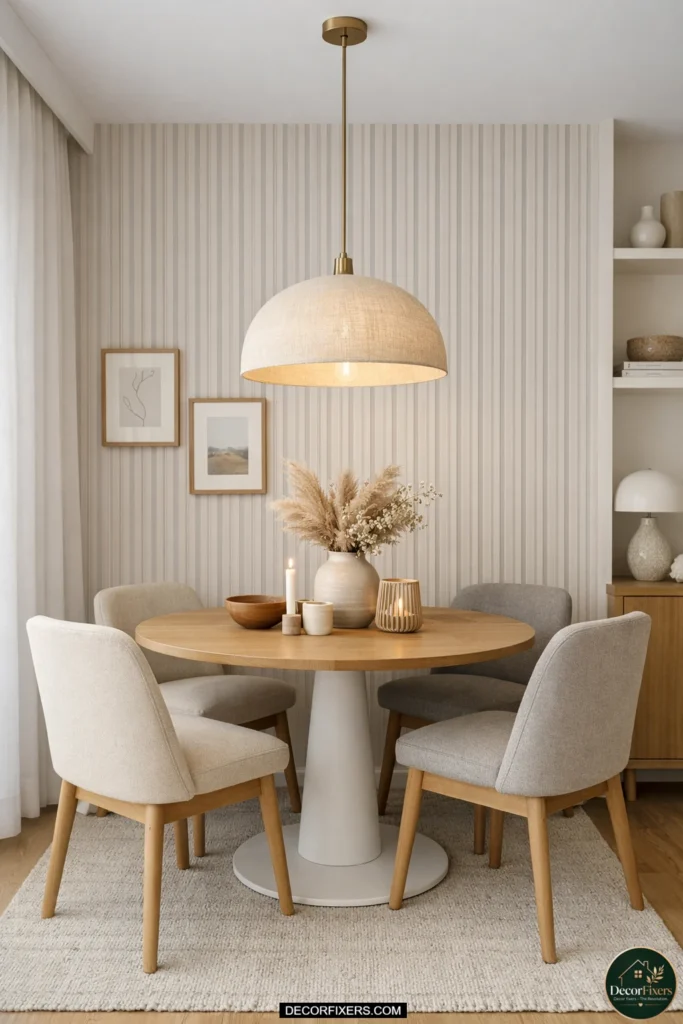
Vertical patterns, stripes, long botanical prints, and tall geometric shapes pull the eye upward, making the ceiling feel higher.
In a dining room where the ceiling height is 8 feet (standard in apartments), vertical wallpaper on one wall can make it feel like 9.5. That’s a meaningful perceptual shift in a small room.
30. Use Natural Wood Tones to Warm Without Visually Closing
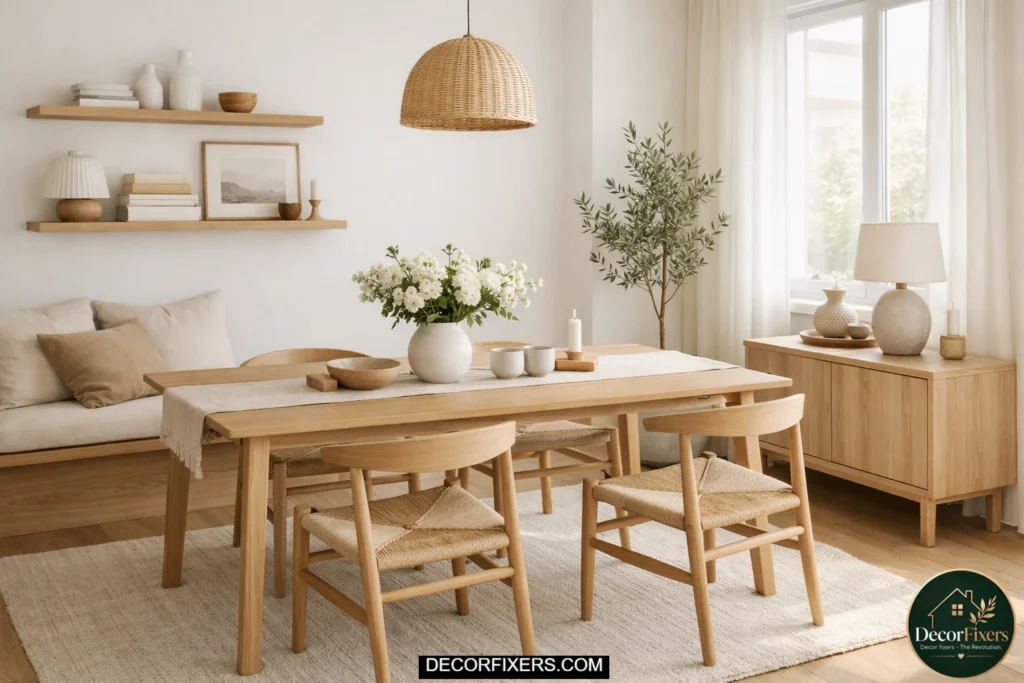
Natural light wood, white oak, blonde pine, and natural ash add warmth to a small dining room without the visual weight of dark stains. It’s the reason light wood dining sets are dominant in 2025 small-space design.
The warmth reads as welcoming; the lightness reads as open. Both qualities matter enormously in a compact room.
31. Use Floating Shelves Instead of a Bulky Sideboard
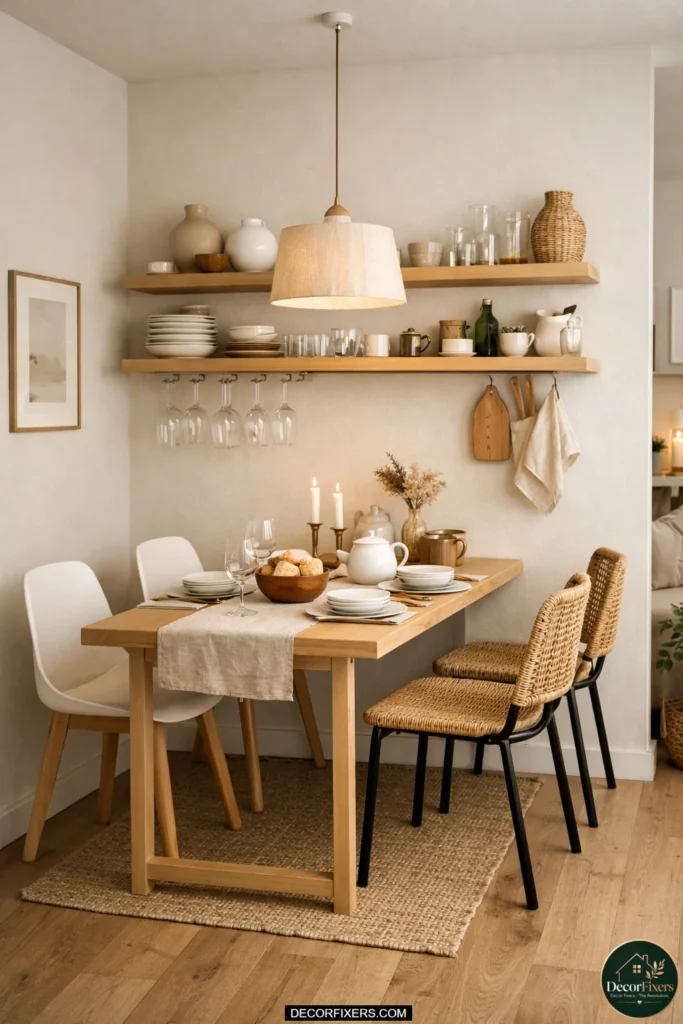
A traditional sideboard sits on the floor and occupies 18-24 inches of depth in the room. Floating wall shelves provide the same storage and display surface with zero floor footprint. In a dining room where every inch of floor clearance matters, this difference is significant.
Quick note: floating shelves need proper anchoring, find the studs, use appropriate wall anchors, and don’t overload them. A falling shelf is not a small problem.
32. Install a Narrow Console Table Along One Wall
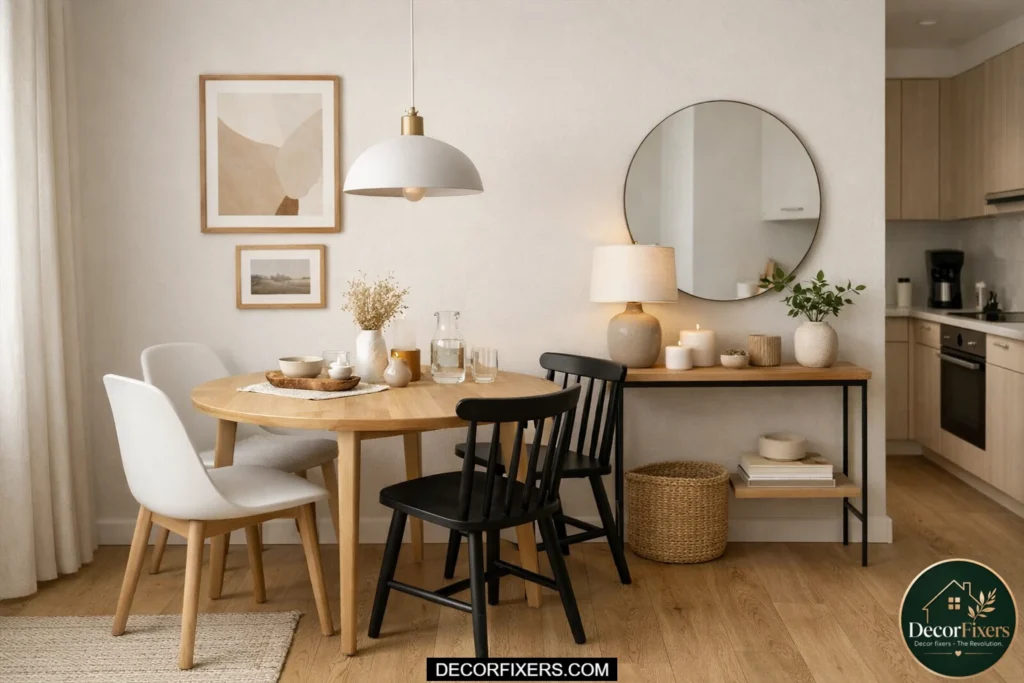
A console table (typically 12-15 inches deep) along a dining room wall serves as a buffet, display surface, and storage surface while taking up a fraction of the floor space a sideboard needs.
Style it with a few curated objects, a ceramic vase, a small plant, a candle or two, and it doubles as décor.
33. Add Overhead Cabinet Storage
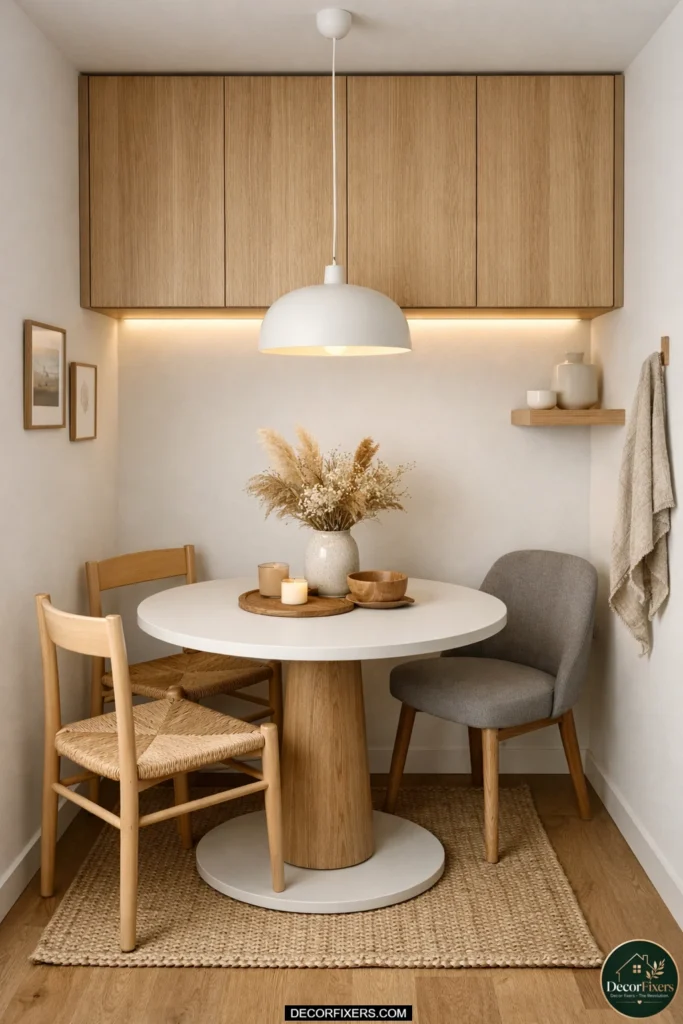
Wall-mounted cabinets above the dining table height, placed on a wall where they won’t be head-level for seated diners, provide enclosed storage without touching the floor.
This is the approach built into dining rooms in older European apartments, used for decades. The storage stays invisible when the doors are closed.
34. Use the Dining Table as a Home Office, With a System
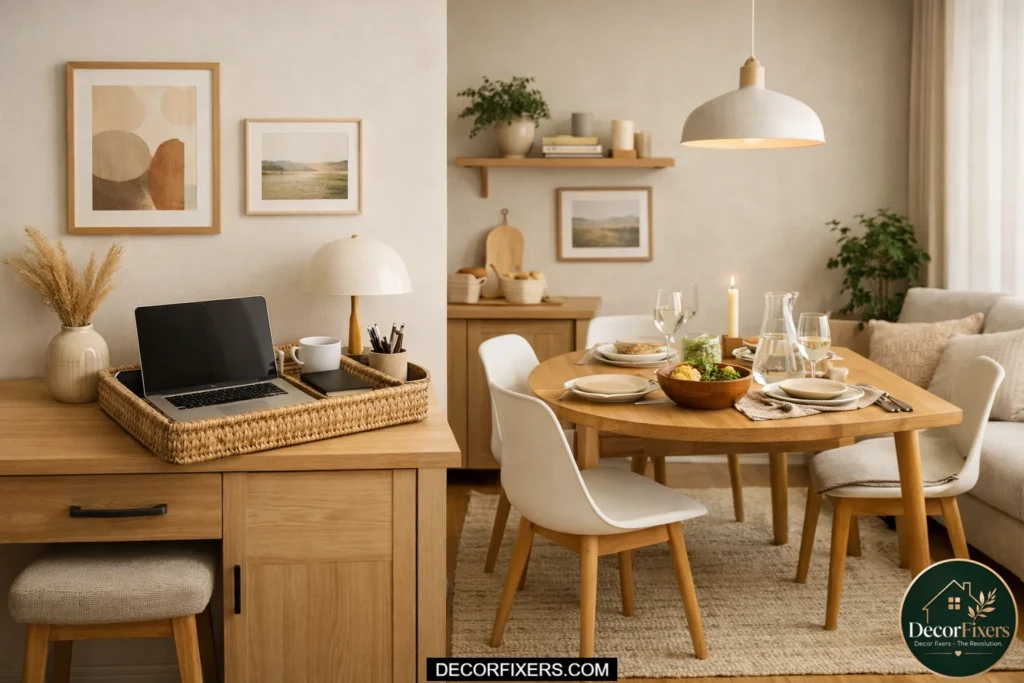
In small apartments, the dining table is often also the workspace. This is fine. The problem is when it looks like both simultaneously, scattered papers and a laptop charger next to a dinner plate, which reads as chaos, not multifunctionality.
The solution is a designated basket or tray that collects all work items and moves to a shelf at mealtimes. The table is always ready for one thing at a time.
35. Add a Bar Cart Instead of a Bar Cabinet
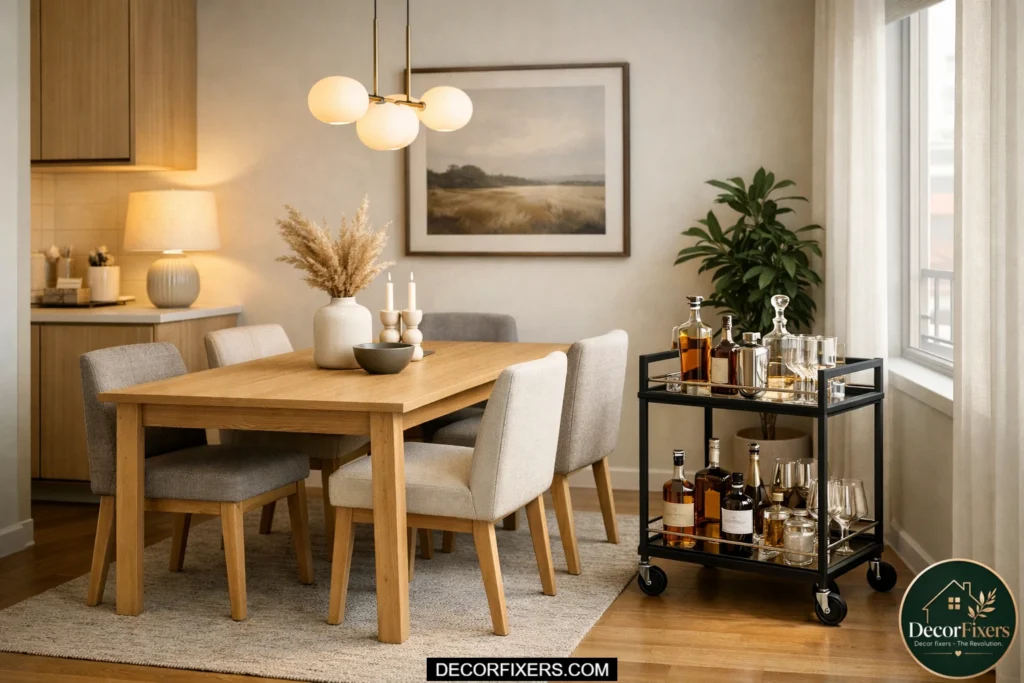
A bar cabinet in a small dining room takes up floor space permanently. A bar cart takes up the same space but can be rolled to wherever it’s needed, against a wall during dinner, into the kitchen for serving, or into the living area for parties. Mobility is a form of space efficiency.
Decor in a small room requires discipline. Every object should earn its place. This isn’t minimalism for its own sake; it’s editing, which is a skill that takes practice.
36. Hang One Large Piece of Art, Not Several Small Ones
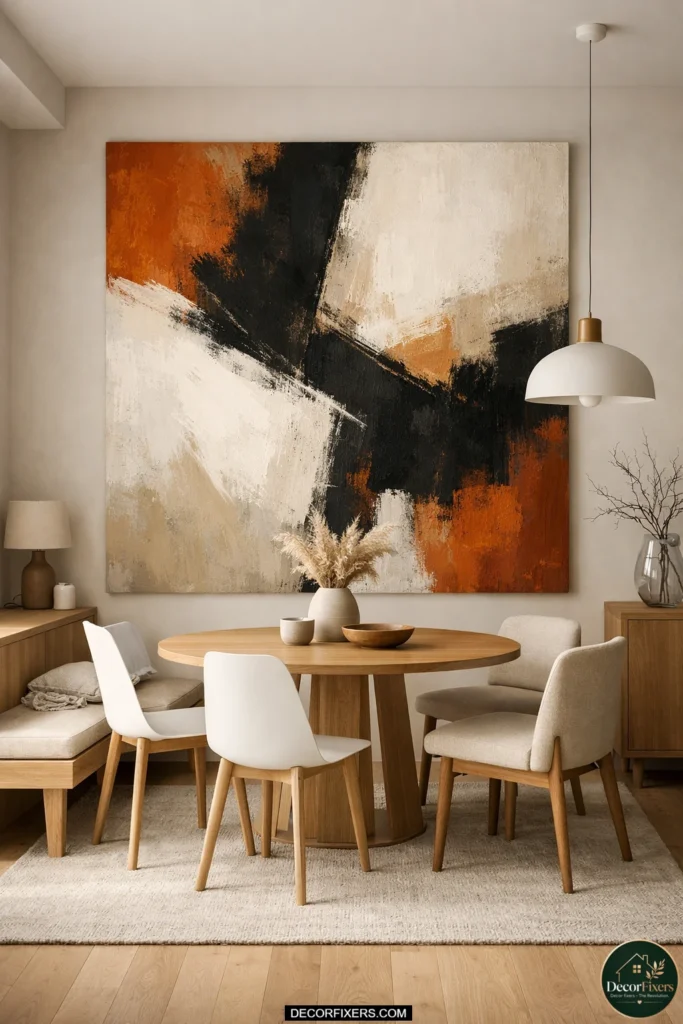
Multiple small frames arranged as a gallery wall in a small dining room create visual noise. One large piece, 24″x30″ or bigger, reads as confident and intentional, and creates a strong focal point that draws the eye away from the room’s size. Scale up, not down, with art in small rooms.
37. Use Plants Strategically, Not Randomly
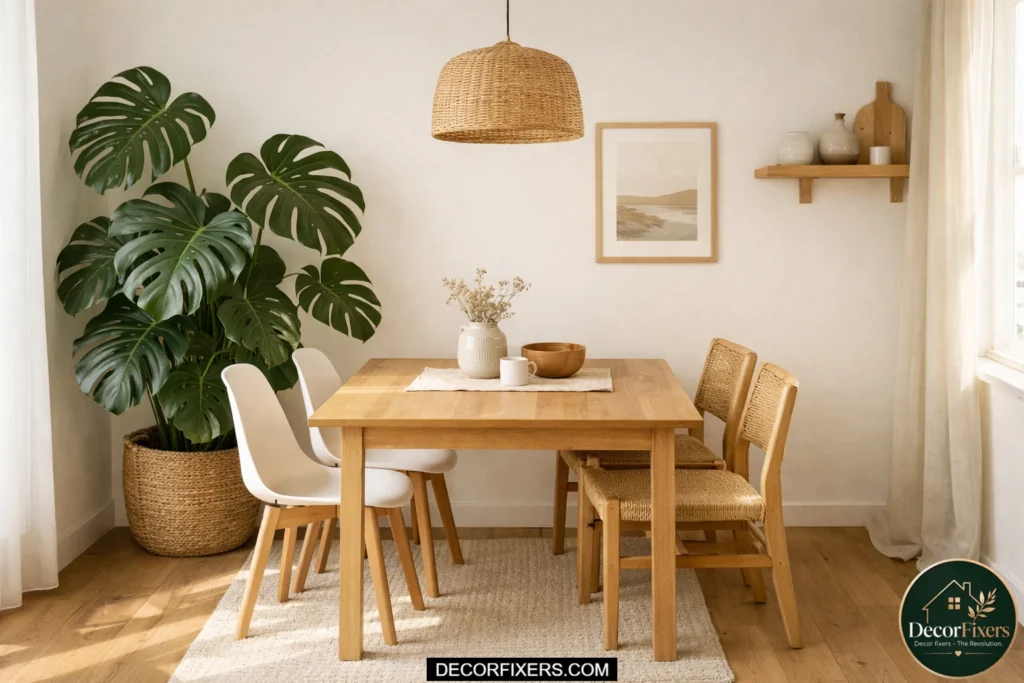
A single large plant, a fiddle-leaf fig, a monstera, a tall snake plant, in a corner of the dining room, adds life, texture, and softness without taking up surface space. Multiple small plants on the dining table create clutter. One statement plant in a floor planter is the move.
38. Add Texture Through Textiles, Curtains, Napkins, and a Runner
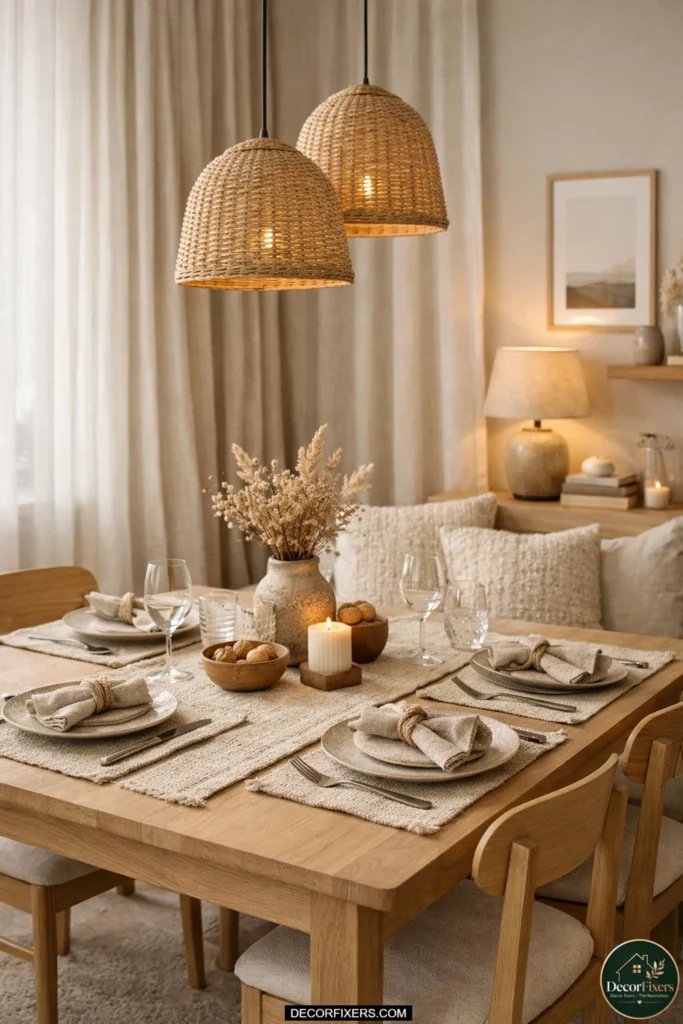
Texture is how you add warmth to a space that can’t afford more furniture. A linen table runner, cloth napkins, and a woven place mat; these cost almost nothing, take up no floor space, and do significant work in making a small dining area feel layered and considered rather than bare and minimal.
Curtains that hang from ceiling to floor, even in a room with short windows, visually extend the wall height and add softness to the room’s edges. Use a sheer or light linen in neutral tones to avoid darkening the room.
39. Keep the Center of the Table Clear
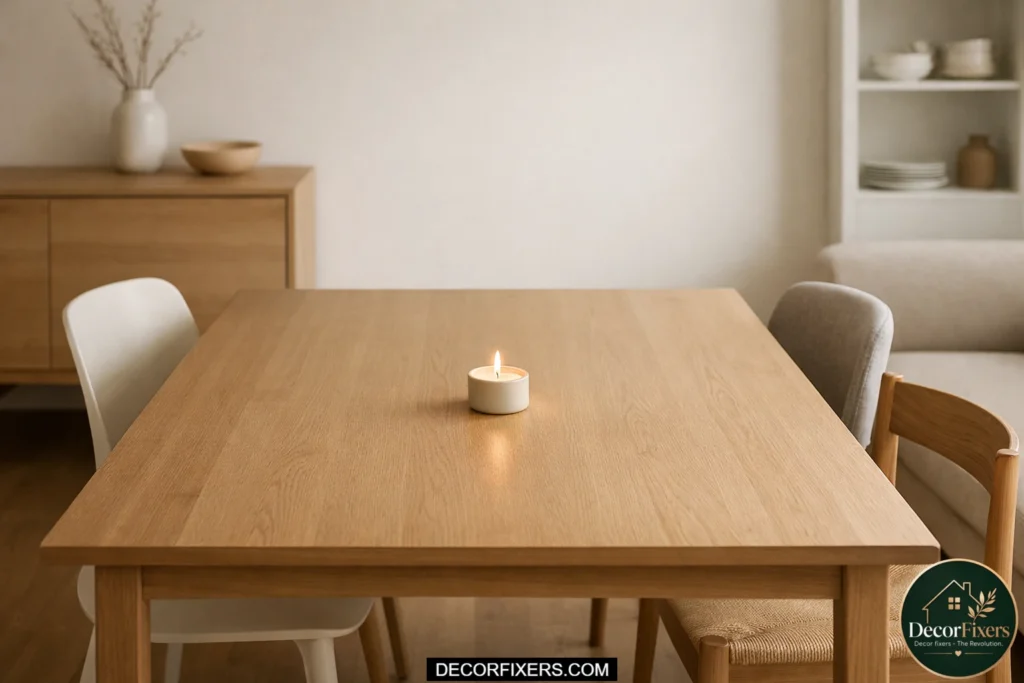
Users who’ve tried heavy centerpiece arrangements in small dining rooms often report the same issue: a table that’s already compact becomes practically unusable when a third of it is occupied by a floral arrangement or a cluster of candles.
A single low centerpiece, a small succulent, a candle in a simple holder, a bowl of fruit, keeps the table functional while still looking styled.
40. Edit Ruthlessly. The Last Idea Is the Most Important
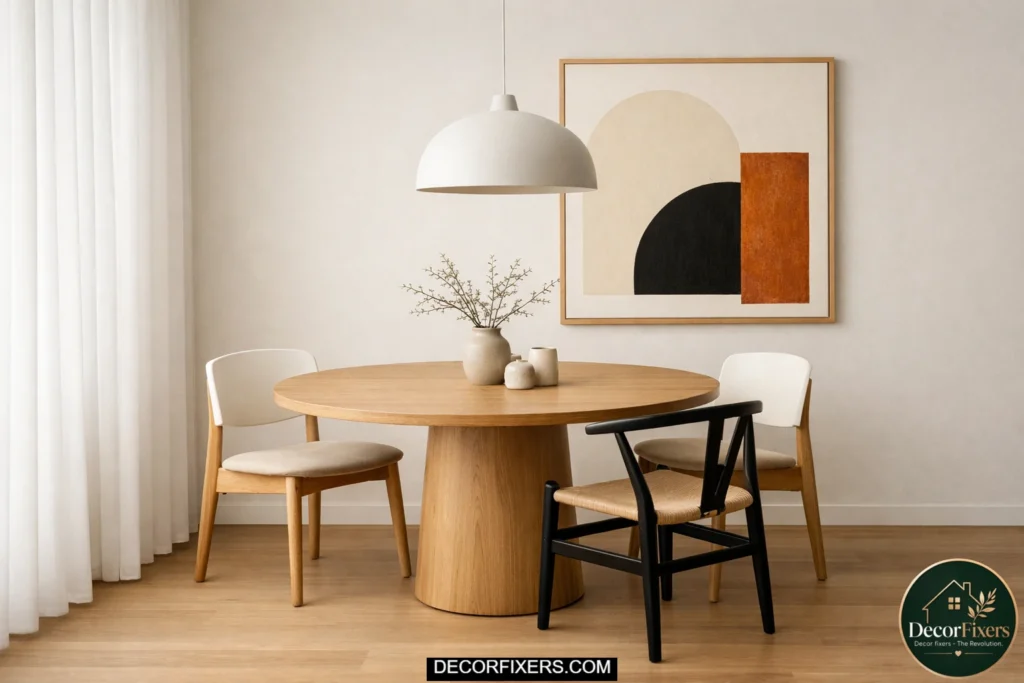
Every object you add to a small dining room competes for visual space. The question for every piece, every chair, every shelf, every decorative item, is: Does this earn its place? If the answer is no, or even maybe, the answer is actually no.
The most beautifully designed small dining rooms I’ve ever seen share one quality: restraint.
Not emptiness. Restraint, which means every single thing that’s there was chosen on purpose, and everything that wasn’t chosen isn’t there.
That discipline is harder than picking furniture. But it’s also more powerful.
CONCLUSION:
I eventually returned that dining table. Not with drama, I just quietly arranged the pickup and sat with the empty corner for a few days before deciding what to replace it with.
What I ended up with was a 36″ round white oak pedestal table, a drop-leaf extendable section I can open when a third person comes for dinner, and a bench along the wall that holds extra linens in the seat. The whole setup costs less than the original rectangular disaster. It takes up about 40% less floor space. And it looks, genuinely, not in a “making the best of it” way, better.
Small dining rooms aren’t a design problem. They’re a design brief. The constraints are real, but constraints are also what force creative decisions. Every one of the 40 ideas above came from someone, a designer, an architect, an ordinary person in a 600-square-foot apartment, who was told they didn’t have enough room and decided that wasn’t going to stop them.
You don’t need more space. You need the right ideas for the space you have. Now you have 40 of them.
FAQs:
Q: What’s the best dining table shape for a small room?
A: Round tables work best in most small dining rooms. They have no corners to block movement, they seat more people per square foot than rectangles, and they improve conversation flow. A 36″ round table seats four adults comfortably in a room as small as 80 square feet.
Q: How do I make my small dining room look bigger?
A: Use a round or glass-top table, hang a large mirror on the wall opposite the window, choose furniture with exposed legs, install a pendant light directly over the table, and keep the color palette in one tone family. Each of these works, together, they’re transformative.
Q: Should I use dark or light colors in a small dining room?
A: Light neutrals make small rooms feel larger, but a single dark accent wall adds depth without shrinking the room. The mistake is painting all four walls dark. Paint three walls in a light neutral, one wall in a bold tone, and you get atmosphere and openness.
Q: How much space do I need around a dining table?
A: 36 inches minimum on all sides is the functional standard, enough for chairs to pull out and for someone to walk behind a seated diner. 42-48 inches is comfortable. 30 inches is survivable, but it will feel tight. According to interior design standards, each diner also needs approximately 24 inches of table width.
Q: When should I consider a built-in banquette for a small dining room?
A: Consider a corner banquette when your dining area is in a corner with two walls available, you need storage beneath the seating, and you’re willing to commit to a fixed layout. It’s the most space-efficient dining configuration that exists, but it’s permanent, so plan carefully before building.

Creator of DecorFixers, sharing practical home and interior ideas focused on real-life usability, simple design improvements, and budget-friendly solutions.
6 thoughts on “40 Modern Dining Room Ideas for Small Spaces That Actually Work”