

I’ll be honest, I didn’t think a wardrobe could make or break a bedroom. Then I watched someone open a beautifully planned built-in on a design reel, and I spent the next two hours rethinking my entire room layout. That’s the power of a well-designed wardrobe. It’s not just storage. It’s what makes your bedroom feel either like a calm, organized retreat or a room you’re perpetually trying to tidy up, yet somehow can’t.
This guide covers 40 modern wardrobe design ideas, from built-in fitted wardrobes to modular systems and compact sliding door setups. I’ve also gone beyond the aesthetic and included interior compartment planning, hanging zones, shelf heights, drawer ratios, the stuff most articles skip entirely. Whether your room is 80 sq. ft. or 200 sq. ft., you’ll find something actionable here that you can actually brief a carpenter or retailer with.
| Wardrobe Design Bedroom Ideas Modern Living Wardrobe design for modern bedroom living refers to fitted, modular, or built-in storage systems planned around both room dimensions and personal wardrobe habits. It combines aesthetic integration with interior compartment logic, hanging zones, drawer ratios, lighting, and door configuration to turn dead wall space into functional, seamless storage. |
Quick note: if you’re renting, modular is almost always the smarter play. You can reconfigure or take it with you. If you own, fitted or built-in storage gives a cleaner result and, according to Livingetc, built-in storage consistently adds value when selling a home.
Built-In Wardrobe Ideas for Small Bedrooms, 10 Layouts That Reclaim Dead Space
This is the section most articles skip straight past. They show you pretty photos without answering the actual question: how do I plan a built-in wardrobe in a room that’s under 120 sq. ft.? Here’s what actually works.
1. Floor-to-Ceiling Alcove Wardrobe
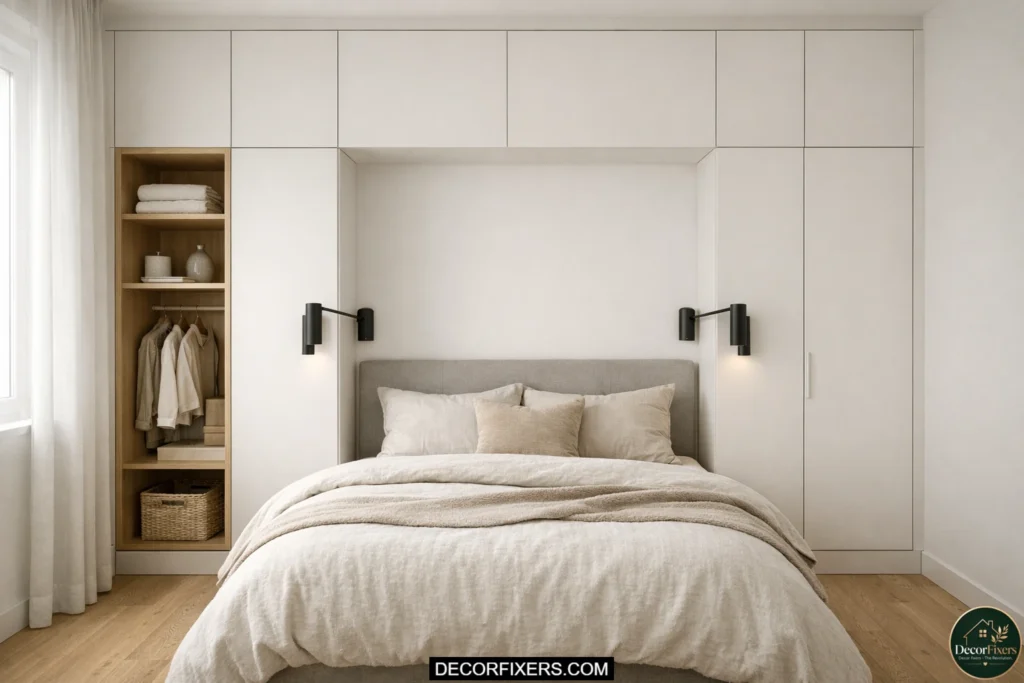
If your bedroom has a chimney breast or a recessed alcove, use it. Alcove wardrobes are the single most space-efficient built-in design for small rooms because they exploit existing depth without pushing into your floor area. Homedit’s 2026 guide shows multiple examples of wardrobes built into alcoves flanking a fireplace, creating symmetry and storage without occupying a single centimeter of open floor.
Interior tip: in a 60cm-deep alcove, plan for a 50cm hanging rail with a 10cm clearance at the back. That’s enough for most garments. Run a full-height shelf column on one side for folded items and shoes.
2. Wardrobe Built Around the Bed
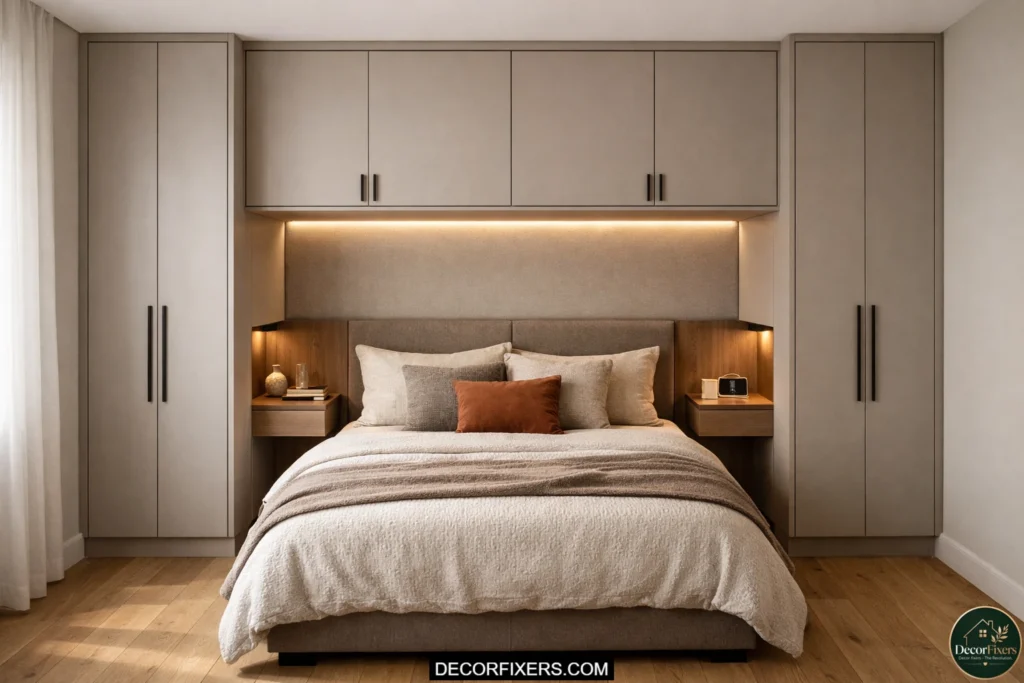
This is the most underused layout in small warm bedroom design. Build storage modules on both sides of your bed, connect them with an overhead cabinet, and you create a hotel-style niche that makes the bed feel intentional rather than crammed in. Coco Lapine Design documents this brilliantly; the overhead connection also adds a sense of enclosure that makes small rooms feel cozy rather than claustrophobic.
This layout works in rooms as narrow as 9 feet. The key is keeping the wardrobe depth uniform (no deeper than 60cm) and painting it the same color as the walls so it reads as architecture, not furniture.
3. Eaves Wardrobe in a Loft or Converted Room
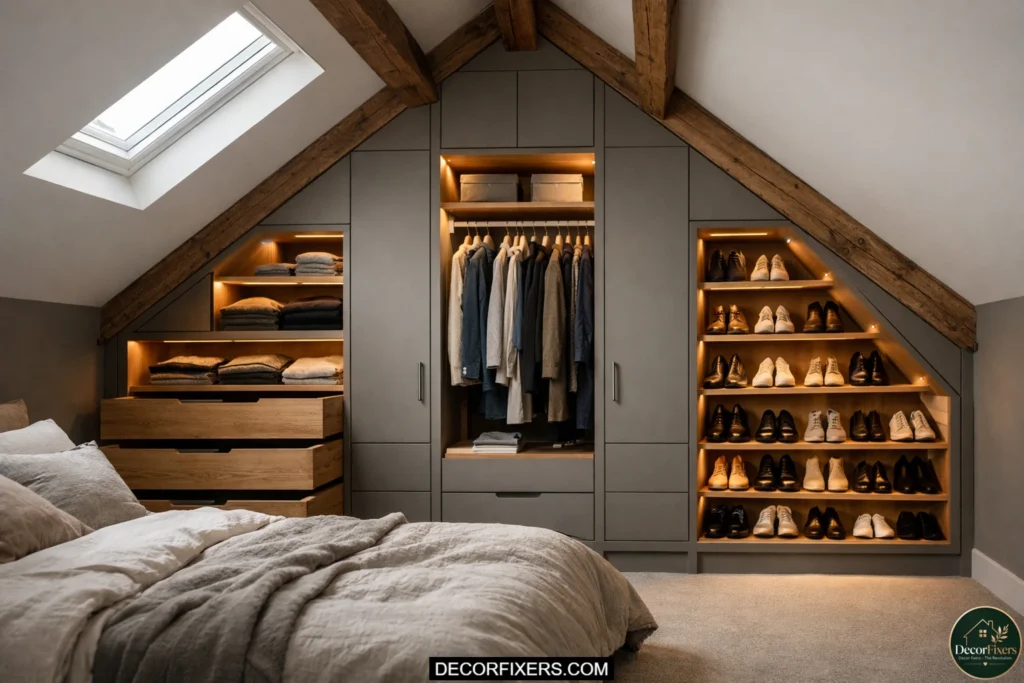
Sloped ceilings are an organizational nightmare with freestanding furniture. A fitted eaves wardrobe solves this by designing the unit around the angle of the roof, lower sections become drawers or shoe storage, taller sections near the central ridge become hanging space. Houzz calls eaves ‘spaces that aren’t really usable for anything else’, and they’re right. A carpenter can turn an unusable pitch into your most efficient storage zone.
4. Full Wall Built-In With Open Centre Section
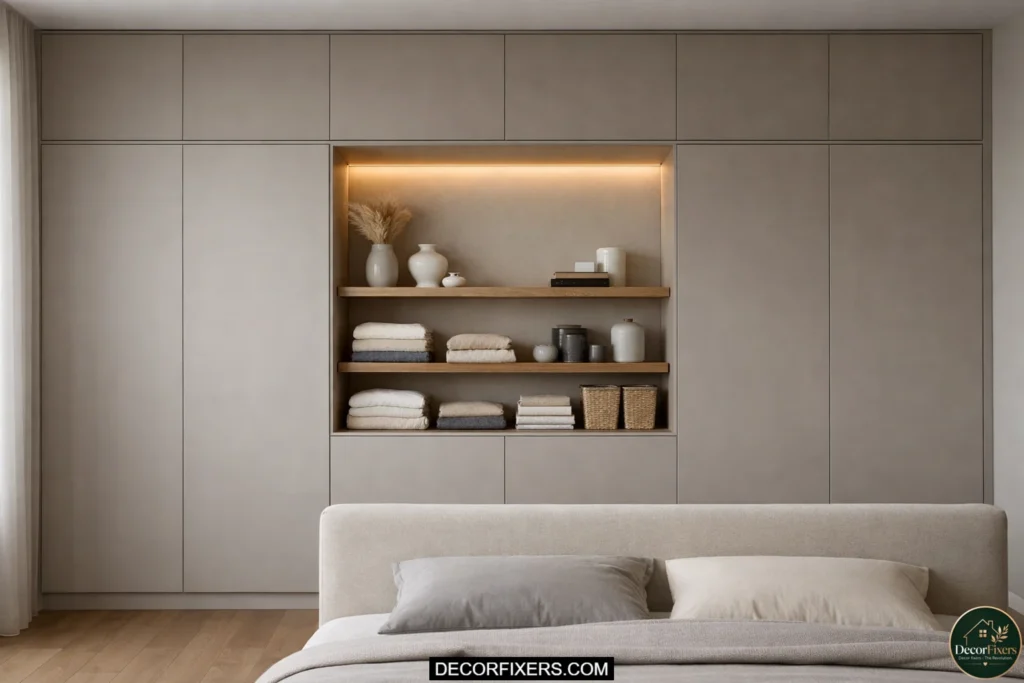
Run closed-door cabinets across the full wall, but leave a 60–80cm open center section lit with LED strips. The open zone breaks the visual mass of solid cabinetry and gives the eye somewhere to land. It’s also practical: keep your most-used items there for quick access without opening doors. Homedit uses this format in their 2026 roundup for exactly this reason; it balances ‘clean and usable’ in tighter layouts.
5. Corner L-Shaped Wardrobe
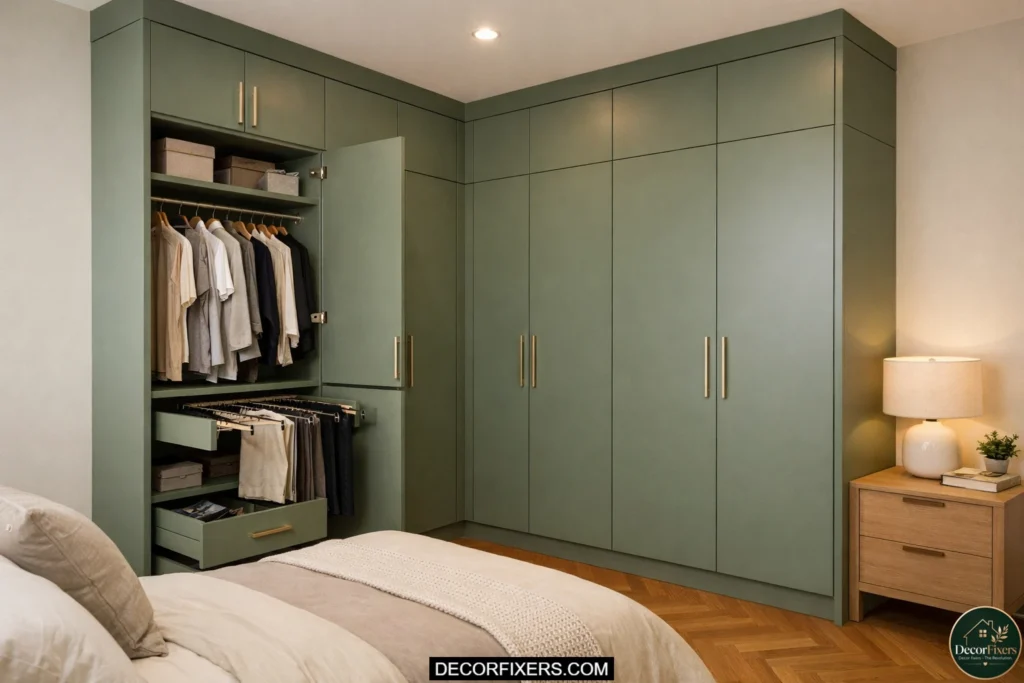
Corner wardrobes are polarizing. Done badly, they waste the inside corner. Done well, they can house a rotating corner carousel or pull-out trouser rack that makes that dead angle actually useful. The structural requirement is a custom-fitted corner module, not something you can achieve with a standard flat-pack. Budget approximately £800–£1,500 for a bespoke corner unit from a local joiner in the UK, or opt for IKEA PAX corner planner solutions as a starting point.
6. Slim 40cm-Depth Wardrobe for Narrow Rooms
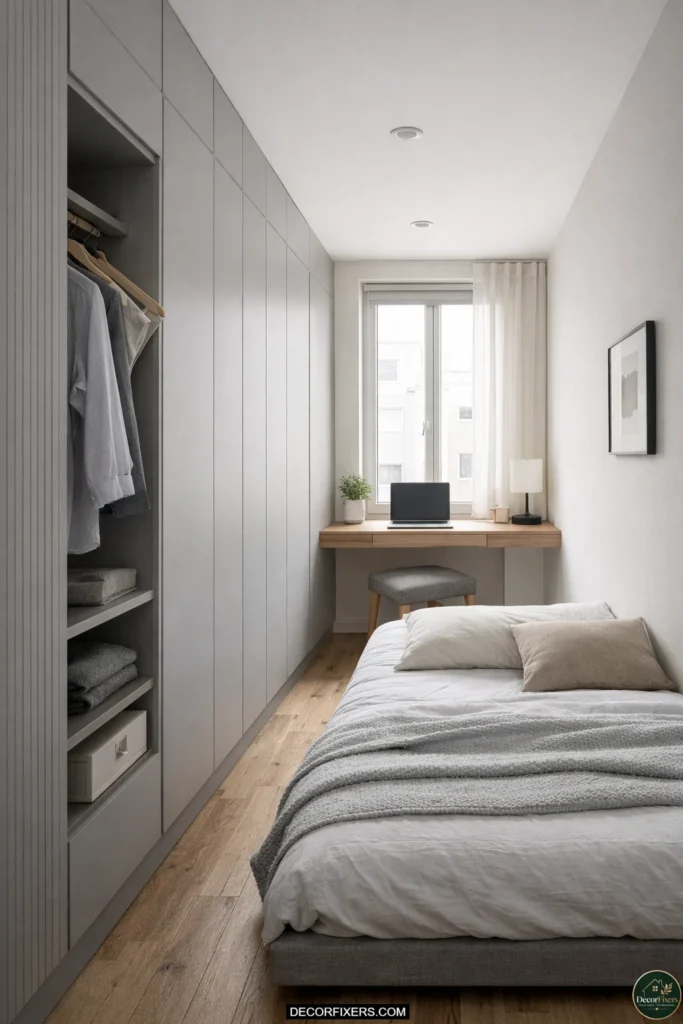
Standard wardrobes run 60cm deep. But if your room is under 10 feet wide, that depth costs you more than it gives. A 40cm-depth wardrobe can still hold folded clothing, shoes, bags, and accessories. Hanging is limited; you can use angled rails or a rod-to-wall configuration, but the floor space you reclaim often transforms how the room feels to live in. Think about it: 20cm reclaimed across a 3m wall is 60 liters of breathing room back in your bedroom.
7. Built-In Behind the Bedroom Door
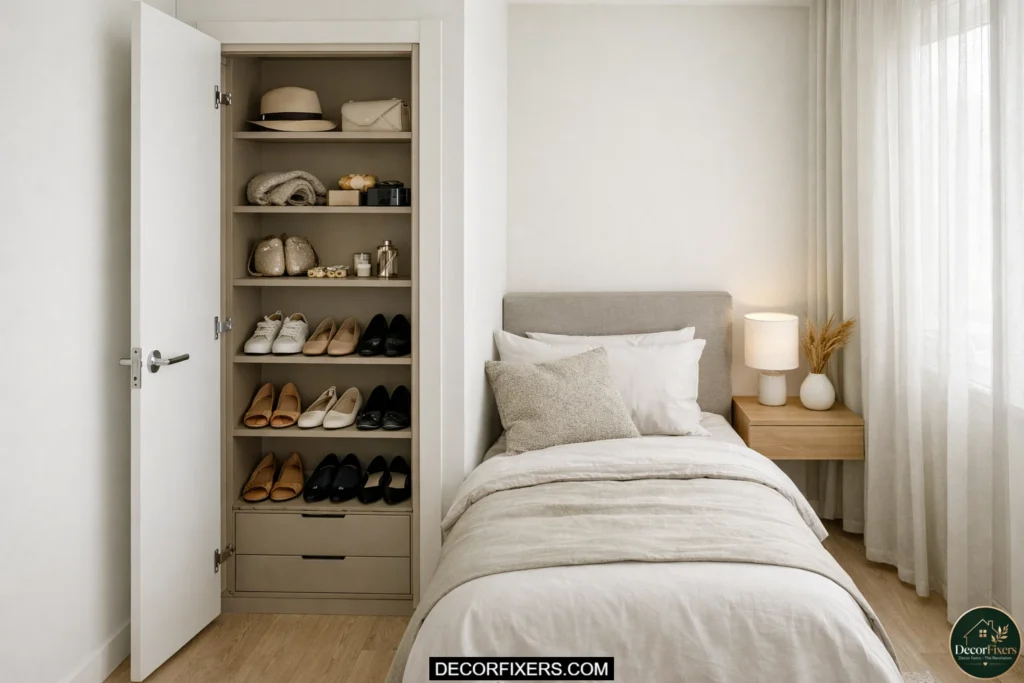
The wall behind your bedroom door is almost always underused. A shallow 25–30cm built-in there, even just shelving with a simple door, handles shoes, accessories, bags, and seasonal extras without touching your main wall. This works especially well in rooms where the main wall is already taken by the bed.
| How to Plan a Built-in Wardrobe for a Small Bedroom? 1. Measure the full wall length; each meter gives you roughly one double compartment. 2. Identify the door configuration: sliding for rooms under 10 ft. wide; hinged only if swing space exceeds 24 inches. 3. Plan zones: long hanging (dresses, coats), short hanging (shirts, jackets), shelves, and drawers. 4. Mark the ceiling height and build to it, leaving no gap above. 5. Choose a finish that matches or blends with your wall color. |
8. Double-Sided Wardrobe Between Bedroom and Ensuite
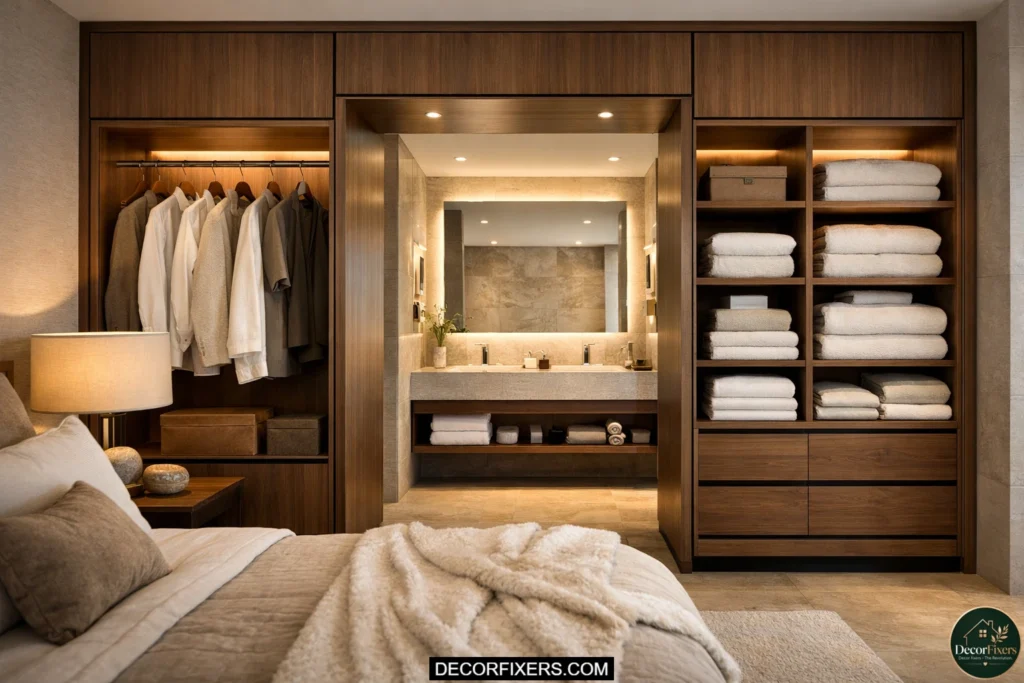
If your bedroom connects to an unsuited, a double-sided built-in acts as both storage and a partition wall. Open from the bedroom side for clothes; access towels and linens from the bathroom side. Interior designer Lisa Station documents this in Livingetc. The unit is custom-built and accessible from both rooms, maximizing space without adding any footprint.
9. Wardrobe with Integrated Bedside Tables
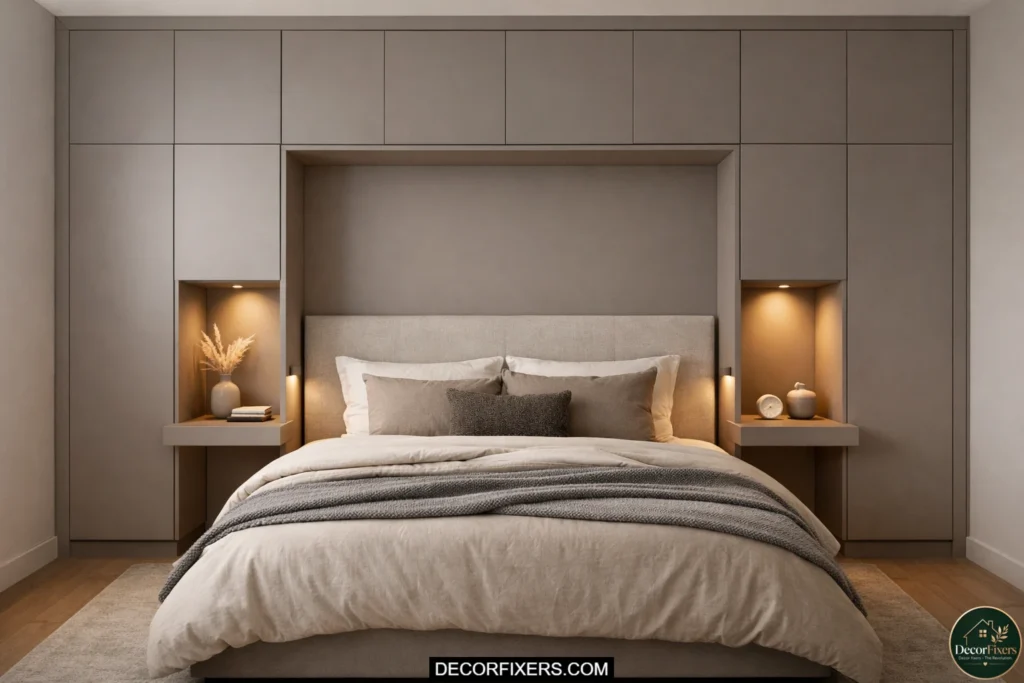
This detail separates a good carpenter brief from a great one. When your built-in wardrobe flanks the bed, design a cut-out at waist height on each side to create a recessed bedside table. This eliminates two separate pieces of furniture, keeps the visual line clean, and gives you a hardwired reading light niche built in. JV Carpentry has built wardrobes like this for small bedrooms. The result makes even a 90 sq. ft. room look intentional.
10. Wardrobe That Frames a Media Wall
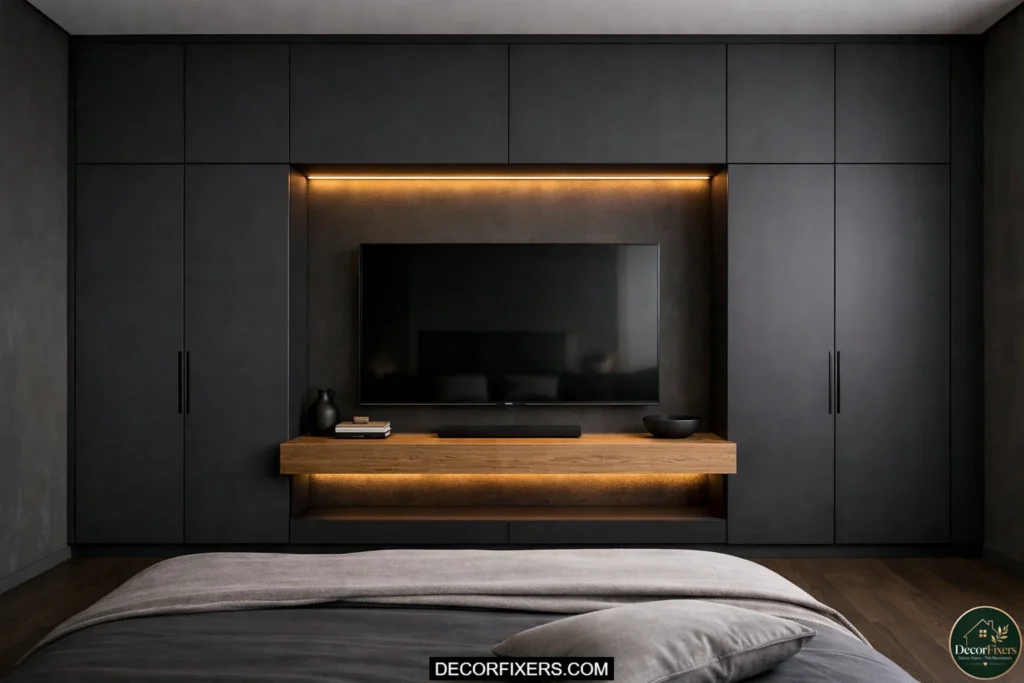
Run full-height storage on both sides of a central recess that holds a floating shelf and wall-mounted TV. This layout fromHomedit’s 2026 wardrobe roundup replaces both a standalone media unit and a wardrobe with one integrated wall system. Upper cabinets extend to the ceiling for seasonal storage; the open center prevents the wall from feeling closed. Ideal for open-plan studio apartments.
Sliding door wardrobes are the right choice for any bedroom under 120 sq. ft. where door swing would conflict with bed placement, circulation, or other furniture. They’re not just a default compromise; they’re genuinely the smarter architectural choice in tight rooms. The Coolist’s 2026 sliding door roundup confirms they’ve become a favorite precisely because they eliminate the swing footprint while creating a streamlined, continuous surface.
11. Mirror-Panel Sliding Wardrobe
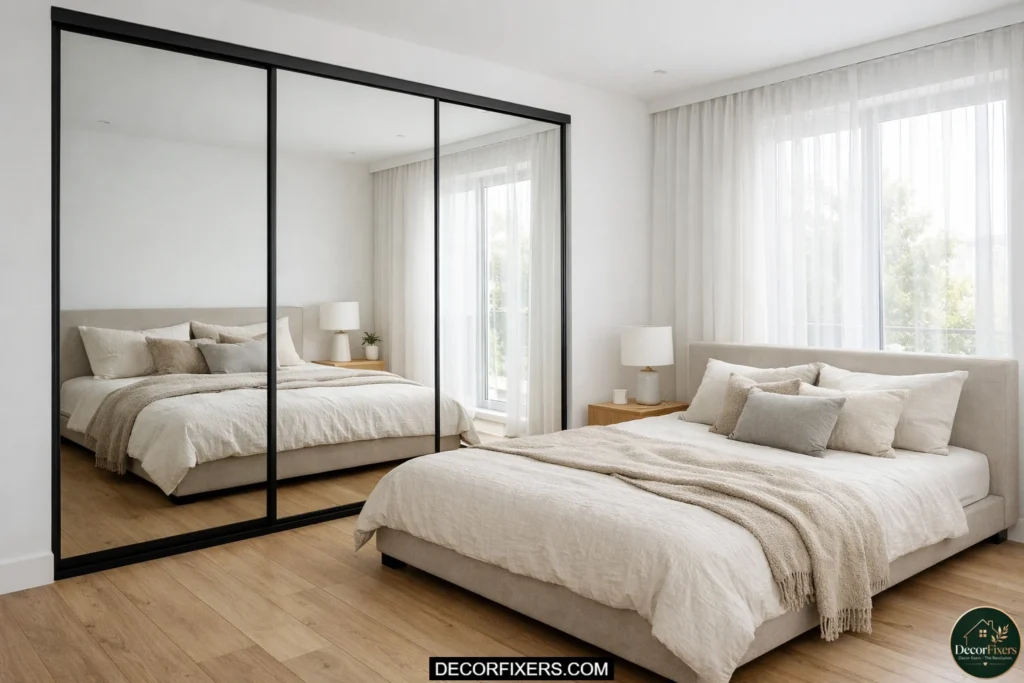
A mirrored sliding wardrobe does two jobs at once: storage and the illusion of space. In a small bedroom, a full-width mirrored wardrobe effectively doubles the perceived width of the room. The reflection also bounces natural light from windows, brightening dark rooms without electrical work. Finish the frames in matte black for a contemporary edge; keep them in a warm metallic like brass for a softer, boutique feel.
12. Frosted or Tinted Glass Sliding Panels
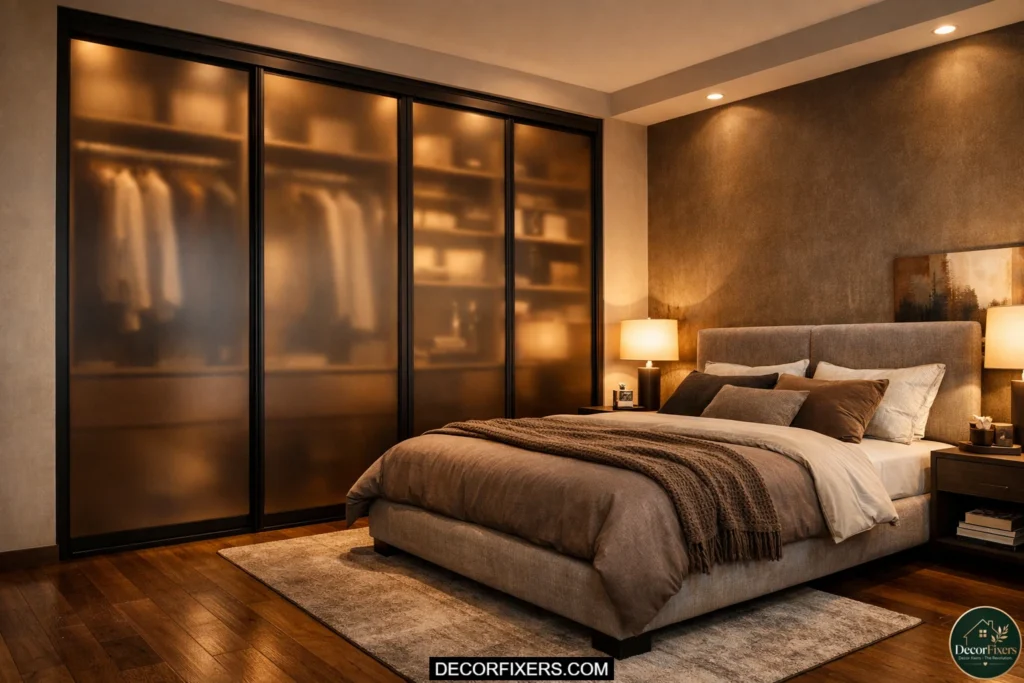
Tinted glass panels, particularly bronze or smoked finishes, give a hint of the wardrobe’s interior without fully exposing it. This works particularly well when your interior is organized and lit: the panels create a boutique-retail effect that makes storage feel curated rather than hidden. Mix bronze-tinted glass with black aluminum frames for a finish. Wall and All Interiors specifically calls out as a high-end direction for 2026.
13. Two-Tone Sliding Door Design
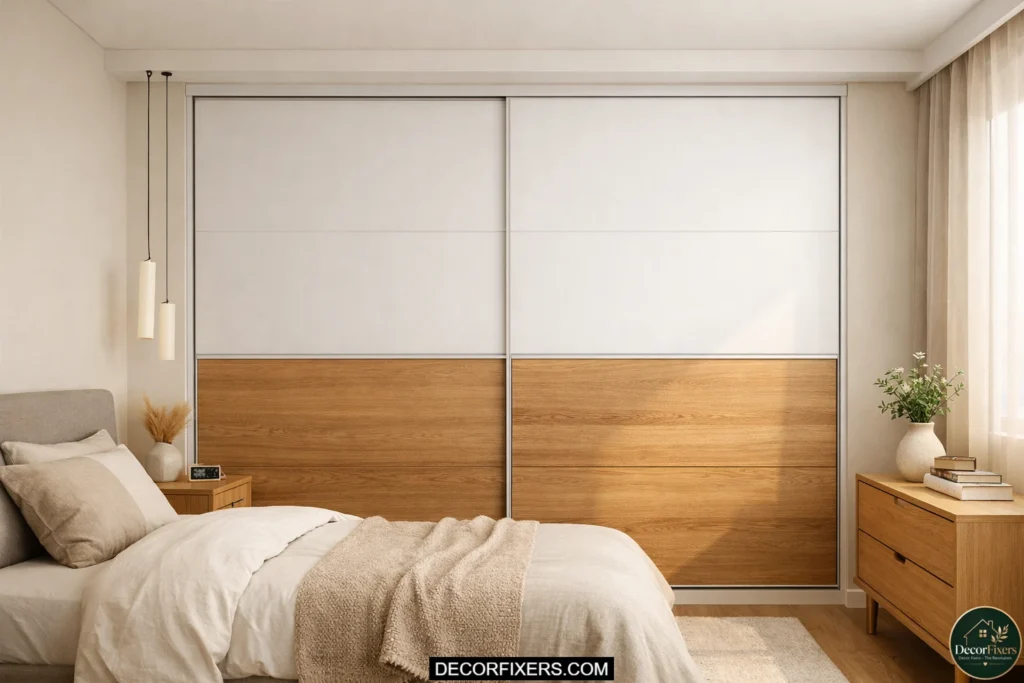
Use two contrasting panel finishes, say, white matte on the upper two-thirds, warm oak veneer on the lower third, to break up the visual height of a large wardrobe. This is especially useful in rooms with low ceilings (under 8 feet), where a solid tall surface can feel oppressive. The horizontal line created by the color change visually widens the wall.
Quick Comparison:
| Option | Best For | Key Benefit | Limitation |
| Built-in / Fitted Wardrobe | Permanent homes, maximizing walls | Seamless look, ceiling-height use | Expensive; can’t move when you shift |
| Modular Wardrobe (e.g., IKEA PAX) | Renters, flexible budgets | Adjustable; reconfigure anytime | Visible gaps; rarely reaches the ceiling perfectly |
| Sliding Door Wardrobe | Small bedrooms under 120 sq. ft. | No door swing space needed | Can’t open both sides at once |
| Walk-in Wardrobe | Master bedrooms 150 sq. ft.+ | Full dressing zone; luxury feel | Sacrifices sleeping floor space |
| Wardrobe + Dressing Table Combo | Urban apartments, solo dwellers | Two functions, one footprint | Requires careful lighting planning |
14. Handle less Push-to-Open Sliding Wardrobe
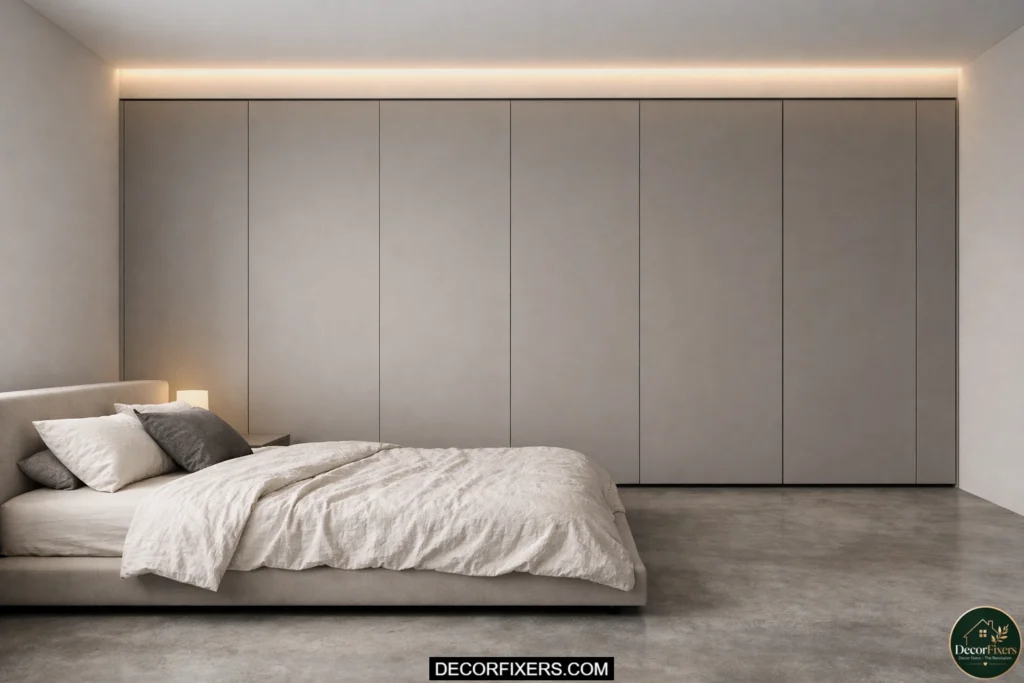
Push-to-open mechanisms eliminate handles, giving a continuous flush surface. This works best in minimalist bedrooms where visual noise needs to stay low. The doors are activated by a gentle push, releasing a magnetic latch. Dako Furniture’s design guide notes that handle-less systems are a core feature of contemporary wardrobe aesthetics; they ‘maintain visual calm’ across the surface.
15. Sliding Wardrobe With Open Shelving End Section
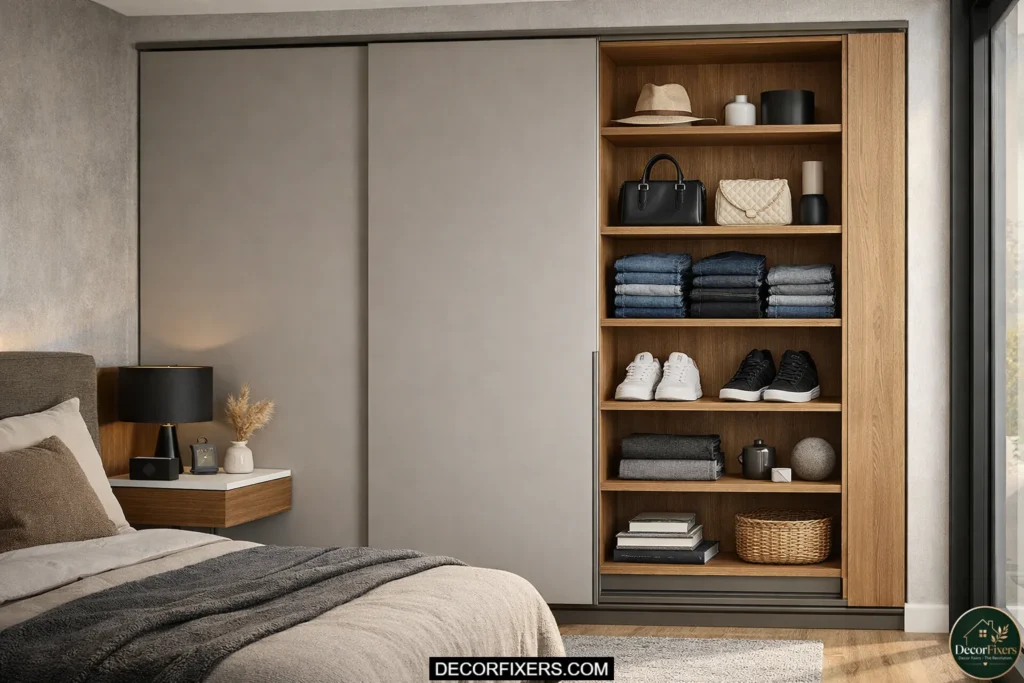
Instead of closing the entire wardrobe with sliding panels, terminate one end with 2–3 open shelves. Use these for frequently accessed items, folded jeans, favorite trainers, and a bag you use daily. The open section also breaks the wall-to-wall heaviness of a full sliding wardrobe, making the room feel less like a hotel corridor and more like a considered home.
16. Curved Geometric Patterned Sliding Doors
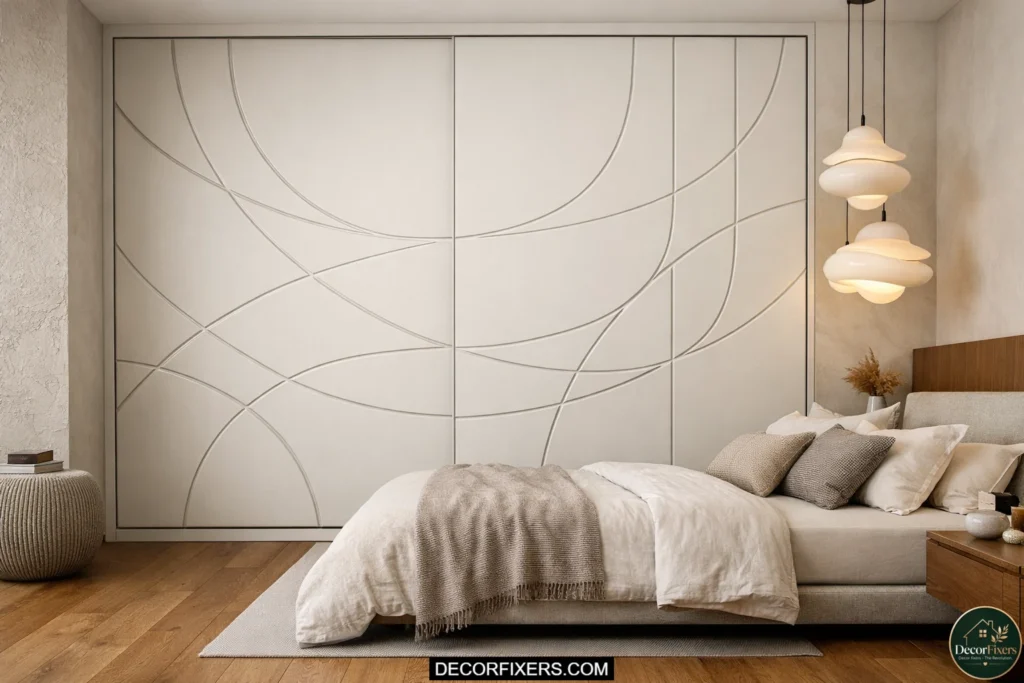
This is not a mainstream choice, but it’s genuinely striking in the right bedroom. CNC-routed geometric patterns on sliding panels, curves, arches, and repeating lines transform the wardrobe into a feature wall. The doors read like wall art before they read like storage. The Coolist highlights this as one of the more avant-garde directions for 2026 wardrobes that want to stop looking purely functional.
17. Sliding Wardrobe in a Dark Bedroom Palette
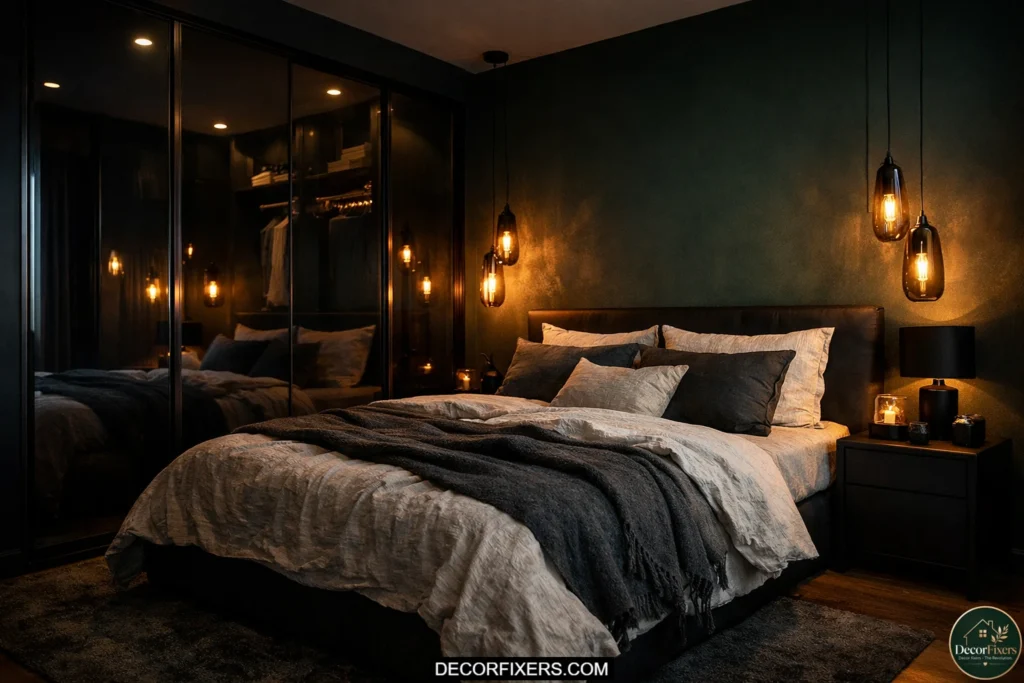
Dark glass sliding doors in charcoal, deep navy, or forest green work remarkably well in moody, high-contrast bedrooms. The reflective surface adds depth rather than weight, and when paired with warm pendant lighting, the effect is closer to a five-star hotel room than most furniture ever gets. This is one design direction where bigger is better; a full wall of dark sliding panels actually feels less heavy than a half-width dark wardrobe.
18. Sliding Wardrobe Integrated Into a Structural Arch
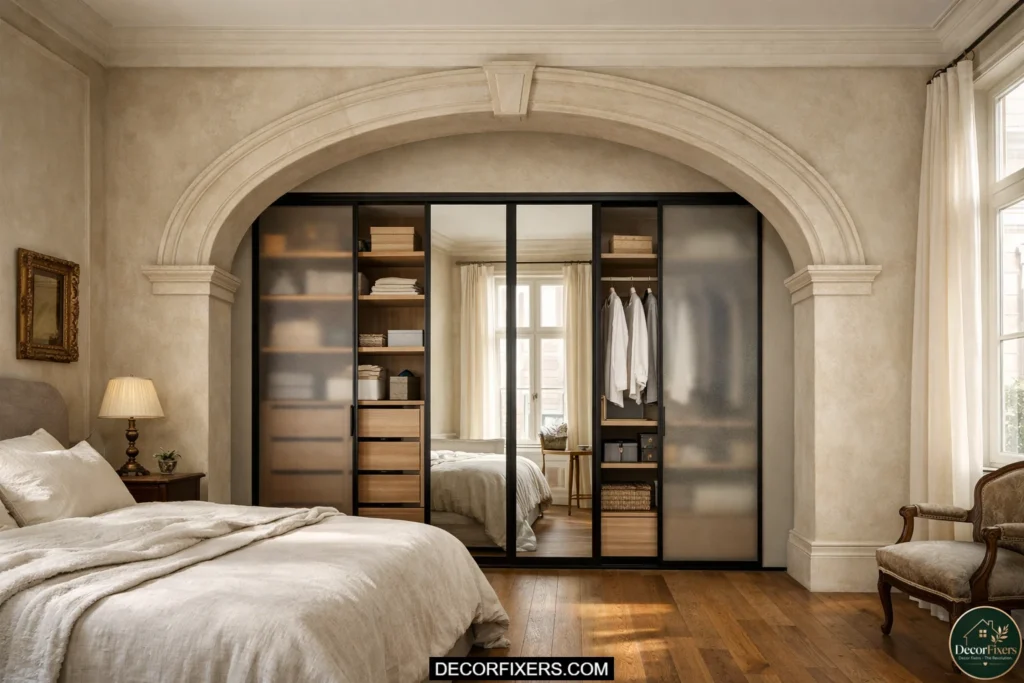
In older homes with internal arch openings between rooms, a sliding door wardrobe can be fitted directly within the arch frame, using the existing architecture as a natural door stop on each side. This avoids structural work entirely while creating what looks like a bespoke built-in. It’s one of those clever solutions that makes guests assume you’ve spent triple what you actually have.
Or maybe I should say it this way: modular wardrobes are the most underrated category in this entire guide. Not because they’re cheap, though systems like IKEA PAX give you remarkable value, but because they’re honest. They admit that your storage needs will change, and they’re built around that reality.
According to Homelane’s 2026 wardrobe guide, modular systems work well in today’s homes where flexibility matters. You can adjust shelves, add drawers later, and rework the layout without starting from scratch. That’s the real argument for modular over fitted, especially if you’re in your first or second home.
19. IKEA PAX System With Bespoke Surround
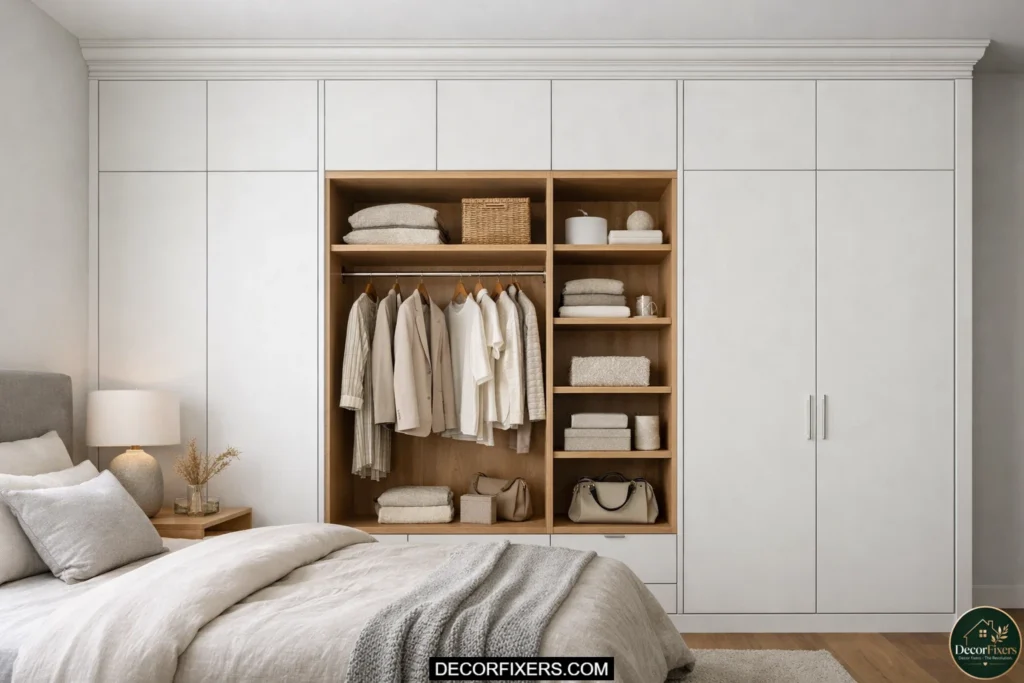
The PAX wardrobe system is the industry benchmark for budget-friendly modular storage. Out of the box, it looks exactly like what it is: flat-pack furniture. The upgrade is framing it with a custom-built surround, a simple plywood soffit that runs to the ceiling, and side panels that fill the wall-to-wall gap. The result looks built-in. The cost is a fraction of bespoke. One PAX unit starts at approximately £150–£300, depending on size; the surrounding carpentry adds £400–£800, depending on your joiner. Full-wall built-in look for under £1,200 in most UK cities.
20. Modular Wardrobe With Mix-and-Match Doors
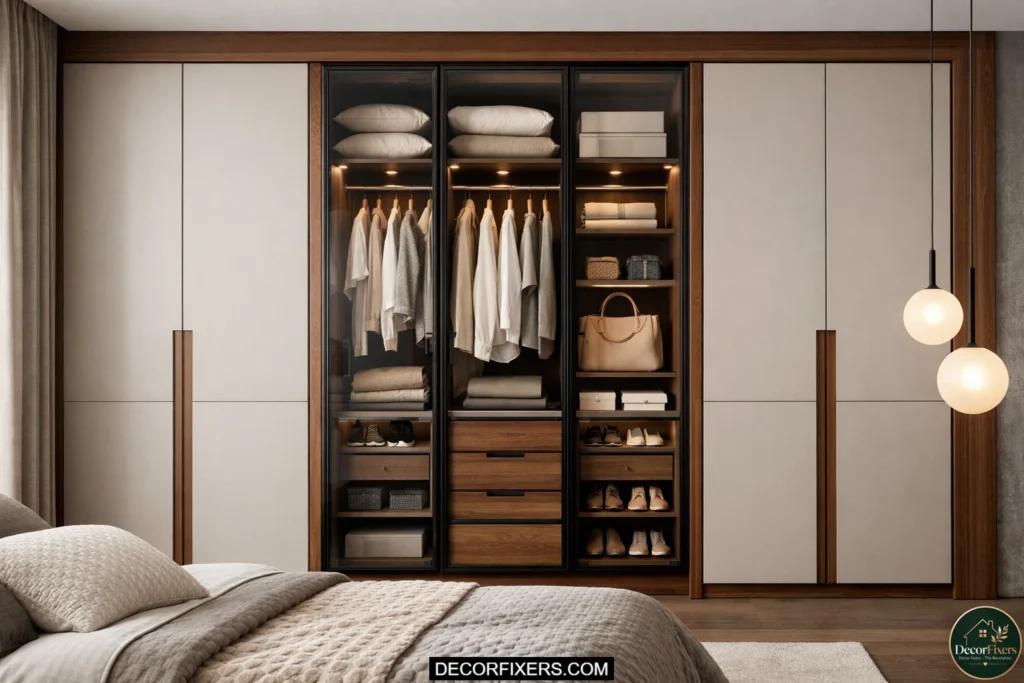
Leading South Asian modular brands like Spicewood and Godrej offer door configuration mixing, matte panels on outer frames, glass inserts in the center, or wood veneer accents across selected doors. This level of customization at a mid-range price point is one reason these brands have strong urban penetration across Indian and Pakistani markets. If you’re working with a carpenter in Lahore, Karachi, or Mumbai, request this modular-door approach as a starting brief.
21. Floating Modular Wall, No Floor Fixing
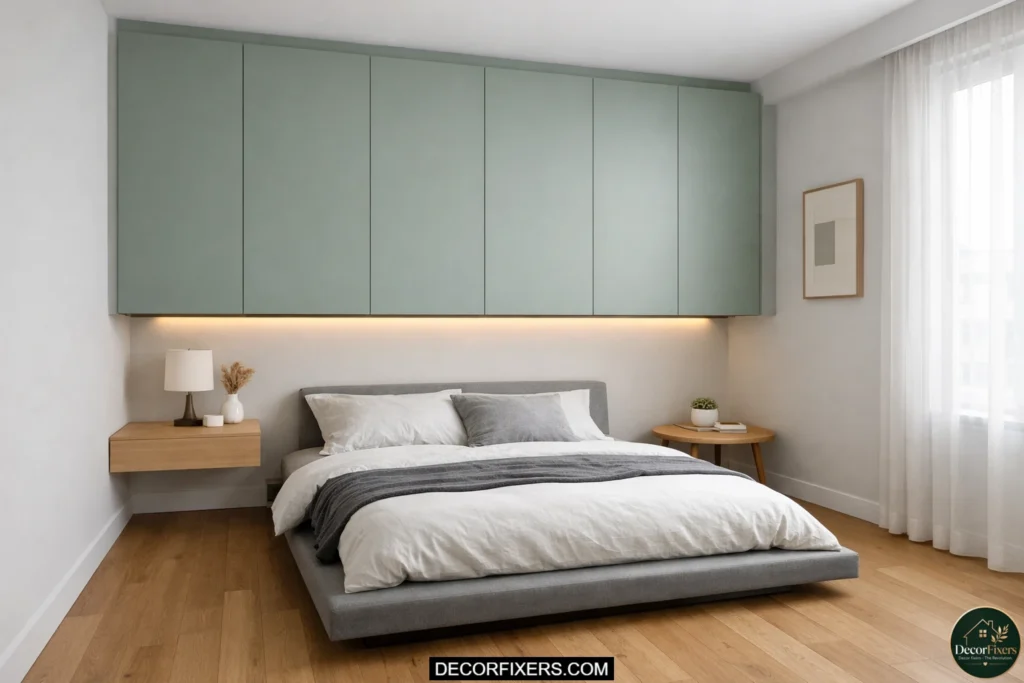
Wall-mounted modular cabinets that float 30cm above floor level are having a moment. The visible floor beneath makes small rooms feel less crowded; cleaning becomes significantly easier; and the design looks intentional rather than accidental. Works best with handle-less doors and a consistent finish across all modules. Maximum load per wall-mounted module: check manufacturer specs, most support up to 30kg per unit.
22. Modular Wardrobe + Dressing Table Combo
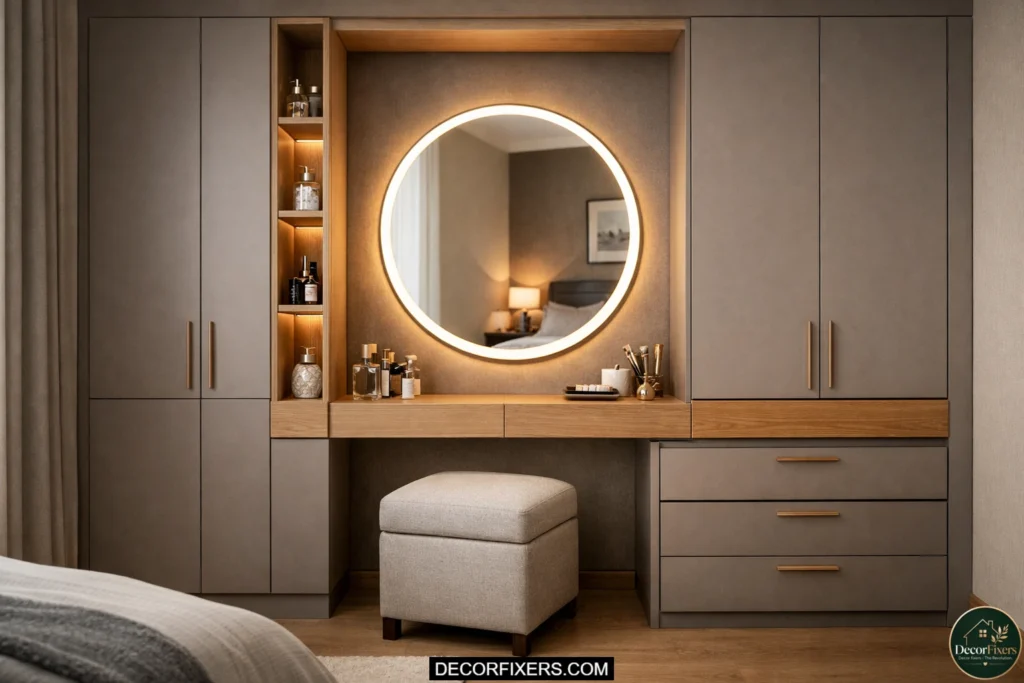
This is the spatial efficiency play. A modular system with a dedicated section, typically 80–100cm wide, that has a shallow shelf at desk height, an integrated mirror above, and drawer units below, gives you a full dressing table without adding a separate piece of furniture. Wall and All Interiors calls this an ’emerging trend for 2026′, the combination saves floor space and creates a single coherent wall rather than furniture competing for attention.
23. Modular Wardrobe in Sage Green With Brass Hardware
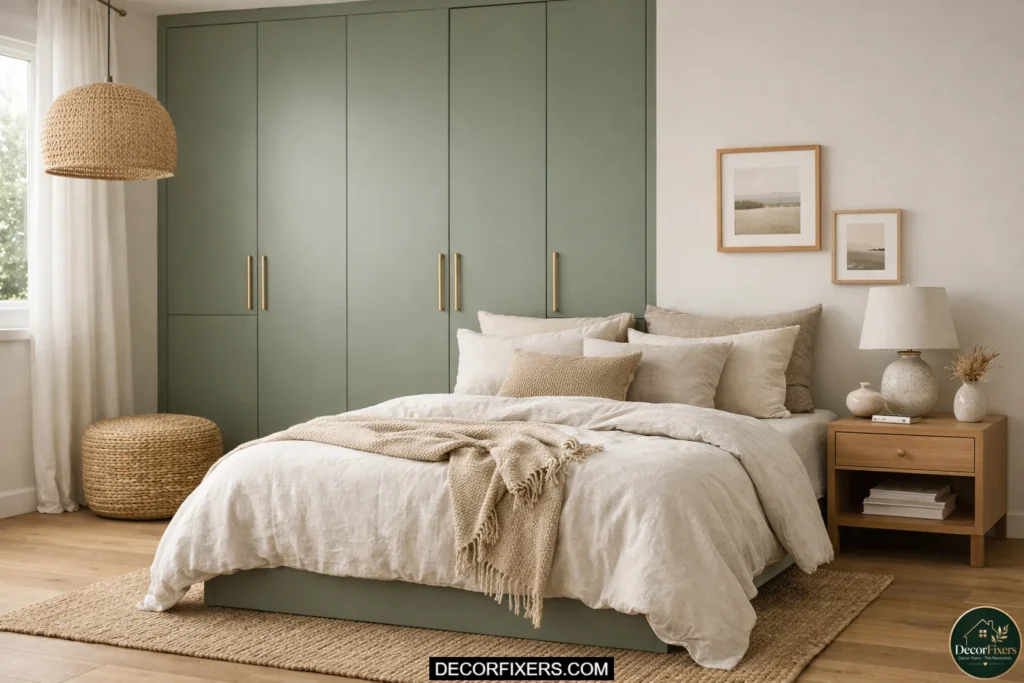
Sage green with warm brass or antique gold handles is probably the most requested mid-range modular finish right now. The combination sits naturally in any bedroom with natural materials, linen bedding, rattan accents, and wooden floors. The Coolist’s 2026 bedroom wardrobe roundup describes the sage exterior with oak interior combination as ‘classic with a modern twist, a reminder that color in the bedroom does not need to be bold to make an impact.’
24. Open-Back Modular Shelving as a Wardrobe Alternative
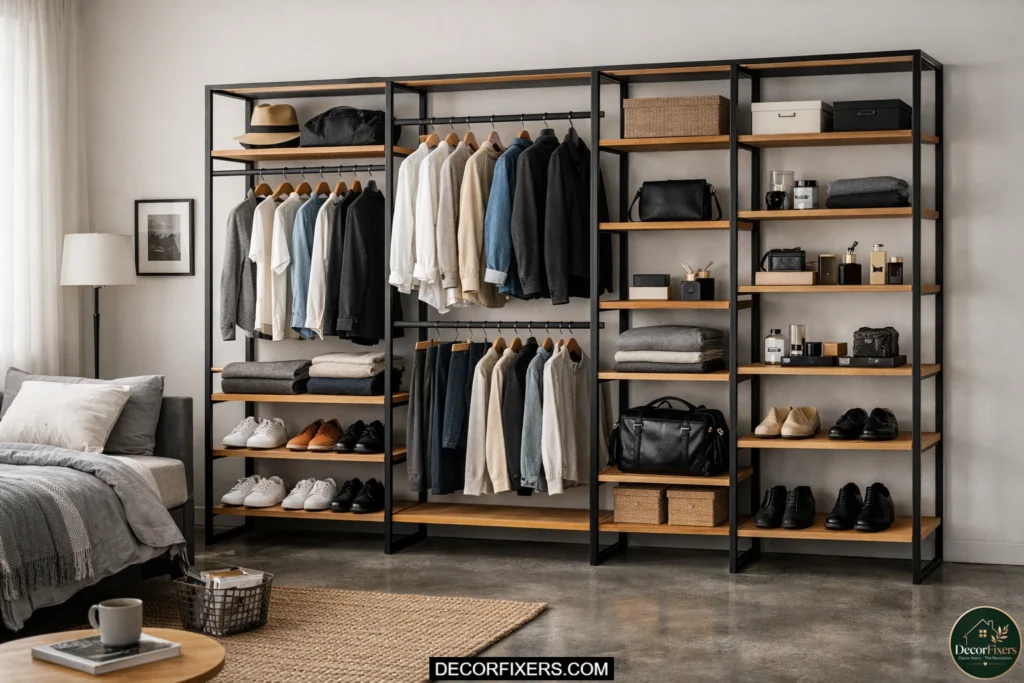
Look, if you’re in a studio apartment where everything is visible and you actually have well-organized clothing, a fully open modular shelving system can replace a traditional wardrobe entirely. The key is discipline (everything on display needs to look intentional) and dust management (open shelves collect it fast). This is the capsule wardrobe approach taken to its logical interior design conclusion. It works. It takes commitment.
A walk-in wardrobe doesn’t require a separate room. It requires a dedicated zone and the correct interior planning to make that zone earn its floor space. Here’s what most guides get wrong: they show you the walk-in of a 3,000 sq. ft. apartment and call it inspiration. Real walk-in wardrobe design for a 150–200 sq. ft. master bedroom is a different exercise entirely.
25. The L-Plan Walk-In Zone Within a Master Bedroom
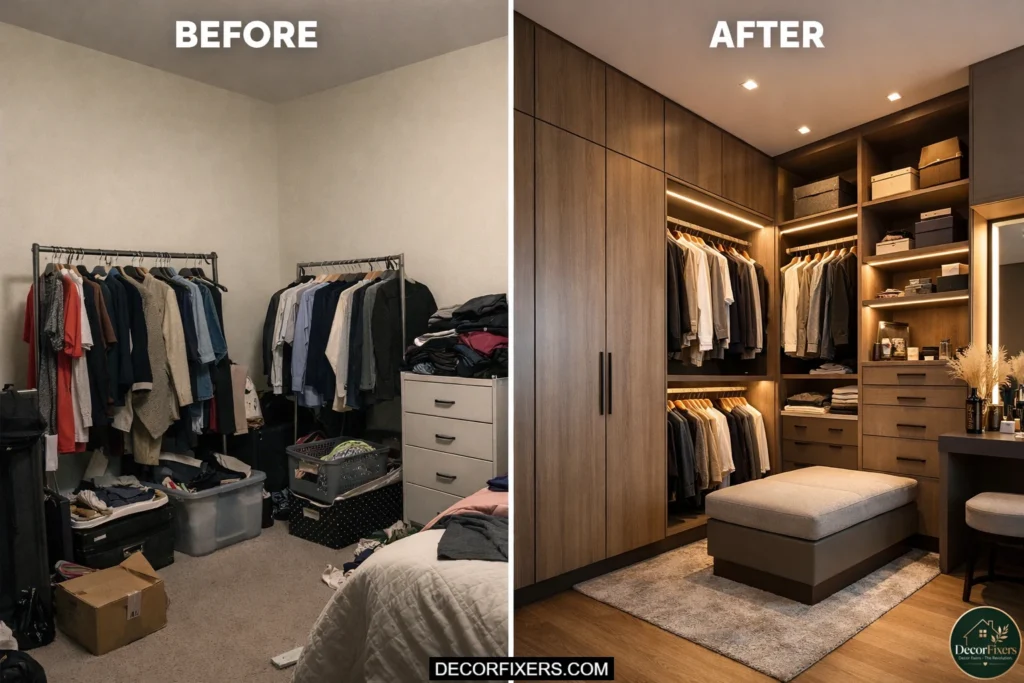
In a bedroom wider than 15 feet, you can create a walk-in zone by running one row of wardrobes along the back wall and a perpendicular run down one side, leaving the entrance open. This L-shape gives you dedicated hanging space on both walls without a separate room. A ceiling-height curtain or slatted screen defines the dressing zone without structural work. Total wardrobe access from a 2.5m x 2.5m corner.
26. Walk-In Island With Central Drawer Unit
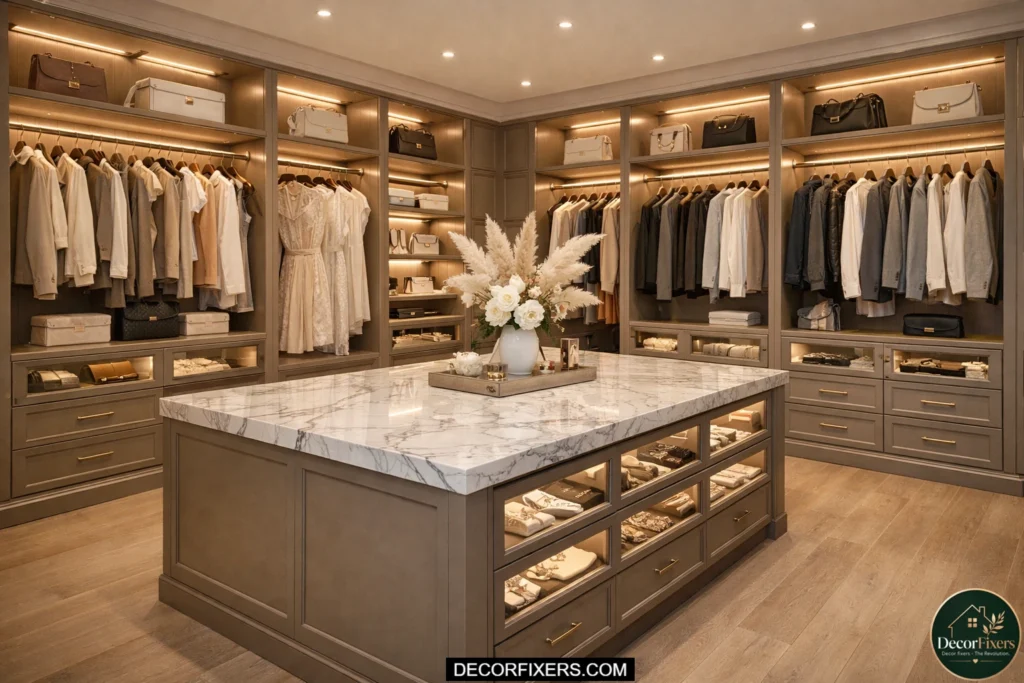
If your walk-in zone exceeds 8 feet in width, a central island, essentially a freestanding drawer unit with a flat top, elevates the space from functional to genuinely luxurious. The top surface handles folding and accessory laying. Below: drawers for knitwear, accessories, and folded trousers. The island should be no wider than 90cm, and leave at least 90cm of circulation space on each side. This is a Sharps Bedrooms signature detail; their bespoke interior planning frequently includes central islands in walk-in configurations.
27. Partial Walk-In With Glass Partition
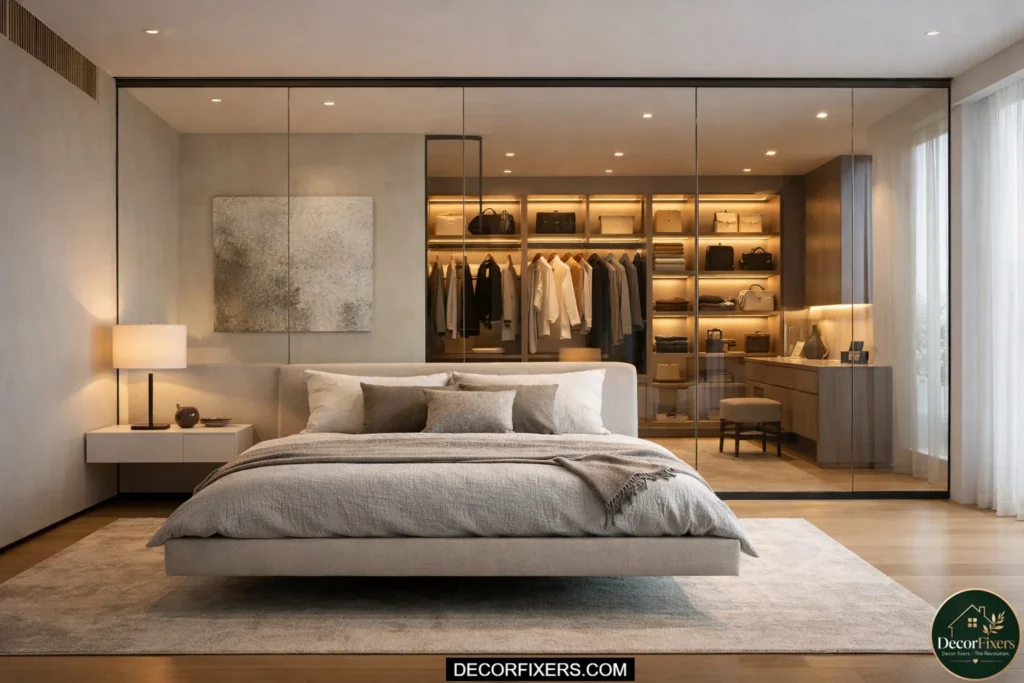
A frameless glass partition between the sleeping area and the dressing zone creates a walk-in that feels separate without sacrificing light. The glass reflects your clothes back into the bedroom, creating a boutique-like display effect. Used by Sharps Bedrooms in premium master bedroom fit-outs, this approach works in rooms from 150 sq. ft. upward. The partition is typically 180cm high, not ceiling height, which keeps the space open above.
28. Walk-In With a Full-Length LED Mirror Wall
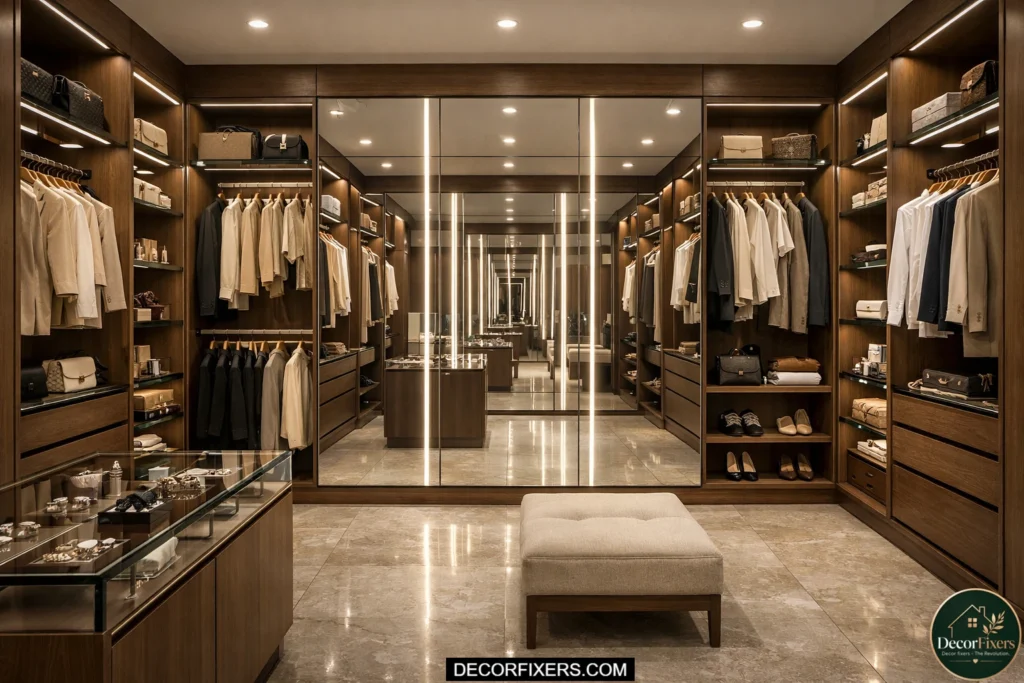
Replace the back wall of your walk-in zone with backlit full-length mirror panels. The LED lighting gives true color rendering for outfit checks, and the mirror visually doubles the depth of the dressing zone. LED color temperature matters: aim for 3,000–4,000K (warm white to neutral) for accurate color perception. Pure white light (5,000K+) distorts clothing colors and makes skin tones look flat.
29. Budget Walk-In Using a Corner Curtain Track
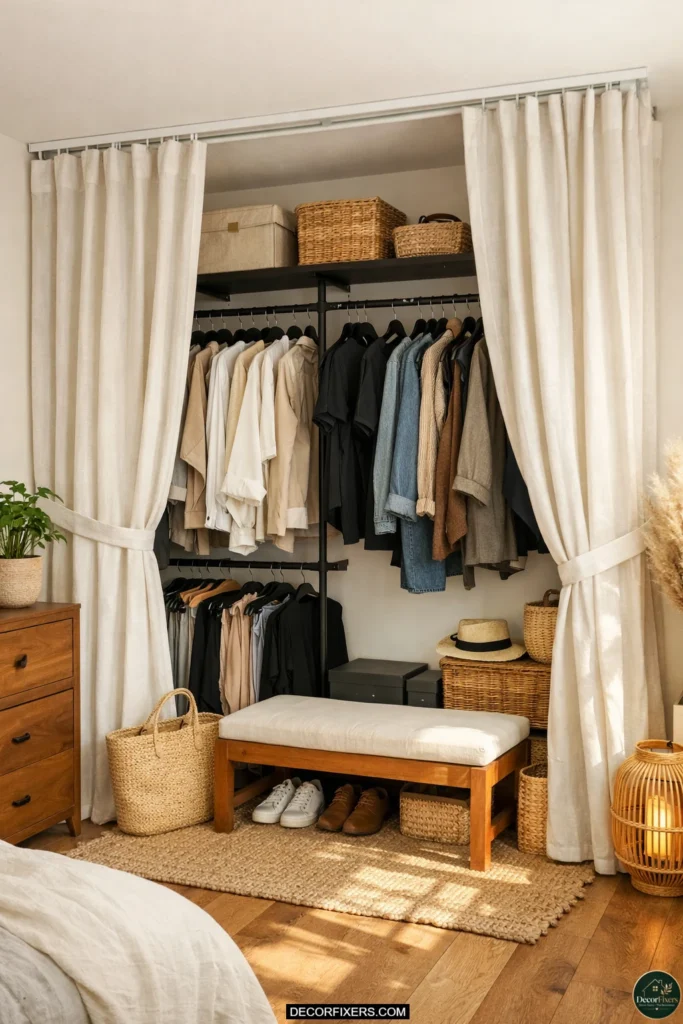
Not every walk-in needs carpentry. A ceiling-mounted curved curtain track in a corner of your bedroom, fitted with a floor-length curtain, creates a dressing zone from a freestanding garment rail inside. This whole setup, track, curtain, and garment rails runs under £150 in most UK and European markets. It won’t look bespoke, but it functions as a private dressing zone and can transform how you use the space every morning.
Here’s the thing: interior compartment planning is where most wardrobe projects succeed or fail. You can spend £3,000 on beautiful fitted doors and then fill the interior with a single hanging rail and two shelves, and wonder why your wardrobe still feels chaotic. The logic of what goes where matters more than almost any other design decision.
| Built-In vs. Modular: Which Is Right for Your Bedroom? Built-in wardrobes suit permanent homes where you want architectural integration, ceiling-height seamlessness, and long-term storage permanence. Modular wardrobes (e.g., IKEA PAX, space wood, Godrej) suit renters and flexible budgets; they’re reconfigurable and portable. The key difference: built-in looks like part of the room; modular looks like furniture. Both can be made to look similar with the right surround treatment. |
30. The 50/30/20 Hanging Zone Rule
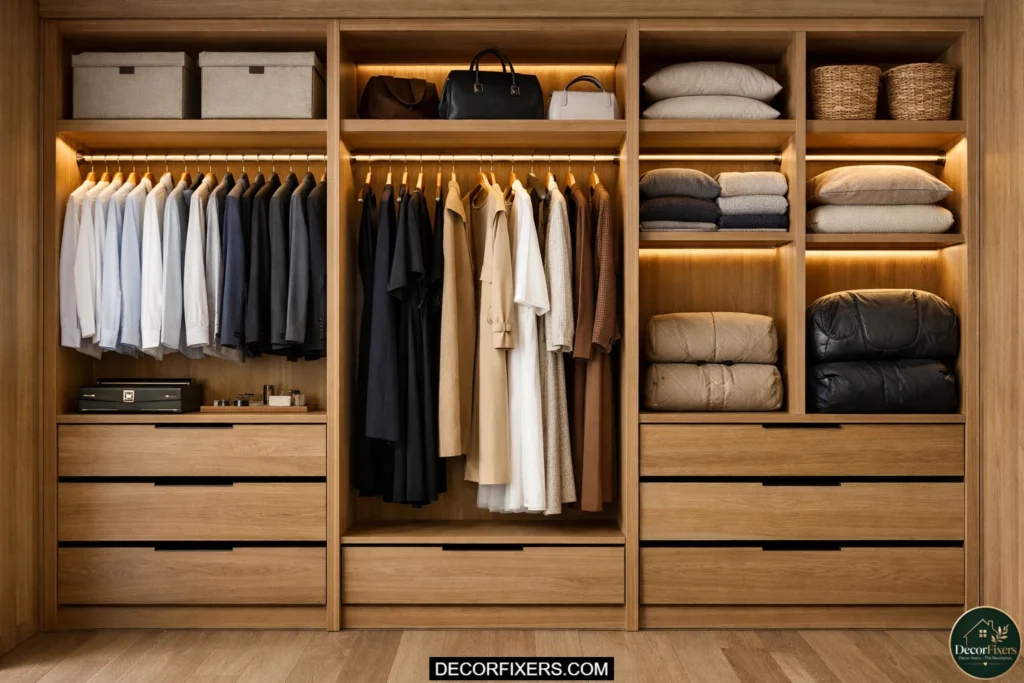
A wardrobe that actually works follows a hanging zone ratio: 50% of hanging space for short items (shirts, jackets, trousers folded over a rail), 30% for long items (dresses, coats, suits), and 20% for very long or bulky items. Below every short-hang section, you gain 40–50cm of usable space, enough for a small set of drawers or a shoe rack insert. JV Carpentry’s interior layout guide recommends organizing hanging sections by garment length as its primary layout tip, and it’s genuinely the most impactful change most wardrobes need.
31. Drawer Ratios for Everyday Clothing
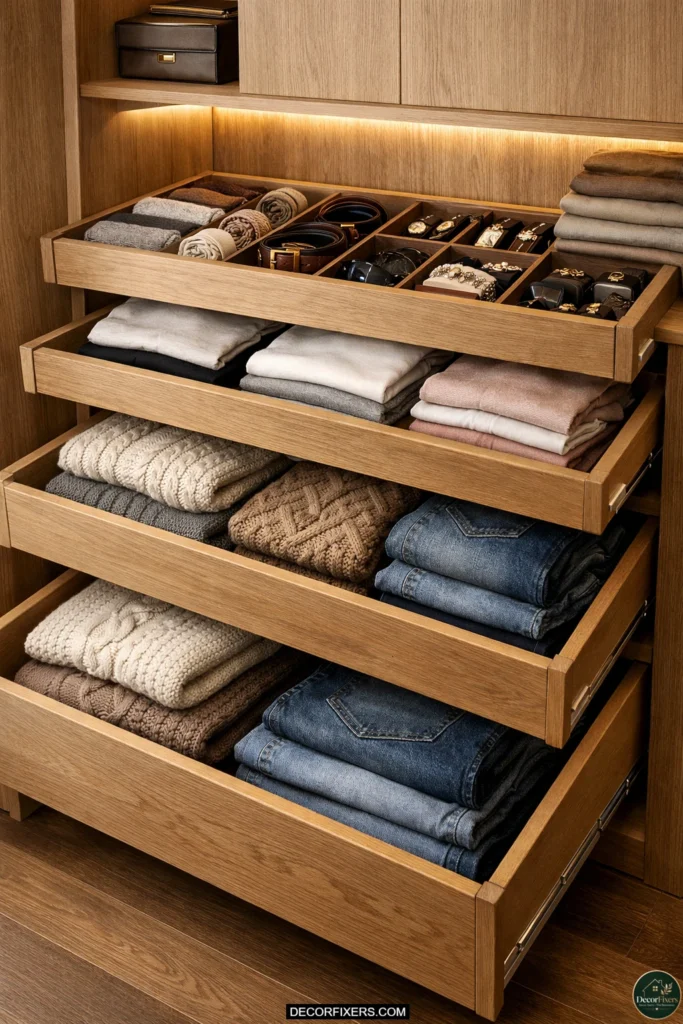
Most wardrobes have too many shelves and too few drawers. Folded items on open shelves collapse into each other within a week. The recommended drawer allocation for a 2-person household: 6–8 drawers of standard depth (12–16cm), plus 2 deep drawers (25–30cm) for knitwear and denim. A wardrobe that’s 3 meters wide should allocate at least one full meter of that width to drawer units. This single change often eliminates the need for a separate chest of drawers in the bedroom.
32. Dedicated Shoe Zone Design
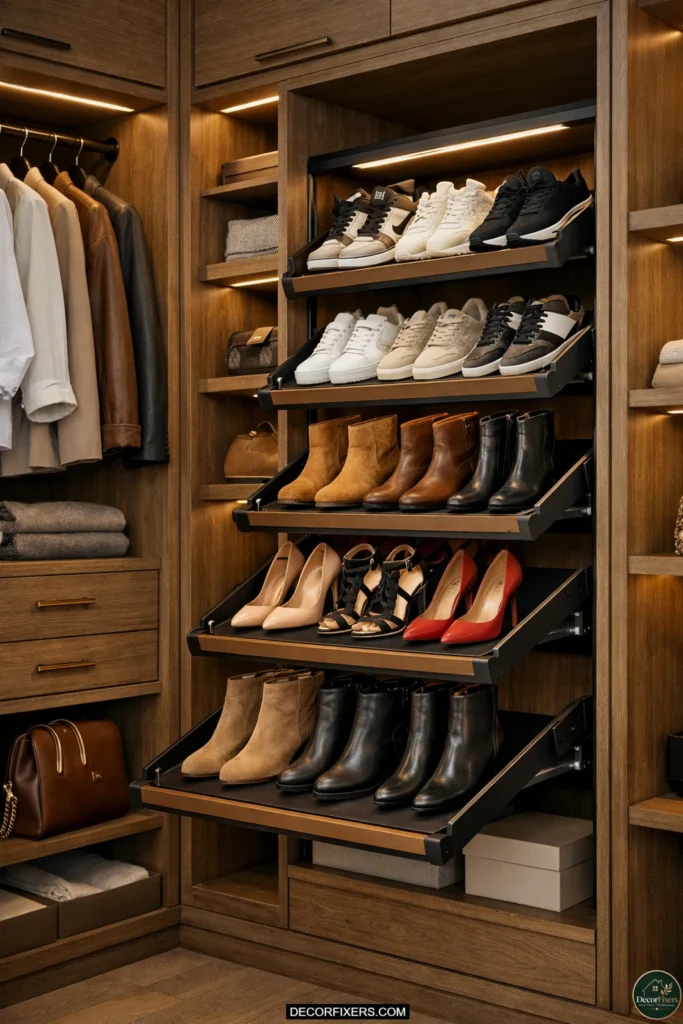
Shoes need specific shelf spacing: 12–15cm between shelves for flats and trainers, 18–20cm for boots and heels. A 60cm-wide shoe tower with 10 shelves holds approximately 20 pairs, enough for most households. A pull-out angled shoe rack (where shoes rest at a 15-degree incline) fits more pairs in the same space and makes selection faster. Dako Furniture includes shoe zone planning as a core element of built-in wardrobe interior design.
33. Integrated Accessories Drawer With Dividers
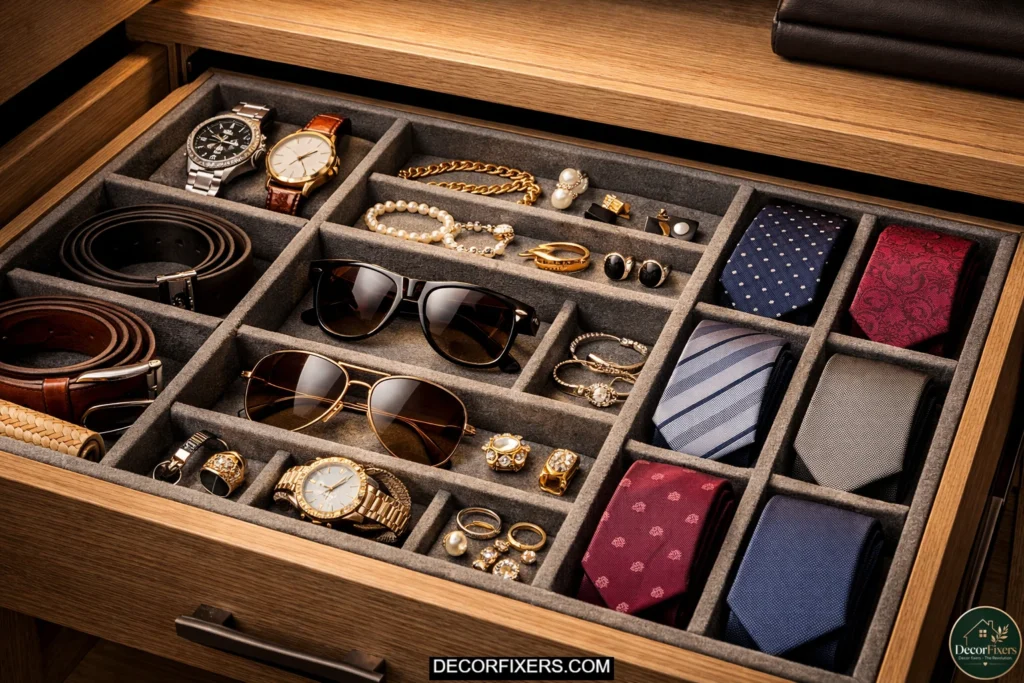
A single accessories drawer, fitted with a custom insert divided into compartments for jewelry, belts, ties, and sunglasses, replaces the bedside table clutter that accumulates in most bedrooms. The insert should be lined with felt or cork. Depth: 6–8cm is ideal. Deeper drawers cause accessories to layer and get lost. This one interior detail disproportionately improves the daily experience of using a wardrobe.
34. Motion-Sensor LED Interior Lighting
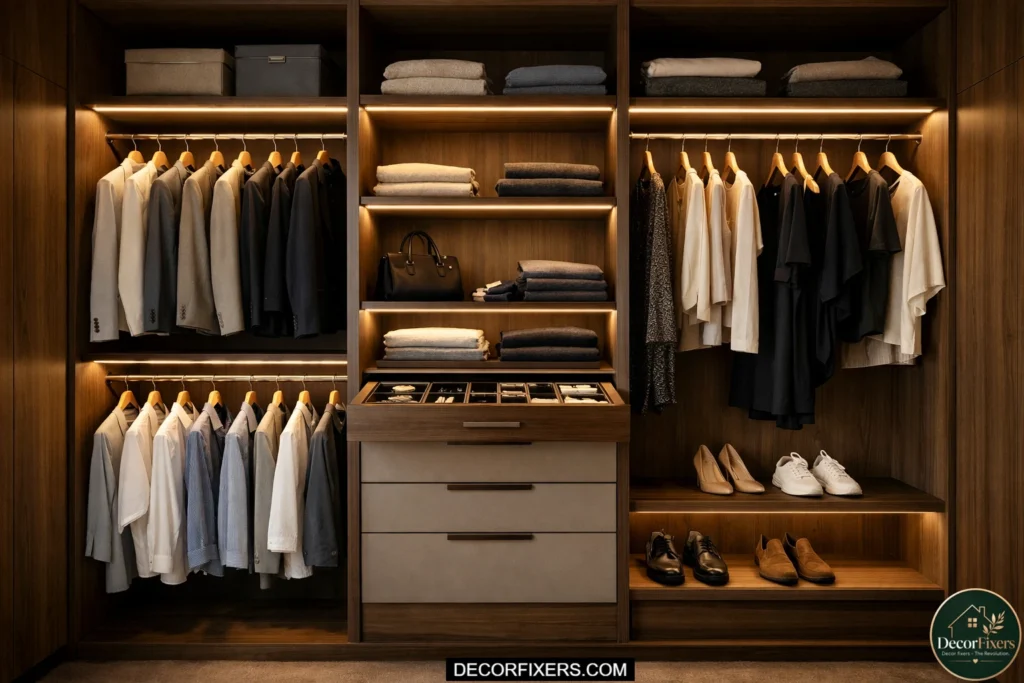
Motion-activated LED strips along hanging rails and shelf undersides transform how usable a wardrobe is on dark mornings. The specification to request: warm white LEDs (2,700–3,000K), strip lighting along both the hanging rail and the shelf edge above it, and a motion sensor with a 30-second auto-off. Wall and All Interiors notes motion-sensor LED lighting as a standard smart addition in 2026, fitted wardrobe designs.
35. Valet Hook and Pull-Out Mirror
A slim pull-out mirror (10cm wide, retracted) and a valet hook on the inside of a door make the wardrobe a full dressing station without needing a freestanding mirror. The valet hook holds tomorrow’s outfit. The pull-out mirror handles the final outfit check. These two hardware items together cost under £80 from most wardrobe fitting suppliers and are the most practical upgrades for a daily-use wardrobe that most people never think to specify.
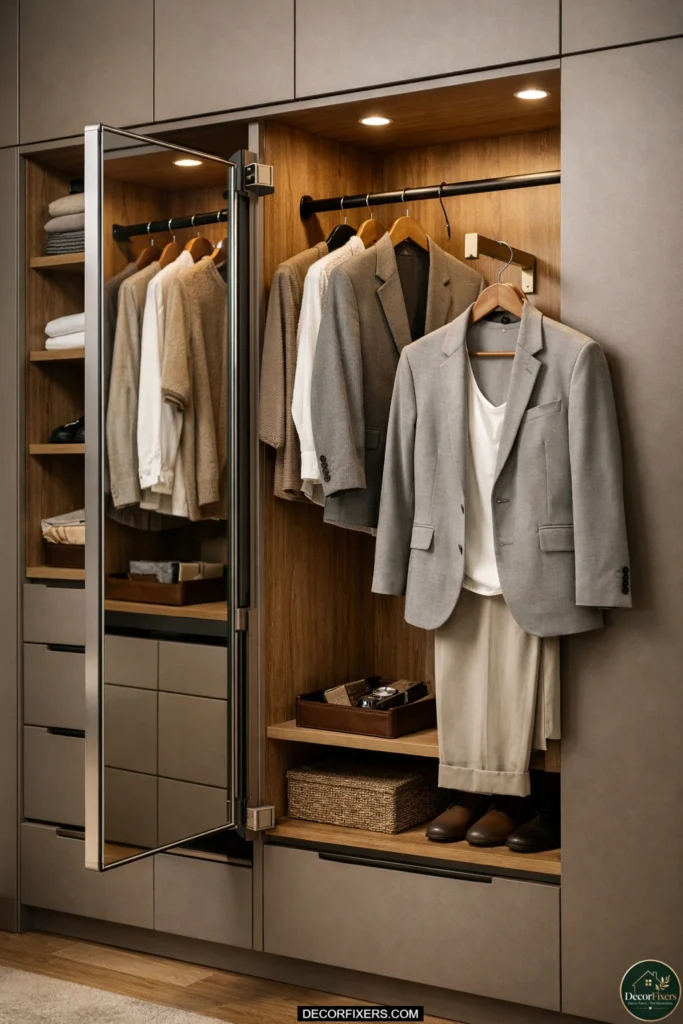
Interior designer, Laura Stephens, told Homes and Gardens that the direction for 2026 built-in wardrobes is ‘personality in the details, a tactile rope or beaded trim, woven cane, or a sculptural handle that feels more like a jeweler than a grip.’ The finish is where character lives.
36. Paint-to-Wall Tone-on-Tone Wardrobes
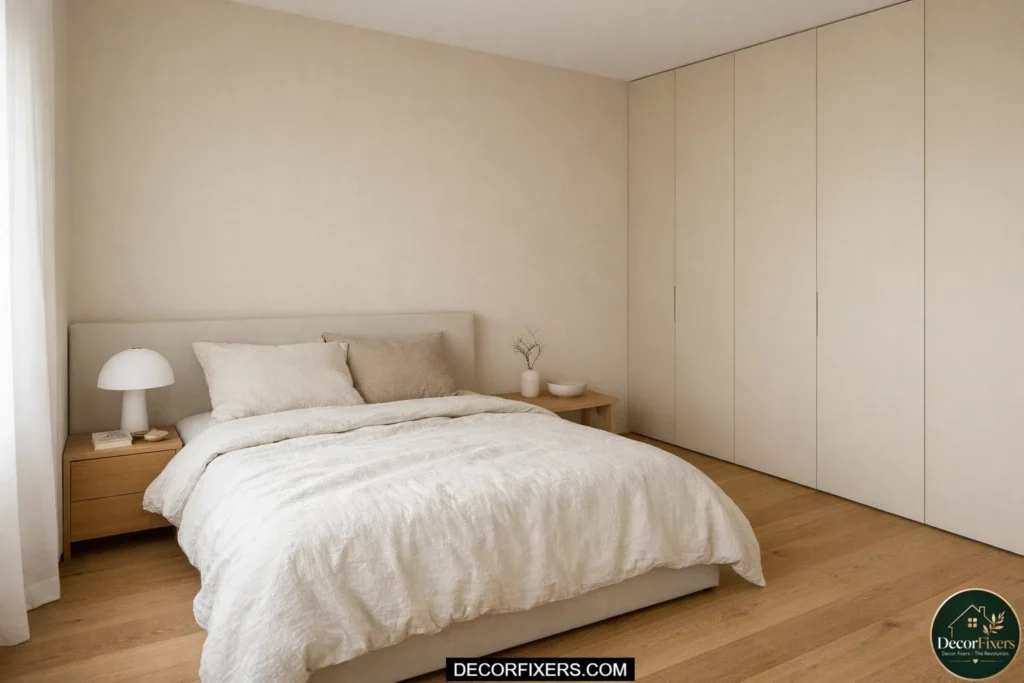
Painting your wardrobe the exact same color as your walls is the single most effective way to make a bedroom feel larger and more cohesive. The wardrobe ‘disappears’ into the room. Laura Stephens adds: ‘Designing wardrobes to feel bespoke rather than generic is what will keep them looking current for years to come’, and tone-on-tone is the most reliable version of that. It works in every color family: white, grey, navy, sage, and terracotta.
37. Warm Oak Veneer Interior With Matte Painted Exterior
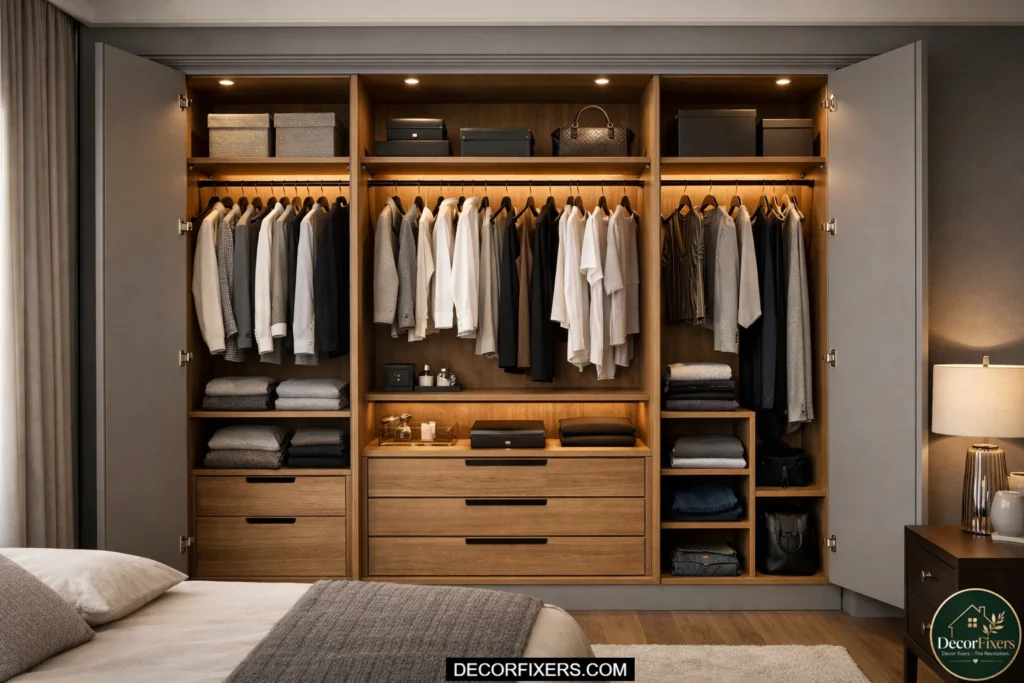
The contrast between a cool, matte exterior (white, grey, or sage) and a warm oak interior is one of the most consistently popular wardrobe combinations right now. The exterior blends with the room; the interior rewards you when you open the doors. It feels considered without trying hard. This is the combination The Coolist describes as ‘classic with a modern twist.’
38. Textured Laminate, Concrete, Linen, and Ribbed Wood Finishes
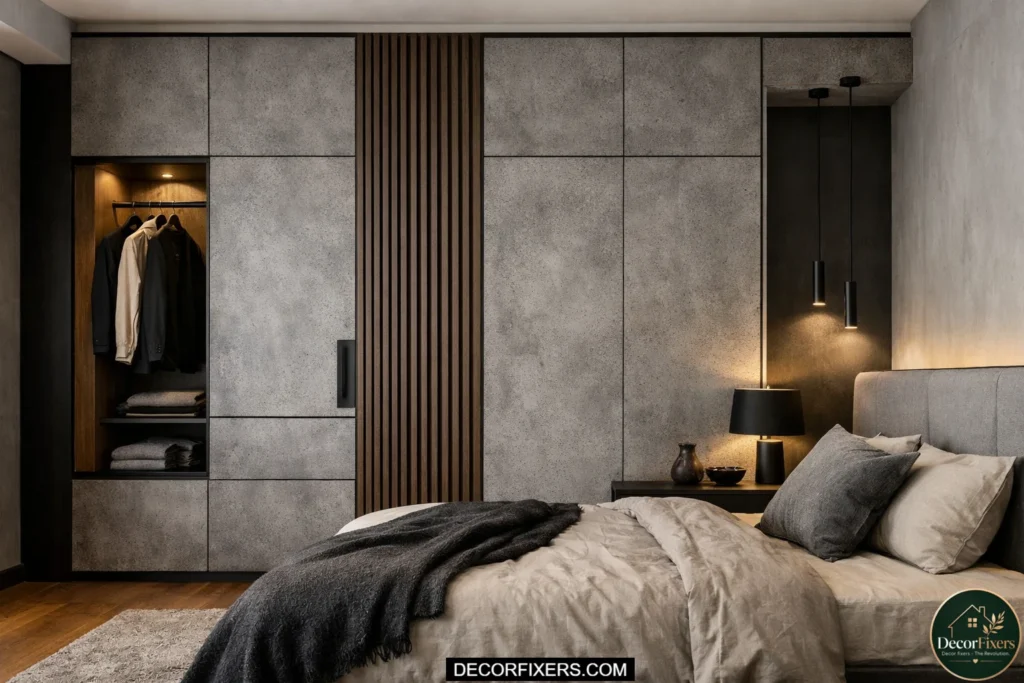
High-pressure laminate in textured finishes, concrete grey, linen white, or ribbed vertical wood grain, delivers the visual complexity of natural material at a fraction of the cost and with significantly better durability. These finishes are scratch-resistant, moisture-tolerant, and consistent across panels, something real wood veneer can’t always guarantee. Homelane’s 2026 wardrobe guide notes ‘smooth laminate finishes and beautifully balanced proportions’ as defining features of modern 2026 wardrobe design.
39. Cane Front Panels or Woven Rattan Inserts
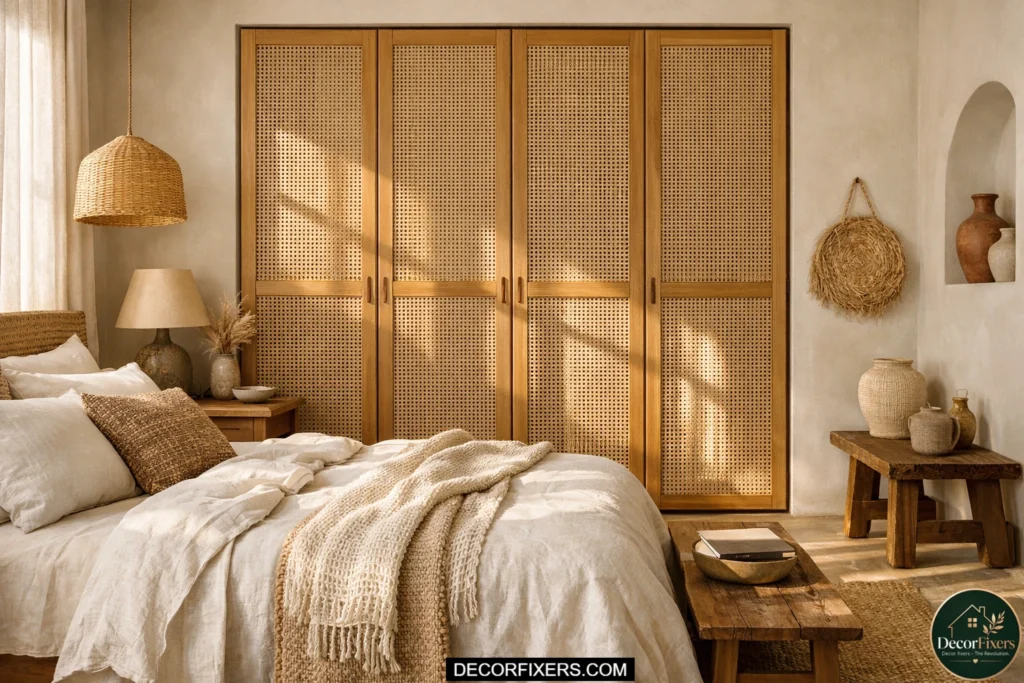
Replacing solid door panels with cane or rattan weave inserts adds warmth, texture, and a natural material reference to any wardrobe. It’s one of the details Laura Stephens specifically calls out for keeping built-ins ‘feeling fresh and right for 2026.’ Cane panels also allow slight ventilation, useful in wardrobes storing natural fibers like wool or cashmere. The insert can be retrofitted into existing door frames; it doesn’t require full door replacement.
40. Eco-Friendly Bamboo and Salvaged Wood Wardrobes
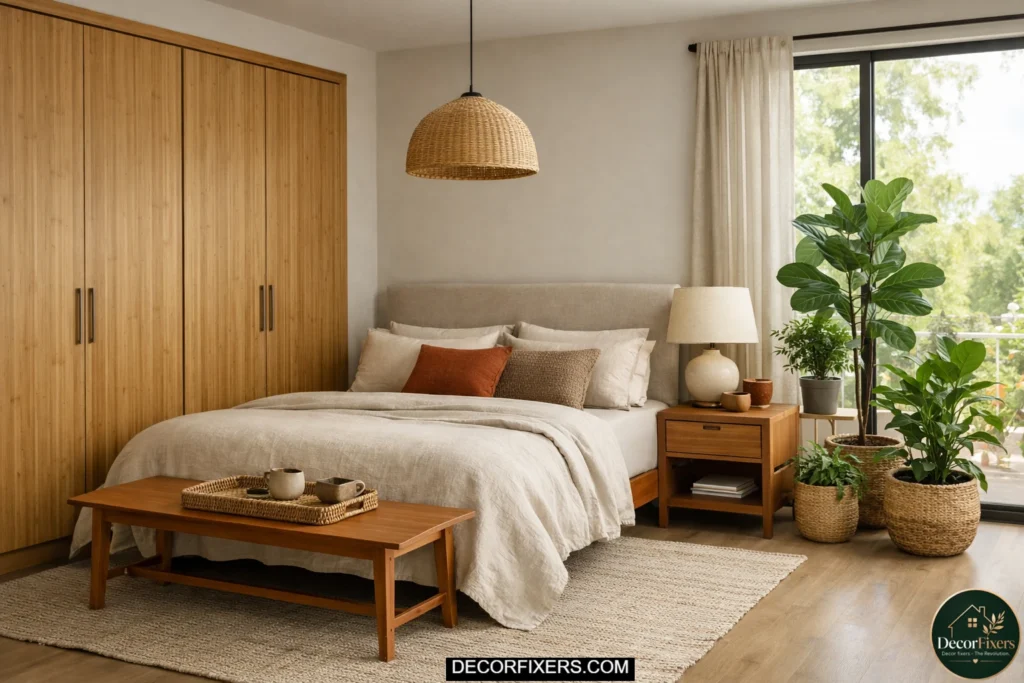
Sustainability is no longer a niche consideration in wardrobe design. Wall and All Interiors notes that eco-conscious households are increasingly choosing wardrobes made from bamboo, salvaged wood, and sustainable veneers. Bamboo-veneered carcasses are dimensionally stable, hard-wearing, and carry a considerably lower carbon footprint than MDF. Pair matte earth tones, walnut, teak, oak, with pastel or neutral bedroom colors for what the same source calls ‘a cozy yet contemporary look.’ This is a direction that will age well, aesthetically and ethically.
CONCLUSION:
I’ve looked at a lot of wardrobe designs now, and here’s what genuinely changed my thinking: the interior layout matters more than the exterior finish. You can have the most beautifully fitted wardrobe doors in the world, but if you’re still living with a single hanging rail and a shelf you can’t reach, the problem isn’t solved. It’s just hidden.
If I were starting a bedroom redesign today, I’d do three things first: measure the wall and identify the door type that actually fits the room (sliding for anything under 10 feet wide), plan the interior zones before I choose any finish, and pick a color that matches my wall. That last one costs nothing and has the biggest visual impact of anything on this list.
The 40 ideas in this guide run from full bespoke built-ins (worth every penny if you own your home) to the budget sliding-door setups that still outperform most freestanding wardrobes on the market. Pick the one that matches your room size, your budget, and, honestly, the way you actually get dressed in the morning. That’s the only design that counts.
Have a specific room layout you’re working around? Drop your measurements, and I can suggest the most efficient wardrobe configuration for your space.
FAQs:
Q: What’s the best wardrobe design for a small bedroom?
A: For rooms under 120 sq. ft., a sliding door built-in wardrobe that runs floor-to-ceiling and wall-to-wall is the most space-efficient option. Sliding doors eliminate swing space; ceiling height avoids dead space above. Paint it the same color as your walls.
Q: How do I plan a built-in wardrobe interior?
A: Follow the 50/30/20 rule, 50% short hanging, 30% long hanging, 20% bulky items. Add drawers below short-hang sections. Allocate at least one full meter of width to drawer units. Include a dedicated shoe zone with 12–20cm shelf spacing.
Q: Should I choose sliding or hinged doors for my wardrobe?
A: Sliding doors work best in rooms under 120 sq. ft. where door swing conflicts with the bed or circulation. Hinged doors give full simultaneous access to the entire wardrobe interior, better for larger rooms where swing space isn’t an issue.
Q: Why does my wardrobe always look messy even after tidying?
A: Usually, because the interior zones don’t match how you actually use your wardrobe. A single long hanging rail and two shelves can’t handle a mixed wardrobe. The solution is interior redesign, zoning by garment type, adding drawers, and including an accessories insert.
Q: When should I choose modular over fitted wardrobes?
A: Choose modular, like IKEA PAX or Spicewood, if you’re renting, have a limited budget, or expect your storage needs to change. Choose fitted or built-in if you own your home and want a seamless, permanent result that adds resale value.

Creator of DecorFixers, sharing practical home and interior ideas focused on real-life usability, simple design improvements, and budget-friendly solutions.