

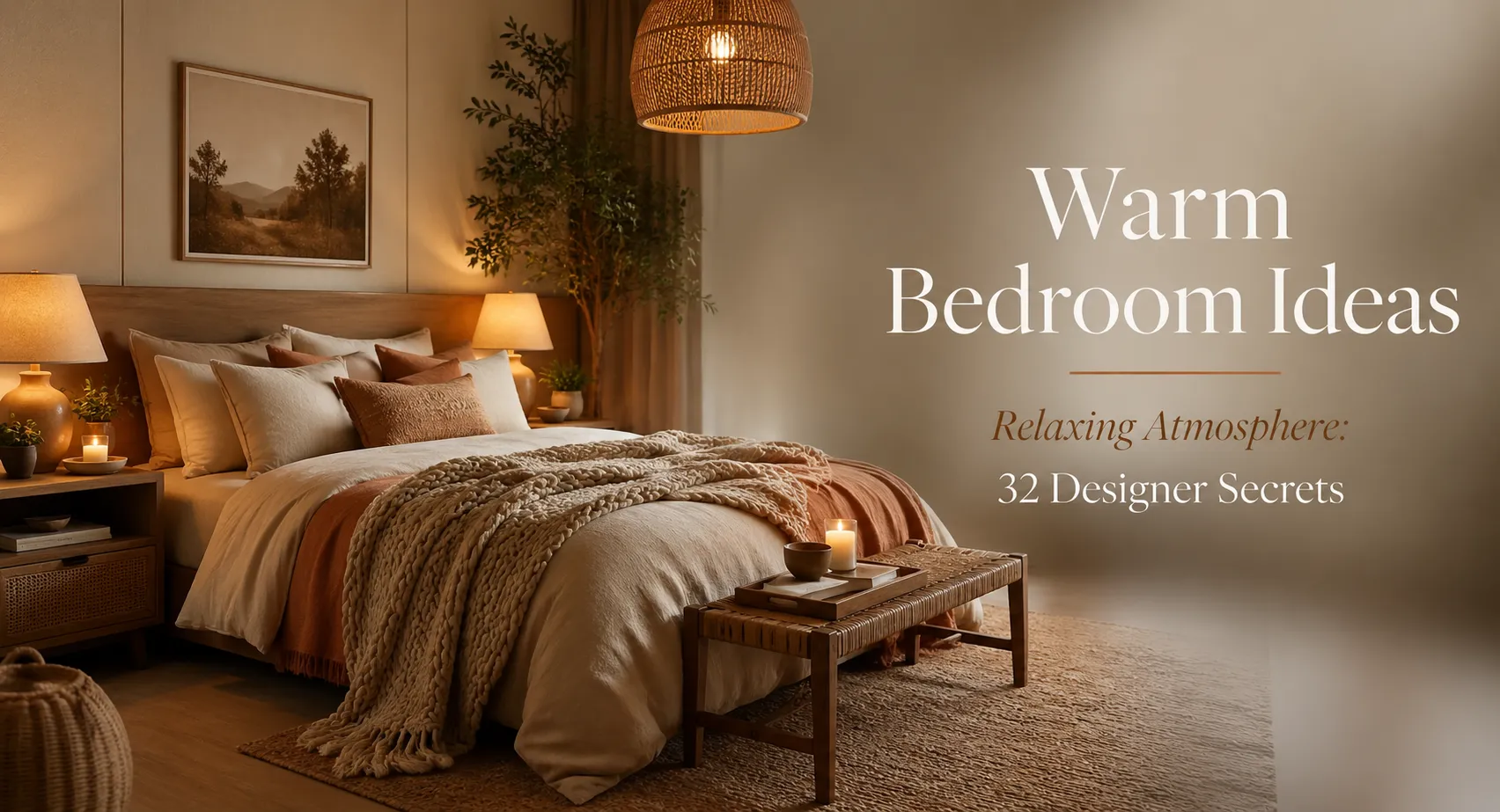
Warm bedroom ideas for a relaxing atmosphere refer to intentional design choices, layered lighting, earthy color palettes, tactile textures, and sensory details that shift a bedroom from visually “fine” to genuinely restful. The goal isn’t decoration. It’s creating an environment your nervous system actually wants to unwind in.
Your bedroom looks fine. That’s the problem.
It’s clean, it’s neutral, it matches. But every night you climb into it and feel nothing. No exhale. No softness. Just a room that happens to have a bed in it.
Here’s the thing: warmth isn’t about spending more. It’s about understanding why certain spaces feel like a hug, and others feel like a waiting room.
Lighting temperature, material weight, scent, sound absorption: these are the levers. This guide pulls all 32 of them.
1. Switch to 2700K Bulbs in Every Fixture
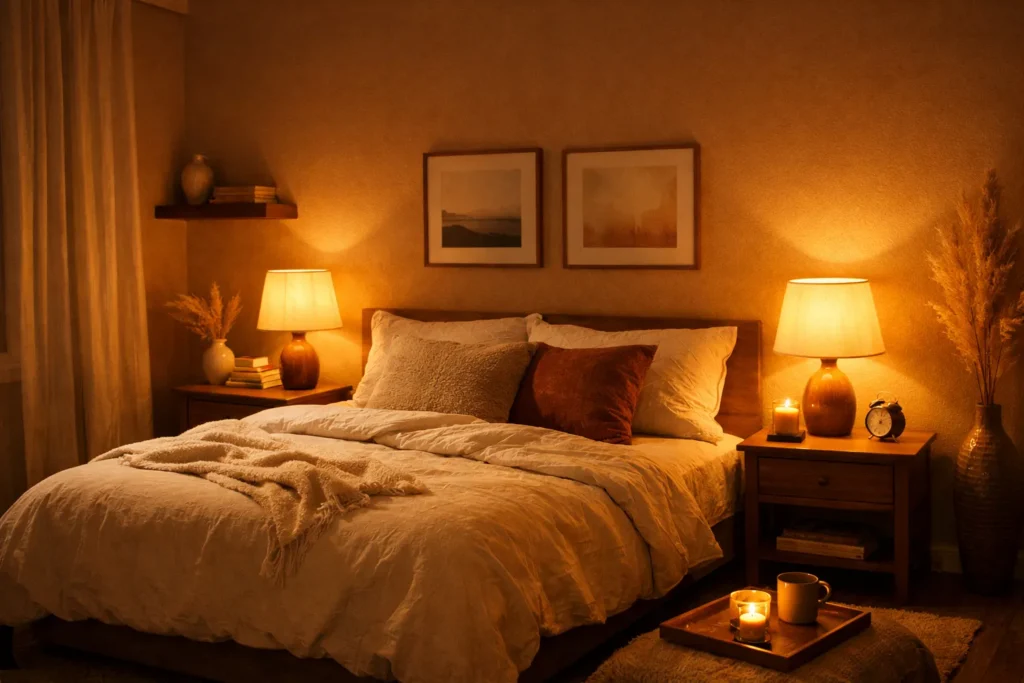
The single highest-leverage change you can make costs under $15. Most bedrooms run on cool-white bulbs between 4000K and 5000K, the same light temperature as a hospital corridor.
According to a 2022 report by the American Lighting Association, 72% of homeowners rank lighting comfort as their top priority when redesigning bedrooms, above style and cost. Swap every bulb to 2700K–3000K warm white. The shift is immediate and dramatic. Philips and GE both make excellent warm-white LED options under $12 for a 4-pack.
Your walls will look warmer, your skin will look healthier, and your brain will start interpreting “bedroom” as “wind down” rather than “stay alert.” This is where every bedroom transformation should begin, not with furniture, not with paint.
2. Layer Three Light Sources Instead of One
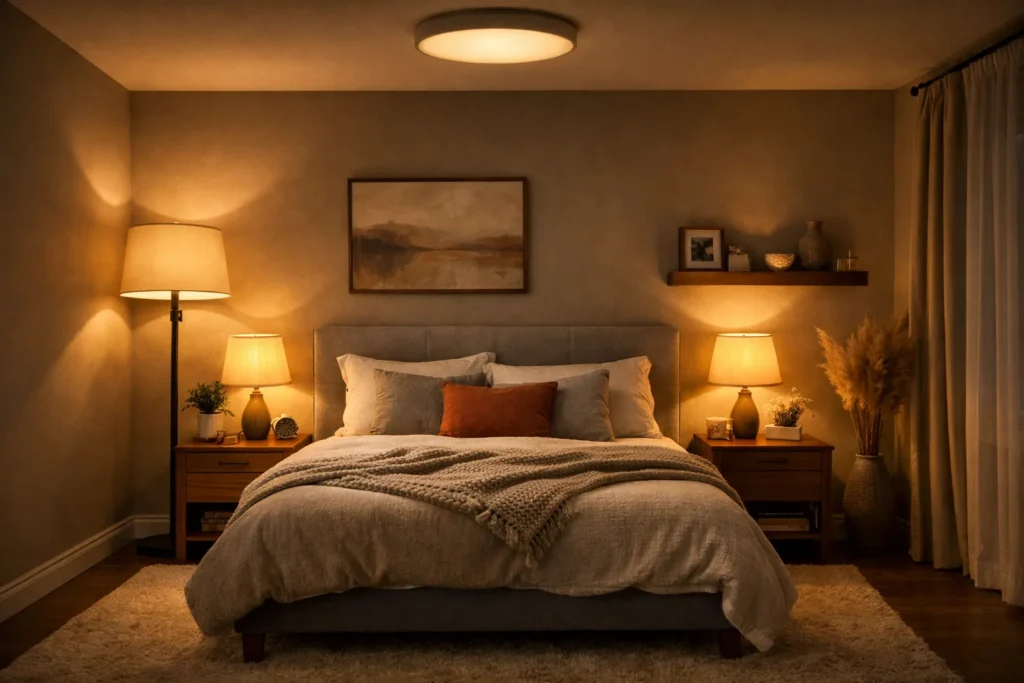
One overhead light makes a bedroom feel like an interrogation room. Warm rooms use layers: ambient (overhead or ceiling), task (bedside or desk), and accent (floor lamp, shelf light, candle). The goal is to be able to turn off the overhead entirely by 9 PM and run only the lower, softer sources.
This is what hotel rooms and high-end rental properties do that most people miss. A simple floor lamp from IKEA’s RANARP line ($49) paired with two clip-on reading lights ($18 each) gives you full layering for under $90. No rewiring, no electrician. Just plugs and placement.
3. Install a Dimmable Smart Bulb with Sunset Mode
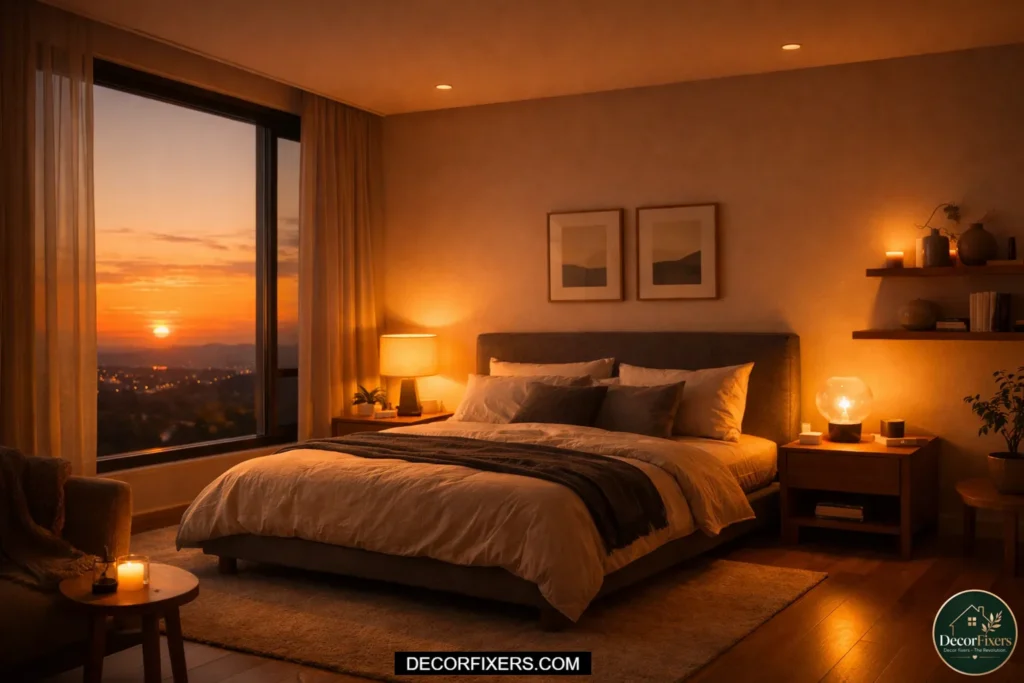
This one sounds indulgent. It isn’t. Philips Hue warm-tone smart bulbs ($24–$35 each) allow you to programme a “sunset simulation”, the light gradually dims and warms over 30 to 60 minutes, mimicking natural dusk and nudging your body toward melatonin production. The Casper Glow Light ($89) does this automatically without any app setup.
I’ve seen conflicting data on exactly how much sleep onset improves; some studies cite 15 minutes faster, others up to 30, but the physiological mechanism (light temperature suppressing cortisol) is well-established. My read: even if the improvement is modest, the ritual of watching the room dim is relaxing in itself. That’s worth $35.
4. Paint One Wall in a Warm Earthy Tone
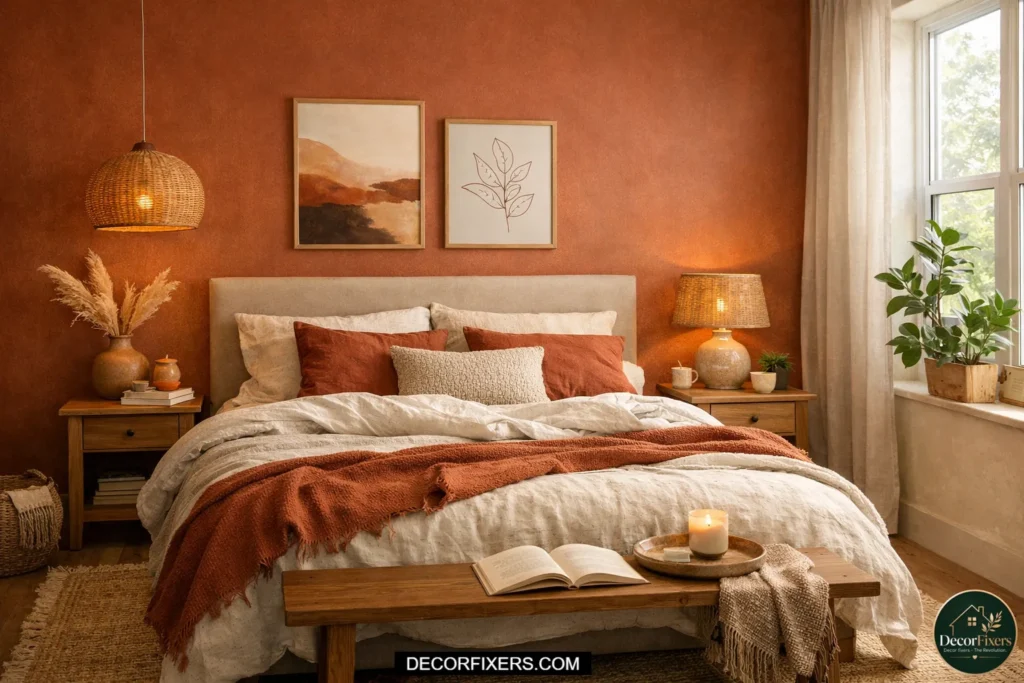
You don’t need to repaint the whole room. One accent wall in a warm terracotta, dusty clay, or deep sand tone does more for bedroom atmosphere than four walls of “greige.” Look at Benjamin Moore’s Pale Oak, Wenge, or Sherwood Tan, all under $60 per gallon, which covers a standard accent wall twice over.
The key is choosing undertones correctly: warm bedrooms need yellow, red, or orange undertones, not cool blues or greens hiding in your “neutral.” Hold the sample chip next to your bedding and your wood furniture before committing. One wall. That’s it. The rest of the room will read warmer just from the contrast.
5. Choose Bedding in Warm Neutrals, Not Bright White
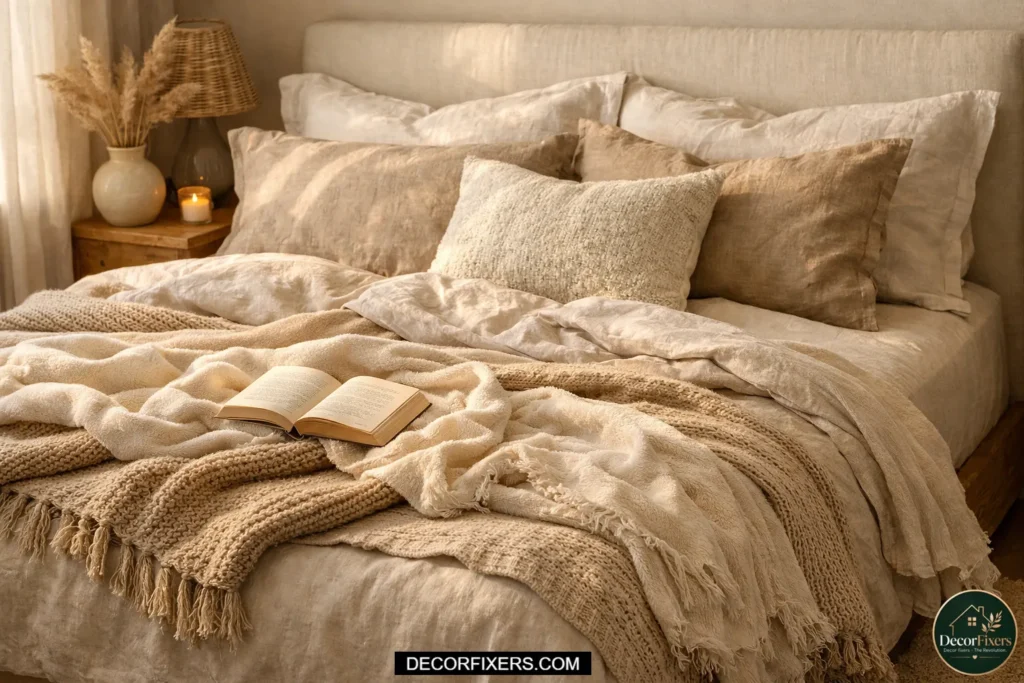
Bright white bedding photographs beautifully. It does not feel warm. Every luxury hotel that actually relaxes guests, think boutique properties, not chains, uses ivory, oatmeal, flax, or warm linen tones. These colours absorb light instead of reflecting it, which makes the bed feel softer and heavier even before you touch it.
A linen duvet cover set in warm sand tones from H&M Home or Amazon Basics runs $45–$85 and completely reframes the room’s temperature. Layer a slightly darker throw at the foot, deep camel or burnt sienna, and you’ve built a bed that looks like it belongs in an Italian countryside villa. Under $130 total.
6. Add a Chunky Knit Throw, Weight Matters
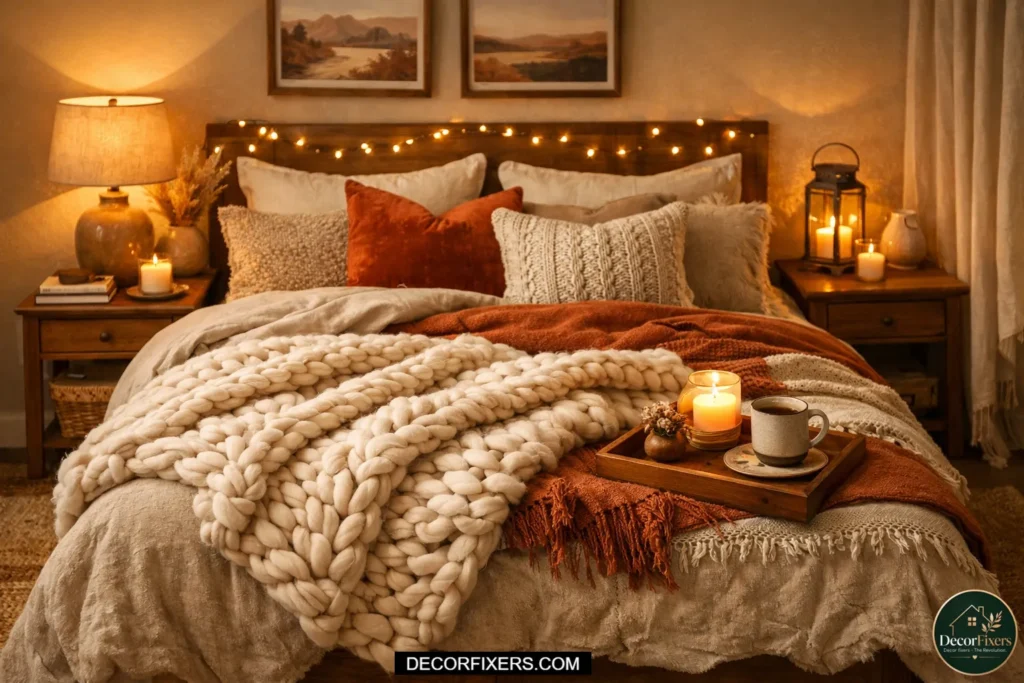
Not all throws are equal. The thin, polyester blankets that fold over armchair backs in every staged apartment do nothing for warmth, visual or physical. What you want is weight and texture: a chunky knit or waffle-weave throw in merino wool or a wool blend ($45–$120) that you can actually see from across the room.
The visual bulk signals comfort before you’ve even touched it. Drape it casually over one corner of the bed, not folded, not centered. That slight asymmetry reads as lived-in and intentional rather than staged.
7. Layer Two Rugs for Depth and Warmth
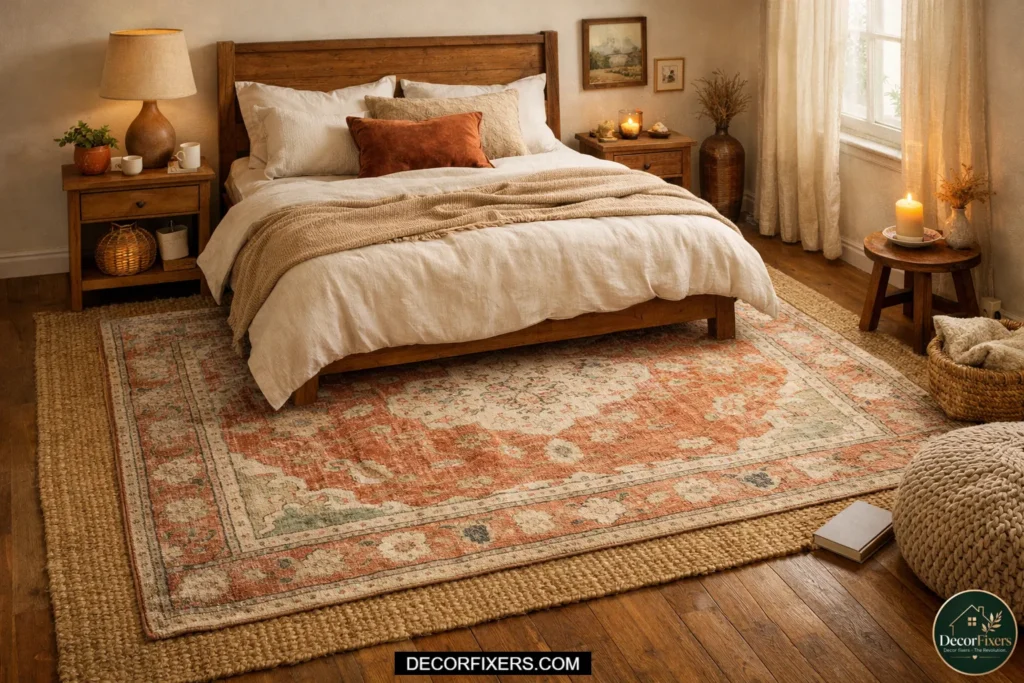
One flat rug on a hardwood floor is better than nothing. Two-layered rugs are a completely different room. Start with a large natural-fiber base (jute or sisal, $60–$120 for a 5×8) and layer a smaller, softer rug on top, a Moroccan-style shag or a Beni Ourain-inspired flatweave ($45–$95).
The texture contrast between rough natural fiber and soft pile creates visual richness that reads as expensive even when it isn’t. More practically: rugs absorb sound. A quieter room feels warmer. This is the most underrated acoustic improvement you can make without touching the walls.
8. Replace Your Overhead Light with a Warm-Glow Pendant
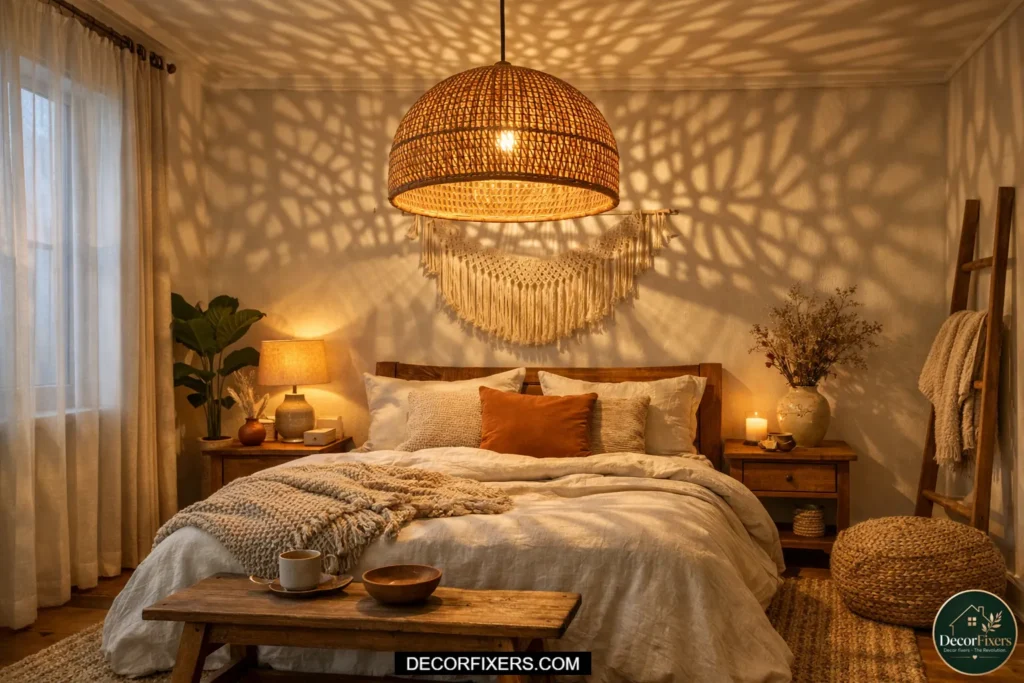
Most bedrooms have a single flush-mount ceiling fixture that throws flat, shadowless light across the room. Replace it. A rattan pendant, a woven linen drum shade, or a frosted amber glass pendant casts directional, diffused light that creates shadows, and shadows are what make a space feel three-dimensional and intimate.
IKEA’s KNIXHULT bamboo pendant ($35) and the rattan options on Amazon ($40–$75) both work beautifully. If your ceiling box is already wired, this is a 20-minute swap. Warm light through natural material is one of the most immediate visual upgrades in this entire list.
9. Use Linen Curtains That Pool Slightly on the Floor
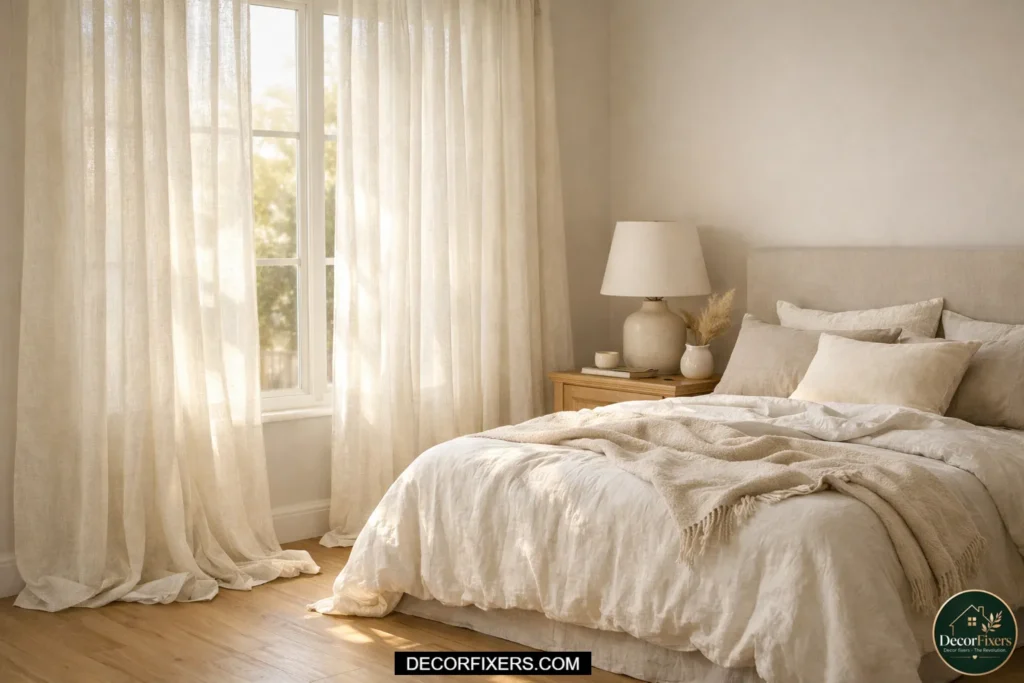
Curtains that stop precisely at the windowsill look correct. Curtains that graze or pool on the floor look luxurious. The difference is about 6–12 extra inches of fabric. Linen curtains in ivory, warm white, or soft flax ($35–$80 per panel) soften the entire wall, absorb sound, and add height to any room when hung close to the ceiling rather than the window frame.
Buy them slightly long. Let them touch the floor. This is not a mistake; it’s the detail that makes people ask, “What changed in here?” when they walk in.
10. Hang Curtains High and Wide, Not at the Window Frame
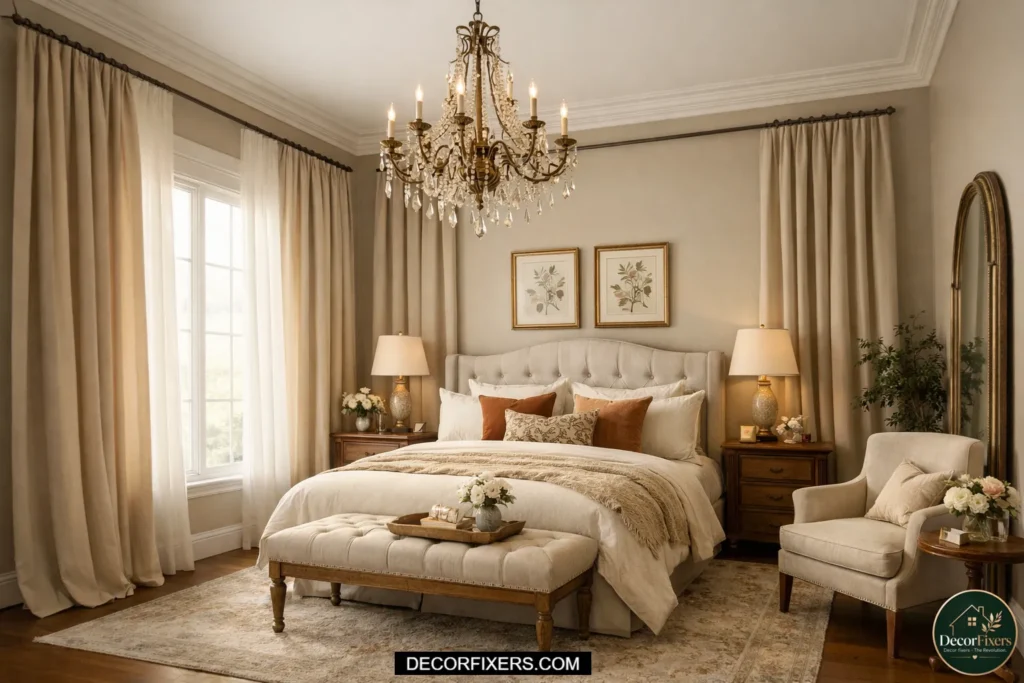
While we’re on curtains, the single most common installation mistake is hanging the rod at window frame height and frame width. This makes windows look small, and ceilings look low. Hang the rod 4–6 inches above the window frame (closer to the ceiling) and extend it 8–12 inches past the frame on each side.
The curtain panels should cover mostly the wall, not the window, when open. This costs nothing extra if you’re already buying curtains. It makes a 9-foot ceiling feel like 11 feet and makes the whole room feel more expansive and curated.
11. Bring In One Oversized Piece of Botanical Art
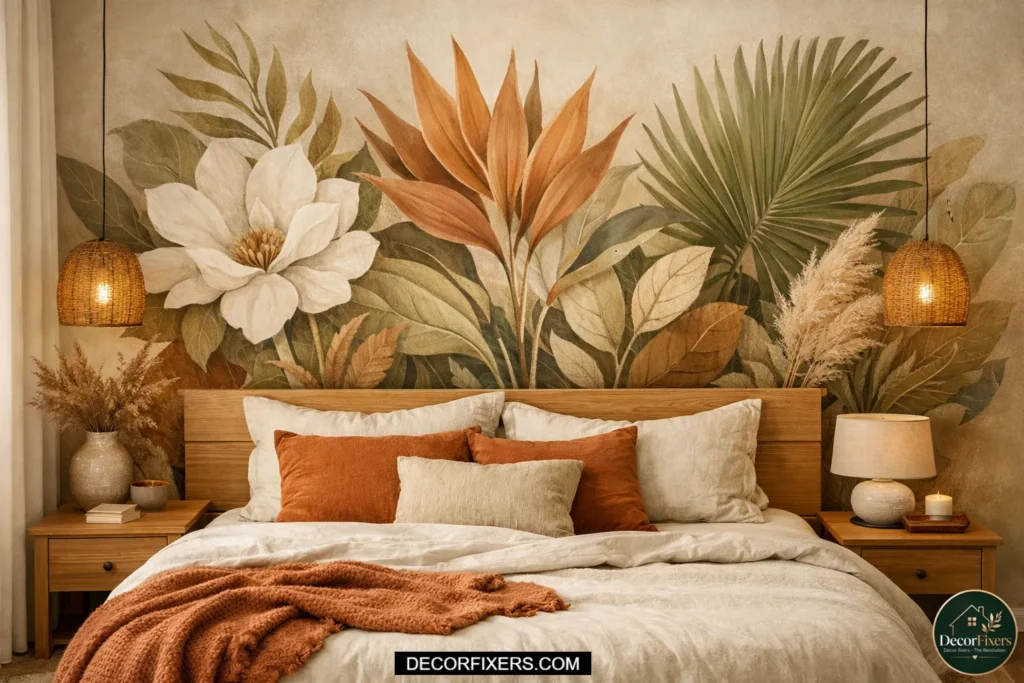
The fastest way to add warmth to a bare wall isn’t a gallery wall, it’s one large, confident piece. A single oversized botanical print, abstract landscape, or warm-toned photograph ($20–$150 framed from Society6, Desenio, or Artifact Uprising) anchors the room and signals intention.
The keyword is oversized; smaller prints get lost and make walls look cluttered. Go for at least 24×36 inches for a standard bedroom wall. Warm tones: aged terracotta, deep forest green, dusty olive, rust. Avoid anything with cool blues or stark black-and-white in a bedroom, trying to feel cozy.
12. Add a Reading Nook Corner with a Floor Lamp
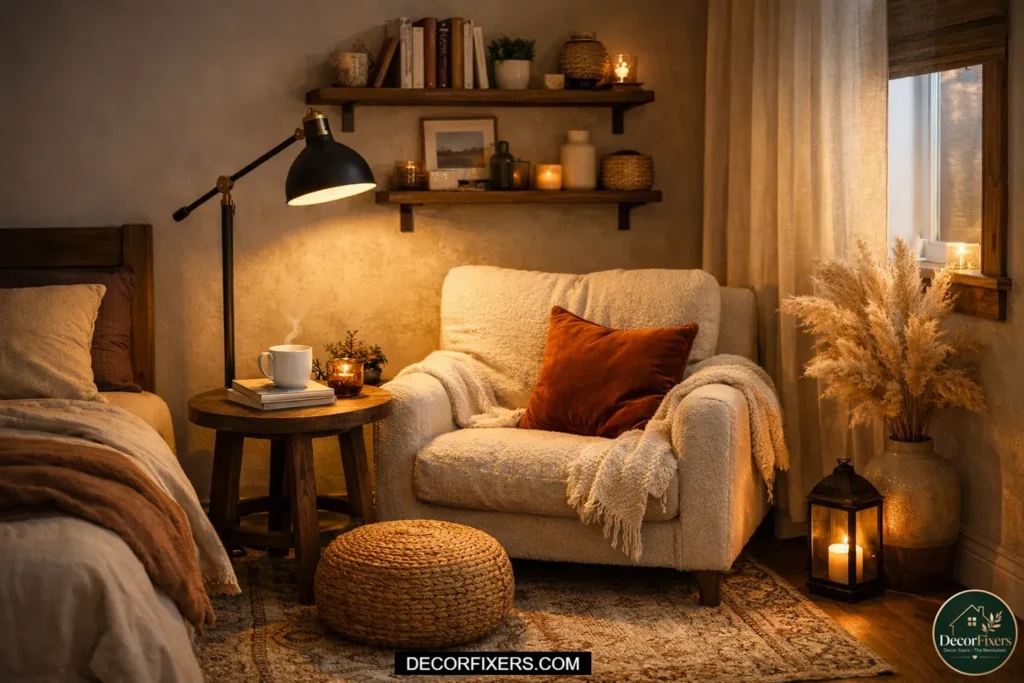
You don’t need square footage. You need intention. Push a chair, any comfortable chair, even one repurposed from another room, into a corner, angle a floor lamp over it, stack a small side table beside it with a candle and two books, and you’ve created a destination within your bedroom.
This matters psychologically: a room with multiple “zones” feels richer, more residential, more like a space that was designed for living in rather than just sleeping in. The floor lamp ($40–$80), a secondhand chair ($0–$150), and a small side table ($25–$60) make this transformation happen for under $300.
13. Layer Scatter Pillows in Three Textures
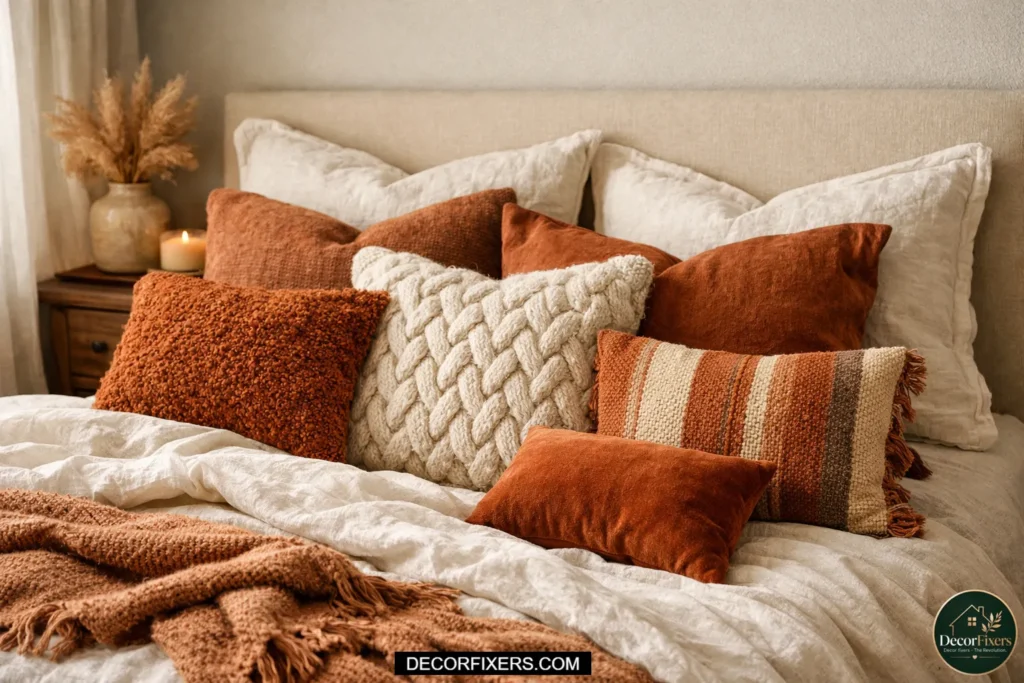
Two matching Euro shams do not make a cozy bed. Warmth through pillows comes from texture contrast, mix at minimum three: something smooth (cotton or sateen), something nubby (linen or waffle), and something tactile (boucle, knit, or velvet). Keep the color palette tight, all within the same warm family of ivory, camel, rust, or sage, so the texture variety reads as intentional layering rather than visual noise.
Five to six pillows total is plenty. Stack the Euros against the headboard, place the textured ones in front, and put the smallest, most decorative pillow slightly off-center at the front.
14. Choose a Wooden or Rattan Headboard
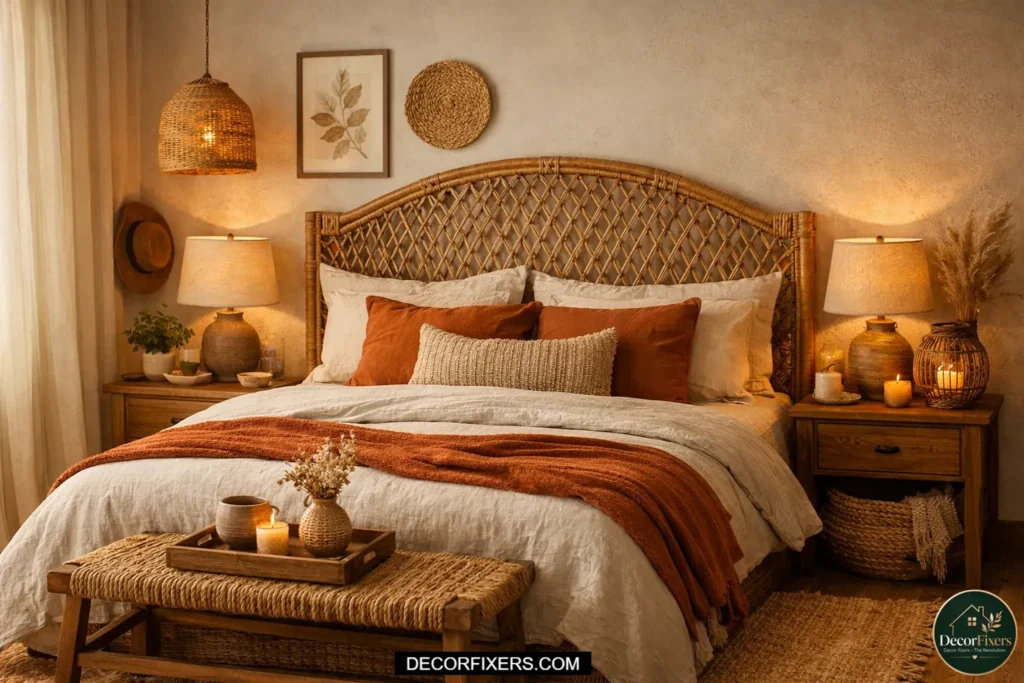
Metal and upholstered headboards in grey or charcoal are everywhere. They’re also why so many bedrooms feel cold. A wooden headboard, especially in lighter oak, walnut, or bleached pine, introduces natural warmth that no paint color can fully replicate. Rattan headboards ($80–$200 from Amazon, Wayfair, or Anthropologie’s sale section) bring both texture and a slightly bohemian, resort-like quality that photographs beautifully and ages even better.
If a new headboard isn’t in the budget this month, lean large decorative branches or a piece of driftwood against the wall behind the bed. Sounds strange. Works perfectly.
15. Keep the Room Between 18–20°C at Night
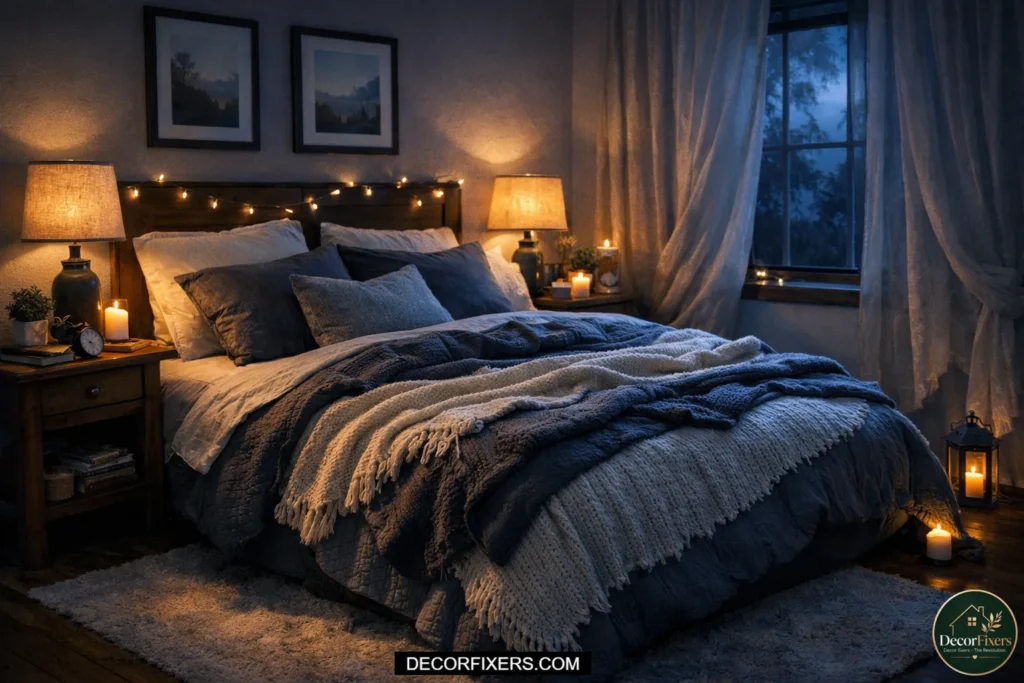
This isn’t a design tip. It’s a sleep science fact, and most guides completely skip it. According to published sleep research from the National Sleep Foundation, the optimal sleep temperature is 18–20°C (65–68°F). A room that’s too warm disrupts deep sleep cycles even when everything else is perfect.
A programmable thermostat ($25–$45) or a simple plug-in fan ($20–$35) makes this manageable year-round. Here’s the counterintuitive part: a cooler room actually feels cozier when you’re layered in warm bedding. The contrast between cool air and warm blankets is exactly what makes hotels feel so indulgent.
16. Use Beeswax or Soy Candles Strategically
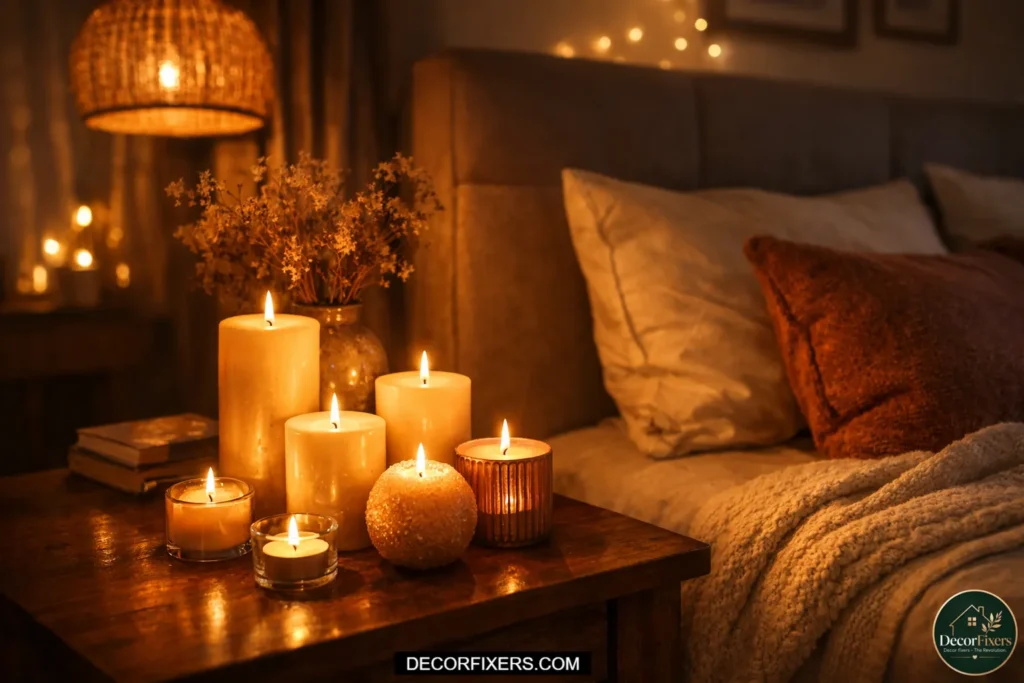
Candles are a cliché recommendation because they work. But most people use them wrong, scattering small votives randomly across the room. Instead, use 2–3 larger candles ($15–$35 each) clustered on one surface, a dresser, windowsill, or bedside table, to create a focal point.
Choose beeswax or soy rather than paraffin; they burn cleaner, longer, and with a warmer amber flame. Scent matters too (see idea #22), but even unscented candlelight at 2700K or lower does something to the nervous system that no light bulb fully replicates. There’s a reason every spa and high-end restaurant uses them.
17. Hang a Tapestry or Woven Wall Panel
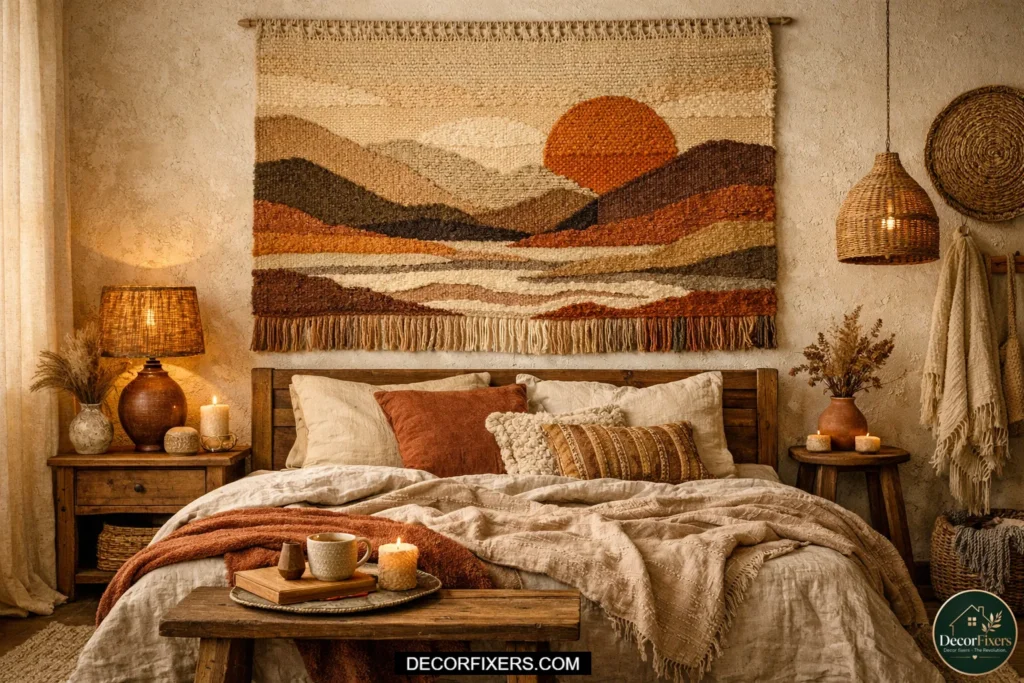
This is the textile version of the accent wall, and often more effective. A large woven tapestry in natural fiber (cotton, wool, or jute) on the wall behind the bed adds texture, absorbs sound, and fills vertical space in a way that feels collected and intentional.
Etsy shops and H&M Home carry beautiful options between $35–$120. Choose earthy tones: terracotta, warm beige, deep olive, and rust. The weave texture will visually “warm” the wall even when the room is lit with overhead lighting, which is exactly what you need during those unavoidable bright moments.
18. Choose Warm Wood Furniture Over White Lacquer
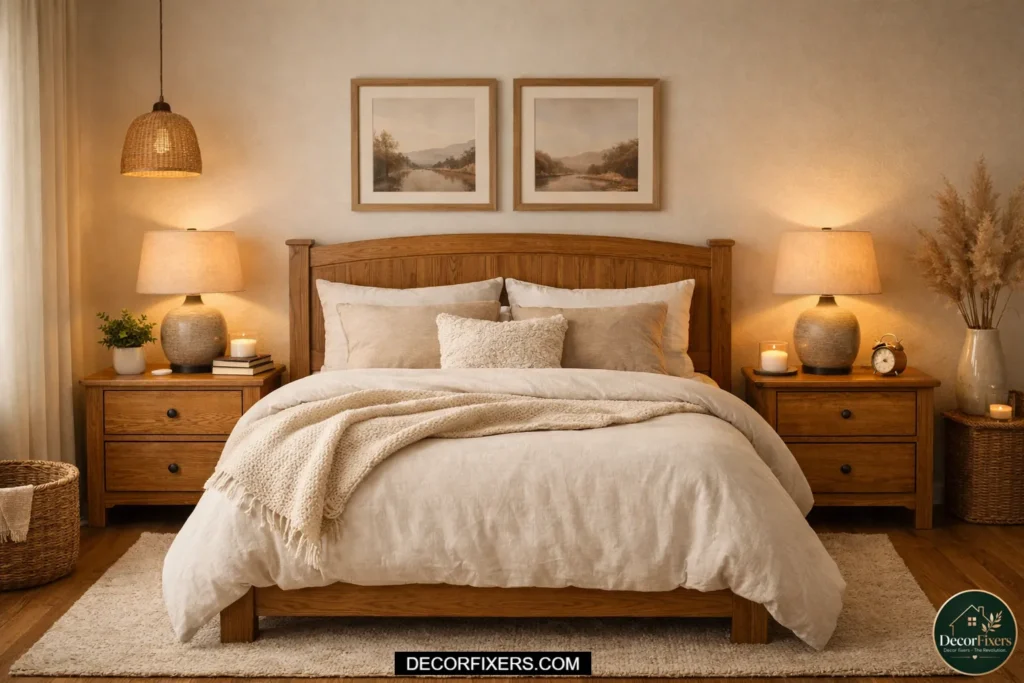
White and grey furniture dominate affordable ranges from IKEA and most flat-pack brands. It photographs cleanly. But it reads cold in person, especially under warm light, where it can look slightly yellowish rather than crisp. Warm wood tones, oak, birch, acacia, walnut-effect, absorb warm lighting beautifully and create visual continuity with natural elements like plants, rattan, and linen.
You don’t need to replace everything at once. Start with the bedside tables ($30–$80 each on Amazon or Wayfair) since they sit in your direct sightline from bed. One swap can shift the room’s entire perceived temperature.
19. Introduce a Salt Lamp or Amber Night Light
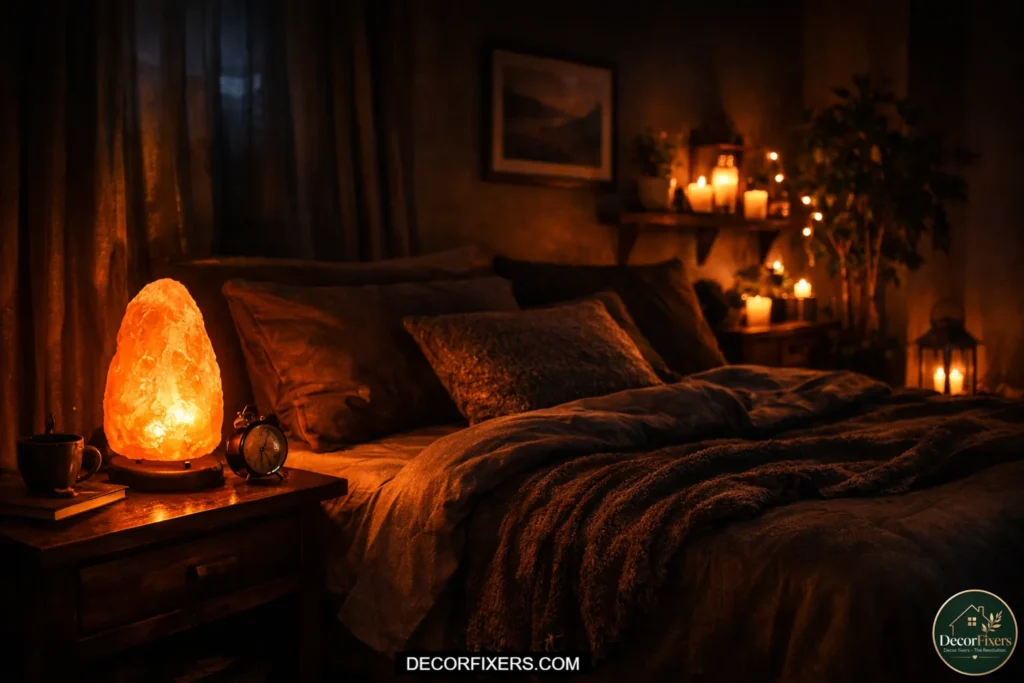
This is an optional but genuinely useful layer. Himalayan salt lamps ($20–$45) emit a low, amber-orange glow that’s both visually warm and practically useful as a night light that won’t disrupt melatonin. Or maybe I should say it this way: even if you’re skeptical of the wellness claims around salt lamps, the light quality is independently excellent; it’s the visual equivalent of firelight.
A small amber-tinted plug-in night light ($8–$15) achieves the same light effect with less counter space. Either option eliminates the need to turn on overhead lights during middle-of-the-night bathroom trips, which is one of the fastest ways to kill sleep quality.
20. Add Living Greenery, Even One Shelf Plant
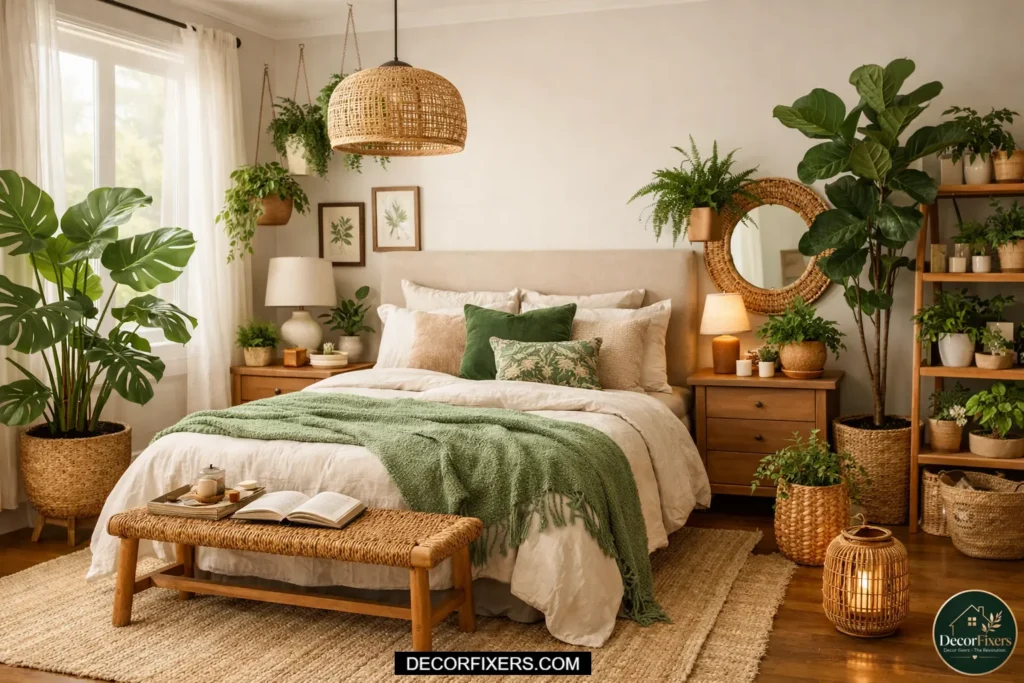
Plants aren’t just decorative. A room with living things in it reads as warmer, more inhabited, and more intentional than one without. The best bedroom plants, pothos, snake plant, and peace lily, are low-maintenance, tolerate low light, and stay under $15 at most garden centers.
Place one on a floating shelf above the bedside, one on the windowsill, and one on the floor in the reading nook corner (see idea #12). Three plants. Under $45. The layered greenery creates a subtle sense of enclosure that makes the room feel curated and cared for, which is the foundation of genuine coziness.
21. Use a Tray to Style Your Dresser or Nightstand
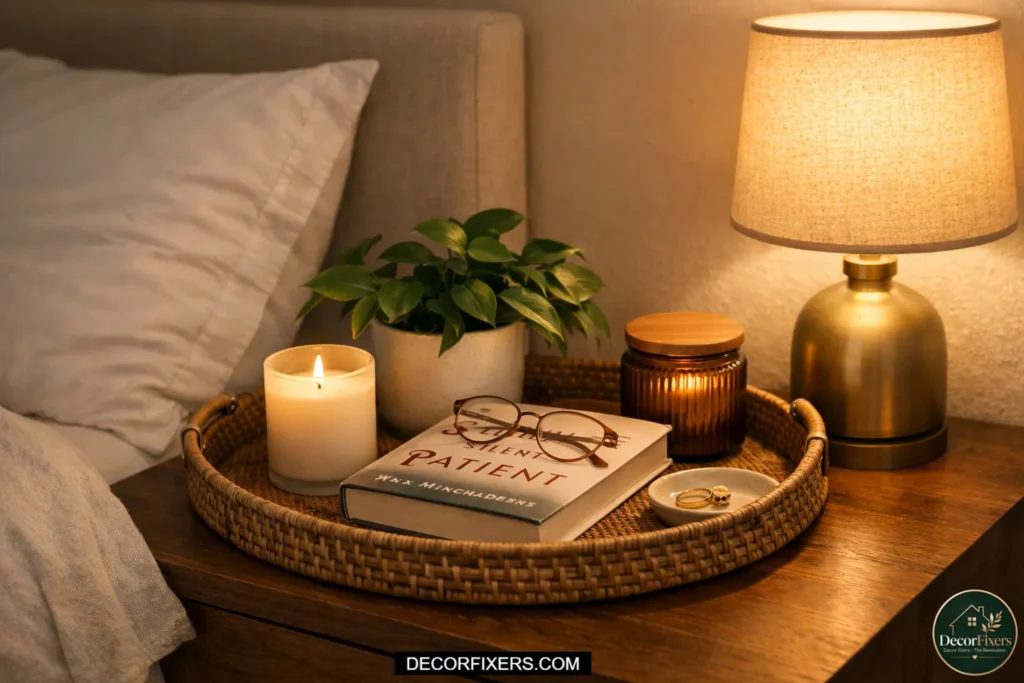
Loose objects on a nightstand look like clutter. The same objects inside a tray look styled. A small wooden, marble-effect, or brass-toned tray ($12–$30) corrals your candle, your book, your glass of water, and one small plant into a composed vignette. This is the trick every interior stylist uses.
The tray creates an invisible boundary that signals intention. This is a curated surface, not a catch-all. It also makes cleaning easier; the whole tray lifts off in one move. A 20-second habit change that photographs like a design detail.
22. Choose One Signature Bedroom Scent
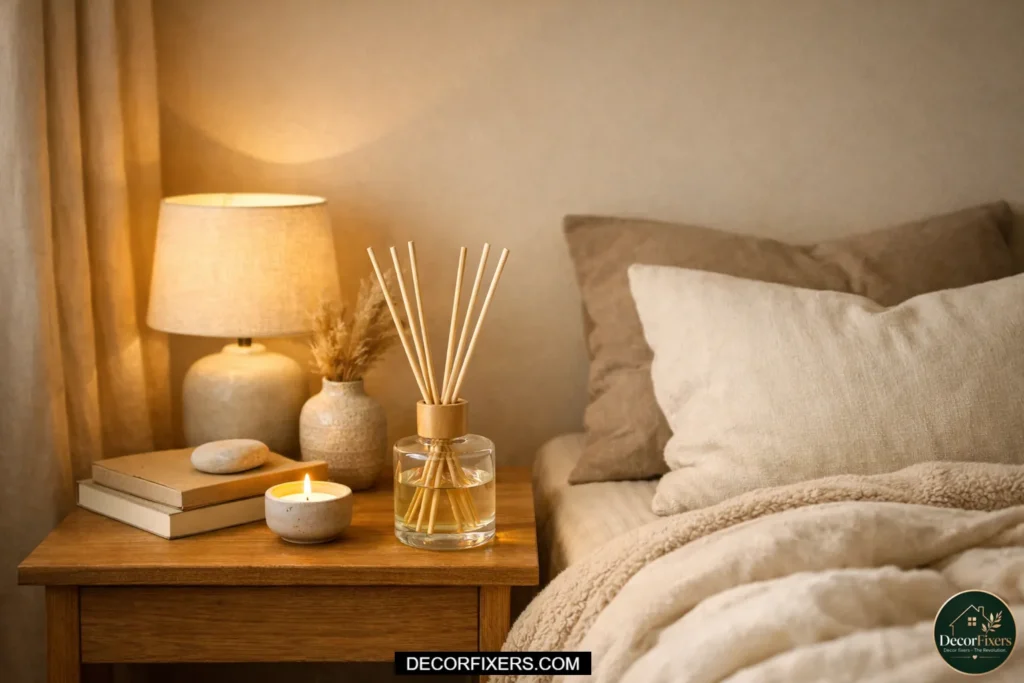
Smell is processed by the limbic system, the same brain region that handles emotion and memory. A bedroom with a consistent signature scent trains your nervous system to associate that smell with relaxation and sleep. Choose one: a reed diffuser ($15–$35) in sandalwood, cedarwood, amber, or vanilla works continuously without requiring an open flame.
Avoid anything citrus or peppermint in the bedroom; these are stimulating scents, not relaxing ones. NEST Fragrances, Muji, and Vitruvi all offer bedroom-appropriate options under $35. One diffuser, one scent, used consistently. Within two weeks, the scent alone will begin triggering a relaxation response.
23. Mount Floating Shelves for Styled Storage
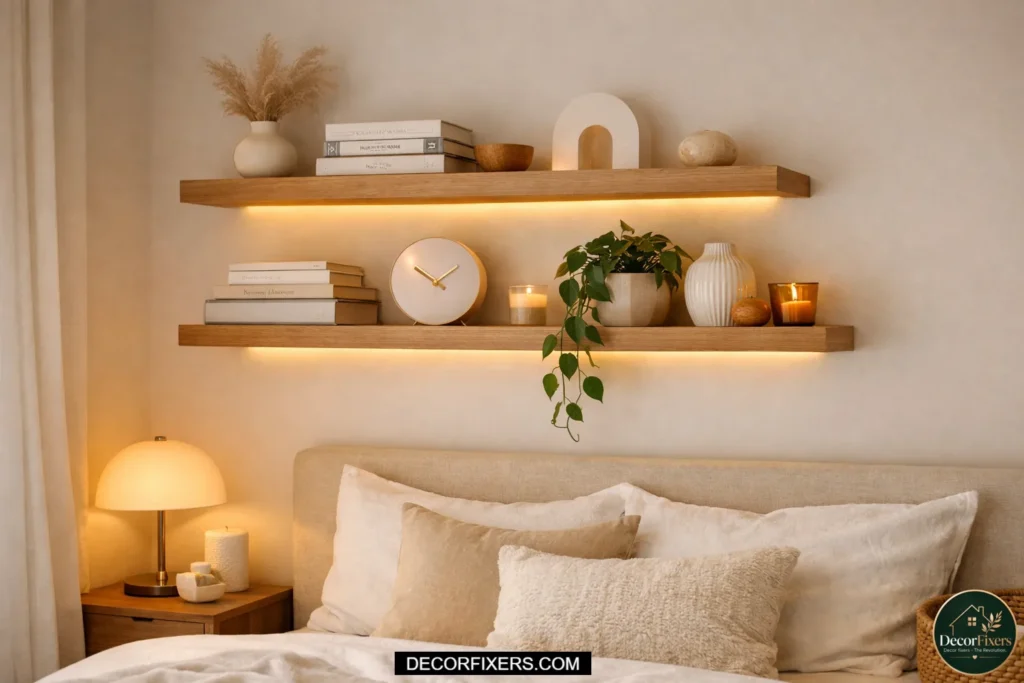
Floating shelves serve two purposes: they get clutter off surfaces (which reduces visual noise and stress), and they create deliberate display opportunities. Install two to three small floating shelves ($15–$35 each) in a bedroom corner or above the desk/reading chair, and style them with a plant, one or two books spine-out, a candle, and a small decorative object.
Keep them underfilled; a shelf that’s 70% full reads as curated; 100% full reads as storage. The negative space is part of the design. This is what interior design accounts on Pinterest call “breathing room.”
24. Layer a Bed Skirt or Valance for Visual Weight
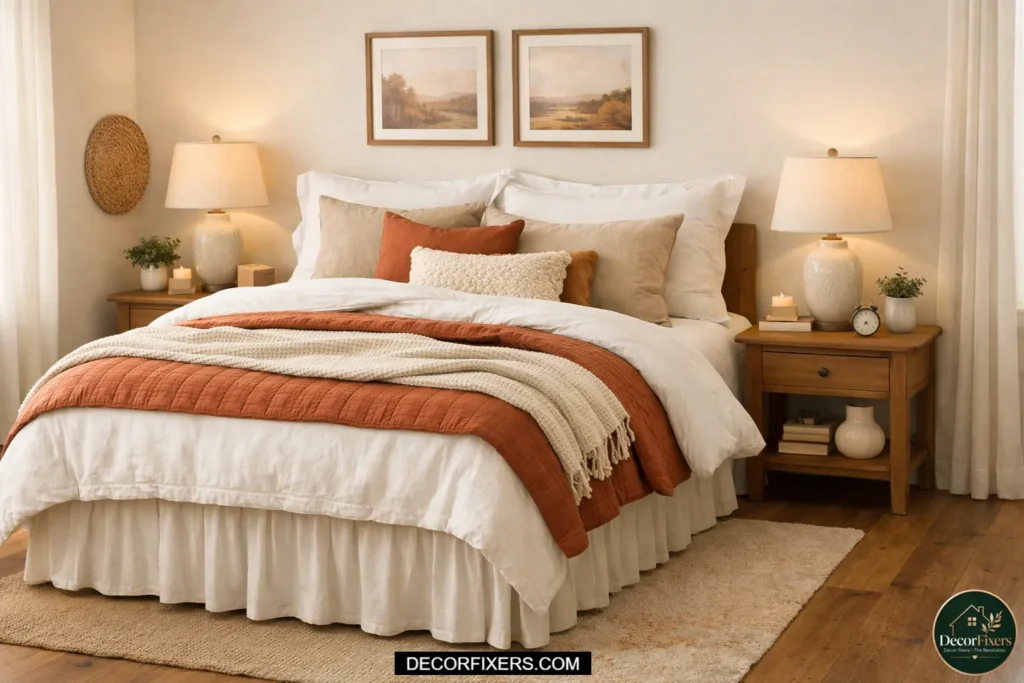
The gap between your bed frame and the floor is one of the most overlooked sources of visual coldness in a bedroom. A bed skirt, either a tailored, fitted style ($25–$55) or a linen-look drop style, closes that gap and makes the bed look more substantial, more grounded, and frankly more expensive.
Choose linen, cotton, or a textured fabric that matches or closely coordinates with your bedding. This is especially impactful in older bed frames where the metal hardware or box spring would otherwise be visible. One piece of fabric. The entire bed silhouette changed.
25. Use Mirrors Strategically to Bounce Warm Light
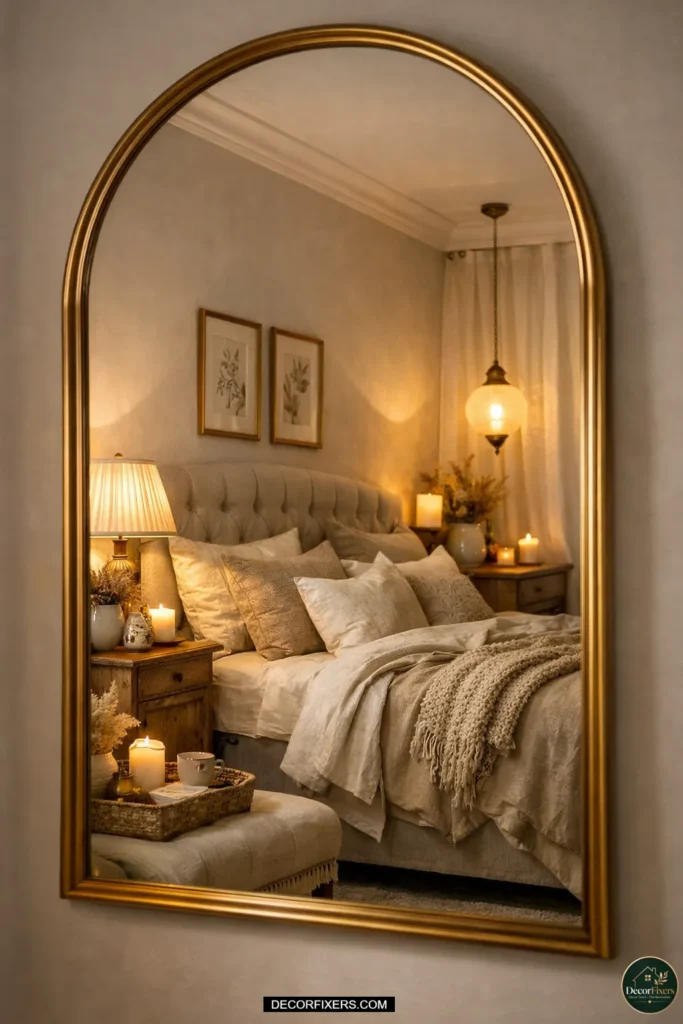
A mirror reflects whatever light is in front of it. Place a warm-toned, antique-finish or arched mirror ($40–$120) opposite or adjacent to your warm light sources, the floor lamp, the bedside candles, the pendant, and the light bounces and multiplies. The result is a room that feels brighter without being harsher, which is the exact balance a warm bedroom needs.
Lean a large floor mirror against the wall rather than mounting it; it’s adjustable, renter-friendly, and frankly looks more intentional. Rounded or arched mirrors are currently everywhere in interior design for a reason: their soft shape works beautifully with organic, warm aesthetics.
26. Replace Harsh Doorknobs and Hardware with Warm Metal Tones
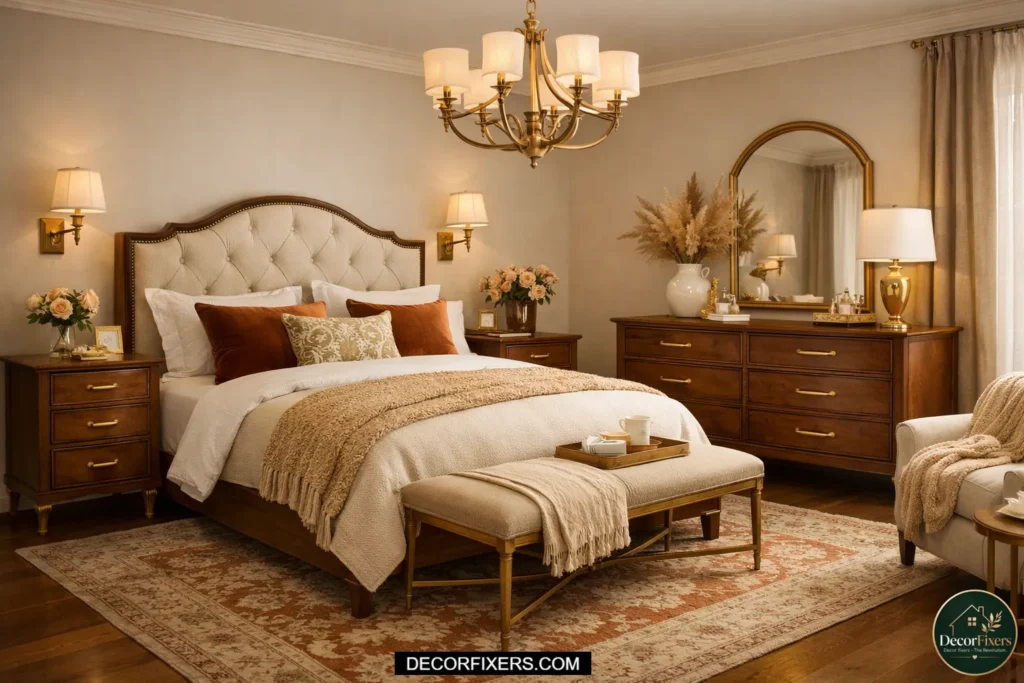
This sounds minor. It isn’t. Brushed gold, aged brass, or warm bronze hardware ($8–$25 per piece) on dresser drawers, closet doors, and bedside tables creates a cohesive metallic warmth that pulls every piece of furniture together visually. Most generic furniture comes with cold chrome or matte black hardware that fights against a warm bedroom palette.
Swapping handles is a 10-minute job with a screwdriver. Do the dresser first, as it has the most visible hardware in most bedrooms. The before-and-after impact is disproportionate to the effort.
27. Add a Bookshelf Styled with Objects, Not Just Books
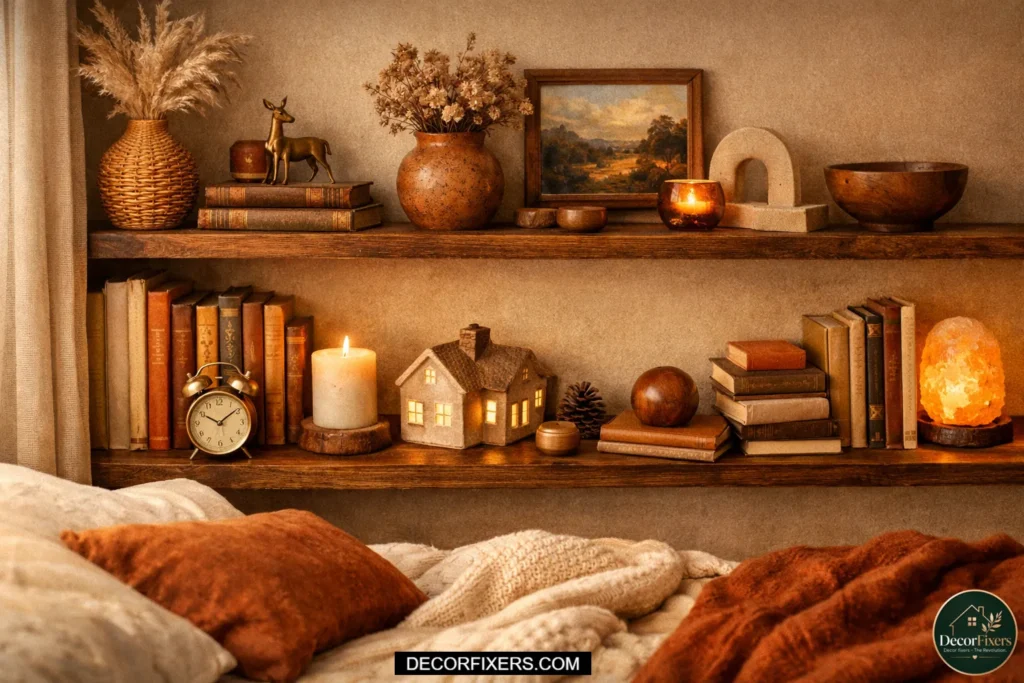
A bare bookshelf in a bedroom reads as functional. A styled one reads as lived in, the difference between a rented room and someone’s actual home. Alternate books (some spine-out, some stacked horizontally) with small objects: a ceramic vase, a trailing plant, a small framed photo, a candle.
The rule is roughly 60% books, 40% objects, with deliberate space left in at least one section. A secondhand bookshelf from Facebook Marketplace ($0–$60) paired with $30 in styling objects transforms an entire wall. This is the interior design equivalent of mixing patterns; it only works when there’s an organizing principle (here: warm tones and natural materials).
28. Add Acoustic Panels Disguised as Art
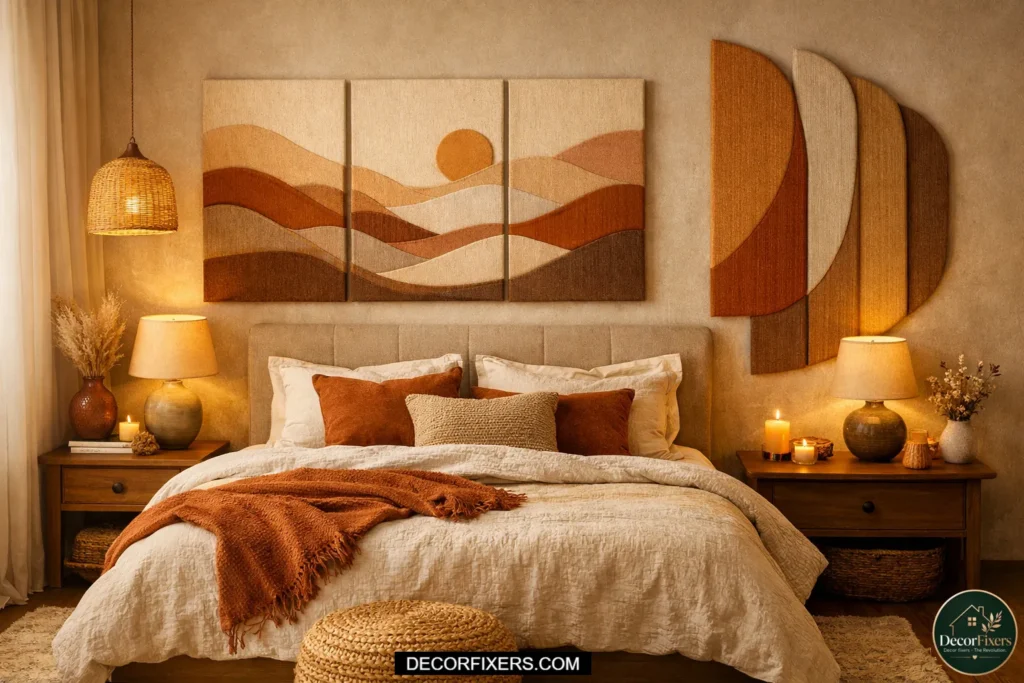
This is the idea most guides skip entirely. Hard walls, uncarpeted floors, and minimal furniture create a room that sounds hollow, and a room that sounds hollow feels cold, even when everything else is right. Look, if you’re in a space with bare walls and hardwood floors, here’s what actually works: acoustic foam panels wrapped in fabric ($35–$80 for a set) can be mounted and styled to look like upholstered wall art.
Alternatively, a large macramé piece, heavy tapestry, or gallery of fabric-based art achieves the same sound-dampening effect more decoratively. A quieter room registers as warmer, cosier, and more private. It’s one of the most underrated sensory upgrades on this list.
29. Use Under-Bed Lighting for a Floating Effect
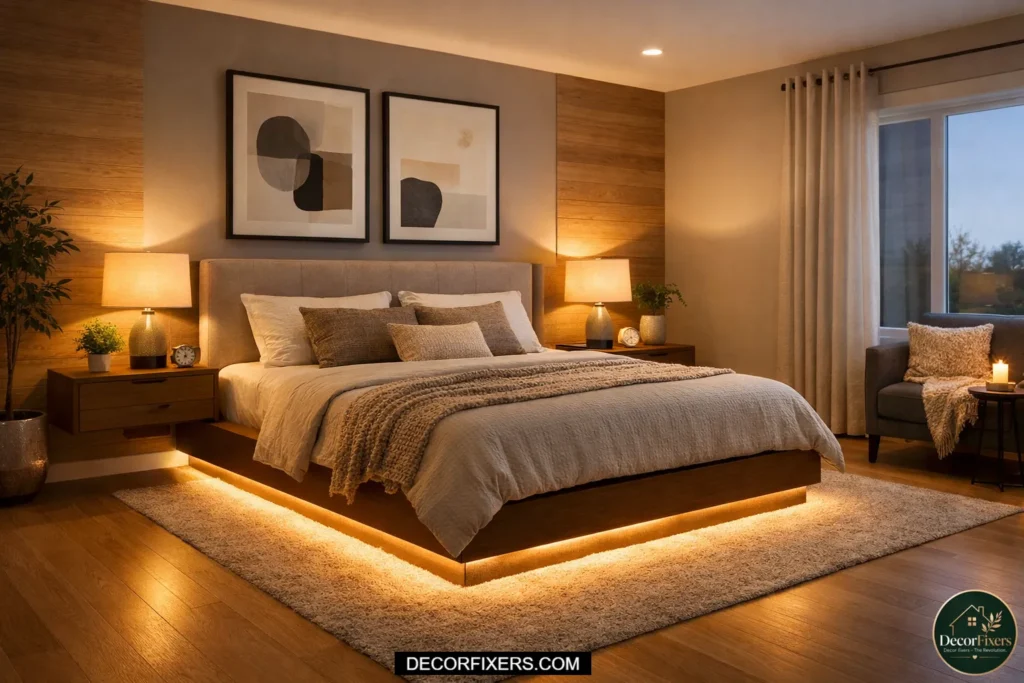
LED strip lights under the bed frame ($12–$25 for a warm-white, dimmable strip) cast a soft amber glow along the floor that makes the entire bed appear to float. It’s a hotel trick. It’s also a genuinely practical night light that doesn’t require reaching for a switch when you wake up at 3 AM. Use warm white only, not RGB colour-changing strips, which belong in gaming rooms, not sleep sanctuaries.
Set the strip on a timer or smart plug so it dims with your bedtime routine. This is a $20 change that photographs like a $2,000 renovation.
30. Invest in One Quality Piece: The Headboard or Duvet

If the budget allows one significant purchase in the $150–$400 range, make it either a proper linen duvet insert (the fill, not just the cover) or a quality wooden or upholstered headboard.
These are the two pieces the eye goes to first in any bedroom. A proper duvet with 400–600 fill power down or a quality down-alternative ($120–$250 from Parachute, Brooklinen, or IKEA’s top-tier FJÄLLBRÄCKA) changes how the whole bed reads, it has loft, it has presence, it doesn’t lie flat and thin like a basic insert. This is the one area where spending slightly more returns dramatically more. Everything else on this list stretches a small budget. This one is worth saving for.
31. Create a Morning Light Ritual with Sheer Layered Curtains
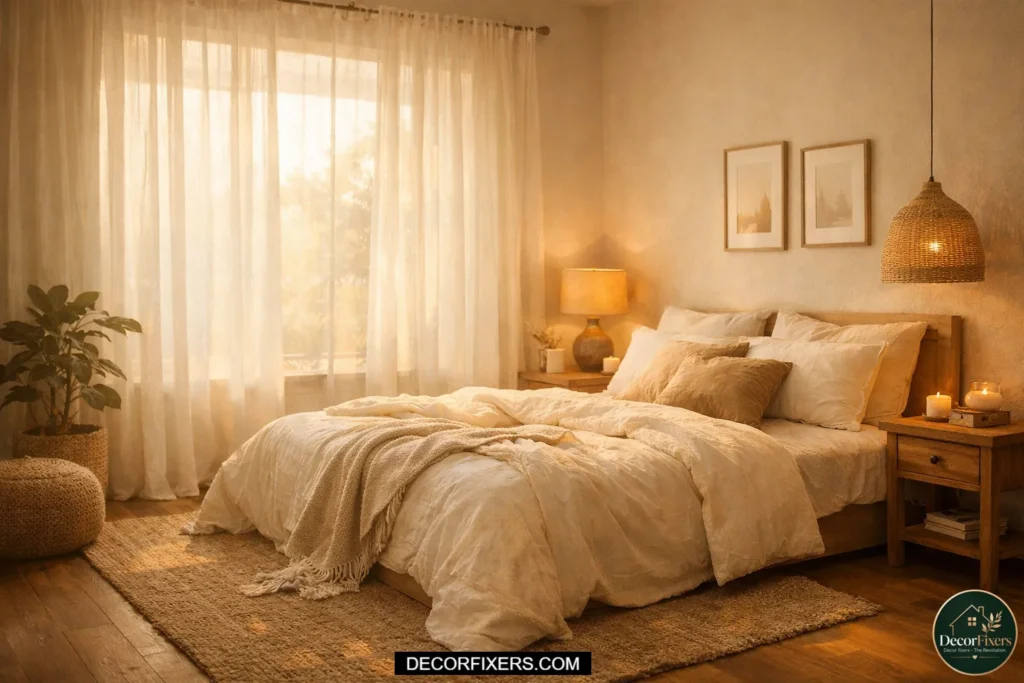
Warm bedrooms work in both directions, not just evening softness but gentle morning light that doesn’t shock you awake. Layer sheer curtains ($20–$45 per panel) behind your main linen panels so that when the heavies are open, the morning light filters through gauze rather than hitting the room directly.
This is the difference between waking up in a spa and waking up in a bus terminal. The layered curtain look is also inherently richer than a single panel; it adds visual depth to the window and makes the whole wall feel considered. Use the same warm-toned palette: ivory sheers under flax or sand linens.
32. Edit the Room, Warmth Comes from What You Remove
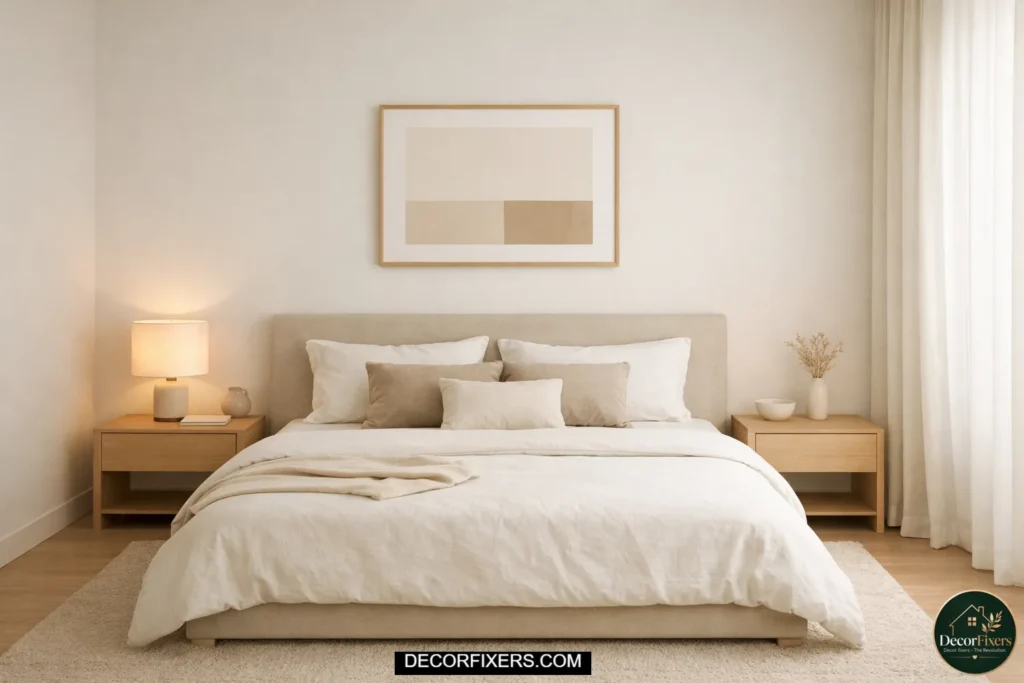
This is the most counterintuitive idea on the list. And it’s possibly the most important. Warmth is not just additive, it’s also about subtraction. A room full of mismatched objects, exposed cables, generic decorations, and visual clutter cannot be warmed by candles or linen.
The nervous system reads clutter as unfinished business. Go through your bedroom and remove anything that doesn’t serve a purpose or make you feel calm when you look at it. The TV, if you can live without it. The gym equipment. The stack of mail on the dresser. The throw pillows that don’t fit the palette. Cold rooms are often just over-full rooms. Give the warm elements room to breathe, and the whole space will shift.
MUST READ: 28 Cozy Bedroom Aesthetic Ideas for a Serene Retreat
Quick Comparison:
| Upgrade | Best For | Key Benefit | Approx. Cost |
| 2700K Bulb Swap | Immediate impact | Changes the light mood in minutes | Under $15 |
| Linen Curtains (high hung) | Renter-friendly | Adds height + softness | $70–$160 |
| Layered Rugs | Hard floor rooms | Warmth + sound absorption | $105–$215 |
| Rattan/Wood Headboard | Visual anchor | Texture + natural warmth | $80–$200 |
| Reed Diffuser (warm scent) | Sensory layer | Trains relaxation response | $15–$35 |
CONCLUSION:
A warm bedroom isn’t built by copying a Pinterest image or buying more decor. It’s built by understanding how light, texture, color, and sensory cues work together to signal rest. Most bedrooms fail not because they’re empty, but because they’re working against your biology—too bright, too cold, too cluttered.
If you take anything from this guide, start with the fundamentals: fix your lighting, soften your materials, and remove what doesn’t belong. Those three moves alone will shift how your room feels within days, not months.
From there, layer intentionally. Add warmth through texture, control your lighting at night, and create small zones that make the space feel lived in, not staged. You don’t need all 32 ideas. You need the right 5–7 applied properly.
I’ve seen this over and over: the rooms that feel the best aren’t the most expensive ones—they’re the ones that are edited, intentional, and designed around how someone actually lives and unwinds.
Your goal isn’t a “beautiful bedroom.” It’s a room where your body relaxes the moment you walk into it. Build for that, and everything else falls into place.
FAQs:
Q: What’s the best lighting color temperature for a warm bedroom?
A: 2700K to 3000K warm white. This range mimics candlelight and sunset, signals the brain to wind down, and makes every surface in the room look softer and warmer. Avoid anything above 3500K in a bedroom.
Q: How do I make my bedroom feel cozy on a tight budget?
A: Start with the bulbs (under $15), then add one warm-toned throw ($35–$60) and a reed diffuser ($20). Three changes, under $100, and the room will feel noticeably different within 24 hours.
Q: Should I use warm or cool colors in a bedroom for relaxation?
A: Warm is almost always better for relaxation; earthy tones, terracotta, clay, sand, ivory, and dusty sage all support a restful atmosphere. Cool blues and greys can work, but require significantly more effort to layer warmth into.
Q: Why does my bedroom feel cold even though it’s decorated?
A: Usually one of three issues: lighting is too cool (above 3500K), surfaces are too reflective (white walls, chrome hardware, white bedding), or the room is acoustically harsh (hard floors, bare walls). Fix the lighting first; it’s the fastest and cheapest correction.
Q: When should I use a smart bulb instead of a regular warm bulb?
A: Use smart bulbs if you want a programmable sunset/dim routine to support sleep onset. A regular 2700K LED works perfectly well if you’re willing to manually dim or switch off lights. The smart version adds convenience, not better light quality.

Creator of DecorFixers, sharing practical home and interior ideas focused on real-life usability, simple design improvements, and budget-friendly solutions.
5 thoughts on “32 Warm Bedroom Ideas That Create a Genuinely Relaxing Atmosphere”