

I remember standing in my bedroom one evening, staring at a space that had everything: a nice duvet, a few plants, some candles, and still feeling like something was deeply off. It wasn’t cluttered exactly. It just wasn’t calm. It felt like the room was trying too hard and resting too little.
That’s exactly what this guide covers: 27 specific topics that sent me down a rabbit hole of Scandinavian bedroom design. Not the Pinterest-perfect version that costs a small fortune and involves ripping out every wall. The real version. The kind that works in a rented flat, a compact apartment, a room with awkward windows and not enough natural light.
, actionable Scandinavian bedroom ideas, from the big design decisions down to the kind of lampshade that actually changes how a room feels at 10 PM. No vague advice about ’embracing minimalism.’ Real moves you can make this weekend.
What are Scandinavian bedroom ideas? Scandinavian bedroom design is a minimalist interior style rooted in Nordic principles of simplicity, functionality, and natural warmth. It prioritizes neutral palettes, clean-lined furniture, natural materials like oak and linen, and layered textiles to create a space that feels calm, uncluttered, and genuinely restful.
1. Start with a Warm Neutral, Not Just White
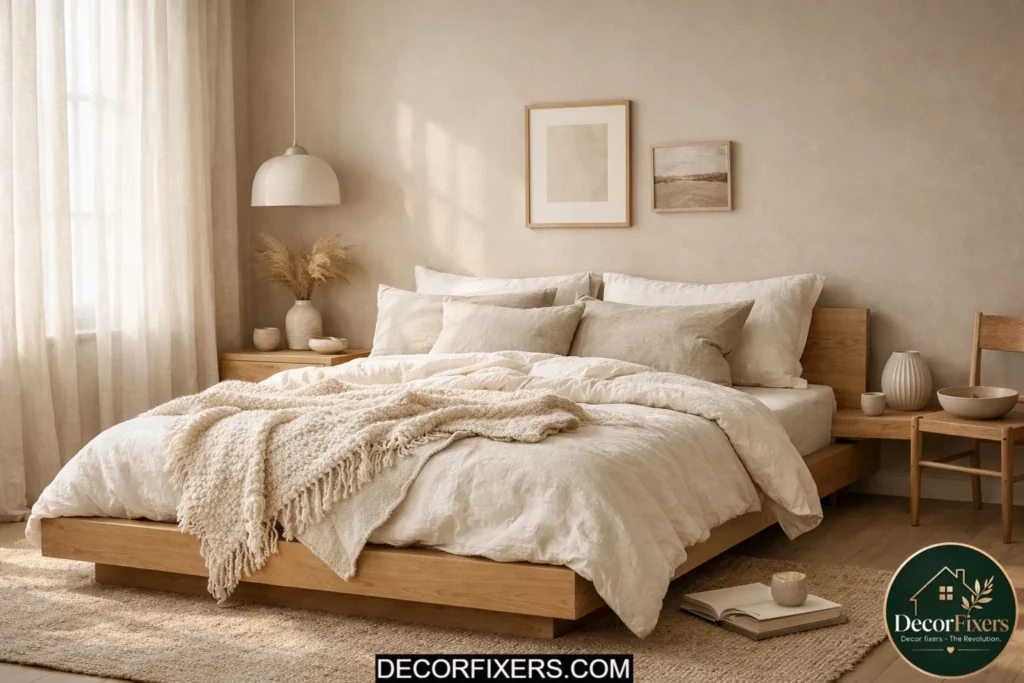
Pure white walls are the most common mistake in Scandinavian bedroom design. White reads cold in small spaces or rooms with little natural light, and the Scandi look was never about surgical sterility.
Instead, reach for warm off-whites (like linen, greige, or soft sand), which absorb and reflect light differently throughout the day. Paired with natural wood furniture, a warm neutral wall feels alive in a way that brilliant white simply doesn’t.
2. Choose a Low-Profile Bed Frame in Natural Oak
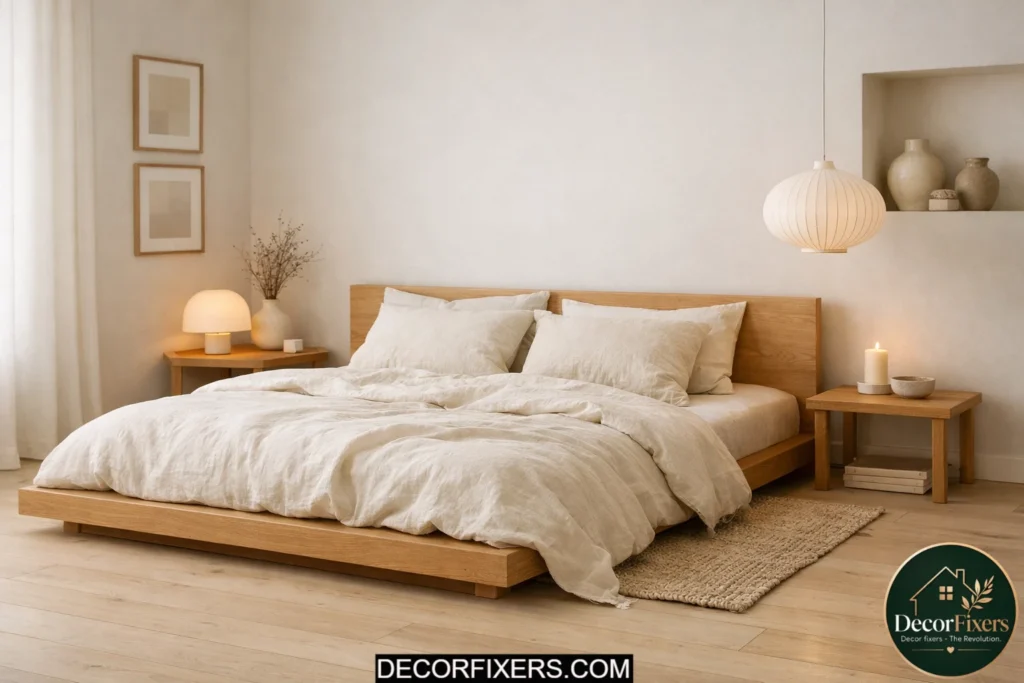
The bed is the anchor of any Nordic bedroom design, and the frame matters more than most people realise. Low-profile platform beds sit closer to the floor, which creates an immediate sense of spaciousness and visual calm. Exactly what you’re after.
Solid oak is the default choice for good reason: it ages beautifully, it adds warmth without heaviness, and it pairs with almost every neutral palette. Brands like GUBI and the IKEA STOCKHOLM 2025 collection both offer clean-lined frames in pale and natural oak at very different price points.
3. Layer Your Bedding Like a Nordic Hotel
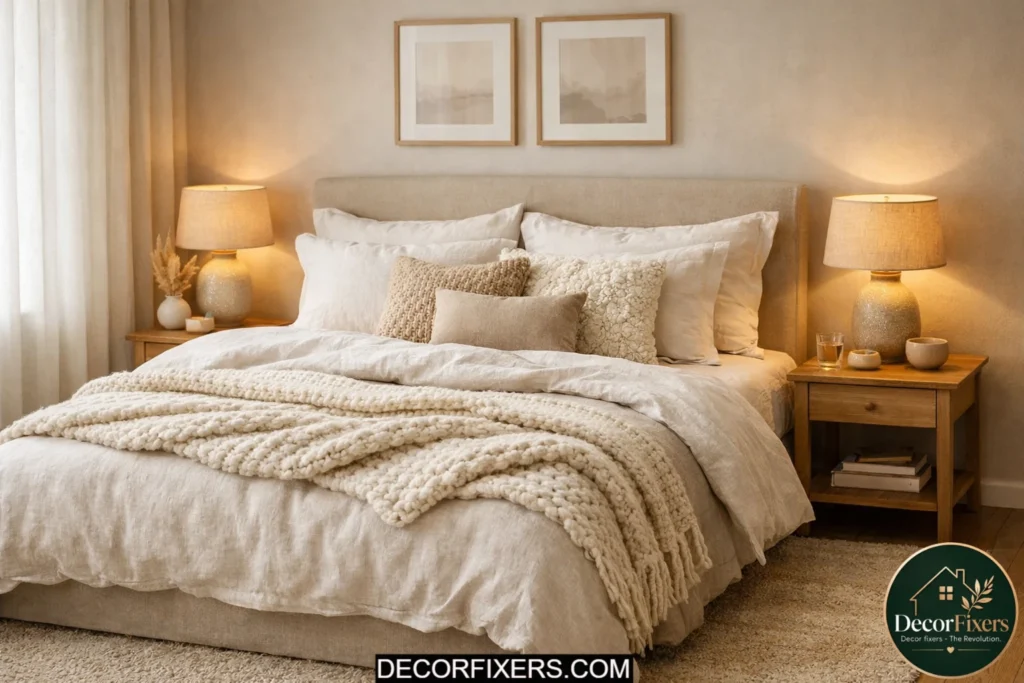
This is where hygge bedroom decor actually lives, not in the furniture, but in the textiles. Layering isn’t about piling on throws randomly. It’s a deliberate system.
Start with a percale or linen base sheet in soft white or light sand. Add a linen duvet or quilted comforter as the middle layer. Drape a chunky wool or bouclé throw across the foot of the bed. Two accent pillows in a slightly different texture, not four matching ones, finish it off. The result looks effortlessly collected, because it is.
4. Use Linen Everywhere, It’s the Fabric Scandi Design Was Built On
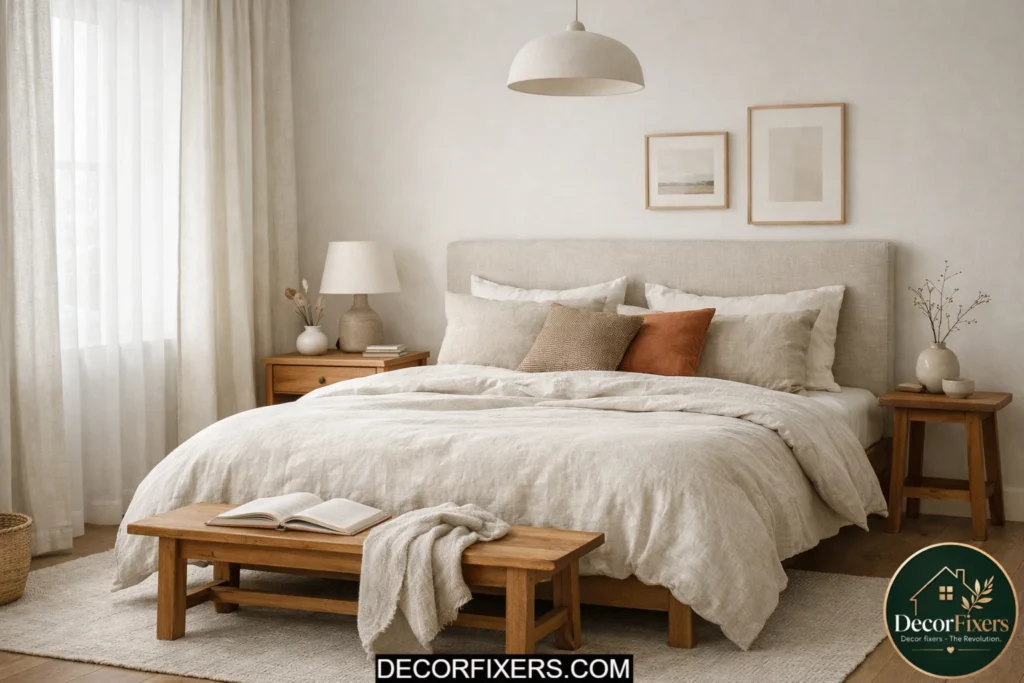
Linen is breathable, it gets softer with every wash, it has a natural, slight wrinkle that looks intentional rather than sloppy, and it photographs beautifully. No wonder it’s the default textile in every Scandinavian interior you’ve ever admired.
Use it on your duvet cover, your curtains, and if you want to go deeper, a linen upholstered headboard. Ferm Living does some of the best linen textiles in the market; their muted earth-tone cushions and throws hit that exact Scandi note without looking mass-produced.
5. Get Your Lighting Right, Three Layers, Not One Overhead Bulb
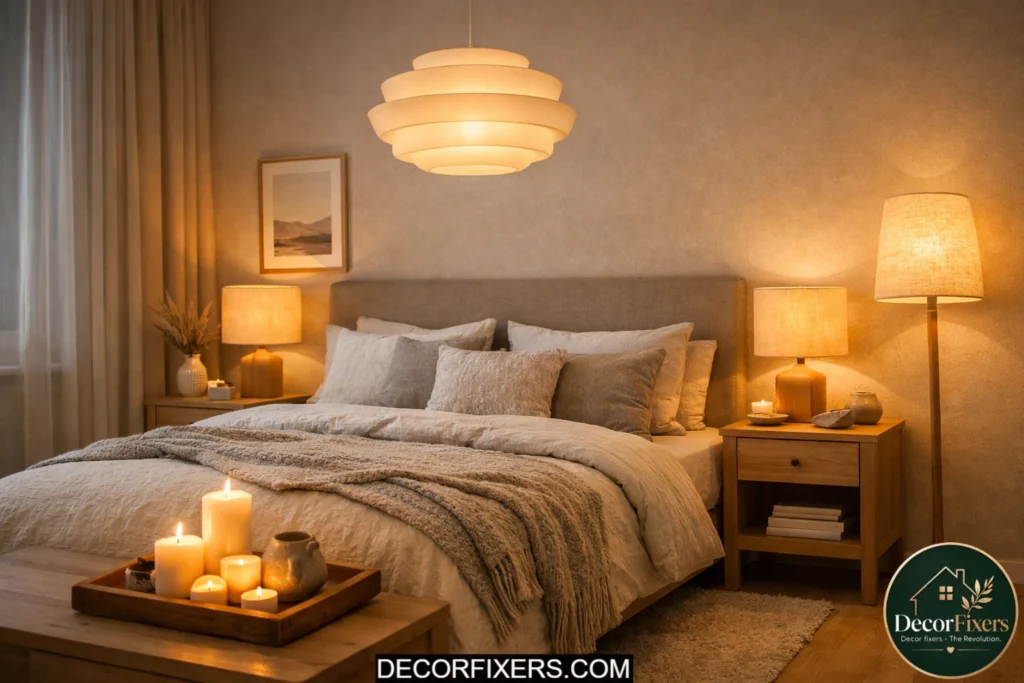
Nothing kills a Scandinavian bedroom faster than a single ceiling light blazing at full strength. Nordic design is famous for its relationship with light precisely because Scandinavian countries deal with limited natural light for months at a time. The solution they developed: layered, low, warm lighting.
Layer one is ambient, a pendant or ceiling fixture, preferably dimmable. Layer two is task, bedside lamps with a warm bulb temperature (2700K maximum). Layer three is accent, a floor lamp in the corner, or small candles on a tray. That three-source combination creates a room that feels completely different at 7 PM versus 11 PM, which is the whole point.
How to Layer Lighting in a Scandinavian Bedroom
To achieve Nordic-style layered lighting, follow these steps:
- Install a pendant or ceiling fixture with a dimmer switch.
- Place two matching bedside lamps with 2700K warm bulbs.
- Add a floor lamp or reading sconce in a corner of the room.
- Use candles on a wooden or ceramic tray as accent lighting.
- Switch all lights to warm-white bulbs, remove any cool-white bulbs.
6. Bring In Real Wood, Even One Piece Transforms the Room
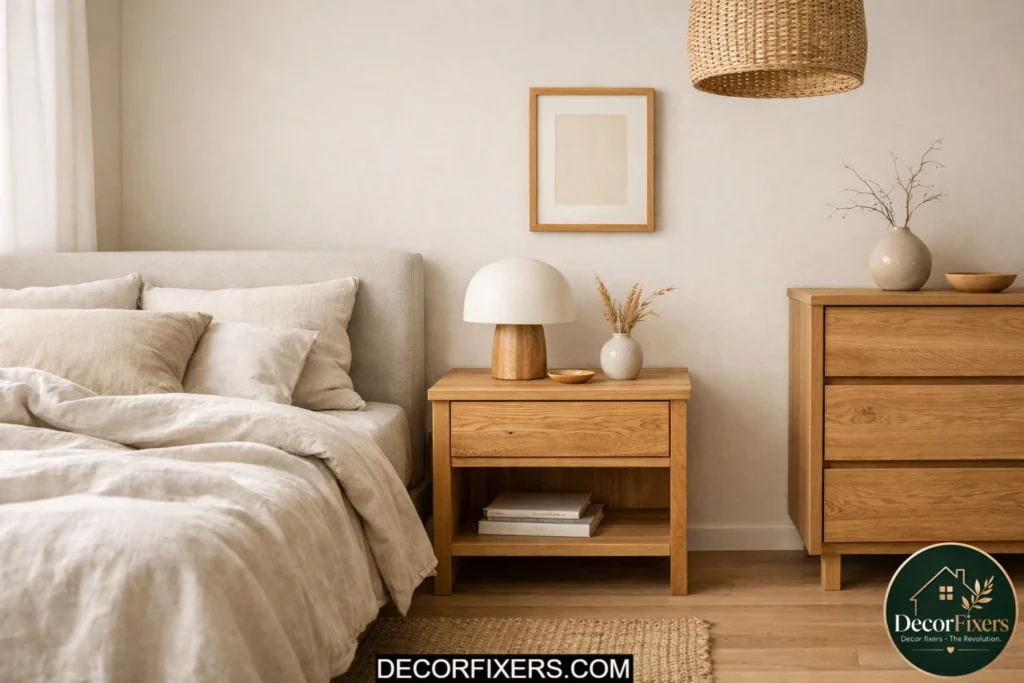
You don’t need to replace all your furniture. One genuine wood piece, a solid oak bedside table, a reclaimed pine shelf, and a simple wooden stool introduce organic warmth that no faux-wood laminate can replicate.
The grain matters. Look for visible wood grain, not smooth, uniform surfaces. Light-toned woods (ash, pine, white oak) keep the room airy. Medium tones (natural oak, walnut) add depth without going dark. Stay away from red-toned woods; they pull in the wrong direction for this aesthetic.
7. Declutter with Intention, The Scandi Rule Is “Only What You Use or Love.”
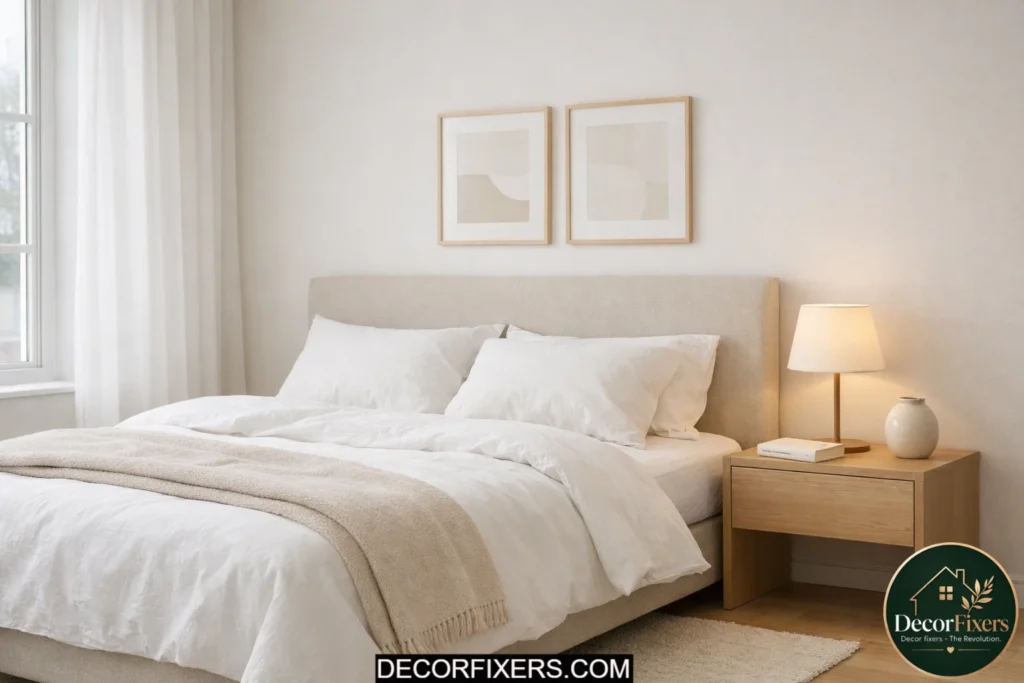
Here’s the honest version of Scandinavian minimalism: it’s not about owning less. It’s about displaying less. The Nordics weren’t living with bare rooms; they had functional, well-organized storage that kept living surfaces clear.
Start with your bedside table. Leave only: one lamp, one book, one small object (a ceramic, a candle). Everything else goes in a drawer. That single cleared surface will change how the room feels more than any new purchase. Or maybe I should say it this way: decluttering is the fastest Scandi upgrade that costs nothing.
8. Add a Chunky Wool Rug Underfoot
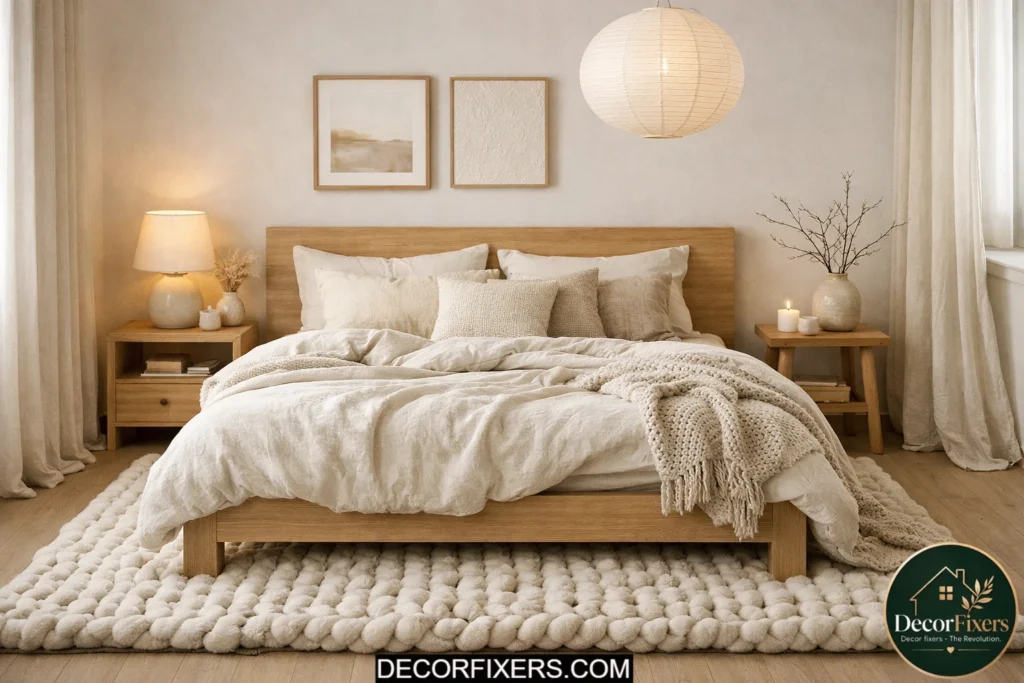
A Scandinavian bedroom without a rug feels unfinished. The rug grounds the bed, softens the acoustic, and adds that tactile warmth that makes you want to stay.
Go for natural fibers, wool, or jute for durability, cotton for budget-friendly softness. A hand-loomed or hand-woven texture looks authentic. Keep it simple: no loud patterns, no high-contrast colors. A natural, undyed wool rug in cream, oatmeal, or soft grey ties the room together without demanding attention.
9. Try the Japandi Bedroom Fusion, Scandi’s Best Evolution Right Now
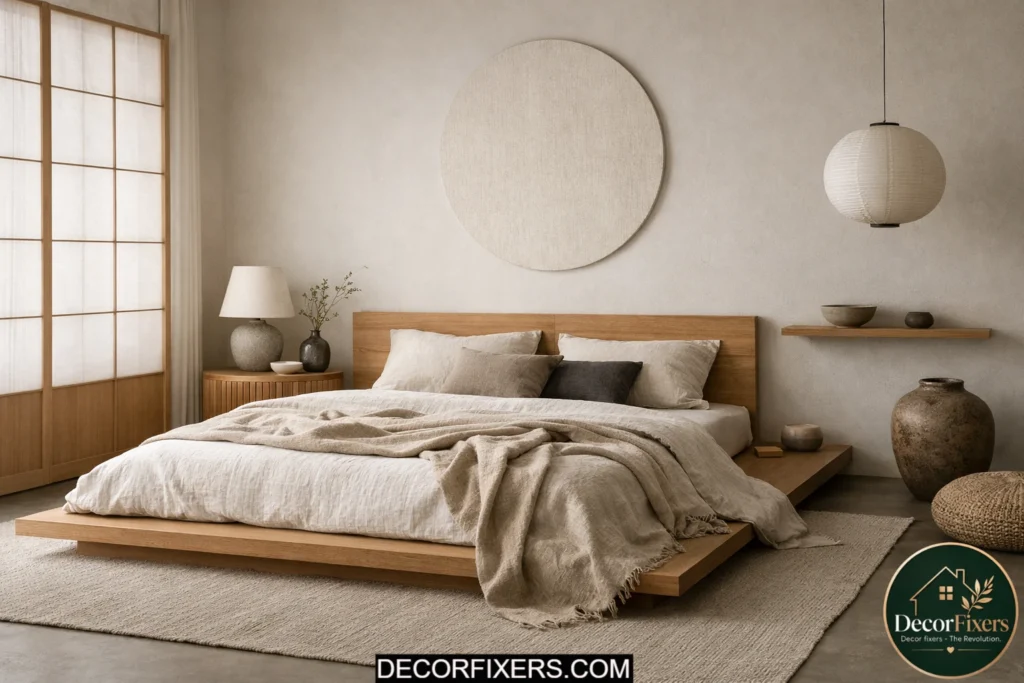
If there’s one trend actively reshaping Scandinavian bedroom design in 2025–2026, it’s Japandi, the blend of Japanese wabi-sabi philosophy with Nordic hygge warmth. Most competitor articles don’t cover this, and that’s a gap worth filling.
Japandi takes the low-profile bed and natural wood from Scandi design, adds the Japanese principle of ‘ma’ (intentional negative space), and removes even more decorative noise. The result is a room that feels almost meditative. Low furniture, muted earthy tones, one meaningful art piece, nothing more. If pure Scandi still feels too busy to you, Japandi is the next step down, and it’s extraordinary.
What is the Japandi bedroom trend?
Japandi is a hybrid interior style combining Scandinavian warmth (hygge, natural wood, layered textiles) with Japanese minimalism (wabi-sabi, negative space, purposeful objects). According to multiple 2025 design publications, including Norm Architects, it produces a sense of quiet luxury that’s particularly well-suited to urban bedrooms where visual calm is a priority.
10. Embrace the Dark Side, Charcoal Accent Walls Work
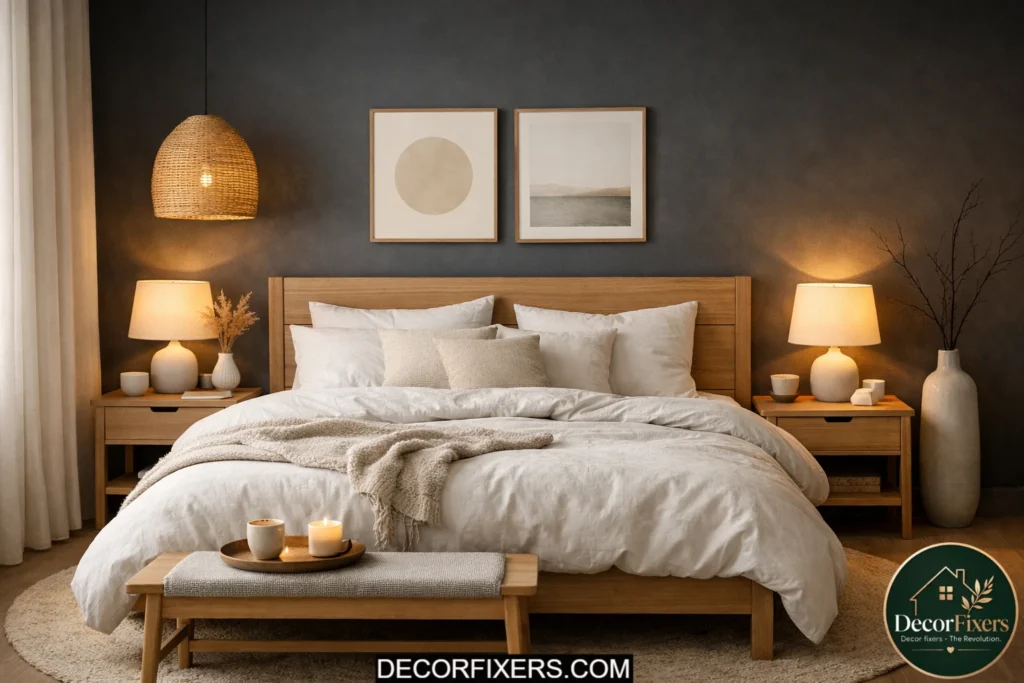
Some experts argue that Scandinavian bedrooms should always stay light and airy. That’s valid for small rooms or those lacking natural light. But if you’re dealing with a large room or strong daylight, a single deep charcoal or warm dark grey accent wall behind the bed head adds drama and coziness without undermining the Nordic feel.
The key: use a matte finish. Glossy dark walls feel oppressive. Matte dark walls feel enveloping, like a very good hotel room at midnight. Balance with pale bedding and light wood furniture to keep the contrast intentional, not accidental.
11. Hang Sheer Linen Curtains All the Way to the Ceiling
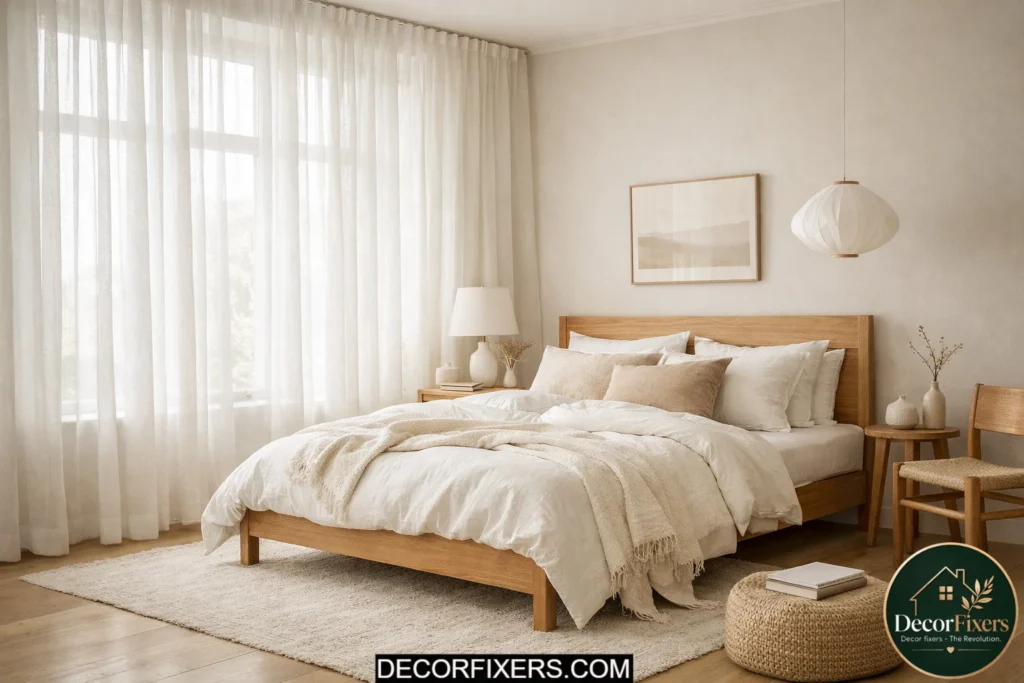
This is a small trick with an outsized impact. Most people hang curtains just above the window frame, which makes ceilings look low and windows look small. In Scandinavian interior design, curtains often run from ceiling to floor, even on short windows.
The effect is dramatic: the room feels taller, the window feels larger, and the light filters in with that soft, diffused Nordic quality that makes everything look slightly more beautiful. Off-white or undyed linen is the go-to. Nothing with a heavy pattern.
12. Keep Your Color Palette to Three Tones Maximum
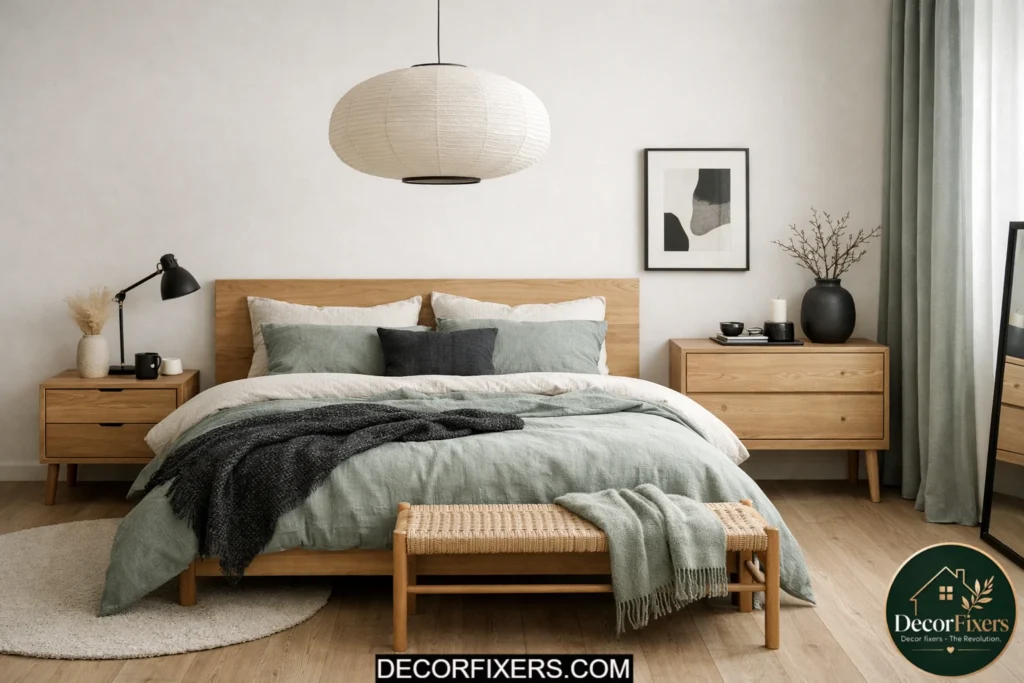
Decision fatigue is real in interior design. The reason Scandinavian bedrooms feel so calm is partly that there’s no color confusion; the eye has nowhere to get lost.
A reliable Scandi palette: one base tone for walls and large surfaces (warm white, soft sand, pale greige), one mid-tone for textiles (natural linen, warm grey, dusty sage), and one dark anchor for accents (charcoal, deep brown, matte black). Three tones. That’s it. Every new element you bring in must fit one of those three.
Quick Comparison:
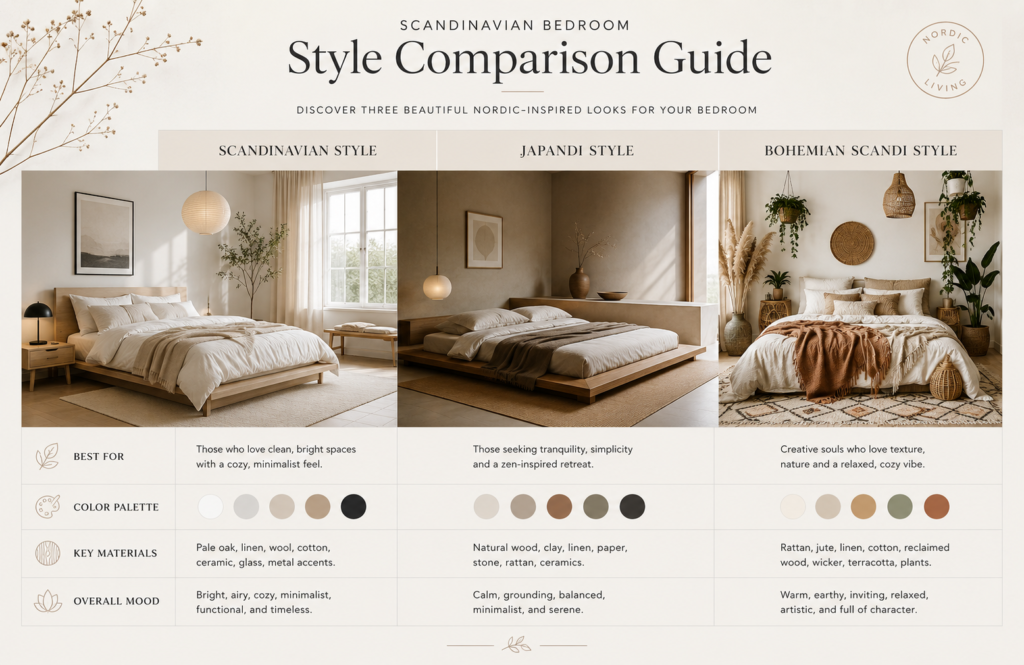
| Style | Best For | Key Benefit | Limitation |
| Scandinavian | Cozy, warm minimal spaces | Hygge warmth + clean lines | Can feel cold if over-stripped |
| Japandi | Ultra-calm, meditative rooms | Zen quiet + natural wood | Less accessible for beginners |
| Generic Minimalism | Clean, modern look | Easy to execute quickly | No warmth, often feels sterile |
13. Invest in One Statement Pendant Light
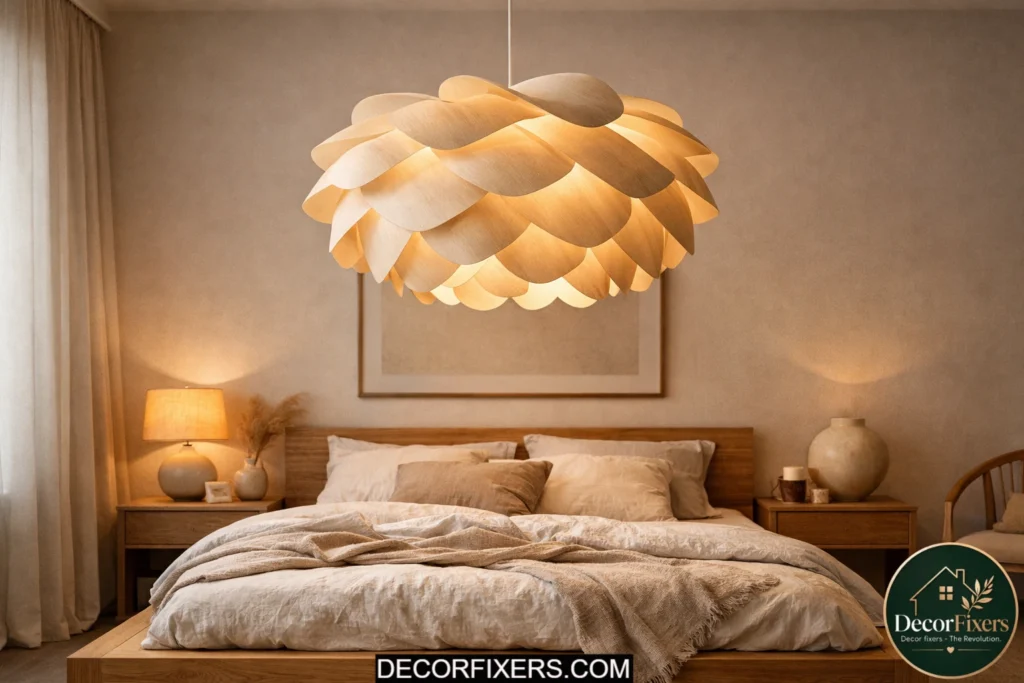
If there’s one place to spend real money in a Scandinavian bedroom, it’s lighting. A well-chosen pendant over the bed does more aesthetic work than any piece of art, any throw pillow arrangement, any curated shelf display.
GUBI makes some of the most iconic Nordic pendants; the Multi-Lite and Best Lite are classics. But even affordable rattan pendants from IKEA or local homeware shops can deliver the same organic warmth at a fraction of the price. Shape and material matter more than brand.
14. Use Under-Bed Storage to Stay Clutter-Free Without Sacrificing Anything

One of the biggest practical tensions in Scandinavian bedroom design: people need storage, but visible storage kills the calm. The answer is under-bed storage, specifically, beds with built-in drawers or simple wooden crates slid underneath a platform bed.
This is especially important for renters and anyone in a small space. If you’re interested in maximizing every square centimeter, my guide on
If you’re working with a limited floor area, the same principles apply. Take a look at Small Bedroom Ideas for room-specific layout strategies that complement Scandi design perfectly.
15. Bring Nature In, Plants, Wood, Stone, and Water
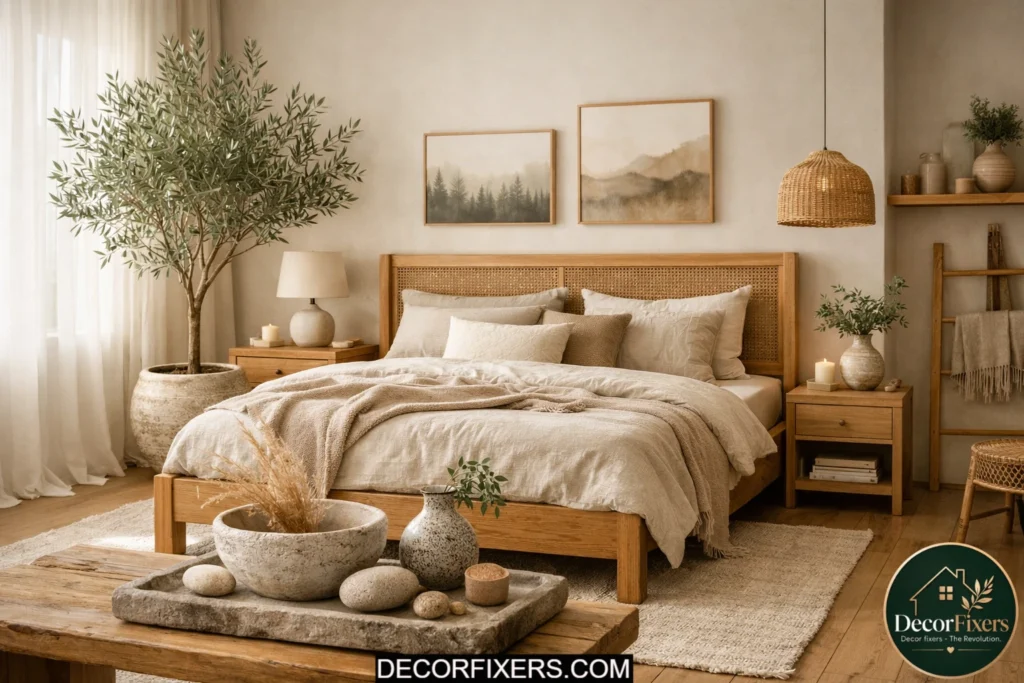
Biophilic design, incorporating natural elements to create a connection to the outdoors, is fundamental to Nordic interiors. It’s not decoration for decoration’s sake. It serves the psychological purpose of making humans feel less tense, which is exactly what a bedroom should do.
Start small: one mid-sized plant with a calm leaf structure (a snake plant, a fig tree, or an olive tree works beautifully), a small ceramic pot in an earth tone, and a stone or wood tray on the dresser. These elements don’t crowd the space. They ground it.
16. Choose Furniture with Tapered Legs, it’s a Detail That Changes Everything
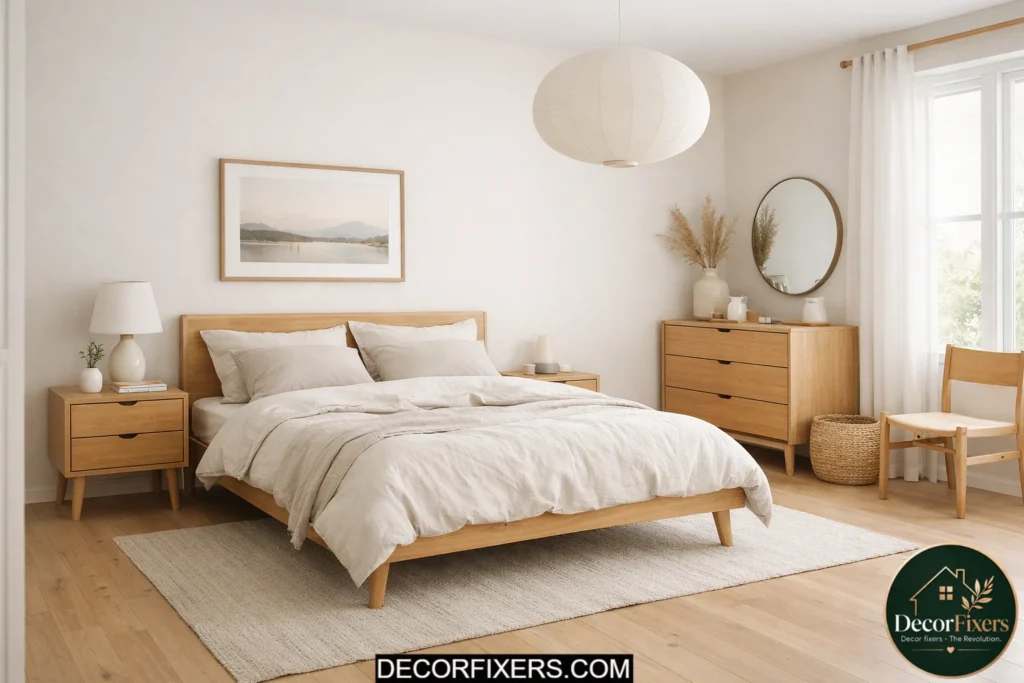
Tapered wooden legs on furniture are to Scandinavian design what exposed brick is to industrial loft style, a signature detail that immediately signals the aesthetic. More practically, furniture on tapered legs shows the floor beneath it, which makes any room feel larger and airier.
Look, if you’re renovating on a tight budget and can’t replace your bedroom furniture, this is what actually works: buy simple hairpin-leg or tapered-leg replacements online and swap out the legs on your existing pieces. It costs almost nothing, and the transformation is real.
17. Add Texture Through Wall Art, Not Color
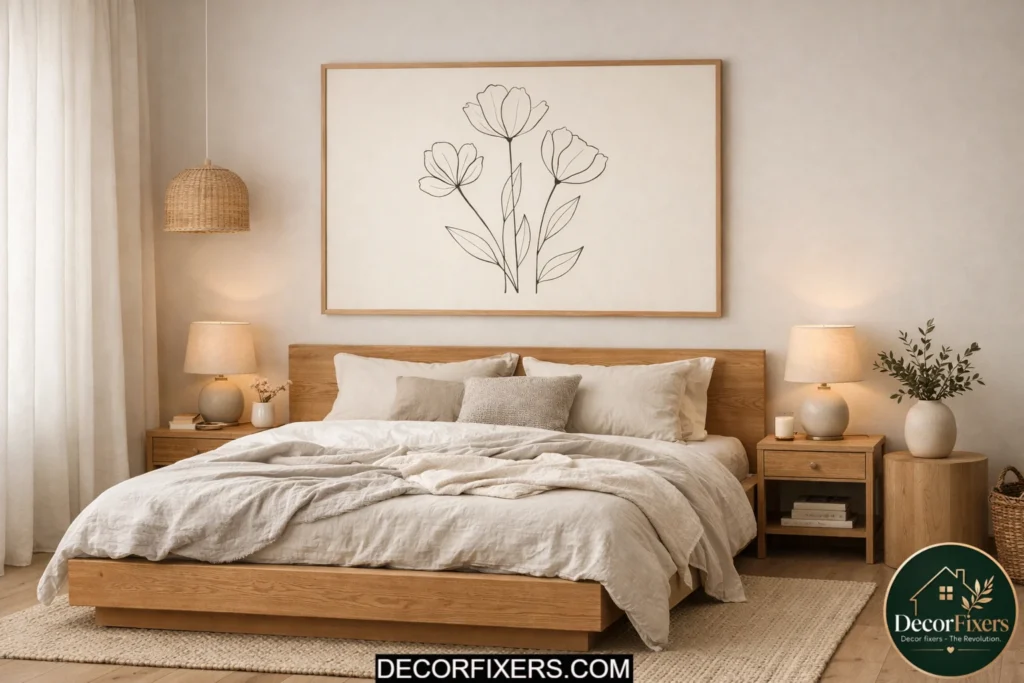
Scandi bedrooms use art sparingly, one piece, well-chosen, usually simple—no gallery walls with fifteen frames. Botanical prints, abstract line drawings, and architectural photography in simple black or natural wood frames are all common choices.
The trick is keeping the frame simple and the image uncomplicated. A single large print (70x100cm or larger) makes more visual impact than three small ones arranged asymmetrically. It anchors the wall without cluttering it.
18. Try Washed or Stone-Washed Linen Bedding for Instant Authenticity
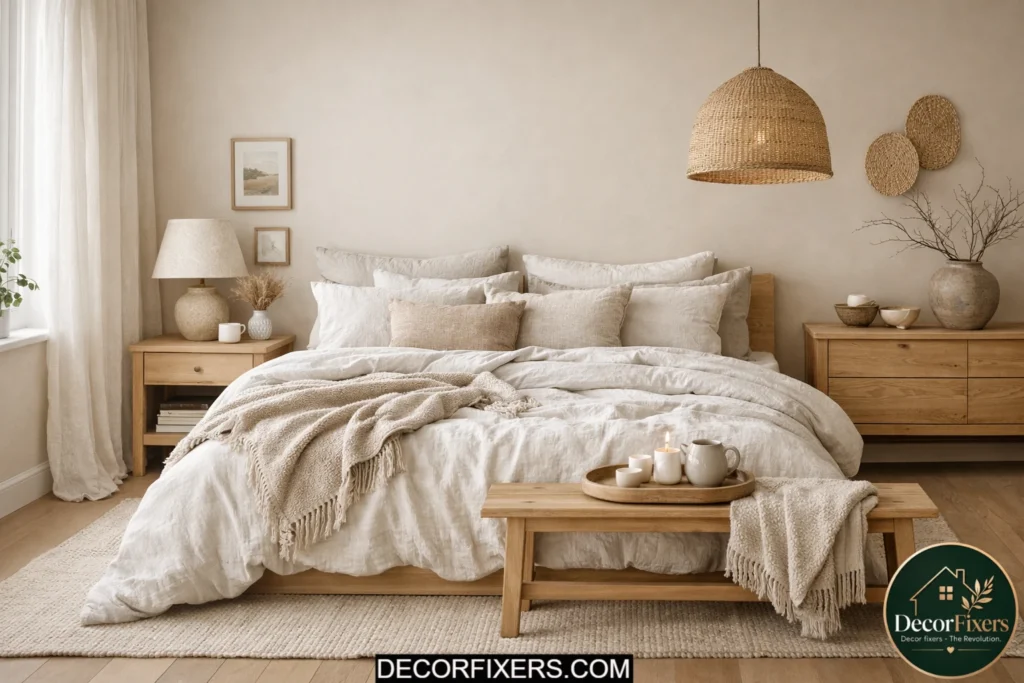
There’s a specific softness to stone-washed linen that you simply can’t fake with polyester blends. The slight texture, the relaxed drape, the way it looks perfectly made even when slightly rumpled, it’s what gives Scandinavian bedroom photography that effortlessly lived-in quality.
The Modern Dane and Ferm Living both produce excellent stone-washed linen bedding. I’ve seen conflicting advice about thread count for linen; some sources say higher is better, others say that in linen, weave and wash treatment matter far more than count. My read is that washed texture beats high thread counts every time for the Nordic look.
19. Use a Wooden Stool as Your Bedside Table
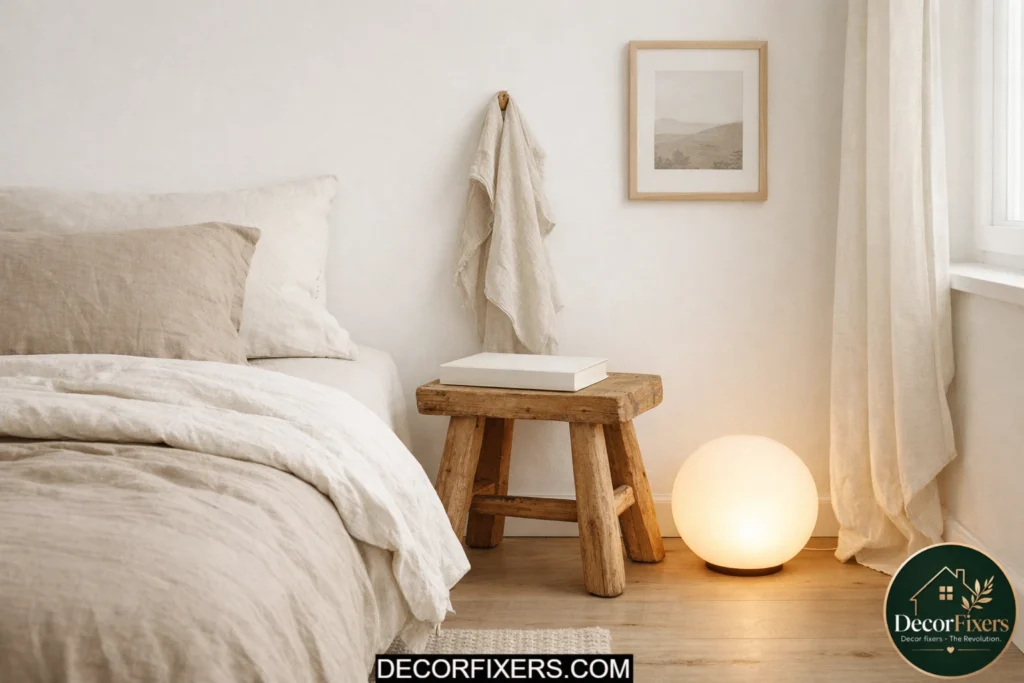
This might be the most underrated tip in all of Scandinavian bedroom styling. A simple wooden stool, raw, natural finish, no frills, used as a bedside table, costs almost nothing and looks intentional rather than improvised.
It keeps the bedside area visually light (no heavy mass of a chest of drawers), it shows floor space, and the imperfection of raw wood adds exactly the organic warmth the room needs. Stack one book on it. Put a small lamp on the floor beside it. That’s the whole composition.
20. Create a “Quiet Shelf”, The Scandi Styling Rule for Surfaces
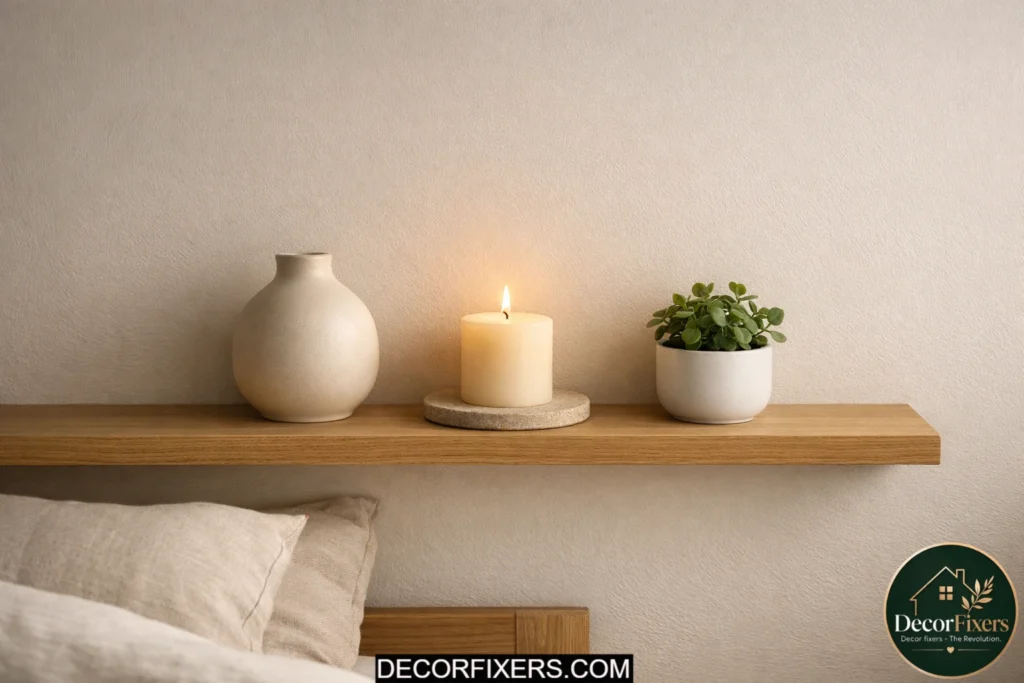
A quiet shelf has three elements and three only: one large object (a ceramic vase, a sculptural book), one mid-sized object (a candle, a small plant), and one small object (a stone, a tiny dish). Nothing more. This rule works on any surface, shelf, dresser top, or bedside table.
The reason it works psychologically is the visual rhythm. Three objects of varying scale create interest without visual noise. More than three, and the brain starts cataloguing instead of resting. Fewer than three, and the surface feels incomplete. Three is the Scandi sweet spot.
21. Go Rental-Friendly with Non-Permanent Scandi Changes
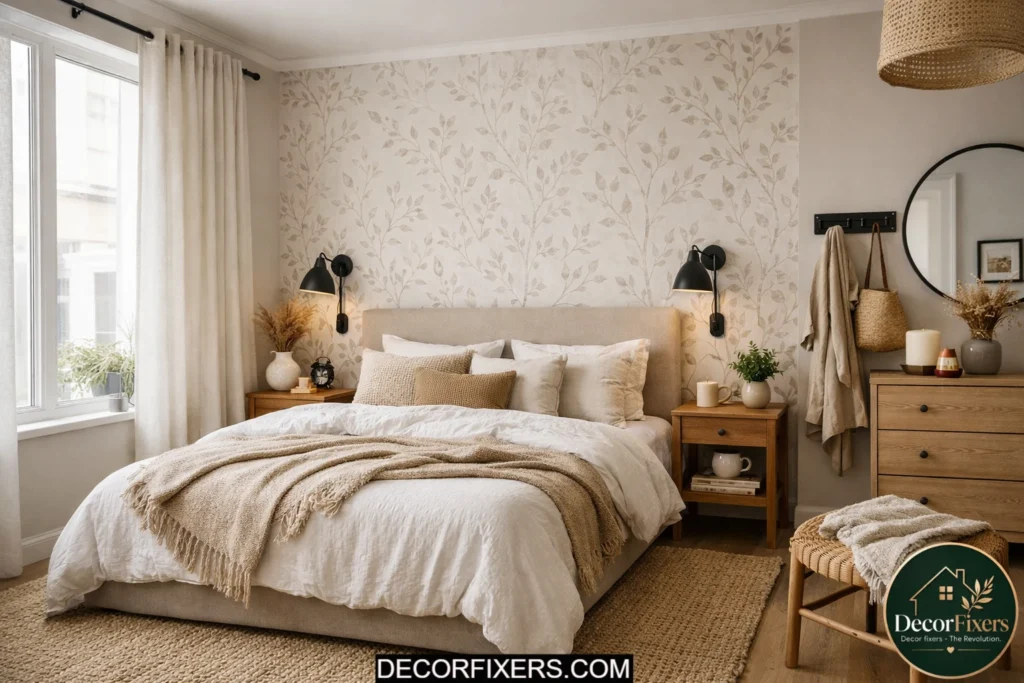
One of the biggest gaps in competitor articles is practical guidance for renters. Most Scandinavian bedroom guides assume you own the place, that you can paint walls, install built-in wardrobes, and replace light fixtures at will. Most readers can’t.
Here’s what actually works without touching walls: swap curtain rods for ceiling-mounted ones using tension or adhesive brackets (gives you that floor-to-ceiling curtain effect), use removable wallpaper for a feature wall, replace hardware on existing furniture with matte black or brass knobs, and add a large jute rug to cover damaged flooring. None of these requires a landlord’s permission. All of them shift the room significantly toward a Nordic aesthetic.
Can I achieve Scandinavian bedroom design in a rental?
Yes. The most effective rental-friendly Scandi changes include ceiling-height linen curtains on adhesive brackets, removable feature wallpaper, swapped furniture hardware in matte black or brushed brass, and large natural-fibre rugs. These require no permanent alterations and collectively shift a room’s aesthetic considerably toward Nordic design principles.
22. Add Candles, Hygge Is Incomplete Without Them
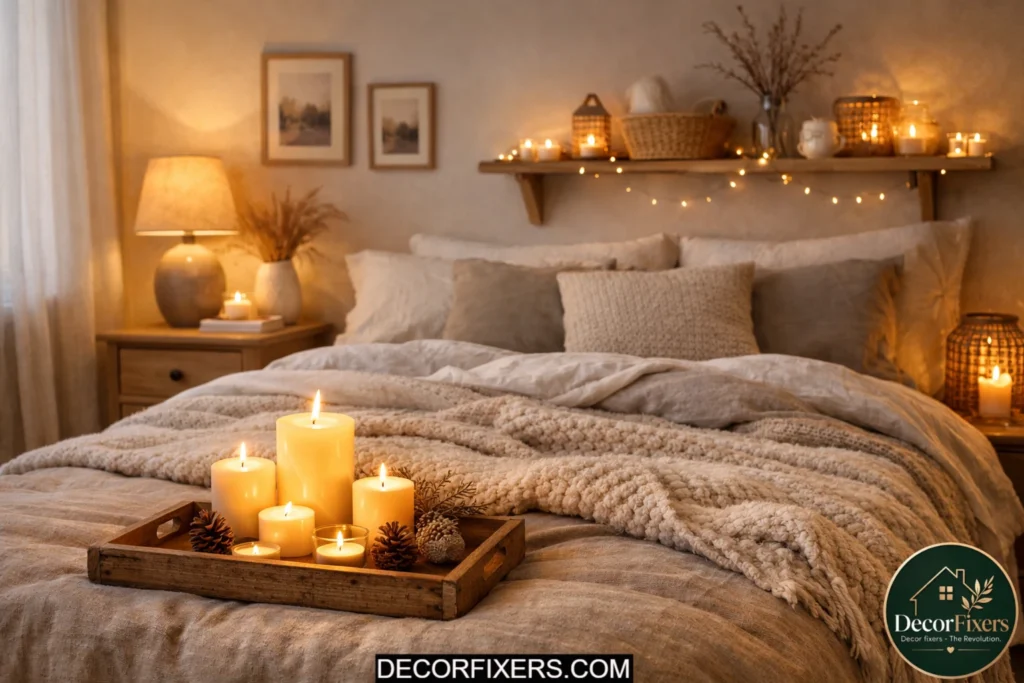
Hygge, the Danish concept of comfort and conviviality, is most often described through objects, but it’s actually experienced through atmosphere. And nothing creates atmosphere faster in a Scandinavian bedroom than candlelight.
Keep it minimal and intentional: two or three pillar candles on a wooden tray, one or two taper candles in simple holders. The scent matters; unscented or very lightly scented (cedarwood, beeswax, clean cotton) keeps the room restful rather than overwhelming. Quick note: battery-powered LED candles do a surprisingly good job for renters with restrictions on open flames.
23. Try Tone-on-Tone, Same Color, Different Textures
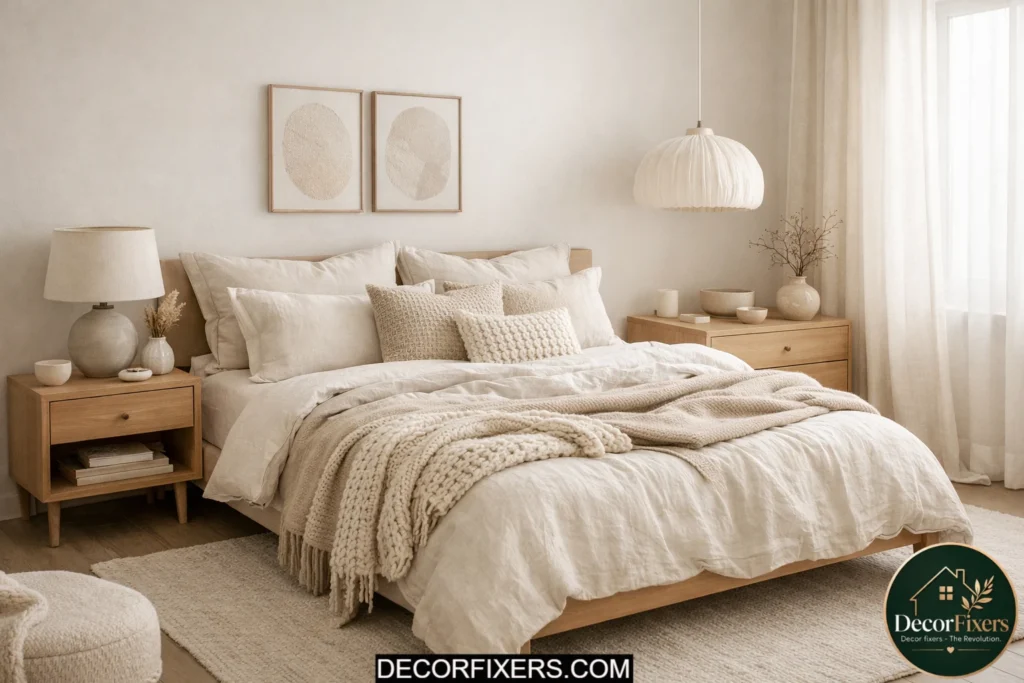
One of the most elegant and least-discussed techniques in Scandinavian interior design is tone-on-tone layering: using the same general color at different texture levels to create depth without introducing new colors.
In practice: warm white walls, white linen duvet, cream wool throw, off-white linen pillow, natural cotton knit blanket. All broadly ‘white’ or ‘cream’, but the variation in texture (smooth, rough-woven, knit, matte) makes the room feel rich and considered. This is how Nordic bedrooms manage to look interesting with almost no color.
24. Consider a Headboard Upholstered in Textured Fabric
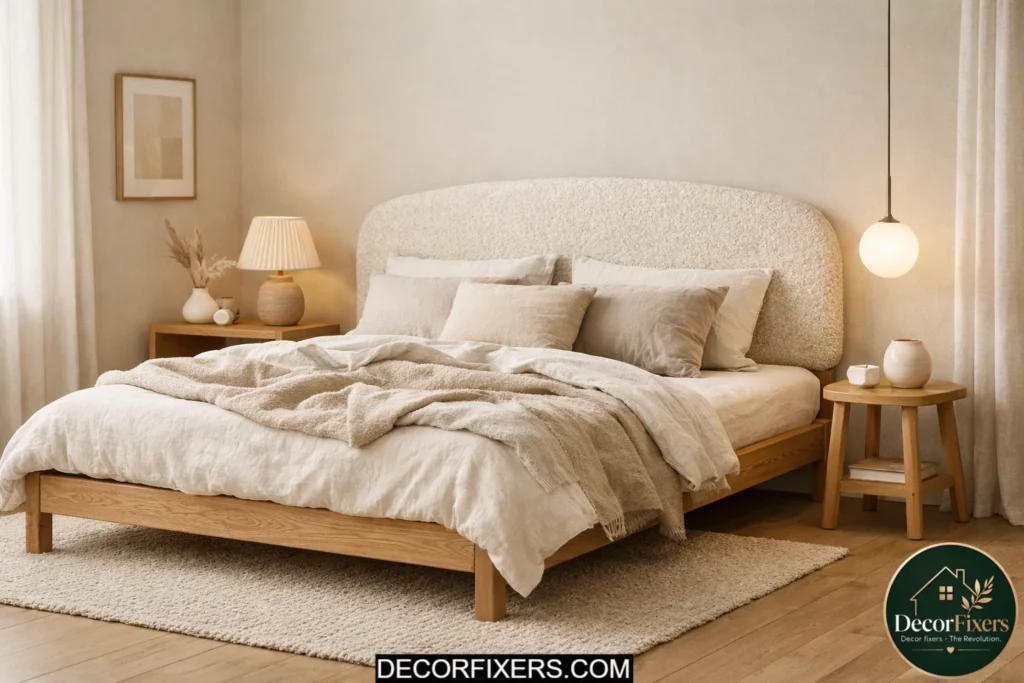
A fabric headboard, particularly in bouclé, boucle-wool blend, or textured linen, adds softness, warmth, and acoustic absorption to a Scandinavian bedroom. It’s a functional and aesthetic upgrade in one.
Keep it low-profile (the headboard height should not exceed the width of the bed) and choose a fabric in your base tone or one step richer. A warm ivory bouclé headboard on an oak slat bed base is one of the most reliable Scandinavian bedroom compositions you can build.
25. Don’t Forget the Boho Crossover, Scandi and Bohemian Overlap More Than You Think
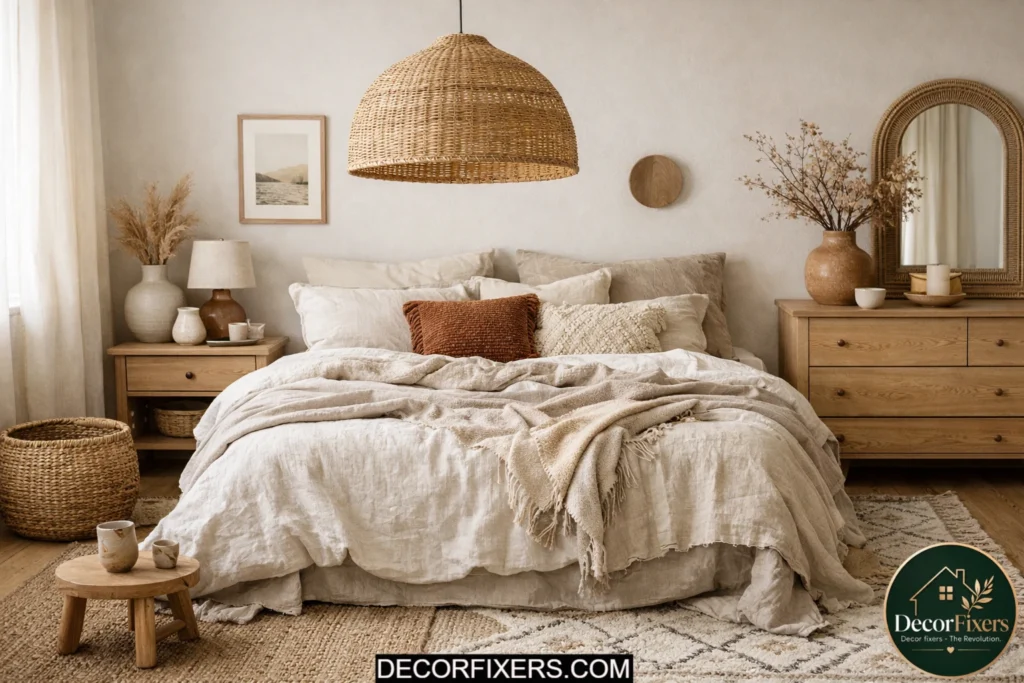
If Scandinavian design feels too restrained for your personality, the style sits surprisingly close to relaxed bohemian aesthetics, both of which value natural materials, organic textures, and an anti-fussy attitude toward decoration. For a warmer, more textured take, exploring Boho Bedroom Ideas can help you find the right balance between Scandi calm and boho warmth without losing either.
The crossover is particularly effective in how both styles use rugs, throws, and ceramics; you can take Boho’s richer texture palette and ground it with Scandi’s restrained color approach. The result is a room that’s warm and personal without tipping into visual chaos.
26. Use Matte Black or Brushed Brass Hardware for Edge
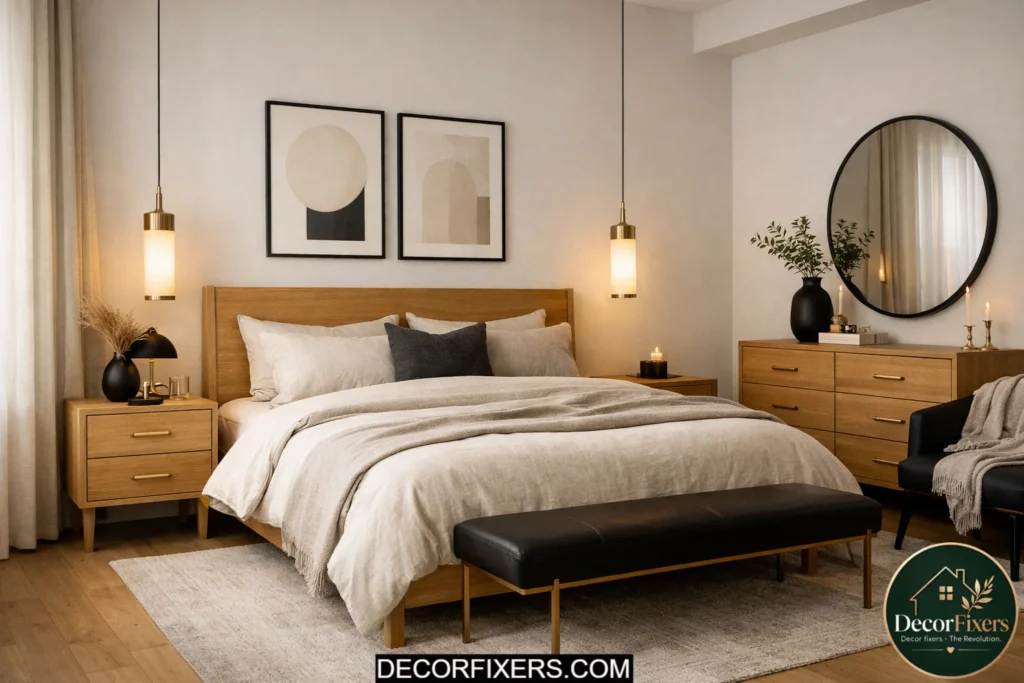
Every Scandinavian bedroom needs at least one element of visual contrast, something that stops the room from reading as one flat, beige blur. Hardware is the lowest-effort, highest-impact place to add it.
Matte black is the sharper, more contemporary choice. Brushed brass (not shiny gold) is warmer and pulls toward the hygge end of the scale. Replace drawer pulls, curtain rings, lamp bases, and mirror frames with one consistent metal finish. The coherence is immediate, and it looks expensive for a fraction of the cost.
27. Let Negative Space Do the Work
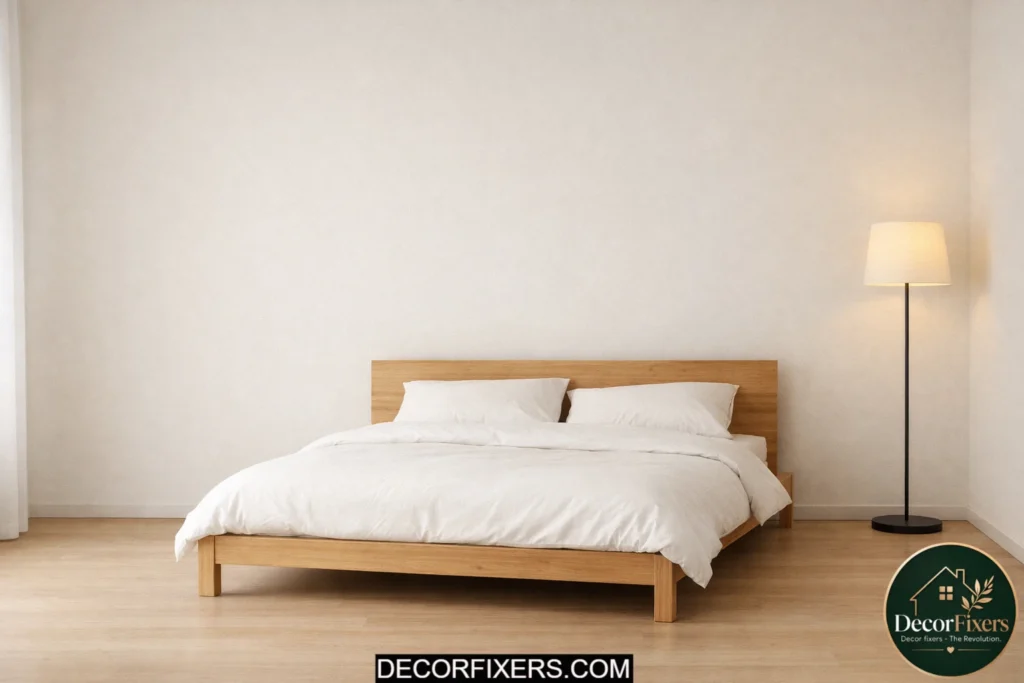
This is the hardest principle for most people to embrace, and it’s the one that separates an average Scandi-inspired room from a genuinely extraordinary one. Negative space, the intentionally empty areas of a room, is not wasted space. It’s where the eye rests.
A bare wall beside a bed is not a design failure. An empty corner with only a floor lamp is not a missed opportunity. These deliberate voids create visual breathing room, which is exactly what makes you feel physically calmer when you step into the space. Most Scandinavian design guides spend 2,000 words on what to add. This one last point is about what to resist adding, and it might be the most useful thing here.
CONCLUSION:
When I finally got my own bedroom to feel right, it wasn’t because I bought the perfect duvet or found the right shade of paint. It was because I stopped adding and started editing. I took three things off the bedside table. I swapped the overhead bulb for a pair of warm bedside lamps. I added one wool throw that I’d been resisting because it felt ‘too expensive for a blanket.’
The room didn’t look like a magazine. It looked like somewhere I actually wanted to sleep. Which, when you think about it, is the entire point of Scandinavian bedroom design, not perfection, but genuine rest.
Pick two or three ideas from this list and start there. You don’t need all 27. You need the right ones for your specific space, your budget, and the way you actually live in your room.
Start with lighting. Always start with lighting. Everything else follows.
FAQs:
Q: What’s the best color for a Scandinavian bedroom wall?
A: Warm neutrals like soft greige, warm off-white, or pale sand work best. Pure bright white often reads cold; a warm undertone is what creates the Nordic feeling of a space that breathes.
Q: How do I make my bedroom feel more Scandinavian without buying new furniture?
A: Swap your bulbs for 2700K warm-white, hang linen curtains at ceiling height, add a natural-fiber rug, declutter every surface down to three objects maximum, and replace hardware with matte black or brushed brass fittings.
Q: Should I use plants in a Scandinavian bedroom?
A: Yes, one or two plants with a calm, structural leaf shape. Avoid too many small pots scattered around. A single large olive tree or fig plant in one corner is more impactful than six small succulents.
Q: Why does my Scandinavian bedroom feel cold instead of cozy?
A: You’ve probably overdone the minimalism and underdone the texture. Add a wool or bouclé throw, swap any cool-white bulbs for warm ones, and introduce one wood element. The warmth comes from materials, not color.
Q: When should I try Japandi instead of pure Scandinavian design?
A: Try Japandi if you want even more visual silence, fewer objects, lower furniture, stronger emphasis on negative space. It works especially well in rooms with strong natural light and at least 12 square meters of floor space.

Creator of DecorFixers, sharing practical home and interior ideas focused on real-life usability, simple design improvements, and budget-friendly solutions.
1 thought on “27 Scandinavian Bedroom Ideas: Tips for Calm, Cozy Space”