

I want you to stop and think for a second. Right now, as you’re reading this, there’s probably a graveyard of dust bunnies, forgotten shoes, and mystery boxes living rent-free under your bed. You might’ve tried shoving a few plastic bins under there once. They didn’t fit. Or they did fit, but you never opened them again because getting to them felt like an archaeological dig.
That experience isn’t rare. It’s the norm. But here’s the thing: under your bed is likely the single largest untapped storage zone in your entire home, and most people are using zero percent of it effectively.
I’ve spent time testing, researching, and talking to people who’ve actually transformed cluttered bedrooms using nothing but smart underbed storage. Some ideas cost under $15. Some take a weekend to build. All of them are real, specific, and actually work.
This guide covers 25 underbed storage ideas sorted by type, budget, and use case. It does NOT address storage beds with hydraulic lifts or full bedroom renovation projects, just what you can do with the space you already have.
What Is Underbed Storage and Why Most People Get It Wrong
Underbed storage refers to any system, bins, bags, drawers, or DIY builds that use the empty vertical space beneath a bed frame to organize and store belongings out of sight.
The mistake almost everyone makes? Buying something before measuring. Your bed’s clearance height, the gap between the floor and the bottom of your bed frame, determines everything. A bin that’s 7 inches tall won’t slide under a platform bed with 5 inches of clearance. This is the #1 reason people give up on underbed storage.
Bins and Containers
1. Rolling Bins with Wheels, The Everyday Workhorse
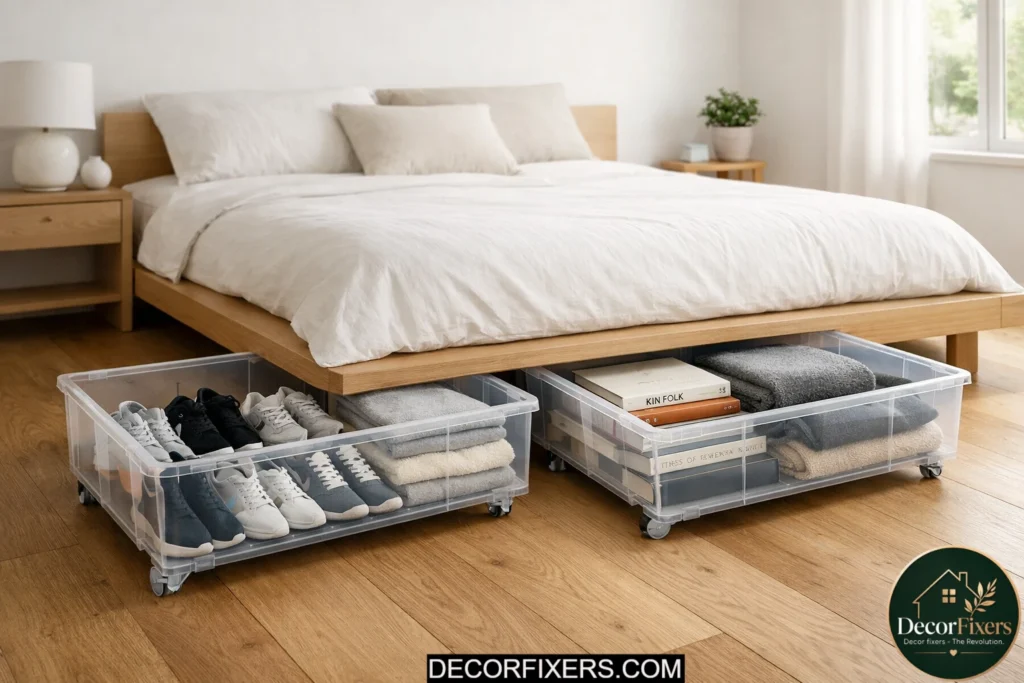
If you store things you actually reach for regularly, gym shoes, extra blankets, books, and wheeled bins are the smartest starting point. They glide in and out without scraping your floor, and you don’t have to wrestle with the bin every time you need something.
Look for bins with four swivel casters, not just two fixed wheels. The difference matters when your bed is against a wall. Needs at least 7 inches of clearance. Brands like Sterilite and IRIS USA make solid options in the $15–$30 range.
2. Clear Plastic Bins with Snap Lids, See What You Have
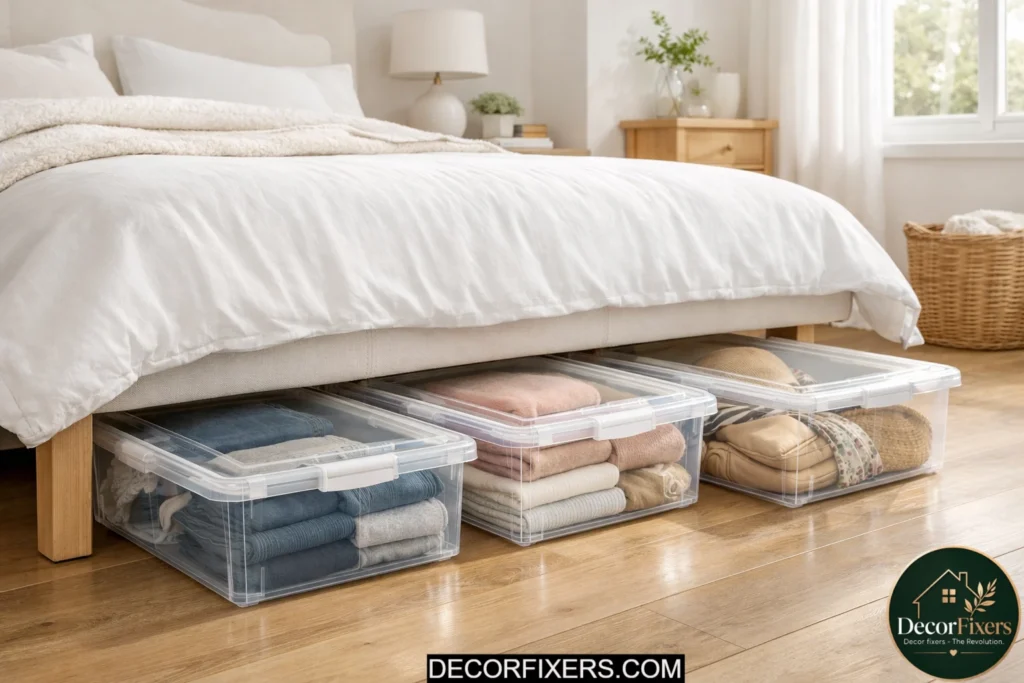
Transparent plastic bins are deceptively simple but genuinely useful. When everything is visible at a glance, you’re far more likely to actually use what’s in there, instead of treating it as a long-term burial site. Snap lids keep dust out better than loose-fitting tops.
The Container Store’s Weathertight Underbed Tote is one of the best versions of this; it’s genuinely airtight, which matters if you live somewhere humid. Comes in a long, shallow profile designed to fit most standard frames.
3. Fabric Zip-Top Storage Bags, Best for Soft Items
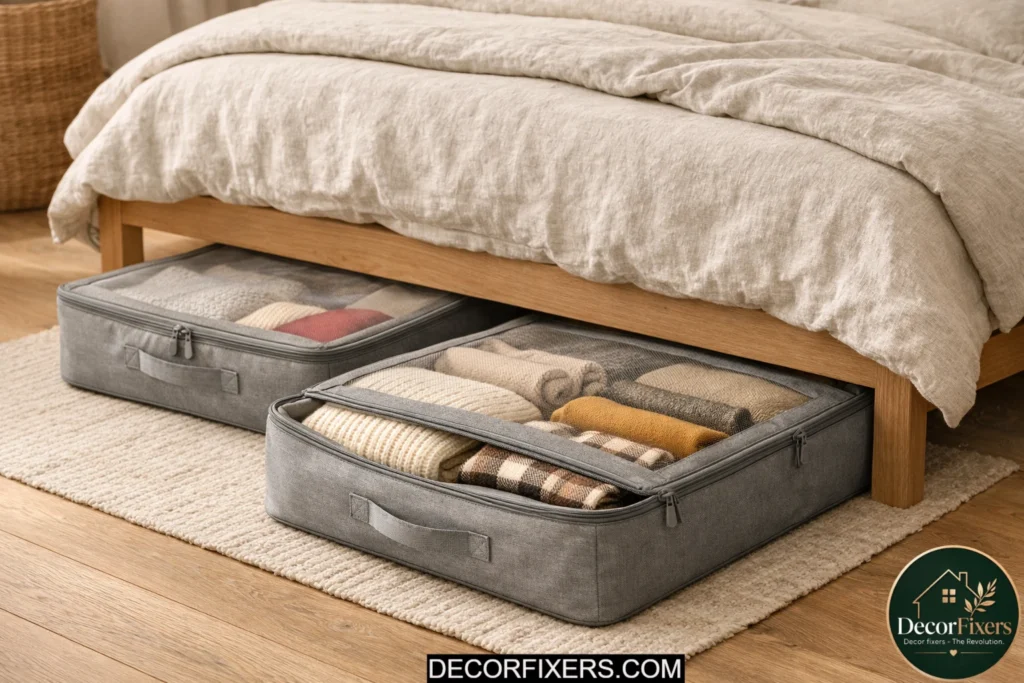
These are the workhorses of seasonal wardrobe storage. A good zip-top fabric bag keeps clothes compressed, dust-free, and accessible without any bulky hardware. Most fold flat when empty, which is a practical bonus.
IKEA’s SKUBB series is a consistent favorite here; they’re wide, low-profile, and sized specifically for underbed use. Pair them with cardboard dividers inside to keep folded items from sliding around. Needs at least 5 inches of clearance.
4. Vacuum Storage Bags, Maximum Compression for Bulky Items
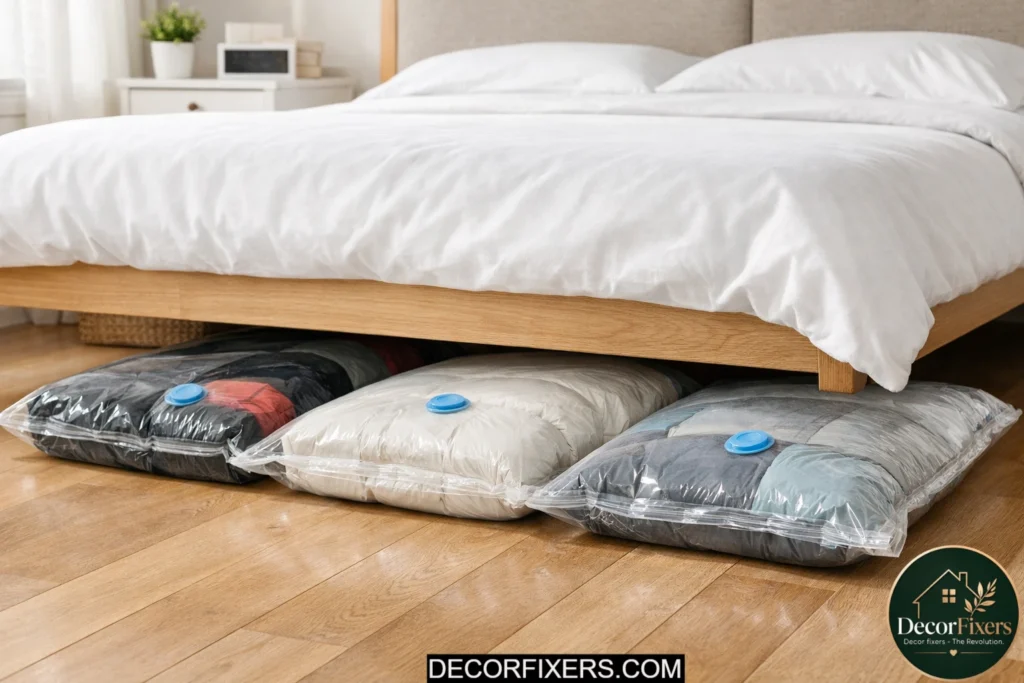
Vacuum bags can compress a winter duvet to roughly a quarter of its original size. That’s not an exaggeration. For bulky coats, thick comforters, or pillow collections you’re rotating seasonally, nothing else comes close for raw space efficiency.
Here’s an important caveat most guides skip: vacuum compression damages down feathers and natural wool fibers over long periods. It crushes the loft permanently. Spacesaver vacuum bags work brilliantly for synthetics, polyester fills, and cotton, not for your grandmother’s wool blanket or a down duvet you actually care about.
5. Lidded Wicker Baskets with Casters, Storage That Looks Intentional
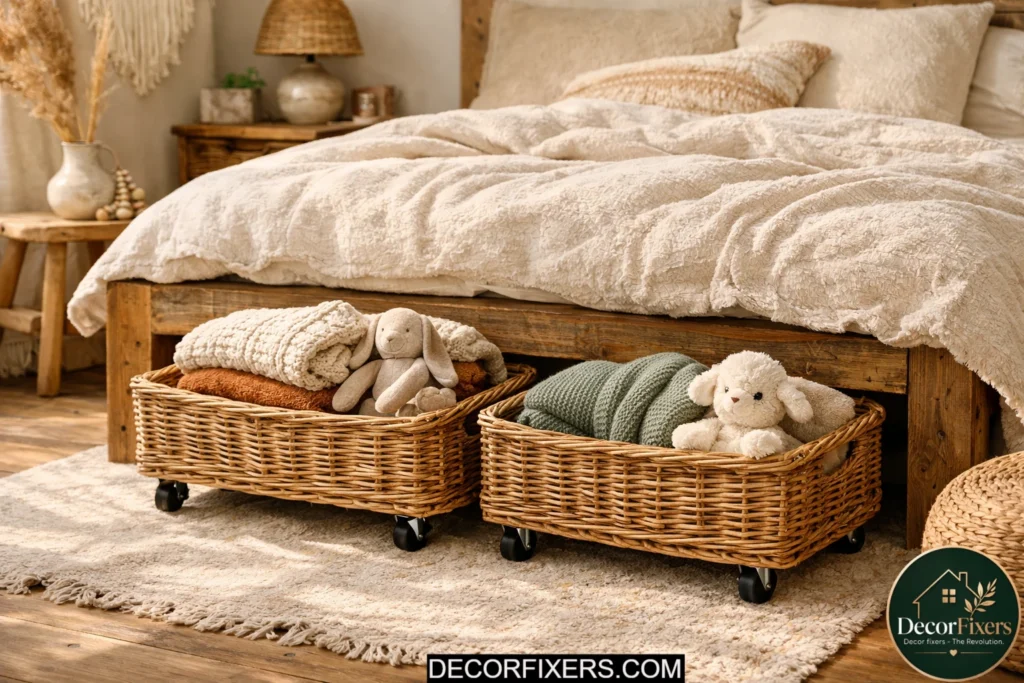
Not everything under the bed has to be hidden behind a bed skirt. Low-profile wicker baskets on casters have a natural, warm aesthetic that works in boho, Scandinavian, and farmhouse-style bedrooms without looking like you’re desperately hiding clutter.
The key is height; stay under 7 inches total, basket plus casters. Fill them with folded throws, lightweight shoes, or kids’ stuffed animals. Anything light enough that the casters don’t buckle under the weight.
6. Long Flat Plastic Boxes, For Beds with Very Low Clearance
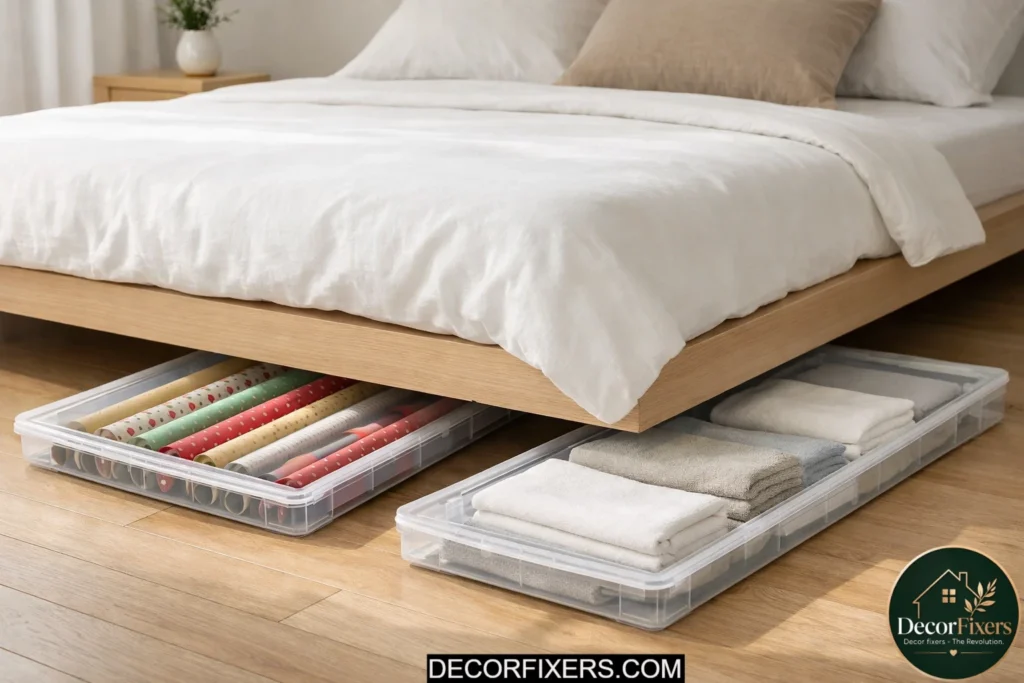
Platform beds and some upholstered frames give you as little as 4 to 5 inches of clearance. Almost nothing fits there, except purpose-built flat boxes. These slim-profile containers are designed for exactly that situation.
Look for boxes specifically labeled ‘low-clearance’ or ‘4-inch height’. They’re perfect for storing flat items: wrapping paper rolls, seasonal table runners, extra sheets, or yoga mats. Don’t try to fit shoes; they’ll just end up jumbled, and you’ll lose pairs.
7. Modular Stackable Bins, Build a System, Not Just Storage
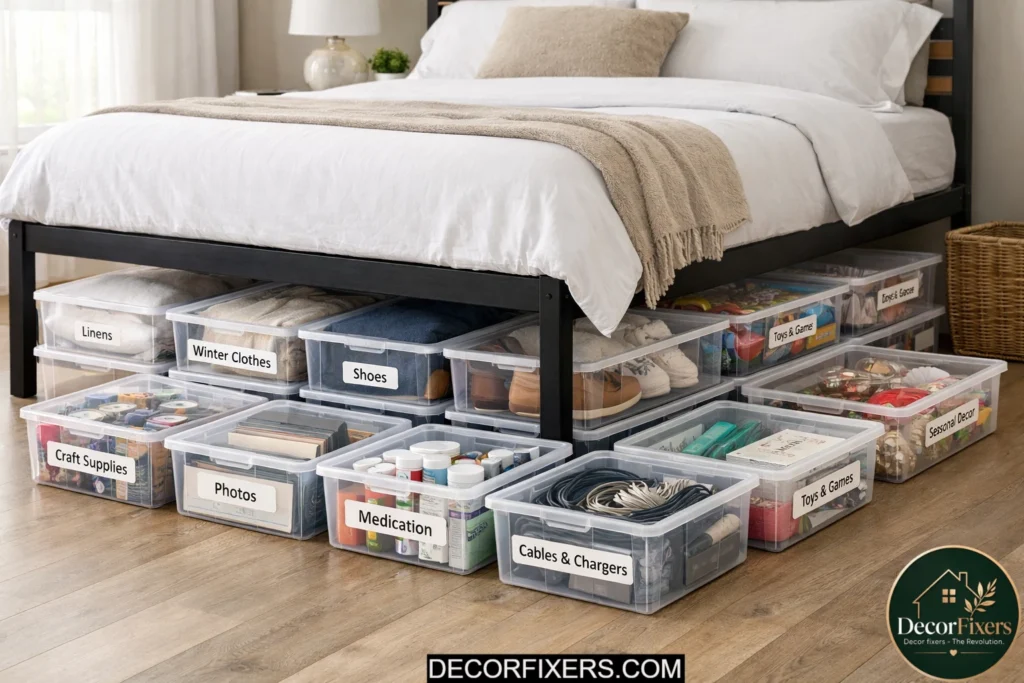
One bin is for storage. A set of coordinated modular bins is a system. If your bed has generous clearance, 10 inches or more, you can use a staggered approach: one row of tall bins at the back, a row of flatter bins in the front that slide out first.
IRIS USA makes modular clear bins that click together, which prevents them from sliding around or tipping when you pull one out. This approach works best on hardwood or laminate floors; carpet adds enough friction to make stacking a pain.
How to measure your bed clearance in three steps:
- Grab a measuring tape and a flashlight.
- Measure from the floor straight up to the lowest horizontal beam of your bed frame.
- Subtract half an inch; that’s your maximum container height.
Most standard bed frames give you 7 to 12 inches of clearance. Low-profile platform frames can drop to 4 or 5 inches. Storage beds with built-in drawers typically have 8 to 10 inches. Know your number before you buy anything.
What can you store under your bed? Almost anything that isn’t needed daily: off-season clothing, extra bedding, spare pillows, shoes, books, gift wrap rolls, children’s toys, luggage, and sentimental keepsakes. According to a StorageCafe survey of 2,824 U.S. respondents (2024–2025), 42% of Americans feel cluttered at home, and clothing is the single biggest culprit, making it the most common thing people store under the bed.
How do you keep underbed storage dust-free? Use containers with lids, zippers, or sealed edges. Fabric bins with zip-top closures are the most effective for soft items. Clear plastic bins with snap lids work for shoes and accessories. Avoid open-top baskets if dust buildup is a concern; they look great but offer zero protection.
Shoe Storage Under the Bed
8. Under Bed Shoe Organizers with Individual Compartments
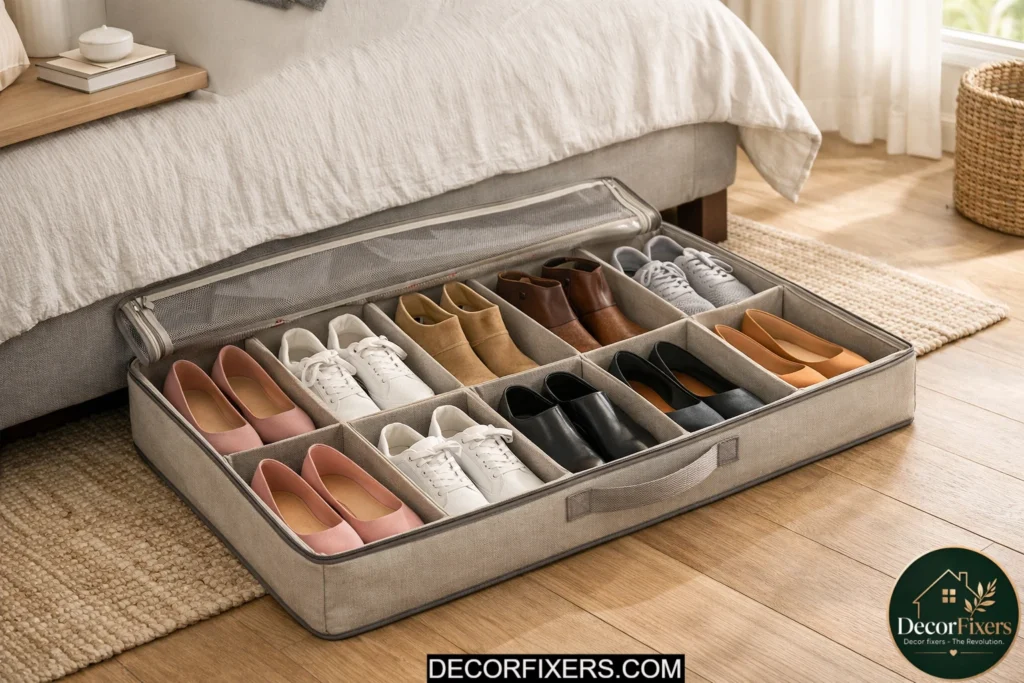
Throwing shoes loose into a deep bin is a guaranteed way to lose pairs and scuff your good shoes. Individual-compartment shoe organizers, either rigid plastic or fabric-divided, keep every pair visible, separated, and intact.
Consumer Reports recommends placing shoes in individual cloth bags before sliding them into bins, especially for leather or suede. It adds one step but protects the finish. The IKEA SKUBB shoe box is a popular solution that stacks flat and fits under most beds with 5-plus inches of clearance.
9. Under Bed Shoe Drawers on Rails, Slide and Select
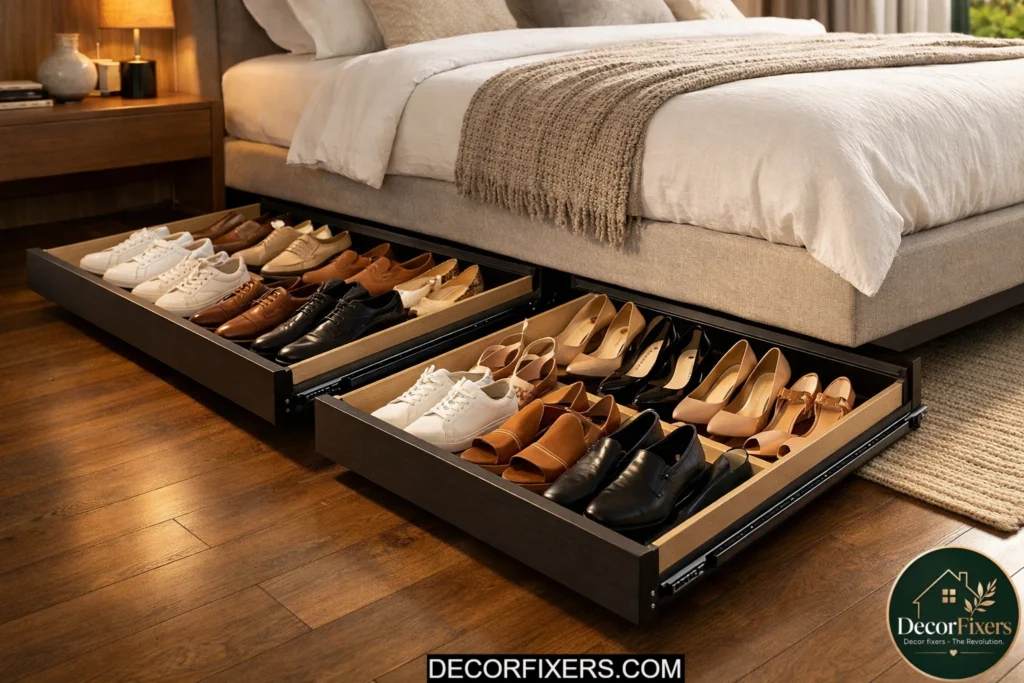
For people with larger shoe collections, a dedicated under-bed shoe drawer on sliding rails is worth the investment. These are essentially built-in drawer systems that install under your existing bed without any tools, using adjustable legs that grip the frame.
Each drawer holds roughly 8 to 10 pairs, depending on the shoe size. Pull it fully open, and every pair is visible at once, no digging. Works best with beds that have 9 inches or more of clearance and a solid wooden or metal frame that can anchor the rail brackets.
10. Repurposed Wine Crates for Shoes, Cheap and Surprisingly Effective
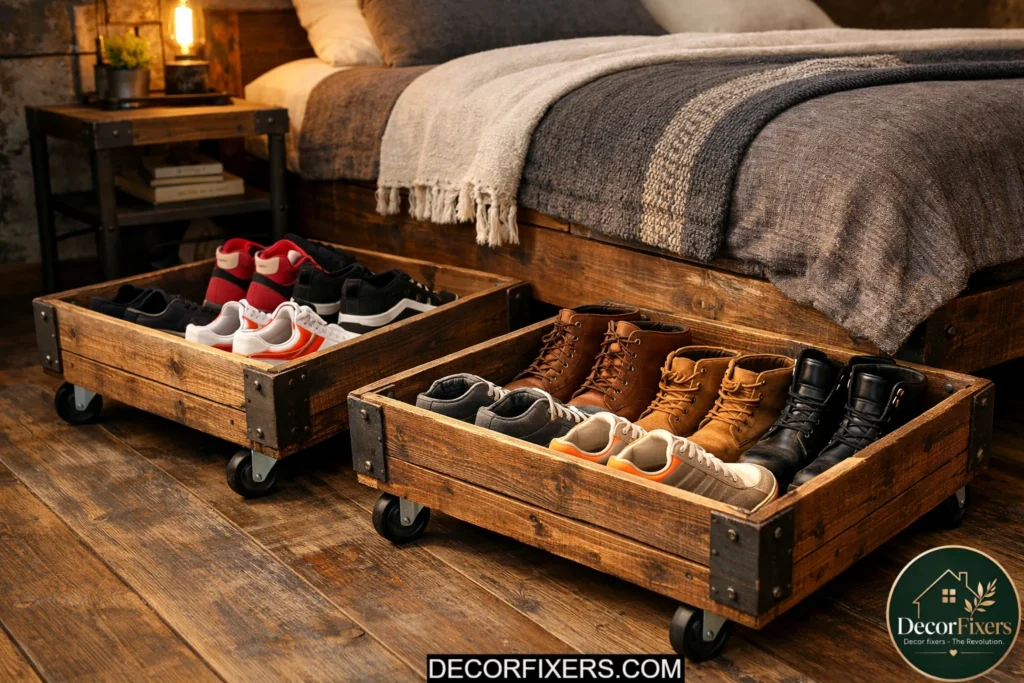
Wine crates are exactly the right dimensions for storing shoes, low, long, and with a natural divider down the middle from the wooden slat. Sand them smooth, attach small furniture casters, and you’ve got a rolling shoe rack that costs almost nothing.
This is one of those DIY underbed storage ideas that looks better in practice than it sounds on paper. The rustic wood aesthetic works especially well in bedrooms with natural or industrial decor. Two crates side by side hold about 12 pairs.
Clothes and Seasonal Storage
11. Seasonal Clothing Rotation System, One In, One Out
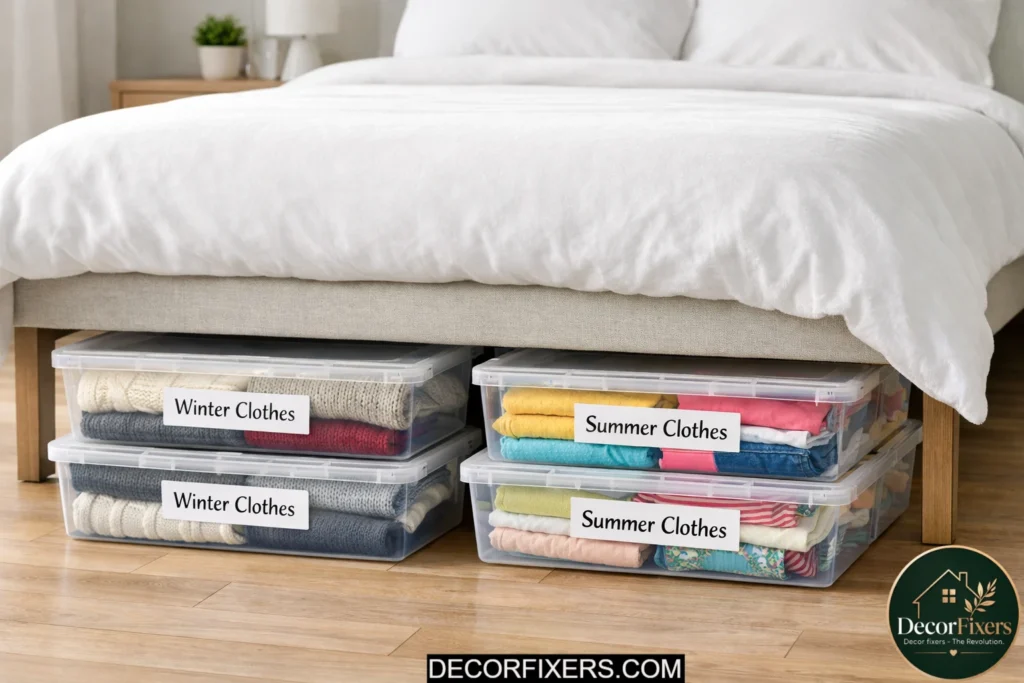
The most overlooked underbed storage strategy isn’t a product; it’s a habit. A seasonal rotation system means your summer wardrobe lives under the bed in winter and vice versa. The clothes taking up wardrobe space are always in season. The clothes under the bed are always out of season.
Label every container clearly on the side facing out. Use a consistent labeling system, ‘Summer Tops’, ‘Winter Knitwear’, not cryptic shorthands you’ll forget in six months. This one habit alone prevents the ‘mystery box’ problem that makes underbed storage feel useless.
If your wardrobe still feels overcrowded even after rotating off-season pieces under the bed, these Small Closet Shelving Organization Ideas can help you maximise vertical storage and make everyday essentials easier to access without adding bulky furniture.
12. Flat Fabric Bins for Off-Season Clothing, Organized by Category
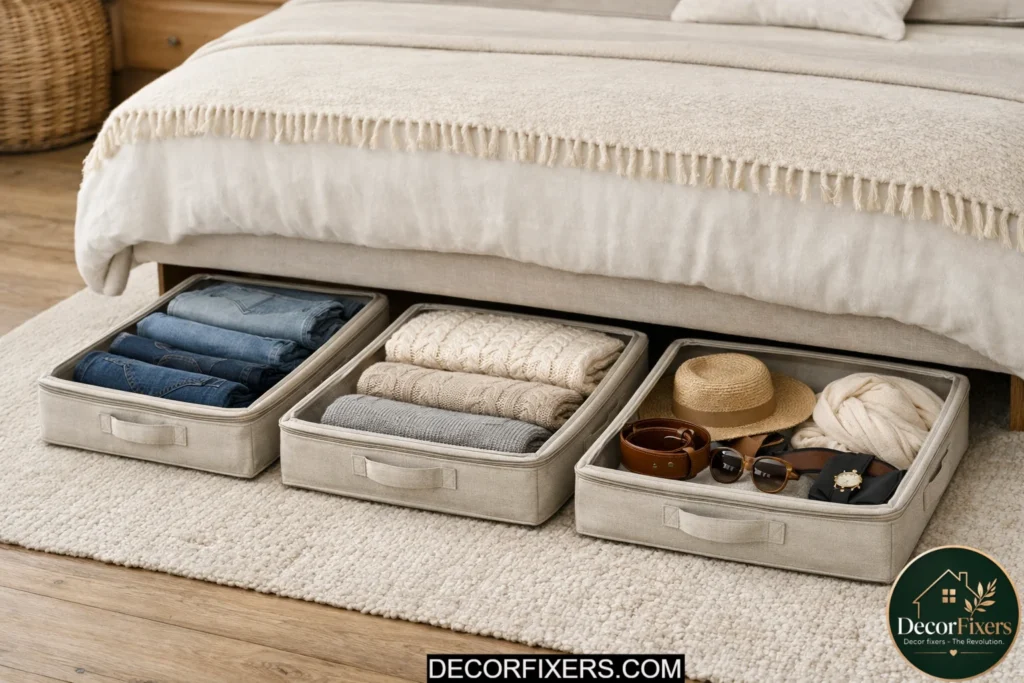
Rather than throwing all off-season clothes into one giant bin, divide them into category-specific fabric containers: one for sweaters, one for jeans, one for accessories. You’ll spend less time digging when the season changes and you actually need something.
IKEA KUGGIS boxes, though technically designed for shelves, work surprisingly well under most beds with 8-plus inches of clearance. They’re rigid, stackable, and the lids clip shut firmly. Stack two on their sides, and you’ve got a lot of accessible space.
13. Vacuum Bags + Fabric Bin Combo, The Layered Method
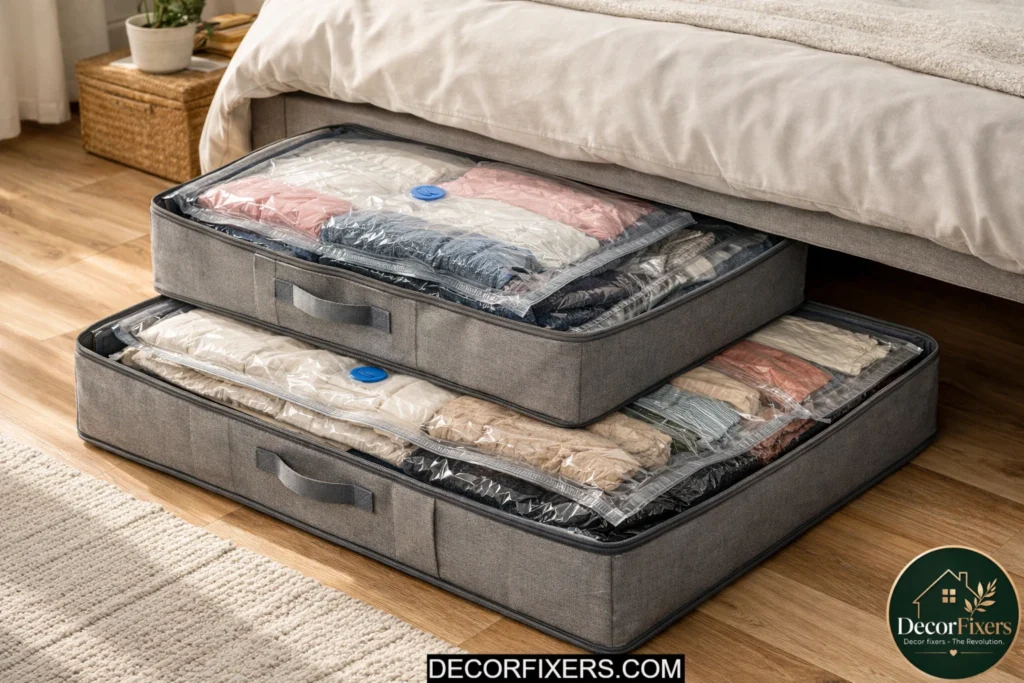
This is a technique I haven’t seen other guides address: compress bulky items like coats or ski gear in vacuum bags, then slide those flat compressed packages inside a larger fabric bin. The bin holds the shape, keeps out dust, and gives you a rigid container to label and pull out cleanly.
It also means you’re not sliding a floppy vacuum bag across your floor every time, you’re sliding a contained bin. Small detail. Makes a real difference in daily use.
Bedding and Linen Storage
14. Long Rolling Box for Spare Bedding Sets, Access Without Effort
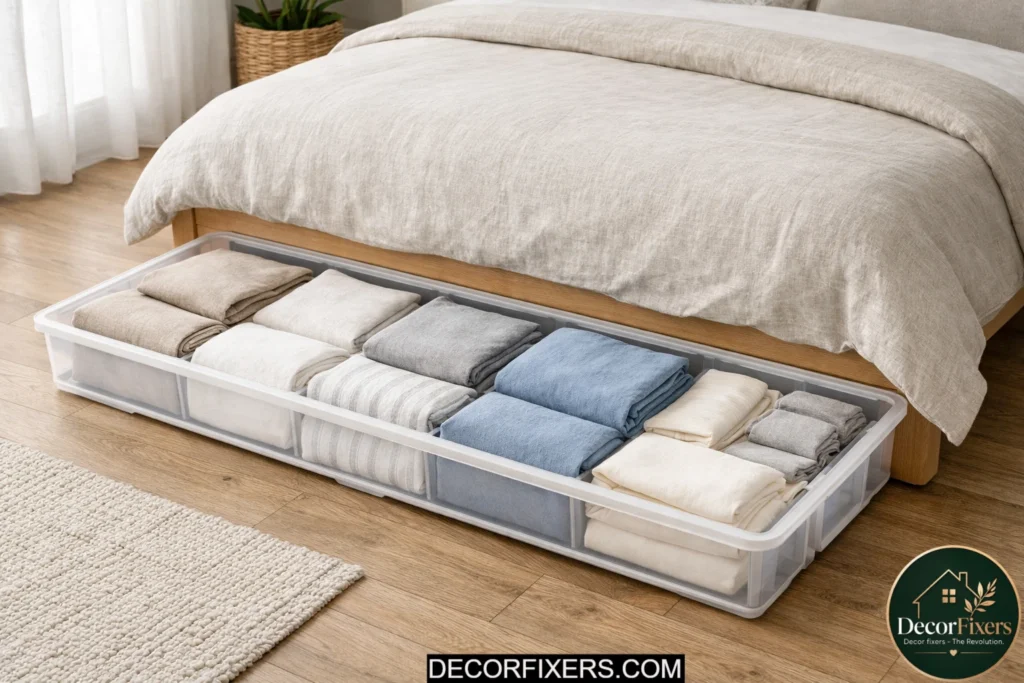
Spare sheet sets and pillow covers are bulky, awkward, and practically homeless in most bedrooms. A long-wheeled box, the kind that spans the full length of the bed, is the perfect solution. Fold everything flat, stack by set, and roll it out when you need a change.
Consumer Reports specifically recommends hinged-lid rolling boxes for spare bedding because of the combination of easy roll-out access and top-opening convenience. Look for boxes that are at least 36 inches long and 7 inches tall for a full or queen bed.
15. Pillowcase Storage Trick: Store Sets Inside Their Own Pillowcase
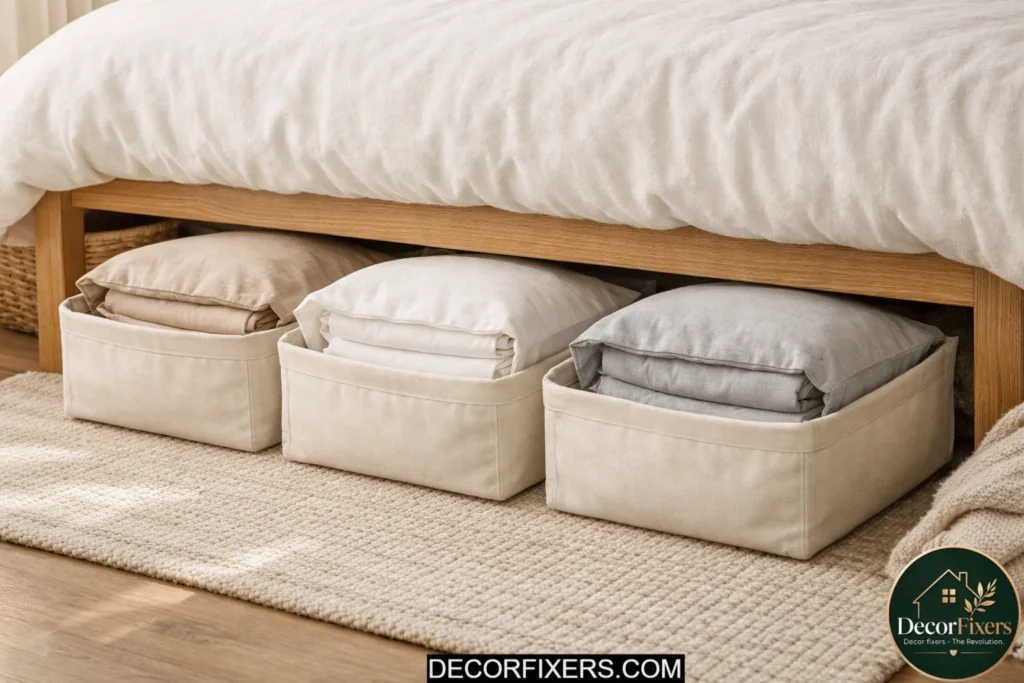
This isn’t just an underbed tip; it’s a game-changer for anyone who’s ever pulled a random sheet out of storage and spent 10 minutes matching it to a pillowcase. Fold your entire sheet set and stuff it inside one of the matching pillowcases. Now it’s one neat bundle.
Store six of these bundles in a low fabric bin under the bed, and you’ve got six complete bedding sets that are immediately identifiable, contained, and accessible. No more rogue fitted sheets escaping the stack.
16. Climate-Appropriate Storage for Duvets, Don’t Just Stuff Them In
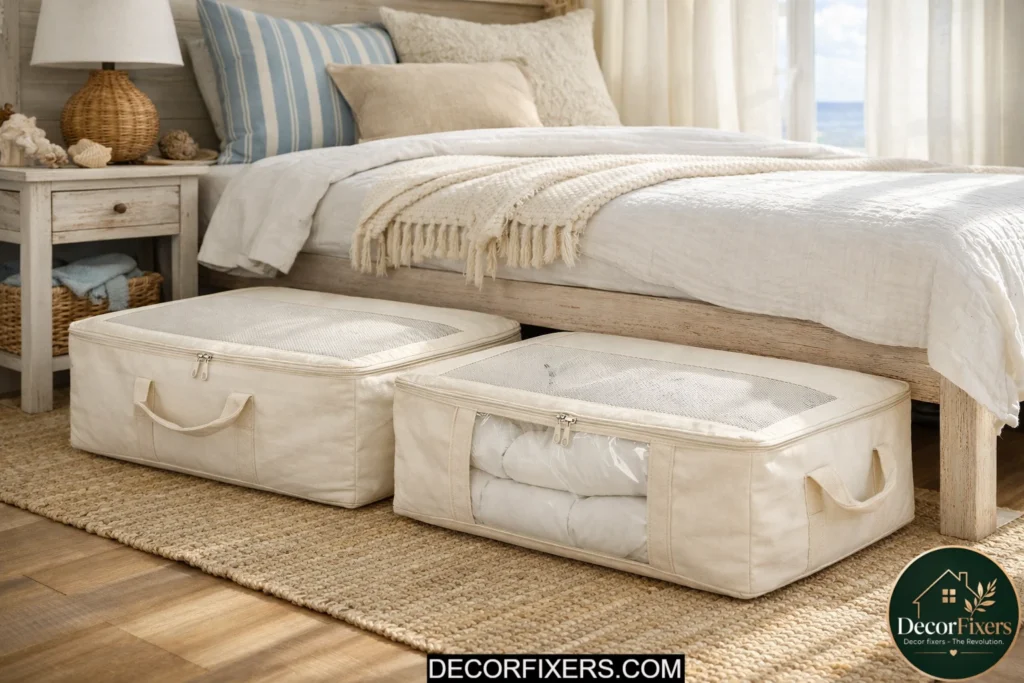
If you live somewhere humid, in coastal areas, or in monsoon-prone regions, storing a duvet in an airtight plastic bin is actually a mistake. Without airflow, moisture gets trapped, and mold becomes a real risk. Use a breathable cotton storage bag instead.
Conversely, in dry climates, airtight plastic containers are ideal for protecting linens from dust and dry air. I’ve seen conflicting advice on this; some sources say always use fabric, others say always seal it. The right answer depends on your environment’s humidity levels, not a universal rule.
DIY Underbed Storage Ideas
17. DIY Wood Crate Drawers, Build to Your Exact Clearance
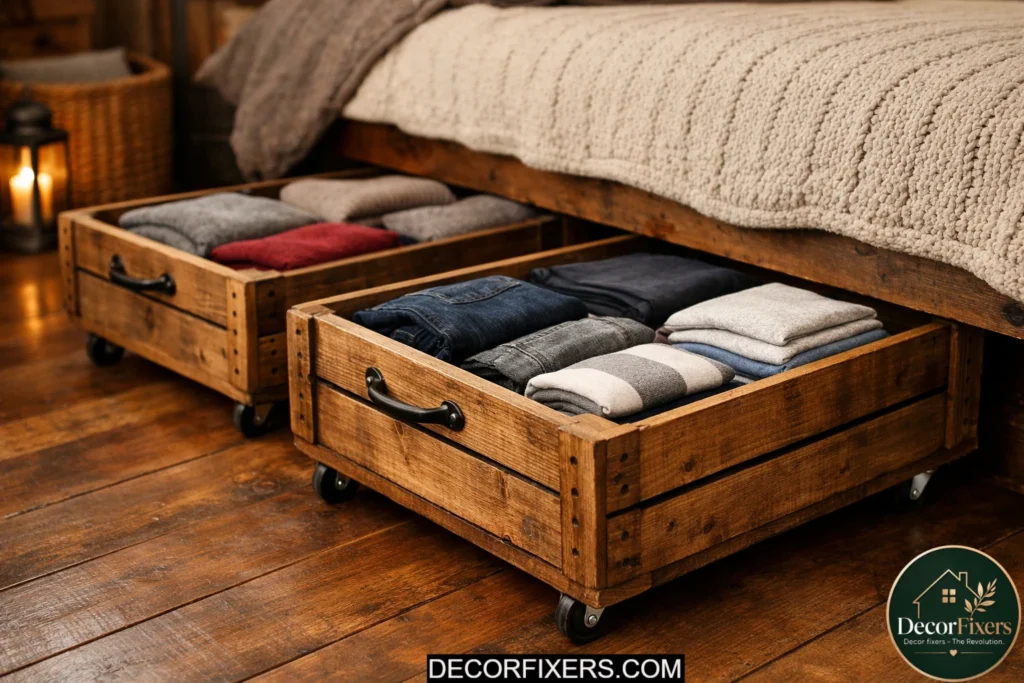
Pre-made bins are made for the average bed. Your bed might not be average. Building simple wood crate drawers from pine boards, wood glue, and screws lets you size the container to exactly the clearance you have, down to the centimeter.
Attach furniture casters to the bottom (4-inch swivel wheels are standard), sand all edges smooth, and stain or paint to match your room. A basic crate costs about $12 to $20 in materials. Two of them under a full-size bed give you substantial, customized storage that looks intentional.
18. PVC Pipe Shoe Rack, The Unconventional Approach
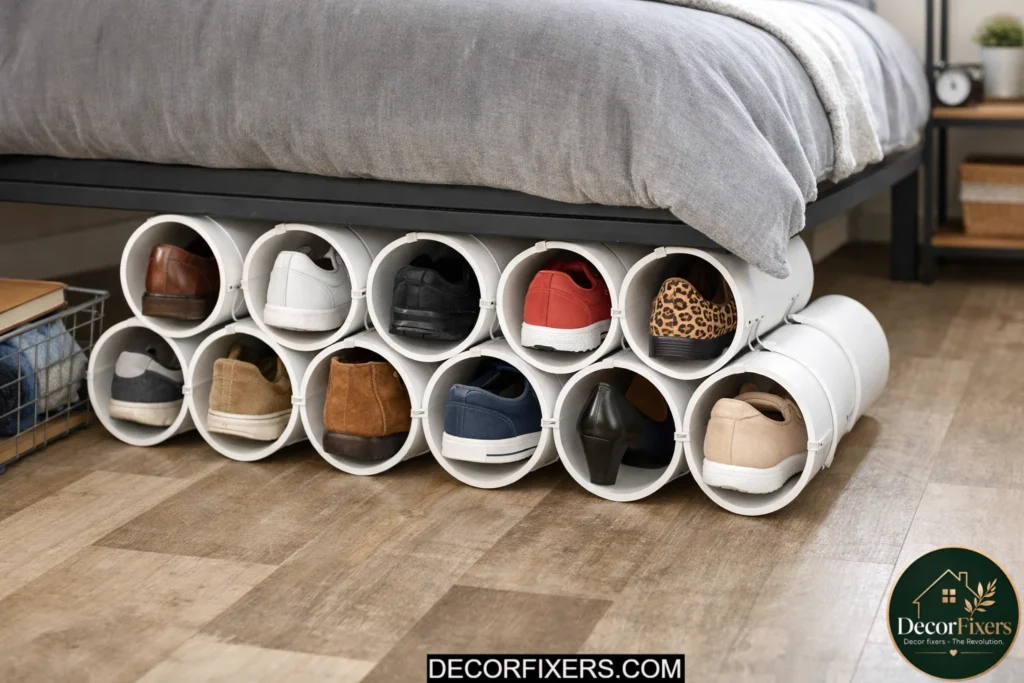
Cut PVC pipes to the same length (about 12 inches works for most shoes) and bundle them in a flat wooden tray or crate. Each pipe holds one shoe. It sounds industrial, but the result is a genuinely organized, low-profile shoe rack that fits under most beds.
The whole build costs under $10 if you buy PVC from a hardware store. It’s not for everyone, the aesthetic is utilitarian, but for a kid’s room or a garage-adjacent bedroom where function beats form, it’s hard to beat the price-to-organization ratio.
19. Repurposed Dresser Drawers, Instant Storage Without Building Anything
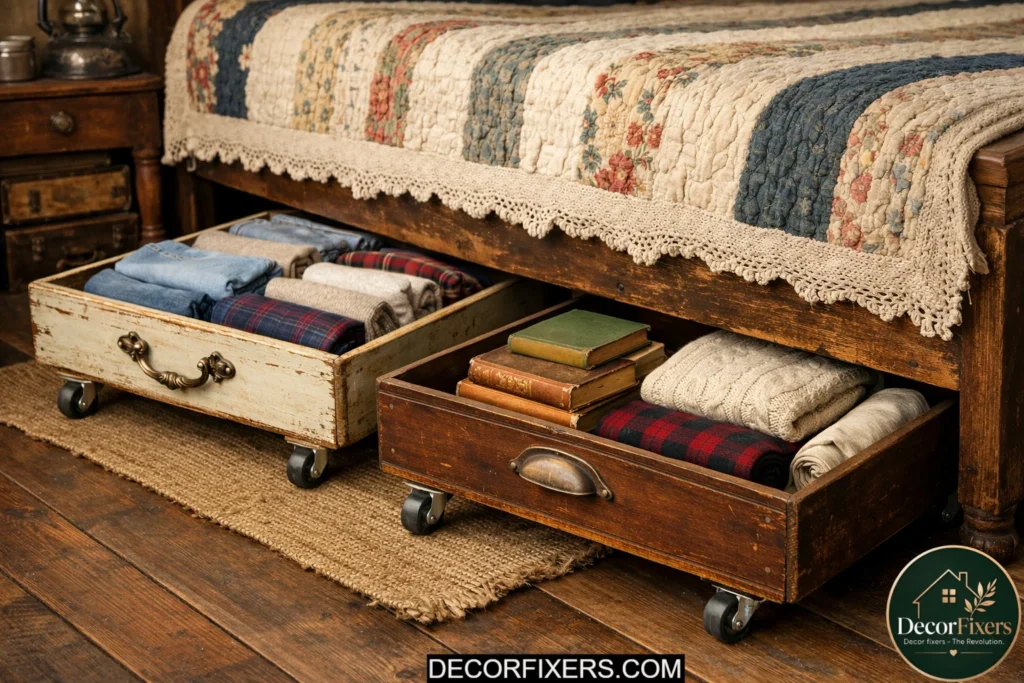
Old dresser drawers are exactly the right shape and depth for under-bed storage. If you have an old dresser falling apart, salvage the drawers, attach casters to the outside bottom corners, and slide them under the bed. Done.
Or maybe I should say it this way: this is genuinely the fastest DIY underbed storage solution that exists. No cutting. No measuring lumber. Attach four casters, and you have a functioning roller drawer in under 20 minutes. Check thrift stores and Facebook Marketplace for old dressers if you don’t already have one.
20. Floating Shelf Under Slatted Bed Frames, Use the Frame Itself
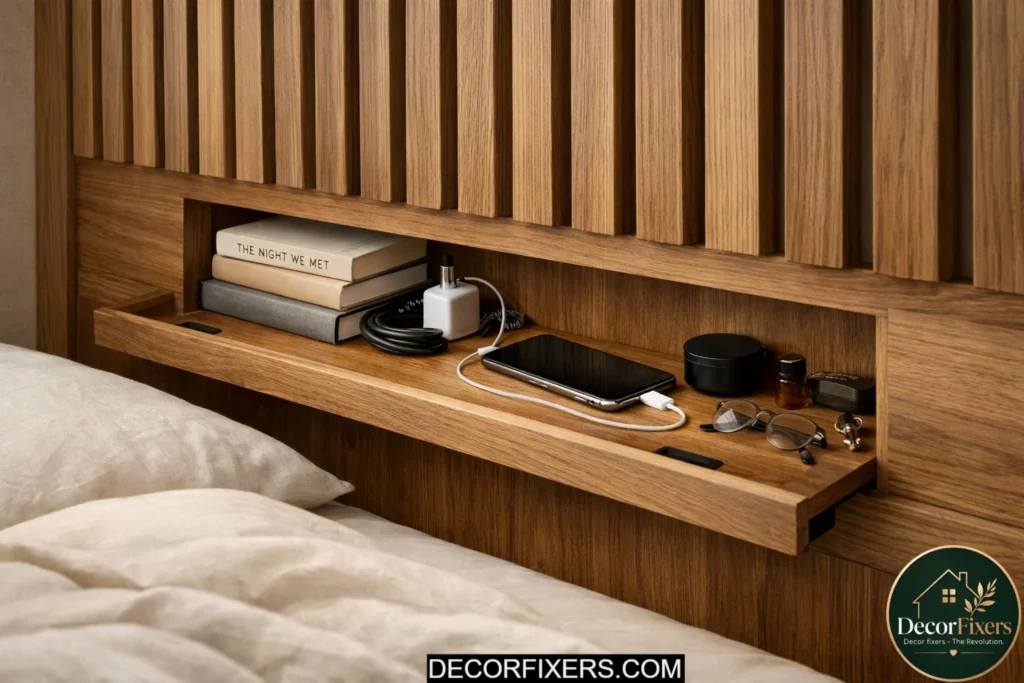
Some slatted wooden bed frames have enough structural space between the slats that you can mount a lightweight floating shelf directly to the internal frame structure, essentially creating a hidden shelf inside the bed frame itself.
This isn’t a universal solution; it only works on certain frame designs, but for those it fits, it’s genuinely clever. Store small flat items: books, charging cables, a sleep journal, and a spare phone charger. Hidden and within arm’s reach.
Specialty and Room-Specific Ideas
21. Under Bed Toy Storage for Kids’ Rooms, Contain the Chaos
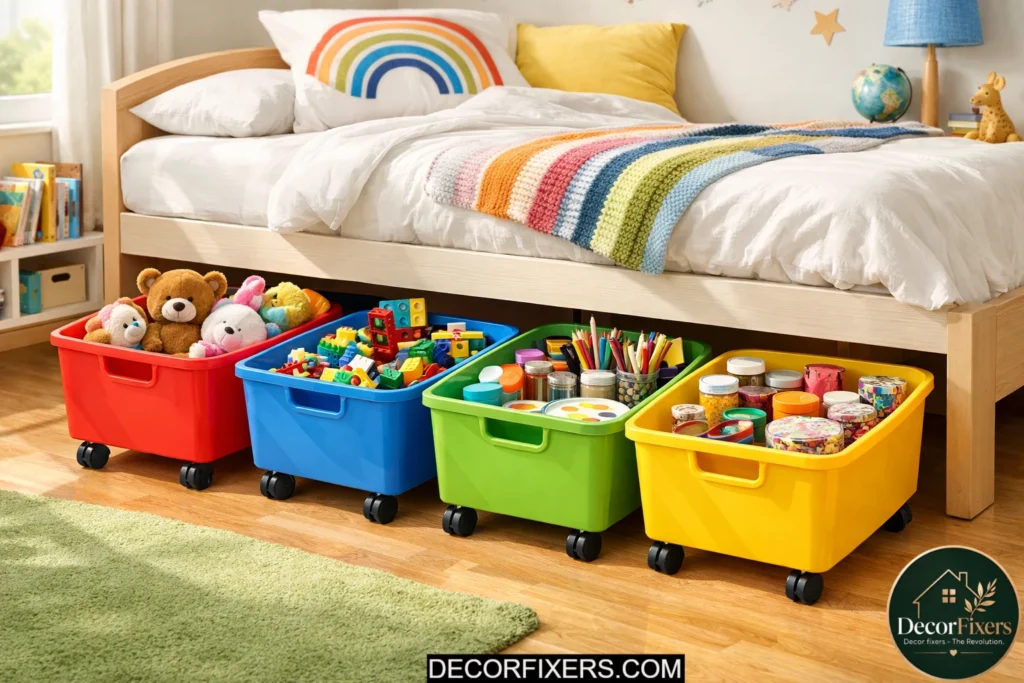
Kids’ bedrooms are a specific storage problem. The floor is always a landmine of action figures and puzzle pieces. Low-profile rolling bins with open tops, or mesh laundry-bag-style containers, work well because kids can dump toys in quickly without a lid becoming a barrier.
Use color-coded bins for different categories: red for Lego, blue for stuffed animals, green for art supplies. Children learn the system fast, and it makes cleanup genuinely autonomous; they know where things go without being told every time.
22. Under Bed Book Storage, For the Perpetual Reader
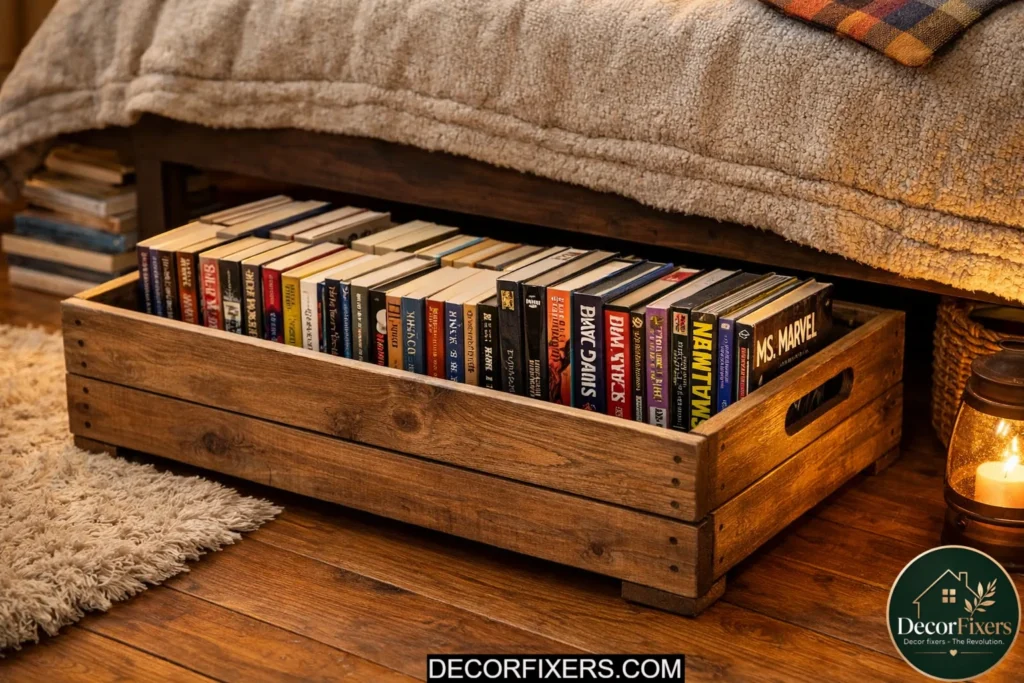
A long flat bin or wooden crate under a reading nook bed works beautifully as a book storage system, especially for paperbacks and graphic novels. Stand books upright with their spines facing out (like a mini library shelf) rather than stacking them flat.
You can fit 30 to 40 paperbacks in a single standard rolling bin this way. Spine-out storage means you can find what you’re looking for at a glance without pulling the whole bin out. It sounds simple. It works.
23. Under Bed Luggage Storage: The Travel Gear Problem Solved
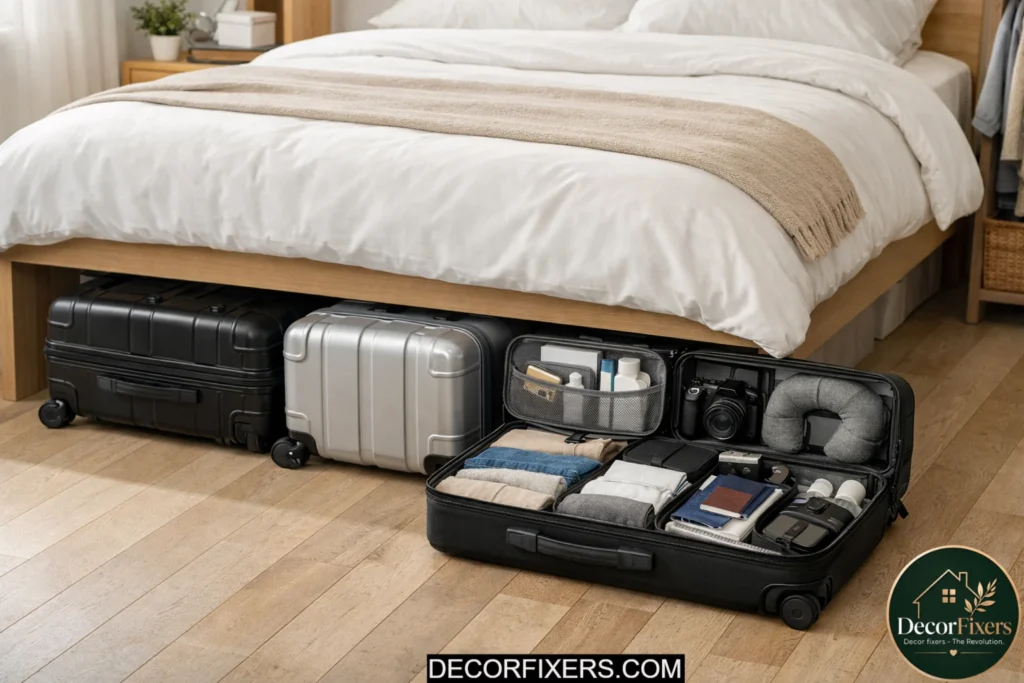
Luggage is the storage problem nobody talks about. It’s too large for closets, too awkward for shelves, and spends 49 weeks a year doing absolutely nothing. Under the bed is the logical home for it, as long as your clearance allows.
Nest smaller bags inside larger ones before sliding them under. Use the interior of the luggage itself as bonus storage for travel accessories, packing cubes, and adapter kits. You’re doubling the function of the space without adding any new containers.
24. Gift Wrap and Holiday Decor Storage, The Seasonal Stuff Nobody Accounts For
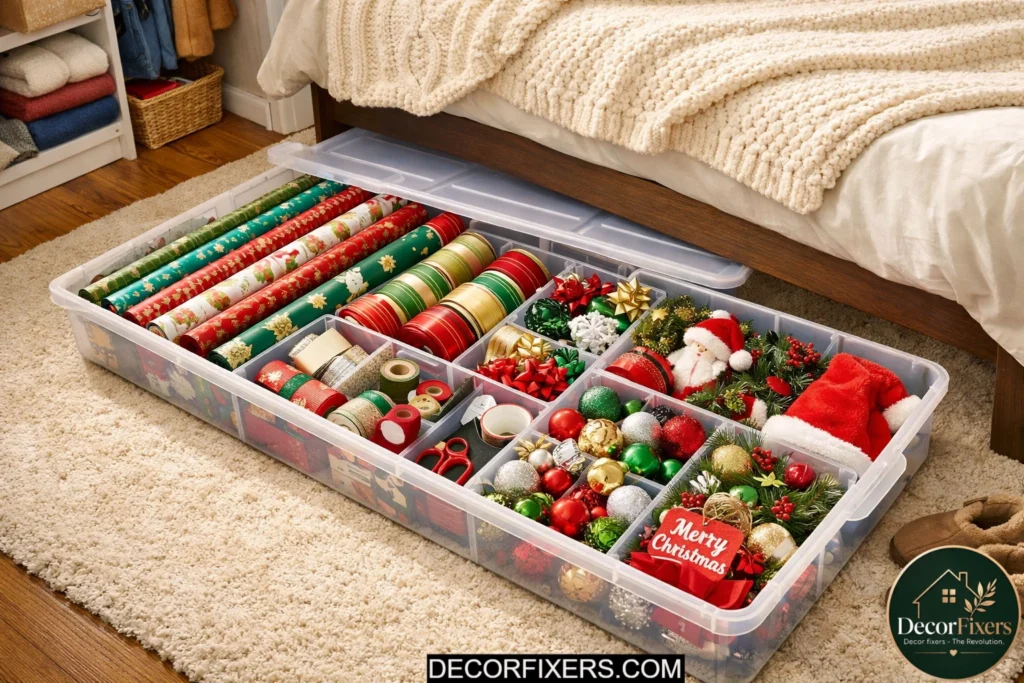
Rolls of wrapping paper, ribbons, tape, scissors, tissue paper, all of it ends up in a closet corner every January and causes mild panic every December. A long flat bin, ideally 36 inches or longer, stores all of it flat and accessible.
Some people use a designated ‘holiday bin’ that contains both the wrapping supplies and small holiday decorations, ornaments in a zip bag, a small garland, and ribbon. One bin, one season, one place. Not complicated. Just not something most storage articles think to address.
25. Under Bed Storage for Studio Apartments, Full Bedroom Overhaul
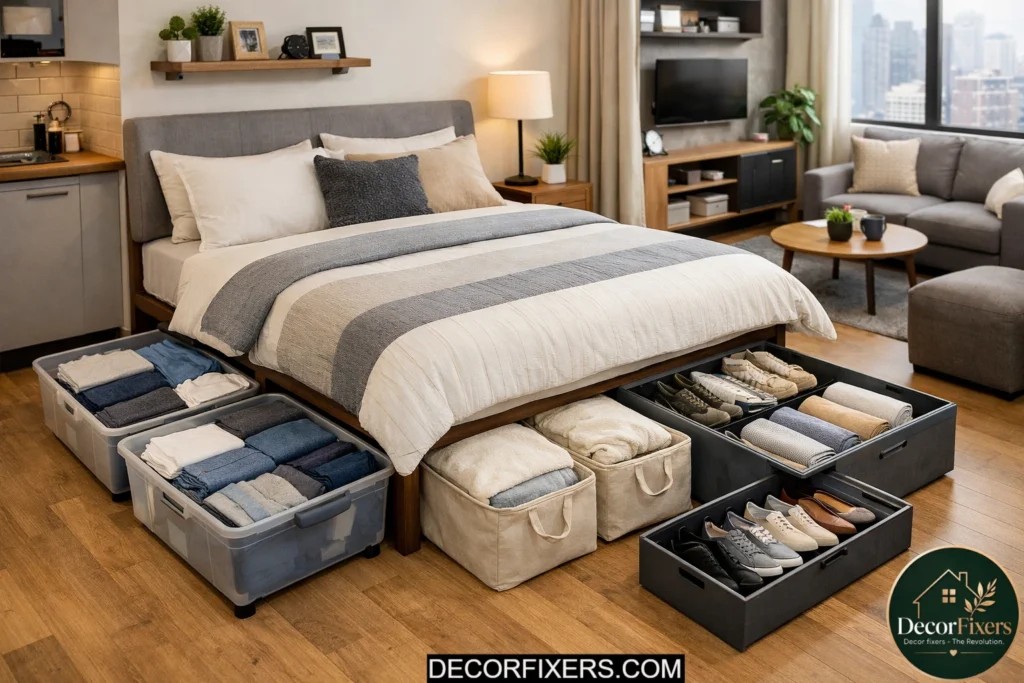
In a studio apartment, the bed isn’t just where you sleep, it’s also your guest room, your reading chair, and your storage unit. Everything needs to multitask. Underbed storage in this context isn’t optional; it’s structural.
The most effective studio setup uses every inch: a rolling bin on one side for clothes, a flat fabric bag on the other for linens, and a long box at the foot of the bed for shoes. Label everything. Commit to the seasonal rotation system from Idea #11. A studio can function as well as a two-bedroom if the storage is intentional.
For people living in compact apartments or multifunctional homes, combining underbed systems with broader Home Storage and Organization Stunning Ideas creates a much more efficient living space without making rooms feel overfilled or visually chaotic.
Quick Comparison: Underbed Storage Options at a Glance
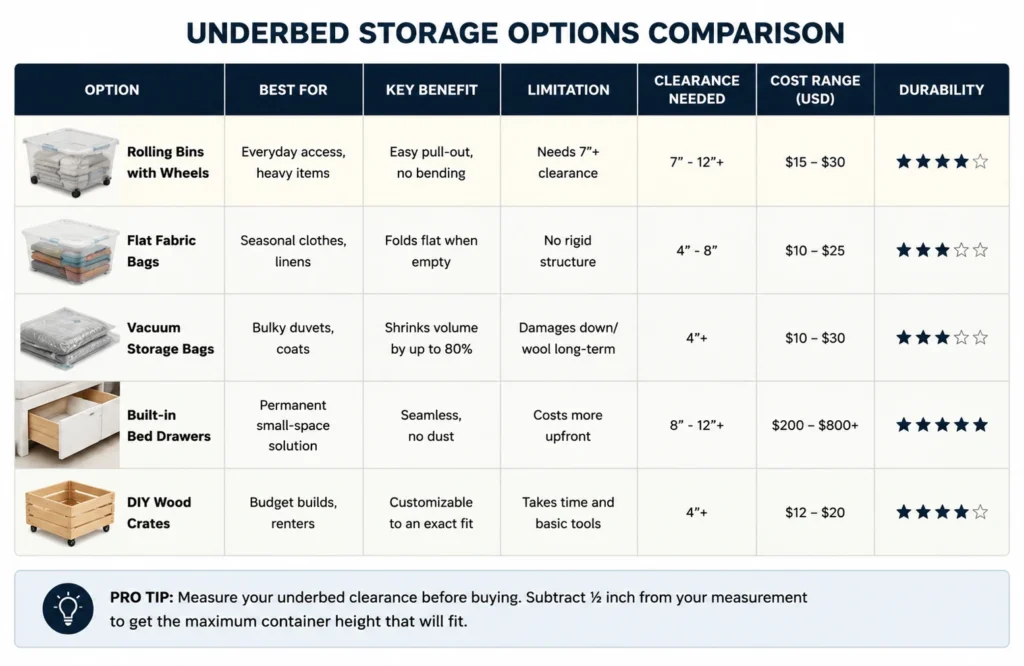
| Option | Best For | Key Benefit | Limitation |
| Rolling bins with wheels | Every day access, heavy items | Easy pull-out, no bending | Needs 7″+ clearance |
| Flat fabric bags | Seasonal clothes, linens | Folds flat when empty | No rigid structure |
| Vacuum storage bags | Bulky duvets, coats | Shrinks volume by up to 80% | Damages down/wool long-term |
| Built-in bed drawers | Permanent small-space solution | Seamless, no dust | Costs more upfront |
| DIY wood crates | Budget builds, renters | Customizable to an exact fit | Takes time and basic tools |
CONCLUSION:
I’ll be honest with you. Before I started paying attention to underbed storage, I had exactly three things under my bed: a rogue sock, a book I’d been looking for since 2022, and what I can only describe as a dust ecosystem with ambitions.
The shift happened when I measured the clearance first, 9 inches, and realized I was sitting on a small room’s worth of usable space. Two-wheeled bins and a flat fabric bag later, I’d cleared out an entire shelf in my closet and stopped buying extra storage furniture I genuinely didn’t need.
That’s the real point here. Underbed storage ideas aren’t about buying more stuff. They’re about using what you already have. The space exists. The solution is usually cheap. The only thing standing between you and a calmer bedroom is one measuring tape and 20 minutes of actual effort.
Start with Idea #1 if you want something ready in an hour. Start with Idea #17 if you want something built to last. Either way, measure first.
FAQs:
Q: What’s the best underbed storage for low-clearance beds?
A: Flat fabric bags or low-profile bins specifically labeled ‘4-inch height’ are your best option. Vacuum bags also work well for soft items since they compress to almost nothing.
Q: How do I stop dust from getting into underbed storage?
A: Use containers with zip-top closures or snap-fit lids. Fabric bags with full zip openings are the best balance of dust protection and access for soft items. Avoid open baskets if dust is a concern.
Q: Should I use vacuum bags for all off-season clothes?
A: No. Vacuum bags work well for synthetic fills, polyester, and cotton. Avoid using them for down, wool, or silk; long-term compression damages the fibers and reduces insulating loft permanently.
Q: How do I organize underbed storage so I can actually find things?
A: Label every container on the side facing outward. Group items by category, not by size. Use one container per category (shoes, winter tops, bedding) and stick to a seasonal rotation system so you know exactly what’s under there.
Q: When should I choose built-in bed drawers over separate bins?
A: If you’re buying a new bed frame anyway and plan to stay in one place for 2+ years, built-in drawers are worth it; they’re cleaner, dust-free, and more accessible. For renters or anyone wanting flexibility, rolling bins are the more practical choice.

Creator of DecorFixers, sharing practical home and interior ideas focused on real-life usability, simple design improvements, and budget-friendly solutions.