

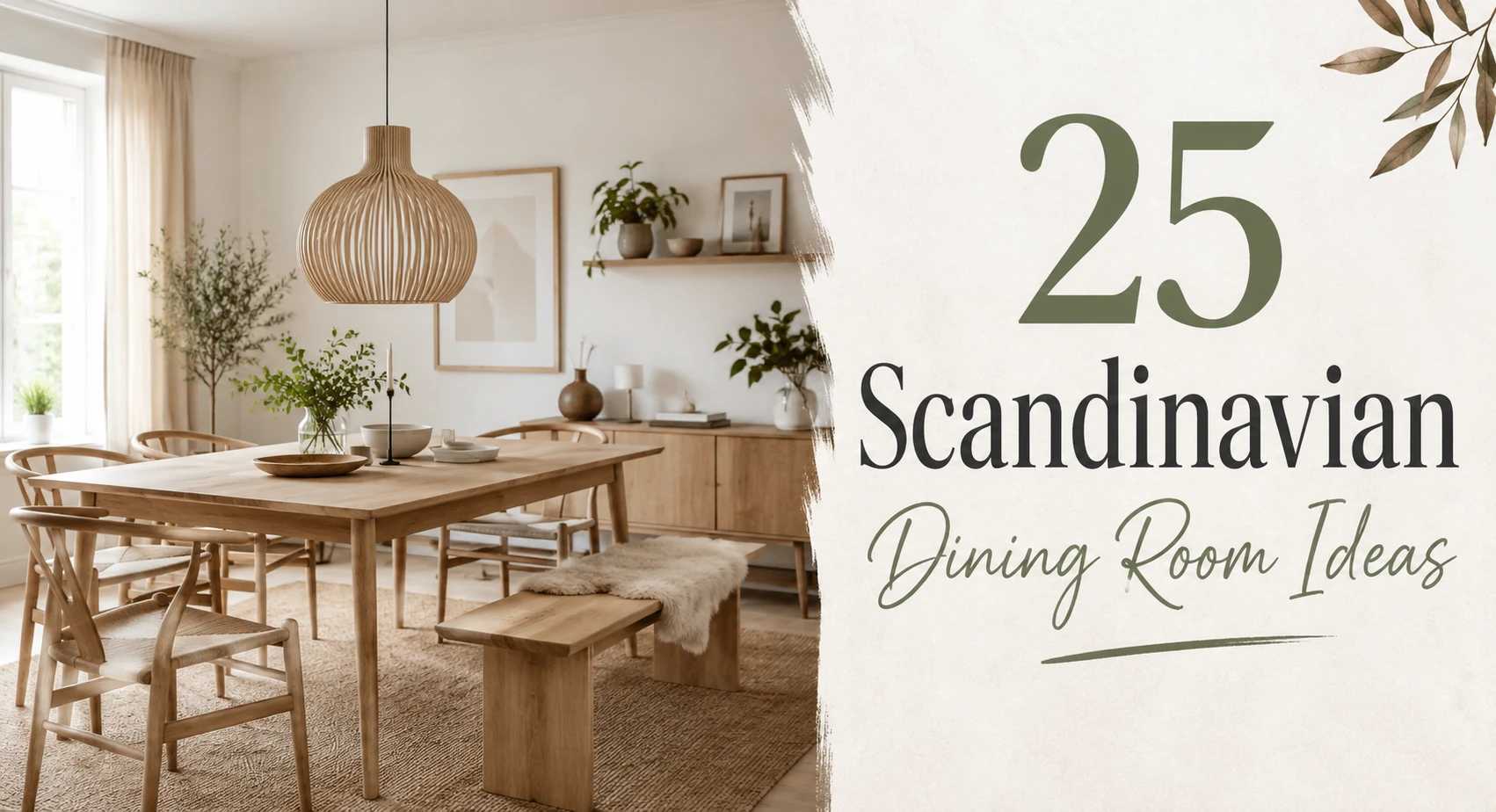
I remember standing in my dining room at midnight, surrounded by mood board printouts and an open browser tab with 47 Pinterest pins I’d saved as “inspiration.” None of them looked like my actual house. None of them told me what kind of wood, which pendant, or how many throw pillows were too many throw pillows.
So, I did the work. I pulled apart what makes Scandi dining rooms actually feel warm, not just look white, and I built this guide around 25 real, actionable ideas you can start using today, whether you rent a flat in Manchester or own a house in Melbourne.
Here’s the thing: Scandinavian design is not about owning expensive furniture or tearing down walls. It’s a philosophy. And once you understand the philosophy, every decision, from your lighting to your table runner, becomes easy. Or maybe I should say it this way: Scandi design isn’t about having less. It’s about having exactly the right things, placed with intention.
1. Start With a Warm Neutral Palette, Not Just White
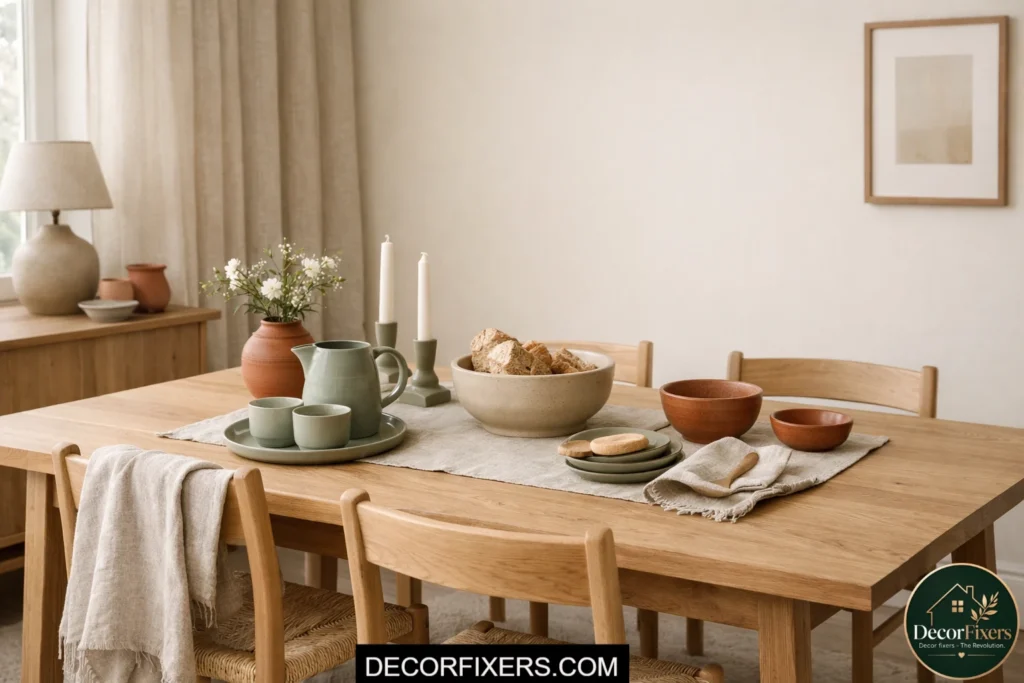
Most people hear “Scandinavian” and immediately paint their walls bright white. That’s the single most common mistake I see, and it’s exactly what creates that cold, sterile feeling everyone complains about.
Warm whites like Farrow & Ball’s “Pointing” or Benjamin Moore’s “White Dove” read as white in photos but add just enough yellow undertone to keep a room from feeling like a hospital corridor. Pair them with soft, warm grey accents, dusty sage, or muted terracotta accessories. The contrast is subtle. The difference in mood is enormous.
What Is a Scandinavian Dining Room?
A Scandinavian dining room is a space designed around three core principles: simplicity, functionality, and a quiet connection to nature. It uses a neutral color palette, whites, warm greys, and soft beiges, paired with natural materials like light oak and linen, and layers texture rather than color to create warmth. The result is a room that feels calm and inviting at the same time.
2. Choose a Light Oak Dining Table as Your Anchor Piece
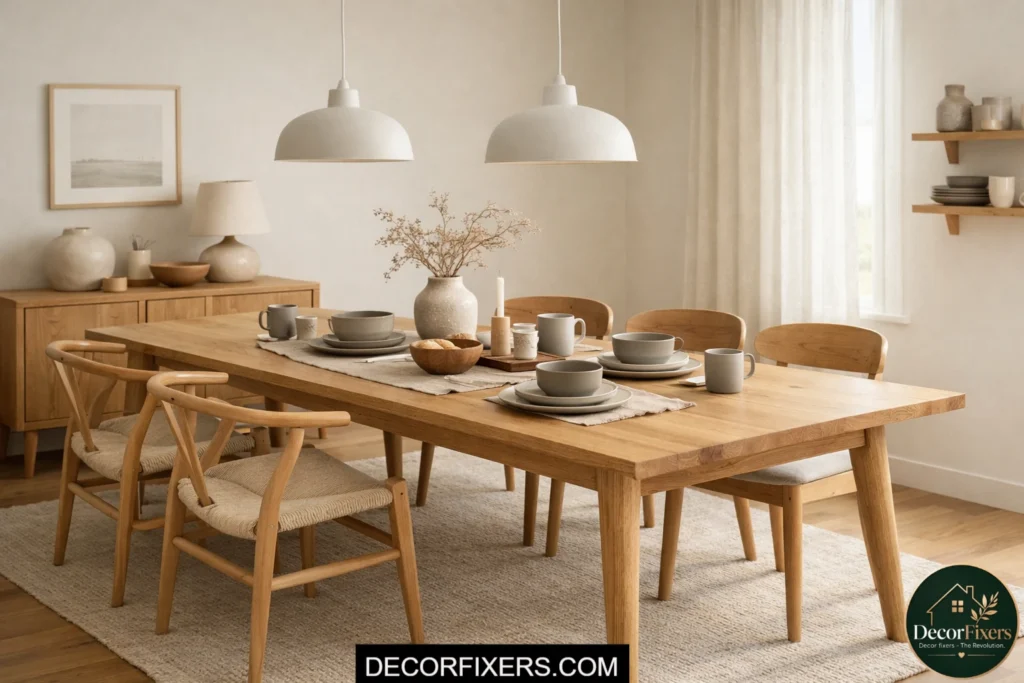
The dining table is the single piece that defines the entire room’s personality. In a Scandinavian dining room, that means light oak, ash, or birch, natural grain visible, legs tapered and clean, no ornate carved details.
HAY’s “Loop Stand Table” and IKEA’s MÖRBYLÅNGA oak-veneer table are both excellent entry points at different price brackets. If you’re shopping mid-range, look for solid wood over veneer; it’ll age beautifully rather than peel at the edges after two years of dinner parties.
3. Layer Textiles to Add Hygge Without Clutter
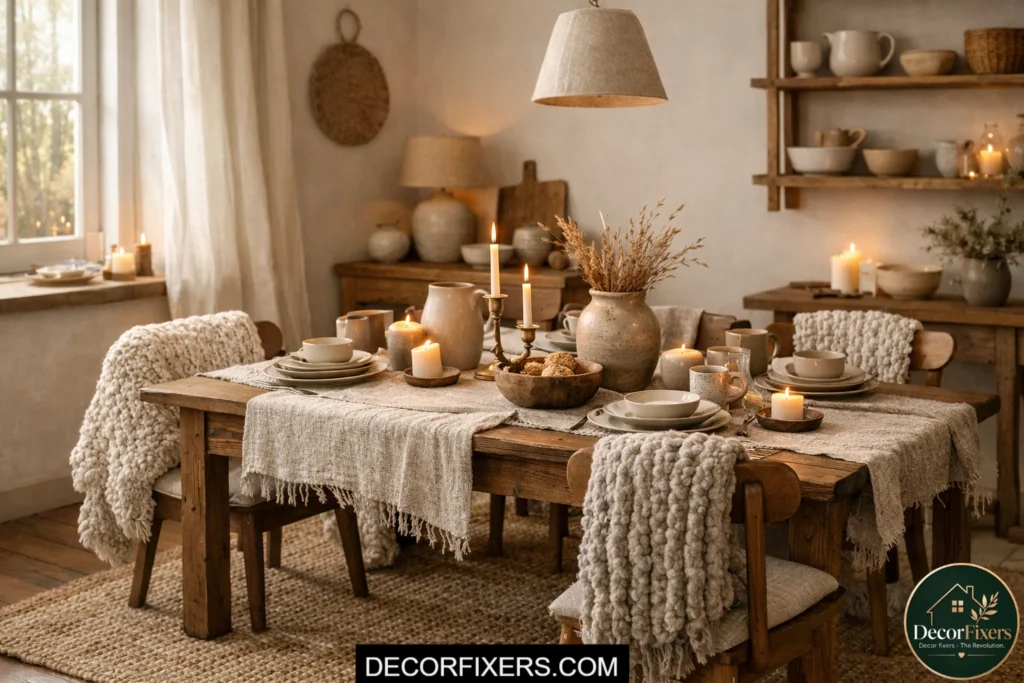
Hygge (pronounced “Hoo-gah”) is the Danish concept of cosiness and contentment, and textiles are its primary vehicle. A wool table runner, linen chair cushions, and a chunky jute rug under the table can transform a clinical minimalist room into a space that feels genuinely lived-in.
The key rule: layer textures, not patterns. Everything can be neutral in color as long as the materials differ, rough linen next to smooth ceramic next to nubby wool. That contrast is what the eye reads as warmth.
4. Hang a Statement Pendant Light Above the Table
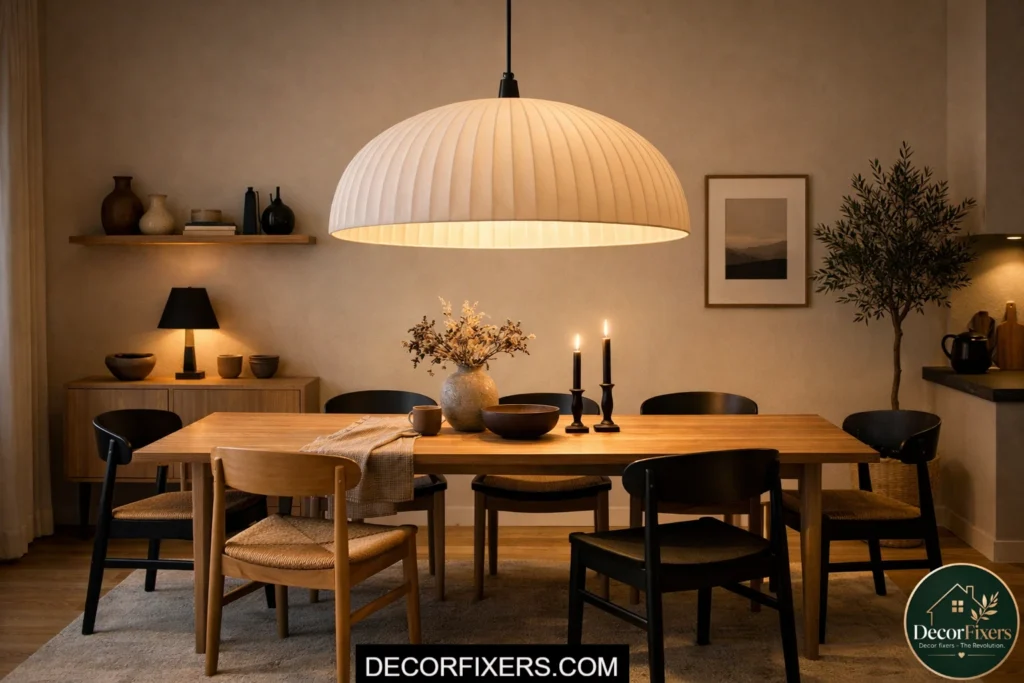
Lighting in a Scandinavian dining room does double duty; it’s both functional and the room’s most visible design statement. The pendant light above your table is your equivalent of a chandelier in a traditional dining room: it sets the entire tone.
Muto’s “E27” pendant and Normann Copenhagen’s “Bell” lamp are two iconic options. Both sit in the £200–£400 range and photograph beautifully in any color. If budget matters, IKEA’s SINNERLIG pendant in seagrass achieves a similar organic Scandi feeling for under £30. Hang it low, around 70–80cm above the table surface, so it creates an intimate pool of light rather than flooding the whole room.
5. Mix Dining Chairs for a Collected, Non-Showroom Look
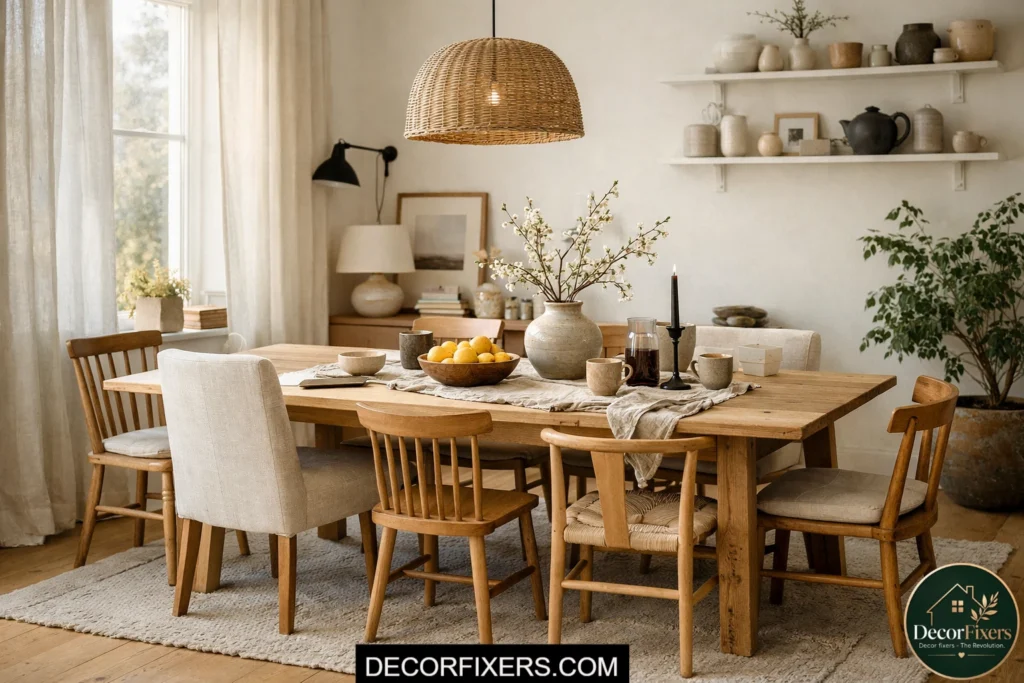
One of the most common Scandi decorating mistakes is buying a completely matched dining set, four identical chairs, and one table, sold as a unit. The result looks like a furniture showroom floor. Real Scandinavian homes mix chairs intentionally.
Try two upholstered chairs at the heads of the table and four wooden side chairs along the long edges. Or combine a bench on one side with chairs on the other, a very common Nordic approach that also helps with space efficiency. Keep the material palette consistent (all light wood tones or all black frames), even if the silhouettes vary.
6. Use a Wooden Dining Bench on One Side
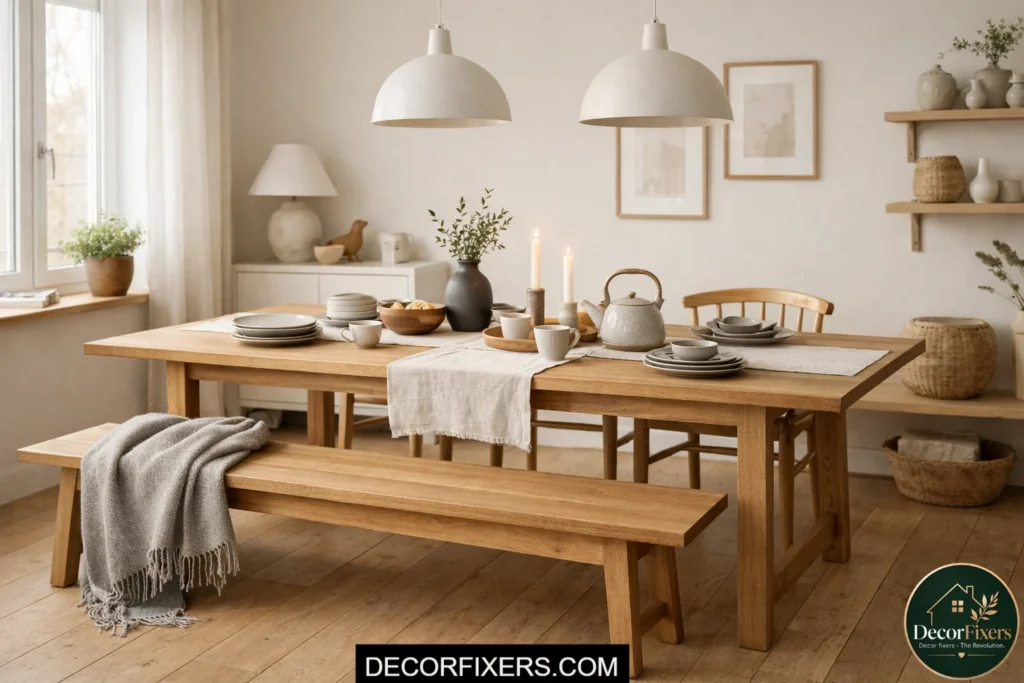
A wooden bench is one of the most practical Scandinavian dining room ideas that rarely gets discussed. It seats more people than chairs in the same linear space, costs less per seat, and creates a relaxed communal energy around the table that formal dining chairs simply don’t.
Pair it with a sheepskin or folded wool throw draped casually over one end, that’s your hygge sorted without any additional decor effort. SKAGERAK’s “Ratio Bench” is a beautifully crafted option. IKEA’s SKOGSTA acacia bench is excellent for the budget-conscious shopper and holds up surprisingly well.
7. Add an Area Rug to Ground the Dining Zone
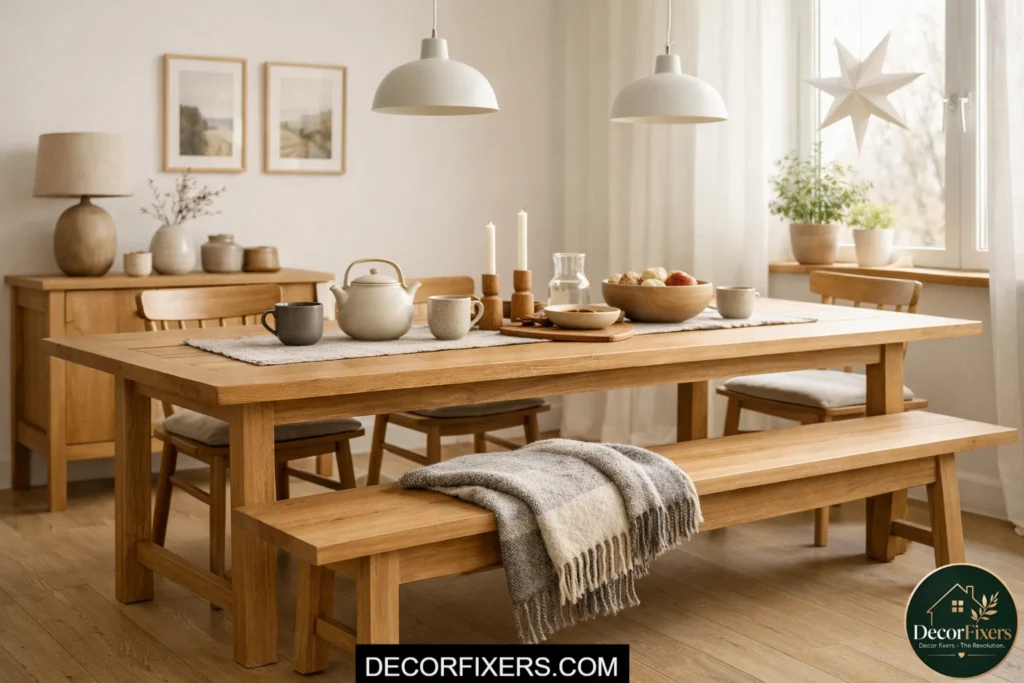
An area rug under a dining table is one of those Scandinavian design choices that many people are afraid to commit to, and then absolutely love once they do it. It defines the dining zone within an open-plan space, adds visual warmth from the ground up, and softens the acoustics of the room considerably.
Choose a flat-weave or low-pile rug for practicality: crumbs and spills clean up easily, and chair legs won’t snag. Natural fibers, jute, sisal, or undyed wool, are the most Scandi-authentic choices. Size matters: the rug should extend at least 60cm beyond every side of the table so pulled-out chairs still land on it.
8. Keep Walls Mostly Bare, Then Add One Intentional Piece
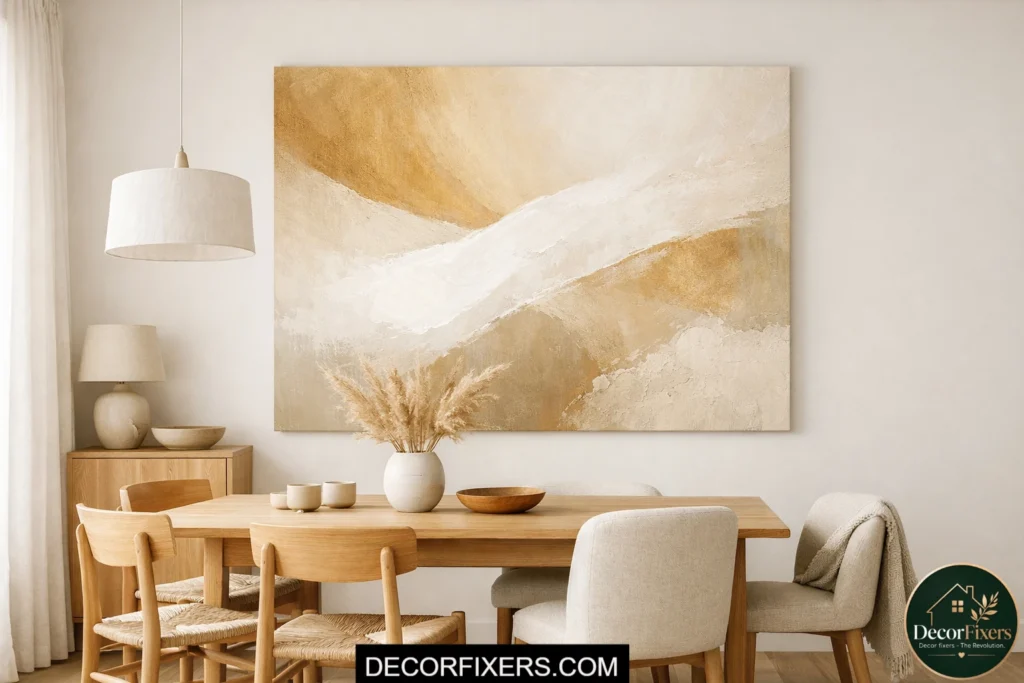
Scandinavian design treats empty wall space as a design element in its own right, not a gap to fill. Most of the walls in an authentic Scandi dining room stay clean. But that doesn’t mean the room feels bare.
One carefully chosen piece of wall art creates far more impact than a gallery wall of twelve. Consider gold abstract wall art as a focal point; the warmth of the gold tone sits perfectly against a soft white or sage wall without disrupting the calm of the space. Abstract over-representational art is almost always the more Scandi-feeling choice: it suggests rather than dominates.
If your Scandinavian dining room feels visually complete but still lacks a focal point, artwork is usually the missing layer. These Gold Abstract Wall Art Dining Room Ideas work particularly well with Nordic interiors because the muted metallic warmth complements oak, linen, and soft neutral palettes without overwhelming the space.
The key is restraint. One oversized abstract piece with warm gold detailing can create depth and elegance while still preserving the calm, minimal atmosphere that defines Scandinavian design.
9. Bring in Natural Wood Accessories at Every Scale
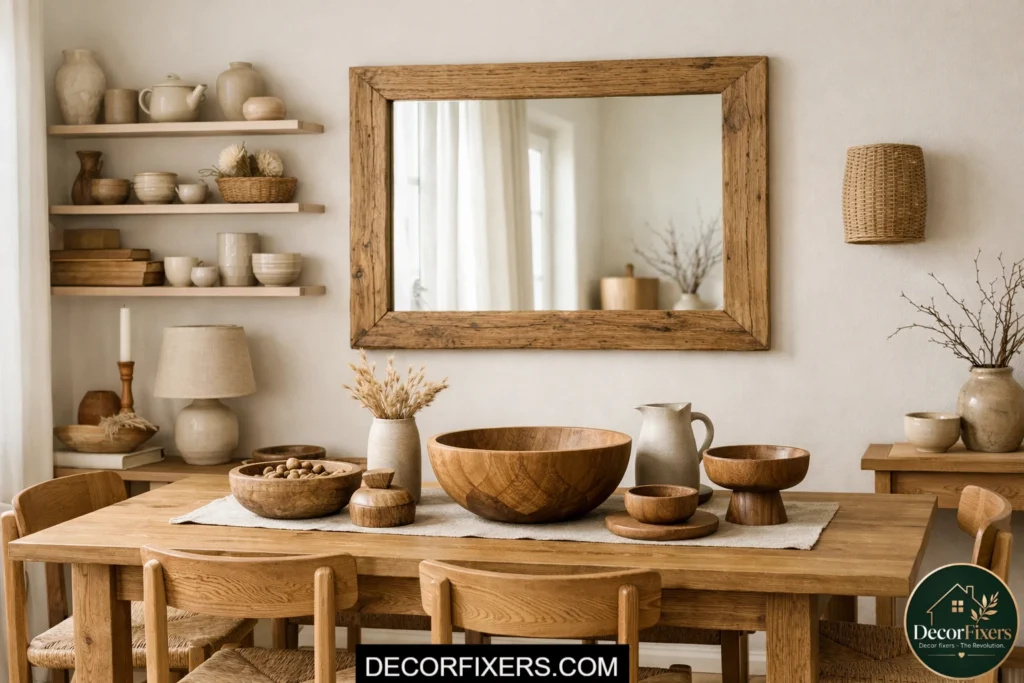
Wood is the connective tissue of Scandinavian interior design. It appears in the furniture, yes, but the rooms that feel truly authentic layer it into accessories at every scale: a wooden salad bowl on the table, a timber-framed mirror on the wall, small carved decorative objects on a sideboard shelf.
This repetition of the material across scales is what gives the room its cohesion. Without it, even a Scandi-colored room can feel disjointed and flat. Stick with lighter wood tones, birch, ash, light oak, rather than dark walnut or mahogany, which pull the room in a warmer but distinctly non-Nordic direction.
10. Style Open Shelving With Purposeful Restraint
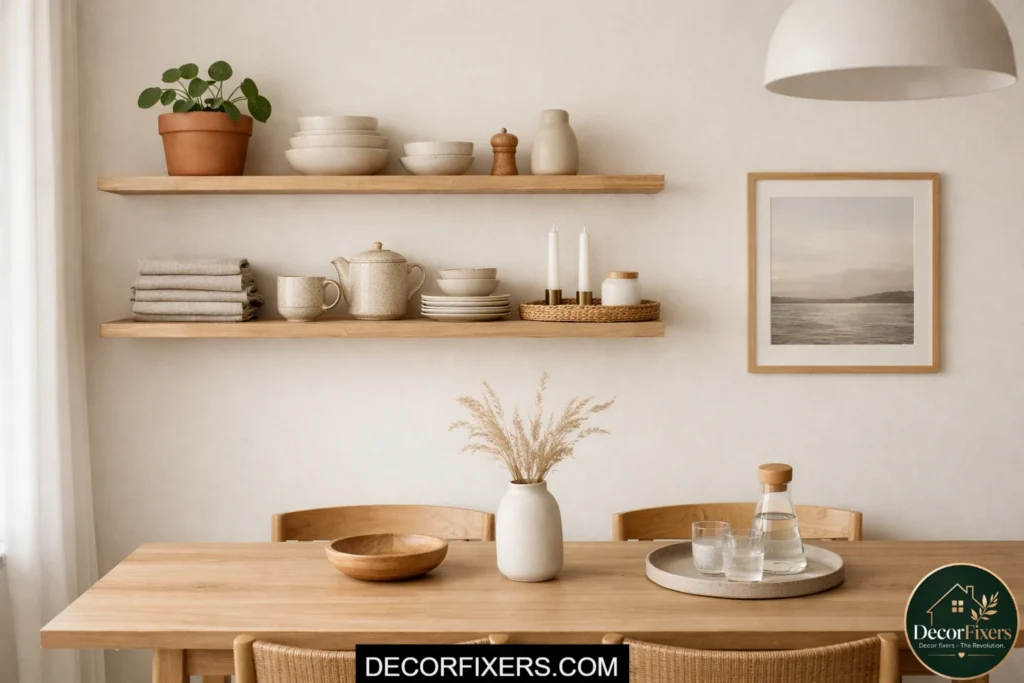
Open shelving in a Scandinavian dining room follows a very specific logic: display only things you genuinely love or regularly use, and leave at least 30% of the shelf empty. The negative space is not wasted; it’s part of the design.
A classic Scandi shelf arrangement groups by material rather than color: a cluster of ceramic mugs, a stack of linen napkins, a single plant in a terracotta pot, and one small framed print. It looks curated without looking styled. That’s a hard balance to hit, but once you see it, you can’t unsee it.
11. Choose Stoneware and Ceramic Tableware Over Porcelain
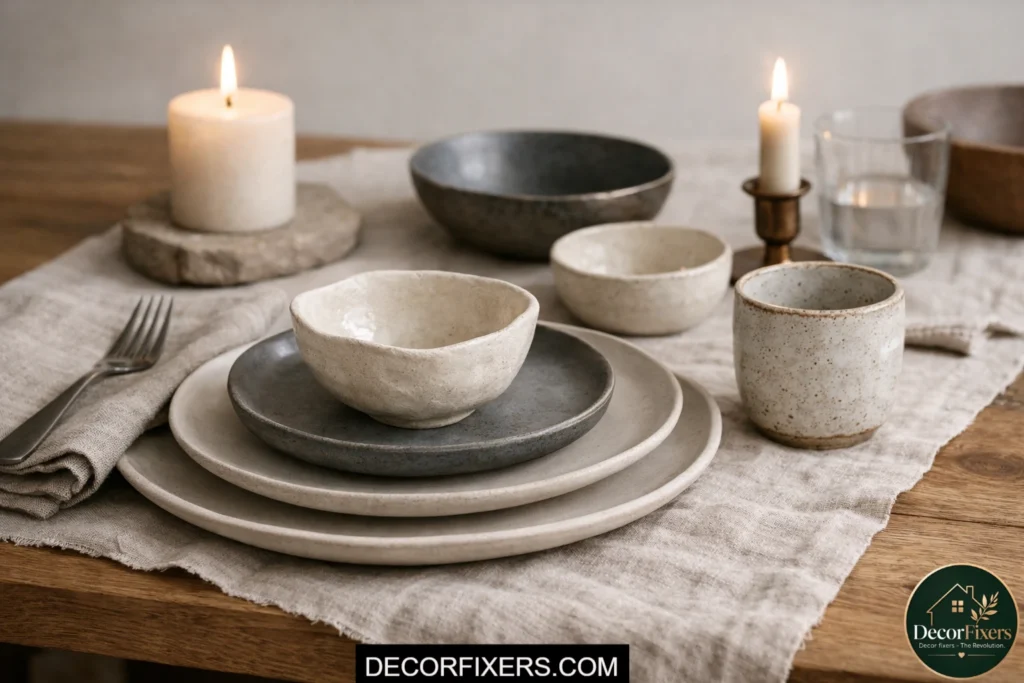
The tableware you eat off of daily is part of the design. Scandinavian tables almost universally feature matte stoneware with organic, slightly irregular shapes, the visual opposite of bone-China perfection. The imperfection is the point. It communicates handcrafted warmth and intentionality.
Royal Copenhagen’s “Ursula” stoneware and HAY’s ceramic tableware ranges are iconic references. For a more accessible option, H&M Home and IKEA’s FRÖJDEFULL collection both offer credible matte stoneware at a fraction of the designer price. Avoid anything glazed to a high shine; it immediately reads as non-Scandi.
12. Use Candles as a Primary Light Source in the Evening
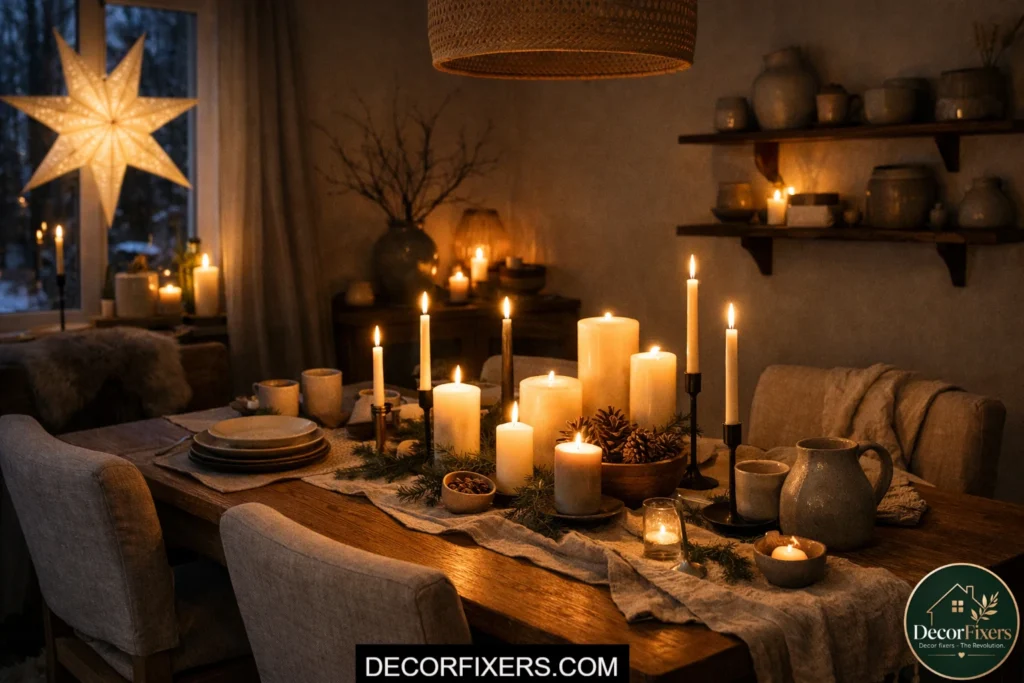
Candles aren’t decorative in Scandinavian homes; they’re essential. According to a 2023 consumer survey by the Danish trade body Dansk Industri, Danish households use more candles per capita than any other country in Europe, averaging over 13kg of candle wax per person annually.
That tells you something about the culture’s relationship with light and warmth. For your dining room, place pillar candles of different heights on the table and along the windowsill. MENU’s “Ignas” candleholders and Ferm Living’s “Memento” taper holders both hit the right Scandi aesthetic note. Use unscented candles on the dining table itself; you want to smell the food.
13. Add Indoor Plants, But Keep It Minimal
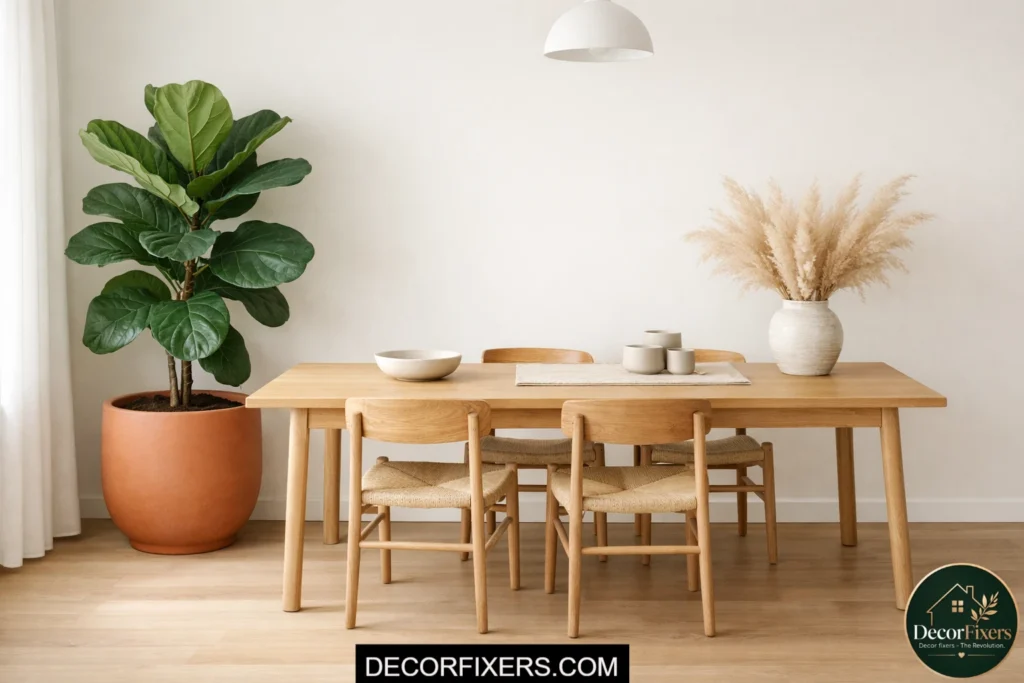
Scandi design brings the outside in, but it does so selectively. One large plant in a terracotta or matte white planter has far more design impact than a sill full of tiny succulents. Think: a fiddle-leaf fig in the corner, a trailing pathos on the sideboard, or a simple bunch of dried pampas grass in a tall ceramic vase.
Dried botanicals are particularly Scandinavian in sensibility. They’re nature-inspired, long-lasting, and require zero maintenance, very “lagoon,” which is the Swedish concept of having exactly enough. A few stems of dried wheat or lunaria in a simple glass vase add texture, height, and organic warmth without a single water ring on your shelf.
14. Design for Small Spaces With Legs-Up Furniture
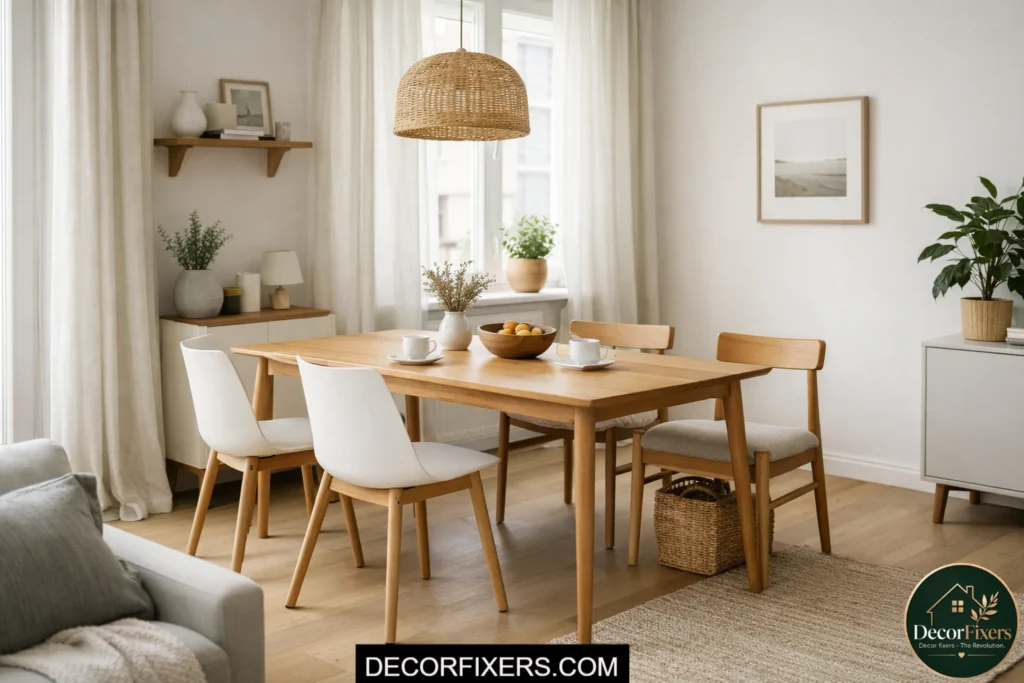
If you’re working with a compact room, Scandinavian design has a built-in solution: furniture on legs. Raised legs let the floor run visually underneath the furniture, making the room feel larger and airier than it is. This works for dining chairs, sideboards, and even small display cabinets.
I’ve put together a full set of practical, covering round vs rectangular tables, bench vs chair configurations, and the one layout mistake that makes small dining rooms feel cramped instead of cozy.
If you’re working with a compact dining area, choosing the right table shape matters far more than most people realise. I’ve put together a full guide on Dining Table in Small Space Ideas that breaks down the best layouts, space-saving table styles, and practical sizing decisions for apartments and narrow dining rooms.
A well-scaled table can completely change how a room functions. In Scandinavian interiors, especially, smaller dining spaces feel more intentional when the furniture allows light, movement, and negative space to flow naturally throughout the room.
15. Paint an Accent Wall in Dusty Sage or Slate Blue
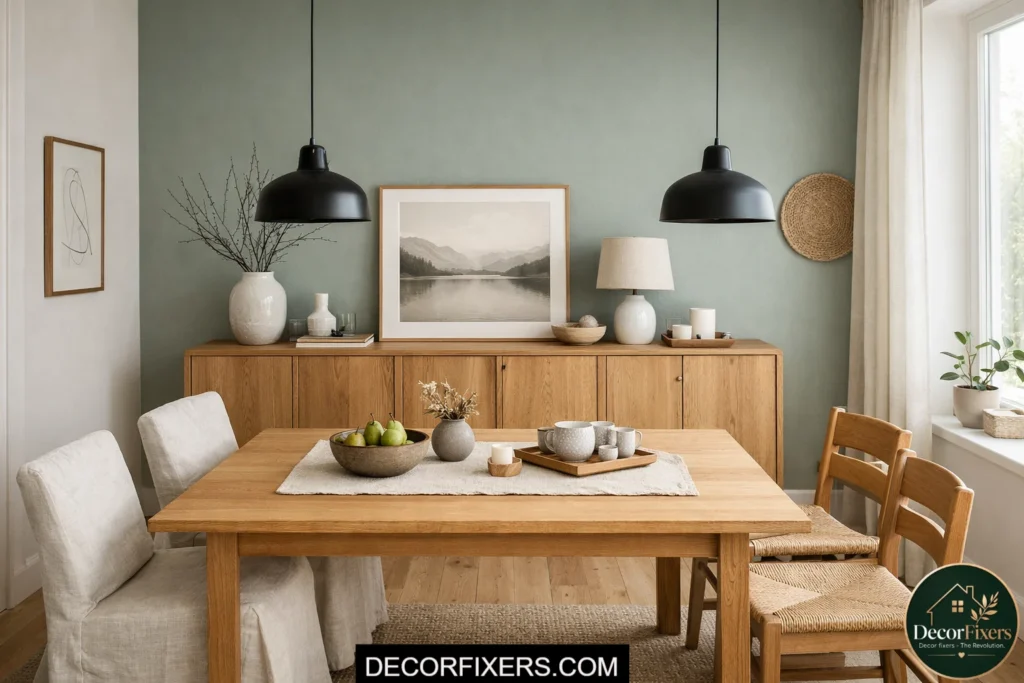
Scandinavian dining rooms aren’t always all-white; that’s a common misconception. The Nordic countries’ relationship with color is sophisticated and muted rather than absent. Dusty sage, slate blue, terracotta, and deep forest green are all authentically Scandi when used at the right saturation level (muted, never bold).
Paint a single accent wall, ideally the one behind the sideboard or at the head of the table, and keep the other three walls in a warm white or pale grey. This gives the room a focal point without disrupting the overall calm. Farrow & Ball’s “Muzzle” and “Borrowed Light” are two excellent references for that muted Nordic quality.
16. Layer Lighting With Multiple Sources
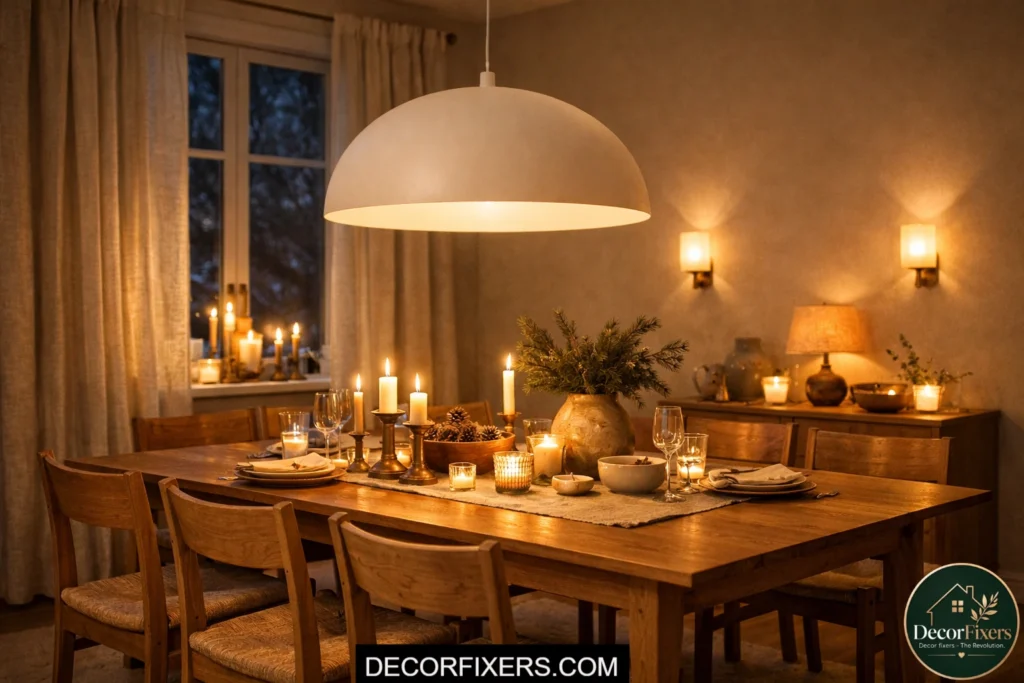
A single overhead ceiling light is the enemy of atmosphere, and Scandinavian dining rooms never rely on one. The standard Scandi lighting scheme runs across three levels: overhead (the pendant above the table), mid-level (wall sconces or a tall arc floor lamp in the corner), and low (table candles and tea lights).
All three together create what designers call “layered light”, and it’s the reason Scandi rooms feel cozy at 7 pm in winter, the same way they feel bright at midday in summer. Use warm-toned bulbs throughout: 2700K–3000K color temperature is the sweet spot for dining rooms.
17. Incorporate a Sideboard for Storage Without Visual Weight
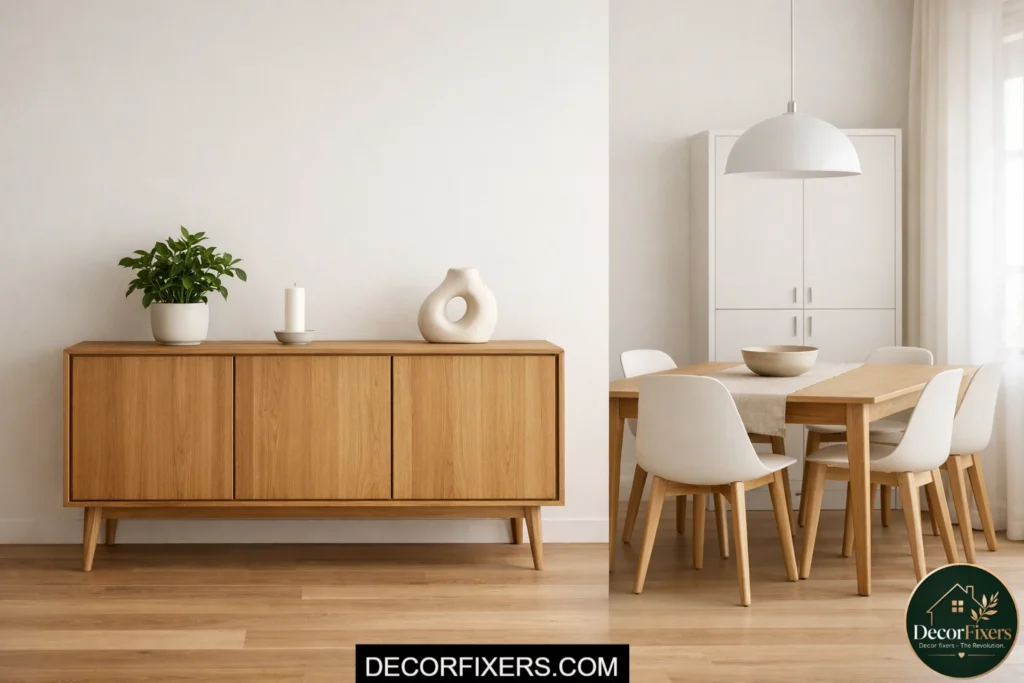
Every Scandinavian dining room needs at least one dedicated storage piece; clutter is the antithesis of Scandi design, and you can’t hide clutter without storage. A sideboard is the standard solution: it stores linens, tableware, and serving pieces while also providing a surface for decorative display.
Look for sideboards with clean lines, tapered legs, and push-to-open or recessed-handle doors. Muto’s “Compile Shelving System” and IKEA’s BOASTAD sideboard are at opposite ends of the investment scale but share the same clean visual DNA. Style the top surface with a single tray grouping: one plant, one candle, one small sculptural object. Three things. Stop there.
18. Hang Sheer Linen Curtains to Maximize Natural Light
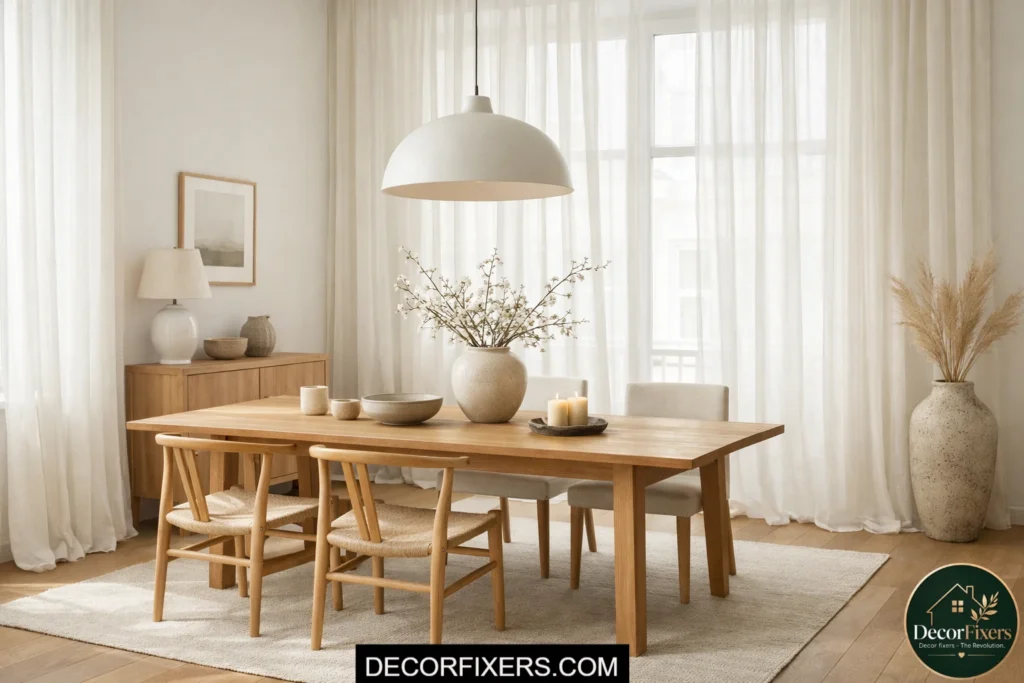
Scandinavian countries deal with limited daylight hours for much of the year, which is exactly why their design philosophy is so obsessed with maximizing natural light. For your dining room, that means lightweight, sheer curtains rather than heavy drapes. The goal is to filter light, not block it.
Natural linen in undyed or off-white tones is the most authentic material choice. Hang the curtain rod at ceiling height, even if the window doesn’t reach the ceiling, and let the curtains pool slightly on the floor. This elongates the room visually and creates that airy, soft quality that defines Nordic interiors. Never choose blackout curtains for a dining room.
19. Add a Round Mirror to Create Depth and Light
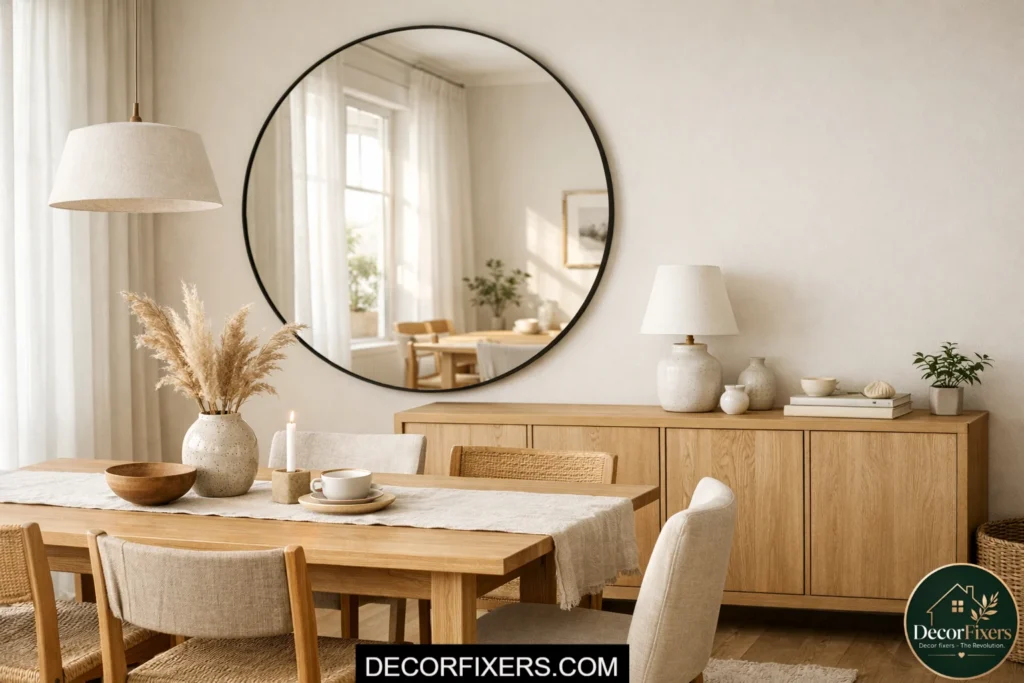
A large round mirror is one of the most versatile pieces in Scandinavian dining room design. It bounces light around the room, creates the illusion of depth in a small space, and adds a soft, organic shape that contrasts nicely with the room’s clean-lined furniture.
Position it on the wall opposite the main window for maximum light reflection, or lean a full-length version against the wall beside the sideboard for a more casual, relaxed feel. Muto’s “Framed Mirror” comes in beautiful muted color options. For a budget alternative, IKEA’s LINDBYN mirror in a matte black frame is a very strong Scandi option under £50.
20. Use Black as a Precise Accent, Not a Statement Color
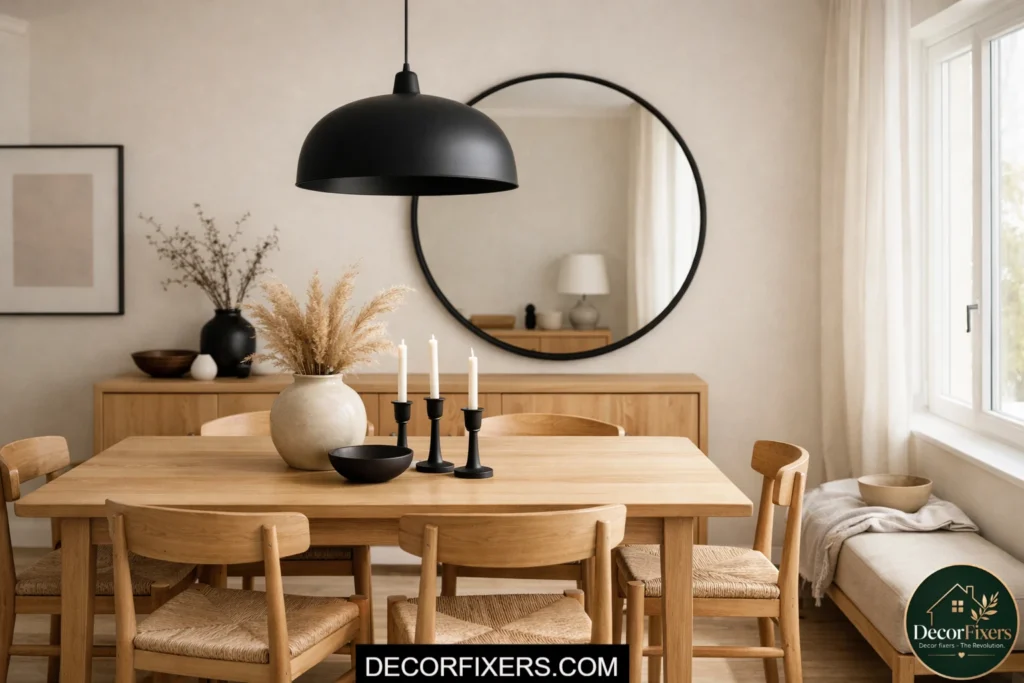
Scandinavian design uses black the way a good chef uses salt: sparingly, and with total precision. A matte black pendant frame, a black-framed mirror, black tapered candlesticks, or hairpin table legs in black; these small hits of contrast stop the room from feeling anemic without overwhelming the calm neutral palette.
Look, if you’re in a situation where your room feels “too beige” and you’re not sure what’s missing, a few black accents are almost always the answer. It sharpens everything. The mistake is going too far: one or two black elements is a decision; five or six becomes a different aesthetic entirely.
21. Invest in One Iconic Chair Design as a Feature Piece
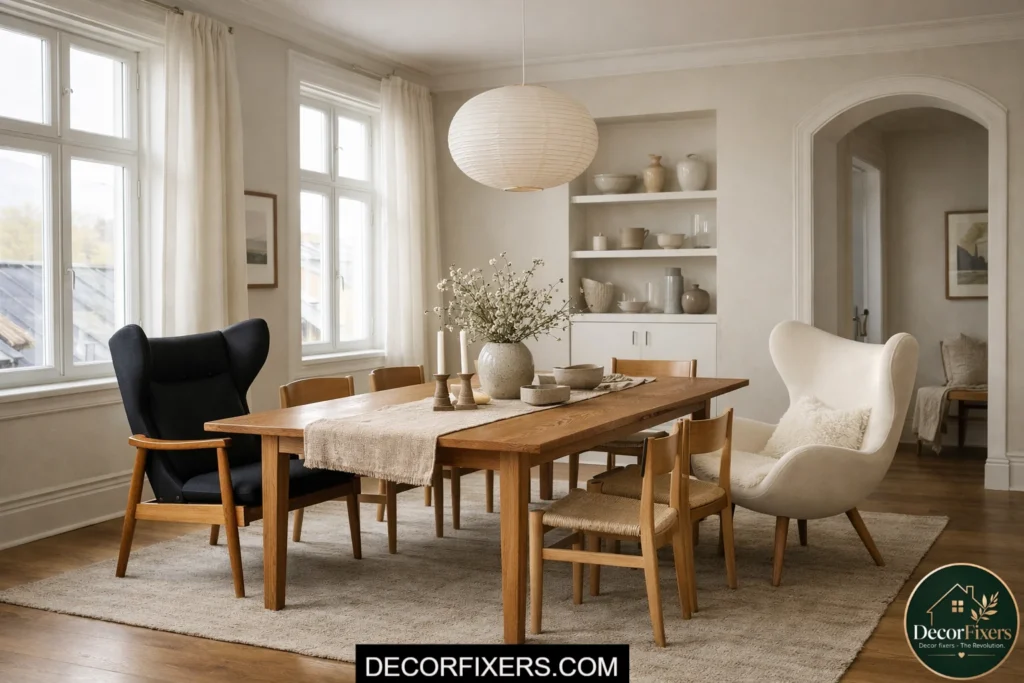
Some Scandinavian chair designs are so well-executed that they’ve become cultural landmarks: Hans Wegner’s “Y Chair” (produced by Carl Hansen & Son), Arne Jacobsen’s “Series 7” (produced by Fritz Hansen), and HAY’s “About a Chair.” These aren’t just furniture; they’re icons of Nordic design philosophy made physical.
You don’t need a full set. Place one or two iconic chairs at the heads of the table and pair them with simpler side chairs along the long edges. The single statement piece elevates the entire room while keeping the overall look grounded.
22. Declutter Aggressively, Then Decorate Intentionally
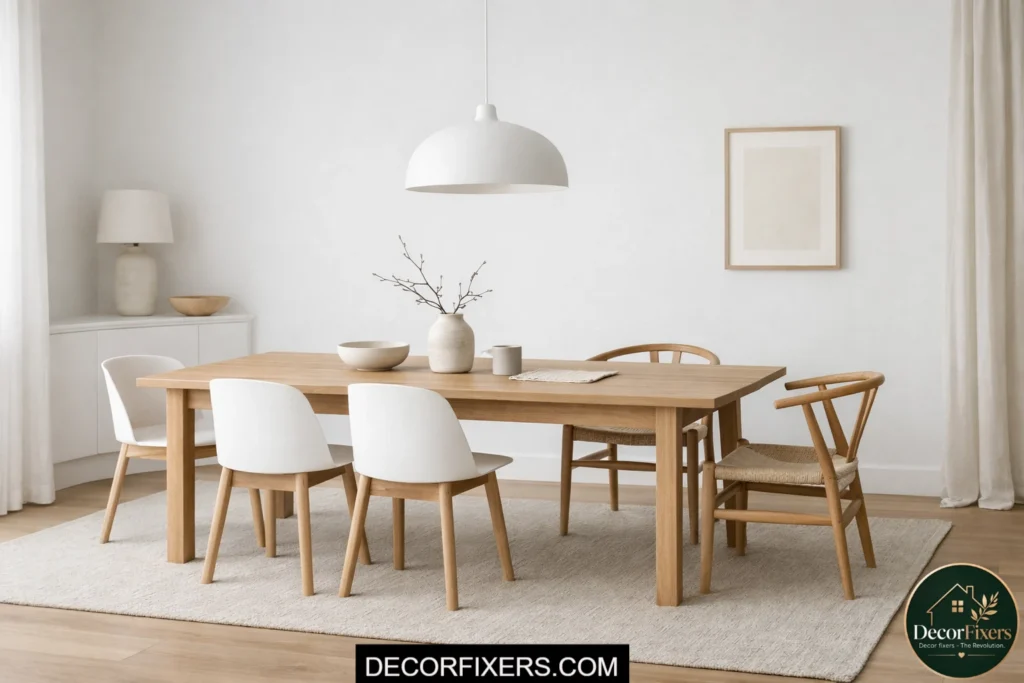
I’ve seen conflicting data on this; some sources suggest Scandinavian design is primarily about aesthetics, others argue it’s fundamentally about function. My read is that it’s inseparably both: you cannot achieve the Scandi look in a cluttered room, because visual noise is the enemy of the calm that defines the style.
Before you buy a single new item, remove everything from your dining room that doesn’t have a clear purpose or that you don’t genuinely find beautiful. Then reintroduce pieces slowly and deliberately. This process, not the shopping, is what separates authentic Scandinavian dining rooms from rooms that just have wooden furniture and white walls.
Quick Comparison:
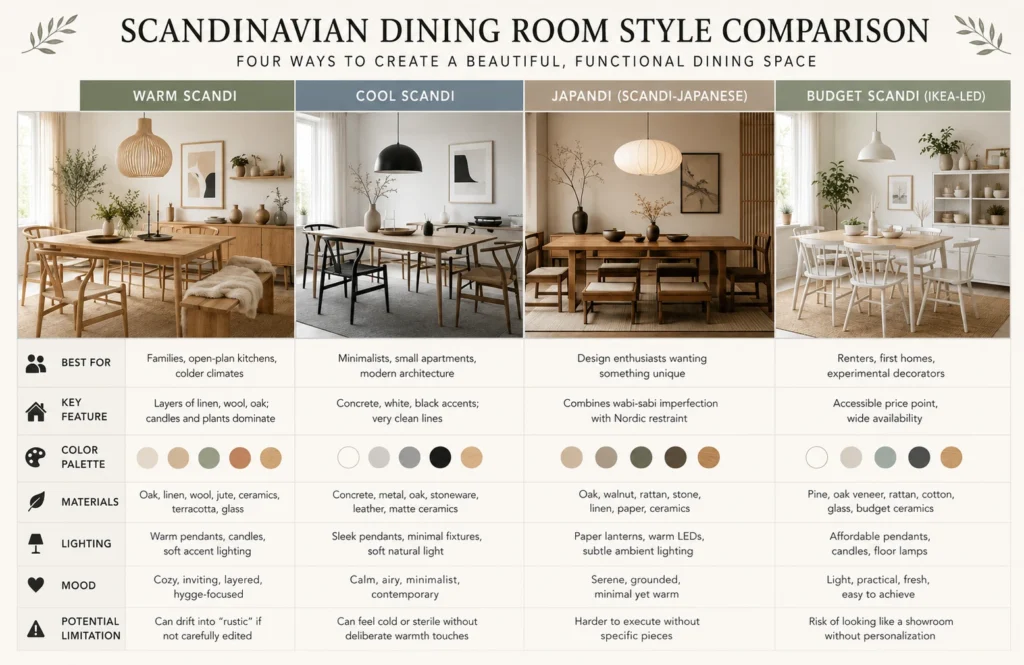
Not all Scandinavian dining rooms feel the same. Here’s how to identify which direction suits your space and lifestyle:
| Style Direction | Best For | Key Feature | Potential Limitation |
| Warm Scandi | Families, open-plan kitchens, colder climates | Layers of linen, wool, oak; candles and plants dominate | Can drift into “rustic” if not carefully edited |
| Cool Scandi | Minimalists, small apartments, modern architecture | Concrete, white, black accents; very clean lines | Can feel cold or sterile without deliberate warmth touches |
| Japandi (Scandi-Japanese) | Design enthusiasts wanting something unique | Combines wabi-sabi imperfection with Nordic restraint | Harder to execute without specific pieces |
| Budget Scandi (IKEA-led) | Renters, first homes, experimental decorators | Accessible price point, wide availability | Risk of looking like a showroom without personalization |
23. Style Your Table With a Linen Runner and Seasonal Objects
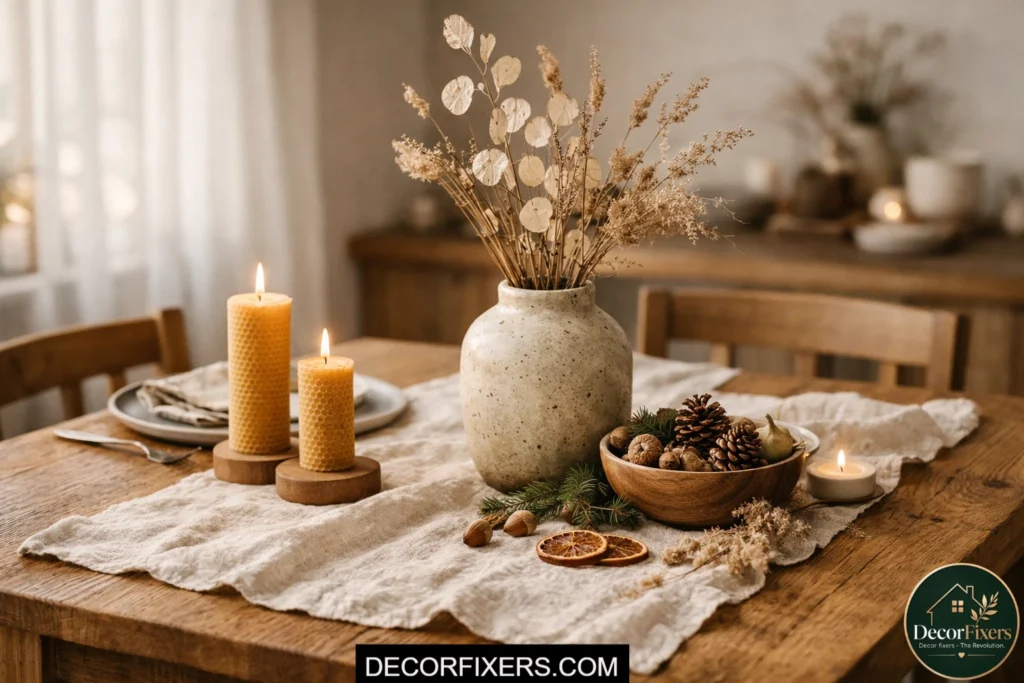
The dining table surface itself is one of the most underutilized design opportunities in a dining room. A casual linen or cotton runner down the center (not a tablecloth, that’s too formal for Scandi) creates a visual spine for the table without covering the beauty of the wood underneath.
On top of the runner, group a small cluster of seasonal objects: a ceramic vase with dried stems in autumn, a few pinecones and a beeswax candle in winter, a small potted herb in spring. Change this grouping four times a year, and your dining room feels perpetually alive and intentional.
24. Consider a Built-In Window Seat for Multifunctional Dining
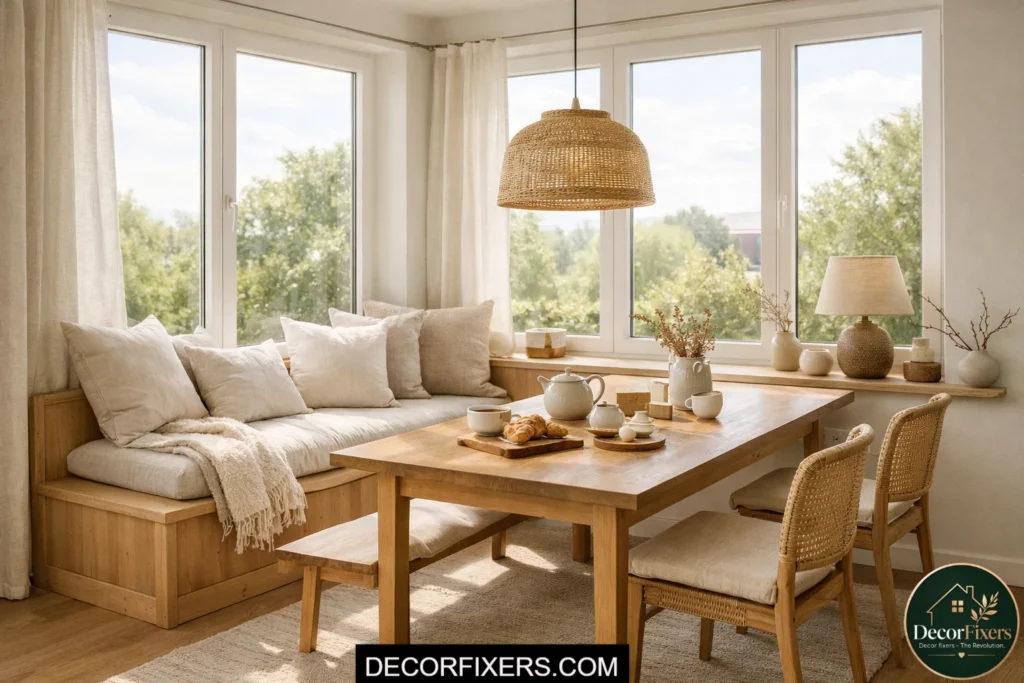
This idea shows up in almost no competitor articles, which is exactly why I’m including it. Built-in window seating along one wall of a dining room is extremely common in Nordic architecture, and for good reason: it maximizes natural light at the dining table, creates additional seating without pulling chairs away from the wall, and provides a natural hygge corner for morning coffee or a book in the afternoon.
If structural changes aren’t possible, achieve the same effect with a long wooden bench pushed against the wall under a window, dressed with linen cushions. Position the dining table with one of its long sides alongside the bench. Instantly more Scandinavian. Instantly more human.
25. Let Function Lead Every Single Decision
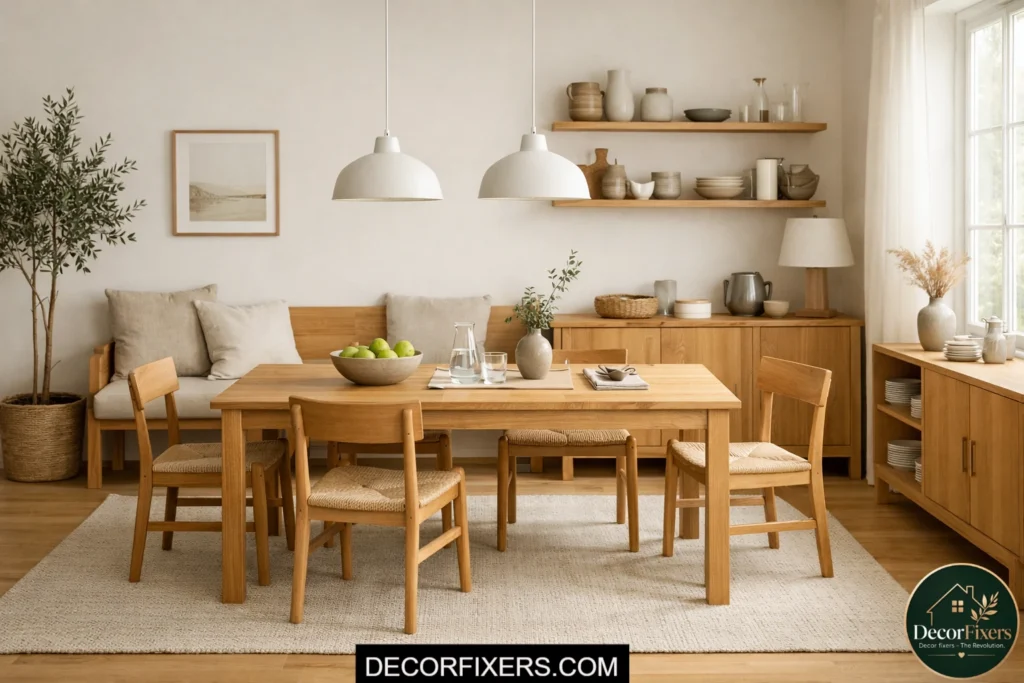
Scandinavian design has one rule that overrides all the others: function first. Every object in the room should do something, serve a purpose, create comfort, or earn its visual presence by being genuinely beautiful. If you pick up a decorative object and can’t answer the question “why is this here?”, put it back down.
Some experts argue that Scandinavian design is restrictive. That’s valid if you measure it against maximalist styles. But if you’re dealing with a home that already feels cluttered, chaotic, or incoherent, the Scandi philosophy is genuinely liberating. You don’t have to have more. You just have to be more deliberate about what you have.
CONCLUSION:
Here’s what I’ve learned after spending a lot of time studying, writing about, and genuinely living with Scandinavian design principles: the rooms that feel best aren’t the ones with the most expensive furniture. They’re the ones where the person who lives there made considered, intentional choices, and then stopped.
Stopped buying. Stopped adding. Stopped second-guessing the empty wall space. That discipline, that willingness to trust restraint, is the real heart of Scandinavian design. The furniture, the candles, and the oak table are just the tools.
Start with one idea from this list. Execute it properly. See how it feels. Then come back for the next one. Your Scandinavian dining room won’t happen in a weekend, but it will happen.
FAQs:
Q: What’s the best color for a Scandinavian dining room?
A: Warm white or pale greige on the walls, with natural wood tones in the furniture. Avoid pure bright white; it reads as cold. Introduce muted sage or slate blue on a single accent wall if you want color without disrupting the calm.
Q: How do I make my Scandi dining room feel warm and not sterile?
A: Layer textiles (linen, wool, jute), use candles as your primary evening light source, and bring in natural wood at multiple scales, not just the table. Warmth comes from material contrast and soft lighting, not from the color of your walls.
Q: Should I mix dining chair styles in a Scandinavian dining room?
A: Yes. Matching sets look like a showroom. Mix silhouettes within a consistent material palette, all light wood frames or all black frames, and the room will feel intentional rather than random.
Q: What type of rug works best under a Scandinavian dining table?
A: A flat-weave rug in a natural fibre, jute, sisal, or undyed wool. It needs to extend at least 60cm beyond the table on all sides so chairs still land on it when pulled out. Avoid high-pile rugs: they trap crumbs and snag chair legs.
Q: When should I choose Japandi over Scandinavian dining room design?
A: Choose Japandi if you prefer even more restraint and are drawn to darker wood tones and wabi-sabi imperfection. Scandinavian design prioritizes lightness and warmth; Japandi is slightly cooler and more minimal. Both are functional; the difference is in mood.

Creator of DecorFixers, sharing practical home and interior ideas focused on real-life usability, simple design improvements, and budget-friendly solutions.