

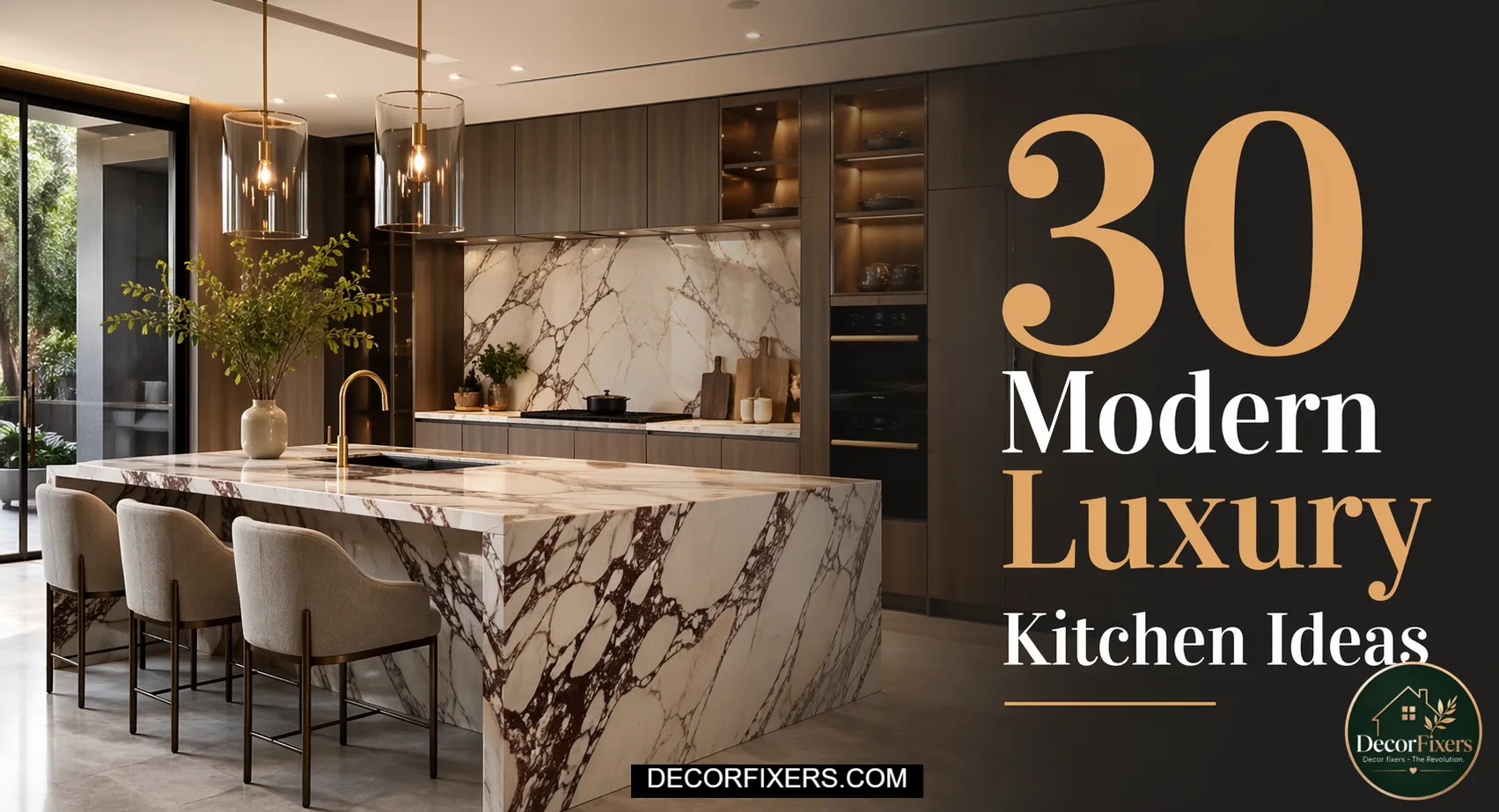
Modern luxury kitchen ideas are design concepts that combine high-end materials, integrated appliances, and purposeful spatial planning to produce a kitchen that functions perfectly and looks organized, not just expensive. The goal is always the same: visual restraint, material quality, and zero visible friction in daily use.
You’ve saved the Pinterest boards. You’ve walked through the showroom. You’ve flipped through the magazine spreads. And you still can’t articulate what you actually want or why some kitchens feel genuinely luxurious while others just feel costly.
The difference is specificity. This guide gives you 30 concrete, actionable ideas, organized by category, each one explaining not just what to do, but why it works and how to execute it well. No vague inspiration. Real direction.
This guide covers high-end residential kitchens in new builds and full renovations, with budgets of roughly $70,000–$250,000+. It does NOT address cosmetic refreshes, rental properties, or light facelifts; different logic applies to those projects.
Calacatta Viola Marble Island Top
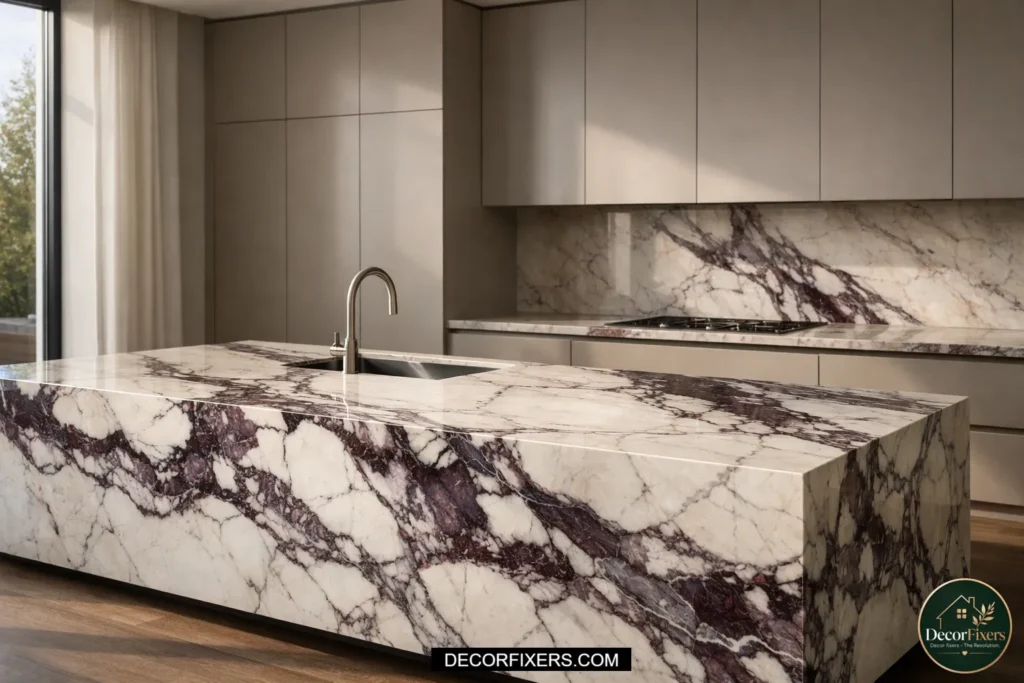
Position a full slab of Calacatta Viola, defined by its deep purple-grey veining on a warm white ground, as the kitchen’s single statement surface.
Use it only on the island top; keep perimeter counters in a quieter companion stone. One bold material used deliberately reads as more luxurious than four premium materials competing simultaneously. The restraint is the design decision.
Seal annually with a penetrating impregnator sealer. Blot, never wipe, oil spills immediately. The patina Calacatta develops over the years is part of the material’s character, not a flaw worth preventing.
Dekton Sintered Stone Worksurfaces
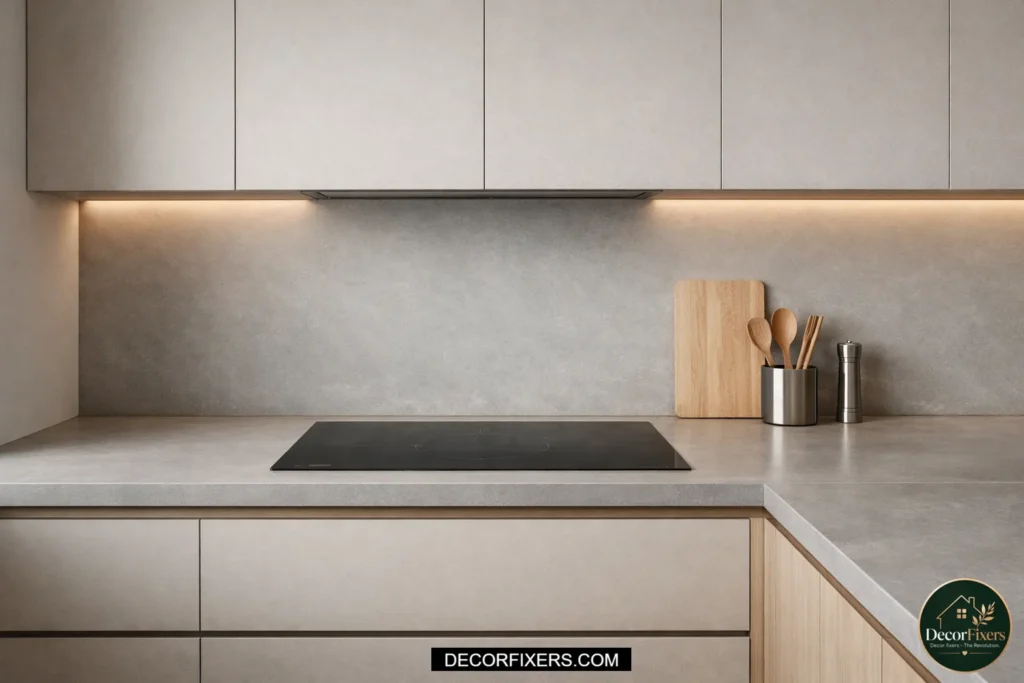
Dekton, manufactured by Cosentino, is a sintered stone that replicates the visual depth of marble with near-zero porosity. It resists heat directly from pans, doesn’t etch from citrus or wine, and requires zero sealing.
For high-use kitchens, busy households, avid cooks, and families with young children, it’s the most defensible countertop choice at the luxury tier. Some designers argue it looks “too perfect.” That’s a real trade-off worth naming: natural stone develops character over time; sintered stone stays pristine. Neither is wrong. They’re different answers.
Specify a matte or satin finish over polished for worktops; it hides everyday contact marks far better and reads as more sophisticated in most kitchen color palettes.
Integrated Handle-Free Cabinetry System
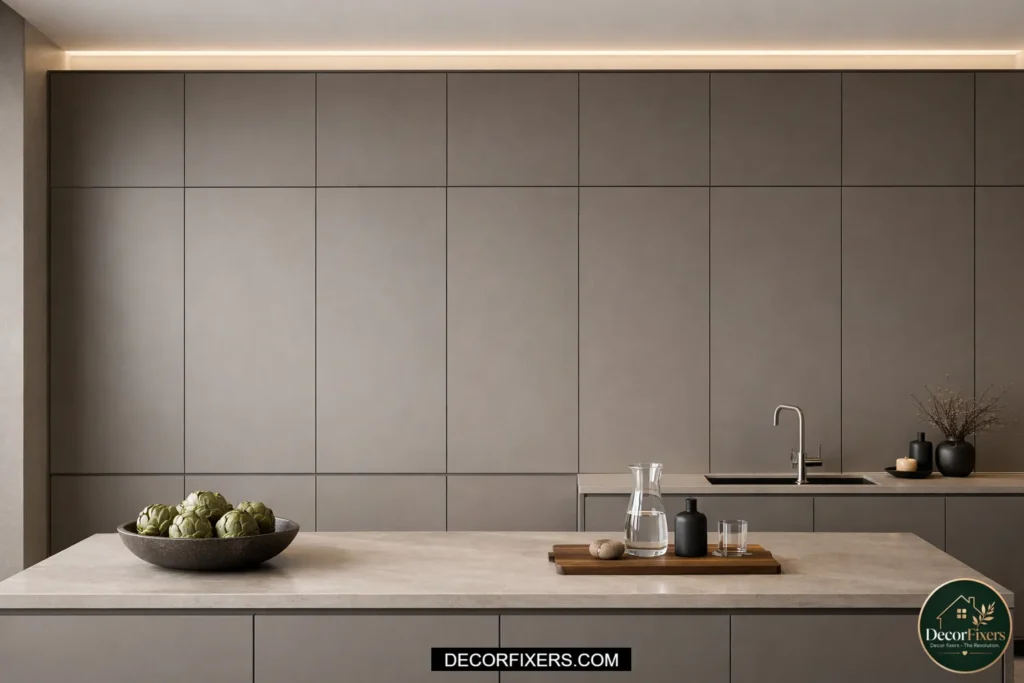
Frameless cabinetry with integrated J-pull profiles or push-to-open mechanisms, so the cabinet faces read as unbroken planes with no visible hardware, is the defining surface move of contemporary luxury kitchen design.
Boffi and Poliform lead this category; both offer bespoke panel systems that accept matching veneers and lacquers across every surface. When executed correctly, the kitchen’s cabinetry reads as a single architectural wall. When executed poorly, with misaligned gaps and inconsistent reveals, it reads as assembly work pretending to be custom.
Push-to-open (servo-drive) mechanisms require precise alignment and seasonal recalibration. Budget for professional tuning after the first year; wood moves, doors shift slightly, and the mechanism needs adjustment.
Matte Perimeter + High-Gloss Island
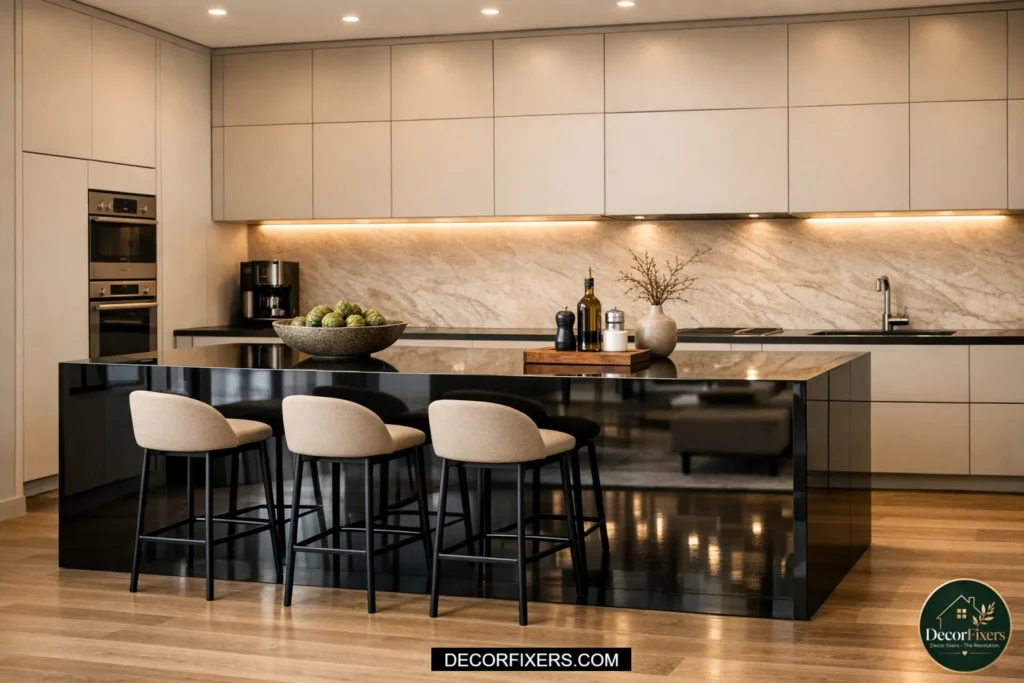
Alternating gloss and matte on adjacent cabinet doors reads as indecisive, not sophisticated. The correct approach separates them spatially: matte lacquer on all perimeter and wall cabinetry and high-gloss on the island base only. The island becomes the focal point. Everything else recedes. One visual hierarchy, clearly expressed across the whole room.
High gloss shows fingerprints constantly. If the island is used as a prep surface by children, consider a satin finish as a practical middle ground; it still reads differently from the matte perimeter without requiring daily polishing.
Full-Height Book-Matched Stone Slab Backsplash
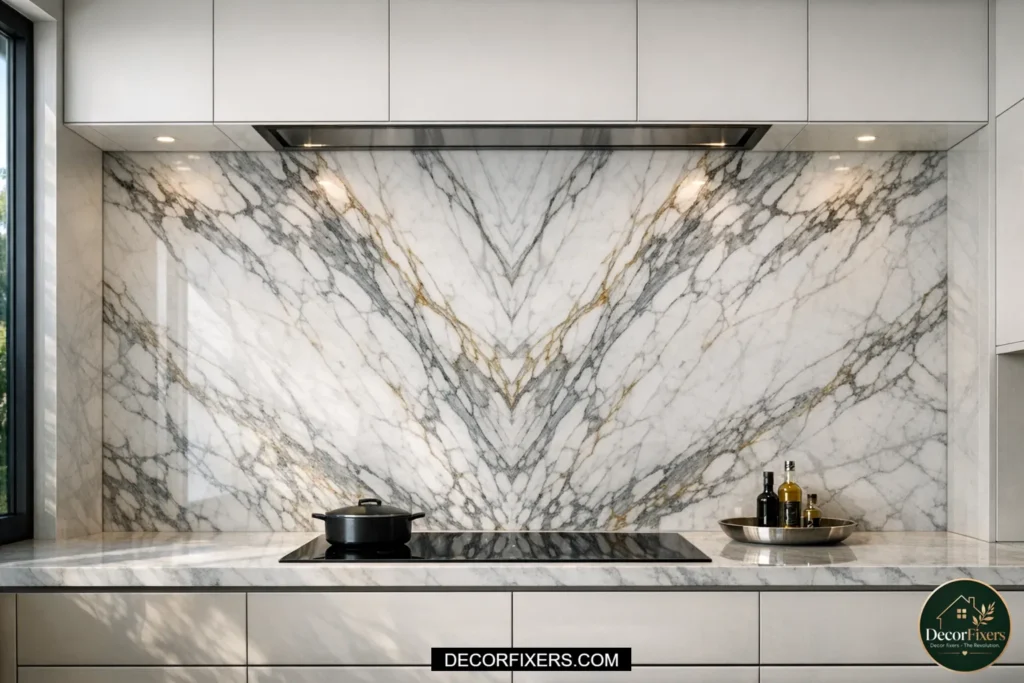
Replace traditional tile with a continuous slab of the same stone used on the countertop, running floor-to-ceiling behind the cooking zone. Book-matched slabs—two adjacent cuts from the same block, mirrored along their shared edge; produce a symmetrical veining pattern that no tile arrangement can replicate. The wall reads as a single geological statement. It’s expensive, heavy, and worth every engineering challenge in a kitchen at this level.
Smoked Oak Veneer Accent Panel Run
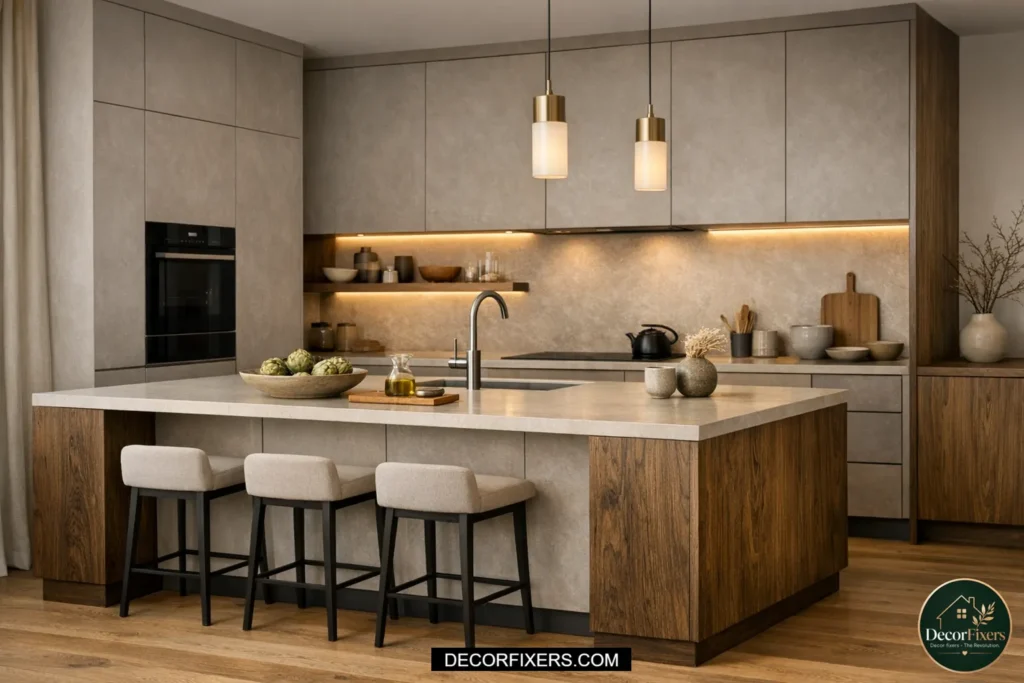
A kitchen built entirely from stone and lacquer can feel sterile. The corrective is a single run of smoked or fumed oak veneer; typically, the island sides, a pantry tower, or a floating shelf zone, that introduces organic warmth without disrupting the room’s clean language. The smoke treatment deepens the grain’s contrast and gives the wood a considered, aged quality that raw oak never achieves fresh out of the mill.
Specify longitudinal (flat-cut) grain rather than quarter-sawn for the most dramatic visual movement across panel faces. The difference in character is significant and adds no cost.
Quick Comparison: Premium Surface Materials
| Material | Best For | Key Benefit | Limitation |
| Calacatta Viola Marble | Statement islands | Unmatched visual drama, ages with character | Porous, etched, requires annual sealing |
| Dekton Sintered Stone | High-use worktops | Heat/scratch/stain resistant, zero sealing | Looks engineered; less organic character |
| White Macaubas Quartzite | Natural stone with more durability | Harder than marble, unique veining | Still porous; less dramatic visual movement |
| Smoked Oak Veneer | Island sides, pantry towers | Organic warmth, distinctive grain movement | Moisture-sensitive; seal near sink area |
Floor-to-Ceiling Concealed Furniture Wall
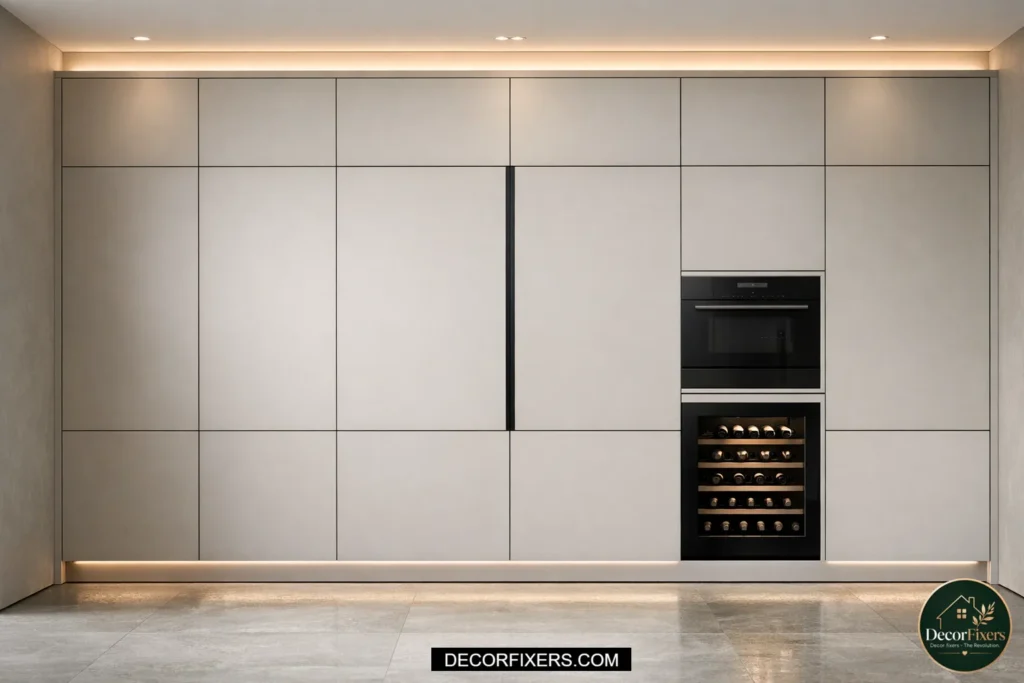
A full wall of cabinetry running from floor to ceiling with no visible break between uppers and lowers creates what designers call a “furniture wall”; it reads as a single architectural element rather than a stack of units. Appliances, pantry storage, and daily-use items all live behind matching panels. The kitchen’s working contents become invisible. This single design move does more for the luxury reading than almost any material choice.
Deep Drawer System in Place of Base Cabinets
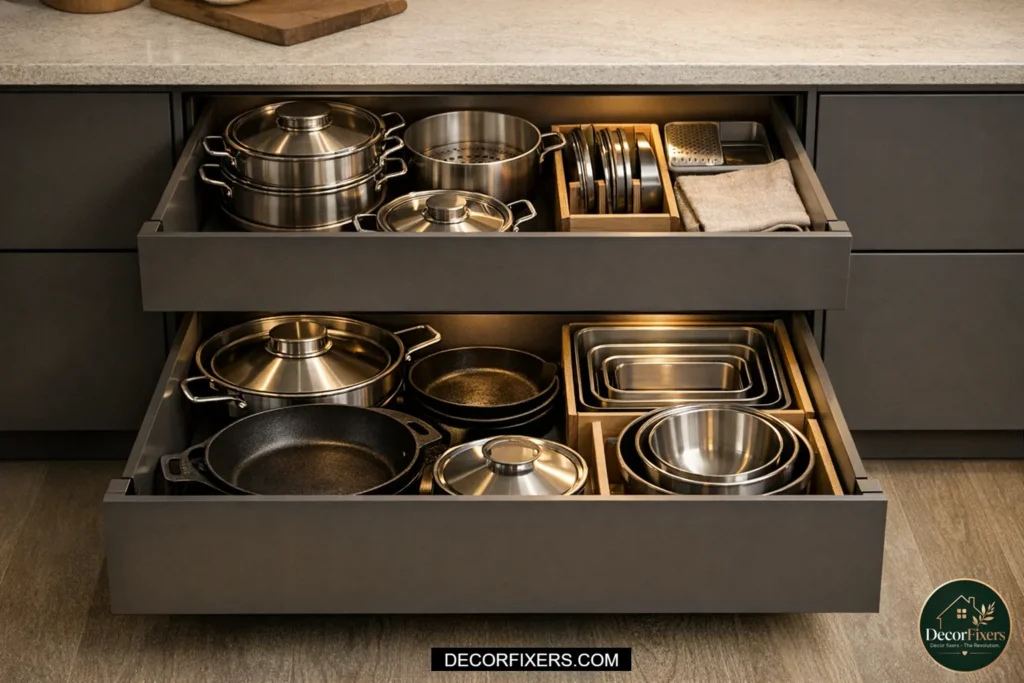
Base cabinets with doors are the least efficient storage format in a kitchen. Replace them entirely with deep drawer stacks; three or four drawers per run, each on full-extension soft-close runners. Pots, pans, lids, and dry goods become accessible in a single gesture without kneeling, squinting, or excavating the back of a shelf. That’s what real luxury use feels like. Daily. Every morning.
Specify Blum Legrabox or Häfele Matrix Box S runners; they extend to a full 100% and carry 60 kg loads without deflection. The quality of the runner is felt every single day.
Tambour-Door Appliance Concealment Zone
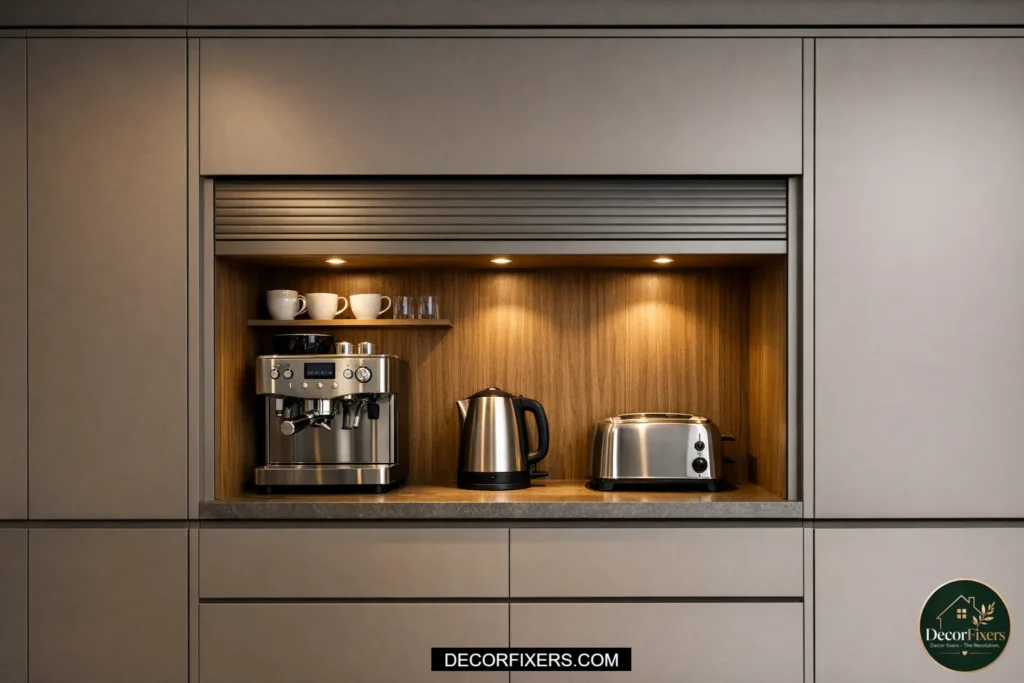
A dedicated countertop zone, typically 900–1200 mm wide, with a tambour (rolling slatted) door that lowers to reveal a coffee machine, kettle, and toaster, all plugged in permanently. When not in use, the door closes, and the counter reads as an uninterrupted worksurface. It’s the elegant solution to the “I don’t want appliances on show, but I use them daily” problem that most kitchens never solve.
Allow a minimum of 380 mm of internal clearance height in the tambour zone for a standard espresso machine. Measure your tallest appliance before finalizing cabinet drawings; this is a common sizing mistake.
The Scullery: A Second Working Kitchen
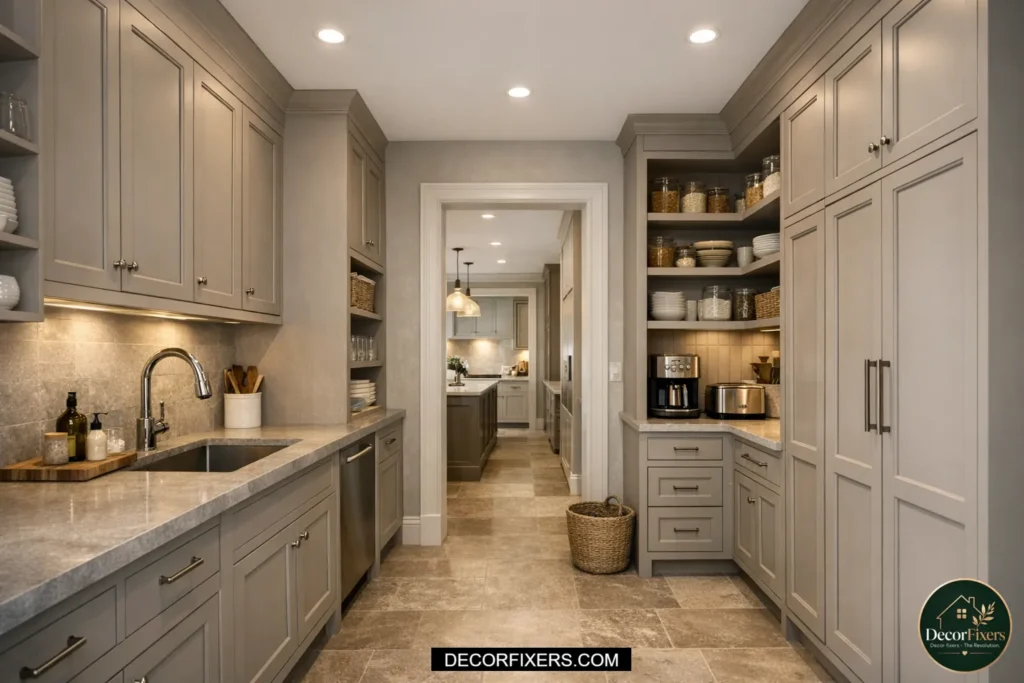
A scullery, a small secondary kitchen adjacent to the main space, is the functional luxury move that allows a show kitchen to stay pristine. Everyday mess, bulk storage, a second sink, the dishwasher, and a secondary fridge all live in the scullery. The main kitchen handles plating, coffee, and entertaining. It answers the question everyone asks about immaculate kitchens: there’s a second room doing the real work behind a closed door.
Minimum viable scullery: 6–8 square meters of space with a deep sink, full-height pantry pull-out, and a dishwasher. That’s enough to remove 80% of visual kitchen clutter from the main space.
Full-Access Corner Pull-Out System
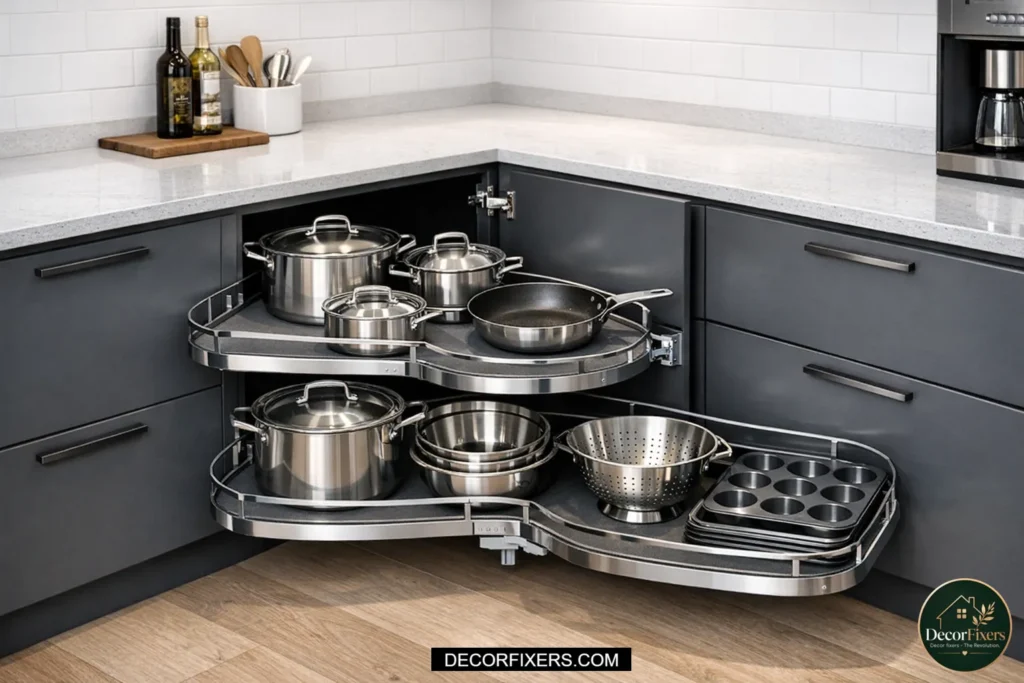
Corner base cabinets are traditionally wasted centimeter space; the “blind corner” problem. The modern solution: a full-access pull-out system (Le Mans II or Kesseböhmer Magic Corner) that extracts every usable centimeter in a single motion. Both shelves swing out simultaneously, giving complete visibility and reach to the entire corner. Not the most glamorous idea on this list. The one that changes daily kitchen use more than almost anything else.
Specify the full-extension version, not the basic pull-out. The difference in accessibility is substantial; the cost difference is minimal. It’s a specification worth specifying clearly.
One Curated Open Shelf Zone
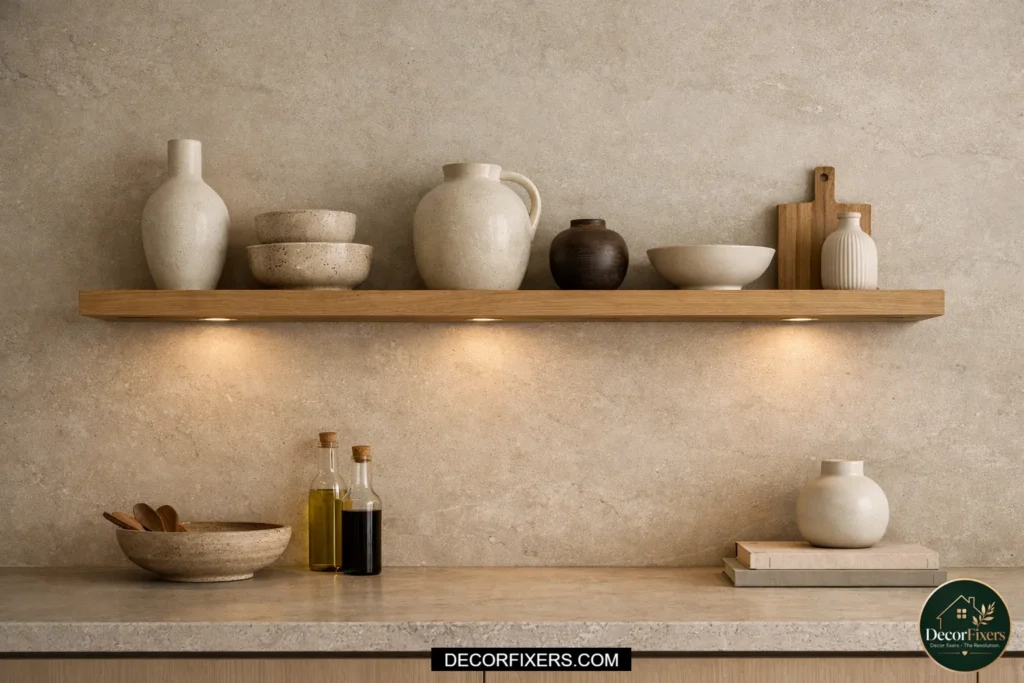
Open shelving everywhere is a maintenance burden and a visual liability in most real households. One disciplined run, 1200 mm finalizing wide, floating at eye level in a dedicated display zone, captures the visual interest of open storage without the chaos. Curated with matching ceramics, a few cookbooks, and restrained objects, it reads as intentional. The keyword is one: a single zone, not distributed shelving scattered across the whole kitchen.
I’ve seen conflicting data on this; some interior surveys rank open shelving highly, while kitchen ergonomics research links it to increased perceived mess over time. My read: one dedicated display zone works reliably; distributed open shelving throughout rarely stays curated past the first six months.
Sub-Zero Column Refrigeration System
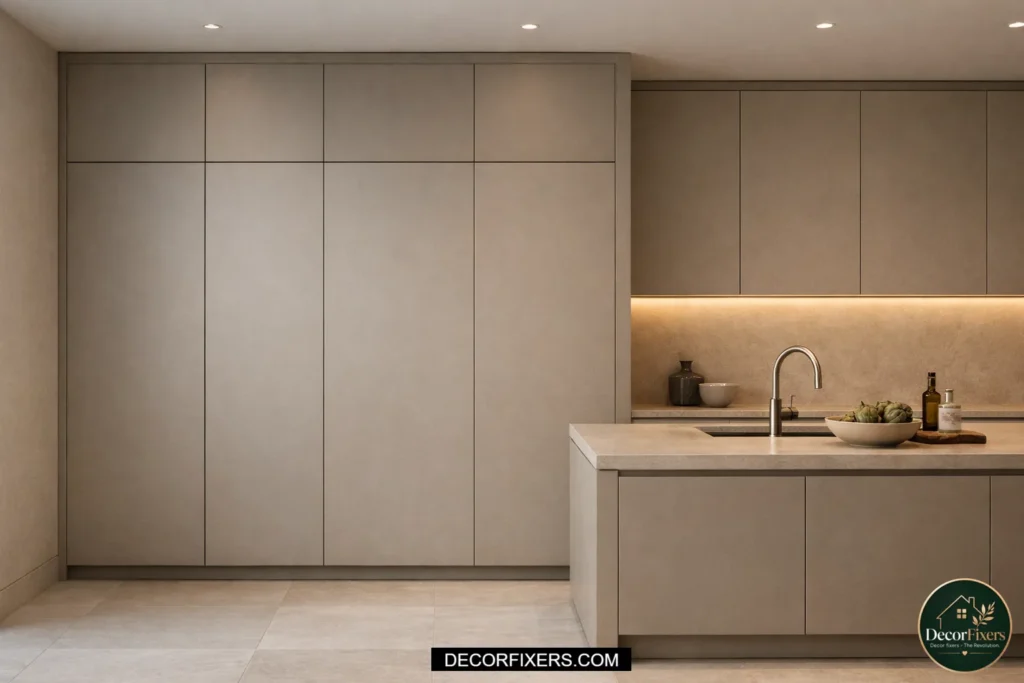
Sub-Zero’s column system separates the refrigerator and freezer into individual tall columns, each accepting a full-overlay cabinet panel that matches the surrounding cabinetry exactly. When closed, both columns are indistinguishable from the rest of the kitchen. The units run on separate compressor systems, meaning the fridge and freezer each maintain ideal humidity and temperature independently. Better food preservation and better aesthetics. Both at once, with no compromise.
Lead times on Sub-Zero column units run 10–16 weeks as of early 2026. Specify before finalising cabinetry shop drawings; panel thickness matters to millimeter precision.
Wolf Flush-Mount Induction Cooktop
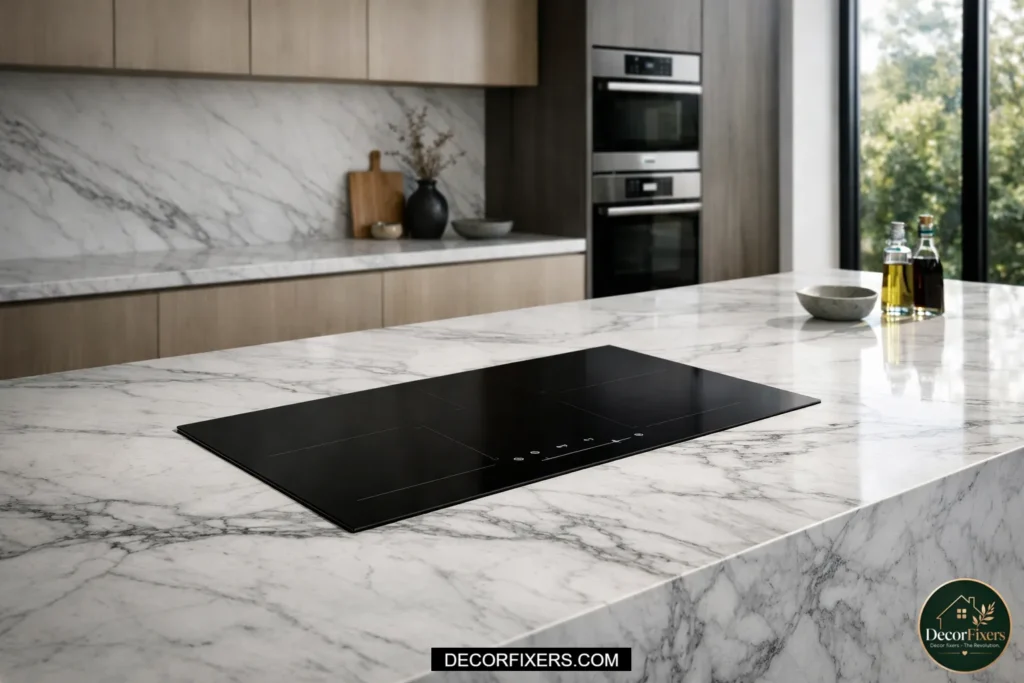
Wolf’s 36-inch induction cooktop in the Transitional series offers a flush-mount installation option; the cooktop surface sits level with the surrounding countertop, with no visible lip or height transition. The result is a continuous stone surface interrupted only by the cooktop glass. A small detail with an outsized visual impact, particularly in a kitchen with book-matched stone. The cooking performance is benchmark-level; the integration is the differentiator over standard installation.
Ceiling Cassette or Downdraft Extraction
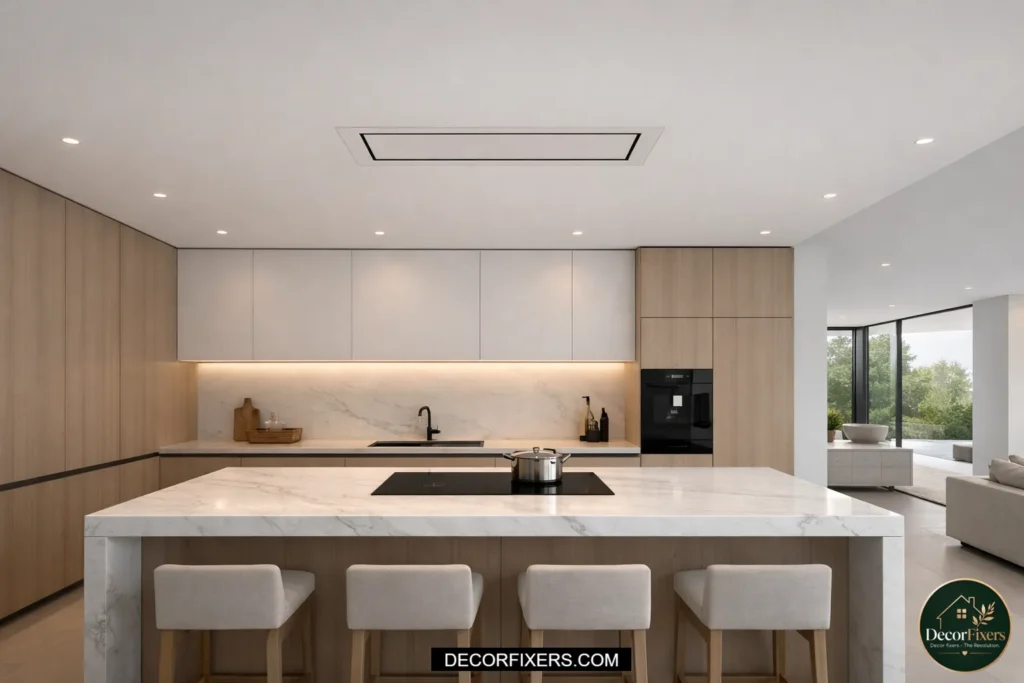
A traditional overhead hood, even a beautifully designed one, interrupts sightlines in an open-plan kitchen and competes with the ceiling as an architectural element. The two invisible alternatives are a ceiling cassette extractor (recessed flush into the ceiling above the cooktop) or a downdraft system that rises from the countertop only during cooking. Both eliminate visual bulk entirely. A ceiling cassette performs better for high-BTU gas cooking; downdraft is the more dramatic choice for induction.
Downdraft systems are less effective for gas ranges; airflow works against the natural rise of combustion gases. For induction cooktops, they perform extremely well.
Built-In Espresso Column at Eye Height
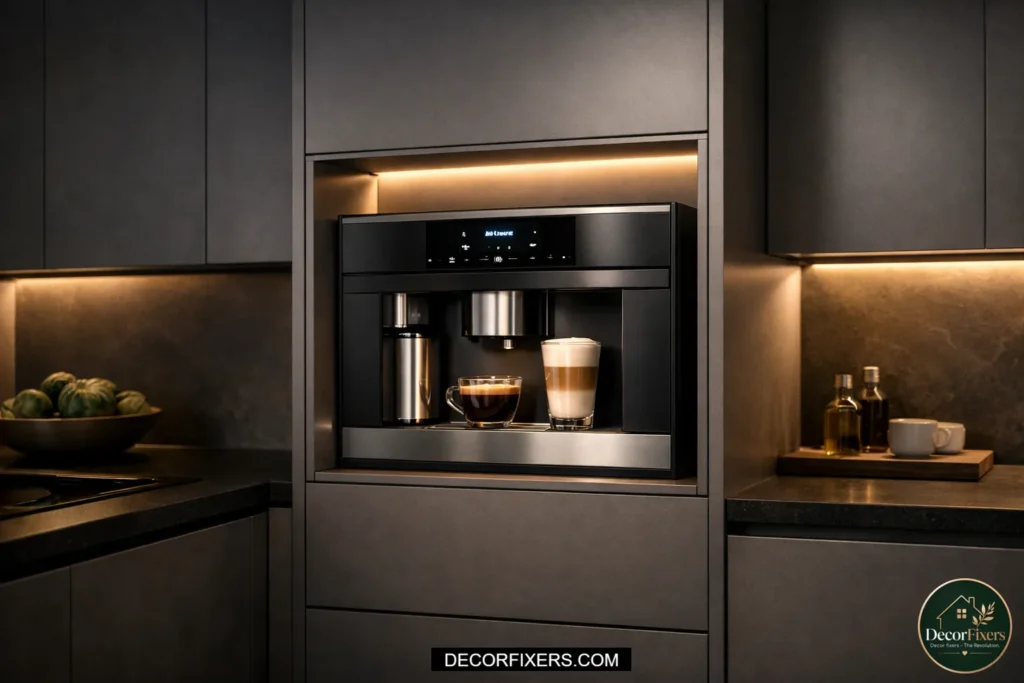
A dedicated built-in espresso machine, Miele’s CM7 or the Gaggenau 200 Series, recessed into a cabinet column at eye height, with a dedicated water line and waste connection. No countertop footprint. No visible cord. No moving it to clean. The morning coffee ritual becomes a gesture: press, wait, collect. Households that have it say it’s one of the daily-use decisions they’d never reverse. That’s the right test for any luxury decision.
The Gaggenau 200 Series accepts a full-height cabinet door, making it completely invisible when closed. The Miele CM7 is more accessible price-wise and has exceptional bean-to-cup automation for daily use.
Integrated Warming Drawer Below the Oven
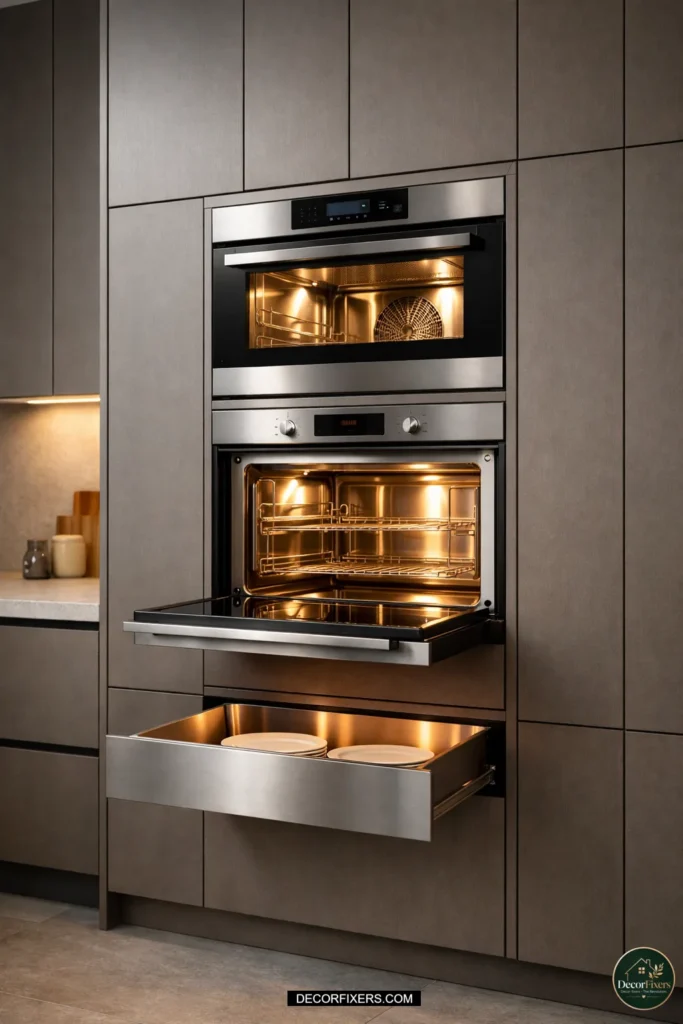
A warming drawer positioned in the tower directly below the wall oven holds plated food at serving temperature while the rest of the meal finishes cooking. It also works for proofing bread, warming plates before service, and low-and-slow overnight cooking. In practical terms, it changes how a household hosts: everything is ready simultaneously. Both Wolf and Gaggenau make units sized to accept matching cabinet panels, so the oven tower reads as an uninterrupted vertical architectural element.
Specify a proofing function if you bake. It holds 35°C, ideal for yeast activation, without the inconsistency of using an oven on its lowest setting with the door cracked open.
Zone-Based Planning: Replace the Work Triangle
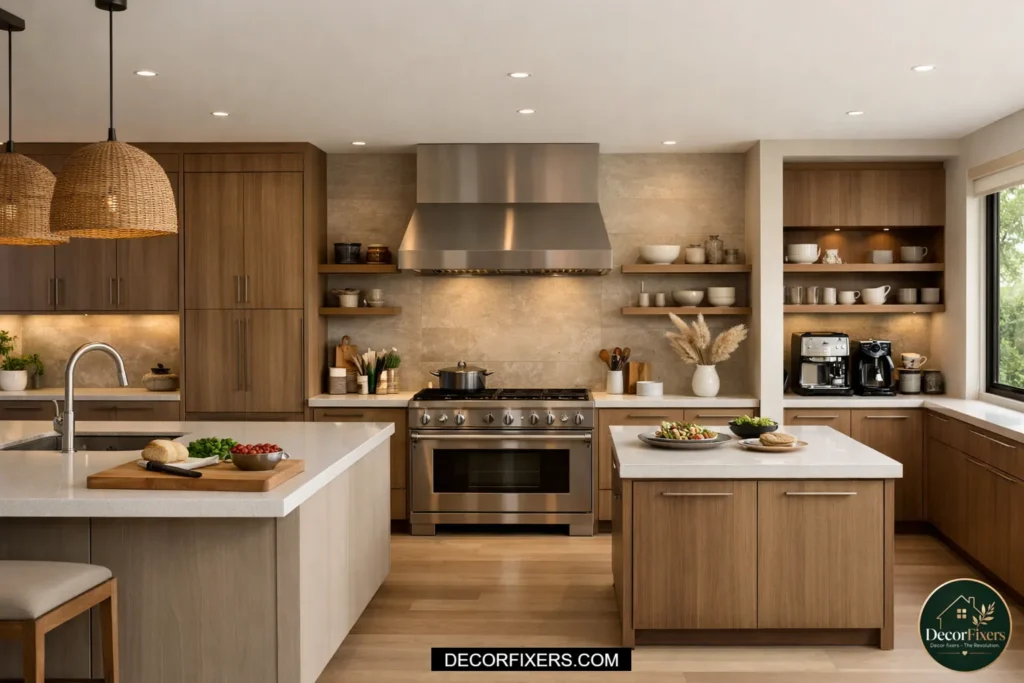
The work triangle, refrigerator, sink, and stove in a triangle, is cited in almost every design guide. It was developed in the 1940s for single-cook, closed kitchens. Most modern households need distinct zones for prep, cooking, plating, cleaning, and social engagement, each sized and positioned for how this specific household uses the space. Two people who cook simultaneously need two prep zones. A household that entertains needs a plating zone near the dining area. Askbehavior first. Design the layout second.
Map a week of actual cooking behavior on the cooktop (ask before finalizing your layout). Where do you put groceries down when you walk in? Where do you make coffee? These patterns reveal your real workflow far better than any design theory can predict.
Double Island Configuration
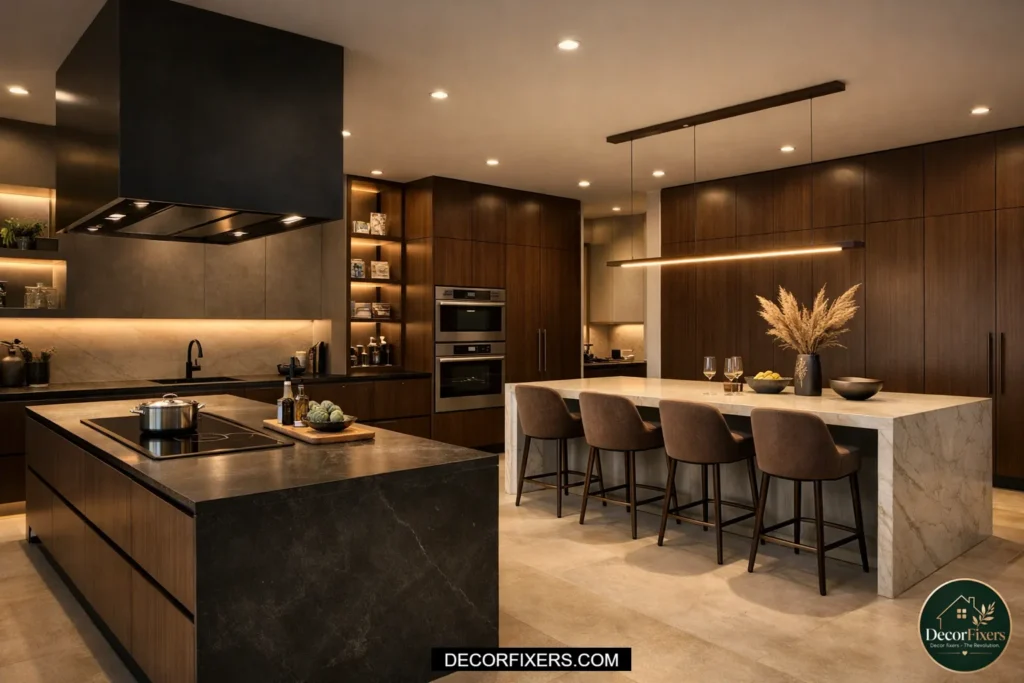
Two islands, a primary cooking island with an integrated cooktop (ask about behavior) and a secondary social island at bar height with seating, have moved from novelty to near-standard in high-end residential kitchens over the past three years. The functional logic is clean: one island handles prep and cooking, and the second handles guest interaction and plating without putting guests in the work path. You need 1.2 meters of clear circulation on all sides of both. In kitchens under 40 square meters, don’t force it.
Kitchen-to-Living Continuity with Visual Break
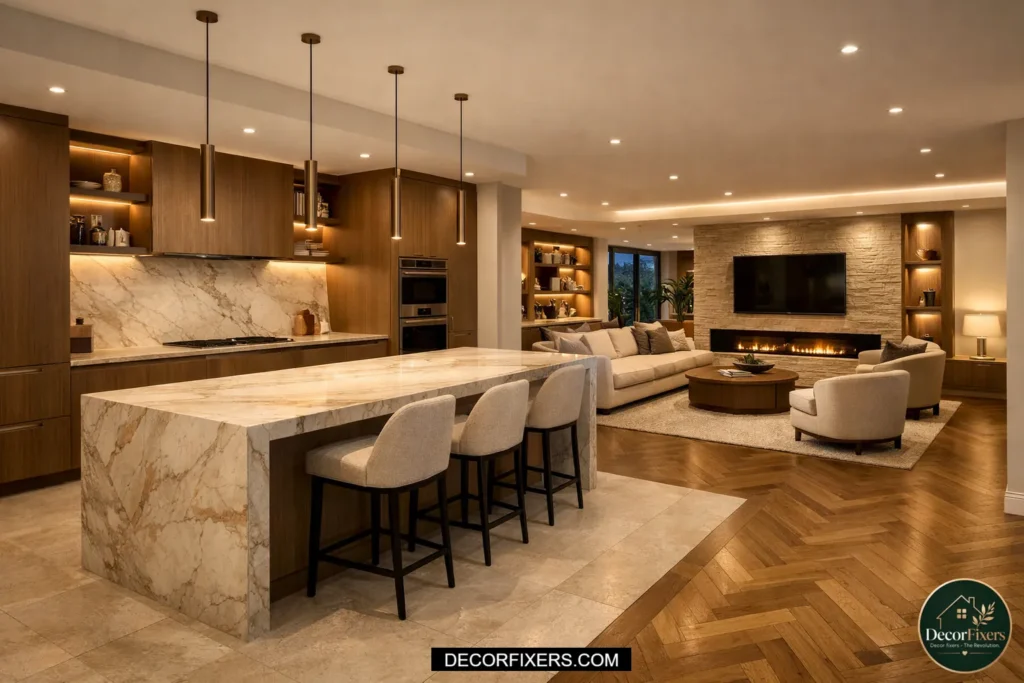
Full open-plan; kitchen merging entirely into living space with no transition; creates sound and smell circulation problems that most homeowners underestimate until they live with them. The better resolution: a deliberate visual break that doesn’t close the space. A change in ceiling height, a low wall, a step between zones, or a flooring material transition signals separation without blocking sightlines. The kitchen reads as connected; it doesn’t read as the same room.
Herringbone parquet flooring in the living zone transitioning to large-format stone in the kitchen is one of the most effective and time-tested material break strategies. It works because both materials can share a warm, neutral palette.
Bi-Fold Connection to Covered Outdoor Kitchen
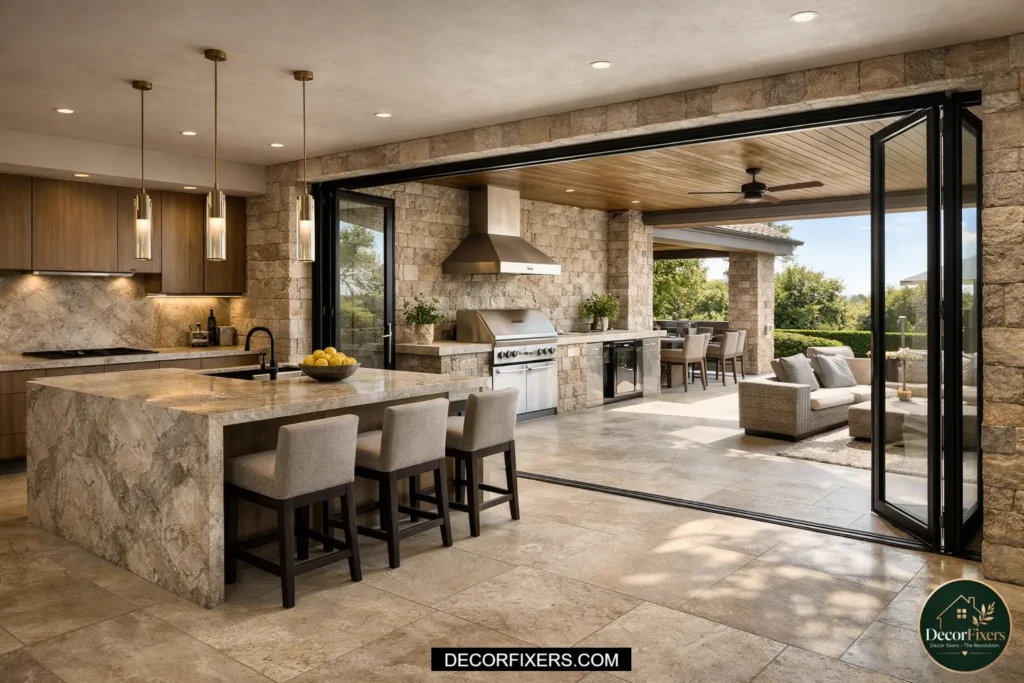
When a kitchen is positioned on an exterior wall, large bi-fold or lift-and-slide doors that open directly to a covered outdoor terrace, with a secondary barbecue station or outdoor kitchen, extend the kitchen’s effective footprint for the warmer months. The indoor and outdoor surfaces must speak the same material language: same stone, same wood tones, same palette. A jarring material transition across the threshold undermines both spaces simultaneously.
Specify thermally broken aluminum frames for bi-fold doors. Standard aluminum frames develop condensation on the interior face during temperature differentials; a small but constant daily irritation in a kitchen you’ve invested in.
Perimeter Sink Facing a Garden or Courtyard View
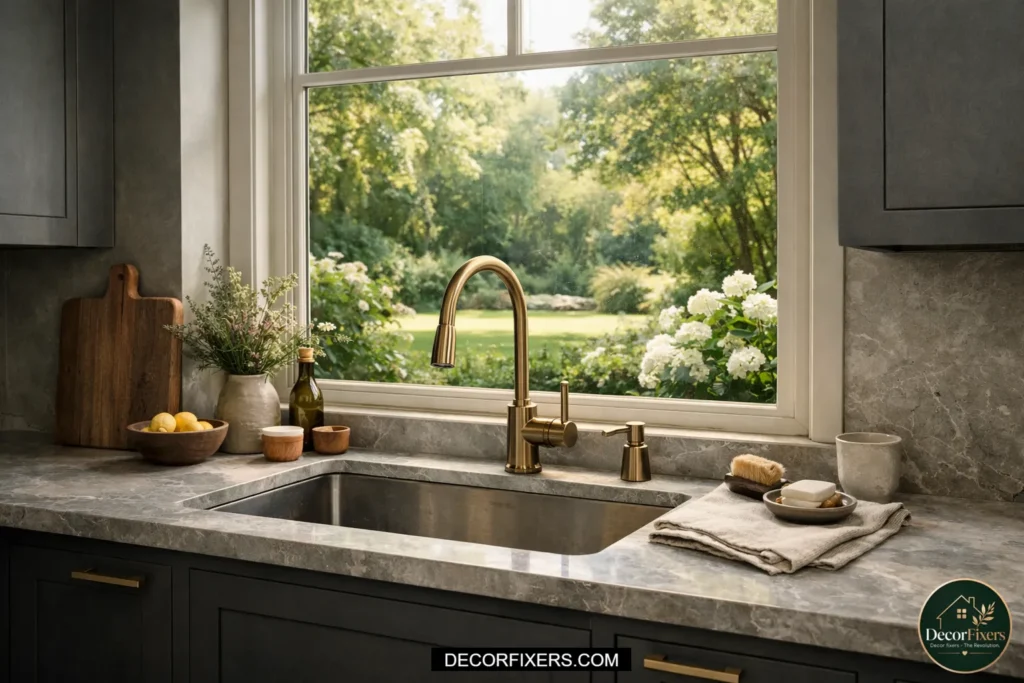
The sink position is the single fixed point in a kitchen where a person spends the most cumulative daily time differentials washing produce, cleaning up, and prioritizing filling pots. Positioning it on the exterior wall, facing a garden, courtyard, or landscape, transforms a functional task into a moment of daily pleasure. It sounds like a small consideration. People who’ve lived with it consistently say it’s among the kitchen decisions they’d prioritize above almost everything else when designing again.
Specify an undermount sink in the same stone as the countertop for a seamless transition. Integral stone sinks carved from the same block are the apex version; they eliminate the join entirely.
Six-Layer Lighting with Independent Scene Control
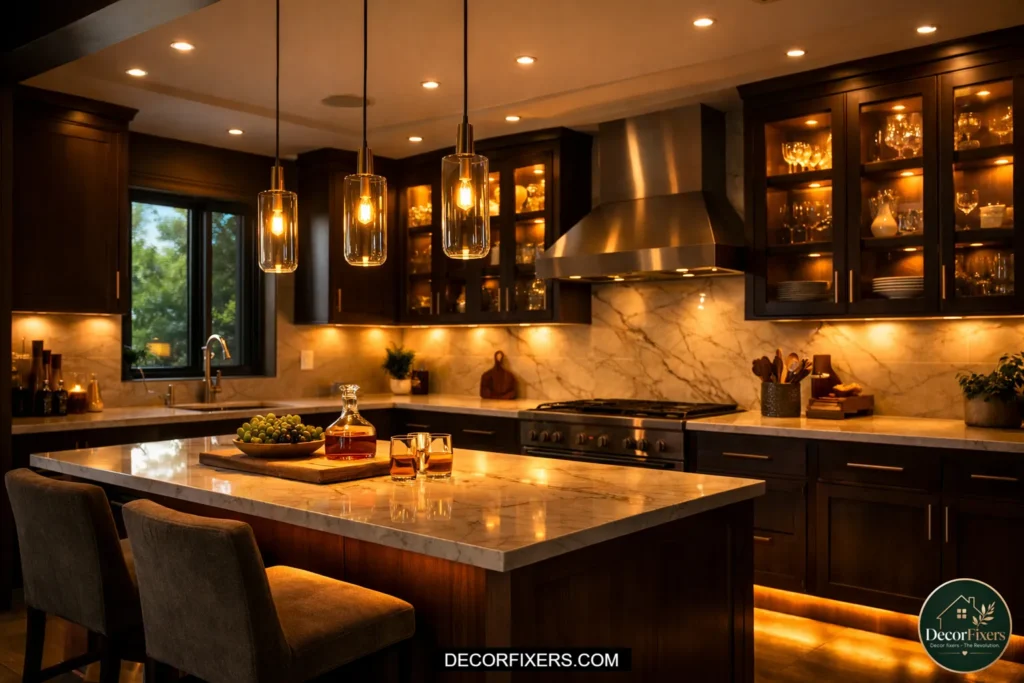
A properly lit luxury kitchen has six distinct layers: ambient (recessed ceiling), task (under-cabinet LED strips), accent (inside glazed cabinets and toe-kick glow), pendant (decorative, island-scaled), natural (window and skylight), and independent dimmable control for every layer. That last element, the ability to set morning prep lighting differently from evening entertaining, separates a well-lit kitchen from a genuinely transformative one. Most renovation briefs describe a pendant. That’s one layer of six.
Install a Lutron Caseta or Control4 scene controller during rough-in. Retrofitting scene control after walls are plastered is expensive and invasive; it’s a decision that must be made before any other electrical work begins.
Correctly Scaled Pendants Over the Island
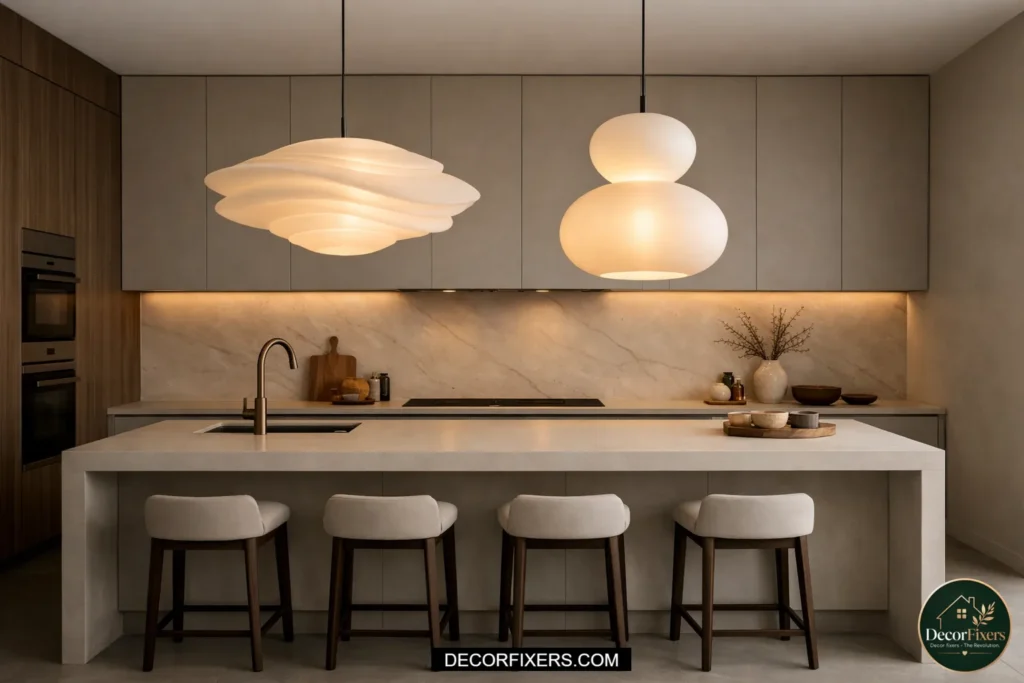
The most consistently mishandled lighting decision in high-end kitchens: pendants that are half the appropriate size, making even an expensive kitchen look tentative. A workable rule: pendant diameter in inches should approximately match island width in feet. A ten-foot island calls for pendants around ten inches in diameter. Two or three pendants, evenly spaced along the island’s length, hung at 700–750 mm above the countertop surface. Scale first, style second. That’s it.
Kitchen Skylight Positioned Over the Cooking Zone
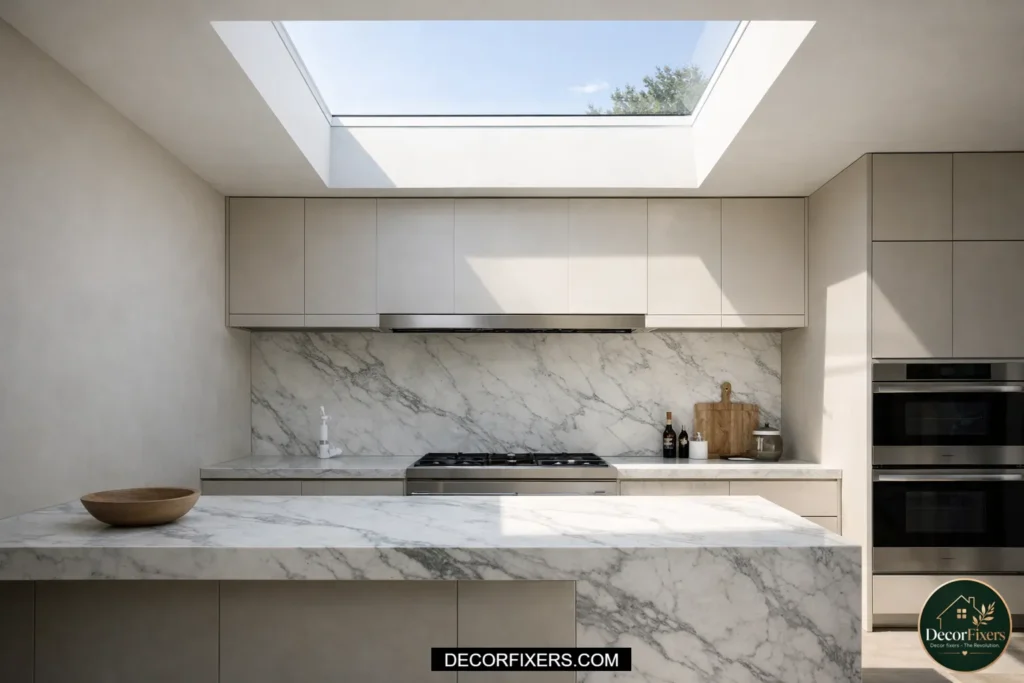
A rooflight positioned directly above the cooking zone washes the most-used work surface in natural daylight from above, eliminating the shadow a wall window always creates at worktop level. In north-facing or basement-adjacent kitchens, it’s transformative. In south-facing kitchens, it requires a diffusing glass specification to prevent direct summer sun from creating a hotspot. Both problems are solvable. The light quality reward is consistent regardless of orientation.
Specify acid-etched or fritted glass for any south-facing skylight over a cooking zone. Clear glass creates an unusable heat pocket in summer months that no amount of extraction resolves comfortably.
Warm Neutral Perimeter with Contrasting Island
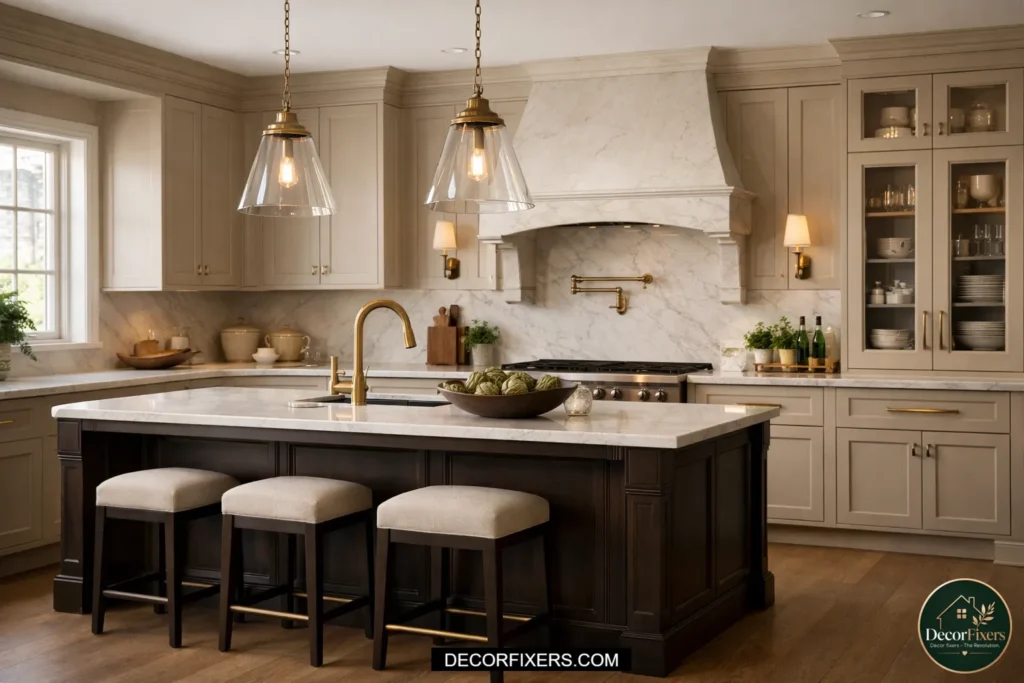
The all-white kitchen has been functionally finished in high-end residential design since roughly 2021. What replaced it: warm neutrals on the perimeter; greige, linen, and soft stone tones, with a contrasting island in a deeper shade. Charcoal, bottle green, and moody navy all work at the luxury level when the surrounding palette is warm enough to prevent them from reading as oppressive. The contrast does the visual work. The warmth prevents the sterility that made all-white fall from favor in the first place.
Quick note: always choose colors from physical samples viewed in your actual kitchen before committing. Window orientation shifts color perception dramatically, something no screen or showroom can simulate. Farrow & Ball’s “Elephant’s Breath” reads lavender in a north-facing kitchen and warm grey in a south-facing one. Same paint; entirely different rooms.
Single Metal Finish Committed Across All Fittings
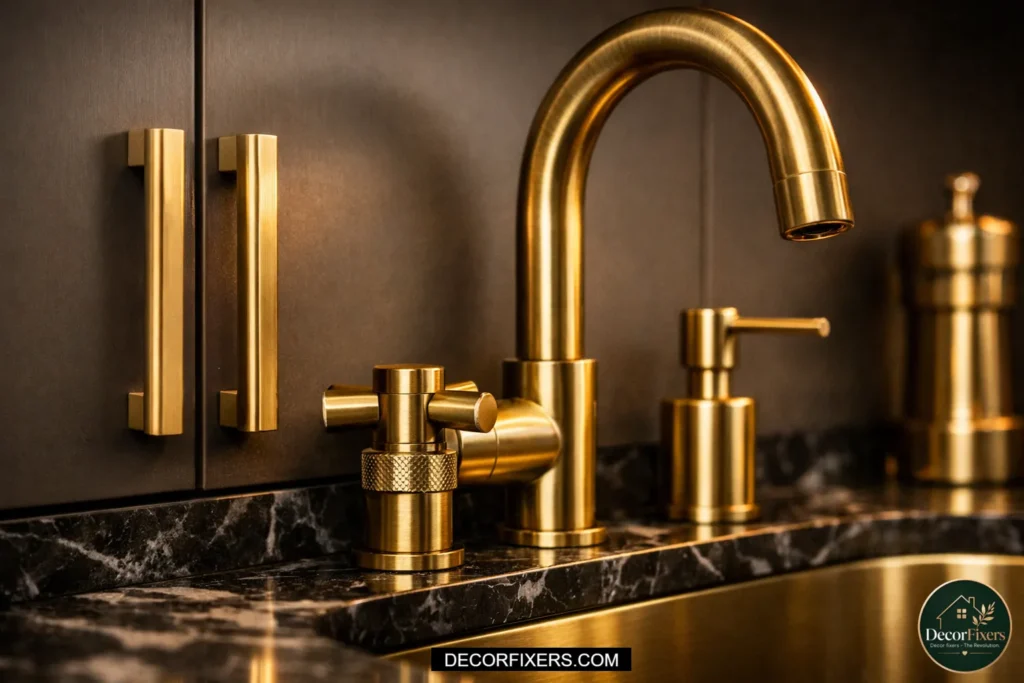
Mixed metals: brass taps, chrome handles, and matte black hinges—produce a kitchen that reads as unsettled rather than curated. The luxury move: one metal across every visible fitting. Taps, handles (if any), pendant light frames, sink accessories, and oven trims all match. Brushed brass is the dominant choice in current high-end residential work because it reads warm at every light level and ages into a richer tone rather than showing watermarks. Commit fully or not at all.
PVD-coated brass (physical vapor deposition) holds its finish significantly longer than lacquered brass. Specify PVD for taps and sink mixers in particular; these receive the heaviest daily contact and will show wear first.
Large-Format Stone Tile with Minimal Grout Joints
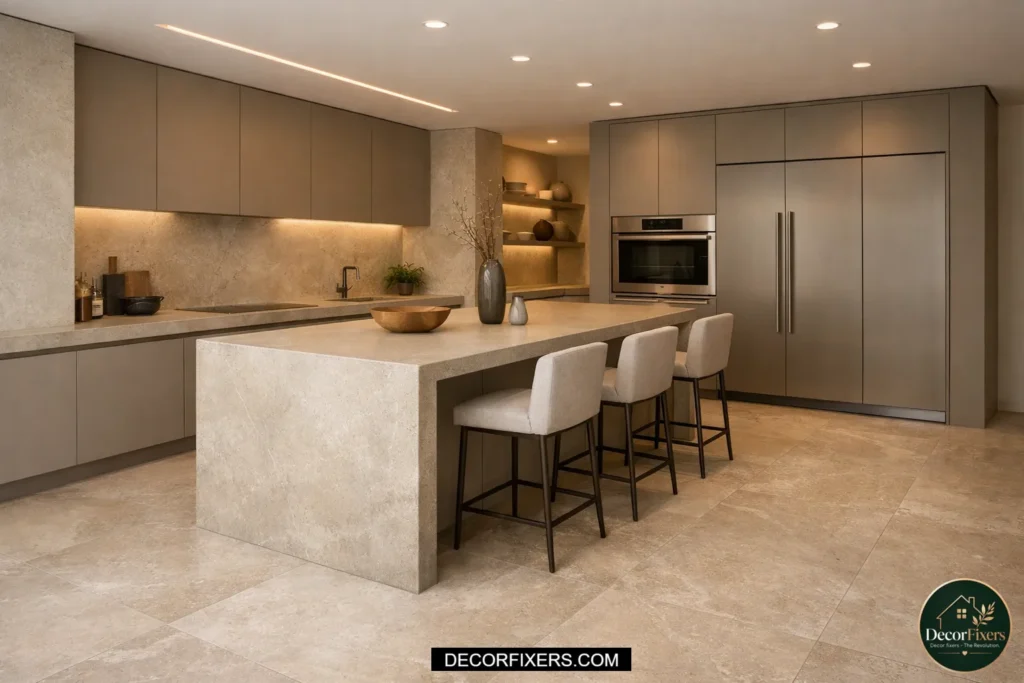
Large-format floor tiles, 1200 mm × 600 mm or larger, with 2–3 mm grout joints, create a floor that reads as a continuous surface rather than a grid. In a luxury kitchen, the floor should recede: it’s a background that supports cabinetry and stone surfaces, not a feature in its own right. Rectified large-format porcelain in a warm travertine or limestone finish achieves this consistently. Reduced grout also makes cleaning dramatically simpler over the lifetime of the kitchen.
Rectified tiles (machine-cut to precise dimensions) are essential for tight grout joints. Non-rectified tiles have dimensional variation that forces wider joints; specify “rectified” explicitly on your tile order to avoid this.
Integral Stone Sink with Bespoke Mixer Tap
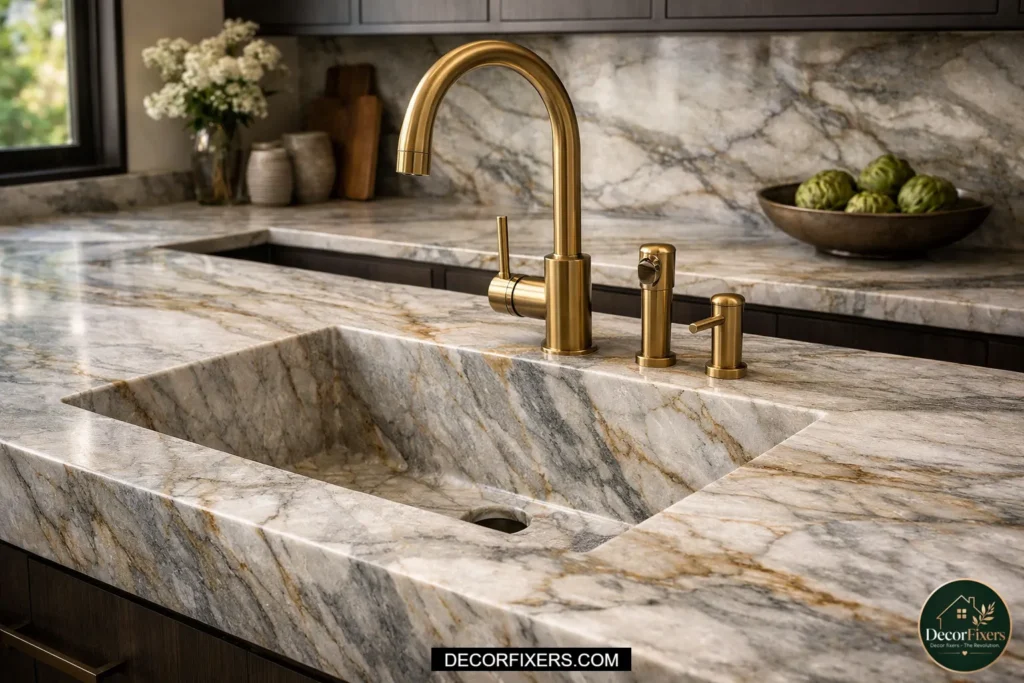
An integral stone sink, carved from the same slab as the countertop with no visible joint between counter and basin, is the detail that genuinely marks a kitchen as custom rather than assembled. It’s expensive to fabricate, requires precise waterproofing, and isn’t forgiving of soft stone selection. Done correctly in quartzite or granite, it’s one of the few kitchen elements that reads as irreplaceable. Pair with a Dornbracht or Vola mixer; both manufacture in formats designed to look as though the tap and sink were conceived together, because at this level they should be.
“Budget 6–8 weeks lead time for integral stone sink fabrication above standard stone countertop timelines. The fabricator needs the sink specification before cutting begins; the basin is carved out of the same slab, not added afterward.”
Invisible Smart Integration Throughout
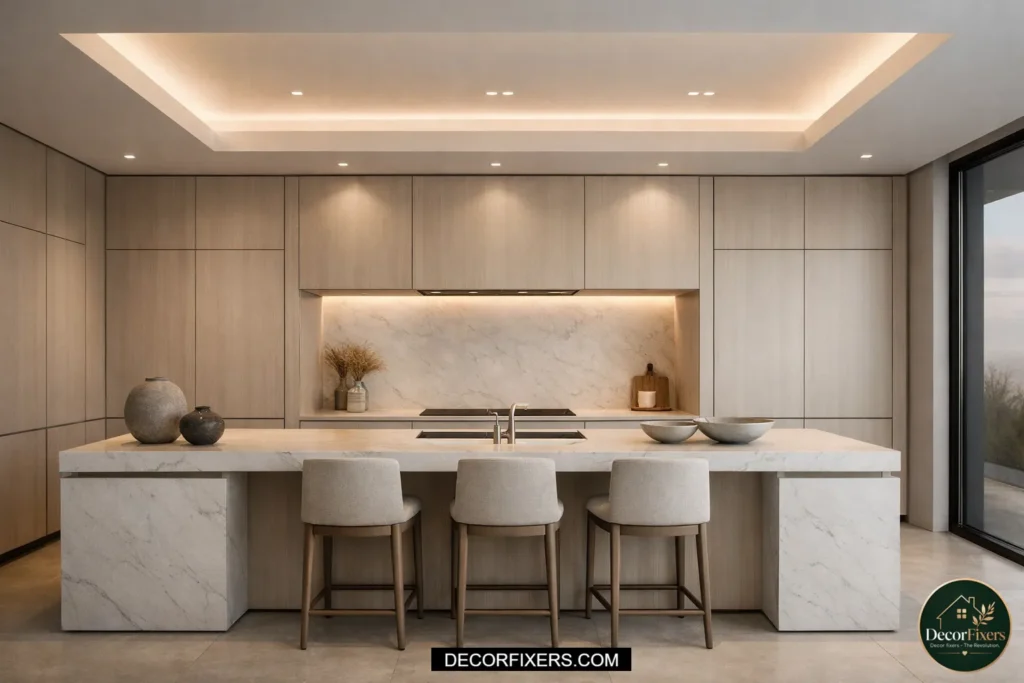
Smart kitchen technology at the luxury level should be completely invisible: no tablets mounted on walls, no displays built into cabinet doors, and no visible speakers on worktops. The correct implementation: voice-activated lighting and appliance control, motion-triggered under-cabinet lighting that activates as you approach the work surface, oven preheating via phone on the way home, and refrigerator inventory monitoring. Technology that removes friction without adding visual clutter. That’s the distinction between a smart kitchen and a gadget kitchen.
Specify all smart-home integrations during rough-in: cable routes, device locations, and network infrastructure. Retrofitting is the most expensive version of every smart home decision and the most disruptive to a finished kitchen.
READ MORE: Kitchen Decor Ideas to Upgrade Your Space: 20 Ideas That Actually Work
Budget Tiers: What’s Achievable at Each Level
The luxury aesthetic is achievable across a wider budget range than most people assume, but the trade-offs need to be chosen strategically, not randomly. Compromise on the right things. Protect the things that carry daily visual impact.
Quick Comparison: Budget Tiers for Luxury Kitchen Aesthetics
| Budget Range | Where to Invest | Where to Save | Key Constraint |
| $40K–$70K | Island stone top + hardware finish | Semi-custom cabinets (IKEA Sektion + custom fronts), mid-range appliances | Limited integration; some visible appliances are necessary |
| $70K–$130K | Full cabinet system + integrated appliances | Sintered stone vs. marble; local stone fabricator vs. imported | One premium zone; the perimeter is the supporting cast |
| $130K–$250K | European cabinetry (Boffi/Poliform), Sub-Zero/Wolf, natural stone | Budget shifts to lighting design + architectural details | 16–24 week lead times; coordination complexity throughout |
| $250K+ | Fully bespoke: custom cabinetry, integral stone sinks, full smart home | N/A; restraint in design, not in spend | Risk of over-specification; curation is the actual skill at this level |
CONCLUSION:
A modern luxury kitchen is not defined by expensive materials alone, but by how intelligently those materials, layouts, and technologies work together in daily life. The most successful designs are not the most visually complex; they are the most coherent, where every surface, appliance, and detail follows a consistent design language and serves a clear purpose.
From integrated appliances and handle-free cabinetry to scullery spaces, layered lighting, and carefully chosen natural stone, each element in a luxury kitchen should reduce visual noise while improving function. When design decisions are made with restraint and clarity, the result is a kitchen that feels effortless, organized, and timeless rather than merely expensive.
If there is one key takeaway, it is this: true luxury is not about adding more features but about eliminating friction. A well-designed kitchen anticipates movement, simplifies routine tasks, and maintains visual calm even in active use. That balance between performance and aesthetics is what ultimately separates high-end design from ordinary renovation.
As kitchen design continues to evolve in 2026 and beyond, the focus is shifting even further toward integration, personalization, and invisible functionality. Homeowners who prioritize cohesion over trend-chasing will consistently achieve spaces that not only look exceptional but also remain practical and enjoyable for years to come.
FAQs:
What’s the best countertop material for a luxury modern kitchen?
Calacatta Viola marble delivers the most dramatic visual impact for statement islands. For high-use worktops where maintenance is a genuine concern, Dekton sintered stone matches the aesthetics with near-zero maintenance: no sealing, no etching, and no staining. Different answers to the same question depending on your household’s use pattern.
How do I make my kitchen look more high-end without a full renovation?
Three changes carry the most visual impact per dollar: replace all hardware with brushed brass pulls in one consistent finish, install under-cabinet LED task lighting, and reface or repaint cabinet doors in a uniform matte finish. These three moves transform the reading of a kitchen faster than any other partial investment.
Should I choose an open-plan kitchen for a luxury home?
Open-plan connection to living is standard in high-end residential design, but pairing it with a scullery keeps the show kitchen permanently pristine. Connected and open to the living space, with the actual working kitchen tucked behind a closed door. That combination is the real luxury answer.
Why does my kitchen look expensive but not luxurious?
Almost always a coherence problem; too many competing premium materials or finishes without a unifying language. Luxury reads as one strong design decision executed consistently. Five impressive individual choices without coherence produce a kitchen that feels costly, not curated.
When should I decide on appliances in a kitchen renovation?
Before cabinetry drawings are finalized, not after. Integrated appliances require millimeter-precise coordination with cabinet fabrication. Choosing appliances after cabinets are built is among the most expensive renovation mistakes to correct, often requiring entire runs to be rebuilt from scratch.

Creator of DecorFixers, sharing practical home and interior ideas focused on real-life usability, simple design improvements, and budget-friendly solutions.
3 thoughts on “30 Modern Luxury Kitchen Ideas; Materials, Layouts & Cabinets”