


You’ve saved the Pinterest boards. You’ve grabbed the swatches. You’ve held a paint chip against the wall, squinted at it in morning light, squinted at it again at noon, and still walked away unsure.
White and grey kitchen cabinets ideas dominate every inspiration feed right now for a reason: the combination is genuinely timeless, endlessly adaptable, and hard to date. But choosing the wrong shade of grey, even by a small margin, is one of the most common and costly mistakes homeowners make.
This article covers 15 specific white and grey kitchen cabinet ideas, from two-tone layouts to shade pairings and hardware picks. You’ll also find a lighting test you can run today, no designer required.
What Are White and Grey Kitchen Cabinets?
White and grey kitchen cabinets refer to kitchens where cabinet finishes use both white and grey tones, either across the whole kitchen or split between upper and lower cabinets in a two-tone layout. The pairing works because both colors share a neutral base, making them naturally cohesive while still creating depth and visual contrast.
1. White Upper Cabinets with Light Grey Lowers, The Classic Start
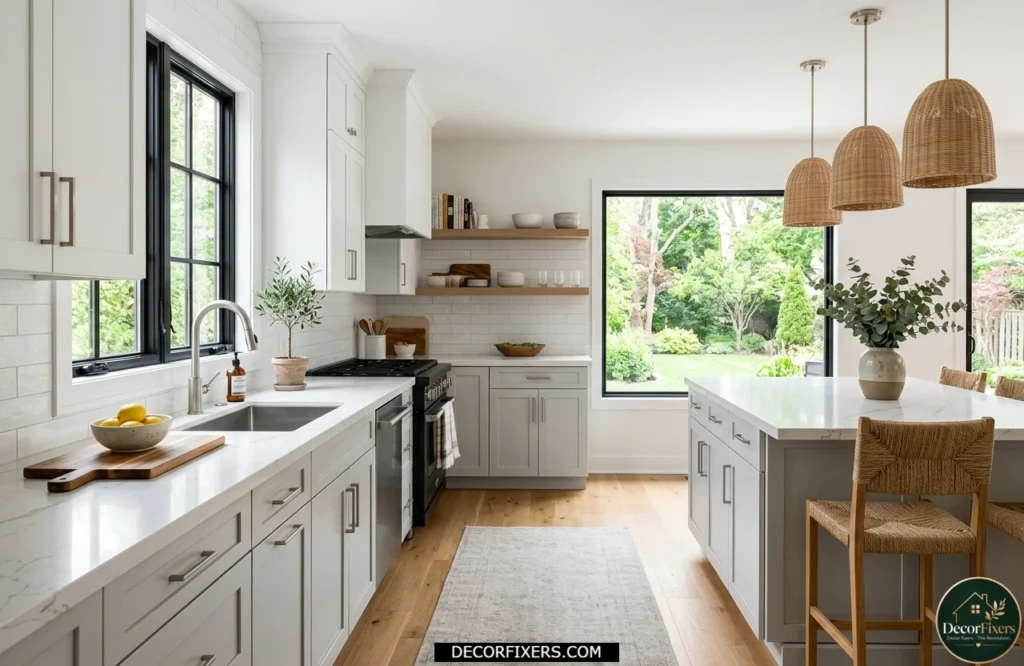
This is the layout that started the whole two-tone conversation. White uppers keep the kitchen feeling open and airy, while a soft grey on the lower cabinets adds just enough grounding without visual weight.
What makes this particular configuration so durable is the horizontal split. Lighter tones above the counter height mirror how light actually moves in a kitchen, brighter near the ceiling, deeper at the base. Pair this with white quartz countertops to tie the two tones together cleanly.
2. Charcoal Grey Lowers with Bright White Uppers, Maximum Contrast
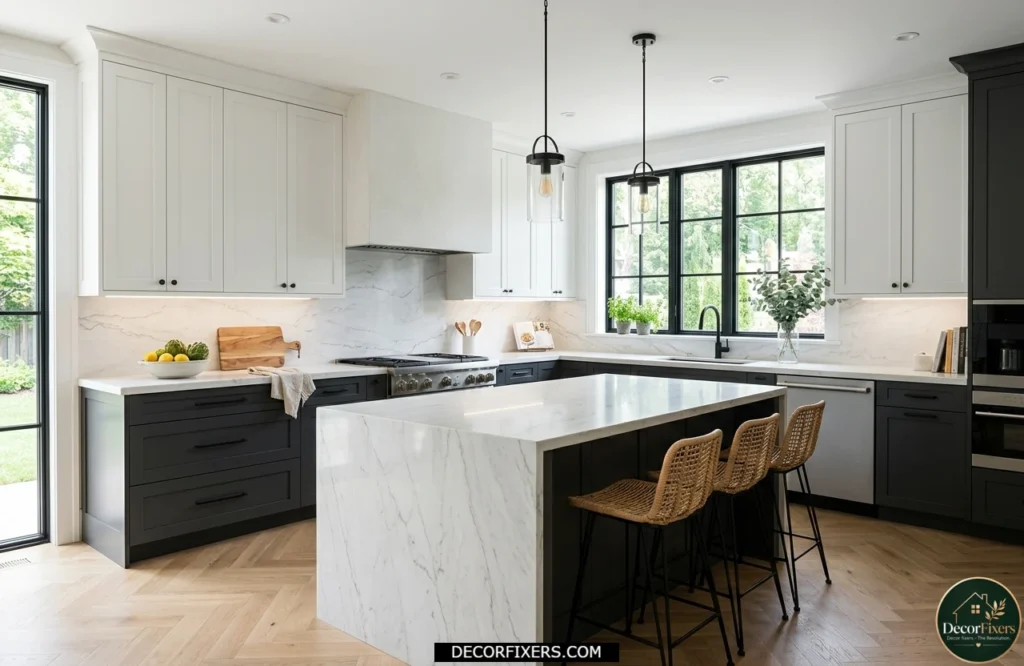
When you want the kitchen to command attention, charcoal on the lower cabinets does it without drama. Benjamin Moore’s Kendall Charcoal or Chelsea Gray works beautifully here. The upper cabinets stay white; Sherwin-Williams Alabaster is the warm white that prevents the whole thing from feeling clinical.
Here’s the thing: contrast in a kitchen reads differently depending on your light source. Under cool 5000K LED under-cabinet lighting, charcoal grey can look almost blue-black. Under warm 2700K bulbs, it softens to a deep neutral. Test your chosen charcoal shade under the actual bulb temperature you plan to install before committing.
3. Greige and White, The Warm Two-Tone for Cooler Rooms
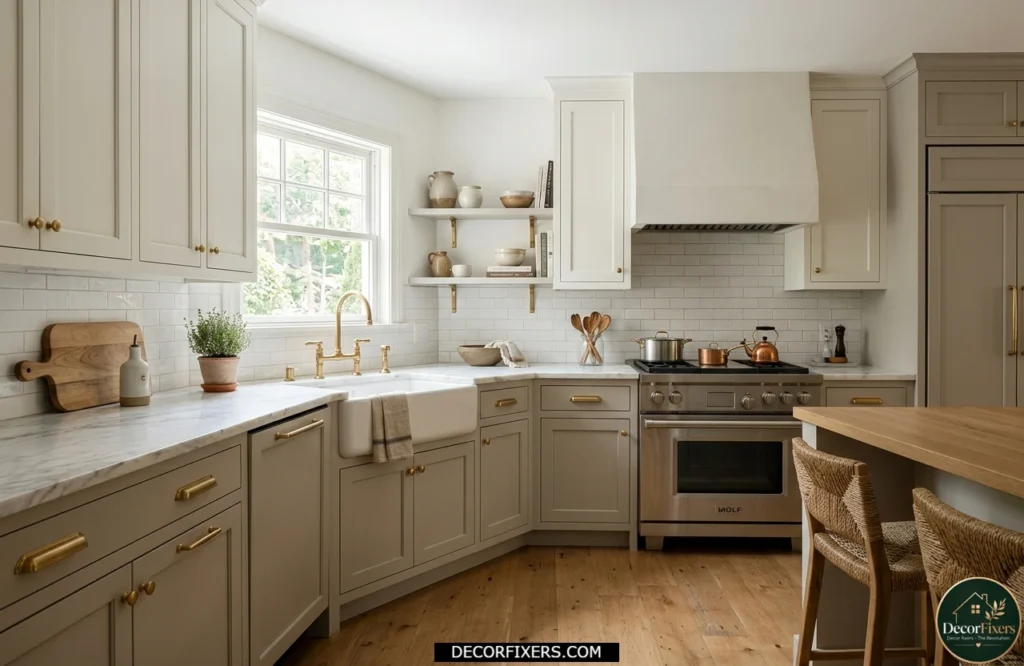
Greige is grey plus beige, and it solves one of the trickiest problems in kitchen design: keeping a grey palette from reading cold. Benjamin Moore Edgecomb Gray HC-173 is the most referenced greige for cabinets. It reads as a warm cream in afternoon light and a soft grey in the morning. Both readings are good.
This pairing is the one I’d recommend if your kitchen faces north or gets limited natural light. Cool rooms pull out grey’s blue and purple undertones fast. Greige resists that. Pair it with a slightly off-white upper cabinet, White Dove by Benjamin Moore, rather than a stark pure white, and the result feels warm without being dated.
4. White Cabinets with a Grey Island, The No-Commitment Two-Tone
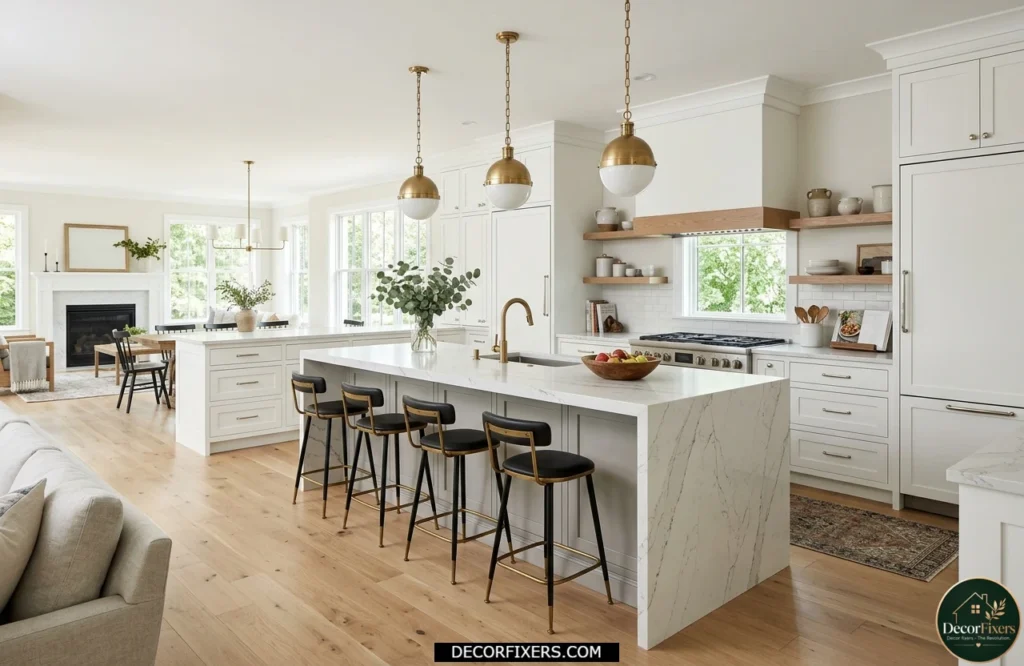
Not ready to commit to two full cabinet colors? The grey island is your answer. Keep all perimeter cabinets white, then paint the island in a mid-tone grey. Repose Gray works here, but so does a slightly deeper option like Mindful Gray, which adds presence without going dark.
This approach is especially effective in open-concept kitchens where the island is already a visual centerpiece. It also lets you try a grey tone in real light before applying it across an entire cabinet run, which, honestly, is the smarter order of operations anyway. Use the same hardware finish across the island and perimeter cabinets to keep everything cohesive despite the color difference.
5. Dark Grey Uppers with White Lowers, The Unexpected Reversal
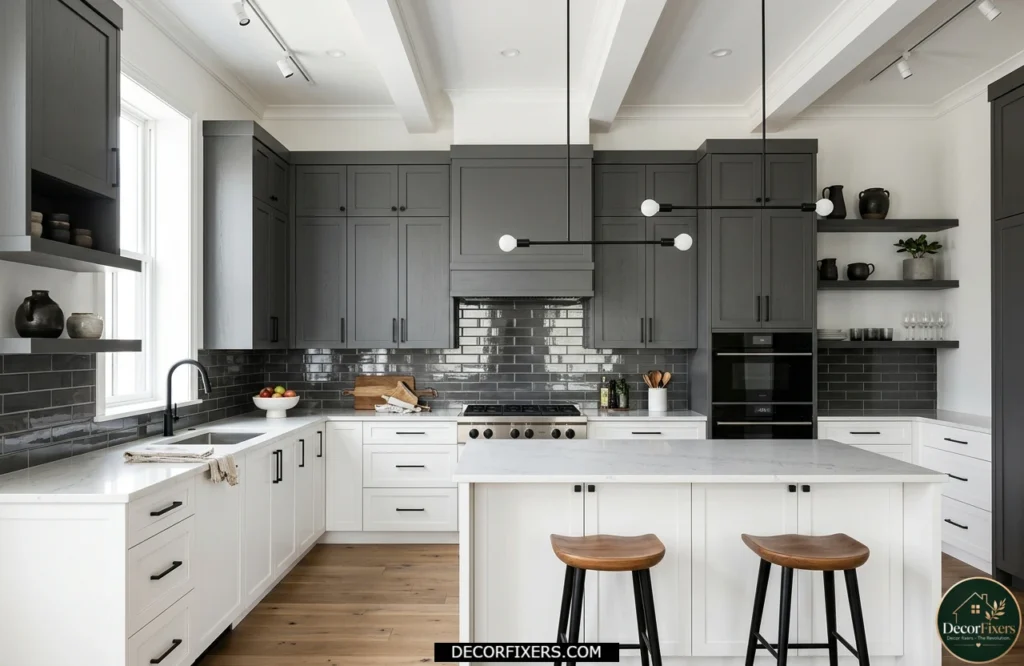
Most guides tell you to put the lighter color on top. And they’re right, for most kitchens. But flipping it creates something genuinely dramatic. Dark grey upper cabinets draw the eye up without adding floor-level visual weight, which actually makes small kitchens feel taller.
The trick is choosing a grey that doesn’t go heavy. Benjamin Moore Gray Owl is a soft, mid-tone option that works as an upper without closing the space in. Pair it with clean white lowers and a reflective backsplash tile to bounce light back into the room. Keep the countertop pale, white, or cream, so the transition reads as intentional, not accidental.
Quick Comparison: Grey Shade Options for Kitchen Cabinets
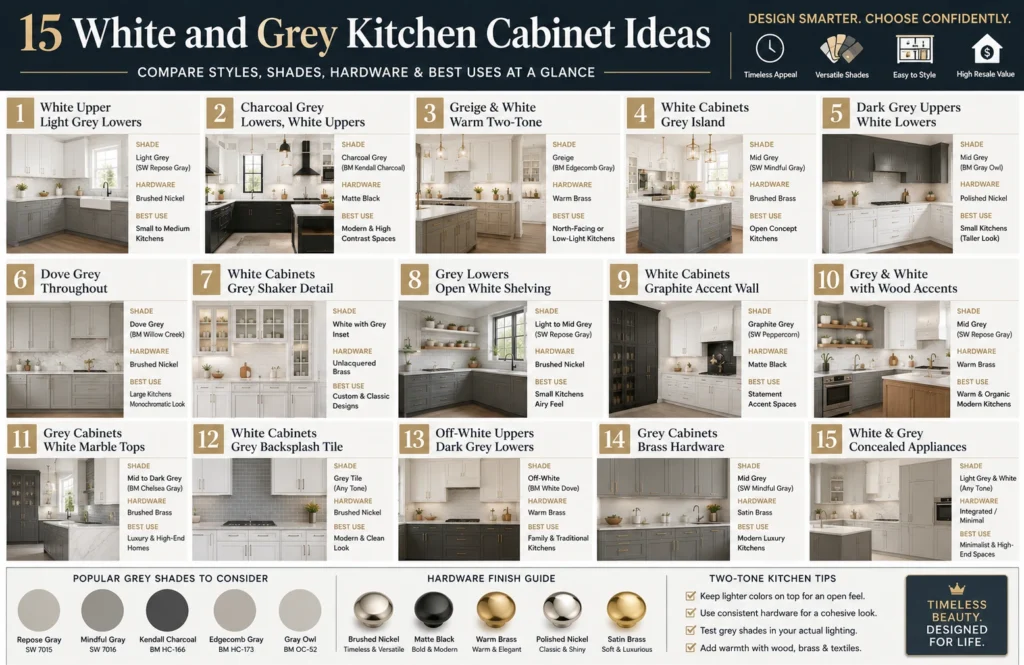
| Grey Shade | Best For | Key Benefit | Limitation |
| Repose Gray (SW) | Two-tone uppers or island | True neutral, no strong undertone | Can pull slightly purple in cool light |
| Mindful Gray (SW) | Full cabinet runs | Warm chameleon, shifts beige at night | May look too beige in bright south-facing rooms |
| Kendall Charcoal (BM) | Lower cabinets, bold contrast | Deep, grounded, modern feel | Reads near-black under cool LEDs |
| Edgecomb Gray (BM) | North-facing or low-light kitchens | Warm greige resists cold readings | Too warm for ultra-modern aesthetics |
| Gray Owl (BM) | Reversed two-tone (dark uppers) | Light enough to use on top without closing space | Subtle, may not feel different enough from white |
6. Dove Grey Throughout with White Countertops, The Monochromatic Move
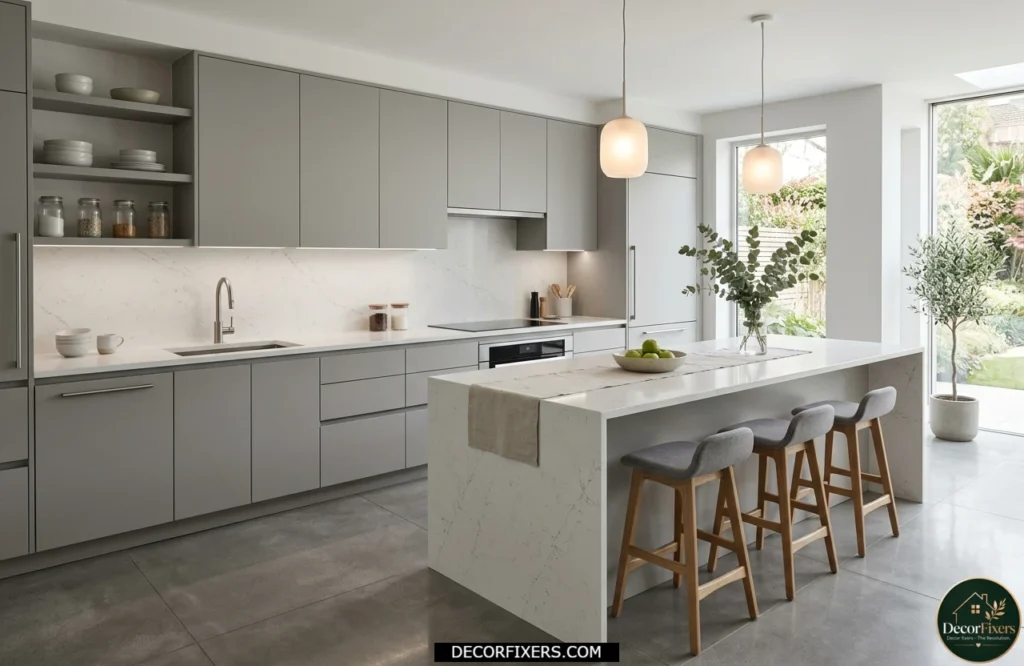
Dove grey, think Benjamin Moore Willow Creek or a similar mid-tone with faint violet undertones, on all cabinets, reads as sophisticated when offset by white countertops. The countertop becomes the contrast element rather than a second cabinet color. This works particularly well in kitchens where the backsplash or flooring is already introducing pattern or texture.
Or maybe I should say it this way: the all-grey cabinet look isn’t a risk when the rest of the kitchen is doing the contrast work. White quartz with soft grey veining is the countertop material that bridges this best; it picks up the grey of the cabinets without matching it exactly.
7. White Cabinets with Grey Shaker Detail, Texture as the Two-Tone
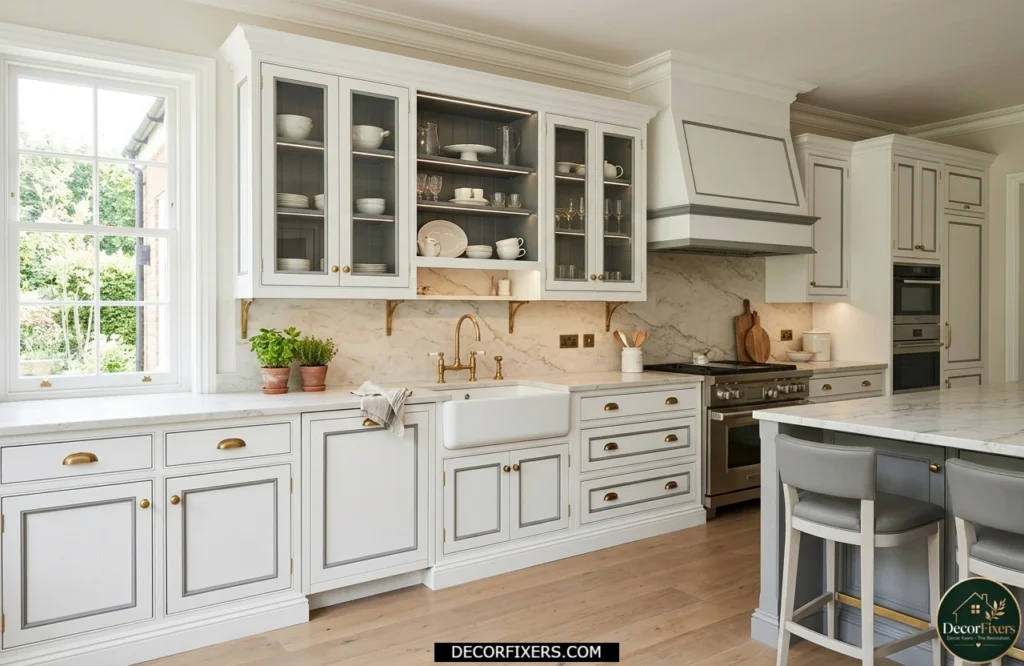
Two-tone doesn’t have to mean two colors. White Shaker cabinets with a slightly deeper grey on the inside of the frame, or on cabinet backs visible through glass doors, create a layered effect that reads as texture rather than color change. It’s subtle. It’s the thing that makes a kitchen feel custom without looking like a design project.
This works best with glass-front upper cabinets. The grey interior gives the eye something to rest on through the glass. Pair with unlacquered brass hardware for warmth, and consider a slightly warmer white, Chantilly Lace by Benjamin Moore, which keeps things crisp without being clinical.
If you’re still figuring out the broader direction for your space before locking in cabinet colors, the piece on Kitchen Design Trends covers what’s actually staying and what’s quietly fading, useful context before you commit to a shade.
8. Grey Lower Cabinets with Open White Shelving Above, The Airy Hybrid
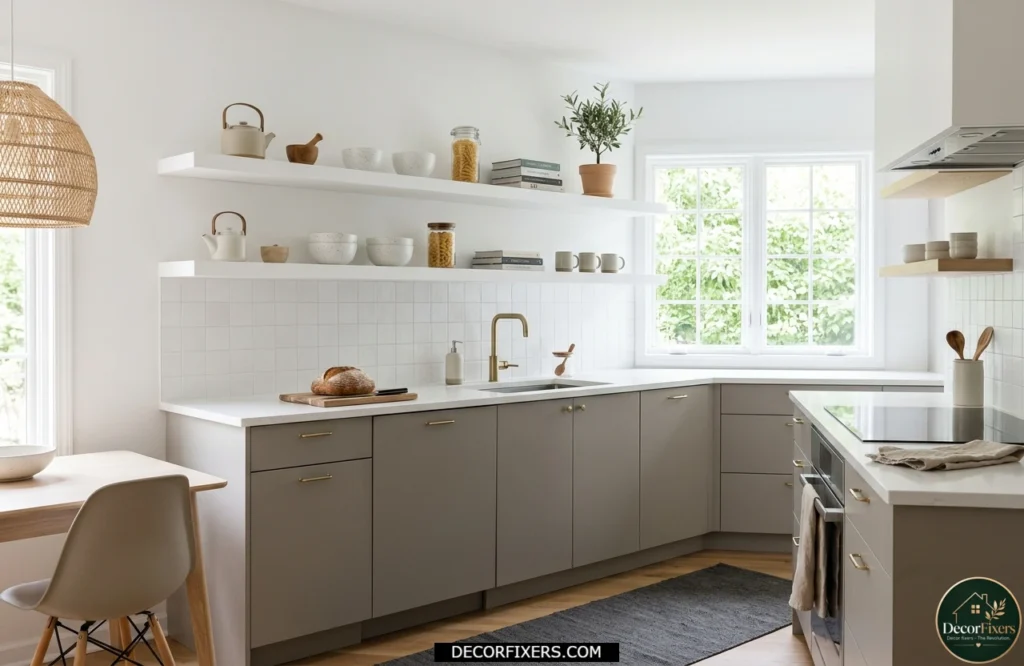
Replace the upper cabinets entirely with open white shelving and let your grey lower cabinets carry the color story. This layout has held momentum because it solves two problems simultaneously: it makes small kitchens feel significantly larger by removing visual mass above the counter, and it gives you a built-in display zone that breaks up the monotony of an all-cabinet run.
The grey tone for the lowers should be mid-range here, not too light (it’ll disappear without the upper cabinets anchoring it), not too dark (it’ll feel heavy with no visual relief above). Repose Gray hits that zone well. Style the shelves intentionally; overcrowded open shelving is worse than no shelving at all.
9. White Cabinets with a Graphite Accent Wall Panel, The Statement Grey
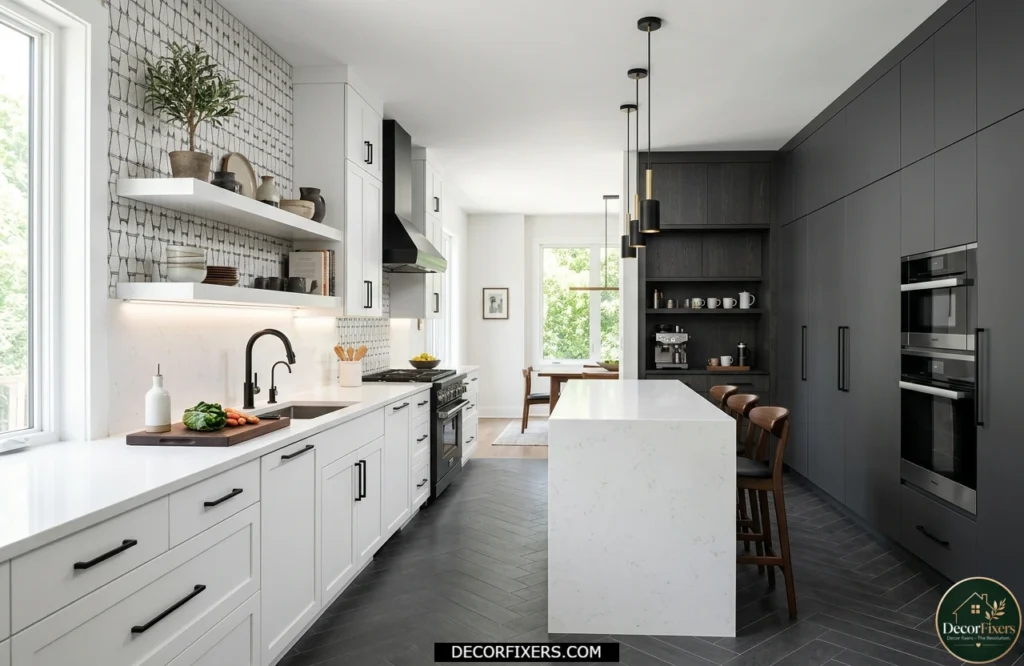
Some kitchens need one moment of drama, not an entire cabinet run in a bold shade, just one wall or one run of tall pantry cabinets in a deep graphite grey. Sherwin-Williams Peppercorn or Benjamin Moore Iron Mountain pulls this off without requiring a full commitment to a dark kitchen.
Look, if you’re in a rental or a home you’re planning to sell within five years, here’s what actually works: limit the bold grey to a single enclosed section or pantry wall that can be repainted without touching the main cabinets. It gives you the high-impact look without the resale risk.
10. Two-Tone Grey and White Kitchen Cabinets with Wood Accents, The 2025 Look
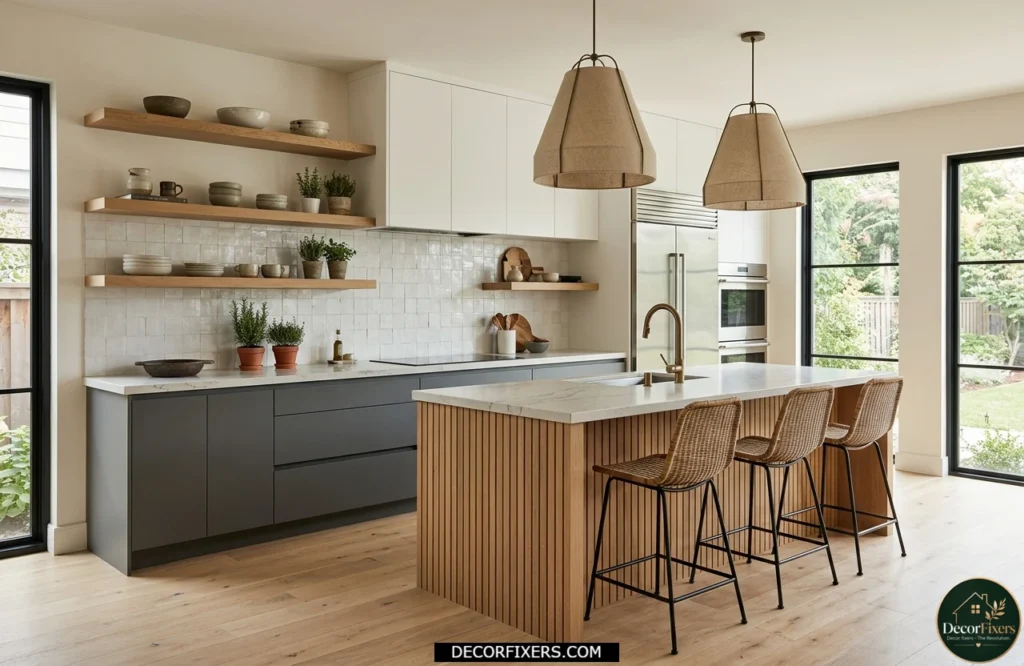
The two-tone kitchen trend has evolved. The stark tuxedo kitchen, white uppers, black lowers, nothing else, is fading. What’s replacing it is softer: white and grey with raw wood accents that stop the contrast from feeling harsh. A floating wood shelf between the upper and lower cabinet runs, or a wood-faced island, does this without requiring a full commitment to wood cabinets.
This is the configuration dominating 2025 kitchen design right now. White upper cabinets, grey lowers, and one warm wood element, usually the island or open shelf. The wood pulls in warmth that grey and white alone can struggle to project, especially in kitchens with cool-temperature LED lighting.
11. Grey Cabinets with White Marble Countertops, The Luxury Pairing
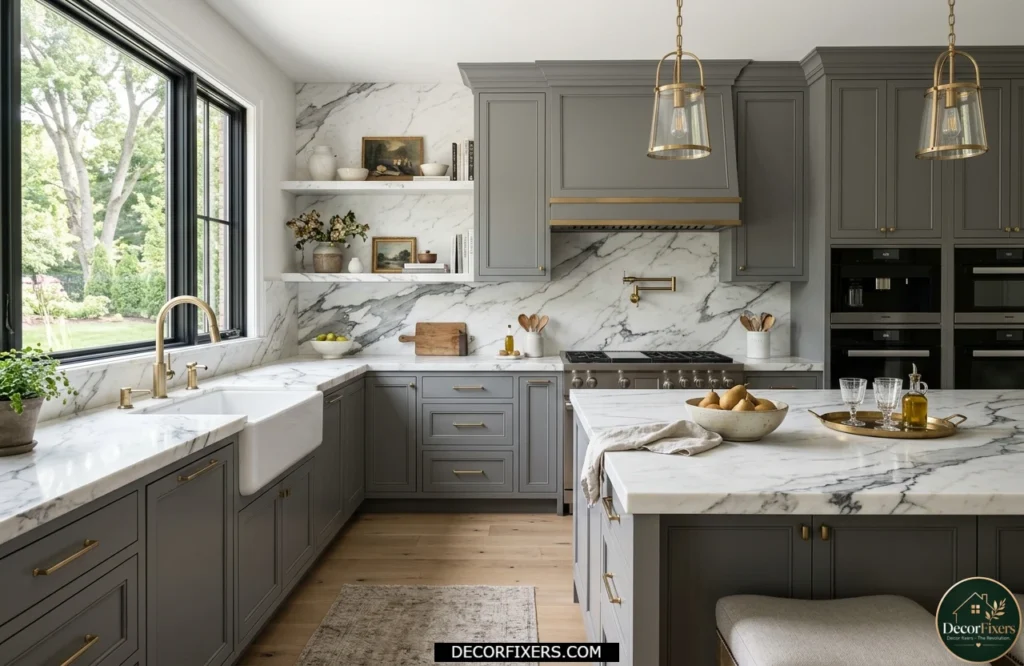
Marble, real or engineered quartz that reads as marble, is the countertop material that gives grey cabinets their fullest expression. The veining in white marble picks up the grey from the cabinet without competing with it. The result looks expensive even when the cabinet is painted, not custom-built.
If you’re using a warm grey like Edgecomb Grey, choose a marble with warm cream undertones in the veining. If your grey runs cool, Repose Grey, for example, a crisper white marble with cool grey veining maintains harmony. Matching undertones across surfaces is the thing most guides skip, and it’s the reason two kitchens with nearly identical elements can look completely different.
Once you’ve settled on the cabinet palette, the next decision that trips most homeowners up is what to put on the countertops and how to arrange the elements on top. The guide on Kitchen Counter Styling breaks that down in detail.
12. White Cabinets with Grey Backsplash Tile, Color Through Texture
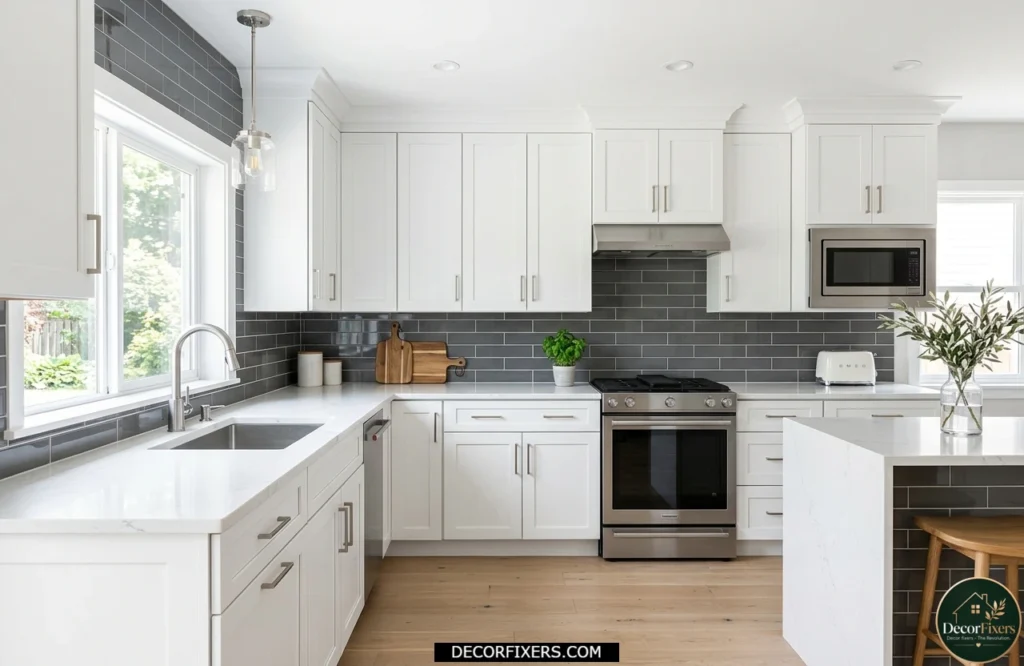
Not every kitchen needs two cabinet colors to achieve the white-and-grey look. White cabinets paired with a grey tile backsplash, subway tile, hexagon, or large-format slate, introduce grey as a surface rather than a cabinet finish. The advantage is flexibility: backsplash tile is easier and cheaper to change than cabinet paint.
How to Test Your Grey Cabinet Color Before Committing
To avoid the most common grey cabinet regret, follow these steps before ordering paint:
- Order peel-and-stick samples (Samplize) in your top three grey options.
- Place samples on the actual cabinet door surface, not the wall.
- View samples at 8 AM, 12 PM, and 8 PM under your existing lighting.
- Switch on your under-cabinet lights and observe again, noting any blue or purple shift.
- Hold a sample of your countertop or flooring material next to the swatch and check undertone alignment.
13. Off-White Uppers with Dark Grey Lowers, The Soft Contrast Version
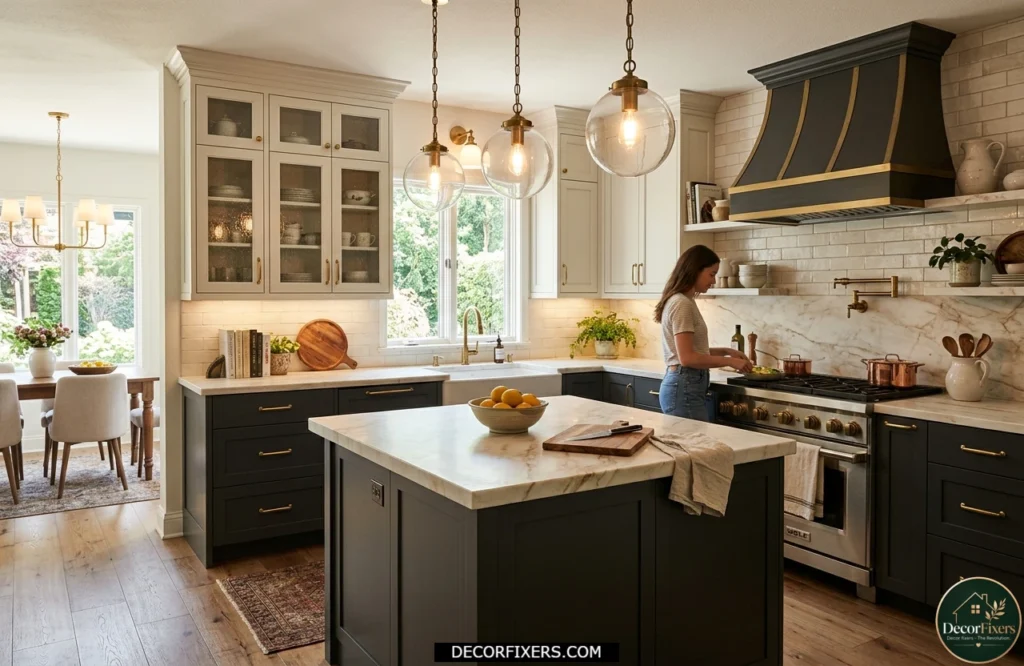
Pure white can be brutal in certain kitchens; it highlights every smudge, every nick, every imperfection in the cabinet surface. Soft off-white as the upper cabinet color, paired with a deep grey below, creates a contrast that’s slightly warmer and more forgiving to live with day-to-day. Benjamin Moore Chantilly Lace or White Dove both work for the uppers here.
This is actually my opinion, and I’ll own it: I think off-white uppers with dark grey lowers read as more sophisticated than the pure white version, and I’ve seen conflicting advice on this from designers; some argue pure white reads cleaner, others say off-white ages better. My read is that off-white wins in lived-in family kitchens, but pure white is stronger in very modern or minimalist spaces.
14. Grey Kitchen Cabinets with Brass or Gold Hardware, The Warmth Fix
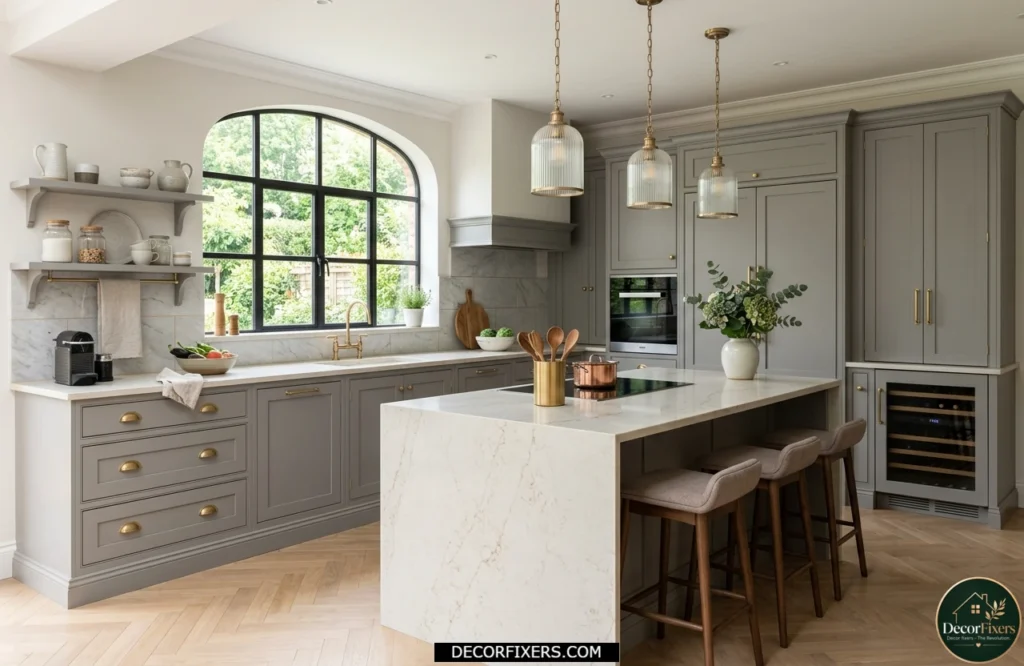
Hardware is the single fastest way to warm up a cool grey cabinet. Unlacquered brass, satin brass, or brushed gold pulls bring warmth that grey alone can’t generate, and they do it without requiring a single additional coat of paint. This matters most in kitchens with north-facing windows or cool-temperature LED lighting.
The pairing of Repose Gray cabinets with champagne bronze or satin brass hardware has become a near-signature look in 2025 kitchen design. It reads as warm, collected, and intentional, not trendy in a way that will feel dated. Avoid polished gold, which can feel more costume than design. Brushed and satin finishes hold up better over time and photograph better in listing photos if resale matters to you.
15. White and Grey Kitchen Design with Concealed Appliances, The Clean Read
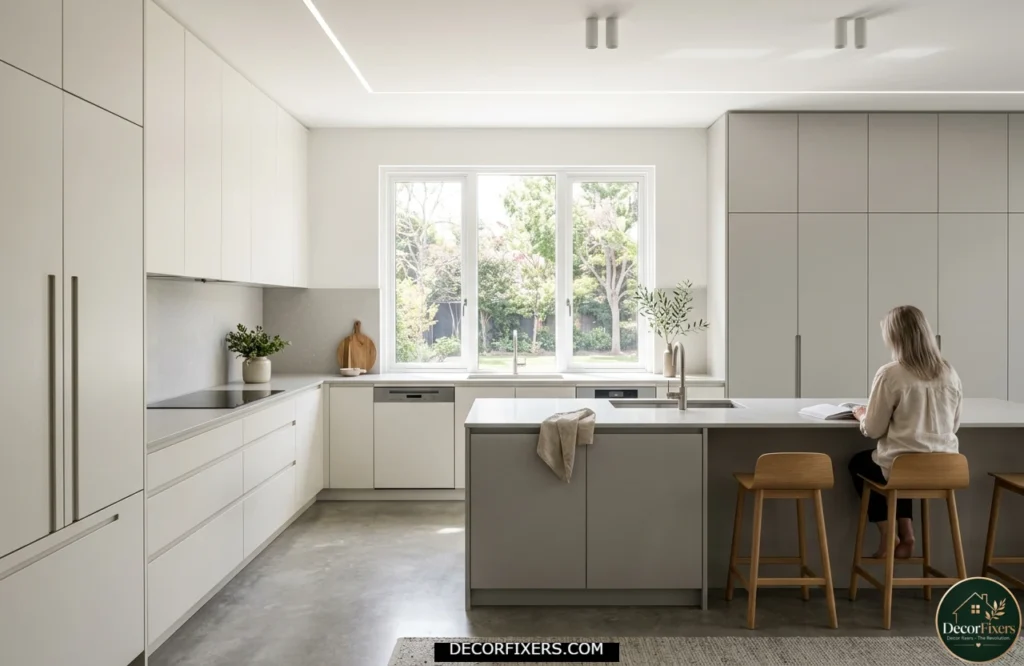
The cleanest iteration of the white-and-grey kitchen is one where the appliances disappear into the cabinetry. Panel-ready refrigerators, integrated dishwashers, and microwave drawers, all faced in the same white or grey as the surrounding cabinets, create a seamless run that makes the color palette feel like architecture rather than decor.
Panel-ready appliances aren’t cheap. But even partial concealment, putting a cabinet panel on just the dishwasher and using built-in microwave placement, dramatically changes the visual clarity of the kitchen. If the appliance budget is limited, the guide on Hide Kitchen Appliances covers practical, lower-cost approaches that still read clean.
Conclusion:
I’ve looked at a lot of grey kitchen inspiration boards, and the honest truth is that most of them leave out the one thing that matters most: what those greys actually do under real kitchen light. A color that reads perfectly in a photographer’s studio with a skylight can look entirely different in your kitchen with its north-facing window and 2700K recessed lights.
The white and grey kitchen cabinet ideas in this guide aren’t just visual inspiration; each one comes with a specific shade rationale, a lighting consideration, and a pairing logic you can actually use. The 15 ideas here span the full range, from the safe and proven (white uppers, Repose Gray lowers) to the more considered moves (reversed tone-on-tone layouts, panel-ready appliance integration).
Start with the light in your kitchen, match undertones before anything else, and test your grey under the actual bulbs you plan to use. Get that right, and this combination won’t just look good on install day; it’ll look right in ten years, too.
FAQs:
Q: What’s the best grey paint for kitchen cabinets that won’t look purple?
A: Sherwin-Williams Mindful Gray and Dorian Gray are two of the most consistently warm-reading options. They stay in the grey-beige range rather than pulling violet or blue under most lighting conditions. Always test under your actual kitchen bulb temperature before committing.
Q: How do I choose between white upper and grey lower cabinets vs. the reverse?
A: For most kitchens, white uppers and grey lowers are the safer and more light-friendly choice. Reversing the layout, dark uppers, white lowers, works best in tall-ceilinged kitchens where the extra height prevents the dark uppers from closing the space in.
Q: Should I use the same hardware on both cabinet colors in a two-tone kitchen?
A: Yes. Using one consistent hardware finish across both cabinet colors is the simplest way to unify a two-tone kitchen. It prevents the palette from reading as two separate design decisions that happened to end up in the same room.
Q: Why does my grey cabinet look blue in my kitchen?
A: Grey paint with cool (blue or violet) undertones reads dramatically bluer under warm incandescent or 2700K LED light. The solution is either to switch to a warmer grey (try Mindful Grey or Edgecomb Gray) or to shift to a warmer light temperature if the color is already applied.
Q: When should I use Cabinetry Direct for planning a grey and white kitchen?
A: Cabinetry Direct is a useful online planning tool for mapping out cabinet placement and visualizing how a two-tone layout will work across your specific floor plan before you commit to purchasing. It’s especially helpful if you’re debating between a full two-tone run versus a grey island paired with white perimeter cabinets.

Creator of DecorFixers, sharing practical home and interior ideas focused on real-life usability, simple design improvements, and budget-friendly solutions.