

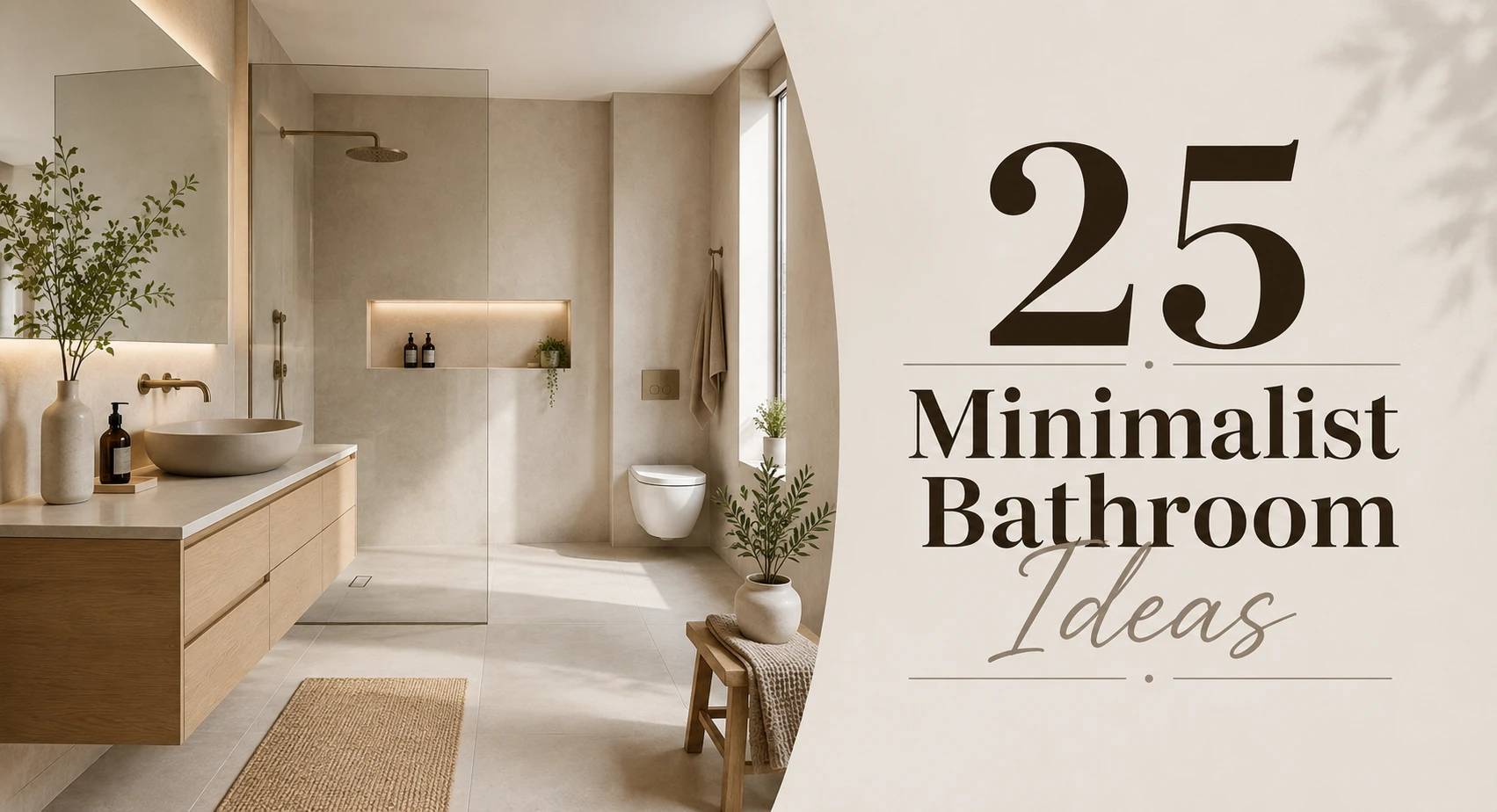
I used to think my bathroom was the problem. Too small. Wrong tiles. Bad lighting. Then I realized, the bathroom wasn’t the issue. The stuff was.
I’d bought the matching baskets. Painted the walls white. Watched every makeover video I could find. And every time, the space still felt cramped, chaotic, and like something a student might move into temporarily and never fix.
What I wasn’t doing was editing. Real minimalist bathroom design isn’t about buying the right things. It’s about removing the wrong ones and then making every single thing that stays count.
That shift changed everything. And this article is what I wish I’d found back then.
Minimalist bathroom ideas refer to design approaches that prioritize function, visual restraint, and intentional material choices over decoration. The goal isn’t emptiness, it’s calm. Every element earns its place.
1. Float the Vanity Off the Floor
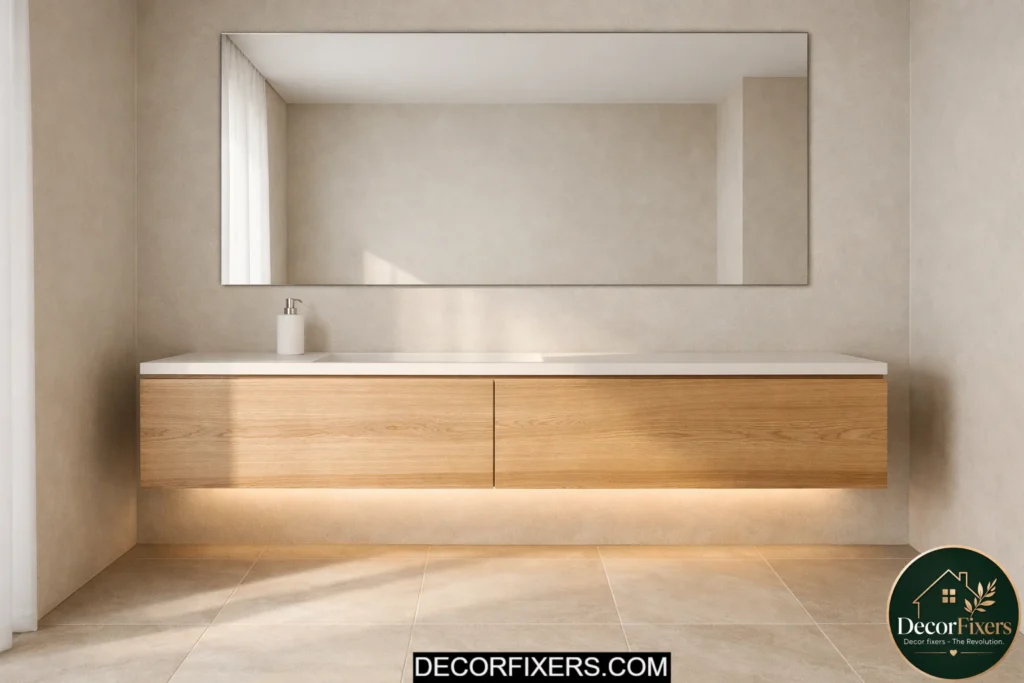
A wall-mounted vanity is the single highest-impact swap in a small minimalist bathroom. By exposing the floor beneath, you visually extend the room; the eye reads it as one continuous plane instead of stopping at a cabinet base.
IKEA’s GODMORGON series is the most practical entry point: it mounts cleanly, comes in several widths, and has concealed hinge drawers that don’t break the flat-front profile. Pair it with a push-to-open mechanism, and you eliminate hardware entirely.
2. Pick One Neutral and Commit to It Completely
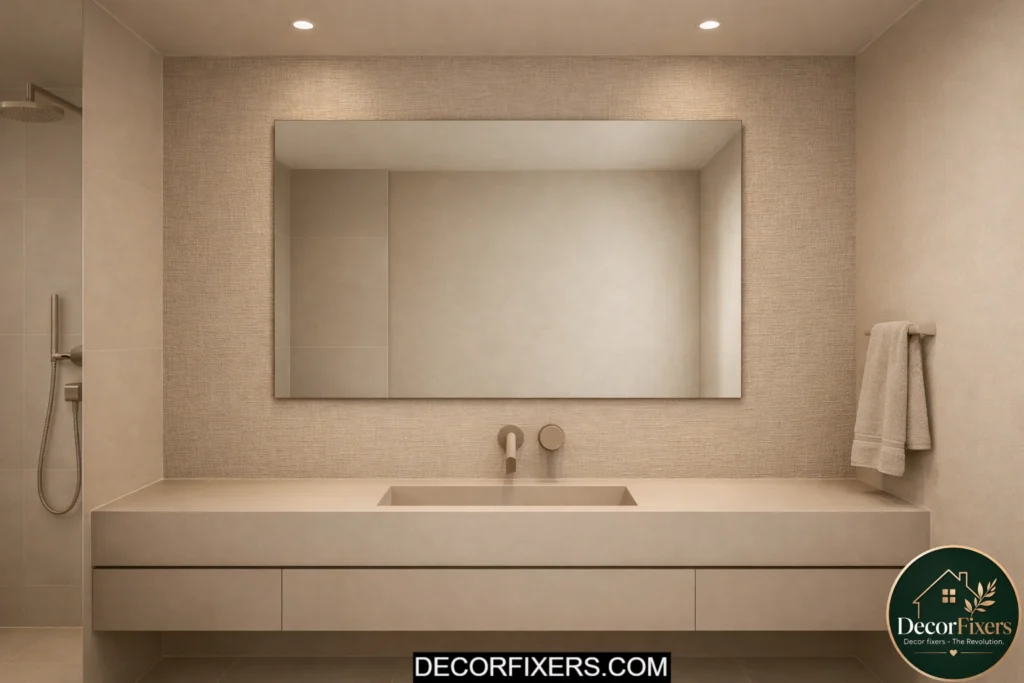
Color indecision is the enemy of a minimalist bathroom. Warm greige, cool concrete grey, soft sage, whichever you choose, it should appear on walls, on trim, and ideally on the grout. This technique is called color drenching, and it’s what makes small bathrooms feel like a considered space rather than a patchwork.
The most approachable option for renters: a removable peel-and-stick textured wallpaper in a single tone applied to one wall only. Cost under $80. No landlord conversation required.
3. Replace Your Mirror With a Full-Length or Oversized Version
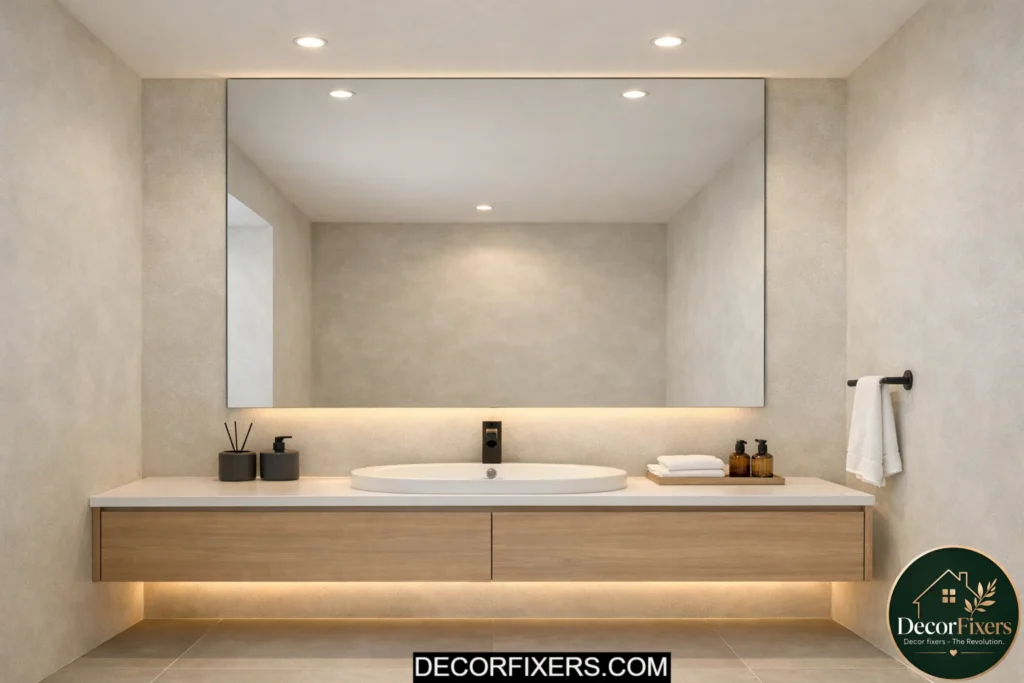
Most bathrooms have undersized mirrors that stop well below ceiling height. An oversized mirror, mounted high and close to the ceiling, reflects more light, makes the room taller, and doubles as a design statement without adding a single object to the counter.
Frameless is the cleanest for strict minimalism. If you want warmth, a thin natural oak or matte black frame works. What doesn’t work: ornate gold frames or anything that reads as decorative over functional.
4. Use Large-Format Tiles to Eliminate Grout Lines
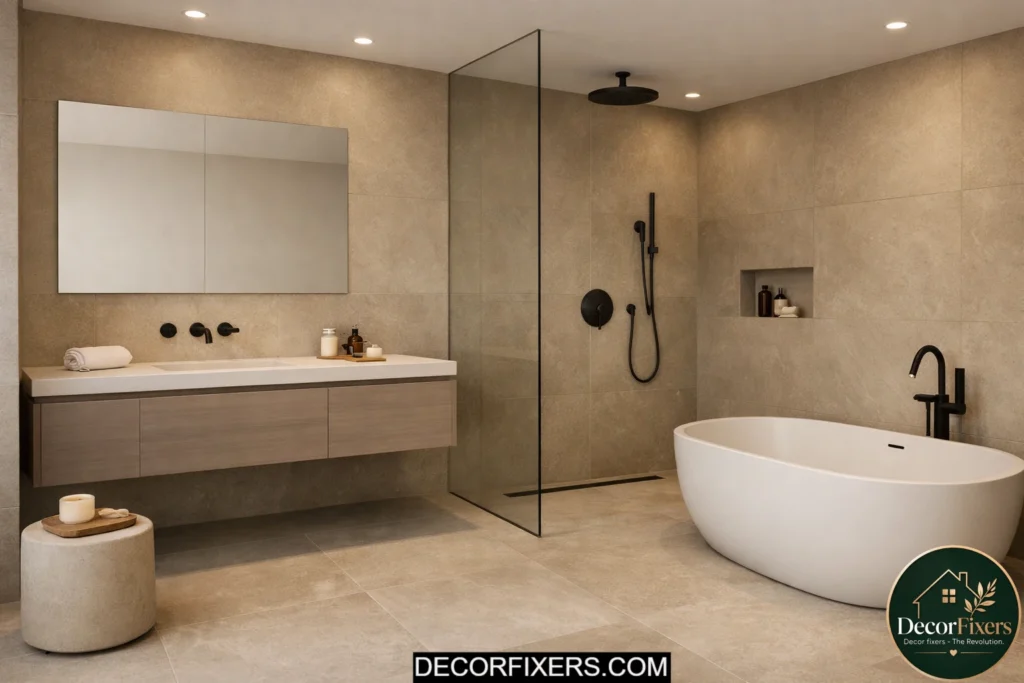
Grout lines are visual grid noise. The more of them, the busier the room. Large-format tiles, 24×24 inches or bigger for floors, 12×24 or slab-style for walls, dramatically reduce that noise.
For small bathrooms on a budget, you don’t need to tile every surface. Even one tiled accent wall in a larger format than you currently have will shift the energy of the whole room. Offset the rest with limewash or a matte-painted surface.
5. Go Frameless With the Shower Enclosure
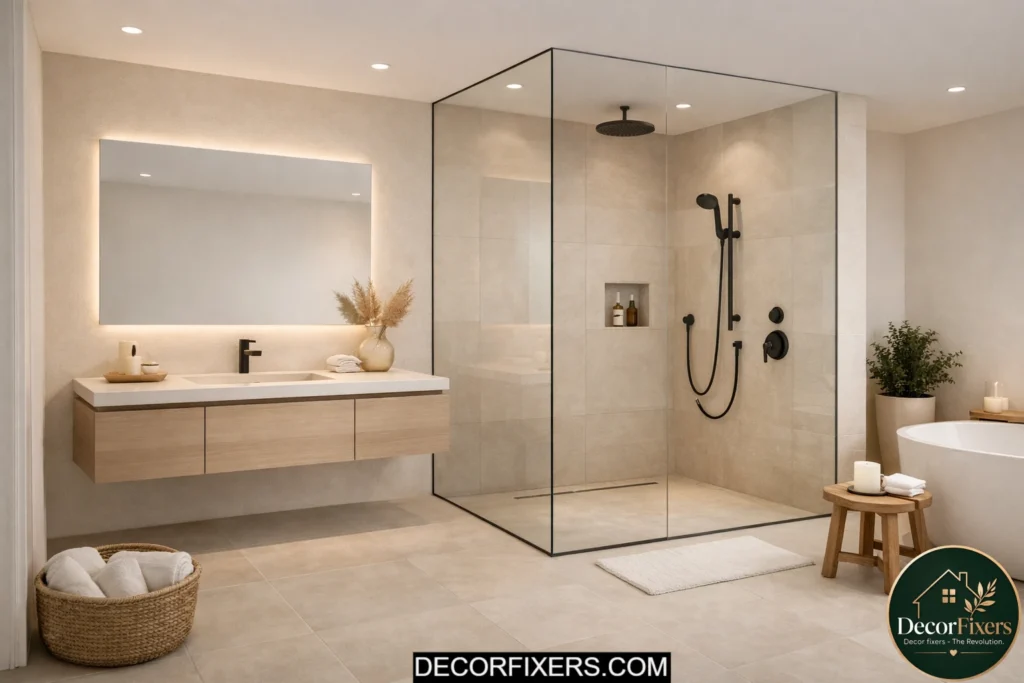
A framed shower door carries a thick aluminum track, corner posts, and top rail, all of which chop the bathroom into visual segments. Frameless glass removes all of that, letting the eye travel straight through to the back wall of the shower.
This isn’t only a luxury move. Frameless panels are available at mid-range price points and fit most standard openings. The visual payoff is immediate. It’s one of the few upgrades that makes a bathroom look twice as large without touching the footprint.
6. Install a Recessed Niche Instead of Shower Caddies
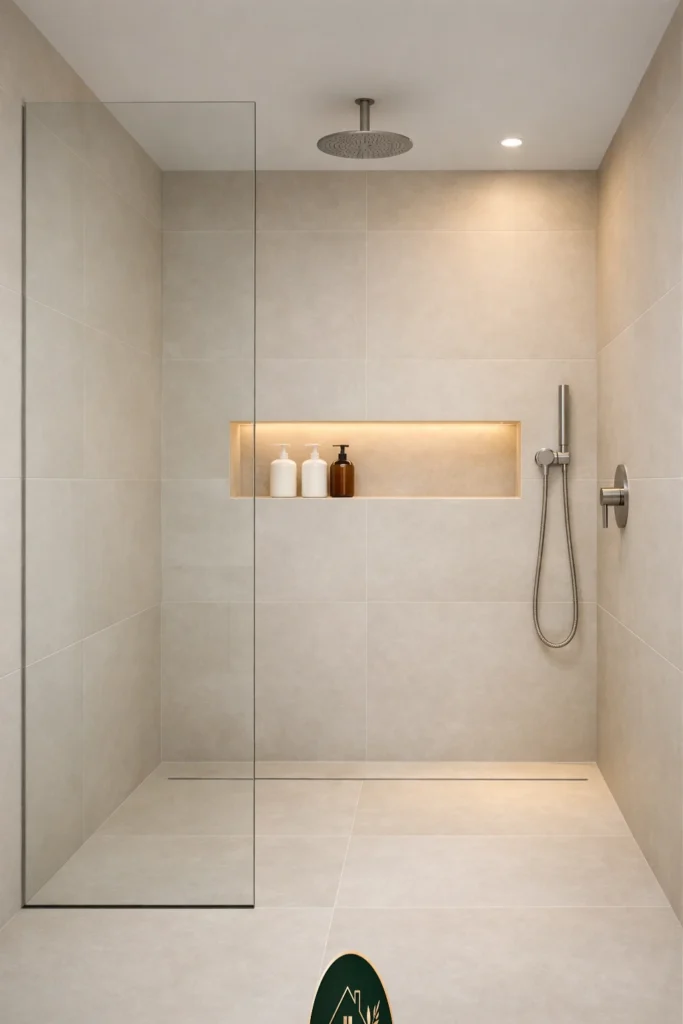
Freestanding shower caddies, even matching metal ones, read as clutter in a minimalist bathroom. A recessed tile niche built into the shower wall sits flush, looks intentional, and holds the same items without the visual mess.
If you’re renting and can’t tile, a recessed shelf kit that adheres to existing tile is the workaround. It’s not perfect, but it’s dramatically cleaner than a caddy hanging off your showerhead.
7. Switch Every Fixture to the Same Metal Finish
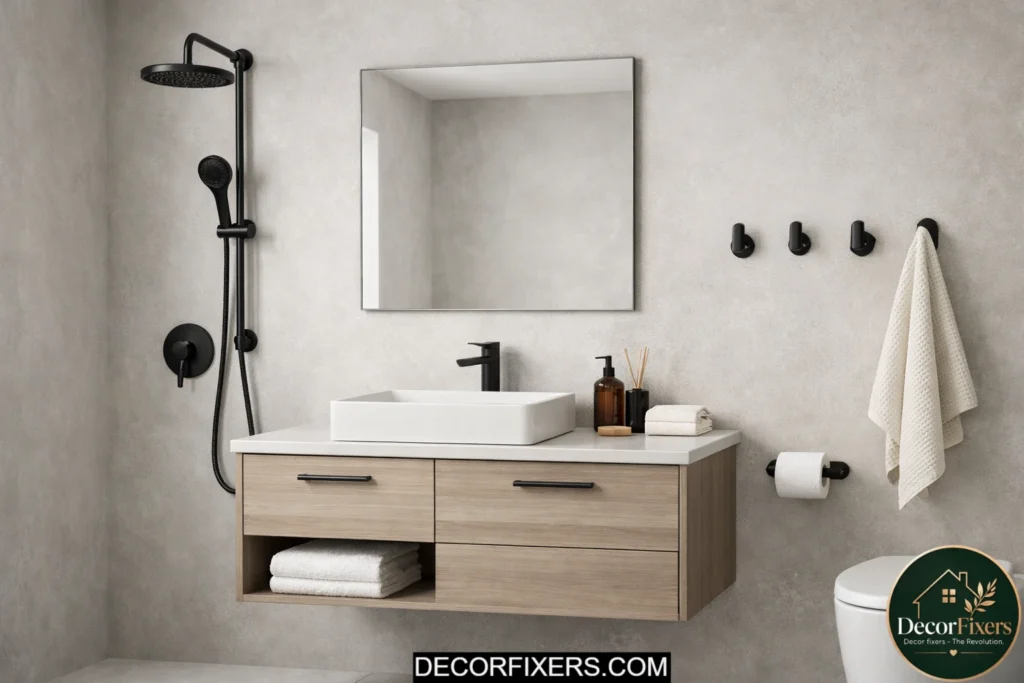
Mixed metals is a maximalist move dressed up as eclecticism. In a minimalist bathroom, it just reads as unfinished. Toilet paper holder, towel bar, faucet, showerhead, cabinet pulls, they should all be in the same family.
Matte black is the most forgiving because it reads as intentional at every price point. GROHE Essence matte black fixtures are mid-range, widely stocked, and pair with nearly every neutral palette. If you want warmth, brushed brass over white or taupe is the current design-forward move.
8. Declutter the Counter, All of It
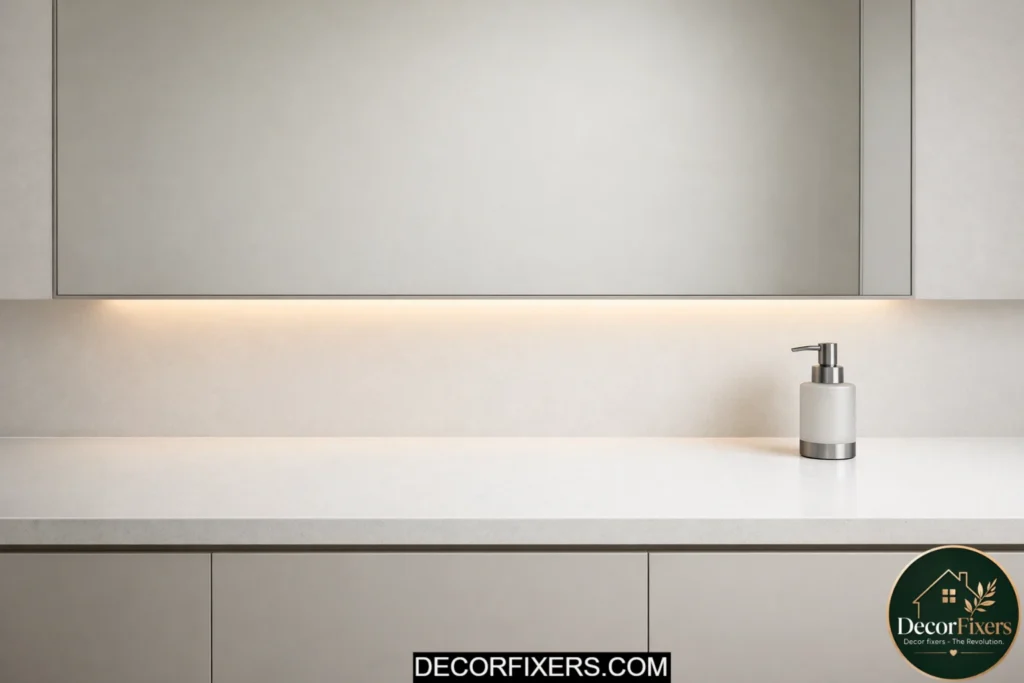
This is the free idea. The one that works before you spend a single dollar. Every item currently living on your bathroom counter that doesn’t get used twice daily belongs in a drawer or a cabinet. Not an organizer on the counter. Actually, inside storage.
Look, if you’ve done this already and the counter still feels cluttered, the real issue is probably that you don’t have enough storage inside the vanity. That’s idea #1 and #9 combined.
If your bathroom storage still feels chaotic after decluttering, these Minimalist Bathroom Closet Organization strategies can help create hidden storage zones without disrupting the calm visual flow of the room. The key is keeping daily essentials accessible while removing visual noise from open surfaces.
9. Add Hidden Storage Behind the Mirror
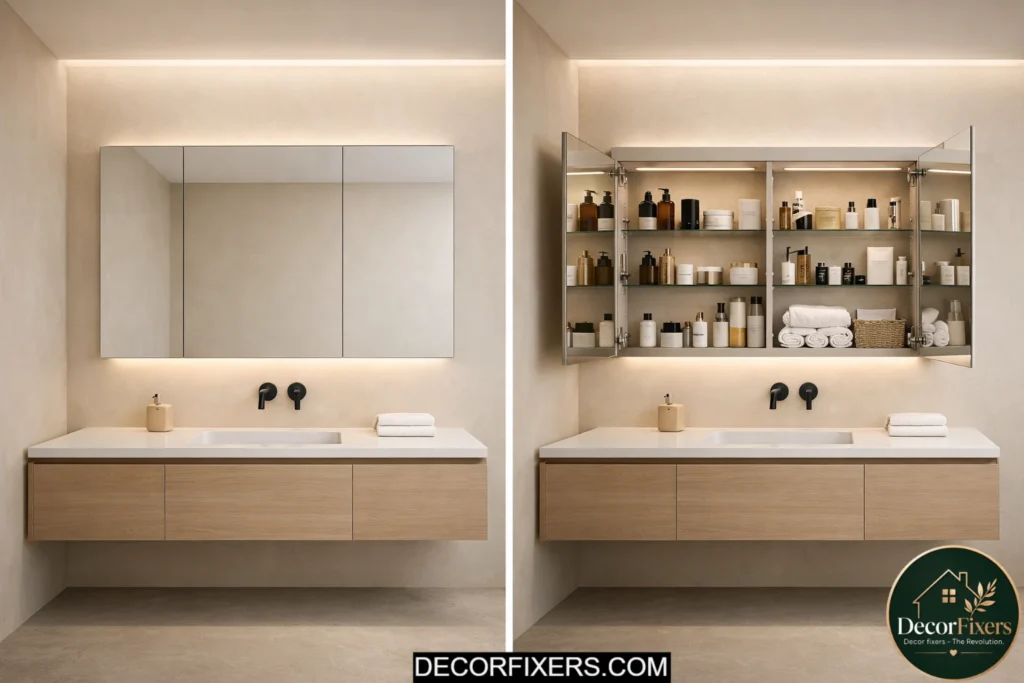
A recessed medicine cabinet flush-mounted behind a frameless mirror is invisible from the front and stores everything from the counter. This single upgrade, widely available from brands like Robern or budget alternatives at IKEA, can eliminate a countertop’s worth of clutter without adding a single visible object to the room.
The keyword is flush. Surface-mounted medicine cabinets that project from the wall break the flat plane and read like furniture, not architecture. Go recessed or don’t bother.
10. Swap Towel Bars for Slim Hooks or a Ladder Rail
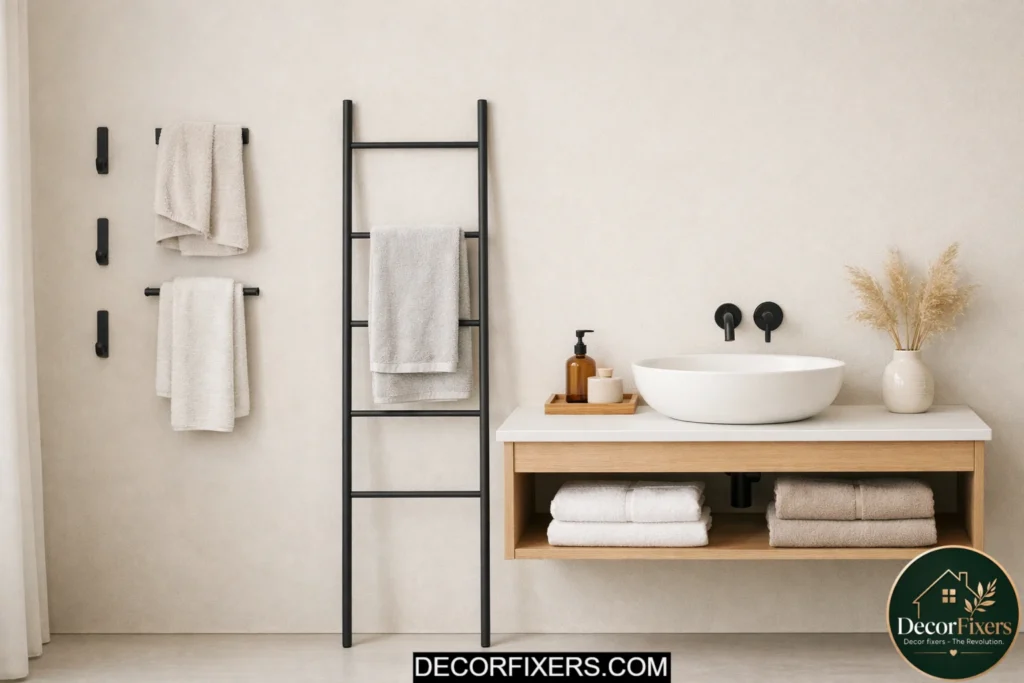
Standard towel bars sit parallel to the wall and hang towels in a folded row. That’s functional. A slim ladder-style towel rack, or a row of minimal hooks, offers the same function with a much more considered look, especially in a narrow bathroom where a bar forces the towel to billow into the room.
Single hook per towel. Matte black or brushed brass. Keep hooks at the same height, evenly spaced. It’s a small move with a disproportionate visual impact.
11. Choose a Back-to-Wall or Wall-Hung Toilet
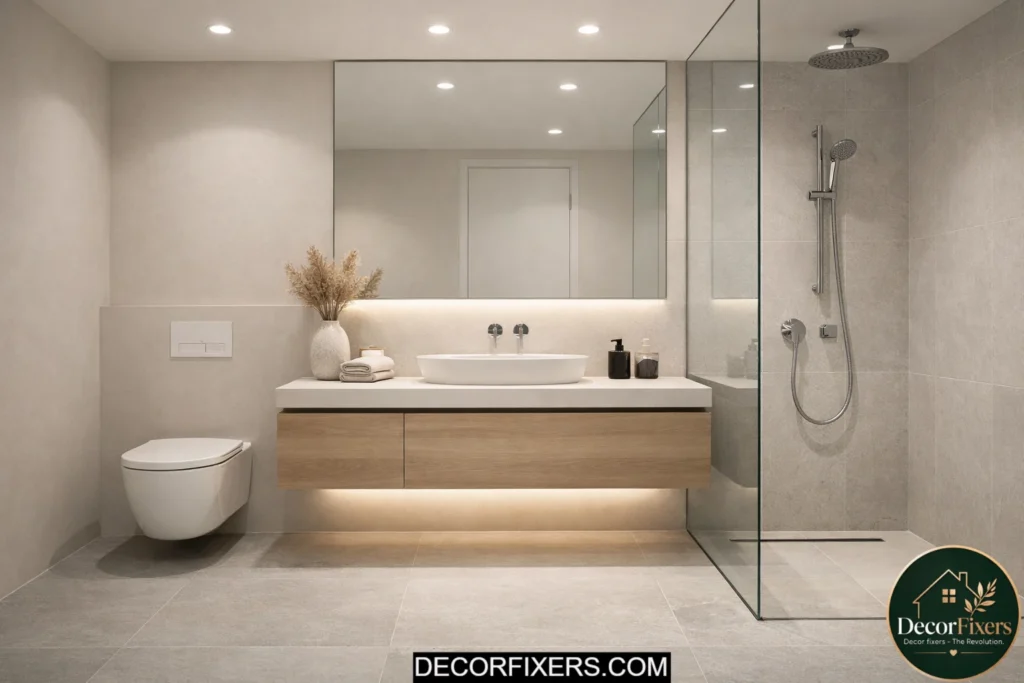
A traditional toilet exposes its cistern, that white tank at the back, which reads as bulky and dated in minimalist spaces. A back-to-wall or wall-hung model conceals the cistern inside the wall cavity or a slim unit, leaving a clean silhouette that disappears into the room rather than dominating it.
This is the most structural idea on this list, so it belongs on a renovation budget rather than a quick-refresh list. But if you’re planning a remodel, skipping this is leaving the most impactful clean-line upgrade on the table.
If you’re planning a larger renovation rather than a quick refresh, these Bathroom Remodel Ideas can help you rethink layout, lighting, and storage together instead of upgrading one feature at a time. Minimalist bathrooms work best when every structural decision supports simplicity.
12. Use Matte Surfaces Over Gloss Everywhere You Can
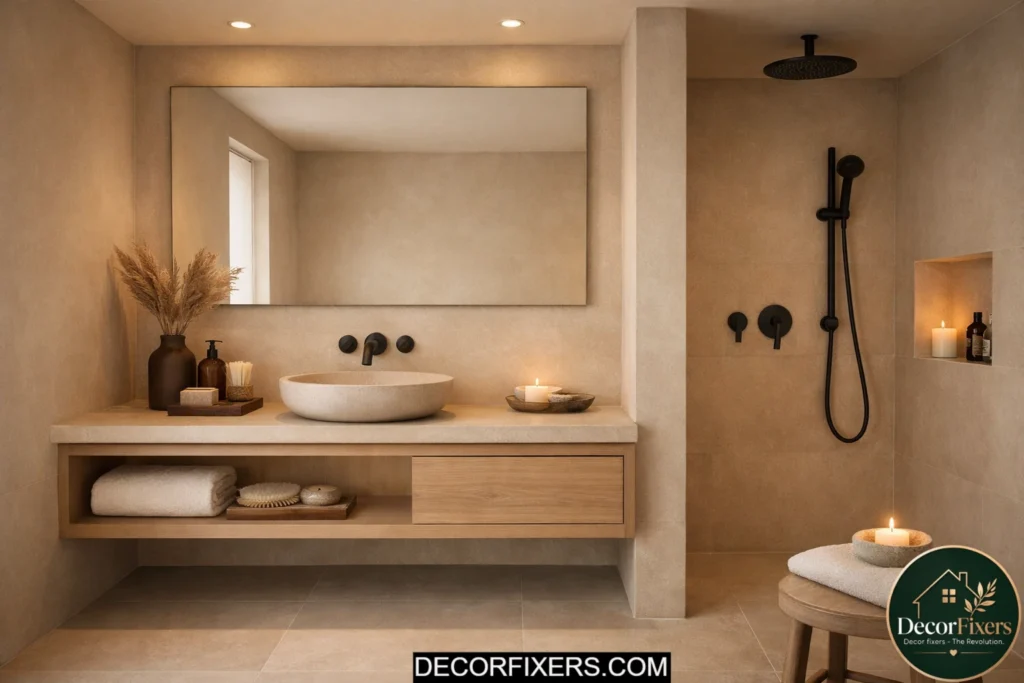
Gloss tiles and gloss-painted walls reflect light in a way that reads as cheap in smaller bathrooms. They bounce light unevenly, amplify every water spot, and make the space feel clinical rather than calm.
Matte finishes, matte tile, matte paint, matte fixtures, absorb light, soften the space, and hide imperfections. They’re also the material signature of warm minimalism. If you’re painting right now and choosing between matte and satin for bathroom walls, go satin (it’s still low-sheen and wipes clean), but avoid anything glossier.
13. Bring In One Natural Material, and Only One
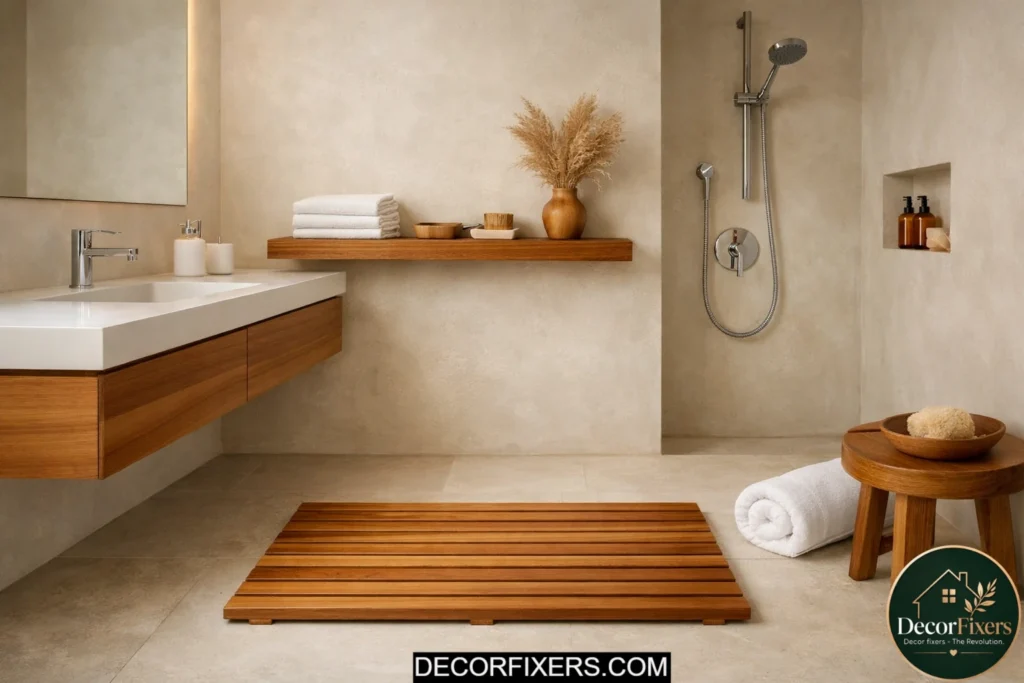
Wood, stone, rattan, or linen. One. Not all of them. The trap most people fall into is mixing every ‘natural material’ they love at once, a wooden bath mat, a stone soap dish, a rattan basket, and a linen hand towel, and the result reads as a boutique hotel gift shop, not a minimalist bathroom.
Pick one and amplify it. A teak bath mat and matching teak shelf. Or a marble soap dish and marble-look tile. Or nothing textured at all, just a single folded waffle-weave towel. Restraint is the skill.
14. Try a Wet Room Layout for Maximum Floor Space
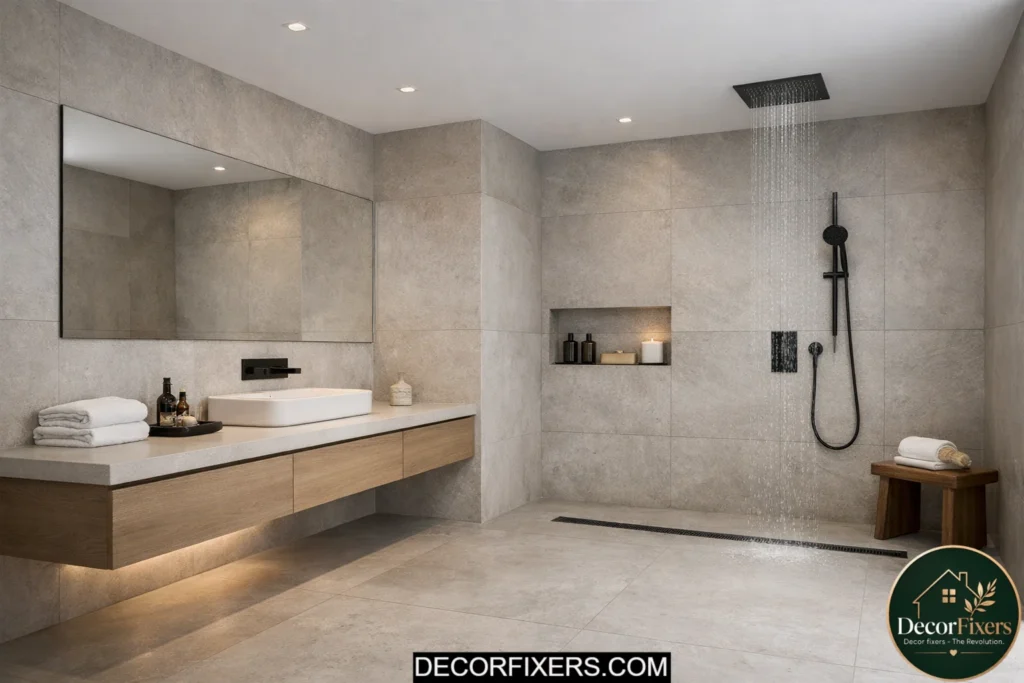
A wet room removes the shower tray and glass enclosure entirely, waterproofing the entire floor and using a linear drain to manage water. The whole room becomes the shower zone, which is the cleanest spatial solution in existence for a small minimalist bathroom.
This requires proper waterproofing and is a project for a licensed tradesperson, but the result is a bathroom with zero visual segmentation. Just one floor plane, one wall surface, no dividing line between the shower space and the rest of the room.
15. Layer Lighting Instead of Relying on One Overhead Fixture
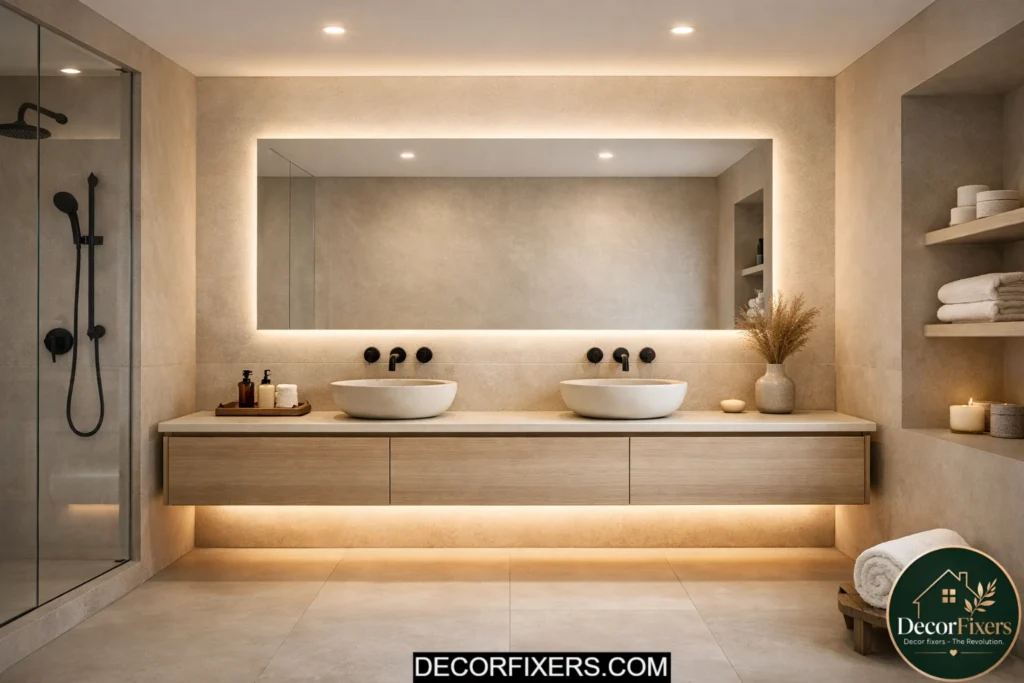
A single recessed ceiling light is the fastest way to make a bathroom feel like a hospital. Real bathroom lighting is layered: ambient light (the ceiling fixture), task light (on or around the mirror for getting ready), and accent light (under the vanity, or a small wall-mounted strip behind the mirror).
Backlit mirrors do all three in one product. Brands like IKEA’s STORJORM or higher-end options from Tom Dixon combine a flat frameless mirror with integrated LED, clean, task-lit, and visually minimal.
16. Install an In-Wall Shelf Instead of a Freestanding Unit
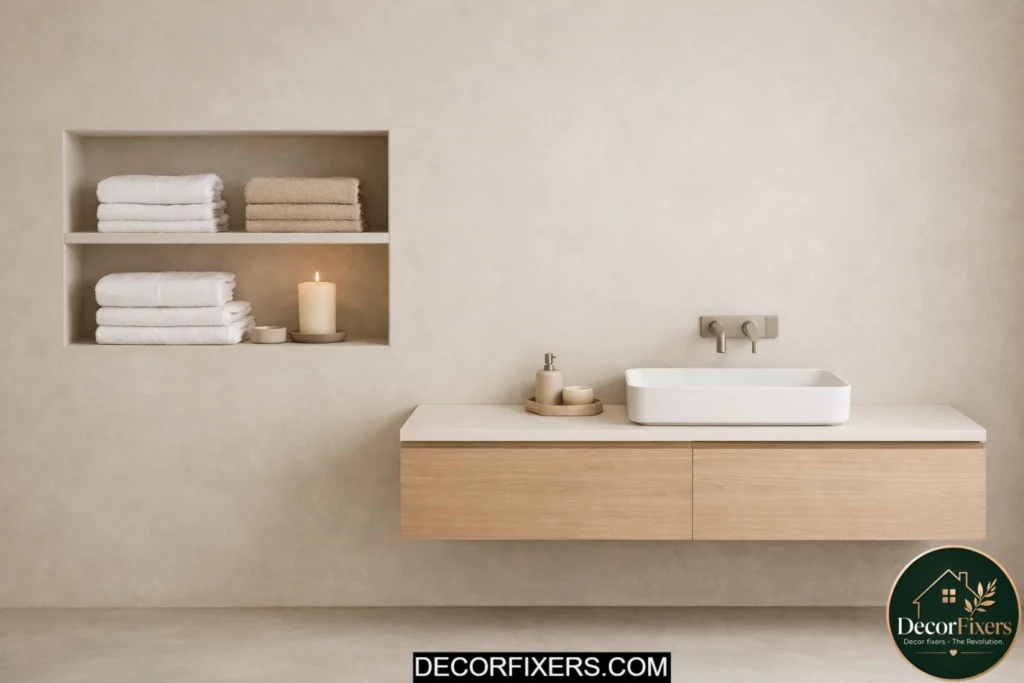
A freestanding bathroom shelf, even a beautiful one, sits on the floor, collects dust underneath, and adds four more legs to the visual floor plan. An in-wall shelf sits flush and disappears. It holds the same candles, the same plants, the same towels. And it looks built-in, not bought.
For renters, IKEA ENHET system units can be configured to look built-in when mounted properly and painted the same color as the surrounding wall. The effect from across the room is nearly indistinguishable from a custom niche.
17. Add a Single Indoor Plant, and Remove Everything Else Decorative
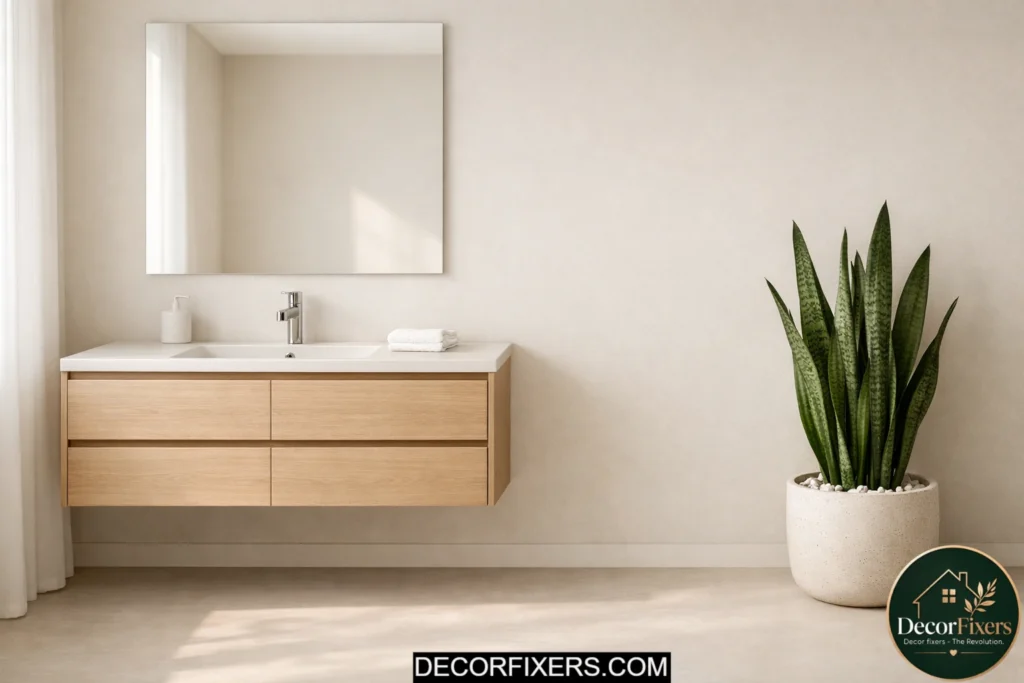
One plant. One. Not a row of succulents, not a shelf of diffusers and candles and shell art. One plant, a pothos, a ZZ plant, a snake plant, was placed deliberately. On the edge of the vanity, or on the floor beside the tub if there’s space.
Here’s the thing: a single object in a clean space reads as a design choice. The same object in a cluttered space reads as more stuff. The plant doesn’t do the work; the emptiness around it does.
For homeowners who prefer a softer and more layered aesthetic, these Boho Bathroom Ideas show how natural textures and earthy styling can still feel calm without becoming visually cluttered. A restrained boho approach pairs surprisingly well with warm minimalism.
18. Paint the Ceiling the Same Color as the Walls
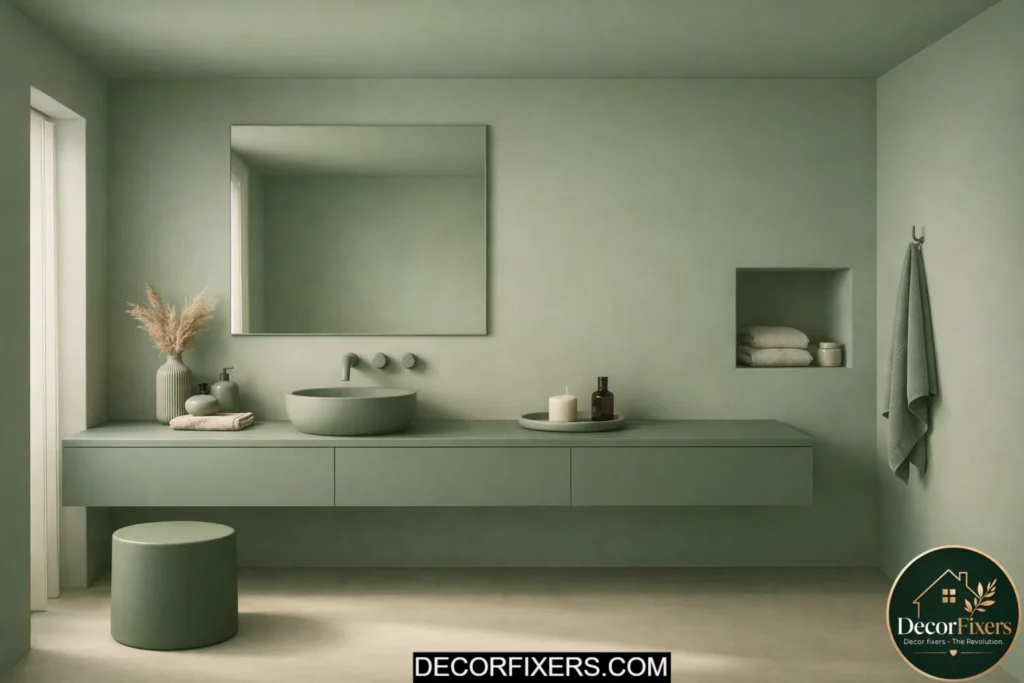
White ceilings in colored rooms create a lid effect; the eye reads the ceiling as a cap on the space. Paint the ceiling in the same tone as the walls, and the room suddenly reads taller, more continuous, and more architectural.
This works in any color, but it’s especially effective in warm greiges, dusty sages, and soft slates, the palette of warm minimalism. In a white bathroom, it’s irrelevant. In anything else, it’s a quiet revelation.
19. Choose a Trough Sink or Single Undermount Over a Drop-In
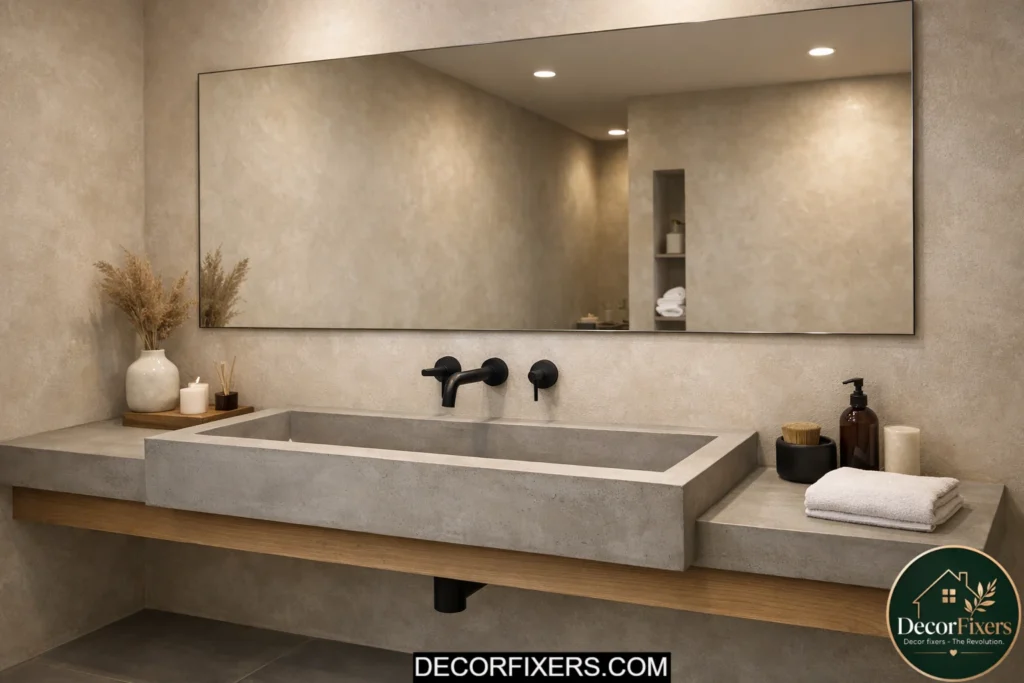
A drop-in sink has a visible rim sitting on top of the counter surface. That rim collects grime, creates a visual edge, and breaks the flat counterplan. An undermount sink removes that rim entirely, the counter surface runs clean to the edge, and the bowl sits below.
For a small minimalist bathroom, a single undermount basin is the cleanest option. For a wider vanity, a concrete or stone trough sink across the full width of the counter is the most architectural choice you can make at the vanity level.
20. Use a Curbless Shower Entry
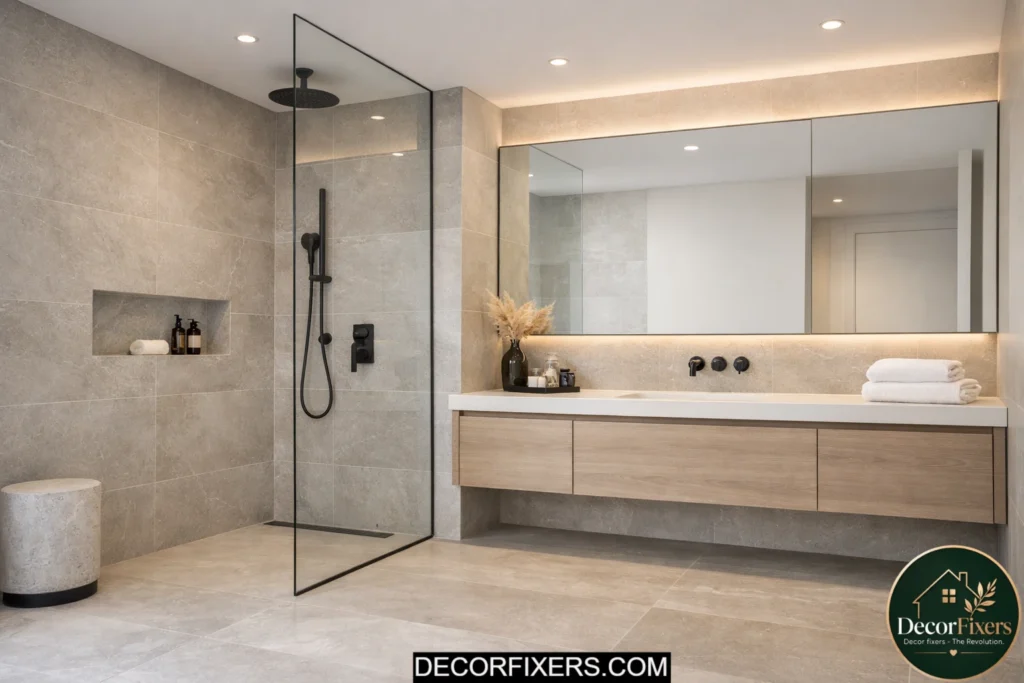
A curb at the shower entry is a physical and visual barrier. Curbless or zero-threshold showers eliminate the bump, create a flush transition between the shower floor and the bathroom floor, and visually extend the floor plane, making both spaces feel larger.
This is also a genuine accessibility benefit and future-proofs a bathroom for long-term use. The NKBA has been tracking this as a growing trend since 2023, and frameless glass combined with a curbless entry is the closest a real bathroom gets to a luxury hotel wet room.
21. Try Limewash Paint for Texture Without Pattern
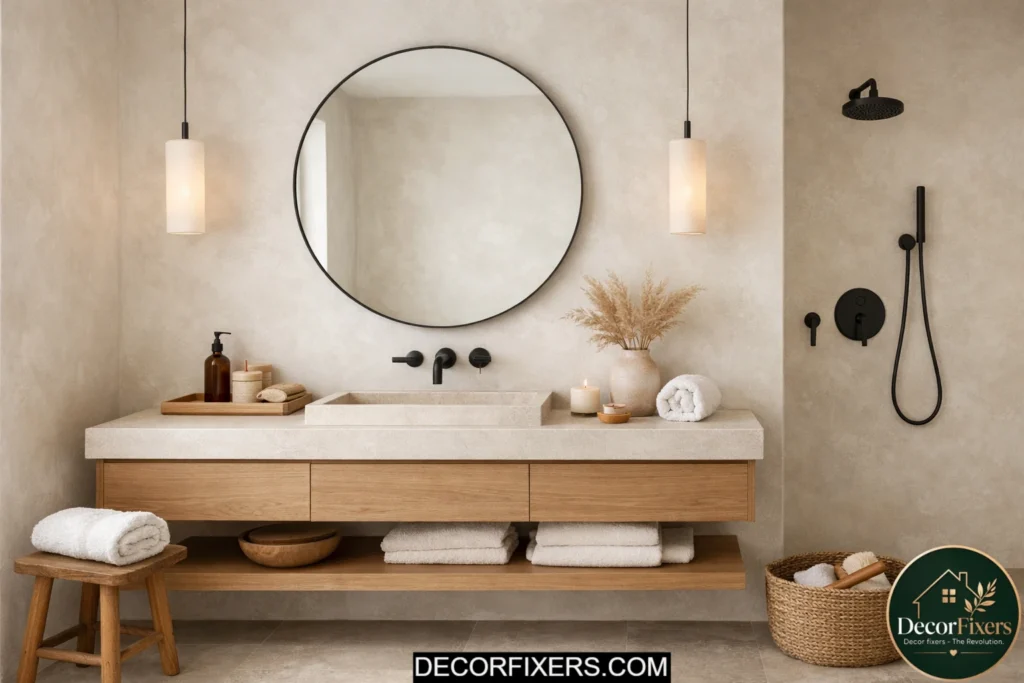
If bare walls feel too flat but tile feels too permanent, limewash paint is the answer. It creates a subtle layered texture, slight depth variation in tone across the surface, that reads as atmospheric rather than decorative.
It’s also renter-friendly in many cases, since it applies over standard paint and can be painted over cleanly when you leave. Brands like Portola Paints or Kalk & Co. make affordable limewash kits for DIY application. The technique takes practice, but the margin of error is forgiving.
22. Eliminate Exposed Plumbing Wherever Possible
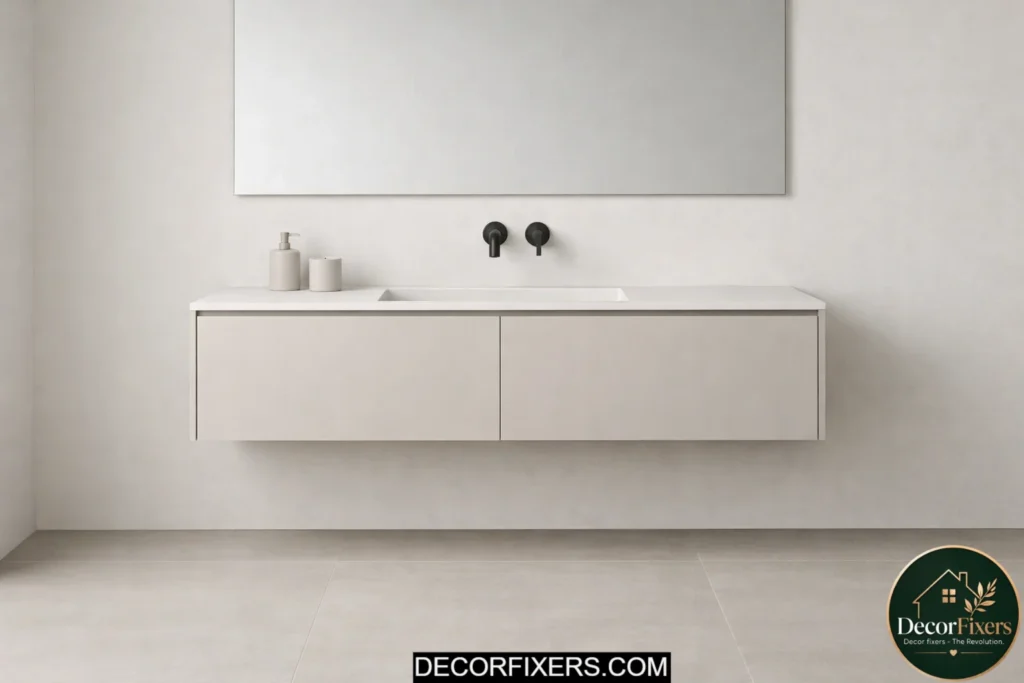
Exposed pipes under a wall-mounted sink look fine in an industrial loft. In a minimalist bathroom, they’re visual noise. Pipe shrouds, slim chrome or matte cover kits that clip over the P-trap and supply lines, cost under $40 and take the plumbing from visible to invisible in twenty minutes.
Or maybe I should say it this way: you don’t have to replace the plumbing. You just have to hide it. That distinction saves most people several hundred dollars and a lot of anxiety.
23. Use Matching Decanted Containers for All Products
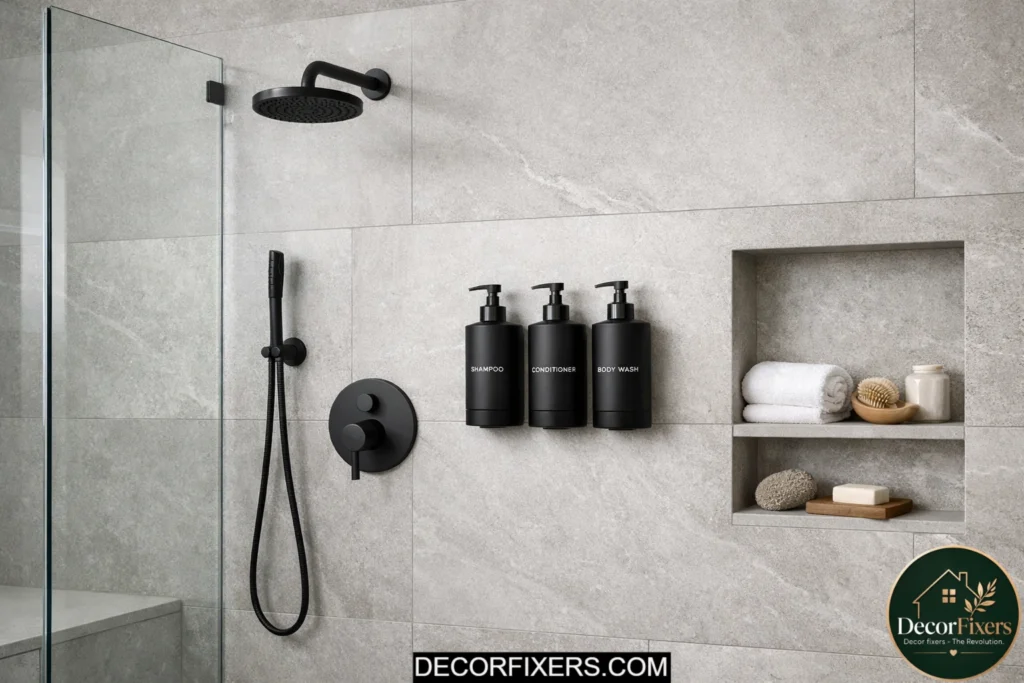
Eighteen different shampoo bottles, three body washes, a brand-name shower gel, and a half-empty conditioner are what the inside of most showers looks like. Decanting everything into matching refillable bottles, one for shampoo, one for conditioner, one for body wash, reduces that visual chaos to three clean objects.
Brands like Aesop and Apothecary make this easy at the high end, but IKEA TACKAN dispensers do the same job for under $15 each. Three identical black or white wall-mounted dispensers are a minimalist shower detail that costs almost nothing and changes the way the room feels immediately.
24. Fit a Pocket Door or Barn Door to Save Swing Space
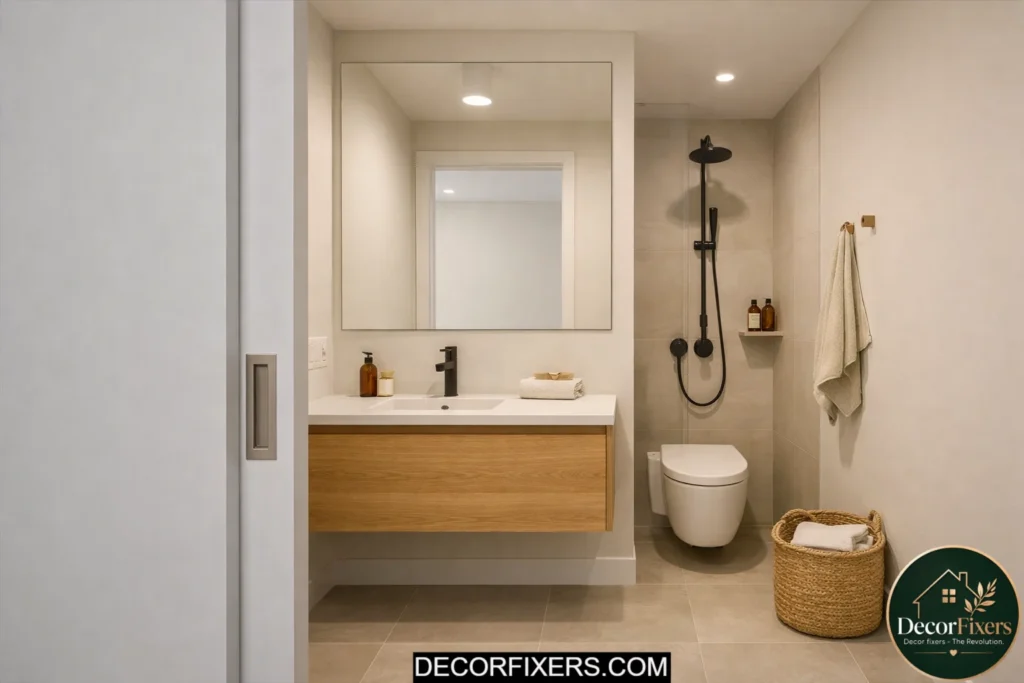
Standard hinged bathroom doors need about nine square feet of clear swing space on each side. In a small bathroom, that’s nine square feet the layout can never use. A pocket door slides into the wall and disappears. A barn door slides along the wall exterior and stays visible, but adds an architectural element rather than just a functioning door.
I’ve seen conflicting data on whether pocket doors cause mold issues in bathrooms. Some sources cite humidity concerns inside the wall cavity, while others find no issue with adequate ventilation. My read: if ventilation is good and the door is properly sealed, pocket doors are fine, and the space savings are worth it.
25. Edit Down to One Towel Per Person on Display
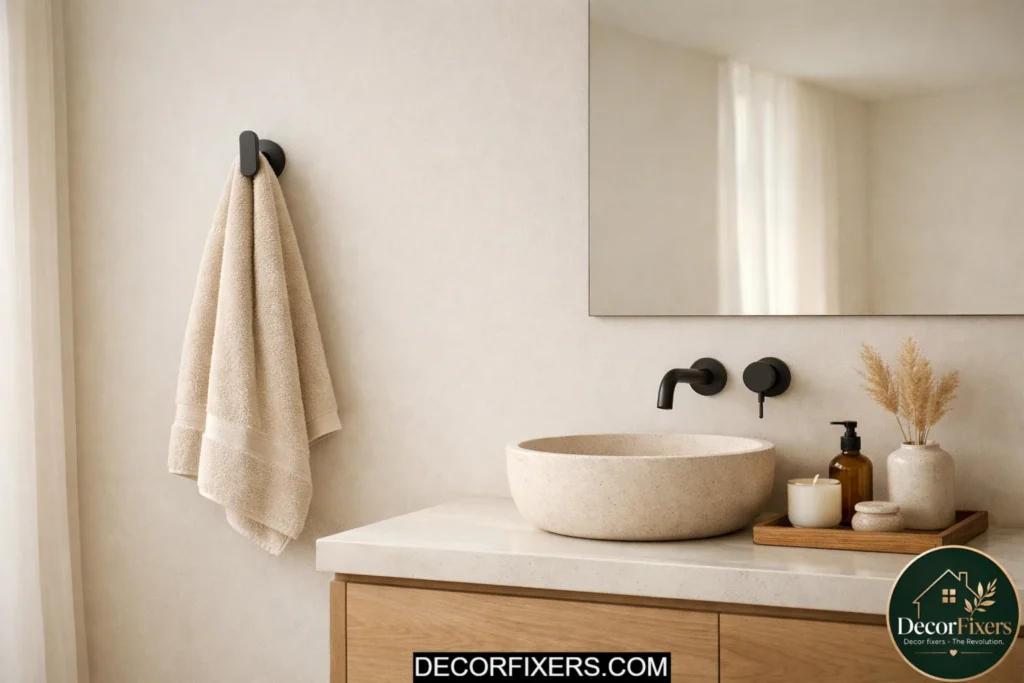
This is the last idea, and it might be the most important. How many towels are currently on display in your bathroom? Most households have at least four: a bath towel, a hand towel, a face towel, and a gym towel draped somewhere. That’s four objects, four colors (probably not matching), and four different texture signals.
One towel per person. Same color family. Folded once, hung straight. The rest go in a closed cabinet or a linen closet. This single edit, done right now, is the most immediate way to feel the effect of what minimalism actually looks like in your real bathroom, in your real home, today.
Quick Comparison: Warm Minimalism vs. Cold Minimalism vs. Japandi vs. Budget
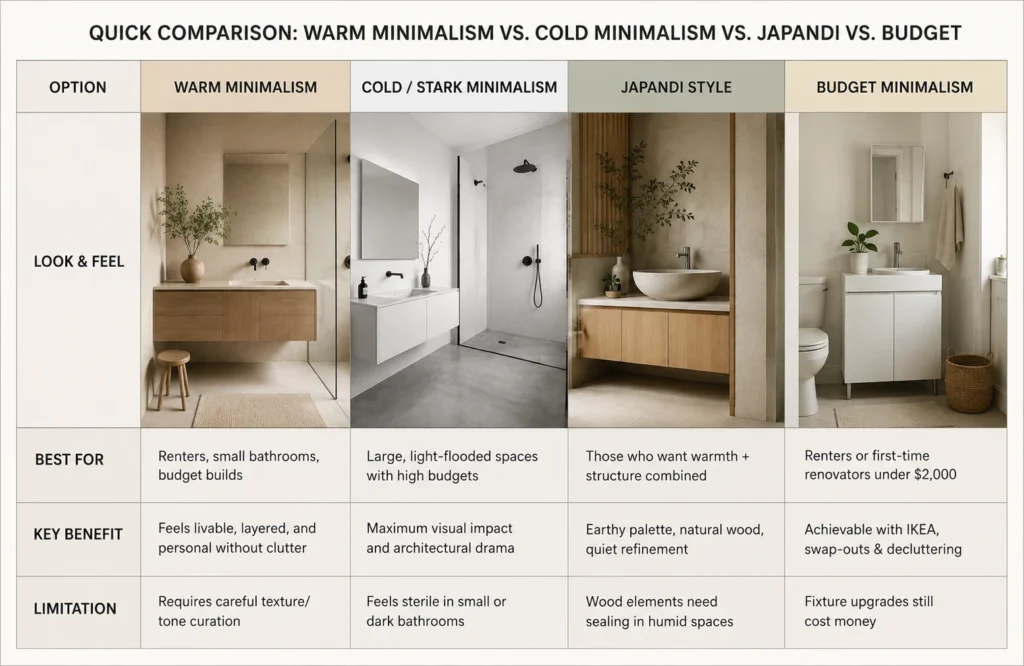
| Option | Best For | Key Benefit | Limitation |
| Warm Minimalism | Renters, small bathrooms, budget builds | Feels livable, layered, and personal without clutter | Requires careful texture/tone curation |
| Cold/Stark Minimalism | Large, light-flooded spaces with high budgets | Maximum visual impact and architectural drama | Feels sterile in small or dark bathrooms |
| Japandi Style | Those who want warmth + structure combined | Earthy palette, natural wood, quiet refinement | Wood elements need sealing in humid spaces |
| Budget Minimalism | Renters or first-time renovators under $2,000 | Achievable with IKEA, swap-outs & decluttering | Fixture upgrades still cost money |
How to Start Your Minimalist Bathroom Transformation?
To apply minimalist bathroom ideas without a full remodel, follow these steps:
1. Remove everything from the counter and only return items used daily.
2. Choose one neutral tone and one metal finish for the whole room.
3. Replace one bulky item (freestanding shelf, shower caddy) with a flush alternative.
4. Decant products into matching containers.
5. Add one plant, remove all other decorative objects.
CONCLUSION:
I came back to my bathroom three months after making the changes I’ve described in this list, not a renovation, just edits. The floating vanity. The matching fixtures. Everything off the counter. One plant. Matching towels.
It didn’t look like a hotel. It looked like my bathroom, but I finally finished, as if someone had made a decision about it instead of just accumulating things in it over time.
That’s what minimalism does. It’s not a style. It’s a decision. Decide what stays. Remove everything else. And then stop.
This guide covered 25 ideas across a range of budgets and commitment levels. It does not cover high-end custom joinery, structural layouts, or full architectural redesigns; those belong in a conversation with a bathroom designer, not a blog post.
FAQs:
Q: What’s the best minimalist bathroom style for a small space?
A: Warm minimalism or Japandi style. Both use earthy tones, natural textures, and slim-profile furniture that makes small bathrooms feel deliberate rather than cramped. Avoid cold all-white schemes in rooms under 50 square feet; they amplify every imperfection.
Q: How do I make my bathroom look minimalist without renovating?
A: Declutter the counter completely, decant products into matching containers, replace towels with one set in a matching tone, add one plant, and remove all decorative objects. Those five steps cost under $100 and deliver immediate results. No tiles, no tools required.
Q: Should I use matte or gloss tiles in a minimalist bathroom?
A: Matte tiles in almost every case. They’re more forgiving, hide water marks, and produce the calm, absorbed-light quality that defines minimalist spaces. Gloss reflects unevenly and makes small bathrooms feel clinical rather than serene.
Q: Why does my white bathroom still feel cluttered?
A: Because color isn’t the issue, objects are. A white bathroom full of mismatched products, different-height containers, and various textures reads as cluttered regardless of paint color. Declutter first. White amplifies what’s already there, both good and bad.
Q: When should I hire a designer for a minimalist bathroom?
A: When you’re touching plumbing, moving walls, or installing a wet room, ideas 11, 14, and 20 in this list all require trades. Everything else, from decanting to lighting to vanity swaps, is DIY or contractor-light work that most homeowners can manage with a clear brief.

Creator of DecorFixers, sharing practical home and interior ideas focused on real-life usability, simple design improvements, and budget-friendly solutions.