

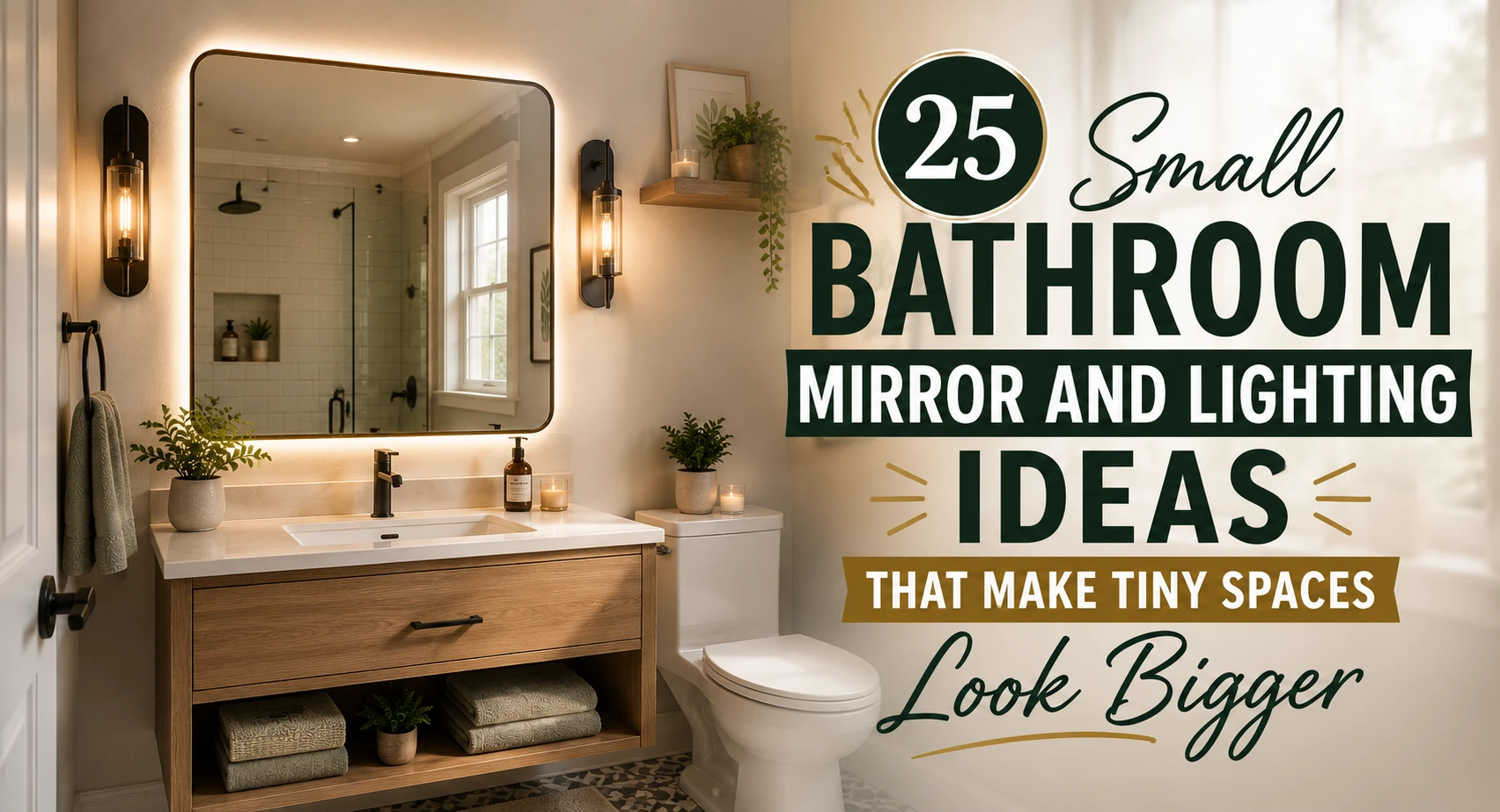
I still remember standing in my first apartment bathroom, roughly the size of a walk-in closet, staring at a blurry reflection under one buzzing ceiling bulb. Everything looked yellow, cramped, and honestly a little sad. I spent weeks thinking I needed a full gut renovation to fix it.
I didn’t. Two changes, the right mirror and a proper light source, flipped the entire feel of that room in a single weekend.
That’s the thing about small bathrooms. The mirror and lighting aren’t just accessories. They’re the most powerful design tools in the room. Get them right, and the space feels twice as large, twice as bright, and oddly luxurious. Get them wrong, and even a fresh coat of paint won’t save you.
Below are 25 small bathroom mirror and lighting ideas. Whether you’re renting, renovating, or just tired of squinting at yourself every morning, there’s something here that’ll work for your space.
1. Go Oversized with a Frameless Mirror
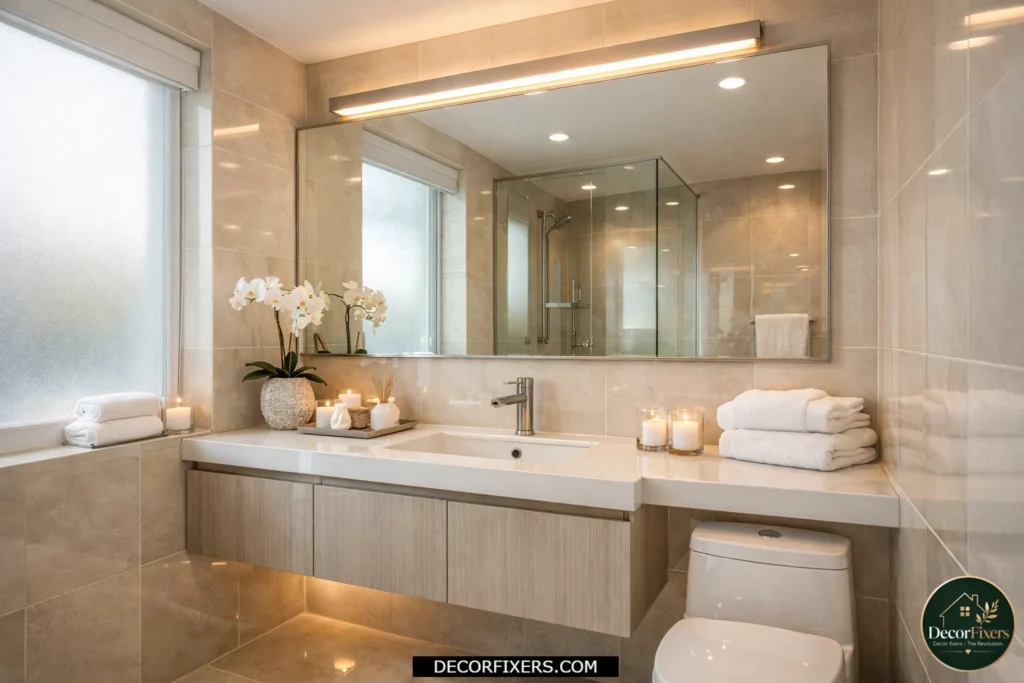
Most people in small bathrooms default to a mirror that matches the vanity width exactly. That’s actually a mistake. Going wider, even slightly, reflects significantly more light and makes the wall feel like it opens up.
A frameless mirror sized at 30″–36″ wide costs between $80 and $220 at most home retailers and is one of the highest-impact, lowest-effort swaps you can make. It works especially well with a simple vanity bar light mounted just above. The frameless edge keeps visual clutter to zero, with no chunky frame competing for attention in an already tight space.
2. Install a Backlit LED Mirror for Shadow-Free Light
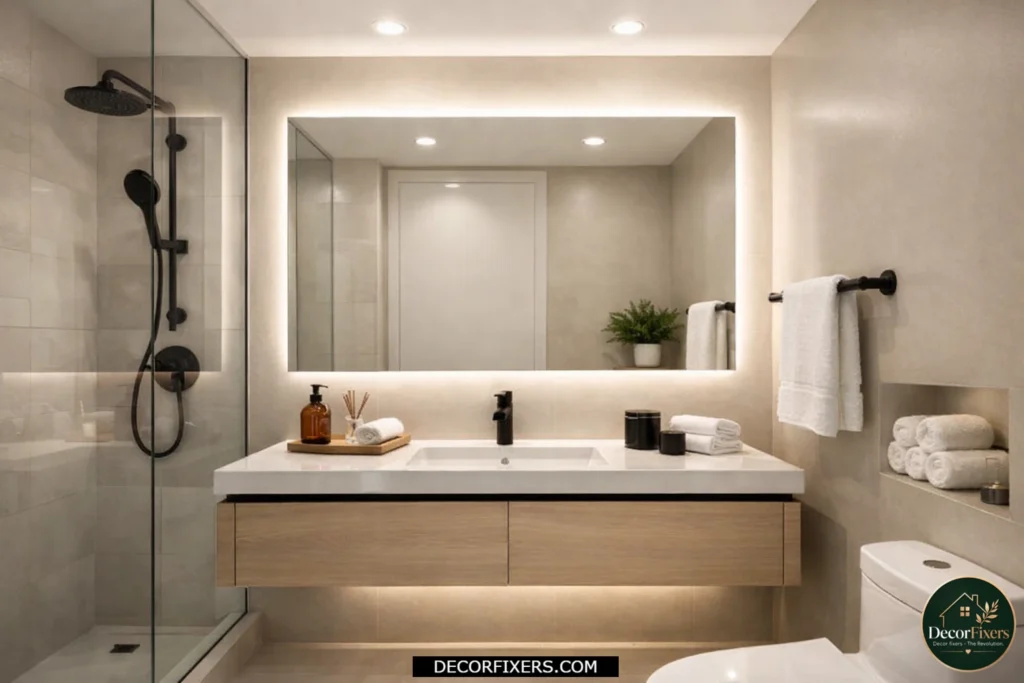
Here’s the thing: overhead lights cast shadows downward across your face. That’s why you look tired every morning; it’s not you, it’s the physics of your light source. A backlit LED mirror solves this completely. The light radiates from behind and around the glass, creating an even, diffused glow with no harsh shadow.
Brands like ALTAIR Mirrors offer backlit options starting around $150–$350, a fraction of what most people assume they cost. Look for a CRI rating of 90 or above and an adjustable color temperature (around 3000K–4000K) so you can switch between warm evening light and bright morning task lighting.
3. Mount Wall Sconces at Eye Level on Each Side
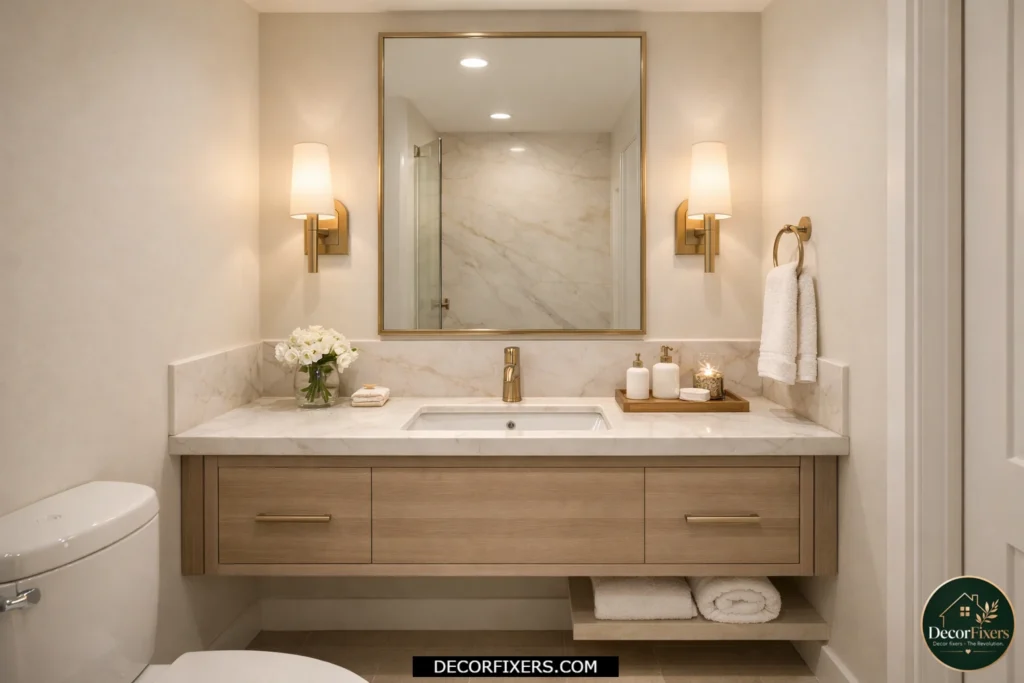
I’ve seen conflicting data on this; some sources recommend sconces at 60 inches from the floor, others say 65 inches. My read is: mount them at your own eye level, or just slightly above it. The goal is to light your face from the sides, not the top.
Side sconces eliminate the shadow problem that a single overhead fixture creates. Kichler’s Everly and Winslow vanity sconces run between $90 and $180 per pair and come in matte black, brushed nickel, and champagne bronze, all three of which are having a real moment in 2026-bathroom design. Keep the sconces no more than 24 inches apart, centered on either side of the mirror.
4. Try a Round Mirror to Soften a Box-Shaped Space
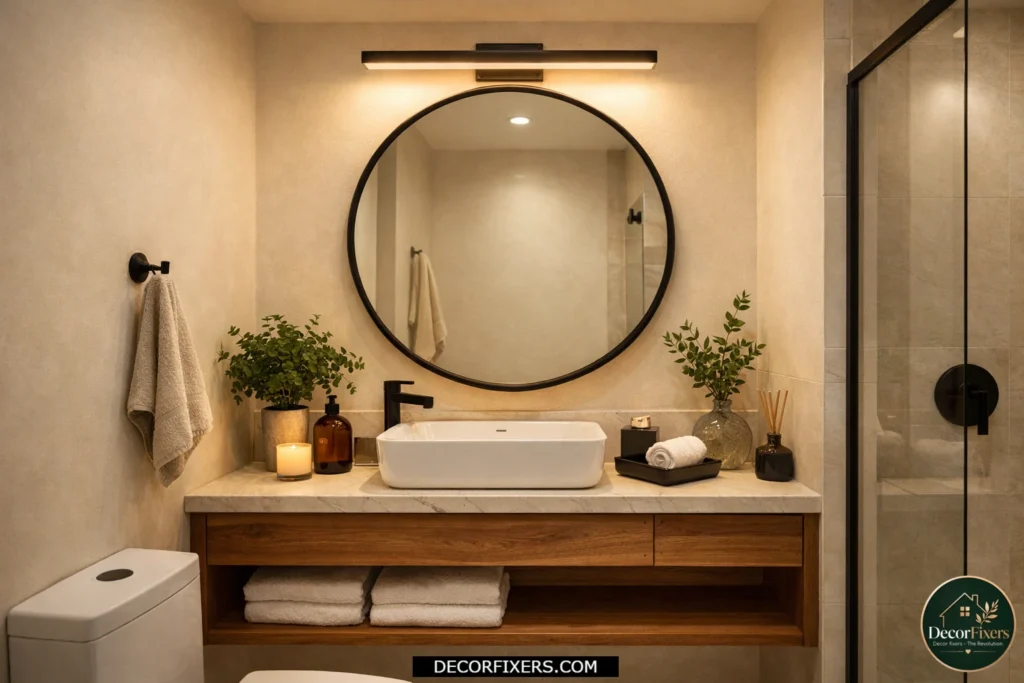
Small bathrooms are full of hard lines, square tiles, a rectangular vanity, and a boxy toilet. One round mirror cut through all of that and adds an immediate sense of softness and air. It’s a psychological trick that actually works: your eye reads curves as spacious.
A 24″–30″ round mirror in matte black or brass frame sits in the $60–$180 range at most decor retailers. Pair it with a slim vanity bar light above, or go bold with a single pendant on one side. Either way, the shape alone does most of the design heavy lifting.
5. Use an Arched Mirror to Create the Illusion of Height
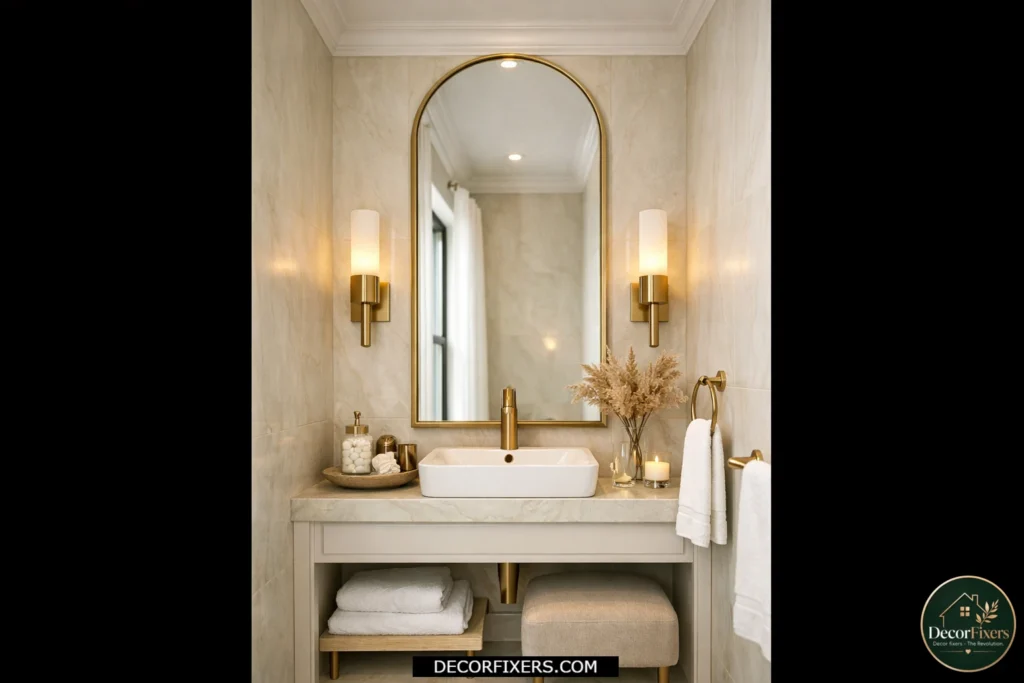
Low ceilings are a small bathroom’s worst enemy. An arched mirror draws the eye upward and creates the visual impression that the ceiling is higher than it really is, similar to how a tall, narrow window makes a room feel taller.
This shape pairs especially well with vintage-inspired or transitional bathroom styles. Arched mirrors in the 24″×36″ size range cost $95–$250, depending on frame material. A natural wood or brushed gold arch feels genuinely luxurious without trying too hard. Hang it slightly higher than you normally would; the arc of the top should be at or above standard eye level.
6. Add an LED Vanity Bar Light Above the Mirror
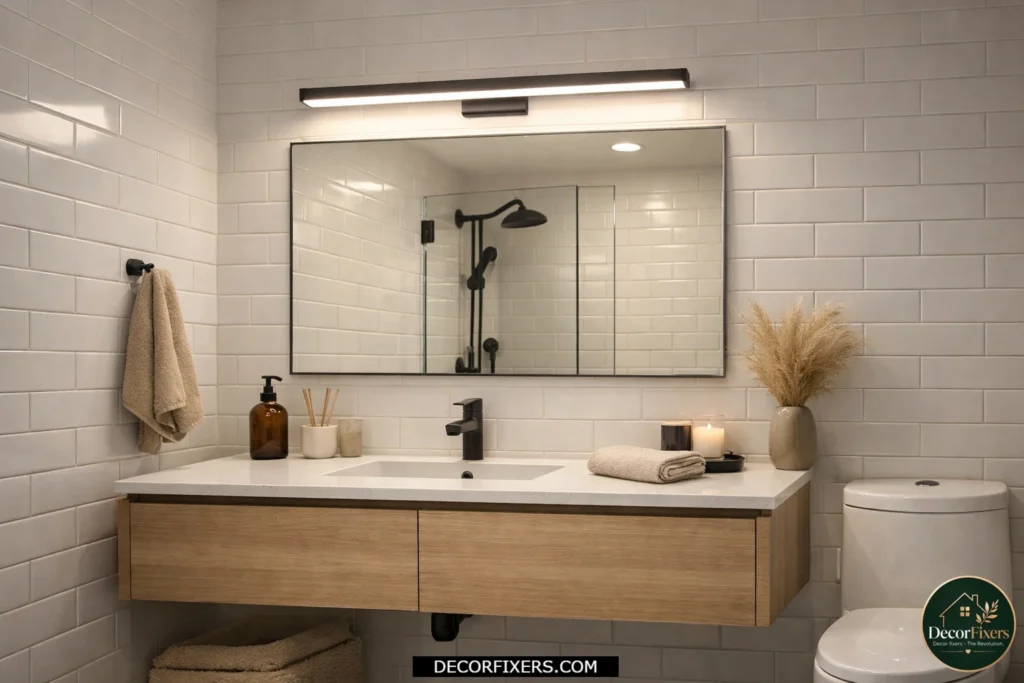
If side sconces aren’t an option because your wall space is too narrow, a vanity bar light above the mirror is your next best move. The key is placement: the bar should sit no more than 6–8 inches above the top edge of the mirror. Any higher and you’re back to overhead shadow territory.
Look for bars with downward-facing bulb sockets rather than upward-facing ones; this directs light toward your face rather than at the ceiling. Kichler and Progress Lighting both make clean, modern options starting around $70–$160. Chrome and matte black finishes tend to photograph best and age the most gracefully.
7. Choose a Lighted Medicine Cabinet for Storage and Style
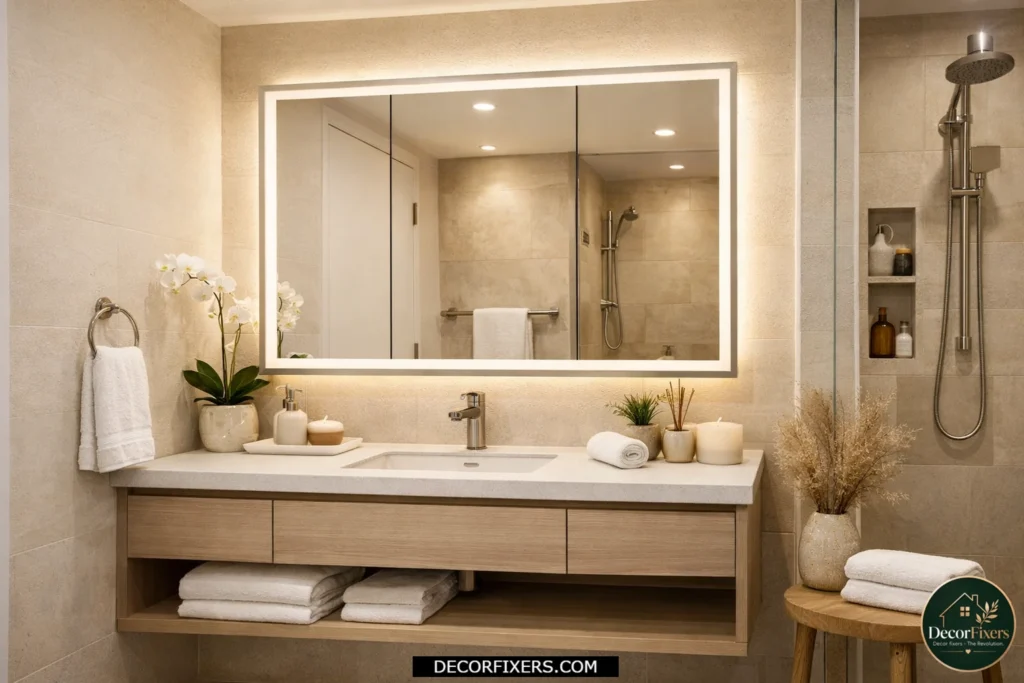
In a tiny bathroom, counter space is sacred. A medicine cabinet mirror kills two problems at once: it gives you a clean, flat reflective surface and hides everything from cotton balls to backup toothpaste behind it.
The Kohler Verdera medicine cabinet with integrated lighting is a real standby; it runs around $350–$600 and installs recessed into the wall, so it doesn’t protrude into your already-tight footprint. Even the surface-mount version works well in smaller bathrooms since the mirror face is flush and clean. Built-in LED strips inside provide ambient light that makes the cabinet feel like a luxury hotel detail.
8. Use a Tall Narrow Mirror to Maximize Vertical Space
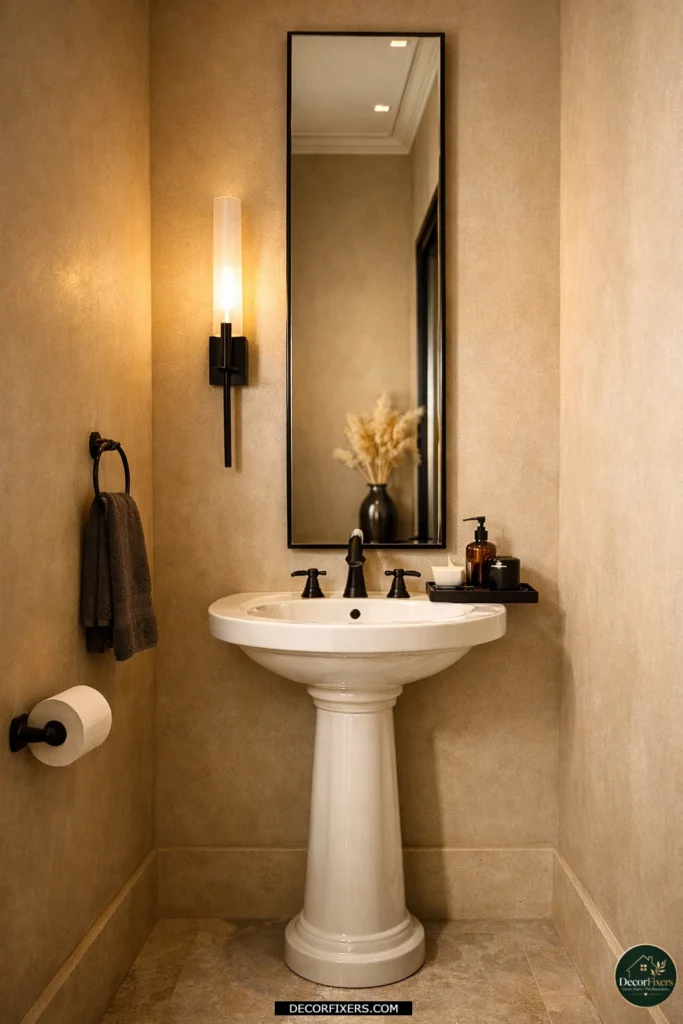
Pedestal sinks have almost no horizontal vanity space on either side. A tall, narrow mirror, think 16″×48″, takes advantage of vertical wall space instead and keeps everything scaled correctly for a narrow sink.
This shape also works brilliantly in powder rooms where you need a mirror but have no real vanity to anchor it to. Prices typically fall in the $55–$150 range. Add a slim wall sconce directly beside it, not above, and you’ve created a composed, intentional vignette that looks like it cost three times the actual price.
9. Layer Lighting With Dimmable Recessed Lights Plus a Mirror Light
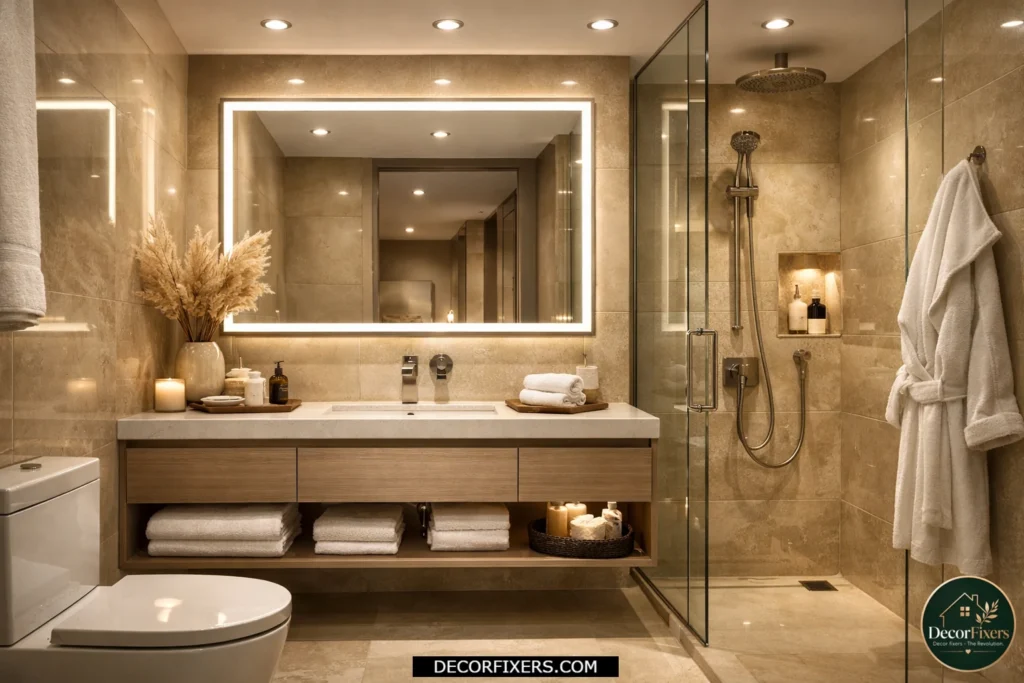
One light source in a small bathroom is never enough. What actually works is layering: a dimmable overhead recessed light for ambient fill, plus a dedicated mirror light (bar or backlit) for task use. The recessed light lifts the entire room; the mirror light handles the detail work.
Or maybe I should say it this way: think of it like layering in a living room. You wouldn’t rely on one floor lamp for the whole space. The same logic applies here.
Dimmable LED recessed kits cost $30–$80 per can, and adding a dimmer switch is another $15–$25. Pair with any mirror light from this list, and the result feels genuinely spa-like.
What Are Small Bathroom Mirror and Lighting Ideas?
Small bathroom mirror and lighting ideas refer to design strategies that combine the right mirror size, shape, and placement with a complementary light source to maximize brightness, create the illusion of space, and elevate the room’s style, without structural renovation. The goal is a flattering, functional vanity that feels intentional even in under 50 square feet.
10. Install a Floating Vanity Mirror With Built-In LED Strips
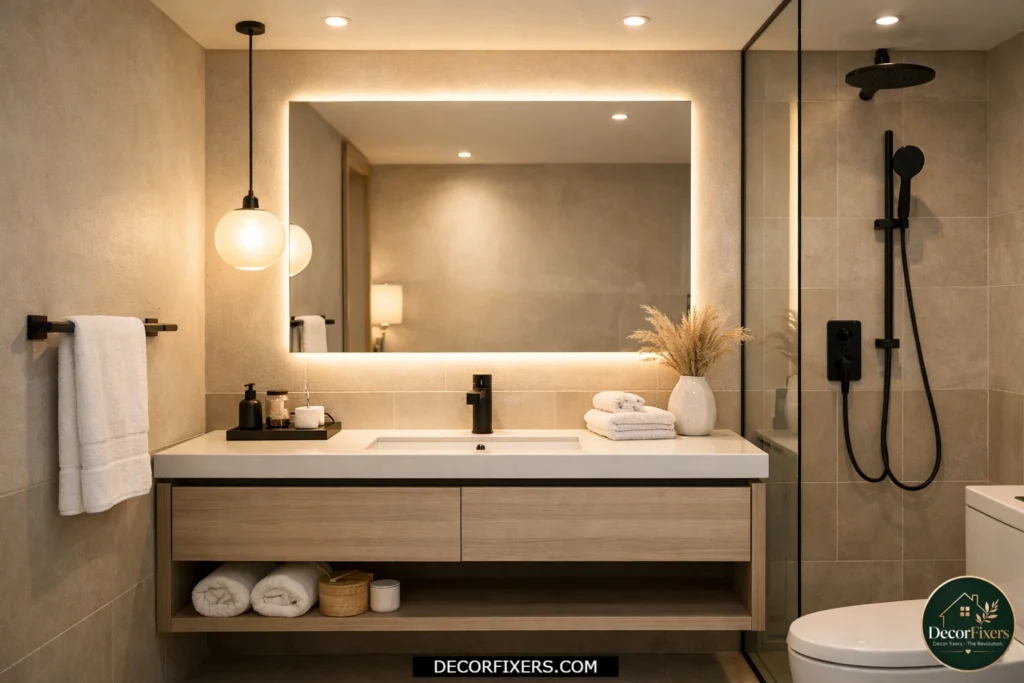
LED strip lighting along the bottom or sides of a mirror creates a floating effect; the mirror appears to hover off the wall, which adds an unexpected luxury detail to even a basic bathroom. It’s a trick pulled straight from boutique hotel design.
You can DIY this with a standard frameless mirror and adhesive LED strip tape for as little as $40–$80 total. Or buy a mirror with pre-installed perimeter strips starting around $120–$200. Either way, the result looks like a renovation that cost ten times the actual spend. Use warm white strips (2700K–3000K) for an evening glow effect, or neutral white (4000K) for a clean, modern daytime look.
11. Go Bold With a Black-Framed Mirror and Warm Edison Sconces
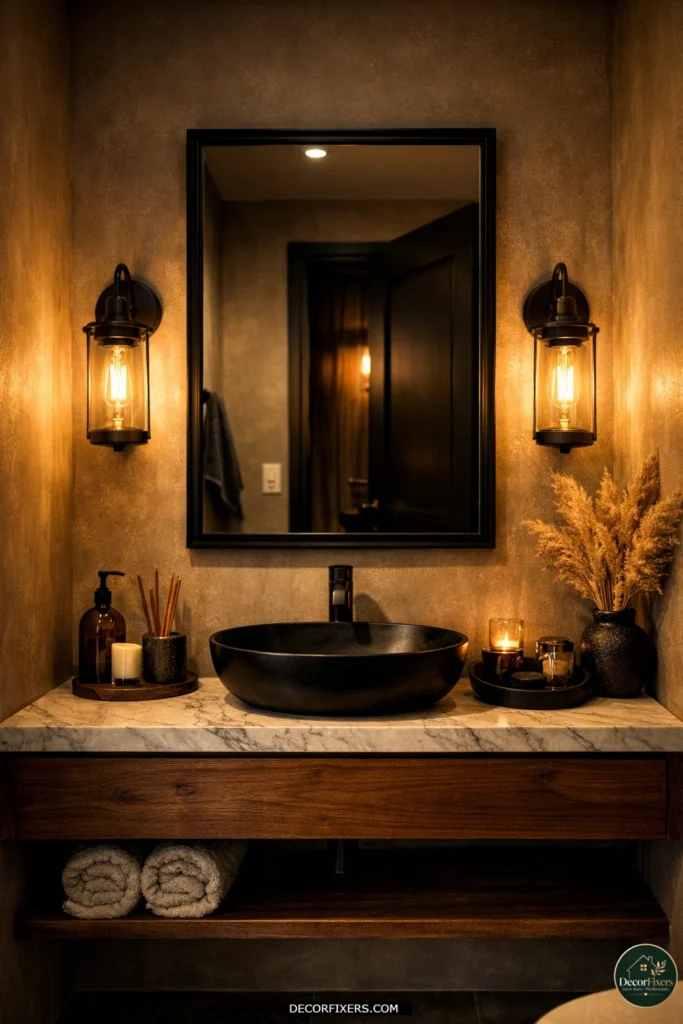
Matte black frames look dramatically more expensive than they cost. A 30″ black-framed mirror runs $75–$180 and instantly modernizes a builder-grade bathroom. The frame acts as an anchor; it defines the vanity zone and gives the eye a sharp edge to rest on.
Pair it with warm Edison-style sconces on either side. The amber glow against the black frame creates a moody, deliberate contrast that reads as high-end without trying too hard. Edison vanity sconces start around $45–$110 per fixture. This combo works best with warm-toned walls, beige, sage, warm gray, and terracotta, rather than cool whites.
12. Reflect a Window With Strategic Mirror Placement
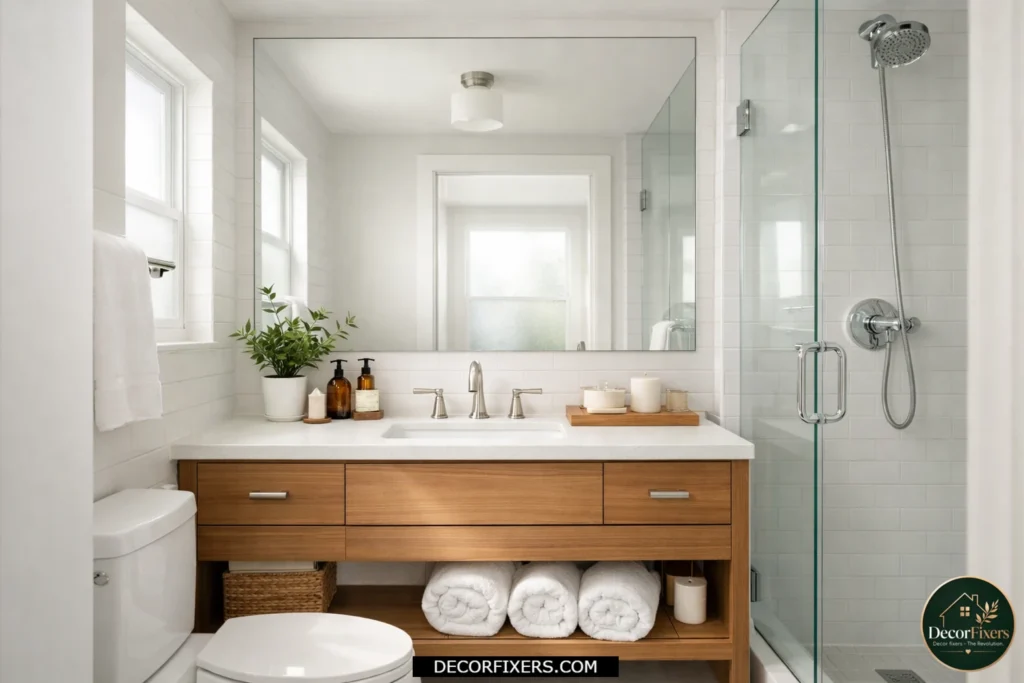
Natural light is free. Use it. If your small bathroom has a window, even a frosted privacy window, position your mirror on the wall directly opposite it. The reflection multiplies the available daylight and makes the entire room feel brighter without any electrical work.
This is one of those tricks that most guides skip entirely. The effect is most dramatic in the morning when the sun’s position is low. Any mirror in the $60–$200 range works here; the placement is doing the work, not the fixture. If your window is directly beside the vanity, a slightly angled frameless mirror can still catch that light with the right positioning.
13. Add a Lighted Makeup Mirror as a Secondary Task Light
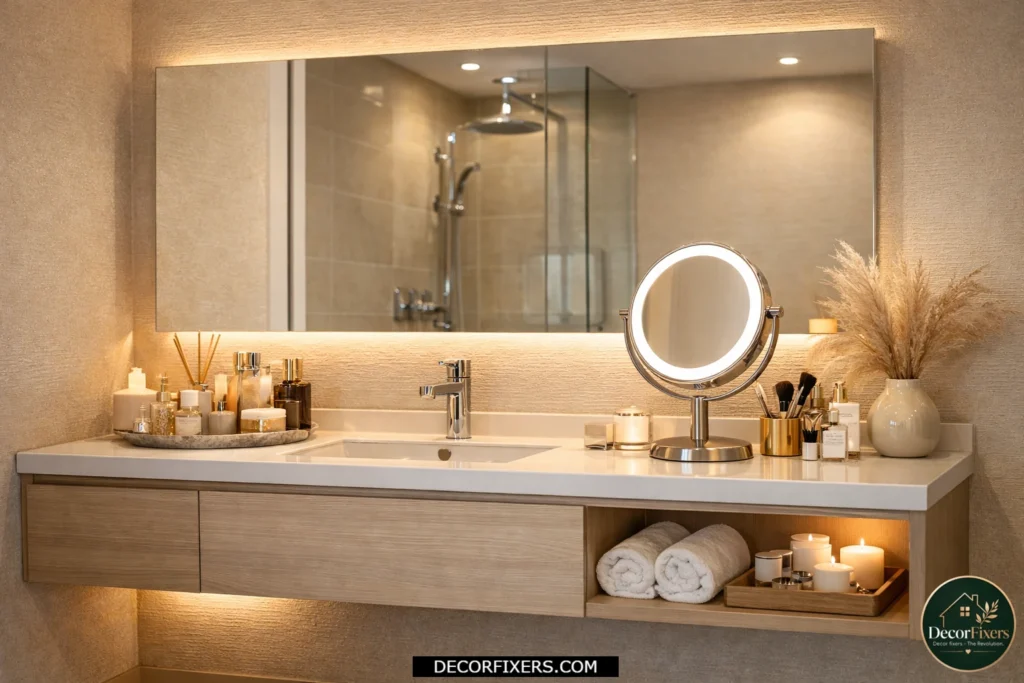
Look, if you’re someone who does detailed makeup or skincare in a small bathroom with bad overhead lighting, here’s what actually works: a separate lighted tabletop makeup mirror. It supplements whatever your main fixture can’t do.
The RIKI Skinny and Conair’s TrueLux series are strong options in the $60–$150 range. Place it on the counter angled toward your face. The close-proximity light is significantly more flattering and accurate for color matching than any ceiling or wall fixture. It also lets you keep your main mirror clean and uncluttered.
14. Use Warm White Bulbs (2700K–3000K) for a Luxurious Feel
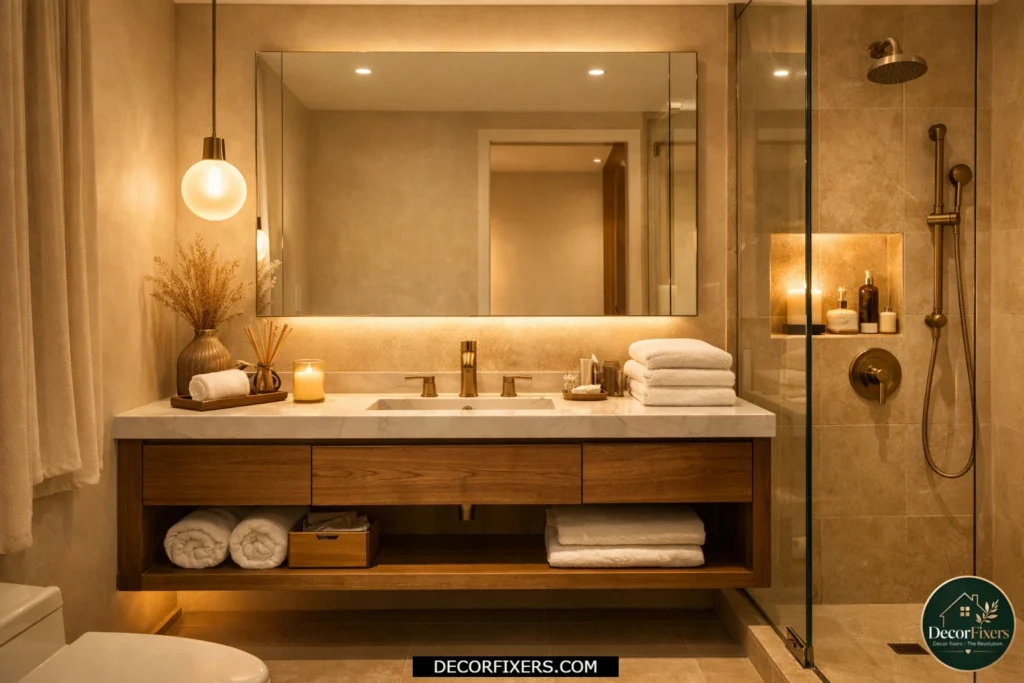
Color temperature is the single most overlooked variable in bathroom lighting decisions. Most people install whatever bulb comes in the box and wonder why the room feels sterile or clinical.
Warm white bulbs in the 2700K–3000K range replicate the flattering quality of candlelight; they make skin tones look healthy, and the room feels intimate. Cool white bulbs (5000K+) are for task-heavy spaces like garages. A pack of warm LED bulbs costs $8–$20 and is the cheapest single upgrade on this entire list. If your bathroom currently has cool or daylight bulbs, swap them tonight. The difference is immediate.
15. Install a Smart Mirror With Anti-Fog and Touch Dimming
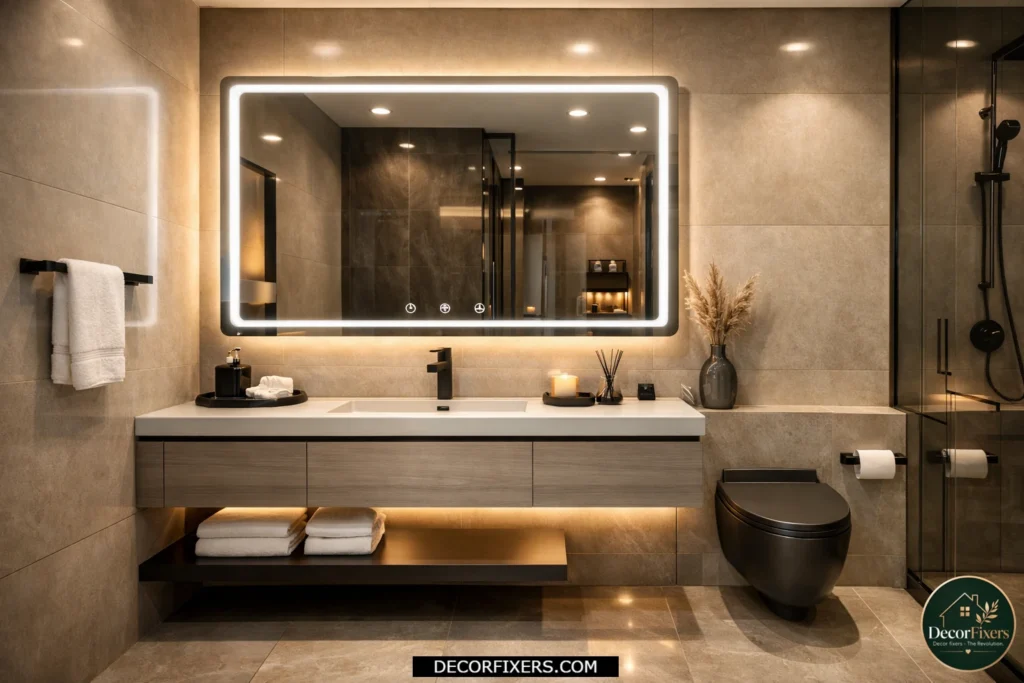
Smart mirrors have crossed from luxury novelty into genuinely practical territory. Anti-fog technology keeps the glass clear the moment you step out of the shower. Touch-controlled dimming means you can go from a bright task light for morning grooming to a soft ambient glow for a bath at night, same fixture, zero extra switches.
Entry-level smart mirrors with these features now start around $180–$450, a significant step down from where they were two years ago. Brands like Hauschen and Keonjinn offer solid mid-range options that don’t require any special wiring. For a small bathroom, this is one upgrade that genuinely earns its cost back in daily convenience.
Quick Comparison:
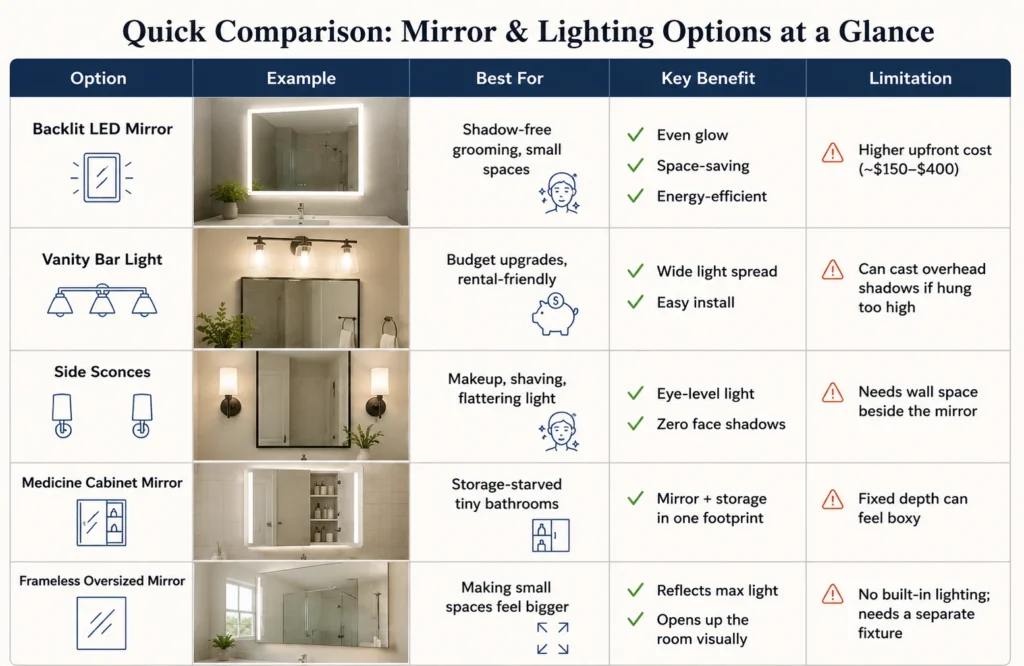
| Option | Best For | Key Benefit | Limitation |
| Backlit LED Mirror | Shadow-free grooming, small spaces | Even glow, space-saving, energy-efficient | Higher upfront cost (~$150–$400) |
| Vanity Bar Light | Budget upgrades, rental-friendly | Wide light spread, easy install | Can cast overhead shadows if hung too high |
| Side Sconces | Makeup, shaving, flattering light | Eye-level light, zero face shadows | Needs wall space beside the mirror |
| Medicine Cabinet Mirror | Storage-starved tiny bathrooms | Mirror + storage in one footprint | Fixed depth can feel boxy |
| Frameless Oversized Mirror | Making small spaces feel bigger | Reflects max light, opens up the room visually | No built-in lighting; needs a separate fixture |
16. Try a Two-Light Sconce Bar for a Boutique Hotel Look
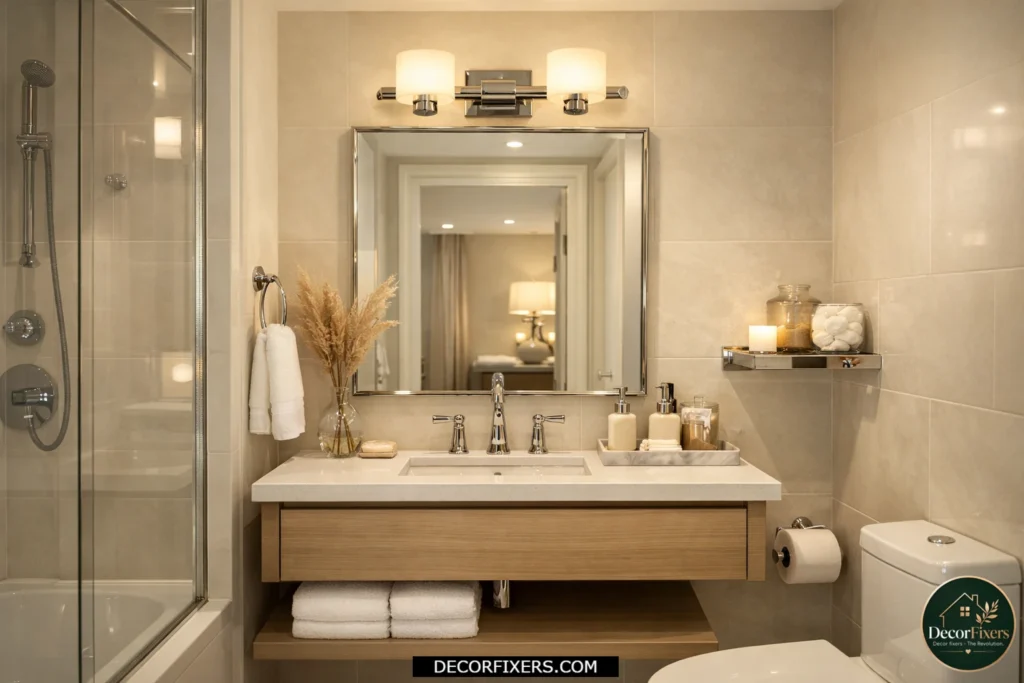
A two-bulb sconce bar mounted centered above the mirror is the simplest way to get a balanced, even light distribution without committing to full side sconce installation. It’s also a great option for bathrooms where the wall beside the mirror is occupied by a towel bar or toilet.
The key difference versus a standard vanity bar is scale: a two-light bar in the 18″–24″ width range sits more proportionally above a single-sink mirror than a longer four-bulb bar. Expect to spend $65–$150 for a quality two-light option. Aged brass and polished chrome are both strong finishes here; aged brass adds warmth, and chrome keeps things crisp and clean.
17. Add a Pivot or Tilt Mirror for Flexible Functionality
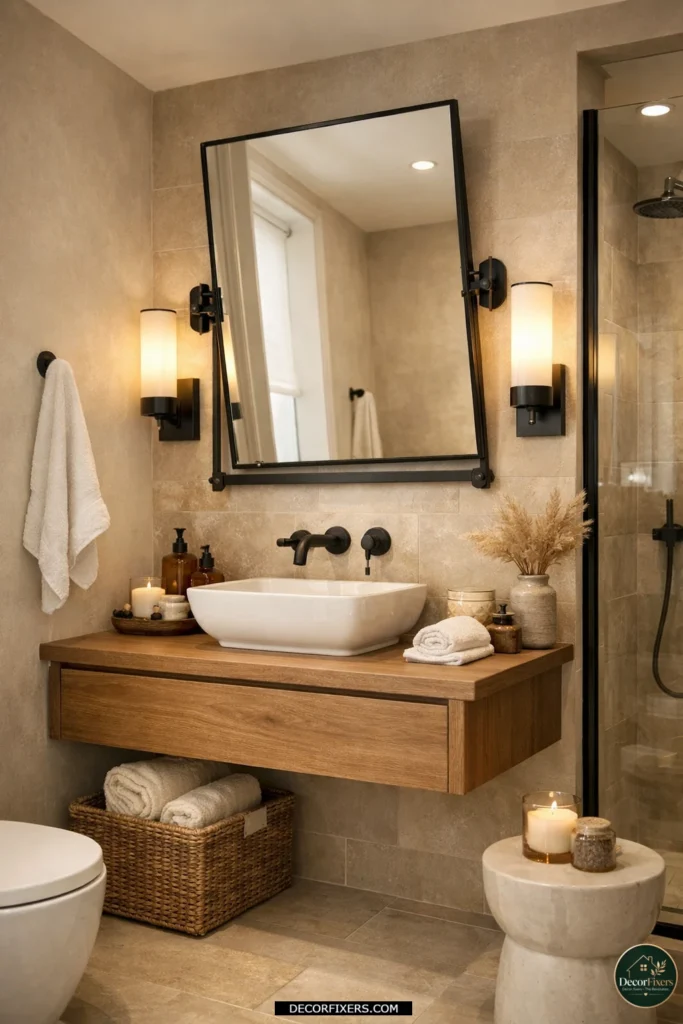
Pivot mirrors adjust their angle, which matters more than most people realize in a small bathroom. If your ceiling is low or your light source hits the mirror at an awkward angle, being able to tilt the glass even slightly transforms how well you can actually see.
Pivot mirrors also read as a design detail; the visible hardware (usually exposed brass or matte black brackets) adds an intentional, crafted look to the wall. Pivot bathroom mirrors start around $80–$200. Look for a model with a sturdy locking mechanism so it holds its position. Pair with side sconces for best results; the adjustable angle plus eye-level light is an unbeatable combination.
18. Place a Sconce Inside a Recessed Niche for Dramatic Effect
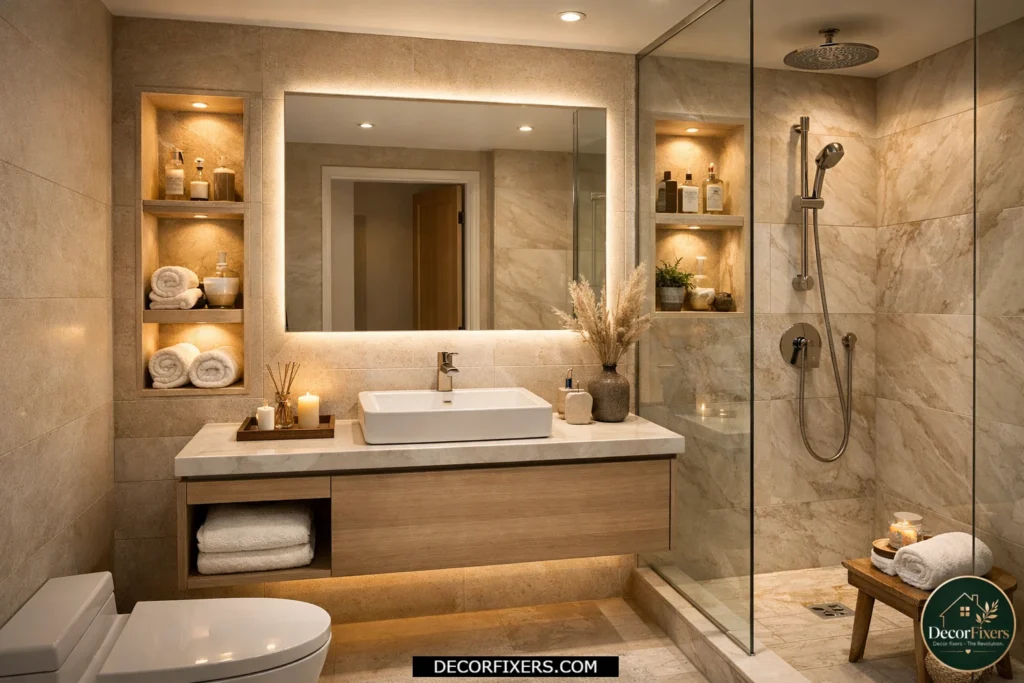
This one requires a small amount of wall work but rewards you with something that looks genuinely architectural. A recessed niche, even just 4 inches deep and 12 inches wide, fitted with a small sconce or LED puck light, creates a dramatic accent that no flat-wall fixture can replicate.
Most tile installers or drywall contractors can add a niche during a minor refresh for $200–$500 in labor. The sconce itself adds another $50–$150. The final result makes the bathroom look custom-designed, not builder-grade. This works especially well flanking a mirror on the long wall of a narrow bathroom.
19. Use a Brass-Framed Mirror to Add Warmth Without Paint
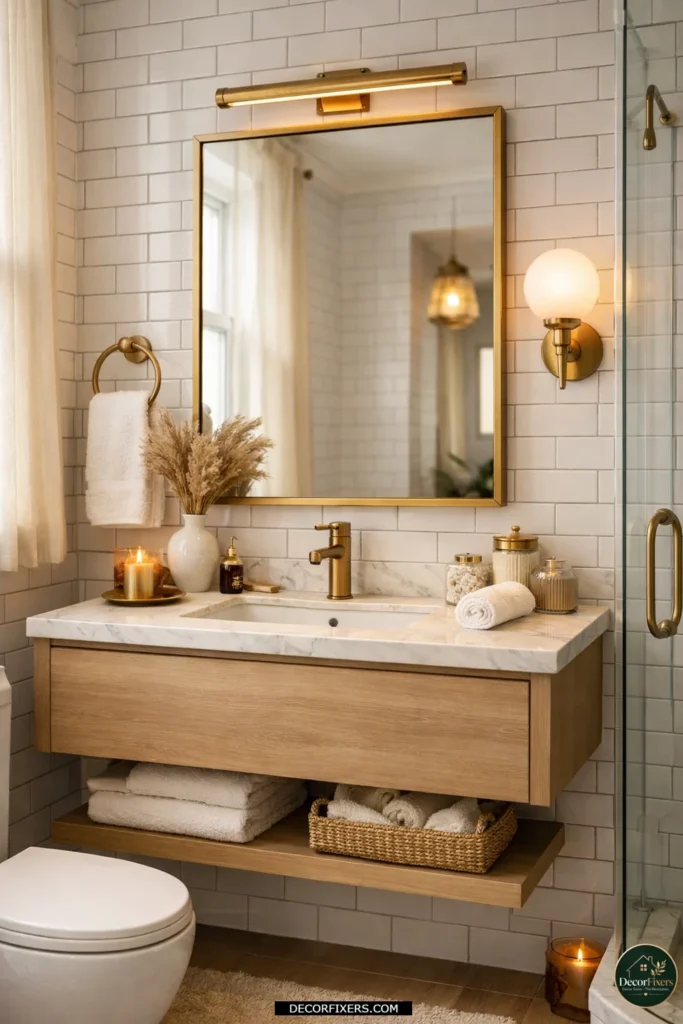
Cool-toned small bathrooms, think white subway tile, gray grout, chrome fixtures, can feel a little cold and impersonal. A brass-framed mirror is the fastest fix that doesn’t involve repainting or retiling.
Brushed or satin brass is warmer and more forgiving than polished brass, which can read as dated. A 24″–30″ brushed brass mirror runs $90–$220. It pulls warmth into the space visually and coordinates naturally with wood vanity tones, warm whites, and terracotta accents, all of which are trending heavily through 2025 and 2026. This is a detail a good interior designer would tell you costs ten times what it actually does.
20. Mount Lights on the Mirror Face Itself for a Statement Look
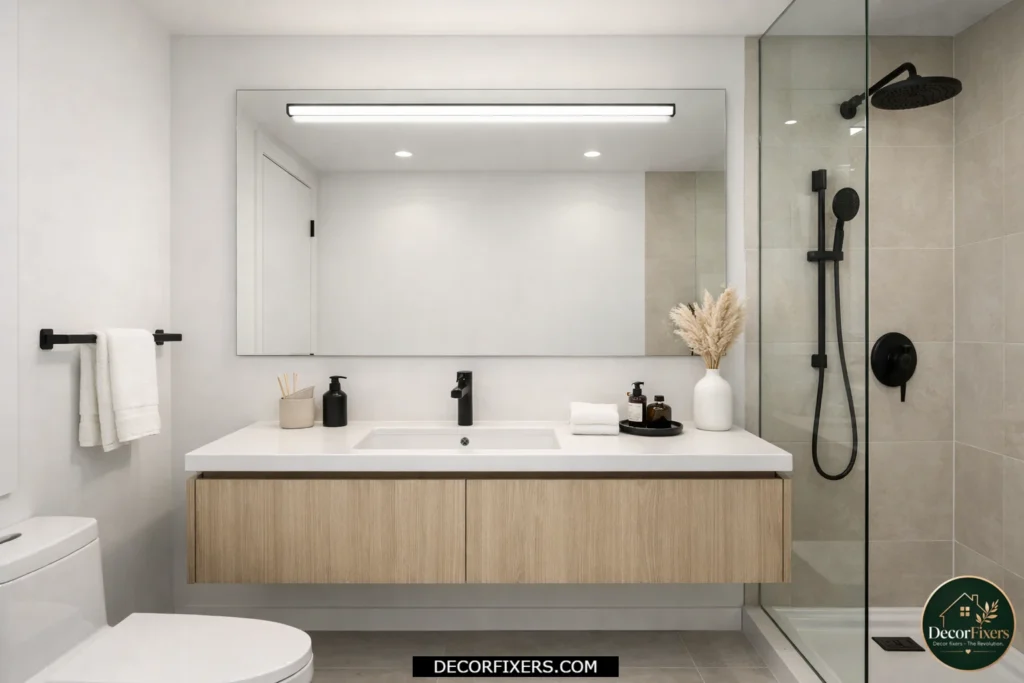
Most experts recommend lighting around the mirror, not on it. And that’s valid for most setups. But if your bathroom wall is extremely narrow, no room for sconces, no header space above the mirror, mounting a slim light bar directly on the mirror face is both practical and visually striking.
The light bounces immediately off the reflective surface behind it, which actually amplifies its reach into the room. Slim surface-mounted LED bars cost $35–$90 and attach with minimal hardware. The look is graphic and deliberate, like something from a photography studio, and it works especially well with frameless mirrors where you want a clean, minimal aesthetic.
21. Go Full-Width With a Mirror That Spans the Entire Vanity Wall
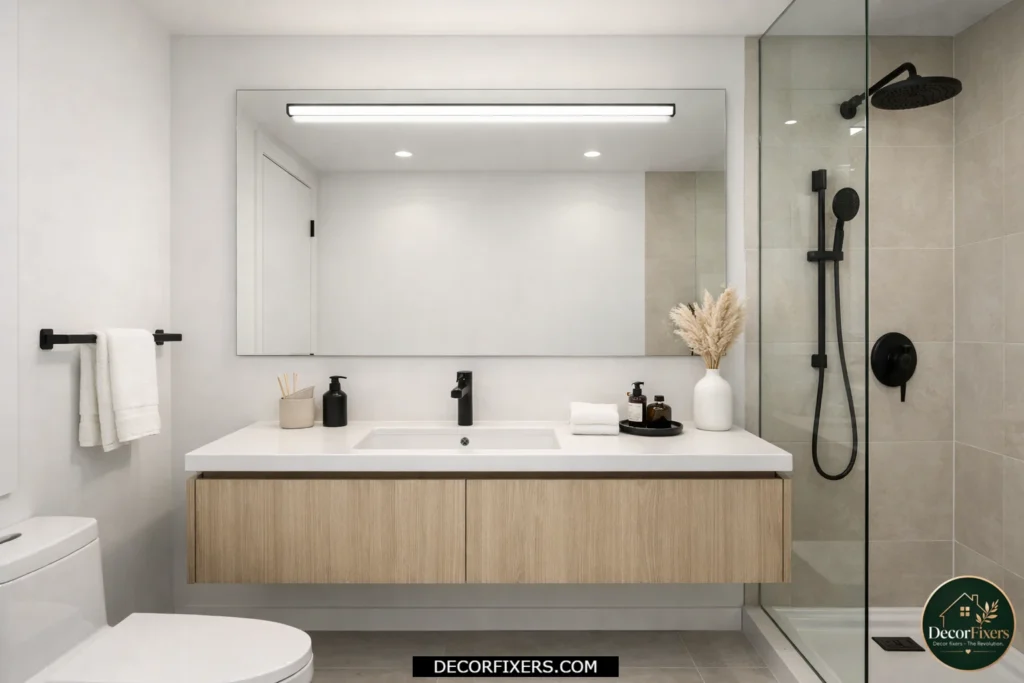
Some experts argue that oversized mirrors are overpowering in a small bathroom. That’s valid for spaces with lots of decorative detail. But if your bathroom is narrow and long, like a galley layout, a wall-to-wall mirror above the vanity creates the single most effective visual space-expansion you can achieve.
The mirror reflects the entire opposite wall, doubling the perceived width of the room. Custom mirror panels cut to size cost $150–$400, depending on dimensions, or you can butt two standard frameless mirrors side by side with a thin hidden seam. Add a horizontal LED strip or vanity bar above the full width to complete the effect. The result looks like a designer intervention.
22. Use a Wooden-Framed Mirror for a Warm, Organic Contrast
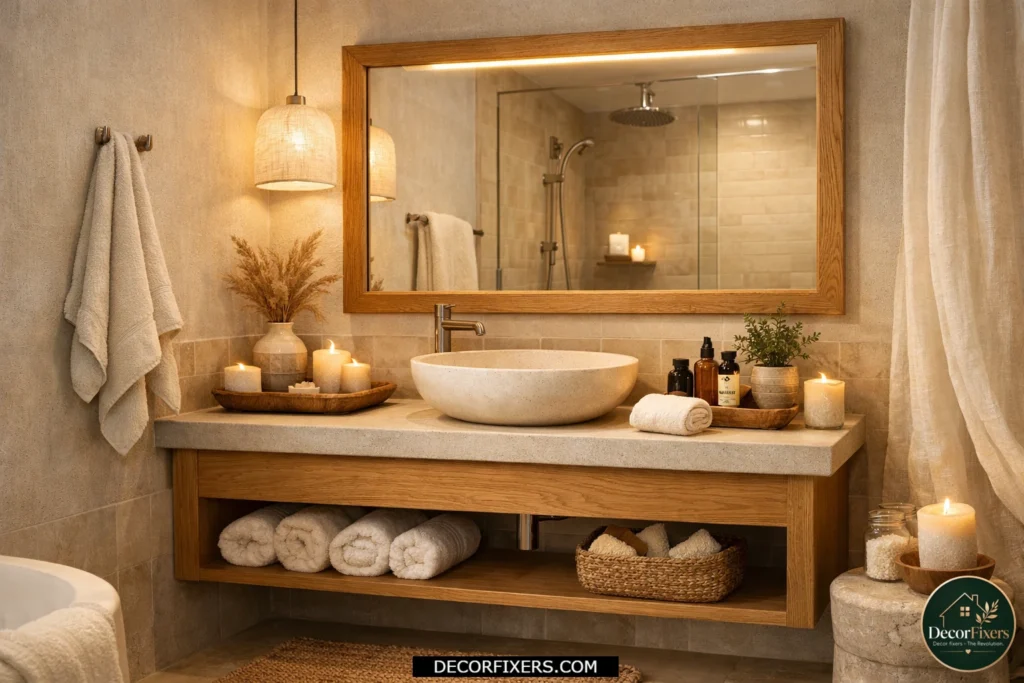
Wood in a bathroom feels counterintuitive, but a wood-framed mirror works because it’s decorative, not structural. It doesn’t need to withstand moisture the way a wood vanity does. It adds grain, warmth, and texture to a space that’s typically full of hard, reflective surfaces.
Oak and walnut frames are the strongest choices; both pair naturally with white walls and warm-toned fixtures. Wood-framed mirrors in the 24″–30″ range cost $75–$180. Pair with warm white bulbs at 2700K and linen-toned towels, and the bathroom instantly feels like a boutique spa rather than a rental unit. Quick note: seal the frame with a light wax finish if your bathroom gets steamy.
23. Add Candle Sconces for Evening Ambiance on a Budget
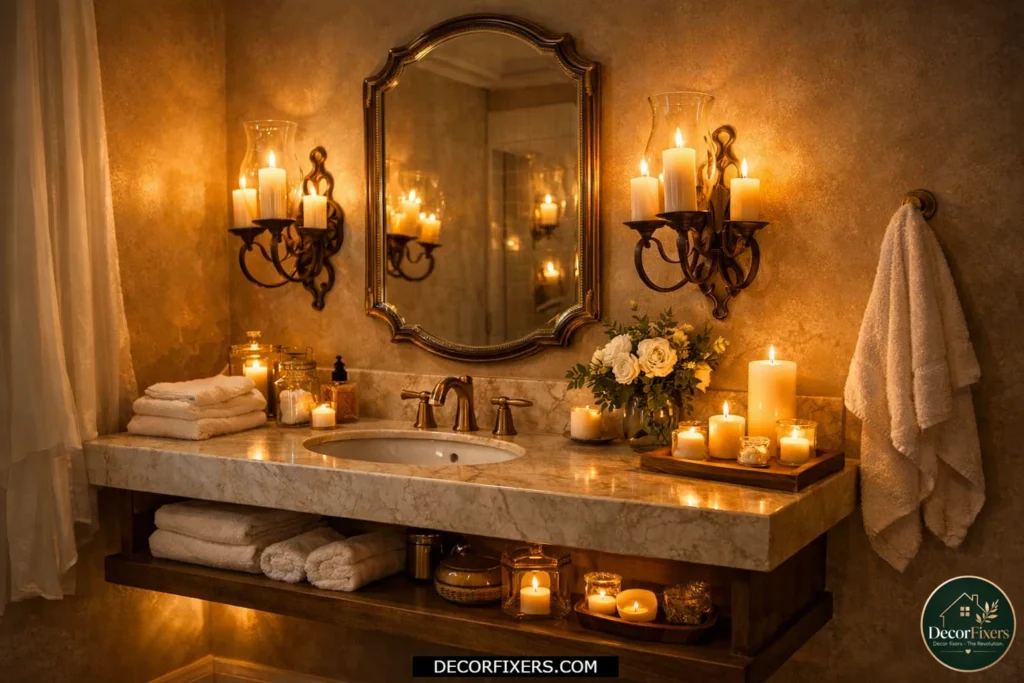
Not every bathroom upgrade needs to be hardwired. Battery-operated candle sconces, especially the newer flameless wax candle versions, add genuine warmth and texture to bathroom walls for almost nothing.
These work best as accent lights beside the main mirror, not as primary task lighting. Use them for evening baths when you want a lower, more ambient glow. Sets of two candle sconces or flameless options run $25–$75. Mounting takes minutes. For a rental bathroom, especially, this is one of the highest-charm, lowest-commitment tricks available. The warm flicker effect reads as deliberately designed, not improvised.
24. Install a Magnifying Mirror With Its Own Light for Detail Work
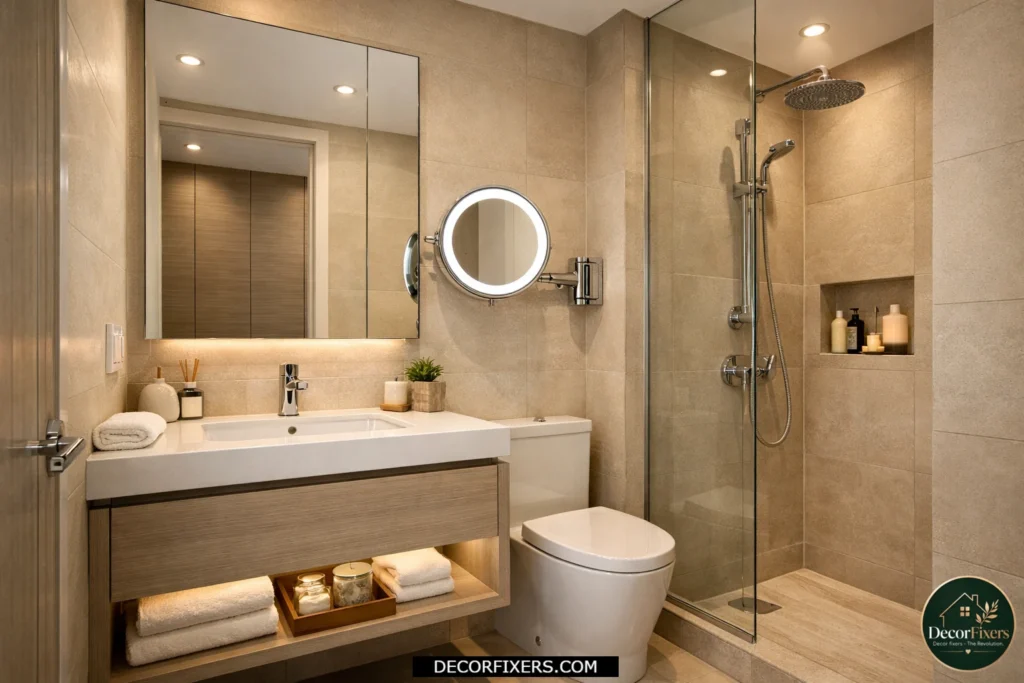
A standard bathroom mirror is fine for general appearance checks. It’s not great for threading eyebrows, tweezing, applying eyeliner, or detailed skincare. A wall-mounted 5x or 10x magnifying mirror with an integrated LED ring light handles all of that, and in a small bathroom, it’s a functional upgrade that actually changes your morning routine.
Wall-mounted versions on articulating arms fold flat against the wall when not in use, adding zero visual bulk to the space. Quality magnifying lighted mirror models run $55–$150. Place it to the side of your main mirror at eye level. It looks intentional, adds a spa-like detail, and genuinely earns its wall space every single day.
25. Mix Metals Intentionally, One Warm, One Cool, for Layered Luxury
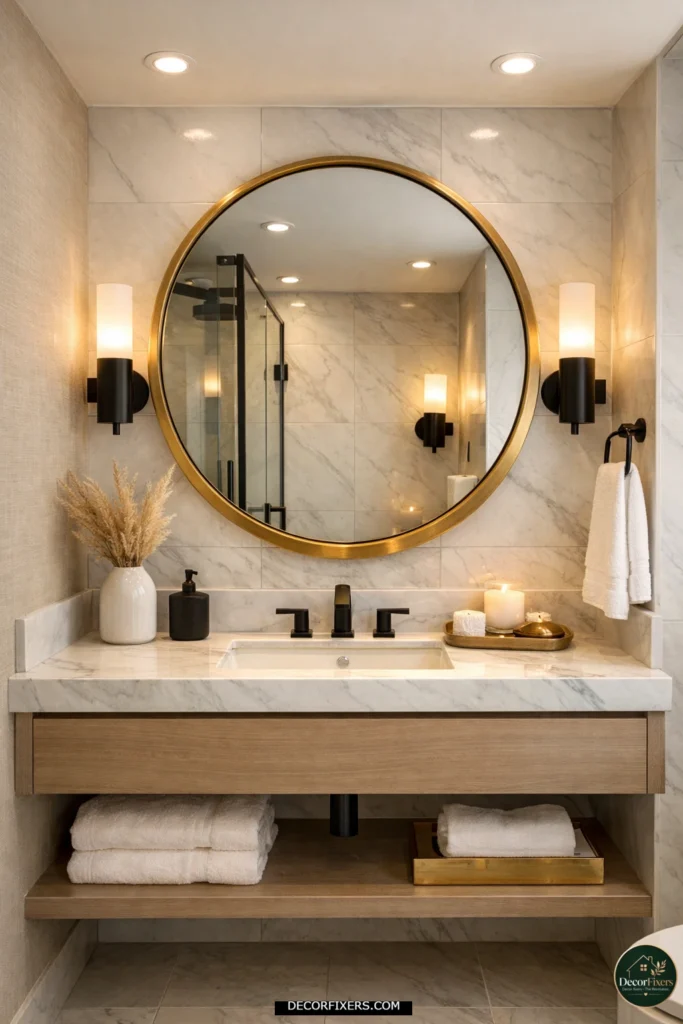
The old rule was match all your metals. Interior designers largely abandoned that rule five years ago. The current approach is to mix intentionally, one warm metal, one cool or neutral, for a layered, collected look that no single-finish bathroom can achieve.
In a small bathroom, this means something like a brushed brass mirror frame paired with matte black sconce fixtures, or a chrome vanity bar with a warm gold mirror frame. The contrast reads as deliberate rather than accidental, which is the difference between ‘eclectic’ and ‘hasn’t decided yet.’ Both metals should appear at least twice in the room to feel cohesive. This costs nothing extra; it’s purely a selection decision that elevates the entire space.
How to Choose the Right Mirror and Light Combo for a Small Bathroom
To upgrade your small bathroom mirror and lighting without a full renovation, follow these steps:
1. Measure your vanity width; your mirror should match or be slightly wider, never narrower.
2. Identify your wall space. If you have 6+ inches beside the mirror, use side sconces; if not, use a bar light or backlit mirror.
3. Pick your color temperature, 2700K–3000K for warm luxury; 4000K for clean task light.
4. Choose a mirror type, backlit LED for shadow-free all-in-one; frameless oversized to maximize reflection.
5. Install your fixture at eye level or just above it, never high on the ceiling.
CONCLUSION:
I’ve spent a lot of time in bathrooms that made me feel worse about myself than I should. Harsh light, a mirror too small to actually see my whole face, everything just slightly off. And I’ve spent a lot of time helping people fix those spaces without tearing anything apart.
The truth is, the mirror and the light are in the bathroom. Everything else is background. A frameless oversized mirror and a proper light source, side sconces at eye level, a backlit LED, or even just warm-toned bulbs in the existing fixture, will do more for how a small bathroom looks and feels than any tile update or fixture change.
Start with one idea from this list. The backlit mirror swap. The color temperature change. The round mirror over the rectangle. Pick one and do it this weekend. You won’t believe how much difference it makes until you see it.
FAQs:
Q: What’s the best mirror for a very small bathroom?
A: A frameless oversized mirror or a backlit LED mirror works best. The frameless version maximizes light reflection, while the backlit option eliminates face shadows; both make a small bathroom feel larger and brighter.
Q: How do I light a bathroom mirror without side sconces?
A: Mount a slim vanity bar light no more than 6–8 inches above the mirror. Keep bulbs at eye level when possible, and choose warm white LEDs (2700K–3000K) for a flattering glow. A backlit mirror is an even simpler all-in-one solution.
Q: Should I use warm or cool light in a small bathroom?
A: Warm white (2700K–3000K) makes skin tones look healthy, and the room feel luxurious. Cool white (5000K+) is harsh and clinical for a bathroom. Unless you need clinical task lighting, stay in the warm white range.
Q: How big should a mirror be over a bathroom vanity?
A: The mirror should be the same width as the vanity, or slightly wider, never wider than the vanity by more than a few inches. Height-wise, aim for at least 24 inches tall for a single-sink setup, taller if ceiling height allows.
Q: When should I choose a medicine cabinet over a flat mirror?
A: Choose a medicine cabinet if counter space is less than 12 inches on either side of your sink. The hidden storage eliminates clutter instantly, and models with built-in LED lighting solve both the mirror and lighting problem in one install.

Creator of DecorFixers, sharing practical home and interior ideas focused on real-life usability, simple design improvements, and budget-friendly solutions.
1 thought on “25 Glamorous Small Bathroom Mirror and Lighting Ideas That Make Tiny Spaces Look Bigger”