

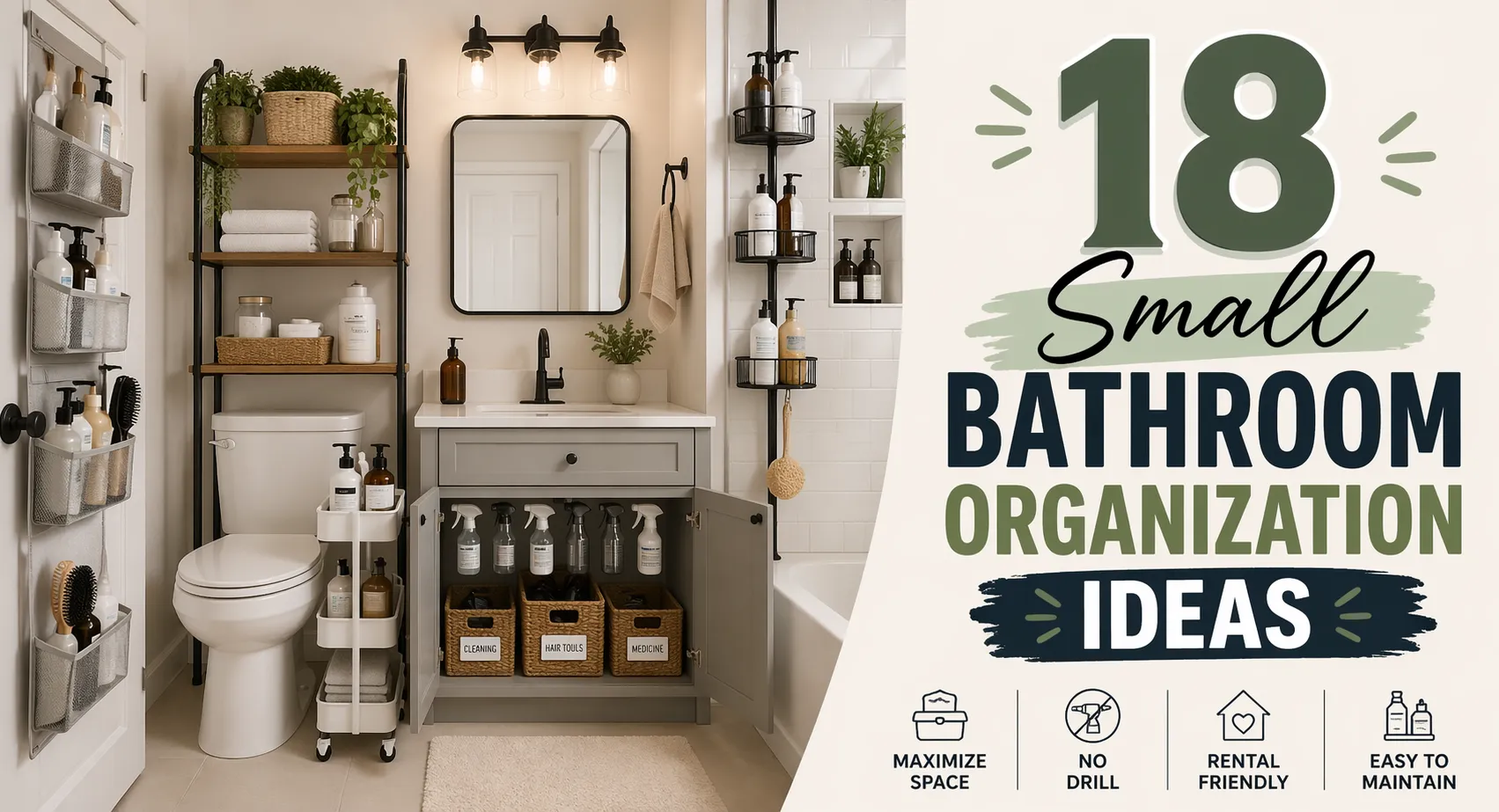
Small bathroom organization is the process of grouping, storing, and accessing bathroom products in a compact space, typically under 60 square feet, using vertical storage, door space, and containment zones instead of expanding the room’s footprint. It doesn’t require a renovation. It requires a system.
This guide covers only renter-friendly solutions: no drilling, no permanent hardware, no landlord conversations. It does NOT address full remodels, built-in cabinetry, or bathroom additions.
According to the 2025-2026 U.S. Bathroom Trends Study, the share of homeowners improving their bathroom specifically to make it “more accommodating” rose from 23% to 27% year-over-year; the first-time functionality outranked aesthetics as the top motivation. People don’t want prettier bathrooms anymore. They want ones that actually work.
The problem is that most renters can’t remodel. That’s exactly what this guide solves.
Once you mentally separate those categories, every idea in this guide becomes dramatically more effective. Start there. Then pick your solutions.
1: Under-Sink Expandable Shelf Unit
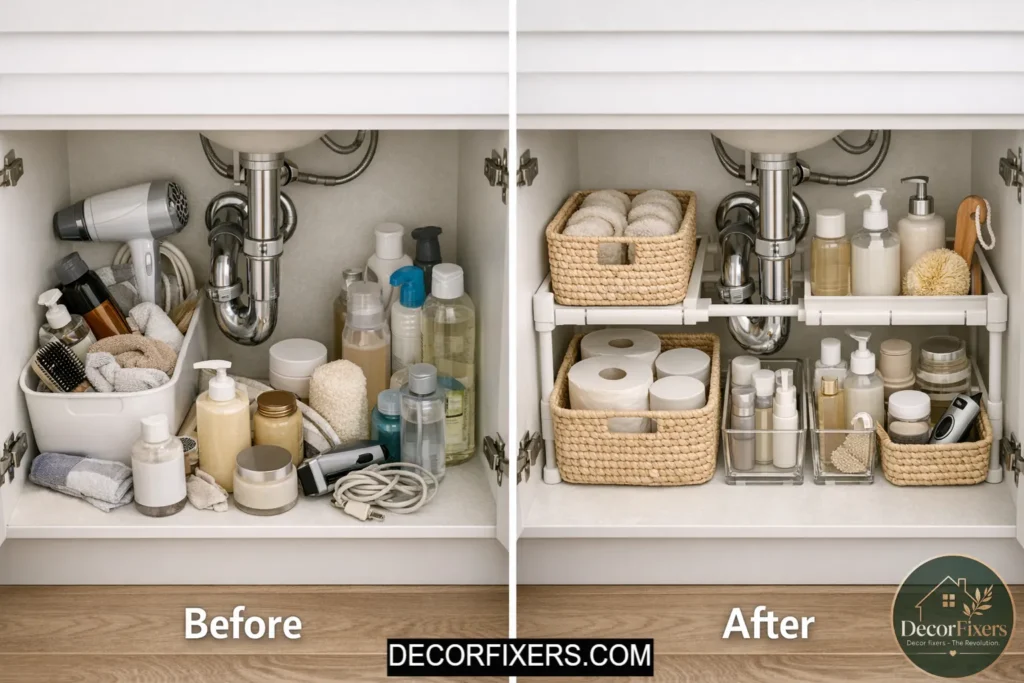
The cabinet under your bathroom sink is almost always wasted space. Most people shove things in once, lose track of what’s in the back, and never touch it again.
The mDesign expandable under-sink organizer ($25–$35 on Amazon) is specifically engineered to work around plumbing pipes; it adjusts in both width and height, fitting the awkward interior without tools.
Users who’ve tried it consistently report reclaiming 60–70% more usable storage from what felt like an unusable cabinet. Start here before anything else. This one change alone often eliminates the counter clutter problem.
This works best for bathrooms where counter overflow is the main problem. It won’t help if your cabinet has a garbage disposal unit or unusually deep plumbing.
2: Over-the-Door Organizer
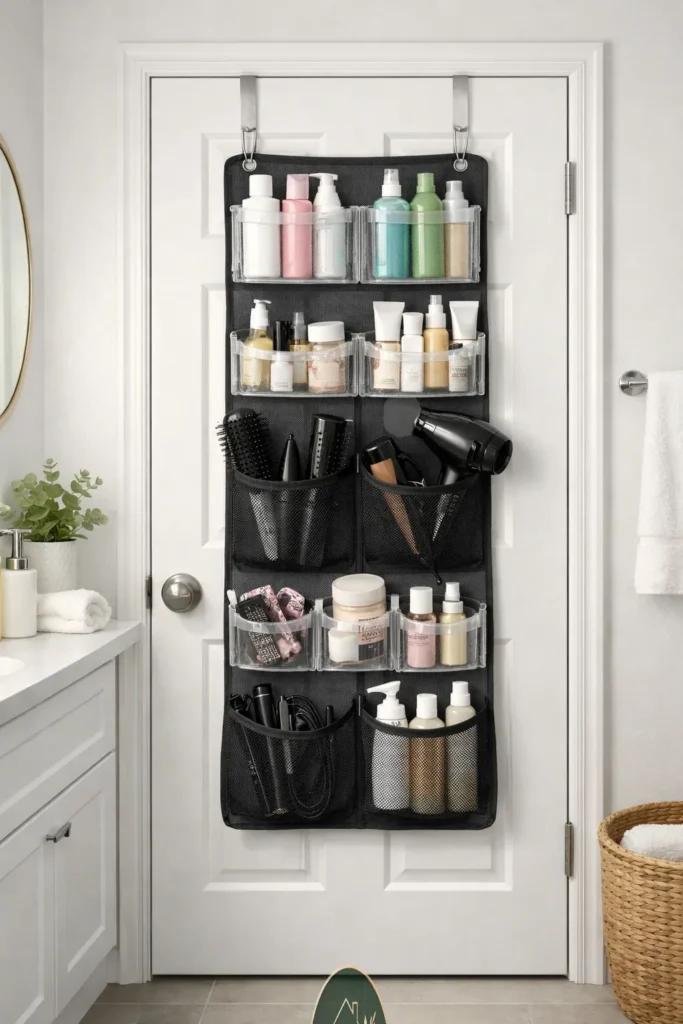
The back of your bathroom door is almost certainly empty. That’s square footage you’re paying for.
An over-door organizer with deep, clear pockets holds haircare tools, full-size shampoo bottles, cleaning sprays, and backup products; all without touching a single wall. No adhesive, no hooks drilled into anything. The organizer simply hangs over the door edge.
Look for versions with adjustable hooks so the fit works regardless of your door’s thickness. Mesh pocket versions allow you to see contents at a glance; clear plastic pockets offer slightly better moisture resistance in humid bathrooms.
Quick note: measure the gap between your door and the frame before buying. Some doors in older rental units have very little clearance when closed.
3: Freestanding Corner Shelf (IKEA RÅGRUND)
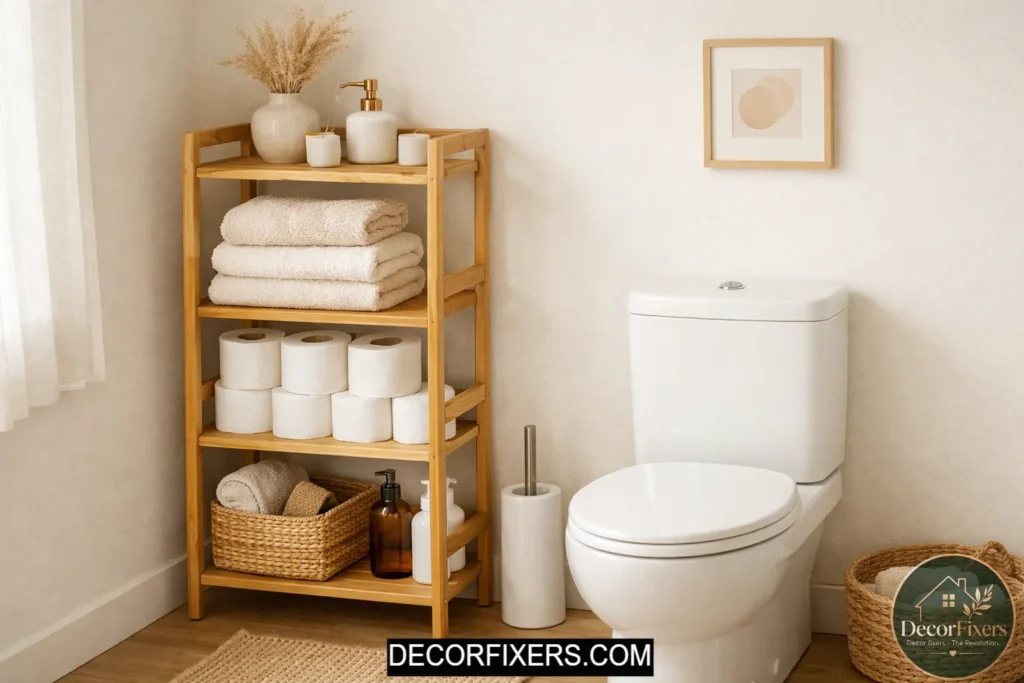
No tools. No drilling. Fits in the dead corner next to the toilet or alongside the vanity.
The IKEA RÅGRUND bamboo corner shelf (around $30) holds towels, rolled hand towels, spare toilet paper, and a small basket of products on the top tier.
It’s specifically designed for bathroom humidity and moves when you do, which matters for renters who change apartments every 1–2 years. It’s not glamorous. It’s effective. And it pays for itself in about a week of not hunting for things.
Limitation worth knowing: bamboo can swell slightly in very high-humidity bathrooms without ventilation. If your bathroom runs steamy, give the shelf about 6 inches of clearance from the shower zone.
4: Tension Rod Under the Sink
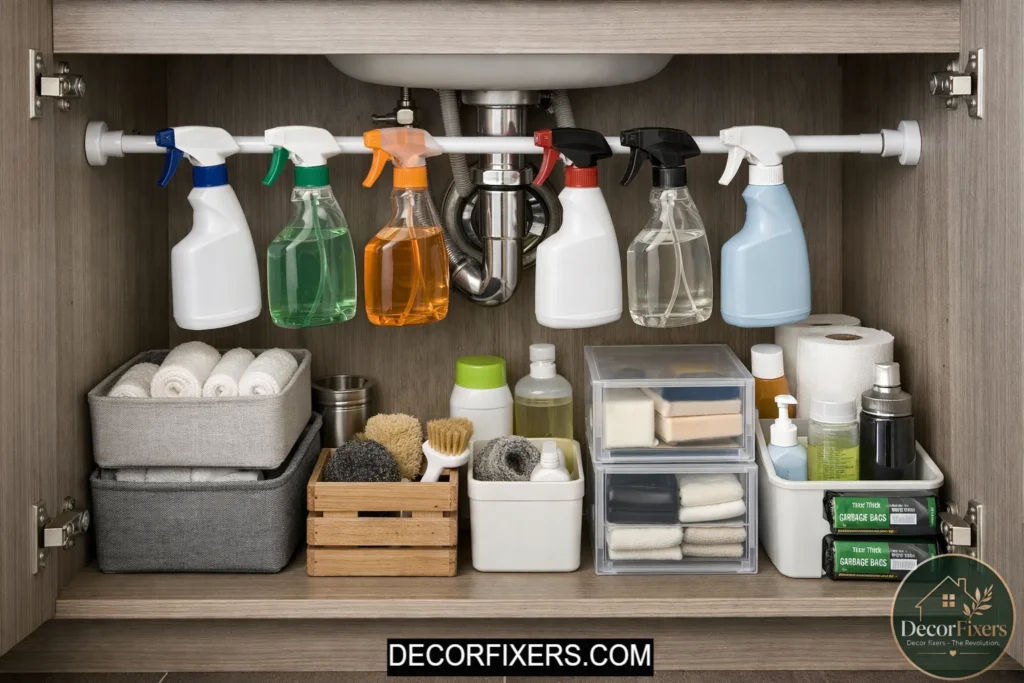
Place a tension rod horizontally inside your under-sink cabinet, about halfway up the interior height. Hang spray cleaning bottles from it by their triggers. The entire lower half of the cabinet instantly becomes free for flat-stored items; boxed tissues, hair tools, backup products, first aid kit.
This is the idea most bathroom organization guides skip. I’ve seen conflicting data on load limits; some sources list 10 lbs maximum, others say 15 lbs with wider rods. My read is: use it exclusively for spray bottles, and you’ll never have a problem.
Cost: $5–$12 at any hardware store. Install time: two minutes. Storage gain: surprisingly significant.
5: Command Adhesive Hooks (3M)
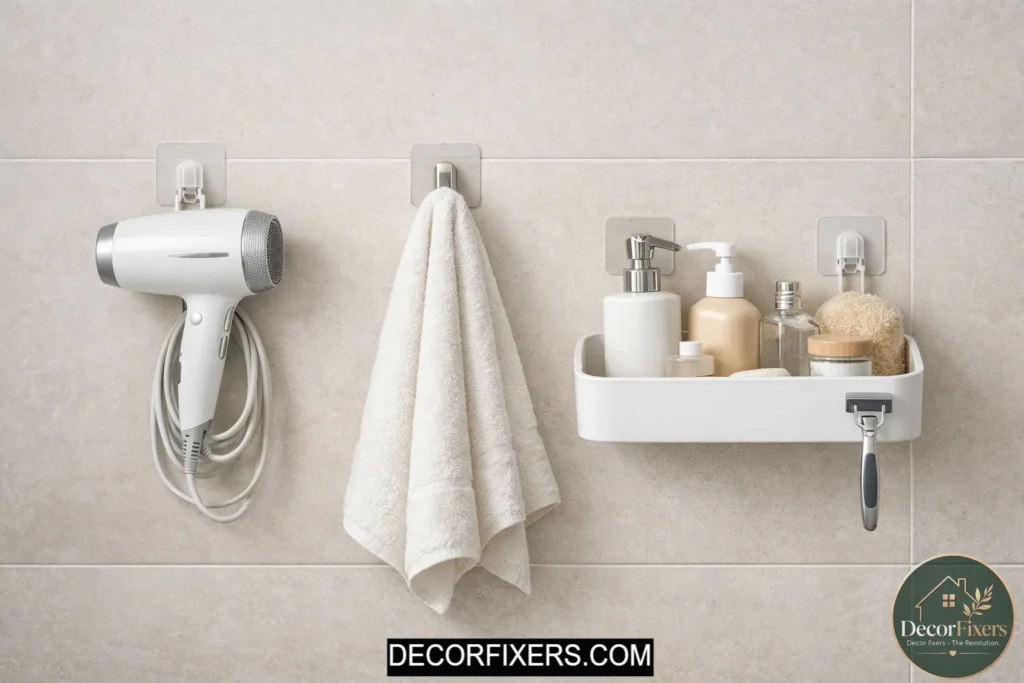
Command Brand medium utility hooks (3M) hold up to 3 lbs each, adhere cleanly to tile and painted walls, and remove without residue when you move out. That’s a meaningful promise for renters.
Use them specifically for:
- Looping and hanging your hair dryer cord on the wall beside the vanity upgrades
- Holding a small mesh shower caddy on the side wall of the shower
- Keeping one hand towel off the counter and on the wall
Group three or four hooks together in a low-traffic wall section rather than scattering them across the room. Clustered hooks look intentional. Scattered hooks look accidental.
6: Magnetic Strip for Small Items
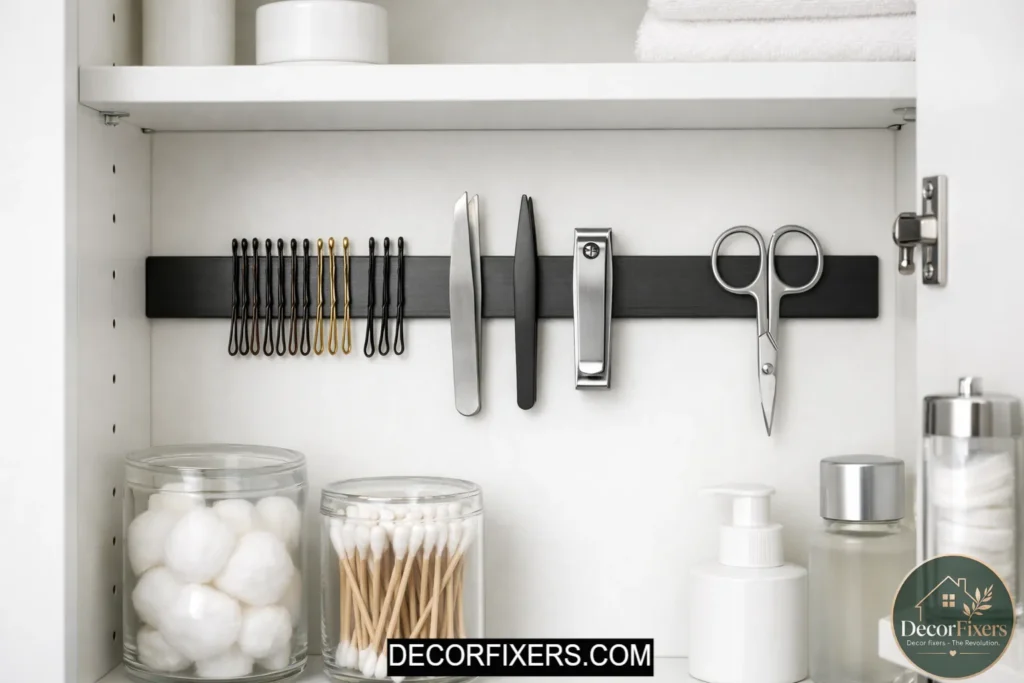
A magnetic strip (originally designed for kitchen knives) mounted on the side panel of your medicine cabinet or inside a cabinet door using Command strips holds an entirely different category of items: bobby pins, tweezers, nail clippers, metal nail files, and small scissors.
These are the items that perpetually disappear into bathroom drawers and take three minutes to find every time. A magnetic strip puts them in one visible, accessible spot.
Or maybe I should say it this way: it’s not a knife strip at this point. It’s a small metal object recovery system. Rename it whatever helps you remember to use it.
7: Tension-Pole Shower Caddy
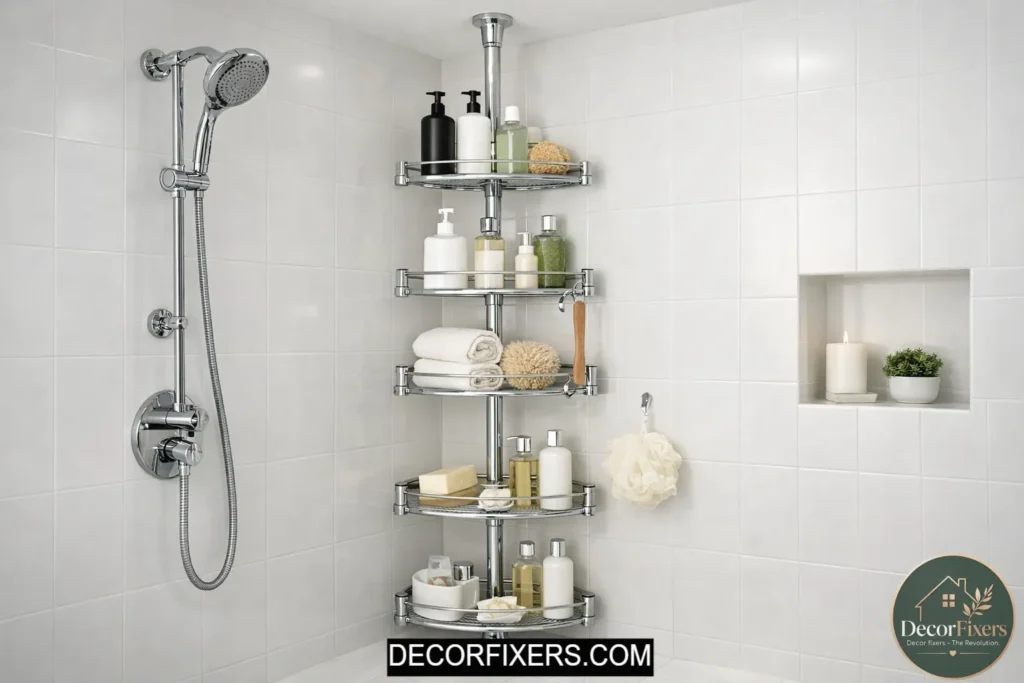
Wall-suction shower caddies fall. That’s their defining characteristic; they hold things reliably until they don’t, then they crash at 6 a.m. and wake everyone up.
A tension-pole shower caddy, the floor-to-ceiling type with 3–4 adjustable shelves, requires no adhesive or wall contact at all. It’s held in place by tension between the floor and ceiling. Rust-resistant models start around $40–$60 and handle two people’s worth of shower products without complaint.
The performance gap between a suction caddy and a tension-pole caddy is larger than most people expect until they’ve experienced both.
This works best for showers with flat ceilings and standard height (8 ft or less). Skip it if: your shower has a curved ceiling, low clearance, or a very uneven floor.
8: Acrylic Drawer Dividers
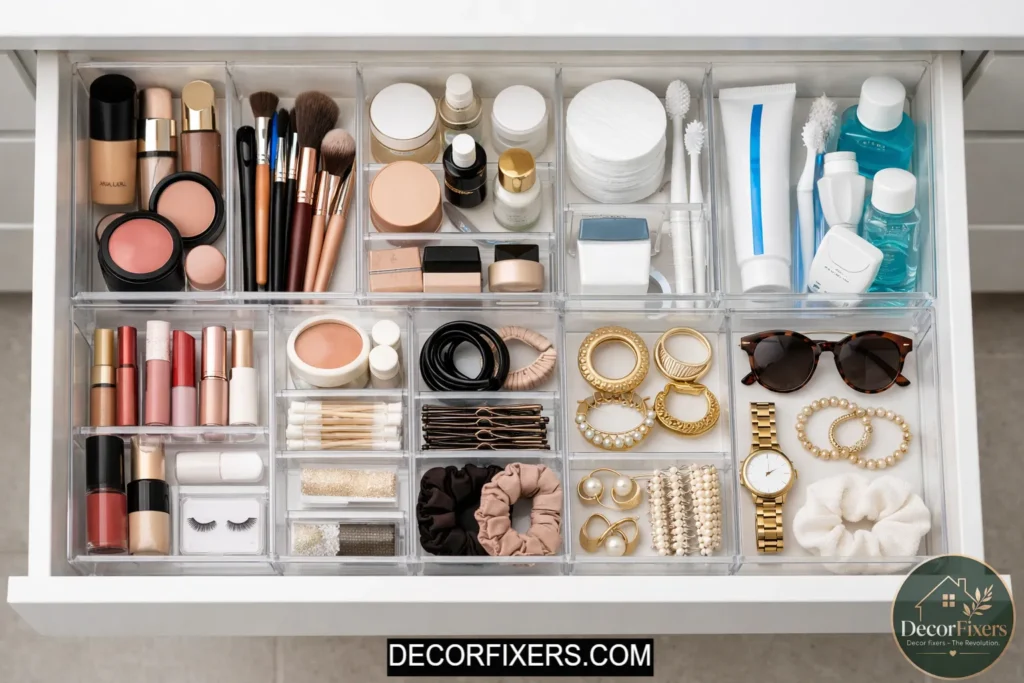
If you have even one bathroom drawer, you almost certainly have a drawer graveyard; loose items rattling around with no system, making every search an excavation.
Clear acrylic drawer dividers create fixed channels inside the drawer, separating toothpaste from eyeliner from hair ties from the twelve things that don’t have a category. Standard sets come in adjustable widths to fit most bathroom drawer depths.
The brand doesn’t matter much here. What matters is measuring your drawer interior before buying; a 12-inch divider set in a 10-inch drawer becomes an obstacle, not a solution.
9: Over-Toilet Etagere
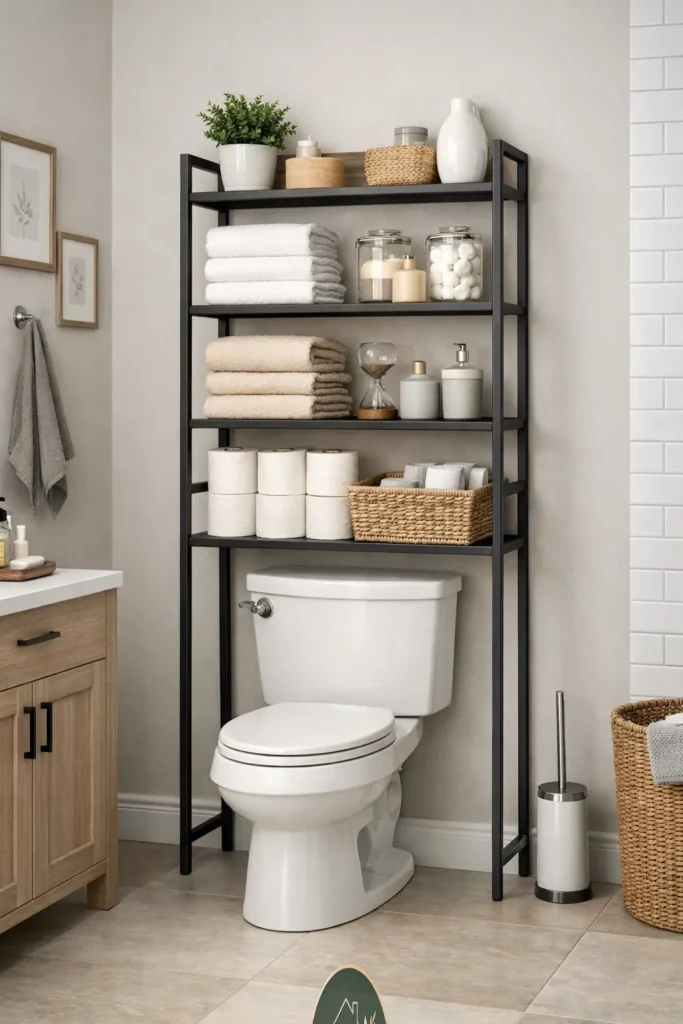
An etagere is a freestanding three-tiered shelving unit that straddles the toilet tank, converting the empty wall space above the toilet into 3 shelves of storage without touching the wall.
Most standard toilet tanks are 6–8 inches deep. Confirm clearance before buying; cheap models sometimes fit poorly and rock. A well-fitted étagère holds spare toilet paper on the bottom shelf, folded hand towels on the middle, and decorative or rarely used items on top.
This is one of the highest storage-gain-per-dollar investments in a small bathroom, because it converts completely dead vertical space.
10: Adhesive Floating Shelves
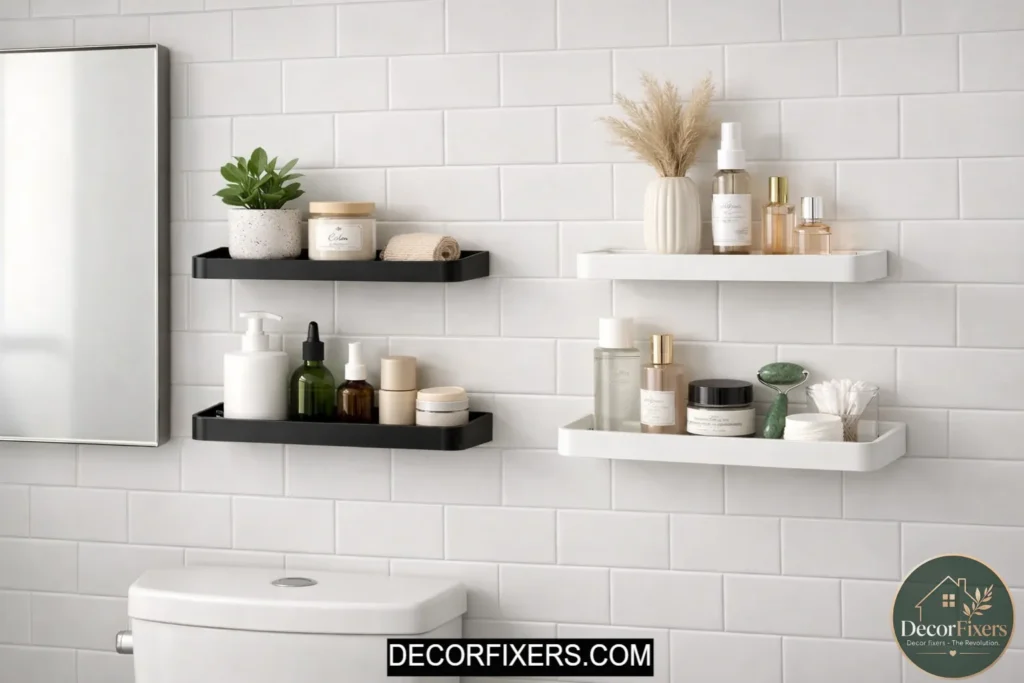
Some modern adhesive shelves hold 11–15 lbs per set and bond to tile without drilling. They remove cleanly when you move. The IKEA KALKGRUND shelf is a common example: short, humidity-rated, and designed specifically for bathrooms.
Place one above the toilet for display plus light storage. Place one beside the mirror for daily skincare items you’d otherwise leave on the counter.
The limitation is real and worth stating clearly: these require a completely flat, clean tile surface. If your grout lines are raised or your tiles have texture, the adhesive won’t seat properly, and the shelf will eventually fail. Test the surface by pressing a flat piece of cardboard against the area first; if there’s any rocking, this solution isn’t suitable for that spot.
11: Slim Rolling Cart
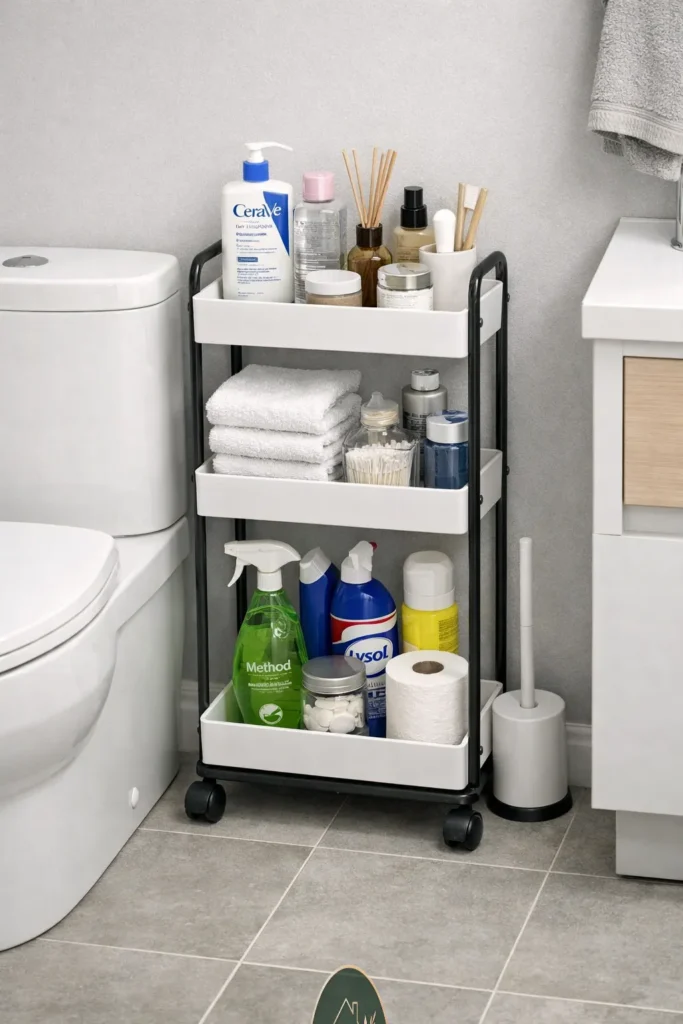
The gap between your toilet and the wall, almost always 6–10 inches wide and completely unused, is exactly where a narrow rolling cart belongs.
The IKEA RÅSKOG cart ($40–$50) is the most recognized version, but similar models exist at every price point. Three tiers, each holding a category: cleaning supplies on the bottom, backup toiletries in the middle, daily-grab items on top. Rolls out when you need it. Tucks back when you don’t.
For renters who move frequently, this is one of the best investments because it requires zero installation and travels with you.
12: Wall-Mount Toothbrush and Soap Dispenser
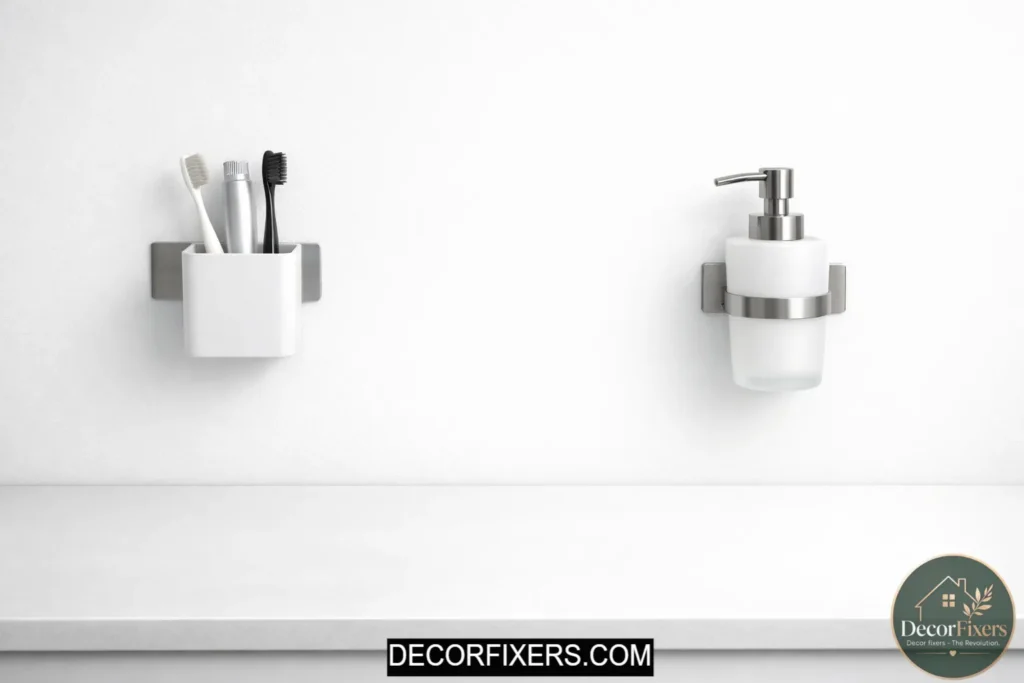
Clearing counter space starts with the items that live there permanently.
A wall-mounted toothbrush holder and adhesive wall-mount soap dispenser remove two constant counter fixtures, which sounds minor until you see how much visual and physical space that opens up. Both mount with adhesive in under five minutes.
Some experts argue these items should stay on the counter for accessibility, and that’s valid for households with young children or people with limited fine motor control. But if you’re dealing with a solo or dual-adult bathroom, mounting them is almost always the right move.
The counter isn’t a permanent home for those items. It’s just where they’ve been defaulting.
13: Two-Tier Countertop Bamboo Shelf
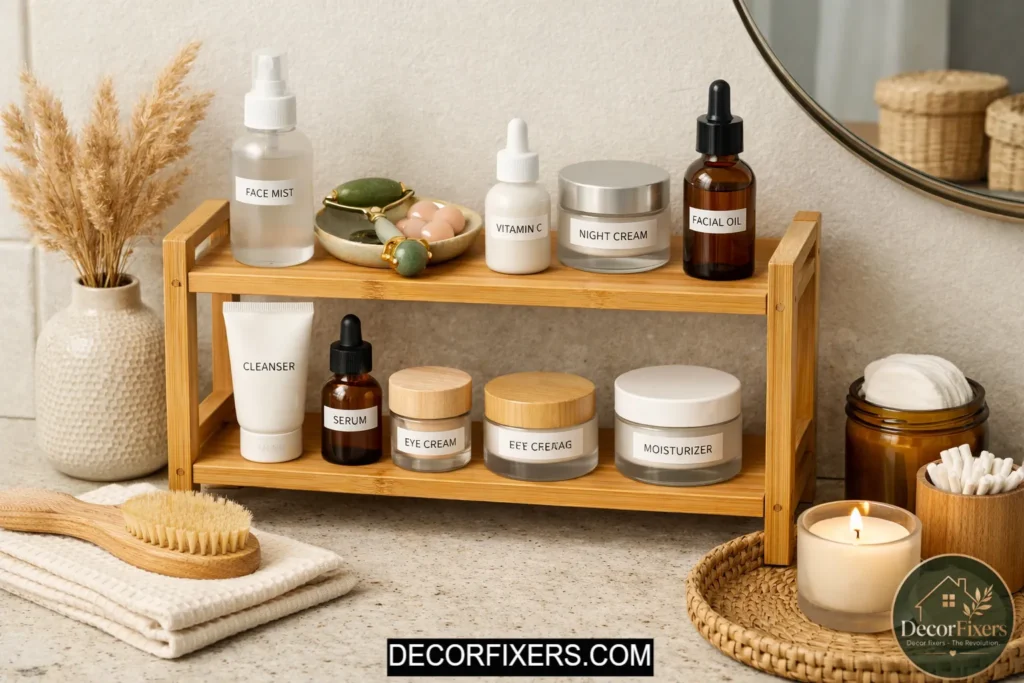
If you have any counter space at all, even just 8 inches of it, a compact two-tier bamboo riser doubles its vertical capacity.
Keep daily skincare on the bottom tier (where you reach it fast) and backup or weekly-use items on the top tier. The visual separation alone makes the counter feel more ordered, even if the total number of items hasn’t changed.
This one work particularly well for people who have a medicine cabinet but a surface they still can’t stop cluttering. The riser imposes structure where there was none.
14: Labeled Basket System for Under-Sink Categories
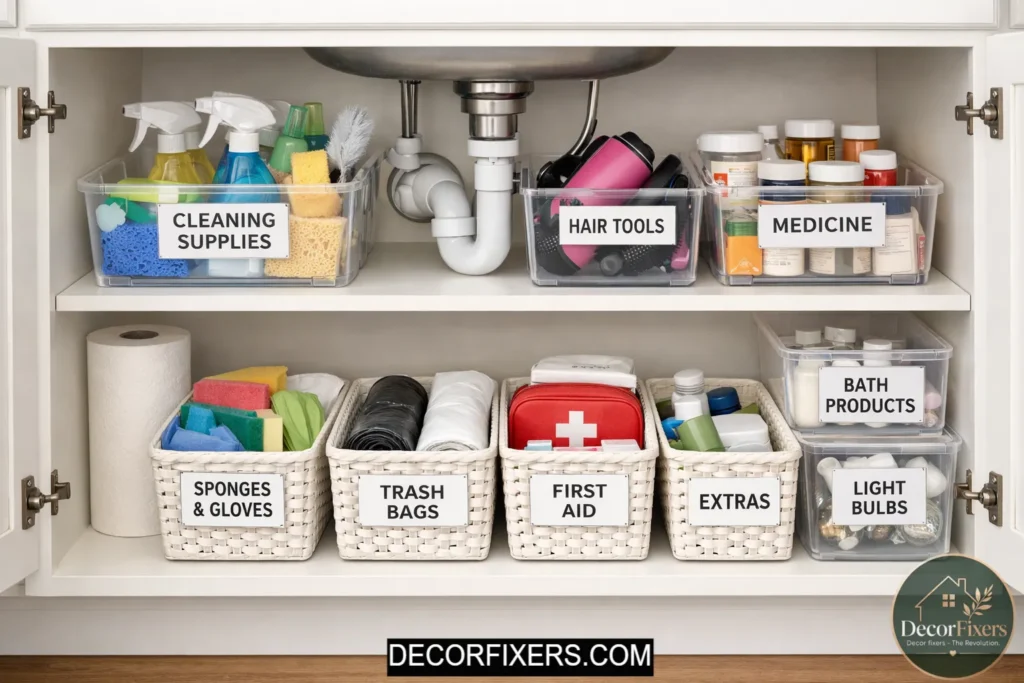
Baskets alone don’t organize. Labeled baskets with defined categories do.
Take your under-sink cabinet (ideally already fitted with the expandable shelf from Idea 1) and assign one basket per category: cleaning supplies, hair tools, backup stock, medicine/first aid. Label each basket clearly; a label maker or even a strip of masking tape with a marker works fine.
The rule is simple: if it doesn’t have a category, it doesn’t go under the sink. This constraint forces a purge and prevents the gradual re-accumulation of clutter.
Users who’ve implemented this system report it takes about 20 minutes to set up and roughly 30 seconds per session to maintain.
15: Shower Niche Caddy or Corner Insert
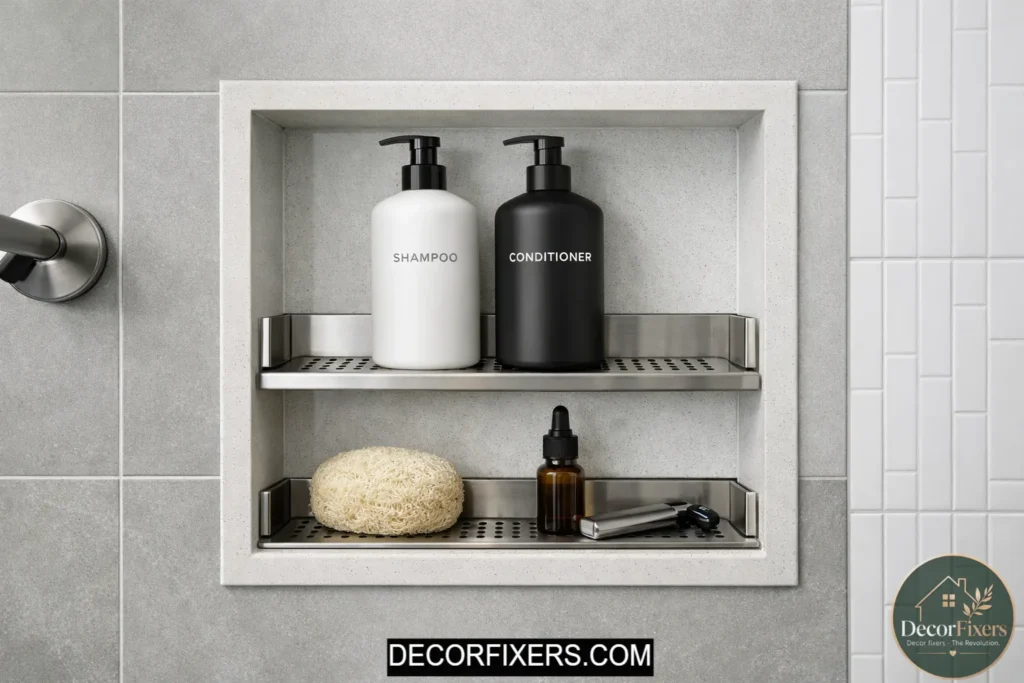
If your shower has a built-in niche (a recessed shelf), it’s probably underused; a few bottles shoved in with no system.
A corner insert or expandable niche shelf ($15–$30) divides the niche into two levels, doubling its capacity. On the bottom: daily shampoo and conditioner. On the top: body wash and any leave-in or specialty product.
If your shower doesn’t have a niche at all, a rust-resistant corner shelf that suction-cups into the corner (different from the full tension pole in Idea 7) works for lightweight items like razors, shaving cream, and soap bars, provided you accept it may need re-adhering every few months.
16: Medicine Cabinet Interior Organizer
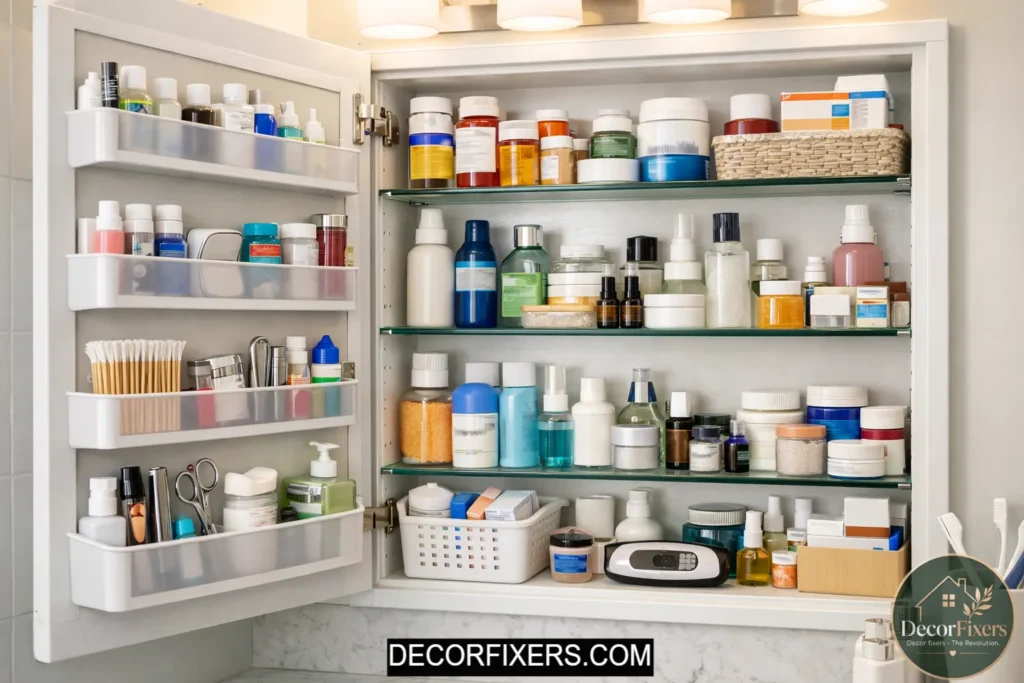
The inside of your medicine cabinet is one of the most overlooked storage surfaces in a small bathroom. Most people use it as a single-layer shelf; items are stacked in front of each other, with no system.
Narrow cabinet door organizers (thin acrylic or wire racks that mount to the inside door panel) add a second storage layer for small tubes, single-dose packets, and folded items. Adhesive-mounted versions require no tools.
Additionally, standardize the shelf heights inside the cabinet: one shelf for daily items at eye level, one for weekly, and one for backup. Rearranging those heights takes five minutes and changes how accessible everything feels.
17: Repurposed Spice Rack for Countertop Products
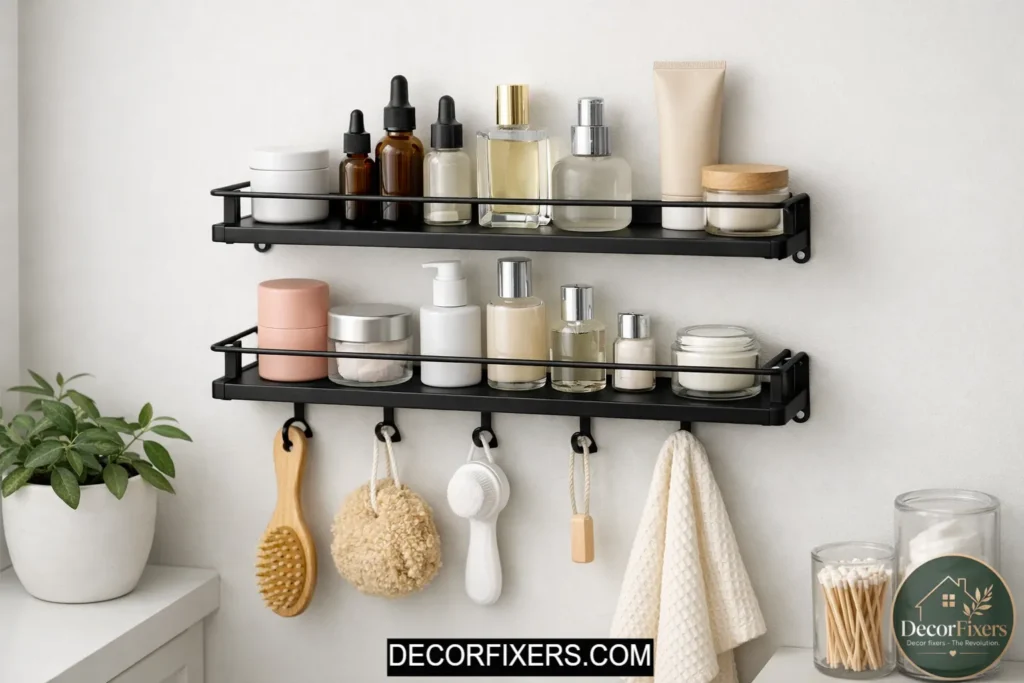
A wall-mounted spice rack, originally designed for a kitchen, works just as well in a bathroom for small, uniform containers: travel-size tubes, nail polish bottles, cotton swab containers, face mist, lip treatments.
Mount it on the wall beside your mirror with Command strips at a height that makes items easily reachable. The visual effect is organized rather than cluttered because the rack creates a defined, finished-looking grid.
This costs $15–$25 and removes a category of small items from your counter and drawers permanently.
18: Dedicate One Zone Specifically to Each Person (Shared Bathrooms)
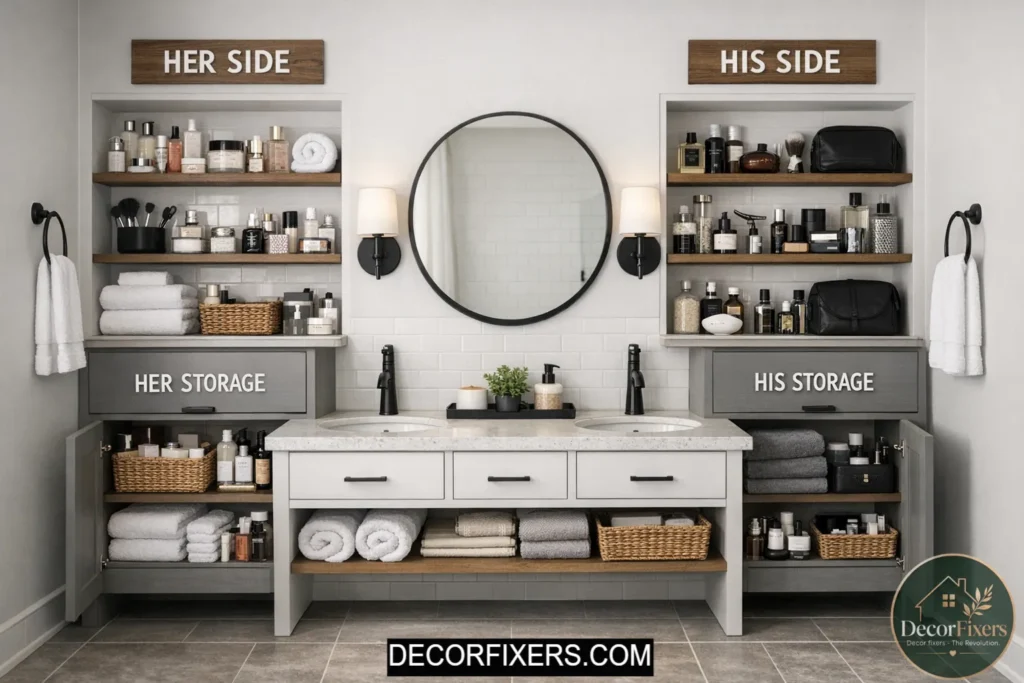
This is the idea no one writes about, but it’s the most critical one for shared bathrooms. And it’s not a product; it’s a rule.
When two people use one small bathroom without defined zones, the organizational system breaks down within two weeks, regardless of what storage products you’ve bought. The problem isn’t the clutter. It’s that no one owns any particular space, so everything spreads everywhere.
The fix is physical zone assignment: one half of the under-sink cabinet per person, one shelf per person on the etagere, one side of the medicine cabinet per person. Labeled if needed. Non-negotiable.
It sounds rigid. What it actually does is eliminate the low-grade daily friction that makes a shared small bathroom feel permanently chaotic. The storage solutions in this guide work for one person. This idea makes them work for two.
Quick Comparison:
| Solution | Best For | Key Benefit | Main Limitation |
| mDesign Under-Sink Shelf | Renters with no counter space | Works around pipes, no tools | Requires measuring the cabinet interior first |
| Over-Door Organizer | Full-size bottles, tools | Zero wall contact | Door clearance must allow it to close fully |
| IKEA RÅGRUND Corner Shelf | Towels + spare supplies | Freestanding, moves with you | Bamboo may swell in poor ventilation |
| Tension-Pole Shower Caddy | Shower product clutter | No adhesive, very stable | Needs a flat floor and ceiling, standard height |
| Slim Rolling Cart | Toilet-side dead space | Portable, three tiers | Requires a 6+ inch gap beside the toilet |
| Command Adhesive Hooks | Lightweight hanging items | Damage-free, clean removal | Won’t work on textured or wet surfaces |
| Over-Toilet Etagere | Vertical wall space above the toilet | High storage gain per dollar | Must confirm tank depth before buying |
| Labeled Basket System | Under-sink chaos, shared bathrooms | Creates permanent categories | Requires purge first, not just addition |
3 Things Most Small Bathroom Guides Don’t Tell You
Most people assume more storage = more organization.
The data says otherwise. Research on household organization behavior consistently shows that adding containers without first removing and categorizing creates a more visually complex problem, not a solution. The correct sequence is purge first, categorize second, and buy storage third.
What most guides skip is the shared bathroom. One person’s organization system applied to a two-person bathroom fails within two weeks because the second person has no assigned space and no reason to maintain someone else’s system. Idea 18 above fixes this, not with more products, but with zone ownership.
Anyway, here’s the counterintuitive take worth sitting with: the most organized small bathrooms aren’t the ones with the most storage products. They’re the ones with the fewest items that are actually used.
How-To: Setting Up a No-Drill Small Bathroom in One Weekend
To organize a small rental bathroom from scratch:
- Remove everything. Purge expired, unused, or duplicate products first.
- Group remaining items into three categories: daily use, weekly use, and backup stock.
- Install an expandable under-sink shelf unit and assign backup stock there.
- Place an over-door organizer on the bathroom door for full-size and weekly items.
- Mount Command hooks and an adhesive toothbrush holder to clear the counter.
- Add a tension-pole shower caddy to consolidate all shower products in one zone.
- Use labeled baskets or acrylic dividers to finalize any drawer or shelf zones.
Each step: one clear action. Total time: one afternoon.
Conclusion:
A small bathroom doesn’t need more space; it needs smarter systems. As you’ve seen, the real revolution comes from merging practical storage solutions with intentional organization habits. From under-sink shelves and over-the-door organizers to categorized baskets and private zones, each idea works because it solves a specific problem instead of just adding more “stuff.”
The key takeaway is simple: declutter first, organize second, and then add only the storage you really want. When every item has a clear place and every space has a clear purpose, even the smallest bathroom can feel open, valued, and stress-free.
Whether you’re a renter looking for no-drill solutions or just trying to exploit every inch, these 18 small bathroom organization ideas give you a complete, realistic system you can set up in a single weekend.
Start with one or two changes today, and you’ll quickly notice the difference. Because in the end, an organized bathroom isn’t about excellence; it’s about creating a space that works naturally for your daily life.
FAQs:
Q: What’s the best way to organize a tiny bathroom with no storage at all?
A: Start under the sink with an expandable shelf, add an over-door organizer on the back of the bathroom door, and use a freestanding corner shelf beside the toilet. All three are no-drill solutions that cost under $100 combined.
Q: How do I organize my bathroom if I’m renting and can’t drill?
A: Use Command adhesive hooks for hanging items, freestanding shelf units for floor storage, tension rods under the sink for spray bottles, and an over-door organizer for larger products. None require drilling, and all remove cleanly.
Q: Should I get a rolling cart or an over-toilet shelf for a small bathroom?
A: If there’s a 6-inch gap beside your toilet, the rolling cart is more versatile; it moves and holds more. If that gap doesn’t exist, an over-toilet etagere uses the dead vertical space above the tank without floor interaction.
Q: Why does my bathroom still feel cluttered even after I organized it?
A: Usually because products from different use-frequency categories are stored at the same level. Separate daily, weekly, and backup items into distinct physical zones, and the visual clutter drops significantly, even without removing a single item.
Q: When should I use a tension rod in my bathroom?
A: Use one horizontally inside your under-sink cabinet to hang spray bottles from their triggers, freeing the lower shelf for flat storage. The installation takes two minutes and costs under $10.

Creator of DecorFixers, sharing practical home and interior ideas focused on real-life usability, simple design improvements, and budget-friendly solutions.
4 thoughts on “18 Small Bathroom Organization Tips Renters Can Actually Use”